
Crypto World
BitMart x $EAT Trade-to-Feed Competition to Pay Out $4.4M USDT to Traders in May 2026

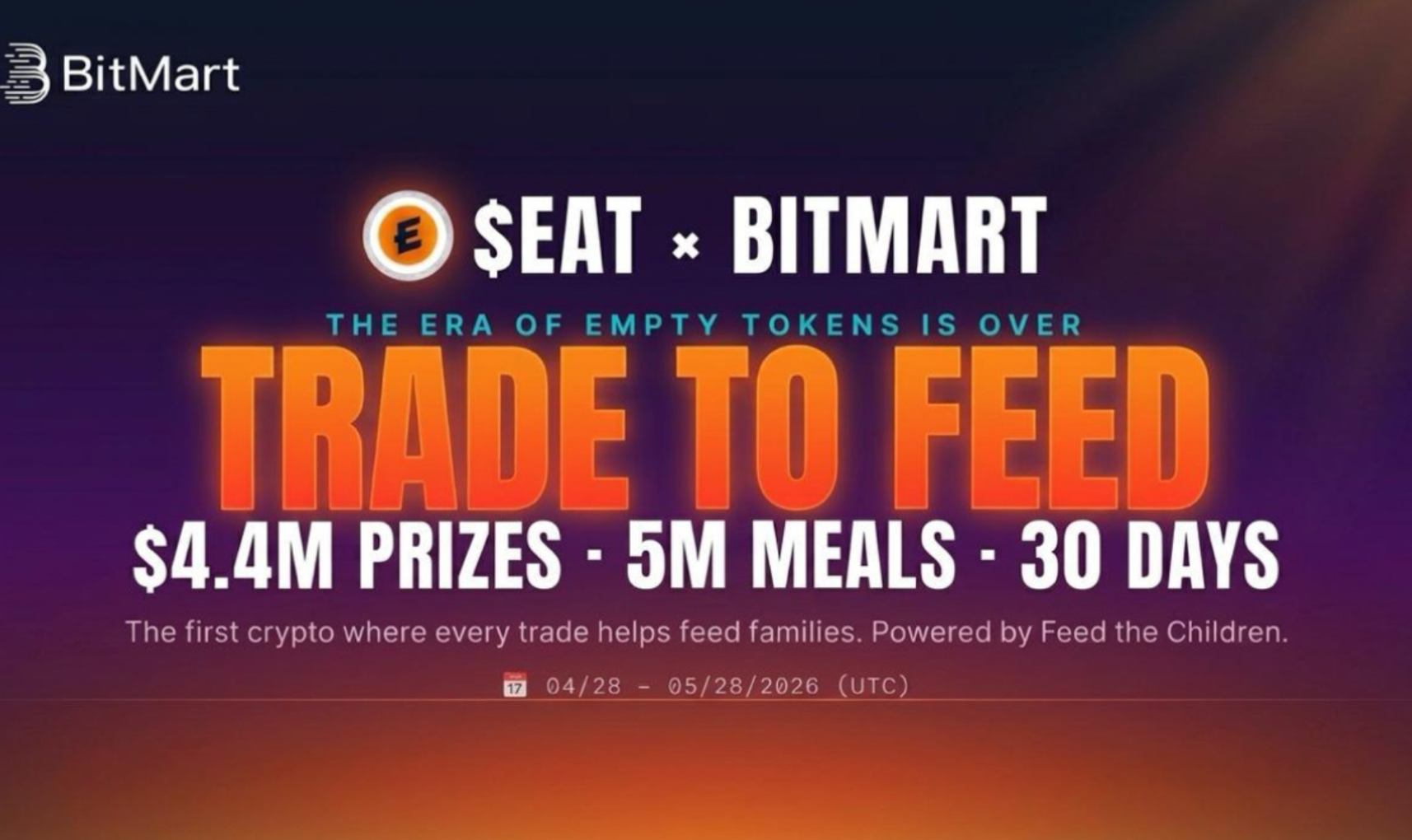
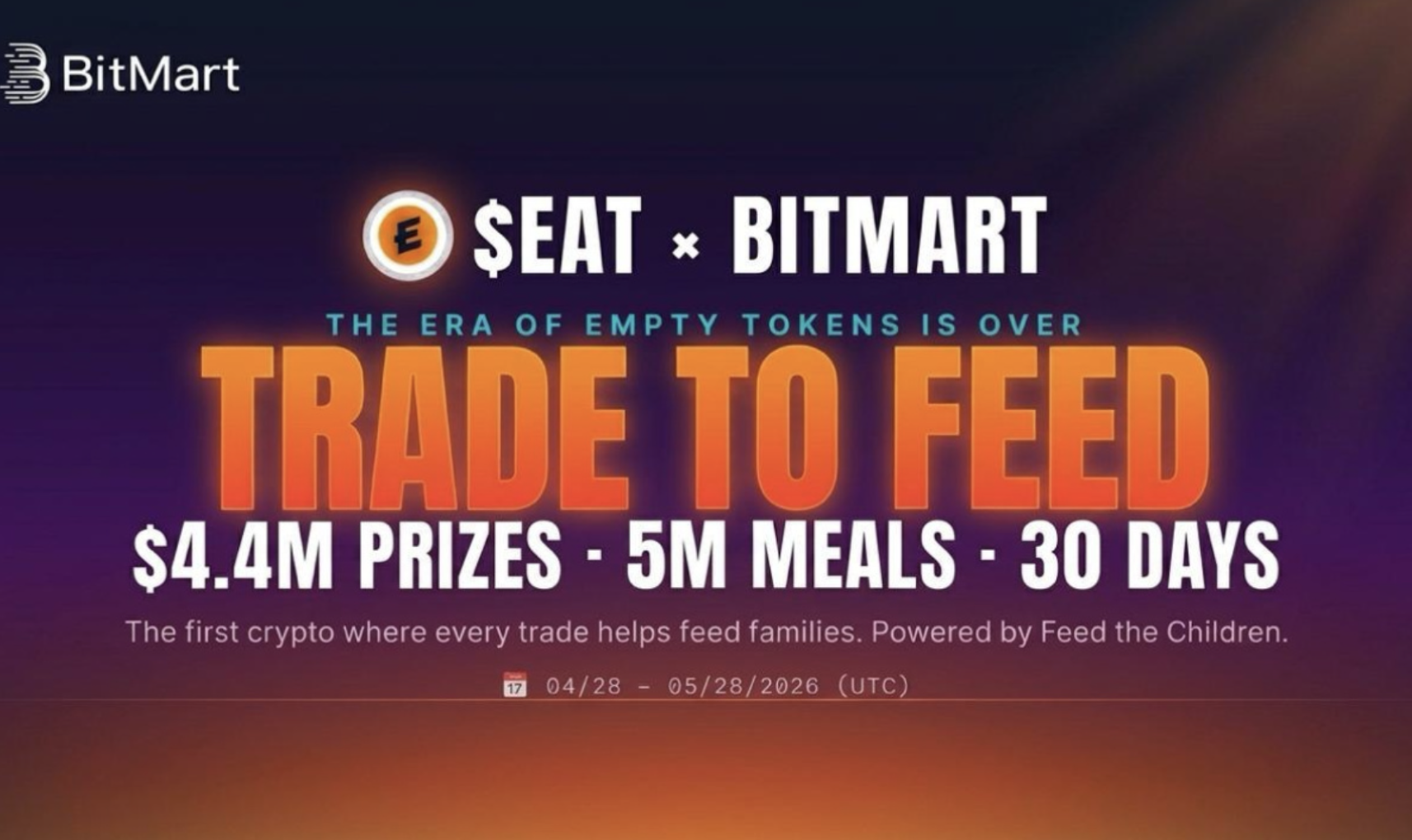
BitMart, the global digital asset exchange serving millions of users worldwide, today launched the Trade-to-Feed competition, a 30-day trading competition paying out up to $4.4 million USDT in trader rewards. The campaign marks BitMart’s eighth anniversary and the exchange’s listing of $EAT (WYDE: End Hunger), the first cause coin to list on a major centralized exchange.
Cause coins are an emerging asset class engineered so that fees from trading activity flow to charitable grant-making infrastructure alongside trader rewards. By making $EAT the inaugural cause coin listing and pairing it with the largest competition in BitMart’s history, the exchange is positioning itself ahead of a category where market activity produces measurable real-world outcomes.
Running April 28 through May 28, 2026, the Trade-to-Feed competition distributes up to $4.4 million USDT across three concurrent tracks:
Three concurrent competitions, 76,391 chances to win.
The campaign runs three reward tracks simultaneously, all funded from a single pool that grows with volume:
- Volume Leaderboard: Up to 73 traders share the leaderboard pool by rank, with the first-place trader winning up to $2.2 million USDT (50% of the total prize pool).
- Power Drop: 75,500 tickets distribute across the campaign, each worth a flat $10 USDT. Any trader completing $40 or more in $EAT spot volume qualifies; tickets allocate proportionally to volume.
- Lucky Drops: Up to 15 random USDT jackpots from $5,000 to $100,000, drawn weekly and at close, with a cumulative pool of $435K at the $200M cap. Any trader completing $2,000 or more in $EAT spot volume qualifies.
In addition, a Welcome Lucky Draw with a $5,000 USDT pool opens to any new participant who registers and completes a $5 USDT spot trade in $EAT, with 803 winners selected across three tiers.
To join or learn More: Trade to Feed (Up to 4.4M in rewards)
Where the meals go
Charitable distributions from the campaign flow through WYDE Association’s two-pool allocation model. Fifty percent of cause fees fund WYDE’s exclusive national hunger-relief grant partner, Feed the Children, a global movement working to end childhood hunger since 1979 that distributes food, essentials, and disaster relief across the United States and ten countries. The remaining fifty percent is allocated by $EAT token holders through community voting on the Hunger Network, a public directory of verified hunger-relief organizations available at www.eat.ong. Token holders direct funding to local food banks and partner organizations in their own communities each voting round, giving $EAT its core utility — holder governance over real charitable allocation, recorded on-chain and publicly verifiable.
“BitMart’s eighth year is the right moment to put real weight behind a direction we believe in,” said Chad Liang, EVP of BitMart. “Cause coins connect market activity to outcomes the world can see and measure. Listing $EAT and committing the largest competition in our history to it is how we mark this anniversary: by helping define what comes next, not just trading what already exists.”
“BitMart didn’t just list $EAT. They named a category,” said Aaron Rafferty, Co-Founder of WYDE.” A global exchange recognizing cause coins as a strategic priority is a structural moment. Every dollar of organic volume in the Trade-to-Feed competition also funds meals. That is the proof point.”
About BitMart
Founded in 2018, BitMart is a global digital asset trading platform serving millions of users worldwide. Ranked among the top exchanges on CoinGecko, BitMart offers 1,700+ trading pairs with one of the lowest fee structures in the industry. Learn more at bitmart.com.
About WYDE
WYDE is a Wyoming 501(c)(4) nonprofit operating the first Impact Exchange, infrastructure where transaction-based fees fund verified hunger-relief organizations through charitable grants. All distributions are recorded on-chain and publicly verifiable. Learn more at wyde.org.
About $EAT
$EAT (WYDE: End Hunger) is the first cause coin listed on the WYDE Impact Exchange, launched on Base on December 10, 2025. To date, $EAT has crossed 25,000 meals funded. Learn more at eat.ong.
Risk Disclosure
Use of BitMart services carries substantial risk. Digital assets are not suitable for all participants. Sweepstakes mechanics do not guarantee winning. Charitable grants from WYDE Association to verified hunger-relief organizations are made by WYDE Association from fees received through the Impact Exchange.
The post BitMart x $EAT Trade-to-Feed Competition to Pay Out $4.4M USDT to Traders in May 2026 appeared first on BeInCrypto.



Crypto payments firm MoonPay has acquired Sodot, an Israeli crypto security startup, as part of its plan to launch MoonPay Institutional, a new unit built for large financial institutions looking to access crypto.
Bloomberg reports, citing sources familiar with the acquisition, that it’s an all-stock deal worth about $100 million.
The new unit will offer tools for trading, tokenized securities, payments, wallet management and stablecoin issuance. Sodot’s technology will serve as the key management layer for the business.
MoonPay Institutional will be led by Caroline D. Pham, who joined MoonPay in December as chief legal officer and chief administrative officer after serving as acting chair of the Commodity Futures Trading Commission last year.
Sodot’s self-hosted multi-party computation (MPC) infrastructure is built for institutions that need tighter control over how assets move, who can approve transfers and how automated systems handle transactions.
MoonPay is best known for letting users buy and sell crypto through cards, bank transfers and other payment methods, though the past year has seen it acquire stablecoin platform Iron and crypto checkout firm Helio as part of a deeper push into enterprise infrastructure.
MoonPay has nearly 30 million customers worldwide and powers the infrastructure of 500 firms across the decentralized economy.


IBM and Massachusetts Institute of Technology have launched the MIT-IBM Computing Research Lab, expanding their long-standing collaboration to focus on next-generation computing technologies.
Summary
- IBM and Massachusetts Institute of Technology launch MIT-IBM Computing Research Lab, expanding a long-standing partnership to focus on next-generation computing.
- New lab integrates AI, advanced algorithms, and quantum computing, with an emphasis on hybrid systems that combine quantum and classical technologies.
- Initiative aims to drive breakthroughs in scientific research and train future talent, with applications spanning materials science, biology, and financial modeling.
According to reports, the new lab builds on the foundation of the MIT-IBM Watson AI Lab, established in 2017, and reflects the rapid evolution of both artificial intelligence and quantum computing.
While the earlier initiative focused primarily on AI, the updated lab will integrate quantum computing into its core research agenda. This will allow researchers to unlock computational methods that go beyond the limits of classical systems.
Leaders from both institutions said the initiative is designed to bring together academic and industrial expertise to tackle increasingly complex scientific and engineering challenges.
IBM Research director Jay Gambetta noted that the collaboration will focus on rethinking how models, algorithms, and systems are built in an era shaped by the convergence of AI and quantum technologies.
Expanding research across AI, algorithms, and quantum
The MIT-IBM Computing Research Lab will act as a central hub for joint research across three core areas: artificial intelligence, advanced algorithms, and quantum computing. A key focus will be on developing hybrid systems that combine quantum hardware with classical computing and AI techniques.
Researchers will also work on improving efficient and modular AI models, as well as designing enterprise-grade systems that can be deployed reliably in real-world environments. At the same time, the lab will explore new quantum algorithms aimed at solving complex problems in fields such as chemistry, biology, and materials science.
Beyond technical development, the initiative will contribute to training the next generation of scientists by involving MIT faculty and students across disciplines. The collaboration is expected to drive innovation with applications ranging from improved weather forecasting to more accurate financial modeling.
The new lab also aligns with broader strategic initiatives at MIT, including efforts to expand the impact of generative AI and quantum research, while leveraging IBM’s roadmap toward building a fault-tolerant quantum computer by the end of the decade.
Crypto World
DeFi absorbs $292 million shock as AAVE-led rescue steadies markets: Standard Chartered


Decentralized finance (DeFi) was “bent, not broken” after a $292 million exploit on April 18 exposed systemic risks, according to investment bank Standard Chartered.
The attack on KelpDAO spilled into AAVE, the largest DeFi lender, after stolen tokens were used as collateral to borrow other assets. The episode sparked a sharp liquidity crunch, with the liquidity protocol seeing deposits fall by roughly 38% and active loans by 31%, in what the bank described as a bank-run dynamic.
Despite the shock, tokenized real-world assets are still expected to reach a $2 trillion market cap by end-2028, driven by continued growth in DeFi lending and stablecoin liquidity, the report said.
“We still project that tokenised real-world assets (RWAs) will reach a market cap of $2 trillion by end-2028, up from $35 billion in October 2025,” wrote Geoff Kendrick, head of digital assets research at Standard Chartered, in the Wednesday report.
Hacks and exploits remain a core risk in crypto, undermining trust in systems built on code rather than intermediaries. Smart contract bugs, phishing and cross-chain bridge flaws can expose large pools of locked assets, where a single weak point can trigger outsized losses.
These risks are amplified by the complexity and interconnected nature of blockchain infrastructure. Cross-chain bridges, while expanding functionality, also widen the attack surface and have accounted for billions in losses due to intricate designs, shared systems and, in some cases, weak validation.
Beyond the immediate damage, repeated exploits erode confidence across the ecosystem. Major hacks can push users and institutions to the sidelines, invite tighter regulation and slow adoption, making security a key constraint on crypto’s growth.
AAVE and a coalition of DeFi firms moved quickly, committing more than $300 million to stabilize the system. According to the report, the intervention helped normalize conditions, with yields easing and deposits recovering.
The bank added that the incident is accelerating structural upgrades. AAVE’s V4 upgrade and the forthcoming Ethereum Economic Zone aim to reduce reliance on cross-chain bridges, a frequent target in major crypto hacks, including this one.
Wall Street bank JPMorgan (JPM) said hacks and stagnant capital levels in decentralized finance continue to weigh on DeFi’s institutional appeal, highlighted by a $20 billion hit from the KelpDAO exploit.
Read more: JPMorgan says persistent security flaws curb DeFi’s institutional appeal
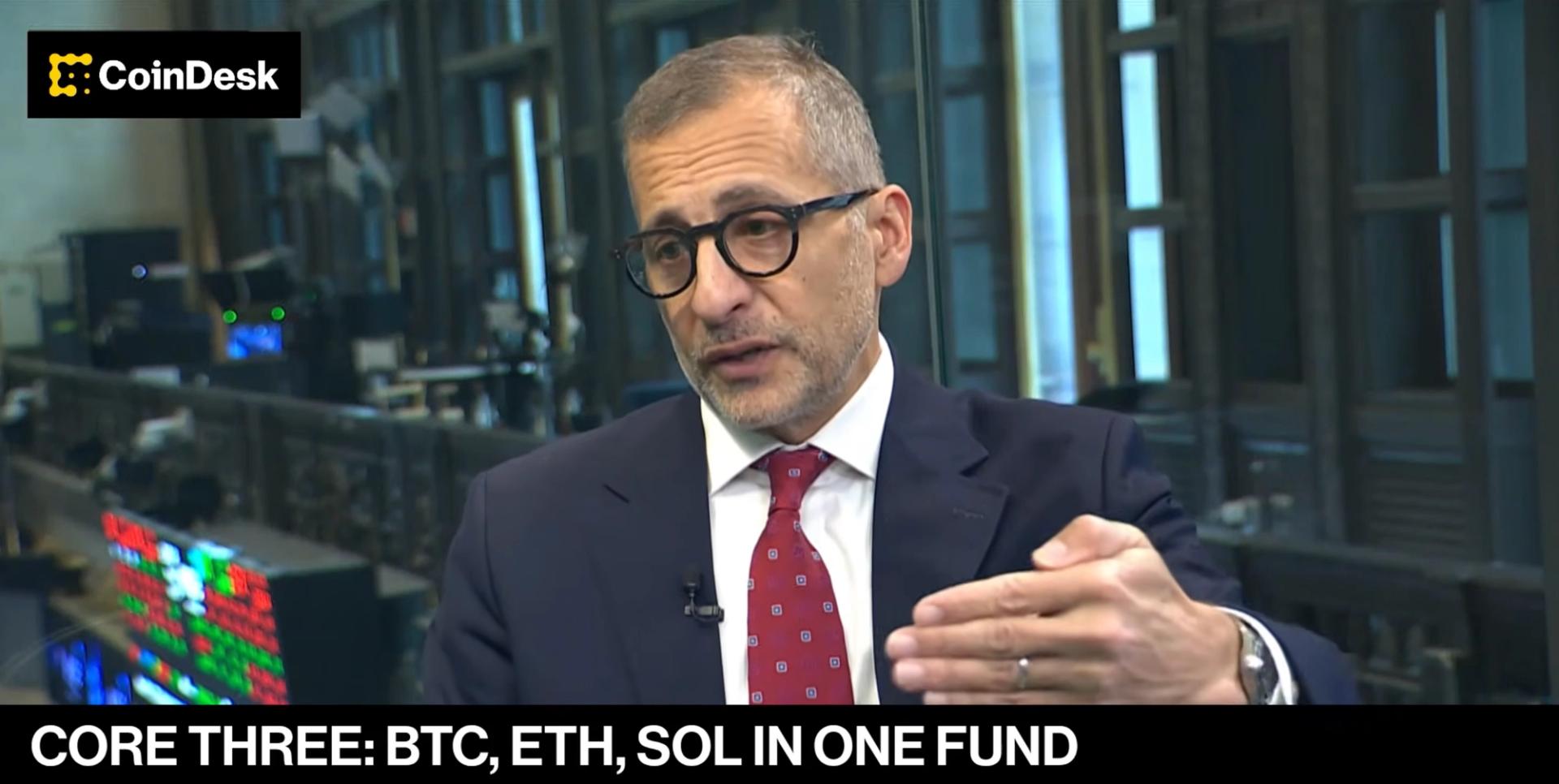
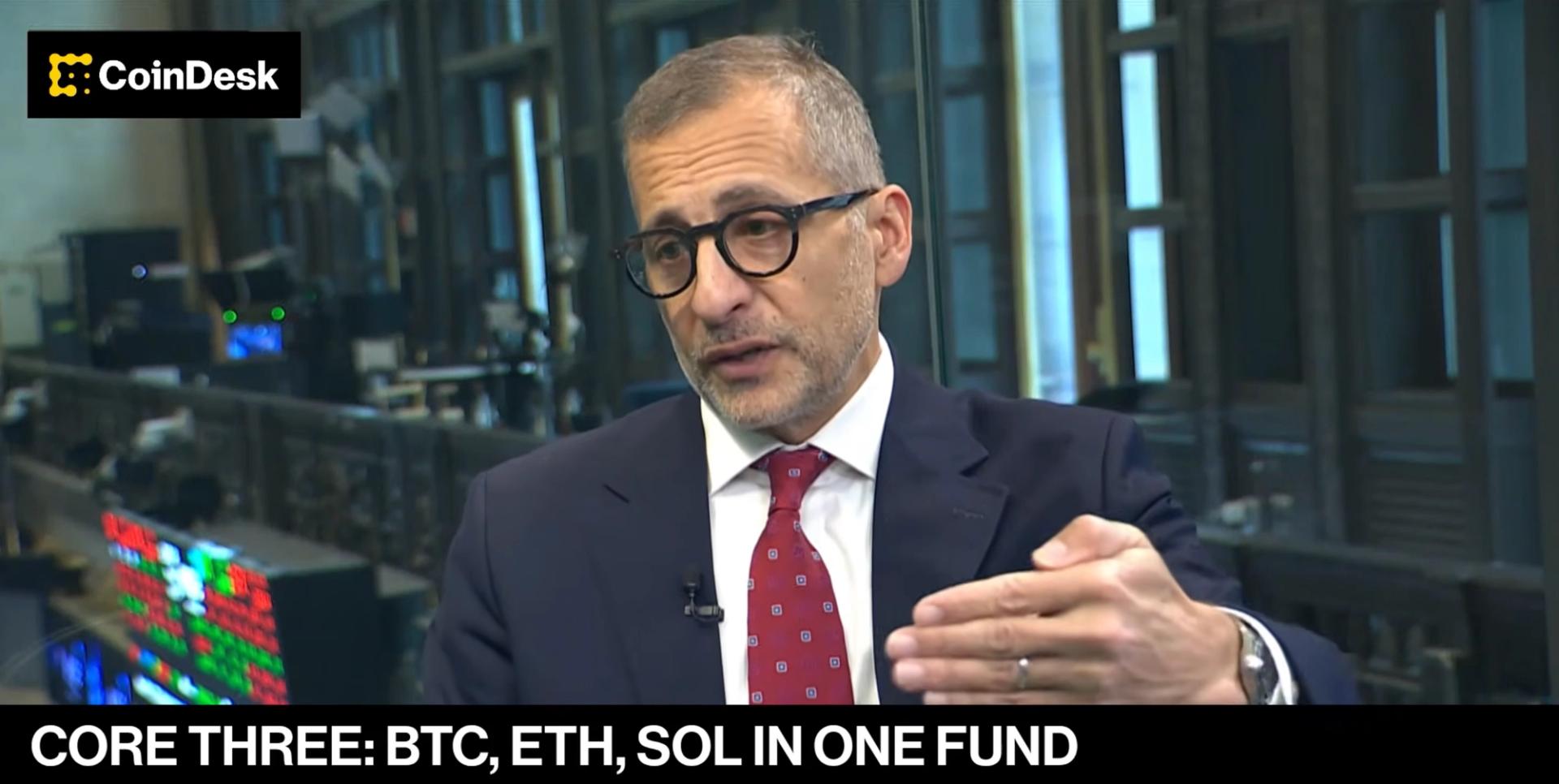
What’s new: GSR has launched its first ETF built around three major tokens with active management layered on top.
- The fund holds Bitcoin, Ethereum and Solana, with weekly rebalancing to adjust market exposure, said GSR Managing Director of Asset Management, Andy Baehr on CoinDesk’s Public Keys.
- It includes staking rewards for Ethereum and Solana, adding yield on top of price exposure
- The goal: offer a core portfolio investors can hold without constant trading decisions
Why it matters: Crypto ETFs are shifting from trading tools to long-term allocation products.
- Institutional players like Morgan Stanley and Goldman Sachs are tailoring crypto ETFs for wealth clients, Andy said
- Advisors increasingly need simple, diversified crypto exposure beyond just Bitcoin
- GSR is betting investors want a single, easy entry point rather than complex multi-token baskets
The strategy: A mix of macro stability and growth upside.
- Bitcoin serves as the macro asset and store of value in the portfolio
- Ethereum and Solana represent growth tied to stablecoins, tokenization and on-chain activity
- Active weighting aims to tilt toward Bitcoin in downturns and toward ETH/SOL in growth cycles
Reading between the lines: This is a bet on core crypto consolidation.
- GSR rejected market-cap weighting as too Bitcoin-heavy and broad indexes as too complex
- The firm sees Ethereum and Solana as the leading layer 1 platforms competing for long-term dominance
- Weekly rebalancing is designed to outperform passive crypto baskets
What comes next: More ETF products could follow.
- GSR has filed for five ETFs and may expand its lineup, Andy said
- The firm is also building out advisory and token launch services after recent acquisitions
- Regulatory clarity — including treatment of major tokens as commodities — is opening doors for new products


BlackRock-backed Securitize and Computershare are bringing parts of the $70 trillion U.S. stock market onchain via tokenized equities, in a move that pushes traditional Wall Street infrastructure closer to blockchain rails.
The agreement allows listed firms to add tokenized equity — called Issuer-Sponsored Tokens (ISTs) — alongside existing shares, giving investors the option to hold stock through traditional systems or in a digital wallet.
The effort is part of a broader push to make tokenized shares work within current market rules while offering new ways to hold and move assets, from wallet-based ownership to faster settlement. Transfer agents like Computershare sit at the center of that system, maintaining shareholder records and handling corporate actions.
By integrating at that layer, the companies aim to avoid a common crypto workaround, in which tokens represent claims on shares rather than the shares themselves.
Securitize is a blockchain-based firm, enabling real-world assets, such as equities and funds, to be issued, traded, and managed in tokenized form on blockchain networks.
Blockchain meets transfer agents
Under the setup, Computershare will act as transfer agent for tokenized shares just as it does for traditional ones. That includes managing records and processing events like dividends or stock splits across both formats.
Securitize provides the underlying technology, but like other recent efforts in the space, the blockchain component sits mostly in the background. The tokens are designed to represent direct ownership, not derivatives layered on top of existing stock.
“ISTs do not rely on derivative tokens that sit on top of underlying shares,” said Securitize CEO Carlos Domingo. “They provide U.S. issuers with the ability to create direct equity ownership in token form.”
Computershare’s reach could give the effort scale. The firm serves more than 25,000 companies and acts as a transfer agent for about 58% of the S&P 500.
The structure also keeps issuers in control of their shareholder base, a key requirement for public companies. “Our focus has been to empower U.S.-listed companies to issue tokenized equity while retaining control,” said Ann Bowering, CEO of issuer services at Computershare North America.
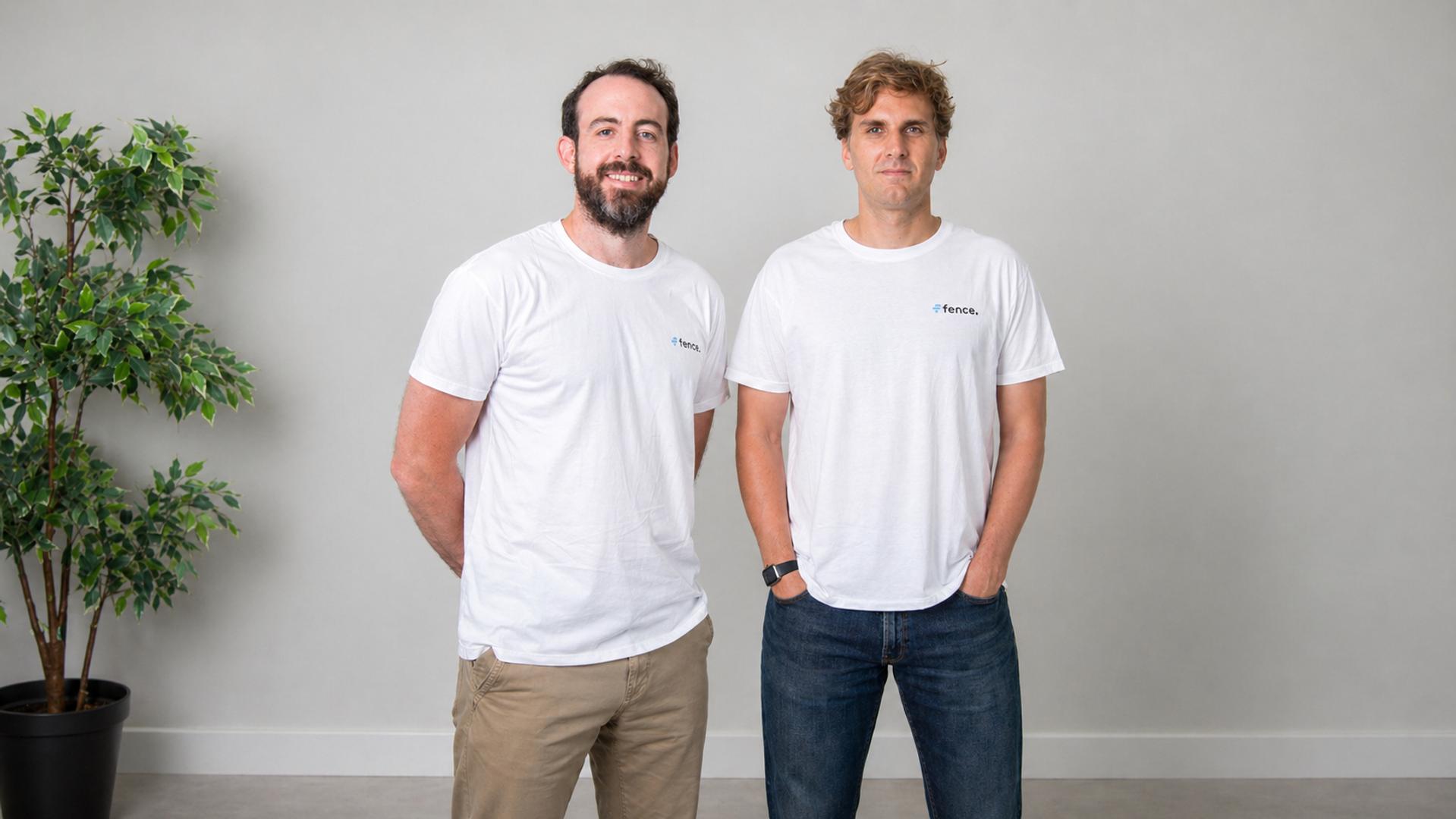
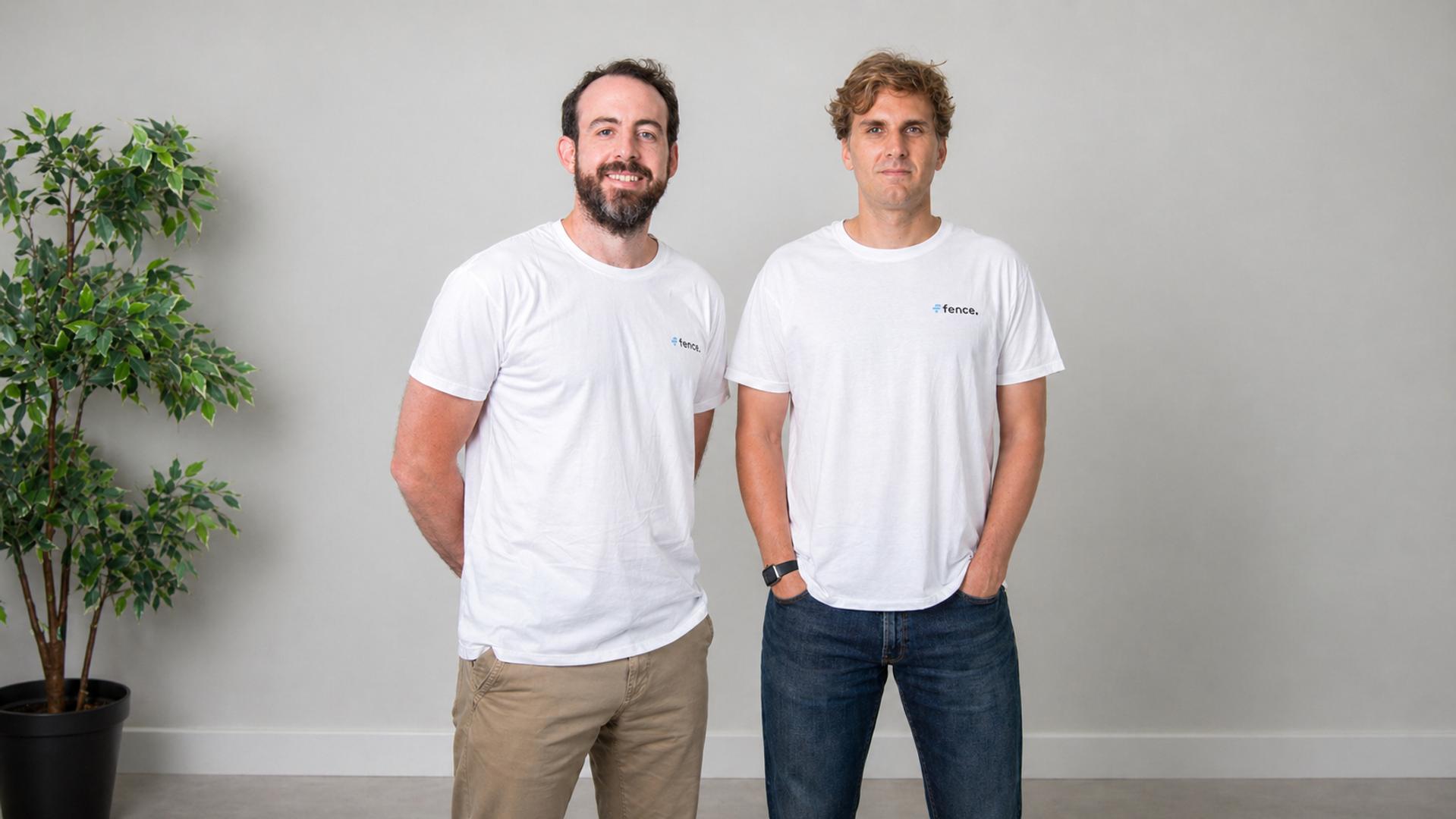
A $20 million funding round led by Mike Novogratz’s Galaxy Digital (GLXY) is backing a push to use blockchain behind the scenes to overhaul the $6 trillion asset-backed finance market, where many deals still rely on manual workflows.
The round, which included Parafi Capital and Crane Ventures, went to Fence, a startup building software to handle the operational layer of structured credit deals.
That layer — from tracking loan pools to verifying collateral and moving cash — is often fragmented across multiple firms and still runs on spreadsheets, PDFs and email. The setup can slow transactions and leave investors with limited visibility into the assets backing their investments.
Fence aims to replace those processes with a single system that updates data in real time, Juan Montero, co-founder and CEO of Fence, told CoinDesk in an interview. Lenders can monitor loan performance and cash flows continuously, rather than relying on periodic reports, he explained.
The company says that approach can cut costs for big asset managers. In deals with BBVA, one of Spain’s largest banks overseeing $800 billion in assets, Fence reported lower funding costs for borrowers and reduced operational work, while tracking large volumes of loans on an ongoing basis.
Blockchain in the background
Fence is using blockchain less as a front-end product than as back-end plumbing. The company does not pitch banks and asset managers on tokens or crypto wallets. Instead, it uses smart contracts behind the scenes to manage cash, collateral and the rules that govern these deals.
In a typical facility, lenders may wait days for loan data to be checked, reports to be sent and payments to clear, Montero said. Fence pulls that information through APIs, runs checks in software and uses smart contracts to release cash when deal terms are met, he said.
The company can also tokenize lender positions in financing vehicles and, in some cases, the underlying loans or invoices. That can allow investors to transfer positions, borrow against them or receive payments automatically if ownership changes. Still, Montero said tokenization is only used where it adds value.
“We don’t want to be seen as a blockchain company. We’re building the infrastructure for the capital markets,” Montero said. “Others digitize the paperwork. Fence rebuilt the plumbing.”
The company says it now oversees about $1.5 billion in assets across its platform, working with firms including BlackRock and Fortress. It can onboard new deals in weeks, compared with months under standard processes.
The funding will help the company expand in the U.S. and build out its product, Montero said, betting that faster data and fewer manual steps can reshape how credit markets operate behind the scenes.
XRP price has formed a decisive symmetrical triangle pattern on charts as bulls and bears battle for dominance. Will it stage a bullish breakout from its current range as it continues to grow into a leading RWA powerhouse?
Summary
- XRP price fell 9% from $1.50 to $1.37 before stabilizing near $1.39, forming a symmetrical triangle as macro tensions weigh on sentiment.
- XRPL sees rising RWA adoption, with tokenized U.S. Treasuries reaching $418 million and transfer volumes surging to $352 million in recent months.
- Spot XRP ETFs recorded nearly $83 million in April inflows; a breakout above $1.39 could target $1.50–$1.61, while $1.32 remains key support.
After hitting the $1.50 mark on April 17, XRP (XRP) price has been in a steady decline, dropping by 9% to $1.37 on Tuesday before stabilizing around $1.39 at press time.
While bulls tried pushing the asset back above recent highs, they failed as a sell-off ensued over investors’ concerns surrounding a delayed peace agreement between the U.S. and Iran, which has injected fresh volatility into the global markets.
Despite the XRP token’s downtrend, there remain two positive catalysts that could spark a recovery in the coming weeks.
First, the XRP Ledger is evolving rapidly to become a distribution layer for real-world financial assets, not just payments.
According to an April 28 X post by treasury-focused firm Evernorth, tokenized U.S. Treasuries on the XRPL network have ballooned to $418 million today, which is nearly 8 times the roughly $50 million seen 12 months ago.
The network has also registered strong growth in the transfer of this liquidity. As the firm noted, transfer volume of tokenized US Treasuries on XRP grew nearly 5 times to $352 million in just the past 4 months in comparison to $70 million seen throughout 2025.
The increase in tokenized Treasury issuance on XRPL indicates that more financial institutions are using the network to move and manage Treasury-backed digital assets. Such growth could significantly attract investor demand, especially if the trend of traditional finance moving on-chain continues to accelerate.
Second, institutional investors have also shown consistent demand for its ETFs. Per data from SoSoValue, the 5 spot XRP ETFs have drawn in nearly $83 million in net inflows during April, a major reversal from the $31 million in withdrawals seen in the past month.
XRP price analysis
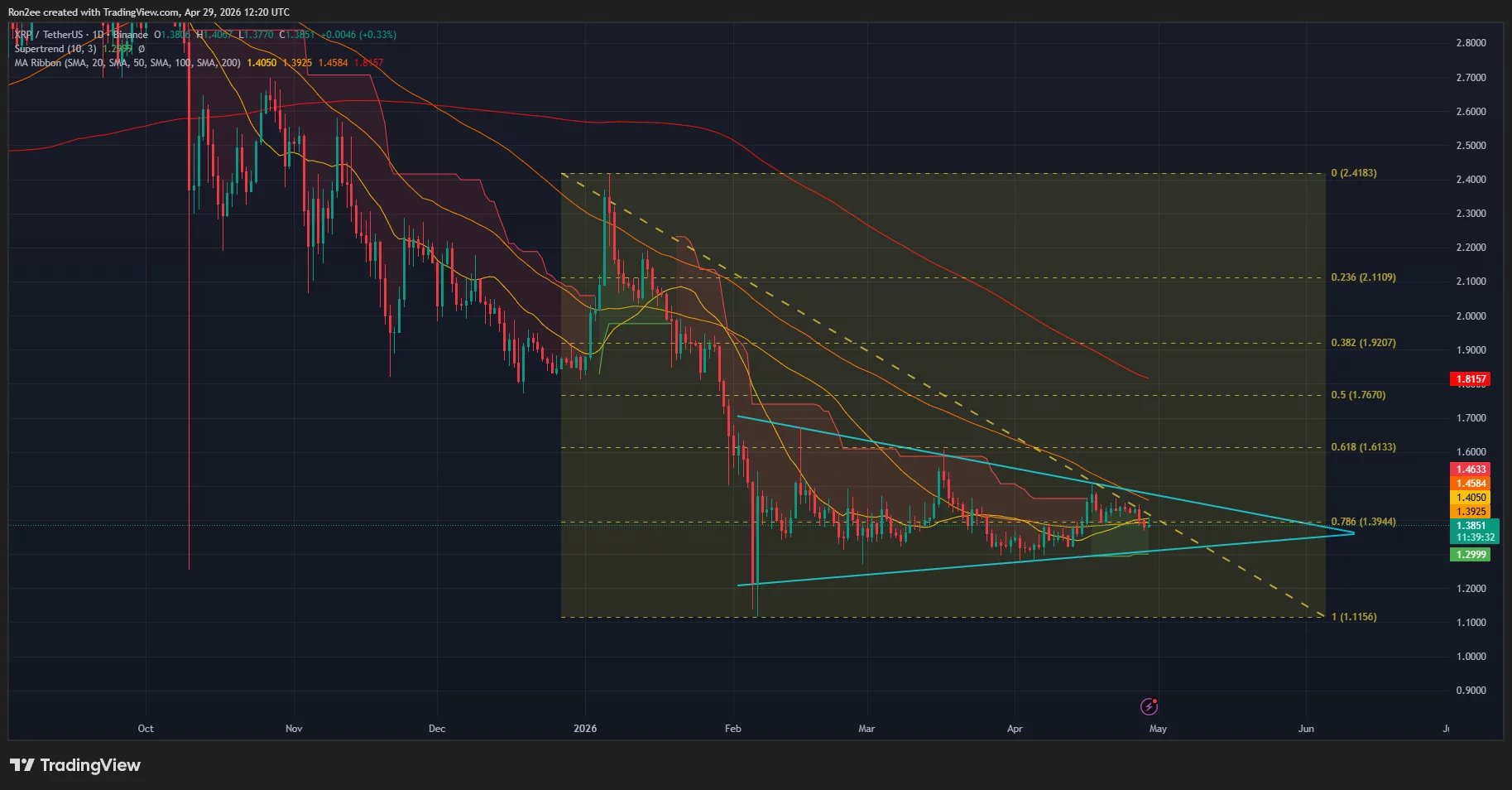
On the daily chart, XRP price has formed a symmetrical triangle pattern consisting of two converging support and resistance lines. Typically, a breakout from the upper trendline confirms a bullish breakout from the pattern, which results in a massive price spike, while a move below the lower trendline suggests further downside.
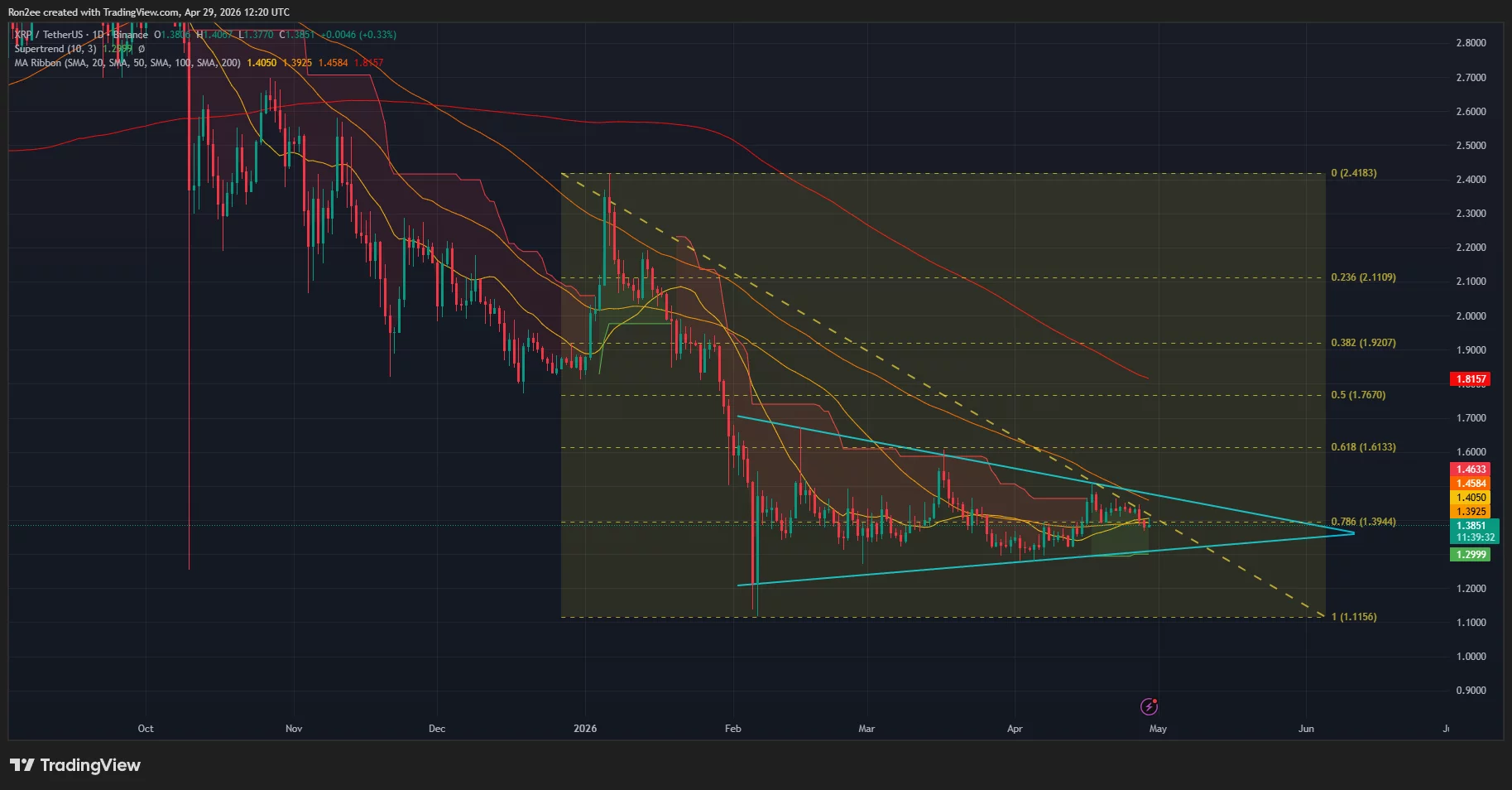
In the case of XRP, technical indicators present a bias tilted towards a potential bullish breakout from the pattern, thus rewarding patient buyers. The Supertrend has flipped green for the first time in weeks, while the 50-day SMA is close to forming a mini golden cross with the 100-day SMA, suggesting that the long-term trend is turning positive.
For now, $1.39, which aligns with the 78.6% Fibonacci retracement level, lies as the key resistance level to watch in the immediate term. A breakout from this barrier could trigger a rally towards $1.50 and beyond to challenge the 61.8% Fibonacci retracement level at $1.61.
On the contrary, a failure to hold the lower boundary of the triangle near $1.32 could lead to a deeper correction toward the psychological support at $1.20.
Disclosure: This article does not represent investment advice. The content and materials featured on this page are for educational purposes only.

The Canadian government has proposed banning Bitcoin and other crypto ATMs, arguing the machines have become a primary on-ramp for fraudsters and money launderers rather than a convenient access point for everyday users.
The government’s Spring Economic Update 2026, published on April 28, says crypto ATMs are a “primary method for scammers to defraud victims and for criminals to place their cash proceeds of crime,” and explicitly states that the government “proposes to ban crypto ATMs.”
The proposal states that Canadians will still be able to buy virtual currencies from brick-and-mortar money services businesses, but the standalone kiosks that have proliferated in malls, gas stations and corner stores would be phased out.
The move adds to a broader push by Ottawa to clamp down on what it frames as retail-facing crypto risks as fraud cases surge, while bringing more of the digital asset sector under tighter federal oversight. Authorities say the move is aimed at cutting off one of the most common channels used in scams that have increasingly targeted Canadians.
The policy is of particular note given Canada’s early role in the sector. The world’s first publicly available Bitcoin ATM went live in a Vancouver coffee shop in 2013, making Canada the birthplace of the Bitcoin ATM.

Spring Economic Update 2026. Source: Government of Canada
Since then, the country has grown into one of the most crypto-ATM-dense markets globally, a status regulators say has given it disproportionate exposure to fraud. Coin ATM Radar data estimates that Canada accounts for 10.1% of global crypto ATMs, second only to the United States.
A months-long CBC investigation and internal Financial Transactions and Reports Analysis Centre of Canada (FINTRAC) analysis posted April 28 found that crypto ATMs have become the principal method used by domestic and foreign criminal fraudsters to extract money from Canadian scam victims and push those funds into the crypto ecosystem.
Law enforcement agencies told CBC they have seen a clear uptick in cases where victims are instructed to feed cash into these machines under the guise of paying tax debts, securing romance relationships or recovering hacked accounts.
Related: Canada revokes 47 crypto money licenses, vows to continue
Ban forms part of broader crypto regulatory push
The proposed ATM ban sits within a broader effort to tighten controls around high-risk corners of Canada’s crypto market while drawing core infrastructure more firmly into the regulatory perimeter.
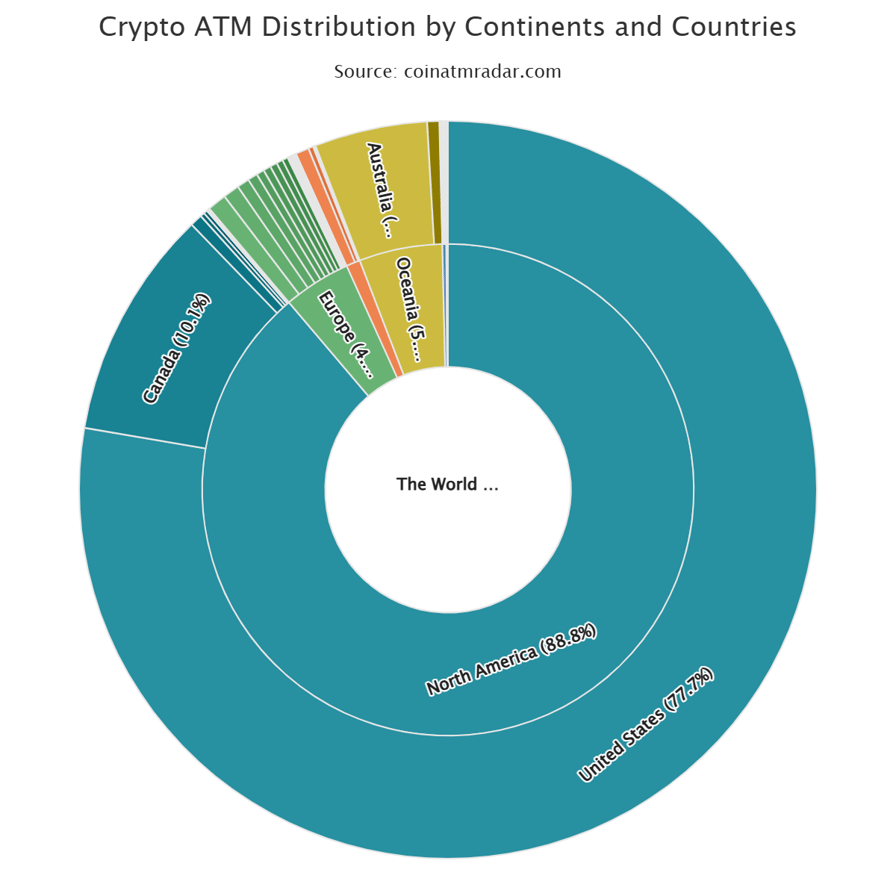
Crypto ATM distribution by continents and countries. Source: Coin ATM Radar
The same Spring Economic Update bolsters a new Financial Crimes Agency and gives FINTRAC more tools to refuse or revoke registrations for non-compliant money services businesses, including crypto companies.
In parallel, Ottawa has enacted a federal stablecoin framework in Bill C-15 that makes the Bank of Canada the supervisor and requires fiat-referenced issuers to register, fully back reserves and redeem at par, with most rules kicking in after regulations are finalized ahead of an expected 2027 start date.
Lawmakers are also advancing Bill C-25 to bar cryptocurrency donations in federal politics over concerns about traceability and foreign interference, as the country adopts a regulation-first approach to target retail-facing abuse risks and pull core digital asset rails under federal oversight.
Magazine: Bitcoin will not hit $1M by 2030, says veteran trader Peter Brandt


The investment, worth over $19M at current prices, coincides with Mezo’s launch of Bitcoin yield vaults for institutional clients.
Bullish, the publicly listed digital asset exchange and parent company of CoinDesk, has invested 250 BTC — roughly $19 million — into Mezo, a Bitcoin DeFi-focused protocol, per a press release shared with The Defiant. The investment coincides with the launch of Mezo Prime, a new institutional yield product built in partnership with Anchorage Digital Bank.
Bullish will become the first company to use Mezo Prime with Anchorage, deploying a portion of its corporate Bitcoin treasury into the product. Anchorage is the custody provider for the vaults, per the release, and Mezo Prime is now available to Anchorage Digital Bank clients.
Mezo Prime centers on “Enclaves” — segregated Bitcoin vaults designed for institutional depositors. Bitcoin deposited into an Enclave can be locked as veBTC to earn protocol fees or used as collateral to borrow MUSD, Mezo’s Bitcoin-backed stablecoin, the release notes.
“Over a million Bitcoin sits on corporate balance sheets today, and almost none of it is working,” said Matt Luongo, co-founder of Mezo.
The launch comes as the broader BTCFi space continues to expand. Institutions in particular have faced a gap between wanting to earn yield on BTC holdings, and meeting their risk and compliance requirements. Late last year, The Defiant reported that Threshold Network had updated its tBTC bridge to make it easier for institutional Bitcoin holders to deploy their funds in DeFi.
This article was written with the assistance of AI workflows. All our stories are curated, edited and fact-checked by a human.
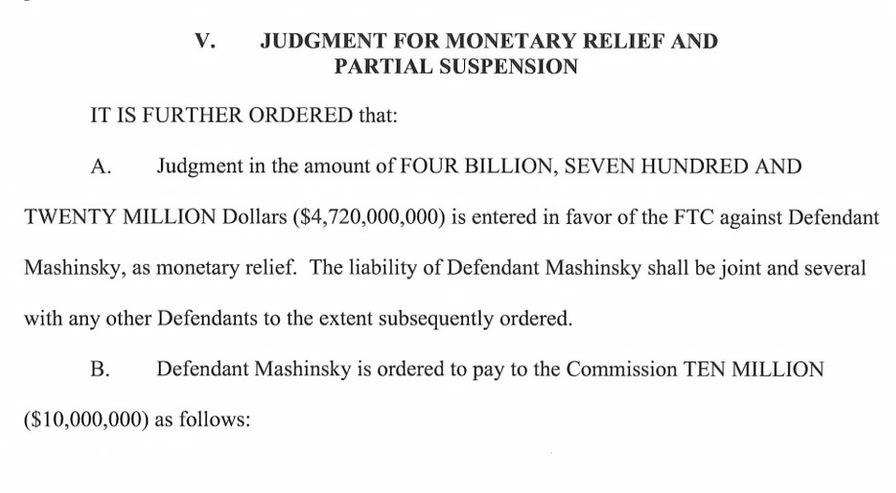
Celsius founder Alexander Mashinsky agreed to a US Federal Trade Commission (FTC) settlement that permanently bars him from promoting asset-related products and requires a $10 million payment tied to a broader, mostly suspended $4.72 billion judgment.
The stipulated order, entered by Judge Denise Cote in the Southern District of New York on Tuesday, said Mashinsky is “permanently restrained and enjoined” from advertising, marketing, promoting, offering or distributing any product or service that can be used to “deposit, exchange, invest, or withdraw assets.”
The order entered a $4.72 billion monetary judgment in favor of the FTC against Mashinsky, but most of it was suspended. Mashinsky must now pay $10 million to the FTC. However, the order said this obligation can also be satisfied if he pays at least $10 million to the US Department of Justice under the forfeiture order in his criminal case.
The settlement adds to the legal fallout from Celsius’s 2022 collapse, while preserving the FTC’s ability to pursue the larger judgment if Mashinsky is found to have misstated or omitted assets in financial disclosures.
In May 2025, Mashinsky was sentenced to 12 years in prison after pleading guilty to commodities fraud and securities fraud, with prosecutors saying he misled Celsius customers about the company’s profitability, investment risks and the safety of customer funds.
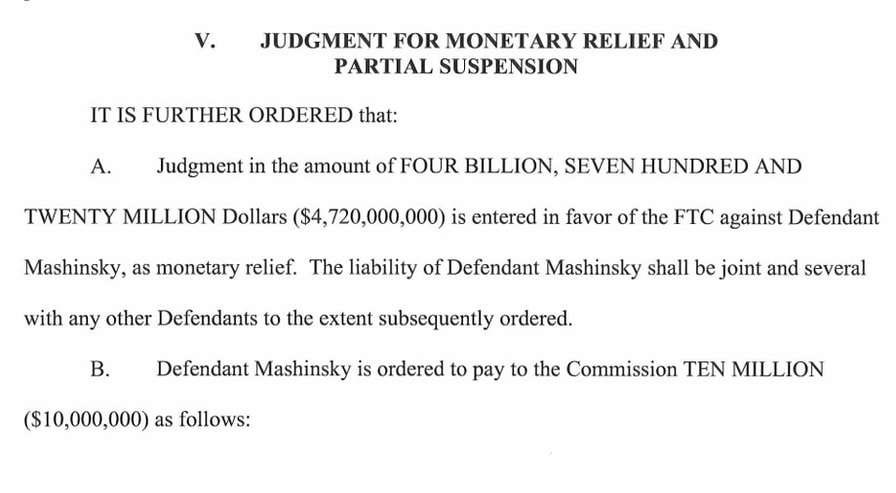
Excerpt from the court filing. Source Court Listener
Suspended judgment can be revived
According to the order, the remainder of the judgment beyond the $10 million payment obligation is suspended, but the suspension is conditional.
It can be lifted if the FTC asks the court to do so and the court finds that Mashinsky failed to disclose a material asset, misstated the value of an asset or made another material misstatement or omission in his financial disclosures.
Related: Judge rejects new trial for former FTX CEO Sam Bankman-Fried
If the suspension is lifted, the order said the $4.72 billion judgment would become immediately due against Mashinsky.
That amount would be reduced by any payments already made under the FTC order, any amount paid to consumers through the DOJ forfeiture order in his criminal case or any amounts Mashinsky can show were paid to consumers by other defendants, including through the Celsius bankruptcy case.
The structure allows the FTC to preserve a larger consumer-redress claim while limiting Mashinsky’s immediate payment obligation.

Shaq’s daughter, Me’Arah O’Neal, announces transfer to Kentucky Wildcats

Pixel 11’s Tensor G6 could be fast, just not for gaming

Carrie Underwood Admits Life On Her Family Farm Is ‘Frustrating’

Manchester United reach agreement with Casemiro over contract clause amid transfer speculation

US brings back mandatory military draft registration

Steven Gerrard disagrees with Gary Neville over ‘shock’ Chelsea and Arsenal claim | Football


-

 Tech2 days ago
Register Renaming | Hackaday
-

 Fashion5 days ago
Weekend Open Thread – Corporette.com
-
 Crypto World4 days ago
Hyperliquid $HYPE Rally Builds Momentum as AI Sector Enters Prove-It Phase
-

 Politics7 days ago
Making troops accountable for war crimes threatens US alliance, ex-SAS colonel warns
-

 Politics7 days ago
Disabled people challenge government SEND proposals over segregation concerns
-

 Business6 days ago
Patterson-UTI Energy, Inc. (PTEN) Q1 2026 Earnings Call Transcript
-
 Sports3 days ago
IPL 2026: Ruturaj Gaikwad registers slowest fifty of the season, enters all-time unwanted list | Cricket News
-

 Politics2 days ago
Drax board avoid their own AGM, accused of greenwashing & environmental racism
-

 Politics7 days ago
Zack Polanski responds to home secretary’s taser threat
-

 Politics7 days ago
Starmer handler McSweeney to be dragged from shadows by Foreign Affairs Committee
-
Politics7 days ago
Wings Over Scotland | How To Get Away With Crimes
-

 Politics7 days ago
‘Iran is still a nuclear threat’
-

 NewsBeat3 days ago
LK Bennett closes all stores after entering administration
-
 Sports6 days ago
Tim Bradley names the current best in the world: “Better than Inoue and Usyk”
-

 Crypto World5 days ago
Michael Saylor says BTC winter is over. Market analyst disagrees, says bitcoin was in a pullback
-
 Entertainment4 days ago
Mariah Carey Slams Deposition Claims In Brother’s Lawsuit
-
Business6 days ago
Altimmune prices $225 million public offering at $3 per share
-

 Fashion14 hours ago
Kylie Jenner’s KHY Enters a New Era with ‘Born in LA’
-
Entertainment6 days ago
Michael B. Jordan and Austin Butler's “Miami Vice” movie will bring the action back to the '80s
-
Entertainment6 days ago
Russell Brand Had Sex With 16 Year Old When He Was 30
You must be logged in to post a comment Login