
Crypto World
Bitmine Accelerates ETH Buys, Treasury Hits 4.6M Coins


TLDR
- Bitmine increased its Ethereum purchases and lifted its treasury to 4.596 million ETH.
- The company bought 5,000 ETH directly from the Ethereum Foundation through an over-the-counter deal.
- Tom Lee said Bitmine added 60,999 ETH in the past week, exceeding its recent weekly average.
- Bitmine now controls about 3.81% of Ethereum’s total supply.
- The company reported total crypto holdings, cash, and investments of about $11.5 billion.
Bitmine Immersion Technologies increased its Ethereum purchases and expanded its treasury to 4.596 million ETH. The company disclosed a direct 5,000 ETH purchase from the Ethereum Foundation. Chairman Tom Lee confirmed the firm accelerated weekly accumulation in recent weeks.
Bitmine Expands Ethereum Holdings and Staking Operations
Bitmine added 60,999 ETH over the past week, Lee said on Monday. He stated that recent weekly purchases averaged between 45,000 and 50,000 ETH. The latest buying pace exceeded that recent range.
The company structured the 5,000 ETH transaction over the counter with the Ethereum Foundation. Lee said the structure allowed the foundation to fund operations without selling on exchanges. As a result, Bitmine avoided open market impact during the purchase.
Bitmine now controls about 3.81% of Ethereum’s total supply. The company reported total crypto holdings, cash, and investments of about $11.5 billion. It said 3,040,515 ETH remain staked, representing about 66% of its treasury.
Bitmine valued its staked Ether at roughly $6.6 billion at a price of $2,185. The company estimates staking generates about $180 million in annualized revenue. It plans to expand operations through its Made in America Validator Network.
Lee said the Made in America Validator Network will launch in the coming months. He stated the network will increase staking capacity and validator participation. The company confirmed it will continue expanding its Ethereum position.
Corporate Treasuries Increase Exposure to Ether and Bitcoin
Corporate entities now hold about 6.6 million ETH across seven countries. CoinGecko data shows those holdings equal about 5.47% of the total Ether supply. Public companies slowed their accumulation during the past month.
Among the 20 largest corporate Ether treasuries, only four increased holdings in 30 days. Bitmine added 269,824 ETH during that period. SharpLink added 3,859 ETH, while Eightco added 11,068 ETH.
Eightco raised $125 million to expand blockchain and artificial intelligence investments. Bitmine invested $75 million in that funding round. ARK Invest and Payward, Kraken’s parent company, each committed $25 million.
As part of the agreement, Lee joined Eightco’s board. The companies confirmed the capital will support growth initiatives. They disclosed the funding details last week.
Earlier today Strategy disclosed a separate Bitcoin purchase. The company acquired 22,337 BTC for $1.57 billion. Strategy now holds more than 760,000 Bitcoin.
Shares of Bitmine, trading under BMNR, closed up nearly 14% at $23.39. Yahoo Finance reported the closing price data. At press time, Ether traded near $2,342, up nearly 11% in 24 hours.
Ether’s year-to-date decline stands near 21%. The cryptocurrency’s market capitalization measures about $282 billion. Circulating supply totals approximately 120.7 million ETH.


Key Takeaways
- International coalition addresses approval phishing attacks on cryptocurrency holders.
- Three-nation task force deploys resources to combat wallet authorization fraud.
- Ontario-led teams implement transaction freezing and wallet security protocols.
- American and British agencies deploy real-time threat detection systems.
- Cryptocurrency-related fraud totals $14 billion in 2025, spurring enhanced cooperation.
Law enforcement officials from three major nations have initiated a coordinated campaign against digital currency theft. The collaborative effort, designated Operation Atlantic, addresses fraudulent schemes exploiting wallet authorization mechanisms to drain user accounts. Participating agencies are working to detect criminal activity, retrieve stolen assets, and minimize ongoing financial damage.
The initiative brings together Canada’s Ontario Securities Commission and Ontario Provincial Police with American and British counterparts. The U.S. Secret Service and the United Kingdom’s National Crime Agency provide additional resources for this international undertaking. This operation expands upon earlier efforts addressing widespread cryptocurrency-related criminal activity.
The campaign specifically addresses fraudulent tactics where perpetrators manipulate victims into authorizing harmful blockchain operations. After obtaining these permissions, criminals rapidly transfer digital assets beyond easy retrieval. Law enforcement personnel will actively surveil questionable transactions and alert endangered users without delay.
Ontario Spearheads Prevention and Asset Recovery Initiatives
Canada’s securities regulator employs sophisticated analytical tools to identify vulnerable crypto wallets operating on various blockchain networks. Collaboration with federal and provincial police enables rapid freezing of unauthorized transfers. The program additionally assists affected individuals in strengthening access controls against subsequent breaches.
A preceding 2024 program called Project Atlas successfully located more than 2,000 vulnerable accounts spanning 14 nations. Investigators secured $24 million in misappropriated cryptocurrency while preventing $70 million in additional fraudulent activity. These earlier accomplishments shaped the international framework now supporting Operation Atlantic.
Canadian investigators depend on instantaneous surveillance capabilities and seamless partner communication. Specialists identify suspicious authorization patterns and act before complete account depletion occurs. Blockchain forensics enable asset recovery efforts across multiple jurisdictions.
American and British Agencies Strengthen Cross-Border Response
The United States Secret Service collaborates with federal prosecutors in Washington, D.C., to monitor authorization fraud schemes as they unfold. Intelligence sharing with Canadian and British authorities enables immediate disruption of active criminal operations. Federal investigators prioritize identifying organized crime groups while pursuing asset repatriation.
British authorities deploy the National Crime Agency alongside the Financial Conduct Authority to detect malicious digital wallet operations. Regulatory enforcement actions accompany educational initiatives on asset protection strategies. This partnership accelerates response times against transnational fraud networks.
Operation Atlantic emerges amid escalating worldwide losses from cryptocurrency scams, totaling $14 billion in 2025. Criminal organizations increasingly exploit psychological manipulation, artificial intelligence-generated materials, and commercialized phishing infrastructure. Law enforcement officials emphasize that authorization-based fraud remains among the most significant dangers facing crypto wallets globally.
Operation Atlantic demonstrates a coordinated multinational strategy by Canadian, American, and British authorities against digital currency theft. Through pooled investigative capabilities and continuous surveillance systems, law enforcement seeks to discourage criminal activity. The initiative underscores the expanding magnitude and complexity of international cryptocurrency fraud operations.

Bitcoin has continued its recovery, extending a third straight week of gains as institutions show renewed interest and large-scale purchases surface. The leading crypto briefly touched the high $74,500s, a level unseen since early February, amid a confluence of bullish signals: a surge in spot-market demand, heftier ETH-like inflows into related vehicles, and fresh capital committed to acquiring more BTC. Market observers point to a constructive backdrop even as traders debate whether the current momentum will culminate in a sustained breakout or a temporary rebalancing within a broader accumulation phase.
Key takeaways
- Bitcoin traded to about $74,509, marking a multi-week rally and placing the price within sight of the mid-$70k range.
- Strategy, the largest public Bitcoin holder, added 22,237 BTC for roughly $1.57 billion, signaling formidable institutional conviction.
- US-listed spot Bitcoin ETF inflows continued, with net weekly flows surpassing $763 million, underscoring a renewed institutional appetite.
- Tokyo-based Metaplanet announced a $255 million private placement aimed at funding additional BTC purchases, signaling ongoing strategic capital deployment.
- Analysts highlighted a shift in market structure toward a more favorable setup, even as price action still tested resistance and futures activity rose.
Tickers mentioned: N/A
Sentiment: Bullish
Price impact: Positive. The price recovery and sustained flows point to upside potential as institutional demand returns.
Trading idea (Not Financial Advice): Hold. The current momentum is supported by inflows and large buyers, but the absence of a definitive breakout leaves room for consolidation.
Market context: The latest price action comes amid improving liquidity in digital-asset markets and a broader re-pricing of risk as institutions revisit BTC allocations against a backdrop of macro cues and ETF demand.
Why it matters
The renewed flow of capital into Bitcoin appears to be anchored by concrete, verifiable purchases from established institutional players. Michael Saylor’s Strategy, the largest public holder of BTC, disclosed a significant expenditure of $1.57 billion to acquire 22,237 BTC, reinforcing the narrative that deep-pocket buyers view BTC as a core treasury asset in a world of rising macro volatility. This move not only enlarges the company’s BTC reserve but also signals a broader willingness among institutions to deploy capital in a manner that could influence market psychology and liquidity in the near term.
Beyond individual buyers, the sustained inflows into exchange-traded BTC products point to a broader legitimization of Bitcoin as an investable asset class among mainstream institutions. Bloomberg’s reporting noted that net flows for the 12 US-listed spot Bitcoin ETFs surpassed $763 million in a single week, the third consecutive week of inflows. That cadence suggests a shift in risk appetite and a growing comfort with regulated vehicles designed to provide regulated exposure to the asset class, which could attract further flows as products evolve and regulatory clarity broadens.
On the demand side, new capital commitments from Metaplanet—a Tokyo-listed company with a history of corporate Bitcoin treasuries—underscore persistent interest in building on-chain exposure through structured, scalable means. The firm announced a $255 million private placement intended to fund a new instrument to buy more Bitcoin, signaling strategic intent to scale up holdings over time. Metaplanet CEO Simon Gerovich framed the fundraising as enabling a continued “march towards 210,000 BTC,” illustrating how corporate treasuries are increasingly aligning long-term Bitcoin strategies with capital-raising activities.
Analysts have offered a mixed but increasingly constructive read on the technical backdrop. Bitfinex researchers suggested that Bitcoin was entering the week with renewed momentum and had reclaimed the $70,000 level, a milestone that tends to attract further attention from traders and institutions alike. They also emphasized that the market structure had improved meaningfully, even as BTC had not yet decisively breached local highs. The emphasis on structure hints at a market that may be shifting away from pure price momentum toward a more sustainable consolidation underpinned by improving funding conditions and healthier open-interest dynamics.
Other industry voices highlighted a notable transition from a seller-dominated regime to one where leverage and long positioning are increasing. Hyblock’s analysis described a regime shift: after a period of selling pressure and shrinking open interest, traders began increasing long-side leverage, and open interest rose while perpetual funding cycles grew supportive of a move higher. This transition is important because it can indicate whether the current rally has legs beyond a test of immediate resistance levels, or whether it could stall without stronger spot-market demand to accompany futures-driven upside.
Taken together, the incoming data points to a market that is gradually healing from the risk-off mood that dominated late last year. The convergence of large-scale purchases, ETF inflows, and improving market structure suggests institutions are returning to BTC as a strategic exposure rather than a speculative bet. However, the narrative remains nuanced: while the headline numbers are supportive, price action has yet to enact a clean breakout above prior range highs, and traders will be watching whether the rate of inflows can persist in the face of evolving macro signals and potential regulatory developments.
What to watch next
- Track the trajectory of US-listed spot BTC ETF inflows in the coming weeks to gauge sustained institutional demand.
- Monitor Metaplanet’s private placement timeline and any additional warrants or instruments tied to BTC purchases.
- Watch for a potential test of resistance around recent highs and whether a sustained breach could attract further buying from both retail and institutions.
- Keep an eye on the March 18 FOMC meeting and any remarks that could affect risk sentiment and liquidity conditions in crypto markets.
- Observe changes in futures open interest and perps funding rates for signs of shifting market dynamics beyond spot demand.
Sources & verification
- Bitcoin price action and commentary from Cointelegraph and linked sources discussing price levels and recent movements.
- Strategy’s reported Bitcoin purchases totaling 22,237 BTC for $1.57 billion.
- Bloomberg reporting on ETF inflows into US-listed spot Bitcoin ETFs, including weekly net flows above $763 million.
- Metaplanet’s $255 million private placement and its stated objective related to BTC acquisitions.
- Bitfinex analysis on Bitcoin momentum ahead of the FOMC meeting and the evolving market structure.
Bitcoin climbs as institutional appetite returns and ETF inflows surge
Bitcoin (CRYPTO: BTC) continued its ascent into the mid-70k zone as institutional demand and regulated exposure rekindled confidence in the market. The price move reflected more than technical breakout fever: it mirrored a broad shift in investor posture, with major buyers expanding exposure and market watchers noting a constructive shift in the underlying flow dynamics. The confluence of investor inflows, large-scale purchases, and corporate treasury activity points to a market that is increasingly driven by strategic allocation rather than pure momentum.
Over the previous week, Strategy’s sizable buy supported the narrative of a rising baseline for BTC holdings, reinforcing the idea that the asset is gaining legitimacy as a long-term treasury asset for prominent institutions. The $1.57 billion deployment to acquire 22,237 BTC not only expands the firm’s BTC reserves but also serves as a public signal that the appetite for regulated, large-scale exposure remains intact. This development dovetails with ETF inflows that have kept the narrative buoyant, suggesting that more traditional financial rails are channeling money into Bitcoin via accessible vehicles that can meet risk-management preferences and fiduciary constraints.
Meanwhile, Metaplanet’s capital-raising activity adds another layer of narrative complexity. By pursuing a $255 million private placement to fund further Bitcoin acquisitions, the company demonstrates how corporate treasuries are increasingly willing to deploy capital through structured instruments designed to facilitate ongoing accumulation. The statement from Metaplanet’s leadership underscored a long-term horizon—“towards 210,000 BTC”—as a demonstration of commitment to scale exposure in a manner that can weather short-term volatility.
Technical observers have framed the current environment as one of improving market health rather than a one-way sprint. Bitfinex highlighted that Bitcoin had reclaimed the $70,000 mark and was entering a period of higher momentum ahead of macro events, while noting that the market had not yet broken out of local range highs. The absorption-to-emissions ratio (AER) and rising futures open interest echoed a market gradually aligning with the structure seen during earlier phases of the bull cycle, suggesting that the rally could be partly price-discovery driven by institutional positioning rather than a sudden spike in spot demand alone.
In this context, traders are weighing the balance between spot-driven demand and derivatives-driven positioning. Hyblock’s assessment emphasized a regime shift: after a period dominated by selling pressure and risk-off behavior, the market appears to be embracing leverage on the long side in tandem with rising open interest. If this trend persists, the path of least resistance could favor a continued consolidation within a higher range, with the potential for a breakout if the current inflows stabilize and macro conditions remain supportive.
As investors parse the evolving landscape, the question remains whether BTC can sustain above-the-curve momentum or whether price action will pause to allow a broader consolidation. The combination of substantial private capital commitments, regulated inflows, and improving market structure provides a framework for cautious optimism, albeit with an awareness that macro surprises and regulatory developments could alter the risk-reward calculus in crypto markets.
TLDR
- SEC Commissioner Hester Peirce urged firms exploring tokenization to meet directly with regulators to discuss product structures.
- Hester Peirce said the SEC wants companies to engage early as they develop tokenized securities and crypto-linked ETFs.
- She confirmed that SEC staff are working on a narrower innovation exemption for limited tokenized securities trading.
- Peirce stated that the SEC does not judge investment quality but focuses on disclosure and compliance standards.
- She addressed scrutiny of leveraged ETFs and said sponsors must meet statutory limits and risk disclosure requirements.
SEC Commissioner Hester Peirce urged asset managers to engage regulators on tokenized products and new exchange-traded structures. She said the agency wants firms to discuss proposals directly as markets evolve. Peirce also addressed leveraged ETF oversight and outlined plans for a narrower innovation exemption.
Hester Peirce invites dialogue on tokenization plans
Hester Peirce said firms developing tokenized instruments should approach the SEC early in the process. She stated, “It really is a ‘come in and talk to us’ about what you’re trying to do.” She added that the agency wants to work with sponsors as they test whether markets demand these products.
She explained that asset managers continue to explore blockchain-based securities within exchange-traded funds. She said the SEC prefers direct engagement instead of informal assumptions about compliance. She also said staff expect legal and technical questions as tokenization efforts expand.
Peirce noted that more companies have contacted the SEC about tokenization proposals. She said attitudes toward blockchain technology have shifted in recent years. She stated, “People have come to us and said we really think tokenization has potential here.”
She referred to discussions at the SEC’s Investor Advisory Committee about a limited innovation exemption. She said staff are working on a “narrower” framework for certain tokenized securities. She explained that the approach would allow targeted trading within existing securities laws.
SEC reviews leveraged ETF structures and disclosure rules
Peirce addressed the SEC’s review of highly leveraged exchange-traded funds. She said the agency does not judge whether products are good or bad investments. She stated, “It is our job to work with sponsors to make sure that they’re disclosing what those products are and what the risks are.”
She explained that current rules impose leverage limits on registered funds. She said sponsors may propose structures that exceed typical thresholds under securities laws. She added that firms must demonstrate how their products comply with statutory requirements.
Issuers have tested structures that extend beyond triple-leveraged ETFs offered by firms such as ProShares. Peirce said the SEC has seen increased proposals related to higher leverage levels. She noted that disclosure standards remain central to product approvals.
Peirce said the SEC expects operational and compliance questions as firms test new models. She said the agency wants to engage with industry participants during that process. She stated, “We want to walk side by side with you as we think through those questions.”
She confirmed that the proposed exemption would not create a broad carve-out from securities rules. She said the framework would preserve investor protections while allowing limited experimentation. She said staff continue refining the proposal following committee discussions.
Industry participants have argued that tokenized assets may improve settlement speed and ownership tracking. Regulators have emphasized maintaining disclosure and oversight standards for any approved products. Peirce’s comments came during an interview on CNBC’s The Exchange on Monday.
Disclosure: This article does not represent investment advice. The content and materials featured on this page are for educational purposes only.
Shiba Inu, Bonk, and Remittix draw investor comparisons as markets weigh meme momentum against real-world utility.
Summary
- Remittix raises $29.7m as it builds cross-border crypto-to-fiat payment infrastructure.
- Remittix wallet launches on the Apple App Store with support for 40+ cryptocurrencies.
- RTX token listings confirmed on BitMart and LBank ahead of launch.
Shiba Inu coin, Bonk, and Remittix represent three very different types of crypto assets, yet they keep appearing in the same conversations across the crypto market in 2026. Two of them built their followings on meme culture and community momentum. One is building payment infrastructure designed for real-world use.
For crypto investors asking which of these actually carries utility beyond speculation, the answer requires looking at what each project does, not just what its price is doing. The comparison is worth making carefully, and Remittix stands out clearly when utility is the measure.
Shiba Inu Price and what SHIB is today
Shiba Inu coin is currently priced at 0.0000061, down 4.68% over 24 hours. The Shiba Inu market cap sits at $3.61 billion, with SHIB trading volume at $154 million, which reflects reduced retail activity across meme-focused digital assets in the current market environment.
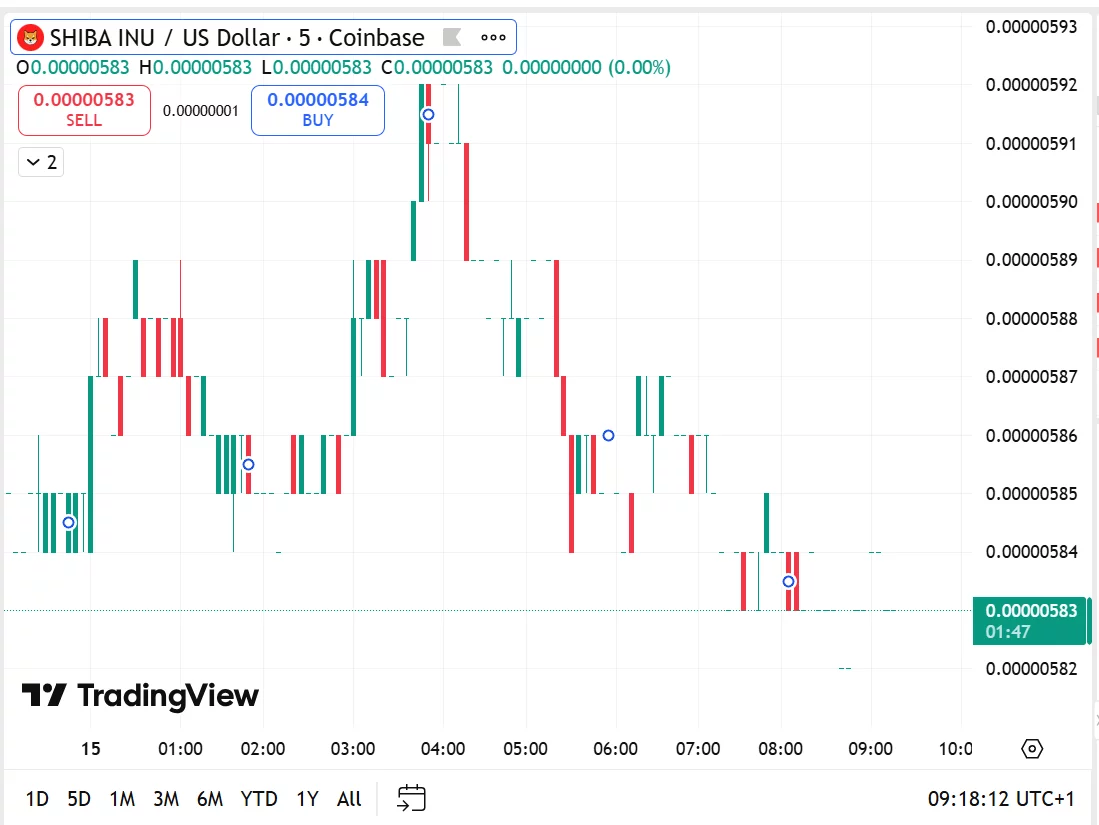
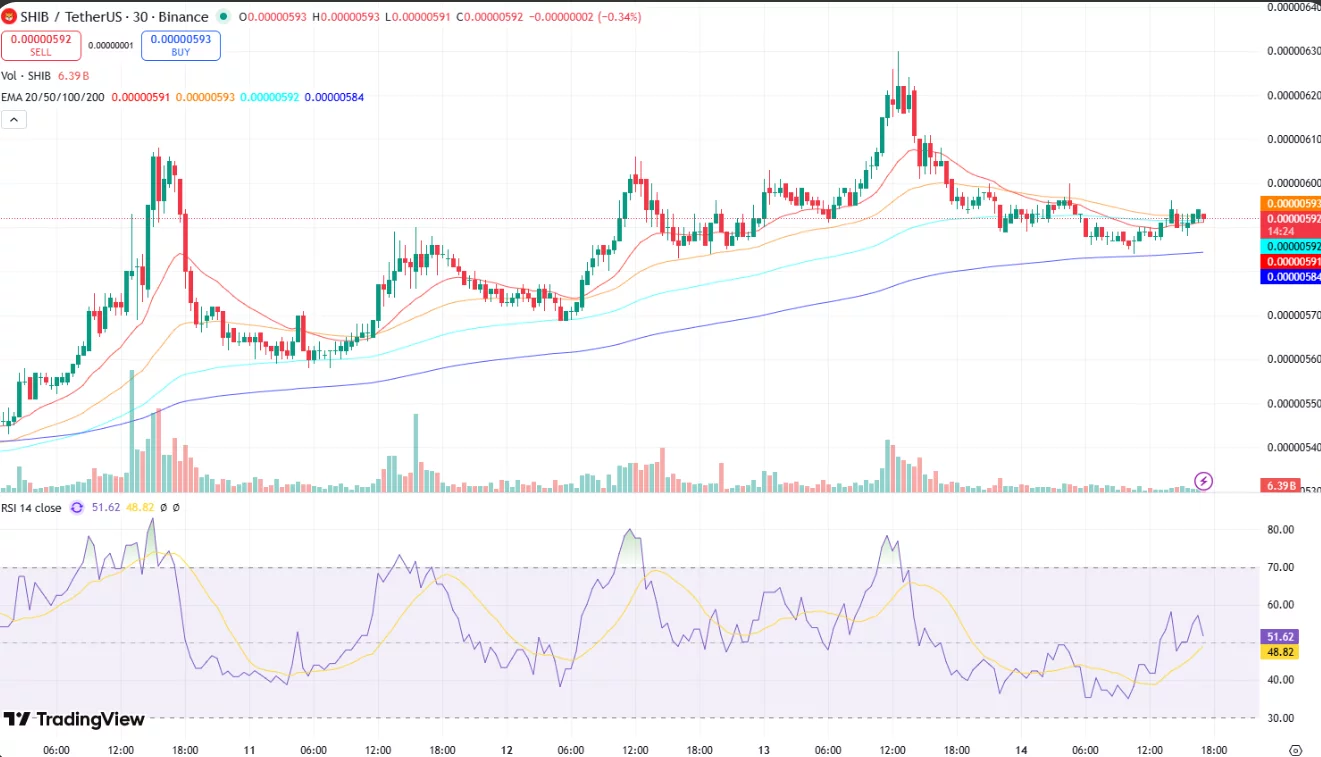
A detailed SHIB technical analysis on CoinMarketCap from analyst @cexscan describes the Shiba Inu price as exhibiting neutral to slightly bullish short-term sentiment. The SHIB price is trying to go up by breaking the consolidation phase, but the overall trend is still unclear. The buying and selling pressure is at the same level. The Shiba Inu coin price is still unclear.
The news regarding the Shiba Inu token has been revolving around the development of the Shibarium network. The Shibarium network is considered to be the Layer 2 network of the Shiba Inu coin.
The transactions on the Shibarium network are cheaper compared to the Ethereum network. The Shiba Inu token has been having on-chain activity since the launch of the Shibarium network.
The ShibaSwap exchange provides the decentralized exchange component of the Shiba Inu coin. The staking of the SHIB coin is also possible. The Shiba Inu coin has seen the development of the network compared to other meme coins. The SHIB price is still largely dependent on the overall meme coin market.
Bonk Coin: What the BONK token offers
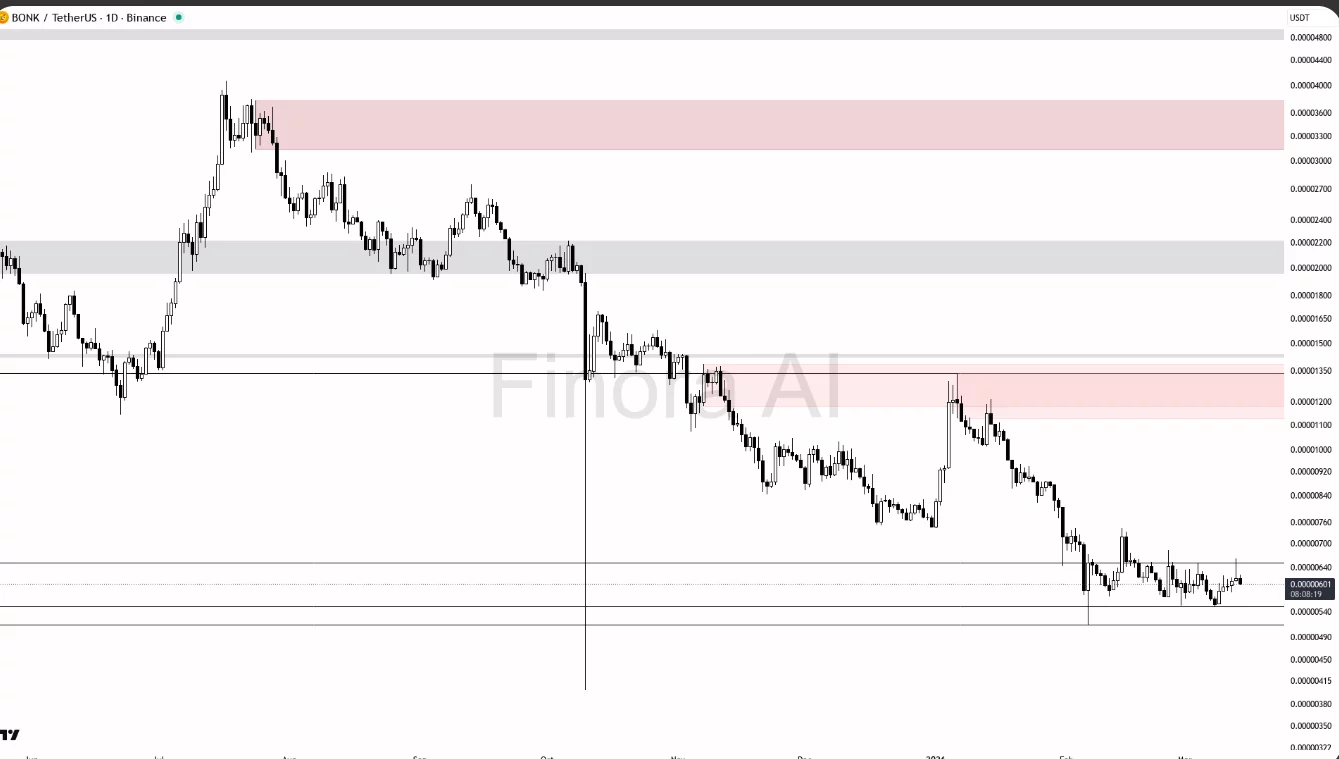
Bonk is priced at $0.00000599, down 1.09% over 24 hours. The Bonk market cap stands at $525.66 million, with trading volume at $39.59 million, down 57.92%.
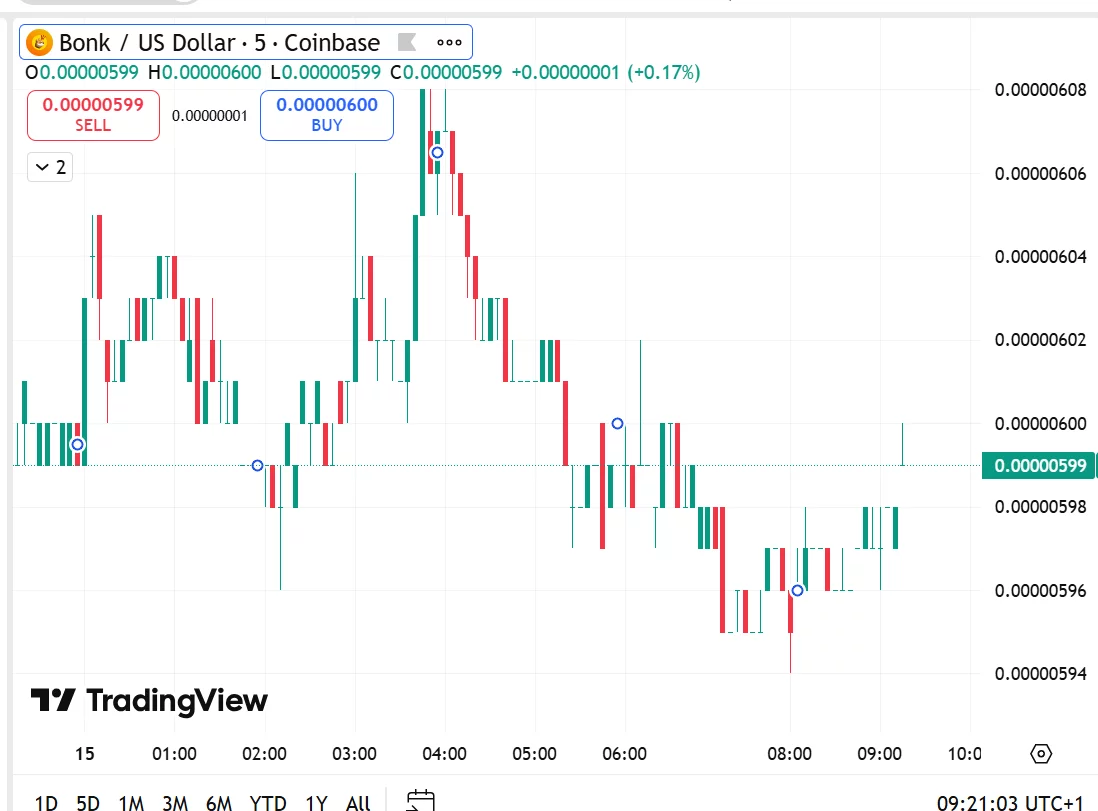
A BONK technical overview on CoinMarketCap identifies a potential move higher from the current base zone, with a target toward $0.00000621 if bullish indicators continue to develop.
The analyst notes that a sweep below the lower support zone, followed by a clear rejection, would represent the safest entry confirmation. However, there are risks if the price goes below the $0.00000514 level.
Bonk was founded as a token based on the Solana blockchain and focused on offering low gas fee alternatives within the Solana ecosystem. The tokenomics were based on the distribution of the token to the Solana community rather than the allocation of funds through the venture capital route.
Bonk has since been integrated into various Solana-based dApps and decentralized exchanges, adding some functional utility. Liquidity on Bonk has been variable, and like most meme coins, its price action is more correlated with crypto market sentiment than with measurable product adoption.
Why Remittix leads on real utility
Remittix operates in an entirely different category. The project is not built on community speculation or meme culture. It is built to solve a specific, measurable problem: moving money across borders using cryptocurrency, without requiring the recipient to hold or manage digital assets.
The Remittix wallet is live on the Apple App Store, allowing users to store, send, and manage over 40 cryptocurrencies today. The next phase brings crypto-to-fiat functionality, enabling direct transfers to bank accounts in more than 30 countries with real-time FX conversion.
This targets the $19 trillion global payments market, a sector where blockchain technology has faced significant adoption barriers due to friction and complexity. Remittix is designed to remove both.
The project has raised $29.7 million in private funding, with RTX priced at $0.13 per token. It holds a CertiK number one ranking for pre-launch tokens, with the team fully KYC verified on CertiK Skynet.
Listings on BitMart and LBank are confirmed for the token launch, and crypto investors tracking RTX ahead of its exchange debut are pointing to it as one of the best altcoins to buy now among projects with confirmed product milestones before their token goes live.

What separates Remittix from meme tokens:
- Live wallet on App Store, real product available today
- Crypto-to-bank payments in 30+ countries at launch
- Supports 40+ cryptocurrencies with real-time FX conversion
- CertiK audited, team fully KYC verified
- $29.7M raised from private funding, token sale closing
Utility wins the long game
Shiba Inu coin and Bonk have both demonstrated that community energy can sustain a token through multiple market cycles. SHIB price and BONK price movements continue to attract traders who understand meme coin dynamics.
Remittix occupies a separate space entirely for those seeking crypto with real utility, a working product, and infrastructure designed for mass adoption. The token sale is in its final stretch, and the project enters its exchange debut with a live wallet, a verified team, and confirmed listings already secured.
For more information, visit the official website or socials.
Disclosure: This content is provided by a third party. Neither crypto.news nor the author of this article endorses any product mentioned on this page. Users should conduct their own research before taking any action related to the company.
Key takeaways
-
A temporary 2.85% pricing discrepancy in wstETH collateral triggered about $27 million in liquidations on Aave, showing how even small technical issues can have major financial consequences in automated DeFi lending systems.
-
The liquidation wave occurred because Aave’s system briefly valued wstETH at about 1.19 ETH instead of its market value near 1.23 ETH, making some borrowing positions appear undercollateralized.
-
Price oracles are critical infrastructure in DeFi because they feed external market data to smart contracts, determining collateral values, loan health and when automated liquidations should occur.
-
The root cause was not a faulty price feed but a misconfiguration in Aave’s CAPO risk oracle system, where outdated smart contract parameters created a temporary cap on the token’s exchange rate.
Decentralized finance (DeFi) protocols use automated logic to handle everything from collateral management to risk assessment. While this setup enables a truly open and permissionless financial system, it also means that minor technical issues can snowball into significant financial disruptions.
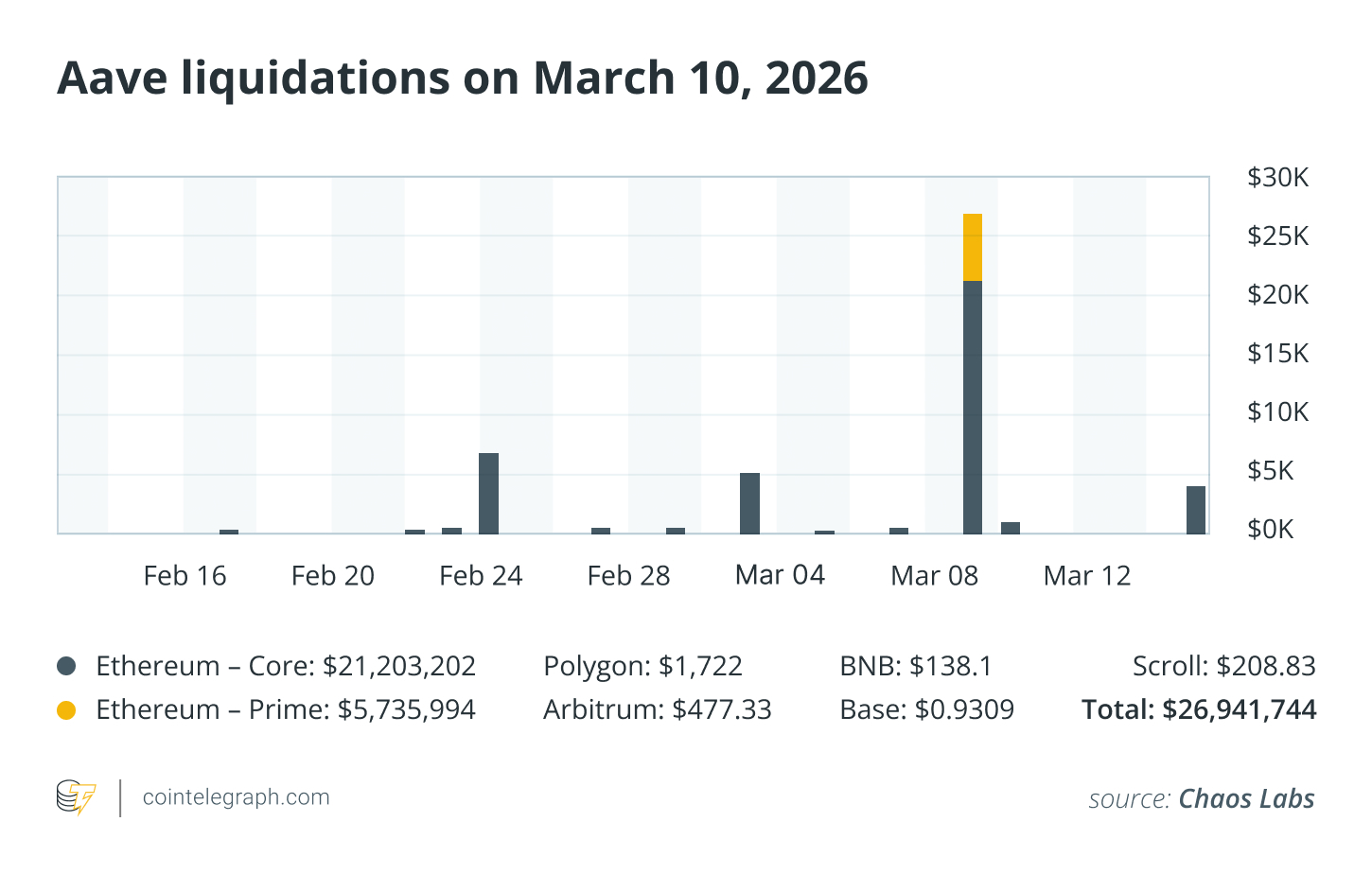
According to risk monitoring firm Chaos Labs, a market downturn on March 10, 2026, triggered approximately $27 million in liquidations for Aave borrowers, clearly illustrating this vulnerability. In a single 24-hour window, approximately $27 million in user positions were liquidated. Surprisingly, this was not caused by a massive market sell-off but by a brief 2.85% price discrepancy affecting wrapped staked ETH (wstETH) collateral.
This event serves as a stark reminder of how critical price oracles and robust risk management frameworks are to the stability of the DeFi ecosystem.
The article explains how a 2.85% pricing discrepancy in wstETH collateral triggered about $27 million in liquidations on the Aave lending protocol. It highlights how oracle configurations, smart contract parameters and automated liquidation mechanisms can amplify small pricing errors in DeFi markets.
A sudden surge in liquidations
When a wave of liquidations occurred across Aave markets, Chaos Labs, which tracks lending protocols for unusual activity, quickly identified and flagged the surge. Early speculation among observers pointed to a possible malfunction in the price oracles, which may have mispriced collateral assets on the platform.
Price oracles serve as critical bridges, supplying external market prices to onchain applications. In lending protocols like Aave, these feeds determine whether a borrower’s collateral still sufficiently covers their loan. When the collateral value falls below the required threshold, the system triggers the automatic liquidation of the position.
The asset at the center of this event was wstETH, a token commonly used as collateral across DeFi lending ecosystems.
Did you know? Liquidations on lending protocols like Aave often happen faster than traditional margin calls. Because DeFi markets operate 24/7 through automated smart contracts, positions can be liquidated within seconds once collateral ratios fall below the required thresholds.
What is wstETH?
wstETH, or wrapped staked Ether (ETH), is a token issued through the Lido protocol, a leading liquid staking protocol.
When users stake Ether via Lido, they initially receive stETH, which represents their staked ETH plus accrued staking rewards. To improve compatibility with various DeFi applications, stETH can be wrapped into wstETH.
Due to the ongoing accumulation of staking rewards, one wstETH generally holds a value slightly above one ETH. This makes it a particularly attractive and widely adopted form of collateral in DeFi lending markets.
The pricing discrepancy
During the liquidation wave, a mismatch appeared between wstETH’s actual market value and the valuation applied by Aave’s risk system. Aave’s algorithm priced wstETH at approximately 1.19 ETH, whereas the broader market valued it closer to 1.23 ETH.
This roughly 2.85% difference caused positions collateralized by wstETH to appear more undercollateralized than they actually were.
As a result, certain borrowing positions fell below their required safety thresholds, triggering Aave’s automated liquidation process.

Why price oracles are critical in DeFi
Price oracles are essential infrastructure in DeFi. Blockchains cannot natively fetch real-world market data, so oracle services supply external price feeds for assets. These feeds directly influence:
A reported drop in collateral price can lead the protocol to deem a loan insufficiently backed, prompting the automatic liquidation of the position.
Because this mechanism operates algorithmically, even minor pricing deviations can cascade into substantial consequences.
Did you know? A small price discrepancy can have outsized effects in DeFi. Even a brief deviation in an oracle or market price of just a few percent can trigger cascading liquidations. This is especially true when many borrowers use highly leveraged positions backed by volatile crypto collateral.
The real cause: CAPO risk-oracle misconfiguration
Deeper analysis confirmed that Aave’s primary price oracle was operating normally.
The root issue instead lay in the correlated assets price oracle (CAPO) risk oracle module, an additional protective layer applied to select assets.
CAPO is specifically designed to cap the rate at which the value of yield-bearing tokens like wstETH can rise. This safeguard helps protect the protocol against abrupt price surges or potential oracle exploits.
In this case, however, a configuration inconsistency within CAPO triggered the problem.
Technical breakdown of the error
Chaos Labs disclosed that the fault originated from outdated parameters stored in a smart contract.
Two key values had fallen out of alignment:
Because these were not refreshed in tandem, CAPO computed a temporary ceiling on the allowable exchange rate that sat below the prevailing market value.
This caused the protocol to undervalue wstETH by approximately 2.85% relative to its prevailing market price.
Did you know? Aave relies on price oracles, which are data feeds that supply real time asset prices to smart contracts. If these feeds briefly reflect unusual market prices from exchanges, the protocol automatically recalculates collateral values and may trigger liquidations.
The liquidation cascade
As soon as collateral ratios fell below the required thresholds, Aave’s automated liquidation engine activated.
Liquidators, typically high-speed trading bots, stepped in by repaying a portion of the borrower’s debt and, in return, acquiring the underlying collateral at a built-in discount.
Across the event, roughly $27 million in borrowing positions were liquidated.
Liquidators ultimately extracted around 499 ETH in combined profits and liquidation bonuses, capitalizing on the short-lived pricing misalignment.

No bad debt incurred by the protocol
Even with the volume of liquidations, Aave remained at zero bad debt. Aave founder Stani Kulechov stated that there “was no impact to the Aave Protocol.”
Chaos Labs said the platform’s core risk and liquidation mechanisms functioned as designed once positions breached their thresholds. Once positions breached their safety thresholds, liquidations proceeded according to design.
The disruption therefore remained confined to affected individual borrowers and did not threaten the protocol’s overall solvency or stability. The resulting artificial depression in collateral value pushed several borrowing positions below their liquidation thresholds.
Aave governance proposed compensating affected users through refunds funded by recoveries and decentralized autonomous organization (DAO) treasury support. This approach aligns with a shifting pattern in DeFi governance, where protocols increasingly view technical incidents as systemic infrastructure risks. They may move to compensate impacted users rather than leave them to bear permanent losses.
A reminder of oracle risk in DeFi
The event underscores that oracle design remains one of the most vital and vulnerable elements of DeFi infrastructure.
Even minor configuration mistakes can trigger outsized consequences when automated mechanisms oversee billions of dollars in collateral value.
Comparable episodes have occurred on other DeFi platforms. For example, a misconfigured oracle once temporarily valued Coinbase’s wrapped staked ETH (cbETH) at around $1 instead of approximately $2,200, sparking widespread disruption.
Such cases highlight the ongoing challenges of maintaining reliable, accurate price feeds in decentralized financial systems.
wstETH and Lido were not responsible
Contributors from the Lido ecosystem made it clear that the liquidations did not stem from any malfunction or flaw in wstETH itself.
The token operated normally throughout the event, and the underlying Lido staking protocol remained fully functional and unaffected.
The primary issue appears to have stemmed from how the Aave lending protocol processed and interpreted price data through its own risk management configuration.
Lessons for the future of DeFi
As decentralized finance continues to scale, protocols are incorporating increasingly sophisticated risk management systems to accommodate yield-bearing assets such as wstETH.
These assets present unique pricing challenges because their value increases steadily over time through accumulating staking rewards.
Effective risk models must therefore properly handle:
Even minor misalignments in these elements can escalate into widespread liquidation events.
Cointelegraph maintains full editorial independence. The selection, commissioning and publication of Features and Magazine content are not influenced by advertisers, partners or commercial relationships.


Crypto investment products recorded $1.06 billion in inflows last week, even as geopolitical stress tied to tensions in the Middle East continued to weigh on broader financial markets.
Summary
- Crypto investment products recorded $1.06 billion in inflows last week, extending a three-week run of positive flows despite geopolitical tensions in the Middle East.
- Bitcoin led with $793 million in inflows, while Ethereum attracted $315 million.
- U.S. spot Bitcoin ETFs have posted their first five-day inflow streak of 2026.
Per a CoinShares report published Monday, crypto investor reaction to tensions in the Middle East appears relatively measured, as digital asset investment products have now recorded a three-week run of positive flows.
In total, the past three weeks have brought in $2.7 billion in inflows, driving net inflows to around $1.2 billion year to date. Meanwhile, total assets under management in digital asset ETPs have also risen 9.4% to nearly $140 billion, according to CoinShares head of research James Butterfill.
With the latest inflows, Bitcoin ETPs have pushed year-to-date gains to $933 million, while Ethereum funds are still in the red with around $23 million in outflows year to date, despite $315 million in inflows last week.
Butterfill noted that the latest data highlights Bitcoin’s “resilience during geopolitical stress” and reinforces its role “as a relative safe haven.”
XRP suffered the most outflows among major assets, totaling $76 million, while Solana recorded $9.1 million in inflows.
Short Bitcoin products also recorded inflows of $8.1 million, suggesting investor positioning remains “somewhat polarized.”
Most of the inflows came from the United States, where spot Bitcoin ETFs recorded their first five-day inflow streak of 2026 last week, attracting $767.3 million.
As such, it appears that institutional investors are primarily favoring Bitcoin over higher beta altcoins during periods of uncertainty.
Separate data tracking U.S. spot crypto ETFs also pointed to similar trends. Spot Bitcoin funds recorded $767 million in net inflows, while spot Ethereum ETFs drew $161 million.
In the meantime, Bitcoin price has climbed above the $73,000 threshold after recovering from local lows near $60,000 earlier this month.
This renewed support from institutional investors, along with a resurgence in risk sentiment following the initial shock of the Middle East conflict as investors rotate back into crypto markets while oil prices surge, appears to be supporting the latest rally.
Analysts suggest that the trend is being reinforced by the digital gold narrative, as traditional equity and commodity markets continue to face volatility tied to tensions in the Middle East.
Looking ahead, the market is closely monitoring the $74,000 to $74,500 range, which currently serves as a critical resistance zone. A decisive close above this level could position Bitcoin for a rally higher.
Meanwhile, on the downside, maintaining the $70,000 to $71,500 support region remains essential for preserving the current bullish structure and preventing a retracement toward earlier monthly lows.
Bitcoin achieved new six-week highs at the week’s first Wall Street open, but analysis stayed risk-off, arguing that the long-term BTC price downtrend was still in place.
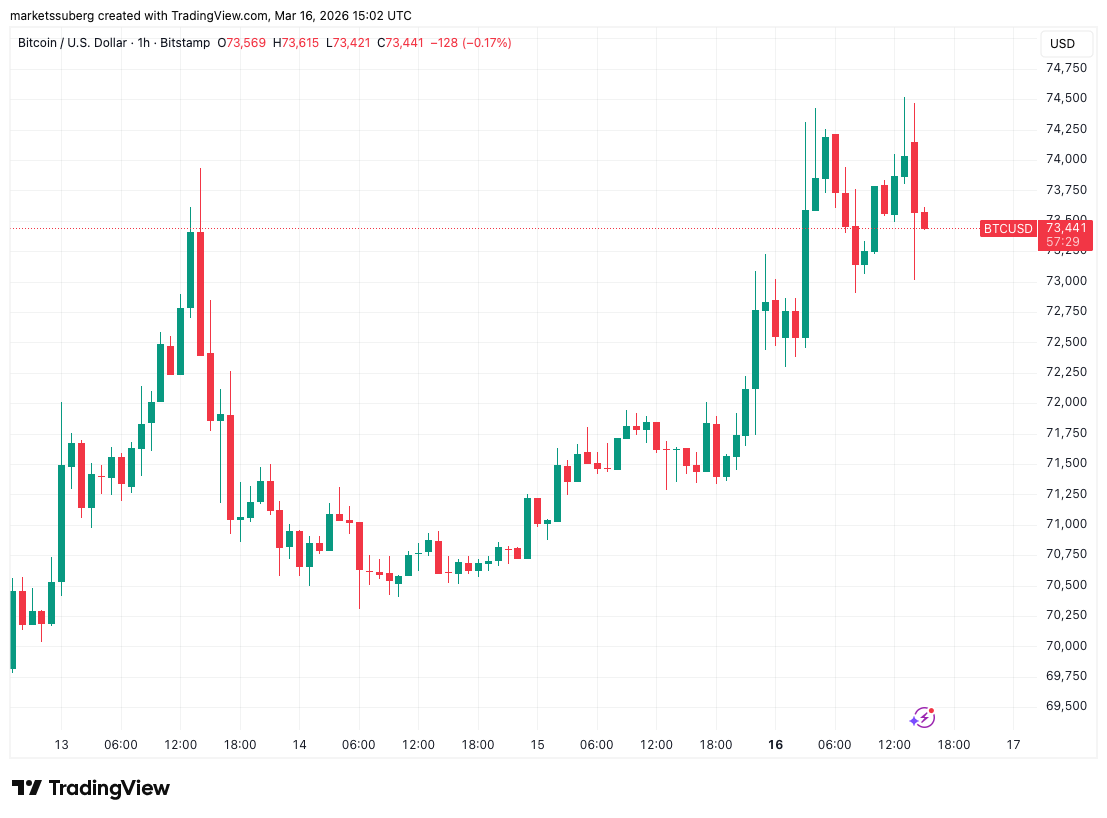
Bitcoin (BTC) hit $74,600 at Monday’s Wall Street open as US stocks gained on Iran war deescalation signals.
Key points:
-
Bitcoin sets another local high near $75,000 after a solid weekly close reclaimed key trend lines.
-
Oil and gold both decline as tensions over the Strait of Hormuz ease slightly.
-
Bitcoin traders are in no mood to trust the current “relief bounce.”
BTC price rises with stocks amid oil pressure
Data from TradingView showed new six-week highs for Bitcoin while stocks opened up 1.5% as oil and gold fell.

Geopolitical headlines steered market moves, with the US saying that it would allow Iranian oil tankers through the Strait of Hormuz. Previously, President Donald Trump pledged to coordinate efforts to reopen the key oil shipping route fully.

As a result, WTI crude oil fell below $100 per barrel, while gold retested the $5,000 mark as support, meeting its 50-day simple moving average (SMA) for the first time since early February.
“BTC and ETH have pushed above $74k and $2,270 respectively, while equities and gold remain under pressure,” trading company QCP Capital wrote in its latest “Market Color” analysis.
“If this pattern persists, it would be a late-quarter plot twist, given crypto’s underdog status and its familiar habit of correlating with traditional assets mostly on the way down.”

QCP mentioned the concept of Bitcoin as a competitor for gold during periods of uncertainty.
“Recent price action suggests the narrative of BTC as a ‘digital safe haven’ or ‘geopolitical hedge’ may be resurfacing, with markets stress-testing that thesis in real time,” it added.
Traders still skeptical on Bitcoin “relief bounce”
After an impressive weekly close, BTC/USD regained key trend lines as support, but traders remained concerned that the latest breakout attempt could collapse.
Related: $58K BTC price still in play? Five things to know in Bitcoin this week
“Longer relief bounce than expected, but in the grand scheme of things – it changes nothing,” trader Jelle wrote in his latest market commentary on X.
“Happily buy a higher low if I’m proven wrong, but until then; patiently waiting for lower prices.”

Jelle added that history demanded continuation of the current bear market to match standard BTC price cycle behavior.
Bull and bear markets have historically lasted similar amounts of time.
If that pattern repeats, we’re not even halfway through this bear market.
Is this time different? $BTC pic.twitter.com/sT7uV4AFE6
— Jelle (@CryptoJelleNL) March 16, 2026
Trader Daan Crypto Trades focused on the latest “gap” in CME Group’s Bitcoin futures created over the weekend near $71,500.
“Good to keep an eye on in case price starts trading into that area. This level also roughly lines up with the range high,” he told X followers about the latest trip past $74,000.
“So as always, not a given that price gets there, but if it does, it’s often good to watch as it can act as a local reversal zone.”

This article does not contain investment advice or recommendations. Every investment and trading move involves risk, and readers should conduct their own research when making a decision. While we strive to provide accurate and timely information, Cointelegraph does not guarantee the accuracy, completeness, or reliability of any information in this article. This article may contain forward-looking statements that are subject to risks and uncertainties. Cointelegraph will not be liable for any loss or damage arising from your reliance on this information.
Crypto World
Australian Senate committee backs digital assets regulatory framework: Senate Economics Legislation Committee


Australia’s Senate Economics Legislation Committee has endorsed proposed legislation to modernize the country’s digital assets regulatory framework.
Australia’s Senate Economics Legislation Committee has backed a proposed legislative framework to modernize digital assets regulation, according to a report published Monday. The committee stated that the new framework will strengthen the regulatory environment for cryptocurrency and digital asset markets in the country.
The endorsement builds on Australia’s prior efforts to establish robust anti-money laundering and counter-terrorism financing (AML/CTF) rules for crypto-assets. The committee has previously recommended introducing new regulatory standards for custody arrangements of digital assets, reflecting ongoing efforts to enhance consumer protection and market integrity in digital asset markets.
Sources: ASIC
This article was generated automatically by The Defiant’s AI news system from publicly available sources.
Crypto World
SEC dismisses civil fraud case against BitClout founder Nader Al-Naji: U.S. Securities and Exchange Commission


The SEC has closed its civil enforcement lawsuit against DeSo creator Nader Al-Naji, ending a case that accused him of wire fraud and selling unregistered securities.
The Securities and Exchange Commission has dismissed its civil lawsuit against Nader Al-Naji, founder of BitClout and the DeSo blockchain, according to a filing on Monday. The regulator ended the enforcement action that had accused Al-Naji of wire fraud and selling unregistered cryptocurrency securities.
The SEC initiated the civil case against Al-Naji in July 2024 as part of a $257 million enforcement action. The dismissal marks a significant development in the regulator’s approach to crypto project founders and decentralized network creators, following months of litigation over allegations that BitClout was misrepresented to investors.
Sources: Court Filing
This article was generated automatically by The Defiant’s AI news system from publicly available sources.
Ironlight Group has raised $21 million in a Series A round to expand infrastructure for tokenized securities, including scaling its alternative trading system (ATS) and technology platform for issuing, distributing and trading digital securities.
The privately held company said the round included backing from institutional investors and financial services executives, led by former TD Bank President and CEO Greg Braca, along with the Sei Development Foundation.
The funds will be used to expand Ironlight’s marketplace infrastructure for tokenized assets, including the Ironlight Markets alternative trading system and its settlement platform. The company operates a broker-dealer and alternative trading system for digital and traditional securities under SEC Regulation ATS and FINRA oversight.
Austin, Texas-based Ironlight said its platform is designed to support tokenized securities across asset classes including private equity, fixed income, structured products, private credit and real estate, with blockchain-based settlement intended to streamline post-trade processes for institutional investors and wealth advisers.
The company added that the capital will support further development of its marketplace as tokenized securities gain traction across private markets and alternative assets.
Related: Metaplanet raises $255M and adds warrant structure for Bitcoin buys
Sei Foundation broadens ecosystem initiatives
The Sei Development Foundation, which participated in the funding round, launched in 2025 as a US-based nonprofit supporting adoption of the Sei blockchain network. Funded by the Sei Foundation, the New York-based organization supports developers through funding programs, education initiatives and ecosystem partnerships.
In March 2025, the Sei Foundation said it was exploring a potential acquisition of genetic testing company 23andMe following its bankruptcy filing, proposing that the company’s genetic data could be placed on blockchain infrastructure to give users greater control over their information. The proposal did not materialize into a deal.
The foundation has also pursued partnerships around blockchain infrastructure. In February, Nasdaq-listed AIxCrypto announced a strategic technology arrangement with the Sei Development Foundation to explore integrations combining artificial intelligence and blockchain systems.
In the first quarter of 2026, Bhutan’s sovereign wealth fund, Druk Holding and Investments (DHI), said it would deploy and operate a validator on the Sei network in collaboration with the Sei Development Foundation as part of the country’s digital transformation efforts.
Sei is a layer-1 blockchain launched in 2023 that focuses on infrastructure for decentralized applications and digital asset trading. The network is backed by investors including Multicoin Capital, Jump and Coinbase Ventures.
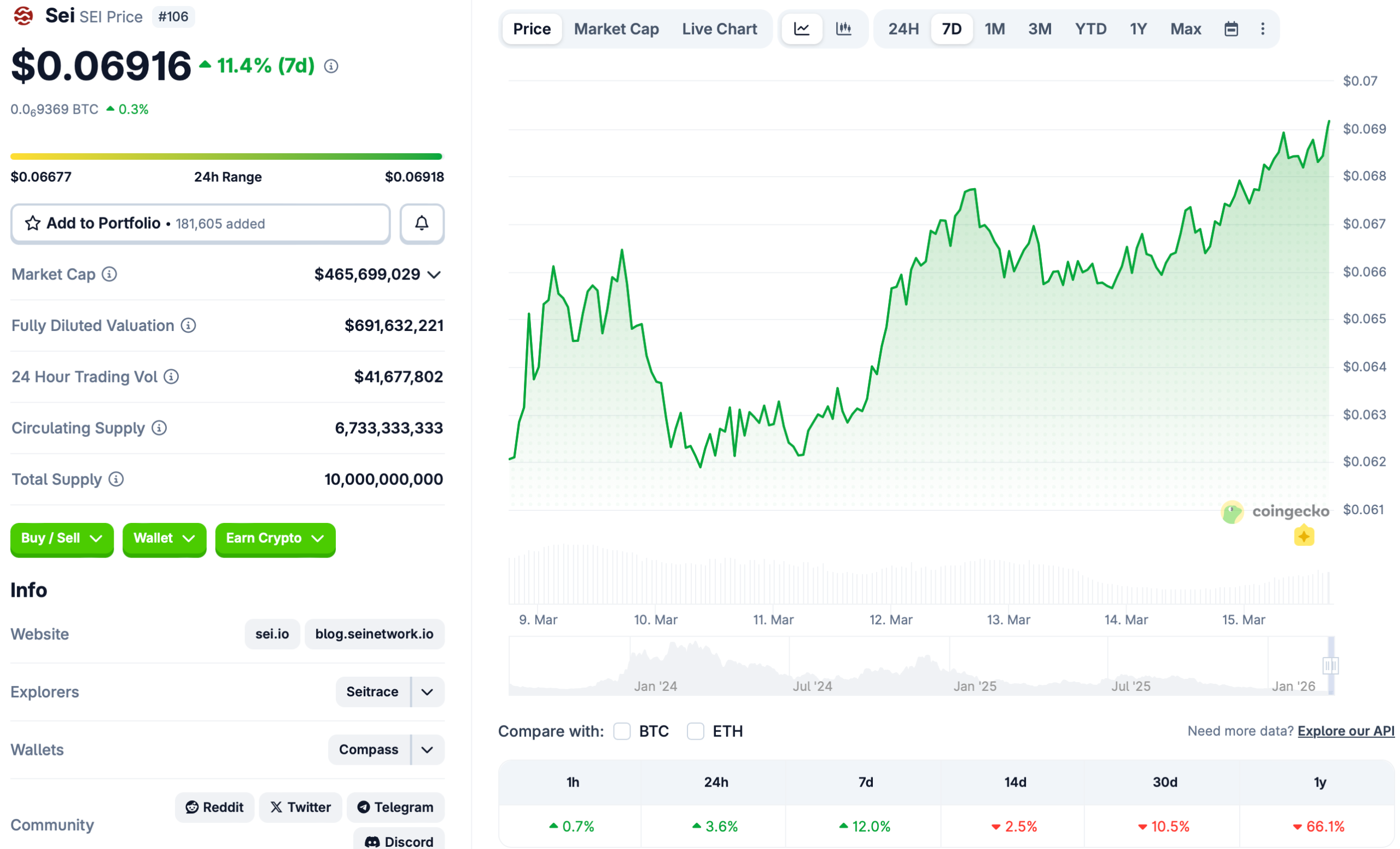
Data from CoinGecko shows the price of SEI (SEI) at about $0.069, up about 11% over the past seven days, giving the token a market capitalization of around $465 million. The token’s value peaked above $0.37 in mid-2025.

Magazine: The debate over Bitcoin’s four-year cycle is over: Benjamin Cowen
Three Nations Unite in Operation Atlantic Against Crypto Wallet Thieves

Sci-Fi Icon Jerry O’Connell Admits To Physical Abuse By His Wife And Daughters Over His Politics

Capitals are ushering in a youth movement on the fly as they prepare for life after Alex Ovechkin


-
 Tech6 days ago
A 1,300-Pound NASA Spacecraft To Re-Enter Earth’s Atmosphere
-
Crypto World3 days ago
HYPE Token Enters Net Deflation as HyperCore Buybacks Outpace Staking Rewards
-

 Business6 days ago
ExxonMobil seeks to move corporate registration from New Jersey to Texas
-

 Fashion3 days ago
Weekend Open Thread: Addict Lip Glow
-

 Tech6 days ago
ChatGPT will now generate interactive visuals to help you with math and science concepts
-
Sports2 days ago
Why Duke and Michigan Are Dead Even Entering Selection Sunday
-

 NewsBeat5 days ago
Residents reaction as Shildon murder probe enters second day
-

 Business6 days ago
Search Enters Sixth Week With New Leads in Tucson Abduction Case
-

 Business1 day ago
Search for Savannah Guthrie’s Mother Enters Seventh Week with No Arrests
-

 Business3 days ago
US Airports Launch Donation Drives for Unpaid TSA Workers as Partial Government Shutdown Enters Fifth Week
-

 NewsBeat5 days ago
I Entered The Manosphere. Nothing Could Prepare Me For What I Found.
-
Crypto World2 days ago
Coinbase and Bybit in Investment Talks: Could Bybit Finally Enter the US Crypto Market?
-

 Business3 days ago
Country star Brantley Gilbert enters growing non-alcoholic beer market
-

 Sports5 days ago
PWHL, Senators discussing plan to keep Charge in Ottawa
-

 Business15 hours ago
Australian shares drop as Iran war enters third week
-

 Crypto World6 days ago
Will Chainlink price reclaim $10 amid volatility squeeze?
-

 Sports3 days ago
College Basketball Best Bets: Conference Tournament Semifinal Picks
-

 Crypto World15 hours ago
Crypto Lender BlockFills Enters Chapter 11 with Up to $500M in Liabilities
-

 Politics6 days ago
Trump Says Middle East Is ‘Very Lucky’ That He’s President
-
 Crypto World5 days ago
Three Binance Charts May Be Hinting at Bitcoin’s Next Move


You must be logged in to post a comment Login