
Crypto World
BlackRock and Partners Group Launch Joint Private Markets Account for Wealthy Investors


TLDR:
- BlackRock and Partners Group created the first US account combining multiple private asset classes in one.
- Three portfolio options available: income-oriented, balanced growth, and growth-focused for different risks.
- The account invests across seven funds from BlackRock, HPS Investment Partners, and Partners Group combined.
- Partners Group manages $56 billion in evergreen funds while BlackRock oversees $250 billion in separate accounts.
BlackRock Inc. and Partners Group Holding AG have introduced their first collaborative private-markets investment product through Morgan Stanley’s wealth platform.
The separately managed account offers exposure to private equity, private credit, and real assets in a single vehicle.
This marks the first US product enabling clients to access multiple private market segments through one account. The offering targets wealthy individuals as institutional investors reduce private market allocations.
Structured Investment Options for Diverse Risk Appetites
The new separately managed account provides three distinct portfolio configurations tailored to different investor objectives. According to Jon Diorio, BlackRock’s head of alternatives for its US wealth business, clients can select from income-oriented, balanced, or growth-focused variations.
Each configuration draws from seven existing funds managed by BlackRock, HPS Investment Partners, and Partners Group. The structure aims to make it “easier and more convenient and more simplified for advisers to do private markets,” Diorio said.
The product charges fees only on the underlying funds, with no additional fees at the account level. The firms declined to disclose specific fee amounts for the underlying investments.
This fee structure represents a departure from typical separately managed account arrangements. The approach reflects efforts to make private market investments more accessible to wealth management clients.
Rob Collins, co-head of private wealth at Partners Group, noted the account’s unique position in the market. Collins explained that the offering “is the only separately managed account that combines more than one private asset class.”
BlackRock contributes its separately managed account expertise, while Partners Group brings experience with evergreen fund structures. The partnership leverages each firm’s core competencies in wealth management and alternative investments.
The collaboration between BlackRock and Partners Group began in 2024 with plans for this private portfolio offering. Since the partnership’s formation, BlackRock has expanded its private markets capabilities significantly.
The firm acquired HPS Investment Partners for $12 billion, strengthening its position in private credit markets. This acquisition enhances the resources available for the jointly managed account.
Market Dynamics Driving Wealth-Focused Product Development
Asset managers face shifting demand patterns as institutional investors reassess private market commitments. Pensions and endowments have reduced allocations to new private investments in recent periods.
This trend has prompted traditional and alternative managers to target wealthy individuals more aggressively. The competition for wealth management distribution has intensified across the industry.
Partners Group manages approximately $56 billion in evergreen fund assets under management. These open-ended perpetual vehicles allow investors greater flexibility in buying and selling positions.
The structure addresses liquidity concerns that often accompany traditional private market investments. BlackRock operates a broader separate-account business managing roughly $250 billion in total assets.
The Morgan Stanley wealth platform provides distribution infrastructure for the new product. Morgan Stanley‘s adviser network gives BlackRock and Partners Group access to high-net-worth and ultra-high-net-worth clients.
The platform integration streamlines the investment process for advisers recommending private market exposure. This distribution partnership proves essential for reaching the target investor base.
The jointly managed account represents a strategic response to changing market conditions. Asset managers must adapt their product offerings as traditional institutional funding sources contract.
Wealthy individuals represent a growing opportunity for private market strategies. The BlackRock-Partners Group collaboration exemplifies industry efforts to tap this expanding market segment through innovative product structures.



Bitcoin’s bear market has been framed by a familiar prism: the traditional four-year cycle. Yet proponents argue that institutional demand, particularly via BTC-focused exchange-traded funds, has muted volatility and may shape the path of prices through the next cycle. In a recent discussion, Anthony Scaramucci, managing partner of SkyBridge, suggested that while the cycle remains visible, its dynamics have been altered by new liquidity channels and changing market participation.
Speaking with Scott Melker on The Wolf of All Streets podcast, Scaramucci described the four-year pattern as “muted” by ETF inflows that have helped cushion sharp swings. “We’re in a four-year cycle, and there were some traditional whales, some OGs, that believe in the four-year cycle, and guess what happens in life when you believe in something? You create a self-fulfilling prophecy,” he said. The implication is that market psychology and the presence of ETFs have tempered the classic boom-bust rhythm that many investors associate with BTC.
Looking ahead, Scaramucci warned that BTC is likely to remain choppy for most of the year, with a renewed bull market emerging in the fourth quarter of 2026. He noted that the broader market narrative at the time had shifted away from a straightforward ascent toward a more nuanced trajectory, where macro and policy factors would matter just as much as on-chain signals.
The conversation also touched on the expectations that had circulated in late 2024 and early 2025. Market participants, including Scaramucci, had anticipated BTC could surge toward around $150,000 in 2025, driven by broad political momentum and regulatory openness in the United States. That consensus was upended by a sharp October downturn that pulled BTC from a prior peak to a much lower range, underscoring how quickly sentiment can swing in crypto markets.
History has repeatedly shown that price movements often defy prevailing sentiment. Scaramucci pointed to the early 2023 period, when BTC’s price action moved contrary to bright-eyed forecasts in the wake of the FTX collapse in November 2022. After a period of disinterest and malaise, the market reversed into a new upcycle, illustrating how catalysts can reset the mood even when the broader narrative appears unfavorable.
Key takeaways
- The four-year cycle remains a reference framework for BTC, but ETF inflows have muted its volatility and potentially altered how the cycle plays out.
- BTC is expected to experience choppy trading through much of this year, with the next major leg higher anticipated in the fourth quarter of 2026.
- Market expectations for a 2025 surge to around $150,000 were fueled by pro-crypto policy signals and regulatory warming, but an October crash shattered that consensus.
- Historical reactions show BTC can rebound after episodes of apathy or negative catalysts, reinforcing the idea that macro shocks and sentiment swings remain powerful drivers.
- Geopolitical developments and stock-market dynamics can influence BTC through correlations with risk assets, underscoring the need to monitor macro risk sentiment alongside on-chain activity.
The cycle, ETFs, and the evolving market backdrop
In the eyes of Scaramucci, the presence of BTC-focused exchange-traded funds has changed the game. ETFs offer a new, regulated channel through which institutional players can gain exposure, potentially dampening sharp drawdowns and tempering the kind of volatile spikes that once defined BTC cycles. This shift does not erase the cycle’s specter, but it reframes it—turning a potentially binary up- or down-market into a more nuanced, information-rich environment in which policy signals and fund flows matter as much as supply-demand fundamentals.
That framing sits alongside long-standing debates within the crypto industry about whether the four-year cycle remains intact. While some observers point to deviations in late 2025 or 2026, others, including Scaramucci, argue that the cycle still offers a useful heuristic for investors trying to gauge risk, duration, and potential turning points. The market’s sensitivity to events such as regulatory announcements, ETF inflows, or major macro shocks continues to complicate any simple forecast.
From peak to pause: how catalysts have shifted the narrative
The historical arc cited by Scaramucci stretches from BTC’s all-time run toward lofty levels to the subsequent retrenchment that has colored investor psychology for years. The narrative notes that BTC once traded near the upper stratosphere—around a $126,000 range in prior cycles—before the October pullback. From there, the price retraced to the $60,000 area, highlighting how quickly sentiment can reverse and the importance of liquidity and risk appetite in determining the price path.
Beyond these cycles, the market’s reaction to external shocks—such as the FTX collapse in late 2022—has underscored a pattern: even after periods of disillusionment, bitcoin has demonstrated resilience, often resuming an uptrend when investor interest returns and liquidity improves. The early months of 2023, in particular, showed that upside moves can unfold despite a broader backdrop of skepticism or unfavorable headlines.
Another facet of the discussion centers on whether 2025 and 2026 would deliver a fresh bull phase. While the consensus among several participants had anticipated a robust climb in 2025, the trajectory was interrupted by the October downturn and broader risk-off dynamics. The question remains whether the market will reassert its longer-term cycle or whether a new regime—shaped by macro policy, regulatory clarity, and global liquidity—will redefine BTC’s pace and scale.
Geopolitics, risk sentiment, and BTC’s market correlations
Macro shocks have always tested BTC’s claimed role as a hedge or diversifier. The recent wave of geopolitical tension and global risk-off periods have at times coincided with renewed pressure on risk assets, and BTC has not been immune. In the most recent turn, BTC dipped below a key psychological level in the wake of intensifying geopolitical events. At the same time, traditional stock indices have faced renewed selling pressure; the S&P 500 fell around 1.3% as the week closed, dipping below a widely watched moving average and highlighting a possible shift in the correlation between BTC and mainstream markets.
Analysts have warned that if BTC continues to exhibit a sustained positive correlation with equities, its downside could be more pronounced in risk-off environments—potentially amplifying losses in a scenario where macro catalysts favor traditional assets. Yet the crypto market has shown episodic decoupling at different points in history, illustrating that the relationship is not fixed and can diverge as new liquidity channels and market participants come into play.
The ongoing debate about Bitcoin’s cycle, and whether it remains a reliable compass for pricing, continues to draw attention from investors and researchers. Some industry voices argue that structural shifts—such as increasing institutional participation, evolving derivatives markets, and tighter regulation—could render the old four-year narrative less predictive than it once was. Others maintain that the cycle still captures a collective behavior pattern—cyclical expectations that influence trading and risk management, even if the visible price path changes in response to external shocks.
For readers seeking a synthesis, it’s not simply a question of whether the cycle endures, but how its cues interact with a broader market fabric that includes policy developments, ETF demand, and macro risk appetite. The interplay among these factors will likely determine how BTC navigates the remainder of this decade.
Longer-form reflections on the cycle’s fate have appeared in industry circles, including discussions in crypto-focused media that weigh the structural shifts against historical precedent. The tension between a legacy four-year rhythm and new market realities remains a core theme for traders and builders alike, as they assess timing, risk controls, and capitalization strategies in a landscape defined by rapid change and evolving incentives.
As the community weighs these signals, investors should stay alert to ETF flow data, central-bank signals, and regulatory developments that could reshape the calculus of risk and reward. The next few quarters will be telling in terms of whether BTC can establish a fresh breakout or whether the cycle will again be interrupted by macro or policy-driven shocks.
Looking ahead, observers will be watching how the market absorbs geopolitical risks, how the S&P 500 and other risk assets respond to policy news, and how BTC trades as liquidity conditions shift. The implications extend beyond price alone: they touch on institutional adoption, derivative markets, and the broader narrative around crypto’s role in diversified portfolios.
For now, the path remains uncertain but informed by a set of recognizable patterns and new inflows. The pace of ETF participation, the resilience of risk sentiment, and the cadence of regulatory clarity will help determine whether BTC’s next major leg higher lies in late 2026 or in a broader, more gradual re-acceleration beyond that horizon.
Readers should watch for how ETF allocations evolve and whether macro catalysts—such as policy shifts or geopolitical developments—alter the balance of risk and return in the coming months. The question of whether Bitcoin’s four-year rhythm endures or evolves is unlikely to be settled in the near term, but the signals from fund flows, price action, and policy readiness will continue to shape market expectations.


As platforms such as Polymarket gain mainstream visibility during U.S. election cycles and major geopolitical events, their prices are increasingly cited as real-time signals of truth. The pitch is seductive: let people put money behind beliefs, and the market will converge on reality faster than polls or pundits. But that promise collapses when a contract creates a financial incentive for someone to change the very outcome it claims to measure.
The problem is not volatility. It is design.
When a forecast becomes a plan
The most extreme example is the assassination market, a contract that pays if a named individual dies by a certain date. Most major platforms do not list anything so explicit. They do not have to. The vulnerability does not require a literal bounty.
It only requires an outcome that a single actor can realistically influence.
Consider a sports-adjacent case: a prop market on whether there will be a pitch invasion during the Super Bowl. A trader takes a large position on “yes,” then runs onto the field. It is not hypothetical. It has happened. That is not a prediction. It is execution.
The same logic extends well beyond sports. Any market that can be resolved by one person taking one action, filing one document, placing one call, triggering one disruption or staging one stunt embeds an incentive to interfere. The contract becomes a script. The trader becomes the author.
In those cases, the platform is not aggregating dispersed information about the world. It is pricing the cost of manipulating it.
Political and event markets carry a higher risk
This vulnerability is not evenly distributed across the prediction universe. It concentrates on thinly traded, event-based or ambiguously resolved contracts. Political and cultural markets are especially exposed because they often hinge on discrete milestones that can be nudged at relatively low cost.
A rumor can be seeded. A minor official can be pressured. A statement can be staged. A chaotic but contained incident can be manufactured. Even when no one follows through, the mere existence of a payout changes incentives.
Retail traders understand this instinctively. They know a market can be correct for the wrong reasons. If participants begin to suspect that outcomes are being engineered, or that thin liquidity allows whales to push prices for narrative effect, the platform stops being a credibility engine and starts looking like a casino with a news overlay.
Trust erodes quietly, then all at once. No serious capital operates in markets where outcomes can be cheaply forced.
“All markets are manipulable” misses the point
The standard defense is that manipulation exists everywhere. Match fixing happens in sports. Insider trading happens in equities. No market is pure.
That confuses possibility with feasibility.
The real question is whether a single participant can realistically manipulate the outcome they are betting on. In professional sports, results depend on dozens of actors under intense scrutiny. Manipulation is possible but costly and distributed.
In a thin event contract tied to a minor trigger, one determined actor may be enough. If the cost of interference is lower than the potential payout, the platform has created a perverse incentive loop.
Discouraging manipulation is not the same as designing against it.
Sports as a structural template
Sports markets are not morally superior. They are structurally harder to corrupt at the individual level. High visibility, layered governance, and complex multi-actor outcomes raise the cost of forcing a result.
That structure should be the template.
It is product integrity
Prediction platforms that want long-term retail trust and eventual institutional respect need a bright-line rule: do not list markets whose outcomes can be cheaply forced by a single participant, and do not list contracts that function as bounties on harm.
If a contract’s payout can reasonably finance the action required to satisfy it, the design is flawed. If resolution depends on ambiguous or easily staged events, the listing should not exist. Engagement metrics are not a substitute for credibility.
The first scandal will define the category
As prediction markets gain visibility in politics and geopolitics, the risks are no longer abstract. The first credible allegation that a contract was based on non-public information, or that an outcome was directly engineered for profit, will not be treated as an isolated incident. It will be framed as proof that these platforms monetize interference with real-world events.
That framing matters. Institutional allocators will not deploy capital into venues where the informational edge may be classified. Skeptical lawmakers will not parse the difference between open-source signal aggregation and private advantage. They will regulate the category as a whole.
The choice is simple. Either platforms impose listing standards that exclude easily enforceable or easily exploitable contracts, or those standards will be imposed externally.
Prediction markets claim to surface the truth. To do that, they must ensure their contracts measure the world rather than reward those who try to rewrite it.
If they fail to draw that line themselves, someone else will draw it for them.

The current Bitcoin (BTC) bear market can be explained by the four-year cycle and long-term BTC holders selling at the $100,000 psychological level, according to Anthony Scaramucci, managing partner of the SkyBridge investment firm.
Bitcoin’s four-year market cycle has been “muted” by institutional investors and inflows from BTC exchange-traded funds (ETFs) that have cushioned volatility, Scaramucci said, but the altered market dynamics have not fully erased BTC’s traditional cycles. He said:
“We’re in a four-year cycle, and there were some traditional whales, some OG’s, that believe in the four-year cycle, and guess what happens in life when you believe in something? You create a self-fulfilling prophecy.”
BTC will continue to see choppy price action for most of the year, until the fourth quarter of 2026, when prices will start to rise again in a new bull market cycle, he said.

Scaramucci said that market participants, including himself, were widely expecting BTC to climb to $150,000 in 2025, driven by US President Donald Trump’s pro-crypto agenda and US regulators warming up to the digital asset industry.
However, the October market crash, which dragged BTC down from an all-time high of about $126,000 to a low of $60,000, completely shattered the widely held consensus.
Markets often move in opposite ways to the prevailing investor sentiment, Scaramucci said, citing Bitcoin’s price action in the early months of 2023, following the November 2022 collapse of the FTX exchange, as an example.

“It was at a period of great disinterest and great apathy that the bull market started again,” he said, adding that the current BTC bear market is a “garden variety” correction in line with previous downturns.
To be sure, crypto industry executives, analysts, and market participants continue to debate whether Bitcoin’s four-year cycle theory is still valid after BTC ended 2025 in the red or if changing market dynamics have permanently altered how the price of BTC moves.
Related: Bitcoin price aims to hold $70K amid rising inflation concerns
Could Iran war and geopolitical turmoil bring BTC more pain?
The price of BTC fell below $69,000 on Saturday as the war in Iran entered its third week, jolting risk assets across the board.

Stock market investors saw the S&P 500 index extend its decline on Friday, dropping by about 1.3%. A day earlier the gauge closed below its 200-day moving average, a key technical indicator closely watched to assess the overall trend of equities markets, for the first time in 10 months.
Some analysts now forecast a potential 50% drop in BTC’s price in 2026 if it continues to exhibit a positive correlation with the S&P 500 index.
Magazine: The debate over Bitcoin’s four-year cycle is over: Benjamin Cowen
Crypto World
Bitcoin Holds as Gold Nears Bear Market: What the Divergence Says About Capital in 2026

TLDR:
- Gold has fallen nearly 20% from its highs, putting it close to official bear market territory in 2026.
- Bitcoin outperformed gold by roughly 20% since the Iran conflict started, per Whale Factor’s analysis.
- On an M2 liquidity basis, gold is trading near historical peak levels, signaling a long-term caution flag.
- Bitcoin remains in a consolidation range that mirrors pre-breakout patterns observed in previous market cycles.
Bitcoin is holding steady as gold slides toward bear market territory, raising fresh questions among traders. Gold has dropped nearly 20% from its recent peaks, while Bitcoin has held within its consolidation range.
This divergence is playing out against a backdrop of rising oil prices and persistent inflation pressures. The contrast is drawing attention to how capital behaves differently across asset classes during macro stress.
Gold Faces Macro Pressure From Rates and Rising Oil
Gold is now close to a technical bear market, down nearly 20% from its recent highs. This drop has persisted even as geopolitical tensions have remained elevated in recent months.
Higher-for-longer interest rates and rising oil prices have combined to weigh heavily on the metal. The issue appears rooted in macroeconomic conditions rather than in any single geopolitical event.
Crypto analyst CryptosRus pointed directly to macro conditions as the source of gold’s trouble. “Rates are staying higher for longer, and rising oil is pushing inflation expectations back up,” the analyst wrote.
That environment reduces demand for non-yielding assets like gold, as traders adjust their positions accordingly.
The liquidity picture is also working against gold on a longer-term basis. CryptosRus noted that gold, when measured against M2 money supply, is trading near historical peak levels.
That reading serves as a caution signal for investors tracking long-term price cycles. Meanwhile, elevated rates continue to offer competing returns that diminish gold’s relative appeal.
A recent trading session gave a concrete look at gold’s current vulnerabilities. Gold fell 5% as oil hit $100 per barrel and stocks touched new 2026 lows. Despite the risk-off environment, gold failed to draw the safe-haven demand traders typically expect.
Bitcoin Tracks Liquidity While Capital Behavior Shifts
Bitcoin has responded to the same environment in a markedly different manner. The asset has stayed within a consolidation range that resembles patterns seen in past market cycles.
Analysts tracking long-term Bitcoin behavior describe this phase as consistent with pre-breakout consolidation. That pattern, if sustained, could place Bitcoin in a more favorable position as macro conditions evolve.
Whale Factor, a market observer, noted the performance gap on one of gold’s worst recent sessions. “Gold crashed 5% today… Bitcoin? Down 1%,” the account wrote, pointing to the contrast directly. Bitcoin also outperformed gold by roughly 20% since the start of the Iran conflict.
On an M2-adjusted basis, Bitcoin is currently retesting its prior highs without a confirmed breakout. CryptosRus framed this as a liquidity retest, noting that a full breakout has not yet occurred. Still, the current setup mirrors historical patterns that preceded larger moves in prior cycles.
Bitcoin and gold are clearly absorbing the same macro conditions in very different ways. Gold is struggling under rate pressure, while Bitcoin continues to track long-term liquidity. The data, for now, shows Bitcoin holding ground in an environment where gold has not.

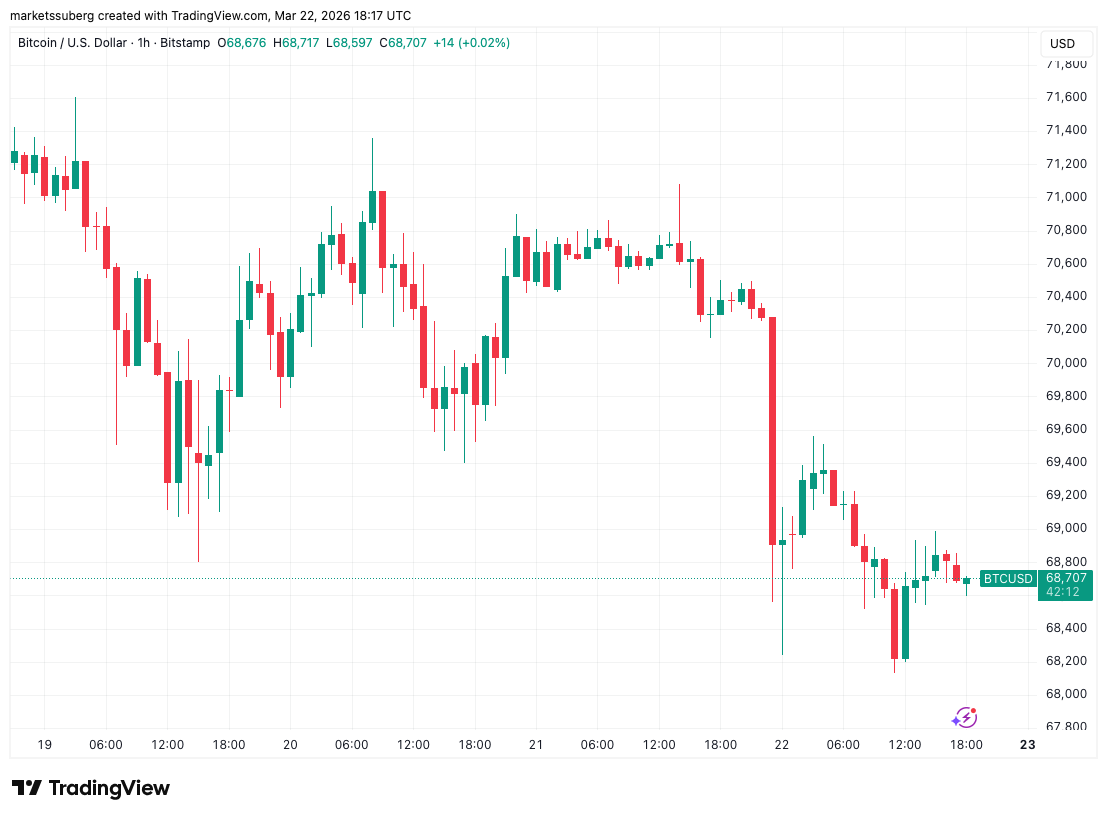
Bitcoin (BTC) traded below $69,000 on Sunday as the market faced a critical weekly candle close.
Key points:
-
Bitcoin approaches its 200-week trend line after sinking throughout the weekend.
-
BTC price action leaves traders firmly bearish on the immediate and long-term outlook.
-
A golden cross on the daily chart may provide some relief, analysis says.
Bitcoin returns to “unreliable” support
Data from TradingView showed BTC price action circling a key trend line after a weekend dip to near $68,000.

Bearish momentum entered into Saturday’s daily close and crypto longs suffered. Over $300 million in longs and nearly $100 million in shorts were liquidated in the 24 hours to the time of writing, per data from CoinGlass.

In so doing, BTC/USD set up a fresh showdown around its 200-week exponential moving average (EMA) near $68,300.
As Cointelegraph reported, the 200-week EMA was of major importance in prior BTC price cycles, but has become “unreliable” in 2026 due to failing to offer support.
Last week, trader and analyst Rekt Capital said that price should retest the 200-week trend line as support from above in order for it to provide the foundation for upside continuation.
“More, there’s also a chance that Bitcoin could simply meander in and around the 200-week EMA for a while, never really turning it into convincing resistance, never really turning it into convincing support, before ultimately breaking down into additional Macro Downside over time anyway,” he noted on X.

Others also retained bearish predictions, including trader Roman, who reiterated his $50,000 target.
“There are still 0 signs of bear market exhaustion on HTF. No divs, no bear PA exhaustion, no momentum loss, etc,” he told X followers on Sunday, referring to higher time frames.
“I still have high confidence in seeing 50k and likely a bit lower.”

BTC price “range game continues”
A potential silver lining on the day came from a “golden cross” involving two other moving averages.
Related: Bitcoin RSI signals potential bottom as analysts flag key setup
Here, the 21-day simple moving average (SMA) crossed over its 50-day equivalent, signalling stronger recent price momentum.

Commenting, Keith Alan, cofounder of trading resource Material Indicators, was cautiously optimistic.
“The Golden Cross will likely deliver some short term bullish momentum. Must watch to see if it develops into something durable,” he acknowledged in an X post.
“For now…the range game continues.”

Earlier in March, the BTC/USD chart produced two “death crosses,” a structure that typically implies more downside pressure to come. These in turn sparked warnings of a collapse below $40,000.
This article does not contain investment advice or recommendations. Every investment and trading move involves risk, and readers should conduct their own research when making a decision. While we strive to provide accurate and timely information, Cointelegraph does not guarantee the accuracy, completeness, or reliability of any information in this article. This article may contain forward-looking statements that are subject to risks and uncertainties. Cointelegraph will not be liable for any loss or damage arising from your reliance on this information.
TLDR:
- Crypto market cap has grown from billions to $2.34T, showing strong long-term upward trends.
- Adoption may reach 4 billion users by 2030, surpassing early internet growth rates.
- Tokenization and stablecoins integrate crypto into global financial systems daily.
- $100T market cap projection depends on continued adoption and partial on-chain asset migration.
Crypto Market Cap continues to expand despite volatility, with projections suggesting adoption could reach billions, pushing valuation toward $100 trillion over the next decade.
Adoption Trends Driving Crypto Market Cap
Crypto Market Cap has steadily grown from billions to trillions over the last decade, reaching about $2.34 trillion today. Despite sharp corrections, the long-term trend remains upward.
Each market cycle introduces new users, infrastructure improvements, and institutional involvement. Corrections reset valuations while strengthening underlying networks, showing that volatility is a natural part of this emerging asset class.
Adoption is a key driver of long-term growth. Raoul Pal, former hedge fund manager and Real Vision CEO, forecasts that crypto could reach 4 billion users by 2030.
Wallet numbers have grown at an average of 137% per year since 2014, outpacing early internet adoption, which expanded at 76% annually after reaching 5 million users.
While growth is expected to slow to 43% next year, projections indicate the industry could surpass one billion users before 2030.
Some analysts caution that wallet metrics may overstate real adoption due to multiple addresses per user and project-driven wallets. Pal countered that early internet metrics faced similar challenges yet still accurately tracked network expansion.
Conservative estimates, such as those from Triple-A and Andreessen Horowitz, suggest 560 million users by 2024, with monthly active users ranging between 30 and 60 million.
Even with lower estimates, the adoption curve remains strong, supporting the potential for continued crypto market cap growth.
Path Toward $100 Trillion Market Cap
Projections for Crypto Market Cap suggest a potential rise to $100 trillion by 2032, driven by adoption, tokenization, and macroeconomic trends.
Currency debasement is cited as a primary factor influencing asset appreciation, while widespread adoption strengthens long-term growth.
Pal notes that adoption explains performance relative to debasement, which accounts for most of the price action historically.
Tokenization of real-world assets could significantly increase valuation if even 10–20% of global assets move on-chain. Combined with stablecoins facilitating billions in daily transactions, crypto is increasingly integrating into financial infrastructure.
Networks such as Bitcoin serve as digital reserve assets, Ethereum enables decentralized finance and applications, and stablecoins support cross-border settlements.
Global financial markets collectively hold hundreds of trillions in equities, bonds, real estate, and gold. Crypto does not need to replace these assets; capturing a fraction could propel the market toward tens of trillions.
Each cycle, marked by drawdowns, strengthens the ecosystem as weaker participants exit and infrastructure improves. The market’s exponential nature indicates most growth occurs after broader attention, suggesting that today’s $2.34 trillion could resemble early internet phases in hindsight.
TLDR:
- Bittensor’s top 10 subnets reached a combined $550M valuation, reflecting strong ecosystem growth.
- Templar SN3 finished Covenant-72B using 72B parameters and 1.1T tokens without any central cluster.
- TAO token demand rises directly with subnet activity, as purchasing subnet tokens requires TAO first.
- Grayscale’s ETF filing and Jensen Huang’s comments signal rising institutional interest in TAO’s future.
Bittensor subnets have collectively reached a valuation of $550 million, drawing fresh attention to the TAO ecosystem.
Templar SN3 completed Covenant-72B, the largest decentralized large language model pre-training in history. The run used 72 billion parameters and 1.1 trillion tokens, with no centralized cluster involved.
This milestone has strengthened investor interest in both TAO and the growing subnet economy beneath it.
Covenant-72B Sets a New Standard for Decentralized AI Training
The Templar SN3 subnet trained Covenant-72B on 72 billion parameters and 1.1 trillion tokens. No centralized computing cluster was used throughout the entire training process.
The model’s performance is competitive with Meta’s LLaMA-2-70B in published benchmarks. This places decentralized pre-training on par with established open-source AI infrastructure.
Crypto analyst @ElCryptoDoc called the achievement “Bittensor’s DeepSeek moment” in a widely circulated post. NVIDIA CEO Jensen Huang also commented on the development, adding further visibility.
The comparison to DeepSeek reflects growing confidence in cost-efficient, distributed training methods. Industry observers have described the run as concrete proof point for decentralized AI.
Beyond Templar, Targon SN4 stands out as the highest-revenue subnet in the ecosystem. The subnet, operated by Manifold Labs, recently raised a $10.5 million Series A.
It serves real companies seeking confidential GPU compute through decentralized infrastructure. Chutes SN64, meanwhile, is expanding as a serverless inference and GPU compute option for developers.
These subnets operate across different layers of the Bittensor network but serve complementary purposes. Together, they show the ecosystem’s capacity for commercial use beyond speculative activity.
Developers are increasingly turning to decentralized alternatives for production AI workloads. This trend supports the credibility behind the $550 million combined valuation figure.
TAO Token Demand Strengthens as Subnet Activity Expands
A key mechanic in the TAO ecosystem ties subnet token purchases directly to TAO demand. Acquiring any subnet token requires TAO, making it the base currency across all subnets.
As subnet usage grows, so does the structural demand for TAO itself. This creates a compounding relationship between subnet performance and token value.
@ElCryptoDoc noted that one viral post about Templar drove TAO’s price up nearly 20% in a single day. That reaction shows how sensitive the market is to subnet-level progress.
Investors are treating individual subnet milestones as direct catalysts for the TAO token. The connection between the two layers is concrete and increasingly well-understood.
Grayscale has filed an ETF application tied to TAO, pointing to growing institutional interest. Jensen Huang’s public mention of Bittensor has also drawn attention from a wider investor base.
These external developments are positioning TAO within a broader AI-native asset conversation. TAO’s staking utility for subnets remains central to discussions around its long-term value.
As subnet competition intensifies, analysts are watching which networks will scale most effectively. Covenant-72B has established a measurable precedent for distributed model training at scale.
The $550 million valuation reflects current momentum alongside anticipated growth. The ecosystem now has tangible benchmarks to guide its next phase of development.
The U.S. Securities and Exchange Commission and Commodity Futures Trading Commission published interpretive guidance explaining how they might define what is or isn’t a security in crypto; the CFTC also issued a no-action letter for a non-custodial wallet provider to facilitate derivatives and prediction markets transactions; Arizona is filing criminal charges against a prediction market provider; and by the way we kind-of-sort-of have hints of movement on market structure legislation.
What a week, huh?
You’re reading State of Crypto, a CoinDesk newsletter looking at the intersection of cryptocurrency and government. Click here to sign up for future editions.
The narrative
The U.S. Securities and Exchange Commission published interpretive guidance this week — joined by the Commodity Futures Trading Commission — laying out how it approached the question of what in crypto it will deem a security.
Why it matters
What is, and isn’t, a security has long bedeviled the industry. We had efforts at somewhat defining this from the SEC in the past — Bill Hinman’s “When Howey met Gary (plastics)” speech, for example — but this week’s interpretative guidance is one of the most specific efforts to define this for the industry.
Breaking it down
The SEC laid out several categories it saw in the crypto space, with one of these categories being digital securities. These are cryptocurrencies that meet the definition of a security under any other context, but happen to be tokenized, the guidance said. For example, if a crypto asset meets the prongs of the Howey Test, it’s a security.
This is the category of tokens the SEC will oversee.
Other categories include payment stablecoins, digital tools, digital collectibles and digital commodities, which are generally not securities unless the issuers or operators take actions that might meet securities regulations, such as fractionalizing the tokens in question.
“We establish a straightforward taxonomy of crypto assets — most of which are not securities — and clarify how the Supreme Court’s Howey test applies when a crypto asset is part of an investment contract,” SEC Chair Paul Atkins and Commissioners Hester Peirce and Mark Uyeda wrote in an oped for CoinDesk.
The CFTC said it would sign on to the guidance and administer it under the Commodities Exchange Act.
“Market participants — from innovators and issuers to individual investors — should review this interpretation to better understand the regulatory jurisdiction between the SEC and CFTC,” the CFTC said in a press release. “The interpretation will be published on CFTC.gov and in the Federal Register.”
Congressman Troy Downing (R-Mont.) called the guidance “very positive,” but said Congress still needed to pass market structure legislation as a future administration could undo the interpretative guidance.
“Just having another two or three years of this and then having ambiguity out there doesn’t make most people comfortable on doing any kind of big investment,” he told CoinDesk. “But it’s a great start because this is exactly what the industry wants, and it allows some people to move forward.”
Chris LaVigne, a partner at the law firm Withers, said the guidance “predictably concludes that most crypto assets and many common crypto activities are not securities,” though the agency kept some discretion to being an enforcement action in this area.
“The guidance moves the securities inquiry away from the asset or activity itself (which are mostly deemed digital commodities not within the purview of the SEC) and re-centers the analysis on the transactions and representations in which these assets or activities arise or are marketed,” he said. “By doing so, the SEC did not completely eliminate uncertainty or its enforcement role, because it concludes that a crypto asset that is not a security can nonetheless be sold as part of an investment contract if it is marketed with promises of profit derived from the issuer’s essential managerial efforts.”
A crypto that was marketed as a security may eventually be deemed something else “once those promises are fulfilled or no longer operative,” he said. This might affect securities more broadly than just crypto assets.
It’s less clear what may constitute a commodity under the guidance.
Jason Gottlieb, a partner at Morrison Cohen, said the Commodity Exchange Act defines commodities as a list of products (excluding onions and motion picture box office receipts), services and other issues “in which contracts for future delivery are presently or in the future dealt in.”
This legal definition diverges from the definition seemingly being used in the guidance. The CFTC’s approach to crypto over the past decade has evolved since some early lawsuits, where it claimed jurisdiction over bitcoin , leading it to seemingly have jurisdiction over non-security cryptocurrencies. But this definition needs to be codified by market structure legislation, he told CoinDesk.
“People need to understand that jurisdiction is still uncertain. The SEC is clearly saying ‘we don’t have jurisdiction if the token does not meet these criteria,’” he said. “Just because the SEC does not have jurisdiction does not mean the CFTC does.”
Gottlieb said he was part of a case before the Seventh Circuit Court of Appeals seeking to gain clarity on this question, but market structure legislation would be needed to cleanly grant the CFTC jurisdiction over all non-security cryptocurrencies.
The status of that legislation also remains up in the air. Senator Cynthia Lummis (R-Wyo.), speaking at the DC Blockchain summit earlier this week, said she anticipated a markup may happen in the final weeks of April. The issue of stablecoin yield may be resolved with an agreement that stablecoin issuers and their partner firms would not describe their products using bank terminology, though she cautioned that she hadn’t seen any specific language yet.
The flip side, several individuals told me, is that the Clarity Act might require the SEC to go back to the drawing board on how it’s defining securities in crypto. But this falls under the category of bridges that can be crossed when they’re reached.
Senator Tim Scott (R-S.C.), the chair of the Senate Banking Committee, said lawmakers are also close to agreements on issues like ethics and quorums on the regulatory agencies — some of the outstanding areas of disagreement on the bill.
Downing said he saw an April time frame as doable for advancing market structure legislation. The closer lawmakers get to the end of the year, however, the less likely it would be that anything could be passed, he said, pointing to the midterm election. “But I don’t think it’s impossible.”
Senator Kirsten Gillibrand (D-N.Y.) said on stage at the DC summit that she was “optimistic” there would be a markup soon, which would then lead to the Banking and Agriculture Committee’s bills combining.
The combined bill would need to incorporate areas of bipartisan agreement, she said.
“One of the issues that I think is very important that people should be aware of is the Senate wants an ethics provision,” she said. “I think the House would have had even more support on the Democratic side if they had retained their ethics provisions in their bill. It’s very important that members of Congress do not get rich off of this industry, because they have access to non-public information, because they have positions of power and authority.”
Downing said the market structure bill needed to address consumer protections and money laundering, without being so restrictive that companies would be scared to do anything.
“Nobody wants bad actors in their space and nobody wants that reputation of bad actors using this as a tool to do bad things,” he said. “… If you bring those [provisions] in too narrow, nobody’s going to do anything innovative.”
He said he understood why banks might be concerned about the yield issues.
“Community lenders, community banks are worried about depositors all exiting the market, in which case you’re not doing mortgages on small farms in Montana, right?” he said.
Late Friday, Senators Angela Alsobrooks and Thom Tillis told Politico they had reached an agreement on the yield issue, though the details had not been shared with the banking or crypto industries as of press time.
Kalshi was just ordered to cease offering most of its prediction markets in the state of Nevada for at least two weeks, pending a hearing on April 3.
The order came after an appeals court refused to grant an administrative motion that could have blocked the state court’s action. Earlier in the week, the state of Arizona filed criminal charges against Kalshi, alleging some of its election and other contracts violate state law.
In Nevada, a judge ruled that Kalshi can’t offer sports, election or entertainment-related event contracts at least temporarily.
According to the order by Judge Jason Woodbury, the record in Nevada’s case against Kalshi so far suggests that it offers products defined by state law, making its conduct subject to Nevada’s gaming regulators.
“The question of federal preemption in this regard is nuanced and rapidly evolving,” the judge wrote. “At the moment, the balance of convincing legal authority weighs against federal preemption in this context.”
The Arizona action goes further, alleging misdemeanor violations on small bets placed on professional football and college basketball games, upcoming elections and on whether bills become law and whether public figures will show up to sporting events.
“Arizona law prohibits operating an unlicensed wagering business, and separately bans betting on elections outright,” Arizona Attorney General Kris Mayes’ office said in a press release.
Kalshi co-founder Tarek Mansour called the charges a “total overstep” that “have nothing to do with gambling or the merits.”
There’s a broader growing backlash to prediction markets. Senator Catherine Cortez-Masto, who represents Nevada, wrote an opinion piece saying prediction markets “blatantly violate state and tribal laws and regulations.”
“To ensure responsible gaming, casinos, sportsbooks and online gaming sites have to follow minimum age requirements, participate in integrity monitoring and support critical consumer protections, like programs that help people with gambling addictions,” she said. “Yet, this past year, emboldened by limp and overly permissive federal regulators like the Commodity Futures Trading Commission (CFTC), so-called ‘prediction markets’ have transformed themselves into illegal sportsbooks, offering their users illicit sports wagers.”
This week
- There are no hearings or public meetings scheduled (at least pertaining to crypto).
If you’ve got thoughts or questions on what I should discuss next week or any other feedback you’d like to share, feel free to email me at [email protected] or find me on Bluesky @nikhileshde.bsky.social.
You can also join the group conversation on Telegram.
See ya’ll next week!
Crypto World
Blackstone’s BCRED Posts First Monthly Loss in Over Three Years as Investor Withdrawals Hit $3.7B
TLDR:
- BCRED reported a 0.4% loss in February 2025, its first monthly decline since September 2022’s 1.3% drop.
- Investors withdrew $3.7 billion from BCRED in Q1 2025, surpassing the fund’s typical quarterly redemption volume.
- Blackstone wrote down loans for select borrowers, including software firm Medallia, per a letter to financial advisers.
- Blackstone shares have dropped over 28% this year as banks tighten lending and rivals cap investor withdrawals.
Blackstone’s private credit fund, BCRED, recorded its first monthly loss in over three years in February 2025. The $82 billion fund reported a total loss of 0.4%, drawing attention to growing pressures across the private credit sector.
Investor concerns around liquidity, credit quality, and withdrawal surges have grown steadily this year. This development marks a turning point for one of the largest private credit vehicles in the world.
BCRED Reports February Loss as Withdrawals Surge
BCRED’s last recorded monthly loss before February was in September 2022, when it posted a decline of 1.3%. The February 2025 loss of 0.4% comes as investor sentiment around private credit has noticeably shifted.
For context, the Morningstar LSTA index of publicly traded leveraged loans fell 0.8% in February, per Morningstar’s website.
During the first quarter of this year, Blackstone’s fund faced a larger-than-usual wave of redemption requests. Investors pulled $3.7 billion from BCRED, a figure that exceeded typical quarterly withdrawal volumes.
The fund allows investors to withdraw a portion of their holdings every quarter, which adds a layer of liquidity pressure.
Financial news reporter Kristen Shaughnessy shared the development on social media, drawing wider public attention. The post referenced a Financial Times report citing a letter sent to financial advisers by Blackstone. According to that report, customer service software firm Medallia was among the companies whose loans were written down.
BCRED wrote down the value of a “select” number of loans during February, per the Financial Times report. Despite this, Blackstone maintained that the fund has delivered a 9.5% annualized total return since inception for Class I shares. The firm also noted that BCRED has outperformed the leveraged loan market by 100 basis points so far this year.
Private Credit Sector Faces Growing Scrutiny From Banks and Investors
Private credit funds have come under growing scrutiny due to weakening credit quality across the sector. Their high exposure to vulnerable sectors such as software has raised concerns among analysts and investors. Additionally, a lack of transparency has made it harder for market participants to assess underlying risks.
These concerns have spilled over onto Wall Street, where some major U.S. banks have tightened lending to the private credit industry.
JPMorgan Chase marked down the value of certain loans to private credit players earlier this month. That move is expected to reduce available lending to funds operating in the space.
Morgan Stanley and BlackRock were among the firms that moved to limit withdrawals from their own funds. Both firms acted following a surge in redemption requests from investors. This pattern across multiple funds points to a broader trend of tightening liquidity across private credit markets.
Shares of Blackstone, the world’s largest alternative asset manager, have lost more than 28% of their value so far this year.
That decline mirrors the broader unease investors have expressed toward the alternative asset space. As the sector navigates these pressures, fund managers are being watched more closely than at any point in recent years.
TLDR:
- XRP open interest is falling across major exchanges, with Binance still holding the largest derivatives market share.
- Liquidation spikes and soft taker volume confirm that leveraged XRP positions are actively being unwound market-wide.
- XRP has gained dual commodity classification from the SEC and CFTC, marking a turning point in regulatory clarity.
- ETF inflows of $1.44B and Ripple’s $2.7B in acquisitions reflect rising institutional confidence heading into 2026.
XRP open interest continues to contract across major derivatives exchanges, reflecting an ongoing deleveraging trend in the market.
Despite this broad decline, Binance maintains the largest share of XRP open interest among top platforms. At the same time, a growing set of regulatory and institutional developments is taking shape in 2026.
Analysts are watching closely to see whether these catalysts can reverse the current market structure.
Binance Dominates as Leveraged Positioning Unwinds
Binance remains the primary venue for XRP leveraged trading, holding the most open interest across major exchanges.
However, the exchange’s own 24-hour data shows continued weakness in positioning, with no strong recovery in sight.
Net taker volume on Binance also remains soft, which points to limited aggressive demand from new buyers. This combination suggests the market is still in a reset phase rather than entering a fresh expansion.
Liquidation data adds further weight to this view. Recent liquidation spikes show that forced leverage cleanup has played a role in driving open interest lower.
Rather than reflecting fresh long conviction, the current structure points to position unwinding. Speculative appetite across XRP derivatives continues to fade as a result.
The overall trend across exchanges mirrors what Binance is showing internally. Open interest is falling in a broad and sustained manner, not in isolated bursts.
This pattern typically follows periods of elevated speculation and leverage buildup. For open interest to recover, the market would need stronger directional participation from both retail and institutional traders.
Until that recovery arrives, the market structure for XRP derivatives remains under pressure. Binance will likely continue to lead the space by volume and open interest.
However, the gap between Binance and other exchanges may shift if conditions improve on other platforms. Traders are watching these metrics carefully as a leading signal for XRP’s next move.
Regulatory and Institutional Catalysts Are Aligning in 2026
On the fundamental side, a series of developments are converging that some analysts say could drive a major move.
XRP has been officially classified as a digital commodity by both the SEC and the CFTC, bringing long-awaited regulatory clarity.
The CLARITY Act markup is targeting April, and Ripple CEO Brad Garlinghouse has placed the odds of passage at 80 to 90 percent. Additionally, a stablecoin yield compromise is reportedly near completion.
Institutional interest is also building at a fast pace. XRP-related ETFs have pulled in $1.44 billion in inflows, while Evernorth has filed its S-4 for a Nasdaq listing.
Ripple has also made over $2.7 billion in acquisitions and is expanding its global footprint. A Ripple National Trust Bank application is currently under review as well.
Crypto analyst X Finance Bull noted on X that in 2024, XRP ran from $0.49 to $3.60 on news alone. The analyst argued that the 2026 setup carries heavier weight, with regulation, infrastructure, and institutional capital aligning together. That framing has drawn attention from traders reassessing their positions.
Whether the derivatives market responds to these catalysts remains to be seen. Open interest recovery alongside stronger volume would signal a shift in market sentiment. For now, XRP sits at a crossroads between fading speculative leverage and growing structural support.

Bitcoin’s four-year cycle intact; Q4 rally forecast

Deputy Resigns Amid Foot-Fetish Account Scandal

XRP I CAN’T BELIEVE WHAT I AM SEEING!


-

 Tech7 days ago
Your Legally Registered ‘Motorcycle’ Might Not Count Under Proposed US Law
-

 Fashion2 days ago
Weekend Open Thread: Adidas – Corporette.com
-

 Politics2 days ago
Jenni Murray, Long-Serving Woman’s Hour Presenter, Dies Aged 75
-
 Tech5 days ago
Are Split Spacebars the Next Big Gaming Keyboard Trend?
-

 Crypto World21 hours ago
Best Crypto to Buy Now: Strategy Just Spent $1.57 Billion on Bitcoin During Fear While Early Investors Quietly Enter Pepeto for 150x Potential
-

 News Videos4 days ago
RBA board divided on rate cut, unusually buoyant share market | Finance Report | ABC NEWS
-

 Crypto World22 hours ago
Bitcoin Price News: Bhutan Sells $72 Million in BTC Under Fiscal Pressure, but the Smart Money Entering Pepeto Sees What the Market Does Not
-
 Crypto World2 days ago
NIO (NIO) Stock Plunges 6.5% as Shelf Registration Sparks Dilution Worries
-

 Business6 days ago
Australian shares drop as Iran war enters third week
-

 Crypto World6 days ago
Crypto Lender BlockFills Enters Chapter 11 with Up to $500M in Liabilities
-

 Politics4 days ago
The House | The new register to protect children from their abusers shows Parliament at its best
-

 Fashion6 days ago
25 Celebrities with Curly Hair That Are Naturally Beautiful
-

 Tech3 days ago
inKONBINI Lets You Spend Summer Days Behind the Register
-
 Politics5 days ago
Real-time pollution monitoring calls after boy nearly dies
-

 Crypto World4 days ago
Canada’s FINTRAC revokes registrations of 23 crypto MSBs in AML crackdown
-
 NewsBeat4 days ago
Residents in North Lanarkshire reminded to register to vote in Scottish Parliament Election
-

 Business6 days ago
Meta planning major layoffs as AI spending and automation reshape workforce
-

 News Videos4 days ago
PARLIAMENT OF MALAWI – PAC MEETING WITH REGISTRAR OF FINANCIAL ON AMARYLLIS HOTEL – INQUIRY LIVE
-
Entertainment6 days ago
Oscars reunite Rob Reiner supergroup of 17 stars for emotional tribute: Here's who appeared on stage
-

 Business4 days ago
Who Was Alex Pretti? 5 Key Facts About the ICU Nurse Killed by Federal Agents in Minneapolis
You must be logged in to post a comment Login