
Crypto World
BlackRock’s ETHB staking ETF leans on Figment as Ethereum yield play goes mainstream



BlackRock’s ETHB staking ETF routes 70–95% of its Ethereum into validators run by Figment and others.
Summary
- ETHB is BlackRock’s first Ethereum ETF that adds staking rewards on top of spot exposure, with roughly 70–95% of ETH staked at any given time.
- Figment runs part of the validator infrastructure for ETHB alongside Galaxy Digital and Attestant, handling block proposals, attestations, and network security duties for the fund’s staked ETH.
- The ETF launched with about $100–107m in assets, did roughly $15.5m in first-day volume, and passes around 82% of gross staking rewards to shareholders, with a 0.25% fee cut to 0.12% on the first $2.5b for a year.
BlackRock’s new iShares Staked Ethereum Trust ETF (ETHB) is pulling institutional staking into the ETF wrapper — and delegating a crucial piece of that infrastructure to Figment. The fund, listed on Nasdaq under the ticker ETHB, is BlackRock’s first crypto product that offers staking rewards on top of spot exposure, staking between roughly 70% and 95% of its ether holdings through professional validator operators. Figment has been named one of the key node operators for ETHB, responsible for running Ethereum validation infrastructure, processing transactions, and helping secure the network on behalf of the trust.
ETHB quietly marks a structural shift in how traditional finance can access Ethereum’s (ETH) proof‑of‑stake economy. At launch, the ETF came to market with around $100–107 million in initial assets and generated about $15.5 million in trading volume on its first day, according to multiple data providers. Under normal conditions, the fund stakes most of that ether, returning roughly 82% of gross staking rewards to shareholders, with the current implied annualized yield around 3.1%, while BlackRock and its partners retain the remainder as fees. Management fees are set at 0.25%, temporarily reduced to 0.12% on the first $2.5 billion in assets for the first year, a pricing structure designed to pull flows away from un‑staked spot products.
Figment’s role is central to that pitch. As one of Ethereum’s largest institutional staking providers, the company operates validators that handle block proposals and attestations for ETHB’s staked share of ether, alongside other providers such as Galaxy Digital and Attestant. By outsourcing validation to specialist firms instead of building its own infrastructure, BlackRock can offer regulated clients exposure to staking yields while keeping operational risk and technical complexity at arm’s length. That model also gives Ethereum another anchor tenant in its validator set, deepening the pool of professionally run nodes that secure the network.
For Ethereum itself, the timing is favorable. ETH is trading around $2,201, up roughly 6.8% in the last 24 hours, with a 24‑hour low near $2,041.70 and high just above $2,200, on nearly $27.76 billion in volume. Staked ether has already hit record highs on‑chain, and the arrival of a yield‑bearing BlackRock ETF that locks up a large portion of its holdings reinforces that supply sink while giving institutions a familiar wrapper for participating in Ethereum’s security budget. For live data, readers can follow crypto.news’ dedicated Ethereum price page, and for more on ETF‑driven flows and Ethereum’s evolving role, see our recent coverage of Bitcoin ETF inflows after Iran tensions, analysis of macro shocks and BTC price volatility, and Michael Saylor’s continued treasury‑driven Bitcoin accumulation.



Metaplanet sold equity and fixed‑strike warrants at a premium, monetizing stock volatility into up to $531 million of dry powder for a 210,000 BTC, yen‑hedged balance‑sheet bet.
Summary
- Metaplanet raised about $255 million via a private share placement at a 2% premium, paired with fixed‑strike warrants at a 10% premium for another ~$276 million if exercised.
- Warrants only trigger if the stock trades above a Bitcoin‑linked mNAV threshold, turning equity upside and volatility into self‑funding BTC accumulation instead of pure dilution.
- The strategy aims to make Metaplanet “Japan’s MicroStrategy,” swapping yen‑denominated equity for a structurally scarce asset and using BTC as a long‑term currency and equity hedge.
Metaplanet just weaponized its equity to buy more Bitcoin (BTC). This is not a vibes-based CT announcement; it is a highly engineered capital markets trade aimed squarely at becoming “Japan’s MicroStrategy,” with a yen hedge bolted on.
Deal structure in plain language
Metaplanet raised about 255 million dollars from global institutional investors via a private placement of new shares priced at a 2% premium to market. Alongside that, it issued fixed‑strike warrants at a 10% premium, which, if fully exercised, could bring in roughly another 276 million dollars. In total, the company is unlocking up to 531 million dollars in incremental “firepower” to push toward its stated target of holding 210,000 BTC on its balance sheet.
The key innovation is not “we raised money and we’ll buy Bitcoin.” It is the explicit monetization of equity volatility: investors are effectively paying for convexity on the stock, and Metaplanet is harvesting that option value to buy hard assets.
Why the warrant design matters
The warrants are struck 10% above the reference price, so they only get exercised if Metaplanet’s share price trades higher, i.e., if the market buys the Bitcoin accumulation story. That creates a self‑funding loop: volatility and upside in the equity translate directly into more capital to deploy into BTC. Commentators on the thread correctly highlight this as “the real innovation,” noting that Metaplanet benefits both from stock volatility and from Bitcoin appreciation.
In market structure terms, the firm is short call options on its own equity and long Bitcoin. It is selling path‑dependent equity upside today to increase its exposure to a non‑sovereign monetary asset it believes will outperform the yen and, likely, Japanese equities over the long term.
Japan, currency risk, and the “denominator”
Where MicroStrategy pioneered this model in the US, Metaplanet adds another layer: a currency hedge against a structurally weak yen. One international holder in the replies openly frames the move as bullish for Japan, arguing that the yen “could benefit greatly from Bitcoin.” Others go further, calling the strategy a matter of corporate “survival” rather than mere profit, a blunt acknowledgment of what sustained currency debasement does to domestic balance sheets.
Another respondent captures the denominator problem cleanly: institutional capital is “waking up to the reality of the denominator” and “building a fortress out of math,” with volatility as the energy source to forge a new standard. Translated into market terms: Metaplanet is trading a dilutable equity, priced in a weakening unit of account, for an asset with a credibly scarce supply schedule.
Signal to the market
Reaction on X swings from praise—calling the placement a “masterclass in capital strategy”—to confusion and outright skepticism about what Metaplanet is and whether this is a scam. That bifurcation is typical early in any new corporate balance‑sheet regime: most participants do not yet speak the language of corporate‑fi‑meets‑Bitcoin, and the documentation reads like jargon to anyone not trained in derivatives.


- Cardano (ADA) rises above $0.28 as whale accumulation boosts short-term momentum.
- Positive funding rates and higher open interest support near-term gains.
- The key levels to watch are the support at $0.25–$0.27 and the resistance near $0.30–$0.35.
Cardano (ADA) has surged over 8% in the past 24 hours, breaking above key short-term resistance levels.
The price is now hovering around $0.286, bringing the $0.30 mark into focus for traders.
Momentum has picked up sharply as derivatives data show positive funding rates and rising open interest.
This price movement has attracted attention from mid-tier whale wallets.
These investors, holding between one million and ten million ADA, have been actively accumulating during recent dips. Their buying has added upward pressure, tightening available supply in the market.
Meanwhile, larger whale wallets, holding ten million to a hundred million ADA, have been reducing positions, suggesting some distribution at higher price levels, creating a mixed picture in the whale ecosystem.
The balance between accumulation and distribution will likely influence price swings in the coming days.
Technical analysis
From a technical perspective, ADA has broken above a descending trendline that had capped price action near $0.25 for weeks.
This breakout has set the stage for further gains as short-term indicators lean bullish.
The relative strength index (RSI) sits above 50, indicating that momentum favours buyers, but it is not yet in overbought territory.
The MACD has crossed above its signal line, and its histogram is expanding, signalling that buying momentum is gaining strength.

Price action has shown that the 20-day exponential moving average (EMA) is providing support near $0.27.
Eyes are now on the 50-day EMA around $0.29 and the 100-day EMA closer to $0.34.
Breaking these levels could open the door to further upside, but failing to hold above the short-term support zone could result in a pullback.
In addition, Cardano’s open interest is also rising, and the funding rate has turned positive, meaning that long positions are paying shorts, which historically aligns with bullish momentum in the near term.
Cardano price forecast
In the short term, traders should monitor $0.30 as the next psychological resistance.
A breakout above $0.30 could target the $0.34–$0.35 range, guided by key EMAs and prior swing highs.
While momentum indicators suggest room for further upside, the market will need consistent buying volume to sustain higher levels.
On the downside, the immediate support lies near $0.27, with a more significant level around $0.25.
A drop below $0.25 could test deeper support near $0.24, potentially signalling short-term bearish pressure.
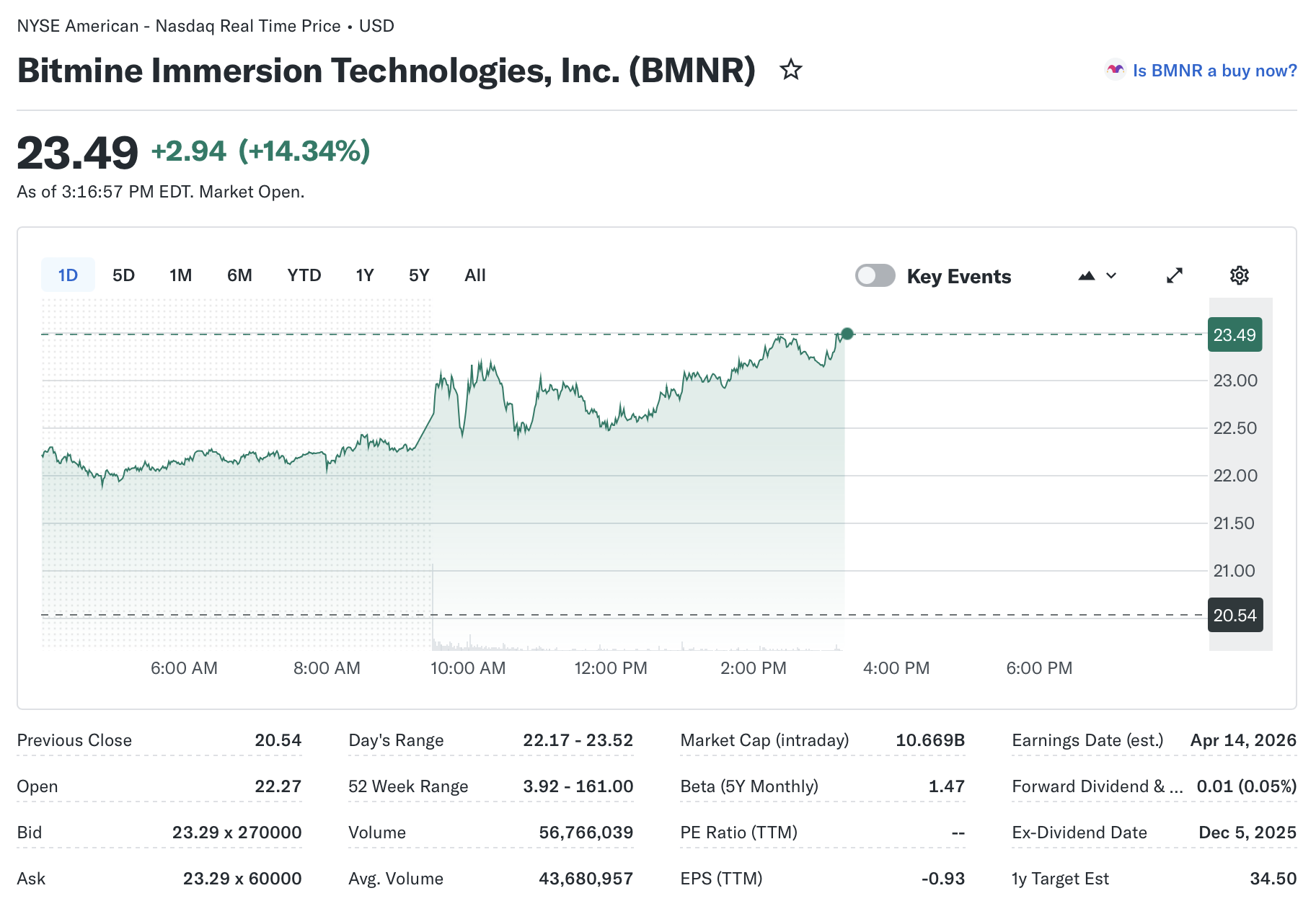
Bitmine Immersion Technologies has accelerated the pace of its Ether purchases in recent weeks, chairman Tom Lee said Monday, following the company’s over-the-counter purchase of 5,000 ETH directly from the Ethereum Foundation.
Lee said Bitmine added 60,999 Ether (ETH) over the past week, up from a recent weekly average of about 45,000 to 50,000 ETH.
The purchases bring the publicly traded company’s Ethereum treasury to 4.596 million ETH, giving Bitmine control of about 3.81% of the token’s total supply. The company said its combined crypto holdings, cash and other investments total about $11.5 billion.
Bitmine said that 3,040,515 ETH, about 66% of its holdings, are currently staked, valued at roughly $6.6 billion at an Ether price of $2,185.
The company estimates its staking operations generate about $180 million in annualized revenue. It plans to expand staking through its Made in America Validator Network (MAVAN), expected to launch in the coming months.
Bitmine said the 5,000 ETH purchase from the Ethereum Foundation was structured to allow the foundation to fund its operations without selling Ether on the open market.
Shares of Bitmine (BMNR) closed Monday trading up almost 14% to $23.39, according to Yahoo Finance data.
Today’s announcement from the Ethereum treasury company coincided with a disclosure by Strategy, the world’s largest Bitcoin treasury company, that it purchased 22,337 BTC for $1.57 billion, bringing its total holdings to more than 760,000 Bitcoin.

Related: Three Ethereum indicators hint that $2.8K is the next ETH price target
Corporate treasuries control over 5% of Ether supply
Public companies holding Ether have largely slowed accumulation over the past month, even as Bitmine continues to rapidly expand its position.
Data from CoinGecko shows that among the 20 largest corporate Ether treasuries, only four companies increased their holdings over the last 30 days. Bitmine added 269,824 ETH during that period, far outpacing SharpLink, which added 3,859 ETH, and Eightco, which added 11,068 ETH.

Eightco also raised $125 million last week to expand investments in blockchain and artificial intelligence. Bitmine led the round with a $75 million investment, while ARK Invest and Payward, the parent company of crypto exchange Kraken, each invested $25 million. As part of the deal, Bitmine chairman Lee joined Eightco’s board.
Across the market, 30 public entities across seven countries collectively hold about 6.6 million ETH valued at around $15.4 billion, representing about 5.47% of Ether’s total supply, according to CoinGecko.
At the time of writing, Ether was trading at around $2,342, up nearly 11% over the past 24 hours, a year-to-date decline at around 21%. The cryptocurrency currently has a market capitalization of about $282 billion, with around 120.7 million ETH in circulation.

Magazine: All 21 million Bitcoin is at risk from quantum computers
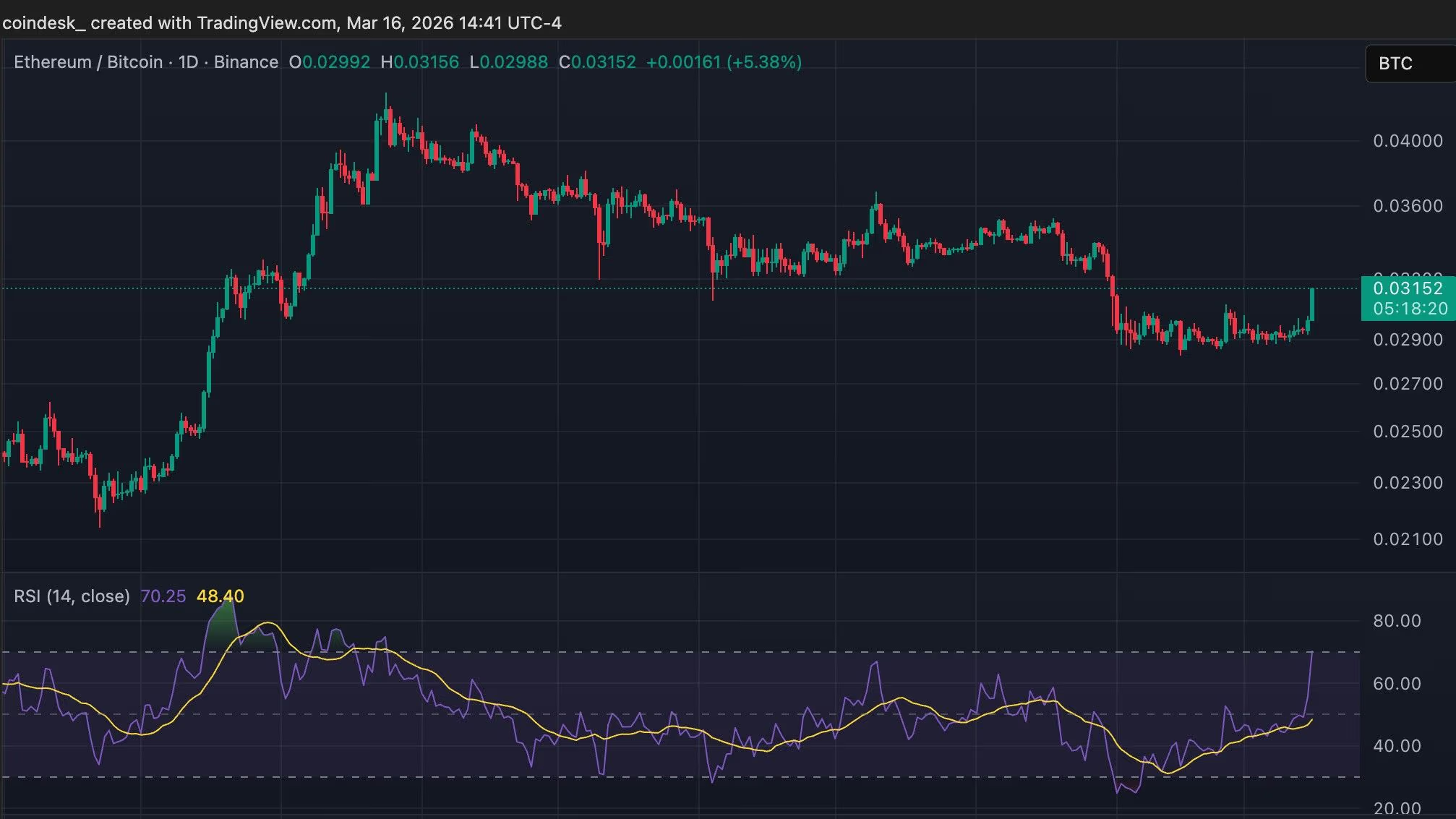
Ethereum’s ether (ETH) is stealing the spotlight in Monday’s crypto rally, climbing to a six-week high as investor demand show signs of return to the second-largest digital asset after months of bruising declines.
Ethereum’s native token, ETH, rose to above $2,300, gaining more than 10% over the past 24 hours. That easily outpaced bitcoin’s 3% advance and the CoinDesk 20 Index’s roughly 5% gain, signaling a shift in momentum toward assets beyond bitcoin.
The move comes after a torrid stretch for the broader crypto market, including ether. With the rebound, ETH is still down more than 50% from its August record high and, at one point, had fallen roughly 65% from its peak during the market’s winter slide.
Prices have stabilized in February and March, and institutional flows are beginning to turn supportive.
U.S. spot ether ETFs pulled in more than $160 million in fresh funds last week, marking their strongest weekly inflows since mid-January, according to data from SoSoValue. Global asset manager BlackRock also rolled out a yield-paying Ethereum staking ETF (ETHB), which has already drawn more than $45 million in inflows in its first two trading days, on top of a $104 million seed investment, data from Farside Investors shows.
Meanwhile, BitMine (BMNR), the largest corporate holder focused on Ethereum treasury strategies, has purchased nearly 122,000 ETH — worth roughly more than $280 million at current prices — in the past two weeks, adding another source of demand.
BMNR shares are higher by 13.6% on Monday. Another major ETH treasury company, Sharplink Gaming (SBET) is seeing a 9.1% advance.
Rotation from bitcoin
Analysts say the price action could reflect investors rotating into ether after bitcoin dominated inflows earlier this year.
“ETH’s relative strength suggests potential rotation dynamics, possibly tied to network developments and valuation appeal beyond bitcoin,” said Joel Kruger, market strategist at LMAX Group.
He added that ether has broken above an important range against bitcoin where it traded since the end of January. “potentially marking a significant bottom for ETHBTC.”

Adam Saville Brown, head of commercial at Tesseract Group, sees the move as a sign that risk appetite is broadening across the crypto market.
“Ethereum’s outperformance is worth watching,” said Adam Saville Brown, head of commercial at Tesseract Group. “ETH has broken back above $2,200 after weeks of underperformance. That kind of rotation into the second-largest asset suggests risk appetite is broadening, which tends to be a healthy sign.”
Still, he cautioned that the rally could remain sensitive to macro signals.
“If Powell strikes a cautious tone on inflation, altcoin gains will give back faster than bitcoin,” Saville Brown said. “The honest assessment is that the floor looks solid. The ceiling requires more than a rate hold to break through.”
Read more: Ethereum Foundation’s new mandate sparks debate about its role, priorities
Pi now trades like a high‑beta narrative coin: stuck in a 0.18–0.25 band while March unlocks, Open Mainnet progress and listing rumors fight to set the next big move.
Summary
- PI is hovering in the low‑$0.20s with roughly $1 million in daily volume, a $1.8–$1.9 billion cap and a heavy bag of holders still down over 90% from 2025 highs.
- Open Mainnet and ecosystem growth offer real utility potential, but March unlocks in the tens of millions of tokens leave the 0.18–0.20 support zone exposed if miners dump.
- Over the next 3–6 months, baseline models cluster around a 0.30–0.50 grind higher, with a bear case near 0.14 and a bull case pushing toward 0.80–1.00 on perfect‑storm adoption.
Pi Network (PI) is trading like a high‑beta, narrative coin pinned between speculative unlock flows and a long‑awaited mainnet story, with March shaping up as an inflection point for price direction.
Market Snapshot: Range, Liquidity, Structure
Across major offshore venues, PI is changing hands around the low‑$0.20s, with recent spot quotes clustered in the 0.21–0.23 dollar band after a short-term grind higher over the past week. MEXC data puts Pi’s market cap near 1.8–1.9 billion dollars, on roughly 9.6 billion tokens in circulation and light but steady 24‑hour volumes close to 1 million dollars, signalling modest but not dead order books for a top‑50 asset. On a higher timeframe, PI is still down more than 90% versus its 2025 peak near 3 dollars, leaving a heavy overhang of trapped supply and emotionally scarred holders into every rally.
Technically, short-term resistance clusters just above 0.23–0.24 dollars, with analysts watching 0.24–0.25 as the level that would confirm a clean break from the recent range. Support sits in the 0.18–0.20 zone, an area already flagged as structurally important given upcoming token unlocks that could stress bids if sentiment wobbles.
Catalysts: Mainnet, Unlocks, Listings
The key structural shift is the project’s transition into an Open Mainnet, enabling real-world transactions, external integrations, and a move away from “mobile mining app” purgatory. That unlocks a credible path to utility – payments, dapps, marketplace integrations – but it does not remove the near-term mechanical risk from supply hitting the market as KYC migrations and token unlocks accelerate.
Near term, traders are also leaning into the “exchange listing plus Pi Day roadmap” combo trade: speculation around new CEX listings, including tier‑one venues, has already driven spikes when rumors surface. At the same time, token unlock trackers highlight roughly tens of millions of PI scheduled to hit circulation in March, putting the 0.18–0.20 floor at risk if early miners rush to cash out into thin books.
3–6 Month Price Scenarios
Baseline: If Open Mainnet stabilizes, daily active users migrate into actual spenders, and unlock supply is absorbed without major liquidations, PI could grind higher into a 0.30–0.50 range over the coming quarters, implying a 30–130% upside from current levels and a market cap in the 3–5 billion dollar band. This tracks with several quantitative and qualitative models that cluster 2026 fair value around the mid‑double‑cent range, assuming no blow‑off mania.
Bear case: Persistent sell pressure from unlocks, tepid dapp traction, and no top‑tier listings could drag PI back toward 0.14 or lower, effectively revisiting winter lows and erasing the recent bounce. Bull case: A “perfect storm” of strong mainnet adoption, surprise listings, and retail FOMO could push price through 0.50 toward the 0.80–1.00 zone flagged by more optimistic 2026 models, though that would require a sustained re‑rating of Pi as a payments‑style network rather than a fading airdrop meme.
For now, PI trades like an options bet on execution: upside capped by dilution and history, downside controlled by how quickly the network can turn its massive user base into real, on‑chain economic activity.

Bitcoin chases $75,000 as the return of aggressive spot BTC ETF inflows, billion dollar buys from Strategy and an improvement in investors’ risk appetite propel the crypto market.
Bitcoin’s (BTC) price recovery extended into a third week as the price rallied to $74,509, a level not seen since Feb. 4. While markets remain reluctant to confirm whether or not Bitcoin bottomed, the cryptocurrency is up 22.5% from its Feb. 6 low at $60,000 and data point to a renewed institutional investor appetite as a potential key player in the current bullish breakout.
Over the last week, Michael Saylor’s Strategy, the largest public holder of Bitcoin, purchased 22,237 BTC for $1.57 billion.
According to reporting from Bloomberg,
“Inflows to exchange-traded funds suggest a return of institutional confidence. Net flows for the 12 US-listed spot Bitcoin ETFs topped $763 million last week, a third consecutive week of inflows”
On Monday, Metaplanet, a Tokyo-based public company that established Japan’s first corporate Bitcoin treasury, announced that it has raised $255 million in a “private placement” for a new instrument that aims to purchase more Bitcoin. Metaplanet CEO Simon Gerovich said the raise would provide the “additional firepower on our march towards 210,000 BTC.”

Related: Metaplanet raises $255M and adds warrant structure for Bitcoin buys
Adding to the institutional Bitcoin demand narrative, Bitfinex analysts said that “Bitcoin is approaching this week’s FOMC meeting on March 18 with renewed momentum, and has decisively reclaimed the $70,000 level.” The report noted Bitcoin’s market structure had “improved meaningfully” even though BTC has “yet to secure a breakout above local range highs.”

According to Bitfinex analysts, the absorption-to-emissions ratio (AER) highlighted institutional investors “absorbing nearly five times the daily miner supply,” and this, combined with rising BTC futures open interest, indicated that the market was beginning to mirror “healthier” structures seen earlier in the year.
When asked whether Bitcoin had bottomed and if institutional capital flows were responsible for the price upswing, Hyblock analysts explained that “following the sharp drop, the market entered a consolidation phase where open interest declined, shorts used more margin, and both spot and perpetual CVDs pointed to selling pressure.”

The analysts added that:
“Over the past month, that regime (sellers) has shifted. Traders have started increasing leverage on the long side, open interest is rising, and the perps CVD has turned positive while spot flows remain weak. This suggests the push toward the top of the range is largely being driven by derivatives positioning rather than spot demand.”
This article does not contain investment advice or recommendations. Every investment and trading move involves risk, and readers should conduct their own research when making a decision. While we strive to provide accurate and timely information, Cointelegraph does not guarantee the accuracy, completeness, or reliability of any information in this article. This article may contain forward-looking statements that are subject to risks and uncertainties. Cointelegraph will not be liable for any loss or damage arising from your reliance on this information.
Crypto World
T. Rowe Price, a $1.8 Trillion asset manager, is ready to put dogecoin (DOGE) and shiba inu (SHIB) in its new crypto ETF


T. Rowe Price has filed to hold a broad set of digital assets in its new exchange-traded fund (ETF), including bitcoin, ether, dogecoin, and shiba inu.
The asset manager, which has $1.8 trillion in assets under management, filed an amended S-1 registration statement with the U.S. Securities and Exchange Commission (SEC), offering new details about its planned Price Active Crypto ETF, a fund designed to give investors actively managed exposure to digital assets.
The updated filing, submitted Monday, expands on the company’s original October application and outlines the cryptocurrencies the fund may invest in, along with details on custody, trading structure, and potential staking activity.
According to the document, the ETF could hold several digital assets, including bitcoin , ether (ETH), solana (SOL), XRP (XRP), , avalanche (AVAX), , , , hedera (HBAR), , chainlink , stellar lumen (XLM), shiba inu (SHIB), and .
Despite that wide universe, the fund will not hold all of those assets at once. Under normal circumstances, the ETF plans to maintain between five and fifteen crypto assets at a time, using an active management strategy rather than tracking a single token or passively following a benchmark. The portfolio will be rebalanced using quantitative models that incorporate fundamentals, valuation, and market momentum, with the goal of outperforming the FTSE US Listed Crypto Index, the filing said.
The amended filing also confirmed that Anchorage Digital Bank N.A. will serve as the fund’s crypto asset custodian, responsible for safeguarding the digital tokens held by the ETF.
For now, the fund will use a cash subscription and redemption model, meaning investors would create or redeem ETF shares using cash rather than transferring cryptocurrency directly. The filing notes that the structure could evolve to allow in-kind transactions in the future, a model some crypto ETFs use to exchange shares for the underlying digital assets.
Another notable addition in the filing is the possibility that the fund could participate in staking, a process used by some blockchains where token holders lock up assets to help secure the network in exchange for rewards.
T. Rowe Price said staking could be pursued in the future depending on risk considerations, tax treatment and regulatory guidance.
The filing marks another step by the 87-year-old investment firm, which is one of the top 25 asset management firms, toward entering the digital asset market.
If approved, the product would join a growing list of crypto investment vehicles designed to give investors exposure to the sector through traditional brokerage accounts.
The fund’s active approach could set it apart from the wave of spot bitcoin ETFs launched in the U.S. in 2024, allowing managers more flexibility to shift holdings as crypto markets evolve.

Key Takeaways
- The Foundation positions itself as a neutral coordinator rather than a directional leader.
- Community members question whether the framework provides sufficient institutional strategy.
- Advocates commend the emphasis on privacy, decentralization, and open-source principles.
- The framework draws clear boundaries between protocol maintenance and commercial development.
- Discussion reveals friction between philosophical ideals and market expansion tactics.
The Ethereum Foundation published a comprehensive constitutional framework detailing its operational philosophy and organizational principles, igniting extensive commentary throughout the crypto sector. The detailed 38-page publication reinforces the foundation’s commitment to serving as an impartial facilitator instead of a centralized governing body. Industry watchers quickly noted the significance of this release as institutional participation in Ethereum continues accelerating.
The constitutional framework articulates the Foundation’s obligation to preserve decentralized infrastructure while advancing protocol-level innovation and ecosystem commons. It characterizes the entity as an enabler of research initiatives, grant distribution, and community coordination without prescribing particular commercial solutions. This publication reinforces the foundation’s historical commitment to fostering development on a robust and dependable blockchain infrastructure.
Ethereum Foundation unveiled this framework during a period of organizational transitions and ongoing conversations regarding governance structures and institutional partnerships. The initiative seeks to crystallize the foundation’s core purpose and establish constitutional guidelines for future activities. Market analysts observe this document emerges while Ethereum encounters mounting expectations to accommodate enterprise-grade applications.
Skeptics Point to Absence of Concrete Business Strategy
Certain blockchain professionals expressed concern that Ethereum Foundation prioritizes theoretical principles above tangible market adoption measures. They contend the publication fails to outline strategies for enterprise integration or commercial partnership frameworks. These voices suggest the Foundation maintains significant influence while avoiding concrete operational accountability.
The Foundation’s framework reads as predominantly theoretical, elevating decentralization ideals, privacy protections, and open-source commitments above commercial considerations. Skeptics emphasize the necessity for proactive guidance to cement Ethereum’s standing in international financial systems. Industry participants observe that alternative blockchain platforms aggressively court institutional deployments while the Foundation maintains its non-interventionist stance.
Blockchain developers additionally cautioned that excessive emphasis on philosophical positioning could constrain tangible expansion possibilities. They propose the organization should deliberately champion Ethereum as the premier infrastructure for financial technology applications. Detractors argue the framework omits concrete roadmaps for commercial product advancement or enterprise collaboration initiatives.
Advocates Celebrate Constitutional Clarification of Mission
Proponents applauded the Foundation for formalizing its organizational charter and strengthening its impartial stewardship model. They maintain this publication preserves Ethereum’s operational durability, security infrastructure, and platform independence. Advocates emphasize the Foundation’s design enables third-party innovation rather than directing proprietary development.
The Foundation’s constitutional principles correspond with infrastructure requirements valued by institutional participants. The publication highlights censorship immunity, transparent accessibility, and privacy safeguards as fundamental characteristics for mainstream acceptance. Advocates assert these attributes guarantee Ethereum continues serving as a trustworthy foundation layer for technological advancement.
Infrastructure operators validated that the Foundation’s philosophical framework informs strategic choices throughout the broader ecosystem. They recognize the foundation oversees protocol evolution while independent organizations construct user-facing applications and services. Analysts believe this functional separation enables Ethereum Foundation to concentrate on enduring viability and ecosystem expansion.
The conversation surrounding the Foundation’s constitutional framework illuminates fundamental questions regarding organizational authority and commercial positioning. As Ethereum matures, transparent governance structures and defined responsibilities become increasingly vital for widespread implementation and network stability. The framework reinforces the Foundation’s dedication to stewardship while delegating execution and commercial innovation to the distributed ecosystem.



Fresh accumulation is emerging in Ethereum markets as whales, builders, and ETF investors add millions despite earlier sales by Vitalik Buterin.
Ethereum extended its recovery wave and surged over 8% in the last 24 hours to climb to almost $2,300 on Monday.
At the same time, blockchain data indicates fresh Ether purchases by a well-known early Bitcoin supporter.
Whales, Builders, and ETFs Pile Into ETH
According to blockchain analytics platform Lookonchain, early Bitcoin supporter and founder of ShapeShift, Erik Voorhees, has resumed buying Ether after a one-year break. Data revealed that Voorhees spent 49.08 million USDT to purchase 23,393 ETH at an average price of $2,098 through two wallets. He still holds 35.25 million USDT.
The firm also added that he had offloaded 12,886 ETH last year when Ether was trading at approximately $3,320.
Lookonchain noted that other investors have also been accumulating Ether alongside Voorhees. A wallet linked to an early Ethereum builder, “billΞ.eth,” spent $17.46 million to purchase 7,769 ETH at an average price of $2,248 on Monday. On the same day, another whale identified as wallet 0x743d bought 1,827 ETH for $3.79 million. Over the past four days, the same whale has spent $24.79 million to acquire 11,985 ETH at an average price of $2,068.
The renewed accumulation trend comes as institutional demand for the asset has also strengthened. Data from spot Ethereum ETFs shows rising investor interest. These funds have recorded over $160 million in net inflows over the past week. During that period, four trading days registered positive inflows, while only one day posted net outflows.
Buterin’s ETH Sales
On the other hand, Vitalik Buterin reduced some of his ETH holdings earlier this year. The Ethereum co-founder sold more Ether than he had originally planned. Buterin had previously announced a plan to sell 16,384 ETH, but on-chain data found total disposals reached about 18,684 ETH.
You may also like:
The entire stash is worth over $38 million. The sales began in early February and occurred in several stages as ETH was gradually sold from his wallets. Buterin said the funds would be used to support open-source software and hardware development, privacy tools, and security-focused infrastructure projects. He also described the move as part of a period of “mild austerity” for the Ethereum Foundation.
Binance Free $600 (CryptoPotato Exclusive): Use this link to register a new account and receive $600 exclusive welcome offer on Binance (full details).
LIMITED OFFER for CryptoPotato readers at Bybit: Use this link to register and open a $500 FREE position on any coin!


Under hostile Swedish tax rules, HIVE Digital is winding down Bitcoin mining and quadrupling Canadian AI data‑center capacity, swapping halving risk for contracted GPU revenue.
Summary
- HIVE says “misuse” of tax rules in Boden has turned Swedish ASIC mining into an opaque, uneconomic business and is weighing a full exit.
- Through BUZZ HPC, HIVE is expanding liquid‑cooled AI facilities in Canada from 4 MW to 16.6 MW, backing roughly 4,000 high‑end GPUs.
- The firm is rotating from pure Bitcoin beta to selling compute as a service to AI and HPC clients on contracts, trading hashprice whiplash for steadier ARR.
HIVE Digital is quietly admitting the old Bitcoin‑only mining model is broken. Under tax and regulatory pressure in Sweden, the miner is pivoting hard into AI and high‑performance computing (HPC) capacity in Canada, effectively swapping volatile block rewards for steadier data‑center cash flow.
The listed firm said its ASIC Bitcoin mining operations in Boden, Sweden, have become economically unstable due to what it calls “misuse of existing tax rules” by local authorities. Those include mandatory margin requirements and other measures that introduce opaque, unhedgeable costs into a business that already runs on thin, highly cyclical margins. Instead of fighting a drawn‑out regulatory battle in a secondary jurisdiction, HIVE is gradually scaling down Swedish production and openly signaling that a full exit from Bitcoin mining in the country is on the table.
The capital is being redeployed into infrastructure for a very different demand curve. Through its BUZZ High Performance Computing subsidiary, HIVE plans to quadruple the capacity of its liquid‑cooled AI data center footprint in Canada, from 4 megawatts in Manitoba to 16.6 MW spread across two provinces. The build‑out includes a 5 MW hosting site in British Columbia engineered to expand to 12.6 MW as utilization grows, giving the company a modular way to scale with AI workloads instead of with hashprice.
Strategically, this is the trade many miners have talked about but few have executed with conviction: rotate from pure Bitcoin beta toward selling compute as a service to AI and HPC clients willing to sign contracts. In market terms, HIVE is swapping exposure to halvings, difficulty jumps and ETF flows for exposure to AI model training budgets and enterprise cloud‑spending cycles. If it works, the firm keeps the upside of owning power‑dense infrastructure while compressing the volatility that has wrecked multiple listed miners in past bear markets.
The risk is straightforward. HIVE now has to compete not just with other miners, but with hyperscalers and specialist AI data‑center operators in a capex arms race where efficiency, client mix and power contracts decide who survives the next downturn. But as Sweden’s tax environment turns hostile and Bitcoin mining economics whipsaw around the halving, standing still is worse. HIVE’s bet is that the next real bull market for infrastructure is denominated in tokens of GPU hours, not just satoshis.

Tom Brady’s Awkward Dating Game Exposed By Insiders

BBC One show viewers make same complaint after new series announcement

Crafting the Art of Private Dining


-
 Tech6 days ago
A 1,300-Pound NASA Spacecraft To Re-Enter Earth’s Atmosphere
-
Crypto World3 days ago
HYPE Token Enters Net Deflation as HyperCore Buybacks Outpace Staking Rewards
-

 Business6 days ago
ExxonMobil seeks to move corporate registration from New Jersey to Texas
-

 Fashion3 days ago
Weekend Open Thread: Addict Lip Glow
-

 Tech6 days ago
ChatGPT will now generate interactive visuals to help you with math and science concepts
-
Sports2 days ago
Why Duke and Michigan Are Dead Even Entering Selection Sunday
-

 NewsBeat5 days ago
Residents reaction as Shildon murder probe enters second day
-
 NewsBeat7 days ago
Pagazzi Lighting enters administration as 70 jobs lost and 11 stores close across Scotland
-

 Business6 days ago
Search Enters Sixth Week With New Leads in Tucson Abduction Case
-

 Business1 day ago
Search for Savannah Guthrie’s Mother Enters Seventh Week with No Arrests
-

 Business2 days ago
US Airports Launch Donation Drives for Unpaid TSA Workers as Partial Government Shutdown Enters Fifth Week
-
Crypto World2 days ago
Coinbase and Bybit in Investment Talks: Could Bybit Finally Enter the US Crypto Market?
-

 NewsBeat5 days ago
I Entered The Manosphere. Nothing Could Prepare Me For What I Found.
-

 Business2 days ago
Country star Brantley Gilbert enters growing non-alcoholic beer market
-

 Business10 hours ago
Australian shares drop as Iran war enters third week
-
 Crypto World6 days ago
Will Chainlink price reclaim $10 amid volatility squeeze?
-

 Sports5 days ago
PWHL, Senators discussing plan to keep Charge in Ottawa
-

 Sports3 days ago
College Basketball Best Bets: Conference Tournament Semifinal Picks
-

 Crypto World10 hours ago
Crypto Lender BlockFills Enters Chapter 11 with Up to $500M in Liabilities
-

 Politics6 days ago
Trump Says Middle East Is ‘Very Lucky’ That He’s President


You must be logged in to post a comment Login