
Crypto World
Blockstream CEO Predicts Hyperbitcoinized Future for Bitcoin



Blockstream CEO Adam Back positioned Bitcoin treasury companies as arbitrage plays between the current fiat financial system and a future where BTC dominates global economics.
His statement adds intellectual weight to Strategy’s aggressive Bitcoin accumulation strategy and similar corporate initiatives gaining momentum.
Bitcoin Treasury as Arbitrage Play
Adam Back’s framing is elegant.
He calls Bitcoin treasury companies an “arbitrage between the fiat present and the hyperbitcoinized future.”
This means firms buying the cryptocurrency today at current prices benefit from two forces. First, BTC adoption accelerates. Second, fiat currencies depreciate through inflation or policy mistakes. The gap between these two outcomes creates substantial upside for early accumulators.
Back’s thesis suggests that companies holding Bitcoin position themselves as asymmetric bets on systemic transition rather than conventional equity plays.
The Financial Path to Hyperbitcoinization
Back’s argument rests on the currency eventually becoming the dominant global store of value. In this future, Bitcoin serves as the reserve asset backing international commerce and national treasuries.
Companies that accumulated BTC before this transition would benefit enormously. Their holdings would appreciate not just through price increases but also through the adoption of Bitcoin, which would increase its utility and acceptance.
This vision parallels Michael Saylor’s endgame prediction that Bitcoin reaches $10 million per coin through digital credit flows and institutional adoption.
Back’s bullish narrative faces serious skepticism. Peter Schiff has called Strategy’s Bitcoin strategy fundamentally flawed, arguing that rising dividend obligations will force liquidations before hyperbitcoinization arrives.
Schiff warns that the cryptocurrency could decline sharply if macro conditions deteriorate, making current accumulation economically irrational.
However, Eric Trump recently predicted Bitcoin would reach $1 million, signaling the Trump family’s confidence in its upside potential despite near-term volatility.
Bitcoin Treasury Companies Multiply
Back’s framework helps explain why public companies are aggressively raising capital to acquire BTC. If the hyperbitcoinization thesis proves correct, early accumulators capture enormous value.
Strategy leads this trend with 815,061 Bitcoin holdings worth $63.46 billion. Other companies are considering similar strategies, creating competitive pressure to accumulate while BTC remains relatively undervalued.
The arbitrage thesis suggests that hesitation to accumulate BTC today could prove costly if hyperbitcoinization accelerates faster than currently modeled.
Adam Back’s arbitrage framing provides intellectual scaffolding for BTC treasury strategies. Rather than viewing Bitcoin as speculative, Back positions it as a rational hedge against fiat system failure.
Whether this arbitrage thesis proves correct depends on adoption accelerating and fiat systems facing genuine stress. For now, companies betting on hyperbitcoinization are making convex bets with asymmetric upside and limited downside from current valuations.
The post Blockstream CEO Predicts Hyperbitcoinized Future for Bitcoin appeared first on BeInCrypto.



Brazil’s central bank has barred virtual assets from settlement inside regulated international payment rails.
Summary
- Brazil’s central bank banned virtual assets from settlement inside regulated eFX cross-border payment rails.
- The new rule does not ban crypto transfers, but limits use inside supervised payment channels.
- Brazil is tightening oversight as stablecoins make up about 90% of reported crypto flows.
The rule applies to eFX services, which cover certain cross-border payments and transfers. Banco Central do Brasil published Resolution BCB No. 561 on Thursday. The measure updates rules for payment providers operating under the country’s foreign exchange framework.
The new rule says payments or receipts between an eFX provider and a foreign counterparty must use foreign exchange transactions. Providers may also use movement in a non-resident Brazilian real account.
The resolution bans the use of virtual assets for those payments and receipts. This means crypto and stablecoins cannot settle transactions inside the regulated eFX channel.
Rule is not a full crypto ban
The measure does not ban crypto transfers across Brazil. It only blocks crypto settlement within the supervised eFX framework.
Transitional rules also apply to firms not yet listed as approved eFX providers. These companies may continue operating if they seek central bank approval by May 31, 2027.
However, they must follow the same settlement rule. Their payments and receipts cannot use virtual assets.
Stablecoin activity draws closer review
Brazil has increased oversight of crypto-linked payment flows as stablecoin use grows. The central bank has been adding virtual assets to its financial and foreign exchange rulebook.
In November 2025, regulators set new rules for virtual asset service providers. These included authorization requirements and rules for crypto services tied to the foreign exchange market.
BCB Governor Gabriel Galipolo previously said crypto use had risen in Brazil over recent years. He said about 90% of flows were linked to stablecoins, raising concerns over taxation, money laundering, and backing.
The central bank has also reviewed stablecoins issued outside its supervision. In a technical note to Congress, it warned that such tokenscould face bans or strict conditions in Brazil.
The note said real-denominated stablecoins issued beyond BCB oversight may affect regulatory equality and monetary sovereignty. It also said foreign-currency stablecoins may raise concerns over capital flows and payment system fragmentation.


South Korea’s Seoul Administrative Court has granted Bithumb a temporary reprieve from a six-month suspension, allowing the exchange to continue operating while the case proceeds.
Summary
- Seoul Administrative Court has paused Bithumb’s six-month suspension, allowing operations to continue until a final ruling.
- Regulators imposed a 36.8 billion won fine after identifying about 6.65 million cases of failed user identity checks.
- Ongoing scrutiny has intensified after a payout error, and AML violations triggered multiple investigations into Bithumb’s controls.
According to Yonhap News Agency, the court’s 2nd Administrative Division under Judge Gong Hyeon-jin approved the stay on Thursday, pausing enforcement of a sanction imposed by the Financial Intelligence Unit, an anti-money laundering body under the Financial Services Commission.
Regulators had issued the suspension notice in March, stating that Bithumb failed to meet AML obligations that required proper identity verification of users. The penalty targeted new customers by restricting external crypto deposits and withdrawals, a move that would have limited onboarding activity if enforced.
The Financial Intelligence Unit also imposed a fine of 36.8 billion won, about $25 million, after identifying roughly 6.65 million cases where user identities were not properly verified, according to The Korea Herald. Disciplinary measures were also directed at CEO Lee Jae-won as part of the same action.
Court filings show Bithumb challenged both the suspension and its execution, submitting a lawsuit and a stay request on March 23. Enforcement had already been paused during judicial review, and the latest decision keeps restrictions on hold until a final ruling is issued, leaving day-to-day operations unaffected for now.
Company statements cited by Yonhap indicated that the suspension could slow new user growth and weigh on business activity, while the FIU maintained that any revenue impact would be limited. Payment of the fine remains pending more than four weeks after the deadline, despite a 20% early settlement discount offered by the regulator, The Korea Herald reported.
“We plan to faithfully present our position throughout the remaining legal proceedings,” Bithumb said, according to local media reports.
Regulatory pressure deepens after operational missteps
Regulatory scrutiny has intensified following a series of operational issues, including a February payout error that triggered investigations into internal controls. During a promotional campaign, the exchange mistakenly distributed a theoretical 620,000 BTC instead of 620,000 won, an error that led to unintended credits reaching external wallets.
According to local outlet Chosun Biz, Bithumb recovered about 99.7% of the assets, while the remaining portion was addressed using company reserves after some users sold the funds. Legal action has since been initiated against certain users who refused to return the assets, with provisional seizure requests filed to freeze holdings ahead of civil proceedings.
Authorities responded to the incident by tightening oversight across the sector. The Financial Services Commission directed exchanges to strengthen real-time monitoring of large transactions after an emergency inspection identified vulnerabilities in automated settlement systems.
Alongside the regulatory challenges, Bithumb has pushed its planned initial public offering timeline to 2028, citing ongoing scrutiny, while investigations by the Financial Supervisory Service continue to examine risk management practices tied to the payout error.


Disclosure: This article does not represent investment advice. The content and materials featured on this page are for educational purposes only.
Bitcoin funding rates stayed negative for 46 days, the longest since 2023, forcing shorts to pay longs daily.
Summary
- Bitcoin funding rates stayed negative for 46 consecutive days, the longest such streak since 2023.
- An estimated 30 to 40 percent of short margin was eroded by funding costs before Strategy’s $2.54B purchase triggered the final squeeze.
- Over $427 million in short positions were liquidated after weeks of margin drain, with Bitcoin now pressing toward the critical $80,000 breakout level.
Bitcoin shorts didn’t just lose money when the squeeze hit; they had been losing money long before it arrived.
For 46 consecutive days, funding rates stayed negative, forcing short traders to pay longs simply to hold their positions.
According to CoinDesk, that stretch marked the longest negative funding period since 2023. When Strategy’s $2.54 billion purchase and Trump’s Iran ceasefire extension finally landed, the damage was already done. The catalysts were just the final blow.
Negative funding rates made holding Bitcoin shorts expensive
Funding rates are periodic payments exchanged between long and short traders in perpetual futures markets. When rates turn negative, shorts pay longs to keep positions open. That cost runs on a clock, not a chart.
As Leverage.Trading outlines in its breakdown of funding rates, at 20x leverage, a 0.05 percent funding charge on notional exposure equals one percent of available margin per settlement.
With three settlements occurring daily, that figure compounds fast. Leverage. Trading’s educational breakdown of funding mechanics lays out exactly how quickly those charges erode a position.
Over 46 days, that steady drain ate through an estimated 30 to 40 percent of the short margin before any major catalyst appeared. Directionally wrong traders were also paying for the privilege of staying wrong, every single day.
Shorts were already near liquidation before the news hit
By the time April’s headlines arrived, short positions were operating on a thin margin. Strategy announced the purchase of 34,164 BTC for $2.54 billion, sending Bitcoin climbing to $77,500, per CoinDesk.
Trump’s Iran ceasefire extension added further risk appetite to the session. Both events hit close together.
The market didn’t need much upward pressure to trigger liquidations at that point. Margin had already been quietly stripped away over six weeks of negative funding.
What looked like a sudden squeeze from the outside was actually the final stage of a much slower process.
Anton Palovaara of Leverage.Trading described it directly:
“Forty-six days of negative funding doesn’t show up on a chart, but it shows up in your margin. By the time the ceasefire news hit, a lot of shorts were already running on fumes.”
They added,
“The liquidations happened fast because the margin was already gone. The headline was just the match.”
Over $427 million in shorts liquidated as margin ran out
Finance Magnates reported more than $427 million in short liquidations across recent sessions. That number reflects how much trapped leverage had accumulated during the extended negative funding window.
Shorts had been positioned for a price drop that kept not materializing.
On April 24, crypto trader CryptoBoss posted a breakdown connecting the setup to historical precedents. He noted that 50 days of deeply negative funding near the $15,500 bottom in 2022 preceded a 48 percent rally to $23,000.
A similar pattern played out during the 2021 China mining ban, where roughly 45 days of negative funding near $29,000 preceded a rally to $48,000.
The 2025 setup matched those conditions closely, with 46 days of negative funding while price ground steadily higher, not lower.
Coinbase premium and the $80k test signal: What comes next?
Alongside the liquidations, Coinbase Premium posted its longest bullish streak since October’s $126,000 high, per CoinDesk.
That streak pointed to consistent spot buying pressure from U.S.-based investors running parallel to the derivatives squeeze. Spot demand and a short-saturated futures market rarely stay in tension for long.
Finance Magnates noted that Bitcoin is now testing the $80,000 breakout level.
Whether that level holds depends on continued spot support and how remaining leveraged shorts respond. Positions that survived the squeeze are still carrying funding risk if rates stay elevated.
The 46-day bleed was not visible on most price charts. However, it showed up clearly in margin balances, and ultimately in the liquidation data that followed.
Disclosure: This content is provided by a third party. Neither crypto.news nor the author of this article endorses any product mentioned on this page. Users should conduct their own research before taking any action related to the company.


Strategy’s CEO has promoted its high-yield STRC stock as a way to cover personal expenses, drawing attention to the risks tied to its dividend structure.
Summary
- Phong Le has promoted STRC as an income source for everyday expenses, citing its 11.5% variable dividend while acknowledging he invested $250,000 personally.
- Company disclosures from Strategy state dividends are not guaranteed and can be suspended, with no assurance of principal repayment.
- Le said about 80% of STRC holders are retail investors, identifying them as individuals managing mortgages, utility bills, and other financial obligations.
According to comments made by Phong Le on Natalie Brunell’s show, the executive described STRC as an income-generating asset that could help investors manage recurring costs such as mortgages, utility bills, and car payments. He said the stock’s variable dividends “almost looks like a paycheck,” while noting that payments arrive regularly.
Le disclosed that he had personally purchased $250,000 worth of STRC, explaining the decision through his own financial setup. He said he holds a 1.75% 30-year mortgage and viewed STRC’s current 11.5% annualized dividend as a way to earn a higher return instead of paying down that debt. He described the approach as earning income from the spread between the dividend yield and his borrowing cost.
Details published by Strategy on its STRC information page state that cash dividends are not guaranteed, while the company’s board retains the authority to suspend payments and adjust the dividend rate at any time. The same disclosures also note that the stock carries no assurance of principal repayment.
During the same appearance, Le compared the consistency of STRC payouts to a salary, although the company’s own documentation outlines conditions under which those payments can be reduced or halted.
Le also addressed the composition of STRC’s investor base, stating that roughly 80% of holders are retail participants. His remarks framed these investors as individuals managing everyday financial obligations, including mortgages and bills, placing them among the primary users of the product he described.
The discussion has drawn parallels to earlier remarks by Michael Saylor, who in March 2021 encouraged the use of leverage, including mortgages, to acquire Bitcoin. Unlike those comments, Le’s remarks focused on STRC rather than bitcoin, positioning the company’s own stock as a yield-based alternative.
In the same interview, Le also said STRC “grew faster than the iPhone,” referring to the pace of stock sales. Standard accounting definitions, however, distinguish capital raised through stock issuance from revenue generated through the sale of goods or services.
Compensation disclosures cited in public filings show that Le’s annual pay has exceeded $15 million, placing his personal investment example in a different financial context than the retail investors he described.


The crypto market rose around 1.2% on Friday, with total market capitalization ticking higher as a wave of short liquidations and stronger tech-led risk sentiment lifted prices despite persistent geopolitical tensions.
Summary
- Crypto market ticks higher as over $140M in liquidations, around 70% shorts, trigger a short squeeze, while Bitcoin holds near $77K.
- U.S. spot Bitcoin ETFs log continued inflows exceeding $200M daily, supporting prices despite ongoing U.S.–Iran tensions and elevated oil near $110.
- Alphabet Inc. shares jump ~10%, lifting global tech stocks and boosting crypto-linked equities, including Coinbase and MicroStrategy.
Bitcoin (BTC) climbed roughly 1.5% to trade near the $77,000 level after rebounding from recent lows, while Ethereum (ETH) gained about 1% to hover around $2,200. Major altcoins such as XRP (XRP), BNB (BNB), and Solana (SOL) also moved higher by 1–2%, reflecting a broader recovery across the market.
The move higher was largely driven by a short squeeze in derivatives markets. More than $150 million in crypto positions were liquidated over the past 24 hours, with roughly 70% of those tied to short positions. The forced unwinding of bearish bets added upward pressure as traders rushed to cover positions.
The rebound comes even as geopolitical risks remain elevated, particularly around the U.S.–Iran standoff.
Iran’s President Masoud Pezeshkian said the U.S. naval presence near Iranian ports amounts to an “extension of military operations,” calling it “intolerable.” U.S. President Donald Trump added that Washington “might need” to restart military action, while offering limited transparency on the status of negotiations.
Despite these developments, markets showed signs of resilience, suggesting that much of the geopolitical risk may already be priced in for now. Oil prices remained elevated but steadied after recent volatility linked to the Strait of Hormuz tensions. Brent crude held near the $110–$111 per barrel range, while WTI crude traded just below that level, easing slightly from recent spikes that had raised fears of supply disruptions.
At the same time, safe-haven assets softened. Gold slipped over 1% during the session, while silver also declined, indicating a partial rotation back into risk assets. This shift provided additional support to crypto markets.
Alphabet Inc. rally lifts tech and crypto-linked equities
Broader market sentiment improved sharply after Alphabet Inc. shares surged roughly 10% following stronger-than-expected earnings driven by its cloud and AI segments. The move added hundreds of billions of dollars in market value and lifted global tech stocks.
The rally extended into Asian markets, where tech-heavy indices such as the Nikkei 225 moved higher, reinforcing a risk-on tone across asset classes.
Crypto-linked equities also tracked the move. Shares of Coinbase and MicroStrategy rose alongside Bitcoin’s recovery, reflecting renewed investor appetite for digital asset exposure. Mining stocks also saw gains as improving prices and sentiment supported the sector.
While the latest move points to improving near-term sentiment, analysts note that crypto markets remain highly sensitive to further developments in U.S.–Iran tensions, oil price movements, and shifts in global liquidity conditions.


Tom Lee’s Bitmine has staked about $508 million worth of Ethereum in a recent move tracked by Arkham.
Summary
- Bitmine recently staked about $508 million worth of ETH, according to Arkham on-chain data.
- Bitmine’s Ethereum holdings crossed 5 million ETH, placing it among the largest institutional holders.
- More than 4 million Bitmine ETH is staked, equal to about 10.5% of total staked supply.
The transfers were routed through institutional channels, adding to the firm’s ongoing staking strategy.
The latest activity comes as Bitmine continues to increase its exposure to Ethereum. On-chain data shows the firm has now staked more than 4 million ETH, valued at about $9.3 billion, representing around 10.5% of total staked supply.
ETH holdings cross 5 million milestone
Recent disclosures show Bitmine’s total Ethereum holdings have crossed 5 million ETH. The company reported holdings of about 5.07 million ETH, marking a key milestone in its accumulation strategy.
Chairman Tom Lee said, “Bitmine ETH holdings crossed 5 million this past week,” noting the pace of accumulation has been rapid.
The firm now holds more than 4% of the total ETH supply. This places Bitmine among the largest institutional holders of Ethereum in the market.
Strategy focuses on staking and supply control
Bitmine has focused on staking a large share of its ETH holdings. More than 4 million ETH is already deployed in staking programs, generating yield while reducing liquid supply.
The company’s broader plan targets holding a larger share of Ethereum supply. Reports indicate a strategy aimed at securing up to 5% of total ETH over time through continued purchases and staking.
This approach combines accumulation with yield generation. Staked ETH contributes to validator activity while producing ongoing rewards tied to network participation.
Market watches concentration and institutional activity
Bitmine’s growing position has drawn attention to staking concentration. Large allocations of ETH in staking reduce available supply on the open market and increase the role of institutional participants.
The company has expanded its holdings steadily in recent months. Earlier filings showed ETH holdings around 4.5 million tokens before the recent increase past 5 million.


Strategy announced it maintained STRC’s 11.5% dividend rate for May 2026, signaling confidence in its Bitcoin strategy despite lingering market skepticism.
The announcement comes as the preferred equity instrument attracts growing institutional interest and daily trading volume surpasses $380 million.
Dividend Sustained Amid Volatility
Michael Saylor emphasized STRC’s resilience in his latest post. He highlighted three key metrics: approximately 3% volatility, 11.5% yield, and roughly $380 million in daily trading liquidity.
These figures paint a picture of stability. The low volatility suggests STRC trades predictably. The high yield attracts income-focused investors. The substantial liquidity ensures shareholders can easily enter or exit positions without moving markets.
The dividend maintenance reflects management’s confidence that Strategy can sustain payouts through ongoing Bitcoin appreciation and continued capital raises.
Shareholders Vote on Twice-Monthly Payments
Beyond the dividend announcement, Strategy is asking shareholders to make a structural change. Brokerages have begun sending voting notices to both MSTR and STRC holders.
The proposal shifts dividend payments from monthly to twice-monthly beginning mid-May 2026. This change improves cash flow timing for investors receiving semi-monthly income streams instead of lump-sum monthly payments.
Both share classes must approve the amendment. The shift suggests MicroStrategy management expects continued strong fundraising capabilities to support more frequent payouts.
Strategy Market Context and Criticism
However, not all observers view STRC positively. Peter Schiff has called Strategy’s structure a scam, arguing that rising dividend obligations will eventually force liquidations if Bitcoin prices stall.
Bitcoin price predictions for May 2026 remain mixed. Some analysts expect continued strength. Others warn of consolidation or pullback risks given macro headwinds.
Meanwhile, Saylor’s endgame thesis projects Bitcoin reaching $10 million per coin through the adoption of digital credit. Eric Trump recently predicted $1 million Bitcoin, signaling continued Trump family bullishness on crypto assets.
Liquidity Milestone Signals Acceptance
The $380 million daily liquidity milestone matters. It demonstrates that institutional and retail investors view STRC as a viable income vehicle, warranting meaningful trading volumes. Compare this to less liquid preferred securities that struggle to attract daily volume. STRC’s liquidity suggests growing acceptance despite skeptical voices like Schiff.
The combination of stable low volatility, high yield, and substantial liquidity creates an appealing risk-reward profile for income investors. This explains growing institutional participation in STRC trading.
Strategy’s dividend maintenance and twice-monthly payment proposal signal management confidence. However, the structure remains controversial.
Skeptics argue that the dividend model eventually breaks down. Believers argue that Bitcoin appreciation and digital credit adoption will sustain it indefinitely.
The $380 million liquidity milestone shows investors are willing to bet on Saylor’s vision. Whether that bet pays off depends on Bitcoin’s path forward and Strategy’s ability to raise capital sustainably.
The post MicroStrategy’s STRC Trading Volume Hits $380 Million as Payment Vote Nears appeared first on BeInCrypto.
Crypto World
Stablecoins Cross $300B Supply as B2B Payments Become the Fastest-Growing Real-World Use Case

TLDR:
- Stablecoin supply has surpassed $300B as banks and payment firms begin direct integration into financial systems.
- B2B transfers account for $226B of real usage, making it the largest and fastest-growing stablecoin category today.
- Real-economy usage sits at just $390B of $35T in annual volume, showing how early adoption still is globally.
- Asia, led by Singapore, Hong Kong, and Japan, is outpacing the West in practical, real-world stablecoin deployment.
Stablecoins are gradually moving beyond crypto-native activity into mainstream financial infrastructure worldwide.
Supply has already exceeded $300 billion, while banks and payment companies pursue direct integration. Regulatory frameworks are becoming clearer across major markets at the same time.
Annual transaction volume sits around $35 trillion, yet real-economy usage remains roughly $390 billion. That figure represents barely over 1% of total activity. The infrastructure is being built well before broader adoption fully arrives.
B2B Payments Emerge as the Clearest Use Case for Stablecoins
Stablecoins are finding their strongest real-world application in business-to-business payments today. Cross-border transfers remain slow, expensive, and full of friction for many companies.
Settlement often takes days, while liquidity regularly gets locked in transit. Smaller businesses tend to face far worse banking conditions than large institutions.
Around $226 billion of real usage comes from company-to-company transfers today. This makes B2B the largest real-economy stablecoin category by a clear margin.
That figure is growing quickly because the problem it addresses is well understood. Fewer intermediaries and 24/7 settlement rails deliver measurable savings for businesses.
As analyst @WorldOfMercek noted, traditional finance and blockchain rails are “no longer moving in completely separate worlds.” Banks are actively adopting crypto infrastructure because the operational benefits are hard to dismiss.
The old “crypto versus banks” narrative has given way to steady convergence. Financial institutions are integrating stablecoin rails for practical, well-documented economic reasons.
Most of the $35 trillion in annual volume still comes from trading, DeFi, and exchange settlement. Real-economy usage at $390 billion remains just over 1% of that total. Rails are always built before populations fully transition to using them.
Asia Leads Real Usage While Integration Remains the Biggest Barrier
Geographic data shows that Asia is ahead of the West in practical stablecoin use. Singapore, Hong Kong, and Japan account for a large share of real-world transactions.
Western markets spend more time discussing potential than actively deploying stablecoins at scale. Asia is already applying them where they directly solve payment and business problems.
Retail usage is growing, though it remains a smaller portion of the overall market. Consumer payments and daily card spending are not the leading story just yet.
That category will likely expand once rails integrate more deeply into existing payment systems. Most users care about speed, cost, and reliability — not which infrastructure moves their money.
The actual bottleneck today is not the technology — it already works. Bank connectivity, payment network access, regulatory clarity, and institutional trust are the real gaps remaining. Those barriers are narrowing as more traditional players enter the space.
Stablecoins are not displacing the financial system on any rapid timeline. Instead, they are being absorbed into it consistently and quietly over time.
That process tends to look slow until it suddenly feels inevitable to outside observers. The most consequential chapter of the stablecoin story is likely still ahead.



Bitcoin traded at $77,250 at press time, with 24-hour volume at $30.89 billion, per crypto.news data.
Summary
- Bitcoin must break $79,000 to target the next resistance zone between $86,000 and $88,000.
- More than 10,000 BTC moved to exchanges last week, raising short-term selling pressure concerns.
- Analysts remain split as Bitcoin holds an uptrend while May seasonality shows no clear bearish pattern.
The asset gained 2% in the past day but remained down slightly over seven days.
The price has recovered from earlier weakness and now trades in a short-term uptrend. The chart shows higher lows since mid-March, pointing to steady demand from buyers.
Analyst says $79K remains key
Crypto analyst Michaël van de Poppe said Bitcoin tends to behave positively at the start of a new month. He also expects spot Bitcoin ETF flows to improve in the coming week.
He said, “If $79K breaks, the next resistance zone is at $86-88K.” A move into that range could improve market confidence and support stronger altcoin performance.
Notably, Bitcoin is consolidating below the $79,000 resistance area. A clean move above this level would confirm stronger short-term momentum.
The moving average on the chart is rising, while the price remains above it. This supports the current bullish setup, although volume has not shown a major breakout signal.
Support sits near $73,000 to $74,000. A drop below this zone could weaken the current structure. Deeper support appears near $65,000 and $60,000.
Analysts remain split on May trend
Ali Martinez said Bitcoin shows similarities to its 2022 bottoming structure. He stated that this could allow another push higher before a final move lower.
He also noted that more than 10,000 BTC, worth about $760 million, moved to exchanges over the past week. Exchange inflows can signal possible selling pressure.
Daan Crypto Trades noted that May does not clearly support the “sell in May and go away” idea for Bitcoin. He noted that May ranks as Bitcoin’s sixth-best month by average return and third-best by median return.
Doctor Profit said Bitcoin has moved in a sideways box since February. He placed the local top around the $83,000 to $85,000 region.
Disclosure: This article does not represent investment advice. The content and materials featured on this page are for educational purposes only.
The US CLARITY Act, which aims to provide the US crypto industry with more regulatory clarity, could now move closer to becoming law after new stablecoin yield provisions were published, according to Coinbase chief legal officer Faryar Shirzad.
“It’s time to get CLARITY done,” Shirzad said in an X post on Friday, after US Senator Thom Tillis and US Senator Angela Alsobrooks published the final text aimed at settling the stablecoin yield dispute between the banking and crypto industries, which has centered on whether such yields would harm the banking system’s competitiveness.
“In the end, the banks were able to get more restrictions on rewards, but we protected what matters – the ability for Americans to earn rewards, based on real usage of crypto platforms and networks,” Shirzad said.

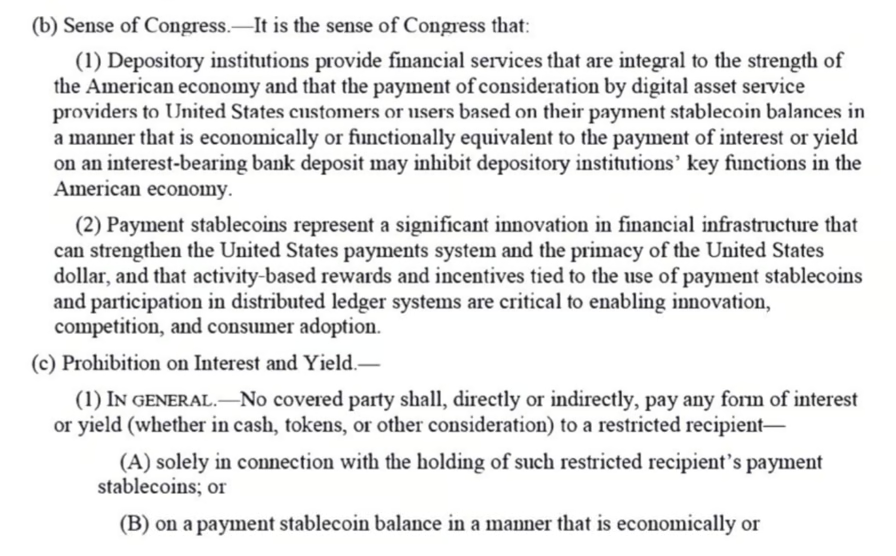
Extract of the “SEC 404. Prohibiting interest and yield on payment stablecoins” document. Source: Alex Thorn
The text titled “SEC 404. Prohibiting interest and yield on payment stablecoins” states that no crypto firm may pay “any form of interest or yield” to customers solely for holding stablecoins, akin to a bank deposit or any similar interest-bearing product.

Source: Patrick Witt
However, it allows firms to offer rewards tied to “bona fide activities.” Some industry executives voiced frustration with the ruling. Helius Labs CEO Mert Mumtaz said, “The clarity of not getting risk-free yield on your dollars without using a bank.”
Polymarket traders anticipate 55% odds of CLARITY passing in 2026
It marks a significant step forward for both the legislation and the broader crypto industry, as the stablecoin yield debate had been one of the main roadblocks delaying its passage, despite expectations earlier this year that it would move through Congress.

Source: Toly Yakovenko
“Now that this issue is behind us, it’s time to focus on the broader bill,” Shirzad said.
Traders on the Polymarket crypto prediction market now see a 55% chance of the CLARITY Act being signed into law in 2026, up 9% over the past 24 hours.
Many in the industry are now calling for the bill to be marked up. Coinbase CEO Brian Armstrong said shortly after the announcement, “Mark it up.”
Senate Banking Committee could schedule markup “imminently”
Galaxy Digital head of firmwide research Alex Thorn said the “release of text suggests that Senate Banking will schedule markup imminently, as soon as the week of May 11.”
Related: Spot Bitcoin ETF outflows top $490M: Is BTC’s rally losing momentum?
However, Thorn warned that he expects “the banks to increase their opposition efforts.”
US Senator Bernie Moreno recently said that he anticipates the CLARITY Act to “get done” by the end of May. On April 11, US Senator Cynthia Lummis said, “It’s now or never.”
Magazine: Why is Ethereum Foundation selling? BTC futures warning signs: Market Moves

Today’s NYT Connections: Sports Edition Hints, Answers for May 2 #585

Take Back Your Money in 2026
Form 13G Eloxx Pharmaceuticals For: 1 May

Manchester United reach agreement with Casemiro over contract clause amid transfer speculation

US brings back mandatory military draft registration

Steven Gerrard disagrees with Gary Neville over ‘shock’ Chelsea and Arsenal claim | Football


-

 Tech4 days ago
Register Renaming | Hackaday
-
Crypto World6 days ago
Hyperliquid $HYPE Rally Builds Momentum as AI Sector Enters Prove-It Phase
-

 Politics4 days ago
Drax board avoid their own AGM, accused of greenwashing & environmental racism
-

 Tech4 days ago
Images of Samsung’s rumored smart glasses have leaked
-

 Tech5 days ago
Why Blue Badges Disappeared From Toyota Hybrids
-
 Sports6 days ago
IPL 2026: Ruturaj Gaikwad registers slowest fifty of the season, enters all-time unwanted list | Cricket News
-
 Tech8 hours ago
Trump’s 25% EU auto tariff breaches Turnberry Agreement that also covers semiconductors and digital trade
-

 NewsBeat6 days ago
LK Bennett closes all stores after entering administration
-

 Fashion3 days ago
Kylie Jenner’s KHY Enters a New Era with ‘Born in LA’
-
 Entertainment6 days ago
Mariah Carey Slams Deposition Claims In Brother’s Lawsuit
-

 Business3 days ago
Most Commercial Energy Audits Miss the Real Losses
-

 Business5 days ago
(VIDEO) Charlize Theron Climbs Times Square Billboard to Promote New Netflix Thriller ‘Apex’
-

 Crypto World4 days ago
CFTC’s AI will review U.S. crypto registration applications, chairman tells CoinDesk
-
 Sports8 hours ago
Paul Scholes issues Marcus Rashford reality check as agreement emerges over Man United star
-

 Business3 days ago
Barclay Brothers Avoid Bankruptcy: HSBC Drops High Court Petitions After IVA Deal
-

 Tech6 days ago
Microsoft to roll out Entra passkeys on Windows in late April
-

 Tech6 days ago
OpenAI’s Sam Altman apologizes for not reporting ChatGPT account of Tumbler Ridge suspect to police
-

 Tech6 days ago
OpenAI CEO apologizes to Tumbler Ridge community
-
 Business2 days ago
Tesla Officially Registers Elon Musk’s Stock: What Investors Need to Know
-

 Tech4 days ago
Get Ready for More Brain-Scanning Consumer Gadgets
You must be logged in to post a comment Login