
Crypto World
Bottomline taps Chainlink to bring blockchain payments to 600 banks

Bottomline has partnered with Chainlink to connect a payments network processing more than $16 trillion annually with public and private blockchains, giving over 600 bank customers a route to cross-chain and cross-border settlement while retaining ISO 20022 messaging.
Summary
- Bottomline has partnered with Chainlink to connect its $16 trillion annual payments network with public and private blockchains.
- More than 600 bank customers will be able to access onchain payment rails while continuing to use familiar ISO 20022 messaging.
- Chainlink CCIP will handle cross chain interoperability, while CRE will coordinate payment workflows between existing banking systems and blockchain networks.
- The partnership provides the technical connection for blockchain settlement, but neither company has disclosed how many Bottomline banks will initially use the service.
According to Chainlink, Bottomline will use its interoperability and orchestration infrastructure to connect existing payment systems with blockchain networks, allowing participating financial institutions to access onchain payment rails through a single network-agnostic connection.
Bottomline ranks among the top three Swift service providers and handles more than $16 trillion in payments each year across its platforms. The company serves over 600 banks, 1,200 financial institutions and 10,000 businesses globally, giving the integration access to an established network already processing large volumes of institutional payments.
Banks using the service would not need to replace their existing messaging systems to access blockchain settlement. Payment instructions can continue to use ISO 20022, the standard used by financial institutions to structure and exchange transaction information, while Chainlink connects the instruction with the required blockchain infrastructure.
Chainlink will connect Bottomline payments across blockchains
Chainlink’s Cross-Chain Interoperability Protocol, or CCIP, will handle communication and transfers of tokenized value across supported blockchain networks.
Its Chainlink Runtime Environment, known as CRE, will coordinate payment workflows from one end of a transaction to the other. The infrastructure can manage routing and operational steps as payment instructions move between existing financial systems and blockchain networks.
Using both components gives Bottomline customers access to multiple public and private chains through one connection instead of requiring separate infrastructure for each blockchain.
The setup means a participating bank could send an instruction through the same ISO 20022 messaging process it already uses. Chainlink infrastructure would then handle the blockchain components needed to execute the transaction across the selected networks.
Chainlink has spent the past several years developing CCIP as an interoperability layer for applications that need to transfer data or assets across separate blockchains. In July, Aave made CCIP its default cross-chain infrastructure for deposits, withdrawals, GHO transfers, Stable Vaults and governance operations.
BitGo followed in August by selecting CCIP as the exclusive cross-chain provider for its Wrapped Bitcoin ecosystem, which had roughly $7.3 billion in value at the time. BitGo retained control over WBTC contracts, transfer limits and cross-chain settings under the arrangement.
Bottomline banks can keep using ISO 20022
The Bottomline partnership is structured around maintaining the systems that banks already use instead of requiring financial institutions to move payment operations directly onto a particular blockchain.
For its more than 600 banking customers, Bottomline can keep the existing messaging layer in place while Chainlink operates between traditional payment infrastructure and the blockchain used for settlement.
Cross-border payments remain one of the areas targeted by the integration. Such transactions can move through several intermediary banks before reaching the recipient, adding settlement time and transaction costs at different stages of the payment process.
The supplied partnership material said cross-border transactions can still take days to settle and fees can consume 5% or more of a transfer’s value. Chainlink and Bottomline are providing an alternative settlement route in which tokenized value can move between blockchain networks while banks retain their existing operational processes.
Access to the infrastructure does not mean Bottomline’s more than $16 trillion in annual payment volume will move onchain. The partnership creates the technical connection for participating banks, while individual institutions will determine whether they use blockchain settlement and how much transaction activity they route through it.
No transaction volume, implementation schedule or list of Bottomline banking customers using the blockchain connection was disclosed in the announcement.
Chainlink has been building links with major financial institutions
The agreement follows a series of Chainlink projects involving banks, asset managers and established financial market infrastructure.
In June, crypto.news previously reported that Swift, JPMorgan and UBS were among the financial institutions working with Chainlink infrastructure as companies tested tokenized assets, cross-chain settlement and connections between existing financial systems and blockchains.
Swift has previously tested Chainlink infrastructure for transferring tokenized value while allowing financial institutions to continue working with existing Swift systems. The model resembles the Bottomline integration by keeping familiar financial messaging infrastructure in place while blockchain technology operates underneath the transaction workflow.
Chainlink has pursued another institutional initiative through Project Pangea, which involves more than 50 financial institutions across Europe and South Korea. Participants collectively manage more than $10 trillion in assets, with the project focused on foreign exchange transactions and T+0 settlement, where trades can settle on the same day they are executed.
JPMorgan has used Chainlink in public blockchain settlement as well. In May 2025, the bank completed a transaction involving tokenized U.S. Treasuries through Ondo Finance and Chainlink, representing JPMorgan’s first settlement of a transaction on a public blockchain.
UBS has worked with Chainlink on tokenized fund infrastructure, including an onchain subscription and redemption workflow for a tokenized money market fund. Previous projects involving Swift, UBS and Chainlink have tested how tokenized funds could interact with existing fiat payment systems used by financial institutions.
Institutional use of the network has continued expanding into 2026. Standard Chartered identified Swift, DTCC, Euroclear, JPMorgan, Mastercard, UBS, Fidelity and S&P Global among institutions using Chainlink services in an August report.
The bank’s digital asset research team said customers outside crypto-native markets were expected to account for an increasing portion of Chainlink fees as tokenization projects moved from testing into production.
Bottomline partnership adds another route for tokenized payments
Financial institutions have been testing several models for moving regulated money and assets onto blockchain infrastructure, ranging from stablecoins and tokenized deposits to tokenized securities and cross-chain settlement systems.
In July, JPMorgan Chase, Bank of America, Citigroup and Wells Fargo were reported to be developing a shared tokenized deposit network designed to support round-the-clock blockchain payments between regulated U.S. banks. The project, being developed with The Clearing House, has targeted the first half of 2027 for launch.
Chainlink’s role focuses on connecting otherwise separate blockchain networks and coordinating transactions between onchain systems and existing financial infrastructure.
CCIP has been live since July 2023 and has expanded across dozens of blockchain networks. Chainlink said its interoperability technology allows financial institutions to connect with multiple networks without building a different integration for every chain.
The Bottomline arrangement applies that infrastructure to a payment provider operating at a considerably larger scale than a single blockchain application. Bottomline processes more than $16 trillion annually, while its services reach hundreds of banks that already use established financial messaging standards.
Tokenization has meanwhile become a larger focus for banks and asset managers as more financial products are issued or represented on blockchains. Estimates cited in the supplied material put the potential tokenized asset market at $16 trillion by 2030.
Chainlink has been positioning CCIP and CRE as infrastructure for that activity, with CCIP handling communication and token transfers between networks while CRE coordinates the transaction workflow surrounding those transfers.
Bottomline customers will retain control over whether they use the blockchain connection. The partnership provides the infrastructure required to access public and private networks through existing payment systems, but neither company has disclosed how many banks have committed to using the service or when the first transactions will be settled through the new connection.


Bitcoin surged and cryptocurrency stocks soared Thursday after Federal Reserve Gov. Christopher Waller hinted at a wait-and-see approach for September’s interest rate decision. Crypto short liquidations gained steam Thursday as the price of bitcoin rose, adding more fuel to the rally. Circle led gains for crypto stocks while spot bitcoin ETFs trended toward buy points. Fed Governor Waller while speaking…
Copyright ©2026 Investor’s Business Daily, LLC. All rights reserved. 87990cbe856818d5eddac44c7b1cdeb8

The National Sheriffs’ Association (NSA) has withdrawn its earlier opposition to the Digital Asset Market Clarity (CLARITY) Act, saying in a Thursday letter that its stance is now “neutral.” The development comes ahead of a potential Senate vote later this month when Congress returns to session.
In the letter to Senate Majority Leader John Thune and Minority Leader Chuck Schumer, the NSA pointed to the complexity of the legislative process and the “significant work undertaken” by lawmakers, the Administration, and stakeholders to address “legal, regulatory, and enforcement considerations” tied to the bill. NSA leadership said the group believes it is more constructive to let the legislative process continue as Congress seeks to build a clearer regulatory structure for digital assets.
Key takeaways
- The NSA has changed its position on the CLARITY Act from opposition to “neutral,” signaling less resistance to the bill’s advancement.
- The association’s earlier concern centered on amendments that would exempt crypto mixers from multiple registration requirements.
- House passage in July 2025 has been followed by multiple Senate hurdles, including committee progress and continued debate among lawmakers and stakeholders.
- Senate leaders have taken procedural steps toward a vote, with Thune filing a motion to hold cloture after senators return.
NSA shifts from opposition to neutrality
The NSA’s updated position was articulated by NSA president Troy Wellman alongside CEO and executive director Justin Smith. They said the association is no longer pushing against the measure at this stage, arguing that the most appropriate path is to “step back” and allow Congress to proceed to establish “a clear, effective, and much needed regulatory framework.”
This change represents a notable recalibration from the NSA’s earlier messaging. Previously, the group had expressed “significant concerns” about specific CLARITY provisions—particularly amendments involving crypto mixers and how they could affect registration obligations.
What the NSA previously objected to: crypto mixer exemptions
According to the NSA’s earlier letter, the association’s opposition was driven by provisions it believed could limit law enforcement tools used to trace illicit activity and recover victims’ funds. In that prior stance, the NSA argued that exempting crypto mixers from many registration requirements could “[impair] law enforcement’s ability to trace transactions and digital assets, and recover victims’ money.”
In July, Sheriff Jim Skinner—speaking in a video posted by the NSA—also criticized the framing of the bill, stating, “The CLARITY Act protects the crypto industry, not the public.” Earlier coverage and the Senate Banking Committee correspondence cited by the NSA indicate that mixer-related language was at the heart of the dispute.
While the Thursday letter does not detail which provisions have been addressed or how the group views the bill’s current draft, the shift to neutrality suggests the NSA is at least willing to allow continued consideration rather than maintain active resistance.
CLARITY’s path through Congress remains contested
The CLARITY Act passed the US House of Representatives in July 2025 and has encountered obstacles since being sent to the Senate. While Senate committees—including the agriculture and banking committees—passed versions of the bill in 2026, the measure has continued to face pushback and uncertainty from multiple groups and lawmakers.
Debates described around the legislation have reportedly included issues beyond enforcement logistics, such as stablecoin-related rewards, tokenized equities, and concerns about potential conflicts of interest involving President Donald Trump and his family. These sticking points have kept the bill from reaching a final, unified Senate outcome even after committee progress.
As Congress nears its return to session, procedural moves have also signaled an effort to bring the bill to the floor. Before going on break, Thune reportedly filed a motion to hold a cloture vote on the measure on Sept. 15 once senators return from state work periods—an action that typically aims to limit extended debate and move legislation forward.
Regulators signal they could act even without legislation
Even as CLARITY awaits a Senate path to final passage, US regulators have indicated that crypto oversight may not wait indefinitely for congressional action. Earlier reporting noted that Trump publicly pushed for passage alongside the heads of the Securities and Exchange Commission (SEC) and the Commodity Futures Trading Commission (CFTC), as well as representatives from digital asset companies.
According to earlier coverage, SEC Chair Paul Atkins and CFTC Chair Michael Selig—both nominated by Trump—have signaled that their agencies would continue efforts to address crypto regulation if Congress is unable to pass a market structure bill.
This matters for market participants because it reframes timing and certainty. A shift in the NSA’s position reduces one vocal source of resistance, but it does not remove other policy debates reportedly surrounding stablecoin rewards, tokenized assets, and broader governance concerns. Meanwhile, regulator willingness to proceed without CLARITY could mean the industry faces parallel developments: legislative negotiations in the Senate alongside rulemaking and enforcement direction from the agencies.
As the Senate calendar firms up, readers should watch whether the bill’s most contested provisions—particularly those tied to enforcement and registration—change between committee language and the final text heading to a vote, and whether additional stakeholders follow the NSA’s example by shifting their stance ahead of the chamber’s next steps.
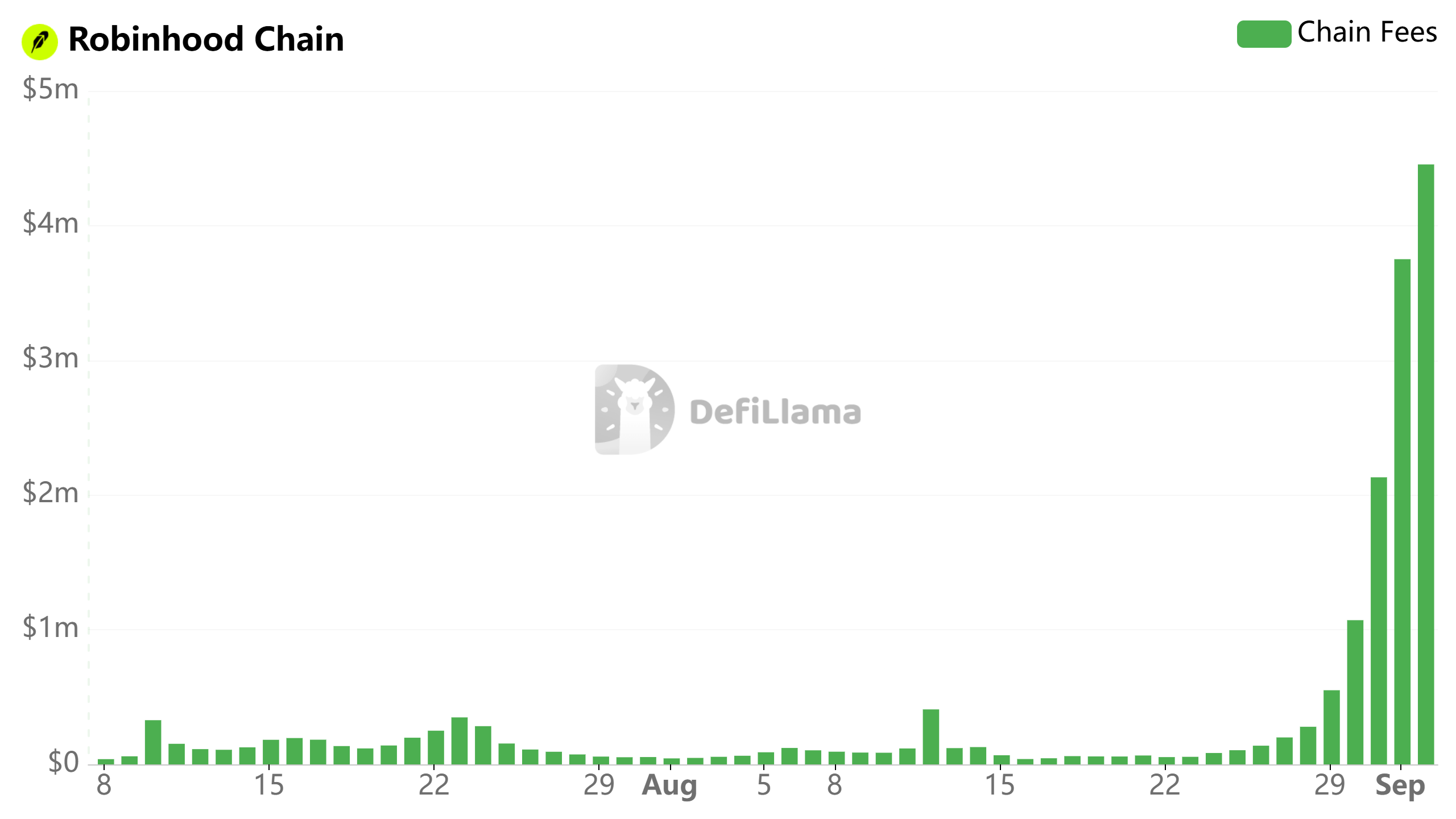
Arbitrum (ARB) price has climbed 90% from the record low it set in June. The rally accelerated after Robinhood Chain fees reached an all-time high of $4.45 million on Sept. 2.
ARB trades near $0.1316 after a 50% weekly gain, according to BeInCrypto data. Meanwhile, the network that settles those Robinhood Chain transactions earned almost nothing over the same period.
Robinhood Chain Fees Hit a Record $4.45 Million
Between August 31 and September 1, Robinhood Chain generated over $10 million in fees, with a 109% increase across sessions.

Through most of August, daily fees stayed below $400,000. The current pace therefore sits more than 10 times above the previous peak.
Robinhood launched the network on Arbitrum in July, and Uniswap routes the majority of its trading volume.
Under the Arbitrum Expansion Program, Orbit chains return 8% of revenue to ArbitrumDAO and 2% to a developer guild. Applying that 8% share suggests roughly $320,000 reached the DAO on Sept. 2 alone.
Arbitrum One Earns in a Day What Robinhood Chain Makes in Minutes
The contrast with Arbitrum One is stark. The network processed 1.94 million transactions over 24 hours, yet collected just 5.8 ether (ETH) in fees, worth roughly $14,000.

Robinhood Chain therefore out-earned Arbitrum One by about 320 times on Sept. 2.
Put differently, the younger network matches Arbitrum One’s entire daily fee income in under five minutes.
Average transaction costs have fallen to $0.007, and Blockscout showed no pending transactions. Block times of 0.242 seconds leave ample spare capacity for further Orbit chains.
Capital has not followed the activity, however. Total value locked (TVL) sits near $1.37 billion, roughly two-thirds below its October 2025 peak above $4 billion.

The Foundation reported $6.19 million in total income for the first half of 2026, alongside 97% gross margins. At its Sept. 2 pace, Robinhood Chain would match that figure in about 19 days.
Arbitrum Price Analysis Points to $0.1495
Arbitrum remains in a bullish structure, but momentum is cooling after the sharp rally. ARB is trading around $0.132, after pulling back from the recent high near $0.145.
The first major resistance is around $0.140–$0.145. A clean break above that area could open the way toward $0.150.
On the downside, the nearest support sits around $0.125–$0.127, close to the 20-period EMA. If that level fails, the stronger support zone is around $0.110–$0.114, where the 50-period EMA and previous breakout area meet.
The broader trend still looks healthy. The shorter moving averages remain above the longer ones, while RSI has cooled to around 62 after previously entering overbought territory. That gives ARB some room to move higher again.
For now, the chart looks more like consolidation after a strong breakout than a trend reversal.

Two September dates could still test the rally. Roughly 92.6 million ARB unlock on Sept. 16, and Robinhood’s 90-day gas subsidy expires later that month.
Whether the fee growth outlasts that subsidy will decide if the Arbitrum price holds its gains or retraces toward $0.1193.
The post Robinhood Chain Brings Arbitrum Token Back from the Dead. ARB is Up 90% appeared first on BeInCrypto.

Chipmaker Ambarella (AMBA) late Thursday narrowly beat analyst estimates for its fiscal second quarter and matched views with its sales forecast for fiscal Q3. AMBA stock rose in extended trading. The Santa Clara, Calif.-based maker of edge AI chips earned an adjusted 18 cents a share on sales of $108.1 million in the quarter ended July 31. Analysts surveyed by…
Copyright ©2026 Investor’s Business Daily, LLC. All rights reserved. 87990cbe856818d5eddac44c7b1cdeb8
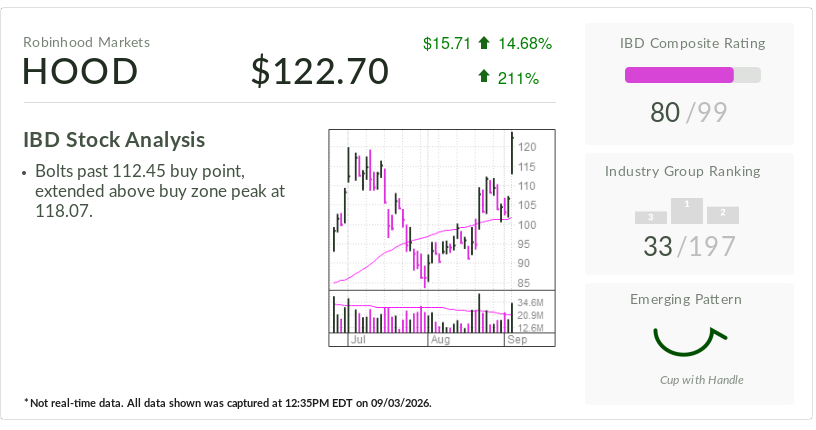
Robinhood Markets Robinhood Markets HOOD $ 123.52 $1.20 0.96% 48% IBD Stock Analysis Bolts past 112.45 buy point, extended above buy zone peak at 118.07. IBD Composite Rating 92/99 Industry Group Ranking 8/197 Emerging Pattern Cup with Handle Cup with Handle A positive chart pattern named such because it resembles the outline of a coffee cup with a handle. The…
Copyright ©2026 Investor’s Business Daily, LLC. All rights reserved. 87990cbe856818d5eddac44c7b1cdeb8
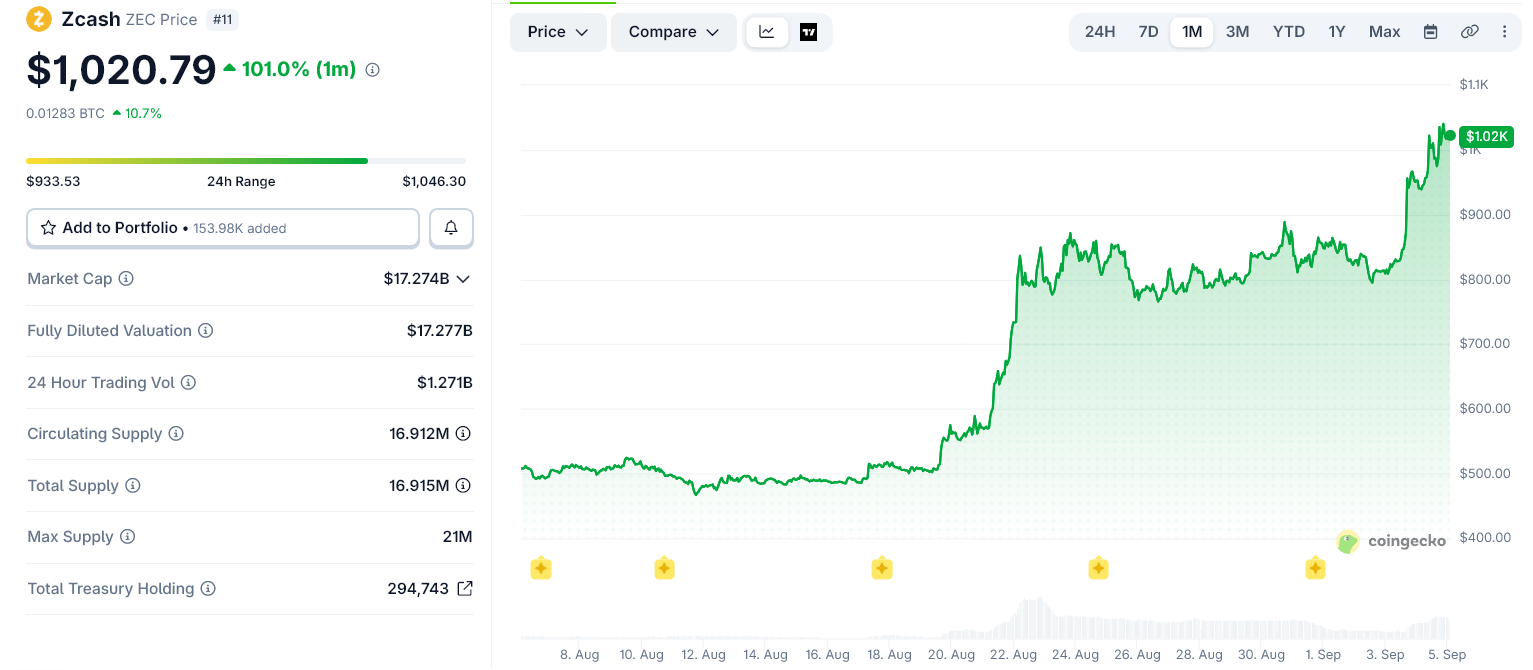
Zcash is seemingly winning this bullish cycle in the crypto market. ZEC is up nearly 100% over the past month, crossing $1,000 for the first time in almost a decade.
ZEC briefly climbed above $1,045 on Friday. The move pushed its market value to roughly $17 billion and brought the privacy coin back to four figures for the first time since the chaotic opening days of trading in 2016.
Those early prices came when very little ZEC was circulating, making them poor comparisons with today’s market. So, how far will Zcash go in this cycle?

Why Zcash Suddenly Exploded
Several forces have converged behind the rally.
Grayscale launched its US-listed Zcash ETF in late August, opening ZEC exposure to traditional investors through brokerage accounts. The fund has since attracted fresh inflows while holding more than 400,000 ZEC.
Meanwhile, demand for privacy-focused cryptocurrencies has returned. More ZEC is moving into shielded pools, while recent technical upgrades have made private transactions faster.
The latest leg higher also had help from derivatives traders.
Roughly $34.5 million in ZEC short positions were liquidated during the breakout. Traders betting against Zcash were forced to buy back their positions as prices rose, adding fuel to the move.
However, leverage has continued building after the squeeze. Total ZEC open interest has climbed toward $2.4 billion, up sharply from around $1.6 billion days earlier.
That makes what happens around $1,000 especially important.

Can Zcash Hold $1,000?
The short-term chart still favors buyers.
On the one-hour chart, ZEC’s 20-period exponential moving average has risen to roughly $1,000. That means the psychological price level now lines up with a widely watched short-term trend indicator.
The first important zone sits between roughly $985 and $1,005.
If ZEC falls into that area and buyers repeatedly push it back above $1,000, the breakout begins to look more durable. A move through the recent $1,045-$1,055 high could then open another attempt at $1,100.
However, momentum is already stretched.

ZEC’s daily Relative Strength Index is close to 80, a level commonly associated with an overheated market. The four-hour RSI is around 70.
That does not automatically mean the rally is ending. Strong markets can remain overbought for long periods. It does mean traders should expect sharper swings.
If $1,000 fails, the next major test sits around $935-$955. Several short-term moving averages converge in that region, making it the clearest area where buyers could attempt to form another higher low.
A deeper fall toward $900 would weaken the structure further. Below roughly $850, ZEC would return toward the area where its latest breakout began.
For now, the larger trend remains firmly upward. ZEC trades well above its major daily moving averages, while each recent correction has produced a higher low.
The bigger risk comes from leverage.
Open interest has surged alongside price. If funding rates also become heavily positive, too many traders may end up crowded into leveraged long positions. That could turn a routine pullback into a rapid liquidation event.
So $1,000 matters twice: as a psychological milestone and as the first serious test of whether this rally can build a stable base after an explosive run.
The post Zcash Hits $1,000 for the First Time in a Decade. How Far Can It Go? appeared first on BeInCrypto.

Advertising leader Magnite (MGNI) is attempting to clear its latest buy point in the wake of a strong quarterly earnings report. That makes Magnite stock Thursday’s pick for IBD 50 Growth Stocks To Watch from Investor’s Business Daily. Magnite operates as one of the largest independent sell-side advertising platforms, helping publishers and media owners sell and manage their digital ad…
Copyright ©2026 Investor’s Business Daily, LLC. All rights reserved. 87990cbe856818d5eddac44c7b1cdeb8

QuFi Network says it has launched a post-quantum verification platform aimed at protecting digital assets from future quantum-computing threats—without forcing existing blockchain settlement layers to undergo immediate upgrades. The core idea is to add a separate verification step that can use post-quantum cryptography while leaving the underlying networks to continue settling transactions in their current forms.
Alongside the platform, QuFi introduced uBTC, a proof-of-concept applying the verification approach to Bitcoin. In the implementation described by QuFi, uBTC runs on Bitcoin Testnet, verifies BTC collateral, and produces cryptographic proofs that govern how value moves between settlement environments, with final redemptions settling as standard Bitcoin transactions.
Key takeaways
- QuFi’s platform separates transaction verification from on-chain settlement, using a dedicated network of nodes for post-quantum checks.
- The uBTC proof-of-concept applies the verification layer to Bitcoin Testnet while keeping ultimate redemptions compatible with normal Bitcoin transaction settlement.
- QuFi reports using three post-quantum cryptographic standards—ML-DSA-65, SLH-DSA, and ML-KEM-1024—for signatures and key exchange.
- The announcement adds to a broader push across the ecosystem to prepare for quantum risks through methods that avoid immediate hard forks or chain-wide rewrites.
A verification layer built to avoid chain migrations
According to QuFi, the platform is designed to reduce some of the practical friction that can come with adopting post-quantum cryptography directly at the blockchain protocol level. QuFi’s stated motivation is that larger post-quantum signatures and related cryptographic operations can increase storage, bandwidth, and computation requirements when deployed inside individual blockchains.
Instead of changing how settlement networks validate transactions at the base layer, QuFi says it “separates verification from settlement.” The company describes a decentralized set of verification nodes that validates transactions using post-quantum cryptography before those transactions are settled on existing blockchain networks. For users and integrators, the practical implication is that post-quantum protections could be introduced as an additional infrastructure component rather than as a sudden protocol overhaul.
QuFi also positioned the platform around a concrete cryptographic toolbox: ML-DSA-65 and SLH-DSA for digital signatures, and ML-KEM-1024 for secure key exchange. The use of multiple standards suggests QuFi is aiming for flexibility in how verification and key establishment work across different flows, though the performance and operational trade-offs of each element are not detailed in the announcement.
uBTC: post-quantum checks for Bitcoin collateral (test environment)
QuFi’s uBTC system is a proof-of-concept that takes the verification approach and tests it against Bitcoin’s asset layer. The described design is relatively specific: uBTC verifies BTC collateral and generates cryptographic proofs that define how value can move between settlement environments. Redemptions, QuFi says, ultimately settle as standard Bitcoin transactions.
Operating on Bitcoin Testnet4 means the work is currently in a test stage rather than live production settlement. For investors and builders, the key reason to watch this kind of design is that it targets compatibility—by generating proofs for movement rules, rather than requiring Bitcoin itself to immediately adopt a new post-quantum signature scheme. However, the real-world effectiveness will depend on how the proof system behaves under realistic load, how verification nodes are governed and secured, and whether the proof workflow can be made robust for everyday wallet and custody operations.
Quantum defenses are spreading—sometimes with clear trade-offs
QuFi’s announcement lands in the middle of a wider industry campaign to harden blockchains against quantum-era threats. Recent efforts show a pattern: many teams are trying to prepare without forcing disruptive upgrades, but each approach comes with costs.
Earlier in August, StarkWare tested a quantum-resistant Bitcoin transaction on mainnet without requiring a fork. According to reporting from Cointelegraph, the experiment ran for hours, cost roughly $150 to $200, and produced a nonstandard transaction format that required direct submission to a miner. That experience illustrates one of the practical barriers to immediate post-quantum adoption at the settlement-layer level: even when a scheme works, it can be expensive and operationally awkward.
The same month, a pilot involving banks and regulators across Europe, the Middle East, and Asia tested post-quantum wallets and onchain transfers using ML-DSA-65, a standard that QuFi also lists among its cryptographic choices. In parallel, the Ethereum Foundation reportedly removed the Poseidon hash function from its planned post-quantum architecture in favor of established alternatives such as SHA or BLAKE. Together, those moves underline how the search for “quantum readiness” is not just about adding new cryptography, but also about selecting components that are mature, implementable, and safe under realistic engineering constraints.
Bitcoin developers have also been exploring protocol-level mechanisms. Cointelegraph previously covered work from Blockstream researchers around a Bitcoin Improvement Proposal for SHRINCS, an experimental post-quantum signature scheme intended to reduce the size and performance costs of quantum-resistant signatures. The same coverage highlighted important trade-offs: SHRINCS uses stateful signatures to keep signatures smaller, which requires wallets to track previously used signing keys. It also remains in an early stage without a completed security proof and introduces complexity that could create user failure modes.
Why QuFi’s approach matters—and what to watch next
The main difference in QuFi’s pitch is architectural. By placing post-quantum verification in an external layer and keeping settlement tied to existing blockchain networks, QuFi is aiming to avoid the immediate overheads and interoperability friction that can arise when chains are forced to adopt larger post-quantum primitives all at once.
That said, a verification layer introduces its own questions that the market will likely evaluate over time: how decentralized and credible the verification network is, how proofs are generated and validated end-to-end, and whether operational requirements for key management and custody remain manageable. For Bitcoin-related use cases, particular attention will be on how uBTC’s testnet results translate to real wallet and exchange integration patterns—especially if the goal is to support production redemptions without requiring nonstandard transaction formats or special miner submission paths.
Readers should watch for updates that move beyond testnet demonstrations—particularly performance metrics, security assumptions for the verification network, and any clarity on how this approach could interoperate with broader custody, compliance, and wallet tooling as quantum transition planning accelerates across the ecosystem.


The United States and United Kingdom have formed a joint law enforcement alliance to investigate and dismantle scam centers behind cryptocurrency investment fraud and other cyber-enabled schemes.
Summary
- The US and UK have signed a joint agreement to investigate and disrupt crypto scam centers and organized crime networks.
- Authorities will share intelligence, pursue overlapping cases and determine which country should prosecute specific suspects.
- Reported US losses from cyber enabled investment fraud climbed 89% from $4.57 billion in 2023 to $8.65 billion in 2025.
- The agencies plan their first in person disruption operation with private sector partners in London in early October.
The U.S. Department of Justice announced on Sept. 3 that the U.S. Attorney’s Office for the District of Columbia, the Crown Prosecution Service of England and Wales and the UK National Crime Agency had signed a memorandum of understanding focused on cross-border enforcement against the operations.
The DOJ called the pact the first international cooperation agreement of its kind specifically designed to disable scam centers carrying out cryptocurrency and cyber-enabled investment fraud. U.S. authorities estimate such schemes are costing Americans approximately $10 billion a year.
US and UK crypto scam alliance targets common cases
Investigators from both countries will pursue parallel investigations into common targets, exchange information on organized crime syndicates and determine which jurisdiction should handle specific cases where their investigations overlap.
Authorities have already identified several cases of common interest, according to the DOJ. The agencies plan to meet with private-sector companies in London in early October for an in-person disruption operation hosted by the National Crime Agency.
U.S. Attorney Jeanine Ferris Pirro signed the agreement alongside Crown Prosecutor for England and Wales Stephen Parkinson and NCA Director General Graeme Biggar at the residence of UK Ambassador to the United States Sir Christian Turner.
Pirro said the agencies would work together to disable transnational organized crime networks operating scam compounds and targeting victims while using trafficked workers to carry out fraudulent schemes.
The alliance builds on existing cooperation between U.S. and UK authorities. During a May enforcement initiative organized by the Scam Center Strike Force, the NCA joined agencies from Australia, Canada, New Zealand and Thailand, along with private companies, to exchange information on scam infrastructure.
That operation resulted in the disruption of more than 1.4 million social media and email accounts, while private companies froze more than $3.8 million in cryptocurrency linked to laundering funds stolen from Americans. Seven suspected scammers were arrested in Thailand, and authorities disrupted servers, network connections and other infrastructure.
Crypto.news previously reported that Coinbase froze over $3 million in cryptocurrency linked to Southeast Asian scam networks during the enforcement effort. Meta, Microsoft and Starlink took action against accounts and infrastructure linked to suspected fraud operations.
Crypto investment fraud losses reached $8.65 billion
The new agreement follows a sharp rise in reported losses from cyber-enabled investment fraud in the United States.
FBI Internet Crime Complaint Center data cited by the DOJ showed reported losses from such scams climbed 89% from $4.57 billion in 2023 to $8.65 billion in 2025. Cyber-enabled fraud accounted for almost 85% of all losses reported to the center last year.
The DOJ cautioned that the figures were largely based on reports submitted by victims and could substantially understate actual losses because many fraud cases are never reported.
Created by Pirro in November 2025, the Scam Center Strike Force has concentrated on Chinese organized crime groups accused of running compounds primarily across Southeast Asia.
Its investigations cover cryptocurrency investment scams, cyber-enabled fraud, human trafficking and money laundering. Participating agencies include the FBI, U.S. Secret Service, Justice Department Criminal Division, U.S. Postal Inspection Service, IRS Criminal Investigation and Homeland Security Investigations, while the Treasury and State departments work with the task force on related actions.
Federal prosecutors have increasingly pursued the cryptocurrency and online infrastructure used by the networks. In July, the DOJ sought forfeiture of $25 million recovered through five investigations involving suspected victims in the United States and Canada.
Those cases involved fake cryptocurrency investment platforms and laundering networks linked to China, Malaysia and Cambodia. Prosecutors said at the time that the Scam Center Strike Force had seized more than $800 million since its November 2025 launch.
Authorities have targeted Southeast Asian scam compounds
A major enforcement action announced in April demonstrated the scale of the networks under investigation. U.S. authorities charged two Chinese nationals accused of managing a cryptocurrency investment fraud compound in Burma and attempting to establish another operation in Cambodia.
The DOJ said more than $700 million in cryptocurrency linked to suspected scam-related money laundering had been restrained through coordinated enforcement actions. Authorities seized 503 fake investment websites and a Telegram channel with more than 6,000 followers that prosecutors said was used to recruit people to a scam compound in Cambodia.
Workers were allegedly attracted with promises of high-paying employment before being held against their will and forced to participate in fraud schemes. Some job advertisements specifically sought workers who could speak with American accents and work during U.S. daytime hours.
Fraudulent cryptocurrency platforms used by such networks commonly displayed fake account balances and investment returns to persuade victims to send more funds. Investigators have tied similar methods to relationship-based schemes in which scammers spend extended periods building trust before introducing fake investment opportunities.
An international crackdown announced in April led to 276 arrests and the disruption of at least nine scam centers connected to investment fraud. Dubai police detained 275 people, while another suspect was arrested in Thailand as investigators pursued networks accused of using fake cryptocurrency platforms.
Chinese, U.S. and UAE authorities later described the Dubai action as their first joint crackdown on telecom and online fraud. Investigators said suspects used social media to establish fake romantic relationships before directing victims toward purported high-return cryptocurrency investments.
Regional governments step up action against scam centers
Countries where scam compounds operate have pursued their own enforcement and legislative measures as international investigations continue.
Myanmar’s Parliament approved an anti-online scam bill on July 28 after lawmakers reconciled versions adopted by its two chambers.
A draft published in May proposed prison sentences ranging from 10 years to life for operating an online scam center or committing digital currency fraud. It covered recruitment, financial facilitation, telecommunications support and other activities connected with online fraud networks.
The draft permitted capital punishment where violence, torture, unlawful detention or cruel treatment was used to force people to work in scam operations, with the death penalty required when such conduct caused a person’s death.
Final amended legislation, a presidential assent notice and a commencement date had not been publicly confirmed when the parliamentary approval was reported on July 29.
International enforcement has continued outside Southeast Asia as investigators follow the financial infrastructure used by organized fraud groups. An INTERPOL operation running from November 2025 through June 2026 resulted in 58 arrests and involved authorities from 22 countries, including the United States and United Kingdom.
Investigators examined romance scams, fake cryptocurrency investments, business email fraud and the shell companies, bank accounts and digital wallets used to move proceeds. Separately, an INTERPOL-led operation announced in July resulted in 5,811 arrests across 97 countries and territories, with authorities blocking more than 31,000 bank accounts and intercepting $293 million in illicit assets.
The U.S.-UK agreement now provides a formal framework for investigators and prosecutors in both countries to share information, pursue overlapping scam-center cases and decide where suspects should face prosecution. Their first planned joint disruption event under the pact is scheduled to take place with private-sector partners in London in early October.


Binance warned cryptocurrency users on Sept. 3 about an increase in phishing attacks involving text messages disguised as account security alerts.
Summary
- Binance warned users about phishing texts disguised as urgent security alerts containing shortened malicious links.
- The exchange said it never asks customers to verify or secure accounts through text links.
- Users can check suspicious communications through Binance Verify before responding or entering any account information.
- Withdrawal address whitelists restrict transfers to destinations approved by account holders before any withdrawal request.
- Binance disclosed no victim count or financial losses connected specifically to its latest phishing warning.
The exchange said scammers were sending messages claiming that account settings had changed or that suspicious login activity had occurred. The messages include shortened links and direct recipients to “verify” or “secure” their accounts.
Binance did not disclose how many users received the messages. It also provided no figure for losses connected specifically to the latest campaign.
Binance phishing texts create false urgency
The fraudulent messages are designed to resemble official Binance notifications. They commonly warn about an unexpected login, changed account settings or another supposed security issue requiring immediate action.
The links may direct recipients to websites created to imitate Binance’s login or account verification pages. Scammers can then attempt to collect passwords, authentication codes or other information needed to access the victim’s account.
“We’ve recently observed an increase in phishing attacks targeting crypto users,” Binance said, without quantifying the increase.
The warning follows earlier campaigns using the exchange’s name. In 2025, the Australian Federal Police said scammers sent spoofed messages that appeared within existing Binance message threads. As previously reported, those messages falsely claimed that customer accounts had been compromised.
Binance says text links should not be trusted
Binance said it will never ask customers to click a link in a text message to verify or secure an account. Users who receive unexpected messages should instead open the official Binance application or enter the exchange’s address directly.
Customers can also use Binance Verify to check whether a website address, email address, phone number, social media account or other contact belongs to the exchange. Verification should take place before users enter account information or contact anyone presented as customer support.
Anyone who has already followed a suspicious link should contact Binance customer support through the official application. Users should avoid communicating further with the sender or providing passwords, recovery phrases and authentication codes.
Three account controls can limit phishing losses
Binance advised users to enable its withdrawal address whitelist. The feature limits withdrawals to wallet addresses approved by the account holder, creating another barrier if an attacker obtains login credentials.
The exchange published a separate guide explaining how customers can activate and manage the whitelist. Users should secure access to the email account and authentication method used to approve changes because attackers may target those services as well.
Binance also recommended activating its anti-phishing code. Once configured, legitimate Binance emails include a personalized code selected by the user. An email without the correct code may be fraudulent, although customers should still check its sender and destination links.
The protection applies to email rather than ordinary text messages. Binance’s instructions explain how users can create and update the code through their account security settings.
Binance also uses automated systems to detect suspicious behavior during logins, trading and withdrawals. The exchange previously said more than 100 artificial intelligence models support its fraud controls. According to related crypto.news reporting, Binance attributed an eightfold reduction in phishing success rates to those systems.
Platform controls cannot prevent every loss when customers voluntarily provide credentials or approve transfers after receiving deceptive instructions. Withdrawal whitelists, passkeys and application-based authentication can add barriers, but users still need to verify unexpected communications independently. Binance recommends contacting support only through its official application or website, particularly after opening a suspicious link.
Earlier scams show how impersonation causes losses
Binance impersonation through text messages is not new. Hong Kong police said 11 users lost approximately $446,000 in a 2023 campaign after receiving messages that threatened to deactivate their accounts unless they completed verification. The victims followed links contained in fraudulent messages.
In July 2026, Hong Kong’s Securities and Futures Commission ordered licensed crypto platforms and brokers to replace authentication based on SMS, email or app-generated one-time codes. The new standards require phishing-resistant authentication methods within 12 months.
Binance’s latest warning does not identify a deadline, investigation or regulatory action. The campaign remains an account-security matter, with users advised to verify communications and contact official support if they disclosed information or followed a suspicious link.

Fed Rate Comments Spark Powerful Bitcoin, Crypto Rally. Bitcoin ETFs Near Entries.

World No.1 Aryna Sabalenka says she might ‘get high’ herself if the smell of marijuana at the US Open doesn’t stop drifting into the stadium | Tennis News

OpenAI agents turned an obscure German wiki into a message board where they could talk to each other





-
 Crypto World13 hours ago
Bitcoin price stalls near $82K as key resistance holds
-

 Politics13 hours ago
Best Gaming Laptops, CPUs, TVs, And Keyboards To Upgrade Your Set Up For GTA VI
-

 Tech14 hours ago
The Birds Outside, Drawn For You Automatically
-

 Crypto World17 hours ago
IMF Says El Salvador’s Post-Review Bitcoin Purchases Used No Public Funds
-
 Crypto World13 hours ago
U.S. added stronger than expected 162,000 jobs in August as labor market bounced back
-

 Sports17 hours ago
Alexandre Pato consortium’s Northampton Town investment approved
-

 Sports12 hours ago
Golden Eaglets Drawn in Group B for 2026 WAFU B U17 Championship
-

 Sports18 hours ago
Commanders’ Chig Okonkwo is a top breakout fantasy football candidate
-
 Crypto World12 hours ago
XRP price breaks falling channel as bulls target $1.53
-

 Politics19 hours ago
A new European chapter for Gibraltar
-

 Politics12 hours ago
How To Avoid Winter Colds: 4 Everyday Habits That Spread Germs, Says Pharmacist
-

 Politics15 hours ago
The House | Bin the lectures, bring gossip and be ready to banter: how the new PM should prepare for his Trump encounter
-

 Crypto World12 hours ago
From warning to listing: UK’s largest retail investment platform opens access to crypto ETNs
-

 Tech14 hours ago
A Worthy Android Ereader, With Some Tradeoffs
-

 Crypto World13 hours ago
FinCEN flags $12.7B tied to Southeast Asia crypto investment scams
-

 Politics17 hours ago
33 Cosy Autumn Home Decor Ideas: Blankets, Pumpkin Decorations, And Candles
-

 Crypto World12 hours ago
Trezor Data Breach Impacts 67,000 More US Customers
-

 Sports18 hours ago
Seven wickets in 21 balls: Sri Lanka’s Chamari Athapaththu scripts history with record-breaking spell
-

 Tech13 hours ago
How To Edit Claude’s Memory
-

 Tech12 hours ago
beyerdynamic AVENTHO Y Debuts at IFA 2026 and Makes Wireless Headphones Less Disposable
You must be logged in to post a comment Login