
Crypto World
BTC price nears $74,000, memecoins drive risk-on mood: Crypto Markets Today



The crypto market is on the cusp of a major breakout as bitcoin trades at $73,000 and ether (ETH) at $2,250, its highest level since Feb. 4.
If bitcoin, the largest cryptocurrency by market capitalization, can break above $74,000 on convincing volume, it will likely run back to $80,000, which was a level of support in November before an eventual breakdown in January.
A rejection, on the other hand, would lead to a reversion to a trading range between $62,000 and $72,000, which has persisted for more than a month.
But the main story on Monday is not among crypto majors, it is the altcoin market and memecoins in particular.
PEPE rose by around 20% in the past 24 hours, while BONK and PENGU are also up by double digits. However, “overbought” conditions on the average relative strength index (RSI) suggest a pullback may be in store before any breakout.
Oil remains inflated at above $106 per barrel despite the U.S. reportedly considering a coalition to escort ships through the Strait of Hormuz, a key trade route.
U.S. stock futures are up around 0.5% and crypto-related companies are advancing in pre-market trading. Crypto exchange Coinbase (COIN) was recently 3% higher and Circle Internet (CRCL) added 5%. Bitcoin treasury company Strategy (MSTR) gained 4%.
Precious metals fell and the dollar weakened, reflecting risk-on sentiment.
Derivatives positioning
- Industry-wide futures open interest has risen over 8% to $112.34 billion in 24 hours in a sign of increased risk-taking in the market.
- Open interest (OI) in ether (ETH) and futures increased by 16% and 19%, respectively, leading the growth among major cryptocurrencies. This indicates strong investor preference for smart contract tokens. OI in bitcoin rose more than 5%.
- In ether’s case, OI in coin terms climbed to 14.34 million ETH, the most since September 2025.
- There are signs of speculation in non-serious tokens such as : Open interest tied to the cryptocurrency has jumped over 11%.
- The growth in OI in most major tokens is accompanied by positive perpetual funding rates and cumulative volume deltas. This combination indicates a rising demand for bullish leveraged plays.
- On Deribit, however, puts tied to bitcoin and ether continue to trade pricier than calls across all time frames. That’s a sign of continued demand for downside hedging despite the market bounce. Overhead call selling could be another reason for the persistent put premium.
- In XRP’s case, the $1.40 strike call and put are the most popular, cumulatively boasting a notional open interest of $14 million. That’s nearly 25% of the total XRP options open interest on the exchange.
Token talk
- The altcoin market is in a jubilant mood with the “altcoin season” index hitting 48/100, the highest in just over two months.
- The total crypto market cap excluding bitcoin reached $1.1 trillion on Monday, adding around $40 billion in the past 24 hours and $10 billion since midnight UTC, according to TradingView.
- The best-performing CoinDesk benchmark over the past 24 hours has been the Smart Contract Platform Select Capped Index (SCPXC), which is made up of ETH, SOL, ADA and SUI among layer-1 networks. The SCPXC is up by 6.3%, closely followed by the Memecoin Index (CDMEME), which has risen by 5.2%.
- AI-focused token bittensor (TAO) lost 3.7% since midnight. This is a consolidation move rather than a decline after it surged by more than 69% from March 8 to March 15.
- It appears some of those profits are being rotated into another AI project, , which has benefitted from a 60% increase in daily trading volume to $195 million, with the token rising by 11% as a result.



Andreas Antonopoulos, author of Mastering Bitcoin and one of the longest-serving Bitcoin educators, announced on Patreon that he’ll no longer produce livestreams or new content for subscribers.
While his Patreon account will stay active to maintain his existing library of books, workshops, and videos, his team stated over the weekend, “For health reasons, Andreas will not be doing any more livestream Q&A or producing any new content.”
According to Antonopoulos, he’s suffering from debilitating migraines that have resisted many attempts at treatment.
Antonopoulos has previously disclosed chronic, severe migraines. Someone in the community speculated that the condition could be something like Familial Hemiplegic Migraine, a rare and inherited neurological disorder whose episodic symptoms mimic strokes, including loss of motor control and speech.
Although Antonopoulos hasn’t publicly confirmed that specific diagnosis, the announcement pauses a notable public career.
Antonopoulos tried to get people into bitcoin early
Antonopoulos, a British-Greek computer scientist born in 1972, first learned about bitcoin (BTC) in 2011 when a single coin traded for a few dollars.
By 2012, he’d quit his consulting job, abandoned a career at the research company he founded, and started speaking and writing about Bitcoin. BTC’s price was less than $15 in 2012.
A now-iconic video from the Bitcoin 2013 Conference in San Jose shows Antonopoulos explaining BTC to a nearly empty room. BTC at that time was worth roughly $120.
Read more: Bitcoin’s Lightning Network is now under surveillance by US authorities
In 2014, Antonopoulos authored Mastering Bitcoin (2014), an O’Reilly technical book that became foundational reading for Core developers.
He followed with the Internet of Money trilogy (2016, 2017, 2019), co-authored Mastering Ethereum (2018), and co-authored Mastering the Lightning Network (2021). He released all of them open-source on GitHub, free for anyone to read, teach, or share. His YouTube talks remain unmonetized and ad-free.
He co-hosted the Let’s Talk Bitcoin! podcast (now Speaking of Bitcoin) and taught at universities. He’s widely credited with coining the phrase, “not your keys, not your coins.”
Loyal fans
One episode defined Antonopoulos’s standing in the community. In December 2017, Roger Ver publicly mocked him for not being a BTC millionaire despite years of unpaid advocacy.
The community’s response was swift. Over a thousand people donated more than 100 BTC, worth over $1 million at the time.
In January 2026, just two months before his health announcement, the Human Rights Foundation named him the recipient of the Finney Freedom Prize for the 2016–2020 halving era.
The award recognized his contributions to Bitcoin and human rights.
Antonopoulos said he’d donate half the financial prize to Creative Commons, the nonprofit that licenses the open works he built.
Got a tip? Send us an email securely via Protos Leaks. For more informed news, follow us on X, Bluesky, and Google News, or subscribe to our YouTube channel.
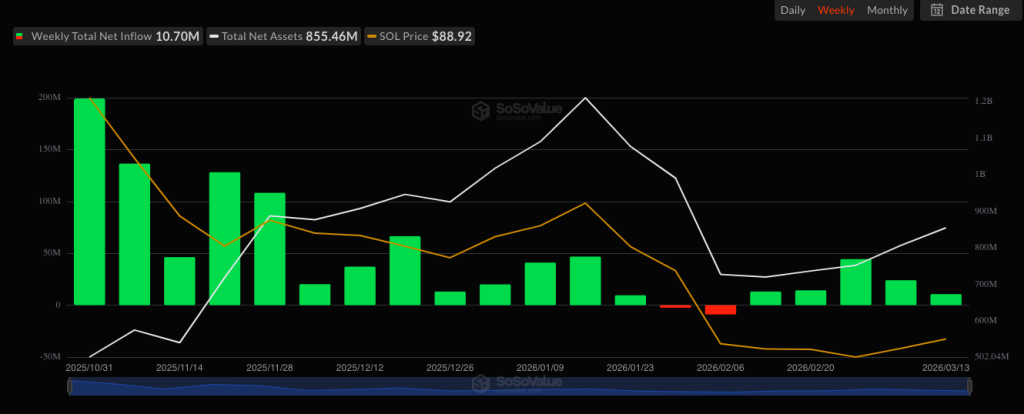
Solana (SOL) is trading at $93, marking a +7% surge since Sunday as buyers aggressively target the psychological $100 resistance level, buoyed by rising ETF demand.
This move is backed by $10.70 million in weekly net inflows into Solana investment products, signaling that the engine behind this rally is unmistakably institutional.

Open Interest Surge Signals Leveraged Conviction
The current SOL price analysis reveals a market structure dramatically different from the retail-driven pumps of previous cycles.
Institutional and retail demand are synchronizing, evidenced by a sharp rise in derivatives activity. According to CoinGlass data, Solana’s futures Open Interest (OI) spiked +11% in the last 24 hours alone, hitting a staggering $5.79 billion.
This buildup suggests traders are opening fresh long positions or significantly increasing leverage in anticipation of a breakout. The buying pressure has already claimed victims: the influx of capital wiped out millions in short positions as the price reclaimed the $90 mark.
Solana-specific investment vehicles recorded $7.60 million in inflows on Friday alone, pushing the weekly total to $10.70 million.
As buying pressure doubles across major exchanges, the divergence between price action and volume is closing, indicating sustainable momentum rather than a fleeting wick.
Discover: The best meme coins on Solana
Institutional Solana Demand: The ETF Catalyst
Institutional crypto appetite has evolved rapidly following the approval of Bitcoin, Ethereum and Solana ETF products, with asset managers now aiming to package high-throughput Layer-1s for Wall Street portfolios.
Launches from heavyweights like VanEck, 21Shares, and recently Canary Capital have fundamentally altered the long-term thesis for holders. Canary Capital’s filing is particularly notable for designating Marinade Finance as a staking provider, introducing a yield component that differentiates it from passive BTC products.
Just as Wall Street piled in after BlackRock’s Ethereum moves, the market is front-running a similar liquidity injection for Solana.
Can the Solana Price Clear $100? Bull Scenario
The technical setup for Solana hinges on a clean break of immediate resistance. The asset is currently compressing below $94, a level that has acted as a localized ceiling during this week’s grind upward.
If bulls can secure a daily close above $94, the probability of breaking the $100 psychological barrier becomes significantly higher.

Bull Scenario: A confirmed breakout above $100 would invalidate local bearish structures and open the door for a spring run toward $116.
Traders are also actively pricing in the upcoming Alpenglow upgrade, targeted for Q1, which promises sub-second finality. This technical improvement validates the “institutional grade” narrative, providing the fundamental justification needed to sustain price levels above $100.
Momentum indicators support this outlook, with the RSI showing room for expansion before hitting overbought territory, suggesting the current rally still has plenty of headroom.
Discover: The next crypto to explode
Downside Risk: If ETF Inflows Fail to Sustain Solana Rally
Despite the bullish ETF narrative, failure to breach resistance could trigger a sharp retracement. The 20-day Exponential Moving Average (EMA) at $88.63 currently serves as the first line of defense for the bulls.
In the bear scenario, if SOL faces rejection at $94 and loses the 20-day EMA support, the price action would likely test the critical $80 floor.
This level is defined by significant historical volume and psychological importance. A breakdown below $80 would negate the current accumulation thesis, potentially exposing the asset to a deeper correction targeting the $59-$64 range, where long-term value buyers have historically stepped in.
The post Solana Eyes Key $100 Resistance as Institutional ETF Demand Signals Accumulation Phase appeared first on Cryptonews.

Key Takeaways
- Clear Street analyst Owen Lau upgraded CRCL to Buy from Hold, increasing the price target from $92 to $136
- USDC circulation reached a new record of $79 billion after recovering from January’s $70 billion level
- Analyst identifies five key growth drivers: tokenized financial products, prediction market expansion, Middle East payment needs, AI agent infrastructure, and upcoming stablecoin regulation
- Year-to-date, CRCL shares are up 46%, though they remain 56% below the June 2025 high of $264
- Expected passage of the Digital Asset Market Clarity Act by summer’s end could trigger additional institutional investment
Shares of Circle Internet Group rallied 7.5% to $123.98 during Monday’s session after receiving a bullish upgrade from Clear Street, which elevated the stablecoin issuer to Buy and boosted its price target from $92 to $136.
The surge positions CRCL for its strongest closing price since October of last year, data from Dow Jones Market Data indicates.
Analyst Owen Lau at Clear Street outlined five distinct catalysts supporting the upgraded rating, emphasizing that each reflects genuine commercial adoption of USDC rather than speculative cryptocurrency trading.
Circulation of USDC has rebounded to a record $79 billion after sliding to approximately $70 billion in late January. This growth occurred despite the broader cryptocurrency market tumbling roughly 44% from October 2025 peaks.
“USDC market capitalization continued to trend higher, even as broader equity and crypto markets declined, suggesting demand was driven by transactional utility rather than speculative positioning,” Lau explained in his research note.
The ongoing Middle East conflict represents one significant demand driver. As traditional banking infrastructure and currency exchanges face disruption throughout the region, individuals have increasingly adopted USDC for remittance transactions and international payments — precisely the use case for which the stablecoin was originally designed.
Institutional Tokenization and Betting Platforms
Financial services firms continue accelerating their tokenization efforts — converting traditional assets into blockchain-based instruments — with USDC becoming a preferred settlement mechanism due to its regulatory framework and widespread platform integration.
Prediction markets contribute additional growth. Polymarket, which processed $22 billion in trading volume during the previous year and plans U.S. market entry, exclusively settles transactions in USDC. Increased activity on such platforms directly translates to higher USDC circulation.
The development of agentic AI represents a longer-horizon opportunity. The concept envisions autonomous AI agents executing tasks — arranging travel, executing contracts, processing purchases — without requiring human intervention. Such automated transactions demand digital payment infrastructure with 24/7 settlement capabilities. Circle is developing its Arc blockchain protocol specifically to support this emerging ecosystem.
“A central misperception among investors is conflating the fortunes of speculative crypto assets with the adoption trajectory of payment stablecoins,” Lau noted. “These are structurally distinct.”
Legislative Progress Expected
Clear Street anticipates a favorable regulatory development in coming months. The Digital Asset Market Clarity Act remains under negotiation, with the primary debate centered on whether stablecoin holders should receive yield on their holdings.
Given President Trump’s active engagement in pushing stakeholders toward resolution, Clear Street projects the Clarity Act will become law before summer concludes. The firm believes passage would remove a significant barrier to institutional capital allocation in digital assets.
“Our conversations with institutional allocators consistently highlight regulatory uncertainty as the primary barrier to increasing crypto exposure,” Lau stated.
The $136 valuation target applies a 30x EV/EBITDA multiple to Clear Street’s fiscal 2028 adjusted EBITDA projection of $1.132 billion, with an additional $2.3 billion in net cash incorporated.
CRCL experienced a dramatic decline from its $264 June 2025 peak to approximately $50 in February 2026 — representing an 81% drop — before staging a recovery exceeding 100%. The stock has gained 45.5% year-to-date and closed Monday’s session at $123.98.
Other Wall Street analysts maintain positive outlooks. Bernstein SocGen confirmed its Outperform rating, while Mizuho Securities lifted its price target to $120, highlighting that USDC transaction volume had exceeded competing stablecoin USDT for the first time since 2018.

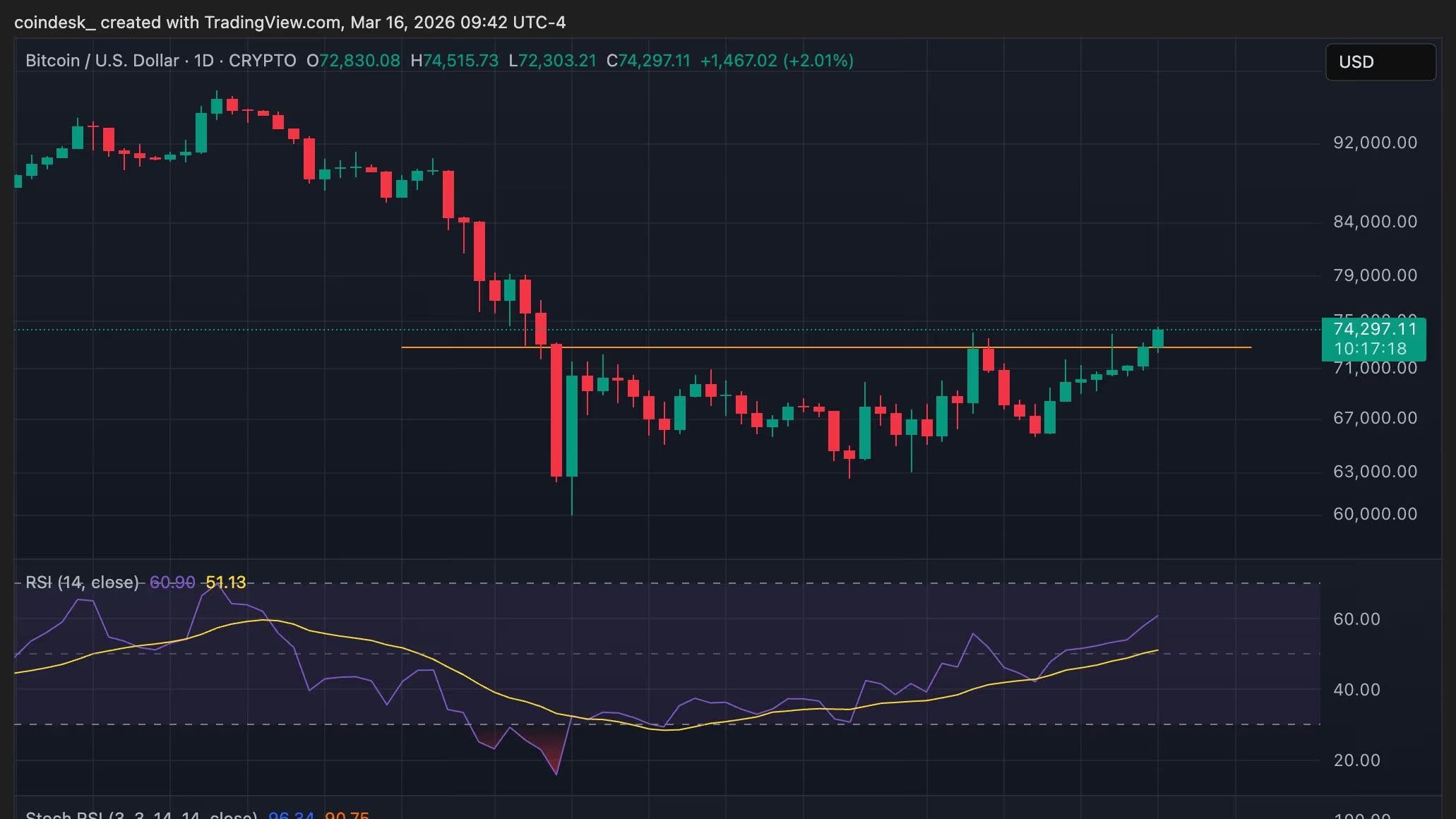
Cryptocurrencies started the week on a strong footing with bitcoin surging above $74,000 and U.S. equities bounced as oil prices eased.
In morning U.S. trade, BTC hit its strongest price since early February at $74,500, up 3.9% over the past 24 hours. The largest crypto broke out of its six-week range, boosting sentiment across the broader market and lifting appetite for smaller, riskier tokens.

Bitcoin’s bounce from its earlier February bottom of $60,000 is now nearing 25%, a notable move given several bounces of about that amount during 2022’s long crypto winter. These rebounds failed multiple times that year before the final November flush to below $16,000, which came alongside the FTX collapse.
Altcoins are outpacing bitcoin over the past 24 hours. Ether (ETH), solana (SOL) and have each climes more than 7%, suggesting renewed appetite for higher risk crypto assets after a period when capital largely concentrated in bitcoin.
U.S. equity indexes also were making moves higher after recent losses. The Nasdaq and S&P 500 were each more than 1% higher in the morning trading. Meanwhile, oil prices, a key driver of recent macro volatility, pulled back. Crude futures dropped about 4% Monday after briefly topping $100 per barrel over the weekend on Iranian strikes on energy infrastructure in the Middle East.
The Monday action happened as tensions around the Strait of Hormuz — a critical oil shipping route between the Persian Gulf and global markets — appeared to ease slightly. U.S. President Donald Trump called on other nations to help secure the waterway, while some Pakistani oil tankers reportedly have crossed the Strait, suggesting that traffic through the corridor has not been fully disrupted.
Crypto-related stocks were higher on Monday, with Circle (CRCL) up 6%. Strategy (MSTR) and Coinbase (COIN) were about 5% and 3% higher, respectively.
Bitcoin miners gain too
Amsterdam-based AI infrastrcuture provider Nebius (NBIS) signed an agreement with Meta (META) valued at up to approximately $27 billion, marking one of the largest AI compute partnerships announced this year.
Under the five-year deal, Nebius will provide roughly $12 billion in dedicated AI compute capacity across multiple locations. The infrastructure will be built on one of the first large-scale deployments of NVIDIA systems, designed to support Meta’s expanding AI workloads.
Shares of Nebius rose about 13% following the announcement, while Meta gained 2.5%.
The deal appears to be lifting sentiment across the broader AI compute and data center cohort. Among bitcoin-related names: IREN (IREN) was higher by 6%, Galaxy Digital (GLXY) by 8%, and Cipher Mining (CIFR) by 7%.
While, TeraWulf (WULF) secured a $500 million, 364 day senior secured bridge facility led by Morgan Stanley to fund construction of its Hawesville, Kentucky data center, providing development capital while longer term project financing is arranged. Shares are up about 12% following the announcement.

An oil tanker unloads crude oil at a terminal at the port in Qingdao, in China’s eastern Shandong province on March 11, 2026.
– | Afp | Getty Images
BEIJING — China on Monday stressed that it had enough energy resources as the Iran war restricts oil flows through the Strait of Hormuz, and U.S. President Donald Trump pressures Beijing to help secure the critical waterway.
China’s energy supply is “relatively strong,” and forms a “relatively good” foundation for responding to external market volatility, Fu Linghui, spokesperson at the National Bureau of Statistics, told reporters in Mandarin Chinese, translated by CNBC.
The bureau also announced that China’s domestic crude oil production rose by 1.9% year on year to 35.73 million metric tons in the January to February period.
Trump said Sunday that China should help with efforts to restore oil flows through the Hormuz waterway before his planned trip to Beijing at the end of this month, The Financial Times reported. He also said he might delay his China travel plans.
Crude oil prices have have surged past $100 a barrel to near 4-year highs as flows through the Strait of Hormuz have stalled for most countries since the Iran war began more than two weeks ago. However, Iran has sent more than 11 million barrels of oil to China through the strait during that time.

Subscribe now
Trump claimed Beijing should assist with ensuring oil flows through the strait because China gets 90% of its oil through the waterway, the report said.
However, analysts have estimated China only relies on the strait for about 40% to 50% of its seaborne oil imports, and pointed out that oil shipments going through Hormuz account for just 6.6% of China’s total energy consumption.
As of January, Beijing held an estimated 1.2 billion barrels of onshore crude stockpiles, one of the largest reserves in the world and enough to meet demand for three to four months.



Crypto exchange Bithumb will have to pay a fine of 36.8 billion won, about $24.5 million, after it was found to be in violation of South Korea’s Anti-Money Laundering rules.
Summary
- South Korean regulators fined Bithumb 36.8 billion won, about $24.5 million, after identifying about 6.65 million AML-related violations during an inspection of the exchange’s compliance controls.
- Authorities said Bithumb processed 45,772 crypto transfers linked to 18 unregistered overseas virtual asset service providers.
- The exchange will face a six-month ban on external crypto transfers for new users from March 27 to Sept. 26.
According to a local media report, South Korea’s Financial Intelligence Unit under the Financial Services Commission identified about 6.65 million violations during an AML inspection where the exchange failed to properly carry out customer identity verification, transaction monitoring, and record-keeping requirements.
Bithumb facilitated 45,772 crypto transfers involving 18 unregistered overseas virtual asset service providers in violation of the country’s AML framework.
Regulators decided on the penalties following a sanctions deliberation committee meeting that reviewed the exchange’s compliance with the Act on Reporting and Use of Specific Financial Transaction Information.
Bithumb has also been banned from processing external crypto transfers for new customers for six months, from March 27 to Sep. 26.
Existing customers, however, will be able to continue trading and using external transfers, while new customers can still buy or sell crypto and deposit or withdraw Korean won through the platform.
The penalties follow repeated warnings from the Financial Intelligence Unit, which had been urging the exchange to suspend all activity involving unregistered overseas crypto firms. Bithumb reportedly failed to implement the necessary blocking measures despite those instructions.
The latest penalty marks the largest fine ever imposed on a South Korean crypto exchange among several platforms that regulators have sanctioned for AML violations.
Last year, Upbit, one of South Korea’s largest crypto exchanges, received a three-month restriction on crypto deposits and withdrawals for new users over dealings with unregistered VASPs, alongside a 35.2 billion won penalty.
Bithumb is also navigating another probe by the Financial Supervisory Service over its operational mistake in which it accidentally credited users with an enormous amount of Bitcoin.
On Feb. 6, the exchange inadvertently distributed 620,000 Bitcoin worth roughly $40 billion to $44 billion at the time after an employee mistakenly entered payout amounts in BTC instead of Korean won during a promotional event.
FSS Governor Lee Chan Jin said regulators would look into how an exchange with far fewer actual reserves was able to record and distribute such large phantom Bitcoin balances within minutes, raising questions about internal controls and electronic ledger systems at the platform.
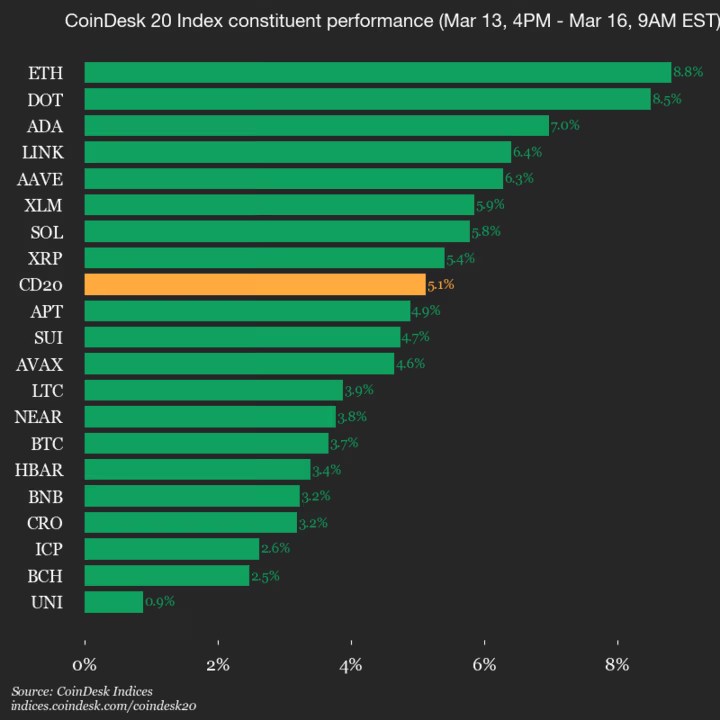
CoinDesk Indices presents its daily market update, highlighting the performance of leaders and laggards in the CoinDesk 20 Index.
The CoinDesk 20 is currently trading at 2140.46, up 5.1% (+104.17) since 4 p.m. ET on Friday.
All 20 assets are trading higher.

Leaders: ETH (+8.8%) and DOT (+8.5%).
Laggards: UNI (+0.9%) and BCH (+2.5%).
The CoinDesk 20 is a broad-based index traded on multiple platforms in several regions globally.
Ether (ETH) bulls are eyeing a move back toward $2,800 in March, with at least three indicators showing ETH price potential to rise higher.
Key takeaways:
-
Ether’s price jumped by over 9% toward $2,280 on Monday.
-
Multiple indicators, including a symmetrical triangle, hint at an extended price rally toward $2,800.
Ether invalidates a bearish chart pattern
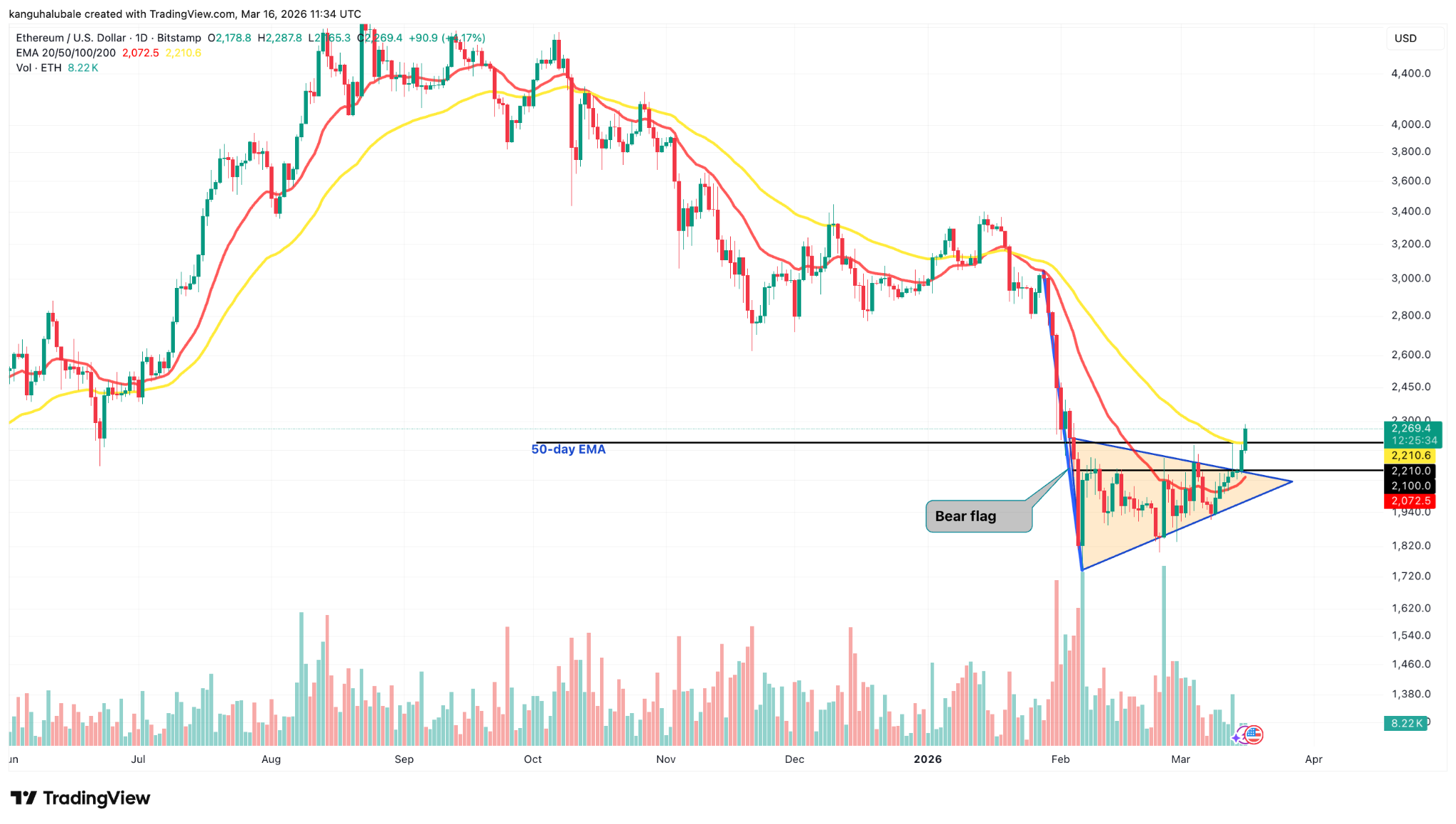
On Sunday, Ether’s price action invalidated what initially appeared to be a bear pennant on the daily chart.
Related: Ethereum Foundation sells $10.2M worth of ETH to BitMine in OTC deal
The ETH/USD pair pierced through the pennant’s upper trend line at $2,100, jumping 9.8% to a six-week high of $2,287 on Monday. Its breakout came alongside a rise in trading volume, implying stronger conviction behind the rally.

The price also reclaimed two key support lines in the name of the 20-day exponential moving average (EMA, red line) and the 50-day EMA (yellow line) at $2,072 and $2,210, respectively.
That simultaneously increased the odds of a symmetrical-triangle bullish reversal.
A symmetrical triangle forms when price makes lower highs and higher lows, compressing into a tightening range. It resolves when the price breaks either of the trendlines and moves by as much as the pattern’s maximum height.

In Ether’s case, the measured move above the upper trend line points to about $2,850, 26% above the current price. The level aligns with the 200-day EMA (the purple line), as shown in the chart above.
Ether’s next hurdle is the 100-day EMA (blue) near $2,500.
As Cointelegraph reported, a rejection there would weaken the breakout and raise the odds of a pullback.
Onchain data caps Ether’s upside at $2,800
ETH has been oscillating within a wide range defined by the realized price at $2,350 on the upside and on the downside at the lowest MVRV band of $1,650.
The chart below shows that the recent rebound off the lowest MVRV band mirrors the market structure observed in Q2 2022, where the price rallied past the realized price before being rejected by the first MVRV band just above.

This similarity reinforces the outlook that the current recovery attempt could be stopped around $2,650, where the first MVRV band sits above the realized price.
Glassnode’s Entity-Adjusted UTXO Realized Price Distribution (URPD), showing at which prices the current set of ETH UTXOs were created, also revealed a dense supply zone at $2,770-$2,880 that has been gradually maturing into the long-term holder cohort. This is where investors acquired more than 7.9 million ETH.
This unresolved supply overhang remains a persistent source of sell pressure, likely to cap attempts around the $2,800 level.

Meanwhile, ETH’s cost-basis distribution heatmap shows a heavy accumulation near $2,800, where more than 3 million ETH were previously purchased, suggesting a potential pathway toward this level in the short term.
Polymarket’s odds of $2,800 ETH price in March rise
Polymarket, a crypto-based prediction market where users trade contracts on real-world outcomes, is showing a clear bullish shift for Ether in March.
Traders now assign 13% odds that ETH reaches $2,800 in March, a 10% increase over the last 24 hours. The $2,600 and $2,400 targets carry even stronger convictions at 32% and 69%, respectively.

At the same time, the odds of the ETH price reaching $1,800 and $1,600 in March are priced lower than before, suggesting the crowd is trimming downside expectations.
This article does not contain investment advice or recommendations. Every investment and trading move involves risk, and readers should conduct their own research when making a decision. While we strive to provide accurate and timely information, Cointelegraph does not guarantee the accuracy, completeness, or reliability of any information in this article. This article may contain forward-looking statements that are subject to risks and uncertainties. Cointelegraph will not be liable for any loss or damage arising from your reliance on this information.

TLDR
- OpenAI has postponed its planned “adult mode” feature for ChatGPT designed to enable erotic conversations
- Safety advisers expressed concern the feature might function as a “sexy suicide coach” given users’ emotional attachment to the AI
- OpenAI’s age verification technology incorrectly identifies approximately 12% of minors as adults
- Given ChatGPT’s ~100 million underage weekly users, the error rate poses risk to millions of teenagers
- The company maintains it will eventually launch the feature but requires additional time to ensure proper implementation
OpenAI has postponed its controversial “adult mode” feature for ChatGPT following significant pushback from internal teams, external advisers, and safety specialists concerned about teenage safety and psychological risks.
CEO Sam Altman initially proposed the feature last year, positioning it as a way to enable adult-oriented text conversations with the AI assistant. Altman defended the concept as respecting mature users’ autonomy while potentially driving user engagement and revenue growth.
However, the initiative encountered substantial resistance within the organization.
During a January gathering, OpenAI’s well-being advisory council—comprising psychology professionals and cognitive neuroscience specialists—reportedly expressed unified and intense opposition to the plan.
One council member cautioned that OpenAI risked creating what they termed a “sexy suicide coach.” This stark warning referenced documented incidents where individuals developed profound emotional attachments to ChatGPT and subsequently ended their lives.
The advisers highlighted additional risks, including the potential for unhealthy psychological dependency on the chatbot and the likelihood that underage users would circumvent age-restriction measures.
The central technical challenge involves OpenAI’s age-detection technology. Testing revealed the system incorrectly categorizes minors as adults approximately 12% of the time. With ChatGPT serving roughly 100 million users under 18 years old weekly, this failure rate could potentially grant millions of teenagers access to mature content.
Age Verification Problems
The organization had originally intended to deploy its age-verification system prior to activating adult mode. However, after discovering the significant error rate, OpenAI opted for a gradual implementation to enhance accuracy.
OpenAI also confronted difficulties in filtering prohibited material, including depictions of non-consensual activities or child exploitation, while permitting legitimate adult interactions. Company insiders indicated that current safety mechanisms remain inadequate for this purpose.
When the adult mode eventually launches, OpenAI intends to restrict functionality to text-based interactions exclusively. The system will not produce erotic images, audio, or video materials.
Other AI Companies and Adult Content
Multiple competing AI platforms already permit certain adult-oriented content. Elon Musk’s xAI introduced a flirtatious personality option for its Grok assistant, though Musk subsequently limited access to paying subscribers. Meta permits its AI to participate in romantic roleplay scenarios, while stating the capability remains unavailable to accounts registered by minors.
In late 2024, a 14-year-old Florida resident died by suicide following an intense emotional relationship with a Character.AI chatbot. His mother pursued legal action, prompting Character.AI to reach a settlement and implement stricter teenage access controls.
OpenAI stated it continues to support the fundamental concept of providing adult content options for mature users. The organization indicated it will prioritize other enhancements in the interim, including improvements to ChatGPT’s personality features and customization capabilities.
The postponement is anticipated to extend at least one month, according to sources with knowledge of the situation.


Bitcoin’s recent strength during geopolitical uncertainty reflects a fundamental shift in the asset’s ownership structure, according to Wall Street broker Bernstein.
The cryptocurrency climbed roughly 7% last week, with ether (ETH) gaining about 9%, outperforming gold and global equity indices as markets reacted to escalating global conflict. The broker said the performance highlights how institutional ownership is reshaping the market.
“We believe the combination of Strategy’s treasury model and ETFs have transformed bitcoin’s ownership structure,” analysts led by Gautam Chhugani said in the Monday report.
Strategy, which the analysts described as acting like a “bitcoin central bank of last resort,” has continued buying through the downturn. The firm extended its streak of weekly purchases, acquiring about $1.57 billion worth of BTC, according to a Monday filing.
The company, led by Executive Chairman Michael Saylor, bought 22,337 bitcoin at an average price of $70,194 each, bringing its total holdings to 761,068 BTC acquired at an average cost of $75,696 per coin.
Strategy has also expanded its preferred equity financing strategy through the STRC product, which offers investors high-yield income linked to the Secured Overnight Financing Rate (SOFR) and has generated rising trading volumes. The additional liquidity helps fund more bitcoin purchases through at-the-market offerings.
Meanwhile, spot bitcoin exchange-traded funds (ETFs) have attracted about $2.1 billion in inflows over the past three weeks, bringing ETF ownership to roughly 6.1% of total bitcoin supply. The analysts said these vehicles are increasingly drawing allocations from wealth managers, pension funds and sovereign investors.
Retail investors have been net sellers in recent months, but long-term holders remain dominant. About 60% of bitcoin supply has not moved for more than a year, a signal that many investors continue to treat the asset as a long-term store of value, the report said.
Bitcoin’s recent outperformance during geopolitical stress has also revived debate about its role as “digital gold.” While the token lagged the precious metal for much of the past year, its gains during the latest bout of global uncertainty have prompted some analysts to argue the asset is beginning to behave more like a geopolitical hedge, though the comparison remains contested.
For equity investors, Bernstein added that Strategy (MSTR) remains a high-beta way to gain exposure to bitcoin’s upside, currently trading at about a 14% discount to its bitcoin net asset value on a basic share basis.
The largest cryptocurrency was trading 4.4% higher around $73,900 at publication time. Ether, the second-largest crypto by market capitalization was up 8.4% at $2,273.
Read more: CEO of crypto investment firm Keyrock says bitcoin is undervalued, entering ‘transition year’

Debt rising higher while rich get richer
Vikings Can Roll the Dice on Another Reclamation Project
The 2026 Audi Q3 Is Better Than It Needs To Be


-
 Tech5 days ago
A 1,300-Pound NASA Spacecraft To Re-Enter Earth’s Atmosphere
-
Crypto World2 days ago
HYPE Token Enters Net Deflation as HyperCore Buybacks Outpace Staking Rewards
-

 Business6 days ago
ExxonMobil seeks to move corporate registration from New Jersey to Texas
-

 Crypto World7 days ago
Paradigm, a16z, Winklevoss Capital, Balaji Srinivasan among investors in ZODL
-

 Fashion3 days ago
Weekend Open Thread: Addict Lip Glow
-

 Tech6 days ago
ChatGPT will now generate interactive visuals to help you with math and science concepts
-
Sports2 days ago
Why Duke and Michigan Are Dead Even Entering Selection Sunday
-

 NewsBeat5 days ago
Residents reaction as Shildon murder probe enters second day
-
 NewsBeat7 days ago
Pagazzi Lighting enters administration as 70 jobs lost and 11 stores close across Scotland
-

 Business5 days ago
Search Enters Sixth Week With New Leads in Tucson Abduction Case
-

 Business20 hours ago
Search for Savannah Guthrie’s Mother Enters Seventh Week with No Arrests
-

 Business2 days ago
US Airports Launch Donation Drives for Unpaid TSA Workers as Partial Government Shutdown Enters Fifth Week
-
Crypto World2 days ago
Coinbase and Bybit in Investment Talks: Could Bybit Finally Enter the US Crypto Market?
-

 NewsBeat5 days ago
I Entered The Manosphere. Nothing Could Prepare Me For What I Found.
-

 Business7 days ago
Search Enters 39th Day with FBI Tip Line Developments and No Major Breakthroughs
-

 Business2 days ago
Country star Brantley Gilbert enters growing non-alcoholic beer market
-

 Business4 hours ago
Australian shares drop as Iran war enters third week
-

 Crypto World6 days ago
Will Chainlink price reclaim $10 amid volatility squeeze?
-

 Sports5 days ago
PWHL, Senators discussing plan to keep Charge in Ottawa
-

 Crypto World5 hours ago
Crypto Lender BlockFills Enters Chapter 11 with Up to $500M in Liabilities

