

Crypto World
BTC price stuck under $70,000 as investors play it safe before U.S. inflation report: Crypto Daybook Americas


By Omkar Godbole (All times ET unless indicated otherwise)
Bitcoin slipped back below $70,000 as war in the Middle East and U.S. inflation data due later today keep investors cautious.
The latest failure to build momentum above $70,000 followed reports that Iran was laying mines along the already disrupted Strait of Hormuz, a major global oil chokepoint. Bullish momentum weakened late Tuesday after U.S. Energy Secretary Chris Wright said in a now-deleted social media post that the U.S. escorted an oil tanker through the strait.
As usual, the disappointment quickly spread from bitcoin to the broader crypto market. Major cryptocurrencies such as ether (ETH), solana (SOL), XRP (XRP), and BNB lost 1% or more since midnight UTC, tracking losses in bitcoin. The CoinDesk 20 Index is also down 1% to 1,980 points.
According to Alex Kuptsikevich, chief market analyst at FXPro, traders should closely track the 50-day simple moving average of bitcoin’s price.
“In the short term, the 50-day moving average has proved a formidable resistance level, preventing bulls from swiftly turning the tide in their favor. This indicator often signals the medium-term trend, and a confident break above it would be an important turning point in the coming days,” he said in an email.
Meanwhile, analysts at Bitfinex said the next moves largely depend on oil prices, U.S. government bond yields and Fed policy.
Speaking of the Fed, its members will closely watch the February U.S. consumer price index report due later Wednesday. It is expected to show the inflation rate ticked up to 2.5% year-on-year from January’s 2.4%, according to FactSet. Core inflation, which excludes food and energy, is also seen rising 2.5%.
A higher-than-expected figure, against already resurging war-led inflation fears, could embolden hawks at the Fed and validate expectations of no rate cuts this year. That, in turn, could breed market volatility. Stay alert!
Read more: For analysis of today’s activity in altcoins and derivatives, see Crypto Markets Today
What to Watch
For a more comprehensive list of events this week, see CoinDesk’s “Crypto Week Ahead“.
- Crypto
- Macro
- March 11, 7:30 a.m.: U.S. consumer price inflation for February YoY Est. 2.5%; core rate YoY Est. 2.5%
- March 11: OPEC monthly report
- Earnings (Estimates based on FactSet data)
- March 11: Exodus Movement (EXOD), pre-market, $0.14
Token Events
For a more comprehensive list of events this week, see CoinDesk’s “Crypto Week Ahead“.
- Governance votes & calls
- Unlock DAO is voting to approve the Unlock Protocol DAO budget for the first and second quarters, totaling $30,768. Voting ends March 11.
- Unlocks
- Token Launches
Conferences
For a more comprehensive list of events this week, see CoinDesk’s “Crypto Week Ahead“.
Market Movements
- BTC is down 0.78% from 4 p.m. ET Tuesday at $69,794.05 (24hrs: -1.92%)
- ETH is down 0.83% at $2,022.17 (24hrs: -1.99%)
- CoinDesk 20 is down 0.98% at 1,979.50 (24hrs: -1.79%)
- Ether CESR Composite Staking Rate is down 3 bps at 2.78%
- BTC funding rate is at -0.0027% (-2.9456% annualized) on Binance

- DXY is up 0.24% at 99.04
- Gold futures are down 0.57% at $5,200.00
- Silver futures are down 2.05% at $87.26
- Nikkei 225 closed up 1.43% at 55,025.37
- Hang Seng closed down 0.24% at 25,898.76
- FTSE 100 is down 0.96% at 10,312.17
- Euro Stoxx 50 is down 1.35% at 5,758.30
- DJIA closed on Tuesday unchanged at 47,706.51
- S&P 500 closed down 0.21% at 6,781.48
- Nasdaq Composite closed unchanged at 22,697.10
- S&P/TSX Composite closed up 0.25% at 33,270.70
- S&P 40 Latin America closed down 0.32% at 3,607.58
- U.S. 10-Year Treasury rate is unchanged at 4.14%
- E-mini S&P 500 futures are down 0.23% at 6,771.75
- E-mini Nasdaq-100 futures are down 0.26% at 24,917.25
- E-mini Dow Jones Industrial Average futures are down 0.37% at 47,569.00
Bitcoin Stats
- BTC Dominance: 59.30% (-(0.08%)
- Ether-bitcoin ratio: 0.0291 (-0.07%)
- Hashrate (seven-day moving average): 1,014 EH/s
- Hashprice (spot): $30.31
- Total fees: 2.7 BTC / $189,651
- CME Futures Open Interest: 105,265 BTC
- BTC priced in gold: 13.4 oz.
- BTC vs gold market cap: 4.64%
Technical Analysis

- The chart shows bitcoin’s daily price swings in candlestick format since July last year. It also shows the average price over 50 days.
- Analysts say this 50-day moving average is a crucial level. A break higher could entice more buyers to the market, leading to a stronger rally.
- The outlook remains bearish while prices hover below the average.
Crypto Equities
- Coinbase Global (COIN): closed on Tuesday at $196.52 (–1.64%), –0.94% at $194.68 in pre-market
- Galaxy Digital (GLXY): closed at $21.83 (+1.56%), –0.41% at $21.74
- MARA Holdings (MARA): closed at $8.57 (–1.04%), –0.58% at $8.52
- Riot Platforms (RIOT): closed at $14.64 (–0.41%), –0.48% at $14.57
- Core Scientific (CORZ): closed at $15.46 (+1.98%)
- CleanSpark (CLSK): closed at $9.63 (+0.21%), –0.42% at $9.59
- Exodus Movement (EXOD): closed at $10.93 (+0.92%), unchanged in pre-market
- CoinShares Bitcoin Mining ETF (WGMI): closed at $37.36 (+0.08%)
- Circle Internet Group (CRCL): closed at $118.09 (+5.59%), –1.38% at $116.46
- Bullish (BLSH): closed at $36.73 (+1.86%), –0.90% at $36.40
Crypto Treasury Companies
- Strategy (MSTR): closed at $138.46 (–0.35%), –0.97% at $137.12
- Strive Asset Management (ASST): closed at $8.98 (+5.52%), –0.78% at $8.91
- Sharplink (SBET): closed at $7.39 (–2.76%), –0.27% at $7.37
- Upexi (UPXI): closed at $0.94 (–2.99%), +2.13% at $0.96
- Lite Strategy (LITS): closed at $1.17 (–2.50%)
ETF Flows
Spot BTC ETFs
- Daily net flows: $246.9 million
- Cumulative net flows: $55.76 billion
- Total BTC holdings ~ 1.28 million
Spot ETH ETFs
- Daily net flows: $12.6 million
- Cumulative net flows: $11.62 billion
- Total ETH holdings ~ 5.68 million
Source: Farside Investors
While You Were Sleeping



The price of Across Protocol token surged sharply after a governance proposal suggested a major structural shift for the project.
Summary
- Across Protocol token jumped 85% as a proposal suggests converting tokens into company shares.
- Holders could exchange ACX for equity in a new US C-corp or sell tokens for USDC in a buyout offer.
- The move is meant to help the protocol secure institutional partnerships and commercial agreements.
ACX saw a sharp surge in activity, trading at about $0.063 at the time of writing. The token gained roughly 85% over the previous 24 hours, lifting its market capitalization to nearly $45 million.
Market participation also spiked. Daily trading volume climbed to approximately $51.7 million, representing an increase of more than 3,000% compared with the day before.
A similar trend appeared in the derivatives market. CoinGlass data show that derivatives trading volume expanded dramatically, rising over 7,700% to $138 million. Meanwhile, open interest jumped by around 950%, reaching $20 million, pointing to a wave of new positions entering the market.
The sudden rally followed a proposal submitted on March 11 to the Across governance forum by Risk Labs, the core development group responsible for Across Protocol.
Proposal explores token-to-equity transition
The proposal, titled “The Bridge Across,” asks the community whether the protocol should transition from a token-based structure into a U.S. C-corporation.
If approved, a newly formed entity tentatively called AcrossCo would take over development, partnerships, and commercialization. The company would also hold the protocol’s intellectual property.
The proposal gives ACX holders two possible paths. They can either swap their tokens for equity in the newly formed company or sell their holdings through a buyout offer.
For those choosing the equity route, the plan outlines a 1:1 conversion, meaning each ACX token would be exchanged for one company share. Holders with more than 5 million ACX would be able to convert their tokens directly into equity. Smaller holders, however, would gain exposure through a special purpose vehicle designed to pool their participation.
Token holders who would rather exit could instead accept a buyout offer set at $0.04375 per ACX, with payment made in USD Coin. That price represents roughly a 25% premium to the token’s average trading price over the past 30 days.
The buyout window would remain open for six months if the proposal ultimately passes. Funding for the offer would come from the protocol’s liquid treasury.
Institutional partnerships driving the proposal
According to the proposal, the shift toward a traditional corporate structure is meant to address practical challenges faced by decentralized autonomous organizations.
DAO-based governance can make it difficult to sign enforceable contracts, establish liability frameworks, or negotiate certain types of commercial agreements. These limitations sometimes create barriers when dealing with institutional partners.
Risk Labs said the change could make it easier for the project to secure partnerships and revenue agreements while continuing to build the protocol’s infrastructure.
The proposal is currently a temperature check, meaning it is meant to gather community feedback before any binding vote takes place.
The timeline outlined in the document suggests a governance vote could occur in early April. If approved, legal structuring and token conversion infrastructure would begin shortly afterward.
Across Protocol has spent several years building cross-chain bridging infrastructure, including fast transaction systems designed to move assets between blockchains in seconds.


Arthur Hayes says he’s waiting for central banks to print again before buying Bitcoin, even as he expects BTC to top $100K.
BitMEX co-founder Arthur Hayes has said that he would not buy Bitcoin (BTC) today if he only had $1 to invest.
However, he still expects the cryptocurrency to eventually climb back above $100,000 once central banks return to printing money.
Waiting for the Fed to Print
In a March 10 interview with Natalie Brunell on CoinStories, Hayes argued that the ongoing conflict pitting the U.S. and Israel against Iran has created a real risk of a broad market sell-off that could pull BTC below $60,000.
“There’s a situation where the longer that this carries on, there could be a massive sell-off in equities, and Bitcoin might fall a bit lower, might break $60,000, and that could be sort of a big cascading of liquidations down,” Hayes said during the interview.
According to him, every major Middle East conflict in his lifetime eventually prompted the Fed to print, leading him to conclude that the signal to watch is not the war itself but what central banks actually do in response.
“If I had $1 to invest right now, would I be putting it into Bitcoin? No,” he said. “I would wait. I think that the longer that this conflict goes on, the higher the likelihood that the Fed has to print money to support the American war machine, and that’s when I’m going to buy Bitcoin.”
However, he cautioned against trying to time the moment, noting that most people are following the same mainstream coverage and could likely misread the situation.
Asked why he thought BTC had underperformed over the past 6 to 9 months, the former BitMEX CEO pointed to what he described as a liquidity deficit rather than weak demand for the king cryptocurrency itself.
“Bitcoin is a liquidity alarm,” he stated, arguing that AI-driven job displacement is quietly building deflationary pressure in the U.S. economy. In his view, there isn’t enough dollar liquidity to offset the other demands on capital, especially spending by large tech companies building out data center infrastructure.
You may also like:
No Grand Schemes to Suppress Bitcoin
Hayes also pushed back on the idea that institutions or large market makers like Jane Street have been suppressing the price of BTC.
“I don’t think there’s anything nefarious or like some evil conspiracy of Jane Street and other market makers to try to manipulate prices lower,” he said.
The crypto trader attributed most such claims to investors looking for someone to blame after bad entries and advised anyone without a professional trading setup to completely avoid leverage and short-term positions.
Personally, he described himself as “structurally very, very long Bitcoin and other coins,” adding that there’s currently a much stronger need for stateless money than when Bitcoin launched in 2009.
Hayes’s comments have come with Bitcoin trading just under the $70,000 mark following months of sideways price action. However, unlike the BitMEX co-founder’s suggestion that the asset could dip to $60,000, analyst Markus Thielen believes that the way BTC brushed off rising oil prices and geopolitical noise in the past week was a bullish sign, which made a move toward $80,000 more likely.
Binance Free $600 (CryptoPotato Exclusive): Use this link to register a new account and receive $600 exclusive welcome offer on Binance (full details).
LIMITED OFFER for CryptoPotato readers at Bybit: Use this link to register and open a $500 FREE position on any coin!

TLDR
- Ethereum whales increased their XAUT holdings as wallet numbers rose to 35,609 by March 11.
- Tether expanded XAUT supply to 712,247 tokens, pushing market capitalization near $3.57B.
- Gold prices gained over 78% in the past year, while BTC declined by 16.78%.
- Abraxas Capital accumulated about 2.7K XAUT tokens valued at roughly $265M.
- XAUT recorded nearly double the trading volume of Paxos Gold across major exchanges.
Ethereum whales accelerated purchases of Tether Gold (XAUT) as gold prices held above $5,179. Wallet data showed steady growth in holders during early March. At the same time, new token issuance pushed supply and market capitalization higher.
Ethereum Whales Increase XAUT Holdings as Wallet Count Rises
Ethereum whales expanded their XAUT reserves as on-chain data recorded steady accumulation. Wallets holding XAUT rose to 35,609 on March 11, up from 33,390 on March 1. The increase reflected growing demand for tokenized gold exposure on Ethereum.
Large holders concentrated the supply as top wallets added more tokens in recent days. The second-largest wallet controlled 8.02% of the total supply after recent purchases. Blockchain trackers linked that wallet to addresses associated with Abraxas Capital.
Abraxas Capital held about 2.7K XAUT tokens valued at nearly $265M. The firm moved most tokens to a final destination wallet and limited outflows. Meanwhile, Antalpha reduced part of its holdings after weeks of accumulation.
Antalpha retained most of its reserves despite recent sales. RhinoFi recorded the largest XAUT outflow among tracked entities. However, on-chain records showed limited activity from the DeFi protocol.
XAUT Supply Expands as Gold Outperforms BTC
Tether minted new XAUT tokens in early 2026, lifting total supply to 712,247. Market capitalization approached $3.57B, near record levels. The growth followed sustained demand for tokenized gold exposure.
Gold prices climbed over 78% in the past year, while BTC declined 16.78%. Traders shifted capital toward gold as volatility increased in crypto markets. XAUT offered spot exposure to physical gold through blockchain infrastructure.
Tether reported $2.31M in net earnings from XAUT during the last quarter of 2025. The company controls the physical gold backing the token supply. It also remains one of the largest XAUT holders.
XAUT trading volumes reached roughly double those of Paxos Gold (PAXG). Bitget processed most XAUT trades, while some whales used Bitfinex. The token maintained liquidity despite the absence of a Binance listing.
Only one company, US-based Aurelion, currently holds XAUT as a treasury asset. DeFi protocols also accept XAUT as collateral in select markets. Data showed continued holder growth as of March 11, reflecting ongoing accumulation by large Ethereum wallets.


Editor’s note: Contrivian’s latest agreement with Amazon Leo signals a shift toward more resilient, software-driven connectivity for government operations. By combining low Earth orbit satellites with Lighthouse performance optimization and NorthStar lifecycle management, Contrivian aims to deliver multi-constellation networking that remains stable even as networks shift across technologies. This editorial prelude highlights how the move expands the company’s mission-critical toolkit, enabling state and local agencies to access high-availability connectivity without disruptive failovers. The collaboration underscores a broader trend toward integrated, monitored networks designed to support critical services at scale.
Key points
- Contrivian becomes an authorized Amazon Leo reseller to deliver government connectivity.
- Multi-constellation, software-defined connectivity blends LEO with Lighthouse and NorthStar.
- Designed to support mission-critical applications with no disruption to end users.
- Public sector and other critical industries gain access to resilient, high-performance networks.
Why this matters
Downtime threatens operations, safety, and budgets. A unified, monitored network blending fiber, broadband, LTE/5G and satellite offers critical resilience for government work. The Contrivian–Amazon Leo collaboration highlights a shift toward software-driven, multi-constellation connectivity that is continuously observed and managed, helping public sector networks stay online and secure even when individual links fail. By tying Lighthouse performance optimization and NorthStar lifecycle management into a single architecture, Contrivian and Amazon Leo aim to raise overall service reliability.
What to watch next
- Rollout of integrated connectivity for state agencies under the new reseller arrangement.
- Broader adoption of multi-constellation, software-defined networking across government operations.
- Ongoing enhancements in satellite orchestration and lifecycle management.
Disclosure: The content below is a press release provided by the company/PR representative. It is published for informational purposes.
Contrivian Expands Multi-Constellation Connectivity with Amazon Leo
Contrivian signs agreement as an authorized reseller of Amazon Leo for mission-critical applications and services.
San Francisco, CA – Mar. 11, 2026 – Contrivian, a technology company providing intelligent mission-critical connectivity, has signed an agreement as an authorized reseller with Amazon Leo to deliver resilient, high-performance connectivity for state and local agencies in the United States. The agreement expands Contrivian’s multi-modal connectivity solutionsto deliver reliable networking that can support mission-critical applications and services.
Contrivian combines low Earth orbit technology with its proprietary Lighthouse performance optimization technology and NorthStar lifecycle management solution to deliver intelligent, software-defined multi-constellation connectivity. This eliminates the need for failover across networking technologies as well as across satellite constellations, with no disruption to applications or end users.
“We aren’t just providing satellite connectivity. We’re enabling mission-critical applications and services on a global scale. We’re providing software-enabled connectivity that is intelligently integrated, continuously monitored, and managed as part of a unified operational model,” said Grant Kirkwood, CEO of Contrivian. “Our agreement with Amazon Leo strengthens that architecture. It reflects how resilient networks must now be designed. It adds true diversity at the satellite layer and gives our customers greater control, greater performance stability, and greater assurance when failure is not an option.”
Contrivian engineers, orchestrates, and manages mission-critical connectivity for organizations that operate in environments where downtime carries operational, financial, or safety risk. The company integrates fiber, broadband, LTE/5G, and low Earth orbit satellite into a single, performance-driven architecture.
“Amazon Leo is developing the world’s most advanced satellite communication network. Through this agreement with Contrivian, we will provide essential connectivity to state and local government agencies, enabling them to stay connected and share vital information, even in isolated areas or during service disruptions,” said Carolyn Cuppernull, Business Development at Amazon Leo for Government.
Contrivian serves public sector agencies, healthcare providers, energy operators, financial institutions, and other critical industries. It designs, deploys, monitors, and supports connectivity across fixed sites, remote facilities, and mobile operations worldwide. The company continues to invest in advanced satellite orchestration capabilities as the global low Earth orbit ecosystem evolves.
About Amazon Leo
Amazon Leo is Amazon’s low Earth orbit satellite network. Its mission is to deliver fast, reliable internet to customers beyond the reach of existing networks, from individual households and small businesses to large enterprise and government customers and anyone in between. Amazon Leo is powered by an initial constellation of more than 3,000 satellites, connected to a secure, global network of ground gateway antennas and dedicated fiber, and includes a lineup of compact, high-performance customer terminals – Amazon Leo Nano, Amazon Leo Pro, and Amazon Leo Ultra – that communicate with satellites passing overhead. The entire system is designed and operated in-house at Amazon and aims to connect tens of millions of customers around the world.
About Contrivian
Contrivian is a technology company specializing in mission-critical connectivity for enterprise and government organizations. The company integrates fiber, broadband, LTE/5G, and low Earth orbit satellite into a unified, software-defined architecture designed for performance and resilience.
Its proprietary Lighthouse solution continuously monitors network conditions and dynamically routes traffic based on real-time performance data. Its NorthStar solution provides centralized visibility and lifecycle management across global deployments.
Contrivian serves public sector agencies, healthcare providers, energy operators, financial institutions, and other organizations operating in environments where connectivity must remain stable and predictable. Headquartered in San Francisco, the company delivers managed connectivity services worldwide.


The initiative brings together a broad spectrum of well-known, global crypto firms and blockchain projects including Circle, Solana, Binance, Polygon, and Ava Labs.
Mastercard announced today, March 11, that it launched a new Crypto Partner Program. The global initiative brings together more than 85 crypto firms, payments providers, and financial institutions to collaborate on the next phase of on-chain payments.
Mastercard said the aim of the new partner program is “to create a forum for meaningful dialogue and collaboration as this space continues to mature.”
Per a video from Mastercard as part of the announcement, the crypto-native participants include Anchorage Digital, Aptos, Arc, Ava Labs, Binance, BitGo, Bybit, Circle, Cosmos, Fireblocks, Gemini, Mercuryo, MoonPay, Optimism, Paxos, Polygon, Rain, Ripple, and Solana — a broad, global cross-section of blockchain networks, custodians, exchanges, and stablecoin issuers.
The program is designed to let participants engage directly with Mastercard teams on the design and direction of future products and services, with a focus on connecting digital asset infrastructure to established card rails and global commerce flows, per Mastercard’s announcement.
The move formalizes what has been a rapidly expanding series of crypto partnerships for Mastercard over the past year, in some cases with crypto firms that are now part of the Crypto Partner Program, including Ripple, Gemini, and MoonPay.
In November, The Defiant reported that Ripple, Gemini, and WebBank teamed up with Mastercard to test settling Gemini Credit Card transactions using Ripple’s RLUSD stablecoin on the XRP Ledger — a move that would mark one of the first instances of a regulated U.S. bank settling traditional card transactions with a regulated stablecoin on a public blockchain.
Earlier, MoonPay issued a stablecoin-powered virtual card in collaboration with Mastercard.
As The Defiant reported last June, Mastercard partnered with blockchain oracle provider Chainlink — which was not in the list of participating firms today — to allow its more than 3 billion cardholders to purchase cryptocurrencies directly on-chain.
This article was generated with the assistance of AI workflows.


- QCP sees Bitcoin as a ‘stress barometer’ amid macro, geopolitical risks.
- BTC continues to eye $70,000 as support, with gains key to upside continuation.
- Breakdown risks BTC retesting $63k lows, where prior dip-buying emerged.
Bitcoin (BTC) continues to show resilience near the critical $70,000 level after today’s US CPI data.
The bellwether digital asset had traded slightly off this mark earlier in the day.
According to analysts at Singapore-based trading firm QCP Capital, Bitcoin’s uptick from lows of $63,000 suggests stabilisation.
However, the continued fluctuation around the $70k mark signals that the market is yet to return to full risk-on sentiment.
QCP sees Bitcoin as a ‘stress barometer’ amid geopolitical risks
While bulls have been patient, the broader context of BTC’s next move combines factors around escalating Middle East risks and the US economic outlook.
QCP has highlighted this in its latest forecast for cryptocurrencies, noting that BTC acts as a “cleaner stress barometer” amid stagflationary pressures.
5/ With US CPI due later today, markets are highly sensitive to any shift in the inflation narrative. For crypto, $ETH remains the higher-beta sentiment check, while $BTC continues to act as the cleaner stress barometer.
Read the full market colour: https://t.co/IKB2AfCFB6
— QCP (@QCPgroup) March 11, 2026
Bitcoin held relatively firm even as equities came under pressure amid escalating tensions in the Middle East, with the US-Israel conflict with Iran weighing on stocks and pushing Treasury yields higher.
The benchmark cryptocurrency also remained close to the $70,000 level as oil prices retreated after a sharp rally toward $120.
However, QCP Capital said the recent swings in crude oil have exposed fragile liquidity and positioning across macro markets, a dynamic that could keep digital assets on edge.
Derivatives markets reflect this cautious tone. Implied volatility has eased, but risk reversals remain negative, suggesting traders continue to favour short-dated downside protection rather than aggressive bullish positioning.
According to QCP, the current setup also underscores Bitcoin’s growing role as a “cleaner stress barometer” during periods of macro uncertainty.
Bitcoin’s outlook after the US CPI print
Data from the US Bureau of Labor Statistics released on March 11, 2026, showed consumer price inflation rose broadly in line with expectations.
The US Consumer Price Index (CPI) increased 0.3% on a seasonally adjusted monthly basis and 2.4% from a year earlier.
Core CPI, which excludes volatile food and energy prices, rose 0.2% for the month and 2.5% annually.
The figures were largely in line with consensus forecasts.
Bitcoin moved modestly higher following the release, climbing back above $70,000 to trade around $70,230 at the time of writing.
Meanwhile, US stock futures edged lower after the report as investors also reacted to news that Iran had attacked two ships in the Strait of Hormuz, adding to geopolitical uncertainty.
The February CPI reading reflects inflation conditions before the escalation of the Iran conflict and the recent surge in oil prices.
Analysts say upcoming macro data, next week’s Federal Open Market Committee (FOMC) meeting, and developments in the Middle East will remain key drivers of near-term market sentiment.
From a technical perspective, Bitcoin needs to reclaim the 200-week exponential moving average (EMA), which continues to act as a significant supply zone despite recent attempts to move above it.
Immediate resistance is seen in the $72,000–$75,000 range, while support is located around $63,000–$64,000.
TLDR
- Goldman Sachs disclosed a $153.8 million position in spot XRP ETFs in its Q4 2025 13F filing.
- The bank holds about 73% of the $211 million reported by the top 30 institutional investors.
- Goldman Sachs spread its XRP ETF exposure across four issuers to diversify allocation.
- Spot XRP ETFs have attracted $1.4 billion in net inflows since launching in November 2025.
- Total assets under management for XRP ETFs reached $1.44 billion by early March 2026.
Goldman Sachs has disclosed a $153.8 million position in spot XRP ETFs in its Q4 2025 13F filing. The bank now holds about 73% of the $211 million reported by the top 30 institutions. The filing places Goldman Sachs at the forefront of institutional exposure in the newly launched XRP ETF market.
Goldman Sachs Builds $154 Million Position Across XRP ETFs
Goldman Sachs allocated its XRP ETFs exposure across four separate issuers instead of a single fund. The bank reported about $40 million in the Bitwise XRP ETF and $38 million each in the Franklin XRP Trust and Grayscale XRP ETF. It also disclosed roughly $36 million in the 21Shares XRP ETF.
This structure shows a diversified allocation within the same asset class. The XRP position forms part of a wider $2.3 billion crypto ETF portfolio. That portfolio includes $1.1 billion in Bitcoin ETFs and $1 billion in Ethereum ETFs.
Millennium Management ranked second with $23.1 million in disclosed XRP ETF holdings. However, its position is less than one-sixth of Goldman Sachs’ exposure. As a result, Goldman holds the dominant institutional share based on current filings.
XRP ETFs Record $1.4 Billion Inflows Since Launch
Spot XRP ETFs began trading in November 2025 after the SEC resolved its lawsuit against Ripple in August. Since launch, the funds have attracted $1.4 billion in net inflows. Total assets under management reached $1.44 billion by early March 2026.
The ETFs recorded net outflows on only nine trading days during that period. Bloomberg ETF analyst James Seyffart said, “About 84% of XRP ETF assets sit with retail investors.” Eric Balchunas also stated that most holders fall below the 13F reporting threshold.
Standard Chartered revised its XRP price target to $2.80. The bank’s forecast implies close to 100% upside from recent levels. Broader institutional estimates place year-end 2026 projections between $3.00 and $8.00.
Prediction markets currently assign a 67% probability that XRP closes above $1.50 by late March 2026. On the infrastructure side, Binance integrated Ripple’s RLUSD stablecoin on the XRP Ledger. The RLUSD stablecoin now carries a market capitalization of $1.59 billion.
Banks, including SBI Holdings, Santander, and PNC, continue using XRP for cross-border settlements. Monthly transaction flows through these channels exceed $15 billion, according to reported figures. These developments follow the ETF launch and reflect ongoing activity across the XRP ecosystem.
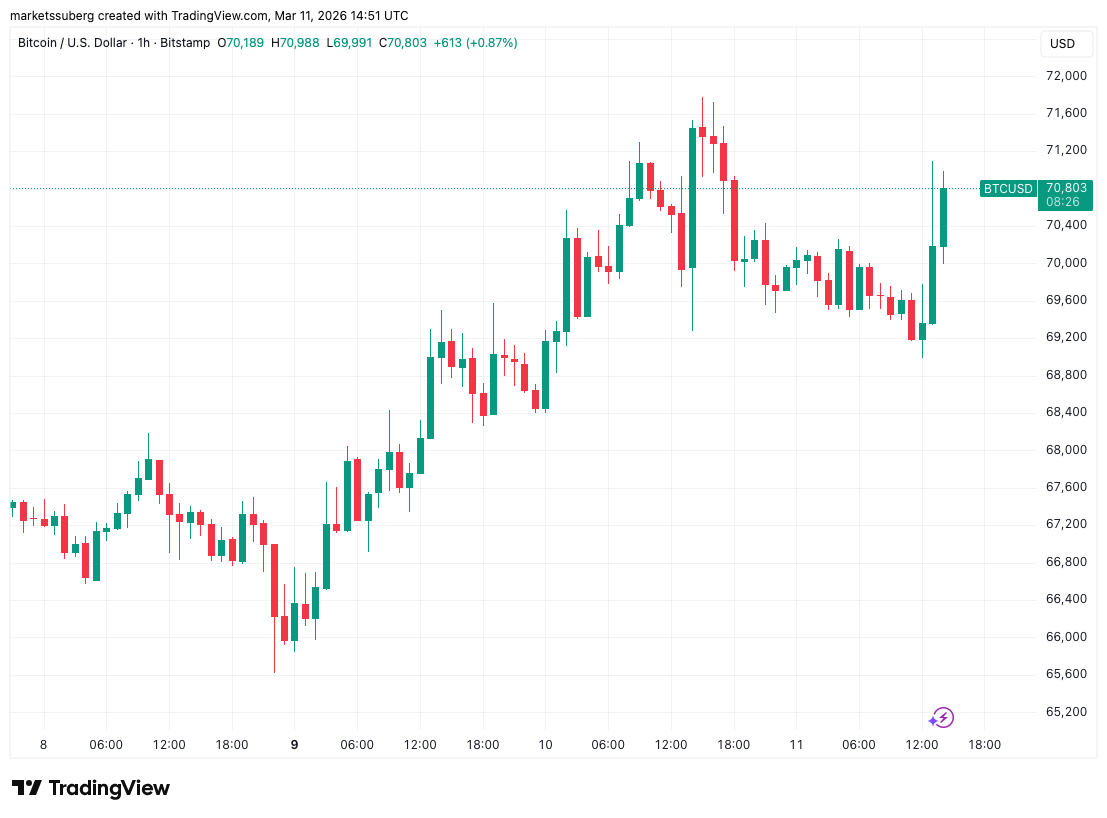
Bitcoin (BTC) broke back above $70,000 around Wednesday’s Wall Street open as US inflation data soothed anxious markets.
Key points:
-
Bitcoin bounces around a narrow range as US inflation data offers a modest tailwind.
-
Oil prices stay lower as an emergency release of 400 million barrels is confirmed.
-
BTC price expectations focus on future liquidations in the mid-$60,000 zone.
Bitcoin edges higher as CPI matches expectations
Data from TradingView showed BTC price action eking out modest gains, while failing to match local highs from the day prior.

The February print of the US Consumer Price Index (CPI) was in line with expectations at 2.4% year-on-year, per data from the Bureau of Labor Statistics (BLS).
“Over the last 12 months, the all items index increased 2.4 percent before seasonal adjustment,” it confirmed in an official statement.

This was a relief for risk assets already on edge over geopolitical instability and its potential impact on inflation. The Middle East conflict and global oil supply squeeze, however, were likely only to be truly reflected in March’s inflation data.
“The market will now await March’s data,” trading resource The Kobeissi Letter thus wrote in a response on X.
Other recent inflation gauges missed anticipated levels both to the upside and downside, making for a shaky overall picture of inflationary forces even before events in Iran.
Oil, a key risk factor for CPI going forward, stayed below the $90 mark on the day as the International Energy Agency (IEA) approved the emergency release of 400 million barrels — the largest such release ever recorded.

Trader eyes BTC price “breakout upwards” in March
With price still rangebound, Bitcoin market participants chose not to bet big up or down.
Related: Bitcoin faces ‘highly volatile’ setup as bulls eye return to $80K by month-end
“Very simple; buy the lower bounds, sell the higher bounds,” trader, analyst, and entrepreneur Michaël van de Poppe told X followers.
“I still think we’ll see that breakout upwards in this month to test higher grounds, but if not, I’m a buyer on lower levels.”

Trader Lennaert Snyder eyed downside liquidity for a potential local low, suggesting that this could come at around $65,000.
$BTC is compressing pre-CPI.
Bitcoin swept ~$71,563 liquidity and rejected like I mentioned yesterday.
I’m already in some shorts, and I’m willing to add if we get a MSB by losing the ~$69,268 low.
My short target will be the liquidity at ~$65,957. Letting 10% open for a… pic.twitter.com/DN3rb9lTha
— Lennaert Snyder (@LennaertSnyder) March 11, 2026
Data from monitoring resource CoinGlass put 24-hour crypto market liquidations at $240 million, with short positions accounting for a larger slice of the total.

This article does not contain investment advice or recommendations. Every investment and trading move involves risk, and readers should conduct their own research when making a decision. While we strive to provide accurate and timely information, Cointelegraph does not guarantee the accuracy, completeness, or reliability of any information in this article. This article may contain forward-looking statements that are subject to risks and uncertainties. Cointelegraph will not be liable for any loss or damage arising from your reliance on this information.

Editor’s note: As TransFi marks a major milestone in cross-border payments, the company reports more than $1 billion in processed volume and a broadened network reaching 70+ countries and 250+ payment methods. This expansion highlights growing demand from businesses for faster, more reliable money movement, especially in Asia, Latin America, and the Middle East, where payroll, remittances, vendor payouts, and treasury moves are increasingly based on modern infrastructure rather than legacy rails. The press release underscores how real-world use cases are driving the shift toward streamlined, global finance that works for high-growth markets.
Key points
- TransFi surpasses $1B in processed volume on its platform.
- Expanded cross-border reach to 70+ countries with 250+ payment methods.
- Focus on real-world use cases: payroll, remittances, vendor and trade payouts, and e-commerce checkouts.
- Plans to reach $5B processed volume in the next 12 months based on current pipeline.
Why this matters
This milestone signals a shift toward faster, more predictable cross-border payments in emerging markets, where legacy rails are costly and fragmented. TransFi’s broader coverage and local-language support aim to unlock opportunities for businesses expanding across Asia, Latin America, and the Middle East, enabling payroll processing, remittances, vendor payouts, and treasury movements with greater speed, transparency, and control that improves cash flow planning in high-growth markets.
What to watch next
- TransFi is set to achieve $5 billion processed transaction volume in the next 12 months.
- Expansion to more countries and additional payment methods continue to broaden use cases.
- Raj Kamal, CEO and Founder, is available for an interview to discuss the announcement and broader trends.
Disclosure: The content below is a press release provided by the company/PR representative. It is published for informational purposes.
TransFi Hits $1B in Processed Volume, Expands to 70+ Countries
Dubai, UAE, 10 March 2026–TransFi, a global payments infrastructure and orchestration company focused on emerging markets, today announced that it has surpassed $1 billion in processed volume on its platform, marking a significant milestone in the company’s growth.
The company also said it is set to achieve $5 billion processed transaction volume in the next 12 months, based on the current pipeline and expected business conversions, reflecting growing demand from businesses seeking faster, more reliable, and more accessible cross-border payment infrastructure.
TransFi now supports payments across 70+ countries and 250+ payment methods, enabling cross-border transfers on stablecoin rails with a particular focus on key emerging markets across Asia, Latin America, and the Middle East.
The platform supports a range of real-world business use cases, including payroll processing, remittances, vendor and trade payouts, and checkout for e-commerce platforms. TransFi’s infrastructure is designed to help businesses move money across borders with greater speed, predictability, and transparency, while reducing friction in markets where legacy payment rails can be costly, fragmented, or unreliable.
“Cross-border payments remain too slow, too opaque, and too difficult to navigate in many of the markets where businesses need reliable infrastructure the most,” said Raj Kamal, Founder and CEO of TransFi. “Crossing the $1 billion mark is an important milestone for us, but more importantly, it reflects a wider shift in how businesses are approaching global money movement. Companies increasingly want payment infrastructure that is fast, predictable, easy to use, and built for the realities of emerging markets.”
TransFi’s value proposition is centered on helping businesses accesspredictable and fast payments, transparent services, simple onboarding, broad local payment method coverage, and 24×7 customer support in local languages. By combining global reach with localized payment access, the company aims to make cross-border transactions more inclusive and operationally practical for businesses serving high-growth markets.
As businesses expand across borders and expectations for always-on payments continue to rise, TransFi is focused on building infrastructure that supports global commerce with stronger coverage, greater reliability, and a better user experience for both enterprises and end customers.
About TransFi
TransFi is a global payments infrastructure and orchestration company providing secure, reliable, and compliant cross-border payments for businesses and individuals, with a focus on emerging markets.
Operating across 100+ countries, 250+ payment methods, and 40+ currencies, TransFi enables real-time global payments with seamless onboarding, reduced friction, and competitive pricing.
Website: www.transfi.com
Media Contact
Crypto World
ECB unveils tokenized finance roadmap as Europe pushes to reduce reliance on foreign infrastructure


The European Central Bank on Wednesday unveiled the timeline for the eurozone’s initiative to shape the development of a tokenized wholesale financial ecosystem based around the single currency and ensure the euro’s continued relevance as an international currency.
The strategy comprises Pontes, a distributed ledger technology (DLT) layer for transactions seen debuting in the third quarter, and Appia, which will “focus on working with the market to develop an entirely innovative and integrated financial market ecosystem embracing tokenisation and DLT,” the bank said in a post on its website.
Appia is the heart of the strategy and is planned to run through 2028, when the Eurosystem — the monetary authority comprising the ECB and euro-using nations’ central banks — plans to publish a blueprint outlining its vision for a tokenized financial ecosystem. It is designed to explore the long-term architecture of a tokenized financial system, including infrastructure, governance and standards.
“The initiative seeks to foster a more integrated, competitive and innovative European payments and securities environment, strengthening Europe’s strategic autonomy and resilience, and ensuring the euro’s continued relevance as an international currency,” the statement said.
European policymakers have increasingly framed financial infrastructure as a geopolitical issue, warning that reliance on non-European payment networks and dollar-centric financial systems exposes the bloc to external pressure. An analysis for the European Parliament last year found Europe’s dependence on foreign payment networks represented a “structural vulnerability” for its financial sovereignty and could become a source of geopolitical leverage.
The project is also part of the Eurosystem’s broader push to adapt financial infrastructure to the rise of distributed ledger technology, or blockchains, which allows financial assets such as bonds, funds and securities to be represented as digital tokens on shared networks.
“Appia is about building a road from today’s financial system to tomorrow’s tokenized markets, firmly grounded in central bank money,” ECB Executive Board member Piero Cipollone said in a statement.

North Yorkshire women makes history with solo sail around world
F5 unveils platform upgrades with new observability tool

ACX jumps 85% as Across Protocol weighs token-to-equity shift


-
Business5 days ago
Form 8K Entergy Mississippi LLC For: 6 March
-

 Tech6 days ago
Bitwarden adds support for passkey login on Windows 11
-

 News Videos2 days ago
10th Algebra | Financial Planning | Question Bank Solution | Board Exam 2026
-

 Fashion5 days ago
Weekend Open Thread: Ann Taylor
-

 Crypto World2 days ago
Paradigm, a16z, Winklevoss Capital, Balaji Srinivasan among investors in ZODL
-
 Tech9 hours ago
A 1,300-Pound NASA Spacecraft To Re-Enter Earth’s Atmosphere
-
 Sports6 days ago
499 runs and 34 sixes later, India beat England to enter T20 World Cup final | Cricket News
-

 Politics5 days ago
Top Mamdani aide takes progressive project to the UK
-

 Sports4 days ago
Three share 2-shot lead entering final round in Hong Kong
-

 Sports3 days ago
Braveheart Lakshya downs Lai in epic battle to enter All England Open final | Other Sports News
-

 Business1 day ago
ExxonMobil seeks to move corporate registration from New Jersey to Texas
-

 Entertainment5 days ago
Hailey Bieber Poses For Sexy Selfies In New Luscious Lip Thirst Traps
-

 NewsBeat6 days ago
Piccadilly Circus just unveiled ‘London’s newest tourist attraction’ and it only costs 80p to enter
-

 Business3 days ago
Search for Nancy Guthrie Enters 37th Day as FBI Probes Wi-Fi Jammer Theory
-

 Business9 hours ago
Search Enters Sixth Week With New Leads in Tucson Abduction Case
-
 NewsBeat2 days ago
Pagazzi Lighting enters administration as 70 jobs lost and 11 stores close across Scotland
-

 Tech2 days ago
Despite challenges, Ireland sixth in EU for board gender diversity
-
Entertainment7 days ago
Harry Styles Has ‘Struggled’ to Discuss Liam Payne’s Death
-

 Crypto World7 days ago
New Crypto Mutuum Finance (MUTM) Reports V1 Protocol Progress as Roadmap Enters Phase 3
-

 Tech6 days ago
ACIP To Discuss COVID ‘Vaccine Injuries’ Next Month, Despite That Not Being In Its Purview