
Crypto World
BTC rises 4%, nearing $75,000 level for first time in six weeks

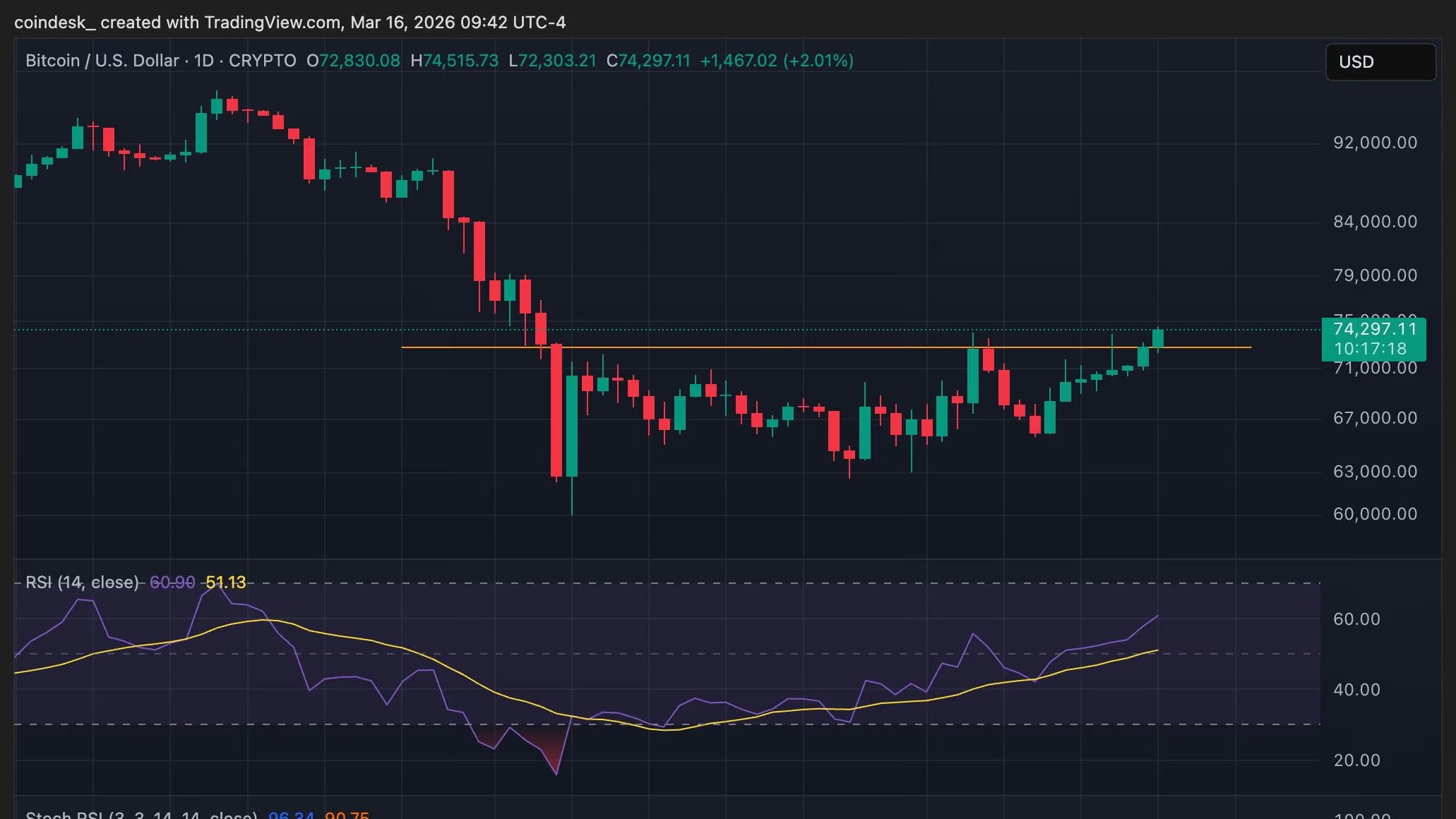
Cryptocurrencies started the week on a strong footing with bitcoin surging above $74,000 and U.S. equities bounced as oil prices eased.
In morning U.S. trade, BTC hit its strongest price since early February at $74,500, up 3.9% over the past 24 hours. The largest crypto broke out of its six-week range, boosting sentiment across the broader market and lifting appetite for smaller, riskier tokens.

Bitcoin’s bounce from its earlier February bottom of $60,000 is now nearing 25%, a notable move given several bounces of about that amount during 2022’s long crypto winter. These rebounds failed multiple times that year before the final November flush to below $16,000, which came alongside the FTX collapse.
Altcoins are outpacing bitcoin over the past 24 hours. Ether (ETH), solana (SOL) and have each climes more than 7%, suggesting renewed appetite for higher risk crypto assets after a period when capital largely concentrated in bitcoin.
U.S. equity indexes also were making moves higher after recent losses. The Nasdaq and S&P 500 were each more than 1% higher in the morning trading. Meanwhile, oil prices, a key driver of recent macro volatility, pulled back. Crude futures dropped about 4% Monday after briefly topping $100 per barrel over the weekend on Iranian strikes on energy infrastructure in the Middle East.
The Monday action happened as tensions around the Strait of Hormuz — a critical oil shipping route between the Persian Gulf and global markets — appeared to ease slightly. U.S. President Donald Trump called on other nations to help secure the waterway, while some Pakistani oil tankers reportedly have crossed the Strait, suggesting that traffic through the corridor has not been fully disrupted.
Crypto-related stocks were higher on Monday, with Circle (CRCL) up 6%. Strategy (MSTR) and Coinbase (COIN) were about 5% and 3% higher, respectively.
Bitcoin miners gain too
Amsterdam-based AI infrastrcuture provider Nebius (NBIS) signed an agreement with Meta (META) valued at up to approximately $27 billion, marking one of the largest AI compute partnerships announced this year.
Under the five-year deal, Nebius will provide roughly $12 billion in dedicated AI compute capacity across multiple locations. The infrastructure will be built on one of the first large-scale deployments of NVIDIA systems, designed to support Meta’s expanding AI workloads.
Shares of Nebius rose about 13% following the announcement, while Meta gained 2.5%.
The deal appears to be lifting sentiment across the broader AI compute and data center cohort. Among bitcoin-related names: IREN (IREN) was higher by 6%, Galaxy Digital (GLXY) by 8%, and Cipher Mining (CIFR) by 7%.
While, TeraWulf (WULF) secured a $500 million, 364 day senior secured bridge facility led by Morgan Stanley to fund construction of its Hawesville, Kentucky data center, providing development capital while longer term project financing is arranged. Shares are up about 12% following the announcement.


Australia pushes digital asset platforms toward financial services licensing
Australia is preparing to regulate crypto exchanges and tokenization platforms under the national financial services framework. The Senate Economics Legislation Committee recommended passing the Corporations Amendment Digital Assets Framework Bill 2025. Consequently, the decision moves the country closer to a formal licensing regime for digital asset operators.
Industry groups warn about definitions affecting blockchain infrastructure providers
Legal and technology groups raised concerns about several definitions used in the draft legislation. These concerns focus mainly on the terms digital token and factual control. Industry experts warned that broad interpretations could capture services that only provide infrastructure.
Piper Alderman highlighted potential issues involving wallet software and multi-party control systems. The firm explained that some security architectures rely on distributed key management. Under the bill’s wording, such systems could face unintended regulatory treatment.
Ripple Labs also commented on the framework and supported the concept of regulation based on asset control. However, the company argued that modern wallet security structures require more precise legal language. Multi-party computation wallets, for example, distribute key fragments across multiple entities.
The company warned that technology providers holding one key fragment might appear as custodians under a strict interpretation. That outcome could classify infrastructure providers as financial service operators. Therefore, industry representatives urged lawmakers to clarify that unilateral asset transfer determines factual control.
Committee backs Treasury approach while bill moves toward Senate vote
Despite industry concerns, the committee supported the Treasury’s overall regulatory approach. Lawmakers acknowledged the technical feedback but chose to address details through later regulations. This method allows adjustments without changing the bill’s main structure.
Coinbase welcomed the committee’s recommendation and described the development as progress for the digital asset sector. The company noted that Australia holds strong capital resources and technical talent in blockchain development. Clear regulatory structures could therefore support industry growth and market confidence.
However, the company also pointed to ongoing banking access challenges affecting crypto businesses. Some firms still face account closures or service restrictions from financial institutions. The company urged policymakers to implement earlier recommendations from national financial regulators.
With committee approval secured, the legislation now proceeds to debate within the Senate. Lawmakers will review the proposal before holding a final vote on the framework. If passed, the rules could reshape how digital asset platforms operate within Australia’s financial system.


- Pi Network marks its seventh year with ecosystem upgrades.
- Pi Coin holds support near $0.19 while testing the $0.20 resistance level.
- A break above $0.2588 may open the path toward $0.34 and $0.40.
The seventh anniversary of Pi Network has drawn fresh attention to the project.
The anniversary celebration, often referred to as Pi Day, has become a yearly checkpoint for the network’s progress, and this year’s event came with new upgrades and growing developer interest that could gradually strengthen the platform.
For many observers, the key question now is whether these developments can translate into sustained momentum for the token.
Ecosystem growth takes centre stage
Pi Network began with a simple idea of allowing people to participate in cryptocurrency mining through a mobile application.
That approach lowered the barrier to entry and helped the network attract a large global community over the years.
The project has continued to emphasise participation and utility rather than speculation.
This year’s anniversary announcement highlighted the expansion of developer tools and infrastructure.
These improvements allow developers to build decentralised applications directly within the Pi ecosystem.
The introduction of smart contract capabilities has been particularly important.
Smart contracts enable developers to create decentralised services such as financial tools, digital marketplaces, and blockchain-based games.
Such features are considered essential for any blockchain that aims to build a real digital economy.
The network has also been working on migrating more users to the mainnet.
This process is intended to move previously mined tokens into the live blockchain environment.
A broader migration increases real network activity and prepares the platform for wider adoption.
Furthermore, community engagement remains one of Pi Network’s defining characteristics.
The project has regularly introduced initiatives that recognise long-time participants and encourage new users to complete identity verification.
These efforts strengthen the ecosystem by ensuring that users are real individuals rather than automated accounts.
In the long run, a verified user base could make the platform more attractive to developers and businesses.
Pi Coin price analysis
Pi Coin has experienced noticeable price fluctuations in recent weeks.
The token previously rallied toward the $0.29 region before cooling down and settling near the $0.20 area.
Such pullbacks are common in the cryptocurrency market after periods of rapid gains.
Short-term movements have also been influenced by broader market sentiment.
In particular, the performance of Bitcoin (BTC) continues to play a major role in shaping momentum across the digital asset sector.
When Bitcoin strengthens, smaller cryptocurrencies often benefit from the same wave of investor interest, and when it weakens, those assets may face additional pressure.
Despite the recent pullback, analysts describe the current sentiment around Pi Coin as cautiously optimistic.
The price has managed to hold above several support levels even after a week of decline, suggesting that buyers are still willing to step in at lower prices.
However, the market has not yet produced a strong catalyst that could trigger a sustained rally.
Pi Network price forecast
For now, the short-term outlook can be described as neutral to slightly bullish.
Technical analysis highlights several price levels that traders are watching closely.
In the short term, the area near $0.19 has acted as an important support zone.
If the price holds above this level, the market could maintain its current stability.
A stronger support level sits around $0.1588, which previously served as a floor during recent price swings.
On the upside, resistance remains close to the $0.20 region.
A decisive move above this level could allow Pi Coin to test the next target around $0.21.
Beyond that point, a larger resistance area is located near $0.2588.
Historical price behaviour shows that a break above this zone has often been followed by stronger upward momentum.
If such a breakout occurs, the next resistance could appear near $0.3426.
Another major barrier stands around $0.4077, where profit-taking could emerge if the rally continues.
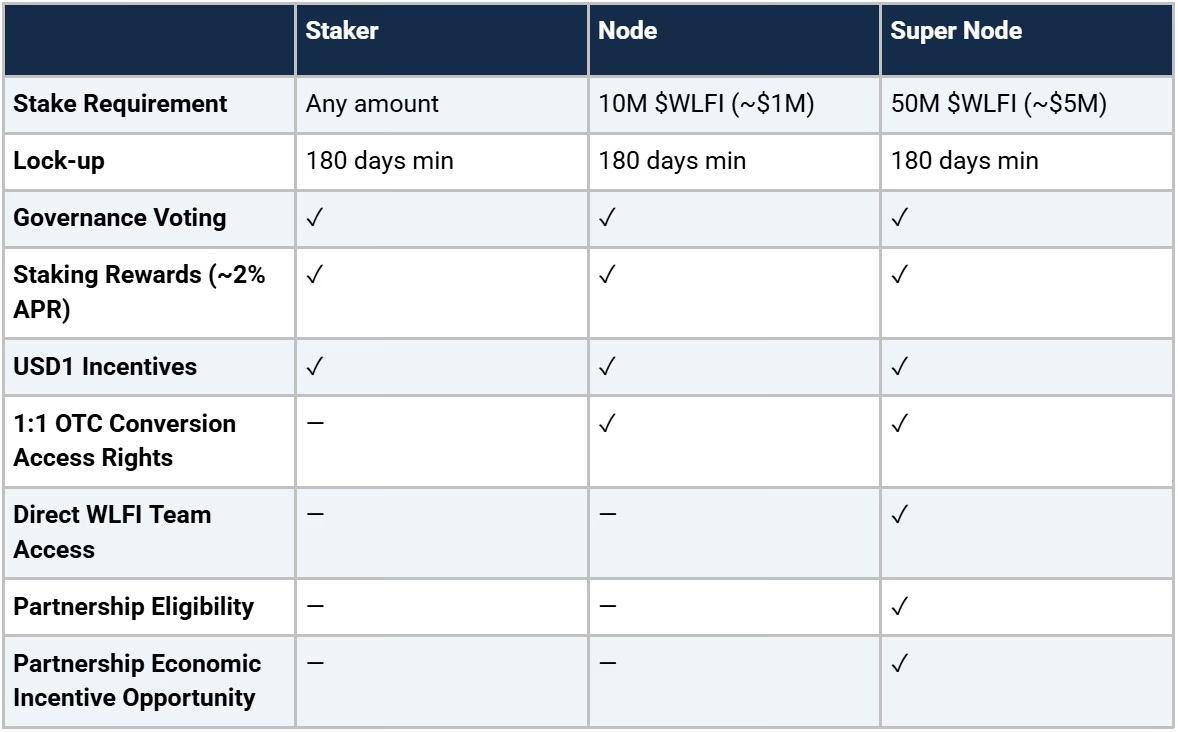
The Trump family-backed protocol’s “Super Node” tier promises partnership discussions with the WLFI team.
World Liberty Financial, the decentralized finance (DeFi) project affiliated with President Trump’s family, has passed a governance proposal that offers investors who lock up 50M WLFI tokens “direct WLFI team access,” raising fresh ethics questions about the intersection of the Trump family’s crypto business and the White House.
The vote by holders of World Liberty tokens closed Thursday with 99% of ballots in favor and 1,786 votes cast, according to Snapshot data.
The WLFI token is up 7% over the past week, according to Coingecko.
$5 Million for a Seat at the Table
The proposal creates a tiered staking system that requires WLFI holders to lock their tokens for 180 days to retain governance voting rights. At the top tier, users staking 50 million WLFI, worth roughly $5 million at current prices, are promised “guaranteed direct access to the WLFI team for partnership discussions,” according to the original proposal.

After Reuters reported on the arrangement, WLFI spokesman David Wachsman sought to narrow the scope of the offer. He characterized it as “preferential access” to the business development team and executives, not to specific founders, and said that becoming a Super Node does not guarantee a partnership.
Two-thirds of the voting power came from just five wallets. While the majority of responses on the governance forum supported the proposal, some community members questioned the project’s lack of transparency around the release of locked tokens from the initial sale.
Meanwhile, World Liberty is currently seeking approval for a U.S. banking license, a process that has drawn scrutiny from ethics experts and congressional opponents.

BlackRock has expanded its Ethereum strategy through a new exchange-traded fund that integrates staking rewards. The product directs most of its ether holdings to professional validators rather than idle custody. This structure introduces institutional staking through a regulated ETF framework.
BlackRock routes Ethereum staking through external validator operators
BlackRock launched the iShares Staked Ethereum Trust ETF under the ticker ETHB on Nasdaq. The fund combines direct ether exposure with staking income generated through network validation. Consequently, the structure allows regulated market participants to earn Ethereum rewards through a traditional financial product.
ETHB allocates roughly 70% to 95% of its ether holdings to staking infrastructure. The fund delegates validation work to specialist operators instead of building in-house systems. This approach reduces operational complexity while maintaining exposure to the Ethereum proof-of-stake mechanism.
Figment operates part of the validator network used by ETHB. Meanwhile, Galaxy Digital and Attestant run additional validation nodes. Together, these firms process transactions, propose blocks, and submit attestations for the ETF’s staked ether.
Validator operators maintain the Ethereum network security and confirm blocks on behalf of the trust. In return, the network distributes staking rewards generated through proof-of-stake participation. The ETF then distributes most of those rewards back to shareholders.
ETHB introduces yield generation inside a regulated ETF structure
ETHB launched with initial assets estimated between $100 million and $107 million. The ETF also recorded about $15.5 million in trading volume on its first trading day. These early figures indicate measurable demand for yield-bearing Ethereum exposure through regulated financial vehicles.
Under normal conditions, the fund stakes most of its ether holdings to generate network rewards. The trust returns approximately 82% of gross staking income to shareholders. Meanwhile, the remaining portion supports operational costs and partner compensation.
BlackRock set the management fee at 0.25% for the ETF. However, the firm temporarily reduced the fee to 0.12% on the first $2.5 billion in assets. This discount remains active during the product’s first year and aims to attract inflows from competing crypto products.
The fee strategy positions ETHB against existing spot Ethereum ETFs that do not provide staking rewards. By integrating yield generation, the product offers an additional return component alongside price exposure. Consequently, the structure could reshape competition among digital asset exchange-traded funds.
Ethereum network participation grows alongside institutional products
The staking model used by ETHB connects institutional capital with Ethereum’s validation economy. Professional node operators maintain the infrastructure while the ETF supplies locked ether liquidity. This structure expands participation in Ethereum’s proof-of-stake security system.
Ethereum traded near $2,201 during the period surrounding the ETF’s introduction. The price showed a daily gain of about 6.8% amid active market trading. During the same period, the asset ranged between roughly $2,041 and slightly above $2,200.
Daily trading volume approached $27.7 billion across major exchanges. Strong activity coincided with record levels of ether already locked in staking contracts. Institutional products that stake assets could strengthen this supply trend.
Large funds that lock ether for validation reduce the amount available for immediate trading. That dynamic can tighten the circulating supply within the broader market structure. At the same time, regulated ETFs provide familiar access channels for institutions seeking blockchain exposure.
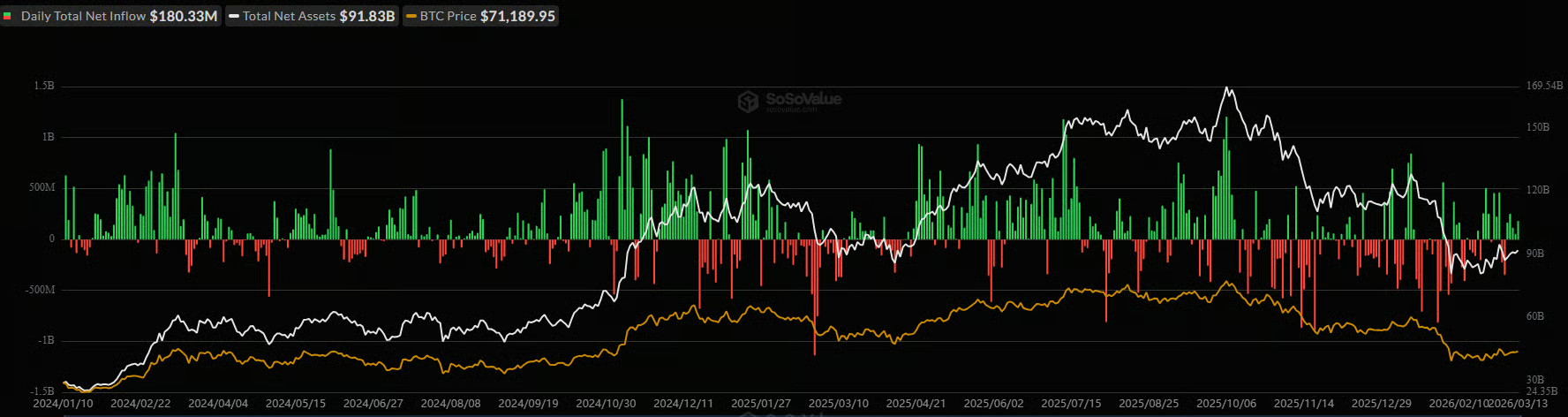
Further pump or crash to $40K: what’s next for BTC?
Bitcoin (BTC) surpassed $74,000 briefly earlier today, reaching its highest point since the start of February.
Some analysts are optimistic that a more substantial move to the upside could be forming, especially if the asset breaks above key resistance levels.
‘Stop Shorting BTC’
The primary cryptocurrency started the business week on the right foot, with its valuation surging to almost $74,400 (per CoinGecko’s data) following Donald Trump’s latest remarks regarding the war in Iran. The US President threatened to send troops to Kharg Island and urged America’s NATO allies to form a coalition to reopen the Strait of Hormuz by deploying military ships in the area.
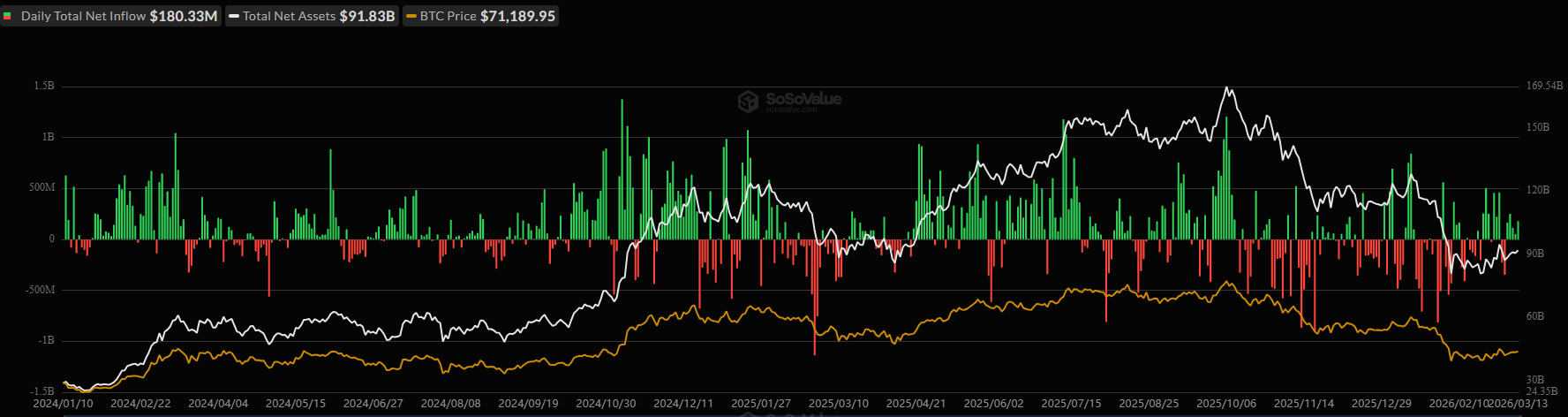
Meanwhile, spot BTC ETFs have attracted hundreds of millions of dollars in inflows over the past several days, a factor that could also have contributed to the asset’s recent price strength.
According to the popular analyst Ali Martinez, a more significant rally could be on the way. In a recent post on X, he claimed that BTC might be forming a local bottom that often comes before a big move north. Martinez noted that Bitcoin’s funding rates have recently flipped negative: a development that has preceded “every major relief rally” in the last four years.
The most recent example dates back to May 2025, when BTC was trading near $95,000. Once funding rates turned negative, the market quickly shifted, and the asset climbed to a historical peak of over $126,000 within months, the analyst reminded.
Besides that, Martinez pointed out that more than 33,000 BTC have been withdrawn from exchanges in the past week. CryptoQuant’s data shows that just a few days ago, the amount of coins stored on such platforms dipped to a six-year low of approximately 2.73 million. This is considered a bullish factor because it reduces immediate selling pressure.
You may also like:

Other analysts on X also think BTC could chart further gains in the near future. Ted, for instance, described the $72,000-$74,000 range as “strong resistance zone,” predicting that a decisive break above it could open the door for an uptrend to as high as $78,000.
Still on Uncertain Ground
Analysts like Leshka.eth remain somewhat cautious about BTC’s short-term prospects. The X user argued that the price is slowly grinding higher within a descending channel toward the $76,000-$80,000 region, warning that a rejection here could trigger a painful crash to as low as $40K.
The analyst who goes by the moniker Klarck also envisioned a potential pullback. They foresaw a bull trap at around $74,000, a “liquidity grab” at $65,000, $62,500, and $60,000, and an eventual plunge to new lows.
BTC’s Relative Strength Index (RSI) is one technical indicator suggesting a price plunge could be imminent. The ratio has surpassed 70, meaning the price has pumped too much in a short period and could be due for a pullback. In contrast, readings under 30 suggest the asset is oversold and on the verge of a potential rally.

Binance Free $600 (CryptoPotato Exclusive): Use this link to register a new account and receive $600 exclusive welcome offer on Binance (full details).
LIMITED OFFER for CryptoPotato readers at Bybit: Use this link to register and open a $500 FREE position on any coin!


Disclosure: This article does not represent investment advice. The content and materials featured on this page are for educational purposes only.
Skywinex highlights an infrastructure-driven model as web3 platforms prioritize automation and system control.
Summary
- Skywinex builds infrastructure combining smart contracts with dedicated server systems.
- Skywinex uses blockchain smart contracts to automate deposits, fund allocation, and earnings distribution.
- The platform runs trading bots on dedicated servers designed for continuous 24/7 execution.
As web3 platforms evolve, infrastructure is becoming just as important as product design. Beyond user interfaces and token mechanics, long-term viability increasingly depends on architecture, automation, and system control.
Skywinex, a web3 investment platform built on smart contracts, positions its technical infrastructure as the core of its model. Rather than relying solely on third-party services, the company combines on-chain logic with dedicated server systems designed for continuous automated operation.
Smart contract as the control layer
At the center of the Skywinex ecosystem is a smart contract deployed on the blockchain. This contract governs the key operational processes of the platform, including:
- Acceptance of user deposits
- Allocation of funds to trading modules
- Calculation of daily returns
- Distribution of earnings
Because smart contracts execute predefined logic and cannot be altered retroactively, the structure ensures consistency in how transactions are processed. Users interact directly with the smart contract by connecting their crypto wallets. No traditional registration or personal data submission is required. Authorization occurs through blockchain interaction rather than centralized account systems. This approach shifts the operational trust model from internal management to code execution.
Dedicated server infrastructure
While the smart contract handles on-chain logic, trading execution takes place off-chain within Skywinex’s server infrastructure. The company operates its own dedicated server farm where trading bots run continuously. These are not temporary cloud instances but configured servers designed for uninterrupted, 24/7 performance.
According to Skywinex, this decision was intentional. “We believe infrastructure defines reliability,” says Richard Lennox, CEO of Skywinex. “Automation only works when the technical foundation is stable. That’s why we built a system where both blockchain logic and physical infrastructure operate in sync.”
The server layer is responsible for:
- Real-time market data analysis
- Processing large volumes of exchange data
- Executing algorithmic trading strategies
- Returning results to the smart contract
By maintaining control over the execution environment, the company aims to optimize latency, stability, and operational consistency.
Modular trading architecture
Each trading bot functions as an independent software module. This modular structure allows:
- Separate strategy deployment
- Independent performance tracking
- Scalable infrastructure expansion
Bots operate according to predefined algorithms. Once a trading cycle is completed, generated results are transmitted back to the smart contract, which performs automated calculations and credits user balances.
The separation between on-chain control and off-chain execution creates a dual-layer architecture:
- Blockchain layer for transparency and settlement
- Server layer for speed and data processing
User perspective: Simplicity over complexity
Despite the technical depth behind the system, user interaction remains minimal. From the investor’s perspective, the process consists of:
- Connecting a crypto wallet
- Selecting a trading bot
- Signing a transaction
All complex infrastructure processes operate in the background. Users do not interact with servers directly and do not manage trading execution manually. Every transaction, however, remains visible on-chain.
Infrastructure as a competitive factor
As algorithmic trading and web3 finance expand, infrastructure design may become a defining factor in platform sustainability. By combining smart contract governance with dedicated server operations, Skywinex represents a hybrid approach to automated investing, one that integrates blockchain transparency with controlled execution environments.
Whether this architectural model becomes standard in the web3 investment space remains to be seen. However, the emphasis on infrastructure suggests a broader industry shift toward systems built around automation, verification, and operational resilience.
For more information, visit the official website, Telegram, or X.
Disclosure: This content is provided by a third party. Neither crypto.news nor the author of this article endorses any product mentioned on this page. Users should conduct their own research before taking any action related to the company.

TLDR
- Abra will go public through a $750 million merger with New Providence Acquisition Corp. III.
- The combined company will trade on Nasdaq under the ticker symbol ABRX.
- The transaction sets Abra’s pre-money valuation at $750 million.
- Existing investors will roll their shares into the new public entity.
- The deal may provide up to $300 million in cash held in trust.
Abra will enter public markets through a merger with New Providence Acquisition Corp. III. The deal values the company at $750 million before new capital. The combined entity will trade on Nasdaq under the ticker ABRX.
Abra to Merge With SPAC at $750 Million Valuation
Abra signed a definitive agreement with New Providence Acquisition Corp. III to complete a reverse merger. The transaction sets a pre-money equity valuation of $750 million. After closing, the combined company will operate as Abra Financial. It expects to list on Nasdaq under the ticker ABRX.
The deal allows existing investors to roll their shares into the public company. These investors include Pantera Capital, Blockchain Capital, RRE Ventures, Adams Street, and SBI. They will not cash out during the merger process. The transaction may provide up to $300 million in cash held in trust. Abra plans to use the proceeds for growth, sales, marketing, and operations.
Abra Financial will offer SEC-registered investment advisory services and a digital asset wealth platform. The company will target institutional clients, high-net-worth individuals, and registered investment advisers. Its services will include custody, segregated accounts, trading, yield strategies, and crypto-backed loans. It will also provide treasury management solutions for clients.
CEO Bill Barhydt said the firm will focus on regulated, on-chain crypto wealth management. He stated, “We aim to provide regulated, on-chain crypto wealth management as digital assets become central to finance.” Abra targets $10 billion in assets under management by the end of 2027. The company expects the merger to strengthen its capital base and support expansion plans.
Abra operates through Abra Capital Management LP, which is registered with the US Securities and Exchange Commission. This registration allows the firm to provide portfolio management services. The company founded operations in 2014 under Barhydt’s leadership. It serves institutions, family offices, and high-net-worth investors.
In 2024, Abra settled with regulators in 25 US states over its Abra Earn product. The company agreed to return assets to investors and wind down the program for US clients. After the settlement, it shifted focus toward institutional and wealth management services.
Crypto Firms Pursue Public Listings Through SPACs and IPOs
Abra joins other digital asset firms seeking access to public markets. SPAC transactions have regained traction for crypto companies in the past year. Jessica Groza, partner at Kohrman Jackson & Krantz, commented on the structure. She said, “While this model offers rapid liquidity and valuation flexibility, it also carries risks such as volatility and regulatory uncertainty.”
Several crypto firms chose traditional IPO routes in 2025. Stablecoin issuer Circle Internet Group listed on the New York Stock Exchange in June 2025. Crypto exchange Gemini debuted on Nasdaq later that year. Figure Technologies and Bullish also completed public listings through IPOs.
Other firms continue to evaluate public offerings. Hardware wallet maker Ledger and institutional custodian Copper have explored potential listings. Abra confirmed that it expects its shares to trade on Nasdaq under ABRX after the merger closes.



A $10m SOFR options win on “higher for longer” rates shows where real money is made upstream of crypto, as oil‑driven inflation forces markets to kill early Fed cuts.
Summary
- A trader reportedly made about $10 million this month on SOFR‑linked options initiated in January, effectively shorting the market’s dovish Fed path.
- Surging oil and Middle East risk have revived inflation fears, pushing yields higher, slashing odds of near‑term cuts, and revaluing the entire front‑end rates surface.
- Slower, shallower easing supports the dollar and front‑end yields, choking risk appetite for duration trades from long‑dated tech to high‑beta altcoins and DeFi.
Macro just handed one trader the kind of P&L most crypto desks pretend they’re running. A short‑term interest‑rate options position tied to the Federal Reserve’s policy path has reportedly booked around 10 million dollars in profit this month, as surging oil prices forced markets to reprice the timing and depth of U.S. rate cuts.
According to Jinshi News, the bet was initiated in January using options linked to the secured overnight financing rate (SOFR), the key benchmark closely tracking the Fed funds corridor. At entry, the trade was effectively a leveraged expression that the market was too dovish on how quickly the Fed would ease. That thesis has snapped into focus over the past two weeks as Middle East tensions pushed crude to its highest levels since 2022, reviving inflation concerns and killing off hopes of early, aggressive cuts.
The mechanical impact is brutal but simple: higher oil feeds into inflation expectations, which pushes Treasury yields and SOFR‑linked rates higher, revaluing the entire options surface. As traders slashed the implied probability of near‑term cuts and shifted toward a “higher for longer” path, payoffs on structures positioned for stickier policy—payer swaptions, call spreads, and similar rate‑hike or no‑cut expressions—exploded in value. That repricing is what generated the roughly 10 million dollars in profit on the January position.
For crypto, this is not some distant TradFi side plot. A slower, shallower cutting cycle supports the dollar and front‑end yields, which traditionally caps risk appetite for duration‑heavy trades, from long‑dated tech to high‑beta altcoins. You can see the same mechanism in 2020–2022: every shift in the Fed dots and real‑yield curve bled straight into crypto’s funding rates, basis trades, and eventually spot flows as ETF and macro funds adjusted risk.
The signal here is clear: serious money is being made upstream of crypto, in the rate complex that sets the discount rate for every “growth” story on‑chain. If you are still treating Fed meetings and oil as background noise, you are already the liquidity for someone else’s SOFR trade.


If ETH continues to climb, the next major resistance is expected at $2,450, said one analyst.
On March 16, Ethereum (ETH) climbed to almost $2,300 for the first time since early February, posting an 8% gain in 24 hours.
This happened even as large holders kept offloading hundreds of millions of dollars worth of the token, as a broader crypto rally appeared to defy ongoing geopolitical tensions that have pulled traditional markets apart.
Whales Sell Into the Rally
Despite the uptick, there hasn’t been the kind of investor confidence that usually comes before a sustained breakout. Data shared by analyst Wise Crypto showed that in the last seven days, big ETH holders sold 380,000 ETH worth about $800 million. They suggested that a lot of those sellers were treating the short-term price spikes as a chance to get out, which could slow further upward movement.
Based on their analysis, Ethereum is currently trading between $1,917 and $2,338, which are its support and resistance levels, respectively. Wise Crypto projected that if the price goes below the lower boundary, ETH could drop to just above $1,700. However, if the asset stays above resistance for a while, it could test levels close to $2,450.
The analyst also noted that the Market Value to Realized Value (MVRV) Long/Short Difference for ETH is very negative, which means that long-term holders may be losing money while short-term traders are making money. The MVRV ratio compares the current price of ETH to the average price at which all coins last moved, giving a rough idea of how much unrealized profit or loss there is among holders.
When short-term holders make most of the money, like they seem to be doing right now, selling pressure usually follows quickly.
Even with the mixed signals, ETH was up 13% over seven days at the time of this writing, moving well above $2,200. The jump happened during a larger rise in the crypto market, which also, for a short period, pushed Bitcoin (BTC) above $74,000, to hit its highest level in about six weeks, following a U.S. attack on Iran’s Kharg Island, which exports 90% of the country’s oil shipments.
You may also like:
Futures Markets Dominate ETH Trading
Elsewhere, data from analyst Darkfost shows that even though ETH has recovered in the spot market, derivatives activity points to short-term trading still dominating the asset’s market structure.
The on-chain technician reported on Sunday that the volume of Ethereum futures trading on Binance is now more than six times greater than the volume of spot trading, with the ratio between them falling to its lowest level since the tail end of the 2023 bear market.
When futures trading is much more active than spot trading, it usually means that the market is driven by leveraged positions instead of steady accumulation.
“This reflects genuine weakness in Ethereum’s spot market at the moment,” Darkfost wrote. “It is possible that sales from the Ethereum Foundation or even Vitalik Buterin are contributing to investor caution.”
Still, not everyone thinks that ETH will stay in a range, as, according to crypto commentator Ash Crypto, a daily close above $2,400 could lead to a move toward $2,800.
Binance Free $600 (CryptoPotato Exclusive): Use this link to register a new account and receive $600 exclusive welcome offer on Binance (full details).
LIMITED OFFER for CryptoPotato readers at Bybit: Use this link to register and open a $500 FREE position on any coin!


The US, UK, and Canada have today launched a new joint initiative aimed at raising awareness of crypto fraud while simultaneously tackling crypto-related organized crime.
Known as “Operation Atlantic,” the initiative will see the US Secret Service (USSS), the UK’s National Crime Agency (NCA), and Canada’s Ontario Provincial Police contact victims, and potential victims, of crypto fraud and advise them on how to keep their crypto assets safe.
A USSS spokesperson told Protos that the operation will last a week, and that the agencies are working alongside “private industry partners” to identify and contact victims of approval phishing.
They added, “Law enforcement personnel will then provide advice and instructions on how to secure their assets to prevent further losses. Additionally, teams will work to trace and seize stolen funds with the goal of victim restitution.”
Read more: How to stay safe on-chain: Three crypto users lose $876K within hours
One particular crypto scam known as “approval phishing” is highlighted in the initiative. This involves a victim signing off on a fake wallet approval request that gives hackers access to their funds.
Some scammers have drained over $600,000 worth of crypto assets through approval phishing. Last year, one of “the largest supply chain attack[s] in history” used approval phishing to redirect funds to a hacker’s account.
This case, despite its scale, only drained $0.05.
The USSS deputy assistant director for the office of field operations claims, “Approval phishing and investment scams cost victims millions in financial loss each year.”
They also claim that Operation Atlantic “will identify and disrupt these scams in near real-time denying criminals the ability to further profit from their crimes.”
Recognising that scammers often impersonate trusted bodies, the NCA and USSS have created a dedicated phone number and webpage to make it easier for callers to verify legitimacy.
Operation Atlantic was inspired by a 2024 Canadian-led program called “Project Atlas.” In this case, $70 million in funds was reportedly kept from scammers while $24 million in stolen funds were frozen.
One crypto fraud body disbands, another takes its place
Last year, the Trump administration disbanded the Justice Department’s crypto enforcement agency in line with an executive order. The agency was created to tackle “complex investigations and prosecutions of criminal misuses of cryptocurrency.”
Since then, the scale of crypto scams orchestrated by criminal gangs in South Asia has been scrutinized by the US and China, and led to the creation of the US “Scam Center Strike Force.”
This body, which aims to bring scam leaders to justice, partnered with social media giant Meta to help take down 150,000 Facebook accounts. The joint operation with Thai authorities led to the arrest of 21 people.
Thailand’s neighbour, Cambodia, has also led a widespread crackdown against crypto scam compounds that reportedly led to the deportation of 48,000 people detained from raids.
Got a tip? Send us an email securely via Protos Leaks. For more informed news and investigations, follow us on X, Bluesky, and Google News, or subscribe to our YouTube channel.

Australia Moves to License Crypto Exchanges Under Financial Law
Rose Byrne and Bobby Cannavale’s Relationship Timeline

One of the ‘greatest British TV dramas of all time’ returns to BBC this week


-
 Tech5 days ago
A 1,300-Pound NASA Spacecraft To Re-Enter Earth’s Atmosphere
-
Crypto World3 days ago
HYPE Token Enters Net Deflation as HyperCore Buybacks Outpace Staking Rewards
-

 Business6 days ago
ExxonMobil seeks to move corporate registration from New Jersey to Texas
-

 Fashion3 days ago
Weekend Open Thread: Addict Lip Glow
-

 Tech6 days ago
ChatGPT will now generate interactive visuals to help you with math and science concepts
-
Sports2 days ago
Why Duke and Michigan Are Dead Even Entering Selection Sunday
-

 NewsBeat5 days ago
Residents reaction as Shildon murder probe enters second day
-
 NewsBeat7 days ago
Pagazzi Lighting enters administration as 70 jobs lost and 11 stores close across Scotland
-

 Business5 days ago
Search Enters Sixth Week With New Leads in Tucson Abduction Case
-

 Business24 hours ago
Search for Savannah Guthrie’s Mother Enters Seventh Week with No Arrests
-

 Business2 days ago
US Airports Launch Donation Drives for Unpaid TSA Workers as Partial Government Shutdown Enters Fifth Week
-
Crypto World2 days ago
Coinbase and Bybit in Investment Talks: Could Bybit Finally Enter the US Crypto Market?
-

 NewsBeat5 days ago
I Entered The Manosphere. Nothing Could Prepare Me For What I Found.
-

 Business7 days ago
Search Enters 39th Day with FBI Tip Line Developments and No Major Breakthroughs
-

 Business2 days ago
Country star Brantley Gilbert enters growing non-alcoholic beer market
-

 Business9 hours ago
Australian shares drop as Iran war enters third week
-
 Crypto World6 days ago
Will Chainlink price reclaim $10 amid volatility squeeze?
-

 Sports5 days ago
PWHL, Senators discussing plan to keep Charge in Ottawa
-

 Crypto World9 hours ago
Crypto Lender BlockFills Enters Chapter 11 with Up to $500M in Liabilities
-

 Sports3 days ago
College Basketball Best Bets: Conference Tournament Semifinal Picks


You must be logged in to post a comment Login