

Crypto World
BTC slides to $65,000, Solana, XRP, dogecoin down 6%



Bitcoin’s attempt to reclaim $70,000 earlier in the week lasted about 48 hours.
The largest cryptocurrency slid to $65,735 in early Asian hours on Saturday, down 3% over the past day and 2.8% on the week. Wednesday’s rally, which came within touching distance of $70,000, has now given back more than half its gains as broader risk sentiment deteriorated through Thursday and Friday’s U.S. sessions.
Altcoins took a harder hit. Solana dropped 6.7%, ether fell 6.2%, dogecoin shed 5.1%, and XRP lost 4%. The losses pushed most major tokens into the red on a weekly basis, erasing the altcoin outperformance that had been the week’s most encouraging signal. BNB held up better than most, down just 2.5%.
The trigger was familiar. Friday’s U.S. session saw the S&P 500 close down 0.4%, the Nasdaq 100 drop 0.3%, and the Dow fall 1.1%. Nvidia, still digesting its post-earnings reaction, shed another 4.2%.
A hotter-than-expected 0.5% jump in producer prices added fuel, signaling inflationary pressure that may keep the Fed from cutting rates anytime soon. Block Inc.’s massive layoffs fanned broader anxiety that AI is starting to displace jobs across the economy rather than just creating them.
Crypto followed equities lower, but as usual, with amplified magnitude. A 0.4% drop in the S&P became a 3% drop in bitcoin and a more than 6% drop in altcoins. The leverage that re-entered the system during Wednesday’s rally got flushed on the way back down.
The irony is that the institutional flow data this week was actually strong.
U.S. spot bitcoin ETFs added $1.1 billion in three days, putting them on pace for their best week in months. But ETF inflows haven’t been enough to overcome the broader macro headwinds.
“Over-analysis of short-term price movements is misguided,” said Dom Harz, co-founder of bitcoin finance firm BOB said in an email. “Bitcoin’s volatility is no surprise, particularly for early investors who have experienced previous cycles. What’s different this time is the type of capital behind the emerging asset class.”
Meanwhile, CryptoQuant data shows USDT stablecoin reserves on exchanges have fallen from $60 billion to $51.1 billion over the past two months, a decline the firm warned could trigger a “massive sell-off” if reserves drop below $50 billion.
Elsewhere, Strategy shares topped the list of large U.S. companies by short interest volume as markets increasingly question the sustainability of the firm’s debt-funded bitcoin buying program.
And on the Ethereum side, large holders have started selling at a loss, with DAT company ETHZilla officially abandoning its ETH accumulation strategy and rebranding to focus on tokenized real-world assets instead.
Bitcoin is now back in the middle of the $60,000-$70,000 range it has been stuck in since the Feb. 5 crash. Wednesday proved the top of that range is resistance. The question heading into March is whether the bottom still holds.


TLDR
- Nebius Group (NBIS) plummeted 13.1% Friday, hitting an intraday low of $88.40 and settling at $91.19
- Fourth-quarter earnings showed a loss of $0.69 per share versus the anticipated -$0.42; sales reached $227.7M against a $246M projection
- Capital spending for the quarter totaled approximately $2.06B, sparking investor worries about liquidity
- Sector-wide weakness intensified as CoreWeave’s (CRWV) lackluster results triggered a broader neocloud retreat
- Wall Street analysts continue favoring the stock with a “Moderate Buy” consensus and $143.22 mean target
Nebius Group (NBIS) experienced significant turbulence Friday, surrendering 13.1% to finish at $91.19 after touching $88.40 earlier in the trading session. The previous session had seen shares close at $104.88.
Volume metrics painted a picture of heightened investor activity. Approximately 22.8 million shares traded hands — representing a 68% surge compared to the typical daily volume of 13.6 million.
The sharp decline followed NBIS’s February 12th fourth-quarter earnings release that fell short of analyst projections across key metrics.
The neocloud provider reported a per-share loss of $0.69, substantially wider than the Street’s forecast of a $0.42 deficit — representing a $0.27 shortfall. Top-line performance also underwhelmed, with revenue reaching $227.7 million versus the $246 million consensus.
While the earnings disappointment initially triggered selling, the investment spending figures ultimately amplified concerns.
The company disclosed capital expenditures totaling roughly $2.06 billion during Q4. Management’s outlook for sustained multi-billion dollar annual investments has prompted investor scrutiny regarding financing strategies and short-term liquidity management.
Sector Pressure From CoreWeave
The NBIS decline wasn’t an isolated incident. Competing neocloud provider CoreWeave (NASDAQ: CRWV) plunged up to 21.9% the same session following its own earnings disappointment.
Both enterprises compete in an identical market segment — acquiring GPU infrastructure and leasing AI computing resources to hyperscalers and emerging artificial intelligence companies. Market sentiment tends to correlate between these players.
This dynamic has emerged as a recurring theme. These equities attract intense scrutiny, remain opaque to mainstream investors, and demonstrate acute sensitivity to adverse developments within the AI infrastructure ecosystem.
NBIS exhibits a beta coefficient of 3.90, underscoring its pronounced volatility relative to broader market movements.
Analyst Views Still Mostly Positive
Notwithstanding Friday’s retreat, Street sentiment remains constructive. Among 11 analysts tracking the name, two rate it Strong Buy, seven assign Buy ratings, one maintains Hold, and one recommends Sell.
The consensus price objective stands at $143.22 — substantially above Friday’s closing level. Morgan Stanley launched coverage in January with an Equal Weight stance and $126 target. Freedom Capital elevated its recommendation to Strong Buy this month.
Skepticism exists in certain quarters. Both Wall Street Zen and Weiss Ratings have recently downgraded shares to Sell.
CICC Research initiated coverage last November with an Outperform recommendation and $143 price objective.
Technical indicators show the 50-day moving average at $95.00, while the 200-day moving average rests at $95.95. The company’s market capitalization approximates $22.96 billion.
Street forecasts project 2026 revenue at $3.35 billion, implying year-over-year expansion of 531%.
Strategic cloud collaborations with Meta and Microsoft underpin analyst confidence in the long-term revenue trajectory.
For the ongoing fiscal period, consensus estimates anticipate a $1.10 per-share loss.
Institutional ownership accounts for 21.90% of outstanding shares, with multiple funds gradually increasing their allocations in recent reporting periods.

Crypto World
ARK Invest’s Latest Moves: CoreWeave and Kratos Purchases Highlight February 27 Trading

Quick Summary
- ARK Invest acquired approximately $19.4M in CoreWeave stock following a 19% decline after the company’s Q4 earnings report
- The fund’s most significant transaction was a $23.2M acquisition of Kratos Defense & Security Solutions shares
- Teradyne holdings were reduced by $12.9M, extending ARK’s pattern of trimming this position
- ARK decreased its Rocket Lab stake despite the company exceeding earnings forecasts, with shares declining roughly 5%
- Additional moves included divesting Roku holdings and establishing a position in Generate Biomedicines
On Friday, February 27, Cathie Wood’s ARK Invest executed multiple strategic portfolio adjustments. The trading activity encompassed fresh investments and position reductions spanning technology, defense, and biotechnology sectors.
Kratos Defense & Security Solutions emerged as the day’s most substantial acquisition. ARK accumulated 252,169 shares valued at $23.2 million. The company specializes in unmanned aerial systems and autonomous defense technologies, aligning with ARK’s investment thesis centered on robotics and automation.
The second-largest acquisition involved CoreWeave, a provider of AI-focused cloud infrastructure. ARK secured 198,980 shares totaling approximately $19.4 million, distributed between its ARKK and ARKW exchange-traded funds.
CoreWeave, Inc. Class A Common Stock, CRWV
ARK’s CoreWeave purchase occurred during a session where the stock declined 19%. The downturn followed fourth-quarter earnings that demonstrated robust revenue growth but revealed expanding losses and capital expenditures that exceeded market expectations.
By purchasing shares during the selloff, ARK appears to interpret the market reaction as temporary volatility rather than fundamental business deterioration. CoreWeave operates in the AI computing infrastructure space, which has experienced substantial demand expansion.
CoreWeave maintains a Moderate Buy rating among Wall Street analysts. With eleven Buy ratings and eight Hold ratings, the consensus price target of $114.18 suggests potential upside of approximately 43.5% from current trading levels.
ARK Scales Back Teradyne and Rocket Lab Holdings
Regarding portfolio reductions, ARK divested 38,773 Teradyne shares valued at $12.9 million across several ETFs. Teradyne manufactures semiconductor testing systems and industrial automation equipment. This transaction continues ARK’s recent pattern of decreasing its Teradyne exposure.
ARK also liquidated 46,921 shares of Rocket Lab valued at approximately $3.4 million. The space technology company had recently announced quarterly performance that surpassed both earnings and revenue projections, yet shares declined roughly 5% on Friday.
Rocket Lab disclosed robust launch operations and an expanding order backlog. Nevertheless, the inaugural launch of its larger Neutron rocket was delayed until late 2026, potentially contributing to investor disappointment.
Additional Portfolio Adjustments in Biotech and Technology
ARK disposed of 46,389 shares of Roku valued at $4.3 million from its ARKK fund. The rationale for this divestment was not publicly disclosed.
Within the biotechnology sector, ARK acquired 459,525 shares of Generate Biomedicines valued at $7.4 million via its ARKG fund. Simultaneously, the fund sold 39,423 shares of Ionis Pharmaceuticals for $3.2 million.
ARK liquidated 10,590 Deere & Co shares for $6.6 million and reduced its Guardant Health position by 27,334 shares valued at $2.7 million.
Minor transactions included a reduction of 205,211 PagerDuty shares for $1.5 million and an acquisition of 14,097 Brera Holdings shares valued at approximately $15,600.
The CoreWeave and Kratos acquisitions represented ARK’s two most significant individual transactions on February 27, with combined value exceeding $42 million.


Mark Karpelès, the former chief executive of the defunct Mt. Gox exchange, is urging the Bitcoin community to consider a network hard fork designed to retrieve nearly 80,000 Bitcoin linked to the platform’s historic hack.
Key Takeaways:
- Mark Karpelès proposed a Bitcoin hard fork to recover 79,956 BTC worth about $5.2B from the Mt. Gox hack.
- The plan would allow the coins to move without the original private key and potentially repay creditors.
- The proposal has triggered strong opposition over fears it would weaken Bitcoin’s immutability.
In a proposal published Friday on GitHub, Karpelès outlined a change to Bitcoin’s consensus rules that would allow 79,956 BTC, currently held in a single wallet, to be transferred to a designated recovery address without access to the original private key.
At current prices, the holdings are worth more than $5.2 billion.
Dormant Mt. Gox Bitcoin Unmoved for 15 Years
“These coins have not moved in over 15 years,” Karpelès wrote, describing the funds as among the most widely monitored unspent transaction outputs in Bitcoin’s history.
He acknowledged the magnitude of the suggestion, stating plainly that the change would require a hard fork.
Such an update would make a transaction previously rejected by the network valid and would require node operators to upgrade their software before a specified activation block.
Karpelès said the idea is not an attempt to sidestep Bitcoin’s development process but rather to trigger discussion around a long-standing impasse.
According to him, bankruptcy trustee Nobuaki Kobayashi has declined to pursue on-chain recovery because there is no certainty the community would support it.
“That creates a deadlock,” Karpelès wrote. “The trustee won’t act without confidence, and the community can’t evaluate the idea without a concrete proposal.”
If the coins were recovered, the existing bankruptcy framework could distribute them to creditors already receiving repayments from the estate.
The suggestion has sparked sharp backlash across Bitcoin forums. Critics argue that altering consensus rules to reclaim stolen funds would undermine Bitcoin’s defining characteristic: irreversible transactions.
“Every time a hack happens, someone will want another special rule,” one Bitcointalk member wrote, warning it would erode trust in the system.
Another user argued Bitcoin should remain independent from legal or government determinations in any jurisdiction.
Karpelès Says Mt. Gox Recovery Case Is Unique as Creditors Back Proposal
Karpelès countered that the case is unique because both law enforcement and much of the community agree the wallet contains stolen Mt. Gox funds.
Some individuals claiming creditor status expressed support, saying any recovery could restore losses from the 2014 collapse.
Mt. Gox once processed roughly 70% of global Bitcoin trading between 2010 and 2014.
The exchange unraveled after a massive theft went undetected for years, ultimately losing about 750,000 customer Bitcoin and forcing a bankruptcy filing in Tokyo.
More than a decade later, the incident remains one of the largest failures in crypto history.
In May last year, Vivek Ramaswamy’s Strive said it plans to acquire 75,000 Bitcoin, valued slightly over $8 billion, from claims related to the defunct Mt. Gox exchange bankruptcy.
Strive noted that the strategy is intended to purchase Bitcoin at a discount price.
The post Former Mt. Gox CEO Proposes Hardfork to Recover $5.2B in BTC appeared first on Cryptonews.
Crypto World
Solana Price Analysis: SOL Slides 5% Amid Middle East Tensions – Critical Support Zones Ahead
TLDR
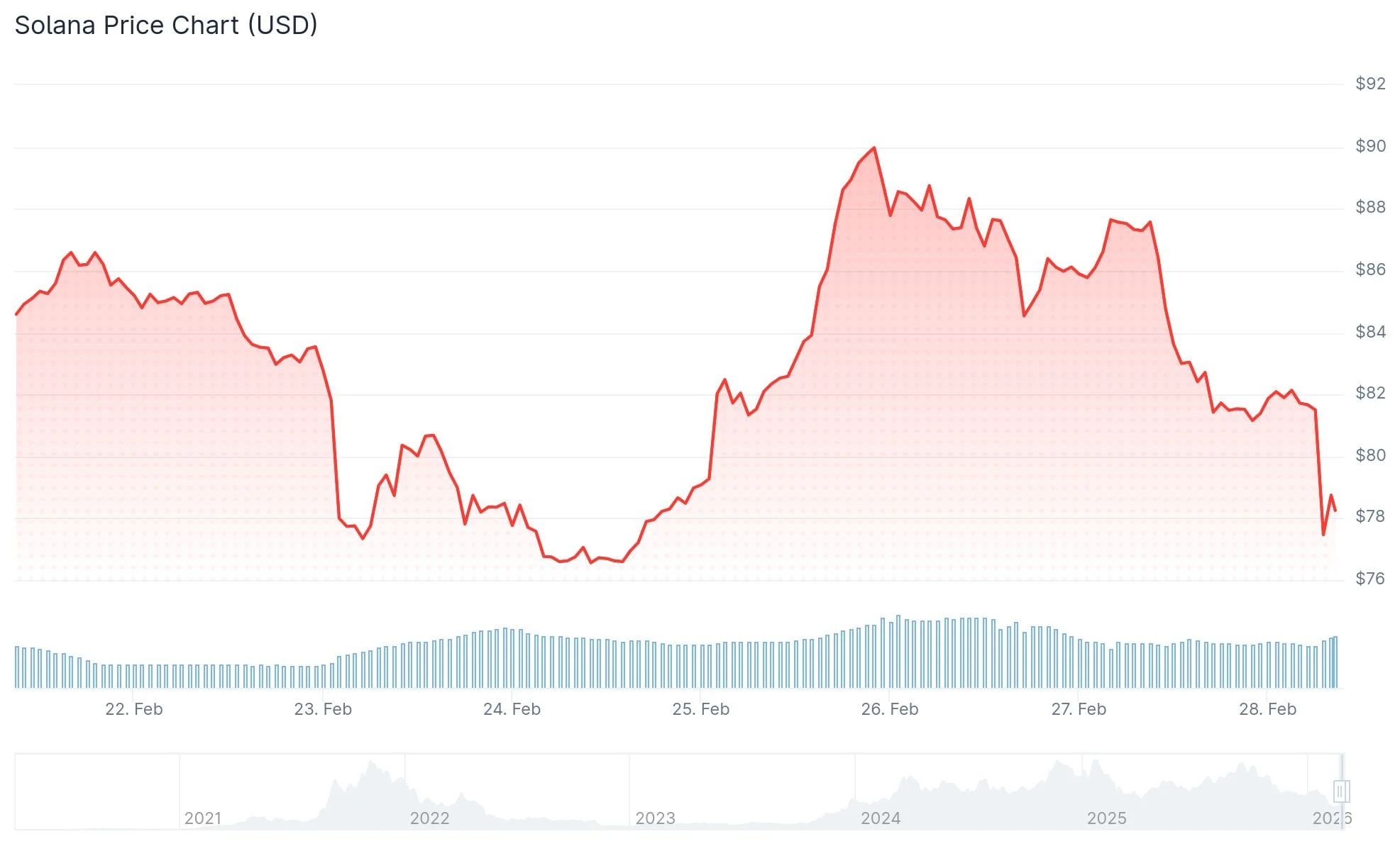
- SOL has declined 72% from its record high of $295 and is currently valued at approximately $78
- The token’s spot ETF products have experienced only $11.3M in total outflows, significantly less than Bitcoin and Ethereum ETFs that recorded four straight months of withdrawals
- Solana dominated decentralized exchange activity with $108 billion in 30-day volume, surpassing Ethereum’s $63.7 billion
- Technical analysts highlight critical support zones at $50, $22, and $10 derived from Parallel Channel formations
- Military strikes involving Israel and Iran sparked widespread cryptocurrency liquidations, driving Bitcoin near $60,000 and weighing heavily on alternative tokens including SOL
The Solana network’s native token SOL is presently valued at $78, representing a 72% decline from its peak valuation of $295. This downturn coincides with a comprehensive cryptocurrency market correction intensified by escalating geopolitical instability on February 28, 2026.
Saturday morning witnessed Israeli forces conducting military operations against Iranian targets. Intelligence from AP sources confirms American involvement in the coordinated assault. Bitcoin experienced a sharp 5% correction within minutes, approaching the $60,000 threshold, with the resulting market panic cascading into alternative cryptocurrencies like SOL.
While price action reflects bearish sentiment, Solana’s fundamental network metrics demonstrate continued robustness. The blockchain recorded $108 billion in decentralized exchange volume throughout the previous 30-day period, outpacing Ethereum’s $63.7 billion and Base’s $31.48 billion by significant margins.
During the past 24-hour cycle, Solana applications produced $3.1 million in protocol revenue compared to Ethereum’s $2.95 million. The network maintained 2.17 million active wallet addresses, substantially exceeding Ethereum’s 682,236 active participants.
Solana’s real-world asset tokenization ecosystem has achieved a new milestone valuation of $1.71 billion, marking a 45% increase over the past month.
SOL ETF Flows Hold Steady
Exchange-traded fund products for SOL debuted in late October 2025, attracting more than $100 million in average daily net inflows throughout their initial five-week period. Weekly capital inflows have subsequently moderated to the $20–$25 million range as token valuations contracted.
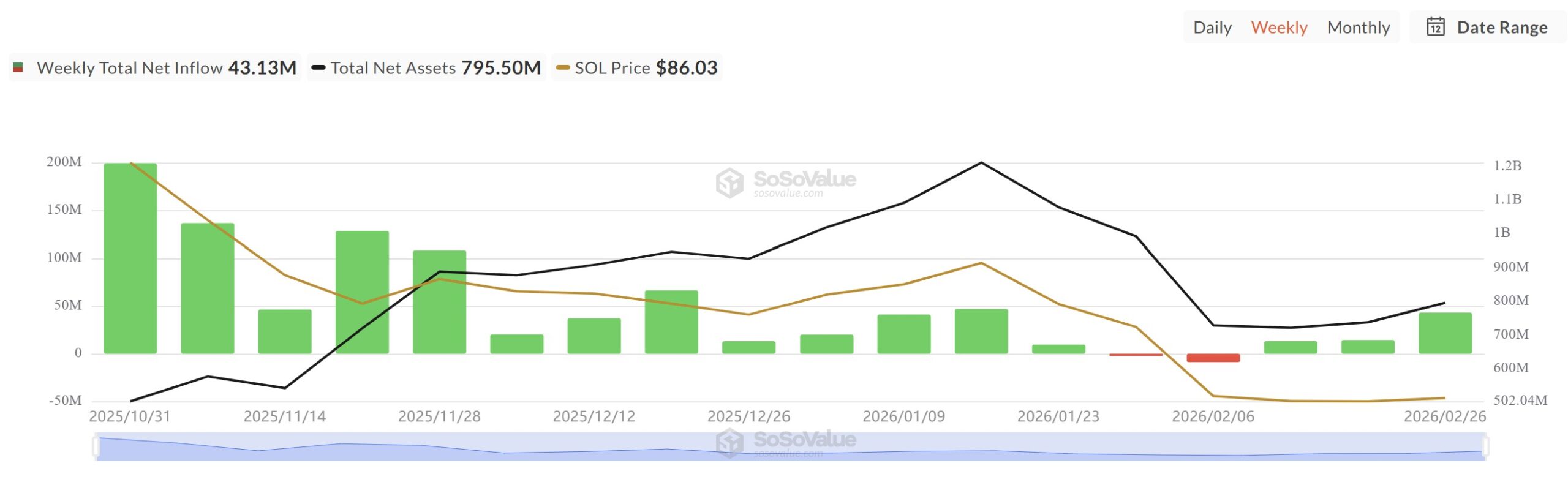
Total accumulated outflows throughout the four-month price correction measure merely $11.3 million across a two-week span. Comparatively, Bitcoin and Ethereum ETF products documented four consecutive months of net negative flows during this identical timeframe.
Solana is presently trading substantially beneath the $188 valuation observed during its ETF product introduction.
Key Support Levels to Watch
Market analyst Ali Martinez has identified a Parallel Channel formation developing on SOL’s weekly timeframe chart. This technical pattern suggests potential support zones positioned at $50.22, $22.47, and $9.98.
Analyst Crypto Scient has pinpointed two supplementary areas of interest. The initial zone corresponds to the 0.75 Fibonacci retracement level spanning $60 to $70. The secondary area represents a weekly demand fair value gap situated between $22 and $29.
UTXO analytics from Glassnode indicate that over 6% of circulating SOL supply last transacted within the current valuation range. The subsequent significant supply concentration, exceeding 3%, exists between $20 and $30.
SOL continues trading beneath the weekly resistance threshold of $120. The $51 to $80 range on weekly charts has undergone testing and corresponds with the retracement zone under analyst scrutiny.
As of February 28, 2026, SOL maintained a $78 valuation as cryptocurrency markets absorbed developments from the Israel-Iran military engagement.
Key Takeaways
- Federal authorities ordered a complete halt to Anthropic’s AI technology across all government agencies, citing national security supply-chain concerns.
- Within hours of Anthropic’s dismissal, OpenAI secured a Pentagon agreement to integrate its AI systems into classified military infrastructure.
- The $200 million Pentagon arrangement with Anthropic fell apart when the company declined to permit its technology for autonomous weaponry or widespread domestic monitoring.
- While OpenAI claims its agreement contains identical usage limitations that Anthropic demanded, skeptics wonder if the company will maintain those boundaries.
- Anthropic plans legal action against the supply-chain risk classification, arguing the decision lacks legal foundation.
On Friday, the United States government severed its partnership with Anthropic and classified the AI firm as a supply-chain security threat. Shortly afterward, competing company OpenAI revealed a fresh agreement to integrate its artificial intelligence technology into the Pentagon’s secure networks.
President Donald Trump mandated that all federal departments cease operations with Anthropic’s technology effective immediately. Organizations currently utilizing the company’s Claude AI systems have six months to complete their migration to alternative solutions.
Defense Secretary Pete Hegseth declared via X that Anthropic represents a “Supply-Chain Risk to National Security.” This classification typically applies to entities from hostile nations such as China.
The decision carries implications beyond government contracts. Organizations partnering with the Pentagon may face requirements to demonstrate they’ve eliminated Claude from their operations entirely. Major corporations including Nvidia, Amazon, and Google count themselves among Anthropic’s investors and collaborators.
Anthropic had achieved a milestone as the initial AI laboratory to integrate its models within the Pentagon’s secure computing environment. The July agreement carried a potential value reaching $200 million.
Negotiations collapsed when Anthropic declined to ensure its artificial intelligence would remain accessible for all legally permissible military applications. The company established firm boundaries against autonomous weaponry and large-scale domestic monitoring programs.
Pentagon officials indicated Anthropic should rely on military adherence to existing legal frameworks. Anthropic CEO Dario Amodei stated Thursday that his organization “cannot in good conscience” accept such terms.
OpenAI Secures Pentagon Partnership
OpenAI CEO Sam Altman revealed the Pentagon arrangement late Friday through X. He indicated the contract incorporates identical restrictions regarding mass surveillance and autonomous weapons systems that Anthropic had sought.
Altman further stated OpenAI requested the administration extend comparable contract conditions to all artificial intelligence providers. Elon Musk’s xAI had previously received military authorization for deployment in classified environments.
OpenAI President Greg Brockman and his spouse contributed $25 million to a Trump-aligned political action committee during the previous year. They continue financial support for Trump’s artificial intelligence initiatives in forthcoming electoral contests.
Anthropic Prepares Legal Response
Anthropic expressed being “deeply saddened” by the classification and intends to pursue judicial remedies. The organization characterized the determination as “legally unsound” and warned it establishes a troubling precedent for American technology companies engaging in government negotiations.
The General Services Administration announced Anthropic’s removal from its catalog of approved products available to government entities.
Certain observers expressed criticism toward OpenAI’s actions. Democratic figure Christopher Hale announced on X his cancellation of ChatGPT membership in favor of switching to Claude Pro Max.
Anthropic emerged in 2021 when researchers departed OpenAI due to apprehensions about diminishing safety priorities. Both organizations have secured funding in the tens of billions recently and are evaluating potential public stock offerings.
The controversy also referenced a particular event. Following Claude’s deployment during a Venezuela operation in January, an Anthropic staff member contacted a Palantir associate seeking clarification on the technology’s application. Pentagon leadership interpreted this communication as inappropriate interference.
Anthropic maintained the conversation represented standard technical coordination between collaborative partners.
Crypto World
BTC Plunges Below $64K as US-Israel Military Action Against Iran Triggers Crypto Selloff
TLDR
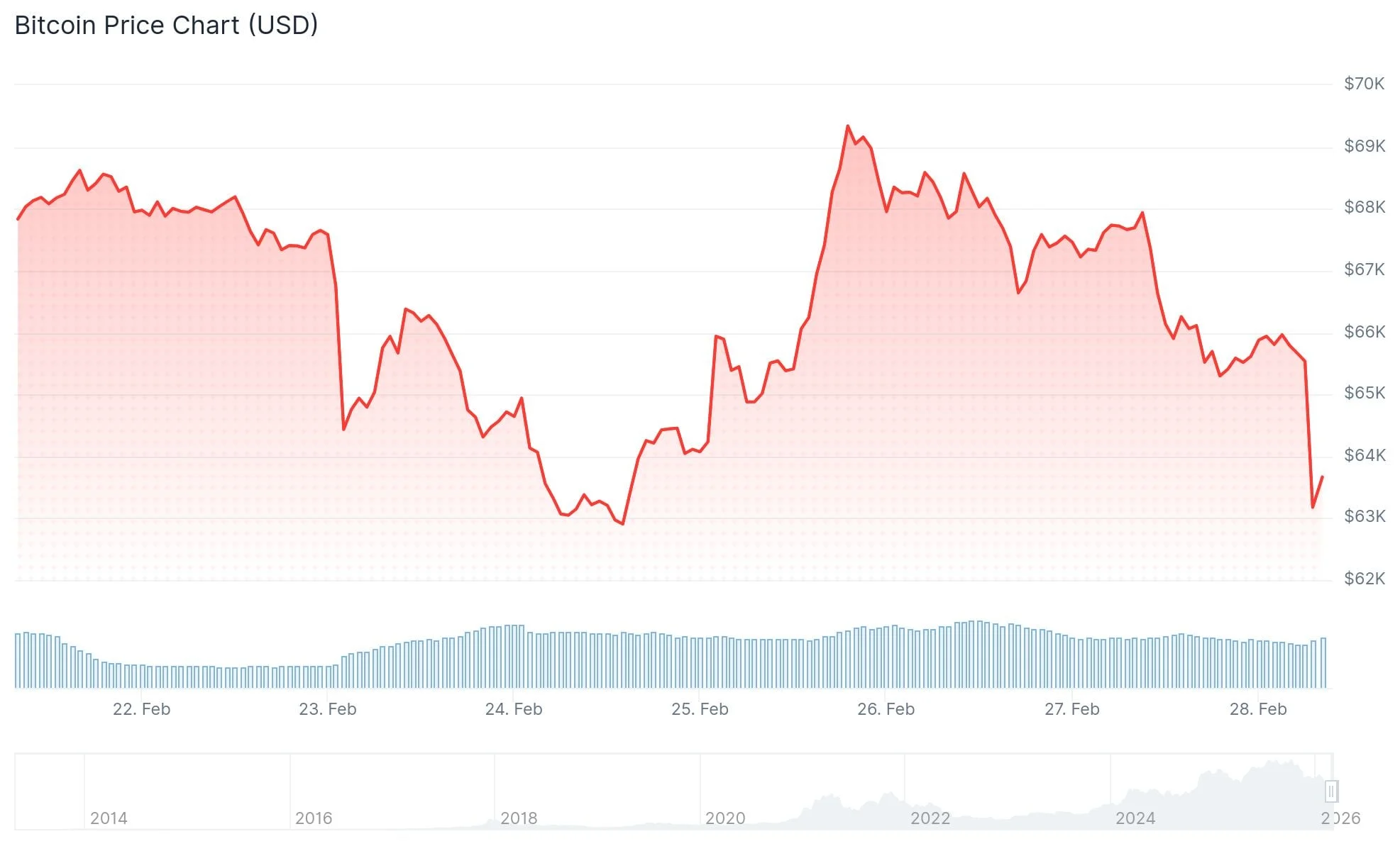
- BTC plummeted almost 5% toward $63,000 following coordinated US-Israeli military operations against Iranian targets
- The cryptocurrency reached its weakest level since the February 5 market crash when BTC momentarily fell under $60,000
- Israel’s Defense Minister Israel Katz announced a nationwide state of emergency throughout the country
- BTC’s continuous trading schedule positions it as an immediate outlet for risk aversion when traditional markets remain closed
- Market participants dumped bitcoin as it represented one of the only major liquid assets accessible during weekend hours
The world’s leading cryptocurrency experienced a dramatic decline on Saturday, February 28, 2026, plunging toward $63,000 following military strikes executed by the United States and Israel against Iran.
The digital asset shed nearly 5% of its value within mere minutes, representing a significant blow to the cryptocurrency market.
The selloff pushed bitcoin to levels not witnessed since February 5, when the digital currency momentarily traded beneath the $60,000 threshold.
Israeli Defense Minister Israel Katz announced a comprehensive state of emergency covering the entire nation immediately following the commencement of the military operations.
According to The Wall Street Journal, a U.S. official verified American involvement in the coordinated attacks.
Reuters reported that Israeli officials characterized the military action as a “preemptive strike,” citing statements from the nation’s defense leadership.
Why Bitcoin Sold Off First
Unlike traditional equity and bond markets that close for weekends, Bitcoin operates continuously without interruption, 24 hours daily, seven days weekly.
This constant availability positions it as among the few substantial, liquid assets accessible for traders to offload during heightened risk periods outside conventional market operating hours.
This behavior represents a recurring phenomenon. BTC frequently experiences rapid selloffs during geopolitical crises, often rebounding once conventional markets resume trading.
“Bitcoin just dropped off a cliff,” one market observer shared on X, further predicting that “Monday will be a bloodbath in the market.”
Geopolitical Context
The military operations arrive after several weeks of escalating U.S. military presence and unsuccessful nuclear discussions with Iranian leadership.
Market analysts had previously been examining potential implications of Iranian conflict for bitcoin, precious metals, and equity markets.
The military action heightens the possibility of expanded regional warfare in one of the globe’s most economically critical regions.
In recent months, bitcoin’s price movement has diverged from gold, challenging its narrative as a safe-haven or “digital gold” investment vehicle.
As of Saturday morning hours, bitcoin was changing hands near $63,000, with additional market volatility anticipated when conventional financial markets resume operations Monday.
Crypto World
Altcoins Bleed Out After Trump Confirms Attacks Against Iran, BTC Down to $63K: Weekend Watch
KCS, STABLE, and PIPPIN are today’s top losers after the latest attacks.
Bitcoin’s price moves took another turn for the worse in the past few hours after Israel attacked Iran, and then US President Trump confirmed his country was also involved.
Numerous altcoins have bled out heavily, while Binance Coin has taken advantage and surpassed XRP in terms of market cap.
BTC Dumps Again
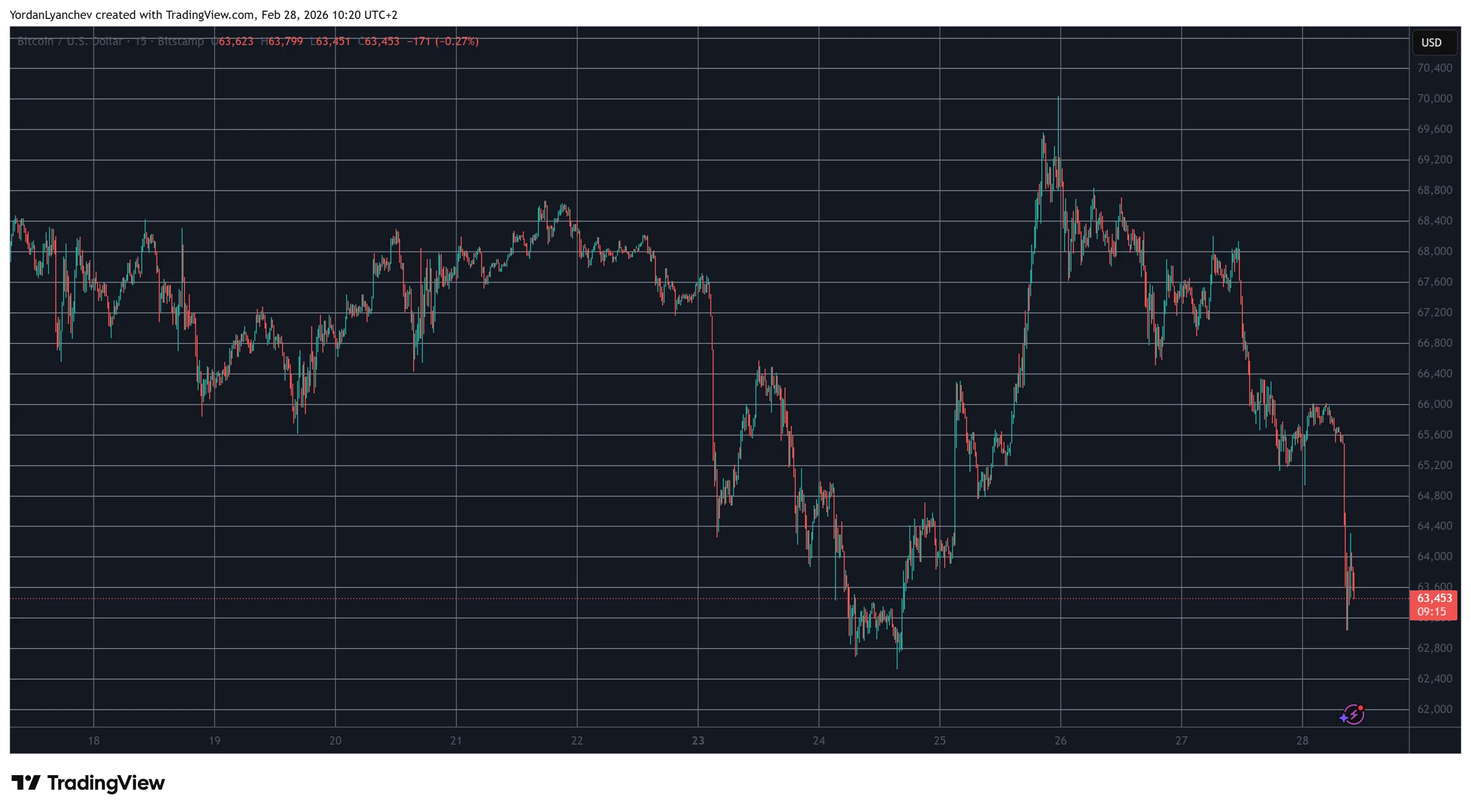
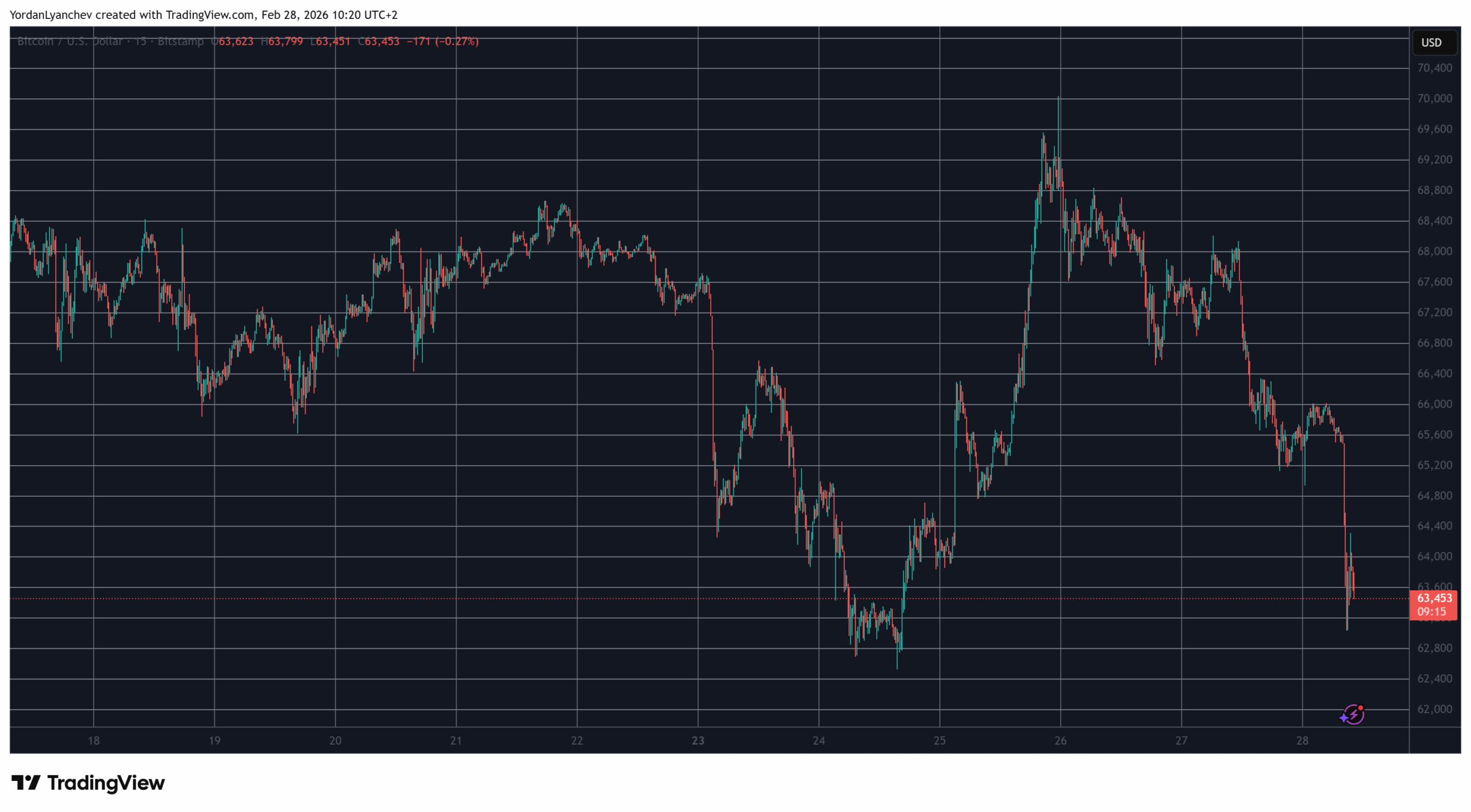
It was already a highly volatile trading week for the primary cryptocurrency as the bears seemed to be in full control by Tuesday. At the time, they pushed the asset south to a multi-week low of $62,500. However, bitcoin rebounded almost immediately and skyrocketed by several grand to $70,000 on Wednesday.
Many analysts speculated whether this was a typical dead-cat bounce, which turned out to be the case. At first, BTC slipped to around $68,000, where it spent most of Thursday and Friday. However, the situation worsened once again on Saturday morning when Israel launched a “preemptive” attack against Iran and issued a state of emergency.
In minutes, BTC plunged to under $62,800 before it recovered some ground to $63,400 as of press time. US President Donald Trump confirmed that the US was also involved in the attacks, and more volatility is expected later today as the situation unravels.
As of now, bitcoin’s market cap has slid to $1.275 trillion on CG, while its dominance over the alts is below 56%.
Alts Bleed
The graph below will show the painful reality in the altcoin space, in which almost all assets are deep in the red. ETH has plunged by $200 in the past few days to $1,850. XRP was surpassed by BNB after a 9% drop, while SOL has slumped by double digits to under $80.
ADA, HYPE, BCH, DOGE, CC, LINK, and XLM have plummeted hard as well. Declines of up to 20% are evident from KCS, PIPPIN, and STABLE, while stablecoins linked to gold are in the green.
The total crypto market cap has erased over $100 billion in the past day or so and is deep below $2.3 trillion on CG.

Binance Free $600 (CryptoPotato Exclusive): Use this link to register a new account and receive $600 exclusive welcome offer on Binance (full details).
LIMITED OFFER for CryptoPotato readers at Bybit: Use this link to register and open a $500 FREE position on any coin!
Disclaimer: Information found on CryptoPotato is those of writers quoted. It does not represent the opinions of CryptoPotato on whether to buy, sell, or hold any investments. You are advised to conduct your own research before making any investment decisions. Use provided information at your own risk. See Disclaimer for more information.
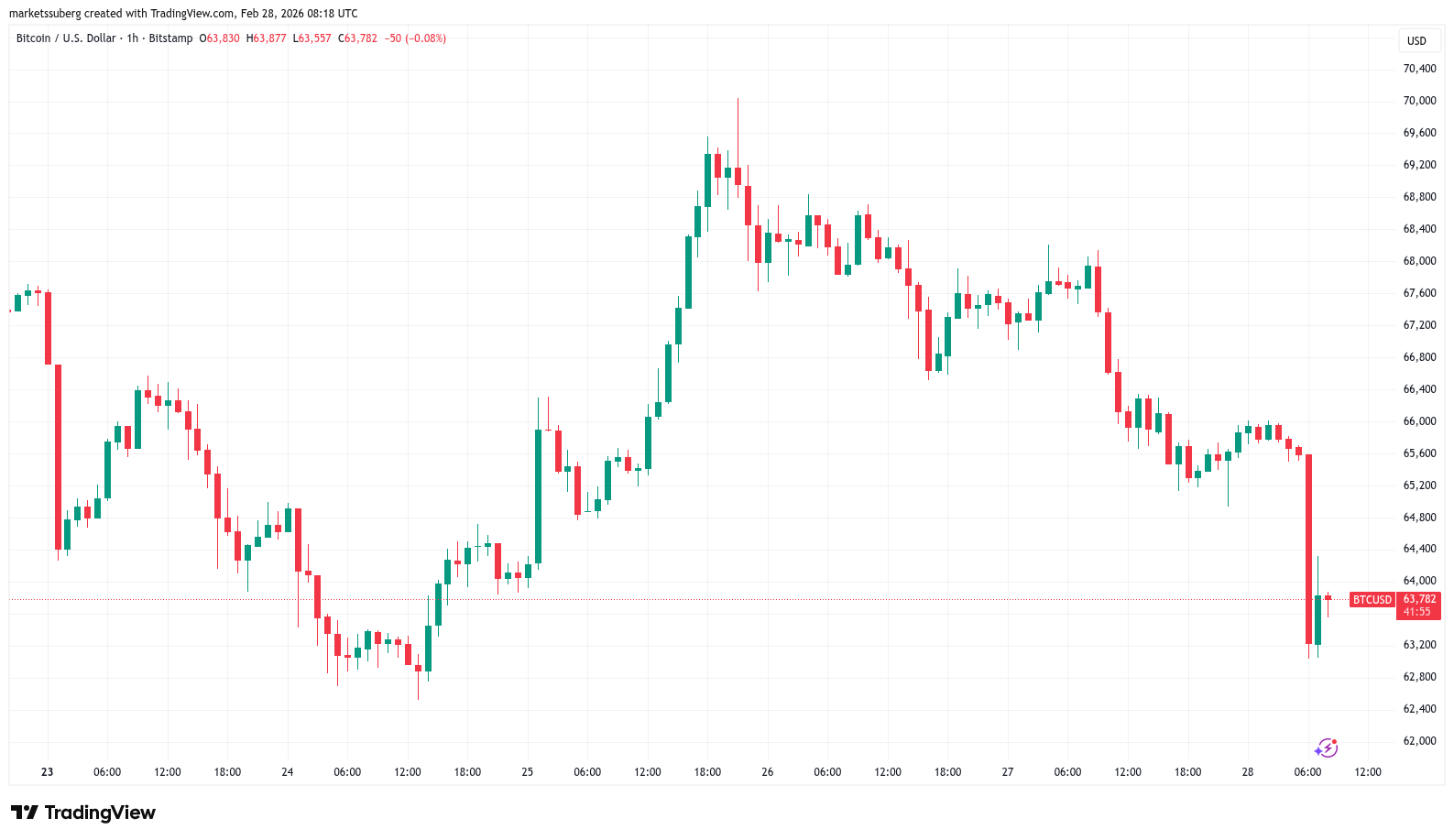
Bitcoin faced geopolitical instability alone as a weekend move on Iran saw traditional markets closed, with key support still holding.
Bitcoin (BTC) daily losses neared 4% on Saturday as the US and Israel announced a military operation in Iran.
Key points:
-
Bitcoin targets $63,000 as US President Donald Trump confirms a major bombing campaign inside Iran.
-
Trump highlights nuclear infrastructure as a key target of the joint raids with Israel.
-
Crypto markets react alone with TradFi trading suspended until futures return.
Trump tells Iranians: “Take over your government”
Data from TradingView showed BTC price action testing $63,000 as crypto markets reacted to the weekend’s events.

In a video address, US President Donald Trump said that the goal of the move was to target Iran’s nuclear infrastructure, but finished by calling on Iranians to take control of the incumbent government.
“When we are finished, take over your government; it will be yours to take,” he said.
“This will be, probably, your only chance for generations. For many years, you have asked for America’s help, but you never got it.”
With US stock market futures yet to open, crypto was alone in deciding on how to react to fresh geopolitical instability.
Data from CoinGlass showed liquidations passing $250 million in the four hours to the time of writing.

“The US and Israel now appear to be at war with Iran for the second time in 8 months,” trading resource The Kobeissi Letter wrote in a response on X.
Kobeissi referenced a previous Iran offensive in 2025 — an event that sparked an immediate, volatile reaction across crypto and risk assets.
Bitcoin reacts to familiar cues
With core support levels still holding for BTC/USD, the fresh escalation comes at a key time for traders as the final hours tick down to the February monthly close.
Related: Price predictions 2/27: BTC, ETH, XRP, BNB, SOL, DOGE, BCH, ADA, HYPE, LINK
As Cointelegraph reported, the pair is now down roughly as much as in February 2025, and due to seal its fifth consecutive month of losses — something not encountered in seven years.
Hot US inflation data added another headwind for Bitcoin bulls on Friday, after they tried and failed to reclaim key support levels closer to $70,000.
This article does not contain investment advice or recommendations. Every investment and trading move involves risk, and readers should conduct their own research when making a decision. While we strive to provide accurate and timely information, Cointelegraph does not guarantee the accuracy, completeness, or reliability of any information in this article. This article may contain forward-looking statements that are subject to risks and uncertainties. Cointelegraph will not be liable for any loss or damage arising from your reliance on this information.
Quick Summary
- On February 28, 2026, Israel executed a coordinated “pre-emptive strike” against Iran alongside US forces
- President Trump announced “major combat operations” were active in Iranian territory
- Iranian authorities shut down national airspace and vowed “crushing” retaliation
- Supreme Leader Khamenei was evacuated from Tehran to an undisclosed secure facility
- Washington simultaneously added Iran to its “state sponsor of wrongful detention” list
On February 28, 2026, Israel executed a coordinated pre-emptive military operation against Iranian targets. A senior Israeli defence official speaking to Reuters confirmed the attack was synchronized with United States forces.
President Donald Trump publicly acknowledged American involvement, stating the United States had initiated “major combat operations” on Iranian soil. CNN’s reporting indicated the strikes concentrated on Iranian military installations.
According to the Israeli defence official, operational planning extended across several months. The specific execution date was finalized weeks before the actual strikes commenced.
Israeli Defence Minister Israel Katz made the official strike announcement while simultaneously implementing emergency protocols throughout Israel. Officials cited expectations of Iranian counter-strikes as justification for the emergency measures.
Around 08:15 local time, warning sirens activated throughout Israeli territory. Citizens received emergency mobile notifications characterizing the situation as an “extremely serious” security threat.
Journalists from AFP stationed in Tehran documented two powerful explosions. Dense smoke columns rose from central and eastern sections of Iran’s capital city.
According to Iran’s Fars news agency, the “type of explosions suggests a missile attack.” Iranian officials have not yet released comprehensive damage assessments.
Following the explosions, Iranian aviation authorities ordered a complete national airspace shutdown. The Civil Aviation Organisation issued the closure directive “until further notice.”
Tehran’s Reaction and Command Structure
A senior Iranian official informed Reuters that Tehran is organizing a “crushing” counter-offensive. Supreme Leader Ayatollah Ali Khamenei was transported from Tehran to a protected location outside the capital.
These military actions occurred approximately eight months after a 12-day aerial conflict between Israeli and Iranian forces in June 2025. Both Washington and Jerusalem had issued multiple warnings about potential strikes should Iran persist with its nuclear enrichment and ballistic missile development.
Washington’s Detention Designation
Coinciding with the military strikes, the United States formally classified Iran as a “state sponsor of wrongful detention.” Iran became the inaugural nation added to this sanctions list, established through a Trump executive order issued in September 2025.
Secretary of State Marco Rubio publicly demanded Iran release all detained American citizens. He indicated future possibilities include invalidating US passport travel authorization to Iran.
Trump additionally declared his objective of eliminating all uranium enrichment activities in Iran, including civilian nuclear programs. This statement followed indirect diplomatic discussions between US and Iranian representatives in Geneva, where both delegations reported constructive progress.
Oman’s Foreign Minister revealed that Iranian negotiators committed during Geneva talks to permanently cease enriched uranium stockpiling. He characterized this commitment as a significant diplomatic achievement with potential to avert broader conflict.
On Friday, Trump stated he hadn’t reached a “final decision” regarding military action. By Saturday morning, operations had commenced.

Morgan Stanley has taken another step deeper into digital assets, filing for a new national trust bank charter that would allow the firm to custody cryptocurrencies and carry out related services for clients in the United States.
Key Takeaways:
- Morgan Stanley applied for a national trust charter to custody crypto and provide trading and staking services.
- The move is part of a broader institutional push for regulated digital asset infrastructure.
- Approval would let the bank hold client crypto directly as it expands ETFs and wealth management offerings.
A public filing with the Office of the Comptroller of the Currency shows the application, submitted Feb. 18, is under the name Morgan Stanley Digital Trust, National Association.
The move would establish a newly created banking entity rather than an acquired institution.
Morgan Stanley Subsidiary to Offer Crypto Custody, Trading and Staking Services
According to reports from Bloomberg and Forbes, the subsidiary would provide custody for selected digital assets and support investment activity through purchases, sales, swaps and transfers.
The filing also outlines plans to offer staking services, an increasingly common feature among institutional crypto platforms.
A national trust charter permits fiduciary operations such as asset safekeeping, custody and trust services. “De novo” status indicates the bank is being formed from scratch.
If approved, it would mark Morgan Stanley’s first trust charter dedicated specifically to crypto.
The application comes amid a broader push by financial institutions to secure federal oversight for digital asset operations.
— Mark (@markchadwickx) February 28, 2026
 BREAKING: This is MASSIVE news for Alts…
Morgan Stanley is going all-in on Crypto – and they like $XRP over Bitcoin.
Morgan Stanley just applied for a national trust bank charter to custody Bitcoin and crypto assets.
This is a Wall Street giant applying to custody crypto… pic.twitter.com/vKjmMGu7oD
More recently, payments firms and trading platforms, among them Stripe-owned Bridge and Crypto.com, have also pursued similar approvals.
The race reflects growing demand from institutional clients seeking regulated custody and trading infrastructure following years of market volatility and high-profile exchange failures.
Morgan Stanley has been steadily expanding its presence in the sector. In January, the bank appointed equity markets executive Amy Oldenburg to lead a newly formed digital asset division.
Job postings indicate the firm is hiring additional specialists across strategy and product roles tied to crypto services.
The investment bank has also filed to launch spot Bitcoin and Solana exchange-traded funds, followed by a proposed staked Ether ETF.
Together, the filings suggest a wider strategy aimed at integrating digital assets into traditional wealth management offerings.
If regulators approve the charter, Morgan Stanley would be able to directly safeguard client holdings instead of relying on third-party custodians, potentially positioning the firm as a full-service provider for institutional crypto investors.
OCC Grants Trust Bank Charters to Major Crypto Firms
The OCC approved national trust bank charters in December for a slate of crypto and digital asset firms, including BitGo, Fidelity Digital Assets, Circle, Ripple and Paxos, widening the on ramp for tokenized finance.
Trust banks sit in a narrower lane than full-service banks, since they generally cannot take deposits or make loans.
Even so, the model can still open doors for stablecoin issuers that want to custody assets and run conversion and settlement services without relying entirely on third-party providers.
Earlier this year, World Liberty Financial also filed for a US national banking charter as stablecoins shift from a trading tool into payment infrastructure.
The post Morgan Stanley Applies for National Trust Charter to Hold Clients’ Crypto appeared first on Cryptonews.
Report: Vikings Eyeing QB Trade
These 5 US Airlines Are Most Likely To Have Regular Flight Delays

Finance Minister is serious on this….#propertyinsurance #homeloaninsurance

Smart energy pays enters the US market, targeting scalable financial infrastructure

Why Israel is blocking foreign journalists from entering

Bitcoin: We’re Entering The Most Dangerous Phase
Finance Minister is serious on this….#propertyinsurance #homeloaninsurance

Crypto Trading for Beginners 2026 | Crypto Trading Kaise Kare | Crypto Trading Strategy

Tamannaah Bhatia Credits Father For Financial Success And Diversified Investment Portfolio
-

 Politics6 days ago
Baftas 2026: Awards Nominations, Presenters And Performers
-

 Sports5 days ago
Women’s college basketball rankings: Iowa reenters top 10, Auriemma makes history
-

 Fashion14 hours ago
Weekend Open Thread: Iris Top
-

 Politics5 days ago
Nick Reiner Enters Plea In Deaths Of Parents Rob And Michele
-

 Business4 days ago
True Citrus debuts functional drink mix collection
-

 Politics1 day ago
ITV enters Gaza with IDF amid ongoing genocide
-

 Crypto World4 days ago
XRP price enters “dead zone” as Binance leverage hits lows
-
Sports5 hours ago
The Vikings Need a Duck
-

 Business6 days ago
Mattel’s American Girl brand turns 40, dolls enter a new era
-

 Business6 days ago
Law enforcement kills armed man seeking to enter Trump’s Mar-a-Lago resort, officials say
-

 Tech4 days ago
Unsurprisingly, Apple's board gets what it wants in 2026 shareholder meeting
-
 NewsBeat2 days ago
Manchester Central Mosque issues statement as it imposes new measures ‘with immediate effect’ after armed men enter
-

 NewsBeat2 days ago
Cuba says its forces have killed four on US-registered speedboat | World News
-
 NewsBeat5 days ago
‘Hourly’ method from gastroenterologist ‘helps reduce air travel bloating’
-

 Tech6 days ago
Anthropic-Backed Group Enters NY-12 AI PAC Fight
-

 NewsBeat6 days ago
Armed man killed after entering secure perimeter of Mar-a-Lago, Secret Service says
-

 Politics6 days ago
Maine has a long track record of electing moderates. Enter Graham Platner.
-

 Business2 days ago
Discord Pushes Implementation of Global Age Checks to Second Half of 2026
-
 NewsBeat3 days ago
Police latest as search for missing woman enters day nine
-

 Business2 days ago
Only 4% of women globally reside in countries that offer almost complete legal equality