

Crypto World
Can a 90-Year-Old Brand Compete With Crypto-Native Gambling?


The gambling industry respects history. A brand that has survived decades of regulation changes, technological shifts, and market upheaval earns a certain kind of credibility that cannot be bought or manufactured. William Hill has that credibility in abundance. But 2026 is testing whether credibility alone is enough when a new generation of platforms is rewriting the rules around game selection, payment speed, and player rewards. ZunaBet represents that new generation, and putting it alongside William Hill highlights just how much distance has opened up between the traditional model and what comes after it.

William Hill: Heritage as a Foundation
William Hill has been part of the gambling landscape since 1934. What started as a UK bookmaking operation has grown into a global brand with an online presence spanning multiple markets. The acquisition by Caesars Entertainment in 2021 reshaped parts of the business, particularly in the United States where it now operates under the Caesars Sportsbook name in several states. In the UK and other international markets, the William Hill name endures as one of the most recognized in the industry.
The sportsbook reflects that long history. Horse racing coverage runs deep, a natural strength for a brand with British bookmaking roots. Football, tennis, basketball, cricket, rugby, golf, and numerous secondary sports are all available with respectable market depth. Live in-play betting keeps pace with modern expectations, offering updated odds across major events. The sports betting product is mature and well-constructed, built through decades of refinement rather than a single launch cycle.
The online casino sits alongside the sportsbook with a modest but functional game library. Slots, table games, and live dealer options from established providers cover the standard categories. Total game counts vary by market but generally land in the range of several hundred to a couple of thousand. It is a competent casino that meets basic expectations without pushing boundaries on scale or variety.
William Hill handles payments through familiar traditional methods. Debit cards, bank transfers, PayPal, Skrill, Neteller, and other conventional options are available depending on the market. Withdrawals follow standard banking timelines — faster for e-wallets, slower for bank-based methods, and occasionally complicated by cross-border processing for international users. It is the same infrastructure the industry has relied on for years.
Loyalty at William Hill depends on the market. UK players have historically had access to the William Hill Plus Card and various promotional offers. Free bets, enhanced odds, and occasional bonuses make up the reward structure. The approach is promotion-driven rather than tier-based, meaning what a player receives back fluctuates with whatever campaigns happen to be live at any given time.
ZunaBet: No Legacy, No Limitations
ZunaBet arrived in 2026 under Strathvale Group Ltd with an Anjouan gaming license and a team that collectively brings more than 20 years of gambling industry experience. That experience informed the build, but it did not constrain it. Instead of iterating on traditional platforms, the team constructed ZunaBet around cryptocurrency as its core operating layer. The result is a platform that shares very little DNA with legacy operators.
Game selection tells the story fastest. ZunaBet carries 11,294 titles across 63 providers. Pragmatic Play, Evolution, Hacksaw Gaming, Yggdrasil, and BGaming anchor the top of the list, while dozens of additional studios push the variety well beyond what most players encounter on any single platform. Slots dominate the numbers, but live dealer rooms and RNG table games receive enough attention that casino players of all preferences find genuine depth. Stacking this catalog against what most traditional operators offer reveals a gap measured not in percentages but in multiples.

The sportsbook was designed as a full product from the outset. Football, basketball, tennis, hockey, and other mainstream sports get thorough coverage. Esports betting runs as a built-in category rather than a supplementary afterthought, with dedicated markets on CS2, Dota 2, League of Legends, and Valorant. Virtual sports and combat sports complete an offering that serves both traditional bettors and a younger audience whose sporting interests extend well into the digital arena.
Payments are crypto only. Over 20 coins are accepted — BTC, ETH, USDT on multiple chains, SOL, DOGE, ADA, XRP, and others. ZunaBet takes no processing fees. Withdrawals happen through the blockchain without bank interaction, without variable timelines, and without the geographic inconsistencies that plague traditional payment setups. A player anywhere in the world gets the same fast, fee-free experience.
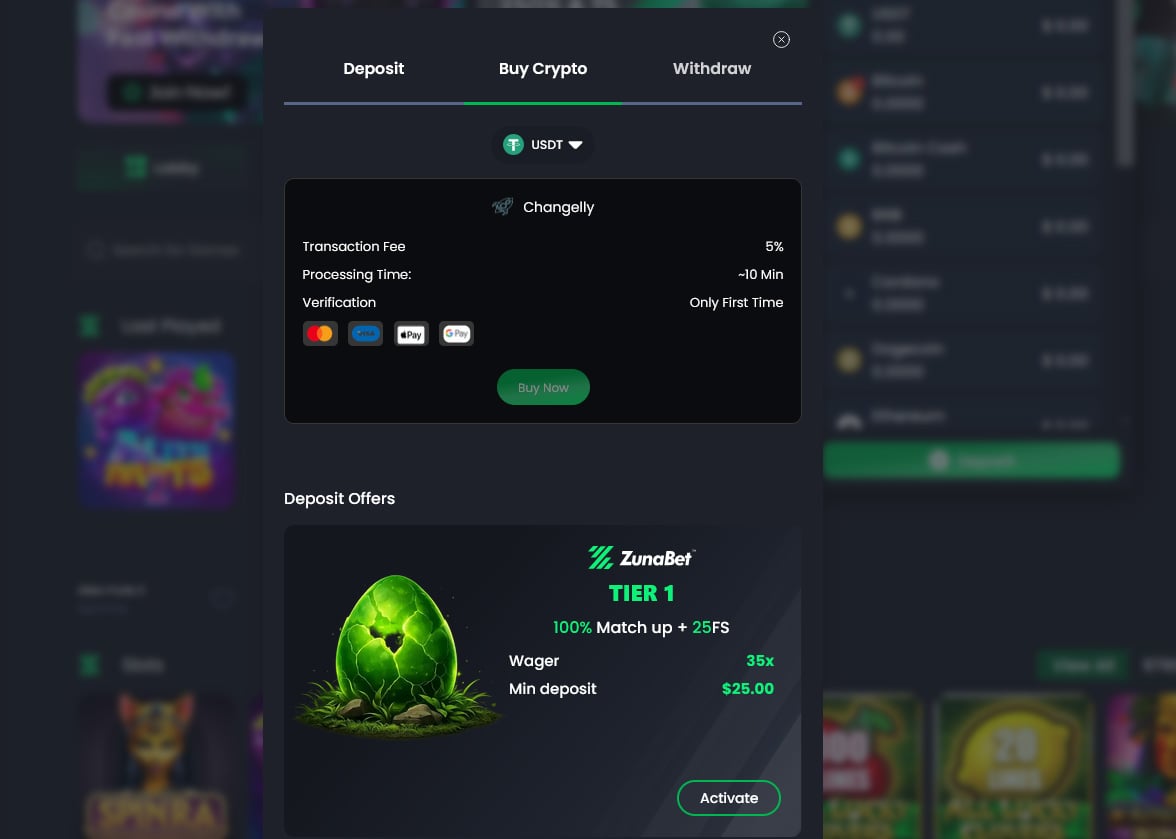
New players receive up to $5,000 plus 75 free spins through a welcome offer split across three deposits. The first deposit earns 100% up to $2,000 and 25 spins. The second earns 50% up to $1,500 and 25 spins. The third earns 100% up to $1,500 and 25 spins. Distributing the bonus across three stages keeps the platform rewarding players well into their early weeks rather than front-loading everything into a single moment.
Native apps cover iOS, Android, Windows, and MacOS. A dark-themed responsive design delivers fast load times across devices, and live chat support stays available 24/7.
What Loyalty Actually Looks Like on Each Platform
Strip the branding away and loyalty comes down to a simple question — what does your regular play actually earn you? William Hill and ZunaBet give very different answers.
William Hill distributes value through periodic promotions. A free bet might appear before a major horse racing event. Enhanced odds might run during a football derby weekend. A deposit match could surface around a quiet midweek period. These offers have value when they show up, but they arrive on the platform’s schedule and vary based on which market you are in. Players cannot look at their activity from the past month and calculate a precise return because no fixed system exists to deliver one.
ZunaBet removes the guesswork entirely. Its dragon evolution loyalty program tracks players across six tiers — Squire at 1% rakeback, Warden at 2%, Champion at 4%, Divine at 5%, Knight at 10%, and Ultimate at 20%. A dragon mascot called Zuno evolves as players move up. Upper tiers unlock extras like up to 1,000 free spins, VIP club access, and double wheel spins.
The rakeback model gives regular players something promotional systems cannot — consistency. Every session, every wager, every week generates a return at a known rate. A player sitting at 15% or 20% rakeback does not need to check a promotions page to know what they are earning. That predictability compounds into serious value over time, and it is one of the main reasons players who try rakeback-based systems rarely want to go back to traditional promotional models.
Getting Paid: Days vs Minutes
Every online gambler has a withdrawal story. Waiting days for funds to clear, wondering whether verification is holding things up, checking bank balances repeatedly. This is the reality of traditional payment infrastructure, and William Hill operates within it just like every other legacy operator. E-wallets offer some relief with faster processing, but card and bank withdrawals still land in the one-to-five business day range. International players may face additional friction through currency conversion and cross-border processing fees.

ZunaBet does not participate in any of that. Withdrawals go out on-chain. No banks are involved. No business day schedules apply. No platform fees are charged. Whether you cash out on a Monday morning or a Saturday night, the process is the same. Whether you are in Nairobi or New York, the speed is the same. Crypto infrastructure does not differentiate between geographies or time zones, which gives ZunaBet a payment experience that is structurally faster and simpler than anything built on traditional rails.
Once a player gets used to instant crypto withdrawals with zero fees, the idea of waiting three to five business days for a bank transfer feels like a relic of a different era. That shift in expectation is happening across the international gambling market in real time.
Where History Meets the Future
William Hill has survived world wars, regulatory overhauls, the transition from retail to digital, and a corporate acquisition. That resilience deserves respect. The brand carries weight, the sportsbook remains competitive, and the trust built over nine decades has genuine value for players who prioritize tradition and established regulatory standing.
But the market William Hill operates in looks very different in 2026 than it did even five years ago. Players who have grown up with crypto wallets see no reason to wait days for a withdrawal. Players accustomed to streaming libraries with thousands of options expect the same scale from their casino. Players who understand percentages prefer knowing their exact rakeback rate over hoping a useful promotion appears at the right time.
ZunaBet was built for exactly these players. Over 11,000 games from 63 providers. Rakeback scaling to 20% through a transparent tier system. A sportsbook that treats esports with the same respect as traditional markets. Crypto payments that work identically for every player on earth without fees or delays. It is a platform that was not designed to compete with history — it was designed to make the case for what happens next.
William Hill wrote important chapters in the story of gambling. ZunaBet is writing the next one. For players choosing between heritage and momentum in 2026, that distinction is becoming the deciding factor.
Disclaimer: This is a Press Release provided by a third party who is responsible for the content. Please conduct your own research before taking any action based on the content.


A US trade group made up of some of the country’s biggest banks is reportedly considering suing the Office of the Comptroller of the Currency (OCC), arguing that granting crypto firms bank charters could put Americans and the financial system at risk.
According to a report on Monday by The Guardian, citing a “source familiar with the lobby’s thinking,” the Bank Policy Institute (BPI) is weighing legal options after the OCC failed to heed warnings from banking groups over its reinterpretation of federal licensing rules.
In December, the OCC granted conditional national trust bank charter approvals to several crypto firms, including BitGo, Fidelity Digital Assets, Ripple and Paxos. A growing number of other crypto companies have followed suit since.
Blockchain infrastructure firm Zerohash submitted an application on Feb. 27. The OCC also issued conditional licenses to Crypto.com, Bridge, and Stripe in February.
The Trump-backed World Liberty Financial also applied for a charter in January to expand the use of its USD1 stablecoin, but is still waiting for a decision.
BPI, which counts major US institutions such as Goldman Sachs, American Express, and JPMorgan among its members, is also concerned that crypto firms with national trust bank charters pose risks to the wider financial system.

A national trust bank charter is a federal license from the OCC that permits a company to operate as a trust bank under federal law and engage in fiduciary activities such as trust services, custody and asset safekeeping.
Banking group hasn’t made the final call yet
According to The Guardian, the BPI has not yet made a final decision on whether to pursue legal action against the OCC. Cointelegraph contacted the Bank Policy Institute for comment.
Related: Bankers push OCC to slow crypto trust charters until GENIUS rules clarified
In October, the BPI released a statement urging the OCC to reject national trust company charter applications from a group of crypto firms, including Ripple and Circle. The BPI argued that granting these charters would result in less oversight than is required for full-service national banks.
The BPI was also among a group of banks and business associations that filed a lawsuit against the Federal Reserve in late 2024 over its stress-testing framework for assessing the health and resilience of the banking sector. The Fed has since agreed to reconsider parts of the framework and the case has been paused.
Magazine: China’s ‘50x’ blockchain boost, Alibaba-linked AI mines Bitcoin: Asia Express
TLDR
- Bitcoin ETF products recorded $1.44 billion in inflows during the first three trading days of the week.
- Investors withdrew $829 million dollars before Friday, which reduced the net weekly total to 619 million dollars.
- Bitcoin attracted $521 million in inflows and led all digital asset funds.
- Ethereum and Solana funds posted gains, while XRP recorded outflows during the same period.
- Bitcoin price rose nearly 11 percent early in the week and later declined about 8%.
Bitcoin exchange-traded funds closed the week with $619 million in net inflows after sharp reversals. Early subscriptions reached $1.44 billion before late withdrawals erased momentum. Oil price volatility and geopolitical tension drove the rapid shift in positioning.
Bitcoin ETF Records $619M net Inflow After Volatile Week
Bitcoin ETF products attracted $1.44 billion during the first three trading days. However, investors withdrew $829 million before Friday and reduced the weekly total. CoinShares reported that Bitcoin led inflows with $521 million during the period.
Bitcoin prices moved in line with fund activity and reflected changing risk appetite. The asset rose nearly 11% from $66,356 to $73,648 between March 1 and 5, according to CoinGecko. It later fell about 8% and traded near $67,777 after Thursday.
Ethereum funds captured fresh capital as investors diversified exposure within digital assets. Solana products also recorded inflows during the early part of the week. In contrast, XRP funds posted outflows while other major assets gained subscriptions.
CoinShares stated that US-based investors drove most of the weekly activity. European and Asian investors showed lower participation during the same period. The report linked early inflows to market reaction following the US strike on Iran.
Nima Beni, founder of Bitlease, described the pattern as routine portfolio management. He said, “Portfolio managers often put on positions early in the week, capture the move, and then trim risk.” He added that the behavior reflects standard capital markets practice.
Oil Surge Pressures Crypto Markets and Trims ETF Demand
Oil prices surged to $119 per barrel after the US attack on Iran. Prices later retreated and stabilized near $102 per barrel by week’s end. Crude had traded near $74 only weeks earlier before the spike.
Market participants reacted as energy costs fed inflation expectations and rate concerns. Higher oil prices weighed on risk assets, including cryptocurrencies and related funds. Bitcoin traded in correlation with broader markets during the period.
Jonatan Randin, senior market analyst at PrimeXBT, cited geopolitical escalation as a driver of outflows. He pointed to activity around the Strait of Hormuz as a source of tension. Iranian officials confirmed developments near the key oil transit route.
About 20% of the global oil supply passes through the Strait of Hormuz. Any disruption to shipping can impact energy markets and investor positioning. Oil remained near $102 at the close of the reporting period.
Bitcoin ETF products, therefore, ended the week with $619 million in net inflows. The data reflects combined subscriptions and withdrawals recorded through Friday. CoinShares published the figures in its latest weekly report.

TLDR
- Strategy purchased 17,994 Bitcoin for $1.28 billion at an average price of $70,946 per coin.
- The company increased its total holdings to 738,731 BTC at a total cost of $56.04 billion.
- Strategy funded the acquisition through $900 million in common stock sales and $377 million in preferred stock sales.
- The latest purchase marked its largest Bitcoin acquisition since January.
- Strategy’s holdings now represent about 3.7 percent of Bitcoin’s circulating supply.
Michael Saylor’s Strategy expanded its Bitcoin reserves with a $1.28 billion purchase last week. The company acquired 17,994 BTC at an average price of $70,946 per coin. As a result, total holdings reached 738,731 BTC as Bitcoin traded below $68,000.
Strategy Increases Bitcoin Holdings With $1.28 Billion Acquisition
Strategy confirmed the purchase in a filing with the US Securities and Exchange Commission on Monday. The company bought 17,994 Bitcoin for $1.28 billion during the reporting period. It paid an average price of $70,946 per coin, according to the filing.
The purchase pushed total holdings to 738,731 BTC at an aggregate cost of $56.04 billion. Strategy reported an overall average acquisition price of $75,862 per Bitcoin. The latest buy came in below that average cost basis.
Strategy funded most of the acquisition through equity sales during the week. The company raised $900 million from common stock sales to support the purchase. It also secured $377 million from sales of its STRC preferred stock series.
The company stated that the purchase marked its largest Bitcoin acquisition since January. In January, Strategy acquired 22,305 BTC for $2.13 billion at $95,284 per coin. The latest transaction occurred while Bitcoin traded near $67,000 for much of the week.
Bitcoin Supply Dynamics and Market Data
Strategy completed five acquisitions during the current below-cost period since Feb. 9. The company bought 25,229 BTC across those transactions during this timeframe. Its average cost basis declined from $76,052 to $75,862 during that period.
During 2022 and 2023, Strategy executed seven smaller purchases in similar below-cost conditions. The company acquired 28,560 BTC across those earlier transactions. This latest purchase exceeded the pace of its prior buying activity.
Market data shows that miners produce about 450 BTC per day. That output equals roughly 3,150 BTC entering circulation each week. Strategy’s purchase equaled nearly five weeks of newly mined Bitcoin supply.
Strategy’s holdings now represent about 3.7% of Bitcoin’s circulating supply. Circulating supply is expected to reach 20 million coins on Monday. At publication, Bitcoin traded at $67,725, up 2.4% over seven days.
Strategy shares rose 0.2% in pre-market trading following the disclosure. Over the past week, MSTR shares gained 3.6% and closed at $133.5 on Friday. The company disclosed the acquisition details in its Monday filing.
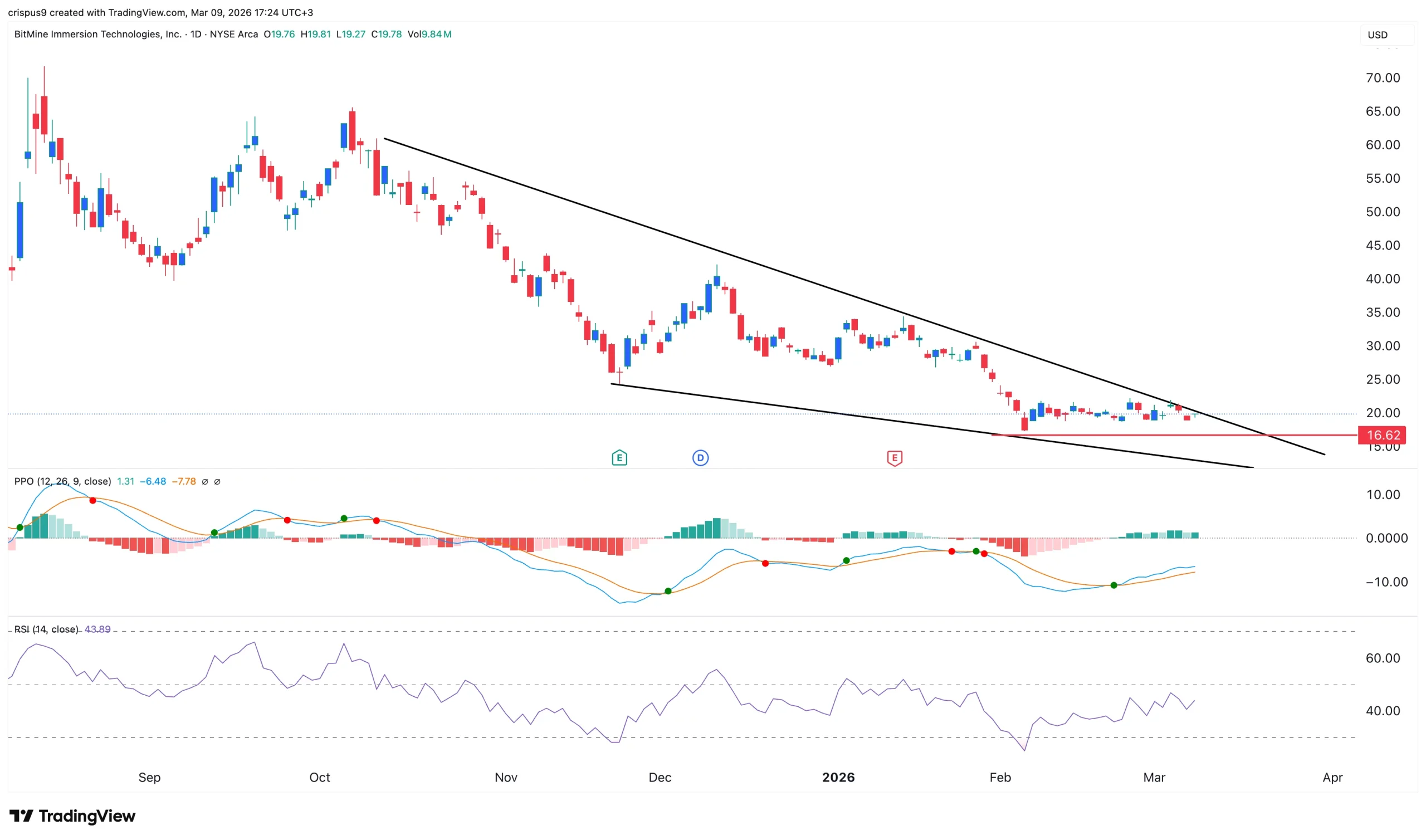
The BMNR stock price rose by over 4% on Monday and retested the important resistance level at $20 as Ethereum rebounded and the company continued accumulating.
Summary
- BitMine stock rose on Monday as the company continued buying Ethereum.
- It now holds over 4.5 million ETH tokens worth over $9 billion.
- The stock has formed a falling wedge pattern, pointing to an eventual rebound.
BitMine stock rose to $20, inside a range it has remained in the past few weeks. This price remains much lower than the all-time high of $150.
In a statement, the company said that it continued accumulating Ethereum (ETH) tokens last week, making it the biggest holder in the world. It now holds 4.534 million tokens, which is equivalent to 3.76% of Ethereum’s total supply. Its Ethereum holdings are now worth over $9 billion.
The company hopes to continue accumulating its Ethereum holdings in the coming months. Its goal is to become a 5% owner of Ethereum, a goal it may achieve later this year or in 2026. It has staked 67% of these holdings and generated over $174 million in annualized revenue.
BitMine also owns 195 Bitcoin (BTC), currently worth over $13 million, a $200 million investment in Beast Industries, and $1.2 billion in unencumbered cash.
The company will likely do well, especially when a crypto market rally starts, which is a possibility when the war in Iran ends, which may happen as soon as this month.
BMNR stock price technical analysis
The daily chart shows that the BitMine share price has remained in a narrow range in the past month. It was trading at $20 on Monday, up modestly from the year-to-date low of $16.60.
The stock is along the upper side of the falling wedge pattern, a common bullish reversal sign in technical analysis.
It has formed a bullish divergence pattern as the two lines of the Percentage Price Oscillator have made a bullish crossover and are pointing upwards.
The Relative Strength Index has also moved from the oversold level of 25 in February to the current 43.
Therefore, there is a possibility that the stock will have a strong bullish breakout, potentially to the next key resistance level at 30. The bullish outlook will become invalid if it drops below the year-to-date low of $16.
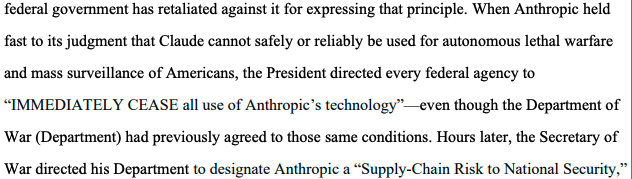
Anthropic, the creator of the AI software Claude, has sued the Trump administration for what it says is an “unlawful campaign of retaliation” after the company refused to allow the military unrestricted use of its technology.
Anthropic sued multiple government agencies and officials in a California federal court on Monday, asking the court to reverse the Department of Defense’s decision to label the company a “supply chain risk.”
It also seeks to overturn US President Donald Trump’s directive to federal employees to stop using Claude. Anthropic also filed suit in a Washington, D.C., appeals court to challenge the Defense Department’s decision.
“These actions are unprecedented and unlawful,” Anthropic argued. “The Constitution does not allow the government to wield its enormous power to punish a company for its protected speech.”
Claude “never tested” for uses wanted by Pentagon
Last month, Defense Secretary Pete Hegseth, who is named in the lawsuit, moved to label Anthropic as a supply chain risk, which was finalized on March 3, meaning any person or business doing business with the military can’t also deal with Anthropic.
It is the first time an American company has been designated a supply chain risk, a label usually reserved for companies tied to foreign adversaries.
The US government and the Pentagon have used Anthropic since 2024, and the company’s technology is the first AI to be deployed for use in classified work.
Anthropic said that Hegseth’s decision came after he demanded the company “discard its usage restrictions altogether,” but Anthropic maintained its technology shouldn’t be used for lethal autonomous warfare and mass surveillance of Americans, clauses that were always part of its government contracts.

“Anthropic has never tested Claude for those uses,” the company said in its lawsuit. “Anthropic currently does not have confidence, for example, that Claude would function reliably or safely if used to support lethal autonomous warfare.”
Related: US military used Anthropic in Iran strike despite ban order by Trump: WSJ
Anthropic’s lawsuit also named the US Treasury and its secretary, Scott Bessent, the State Department, and Secretary of State Marco Rubio, along with 17 other government agencies and officials.
A group of more than 30 AI engineers and scientists from OpenAI and Google, including the latter’s chief scientist, Jeff Dean, also filed a legal brief in support of Anthropic on Monday.
“If allowed to proceed, this effort to punish one of the leading U.S. AI companies will undoubtedly have consequences for the United States’ industrial and scientific competitiveness in the field of artificial intelligence and beyond,” the group wrote.
AI Eye: 9 weirdest AI stories from 2025

In decentralized finance (DeFi), the concept of collateral has long been tied to raw asset value—how much crypto a borrower locks up to secure a loan. But what if collateral could carry more than just value? What if it could also carry trust? Enter Collateral Reputation Tokens (CRTs), a groundbreaking innovation that introduces a “trust score” into the lending process, reshaping risk assessment in multi-chain finance.
What Are Collateral Reputation Tokens?
Collateral Reputation Tokens are digital assets that embed a reputation score derived from a borrower’s historical behavior across blockchain networks. Unlike traditional collateral, which is purely quantitative, CRTs incorporate qualitative insights about past loan performance, defaults, and repayment consistency. Essentially, each CRT carries a “trust rating” that lenders can use to evaluate a borrower’s reliability beyond simple asset ownership.
How CRTs Work
-
Historical Behavior Tracking: Borrowers’ repayment histories, defaults, and liquidation events are recorded and verified across chains. Advanced oracles and decentralized identity protocols consolidate this data into a unified score.
-
Score Encoding: This behavior is encoded into a CRT, which can then be used as collateral on lending platforms. The higher the score, the more trust the token represents.
-
Cross-Chain Compatibility: CRTs are designed to be interoperable, meaning a borrower’s reputation on one blockchain contributes to their trustworthiness on another. This creates a global credit profile in DeFi.
-
Dynamic Adjustment: Scores update in real time as new behavioral data emerges. Timely repayments increase trust, while defaults lower the CRT’s score, affecting its collateral value.
Advantages of Collateral Reputation Tokens
-
Reduced Over-Collateralization: Traditional DeFi loans often require 150–200% collateral. CRTs allow trusted borrowers to access loans with lower collateral ratios.
-
Incentivized Good Behavior: Borrowers have a tangible reason to maintain consistent repayment records, as their trust score directly affects borrowing power.
-
Enhanced Cross-Chain Lending: Lenders can make informed decisions even with borrowers from unfamiliar ecosystems. CRTs function as a portable credit reputation.
-
Efficient Capital Use: By quantifying trust, platforms can allocate liquidity more effectively, potentially reducing interest rates for high-reputation borrowers.
Challenges to Consider
-
Privacy Concerns: Aggregating behavioral data across chains raises questions about user privacy and the handling of sensitive financial information.
-
Score Manipulation: Ensuring CRTs accurately reflect trustworthiness requires robust, tamper-resistant oracles and decentralized identity verification systems.
-
Market Adoption: Lenders and borrowers must buy into the idea of reputation-weighted collateral, which may take time to gain mainstream traction.
The Future of DeFi Lending
Collateral Reputation Tokens represent a shift from purely asset-backed lending to trust-driven finance. By quantifying reliability and extending it across chains, CRTs could pave the way for more sophisticated credit markets in DeFi, where risk is measured not only in tokens but also in proven behavior.
In the evolving DeFi landscape, trust is becoming as valuable as capital—and CRTs might just be the first currency of credibility.
REQUEST AN ARTICLE

U.S. stocks and crypto slipped on Monday as Iran–Israel tensions, CPI sticky inflation and a weaker dollar rattled risk appetite and reinforced JPMorgan’s tactically bearish stance.
Summary
U.S. markets are being yanked back into macro reality as rising geopolitical risk, CPI and sticky inflation concerns and a weaker dollar collide with frothy risk assets. JPMorgan’s trading desk warned that an Iran war “could trigger the S&P 500 index to drop by as much as 10% from its peak,” adding that they are now “tactically bearish” on U.S. equities as oil climbs above $100 per barrel.
At the open, all three major U.S. equity benchmarks moved sharply lower, with the Dow Jones down 1%, the S&P 500 off 0.87% and the Nasdaq losing 0.86%, while large‑cap chip names such as Intel and AMD extended recent declines. Andrew Tyler, head of global market intelligence at JPMorgan, said positioning remains “overall neutral, lacking extreme de‑risking actions,” but argued that in a pullback scenario the S&P 500 could slide toward 6,270, roughly 7% below last Friday’s close. Other strategists echo that caution: “We are tactically cautious as we brace for what could be a prolonged period of heightened uncertainty,” JPMorgan’s team said in a recent note on the U.S.–Iran backdrop.
Inflation expectations are adding another layer of tension. Bank of America said in a client report that February’s CPI print is unlikely to change the Federal Reserve’s near‑term stance, projecting a 0.3% month‑on‑month rise in both headline and core CPI and “moderate growth in consumer prices” overall. That keeps rate‑cut optimism on a short leash and leaves equities more sensitive to growth scares and geopolitical shocks.
The U.S. dollar index DXY has briefly dropped more than 10 points in short order, sliding to around 99.25 as traders rotate into other havens and reassess the U.S. macro premium. In digital assets, bitcoin traded near $68,200, down about 4% over the last 24 hours, while ethereum changed hands around $3,040, lower by roughly 4% on the day. Solana was recently quoted near $85.50, shedding about 3.9% over the same period as liquidity thinned out across majors.

TLDR
- United Parcel Service shares declined approximately 4.9% on March 9, 2026, following an oil price surge beyond $100 per barrel
- Rival FedEx (FDX) experienced an even steeper decline, losing over 7% during the same trading session
- Last week, Jefferies upgraded its UPS price target to $135 from $130, suggesting potential upside of 38%
- Technical indicators show UPS’s RSI at 30.22, approaching oversold levels
- The company anticipates revenue recovery in 2026 following an approximate 3% contraction in 2025
Shares of United Parcel Service experienced significant downward pressure on Monday as escalating oil prices triggered widespread concern throughout the transportation industry. The stock declined approximately 4.9% to trade near $97.90 during midday Eastern Time.
United Parcel Service, Inc., UPS
Oil prices rocketed past the $100-per-barrel threshold during morning trade, fueled by intensifying geopolitical tensions in the Middle East. While crude retreated modestly from peak levels, prices stayed sufficiently elevated to maintain investor anxiety over fuel expenses.
FedEx (FDX) experienced even more severe losses, plummeting over 7% during the session. Transportation stocks witnessed broad-based selling pressure as market participants reassessed fuel cost vulnerabilities throughout the industry.
The market downturn arrives at an unfortunate moment for UPS investors. Only days earlier, Jefferies highlighted UPS as a preferred investment within its “HALO” strategy — an acronym representing “heavy asset, low obsolescence.” The investment thesis centers on allocating capital toward businesses with substantial physical assets that artificial intelligence cannot readily replace or make redundant.
Accompanying that recommendation, Jefferies elevated its UPS price objective from $130 to $135. Based on Monday’s trading levels around $97.90, that target represents potential appreciation of approximately 38%.
Oil Pressure Hits Already-Thin Margins
Fuel represents a critical expense category for any logistics operator maintaining a fleet exceeding 500 aircraft and 100,000 ground vehicles. When crude oil experiences rapid increases, the financial impact materializes quickly.
UPS’s current operating margin stands at 8.87%, following a downward trajectory — declining at an average annual rate of roughly 4% over the previous five-year period. Net margin registers at 6.29%. Any prolonged elevation in oil prices complicates efforts to maintain these profitability metrics.
Top-line revenue contracted nearly 3% during 2025. Company leadership has projected a rebound to positive revenue growth for 2026, although that forecast preceded the current oil market volatility.
The organization’s debt-to-equity ratio measures 1.76, representing elevated leverage. While its interest coverage ratio of 7.74 indicates current debt obligations remain serviceable, the leverage profile provides limited cushion against margin deterioration.
What the Valuation Says
From a valuation perspective, UPS appears reasonably priced at present levels. The trailing P/E ratio stands at 15.6, trading below its historical median of 19.63. The price-to-sales multiple registers at 0.98.
GurFocus estimates fair value at $133.78, characterizing UPS as moderately undervalued relative to current market prices. The RSI reading of 30.22 suggests the stock is approaching technically oversold conditions.
Wall Street analyst consensus averages approximately 2.5 — effectively a hold recommendation — with a mean price objective of $114.40.
The company’s Altman Z-Score calculation of 2.94 positions it within the cautionary grey zone, indicating some degree of financial pressure meriting attention. Recent insider transaction activity has skewed toward dispositions, with 25,014 shares sold during the past three-month period.
UPS handles approximately 22 million package deliveries daily across global markets. Domestic United States operations generate roughly 65% of consolidated revenue, while international package services contribute about 20%.
The stock’s 52-week trading range extends from $82.00 to $123.70. Monday’s intraday trough touched $97.01, with market capitalization hovering around $86.91 billion.
As of Monday’s midday session, UPS traded at $97.90, offering a dividend yield of 6.41%.
Key Points
- On March 9, 2026, Anthropic launched two separate legal challenges against the Pentagon and federal agencies
- The Defense Department classified Anthropic as a “supply-chain risk” following the company’s refusal to eliminate AI safety protections
- President Trump directed all federal entities to cease using Claude, the company’s AI assistant
- The AI firm contends that government actions breach First Amendment protections and due process requirements
- Following Anthropic’s blacklisting, OpenAI secured a new contract with the Defense Department
An AI company has taken the unprecedented step of suing multiple U.S. government entities after being placed on a Defense Department security blacklist this week.
The litigation consists of two distinct cases — one submitted to the Northern District of California court and another to the D.C. Circuit Court of Appeals. Both filings contest the federal government’s determination that Anthropic poses supply-chain threats.
The controversy emerged from disagreements about military applications of Claude, Anthropic’s AI assistant. Pentagon officials requested unrestricted “lawful use” access to the technology. However, the company maintained its position on keeping protective measures that prevent the system from being deployed for autonomous weaponry or domestic monitoring operations.
Defense Secretary Pete Hegseth formally issued the supply-chain risk designation on February 27, with official notification reaching the company on March 3.
President Trump escalated the situation through a social media directive, commanding every federal department and agency to discontinue Claude usage, significantly expanding the initial Pentagon action.
The company characterized the government’s decisions as “unprecedented and unlawful,” asserting that both its “reputation and core First Amendment freedoms are under attack.” According to Anthropic, these measures constitute retaliation for exercising protected speech rights rather than representing genuine national security concerns.
“The Constitution does not allow the government to wield its enormous power to punish a company for its protected speech,” the company stated in court documents.
Financial Impact in the Hundreds of Millions
According to company statements, the security designation is already “jeopardizing hundreds of millions of dollars” in revenue opportunities. The Pentagon has awarded contracts valued at up to $200 million each to leading AI developers including Anthropic, OpenAI, and Google within the last year.
Wedbush analyst Dan Ives cautioned that the blacklisting might prompt corporate customers to suspend Claude implementations pending judicial resolution.
Dario Amodei, Anthropic’s CEO, clarified that he doesn’t categorically oppose AI-powered weapons systems but maintains that existing AI capabilities lack the precision required for completely autonomous military operations. He emphasized that the Pentagon designation has a “narrow scope” and won’t impact business relationships outside the Defense Department.
A leaked internal communication from Amodei, disclosed by The Information, suggested Pentagon decision-makers were influenced by Anthropic’s failure to offer “dictator-style praise to Trump.” Amodei subsequently issued an apology for the memo’s contents.
The Path Forward
The company indicated that filing lawsuits doesn’t preclude ongoing dialogue with government officials. A Defense Department representative declined to discuss active litigation, while a Pentagon official confirmed last week that direct negotiations between the parties had ceased.
The secondary lawsuit addresses broader supply-chain legislation that could expand the blacklist beyond military applications to encompass civilian federal operations. The reach of such a designation hinges on an interagency assessment still in progress.
Shortly following Anthropic’s blacklisting, OpenAI revealed an agreement to supply its AI systems to Pentagon infrastructure. Sam Altman, OpenAI’s CEO, stated that Defense Department requirements aligned with his company’s guidelines regarding human control over weapons systems and rejection of widespread domestic surveillance.
Sources indicate that Anthropic’s financial backers are actively attempting to mitigate consequences stemming from the federal government dispute.


Bitcoin has passed 20 million mined coins, hardening its ultra‑scarce supply just as macro volatility, lost BTC, and a shift toward fee‑driven security reshape the network’s next century.
Summary
- Over 20 million BTC are now mined, with fewer than 1 million left over the next century as halvings push issuance toward zero.
- Lost coins may cut effective circulating supply to roughly 15.8–17.5 million BTC, amplifying scarcity beyond the raw 21 million cap.
- Despite supply being on rails, BTC, ETH, SOL and XRP still trade like macro‑sensitive risk assets, moving with data prints and policy signals.
Bitcoin’s (BTC) 20 millionth coin has quietly tipped the network into a new structural phase, one where hard‑coded scarcity collides head‑on with a still‑fragile macro regime built on cheap liquidity and leveraged risk.
Supply is (almost) done
According to real‑time data from CloverPool’s Bitcoin explorer, more than 20 million BTC have now been mined, meaning roughly 95% of the protocol’s fixed 21 million cap is already in existence. Analysts notes that as the 20 millionth coin is mined, 95.24% of the total supply will be in circulation, leaving fewer than 1 million BTC to be created over more than a century as halving cycles grind issuance toward zero. Others quoted in a recent market note described the event as “a powerful testament to the resilience and predictability of the protocol,” arguing that Bitcoin has effectively transitioned from a high‑inflation asset to an “ultra‑scarce” monetary instrument.
That long tail is not trivial: the final satoshi will be mined “around 2140,” with the 2032 halving already cutting rewards to 0.78125 BTC per block and pushing miners further toward a fee‑driven security model, analysts added. On top of that, between 2.3 and 3.7 million BTC may be permanently lost, implying an effective circulating supply closer to 15.8–17.5 million coins rather than the raw on‑chain 20 million headline.
Macro‑driven tape
Price action, meanwhile, still looks more human than the issuance curve. Bitcoin traded around $68,191 at press time, down about 3.95% over the past 24 hours, with a 24‑hour range between $67,790 and $71,520 as spot volumes hovered near $48.5 billion. That keeps BTC pinned in a choppy range even as the structural supply story hardens in one direction only. Ethereum changed hands near $2,000, Solana around $83, and XRP just above $1.33, each slipping or grinding within a few percentage points on the day as majors continue to trade like high‑beta plays on global risk sentiment rather than slow‑moving monetary experiments.
The tension is obvious to anyone watching the order book: issuance is on rails for the next century, but valuations still breathe with every data print and policy whisper. “Scarcity is no longer a thesis, it’s a live parameter,” one analyst said, adding that from here, “macro, positioning, and fees will do more work than block rewards.”

How to become Financial Analyst in 2026 | Skills required for Financial Analyst #shorts #simplilearn

Alexander brothers convicted of sex trafficking

Five Iranian women’s soccer players granted humanitarian visas in Australia


-

 Politics7 days ago
Alan Cumming Brands Baftas Ceremony A ‘Triggering S**tshow’
-
Business4 days ago
Form 8K Entergy Mississippi LLC For: 6 March
-

 Fashion3 days ago
Weekend Open Thread: Ann Taylor
-

 News Videos15 hours ago
10th Algebra | Financial Planning | Question Bank Solution | Board Exam 2026
-

 Crypto World12 hours ago
Paradigm, a16z, Winklevoss Capital, Balaji Srinivasan among investors in ZODL
-

 Tech5 days ago
Bitwarden adds support for passkey login on Windows 11
-
 Sports4 days ago
499 runs and 34 sixes later, India beat England to enter T20 World Cup final | Cricket News
-

 Sports2 days ago
Three share 2-shot lead entering final round in Hong Kong
-

 Sports2 days ago
Braveheart Lakshya downs Lai in epic battle to enter All England Open final | Other Sports News
-

 Business6 days ago
Guthrie Disappearance Enters Fifth Week as Family Visits Memorial
-

 NewsBeat4 days ago
Piccadilly Circus just unveiled ‘London’s newest tourist attraction’ and it only costs 80p to enter
-

 Politics4 days ago
Top Mamdani aide takes progressive project to the UK
-

 Business1 day ago
Search for Nancy Guthrie Enters 37th Day as FBI Probes Wi-Fi Jammer Theory
-

 Entertainment3 days ago
Hailey Bieber Poses For Sexy Selfies In New Luscious Lip Thirst Traps
-
 Sports7 days ago
Jack Grealish posts new injury update as Man City star enters crucial period
-
 NewsBeat3 hours ago
Pagazzi Lighting enters administration as 70 jobs lost and 11 stores close across Scotland
-

 Tech13 hours ago
Despite challenges, Ireland sixth in EU for board gender diversity
-

 Crypto World5 days ago
New Crypto Mutuum Finance (MUTM) Reports V1 Protocol Progress as Roadmap Enters Phase 3
-

 Tech5 days ago
ACIP To Discuss COVID ‘Vaccine Injuries’ Next Month, Despite That Not Being In Its Purview
-
Entertainment5 days ago
Harry Styles Has ‘Struggled’ to Discuss Liam Payne’s Death