

Crypto World
Can AI drain DeFi? Separating Claude Mythos hype from reality

-
Claude Mythos and DeFi: Real threat or overblown fear?
When Anthropic introduced Claude Mythos-class models as its most advanced AI system for cybersecurity, it drew the usual mix of reactions from crypto communities. The lineup included Claude Fable 5, a Mythos-class model intended for broad use, although access was later suspended after a US government directive.
The concern around decentralized finance (DeFi) was easy to understand. If AI systems can find software flaws faster and with less human input, attackers may also use them to spot weak points in protocols before security teams can fix them.
Those concerns may seem overstated, but they come from a real shift in technology. AI tools have become better at reviewing code, spotting flaws and supporting security teams. At the same time, DeFi remains a major target for attackers because its code is often public, its protocols hold large amounts of money and many systems are new or not fully battle-tested.
The key question is whether Claude Mythos and similar tools pose a serious threat to DeFi, or whether the industry is overstating what today’s AI can actually do.
The answer sits somewhere between the hype and the alarm.
-
What is Claude Mythos?
Claude Mythos is Anthropic’s most advanced AI system for cybersecurity. Unlike general-purpose AI assistants that can write code or explain technical concepts, Mythos is designed to handle complex security tasks.
Anthropic initially limited access to the model instead of releasing it widely. According to the company, Mythos showed clear improvements in vulnerability research, exploit analysis and layered cybersecurity reasoning compared with earlier versions.
That capability drew attention quickly because vulnerability detection is valuable in both cybersecurity and crypto.
A security expert might spend weeks reviewing code for small flaws. If AI can shorten that timeline to hours, or even less, it could change the balance in defensive security.
That possibility explains much of the unease in crypto circles.
-
Why Claude Mythos matters to DeFi
DeFi has lost billions of dollars to hacks, exploits and protocol failures in recent years. The concern is not new.
Flash-loan attacks, cross-chain bridge exploits, governance attacks and smart contract bugs have shown that even audited protocols can still have gaps.
Unlike traditional software systems, DeFi protocols often control large amounts of money through smart contracts. A vulnerability may not just expose information. It could allow attackers to move funds quickly and without permission.
That makes DeFi especially attractive to malicious actors.
The open-source nature of many blockchain projects adds another risk. Their code is available for security teams to review, but it is also available to attackers.
In the past, finding advanced vulnerabilities required deep technical skill. Security researchers needed strong knowledge of coding languages, blockchain architecture, cryptography and attack methods.
AI changes that.
Instead of manually reviewing large codebases, analysts can now use AI assistants to flag suspicious patterns, summarize complex systems and point out possible attack paths.
This is where concerns around Claude Mythos begin.
Did you know? In some controlled security competitions, AI systems have identified software vulnerabilities in minutes that would normally take human researchers several hours, or even days, to find.
-
Can AI really find vulnerabilities in DeFi protocols?
The short answer is yes. AI systems have already shown that they can find certain types of software vulnerabilities.
Studies from Anthropic and other research groups show that advanced models can review code repositories, test security assumptions and sometimes find issues that human analysts miss.
Smart contracts are well suited to this kind of analysis because they are often public and written in structured languages such as Solidity.
An AI system can quickly review thousands of contracts, spot repeated patterns and look for known types of vulnerabilities.
Areas where AI is likely to provide growing support include:
- Reviewing audit reports
- Identifying unsafe coding practices
- Comparing protocol upgrades
- Detecting permission errors
- Modeling possible exploit paths
- Analyzing interactions between smart contracts
AI is becoming a force multiplier for security researchers. A task that once required a full team of experts could increasingly be handled by a smaller group of security professionals using advanced AI tools.
That is a meaningful change, not just marketing hype.
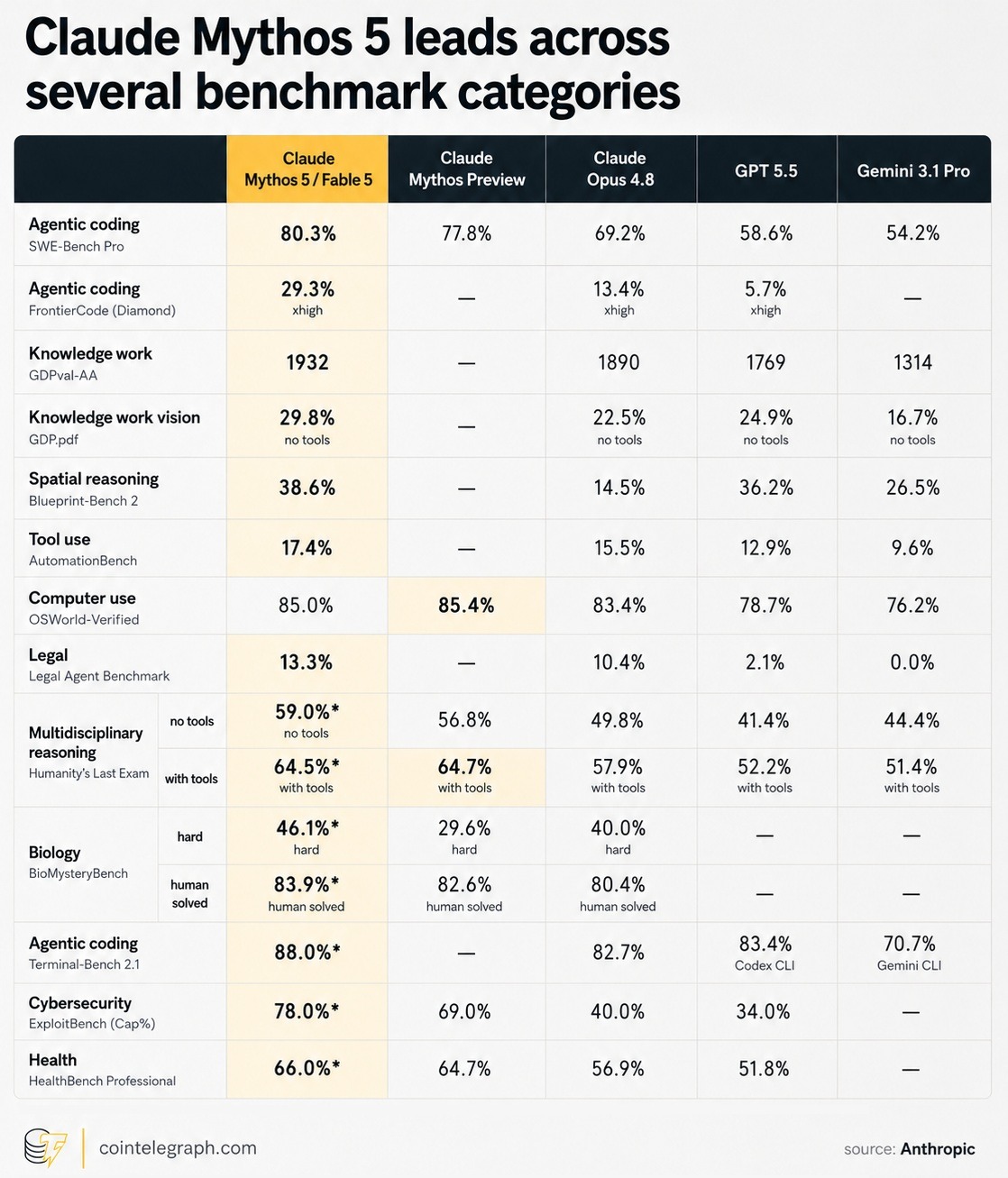
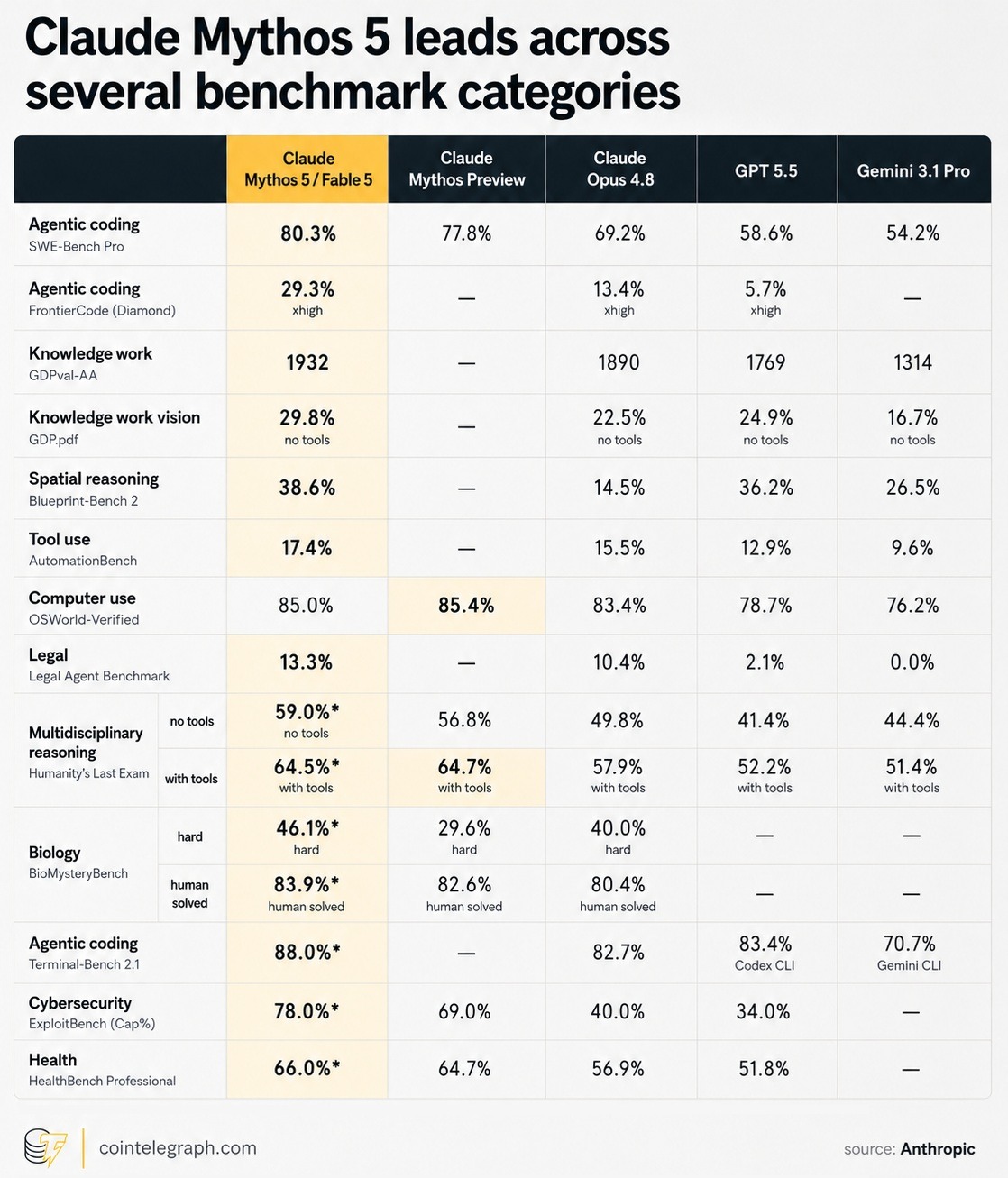
The table below shows how Claude Mythos compares with other models:
-
Why AI threats to DeFi may be exaggerated
Even with these advances, there is a clear difference between finding a vulnerability and stealing funds. Many crypto attacks involve much more than spotting a flaw.
Attackers often need to:
- Understand complex protocol mechanics
- Bring in significant capital
- Coordinate multiple transactions
- Exploit market conditions
- Manipulate liquidity
- Navigate governance systems
- Avoid detection
Even when a vulnerability exists, turning it into a successful attack often requires detailed planning and careful execution.
The real-world environment is far more complex than isolated coding tests.
Current AI systems also have limits. They can reach wrong conclusions, miss key details or follow weak lines of analysis. Security experts often find that AI tools produce useful insights alongside many false alarms.
An AI tool might flag 10 possible vulnerabilities, but only one may turn out to be valid. That matters because skilled human oversight is still essential.
Claude Mythos could speed up vulnerability detection, but it does not remove the need for experienced security experts.
Did you know? Many DeFi protocols publish their code online. This gives both security teams and AI tools more real-world financial software to review than in traditional banking systems.
-
The defensive side of AI in DeFi
A major flaw in the claim that AI will weaken DeFi is the idea that only attackers will benefit from these tools. Security teams have access to them too.
Security firms are already adding AI to their review processes. Developers are using AI-assisted code checks more often. Bug hunters can also use AI to spot issues before attackers find them.
Over time, AI may become a normal part of protocol security.
That could mean:
- Every code update goes through AI-assisted review
- AI agents continuously monitor deployed contracts
- Automated systems look for unusual on-chain activity
- Possible vulnerabilities are flagged before deployment
In that case, AI could strengthen DeFi security instead of weakening it.
The technology is neutral on its own. Its impact depends on how well attackers and defenders use it.
-
When AI attacks meet AI defenses
A more realistic outlook points to a future where AI systems challenge each other directly. This would make security faster on both sides.
Attackers will use more advanced models to find vulnerabilities and plan attacks. Security teams will use similar tools to monitor threats, improve code quality and respond faster.
This already happens in traditional cybersecurity, where offensive and defensive tools improve side by side.
DeFi could become the next major battleground for this contest. The likely result is not a sudden collapse of the sector. Instead, DeFi may enter a period of faster security upgrades and adaptation.
Projects that are slow to find vulnerabilities and update their code could face greater risk. Those that adopt AI-supported safeguards may become stronger than before.
Did you know? Several major crypto losses have come from compromised private keys, social engineering attacks or governance manipulation rather than flaws in smart contract code itself.
-
Assessing protocol vulnerabilities
Risk is not spread evenly across DeFi. Smaller projects with limited security resources often face the highest exposure.
Several categories are especially vulnerable:
- Fast deployment schedules: Projects that prioritize quick launches over careful testing may leave structural flaws in place.
- Copied codebases: Many protocols reuse or slightly modify existing code. Advanced AI tools can compare these systems quickly and expose inherited flaws.
- Weak audit coverage: Projects with little or no third-party review are less prepared for advanced attacks.
- Legacy smart contracts: Older contract designs may rely on assumptions that no longer hold up against modern exploit methods.
Automated analysis tools could sharply reduce the time needed to find these weaknesses.
-
What DeFi builders should do now
Claude Mythos offers an important lesson for the industry. DeFi builders should assume that attackers may already be using automated research tools. Security strategies need to improve accordingly.
Core priorities should include:
- Expanding automated security testing
- Running continuous, real-time audits
- Adding AI-assisted code analysis to development pipelines
- Increasing bug bounty rewards
- Using formal verification for critical code
- Improving threat monitoring and real-time incident response
Engineering teams must reduce the time between finding a vulnerability and deploying a fix. In an AI-accelerated environment, response time becomes just as important as prevention.
-
A major shift, not DeFi’s breaking point
Claude Mythos has shown that automated systems can handle complex security tasks that once required specialized experts. That marks a major shift for DeFi, where a code flaw can lead to the immediate loss of user funds.
Still, predictions of total systemic failure ignore several practical realities. Finding a vulnerability does not guarantee a successful exploit. Current AI tools still produce uneven results, human oversight remains essential and defensive teams have access to the same technology.
The more likely outcome is a change in security standards, not a collapse of DeFi. Automated tools could reduce the time and cost needed to find vulnerabilities. That will put more pressure on development teams to improve code quality, respond faster and build stronger security systems.
Ultimately, these developments are a warning, not a guaranteed outcome. The future of decentralized infrastructure will not be decided only by what AI can find. It will also depend on whether attackers or defenders use the technology more effectively.


Bitcoin traded cautiously just below and around the $60,000 area as the market opened for another week, with traders increasingly focused on whether that level can flip from resistance back into support. Even as broader risk sentiment improved, analysts pointed to a lack of sustained demand from spot buyers—suggesting the current range may persist until conviction returns.
Monday’s price action also reflected a tug-of-war between crypto and traditional markets. US equities started the session higher on renewed hopes for a US-Iran de-escalation, but Bitcoin’s strength did not clearly keep pace with the pickup in stocks, reinforcing the idea that traders are staying selective rather than chasing.
Key takeaways
- Bitcoin is struggling to reclaim $60,000 as support, leaving the market vulnerable to another range-bound push.
- Improving US risk sentiment tied to an announced US-Iran meeting hasn’t translated into clear, sustained crypto buying.
- Trading commentary suggests a “choppy” tape, with attention on potential moves toward $58,000 or $61,000 if the range breaks.
- Glassnode data indicates buyers have not shown the conviction needed for a sustained recovery, with spot activity still characterized by net selling.
- Oil-price uncertainty remains a potential headwind for crypto risk assets, according to QCP Capital’s market color.
Stocks rise on US-Iran meeting hopes, but Bitcoin holds back
According to TradingView data, Bitcoin’s technical battle around $60,000 continued as price strength failed to match the momentum seen in US equities. The S&P 500 and Nasdaq Composite both began the week higher as sentiment improved around efforts to salvage the US-Iran peace deal.
In a post on Truth Social, US President Donald Trump said Iran had “requested a meeting,” to be held in Doha, United Arab Emirates, on Tuesday. While the announcement lifted the tone for risk assets, Bitcoin remained pinned near a key level that traders have been watching for a decisive shift.
That divergence matters because, historically, Bitcoin often responds to broader liquidity conditions and risk appetite. When equities strengthen but crypto doesn’t follow through, it can signal that either (1) participants are waiting for confirmation, or (2) crypto-specific supply and positioning pressures are outweighing macro tailwinds.
Oil volatility risk stays on the radar
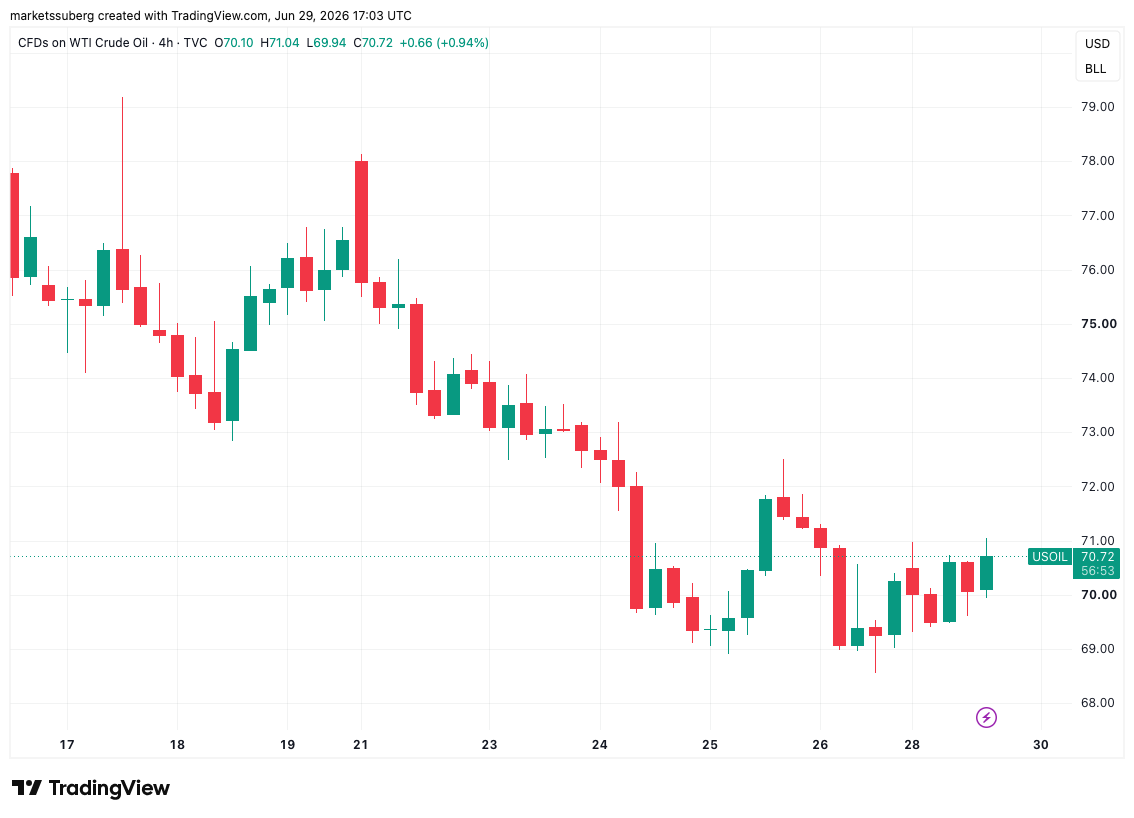
QCP Capital cautioned that even if US-Iran tensions appear to have “stood down for now,” the situation remains uncertain—particularly for oil, which can influence global risk appetite. In its latest Market Color analysis, QCP noted that oil prices were largely stable in the low $70s, implying cautious optimism that tensions may ease.
“However, this relatively muted market reaction also leaves significant upside risk for oil prices should supply recovery prove slower than expected.”
WTI crude had fallen below $68 per barrel for the first time since early March on Friday, but it was back above $70 at the time of writing. QCP also pointed to the likelihood of volatility staying elevated, noting that the US market is set to close on Friday and that the geopolitical situation remains fluid—factors that can amplify moves when liquidity thins.
For Bitcoin traders, this connection is practical: if oil spikes or volatility rises abruptly, it can tighten financial conditions and reduce appetite for risk assets, potentially making it harder for BTC to break out of its current range.
$60,000 remains the pivot as traders watch for range breaks
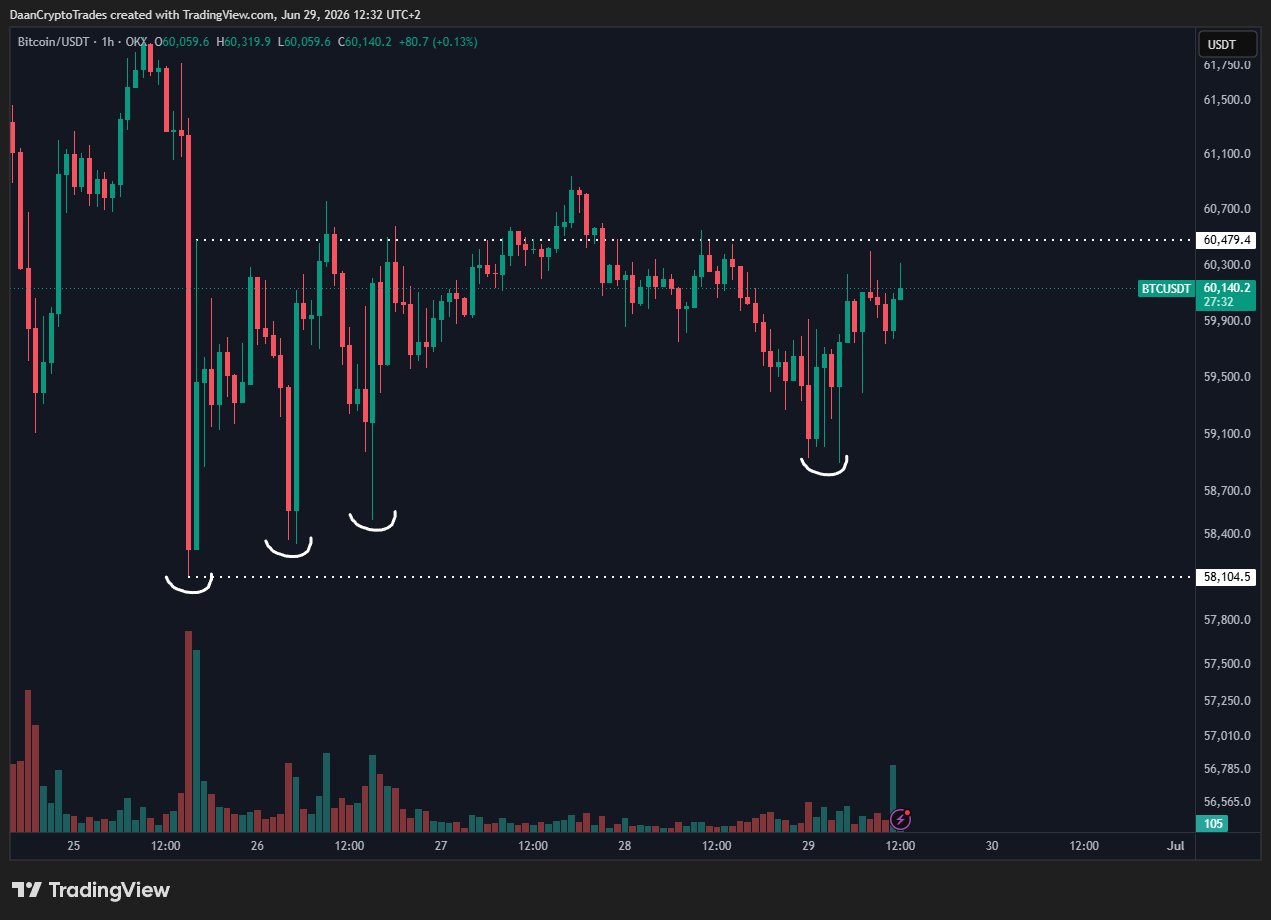
On the crypto side, short-term price action was described as “choppy,” with momentum struggling to build. Trader Daan Crypto Trades, in an update shared on X, said BTC has been trading around “previous June lows,” and that the $60,000 region has continued to cap price.
“The longer price spends moving around in this region, the bigger the following move upon a range break will be. Eyes on $58K & $61K.”
The significance of those levels is straightforward: when price repeatedly tests a range boundary without a clean breakout, traders often begin to position for an eventual expansion move. That doesn’t guarantee direction, but it raises the probability that a decisive break could be more impactful than the incremental chop seen so far.
On-chain signals point to defensive spot behavior
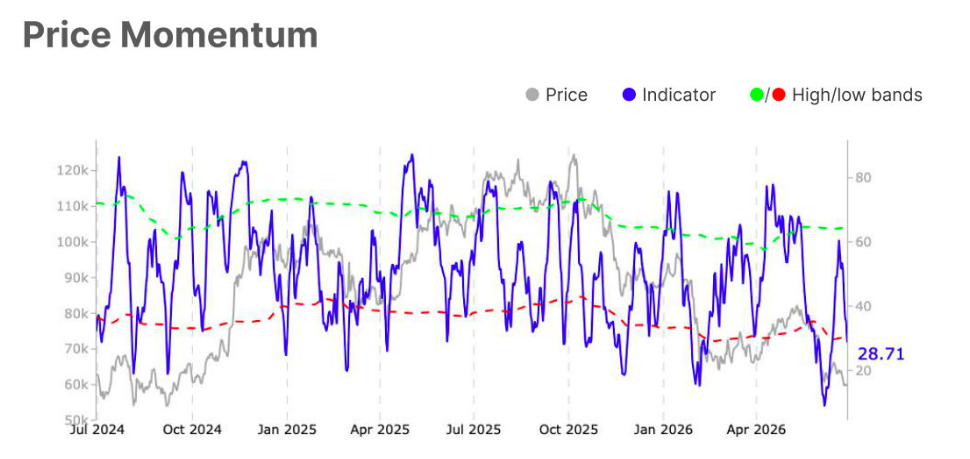
Glassnode’s latest Market Pulse bulletin added an on-chain dimension to the cautious tone. The analytics platform said Bitcoin buyers have “so far lacked the conviction required to establish a sustained recovery,” leaving price range-bound near local lows.
Glassnode also described the market as being in a “structural adjustment” phase, with capital contracting and participants adopting a more defensive posture. The most notable detail was its assessment of spot flows: despite increased trading activity, Glassnode reported persistent net selling.
“Spot markets are still experiencing persistent net selling despite an increase in trading activity, suggesting that available liquidity is being used primarily to distribute rather than accumulate Bitcoin at current prices.”
While Glassnode noted some signs of “more balanced” data beneath the surface, it warned that supply ownership may be shifting toward more speculative participants. According to the bulletin, that mix can increase the potential for sharper volatility swings—even if Bitcoin appears to be stabilizing around the $60,000 area.
In its summary, Glassnode concluded that a sustained recovery is likely to require a “meaningful return of buyer conviction,” citing continued defensiveness across spot order flow, derivatives positioning, and institutional demand.
That framing is useful for investors and traders because it distinguishes between two common scenarios: (1) price holding up due to technical support while demand remains weak, versus (2) price holding up because real accumulation is building. Right now, the on-chain narrative leans toward the first scenario.
Going forward, traders will likely watch whether spot net selling can fade and whether Bitcoin can convert $60,000 into support. With geopolitical headlines still capable of moving risk sentiment and oil volatility potentially reintroducing uncertainty, the next breakout may depend less on macro optimism alone—and more on whether buyer participation becomes consistent enough to break the range decisively.


Michael Saylor’s Strategy, which owns 847,363 BTC, just authorized up to $1.25 billion in sales of the asset. It’s a dramatic reversal of years of guidance that it wouldn’t sell its BTC.
Branding the about-face as a “BTC Monetization Program” — another entry in Saylor’s dictionary of invented terminology — the company permanently destroyed any impression that it plans to hold onto all of its BTC.
Rather than holding, Strategy now plans to aggressively sell BTC whenever it’s short on cash to pay for stock buybacks and dividends.
The immediate market reaction to the news was moderately positive.
Indeed, MSTR, the company’s common stock, and STRC, the company’s largest preferred stock, both opened for Nasdaq trading today approximately 5% higher on the news.
BTC was little changed on the news, opening within 1% of its Friday price. The company hadn’t actually sold BTC, after all. It merely announced plans to do so.
Saylor’s announcement is obviously intended to boost the company’s deteriorating stock prices after both MSTR and STRC hit 52-week lows last week.
Strategy spins its plan to sell BTC
CEO Phong Le tried to explain the company’s betrayal of prior guidance, saying the company is “evolving from one-way capital issuance to active capital management.”
Chief financial officer Andrew Kang offered a tidy slogan: “Bitcoin is capital.” Capital the company has now authorized for liquidation.
Saylor built his reputation on repeated claims that he’ll never sell BTC, even saying people could sell a kidney to HODL.
He now insists the company “remains committed to BTC as its primary treasury reserve asset.”
If Strategy sells all of the BTC authorized under its new BTC Monetization Framework, it would sell 30x more than its largest sale to date: 704 BTC in 2022.
Specifically, Strategy has authorized the sale of roughly 21,000 BTC at current prices. If those sales occur, it’s also cleared up to $1 billion in preferred share repurchases plus up to $1 billion in MSTR buybacks.
Read more: STRC crashes as Strategy’s unrealized BTC losses exceed $13 billion
Strategy increases dividend, promises to ‘remain disciplined’
The announcement also raised the dividend rate of STRC from 11.5% to 12%. Strategy wants STRC to trade near $100 per share and is already paying credit card-like rates to keep it afloat.
Unfortunately, STRC collapsed to $71.25 last week. So, the company lifted its payout rate this morning. Still by lunchtime, shares were struggling at $82 — still 18% below the company’s target.
The company says it now holds a USD reserve (a fancy name for cash) of about $2.55 billion.
That covers roughly 17 months of the $1.7 billion it owes each year in preferred dividend and interest payouts. If it sells all of the BTC it authorized today, that coverage timespan reaches about 26 months.
Holding onto BTC forever isn’t the first commitment on which Strategy has quietly reneged. The company once pledged not to issue MSTR below a 2.5x mNAV (multiple-to-Net Asset Value), except to fund dividends and interest.
It dropped that pledge a few days later.
This time around, the company promises to “remain disciplined in its use of common equity issuance, particularly when the company’s common stock trades at or near 1x mNAV.”
The mNAV of MSTR, currently 1.04x, is dangerously close to that threshold.
Strategy paid $64.1 billion to acquire its 847,363 BTC at an average of $75,651 per coin. After declining in value by about $14 billion, its holdings are now worth about $50 billion.
Got a tip? Send us an email securely via Protos Leaks. For more informed news and investigations, follow us on X, Bluesky, and Google News, or subscribe to our YouTube channel.
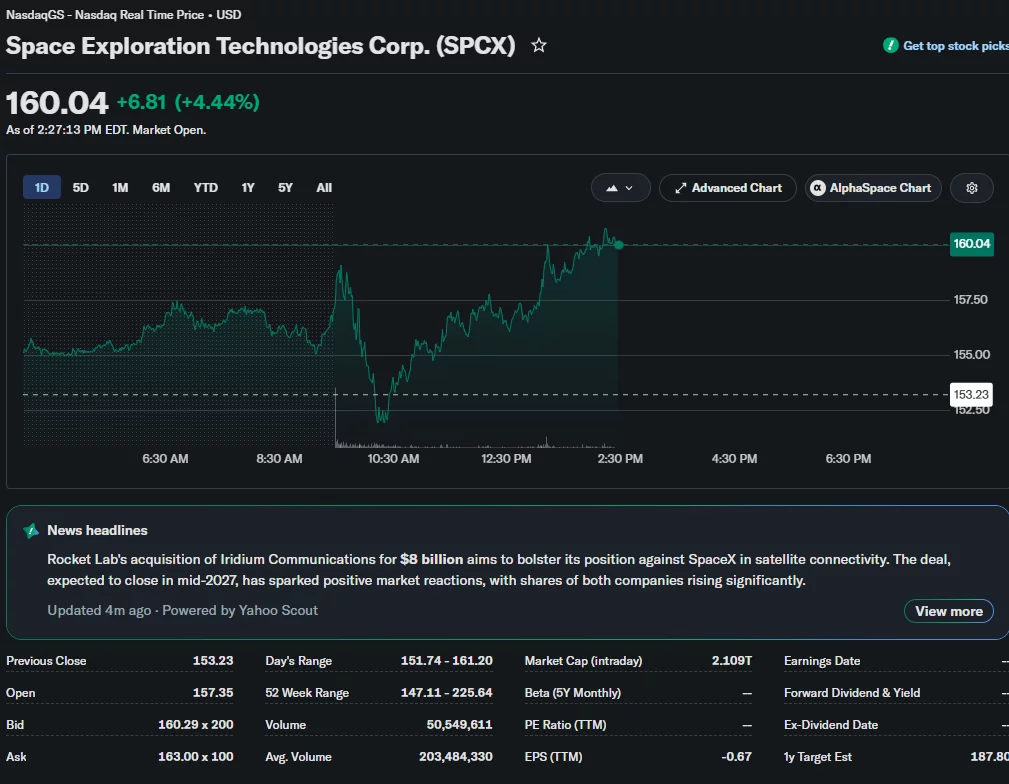
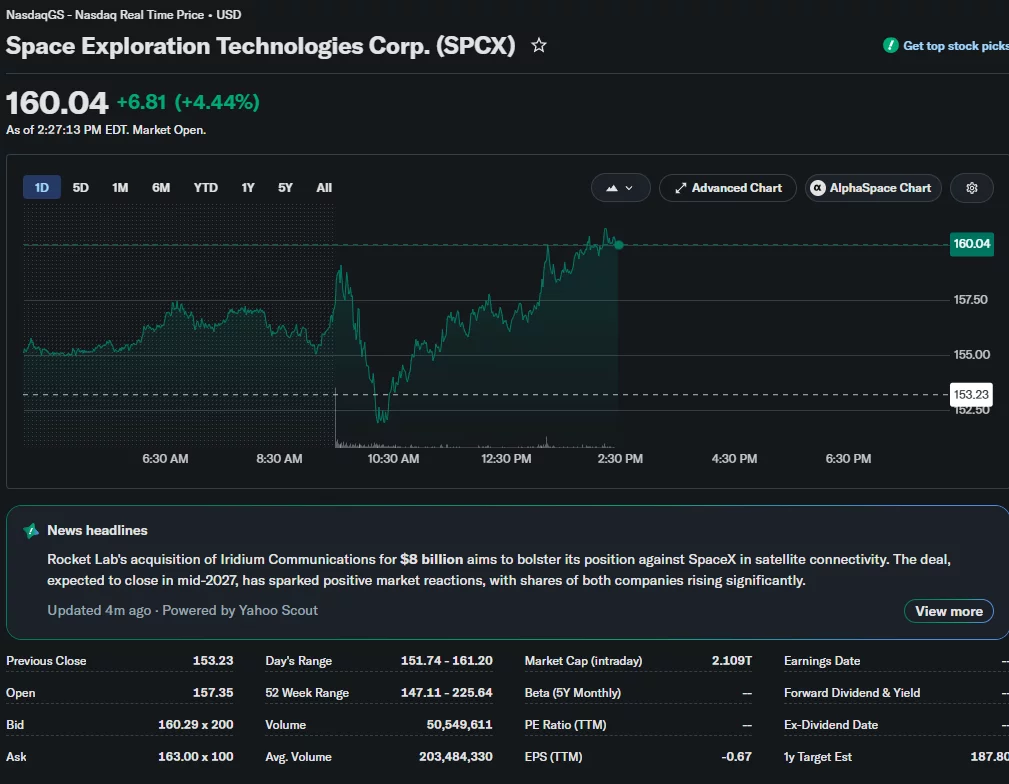
SpaceX stock has climbed nearly 4.5% to around $161 on Monday ahead of its expected Nasdaq-100 entry, even as Citadel Securities has warned that mounting risks could slow the AI-driven market rally.
Summary
- SpaceX stock climbed nearly 4% ahead of its expected Nasdaq-100 inclusion on July 7.
- Citadel Securities warned that higher interest rates could challenge the ongoing AI-driven market rally.
- ARK Invest added $7.01 million in SpaceX shares as Allianz raised concerns over the firm’s debt offering.
According to market data, SpaceX (SPCX) shares were trading near $160 at the time of writing after gaining 4.4% during the session. The advance comes days before the company is expected to join the Nasdaq-100 Index on July 7, a move that investors believe could attract billions of dollars in passive fund inflows.
Nasdaq-100 inclusion has strengthened demand expectations
With the index addition approaching, investors have continued building positions in the stock. Passive funds and exchange-traded funds that track the Nasdaq-100 are expected to purchase SpaceX shares once the company joins the benchmark.
Market estimates suggest the inclusion could generate almost $4 billion in passive buying, increasing liquidity and institutional ownership. Alongside the Nasdaq-100 addition, SpaceX has already secured a place in the Russell 1000 Index, although it remains ineligible for the S&P 500 because the index requires newly qualified companies to wait 12 months before being considered.
Institutional investors have also continued adding exposure. Last week, Cathie Wood’s ARK Invest bought 45,728 SpaceX shares valued at about $7.01 million across its ARKK, ARK Autonomous Technology & Robotics ETF (ARKQ), ARKW, and ARK Space Exploration & Innovation ETF (ARKX).
Citadel has cautioned that AI stocks could face new pressure
Despite the strong momentum in SpaceX shares, a Bloomberg report citing Citadel Securities said investors may be underestimating how committed Federal Reserve officials remain to bringing inflation under control.
According to the report, interest rates staying higher for longer could weigh on high-growth companies and other risk-sensitive assets. The trading firm’s assessment has also added to concerns in cryptocurrency markets, where digital assets have remained under selling pressure over recent weeks.
Bloomberg also reported that Citadel Securities expects the AI-led rally to encounter additional challenges from softer demand, weaker investment returns, and rising political and regulatory scrutiny.
The report did not identify SpaceX as facing those issues directly, but investors are assessing whether a slowdown across AI-related companies could eventually influence sentiment toward the stock.
Separate concerns have also emerged around the company’s financing strategy. As reported by crypto.news earlier, Allianz Chief Investment Officer Ludovic Subran said SpaceX’s enlarged debt offering may indicate that financial markets are showing signs of bubble-like conditions. He argued companies are taking advantage of elevated equity valuations and favorable borrowing conditions to raise additional capital.
The comments followed earlier reports that SpaceX was preparing a larger bond sale, a development that has attracted attention even as investor demand for the company’s shares continues to strengthen ahead of next week’s Nasdaq-100 inclusion.
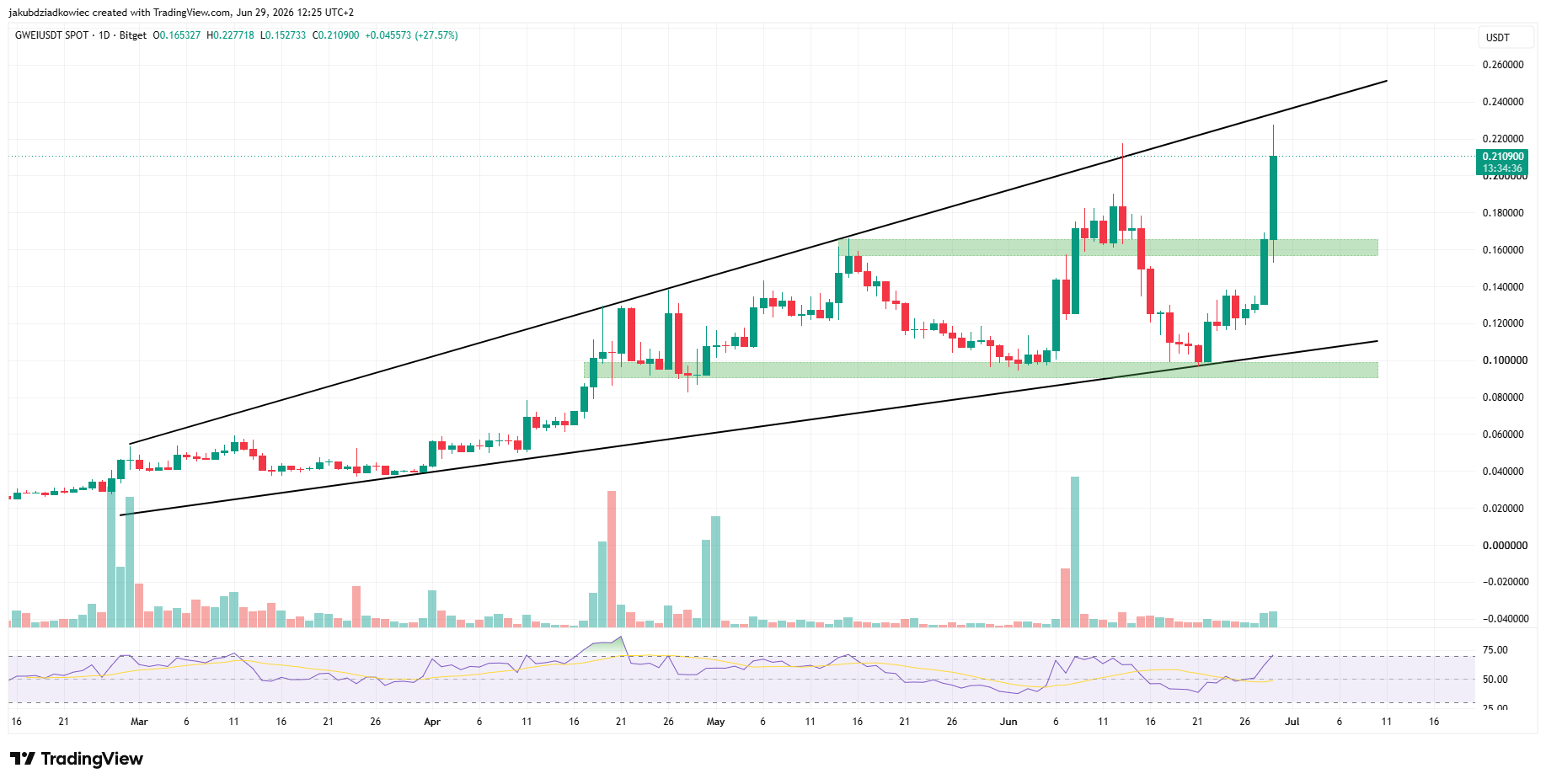
GWEI, VELVET, and DEXE rank among the strongest altcoins to watch as the first week of July opens. GWEI surged roughly 50% in 24 hours, VELVET added about 275% in seven days, and DEXE gained near 40%.
Each token shows a clean technical setup heading into July. Breakout structures, defended support levels, and momentum signals point to possible continuation. Still, stretched indicators warn that volatility could cut both ways.
GWEI Price Eyes $0.24 After Breaking Two Key Levels
ETHGas (GWEI) trades near $0.21 after a sharp move higher. The token climbed roughly 50% over the past 24 hours.
On the daily chart, GWEI trends higher inside a broadening, or megaphone, pattern. Price recently cleared two important levels.
The $0.10 and $0.16 zones now act as support after serving as resistance. That flip strengthens the bullish structure.

GWEI now targets the upper band of the pattern near $0.24. A daily close back below $0.16 would weaken the case.
The Relative Strength Index (RSI) has pushed back above 70 into bullish territory. The move also tries to negate a developing bearish divergence. GWEI joins other altcoins drawing trader attention this summer.
VELVET Price Holds $0.60 Support Below $2 Resistance
Velvet (VELVET) trades near $1.67 after a strong run. The token added about 275% over the past seven days.
The daily chart shows two strong expansion moves to higher prices. Resistance now sits just below $2.00.
VELVET printed an all-time high near $2.07 this week before easing back. The $2 area now caps further upside.

A new support has formed at $0.60. That level acted as resistance between June 13 and June 25.
The RSI shows a first sign of bearish divergence. However, the indicator remains in bullish territory for now. VELVET stays among the week’s top gainers.
Altcoins to Watch: DEXE Price Targets $30 After Cup-and-Handle Breakout
DeXe (DEXE) trades near $21.78 and shows the most mature setup here. The token gained about 40% over the past seven days.
On the weekly chart, DEXE broke out of a cup-and-handle formation (purple). Price now follows the pattern’s projected path higher.
DEXE is trying to close above the resistance near $24, its highest level in years. A weekly close above it would confirm strength.

The first target sits near $30, which aligns with the 1.272 Fibonacci extension. A second target sits near $38 at the 1.618 extension.
Volume has been contracting during the move. That pattern often signals exhaustion before a fresh volatility expansion. DEXE recently exploded 70% in a short squeeze, and earlier analysis flagged building positioning.
All three altcoins show breakout momentum heading into July. Still, stretched indicators and thin volume mean traders should weigh the risk of sharp reversals.
The post 3 Altcoins to Watch in the First Week of July appeared first on BeInCrypto.


Institutional demand for perpetual futures remains limited, with the products largely viewed as speculative trading instruments rather than viable replacements for traditional derivatives, according to a Monday report by Wall Street bank JPMorgan.
Based on conversations with clients and market participants, the bank said institutional interest in perpetuals has been muted. While the contracts offer 24/7 trading and eliminate futures roll costs, most activity is driven by traders seeking leveraged directional exposure rather than producers, consumers or other participants hedging underlying market risk.
“Our due diligence within J.P. Morgan suggests that there is no/limited institutional demand that our desks are seeing,” the bank’s analysts said in the Monday report
“The consensus opinion seems to be that perps activity is more akin to speculative use cases by traders versus hedging by producers/consumers or those players with real exposure to the underlying,” the analysts added.
The report argued that perpetuals offer few incremental benefits over legacy derivatives for institutional investors. On-chain perpetuals are unlikely to appeal to U.S. institutions because they lack traditional clearing protections, while off-chain products reduce roll risk but retain other structural drawbacks.
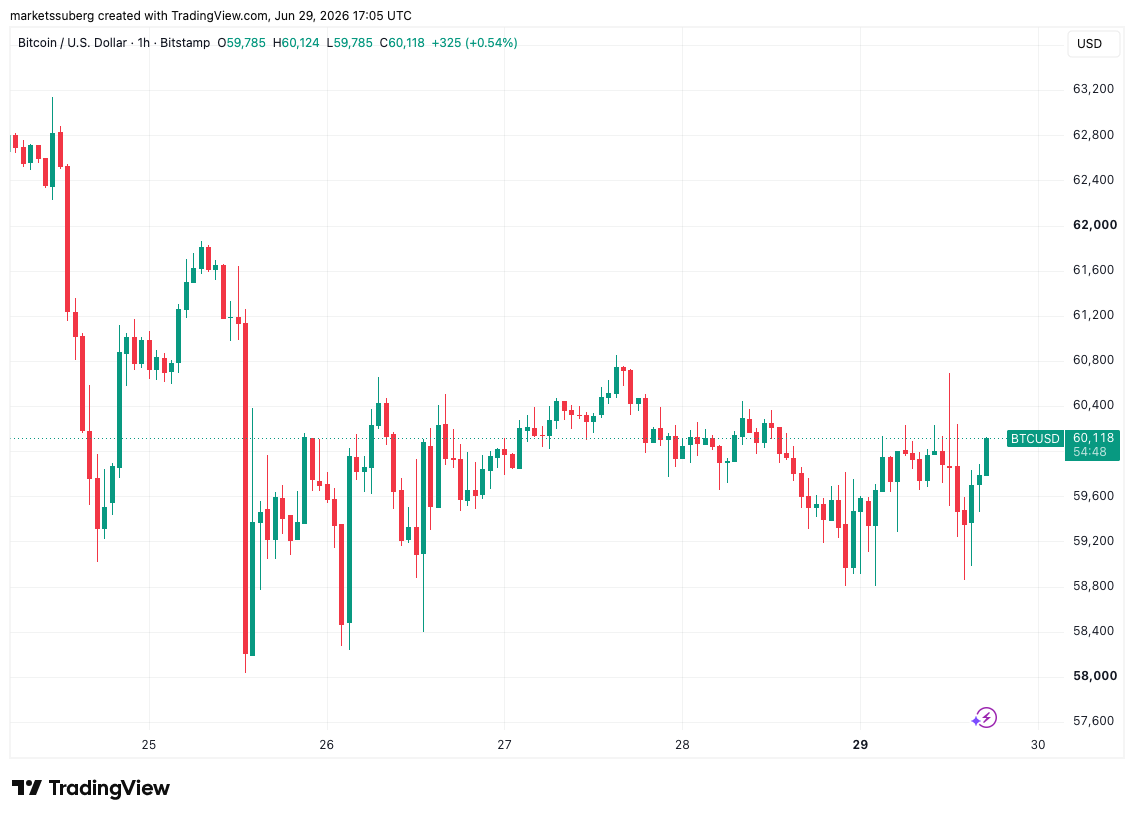
Bitcoin (BTC) struggled near $60,000 around Monday’s Wall Street open as bulls increasingly risked a support/resistance flip.
Key points:
- Bitcoin bulls face an uphill struggle to flip $60,000 back to support, even as US stocks see fresh upside.
- Iran peace hopes fuel a more positive risk-asset mood, but analysis says that Bitcoin buyers “lack conviction.”
- Market participants are “defensive” around current price action.
US-Iran meeting announcement sends stocks higher
Data from TradingView showed an ongoing battle to regain control of $60,000, with BTC price strength again failing to keep pace with US stocks.
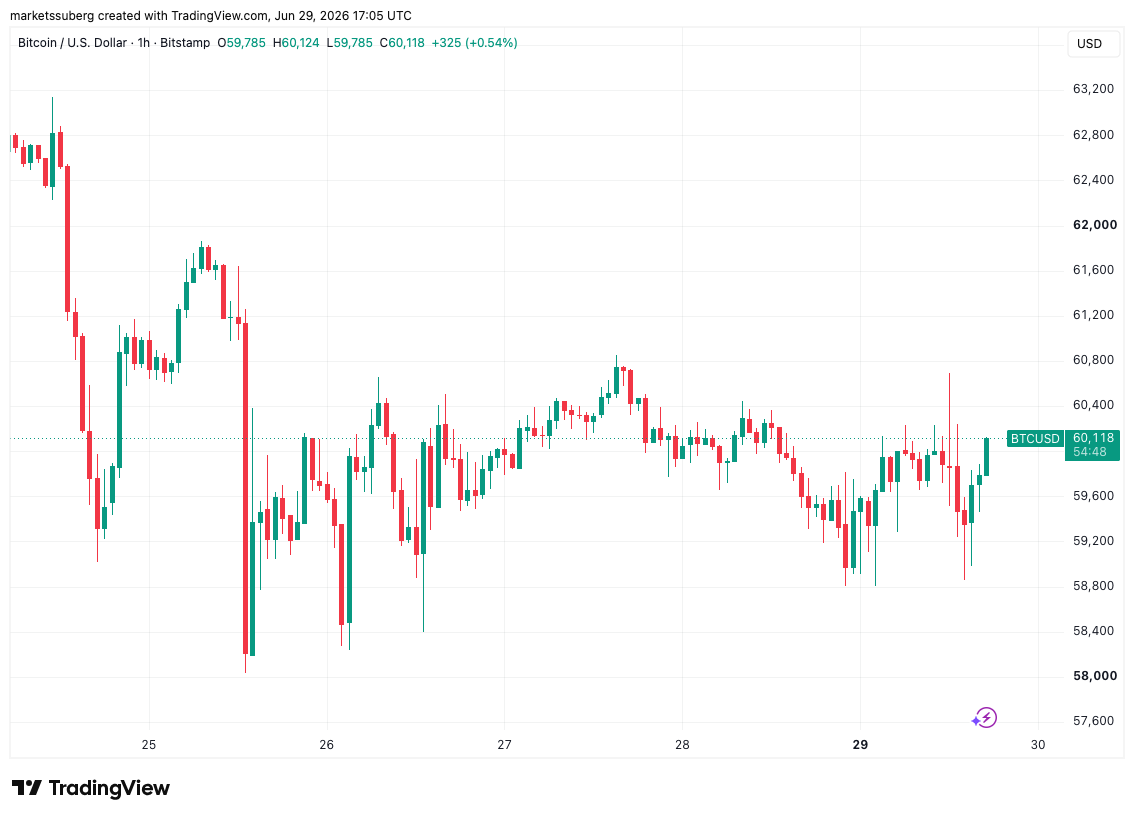
BTC/USD one-hour chart. Source: Cointelegraph/TradingView
The S&P 500 and Nasdaq Composite Index both started the week in the green amid renewed optimism of rescuing the US-Iran peace deal.
In a post on Truth Social, US President Donald Trump wrote that Iran had “requested a meeting,” which would take place in Doha, United Arab Emirates, on Tuesday.
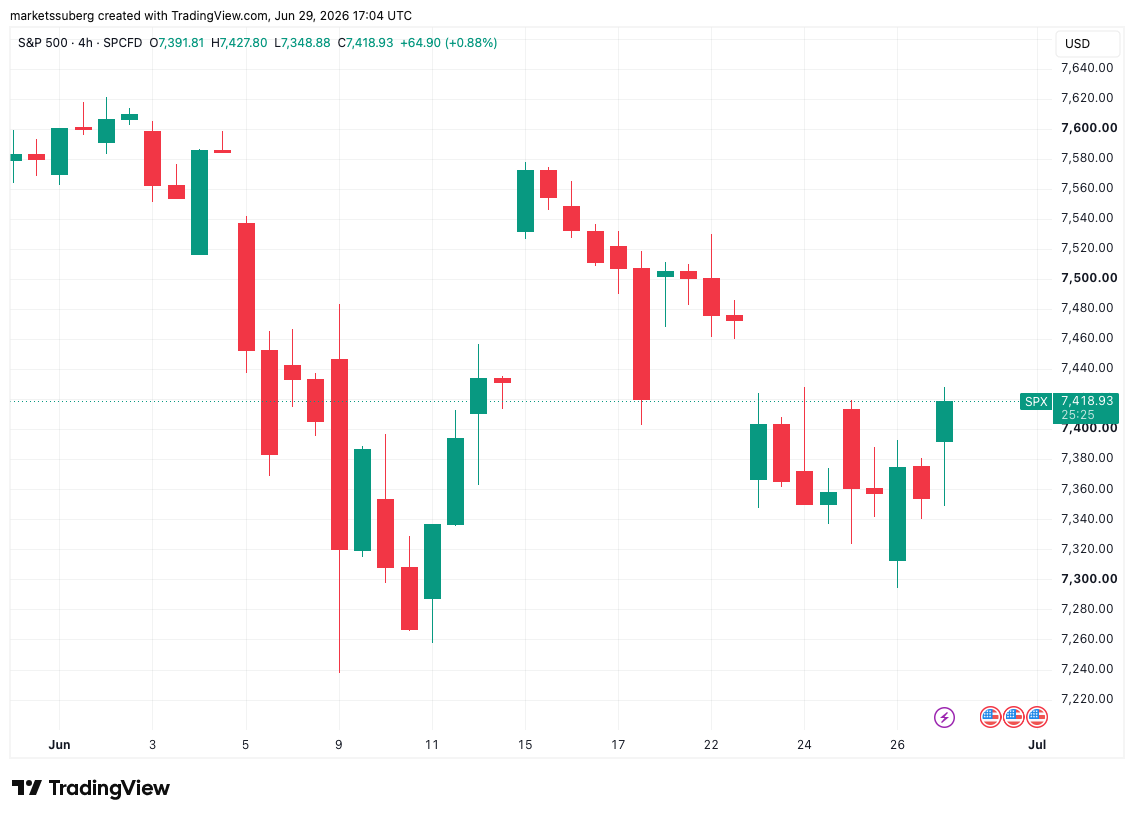
S&P 500 four-hour chart. Source: Cointelegraph/TradingView
Commenting on the latest events, trading company QCP Capital nonetheless cautioned over the potential for oil prices to rebound — a key potential headwind for crypto.
“While both countries appear to have agreed to stand down for now, the situation remains uncertain. That said, oil prices have remained largely stable in the low $70s, suggesting cautious optimism that tensions may ease,” it wrote in its latest Market Color analysis.
“However, this relatively muted market reaction also leaves significant upside risk for oil prices should supply recovery prove slower than expected.”
CFDs on WTI crude oil four-hour chart. Source: Cointelegraph/TradingView
On Friday, WTI crude fell below $68 per barrel for the first time since early March, but was back above the $70 mark at the time of writing.
“U.S. markets are also set to be closed on Friday, while the situation between the U.S. and Iran remains fluid, leaving volatility likely to stay elevated, partly driven by thinner liquidity conditions, similar to what we saw over the past weekend,” QCP added.
Bitcoin needs more “conviction” from buyers
Bitcoin market participants thus sat on the sidelines as “choppy” price moves defined low-time-frame market action.
Related: BTC price RSI prints key 2026 signal: Five things to know in Bitcoin this week
“Chopping around in this range at the previous June lows. The ~$60K region keeps capping price as we have some marginally higher low wicks below,” trader Daan Crypto Trades wrote in his latest X analysis.
“The longer price spends moving around in this region, the bigger the following move upon a range break will be. Eyes on $58K & $61K.”
BTC/USDT one-hour chart. Source: Daan Crypto Trades/X
In its latest Market Pulse bulletin, onchain analytics platform Glassnode said that buyers “have so far lacked the conviction required to establish a sustained recovery, leaving price range-bound near local lows.”
“Beneath the surface, the market remains in a phase of structural adjustment as capital continues to contract and participants adopt a more defensive posture,” it reported.
“Spot markets are still experiencing persistent net selling despite an increase in trading activity, suggesting that available liquidity is being used primarily to distribute rather than accumulate Bitcoin at current prices.”
Bitcoin price momentum data (screenshot). Source: Glassnode
While noting “more balanced” onchain data, Glassnode added that a shift toward supply ownership by more speculative investors increased the potential for price volatility.
“Taken together, Bitcoin appears to be stabilizing around the $60K region, but with spot order flow, derivatives positioning, and institutional demand all remaining defensive, a sustained recovery is likely to require a meaningful return of buyer conviction,” it concluded.
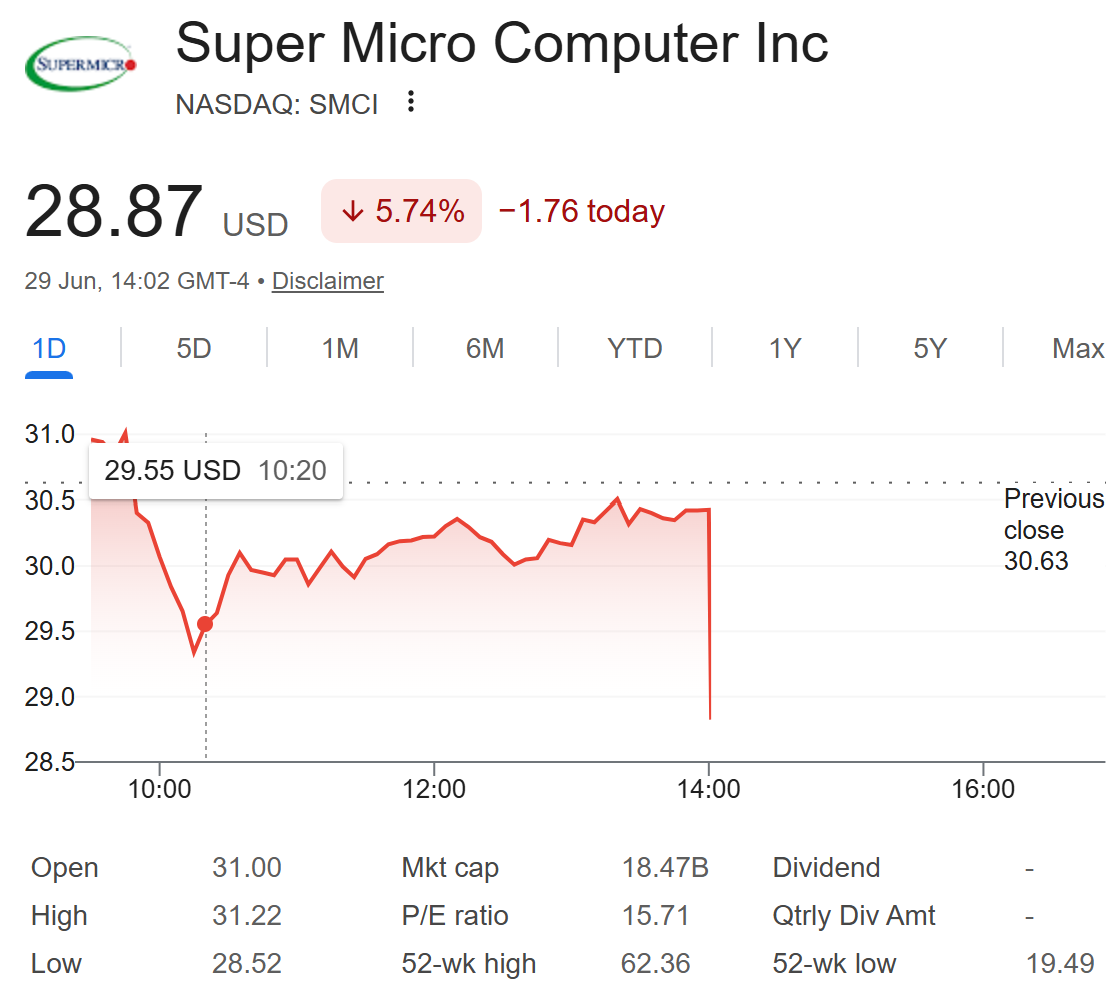
Super Micro Computer Inc.’s Taiwan office was raided Monday as authorities expanded their investigation into alleged smuggling of Nvidia AI chips into China using the company’s servers.
SMCI shares fell sharply on the news. Taiwan’s Keelung District Prosecutors Office searched the residences of six individuals and premises of three affiliated companies, including Super Micro’s local operations. Prosecutors also summoned individuals for interviews.

Targeted Companies Confirm Searches
Distributor Albatron Technology confirmed it was searched in a regulatory filing and reported no material financial or operational impact. Data center operator Chief Telecom was also among the sites visited.
Follow us on X to get the latest news as it happens
Building on Prior Action
Bloomberg reported the Monday operation, which extends May 2026 raids by the same office, covering 12 locations and leading to the seizure of approximately 50 high-end Super Micro servers containing restricted Nvidia chips. Those actions targeted document falsification related to exports.
Super Micro has previously stated it is cooperating with Taiwanese authorities and was not charged as a company in earlier phases of the probe. The company did not immediately respond to requests for comment on the latest developments.
U.S. Controls Drive Regional Enforcement
The case reflects sustained U.S. pressure to restrict advanced AI semiconductors to China over national security concerns. Taiwan, a critical hub for semiconductor manufacturing and server assembly, does not yet treat AI chip exports to China as a standalone crime.
Authorities currently rely on laws covering document falsification. Taipei is actively considering legislation to criminalize such exports directly, which would provide stronger enforcement tools.
What’s Next
The latest raids highlight tightening scrutiny on downstream distribution in the AI supply chain. Further updates from prosecutors or Super Micro could clarify scope and potential charges.
For investors, the developments add to compliance risks even as demand for AI servers remains strong. SMCI’s stock reaction shows how regulatory headlines continue to influence sentiment in the sector.
The post Taiwan Raid Hits Super Micro Office, Slamming SMCI Shares appeared first on BeInCrypto.
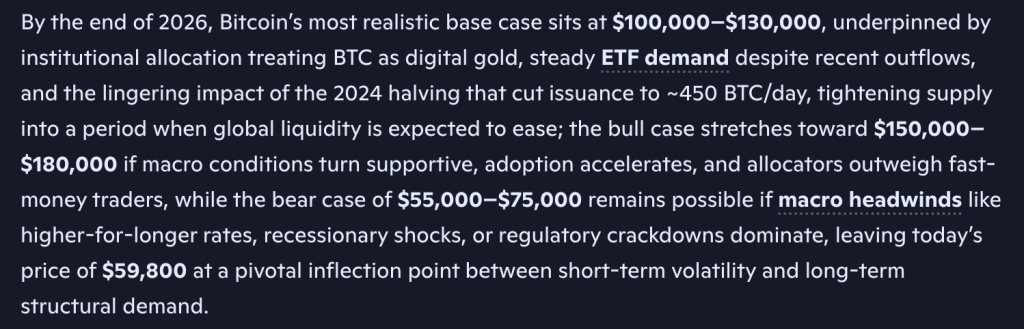
Microsoft Copilot AI just laid out a full spectrum view on Bitcoin price prediction that frames today’s price as standing at a genuine fork in the road. The model predicts a realistic base case of $100,000 to $130,000 by the end of 2026, with a bull case stretching to $150,000 to $180,000 if the right conditions line up.
The bull case leans on a few durable forces rather than a single short term spark. Bitcoin trades near $59,800 today, and the model frames that as a pivotal inflection point between near term volatility and long term structural demand.
Institutional allocation continues treating bitcoin as digital gold, a framing that has only grown stronger as more traditional capital looks for an inflation resistant store of value.
ETF demand remains steady even through recent outflows, which suggests the underlying buyer base has not actually walked away despite choppy headlines.

The lingering impact of the 2024 halving still matters too, since issuance dropped to roughly 450 BTC per day, tightening supply right as global liquidity is expected to ease going forward.
If macro conditions turn genuinely supportive, adoption accelerates faster than expected, and longer term allocators end up outweighing fast money traders chasing short term swings, the model sees that combination stretching price toward the $150,000 to $180,000 range.
The bear case is just as plausible given where things stand today. If macro headwinds like higher for longer interest rates, a recessionary shock, or fresh regulatory crackdowns end up dominating the landscape instead, the model sees bitcoin staying contained in a $55,000 to $75,000 range for an extended period.
That would mean a much longer wait for the structural bull case to play out, with price essentially churning sideways while those headwinds resolve one way or another.

Don’t Miss Out on Our $1,000 USDT Airdrop on ByBit
Bitcoin Price Prediction: BTC Stands At The Exact Fork Copilot Is Describing
The daily chart shows Bitcoin at $59,887 after a long decline from highs near $128,000 set back in October. That drop has been a grinding, persistent downtrend, broken up by a relief rally into May that topped out close to $83,000 before rolling over into the current stretch of weakness.
Price has spent the last several weeks consolidating in the high $50,000s to low $60,000s, which lines up almost exactly with the $59,800 level called out as the pivotal point in this prediction.
That kind of tight, extended consolidation right at a psychologically important number often signals a market waiting for its next real catalyst rather than committing in either direction.
Immediate resistance sits near $64,000, a level price has tested and failed at multiple times recently, with a much heavier ceiling further up near $76,000 where the May rally eventually lost steam.
Support holds in the $58,000 to $59,000 zone, the same area price is currently testing on this very candle. The broader structure remains a clear downtrend stretching back to October, with lower highs and lower lows defining nearly the entire move.
Momentum on the daily candles looks tired rather than decisive, with small, choppy candles clustering near the lows instead of showing strong directional conviction either way.
Given how directly current price lines up with the inflection point in this prediction, the next decisive break above $64,000 or below $58,000 looks like the signal that determines which half of this base to bull range actually starts to play out.
Discover: The Best Token Presales
You Might Like What Copilot AI Predicts About LiquidChain
The rotation is already happening. Most people will only see it in hindsight.
Large-cap crypto is not failing. It is capped. Bitcoin, Ethereum, and XRP have been pressing against the same resistance bands for weeks. The macro tailwinds keep getting delayed.
The institutional inflows keep getting pushed to next quarter. Holding assets where the upside depends on catalysts you cannot control is not a strategy. It is waiting.
A capital that has navigated enough cycles does not wait at resistance. It moves before the destination becomes obvious.
Early-stage infrastructure plays operate on different math entirely. A small enough market cap means a modest rotation produces dramatic price movement. The asymmetry exists because the market has not priced in what is being built yet. That gap between current valuation and what the project is actually worth is where the returns come from.
Multi-chain fragmentation costs DeFi real money every single day. Bitcoin, Ethereum, and Solana run completely isolated liquidity systems with no native way to connect them. Every user moving value between ecosystems absorbs that cost directly in fees, slippage, and failed transactions.
LiquidChain collapses all 3 networks into a single execution layer. One deployment. Full ecosystem access. No cross-chain tax on every interaction.
The market has not found this yet. That is the entire point.
The presale is at $0.01454 with just over $840,000 raised. Ground floor is not a marketing phrase here. It is a description of where this actually sits in its lifecycle.
Execution is unproven. Adoption is unknown. Those risks are real and worth naming directly. Established assets offer a smoother ride toward a ceiling that is already visible. This offers an earlier seat at a table that has not been set yet.
Explore the LiquidChain Presale
The post Microsoft Copilot AI Predicts Incredible Bitcoin Price by End of 2026 appeared first on Cryptonews.
Crypto World
Tom Lee blames bitcoin, ether weakness on quarter-end rebalancing as Bitmine (BMNR) buys $43M ETH

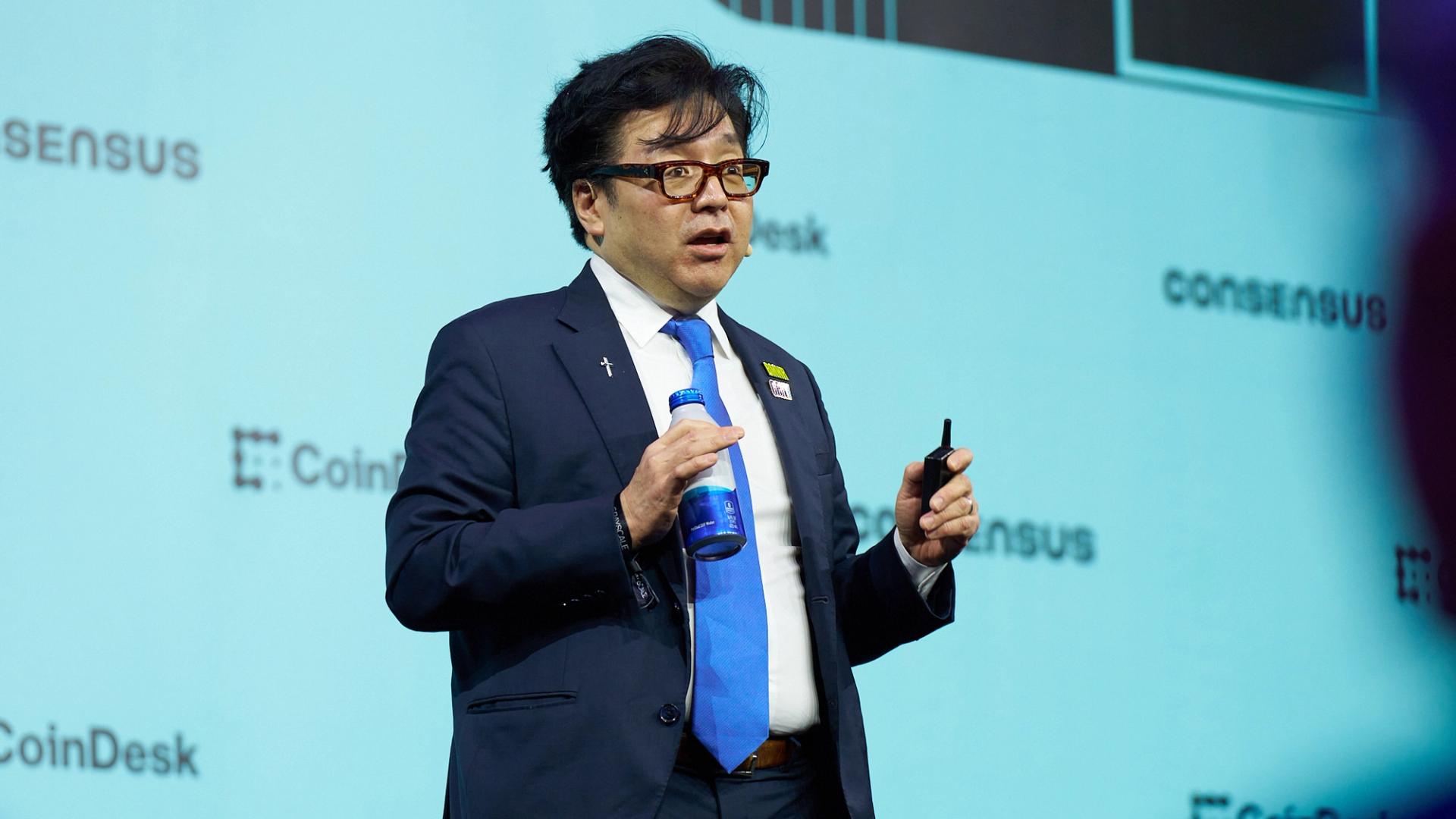
Bitmine Immersion Technologies (BMNR), the largest Ethereum treasury company, bought 27,084 ether (ETH) last week, extending its accumulation streak despite another slide in crypto prices.
The purchase, worth roughly $43 million based on ETH’s current price of around $1,580, lifted Bitmine’s holdings to 5.7 million ETH, according to a Monday company update. The stash is worth about $8.9 billion and represents roughly 4.7% of Ethereum’s circulating supply, nearing the firm’s 5% goal.
The company also held 206 bitcoin, $555 million in cash and marketable securities and stakes in Beast Industries and Eightco Holdings, bringing total crypto, cash and investment holdings to $9.8 billion.
The latest acquisition was the smallest purchase since early May, down from 52,203 ETH the previous week and well below the 126,971 ETH batch earlier this month, suggesting the company is dialing back its buying pace after months of aggressive accumulation. Bitmine nevertheless remains one of the few large digital asset treasury firms still consistently adding to its crypto holdings while many peers have paused purchases amid the market downturn.
Crypto weakness
Chairman Thomas “Tom” Lee pointed to quarter-end rebalancing behind the latest bout of weakness in crypto markets with investors cutting their losses as we enter the second-half of the year.


Prediction-market operators have increasingly moved to own more of their trading infrastructure, setting the stage for an acquisition wave across crypto exchanges, sportsbooks, brokerages and trading venues, according to Bernstein.
Summary
- Bernstein expects prediction markets to enter an acquisition phase as platforms consolidate trading infrastructure.
- Robinhood, Coinbase, DraftKings and Cboe are expanding in-house prediction market capabilities.
- Bernstein warns regulatory disputes between federal and state authorities could slow industry consolidation.
According to a research report published by Bernstein on Monday, the sector is entering a period of operational consolidation as consumer-facing platforms bring together distribution, brokerage, exchange and clearing functions under one roof instead of relying on outside providers.
The analysts wrote that “every consumer platform that matters has merged the front and back end of the prediction-market stack,” arguing that businesses once separated across financial trading, crypto and sports betting are now competing within the same market.
Consumer platforms are taking control of trading infrastructure
Recent product launches and acquisitions illustrate the trend outlined by Bernstein. Robinhood now routes major FIFA World Cup prediction contracts through Rothera, the exchange it jointly owns with Susquehanna, while DraftKings has introduced DKeX and redirected trading volume away from infrastructure supplied by CME and Crypto.com.
Coinbase has also expanded its presence by acquiring The Clearing Company and launching its own event contracts, a move Bernstein cited as another example of platforms assembling every part of the prediction-market business.
Instead of paying third parties for execution, clearing or exchange services, companies that own the full trading stack can keep more of the fees generated by customer activity. Bernstein said acquisitions may therefore become the fastest way for platforms to obtain licenses, reach new users or add missing infrastructure rather than building those capabilities internally.
Outside the crypto sector, traditional financial exchanges have also begun entering the market. Last week, Cboe Global Markets introduced Cboe Predicts, launching binary option contracts tied to the Mini-S&P 500 Index (XSP). Cboe said the products operate as security options under the existing U.S. regulatory framework for listed options, allowing traders to take yes-or-no positions on where the index finishes.
Large technology companies are also exploring the space. Meta has reportedly assembled a team to develop Arena, a prediction-market application expected to compete with platforms including Polymarket and Kalshi. According to reports, Arena will rely on a points-based system similar to video games instead of real-money wagering.
Regulatory disputes could slow dealmaking
While Bernstein sees economic incentives for consolidation, the firm warned that regulation remains one of the biggest obstacles to larger transactions.
The report said combinations involving crypto exchanges, brokerages, sportsbooks and derivatives venues could improve profitability by reducing dependence on external providers.
At the same time, Bernstein cautioned that such deals may attract antitrust scrutiny while intensifying debate over whether sports event contracts should be treated as financial derivatives or gambling products.
Regulatory disagreements are already emerging across the U.S. Bernstein noted that Minnesota has enacted what the Commodity Futures Trading Commission described as the first outright ban on prediction markets, while Illinois has passed legislation requiring platforms to obtain a state license before offering sports event contracts.
Kalshi has challenged both measures, arguing that exchanges regulated by the CFTC fall under the agency’s exclusive jurisdiction rather than state gambling authorities.
According to Bernstein, the commercial logic behind consolidation remains intact, but many of the largest acquisitions may prove difficult to complete until courts and regulators establish where federal derivatives oversight ends and state gambling regulation begins.

Maye Musk’s AI-Tagged Birthday Tribute to Elon Musk Sparks Fresh Online Speculation and Mixed Reactions

Bitcoin Trades Near $60K as US Stocks Rise on Iran Deal Hopes

Wimbledon 2026 results: Cameron Norrie among six Britons to lose on first day


-
 Sports6 days ago
Two goals and an assist by sheer aura: Cristiano Ronaldo just entered the World Cup chat
-

 Fashion3 days ago
Weekend Open Thread: Staud – Corporette.com
-

 Politics4 days ago
The House | Manchesterism won’t survive the painful trade-offs unless it gets citizens on board
-

 Politics4 days ago
Potential 2028er World Cup attendee leaderboard
-

 News Videos1 day ago
MAJOR BITCOIN & MARKET UPDATE!!!! (MUST WATCH ASAP!!!)
-

 Business3 days ago
Asia stock markets slide as tech shares slump
-

 Tech4 days ago
A Look At A Gaggle Of Transputer Boards
-
Crypto World6 days ago
Bitcoin (BTC) Dips Below $62K, Ethereum (ETH) Plunges 6% Daily: Market Watch
-
 Crypto World4 days ago
Dell (DELL) Shares Tumble Over 5% Following Analyst Downgrade to Hold
-

 Crypto World2 days ago
Coinbase, Circle Deepen Crypto Stock Losses Despite Resilient S&P 500
-

 Crypto World6 days ago
Securitize Wraps Roubini's SEC-Registered ETF as Dubai VARA Digital Security
-
Business6 days ago
Entergy settles forward sale agreements, raises $672 million in cash proceeds
-

 Crypto World3 days ago
Kraken's xStocks Opens Bending Spoons IPO Registration to EEA Retail
-

 Sports3 days ago
FIH Pro League: India defeat Pakistan 7-1, register biggest win of campaign | Other Sports News
-

 Tech2 days ago
Russian hackers now target Signal backup recovery keys
-

 Crypto World3 days ago
RTX holders must register wallets before token distribution begins
-

 Tech2 days ago
Bluekit phishing kit adopts browser-in-the-middle for login theft
-
 Crypto World3 days ago
Hyperliquid Named on Singapore MAS Investor Alert Register
-

 Crypto World4 days ago
Bitcoin Sparks $600M Hourly Liquidations With $65,000 Set To Become Resistance
-
 Crypto World4 days ago
AAVE price tests 9-month trendline after 17% rebound as breakout hopes build
You must be logged in to post a comment Login