

Crypto World
Capital B approves 10-for-1 reverse stock split to broaden investor base



Europe’s second-biggest Bitcoin treasury company said the September reverse stock split should attract more institutional investors to the French company.



Strategy raised another $263.5 million by selling Class A common stock while leaving its Bitcoin holdings unchanged for a second straight week.
Summary
- Strategy raised $263.5 million through MSTR sales while keeping its Bitcoin holdings unchanged this week.
- Strategy increased its U.S. dollar reserve to $3.225 billion to support dividends and debt obligations.
- STRC valuation debate continues as investors assess cash flows, leverage, dividend coverage and Bitcoin exposure.
The company sold 2,732,318 MSTR shares between July 13 and July 19 through its at-the-market program, according to a July 20 filing with the U.S. Securities and Exchange Commission. Strategy reported no sales under its STRC, STRF, STRK or STRD preferred stock programs during the period.
Strategy also made no Bitcoin purchases or sales during the week. Its holdings therefore remained at 843,775 BTC, acquired for about $63.69 billion at an average cost of $75,476 per Bitcoin, including fees and expenses. The company’s official Bitcoin tracker confirms the same total.
MSTR sales push cash reserve above $3.2 billion
The latest share sales lifted Strategy’s U.S. dollar reserve to $3.225 billion as of July 19. The figure includes expected proceeds from ATM sales that had not yet settled by the reporting date. Strategy uses the reserve to support preferred stock dividends and interest payments on outstanding debt.
The company still had about $23.53 billion available under its MSTR ATM program after the latest transactions. It also reported no share repurchases during the week, despite having previously authorized programs covering both common and preferred securities.
The latest capital raise follows an even larger stock sale in the prior week. As crypto.news reported, Strategy raised $466.7 million by selling about 4.82 million MSTR shares between July 6 and July 12. Its Bitcoin holdings also remained unchanged at 843,775 BTC during that period, while the U.S. dollar reserve reached $3 billion.
Together, the two weekly updates show Strategy continuing to raise cash through common equity without adding to its Bitcoin position. The company has now increased its reserve by $675 million since July 5, when it reported $2.55 billion in cash after a separate Bitcoin sale.
Bitcoin holdings remain unchanged after earlier sale
Strategy’s current 843,775 BTC balance follows the sale of 3,588 Bitcoin between June 29 and July 5. The company raised about $216 million from that transaction and said the proceeds would support payments tied to its Digital Credit securities. Crypto.news reported at the time that the sale reduced Strategy’s holdings to their present level.
That transaction followed Strategy’s introduction of a broader Digital Credit Capital Framework. The plan gives the company authority to sell up to $1.25 billion in Bitcoin under certain conditions, primarily to strengthen its U.S. dollar reserve and meet dividend, interest and other capital needs. The authorization does not require Strategy to sell the full amount.
As previously reported by crypto.news, the framework also included $2 billion in authorized repurchases across common and preferred securities. Strategy also raised STRC’s annual dividend rate to 12% from 11.5%, effective from July.
For now, Strategy has chosen common stock sales rather than further Bitcoin sales to add liquidity. The company’s current Bitcoin balance remains below the 847,363 BTC it held before its July transactions, while its cash reserve has continued to rise.
STRC valuation debate continues as shares trade below par
The latest filing comes as investors continue to assess Strategy’s preferred stock structure. STRC closed at $85.29 on July 17, well below its $100 reference value, while MSTR ended the same session at $94.85, according to Yahoo Finance historical data.
Credit investor Khing Oei argued that investors may be placing too much weight on STRC’s current headline yield when valuing the security. “Never value a stream by dividing this year’s coupon by today’s price,” Oei wrote, arguing that investors should instead examine expected future cash flows and Strategy’s ability to fund distributions. His assessment represents his own valuation view rather than company guidance.
Strategy has already changed STRC’s payment structure as part of its effort to support the security. As crypto.news reported in June, the company moved toward semi-monthly STRC dividend payments while the shares continued trading below their $100 reference level.
The growing U.S. dollar reserve gives Strategy more cash available to service those obligations without immediately selling additional Bitcoin. However, dividend costs, debt interest, future capital raises and Bitcoin prices remain factors investors are tracking when assessing the company’s securities and treasury structure.
Strategy’s latest filing shows that common equity remains a large source of available financing. After raising $263.5 million during the week, the company retained approximately $23.53 billion of capacity for additional MSTR sales under its ATM arrangements.
The company has not indicated when it will use that remaining capacity or when it could resume buying Bitcoin. Its last two weekly filings showed no Bitcoin acquisitions, while its U.S. dollar reserve rose from $3 billion to $3.225 billion.


The FDIC protects bank depositors, and through a mechanism called pass-through insurance, it can protect people who hold money through intermediaries. Stablecoin holders assumed they were next in line. The FDIC has now said, in a speech and a proposal, that they are not, and the reasons teach you exactly what a stablecoin is.
Summary
- Pass-through deposit insurance extends FDIC protection through an intermediary to the underlying owners of money, which is how fintech app balances held in custodial bank accounts can be insured even though the app is not a bank.
- It only works when strict conditions are met: the account must be properly titled as custodial, records must identify each owner and their share, and the funds must actually sit at an insured bank.
- FDIC leadership stated in March, and an April proposal would codify, that stablecoin reserve arrangements do not qualify: holding a stablecoin makes you a creditor of the issuer, not a depositor of any bank.
- The GENIUS Act reinforces the line from the other side, prohibiting issuers from marketing stablecoins as insured or government-backed, while substituting different protections: full reserves and first-in-line priority if an issuer fails.
- The contrast that makes it all click: tokenized deposits are insured because they are deposits. The insurance question is a test of what the instrument legally is, and stablecoins fail it by design.
There is a sentence buried in the fine print of the American banking system that most stablecoin holders have never read and are implicitly betting on: deposit insurance can pass through an intermediary to reach the real owner of the money. It is why the balance in a fintech app can be FDIC-insured even though the app is not a bank, and why brokerage cash sweeps carry insurance even though the broker is not a bank. For years, a reasonable person could assume the same logic would eventually reach stablecoins, digital dollars whose reserves sit substantially in banks and Treasury bills. Crypto.news has also explained how the products actually hold value. In March, the FDIC’s chairman addressed the assumption directly, and in April the agency proposed to write the answer into its rules. The answer is no. A stablecoin holder is not an insured depositor, not through pass-through, not through the issuer’s accounts, not at all. Understanding precisely why is the single most clarifying exercise available for understanding what a stablecoin actually is, and this guide walks through it.
What deposit insurance actually covers
Start with the base layer, because pass-through only makes sense on top of it.
The FDIC insures deposits at member banks up to the statutory limit, currently $250,000 per depositor, per insured bank, per ownership category. The insured object is a deposit: a claim on a bank arising from money placed with it. The insured party is a depositor: the person or entity holding that claim. When an insured bank fails, the FDIC pays depositors up to the limit, typically within days, funded by the Deposit Insurance Fund that banks themselves pay into through assessments. The system’s entire purpose is run-prevention: depositors who know they will be made whole do not race to withdraw, so failures stay orderly instead of cascading.
Notice what the definition excludes. Insurance attaches to deposits at banks, not to money-like claims in general. A money market fund share is not insured. A prepaid card balance may or may not be. A bond issued by a bank is not. The perimeter is legal form, not economic resemblance, and everything in the stablecoin story turns on that.
How pass-through works, and when it does not
Pass-through insurance is the doctrine that lets the FDIC look through an intermediary to the real owners of pooled money.
The canonical setup: a company that is not a bank, a payments app, a broker, a benefits administrator, collects money from thousands of customers and places it in a single custodial account at an insured bank, often titled for benefit of its customers. If the bank fails, the question is whose deposit that was. Pass-through says: if the account records show that the intermediary held the money as custodian, and if the ownership records identify each customer and their share, then each underlying customer is treated as the depositor for their portion, each separately insured up to the limit. One $50 million custodial account can thus represent thousands of fully insured small balances.
The conditions are strict because the doctrine is easy to abuse. The account titling must disclose the custodial relationship. The records, at the bank or the intermediary, must actually identify the beneficial owners and amounts. And the money must genuinely sit as deposits at the insured bank. When those conditions fail, the protection fails with them, a lesson American fintech customers learned brutally in the Synapse collapse of 2024, where a middleware company’s ledgers were too broken to prove who owned what, and thousands of app users with FDIC-insured marketing discovered that insurance they thought followed their balance could not attach through defective records. Pass-through is real, and it is a machine with parts, and every part has to work.
Note also what pass-through insures against: the bank failing. It has never protected against the intermediary failing. If the fintech collapses but the bank is fine, the money is at the bank and the fight is over records and bankruptcy, not insurance. This distinction, which failure are you protected from, is about to do all the work.
One refinement completes the base layer, because the $250,000 figure is less absolute than it sounds. Coverage applies per depositor, per insured bank, per ownership category, and the categories, single accounts, joint accounts, certain retirement accounts, trust arrangements, stack. A couple with individual and joint accounts at one bank can hold well over a million dollars fully insured; a business with accounts at four banks is covered at each. Sophisticated cash management builds on this arithmetic deliberately, through sweep networks that spread large balances across many insured banks in insured-size pieces, a service sold precisely because the coverage architecture rewards distribution.
The detail matters for this guide because it defines what insurance is for: it is a retail and operational protection, engineered to make ordinary balances safe and runs unnecessary, not a guarantee for concentrated institutional money. Every instrument discussed below inherits its position from where it sits relative to that design. A tokenized deposit slots into the architecture natively, category rules, sweep logic, and all. A stablecoin sits entirely outside it, and no amount of reserve quality changes which side of the perimeter the holder’s claim lives on.
Why stablecoins do not qualify
Now run a stablecoin through the machine, and watch which parts fail.
A stablecoin holder owns a token: a claim against the issuer, redeemable for a dollar under the issuer’s terms. The issuer holds reserves, under the GENIUS Act, full reserves in liquid assets, some portion of which sits as deposits at insured banks, with the rest in Treasury bills, repo, and government money funds. The question is whether the holder’s coin is, through pass-through, an insured deposit for the holder’s benefit.
FDIC Chairman Travis Hill answered publicly in a March 11 speech, and the agency’s April proposal would codify the position: no. The holder of a stablecoin is a creditor of the issuer, not a depositor of the issuer’s banks. The reserve deposits belong to the issuer; they back the issuer’s obligations generally rather than being held as custodial property of identified coinholders; and the coinholder’s claim is against the issuer’s promise to redeem, not against any bank. Structurally, the arrangement fails the custodial-titling and beneficial-ownership requirements at once, because it was never built as a custody chain. It was built as an issuer with a balance sheet, which is a different animal wearing similar clothes.
The practical consequences stack up quickly. The issuer’s own accounts at any bank are insured only up to $250,000 for the issuer itself, a rounding error against tens of billions in reserves, which is why most reserve assets sit in instruments that never pretended to be insured. If a reserve bank fails, the issuer eats the uninsured exposure, and the coin’s fate depends on the size of the hole, which is precisely what the world watched in March 2023 when $3.3 billion of Circle’s reserves were trapped at Silicon Valley Bank and USDC traded to 87 cents. And if the issuer itself fails, insurance is not even the right vocabulary; the holder is in an insolvency, holding whatever the law of that insolvency provides.
Congress, for its part, closed the loop from the marketing side: the GENIUS Act prohibits presenting payment stablecoins as FDIC-insured or backed by the government, an acknowledgment that the confusion is foreseeable enough to legislate against.
What protects holders instead
None of this means stablecoin holders are naked. It means their protection is a different machine, and it is worth naming its parts as precisely as the insurance it replaces.
The first part is reserve composition. The GENIUS Act requires full backing in high-quality liquid assets, cash, short Treasuries, and similar, so that redemption demands can be met by selling assets whose value is not the question. After 2023, major issuers also restructured where reserves live, shifting toward government money funds and custody arrangements and away from concentrated uninsured bank deposits, shrinking the exact exposure that broke USDC’s peg.
The second part is the priority rule. If a permitted issuer fails, the Act pays stablecoin holders ahead of other creditors, first claim on the reserve pool. That is a genuinely strong legal position, closer to a secured creditor than to a shareholder, and it is the Act’s deliberate substitute for insurance: not a guarantee that a dollar is there, but a guarantee about who gets the dollars that are. For more context, crypto.news has covered the priority rule that substitutes for insurance.
The third part is disclosure and supervision, monthly reserve reporting and, eventually, the full supervisory regime, though here the honest caveat is dated: the agencies missed the Act’s July 18 rulemaking deadline, so the operational details of custody, redemption, and examination remain proposals, and the protective machine is running with several parts still on the workbench.
The comparison that makes the whole topic click is the one banks are building on purpose. A tokenized deposit, a bank deposit represented as a token, is insured, up to the limit, like any deposit, because it is one; the FDIC’s current rulemaking addresses its treatment explicitly. Insurance follows legal form. A token that is a deposit gets a depositor’s protections. A token that is an IOU from an issuer gets a creditor’s protections, however good the issuer’s assets. The entire regulatory architecture of digital dollars, the GENIUS reserve rules, the marketing prohibition, the banks’ tokenized-deposit push, is downstream of that one distinction, and a holder who understands it will never again be surprised by what the fine print says.
The Synapse lesson, in full
The 2024 Synapse collapse deserves more than the passing mention above, because it is the closest thing American finance has produced to a controlled experiment in what happens when pass-through protection is assumed instead of verified, and every dynamic it exposed has a stablecoin analogue.
Synapse was middleware: a banking-as-a-service company that sat between consumer fintech apps and the insured banks actually holding customer money. Millions of end users held balances in apps advertising FDIC insurance, their funds pooled in custodial accounts across partner banks, with Synapse keeping the ledger of who owned what. When Synapse failed, the banks were solvent and the money was, in aggregate, mostly there, and none of it could move, because the ledger reconciling individual ownership was incomplete, contradictory, and in bankruptcy. Users spent months locked out of balances, and a shortfall in the tens of millions of dollars emerged between what the apps’ records said users held and what the banks’ accounts contained, a gap that pass-through insurance could do nothing about, because no bank had failed. The FDIC’s later record-keeping rulemaking for custodial accounts was a direct response: the protection had proven only as strong as the intermediary’s books.
Hold that episode against the stablecoin structure and the instructive differences emerge on both sides. In one respect stablecoins are more honest than the Synapse-era fintechs: nobody with a compliant product claims your USDC is insured, and the GENIUS Act now forbids the claim outright, so the assumption Synapse users were lured into is legally off the table. In another respect the structures rhyme uncomfortably: a stablecoin holder’s position also depends on an intermediary’s internal records and asset segregation, the issuer’s reserve accounting, its custody arrangements, the cleanliness of the line between corporate assets and reserve assets. The GENIUS holder-priority rule is powerful precisely to the degree that the reserve pool is identifiable, segregated, and provably matched to outstanding coins on the day it matters. A priority claim on a commingled mess is the Synapse experience with extra steps.
That is the practical translation of all the doctrine in this guide. The question a holder should carry is not the abstract is it insured, the answer is settled and negative, but the operational one Synapse taught: if this intermediary froze today, how fast could anyone prove what I am owed, and from what identified pool would I be paid? For bank deposits, the answer is institutionalized, insured, and measured in days. For fintech balances, the answer post-Synapse depends on record-keeping rules written in its aftermath. For stablecoins, the answer currently lives in attestation reports, custody disclosures, and a rulebook the agencies have not finished. The instruments are converging in user experience and remain far apart in that one dimension, and that dimension is the entire subject.
How to think about it practically
Three habits of mind follow for anyone who holds or uses stablecoins, offered as orientation rather than advice.
Think in failure modes, not in blanket safety. The question is never is this safe but what fails, and what happens to me when it does. If a reserve bank fails: the issuer absorbs uninsured losses, and the coin’s stability depends on the hole’s size relative to the buffer, the 2023 scenario. If the issuer fails: holders stand first in line against a full-reserve pool under the GENIUS priority, strong but slower and less certain than insurance. If a platform holding your coins fails: neither insurance nor the priority rule addresses your custody arrangement at all, which is a separate risk with its own literature.
Read claims of insurance as a red flag, not a comfort. Under the GENIUS Act, a stablecoin marketed as FDIC-insured is either lying or describing something narrow, like the issuer’s own operating accounts, in a misleading way. The presence of the claim tells you about the marketer.
And watch the rulemaking, because the substitute protections are only as real as their implementation. The priority rule and reserve requirements are statute; the mechanics that make them operational in a weekend crisis are in the unfinished rules the agencies owed by July 18. The distance between a legal right and a working process is exactly where the 2024 fintech customers lived for months, and the stablecoin version of that distance is what the current rulemaking exists to close.
Deposit insurance is the quiet technology that makes bank money boring, and its absence is the honest price of stablecoins’ openness. The instruments that carry insurance require a bank in the loop. The instruments that require no bank cannot carry the insurance. Everything else in the digital-dollar debate is a negotiation over that trade, and now you can read it fluently.
Frequently asked questions
What is pass-through deposit insurance?
It is the FDIC doctrine that extends deposit insurance through a custodial intermediary to the true owners of pooled money. When a non-bank places customer funds in a properly titled custodial account at an insured bank, and records identify each customer’s share, each customer is treated as the depositor for their portion, separately insured up to $250,000. It is how fintech app balances and brokerage sweeps can be insured.
What conditions does pass-through require?
Three essentials. The account must be titled to disclose the custodial or fiduciary relationship. Ownership records, at the bank or the intermediary, must identify each beneficial owner and their exact share. And the funds must actually be deposits at an insured bank. If any condition fails, coverage fails, which the 2024 Synapse collapse showed in practice when broken records left fintech customers unable to prove their claims.
Why do stablecoin holders not get pass-through insurance?
Because the structure is not a custody chain. A stablecoin holder is a creditor of the issuer, holding a redemption claim, while the reserve deposits belong to the issuer and back its obligations generally rather than being held as identified customers’ property. FDIC Chairman Travis Hill said as much in a March 2026 speech, and an April FDIC proposal would codify it. The arrangement fails the custodial-titling and beneficial-ownership requirements simultaneously.
Is any part of a stablecoin arrangement insured?
Only trivially. The issuer’s own accounts at an insured bank are covered up to $250,000 for the issuer, which is negligible against reserves in the tens of billions, and most reserve assets, Treasury bills, repo, government money funds, are not deposits at all. That is why a reserve bank’s failure, as with Silicon Valley Bank holding $3.3 billion of Circle’s reserves in 2023, hits the issuer as uninsured exposure.
What protects stablecoin holders instead of insurance?
Three things under the GENIUS Act. Full reserves in high-quality liquid assets, so redemptions are met from assets whose value is stable. A priority rule paying stablecoin holders ahead of other creditors if a permitted issuer fails, a strong first-claim position on the reserve pool. And disclosure plus supervision, though the detailed implementing rules remain unfinished after regulators missed the July 2026 rulemaking deadline.
Can a stablecoin legally advertise itself as FDIC-insured?
No. The GENIUS Act prohibits marketing payment stablecoins as insured by the FDIC or backed by the US government. Congress included the ban precisely because the confusion is foreseeable: the products feel deposit-like, and issuers had incentives to blur the line. A stablecoin promoted with insurance claims is a warning sign about the promoter, not a feature of the product.
Are tokenized deposits insured, then?
Yes, up to statutory limits, because they are deposits: bank money represented as a token while remaining on the bank’s balance sheet, with the FDIC’s current rulemaking addressing their treatment explicitly. The contrast is the cleanest way to see the principle. Insurance follows the instrument’s legal form. A token that is a deposit carries a depositor’s protection; a token that is an issuer’s IOU carries a creditor’s.
Does the SVB episode mean the government will protect stablecoins anyway?
It means something narrower. USDC recovered in 2023 because regulators invoked the one time protection arrived anyway to protect all depositors of a failing bank, and Circle happened to be a depositor. The rescue targeted banking contagion; the stablecoin benefited as a spillover. Reserve reforms since then have moved issuer assets away from bank deposits, narrowing that accidental channel instead of institutionalizing it. Nothing in current law insures holders directly. This is educational information, not financial advice.
Disclaimer: This article is for information and educational purposes only and does not constitute financial, investment, or legal advice. Insurance treatment, regulatory proposals, and issuer practices described here are subject to change, and individual products differ. Always do your own research. Information is accurate as of July 20, 2026.


Spot Hyperliquid (HYPE) exchange-traded products recorded their first weekly outflow since launching in May, according to CoinShares' weekly Digital Asset Fund Flows report. The products shed $7.26 million in the week ending July 17, ending a run of nine consecutive weeks of inflows. The withdrawal… Read the full story at The Defiant


Bitmine Immersion Technologies (NYSE: BMNR) acquired 7,430 ether (ETH) over the past week, its smallest weekly purchase since launching its treasury strategy, as the company shifted capital toward buying back its own stock, according to a company press release issued July 20. The purchase lifted… Read the full story at The Defiant


Former New York Governor Andrew M. Cuomo has joined the board of directors of cryptocurrency exchange OKX as the company expands its U.S. operations and strengthens its ties with traditional financial institutions.
Summary
- Andrew Cuomo joins OKX’s board after advising the exchange on U.S. regulatory strategy since 2023.
- His appointment comes as OKX expands U.S. operations and further deepens institutional ties with ICE.
- Cuomo will co-chair OKX and ICE’s tokenization venture linking traditional and digital markets more closely.
OKX announced the appointment on July 20, saying Cuomo had already worked with the company since 2023. During that period, he advised the exchange on its regulatory and institutional strategy in the U.S.
Cuomo previously served as New York’s 56th governor, the state’s attorney general and U.S. secretary of housing and urban development. His board appointment formalizes an existing relationship with OKX rather than starting a new advisory role.
Cuomo moves from adviser to OKX board member
OKX founder and CEO Star Xu said Cuomo had already played a role in shaping the exchange’s approach to the U.S. market. The company did not provide details about any specific board committees or additional responsibilities tied to the appointment.
“His move to the board formalizes a relationship that has already shaped how we approach the U.S. market,” Xu said.
OKX said Cuomo’s public-sector and regulatory experience would support the company as it develops services for both traditional and digital finance.
The appointment comes as OKX continues rebuilding and expanding its presence in the U.S. As crypto.news previously reported, the company relaunched its U.S. crypto exchange and self-custody wallet in April 2025 and established a regional headquarters in San Jose, California.
That relaunch followed a settlement with the U.S. Department of Justice over past compliance failures. OKX also appointed Roshan Robert to lead its U.S. business and said it had strengthened know-your-customer, fraud detection and other compliance systems.
ICE partnership expands OKX’s institutional strategy
Cuomo will also continue serving as co-chair of a joint venture between OKX and Intercontinental Exchange, the parent company of the New York Stock Exchange. The two companies announced the venture in June as part of a plan to connect traditional financial markets with blockchain-based products.
As crypto.news reported in June, the proposed platform could give OKX users access to ICE futures products and tokenized equity markets linked to the NYSE. The project remains subject to regulatory approval.
The companies plan to combine ICE’s exchange and market-data infrastructure with OKX’s onchain and self-custody technology. The structure is designed to support institutional access to tokenized financial products while linking established market infrastructure with digital asset systems.
The partnership followed an investment by ICE in OKX in March. According to OKX, the transaction valued the crypto company at $25 billion. The investment amount was not publicly disclosed in the earlier announcement covered by crypto.news.
OKX broadens its business beyond crypto trading
OKX has been adding products as it seeks a larger role in institutional and tokenized markets. The company said its licensing footprint now covers markets including the U.S., the European Economic Area, the United Arab Emirates, Singapore and Australia.
Its U.S. expansion is part of that broader strategy. The company returned to the market in 2025 with a centralized exchange and self-custody wallet after spending more than a year developing its compliance infrastructure, according to earlier reporting.
Meanwhile, the ICE partnership gives OKX another route into the growing market for tokenized traditional assets. The joint venture plans to work on products that connect blockchain infrastructure with established futures and equity markets, although the companies still need relevant approvals before launching the proposed services.
OKX has also launched an artificial intelligence marketplace where autonomous agents can find work, transact and build onchain reputations. The company cited that launch, its ICE partnership and its wider licensing activity as parts of its expansion during 2026.
Moreover, Cuomo’s appointment gives OKX a board member who has worked at both the state and federal levels of the U.S. government. He has also spent about three years advising the exchange directly on regulatory and institutional matters.
The move therefore connects two areas of OKX’s current strategy: its continued U.S. expansion and its effort to attract more institutional financial activity. The exchange has already returned to the U.S. market, while its partnership with ICE is targeting a separate route into tokenized assets and traditional market infrastructure.


The move comes as traditional exchanges face growing competition from crypto markets and tokenized equity platforms that offer around-the-clock trading.


Jamie Dimon should be happy with how the US market is doing after reporting JPMorgan’s best quarter ever. However, he says he won’t touch the S&P 500 or long-dated bonds at today’s prices.
The JPMorgan Chase chief executive laid out several warnings on The Master Investor Podcast with Wilfred Frost. His comments came days after posting the largest quarterly profit in US banking history.
Four Warnings From the Top of Wall Street
Throughout the podcast, Frost quizzed the CEO on his stance across stocks and bonds, with Dimon issuing some telling warnings for general investors.
On the S&P 500 specifically, Frost asked whether Dimon was a buyer at current levels. Dimon dodged the index and said he trades name by name, not the market as a whole. He confirmed he has not bought any equities recently, and when Frost asked if markets are pricing in a perfect outcome, Dimon said the scenario looks good, but not perfect.
Together, those answers point to a CEO who sees little room for error at today’s prices, without an S&P 500 buyer in JPMorgan’s own chief executive.
Frost then asked directly whether Dimon would buy long-dated government bonds. Dimon did not hedge.
“Personally, no. I would not be a buyer.”
Dimon pointed to interest rates as the reason for not going with bonds. Even if inflation cooled to 2%, he said, the 10-year Treasury yield should sit near 4% to 4.5%. Short-term rates should be near 3.25% to 3.5%, he added, and markets are already close to those levels. That leaves little upside left to buy for, in his view.
Dimon also tied bond risk to swelling government deficits. He recalled how US inflation climbed from 3.5% to 11% through the 1970s, a stretch when deficits also built up. He pointed to Federal Reserve Chair Kevin Warsh’s call to scrutinize how inflation data gets calculated. Warsh’s own Fed rate hike odds turned sharply hawkish in June.
Finally, Dimon flagged a wider set of dangers. These include the war in Ukraine, tension with Iran, rising military spending worldwide, and the US-China relationship. He likened them to tectonic plates that could shift and combine unexpectedly.
“Those risks are probably bigger than other people think.”
Dimon acknowledged, however, that none of these threats might turn into an actual crisis. He said the global economy has grown more resilient and less energy-dependent. He pointed to how markets absorbed the Iran war oil shock earlier this year. Still, resilience does not remove the chance of a sudden tipping point, he cautioned.
Record Profits, Cautious Words
JPMorgan posted net income of $21.2 billion in the second quarter of 2026, up 41% from a year earlier. It marks the highest quarterly profit any US bank has ever reported.
Equity trading revenue jumped 86% year over year to $6 billion. That helped drive a record bank earnings season across all five of the largest US lenders.
Dimon called the environment nearly ideal for banks. He cited heavy trading volumes and elevated asset prices, but still said the run will not last forever.
Dimon’s skepticism echoes other market voices this year.
Peter Schiff has argued the next bond market crash warning could start in Treasurys rather than Bitcoin (BTC). JPMorgan’s own chief executive is stepping back from stocks and bonds near record highs.
That raises a question for risk assets broadly, crypto included. Will Wall Street’s caution eventually catch up with the price action?
The post Jamie Dimon Won’t Buy S&P 500 or Bonds. Here Are the Warnings Investors Are Missing appeared first on BeInCrypto.
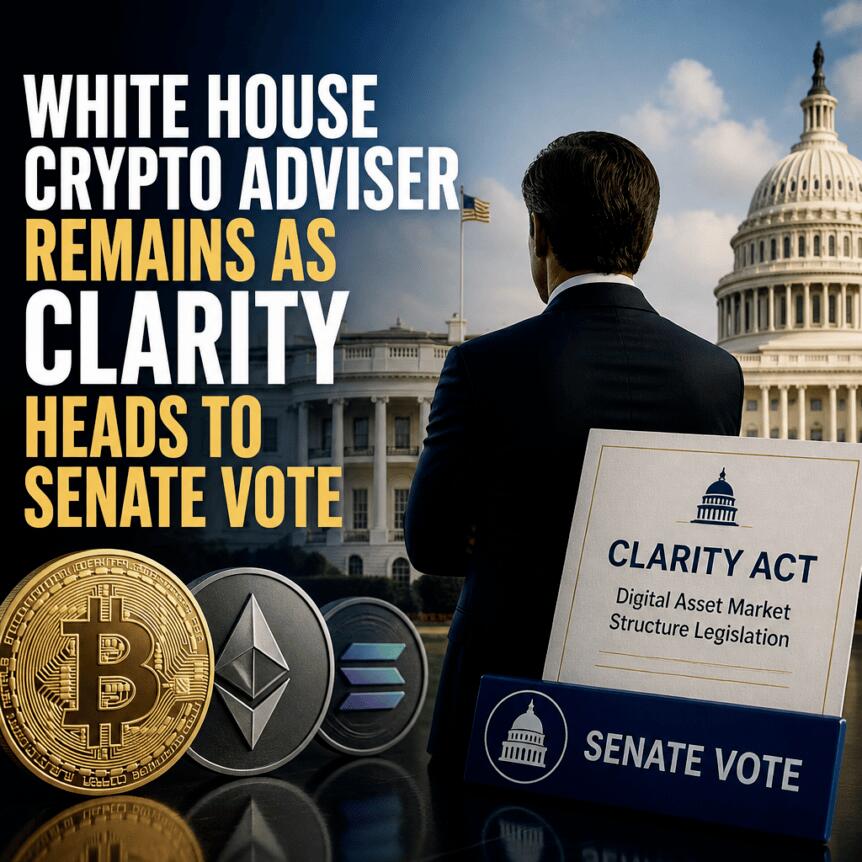
The White House’s top crypto adviser Patrick Witt says he will not depart for required military training at the end of this month, allowing him to remain at the White House to help push the Senate to act on the CLARITY Act. Witt is the administration’s lead negotiator for the legislation and framed the update as a step to ensure he can “see this effort through to the end.”
His announcement comes with the CLARITY Act facing a tight procedural window: the bill must clear the US Senate before the Aug. 8 recess. Witt previously was reported to be scheduled to begin Judge Advocate General (JAG) training with the Georgia Army National Guard on July 27, a program intended to qualify him to serve as a legal officer in the Guard.
Key takeaways
- Patrick Witt said his end-of-month military training has been deferred, so he can continue CLARITY Act negotiations at the White House.
- The CLARITY Act’s push is time-sensitive, with a stated deadline to pass the Senate before the Aug. 8 recess.
- Witt had been expected to report for JAG training on July 27, but the schedule change reduces the risk of leadership disruption during Senate deliberations.
- Witt’s continued presence arrives as Harry Jung, a senior figure at the President’s Council of Advisors for Digital Assets, plans to leave government service.
Why Witt staying matters for the CLARITY Act push
Witt’s role is directly tied to the administration’s negotiation strategy for CLARITY. As the White House’s lead negotiator, he is positioned to coordinate between lawmakers and stakeholders on the bill’s regulatory design—particularly as the Senate approaches the recess timeframe that could determine whether the measure advances this session.
In a post on X on Monday, Witt responded to reports that he was set to leave for mandatory training “right before” CLARITY reaches the Senate floor. Witt said he remains committed to his service obligation, but noted that his training has been deferred.
That change is not a small administrative update: with a deadline to clear the Senate before Aug. 8, continuity in the White House’s negotiating team can matter when legislators are weighing amendments, committee outcomes, and floor timing. If key personnel were forced to step away during a critical stretch, it could shift the balance of negotiations at a moment when the bill’s prospects depend on Senate process.
What the earlier training reports suggested
Before Monday’s clarification, reporting indicated Witt was expected to begin JAG training with the Georgia Army National Guard on July 27. The training is described as part of his obligations and is intended to qualify him for legal officer duties within the Guard.
Earlier coverage had framed the expected departure as timing-sensitive, with the implication that Witt would be away from the White House during the period when the bill’s momentum could be decided. Witt’s latest statement effectively adjusts that timeline, removing the immediate risk that his absence would coincide with the Senate’s decisive window.
Separately, a report from Crypto In America said Witt had already deferred his mandatory training in April to remain at the White House to work on CLARITY negotiations that, according to the report, extended beyond initial expectations. Monday’s development is therefore described as the second deferral, underscoring how central the legislation has become to the administration’s priorities for his time and attention.
Senate deadline heightens the stakes
The CLARITY Act is positioned by the White House as an effort to establish the first comprehensive US regulatory framework for the crypto market. In the current legislative cycle, timing appears to be the central constraint: the bill must pass the Senate before the Aug. 8 recess to keep it moving on a path forward.
Witt’s statement that he can “see this effort through to the end” signals that the administration is treating the remaining weeks before the recess as a decisive phase. It also suggests the White House views the negotiation work as something that requires sustained coordination right up until the bill’s Senate endgame.
Whether additional Senate activity—such as amendments, procedural votes, or negotiations with members across factions—will further test the bill’s schedule remains to be seen. What is clear from Witt’s update is that at least one potential personnel bottleneck has been removed.
Leadership shake-up at the digital assets council
Witt’s continued stay at the White House is occurring alongside a leadership transition within the President’s Council of Advisors for Digital Assets. Harry Jung, the council’s deputy director, announced that he plans to leave government service in about two weeks.
Jung wrote on X that he will depart with “immense gratitude,” stating that the past two years “transformed America’s position on crypto” and expressing pride in what the team accomplished. The announcement adds a new variable to the administration’s internal structure as CLARITY work continues.
According to Crypto In America, Jung had been slated to take over Witt’s responsibilities during Witt’s military leave, had that leave proceeded. With Witt now saying his training has been deferred, that handoff timeline may change—at least in the short term. However, Jung’s planned exit means the council will still face an adjustment period even if Witt remains in place.
For market participants, these kinds of transitions can be meaningful because regulatory bills often depend on consistent drafting, negotiation, and policy coordination. While the CLARITY Act’s legislative mechanics are ultimately determined by Congress, the administration’s negotiating capacity influences how quickly the bill’s terms can be refined and defended through the Senate process.
Readers should watch how the Senate timeline develops between now and the Aug. 8 recess, particularly for signs that additional amendments or procedural obstacles could alter the bill’s path. Witt’s deferred training reduces one risk to continuity, but Jung’s impending departure suggests the administration may still be working through staffing shifts as CLARITY approaches its critical phase.


Bernstein raised its price target on Robinhood Markets (NASDAQ: HOOD) to $160 from $130 and kept an "Outperform" rating, telling clients that revenue from the brokerage's prediction-markets business is set to surpass its crypto trading revenue. Analyst Gautam Chhugani projected prediction-market… Read the full story at The Defiant


Strategy Inc (NASDAQ: MSTR) sold 2,732,318 shares of its Class A common stock between July 13 and July 19, generating net proceeds of $263.5 million under its at-the-market offering program, according to an 8-K filed with the Securities and Exchange Commission on July 20. The company made no… Read the full story at The Defiant
Asian stocks rise as Mideast mediation takes oil lower

Strategy Bitcoin holdings stay at 843,775 BTC after $263.5M raise

Longtime Web-Weirdness Site Fark Faces Ad Pinch


![Sick Luke - MONEY MACHINE (feat. Lazza & Tony Effe) [Official Visual]](https://wordupnews.com/wp-content/uploads/2026/02/1770843044_maxresdefault-80x80.jpg)
-
 NewsBeat4 days ago
London Mayor Sadiq Khan handed a peerage by Keir Starmer alongside 15 other Labour figures… just days before the PM leaves No10
-

 Fashion3 days ago
Weekend Open Thread – Corporette.com
-

 Politics3 days ago
The House | The City of London can help the new chancellor deliver growth in every postcode
-

 Politics6 days ago
Young campaigners urge incoming PM to act on outdoor junk food ads
-

 Crypto World5 days ago
CFTC blocks Kalshi from unwinding Michigan trades after court order
-
 Crypto World4 days ago
Two July Windows Left: The CLARITY Act’s Senate Fight and What Failure Means
-

 Crypto World3 days ago
Ripple Payments Joins MiCA With 14 Firms, Does It Mean Anything For XRP?
-

 Business5 days ago
Nvidia Stock Slips After Big Tuesday Rally as Huang Confirms Vera Rubin Chip Is Now in Production Today
-

 Politics2 days ago
Democrats look to World Cup watch parties to register thousands of voters
-
 Entertainment5 days ago
Disney’s Most Ambitious Failed Star Wars Attraction Is Coming to SDCC
-

 Crypto World3 days ago
Ripple wins EU-wide access as ESMA adds it to MiCA register
-

 Business5 days ago
Palantir Shares Rise After Expanded Nvidia Partnership and Fresh Analyst Upgrades Ahead of Earnings Day
-

 Crypto World4 days ago
Injective Submits SEC Transfer-Agent Registration to Onchain Ownership Records
-

 Tech2 hours ago
Sail Virtually Aboard The “Itanic” With IA-64 Emulator
-

 News Videos6 days ago
XRP BOMBSHELL… XRP OMBOARDED FOR TRANSACTIONS!!!
-

 NewsBeat4 days ago
Registration is now open for March for Men with Kev 2026
-

 Tech7 days ago
Get Your ESP32 Sunny Side Up With This Solar Dev Board
-

 Tech6 days ago
Dark Secrets Emerge When Jailbreaking LLMs
-

 NewsBeat16 hours ago
Unregistered fitter used Gas Safe logo on business flyers
-
 Sports5 days ago
New Cornerback Enters Vikings Trade Rumor Mill
You must be logged in to post a comment Login