

Crypto World
Capital One bet big on Discover. Now it must prove the gamble was worth it


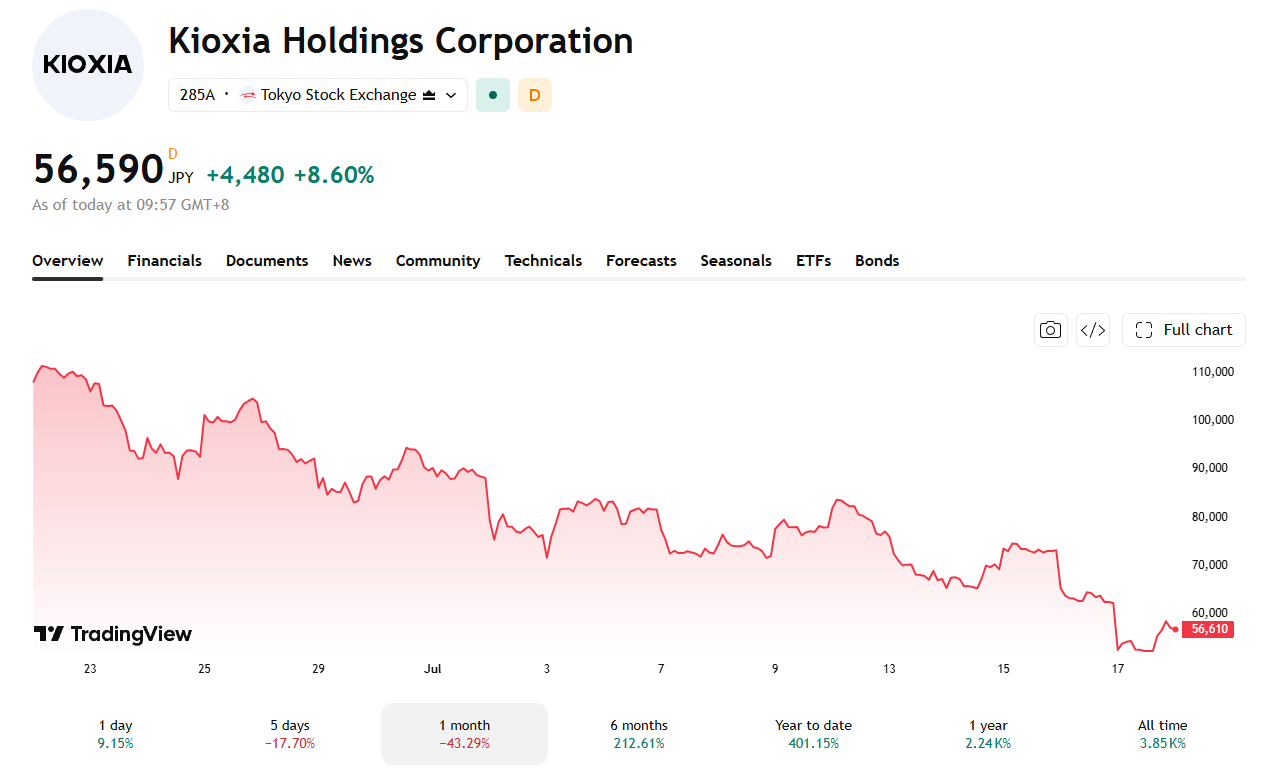
Japan’s Kioxia Holdings Corporation (285A) stock crashed 45% in a month, but Wall Street analysts still expect it to climb another 118% from here.
That gap raises an obvious question. Why do so many analysts still back a stock that crashed this fast?
The Bull Case Analysts Are Sticking To
Kioxia shares fell to a low of ¥52,110 last Friday, but have managed a small comeback, up nearly 9%, to ¥55,860 on Tuesday, July 21. However, this still leaves the stock down 42% for the month, currently.
This is especially noteworthy given Kioxia hit a record high of ¥111,250 on June 22, making it briefly Japan’s largest company by market cap, overtaking Toyota.
Despite this boom-and-bust, Kazuyoshi Saito, senior analyst at Iwai Cosmo Securities, still holds his target at ¥132,000.
“The fundamentals have not changed at all,” Saito said.
He argues the AI-driven demand story remains solid. He expects the shares to recover once technical selling fades.
Meanwhile, Nomura Securities raised its target from ¥115,000 to ¥126,000 last week. Huaxing Research lifted its target above ¥100,000 around the same time. The consensus target near ¥121,959 implies about 118% upside from Tuesday’s close.
Why the Bulls Look Out of Step With the Chart
Kioxia’s chart doesn’t look like a stock about to rally 118%. The stock’s boom-to-bust reversal has wiped out most of this year’s gains.

Some analysts say the memory stock rally has run too far, not just cooled off.
In contrast, Ikio Mitsuishi, portfolio manager at Aizu Securities, expects Kioxia to stay weak until at least late August. He said investors may avoid piling back into one stock so fast. Many could rotate into cheaper, less volatile names instead.
A Pattern That Goes Beyond Kioxia
Kioxia isn’t the only Asian chipmaker swinging this hard. SK Hynix’s Nasdaq-listed shares have surged more than 20% in a day, then dropped double digits days later.
The wider chip selloff across Japan has erased trillions of yen in market value this month.
The real test for Kioxia bulls isn’t the target price. It’s whether Asia’s chip-stock volatility settles down before earnings season arrives.
The post Kioxia Crashed 45% in a Month: Why Are Analysts Still This Bullish? appeared first on BeInCrypto.
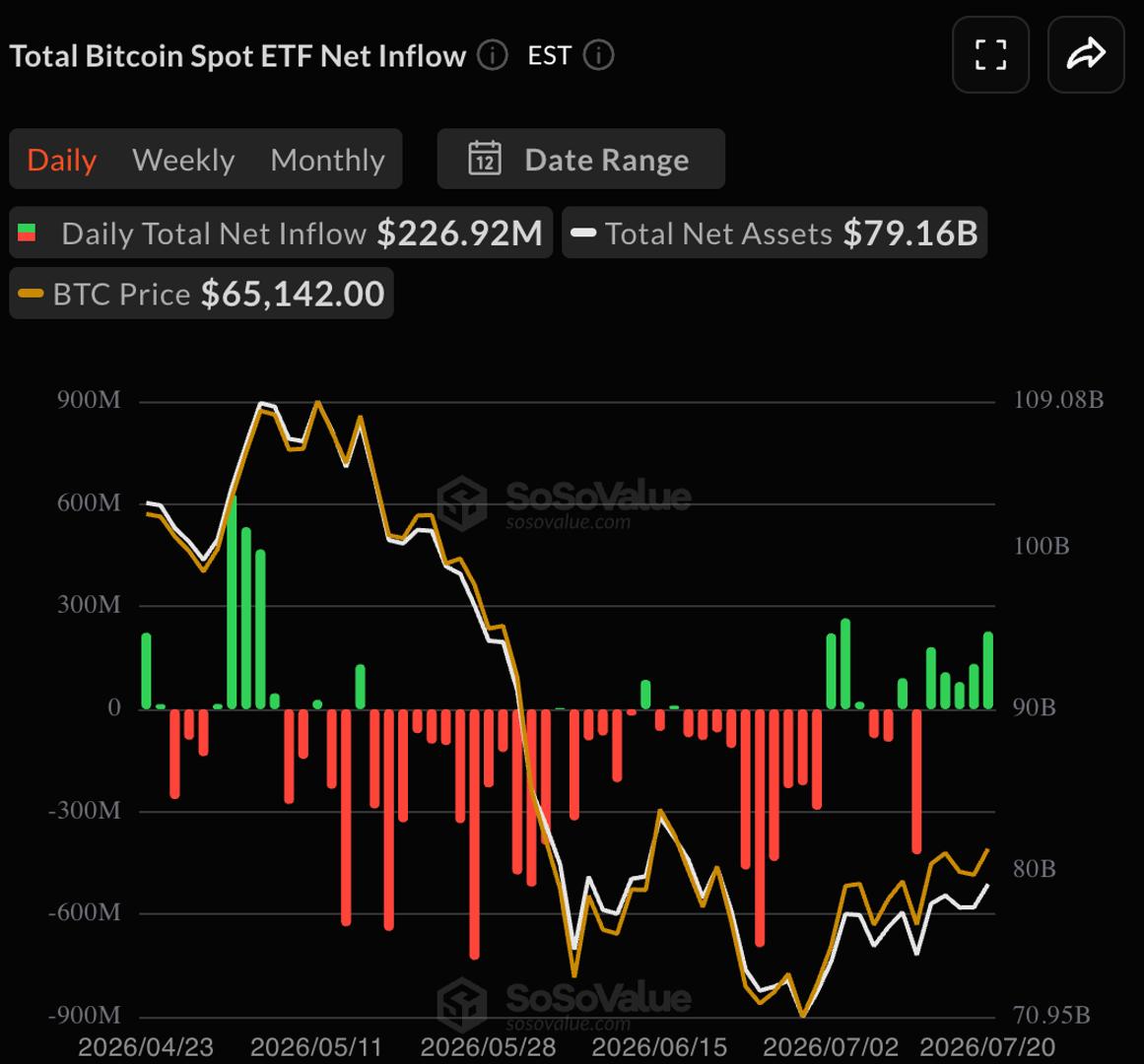
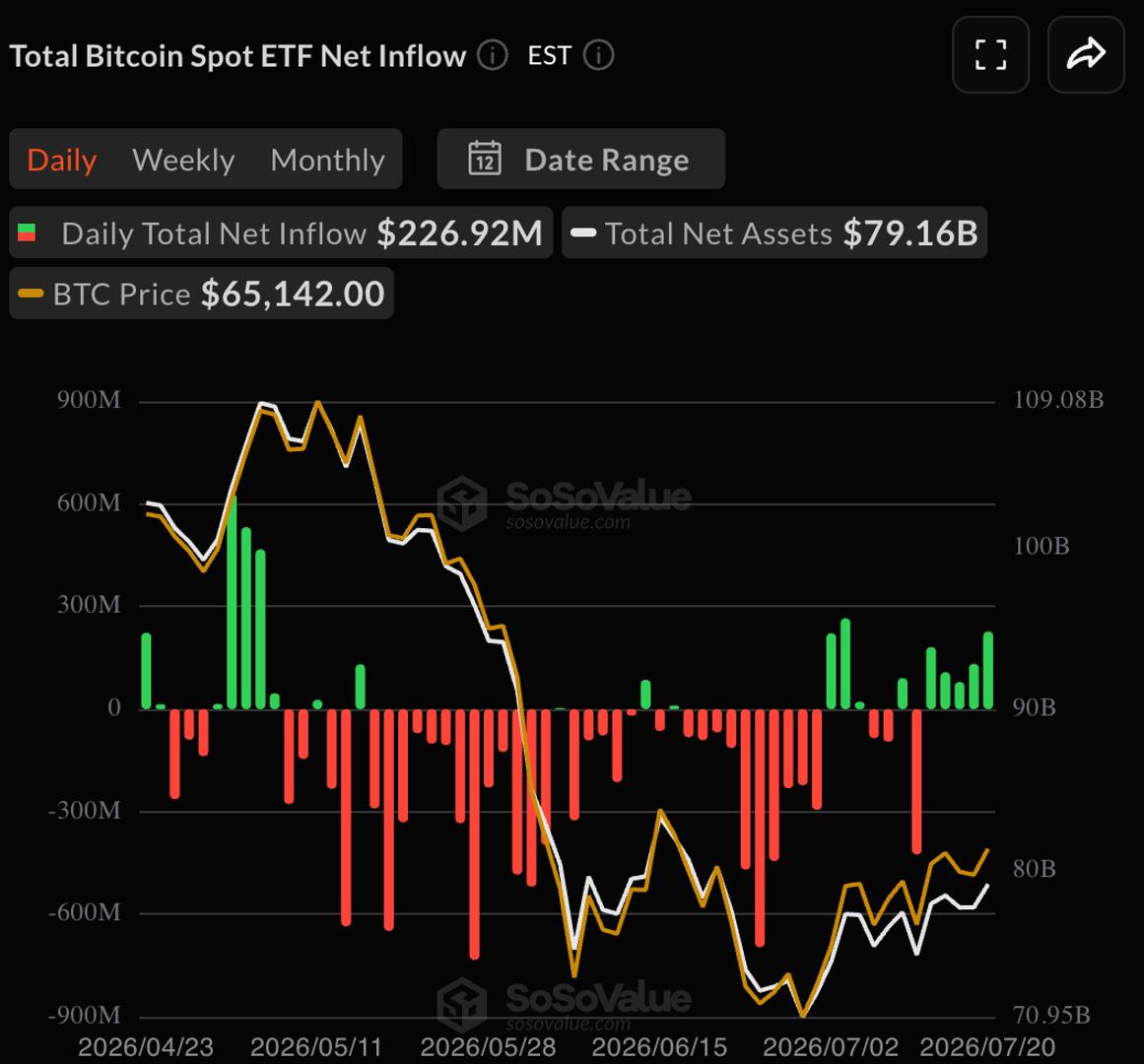
U.S. spot bitcoin ETFs took in about $227 million on July 20, a fifth consecutive day of net inflows for the first time since late April, per SoSoValue data. Ether ETFs added about $38 million, led by BlackRock’s ETHA.
The five-day run has pulled in roughly $727 million, the most sustained stretch of buying since the record outflows of June. Total bitcoin ETF assets have climbed back to about $79 billion from a July low near $75 billion. BlackRock’s ETHA drove the ether side with about $34 million.
Bitcoin has held its range near $63,000 as last week’s chip-driven selloff paused, and the return of the ETF bid is the piece that had been missing through a quarter of mostly outflows.
The test is what it holds through. The Fed meets July 28 and 29, and Big Tech earnings land this week, with Alphabet, Tesla and Intel reporting the numbers that will show whether AI spending, the trade bitcoin has moved with all month, is still climbing.


UK politicians want to know the extent to which the country’s banks have choked-off cryptocurrency firms by refusing them bank accounts and introducing restrictions on crypto-related payments, in a cross-party inquiry kicked off on Tuesday.
The UK’s Crypto and Digital Assets All-Party Parliamentary Group (APPG) is chaired by Lord Vaizey of Didcot, the former UK Government Minister for the Digital Economy, and Labour MP Gurinder Singh Josan CBE, according to a press release.
Ever since crypto came into being, difficulties around attaining banking relationships have made life hard for players in the space, with a systematic debanking of firms and individuals, particularly in the U.S. being referred to as “Operation Chokepoint 2.0.”
Several major UK banks have also introduced restrictions on crypto-related payments, the APPG said in a statement. As such the inquiry will focus on a dearth of bank accounts for crypto businesses, including associated professional services such as insurance.

The U.S. Securities and Exchange Commission (SEC) has filed a lawsuit against crypto mining investment firm Mining Automatic and its founder, Zan Shaikh, accusing them of raising $22 million from investors while allocating only a small portion of the money—about 13%—to mining operations.
According to the SEC’s complaint, the scheme was run through Massachusetts-based Bright Vision Distribution LLC. The agency alleges the business collected funds from more than 380 investors between June 2023 and May 2025, promising monthly, guaranteed returns tied to cryptocurrency mining.
Key takeaways
- The SEC alleges investors were promised guaranteed monthly returns from mining, despite the company generating far less revenue from mining than it paid out.
- Proceeds, according to the SEC, were heavily directed toward advertising and personal or unrelated expenditures rather than mining operations.
- The SEC says Mining Automatic stopped making investor payments by March 2025 and that investors had not recovered their principal.
- The regulator is also signaling a broader shift toward rulemaking for digital assets alongside enforcement actions.
SEC alleges mining payouts didn’t match promised returns
The core allegation in the SEC’s complaint is that the promotional claims did not reflect the operation’s financial reality. The agency states that Mining Automatic advertised payouts as returns from crypto asset mining while its mining activities allegedly produced only about $1.1 million.
Meanwhile, the SEC claims investors received roughly $1.8 million in purported returns. The agency argues that the shortfall required payments to be funded using money from other investors, describing the operation as having “some of the hallmarks of a Ponzi scheme.”
In addition to questioning the returns model, the SEC points to how investor funds were used. The complaint alleges that about $7 million was spent on advertising to attract additional investors, while Shaikh purportedly used investor money for real estate, vehicles, entertainment, and transfers into personal accounts.
Fundraising scope and alleged investor exposure
In its filing, the SEC says Bright Vision Distribution LLC collected the $22 million from more than 380 investors over a two-year span, from June 2023 through May 2025. The SEC also alleges that as the program unraveled, payments stopped by March 2025.
Once payments halted, the SEC contends that none of the investors had recovered their original investment amounts. The complaint states that more than $20 million in principal remains unpaid, according to the SEC’s allegations.
For investors and market participants, the lawsuit underscores a recurring risk in the crypto-adjacent “yield” space: returns tied to mining or other on-chain activities can be presented in a way that obscures financing gaps, and “guaranteed” payout language can draw closer scrutiny from securities regulators.
Regulator seeks penalties and restrictions on Shaikh
The SEC is seeking multiple remedies in the case, including disgorgement and civil penalties. The agency also requests permanent injunctions and asks the court to bar Shaikh from selling securities and from serving as an officer or director of a public company.
These requests reflect the SEC’s typical enforcement posture in cases that it frames as securities fraud and unregistered securities activity, particularly where the regulator argues investor money was misused and returns were not supported by the underlying business model.
The complaint is publicly available on the SEC’s website: SEC litigation document.
Enforcement arrives amid SEC’s stated rulemaking push
While the Mining Automatic case focuses on alleged wrongdoing by a specific operator, it is also landing during a broader period in which the SEC has emphasized building clearer regulatory frameworks for digital assets. Under Chair Paul Atkins, the agency has increasingly pointed to rulemaking efforts rather than relying solely on enforcement.
In June, the SEC published its 2026–2030 Strategic Plan, identifying blockchain technology, tokenization, and crypto market infrastructure among its long-term priorities while reaffirming its investor-protection mandate. Later, in July, the SEC outlined a 2026 rulemaking agenda that includes potential new rules for crypto broker-dealers, digital assets traded on national securities exchanges and alternative trading systems, and possible exemptions or safe harbors for certain digital asset offerings. (The SEC’s agenda was covered in earlier reporting by Cointelegraph: SEC crypto rule changes 2026 agenda.)
At the same time, congressional activity is also aimed at reshaping how U.S. oversight works across agencies. A proposed legislative package—referred to as the Digital Asset Market Clarity Act—would, if enacted, clarify the respective roles of the SEC and the Commodity Futures Trading Commission (CFTC). The bill is expected to face a key Senate vote before the August recess, according to the broader legislative timeline described alongside recent crypto oversight coverage.
In that context, the Mining Automatic lawsuit functions as both a case-specific warning and a signal of where the SEC may draw lines: where a company offers “investment” arrangements with promised returns, the regulator may treat the arrangement through a securities lens—especially when the underlying economics do not appear to support the payout structure.
What to watch next
Investors and builders should watch how the court addresses the SEC’s allegations about the mismatch between advertised mining returns and the company’s stated mining revenue, as well as whether the SEC’s accompanying push toward digital-asset rulemaking eventually narrows the space for similarly structured “guaranteed return” offerings. In the meantime, the case adds another enforcement datapoint for anyone evaluating crypto-linked investment products marketed as stable, predictable yield.
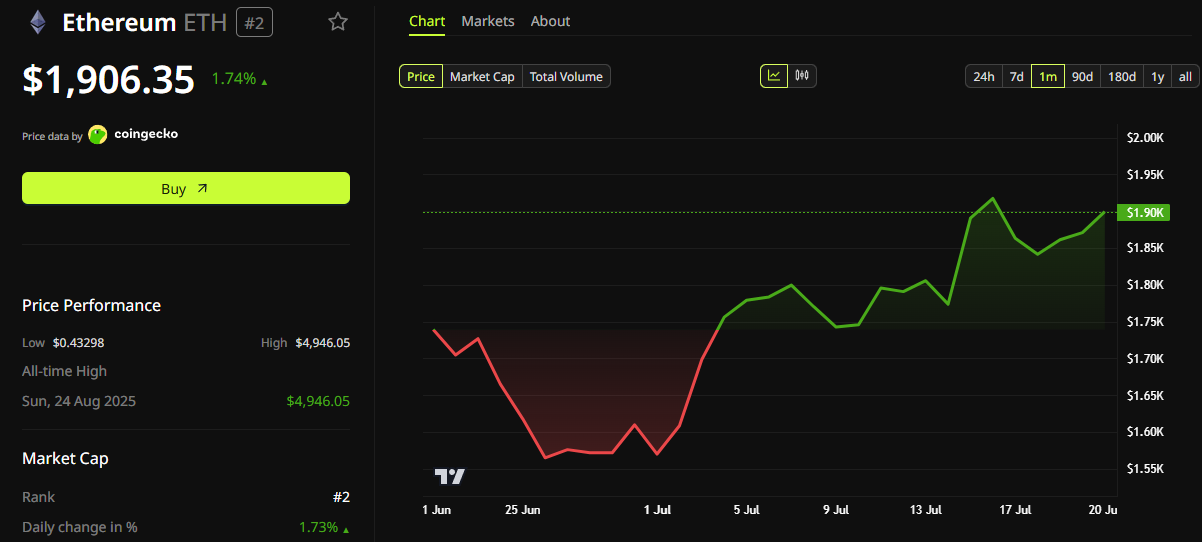
Arthur Hayes bought another 1,332.5 ETH ($2.53 million) today, according to on-chain tracking data shared on X. The purchase extends a buying streak from the BitMEX co-founder. It also renews attention on Ethereum’s institutional demand story.
Hayes sold 6,000 ETH at a roughly $606,000 loss in June. He then reversed course with a series of buybacks in July as some discuss Ethereum’s role in the next bull run for crypto.
Hayes Extends a Pattern of ETH Accumulation
The latest purchase follows Hayes’ return to Ethereum earlier this month. He acquired roughly 1,939 ETH then across two OTC-style transactions. That reversal came weeks after his June exit.
Critics have flagged Hayes’ record of praising tokens like HYPE, ZEC, and WLD before quietly exiting those positions. Ether trades at $1,906, up 1.74% over 24 hours, with a market capitalization over $230 billion.

Some See Institutional Demand Driving the Next Cycle
With some larger accumulation and whale movement around ETH, some are noting a broader shift in Ethereum’s bull case toward institutions. Bitmine Immersion Technologies Chairman Tom Lee argues that Wall Street adoption now drives Ethereum’s growth, not crypto-native speculation. He points to BlackRock’s tokenized BUIDL fund and Robinhood Chain’s use of ETH as a gas token.
“Unlike the crypto bear market of 2022, Wall Street is building on Ethereum.”
— Tom Lee
The staking data backs that thesis. Ethereum’s staking ratio hit an all-time high of above 33% at the end of June, according to CryptoQuant. BlackRock helped drive that shift when it launched the iShares Staked Ethereum ETF, which locks most of its holdings in staking contracts.
Institutions and ETFs held more than 9% of Ethereum’s total supply as of last year, and that share has likely grown since. Also last year, Standard Chartered’s Geoff Kendrick argued that Ethereum treasuries are among the strongest institutional crypto trades available, citing staking yield and stronger valuations compared with Bitcoin and Solana treasury vehicles.
Hayes’ latest buy may reflect conviction in that institutional thesis. Or it may just be another short-term trade. The coming days should make it clearer.
The post Ethereum Could Lead the Next Bull Market: Is Hayes Preparing with More Buys? appeared first on BeInCrypto.
Crypto World
Cramer Says Dump Tech Before Intel, Tesla, Alphabet Earnings: Will Inverse-Cramer Strike?

Jim Cramer told “Mad Money” viewers to avoid new tech buys just as Intel, Tesla, and Alphabet prepare to report earnings this week, reviving questions about whether the Inverse-Cramer Effect will strike again.
The host said he is directing new money into industrials and financials instead. He named FedEx, Honeywell Aerospace, and Goldman Sachs as safer bets during the current selloff.
A Pattern Already in Motion for Cramer
Cramer’s tech retreat follows his own Inverse-Cramer Effect moment. He called Intel his favorite chip stock on July 15. The shares sank roughly 8% hours later, even after ASML confirmed a manufacturing milestone.
That reversal revived a running Wall Street joke. Traders often profit more from betting against Cramer’s on-air calls than from following them. The same pattern hit Nike, which crashed 15% hours after a bullish Cramer call.
Cramer has swung bullish elsewhere too. He issued a call to buy Nvidia even as a broader AI chip stock selloff rattled the sector.
Three Earnings, One Test
Intel reports second-quarter results Thursday, July 23 and analysts expect earnings near $0.21 per share. That would mark a swing from a $0.10 per-share loss a year ago. They also expect revenue of roughly $14.4 billion, up close to 12% year over year.
Alphabet and Tesla both report Wednesday, July 22, after the close. Analysts expect Alphabet to post earnings of $2.87 per share, up 24.2% year over year. They project Google Cloud revenue will reach $22.79 billion, up 67.3%.
Tesla delivered 480,126 vehicles last quarter, well above estimates. Analysts expect revenue near $25.81 billion and earnings of $0.50 per share. The stock still trades at 177 times forward earnings, the richest multiple among its mega-cap peers.
Some analysts already see a bull case forming for chip stocks if Alphabet’s cloud and AI hardware numbers beat expectations.
If all three names rally on their reports, Cramer’s tech exodus will look premature. If they stumble, his rotation call holds, and the Inverse-Cramer Effect stays benched for at least one more week.
The post Cramer Says Dump Tech Before Intel, Tesla, Alphabet Earnings: Will Inverse-Cramer Strike? appeared first on BeInCrypto.


Key takeaways
- Stellar (XLM) continues to trade in narrow ranges as investors await the next major price catalyst.
- Derivatives data presents mixed signals, with bearish long-to-short ratios offset by positive funding rates for XLM.
- XLM remains below key moving averages, leaving its short-term outlook dependent on whether bulls can reclaim major resistance levels.
Stellar (XLM) is trading within narrow ranges on Tuesday as investors weighed conflicting signals from derivatives markets and on-chain activity. Stellar remains under pressure near an important support area.
The combination of bearish positioning in derivatives markets and improving funding rates suggests traders remain divided on the next major move, increasing the likelihood of heightened volatility in the coming sessions.
Derivatives data paints a mixed picture for XLM
Market positioning remains uncertain across both cryptocurrencies. According to CoinGlass, the long-to-short ratio stood at 0.81 for XLM on Tuesday.
Ratios below one indicate that short positions continue to outnumber long positions, reflecting a cautious outlook among derivatives traders.
However, funding rates tell a different story. Stellar’s funding rate flipped positive on Monday and reached 0.0068%.
Positive funding rates indicate that traders holding long positions are paying those with short positions, a sign that bullish sentiment is gradually improving despite the dominance of bearish bets.
Data from CryptoQuant indicates selling pressure continues to dominate both the spot and derivatives markets, with large whale orders pointing toward cautious investor sentiment.
This persistent selling activity could limit the token’s ability to sustain any meaningful upside in the near term.
Key support remains under pressure
Stellar was trading around $0.187, continuing to consolidate near a critical support zone.
The token remains below its 50-day EMA near $0.189, while hovering just above the 100-day EMA around $0.187, indicating that buyers are attempting to defend this level despite the broader bearish trend.
Momentum indicators remain relatively subdued. The RSI is positioned near 53, reflecting weak but stable momentum, while a slightly positive MACD reading points to consolidation rather than a strong directional move.
On the upside, Stellar faces immediate resistance at the 50-day EMA, followed by the 200-day EMA near $0.196 and the 61.8% Fibonacci retracement level around $0.200.

If selling pressure resumes, initial support lies at the 100-day EMA near $0.187, followed by the horizontal support at $0.177 and the 78.6% Fibonacci retracement around $0.173. A deeper correction could expose the long-term support level near $0.142.
With technical indicators sending mixed signals and derivatives markets reflecting growing indecision, both XRP and Stellar appear to be approaching a pivotal point where a decisive breakout or breakdown could determine their next medium-term trend.

Bitcoin momentum is rebuilding, but confirmation has not arrived yet, said analytics platform Swissblock on Monday as BTC tapped a five-week high of $65,700.
“Bitcoin has exited its capitulation regime and is once again inside the transition area,” they added.
Swissblock identified the current area as “where a new impulse begins, or momentum fades back into weakness.”
Where to Next for Bitcoin?
It added that the next test is clear and it needs to “reclaim the ignition line” to push above the “next Inflection point.” “Every sustained rally began with this sequence, but not every transition has succeeded,” it said.
Bitcoin has been in the capitulation zone since early June when it fell below $70,000, having remained below it ever since. It hit a current cycle low of around $58,000 at the end of June and has been trending higher ever since, gaining 12% over the past three weeks, which has moved it into a higher momentum or transition zone.
Is a bitcoin:native breakout on the verge of happening?
Momentum is rebuilding, but confirmation has not arrived yet.
Bitcoin has exited its Capitulation regime and is once again inside the Transition Area.
This is where a new impulse begins or momentum fades back into… pic.twitter.com/m0GBVttR7n
— Swissblock (@swissblock__) July 20, 2026
CryptoQuant analyst ‘Darkfost’ said on Monday that Bitcoin has spent 95% of its time at a higher MVRV. This metric compares market cap, calculated as price multiplied by supply, with its realized value, which reflects the price of each coin when it last moved.
“This shows just how significantly undervalued BTC is today compared to its historical evolution.”
Meanwhile, crypto trader ‘Daan’ said the $65,000 level has capped price for the entirety of July so far, before adding:
“But I do think the longer price spends here, the more likely the $65K level is to break. Especially with the higher lows being made over the past 3 weeks.”
BTC Price Outlook
Bitcoin was trading at $65,500 at the time of writing, following a 1% gain on the day. It tapped $65,700 in late trading on Monday, which is its highest level since June 15 when it topped $67,000 briefly.
Zooming out shows that the asset remains within a seven-week range-bound channel, but at resistance at the upper bounds of that channel.
“If BTC breaks above $66K, the next key level to watch is $66,700,” said Alphractal founder and CEO Joao Wedson.
“This is the Structural Midline, a key on-chain level from the Structural Market Bands that has historically acted as a highly reliable reaction zone,” he said before adding that bears will likely try to regain control around this area.
The post Bitcoin Has Exited Capitulation Regime as Momentum Rebuilds: Analysts appeared first on CryptoPotato.


The U.S. Commodity Futures Trading Commission ordered KalshiEX, LLC to fulfill trades that a Michigan state court had directed the prediction-market operator to cancel, escalating a fight over whether states can reach into federally regulated derivatives venues. In Release Number 9267-26, dated… Read the full story at The Defiant
Two other supports lined up behind the move. U.S. spot bitcoin ETFs have now drawn inflows for five straight sessions totaling more than $600 million, the most sustained institutional buying since mid-July and a reversal of the eight-week outflow run that ran through late June.
And oil, which had climbed for two days on the war, pulled back, with Brent falling 1% to about $88.58 as Iran said mediators were circulating proposals to ease hostilities, including a reported suggestion for a 10-day halt in strikes.
“Current bitcoin and ether prices are low but fair, given the macro uncertainties pervading markets,” said Jeff Mei, chief operating officer at BTSE, who pointed to the Fed meeting as the event traders are positioned around.
“Traders expect rates to hold steady but are looking for more signals as to what’s to come later in the year,” Mei added.
The read on that meeting is where the rally meets its limit. The Federal Reserve gathers July 28 and 29, and markets put the odds of a July rate increase at about 15%, though a September move is still live.
Spot-market volume across crypto stayed subdued even as prices rose, the sign of a tape lifted by returning risk appetite rather than fresh conviction, and higher oil and Treasury yields remain the levers that could keep the Fed hawkish and cap risk assets.

Benches clear in Pirates-Yankees game after Santana shouts at Caballero

What time and TV channel is Larne v Red Star Belgrade on today in the Champions League?

MinRes' crushing arm widens crane fight


-
 NewsBeat5 days ago
London Mayor Sadiq Khan handed a peerage by Keir Starmer alongside 15 other Labour figures… just days before the PM leaves No10
-

 Fashion4 days ago
Weekend Open Thread – Corporette.com
-

 Politics3 days ago
The House | The City of London can help the new chancellor deliver growth in every postcode
-

 Politics6 days ago
Young campaigners urge incoming PM to act on outdoor junk food ads
-

 Crypto World5 days ago
CFTC blocks Kalshi from unwinding Michigan trades after court order
-
 Crypto World4 days ago
Two July Windows Left: The CLARITY Act’s Senate Fight and What Failure Means
-

 Crypto World3 days ago
Ripple Payments Joins MiCA With 14 Firms, Does It Mean Anything For XRP?
-

 Business5 days ago
Nvidia Stock Slips After Big Tuesday Rally as Huang Confirms Vera Rubin Chip Is Now in Production Today
-

 Politics2 days ago
Democrats look to World Cup watch parties to register thousands of voters
-
 Entertainment6 days ago
Disney’s Most Ambitious Failed Star Wars Attraction Is Coming to SDCC
-

 Crypto World3 days ago
Ripple wins EU-wide access as ESMA adds it to MiCA register
-

 Crypto World4 days ago
Injective Submits SEC Transfer-Agent Registration to Onchain Ownership Records
-

 Business5 days ago
Palantir Shares Rise After Expanded Nvidia Partnership and Fresh Analyst Upgrades Ahead of Earnings Day
-

 Tech6 hours ago
Sail Virtually Aboard The “Itanic” With IA-64 Emulator
-
 Tech4 hours ago
Turtle Beach Command Series KB7 review: a nifty screen-equipped gaming keyboard
-

 News Videos6 days ago
XRP BOMBSHELL… XRP OMBOARDED FOR TRANSACTIONS!!!
-

 Tech6 days ago
Dark Secrets Emerge When Jailbreaking LLMs
-

 NewsBeat4 days ago
Registration is now open for March for Men with Kev 2026
-

 NewsBeat20 hours ago
Unregistered fitter used Gas Safe logo on business flyers
-
 Sports5 days ago
New Cornerback Enters Vikings Trade Rumor Mill
You must be logged in to post a comment Login