

Crypto World
Cardano’s Charles Hoskinson Outlines Strategic Funding Roadmap for 2026: Here’s What’s New



Charles Hoskinson speaks about the 2026 funding agenda and how the Cardano ecosystem should evolve going forward.
In a recently released hour-long video, Charles Hoskinson provided considerable insights into how funding for Cardano’s ecosystem will function in 2026. He also pointed out a few pressure points and how the team plans to tackle them.
There’s nothing here that, with the money that we have, Cardano can’t fix. – Said Hoskinson, while outlining critical flaws in existing models.
The Existing Pillars in Cardano’s Funding Focus
Starting off, Hoskinson said that the ecosystem funding model is generally broken down into three layers: infrastructure, utility, and experience. He outlined that historically, Cardano’s funding has been overrepresented within the infrastructure module and underrepresented within the utility and experience modules.
Infrastructure includes nodes like Ouroboros Leios, Plutus, and Aiken, while utility is what users can do with that infrastructure. This includes building decentralized applications within the broader DeFi ecosystem. Experience, on the other hand, is how users interact with the entire system – through wallets, account abstraction, and on/off ramps.
Hoskinson pointed out that the cost to run and build a node team is about $1 to $5 million per year, requiring between 10 and 40 full-time engineers. He said that the recommended infrastructure to fund includes three already mature node projects – Haskell, Rust, and Go, unified by Project Bluepring plus Hydra, and languages such as Aiken and Plutus.
Funding Utility and Strategic Goals in 2026
Acknowledging that the current state of the Cardano ecosystem is unfavorable (low MAU, TVL, and transaction volume), Hoskinson proposes funding the Utility layer. But this comes with certain conditions, including oversight, OPEX reduction, salary cuts, and alignment with strategic goals.
The idea is to create a weighted index of project tokens, and for the treasury to purchase 10-30% of each project’s total supply in the index.
Strategic goals for the dApps included in the investment rounds should include Bitcoin DeFi, specifically by using the Pogan protocol, as well as upgrading to be hybrid dApps with Midnight for increased privacy.
You may also like:
Moreover, a portion of the protocol revenue (example given with 10%) must be used to buy ADA and donate it back to the treasury. With that, these investments are expected to pay for themselves in one to three years as the treasury divests from the appreciating index.
The Experience Layer
Speaking about funding the Experience layer, Hoskinson said it needs funding to rebuild the ambassador and KOL layer, improve user onboarding, and support wallet providers.
He said that the ecosystem needs somewhere between 20 and 30 high-value hackathons each year to improve the developer experience.
Hoskinson pointed out that in order for the ecosystem to attract external capital, it must be willing to invest in itself. Moreover, he outlined that fragmented and competitive treasury proposals create a “race to the bottom,” while staying firm on the fact that the strategy should be unified.
Binance Free $600 (CryptoPotato Exclusive): Use this link to register a new account and receive $600 exclusive welcome offer on Binance (full details).
LIMITED OFFER for CryptoPotato readers at Bybit: Use this link to register and open a $500 FREE position on any coin!

Wells Fargo has filed a trademark application for “WFUSD,” sparking speculation that the U.S. banking giant may be exploring a blockchain-based payment token or stablecoin.
Summary
- Wells Fargo filed a trademark for “WFUSD,” covering crypto-related payment and digital asset services.
- The move may signal exploration of a bank-issued stablecoin or blockchain-based settlement token.
- The filing comes as Wall Street banks prepare for clearer U.S. stablecoin regulation and expanding digital asset adoption.
According to the filing, the mark covers financial services tied to digital assets, including cryptocurrency-related payments and electronic financial transactions.
While Wells Fargo has not announced a product tied to the name, the application has raised the possibility that Wells Fargo could be preparing a dollar-pegged digital asset.
If launched, WFUSD would place the bank among a growing group of major financial institutions experimenting with blockchain-based settlement tools and tokenized payments. Banks have increasingly explored digital tokens as a way to move funds instantly and reduce costs in cross-border or institutional transfers.
The move would also reflect a broader trend of Wall Street firms expanding their crypto strategies. For example, JPMorgan Chase previously launched its blockchain-based payment token, JPM Coin, to facilitate institutional transactions across its internal network.
A potential stablecoin from Wells Fargo could emerge as regulatory clarity around digital dollar tokens improves in the United States. Policymakers have been working toward frameworks that would place stablecoin issuers under stricter oversight, a development that many analysts believe could favor large regulated banks entering the market.
If regulatory rules solidify, traditional financial institutions may become major issuers of dollar-backed digital assets, competing with established stablecoin providers such as Circle and Tether Limited.
For now, the WFUSD filing does not confirm a forthcoming launch, but it shows how major banks are positioning themselves for a financial system increasingly influenced by blockchain-based infrastructure.

Prediction market Kalshi has sued regulators in the US state of Iowa, claiming it did so as there was a risk of an impending enforcement action over its sports event contracts.
Kalshi sued Iowa Attorney General Brenna Bird, along with the Iowa Racing and Gaming Commission and its board, in an Iowa federal court on Wednesday, claiming there “is a substantial risk” Bird would bring enforcement action to block the company’s event contracts.
In its complaint, Kalshi said a company representative met with Bird for what was believed to be a discussion about a tax bill currently under consideration in the Iowa legislature.
“Instead, he [Kalshi’s representative] was greeted by a panel of attorneys, including Iowa’s Solicitor General, who proceeded to ask a series of pointed questions challenging whether Kalshi’s federally regulated offerings ran afoul of (preempted) Iowa state law,” Kalshi claimed.

After the meeting, Kalshi said it contacted a representative for the Attorney General on Tuesday “to seek assurances that the Iowa AG did not intend to bring an enforcement action against Kalshi.”
“The representative did not provide such assurances,” Kalshi said. “To the contrary, the official said in writing that ‘we will not give any assurances about potential future enforcement.’”
Cointelegraph contacted Bird’s office and the Iowa Racing and Gaming Commission for comment.
Prediction markets fight states over sports contracts
Kalshi’s lawsuit against Iowa is the company’s latest legal action targeted at a US state regulator over whether it can offer event contracts across the US.
In the latest lawsuit, Kalshi argued that “federal law preempts Iowa from subjecting Kalshi to state law,” and as a designated contract market, it is subject to the “exclusive jurisdiction” of the Commodity Futures Trading Commission.
The company has made a similar argument in multiple court cases with other state gambling regulators over the legality of sports event contracts.
Related: US Senate bill targets prediction markets on war and assassinations
Many state regulators have alleged that the contracts, which allow users to bet on the outcome of sporting events, are gambling, subject to separate state-level laws, and are offered without a license.
Federal courts have differed in their response to the lawsuits.
On Monday, an Ohio federal court denied Kalshi’s request to block Ohio regulators from taking action against its sports contracts, saying the company failed to show that they were subject to the CFTC’s jurisdiction.
A federal court in Massachusetts blocked Kalshi from offering event contracts in the state earlier this year, and Nevada sued the company last month after an appeals court knocked back Kalshi’s bid to stop the state from taking action.
Federal courts in New Jersey and Tennessee, in contrast, have sided with Kalshi to temporarily block state regulators from taking action over the company’s sports event contracts.
Magazine: How crypto laws changed in 2025 — and how they’ll change in 2026
Bitcoin price risks a drop back to the $65,000 zone as bearish macroeconomic forces continue to impact investor risk sentiment.
Summary
- Bitcoin price failed to hold the $70,000 support on Thursday.
- Investor demand for risk assets dropped amid surging oil prices and rising U.S. Treasury yields.
- The latest U.S. CPI print came in line with market expectations, which can force the Fed to keep interest rates elevated for a longer period.
According to data from crypto.news, Bitcoin (BTC) price fell 4.8% over the past 7 days, dropping below the $70,000 support level. Trading at $69,385 at the time of writing, the bellwether was nearly 29% below its year-to-date high of around $97,500 and 45% from its all-time high.
Currently, Bitcoin faces a number of geopolitical and macroeconomic risks that could push its price towards $65,000 and subsequently the $60,000 mark.
First, Iran has announced that it would change its retaliation strategy in the Middle East from reciprocal hits to continuous strikes against the interests of its adversaries, a move intended to punish Israel and the United States.
Additionally, Tehran said that it would continue blocking all ships carrying oil to Israel and the United States from using the Strait of Hormuz, where millions of barrels of crude pass through daily.
Through these measures, Iran aims to push crude oil prices to as high as $200, a move that could ultimately lead to higher inflation throughout the world, with the greatest impact coming on the U.S., which remains sensitive to energy price shocks. This escalating tension in the Middle East has historically driven investors away from volatile assets like cryptocurrency and into traditional safe havens.
Second, Wednesday’s U.S. core CPI data for February came in line with market expectations, essentially forcing the Federal Reserve to maintain elevated interest rates for a longer period.
Meanwhile, if the war continues to drive up energy costs, it could fuel inflation further and dampen any hopes for a pivot in monetary policy this year. Higher interest rates typically sap the liquidity necessary for speculative assets to thrive.
According to the CME FedWatch data, there is a 99.3% chance that the interest rates will remain unchanged during the March FOMC meeting, with the current target rate sitting at 350 to 375 basis points. Odds of an April rate cut meanwhile stood at just 10.9% when writing, down sharply from 21% one month earlier.
It should also be noted that February inflation data came without fully accounting for the recent impact of surging oil prices and hence does not reflect the hawkish stance the Fed will be forced to adopt over the coming weeks.
Third, US yields on the 10-year Treasury have continued to go higher as bond markets react to these inflationary pressures. These yields recently rose by several basis points, making the guaranteed returns of government debt far more attractive than the risks associated with digital currencies.
Bitcoin price analysis
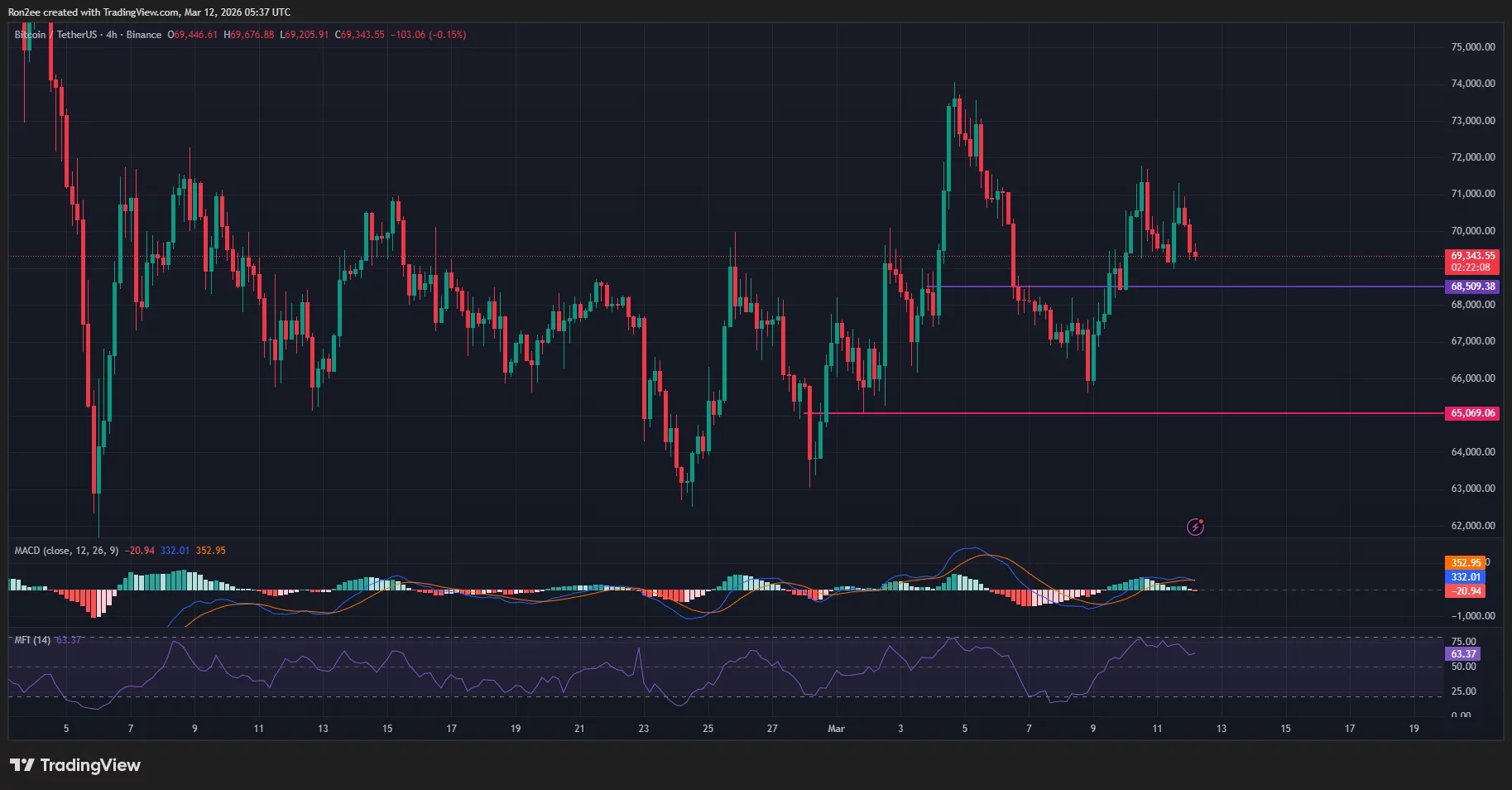
In terms of technicals, Bitcoin has once again fallen below the $70,000 mark. Traders are closely watching the $68,500 support level, but persistent selling pressure suggests that the path of least resistance remains to the downside with a potential retracement to the $65,000 support zone until global stability returns.
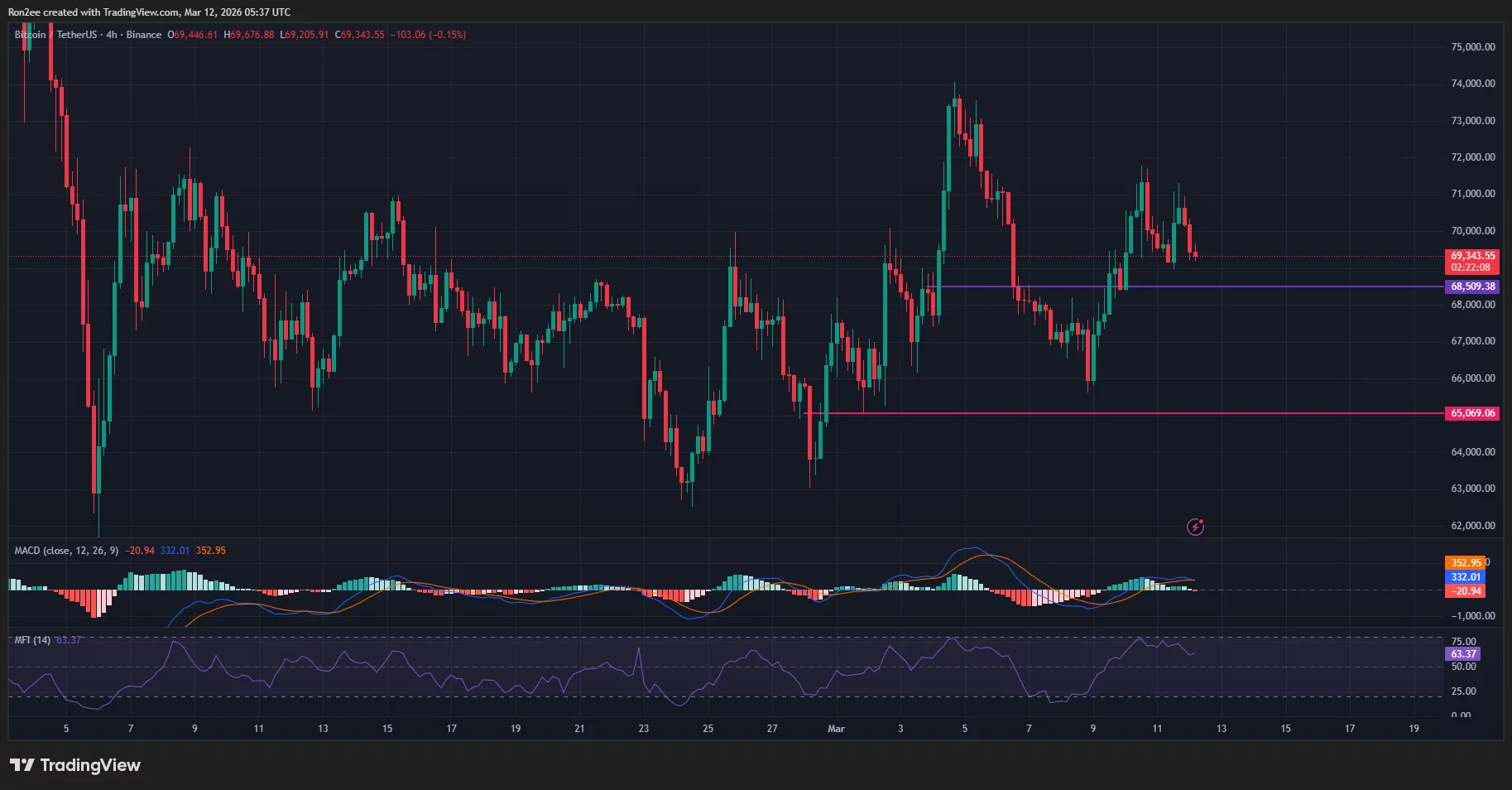
On the 4-hour chart, momentum indicators suggest that the bearish structure has already started building. The MACD lines are close to confirming a bearish crossover, while the RSI is trending downwards after hitting overbought levels.
Disclosure: This article does not represent investment advice. The content and materials featured on this page are for educational purposes only.

Decentralized finance (DeFi) has long wrestled with the tension between accessibility and risk management. Perpetual contracts, in particular, expose traders to extreme leverage and volatile markets. Traditionally, exchanges apply flat leverage caps or margin requirements, treating all users equally regardless of experience or past behavior. But what if a trader’s identity and reputation could dynamically influence how much risk they can take?
The Concept: Identity-Weighted Leverage
At its core, identity-weighted leverage personalizes risk management for perpetual contracts. Each trader is assigned a “trust score” based on verifiable on-chain data, such as:
-
Historical trading performance – e.g., consistent profits, low liquidation history.
-
Collateral behavior – how often and how responsibly they maintain margin.
-
Social governance participation – involvement in protocol voting or community contributions.
The system then adjusts leverage limits or margin requirements according to this score. A highly trusted trader might access 10x leverage safely, while a new user is throttled to 2x or 3x until they prove reliability.
Gamifying Risk Management
This approach doesn’t just manage risk—it gamifies it. Traders are incentivized to maintain a clean record, engage with governance, and demonstrate disciplined trading. The better your reputation, the more freedom you get to deploy capital. It turns risk management into a socially reinforced game, where positive behavior is rewarded with real financial flexibility.
Benefits for the Ecosystem
-
Safer Markets: Reduces systemic risk by limiting reckless leverage for unproven traders.
-
Aligned Incentives: Encourages responsible trading, increasing protocol trustworthiness.
-
Community Engagement: Integrates social reputation, making governance participation materially valuable.
-
Differentiated User Experience: Traders feel recognized and rewarded for their skill and discipline.
Challenges and Considerations
-
Privacy vs. Transparency: Reputation must be verifiable on-chain without exposing sensitive personal data.
-
Manipulation Risk: Systems must guard against fake histories or social score farming.
-
Standardization: Protocols need consistent metrics for scoring across different platforms.
Future Outlook
Identity-weighted leverage could redefine how DeFi perceives risk and trust. By combining traditional risk management with a social trust layer, perpetual trading becomes more than a numbers game—it becomes a community-powered ecosystem, where credibility and behavior are as valuable as capital.
This paradigm introduces the first real bridge between gamified social reputation and financial leverage, opening the door for more sophisticated, self-regulating DeFi markets.
REQUEST AN ARTICLE
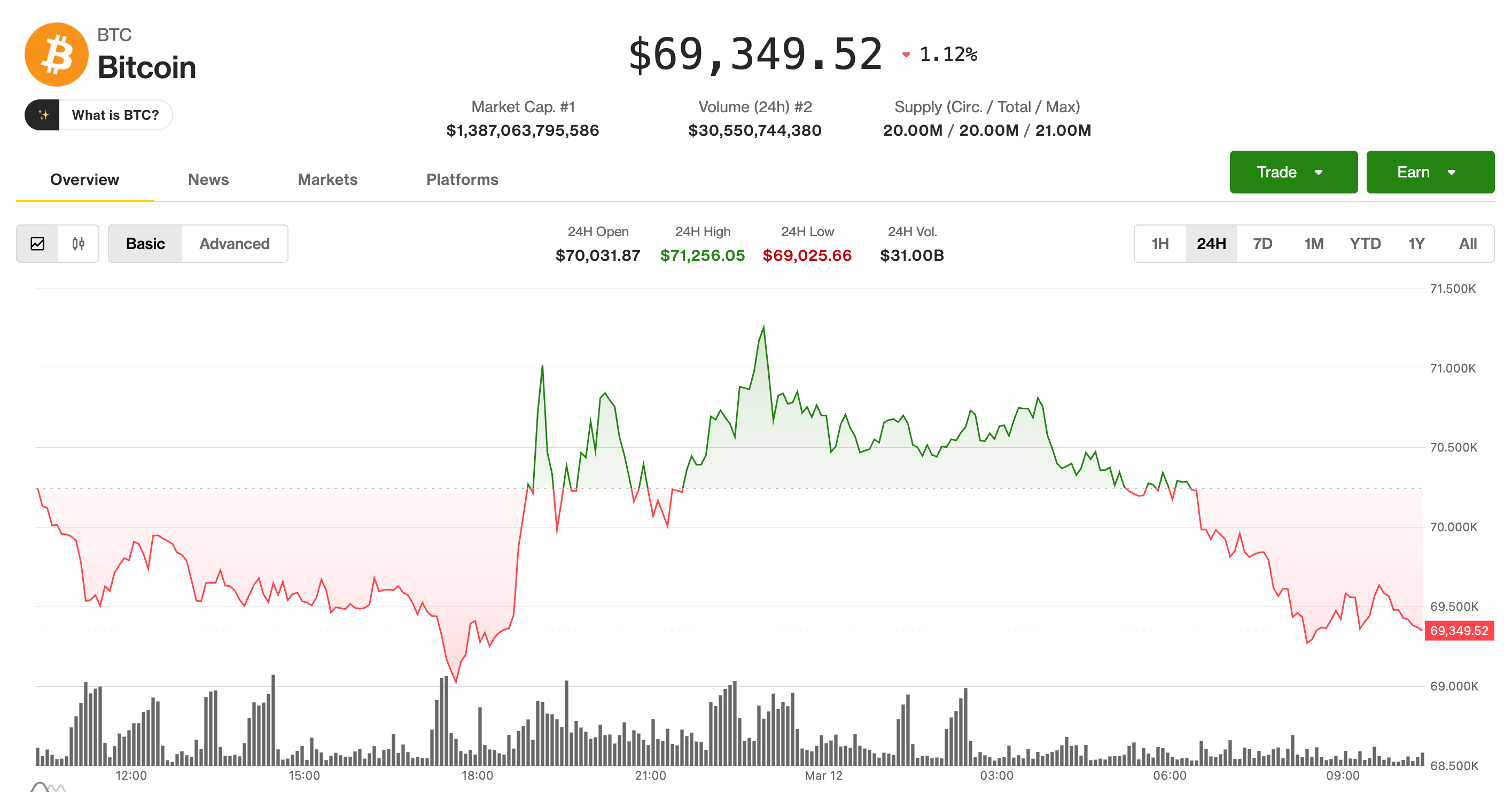
The bitcoin relief rally due to oil losing gains lasted about 36 hours.
Bitcoin fell to $69,393 on Thursday morning, down 0.8% over the past 24 hours and 4.3% on the week, after attacks on two oil tankers in Iraqi waters sent Brent crude surging back above $100 a barrel.
The move wiped out Wednesday’s optimism around the IEA’s proposed record reserve release and pushed risk sentiment back into retreat across Asian markets.
The chart tells the story of a market that can’t catch a break. Bitcoin touched $71,230 late Wednesday evening before the tanker headlines hit, dropping nearly $2,000 in a matter of hours.

That’s the third time in two weeks that bitcoin has pushed above $71,000 only to get knocked back by an escalation in the Middle East conflict.
Brent surged as much as 10.5% on Thursday, driven by a combination of the tanker attacks, clearance of the Mina Al Fahal port in Oman, continued hostilities across the Persian Gulf, and growing doubt about whether the IEA reserve release will be large enough to offset the supply disruption.
MSCI’s Asia Pacific index dropped 1.8% with energy the only sector in the green. The session extended losses as it went on, with no signs of stabilization.
The broader crypto market followed bitcoin lower. Ether fell to $2,025, down 0.5% on the day and 4.5% on the week. Solana dropped 1.5% to $85 and is now down 5.7% over seven days, the worst-performing major. XRP lost 0.8% to $1.37.
Dogecoin fell 0.8% to $0.092, giving back most of Tuesday’s Musk-driven gains. BNB was flat at $642.
The pattern of the past two weeks has been consistent. Good headlines push bitcoin toward $71,000-$74,000. Bad headlines drag it back toward $66,000-$68,000. The net movement over the period is close to zero, which is exactly what the on-chain data has been suggesting.
Apparent demand remains deeply negative at -30,800 BTC on a 30-day basis. CryptoQuant’s bull-bear indicator is still in bear territory, while supply in loss continues to climb. Every bounce gets sold into by holders looking to exit.
Trump said earlier this week the war would resolve “very soon” and that military objectives were “pretty well complete.”
But the timeline remains unclear, Iran continues to strike targets across the region, and the Strait of Hormuz is still disrupted. Mixed messaging from Washington has left markets unable to price the conflict’s duration with any confidence.
The Fed meeting on March 17-18 is now five days away, and oil back above $100 makes the stagflation case harder to dismiss and rate cuts even more distant.

XRP traded quietly near $1.38 as volatility compressed across crypto markets, with traders positioning ahead of U.S. inflation data that could trigger the next directional move.
News Background
- XRP has entered a period of consolidation as broader crypto markets adopt a cautious tone ahead of key macroeconomic data. Investors are closely watching the upcoming U.S. Consumer Price Index release, which could influence Federal Reserve policy expectations and risk appetite across digital assets.
- While price action has been subdued, activity on the XRP Ledger remains elevated. Daily transactions recently climbed above 2.7 million, one of the highest levels in months.
- Institutional positioning has also continued to evolve. XRP-linked investment products have accumulated roughly $1.4 billion in assets since their launch, suggesting longer-term capital remains engaged even as short-term trading momentum slows.
- Meanwhile, Ripple, the blockchain firm closely associated with XRP, has begun a $750 million share buyback that would value the company at about $50 billion, according to a person familiar with the matter.
- The move comes after a $500 million funding round at a $40 billion valuation in November, backed by major hedge funds and crypto investment firms.
Price Action Summary
- XRP slipped slightly from $1.3818 to $1.3787
- The token traded within a relatively tight 2.5% intraday range
- A midday surge briefly pushed price to around $1.41 before rejection
- Support near $1.37 held through several tests late in the session
Technical Analysis
- The most significant move during the session occurred when XRP briefly rallied toward $1.41 on elevated volume before sellers pushed the token back into consolidation. That rejection reinforced the $1.40–$1.41 area as a near-term resistance zone.
- Despite the pullback, buyers repeatedly defended the $1.37–$1.373 region, forming a sequence of higher lows on shorter timeframes. This behavior suggests dip demand remains active even as momentum fades.
- Volatility indicators are now compressing. Bollinger Bands on the daily chart have tightened noticeably, a pattern that often precedes a larger directional move once liquidity returns.
- The current structure leaves XRP trading between resistance near $1.40 and support closer to $1.35–$1.37, creating a tightening range that may resolve soon.
What traders say is next?
- Market participants are focused on whether XRP can maintain support above the $1.35–$1.37 area.
- Holding this zone could allow the token to continue consolidating before another attempt to reclaim the $1.40–$1.42 resistance band.
- A break below $1.35 would weaken the current structure and could expose deeper support around $1.30–$1.32, while a breakout above $1.42 would signal a potential momentum shift toward the mid-$1.40s and higher.
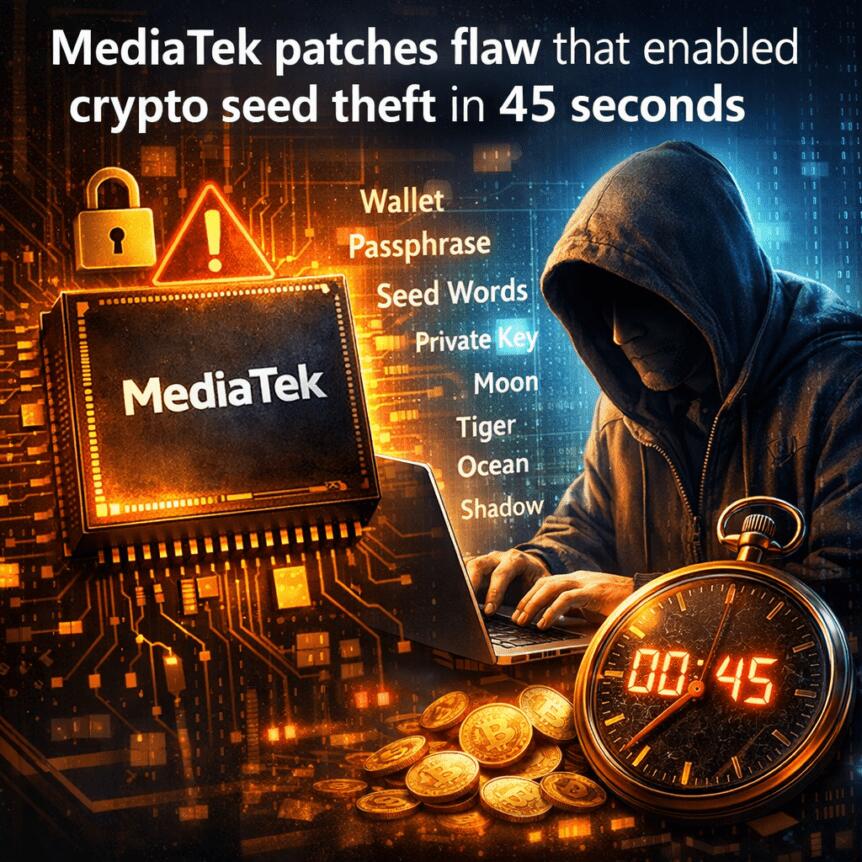
Security researchers have uncovered a flaw in MediaTek’s mobile chipsets that could enable attackers to harvest crypto seed phrases from vulnerable devices simply by connecting a phone to a computer via USB. The vulnerability targets the secure boot chain, a layer designed to boot devices only with authorized software, and was disclosed by Ledger’s white-hat security team, Donjon. A patch was rolled out by MediaTek on January 5, but users who have not updated their devices remain exposed to potential attacks. In practical terms, an assailant with physical access could bypass a device’s protections and access sensitive wallet data without needing to unlock the device, underscoring how far security gaps in consumer hardware can reach in the crypto era.
Ledger notes that roughly a quarter of Android devices rely on MediaTek processors paired with the Trustonic Trusted Execution Environment (TEE), a combination the research found to be particularly exploitable. Donjon demonstrated the proof-of-concept by connecting a Nothing CMF Phone 1 to a laptop and compromising the device’s security in about 45 seconds. The exploit could, in a worst‑case scenario, recover the phone’s PIN, decrypt stored data, and extract seed phrases from popular wallets such as Trust Wallet, Base, Kraken Wallet, Rabby, Tangem’s Mobile Wallet and Phantom, all without requiring the device to be actively unlocked.
Ledger emphasizes that users should apply the January patch promptly, warning that devices left unpatched remain vulnerable to USB-based attacks that bypass the Android protections designed to prevent unauthorized data access. A Ledger spokesperson suggested that the organization does not anticipate the issue to persist as a systemic vulnerability, pointing to the patch as a remedy and noting improvements in hardware and software defenses over time. The broader takeaway is that mobile devices, while increasingly central to crypto management, remain areas of elevated risk when security architectures rely on general-purpose components rather than dedicated protective elements.
As the crypto ecosystem continues to expand, the mobile surface remains a live concern. Ledger’s assessment of the landscape includes a stark reminder that a large share of users store digital assets on smartphones, with the firm citing around 36 million people managing crypto on mobile devices as of early 2025. The implication is not merely about one exploit but about a structural tension between convenience and security in everyday devices. In late 2025, Ledger also revealed testing results on the MediaTek Dimensity 7300 (MT6878) that reportedly bypassed certain security measures, achieving a level of control over a smartphone that left “no security barrier standing.” These findings echo a longer-standing view from Ledger’s chief technology officer that smartphones—whether Android or iPhone—are inherently challenging to secure for crypto use.
Charles Guillemet has repeatedly underscored the underlying architectural gap between general-purpose chips, which prize convenience, and Secure Elements, which are designed to isolate and protect keys even under duress. In a post on X that followed the December tests, he reiterated a recurring theme: the best practice for protecting seeds is to rely on hardware-backed protections rather than trusting software alone. This sentiment aligns with a broader consensus in the security community that crypto keys deserve an isolated enclave, separate from the rest of the device’s software stack. The implications for wallet developers and hardware makers alike are clear: as fraud vectors evolve, so too must the hardware and the threat models that guide wallet design and user behavior. The ongoing discourse around secure elements, trusted execution environments, and hardware-backed security will likely drive further standards and recommendations for the crypto wallet ecosystem.
In the context of rapidly evolving mobile crypto usage, the incident serves as a reminder that security is not a one-time fix but an ongoing engineering challenge. Beyond patch deployment, users must consider the broader ecosystem: keeping devices updated, enabling additional protections on wallet apps, and staying informed about hardware vulnerabilities that could undermine seed protection. The episode also raises questions for manufacturers and platform providers about the balance between performance, feature parity, and robust security, particularly as mobile devices become the primary entry point for many users into the world of decentralized finance and digital assets.
Overall, the episode reinforces the view that mobile crypto security hinges on a layered strategy: hardware-backed secrets, rigorous boot-time protections, prompt software updates, and wallet designs that minimize the risk surface for seed exposure. While patches provide a necessary remedy, the industry faces a broader imperative to harden the entire stack—from chipset design and secure enclaves to firmware and application guardrails—to ensure that the convenience of mobile crypto management does not come at the expense of fundamental security.
Key takeaways
- The vulnerability resides in MediaTek’s secure boot chain, which could allow an attacker with physical access to bypass protections via USB and access wallet seeds.
- MediaTek released a patch on January 5, but devices that have not updated remain at risk of seed extraction and other data compromise.
- About 25% of Android devices are affected due to the combination of MediaTek processors and the Trustonic TEE, increasing the potential attack surface for seed exposure.
- A proof-of-concept demonstrated on a Nothing CMF Phone 1 achieved compromise in roughly 45 seconds, illustrating how quickly seed data could be extracted from several popular wallets.
- Ledger’s stance emphasizes that smartphones are inherently challenging for crypto security and that hardware-backed protections (e.g., Secure Elements) are essential to safeguarding seeds against physical attacks.
- Beyond the January patch, Ledger disclosed ongoing tests in December 2025 on the MT6878 that reportedly bypassed some security measures, underscoring the persistent need for robust hardware protections.
Sentiment: Neutral
Market context: The incident highlights ongoing risk in mobile crypto usage and the importance of timely firmware updates as users increasingly rely on smartphones for wallets and seed storage, contributing to broader risk sentiment around consumer hardware security.
Why it matters
For users actively managing crypto on mobile devices, the incident translates into a pragmatic reminder: seed phrases are high-value targets, and the most effective defense combines hardware-backed secrecy with disciplined software hygiene. The fact that a single USB connection could bypass protective layers and extract seed data from multiple wallets makes the case for diversified security architectures more compelling. Wallet developers may respond by encouraging or mandating hardware-backed seed storage, integrating stronger attestation, and pushing for standardized, secure boot practices across chipset families. The episode also underscores the role of independent researchers and white-hat teams in disclosing vulnerabilities that could otherwise go undetected until exploited in the wild.
From a market perspective, the event does not single out a particular asset or exchange, but it does shape risk perception around mobile wallet usability. As more users store crypto on smartphones, the potential payoff for attackers grows in tandem with the number of devices deployed and the wallets installed on them. This dynamic heightens the urgency for chipset makers, device manufacturers and wallet providers to collaborate on risk mitigation—outside of mere patch cycles—through architectural safeguards, secure update mechanisms, and clear user guidance on how to defend seeds in non-ideal physical environments.
For the broader ecosystem, the episode also serves as a test case for ongoing debates about hardware security: should smartphones rely on Secure Elements that isolate keys, or should wallets shift seed management to external, user-controlled devices with their own secure channels? The balance struck in design decisions over the next few years will influence the resilience of mobile crypto infrastructure as adoption continues to grow and as regulatory and market pressures push for stronger security guarantees.
What to watch next
- How quickly OEMs and MediaTek push out and verify the January patch across devices shipping with the affected chipsets.
- Whether wallet developers adopt more hardware-backed storage or additional attestation to reduce seed exposure risk on compromised devices.
- Any official guidance from Ledger or other security researchers on best practices for users to mitigate risk while awaiting firmware updates.
- Further testing results from security researchers on MT6878 and related MediaTek platforms to assess the durability of current protections.
Sources & verification
- Ledger’s public statements describing the vulnerability and the patch rollout on January 5.
- Donjon’s demonstration using a Nothing CMF Phone 1 to compromise a device within about 45 seconds.
- Ledger’s December 2025 disclosures about testing an attack on the MediaTek Dimensity 7300 (MT6878) and bypassing security measures.
- Charles Guillemet’s public comments on smartphone security and the challenges of securing mobile crypto workflows.
Security episode: how a USB-based breach in MediaTek chips could expose seed phrases
The attack scenario centers on the media ecosystem surrounding contemporary smartphones. By exploiting the secure boot chain in MediaTek’s mobile processors, an attacker could connect a device to a PC and proceed without booting into the Android operating system in a conventional sense. The practical upshot is the potential to automatically recover device PINs, decrypt stored data, and extract seed phrases from widely used wallets—Trust Wallet, Base, Kraken Wallet, Rabby, Tangem’s Mobile Wallet, and Phantom—without requiring the user to unlock the phone or enter sensitive credentials. The proof-of-concept demonstrated on the Nothing CMF Phone 1 in roughly 45 seconds underscores how quickly such a breach could occur in a real-world scenario, particularly when users fail to apply patches in a timely manner.
MediaTek’s response to the vulnerability, which included a software patch released on January 5, aims to close the door on the attack by strengthening the integrity of the boot process and reducing the likelihood of unauthorized access to the secure storage that holds seed material. Ledger’s assessment indicates that while the patch is a necessary stopgap, the broader trajectory of mobile crypto security remains a work in progress, especially given the prevalence of devices that rely on Trustonic’s TEE in conjunction with MediaTek chips. The intersection of hardware security with consumer electronics means that even small architectural choices—how keys are isolated, how boot protections are verified, and how protected storage is accessed—can have outsized implications for user safety in the crypto domain.
Looking ahead, the crypto community will be watching whether the January patch is widely adopted across device fleets, how wallet developers respond with additional mitigations, and whether hardware manufacturers continue to push for more robust, hardware-backed protections as a standard feature. The broader message is that seed storage remains a high-value target, and as the mobile economy around digital assets grows, so too must the security controls that protect those seeds—from the moment a device boots up to the moment a user signs a transaction or unlocks a wallet.
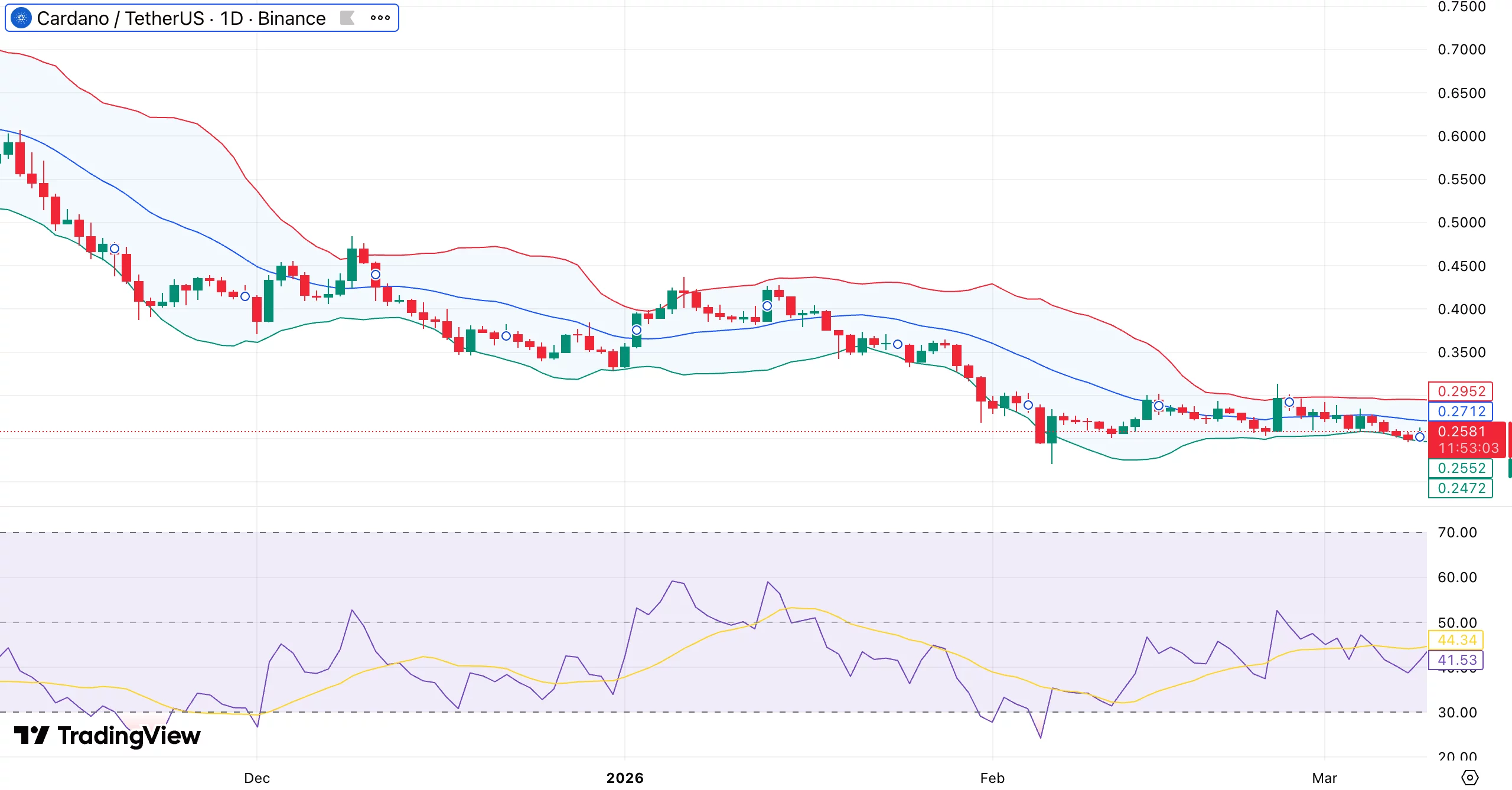
Cardano price is hovering near $0.25 support as traders watch whether ADA can hold the level while Charles Hoskinson discusses potential buybacks.
Summary
- Cardano is still under selling pressure with a continued weak trend and declining derivatives activity.
- Charles Hoskinson suggested a new funding model where the Cardano treasury invests in ecosystem projects and may use returns for ADA buybacks.
- The strategy focuses on increasing developer incentives and expanding real-world applications to strengthen the Cardano ecosystem.
Cardano (ADA) moved lower on Wednesday as sellers kept pressure on the market. At the time of writing, ADA was trading at $0.2585, down about 2% over the past 24 hours.
During the past week, the token traded between $0.2492 and $0.2828. The range has narrowed as the market cooled after earlier volatility. ADA has lost around 5% over the last seven days, and the longer trend remains weak. Since January, the token is down roughly 20% in 2026 so far.
Market activity has not changed much despite the price decline. Daily trading volume reached $799 million, only 0.22% higher than the previous session.
CoinGlass data shows some cooling in derivatives markets. Open interest slipped 3.57% to $419 million, which often happens when traders close positions during uncertain price action.
Hoskinson hints at ADA buybacks and new funding model
In a recent video update, Charles Hoskinson shared new details about how the Cardano ecosystem may be funded in the coming years.
According to Hoskinson, the network has spent years building its core infrastructure. The next step, he said, is to focus more on useful applications and better user experience. Without that shift, strong infrastructure alone will not attract users.
Developers and dApp teams could receive stronger incentives under the proposed model. One idea being discussed involves the Cardano treasury investing in a group of projects across the ecosystem, including DeFi platforms and other applications.
If the plan moves forward, returns from those investments could be used in part to buy ADA from the open market. Hoskinson described this as a possible buyback mechanism that may support the token while also funding ecosystem growth.
The proposal reflects a change in approach. Instead of relying mostly on grants, the treasury may begin making strategic investments designed to increase activity on the network.
Hoskinson has said that 2026 will be an important year for execution, with attention shifting toward real-world utility and stronger dApp ecosystems.
Technical analysis: ADA holds near key support
On the charts, Cardano is trading close to the lower Bollinger Band, which often appears when markets face short-term selling pressure.
The overall trend still points downward. Over the past several weeks, the chart has produced lower highs and lower lows, a pattern that usually marks a continuing downtrend.
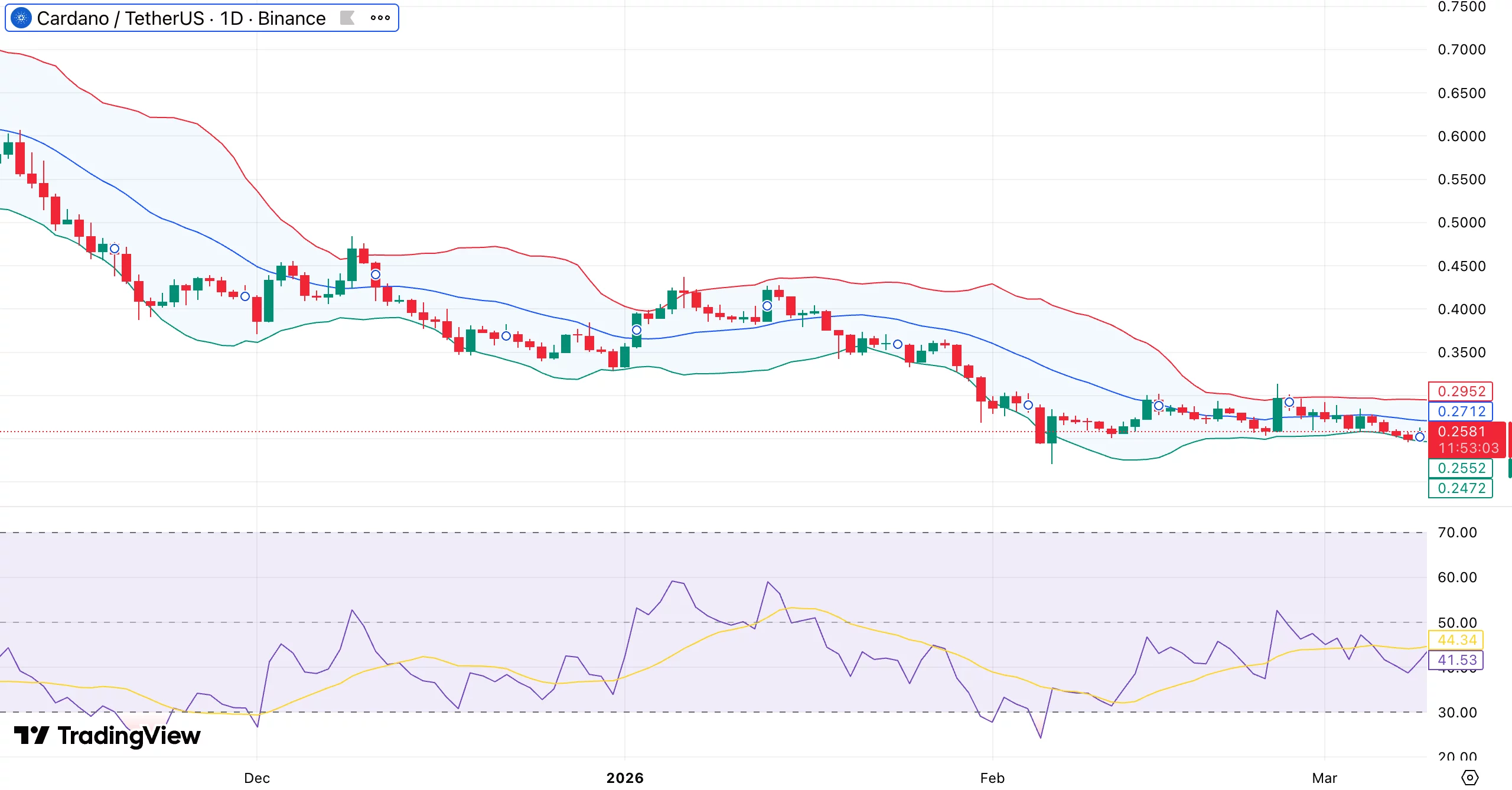
Price also remains below the Bollinger midline near $0.27, which has acted as resistance during recent attempts to recover.
Volatility has started to contract slightly as the Bollinger Bands move closer together. Periods like this often come before a stronger move once volatility returns.
Momentum indicators remain weak. The relative strength index is hovering near 40–45, a level that suggests sellers still hold the advantage, though the market is not deeply oversold.
For now, $0.25 is the key level to watch. The market has tested this support several times in recent sessions. If it breaks, price could slide toward $0.23 or even $0.22.
On the other hand, buyers would need to push ADA back above $0.27 to improve the short-term outlook. That level aligns with the Bollinger midline and has acted as a barrier during the recent downtrend.
Crypto ATM fraud surged to $333 million in the US in 2025, with complaints received by the FBI growing 33% in the year as scam networks became more industrialized while tapping into advanced AI deepfake technology.
Crypto ATM fraud is one of the fastest-growing financial crime categories in the US, according to cybersecurity firm CertiK in its latest report shared with Cointelegraph on Thursday, explaining that criminal organizations are exploiting the “speed and pseudonymity” of crypto ATMs or “kiosks” to extract funds from victims at an accelerating pace.
The FBI recorded more than 12,000 complaints between January and November 2025, also a 33% increase from the prior year. The US accounts for 78% of the world’s 45,000 cryptocurrency machines, said CertiK.
Their ability to convert cash to crypto in under five minutes with minimal identity verification “makes them the lowest-friction extraction channel available to scammers,” the firm added.
Elderly more vulnerable to social engineering
The report also noted that there was an “attribution gap” because the blockchain only records the operator-to-destination transfer, not the victim’s identity. This makes forensic tracing extremely difficult without court orders for operator records.
Around 86% of losses involve victims over 60, as older adults are disproportionately vulnerable due to “liquid savings,” lower crypto literacy, and social isolation.
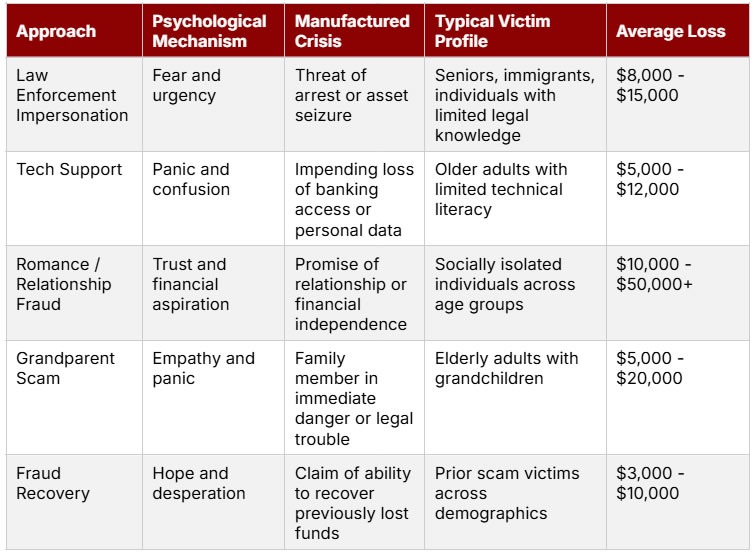
However, younger victims are increasingly appearing in romance or investment scams, commonly known as “pig butchering,” which is one of five primary tactics used by scammers.
The other four approaches are government impersonation, tech support fraud, “grandparent scams,” and fake fraud recovery offers.
Related: DC attorney general sues Athena Bitcoin over alleged hidden fees
Unlike phishing or wallet-draining attacks, which involve compromising private keys or tricking users into signing malicious smart contract requests, ATM-based fraud “relies entirely on social engineering to induce the victim to perform a voluntary physical action at a kiosk,” stated CertiK.

AI is making things worse
AI-enabled social engineering scams were 4.5 times more profitable than traditional methods in 2025, reported CertiK.
The integration of “real-time deepfake synthetic media” into scam and fraud operations represents the most “significant near-term escalation,” it stated.
“AI-driven personalization tools enable scammers to scrape social media data and construct hyper-targeted scripts that mirror the specific language, appearance, and communication patterns of the victim’s trusted contacts.”
The profile of crypto ATM scammers has also shifted from independent actors to structured transnational criminal organizations operating with corporate-level divisions of labor, according to CertiK.
“Transnational criminal organizations are industrializing ATM-based extraction at unprecedented scale.”
Wyoming Senator Cynthia Lummis said in September that she hopes the crypto market structure legislation will help tackle ATM fraud by punishing bad actors without limiting innovation.
In February 2025, US Senator Dick Durbin introduced the Crypto ATM Fraud Prevention Act, aiming to introduce safeguards for crypto kiosk users.
Magazine: China’s ‘50x’ blockchain boost, Alibaba-linked AI mines Bitcoin: Asia Express


Ghana has selected 11 crypto trading platforms to participate in a regulatory sandbox where they will “pilot their products and services in a controlled environment under the regulatory oversight” of the Securities and Exchange Commission.
Summary
- Ghana’s Securities and Exchange Commission has admitted 11 crypto platforms into a regulatory sandbox to test their services under the country’s new Virtual Asset Service Providers Act.
- The 12-month pilot will allow platforms with market-ready products to transition to full licenses after six months.
- Regulators say data gathered during the program will guide future licensing guidelines as Ghana builds a formal regulatory framework for digital asset services.
Starting March 10, Africoin, Blu Penguin, Goldbod, Hanypay, Hyro Exchange, HSB Global, KoinKoin, Whitebits, Vaulta, XChain, and Bsystem will start operating under the country’s Virtual Asset Service Providers Act for the next 12 months.
After the first six months, the SEC will assess which of these platforms have products and services that are market-ready and can transition to a full license to operate. Meanwhile, those that fail to meet the requirements will continue operating within the sandbox for the remaining six months.
According to the commission, the sandbox has been designed to “support responsible innovation while strengthening investor protection, market integrity, and compliance with anti-money laundering and counter-terrorism financing standards.”
Data accumulated during this pilot will help shape “future policy and licensing frameworks for virtual assets services,” it added.
The SEC plans to develop guidelines and subsequently publish them for prospective applicants to apply under the various activity-based licensing categories outlined in the Virtual Asset Service Providers Act.
Ghana’s plans to start licensing crypto platforms were first disclosed in July last year, when Governor of the Bank of Ghana, Johnson Asiama, said regulators had already begun working on a draft framework intended to bring digital asset activity under formal oversight.
“We are actually late in the game,” Asiama said at the time, referring to the growing number of Ghanaians already using cryptocurrencies for transactions despite the absence of a clear regulatory structure.
Subsequently, in December, regulators passed the Virtual Asset Service Providers (VASP) bill, which established the provisions that would allow crypto trading and related digital asset services to operate legally in the country under the supervision of the Bank of Ghana and the Securities and Exchange Commission.
As one of the larger crypto markets in the region in terms of grassroots adoption, Ghana is expected to see greater migration toward regulated platforms if authorities continue shaping a more structured and industry-friendly environment.
Earlier this month, crypto brokerage firm Blockchain.com said it had expanded operations into Ghana as part of a broader push to build digital asset infrastructure across some of the region’s fastest-growing markets.

Chase Blount: My first election was a car crash – but I still gained from it

Dmitry Bivol sets his sights on one man after mandatory defence of world title

If A Mechanic Refuses To Release Your Car, Here’s What You’ll Have To Do


-
Business6 days ago
Form 8K Entergy Mississippi LLC For: 6 March
-

 Tech7 days ago
Bitwarden adds support for passkey login on Windows 11
-

 News Videos3 days ago
10th Algebra | Financial Planning | Question Bank Solution | Board Exam 2026
-

 Fashion5 days ago
Weekend Open Thread: Ann Taylor
-

 Crypto World3 days ago
Paradigm, a16z, Winklevoss Capital, Balaji Srinivasan among investors in ZODL
-
 Tech23 hours ago
A 1,300-Pound NASA Spacecraft To Re-Enter Earth’s Atmosphere
-
 Sports6 days ago
499 runs and 34 sixes later, India beat England to enter T20 World Cup final | Cricket News
-

 Politics6 days ago
Top Mamdani aide takes progressive project to the UK
-

 Business2 days ago
ExxonMobil seeks to move corporate registration from New Jersey to Texas
-

 Sports4 days ago
Braveheart Lakshya downs Lai in epic battle to enter All England Open final | Other Sports News
-

 Sports4 days ago
Three share 2-shot lead entering final round in Hong Kong
-

 NewsBeat12 hours ago
Residents reaction as Shildon murder probe enters second day
-

 NewsBeat7 days ago
Piccadilly Circus just unveiled ‘London’s newest tourist attraction’ and it only costs 80p to enter
-

 Entertainment5 days ago
Hailey Bieber Poses For Sexy Selfies In New Luscious Lip Thirst Traps
-

 Business4 days ago
Search for Nancy Guthrie Enters 37th Day as FBI Probes Wi-Fi Jammer Theory
-

 Business22 hours ago
Search Enters Sixth Week With New Leads in Tucson Abduction Case
-
 NewsBeat2 days ago
Pagazzi Lighting enters administration as 70 jobs lost and 11 stores close across Scotland
-

 Tech3 days ago
Despite challenges, Ireland sixth in EU for board gender diversity
-
 Tech7 days ago
ACIP To Discuss COVID ‘Vaccine Injuries’ Next Month, Despite That Not Being In Its Purview
-

 Business2 days ago
Search Enters 39th Day with FBI Tip Line Developments and No Major Breakthroughs