
Crypto World
Celsius sues BitMEX over trades Alex Mashinsky said never happened



On September 12, Celsius Network debtors sued crypto exchange BitMEX, which is set to close on September 23. Celsius’ debtors suddenly want over $100 million before BitMEX shuts its doors.
Specifically, the debtors allege wrongful liquidation and seizure by BitMEX of Celsius’ BTC around the March 12, 2020 COVID market crash.
One day after that liquidation, Celsius CEO Alex Mashinsky promised that Celsius wasn’t trading at all.
“Fortunately, Celsius is not a trader,” Mashinsky declared on March 13.
Commenting on the COVID crash that had occurred one day prior, he added, “We don’t trade. We don’t buy and sell coins. We don’t decide, oh, BTC’s going up or down.”
He also gushed about Celsius’ supposedly wonderful performance. “We started charging higher and higher rates, earning more money for the community,” Mashinsky claimed, in reference to Celsius’ non-trading, lending division.
“So, we did exceptionally well last night. Again, credit goes to the team for putting together an amazing performance.”
Read more: The many misrepresentations of Alex Mashinsky
Celsius’ BTC derivative trading on BitMEX
Mashinsky is currently in prison but wild tales about Celsius continue.
According to Celsius debtors this month, contrary to Mashinsky’s non-trading claim, Celsius definitely had a leveraged long position in XBTM20 that BitMEX liquidated on March 12, 2020 as part of a “fraudulent scheme to defraud its own customers.”
XBTM20 was a leveraged derivative linked to the price of BTC that Celsius traded on BitMEX.
Although the debtors didn’t specify the financial leverage that Celsius was using, BitMEX famously offered up to 100x price exposure on its BTC derivatives around that time.
The debtors allege BitMEX’s “fraudulent misconduct” and “wrongful liquidation” of Celsius’ XBTM20 position allowed BitMEX to seize Celsius’ BTC that collateralized its trading position.
In essence, debtors claim BitMEX rigged its own liquidation engine.
The loss, Celsius debtors claim, was BitMEX’s fault, not the leveraged trading activity that Mashinsky told his YouTube audience Celsius didn’t conduct in the first place.
On March 12, 2020, BitMEX processed over $700 million worth of liquidations. Over 90% were forced closures of long derivatives.
BitMEX has already announced as of July 23, 2026 that it will close, encouraging users to withdraw their funds prior to the end of business. It has already stopped accepting trades to open new positions as of August 26, and plans to end exchange services entirely on September 23 at 04:00 UTC.
Got a tip? Send us an email securely via Protos Leaks. For more informed news and investigations, follow us on X, Bluesky, and Google News, or subscribe to our YouTube channel.

Crypto World
Stock Market Today: Dow Rises In Day 2 Fed Reaction; Generac, Nebius, Bloom Energy, SpaceX Are Early Movers
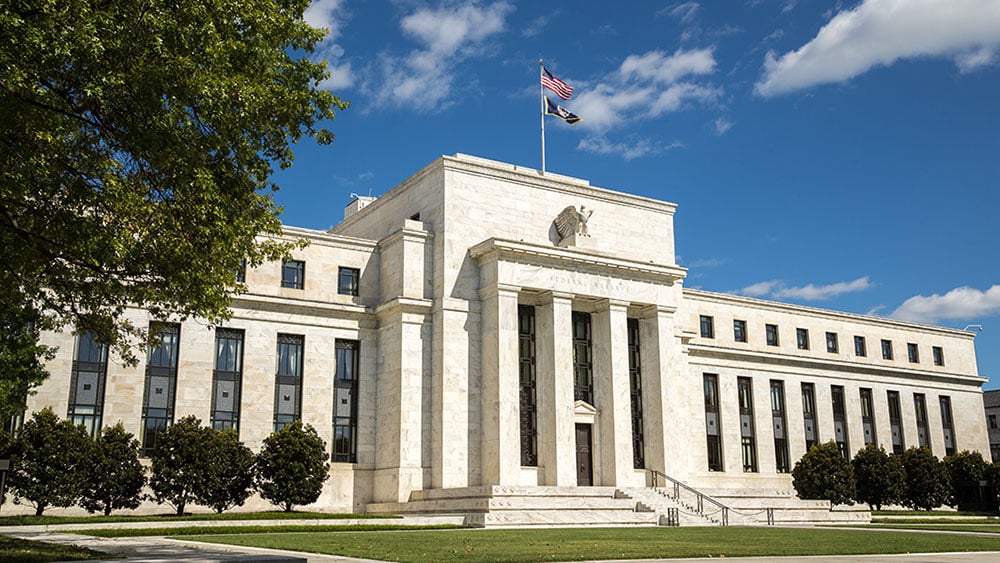
Futures for the Dow Jones industrial average and other major indexes rose strongly early Thursday, rebounding with the help of a better-than-expected reports on jobs and manufacturing after declining in the prior session on hawkish comments from the Federal Reserve. Crude oil prices and Treasury yields retreated on the stock market today. Generac (GNRC) and Nebius (NBIS) were big winners…
Copyright ©2026 Investor’s Business Daily, LLC. All rights reserved. 87990cbe856818d5eddac44c7b1cdeb8


Leverton most recently led institutional digital-asset manager ReserveOne. She previously served as CEO of bitcoin miner Hut 8, overseeing its merger with US Bitcoin Corp. and its transition from a Canadian-listed miner into a U.S.-domiciled company with bitcoin mining and high-performance computing operations.
Her appointment comes as Fortitude expands its exposure to Zcash, whose ZEC token has risen more than 2,000% over the past year. Its market capitalization is roughly $21 billion.
Fortitude mined 72,696 ZEC during the six months through June, about 28% of the network’s total production during that period. The company reported second-quarter revenue of $20.9 million.
The miner operates more than 60 megawatts of power capacity across seven sites in South Dakota, Nebraska, Texas and New York.
“Fortitude is taking a differentiated approach to mining,” Leverton said in the release, pointing to the company’s combination of owned power, mining sites and in-house operations.
The company describes itself as a “venture mining” platform that allocates capital across proof-of-work networks while maintaining a primary focus on Zcash. The company is wholly owned by Barry Silbert’s Digital Currency Group.
Childs said she will concentrate on mining operations, fleet and infrastructure strategy, and industry relationships in her new role as COO.


NEAR has surpassed $70 million in confidential total value locked, automatically triggering the first snapshot under its [email protected] incentive program and setting aside 333,333 milestone tokens for eligible users.
Summary
- NEAR’s confidential TVL has crossed $70 million, triggering the first snapshot under the [email protected] incentive program.
- The snapshot allocates 333,333 milestone tokens to eligible users who maintain more than $100 in confidential balances and have an active swap history.
- Rewards remain locked until NEAR’s three day VWAP reaches at least $3.33, while individual wallets are capped at 2% of the distribution.
- Confidential Intents currently supports private execution across more than 30 connected blockchains.
According to a Sept. 17 announcement from NEAR shared with crypto.news, the milestone was reached through Confidential Intents, its private execution system for cross chain transactions, with the snapshot determining eligibility for the first reward distribution.
Users who qualify for the first drop must maintain more than $100 in confidential balances and have an active swap history. The milestone tokens will remain locked until NEAR’s three day volume weighted average price reaches at least $3.33, when they can convert into NEAR.
The incentive program places a 2% cap on the amount that can be allocated to any single wallet. NEAR said the restriction is intended to limit concentration and spread the distribution across more participants.
NEAR confidential TVL triggers first token snapshot
Confidential Intents routes transactions through a private NEAR shard, which NEAR says removes transactions from public mempool exposure and protects users from front running, strategy leakage and other forms of maximal extractable value.
The system is designed to provide confidential execution without relying on the computational requirements associated with zero knowledge systems, according to NEAR. Its confidential liquidity can be used for high volume swaps across connected blockchains without publicly linking the activity to the party behind the transaction.
Live data cited by NEAR showed confidential TVL crossing the $70 million threshold required for the first phase of the [email protected] program. Independent NEAR Intents tracking data showed the figure at approximately $70.8 million on Sept. 17.
Alex Shevchenko, general manager of NEAR Intents, said the growth showed demand for confidential execution was extending beyond a specialized segment of the market.
“Confidentiality is quickly becoming a core requirement for the industry, and NEAR is becoming the rail to make it the new default,” Shevchenko said.
He said combining cross chain liquidity with protection against front running, strategy leakage and other forms of MEV gives institutions and decentralized finance users a way to transact at scale while retaining privacy.
The $70 million threshold closes the first phase of the [email protected] campaign. NEAR said Confidential Intents currently supports execution across more than 30 connected blockchains.
NEAR Intents expands cross chain infrastructure
NEAR has been building Intents as an abstraction layer for transactions that move across different blockchain networks. Instead of requiring a user or application to manually determine how a transaction should move between chains, users specify the intended outcome and solvers compete to execute it.
As crypto.news previously reported, NEAR has positioned Intents as part of its infrastructure for autonomous AI agents that may need to transact across several blockchains without separately managing assets and transaction routes on each network.
By June, cumulative fees generated by NEAR Intents had surpassed $35.4 million, while average daily fees during that month were above $125,000. The protocol has connected the system with its plan to provide a common settlement layer for cross chain activity and software agents.
Confidential Intents extends that system by placing privacy around execution. NEAR has developed the feature alongside other privacy tools for areas including onchain treasury management, payroll, multisig operations and balance management.
The network’s cross chain infrastructure has continued to gain integrations. An Aptos integration with NEAR Intents gave users access to one click transfers involving assets such as Bitcoin, Ethereum and XRP across more than 20 blockchains. Developers were given access through the 1 Click Swap API, which allows applications to integrate Intents without requiring users to manually operate bridges.
NEAR has tied the infrastructure to its work around AI agents, where software may need to execute payments or trades without manually navigating individual blockchain networks.
Confidential execution fits into NEAR’s AI strategy
Privacy has become part of NEAR’s push to build infrastructure for autonomous agents. The network argues that software handling payments, trading strategies and other financial activity may need to keep transaction details or user information from becoming publicly visible.
In July, NEAR introduced a staking based AI payment system that lets users lock NEAR to receive monthly compute credits for its AI platform. The tokens are not spent and can be recovered when users unstake them.
At launch, the mechanism covered 43 AI models available through NEAR AI, including models from OpenAI, Anthropic and Google. NEAR said users could access confidential AI inference and hosted autonomous agents without providing a credit card or maintaining a conventional cloud billing account.
The protocol has separately introduced automatic anonymization for personally identifiable information contained in prompts sent to closed AI models. NEAR said the system removes sensitive information before prompts reach external inference infrastructure.
A network upgrade released in June introduced dynamic resharding, allowing blockchain capacity to adjust as transaction demand changes. The same release introduced post quantum secure signatures, giving u
Washington’s stablecoin debate is about characteristics: who can issue one, what has to back it, and how it gets audited. The Federal Reserve, the US central bank, and the OCC, the regulator that supervises the country’s national banks, cannot simply accept that a token is worth one dollar; they have to control who is allowed to make that promise.
Because a dollar-pegged token is, in a real sense, a representation of the country’s own currency.
Latin America is regulating something structurally different: access to a currency none of its governments control. For a saver in Buenos Aires, Bogota, or Mexico City, whether the token behind their savings is USDC, USDT, or whatever wins that fight barely matters, as long as it holds its peg and the custodian is solvent.
That asymmetry explains a mistake regional regulators keep edging toward: importing Washington’s fight over issuer specs, when the real problem here is different, and harder.
The real question is not which stablecoin wins. It is where the dollars backing it should live.
Offshore Dollars Become a Domestic Policy Problem
A dollar in a reserve account in New York does the same job, on a user’s screen, as a dollar in a reserve account in Buenos Aires or Sao Paulo. But for a regulator in a region where hard currency has been the state’s scarcest resource for decades, those two dollars are not equivalent. One is available to the local financial system under stress. The other is not.
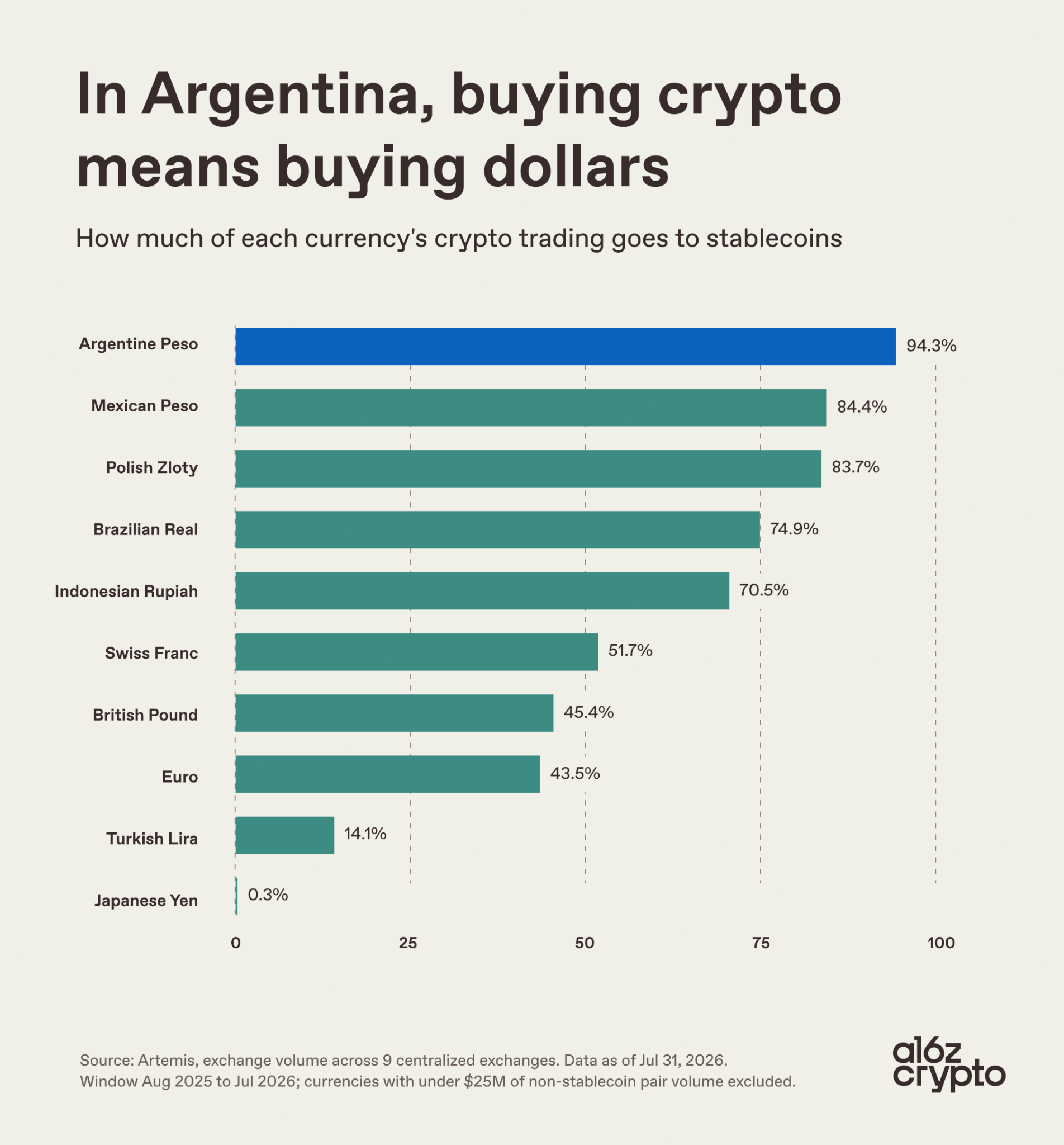
Argentina remains the world’s most dollarized crypto market by share of volume, but the pattern is regional: in Brazil, institutional stablecoin volume jumped from 5% of local crypto flows in 2024 to 84% in 2025, and Mexico’s Senate is now debating a bill to regulate peso-pegged stablecoins.

A rising share of household and corporate dollars sitting in instruments reserved entirely offshore will, sooner or later, look like a policy problem worth solving, not a market outcome to shrug at.
Should Latin America Force Some of Those Dollars Back Home?
This has a preview. In July, Kenya’s Treasury proposed requiring stablecoin issuers to hold at least 30 percent of customer funds in banks domiciled in the country. No Latin American regulator has proposed anything like it yet, but the logic behind Kenya’s rule, chronic dollar scarcity meeting a financial system trying to claw back some claim on flows it can no longer prevent, is arguably more acute in Argentina or Venezuela than in Kenya. I would be surprised if nobody in the region’s finance ministries is already sketching something similar.
I do not think this is an easy call. None of the region’s frameworks so far, not Argentina’s PSAV regime, not Brazil’s rules in force since February, not the bill in Mexico’s Senate, have tried to solve this yet, and one of their underappreciated virtues is that they have not.
My read: mandating local reserves would fragment liquidity that today lives almost entirely in USDT and USDC, strip domestically-backed instruments of the convertibility that makes them useful for remittances, and likely push demand toward unregulated rails instead of compliant ones. That defeats the point of the rule.

The alternative worth building toward is coexistence: locally-reserved and offshore-reserved dollar instruments operating under supervision, moving freely between each other, letting users decide where their dollars live.
Whether the region gets there, or defaults to Kenya’s blunter instrument once dollarization is impossible to ignore, will decide how much of Latin America’s dollar savings stays inside a supervised system, and how much goes looking for the door.
The post Where Do Latin America's Dollars Actually Live? appeared first on BeInCrypto.
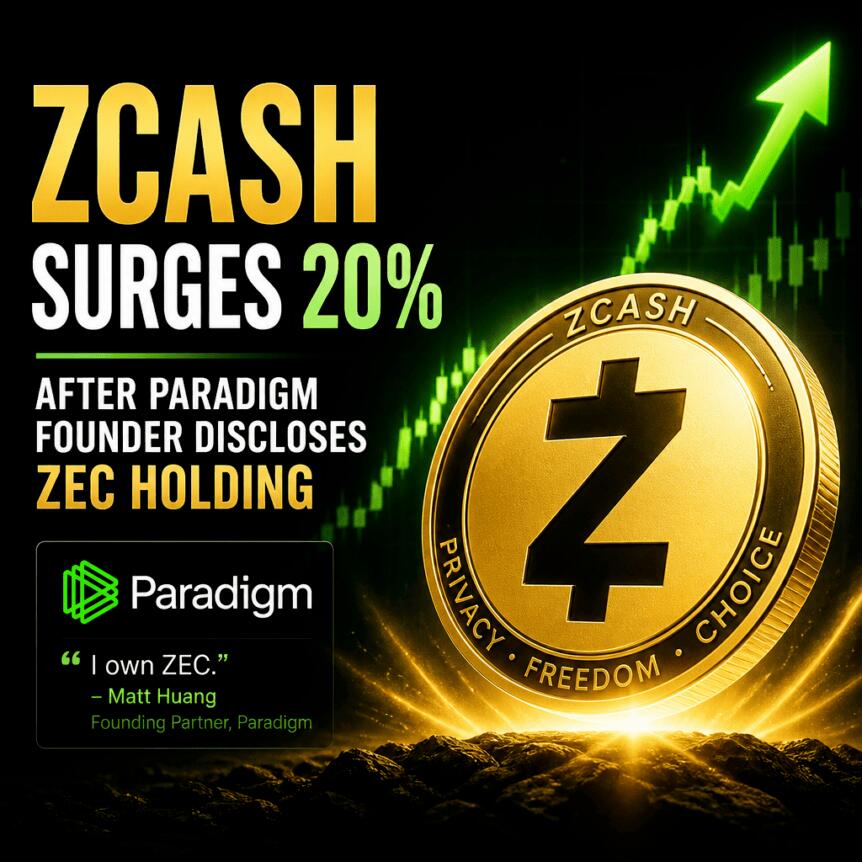
Zcash spiked sharply in the past day, with the privacy-focused cryptocurrency rising by roughly 20% over 24 hours after Paradigm co-founder Matt Huang disclosed that the firm made an unspecified purchase of ZEC. The move follows a broader month-long rally in which Zcash has vastly outpaced Bitcoin, according to CoinGecko price data.
ZEC was trading around $1,338 at last look on Thursday, as the token built on gains that would bring its one-month increase to about 160%, compared with Bitcoin’s 18.2% over the same period, per CoinGecko.
Key takeaways
- Zcash’s surge followed Matt Huang’s disclosure that Paradigm is both a ZODL investor and a ZEC token holder.
- ZEC is up about 160% over 30 days, versus Bitcoin’s 18.2%, based on CoinGecko’s data.
- Zcash’s architecture uses zero-knowledge proofs to support shielded transactions that hide addresses and transaction amounts.
- Privacy coins have generally been outperforming the broader crypto market, with Glassnode data pointing to a large relative lift for the sector.
Paradigm ties spotlight Zcash’s on-chain privacy narrative
The catalyst for Zcash’s latest leg higher was a post by Matt Huang on Wednesday in which he revealed that Paradigm is an investor in the Zcash Open Development Lab (ZODL) and that the firm holds ZEC. The update reframed ZEC’s recent performance through the lens of long-term ecosystem support rather than short-term trading momentum.
Zcash is designed to enable shielded transactions—transfers where the sender and recipient addresses and the transaction amounts are concealed—using zero-knowledge proofs. Those privacy mechanics have been a consistent part of Zcash’s market identity, and the renewed attention around ZEC comes as traders look for assets that can stand apart from broader market direction.
In the same context, Huang characterized Zcash as a “private complement to Bitcoin” and emphasized the importance of sustained funding for development.
Funding the protocol: ZODL and Zcash’s developer model
Zcash’s institutional momentum is not entirely new. Paradigm’s involvement in the ecosystem was already public earlier this year, when ZODL announced a seed round of more than $25 million that included Paradigm, a16z crypto, Coinbase Ventures, and Winklevoss Capital.
Huang also pointed to Zcash’s inflation-funded developer fund, arguing that ongoing support matters as new threats emerge alongside advances in computing. He tied that view to the direction of cyber capabilities increasingly shaped by AI as well as the long-term implications of quantum computing.
Beyond funding, he highlighted governance questions. Huang said he supports combining Zcash coin voting with other forms of governance to reduce unpredictability for the network when ZEC is viewed as a monetary asset.
Macro backdrop: risk assets buoyed as rates rise ends a long pause
ZEC’s climb unfolded alongside strength in the broader crypto market. The timing also coincided with a Federal Reserve move that raised interest rates by 25 basis points to 3.75%-4%—the first increase since 2023—according to the Fed’s press release.
While tighter policy typically pressures speculative assets, crypto markets have often remained sensitive to how investors interpret the path of future rates rather than the immediate change. In this case, Zcash’s rally suggests that token-specific catalysts—especially those tied to institutional involvement and the privacy value proposition—can dominate even when macro conditions are mixed.
Privacy sector momentum: Zcash stands out within a wider trend
Zcash’s outperformance sits within a broader resurgence for privacy-related assets. Glassnode data shared on X indicated the privacy coin sector was 213% above its level at Bitcoin’s October 2025 peak. A separate “basket excluding ZEC” was up about 85% over the past year, per the same Glassnode post.
That comparison matters for traders trying to separate “industry beta” from asset-specific demand. If the broader privacy category is rising, ZEC benefits from sector tailwinds—yet its magnitude over the last month appears larger than the average move of peers, reinforcing the idea that Huang’s disclosure and Paradigm’s positioning added incremental attention and buying interest.
Zcash’s technical positioning also remains central to the story. Shielded transactions using zero-knowledge proofs are designed to make it difficult to trace addresses and amounts in normal transaction history, a key reason privacy assets repeatedly attract both supporters and regulatory scrutiny across markets.
Earlier coverage from Cointelegraph referenced Zcash’s Ironwood work and the protocol changes aimed at strengthening privacy and addressing proof-related concerns (including claims about “undetectable counterfeiting bugs”). While that background doesn’t directly explain Thursday’s jump, it provides context for why Zcash tends to attract investors who follow privacy engineering rather than purely speculative narratives.
Looking ahead, investors will likely focus on whether Huang’s disclosure leads to sustained inflows rather than a short-lived reaction, and whether ZEC’s momentum holds against the broader privacy basket. With the Fed setting a new tone after a long stretch of unchanged rates, traders will also be watching for how macro expectations interact with privacy-sector demand—especially if more institutional disclosures or ecosystem funding signals emerge from Zcash’s development partners.
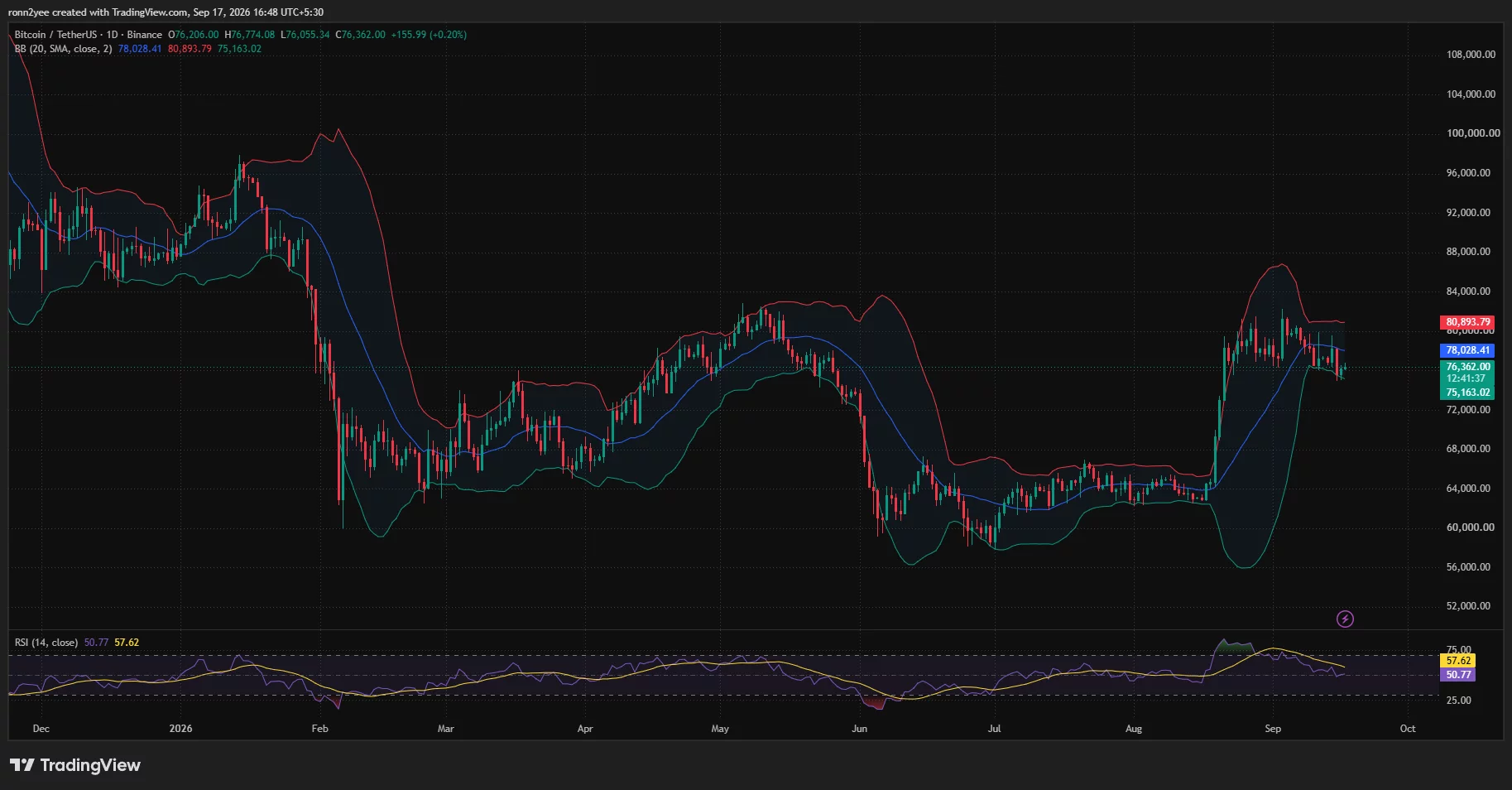
Bitcoin price stabilized above $76,000 after buyers defended the $75,000 area, while improving 4-hour momentum and nearby liquidity at $77,000 pointed to a possible short-term rebound.
Summary
- Bitcoin recovered to $76,362 after falling toward $75,000 during the latest sell-off.
- The daily price remains below the Bollinger Band midpoint at $78,028.
- 4-hour MACD momentum improved, but the Supertrend stays bearish below $78,597.
- Liquidation clusters near $77,000, $78,000, and $80,000 could attract price during a rebound.
Bitcoin price action today
According to data from crypto.news, Bitcoin (BTC) price was trading near $76,362 at the time of writing, up about 0.2% on the day after moving between $76,055 and $76,774. The latest session followed a decline that briefly pushed the asset below $75,000 before buyers stepped in.
The rebound came after the Federal Reserve delivered its first interest-rate increase in three years. The central bank raised its benchmark range by 25 basis points to 3.75%–4.00%, while projections showed 16 of 18 officials expected at least one more increase before the end of 2026.
The rate decision had largely been priced into markets, helping Bitcoin avoid another sharp decline during Fed Chair Kevin Warsh’s press conference. Bitcoin instead protected the $75,000 area and began consolidating between roughly $75,000 and $77,000.
Earlier selling followed the U.S. Senate’s failure to advance the CLARITY Act. The procedural vote ended 49–50, leaving the bill 11 votes short of the 60 required to begin debate. The proposal sought to divide digital asset oversight between the Securities and Exchange Commission and the Commodity Futures Trading Commission.
Fed decision leaves Bitcoin below daily resistance
The daily chart shows that Bitcoin remains in a weaker position despite holding above $75,000. The price trades below the Bollinger Band midpoint at $78,028, which now acts as the first major technical barrier.
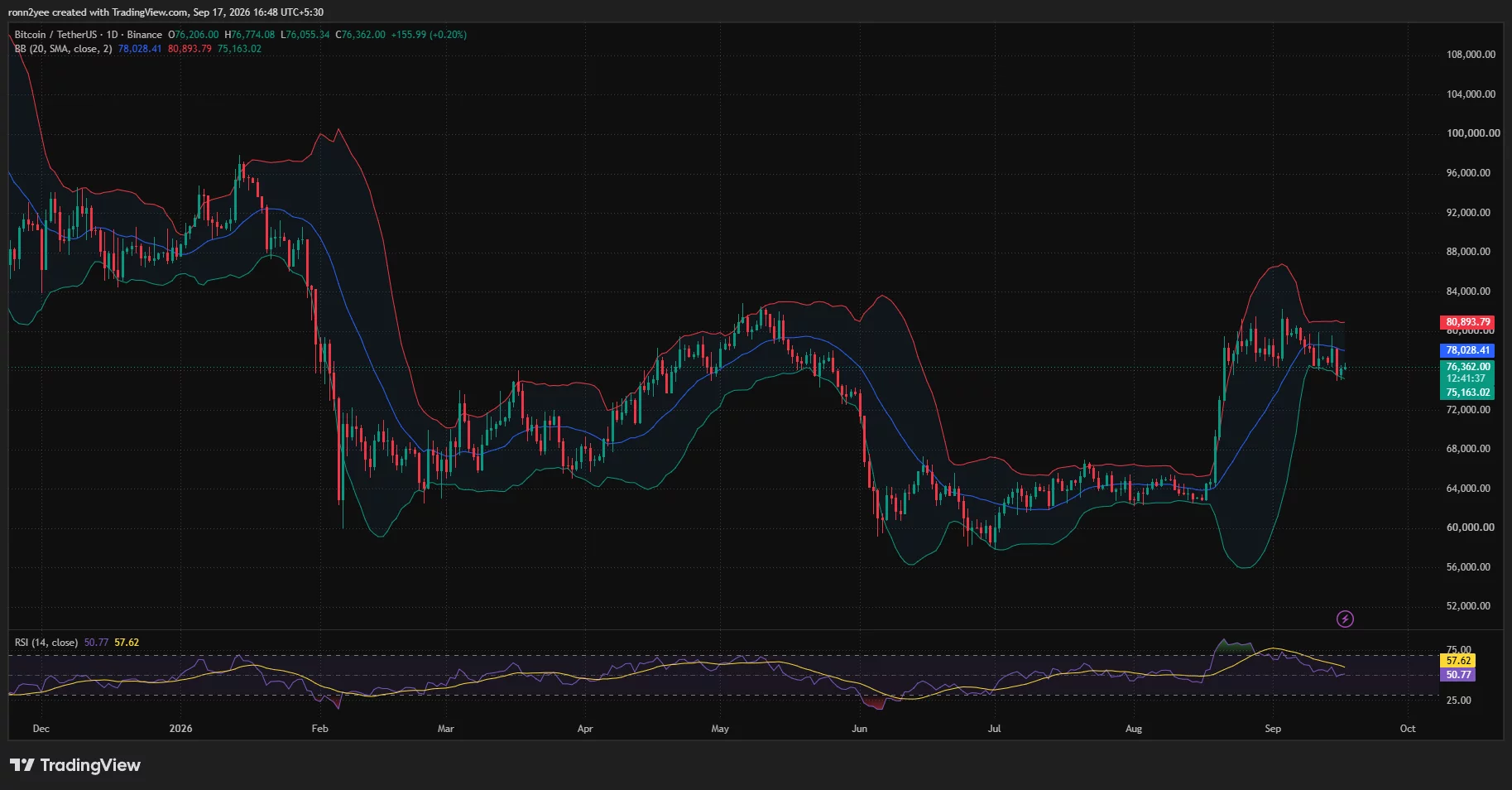
Bitcoin is also close to the lower Bollinger Band at $75,163. The recent test of this area attracted buyers, but another daily close below it could expose the market to a deeper correction. The upper band stands near $80,894, placing it close to the wider resistance area that capped rebounds earlier in September.
Daily relative strength index readings provide a mixed signal. The RSI stands at 50.77, close to the neutral 50 level, while its moving average remains higher at 57.62. Momentum has cooled from overbought conditions reached after Bitcoin’s late-August rally, but the indicator has not yet fallen into oversold territory.
The setup suggests that Bitcoin is consolidating rather than confirming a sustained recovery. A move above the Bollinger midpoint would improve the short-term structure, while a break under $75,000 would give sellers control again.
4-hour momentum points to a possible rebound
Bitcoin’s 4-hour chart shows early signs that selling pressure is easing. The MACD histogram has moved slightly positive at 23.88, while the MACD line stands at minus 353.28 and the signal line at minus 377.16.
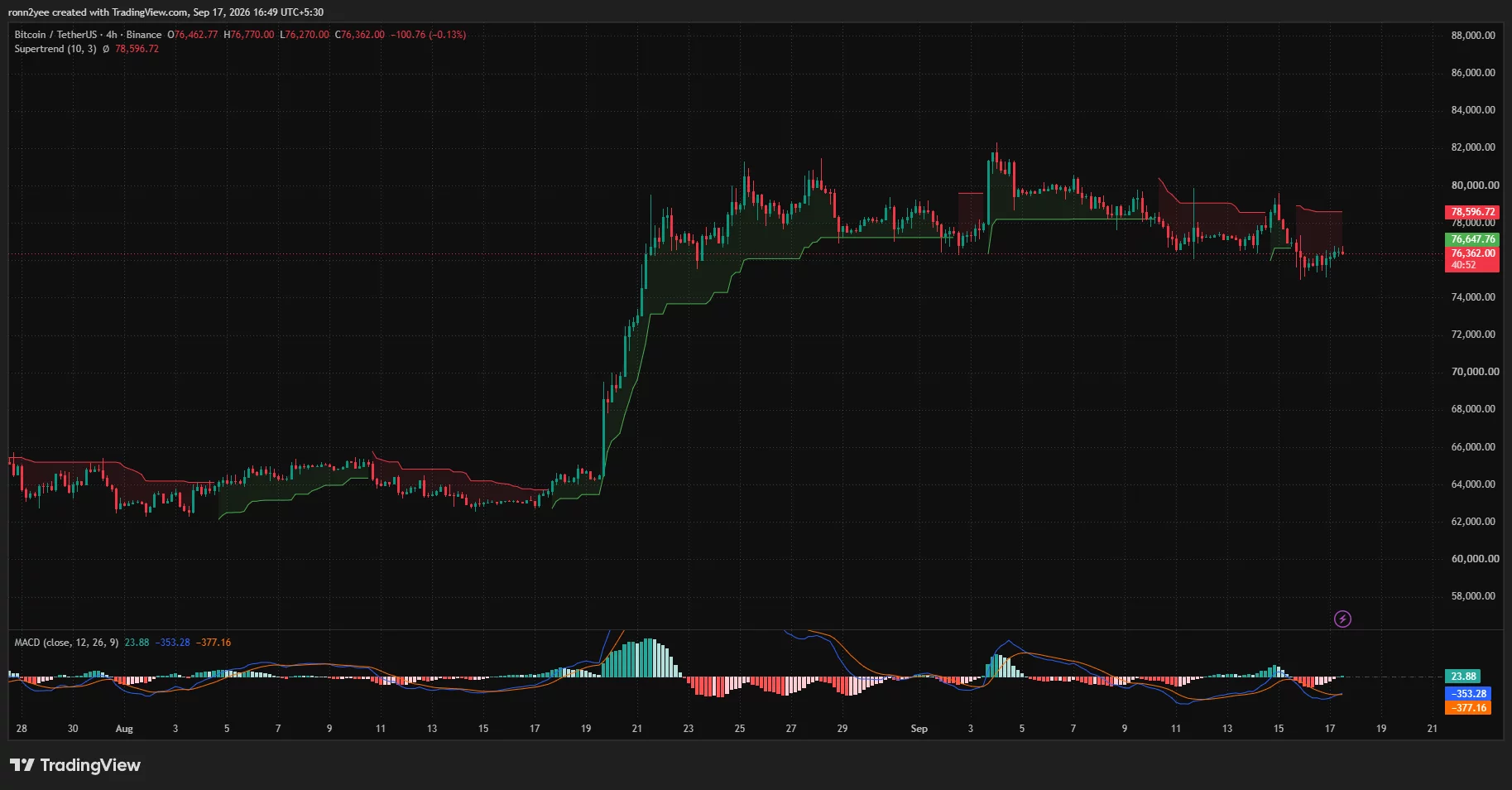
The crossover shows that short-term momentum is beginning to improve, although both lines remain below zero. Bitcoin would need continued buying to turn the signal into a broader bullish reversal.
The 4-hour Supertrend remains bearish at $78,596.72. Price also sits just below a nearby technical level around $76,648, making the $76,650–$77,000 zone the first barrier for buyers.
A close above that range could allow Bitcoin to test $77,300, followed by the Supertrend near $78,600. Failure to clear $77,000 would keep the price vulnerable to another test of $75,000.
Liquidation levels place $77K in focus
The three-day CoinGlass liquidation heatmap shows a dense band of leveraged positions near $76,800–$77,000. Another larger concentration sits between approximately $77,500 and $78,000.
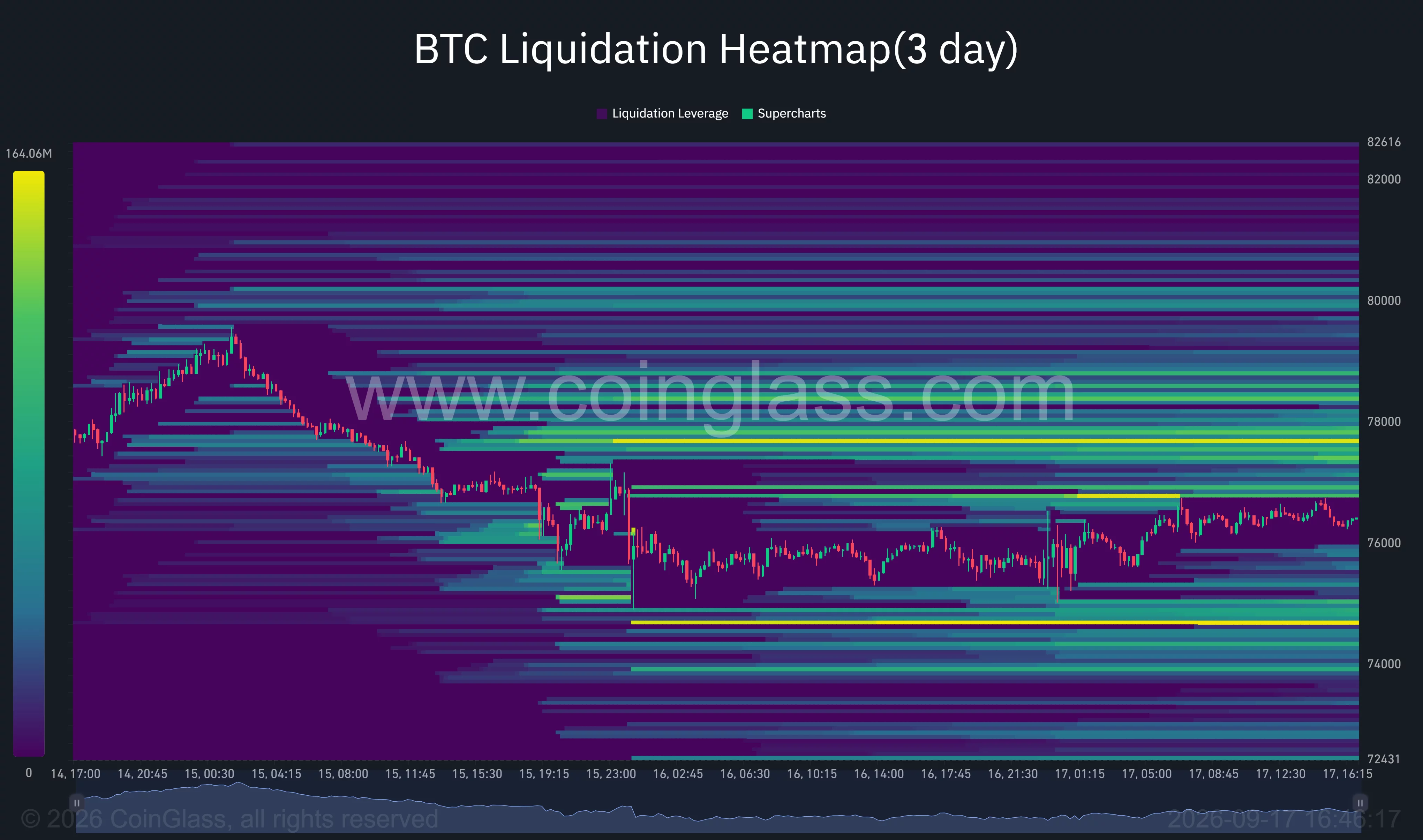
Liquidity becomes heavier around $80,000, with additional clusters extending toward $82,000. Traders often monitor such areas because forced position closures can accelerate a move once price enters a dense liquidation zone.
Crypto trader Daan Crypto Trades said Bitcoin had already removed most of the liquidity below the market when it swept the August lows. He identified $80,000 and $82,000 as the largest remaining clusters within the wider range.
“The big clusters that are left in this range sit at $80K & $82K,” he said.
Those targets remain distant while Bitcoin trades around $76,000. A recovery through $77,000 and $78,600 would be needed before the upper liquidity zones become immediate targets. On the downside, the heatmap shows another strong band close to $74,700–$75,000, making that region a possible target if the current rebound fails.
Analysts watch $77.3K as the next trigger
Crypto analyst Lennaert Snyder said Bitcoin’s ability to defend $75,000 during the Fed decision supported a possible long setup. He added that recent declines had attracted short positions, creating conditions for a squeeze if the market moves higher.
“I’m looking to scalp-long towards the 77.3K POC first, reclaiming that is the next bullish trigger that opens the door to my next targets up to the extremes at 78.5K,” Snyder said.
Snyder identified $74,500 as an alternative support area if Bitcoin makes another downward sweep. A loss of that region would weaken the rebound case and bring the short-term holder cost basis near $71,300 into focus.
The immediate structure therefore depends on whether buyers can reclaim $77,300. A move above that level would open a path toward $78,000–$78,600, while a 4-hour close above the Supertrend could support a broader recovery toward $80,000.
A rejection below $77,000 would keep $75,000 exposed. Losing that psychological level could trigger another liquidity sweep toward $74,500, with $71,300 becoming the larger downside level if selling accelerates.
Disclosure: This article does not represent investment advice. The content and materials featured on this page are for educational purposes only.


Key takeaways
- Ethereum gained 1.7% and reclaimed the important $2,431 level.
- US spot Ethereum ETFs lost $365.5 million across Tuesday and Wednesday.
- A break above $2,544 could target $2,626, while major support sits near $2,269–$2,282.
Ethereum (ETH) gained 1.7% over 24 hours and reclaimed $2,431 despite the Federal Reserve’s first interest-rate increase in three years and the CLARITY Act’s failure to advance in the US Senate.
Exchange outflows, renewed buy-side activity in perpetual futures and short liquidations suggest that crypto-native traders are buying the pullback.
However, continued outflows from US spot Ethereum exchange-traded funds indicate that institutional demand remains weak.
Ethereum holds above $2,400 after Fed rate hike
The Federal Reserve raised its benchmark interest-rate range by 25 basis points to 3.75%–4% on Wednesday.
The unanimous 12–0 decision was widely anticipated, with markets assigning a probability above 90% to the increase before the meeting. Most Fed officials also expect another rate hike before the end of 2026.
Higher interest rates generally pressure cryptocurrencies by raising borrowing costs and increasing the appeal of yield-bearing assets.
However, Ethereum remained above $2,400, suggesting that traders had largely priced in the decision.
The CLARITY Act’s failure to secure the 60 Senate votes required to invoke cloture also produced only a temporary decline before buyers returned.
More than 152,000 ETH left cryptocurrency exchanges on Tuesday, marking the largest daily net outflow since June, according to CryptoQuant.
Inflows briefly exceeded withdrawals on Wednesday, but the metric subsequently returned to net outflows.
Large exchange withdrawals can suggest that investors are moving ETH into private wallets rather than preparing to sell it. They also reduce the supply immediately available for trading, potentially supporting prices if demand remains steady.
However, exchange flows can reflect transfers between custodians and do not always represent outright buying.
Ethereum’s taker buy-sell ratio has returned to buy-side territory after briefly signaling stronger selling on Tuesday.
The ratio compares market-buying volume with market-selling volume in perpetual futures. A reading above one indicates that buyers using market orders are more aggressive than sellers.
Liquidation data also points to improving sentiment. Ethereum recorded $221 million in liquidations on Tuesday, with long positions accounting for 88% of the total.
Over the subsequent 24 hours, liquidations declined to $87.6 million. Short positions accounted for $45.4 million, suggesting that rising prices forced some bearish traders out of the market.
Open interest remained close to 13 million ETH across two days, while funding rates returned to positive territory after briefly becoming negative.
Institutional flows present a less constructive picture. US spot Ethereum ETFs recorded $224.1 million in net outflows on Wednesday, following $141.4 million in withdrawals on Tuesday, according to SoSoValue.
The products therefore lost a combined $365.5 million across two sessions. Continued ETF selling contrasts with the accumulation signals visible on cryptocurrency exchanges and in derivatives markets.
This divergence suggests crypto-native buyers may be absorbing the decline while traditional investment vehicles face redemptions.
ETH reclaims the 20-Day EMA
Ethereum has recovered above the $2,431 horizontal level and its 20-day exponential moving average, both of which provided important support during the past month.
Momentum indicators remain neutral. The Relative Strength Index stands at 53, while the Stochastic oscillator is near 26. These readings suggest consolidation rather than overbought conditions.

Immediate resistance sits at $2,544. A sustained breakout could allow ETH to target $2,626 and then $2,786.
If Ethereum loses $2,431, the 50-day EMA at $2,282 and the 200-day EMA at $2,269 form the next major support zone. Lower levels include $2,172, the 100-day EMA at $2,163, and horizontal support at $1,961.


France’s Council of State has rejected an emergency request from Bull Bitcoin and Paymium to suspend the French decree implementing the European Union’s DAC8 crypto tax reporting rules while a separate challenge seeking to annul the measure remains before the court.
Summary
- France’s Council of State rejected Bull Bitcoin and Paymium’s emergency request to suspend the country’s DAC8 crypto reporting decree.
- The court found insufficient urgency to freeze the rules, while Bull Bitcoin argued that centralized crypto user data could create security risks.
- Bull Bitcoin’s separate case seeking the complete annulment of France’s DAC8 decree remains ongoing before the Council of State.
Bull Bitcoin said in a Sept. 17 statement on X that the summary suspension proceeding was filed in August 2026 and focused on what the companies described as immediate security risks created by collecting and centralizing information about cryptocurrency users.
The proceeding was separate from a legal challenge launched earlier this year against the decree itself. Bull Bitcoin said the first case contests the legality of the French implementation of DAC8, while the second sought to stop its application until the Council of State reaches a decision on the underlying dispute.
Council of State finds no urgent grounds to suspend DAC8
In rejecting the emergency request, the Council of State found that Bull Bitcoin and Paymium had not established a level of urgency sufficient to justify suspending the decree.
“The mere possibility of a risk, the probability of which is very low, cannot constitute a situation of urgency,” the court said, according to an excerpt of the decision published by Bull Bitcoin.
The companies had argued that concentrating information about crypto users in databases accessible for tax reporting creates a security risk if the records are compromised. Data collected under the regime can include information identifying users and details of their crypto transactions.
Bull Bitcoin said leaked information could allow criminals to identify cryptocurrency holders and their families for kidnapping, extortion or other physical attacks.
The company disputed the court’s assessment of the risk, pointing to comments made by France’s General Directorate of Public Finances during parliamentary discussions in February. According to Bull Bitcoin, the tax authority warned that a general declaration system for crypto portfolios could centralize sensitive information, including holders’ identities and the value of their assets, making such records attractive targets for hackers.
Bull Bitcoin said the emergency ruling dealt only with whether there was sufficient urgency to suspend the decree and did not resolve the arguments raised in its main case.
“This refusal in no way means that the Council of State rejects our substantive arguments, and concerns only the grounds of urgency,” the company said.
Bull Bitcoin further said it interpreted the absence of comments on its substantive arguments as a positive sign for the main proceeding. That interpretation represents the company’s view of the ruling, while the Council of State has yet to decide the merits of the annulment challenge.
France faces growing debate over crypto holder data
The security argument comes amid a series of physical attacks targeting cryptocurrency holders and their relatives in France.
As crypto.news previously reported, France had recorded 77 crypto linked cases involving kidnapping, unlawful detention, extortion or attempted offenses during 2026 by early July, according to Interior Minister Laurent Nuñez. The comparable figure for 2025 was 45.
Around 200 people had been arrested following attacks or preventive operations, while authorities introduced measures including stronger intelligence sharing and rapid identification systems for industry participants considered at risk.
Blockchain security firm CertiK separately recorded 52 verified physical crypto attacks worldwide during the first half of 2026, with France accounting for 33 of them. Its dataset put total financial exposure from the incidents at $124.1 million, including stolen assets, ransom demands, frozen funds and other values associated with the cases.
Chainalysis counted 46 documented physical crypto attacks globally through late June, of which 12 resulted in payments to attackers. More than $30 million was taken in successful incidents during the period, while home invasions represented 37% of documented attacks.
The analytics firm identified compromised personal information as a possible factor behind the concentration of attacks in France, citing allegations involving stolen tax records containing investor information. It stopped short of establishing a direct link between specific data breaches and individual attacks.
Physical attacks have continued in recent months. In August, a French couple was kidnapped from their home in Rion-des-Landes in an alleged crypto extortion case. Attackers reportedly sought access to Bitcoin and other cryptocurrency holdings, while two suspects were later arrested.
Another couple in Alès was tied up and threatened by armed intruders in late August. The attackers demanded cryptocurrency transactions and remained inside the home for more than two hours before fleeing as police arrived.
DAC8 expands crypto tax reporting across the EU
DAC8 entered into application across the European Union on Jan. 1, 2026, expanding automatic tax information exchange rules to crypto assets.
Reporting crypto asset service providers must collect information on reportable transactions carried out by EU resident users. Required customer information can include names, addresses, tax identification numbers, dates of birth and tax residence details.
The rules cover crypto to fiat transactions, exchanges between crypto assets and certain transfers. Self custody wallet withdrawals can fall within the reporting framework when they involve a reporting service provider.
Providers are collecting reportable information covering the 2026 calendar year, with the first reporting and automatic exchange of the data scheduled for 2027.
The regime is expected to give tax authorities substantially more information about crypto activity. Chainalysis estimated that France generated $9.4 billion in potentially taxable crypto activity during 2025 across the six blockchains included in its study.
The estimate consisted of $1.7 billion in crypto income, $2.5 billion in realized gains and $5.2 billion in payments. Chainalysis described the figures as potentially taxable activity and did not characterize the full amount as unpaid taxes or government revenue.
French taxpayers reported €368 million in crypto gains for 2024 through roughly 24,000 tax filings, though the figure covers a different period and category of activity and is not directly comparable with the Chainalysis estimate.
Bull Bitcoin continues annulment challenge
Bull Bitcoin said its original proceeding seeking the complete annulment of the French DAC8 decree remains active before the Council of State.
The company said the case challenges the government’s authority to implement the decree and raises arguments concerning fundamental rights and European privacy protections.
Following the rejection of the emergency proceeding, Bull Bitcoin said it plans to publish its filings, supporting documents and arguments from the suspension case in the coming days.
“We are waging this war against mass surveillance on multiple fronts and in multiple countries,” the company said. “We have won battles and suffered setbacks.”
Under the DAC8 implementation timetable, crypto asset service providers must report information covering the 2026 calendar year by Sept. 30, 2027, before the data is automatically exchanged among EU tax authorities.


Zcash gained about 20% over the past 24 hours as Paradigm co-founder Matt Huang disclosed that the crypto investment firm made an unspecified purchase of ZEC, the privacy-focused token that has been outperforming a broader rise across crypto markets.
Zcash (ZEC), a cryptocurrency that enables users to make shielded transactions that conceal addresses and transaction amounts using zero-knowledge proofs, traded around $1,338 at last look on Thursday. Its surge came in the wake of Huang’s Wednesday post revealing that Paradigm is an investor in the Zcash Open Development Lab (ZODL) as well as a ZEC token holder.
Today’s more than 10% rise extends ZEC’s one-month increase to roughly 160%, compared to Bitcoin’s (BTC) 18.2% rise in the same period, according to Coingecko data.
Huang described Zcash as a “private complement to Bitcoin” and backed its inflation-funded developer fund, arguing that long-term funding remains important as AI-driven cyber capabilities and quantum computing advance. He also said he supported combining Zcash coin voting with other forms of governance to reduce unpredictability as a monetary asset.
Paradigm’s investment in the wider Zcash ecosystem was already public. In March, ZODL announced a seed round of more than $25 million that included Paradigm, a16z crypto, Coinbase Ventures and Winklevoss Capital.
ZEC’s rise came as the broader crypto market advanced after the Federal Reserve raised rates by 25 basis points to 3.75%-4%, its first increase since 2023.
Privacy coins have also substantially outperformed the wider market. Glassnode data showed the sector was 213% above its level at Bitcoin’s October 2025 peak, while a basket excluding ZEC was up about 85% over the past year.
Related: Zcash says Ironwood proof rules out undetectable counterfeiting bugs
Bitwise Chief Investment Officer Matt Hougan has revised his view of the CLARITY Act setback after Bitcoin rallied from $57,950 in July to above $80,000 before the Senate failed to advance the crypto market structure bill on Sept. 15.
Summary
- Bitcoin climbed above $80,000 before the Senate rejected CLARITY, prompting Bitwise to revise its outlook.
- The Senate rejected cloture 49-50, leaving the crypto market structure bill short of sixty votes.
- SEC and CFTC leaders say existing authority still allows additional crypto rulemaking without new legislation.
- Robinhood launched its chain, while Morgan Stanley launched Solana and Ether exchange-traded products in July.
- Bitcoin traded near $76,300 Thursday after the vote-driven selloff and Wednesday’s Fed rate increase decision.
Bitwise said in Hougan’sSept. 16 CIO memo that he no longer considers another six weeks of difficult crypto trading the most likely result after the legislation stalled, though his expectation that the current crypto rally can continue remains an investment outlook rather than a confirmed market outcome.
Hougan had previously compared the legislation to crypto’s “Punxsutawney Phil,” predicting a longer market winter if Congress failed to complete the bill. After reviewing Bitcoin’s price action and continued financial-sector product launches, he now describes the Senate setback as a “speed bump, not a roadblock.”
Bitcoin’s rally changed Hougan’s CLARITY outlook
Hougan’s revised position centers on Bitcoin’s performance while expectations for the legislation deteriorated. Bitwise data placed Bitcoin’s July 1 low near $57,950 before the asset climbed above $80,000 on Sept. 4. Over the same period, Bitwise said Polymarket pricing for the CLARITY Act becoming law in 2026 dropped from 39% to 18%.
Hougan argued that the opposing moves weakened his earlier assumption that passage was necessary for the market recovery to continue. The price relationship does not establish that declining legislative odds caused Bitcoin’s advance, and Bitwise did not present it as proof of future performance.
The Senate then rejected cloture on the motion to proceed with H.R. 3633 on Sept. 15. The official Senate roll call recorded 49 votes in favor and 50 against, with one senator not voting. Sixty votes were required to invoke cloture and move toward debate.
The action was not a final vote on passage. Republican Sens. Susan Collins, Josh Hawley, Jerry Moran and Thom Tillis voted against cloture. Tillis changed his vote after the outcome became clear, a procedural move that preserved the possibility of seeking reconsideration. No date for another Senate vote has been announced.
As crypto.news reported after the vote, the failure stopped the Senate from opening debate at that stage while leaving the legislation unresolved rather than formally defeated through a final passage vote.
Wall Street crypto projects continued before the Senate vote
Hougan cited several institutional developments to support his view that large financial companies have not waited for market structure legislation before building crypto products.
Robinhood launched the public mainnet of Robinhood Chain on July 1. The company describes the network as a permissionless, Ethereum-compatible Layer 2 built for financial services and tokenized assets. Its second-quarter regulatory filing confirms that Robinhood Chain moved from its February public testnet into mainnet during July.
Robinhood paired the launch with Stock Tokens for eligible users in more than 120 countries through Robinhood Wallet. Robinhood says approximately 200 stock tokens were available by September.
Morgan Stanley’s Solana product had moved even further than an application by the time of Hougan’s memo. The SEC declared the Morgan Stanley Solana Trust registration effective on July 23, and Morgan Stanley Investment Management formally launched the MSOL product on NYSE Arca on July 28 alongside its Ether product, MSSE.
Morgan Stanley said both exchange-traded products charge a 0.14% sponsor fee and seek exposure to SOL and Ether, with staking incorporated into their structures. Crypto.news reported on the July launch, correcting earlier descriptions of Morgan Stanley as merely seeking approval for a Solana fund.
DTCC supplied another example. On July 15, the Depository Trust & Clearing Corporation processed live production transactions using securities converted into DTC-tokenized assets. The transactions included equity trades, U.S. Treasury and repo activity, securities lending, collateral pledges and token transfers.
DTCC said roughly 40 firms participated in the production event, which came ahead of the planned October 2026 launch of its Tokenization Service. In related coverage, crypto.news reported that participants included firms such as BlackRock, JPMorgan, Goldman Sachs and other financial institutions.
SEC and CFTC rulemaking can continue without the bill
Hougan’s second argument concerns regulatory authority already held by the SEC and CFTC. He characterized the current leadership of both agencies as supportive of crypto-market development and said companies have taken comfort from that policy direction. His description of the agencies as “pro-crypto” is Bitwise’s characterization, not a statutory classification.
SEC Chairman Paul Atkins has separately said congressional legislation remains preferable because agency rules can later be changed. In an Aug. 18 statement, Atkins called legislation “indispensable” for creating rules durable enough to survive a future change in regulatory leadership.
The SEC has nevertheless started its own rulemaking. Its proposed Regulation Crypto Assets, published Aug. 18, would create tailored exemptions for certain investment-contract offerings involving crypto assets and a conditional safe harbor addressing when a crypto asset would no longer be treated as subject to an investment contract. The proposal remains open for public comment through Oct. 20 and is not a final rule.
CFTC Chairman Michael Selig took a similar position after the Senate vote. In a Sept. 16 statement reported by The Block, Selig said the agency was “locked in and ready to ship its rules for the new frontier of finance” using its existing statutory authority.
The CFTC had already created an Innovation Task Force in March to work on crypto assets, blockchain, artificial intelligence and prediction markets. Selig said at the time that the group would coordinate with the SEC while developing rules within the commission’s existing mandate.
Agency authority still has limits. Hougan acknowledged that only Congress can provide the CFTC with the full spot-market jurisdiction contemplated by the CLARITY Act. Administrative rules can face court challenges and may be amended or reversed by future commissions, while legislation would create a different level of statutory permanence.
Former CFTC Chairman J. Christopher Giancarlo similarly said the two agencies could continue writing rules within existing authority while Congress remains divided.
Bitcoin fell after the vote as macro pressure increased
Markets reacted negatively immediately after the Senate action. Reuters reported Bitcoin falling roughly 4% to around $75,908, while Coinbase and Circle shares dropped close to 9% as investors reacted to the failure to advance the bill.
Crypto derivatives markets recorded another layer of selling. Crypto.news reported that exchanges liquidated roughly $571 million in long positions over 24 hours, including close to $190 million each in Bitcoin and Ether longs.
Hougan said the legislative result was not the only factor affecting prices. His memo cited interest-rate and oil concerns as possible contributors to the decline, while describing additional volatility as a risk to his bullish investment thesis.
The macro backdrop changed again on Sept. 16 when the Federal Reserve raised its benchmark rate to 3.75%–4.00%, its first increase since 2023. Reuters reported that the unanimous decision came as policymakers responded to persistent inflation and rising energy costs, with most officials projecting at least one more increase during 2026.
By Sept. 17, CoinGecko showed Bitcoin near $76,274, up roughly 0.5% over 24 hours but down around 2.1% over seven days. The price remained well above Bitwise’s $57,950 July starting point while trading below the early-September level above $80,000.
Hougan’s expectation that the crypto bull market can continue without the CLARITY Act remains Bitwise’s market forecast. The SEC’s Regulation Crypto Assets proposal is still accepting comments through Oct. 20, while the Senate has not scheduled another cloture vote on H.R. 3633.

New Sports Direct could open in Cambridge despite two others being less than 10 minutes away

Protein sodas muscling into the mainstream

Stock Market Today: Dow Rises In Day 2 Fed Reaction; Generac, Nebius, Bloom Energy, SpaceX Are Early Movers



-

 Fashion6 days ago
Weekend Open Thread – Corporette.com
-

 Tech4 days ago
The Latest Weird Thing to Play Doom Is the Mapped-Out Brain of a Fruit Fly
-

 Business6 days ago
10 Most-Streamed Songs On Spotify In 2026 So Far, Led By Ella Langley’s Dominant Run On The Charts This Year
-

 Crypto World6 days ago
XAG/USD: Silver’s Short-Term Rally Meets Its Moment of Truth
-

 Crypto World7 days ago
2 Chip Stocks Broke Out This Week. Neither Was Nvidia
-

 Tech7 days ago
Battery life is the only iPhone 18 Pro and iPhone Duo upgrade I care about. Apple didn’t disappoint
-

 Crypto World7 days ago
OKX launches 10x OpenAI, Anthropic X-Perps in Europe
-

 Crypto World6 days ago
Diesel Tops $6 a Gallon for the First Time as 28 States Set Records
-

 Business7 days ago
Western Digital Slips 2.7% as AI Storage Rally Cools After Record Cash and Guidance
-

 Crypto World3 days ago
Elon Musk Drops a Bombshell: Grok 5 Could Be the AGI Breakthrough
-

 News Videos6 days ago
Facing Financial Fears
-
 Crypto World3 days ago
Kraken Lets xStocks Holders Earn Yield Through DeFi
-

 Business4 days ago
Rivals Sam Altman and Elon Musk Rally Behind Dario Amodei’s Call for a Slowdown in AI Development
-
Crypto World7 days ago
Ethereum Price Analysis: Consolidation at $2.5K Tests Momentum as On-Chain Activity Surges
-

 Crypto World5 days ago
Can AI Build a Startup in 72 Hours? Elon Musk's Team Will Livestream the Test
-

 Entertainment6 days ago
News Specials, Movies, Shows, More
-
 NewsBeat3 days ago
‘Sick conspiracy’: Trump says only guardrails AI needs is ‘a strong and smart (High IQ!) president’ in all-caps rant
-

 Crypto World13 hours ago
US Charges Robinhood Engineers Over Crypto Listing Trades
-

 Crypto World6 days ago
Bitcoin ETFs Pull $167M as 2026’s Best Inflow Run Slows
-

 Crypto World7 days ago
US CPI forecast at 3.4% as tariff risks build
You must be logged in to post a comment Login