
Crypto World
CFTC to discuss crypto and AI rules at first IAC meeting



The CFTC has scheduled a three-hour meeting for Aug. 20 to examine crypto assets, artificial intelligence, prediction markets, and its recent work across the three sectors.
Summary
- The CFTC Innovation Advisory Committee will meet from 1 p.m. to 4 p.m. EDT.
- Committee members will attend in Washington, while the public can watch the meeting online.
- Crypto assets, AI, and prediction markets are listed among the main discussion areas.
- Written public statements related to the meeting must be submitted by Aug. 27.
CFTC meeting will put crypto and AI policy on the agenda
The Commodity Futures Trading Commission said in an Aug. 11 Federal Register notice that its Innovation Advisory Committee will hold its inaugural meeting on Aug. 20, bringing members together to discuss crypto assets, artificial intelligence, and prediction markets.
Scheduled to run from 1 p.m. to 4 p.m. Eastern Daylight Time, the meeting will take place in person for committee members in Washington. Members of the public will be able to follow the proceedings virtually, and the session may finish before 4 p.m. if the committee completes its business early.
The CFTC said recent agency activity involving the three areas will also form part of the discussion. Its notice does not identify a proposed rule that members will vote on, nor does it state that the meeting will produce immediate policy changes.
Rather, the IAC advises the commission on issues where technology, law, policy and finance overlap. Its recommendations may inform the agency’s work, but the committee does not independently adopt or enforce CFTC regulations.
Chairman Michael S. Selig, who sponsors the committee, announced the meeting separately on Aug. 10. According to the CFTC announcement, the group consists of U.S. entrepreneurs, researchers, industry participants, and other specialists chosen to give the agency input on changes in financial markets.
Selig’s announcement described the subjects under review as part of a “new frontier of finance.” However, the release did not include a detailed regulatory proposal for crypto, AI or prediction markets, leaving the committee’s specific discussion points to the meeting agenda and presentations.
Crypto oversight has become a larger CFTC responsibility
Digital assets enter the meeting as Congress continues to consider giving the CFTC a more extensive role in U.S. crypto markets. Existing law already gives the agency authority over commodity derivatives, including futures and options tied to assets such as Bitcoin, while the SEC oversees securities and securities transactions.
Pending market-structure legislation could expand the CFTC’s responsibilities in digital commodity spot markets. A recent crypto.news review of CFTC capacity reported that the agency had 556 employees and a $365 million budget, compared with about 4,200 staff and a $2.149 billion budget at the SEC.
The CFTC’s Office of Inspector General identified digital asset regulation as its leading management and performance challenge for 2026, according to the same report. Any expansion of the agency’s authority would therefore place staffing, technology and funding questions alongside decisions about registration, market surveillance and customer protection.
Work on crypto policy has continued while lawmakers debate the agency’s future remit. In March, the CFTC joined the SEC in issuing an interpretation on how federal securities laws apply to certain crypto assets and related transactions. The two regulators also signed a memorandum of understanding covering coordination between their agencies.
The commission has taken separate action in crypto derivatives markets. In May, it approved KalshiEX’s Bitcoin perpetual futures contract and issued staff relief involving Coinbase Financial Markets and certain foreign crypto perpetual products.
As reported at the time, the Kalshi decision opened a federally regulated route for U.S. traders to access a Bitcoin perpetual futures product. The related Coinbase letter allowed specified customer-owned digital commodities and payment stablecoins to be transferred to an affiliated foreign broker as margin, subject to the conditions set by CFTC staff.
Prediction markets face federal and state disputes
Prediction markets will give the committee another unresolved U.S. regulatory issue to examine. The platforms offer event contracts whose payouts depend on the outcome of elections, sporting events, economic data releases, and other measurable events.
CFTC-registered exchanges maintain that eligible event contracts fall under federal derivatives law. State gaming regulators and other critics have challenged some sports-related products as unlicensed betting, leading to litigation over whether federal derivatives oversight displaces state gambling rules.
During 2026, the commission reaffirmed its view that it holds exclusive federal jurisdiction over prediction markets within the derivatives framework. It also withdrew a 2024 proposal that would have restricted contracts involving political contests, sports, and other listed categories.
In March, the CFTC started another public process focused on event-contract regulation. Submissions came from prediction market operators, crypto companies, venture investors, and state gambling authorities, according to a May policy report.
More recent requests show that the disagreement extends beyond the basic question of federal authority. On Aug. 3, the NFL asked the CFTC to require a minimum age of 21, stronger controls against insider trading, and closer reviews of sports contracts, according to the league’s comments covered in a prediction-market filing.
The commission has also addressed how event contracts are presented to customers. In an Aug. 7 staff letter, its Division of Market Oversight and Market Participants Division reminded regulated entities that their pricing displays and marketing must clearly distinguish derivative products from bookmaker-style wagering.
AI discussion follows the CFTC’s own use of the technology
Artificial intelligence will be considered both as a financial-market tool and as technology already being used inside the regulator. The CFTC has applied AI to tasks that include reviewing registration materials and examining trading data, according to public statements from Selig.
Such use raises questions about data quality, automated analysis, and regulatory accountability within the agency’s operations. The official meeting notice does not list individual AI systems, potential safeguards, or a planned enforcement policy, so any recommendations will depend on the presentations and committee discussion on Aug. 20.
The IAC works alongside the CFTC’s Innovation Task Force, which Selig created in March to develop policy involving crypto and blockchain technology, AI and autonomous systems, and prediction markets and event contracts. Michael J. Passalacqua leads the task force with staff drawn from several parts of the commission.
When announcing the task force, Selig said clear rules could support “responsible innovation at home” and prevent U.S. market participants from being “left on the sidelines.” The CFTC also said the team would coordinate with other federal bodies, including the SEC and its Crypto Task Force.
Public participation in the IAC meeting will remain open after the livestream ends. The Federal Register notice allows interested parties to submit written statements until Aug. 27 through Regulations.gov, by mail to CFTC Secretary Christopher Kirkpatrick, or by hand delivery to the commission’s Washington headquarters. Submissions must identify the “Innovation Advisory Committee,” and the CFTC said qualifying statements will become part of the public record.

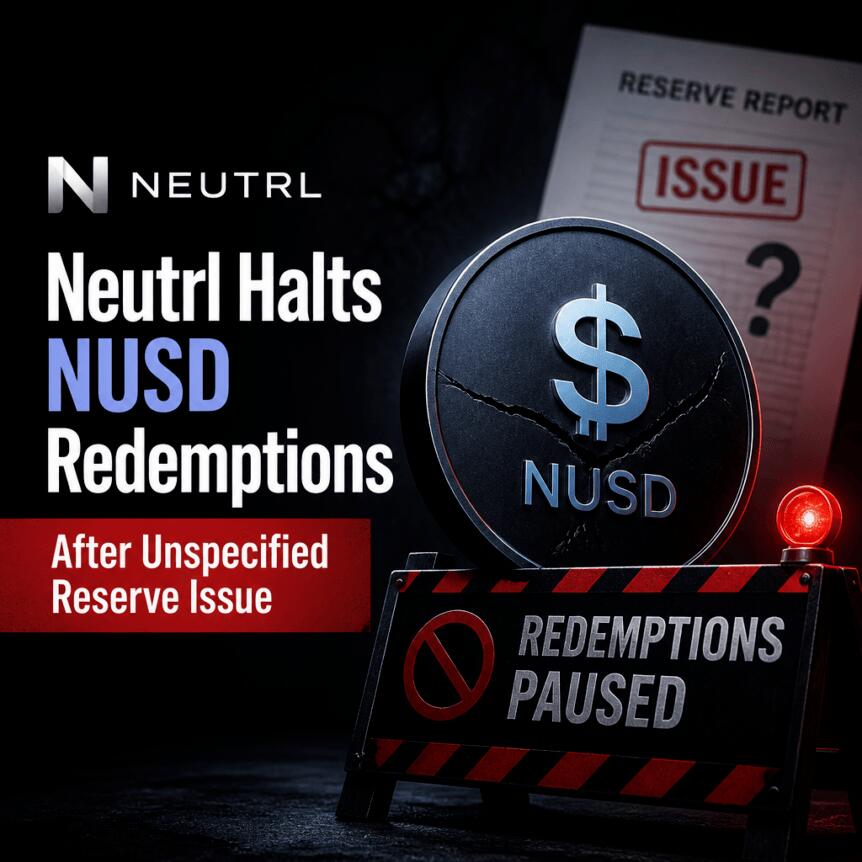
DeFi protocol Neutrl has halted minting and redemptions of its synthetic dollar, NUSD, after “unspecified circumstances” affected the protocol’s reserves. The suspension also includes paused protocol functions as Neutrl evaluates the scope of any potential impairment, but it has not yet disclosed what went wrong, which asset or counterparty is involved, or whether any realized losses occurred.
The pause matters beyond Neutrl itself: other market participants that rely on NUSD-linked positions have also stopped minting and redemption-related activity for Neutrl-based contracts. Until Neutrl provides more clarity, approved counterparties cannot exchange NUSD for its backing assets, leaving holders with fewer routes to exit through the protocol.
Key takeaways
- Neutrl suspended NUSD minting and redemptions after reserves were reportedly affected, without naming the underlying cause, asset, or counterparty.
- Neutrl also paused other protocol functions on legal advice while it assesses impact; no restart date has been provided.
- Structured-yield protocol Strata said it paused minting/redemptions for contracts in its Neutrl market, while keeping other markets running.
- On-chain tracking from RWA.xyz shows NUSD market cap around $53.6M and a sharp decline over 30 days, though the data does not prove the drop is tied to the reserve issue.
NUSD halted as Neutrl reviews reserve impact
Neutrl announced that it had suspended minting and redemptions for NUSD, citing unspecified circumstances that affected protocol reserves. In a separate update, the team said it paused additional protocol functions “on legal advice” while it evaluates how the situation impacts reserves and liabilities.
Crucially, Neutrl has not yet provided details that would help counterparties and token holders assess risk: the protocol did not specify the affected asset or any counterparty, did not confirm whether reserves suffered a realized loss, and did not offer a timeline for resuming operations. Neutrl said it would share timing and next steps when information becomes available.
While the protocol evaluates its position, the direct effect is straightforward: the suspension prevents approved counterparties from exchanging NUSD for backing assets, potentially increasing uncertainty for anyone holding NUSD and for DeFi products that depend on its redemption path.
Ripple effects: Strata freezes Neutrl-linked contracts
The operational pause is also showing up across DeFi infrastructure that builds on NUSD. Structured-yield protocol Strata stated that it paused minting, redemptions, and related functions for contracts in its Neutrl market—an area that supports several NUSD-linked products—while indicating that its other markets remain operational.
That distinction is important for users trying to isolate exposure. If Strata’s Neutrl market is paused but other markets continue, users with positions not tied to NUSD may still be able to transact normally on those venues. For NUSD-linked strategies, however, the liquidity and workflow disruption could extend until Neutrl unfreezes minting and redemptions or clarifies how the reserve issue is being handled.
Supply contraction already underway—but the link remains unproven
Prior to Neutrl’s announcement, NUSD’s footprint appears to have been shrinking. According to RWA.xyz data, NUSD had a market capitalization of about $53.6 million on Friday, down 18.4% over 30 days. RWA.xyz also reported monthly transfer volume fell 72.4% to $71.4 million.
However, RWA.xyz’s figures alone do not establish causation between the earlier contraction and the reserve problem. The protocol’s current suspension raises concern, but investors should avoid assuming the reserve impairment drove the 30-day decline without more evidence.
RWA.xyz also showed NUSD trading at roughly $0.9984, along with 615 holders and 347 active addresses over the preceding 30 days. As with the supply and volume changes, these metrics can help frame usage and distribution trends, but they cannot confirm whether the reserve disruption has already translated into a realized loss.
How NUSD is supposed to work—and what past risk reviews flagged
NUSD is designed to track the US dollar using yield-bearing crypto assets and market-neutral strategies rather than traditional bank deposits. That design aims to avoid simple custodial deposit risk, but it introduces other forms of exposure—particularly around counterparty performance, operational execution, and liquidity conditions.
Earlier, verification platform Accountable said its Neutrl dashboard provided continuous cryptographic proof that NUSD reserves matched the protocol’s liabilities. According to a May 25 Accountable post referenced in earlier reporting, the dashboard was designed to show ongoing correspondence between reserves and liabilities, which is directly relevant when users ask whether backing remains intact.
At the same time, a February assessment by risk-advisory team BA Labs flagged that a proposed Neutrl integration carried higher risk. BA Labs pointed to counterparty, operational, and liquidity exposure, noting that direct redemptions were limited to KYC or KYB-approved counterparties and that redemption requests exceeding a liquid buffer could enter a queue targeted for completion within 48 hours without a guaranteed outcome.
In that February review, BA Labs estimated NUSD supply at $226 million and reserves at $233.7 million, implying a collateralization ratio of 103.6%. The team also estimated that more than 87% of reserves were held via Fireblocks, with smaller amounts on centralized exchanges. While those figures are historical, they outline the kind of reserve structure that can become relevant during a disruption—especially when access, settlement timing, or counterparty availability comes into question.
Importantly, Neutrl has not said whether the current event affects realized value, whether the issue relates to custody/settlement, or whether the mismatch is only operational. Until Neutrl clarifies, the combination of a reserve-impact claim and incomplete transparency means market participants should treat the pause as an unresolved risk event rather than a closed “technical issue.”
For now, the key thing to watch is what Neutrl reveals next: whether reserves are still intact relative to liabilities, what caused the reserve impact, and how and when NUSD minting and redemptions will be restarted. As Strata keeps its Neutrl-linked market paused, the timing of Neutrl’s next steps will likely determine how quickly NUSD-dependent products can resume their normal redemption and minting mechanics.
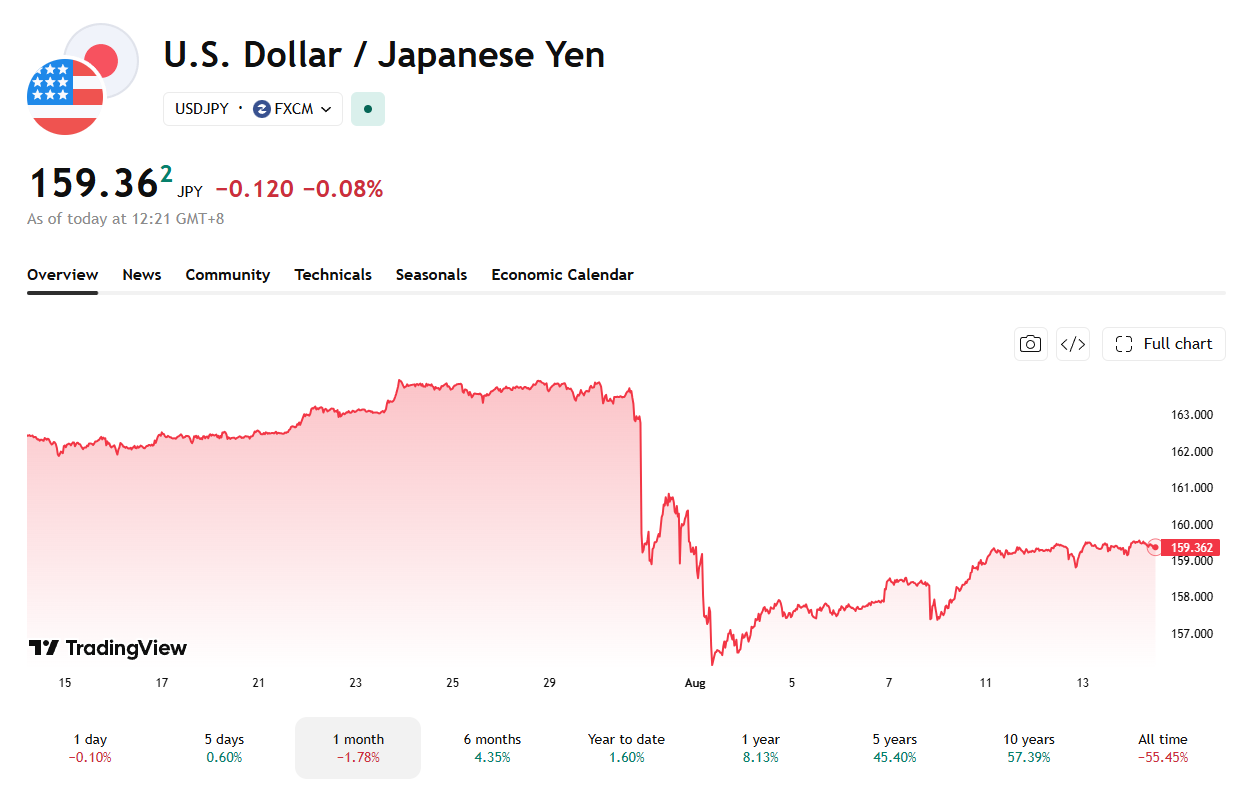
Bettors on Polymarket now put 81% odds on a Bank of Japan rate hike in September. Two weeks ago, that same bet sat at just 22%.
The shift comes as Japan’s currency intervention loses its grip on the yen. The currency is on track for its biggest weekly loss in three months, unwinding much of its recent rebound.
Intervention’s Fading Boost
The yen fell about 1% this week to 159.43 per dollar. That puts it on track for its worst week since May.

The currency has given back roughly half the gains from Japan’s coordinated yen intervention in late July and early August. It was trading near 164 per dollar before that support began.
This is not the first time the boost has faded. Japan’s April intervention followed a similar path, and the yen drifted back toward 40-year lows over the following months.
Tokyo’s former top currency diplomat, Mitsuhiro Furusawa, told Reuters Japan could tap its yen war chest again at any time. He said officials could also signal faster rate hikes to defend the currency.
Bettors Pivot to a BOJ Hike
That link between intervention and rate hikes is why traders are shifting their bets. A quarter-point Bank of Japan hike is now priced at over 80% on Polymarket.
OCBC strategist Sim Moh Siong said intervention alone cannot shift the yen’s trend.
“It’s not much of a surprise that the yen has retraced.”
He said the currency needs a genuinely hawkish Bank of Japan behind it. That lines up with growing talk of faster BOJ rate hikes as inflation nears its target.
The bet carries risk. A hold instead of a hike could disappoint traders quickly. That kind of surprise has previously sent the yen sliding back toward 160. For now, markets are betting on the Bank of Japan, not further intervention, to hold the line.
The post Bank of Japan Hike Odds Triple on Polymarket as Yen Intervention Fades appeared first on BeInCrypto.
Crypto World
Bitcoin (BTC) holding firms Strategy and Metaplanet face stock-index exclusion under MSCI’s new proposal
If it fails that, it moves to an exclusion screen that uses five ratios – operating asset intensity, expense intensity, cash flow, fair value intensity, and capital dependence – to make the final call.
A company becomes ineligible for index inclusion if it fails four out of the five test ratios.
MSCI’s description of the so-called non-operating companies not fit for index inclusion reads like a checklist of bitcoin treasury firms without naming one.
Companies that “create value by accumulating and holding non-operating assets,” generate little cash from actual operations, and depend on outside capital rather than their own business to grow, MSCI explained. Companies not currently in the index face the stricter thresholds based on their latest single filing.
An earlier consultation, opened in October 2025, targeted “digital asset treasury” firms, specifically those holding 50% or more of assets in bitcoin or other cryptocurrencies. That proposal named 39 companies, triggering crypto market volatility and industry backlash. The proposal was ultimately deferred.
Nothing is decided yet
MSCI has invited feedback from market participants through Sept. 30, and the results will be announced roughly two weeks later, on Oct. 16.
It has said that any resulting changes would be folded into the November 2026 index review, if the proposal is adopted at all.
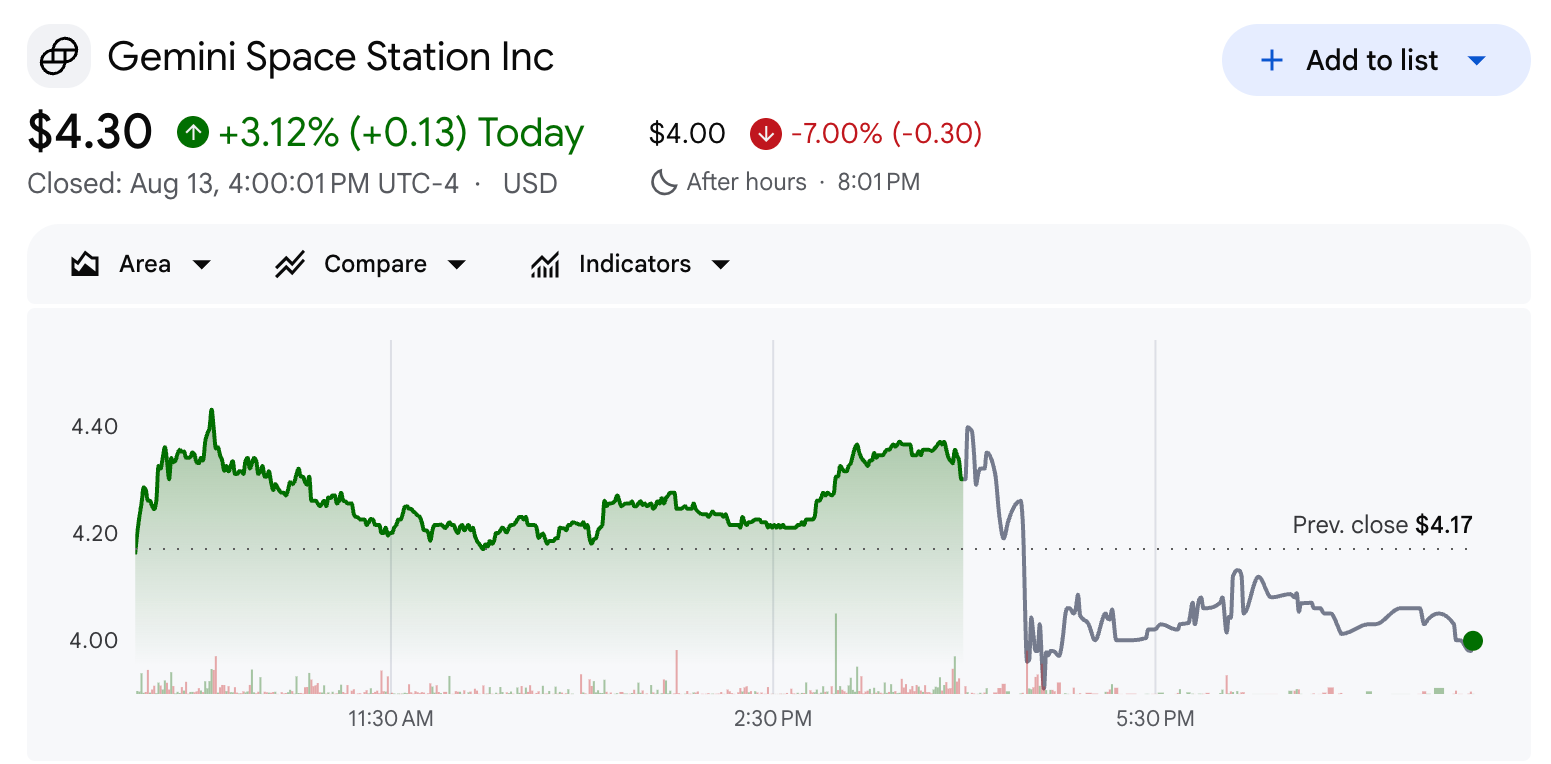
Gemini Space Station (GEMI) stock slid 7% to $4.00 in after-hours trading Thursday after the crypto exchange reported a second-quarter net loss of $107.7 million.
The loss came in 19% smaller than a year earlier, and revenue climbed 37% to $45.5 million. Even so, a fraud charge and thinner trading volumes overshadowed the company’s progress.
Services Revenue Doubles as Crypto Trading Dries Up
The stock closed the regular session 3.12% higher at $4.30 before the company released earnings after the bell, which reversed the gains.
Follow us on X to get the latest news as it happens

According to the press release, net loss per share came in at $0.89, against $27.08 a year earlier. Services revenue and interest income climbed 117% to $26.0 million. Credit card revenue supplied most of that gain, rising 231% to $16.2 million, while staking added $4 million.
OTC revenue jumped to $4.7 million from $0.6 million on heavier institutional trading. In addition, prediction markets added $0.5 million.
Exchange revenue moved the other way. It fell 38% to $12.5 million as crypto trading volume shrank to $3.8 billion from $11.3 billion a year earlier.
“While we still have work to do as a company, this quarter’s results reflect our ongoing efforts to reduce operating expenses while diversifying revenue,” Gemini CEO, Tyler Winklevoss, said.
Fraud Charge Undercuts the Cost Cuts
Meanwhile, transaction losses tell a harsher story. They surged to $20.1 million from $3.6 million. This was driven mainly by a $16.1 million provision for credit losses on the credit card portfolio.
“The higher provision was impacted by an identity fraud event identified earlier in 2026,” the firm noted.
Operating expenses dropped 15% sequentially to $122.4 million from $144.5 million. February’s 30% staff cut and withdrawals from international markets drove the decline. Operating loss came to $76.9 million.
Investors treated the prior quarter differently. Shares rallied after Q1 2026 earnings showed $50.3 million in revenue and a $109 million loss.
Subscribe to our YouTube channel to watch leaders and journalists provide expert insights
The post Gemini Shares Drop 7% Even as Net Loss Narrows to $107 Million appeared first on BeInCrypto.
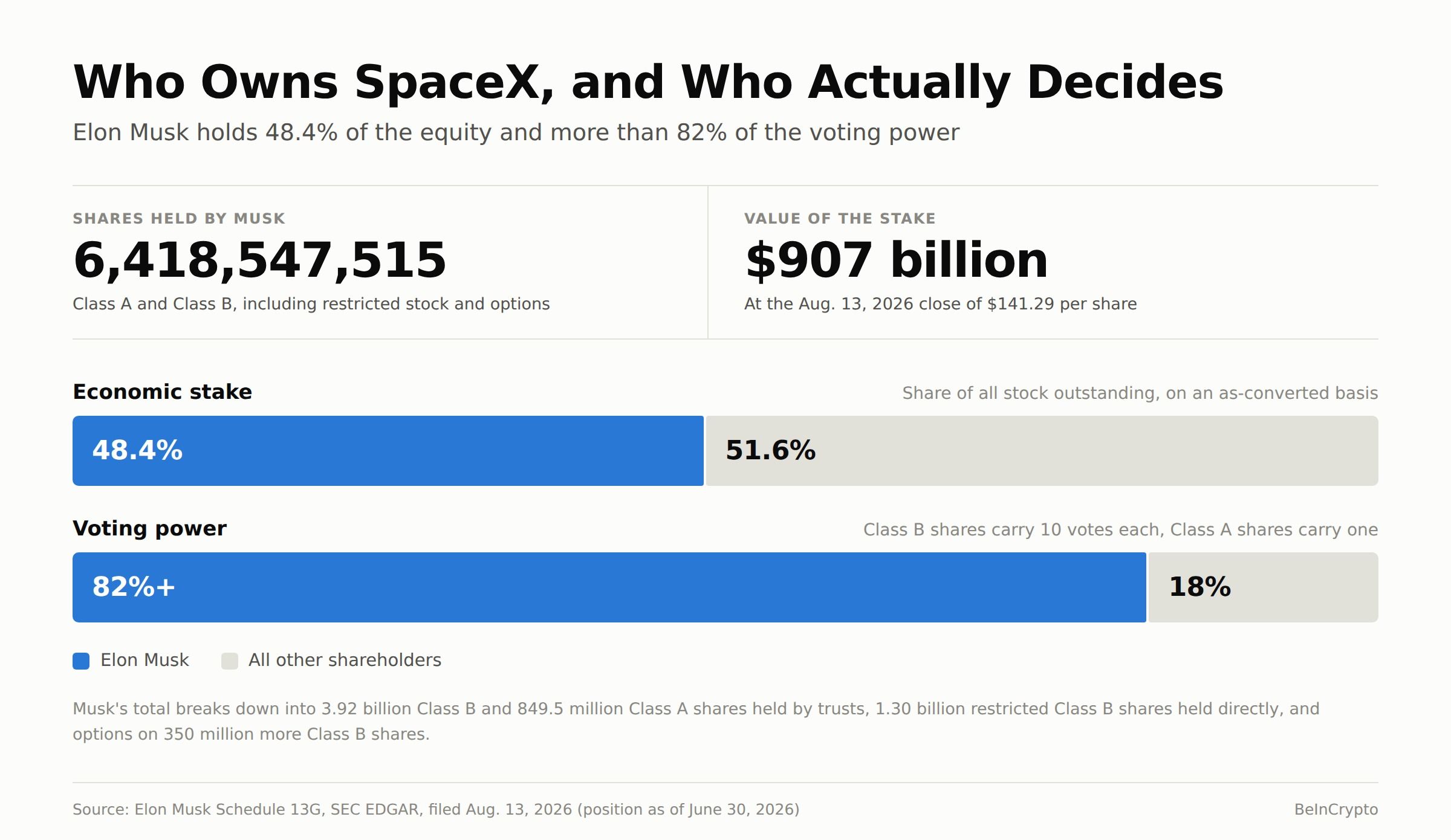
A new SEC filing puts Elon Musk’s SpaceX holding at 48.4%, or roughly 6.42 billion shares worth more than $900 billion.
The same stake carries over 82% of the company’s votes. That gap between ownership and control now decides everything SpaceX does, including what happens to its Bitcoin.
How Much of SpaceX Does Elon Musk Own?
Musk reported sole voting and dispositive power over all 6,418,547,515 shares. The count reflects his position as of June 30.
Four buckets make up the total. Trusts where Musk serves as trustee hold 849.5 million Class A shares and 3.92 billion Class B shares. He directly holds 1.30 billion restricted Class B shares. Options on 350 million more Class B shares complete the figure.
However, Musk says the 48.4% headline flatters his real position.
Vesting conditions include multitrillion-dollar valuations, orbital data centers, and a Mars settlement of one million people. Therefore his fully vested slice sits below the reported number.
Why The Voting Structure Matters for Its Bitcoin
The company runs two share classes. Class A carries one vote, while Class B carries 10. Musk commands the boardroom with less than half the equity, and no sunset clause unwinds that arrangement.
Class B stock converts to Class A the moment an insider sells to an outsider. That switch strips 90% of the voting weight.
Governance investors objected before the listing. The Council of Institutional Investors, which represents pension funds and asset managers, asked Musk in June for a single share class. SpaceX went public anyway.

That control also covers 18,712 BTC. SpaceX has held the Bitcoin since 2021 and has never sold any of it. Bitcoin (BTC) trades near $63,666, valuing the stash around $1.19 billion.
Public shareholders cannot vote the position away. They can only watch it swing, as it did in the company’s first quarterly results, where digital assets landed at $1.098 billion.
The share price tells a similar story. SpaceX raised $85.7 billion in its June IPO and cleared a $2 trillion market cap on day one. It then dropped nearly 33% through July.
August reversed that. The stock has climbed 30% this month on a 90% revenue jump and the first lockup expiry, reclaiming its IPO price along the way.
Institutions kept buying through the slump. Norway’s sovereign wealth fund disclosed a $1.2 billion position this week, and traders rewarded the Grok AI unit despite its $1.26 billion quarterly loss.
Meanwhile, Peter Schiff reads the same rally as a crash warning for stocks and crypto.
More lockup tranches expire in the coming months. Each one frees up Class A supply, yet none of it loosens Musk’s grip on the vote. Investors get a Bitcoin treasury they cannot touch.
The post SpaceX Ownership: How Much of the $2 Trillion Company Does Musk Own? appeared first on BeInCrypto.
Bitmine Immersion Technologies, the largest corporate Ether holder, surpassed 5 million Ether in staked tokens, which will generate an estimated $257 million in annualized revenue, according to a company announcement on Monday.
Ether (ETH) staking is emerging as an important revenue stream that generated about 98% of Bitmine’s revenue for the fiscal quarter ending May 31, or $45.7 million of the company’s $46.5 million, analysts from Bitfinex exchange told Cointelegraph, adding:
“It funds operations and its share buyback program: 19.1 million shares repurchased since July against a $4 billion authorisation, without Bitmine having to sell any Ether.”
Ether treasury companies are facing growing unrealized losses as their margins are pressured by the decline in Ether’s spot price, which fell roughly 23% during the second quarter of 2026.
SharpLink, the second-largest Ether treasury company, reported a net loss of $394 million for the second quarter of 2026, largely driven by $391 million in unrealized crypto losses.
Bitmine ranks as the largest corporate Ether holder with 5.54 million ETH, currently worth $9.4 billion. SharpLink ranks second, with 863,000 Ether, currently valued at $1.46 billion, according to data from the StrategicEthReserve.
Ether emerges as new treasury asset despite staking revenue risk
Bitmine’s staking milestone demonstrates how Ether can generate native yield as a treasury asset while Bitcoin (BTC) is mainly viewed as a balance sheet appreciation asset, according to Alvin Kan, chief operating officer at Bitget Wallet.
While Bitmine’s staking revenue may encourage more crypto-native companies to adopt Ether as a treasury asset, this is not risk-free income, Kan told Cointelegraph, adding:
“The revenue is annualized, depends on ETH price and staking yield, and comes with operational, liquidity, validator and regulatory considerations.”
This makes Ether staking more akin to a yield-bearing enhancement to treasury strategy, rather than a “replacement” for disciplined capital management, explained Kan.
Related: EToro to buy TradeZero as Q2 crypto revenue falls 30%
Still, the recurring staking income acts as a “buffer” to Ether’s price fluctuations and ensures “topline predictability that can be valued without regard to spot ETH price,” wrote Yiannis Zourmpanos, a contributor to Seeking Alpha, in a July 28 report.
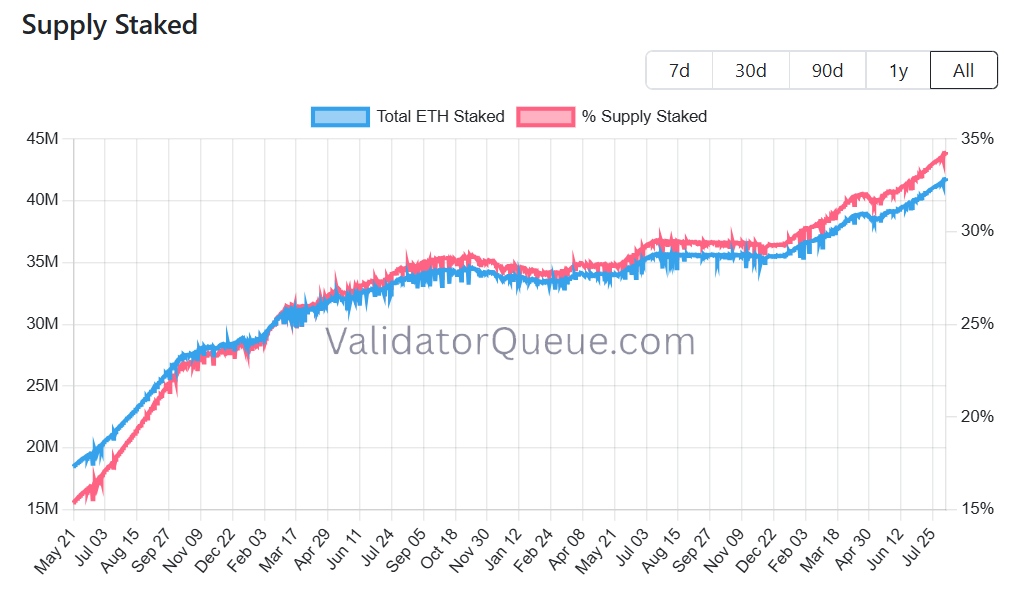
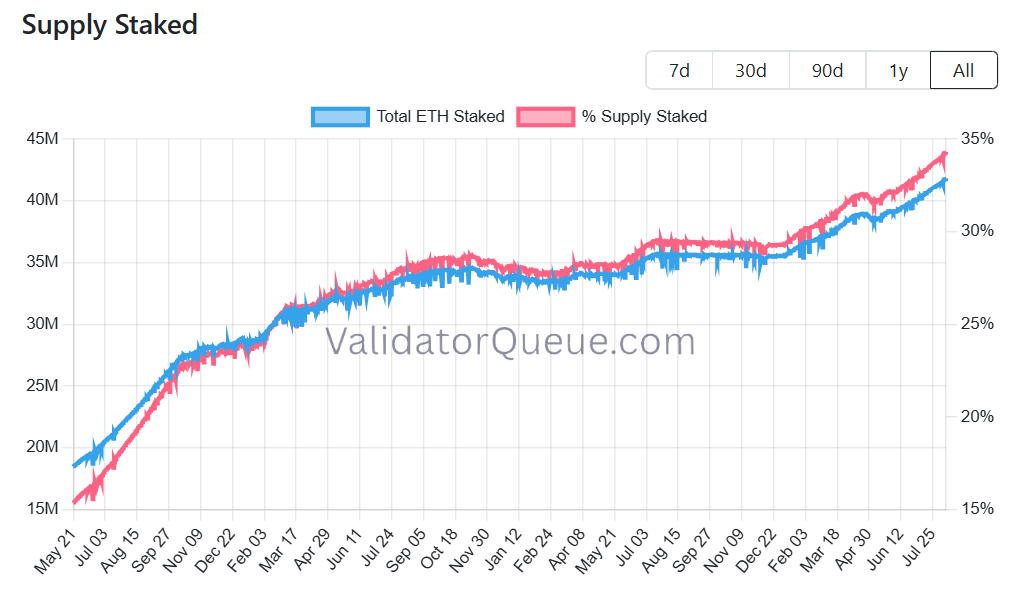
Staked Ether supply, all-time chart. Source: Validatorqueue.com
Ether staking currently pays a 2.61% annual percentage rate (APR). Over 34% of the total Ether supply is currently staked across 897,064 validators, according to data on the Validatorqueue dashboard.
Magazine: Ethereum’s EEZ could pull other blockchains into its orbit


Norway’s Government Pension Fund Global disclosed a $81.87 million position in BitMine Immersion Technologies, giving the world’s largest sovereign wealth fund indirect exposure to Ethereum through a U.S.-listed corporate treasury company rather than through a direct ETH purchase.
Summary
- Norges Bank held 6,151,062 BitMine shares worth $81.87 million at June 30, SEC filings show.
- The position gives Norway indirect Ethereum exposure through equity, not direct ownership of ETH itself.
- BitMine reported 5,805,238 ETH holdings on August 9, with 5,067,309 ETH already staked through validators.
- BitMine was absent from Norges Bank’s December 2025 filing, while acquisition timing remains publicly undisclosed.
- Norway’s fund reached 22.683 trillion kroner at midyear, with 72.1% invested in global equities overall.
An Aug. 12 SEC filing from Norges Bank showed that the fund held 6,151,062 BitMine shares as of June 30. The position was valued at $81,870,635 at quarter end. Norges Bank reported sole investment discretion over the shares.
Norway wealth fund’s BitMine stake appeared by June
The BitMine position was not present in Norges Bank’s Dec. 31, 2025 13F holdings table, confirming that it was added after year end. However, the exact timing remains unclear. Norges Bank’s March 31 filing was submitted under a confidential treatment request, meaning its full first-quarter holdings were not publicly visible. The available filings therefore cannot establish whether the BitMine shares were acquired during the first or second quarter.
The June filing also provides no purchase price or transaction dates. Its reported $81.87 million figure represents the quarter-end market value, not necessarily the amount Norges Bank paid. The position accounted for roughly 0.0082% of the approximately $1.003 trillion in securities disclosed in the fund’s June U.S. 13F report, making it a small allocation within the broader portfolio.
The holding is consistent with the fund’s broad equity mandate rather than evidence that Norway has directly adopted Ethereum as a reserve asset. As previously reported, the fund has already built indirect Bitcoin exposure through companies including Strategy, Coinbase and miners. Its investment strategy spans thousands of listed companies globally.
BitMine turns the equity position into indirect ETH exposure
BitMine’s balance sheet makes the stake crypto-sensitive. In an Aug. 10 SEC release, the company reported holding 5,805,238 ETH as of Aug. 9, representing about 4.8% of the 120.7 million ETH supply figure used by BitMine. It also held 209 BTC, $104 million in cash and marketable securities, and other investments.
Of BitMine’s ETH, 5,067,309 tokens were staked, or about 87% of its Ethereum holdings. The company valued the staked position at $9.8 billion using an ETH reference price of $1,928. As crypto.news reported, BitMine added another 7,391 ETH while expanding its staked position above five million tokens.
This does not mean Norges Bank owns a proportionate pool of BitMine’s ETH. The fund owns BMNR equity, whose value also depends on the company’s liabilities, financing, share issuance, staking operations and other investments. BitMine itself warns that its financial results and stock price face risks from ETH volatility and concentration in digital assets.
BitMine has also said it is pursuing its “Alchemy of 5%” target of eventually holding 5% of Ethereum’s supply. That remains a company goal rather than a guaranteed outcome. Its Aug. 10 disclosure put the company at what it described as 96% of the way toward that target.
The wider Norway portfolio puts $81.9M in perspective
Norges Bank Investment Management published its complete half-year holdings alongside the filing on Aug. 12. The Government Pension Fund Global ended June with assets of 22.683 trillion Norwegian kroner after generating a 9.4% return during the first six months of 2026. Equities represented 72.1% of the portfolio.
In related coverage, the same disclosure showed Norway’s fund holding a $1.22 billion position in SpaceX. The fund holds stakes in roughly 7,100 companies and owns about 1.5% of listed companies globally on average, making individual corporate positions part of a much larger diversified portfolio.
The next firm update on the BitMine stake should come with a later holdings disclosure. Until then, the June report cannot show whether Norges Bank has retained, increased or reduced its 6.15 million shares since quarter end. BitMine, meanwhile, continues to publish weekly updates on its ETH holdings and staking activity.
Crypto World
Bitcoin treasury company Metaplanet (3350) unveils BitBonds with $1.3 million private debt sale


Japanese bitcoin treasury company Metaplanet (3350) unveiled a continuous bond issuance program, dubbed “BitBonds,” completing its first sale with four privately placed series worth about 200 million yen ($1.3 million).
The Tokyo-listed company said the unsecured senior bonds mature in roughly three years and carry annual interest rates of 4% to 4.3%. Solicitation began in late July and has now closed, according to an Aug. 13 disclosure.
Metaplanet said BitBonds will sit alongside common stock, equity-linked securities and preferred shares as a core funding channel. Future issuance will depend on funding needs, market conditions and investor demand, with the company eventually considering registered public offerings.
Unlike Metaplanet shares, which tend to reflect changes in the value of its bitcoin holdings, the bonds offer fixed interest and principal repayment based on the company’s creditworthiness. However, they are unsecured, unrated and not principal-protected, while the issuer’s financial position remains heavily exposed to bitcoin price swings.
The bonds also carry transfer restrictions, and liquidity before maturity is not guaranteed.
The inaugural securities were distributed through wholly owned Metaplanet Securities to individuals and companies under Japan’s small-number private placement rules, marking the firm’s broader push into Japan’s yen-denominated credit market.
JPMorgan Chase stopped providing its banking services to the decentralized prediction market platform Polymarket late last year, according to the Financial Times.
In October 2025 the bank told Polymarket it would have to secure a different banking partner amid regulatory worries. Polymarket has already moved to another lender, though that firm’s name remains undisclosed, the FT report said.
Polymarket was barred from serving U.S. users in 2022 after the CFTC hit the platform with a $1.4 million settlement for running an unregistered derivatives trading venue. The company nonetheless returned to the U.S. market in late 2025 once the Trump administration loosened federal rules.
Even after cutting the formal banking link, JPMorgan has reportedly kept some connection. For instance, it invited Polymarket CEO Shayne Coplan to address a private client conference in February 2026 and is still angling for a role underwriting any future IPO.
CoinDesk reached out to Polymarket for a comment on the matter.


MSCI is considering a new methodology that could remove Strategy and Metaplanet from its Global Investable Market Indexes as early as the November 2026 Index Review.
Summary
- MSCI’s May simulation would delete Strategy, Metaplanet and Yellow Cake under proposed non-operating company screens.
- SharpLink would enter a watchlist because current constituents need two consecutive annual failures before removal.
- Companies failing the core screen become ineligible after triggering four of five financial ratio tests.
- Consultation closes September 30, with results due October 16 and possible November implementation by MSCI.
- MSCI abandoned its earlier crypto-only exclusion proposal in January and promised this broader company review.
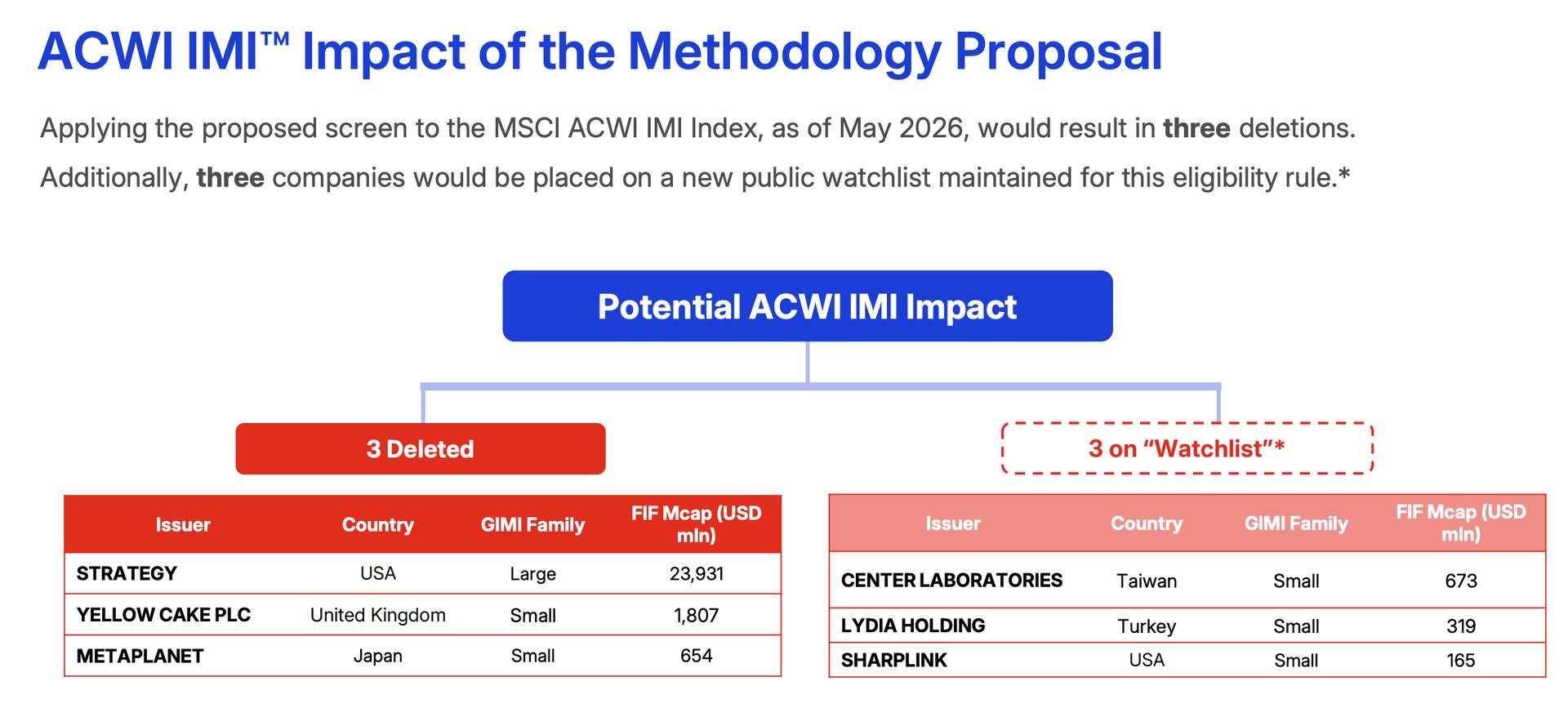
A simulation using May data identified the two Bitcoin treasury companies and U.K. uranium investor Yellow Cake as the three existing constituents that would be deleted under the proposed rules.
The proposal remains a consultation, not a final index decision. MSCI’s announcement says feedback remains open through Sept. 30, with results expected by Oct. 16. Any methodology change would then be targeted for the November review. MSCI explicitly warns that the consultation “may or may not” result in the proposed changes.
MSCI proposal replaces the earlier crypto specific test
The current review is broader than MSCI’s earlier attempt to exclude digital asset treasury companies based largely on their crypto holdings. In January, the index provider abandoned that proposal for the February review after investors raised questions about whether a simple asset threshold could distinguish an operating company from an investment vehicle.
As previously reported, MSCI delayed its earlier crypto treasury exclusions and opted for a wider review. Strategy had opposed the previous 50% digital asset threshold, calling it “arbitrary” and arguing that companies holding large concentrations of other assets were not subjected to the same rule.
The new methodology addresses that criticism by applying financial tests across industries rather than singling out Bitcoin or other cryptocurrencies. The presence of Yellow Cake alongside Strategy and Metaplanet in MSCI’s simulated deletions illustrates the broader approach.
Strategy and Metaplanet fail MSCI’s simulated screen
MSCI proposes a two stage test. A company first passes automatically if operating assets exceed 50% of total assets. Companies falling below that level move to a second test based on operating asset intensity, expenses, operating cash flow, non-operating fair value changes and reliance on financing for asset accumulation.
An issuer would be treated as a non-operating company if it triggers at least four of those five flags. For existing constituents, MSCI proposes less restrictive thresholds and requires failure in two consecutive annual reviews before deletion. New candidates would need to fail only the latest review to become ineligible for addition.
Using May 2026 data, MSCI’s simulation would remove Strategy, with a free float adjusted market capitalization of $23.93 billion; Yellow Cake, at $1.81 billion; and Metaplanet, at $654 million. SharpLink, Center Laboratories and Lydia Holding would instead enter a public watchlist because the simulation found only one qualifying period of failure.
SharpLink’s inclusion is notable for the crypto treasury sector. The Nasdaq listed company reported 888,938 ETH and ETH equivalents as of Aug. 3 and said equity financing remains one of its main sources of liquidity. Its filing also says it uses most capital raising proceeds to acquire ETH, although MSCI’s May simulation predates that latest quarterly filing.
Index removal could create passive selling pressure
Deletion would matter because funds designed to track affected MSCI benchmarks would have to adjust their portfolios when the index composition changes. However, MSCI has not published an estimate of possible selling tied to the new proposal, so current claims of a specific forced outflow figure should be treated cautiously.
During the earlier crypto treasury debate, JPMorgan estimated that Strategy could face about $2.8 billion in passive selling if MSCI removed it, with a larger figure possible if other index providers followed. That estimate concerned the previous proposal and should not be presented as a forecast for the new methodology.
Strategy’s balance sheet remains heavily centered on Bitcoin. Its latest SEC filing showed 840,447 BTC as of Aug. 9 after it sold 1,690 BTC for $108.6 million and used the proceeds to repurchase STRC preferred stock. The company also raised about $653.1 million through MSTR share sales during the week, most of which went into its U.S. dollar reserve.
Metaplanet, meanwhile, currently reports 43,000 BTC on its corporate tracker. Its exposure to MSCI dates back to February 2025, when, as crypto.news reported, the company joined the MSCI Japan Index.
What happens next for Strategy and Metaplanet
Nothing has been removed under the new rule yet. MSCI published its regular August Index Review on Aug. 12, with those changes due after the Aug. 31 close, while the separate non-operating company proposal remains scheduled for possible action in November.
The next deadline is Sept. 30, when consultation feedback closes. MSCI expects to announce its decision by Oct. 16. If the methodology is adopted, qualifying deletions could be incorporated into the November 2026 review.
The May simulation also should not be treated as a guaranteed November constituent list. Company filings and financial structures can change, and MSCI’s proposal incorporates annual financial data and persistence tests. The current simulation shows which companies would have failed using the stated May dataset, not an irreversible decision on Strategy, Metaplanet or SharpLink.

Golden opportunity to balance boards

Neutrl Halts NUSD Redemptions After Unspecified Reserve Issue

Politics Home Article | Nigel Farage Defeats Count Binface To Win Clacton By-Election


-

 Fashion7 days ago
Weekend Open Thread: Mattifying Sunscreen
-

 Fashion7 days ago
Frugal Friday’s Workwear Report: Cap-Sleeve Pointelle Crewneck Sweater
-

 News Videos6 days ago
Can Astrology Help Find Gold and Silver Trends? A Financial Astrology Guide
-

 Tech6 days ago
Rinn Pharma & Biopharma to join NordicPharmaTrain network
-

 Business5 days ago
How to Start a Cleaning Business: A Step-by-Step Guide
-

 Business5 days ago
Datadog: Best Of Breed For Multiple Reasons
-

 Business5 days ago
BDC Weekly Review: Private BDC Q2 Numbers Are Strong
-
 NewsBeat2 days ago
Communication cards help banking customers access services or report scams
-
 Business3 days ago
Oil Price Today (August 11): Crude oil rises to $88 after Trump’s compensation demand dents Hormuz opening. Here’s why
-

 Business7 days ago
Aussie shares lose steam to close record-breaking week
-

 Fashion7 days ago
Weekly News Update, 8.6.26 – Corporette.com
-
 Entertainment7 days ago
Brand New Day’ Characters, Ranked
-

 Fashion7 days ago
Irina Shayk Wows in REVOLVE Los Angeles’ Summer Styles
-

 Fashion7 days ago
Burberry Fall 2026 Takes On Commuter Style
-

 Fashion5 days ago
Amazon Sundays: Closet Care Before Fall
-

 Politics6 days ago
Be quiet, Miriam! – spiked
-

 Business7 days ago
CXMT Shares Drop 4.3% as Post-IPO Rally Cools Amid Global Memory Chip Pressures
-

 Business6 days ago
Mutual Fund Manager Scoops Up Beaten-Down Stocks
-

 Sports7 days ago
Report: Kawhi Leonard had undisclosed deal with Clippers’ scoreboard maker
-

 Crypto World7 days ago
How XRP holders can earn $4,600 daily
You must be logged in to post a comment Login