Crypto World
Chat-Based P2P Crypto Exchange Development: Build an In-Chat Exchange

Over the past few years, a significant yet unnoticed shift has been occurring in peer-to-peer cryptocurrency trading, where discovery, negotiation, escrow, and settlement are leaving traditional exchange interfaces and entering messaging environments. Large volumes of OTC crypto trades today originate in Telegram groups, WhatsApp communities, and private chat networks where buyers and sellers coordinate directly and finalize payments off-platform. The crypto exchange software interface, in many instances, has effectively been replaced by conversation, mainly in mobile-first markets where users trust messaging applications more than financial dashboards. They negotiate prices in chat, confirm payment with screenshots, and rely on social reputation rather than order-book transparency. As a result, P2P crypto trading has naturally converged toward chat-centric workflows where everything happens on a conversational thread.
Recognizing the pattern, several platforms have begun formalizing chat-based crypto exchange software models rather than forcing users back into conventional UIs.
| Platform | Interface Type | Best Jurisdiction | Key Tech Feature |
|---|---|---|---|
| Vexl | Standalone App | Europe / Global | Social graph (Nostr-based) |
| Telegram @wallet | Native Bot | UAE / CIS / SE Asia | Direct Telegram integration |
| Noones | Chat-centric Web/App | Nigeria / Global South | 300+ payment methods |
| Peach Bitcoin | Swipe/Chat Hybrid | Europe / LatAm | No-KYC / privacy-first |
Users prefer to discuss terms, verify counterparties, and coordinate payment within chat before committing funds. Instead of separating messaging and trading into different systems, chat-based P2P crypto exchange software embeds escrow, wallets, and payment confirmation directly into conversational flows.
For enterprises and crypto exchanges targeting high-growth regions such as South Asia, Africa, and Latin America, this model aligns closely with real user behavior. It reduces friction, supports diverse local payment rails, and mirrors how informal crypto trading already occurs at scale.
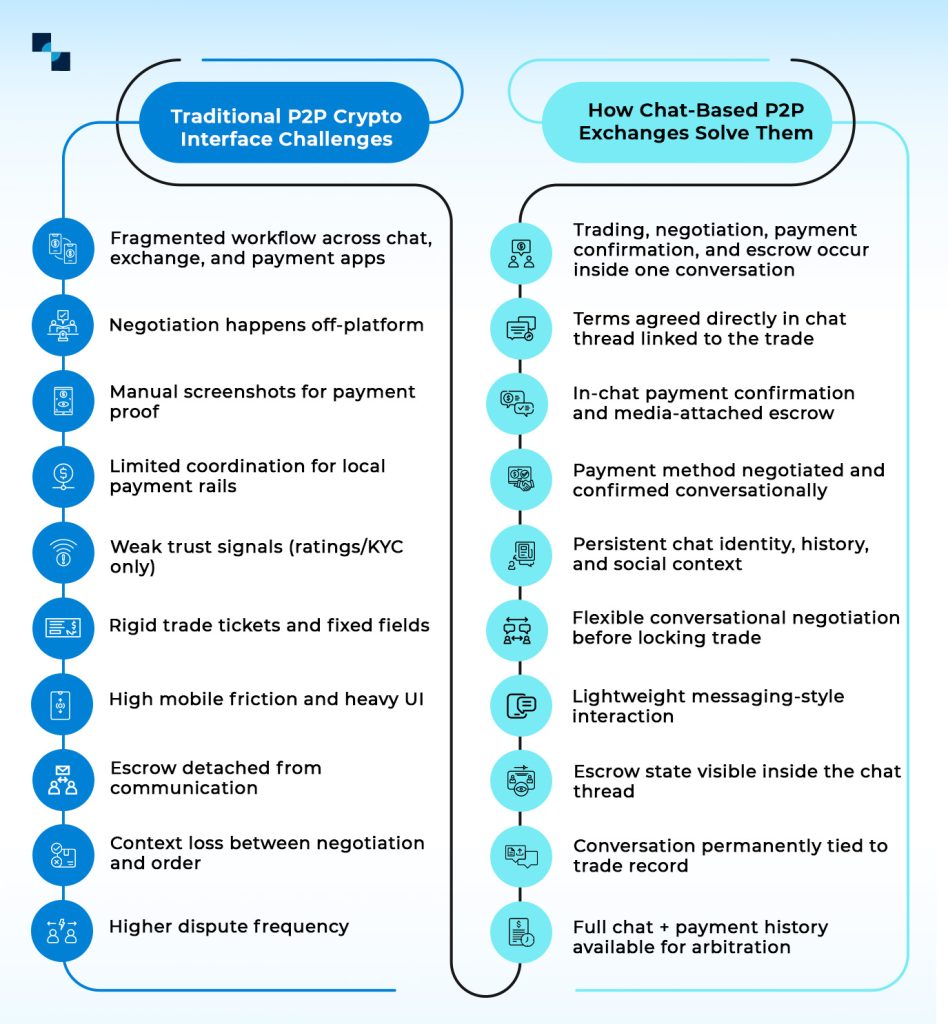

What Is Chat-Based P2P Crypto Exchange Development?
Chat-based P2P crypto exchange development refers to designing peer-to-peer trading systems where the conversational triggers drive and control trade objects linked to escrow, wallet, and settlement infrastructure.
Instead of listing offers and executing trades through marketplace-style trade forms, users initiate, confirm payment, and release escrow within an integrated chat environment linked to wallet and settlement infrastructure. In this model, messaging doesn’t remain an auxiliary feature but is the transaction layer itself. Each trade exists as a persistent conversation thread that contains counterparties, agreed terms, payment proof, and escrow state. The exchange backend orchestrates wallets, escrow locking, and dispute resolution while the user experience remains interaction-first and chat-native only.
Core Features of Chat-Based P2P Crypto Exchanges
1. Conversation-linked trade threads
Each trade must be anchored to a chat thread and stored as a persistent object containing counterparties, agreed terms, timestamps, and state transitions. This implementation ensures the inseparability of negotiation context and execution data.
2. Integrated crypto escrow within chat
Escrow lock, confirmation, timeout, and release actions must be triggered directly from the conversation interface while being enforced by smart contracts or custodial wallet logic in the backend.
3. Payment rail negotiation and mapping
This chat-based crypto exchange software module must support dynamic selection of regional payment methods (UPI, Pix, mobile money, bank transfer) within the chat. It must also bind the chosen rail to the trade state for verification and audit.
4. Embedded payment proof with hash linkage
Payment receipts, transaction IDs, or media confirmations shared in chat must be cryptographically or database-linked to the escrowed trade record to prevent substitution or post-dispute alteration.
5. Counterparty identity and reputation context
User profiles must expose trade history, completion ratios, dispute records, and social linkage signals during negotiation to enable well-informed decisions before escrow commitment.
6. Conversation-native dispute invocation
Either party should be able to escalate directly from the trade thread, allowing moderators or automated systems to evaluate the full sequence of messages, payment evidence, and escrow events without reconstruction.
7. Mobile-native messaging UX
The conversational crypto exchange software interface must prioritize lightweight message exchange, quick action buttons, and asynchronous confirmations to maintain usability on low-bandwidth devices and emerging-market mobile environments.
Technical Architecture of a Chat-Based P2P Exchange Development
In a chat-based crypto exchange architecture, conversational events trigger and update backend trade states while settlement infrastructure manages escrow, wallets, and dispute workflows.
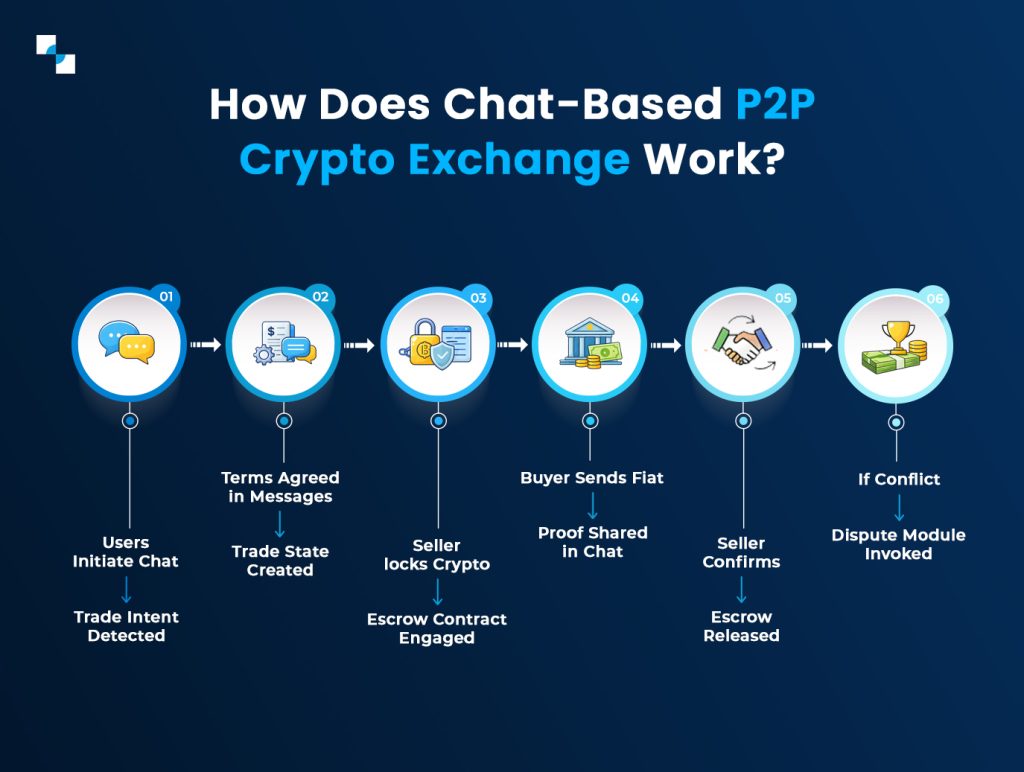

- Chat Interface Layer: It represents the messaging UI (app, web, or bot) where users negotiate, confirm payment, and trigger escrow actions.
- Trade State Engine: The system converts conversation events into structured trade states (initiated, terms agreed, escrow locked, payment pending, released, disputed).
- Escrow and Wallet Layer: This layer includes smart contracts or custodial wallets that lock, hold, and release crypto assets based on trade state transitions.
- Payment Coordination Layer: This level manages the selection of fiat payment methods, proof attachment, and confirmation signals associated with the trade thread.
- Identity and Reputation Services: Persistent counterparty profiles, trade history, and trust signals are accessible within conversations.
- Dispute and Arbitration Module: These moderation tools consistently access full chat, payment, and escrow context for resolution.
- Notification and Event System: This layer facilitates real-time updates for escrow status, payment confirmation, counterparty actions, and deadlines.
Where to Launch Chat-Based P2P Crypto Exchange Software
.
| Jurisdiction | Dominant Payment Integration | Why It’s Relevant for Chat-P2P | Regulatory Body | Licensing Difficulty |
|---|---|---|---|---|
| India | UPI / IMPS | The world’s largest informal WhatsApp/Telegram P2P market. Users expect “Chat-to-Pay” workflows. | FIU (Financial Intelligence Unit) | High (Strict AML/Tax) |
| Brazil | Pix / WhatsApp Pay | Brazil is the global “alpha” for WhatsApp Pay. Pix makes instant chat-settlement frictionless. | Central Bank of Brazil | Moderate |
| Nigeria | Mobile Money / OPay | High mobile-first population. Messenger apps bypass the need for expensive web infrastructure. | SEC Nigeria | Moderate-High |
| El Salvador | Lightning Network | Ideal for “micro-chats” where users send small amounts of BTC/Satoshis over a chat bubble. | CNAD (Digital Assets) | Low |
| UAE (Dubai) | Wio / Local Banks | Focuses on “Social Wealth”—chatting about trades and executing them in a “Superapp” environment. | VARA | High (Costly) |
| European Union | SEPA Instant | Relevant for “Social Investing” apps (Gen Z). Must be MiCA-compliant to operate cross-border. | MiCA (ESMA) | Very High |
Deployment Models for Chat-Based P2P Exchange Development
In-chat or chat-based crypto exchanges can be deployed through different messaging ownership models depending on regulatory exposure, user acquisition strategy, and infrastructure control. The choice of deployment model directly impacts custody design, compliance scope, scalability, and user trust assumptions.
1. Standalone Chat-Native P2P Exchange Development
In custom chat-based P2P crypto exchange development, enterprises create a proprietary application where the messaging system, trading logic, escrow, and wallets are fully owned and operated by the exchange.
Characteristics
- Custom-built chat protocol and trade-state engine
- Direct integration with custodial or smart-contract escrow
- Native wallet and payment rail orchestration
- Platform-controlled identity and reputation graph
When is this P2P exchange development model suitable?
- Regulated or semi-regulated jurisdictions
- For exchanges seeking full custody and compliance control
- Multi-asset or multi-chain expansion plans
- Institutional or high-volume P2P environments
Advantages of Chat-Native P2P Crypto Exchange Development
- Complete control over trade lifecycle and escrow logic
- Independent compliance and KYC framework
- No dependency on external messaging policies
- Stronger monetization and data ownership
Constraints
- Higher development and infrastructure costs are associated with building a complete chat-based P2P exchange app from the ground up.
- Messaging UX must compete with existing apps. This adds an extensive amount of effort to crypto exchange development, while they just reinvent the wheel.
- The chat-driven crypto exchange is required to find its own buyers and sellers, create initial liquidity, build network effects, and grow communities independently. No built-in audience for them
2. Messaging-Platform Integrated P2P Crypto Exchange Software(Telegram / Superapp Bots)
This is one of the most popular ways in which chat-based crypto exchanges are implemented. The exchange backend operates independently while the user interface is delivered through an existing messaging platform such as Telegram or a regional superapp.
Kraken recently picked up on this strategy and announced its collaboration with ICE chat:
“This integration opens a direct line into core institutional workflows, enabling traders to engage with our OTC desk’s expertise and execution in the digital asset class through a familiar interface.”
“Head of Kraken Institutional Gurpreet Oberoi
Characteristics
- A bot or mini-app acts as a conversational interface.
- The external platform handles messaging transport.
- Escrow and wallets are managed off-platform.
- Identity is partially inherited from a messaging account.
When is this chat-based cryptocurrency exchange development model suitable?
- High chat-native user populations
- OTC-heavy or informal trading regions
- Rapid go-to-market requirements
- Community-driven P2P ecosystems
Advantages
- Offers immediate access to existing user networks
- Familiar UX reduces onboarding friction.
- Viral distribution happens through chats and groups.
- Lower frontend development overhead
Constraints
- Dependency on platform APIs and policies
- Limited control over the identity layer
- Compliance boundaries are tied to platform rules.
- Messaging provider risk (blocking, restrictions)
3. Hybrid Chat-Linked P2P Crypto Exchange Software Development
In this model, conversation occurs in external messaging environments, while escrow, wallets, and trade state are managed in a separate exchange system linked through deep links or session binding.
Characteristics
- Negotiation in external chat (Telegram, WhatsApp, etc.)
- Trade instantiated via link or session handoff
- Escrow and settlement executed in the backend
- Conversation reference stored with the trade record
When is this chat-based P2P crypto exchange development model successful?
- Markets where OTC negotiation already occurs off-platform
- Exchanges transitioning from marketplace P2P to chat-based
- Compliance-sensitive jurisdictions
- Cross-platform user bases
Advantages
- Preserves existing user chat behavior
- Lower messaging infrastructure burden
- Clear separation between communication and custody
- Easier regulatory positioning
Constraints
- Context fragmentation risk
- This model requires reliable chat-to-trade linking.
- Less immersive conversational UX
- Dispute’s evidence may be split across chat and cryptocurrency exchange software systems.
Revenue Models and Build Cost for Chat-Based P2P Crypto Exchange Development
| Revenue Model | How It Works in Chat-P2P Context | Who Pays | Implementation Notes |
|---|---|---|---|
| Escrow transaction fee | A small percentage is charged when crypto is released from escrow after a successful trade | Typically buyer or both parties | Deducted automatically from escrowed asset at release |
| Offer a visibility boost | Sellers pay to prioritize their trade offers or profiles in discovery chats or listings | Sellers/merchants | Ranking algorithm or sponsored placement flag |
| Merchant / pro trader accounts | High-volume traders pay a subscription or reduced-fee tier for higher limits and tools | Professional traders | Tiered fee engine and volume tracking required |
| Payment rail markup | Spread added when facilitating specific fiat rails (e.g., local transfer aggregation) | Buyer or seller | Requires payment processor or liquidity partner integration |
| Spread facilitation | Chat-based P2P crypto exchange software platform intermediates pricing between counterparties and retains the spread | Both parties indirectly | Needs an internal pricing engine or liquidity sourcing |
| Dispute resolution fee | Charged when arbitration is invoked, and the platform mediates settlement | Disputing party or loser | Triggered on dispute workflow initiation |
| Withdrawal/custody fee | Fee for moving crypto out of platform wallets post-trade | User withdrawing | Standard wallet fee policy |
| Liquidity seeding incentives | P2P crypto exchange software platform shares fees with early merchants, providing consistent liquidity | Platform revenue share | Smart contract or backend rebate accounting |
| FX/stablecoin conversion margin | Margin on crypto-to-crypto or fiat-equivalent conversions inside chat trade | Converting user | Requires internal swap or routing logic |
Typical chat-based P2P crypto exchange development cost: Chat-based P2P crypto exchange software development generally ranges from $50K-$250K+, depending on custody model, messaging ownership, payment rail integrations, and compliance scope.
Estimated build timelines: 8-24 weeks, depending on messaging model (standalone or Telegram-integrated), custody design, and payment rail integrations.
Security and Compliance Considerations For Chat-Based P2P Crypto Exchange Development
Chat-native P2P trading introduces distinct fraud, identity, and payment risks because negotiation, trust formation, and settlement coordination occur conversationally. In-chat exchanges must implement controls that bind chat activity to verifiable trade and payment states while meeting jurisdictional AML and custody obligations.
Key Security Risks In Chat-Based P2P Crypto Exchange Software Include
- Impersonation and account takeover: Attackers mimic known traders or compromise messaging identities to redirect payments or escrow release.
- Off-rail payment fraud: Counterparties claim payment via manipulated receipts, reversible transfers, or third-party senders.
- Escrow manipulation attempts: Social engineering can trigger premature release or cancellation outside a valid trade state.
- Reputation gaming: Collusive trades or low-value cycles may be maintained to inflate trust metrics before large fraud attempts.
- Conversation tampering or deletion: Fraudsters may attempt to alter or remove chat evidence prior to dispute review.
Enable Crypto Trading Inside Conversations With Chat-Based P2P Exchange Development
Required Platform Controls To Mitigate Chat-Based Crypto Exchange Development Risks
- Trade-bound identity verification: A cryptocurrency exchange development company must create a workflow that binds each trade to authenticated user sessions and device fingerprints before escrow actions.
- Payment proof validation workflows: The chat-based P2P cryptocurrency exchange software must require structured receipt capture (ID, amount, timestamp) and cross-check against the expected rail format.
- Escrow action gating: The in-chat cryptocurrency exchange development must also allow release/cancel only from valid state transitions with counterparty confirmation or timeout logic.
- Immutable conversation logging: The cryptocurrency exchange must store message hashes or append-only records linked to trade objects to preserve evidence integrity.
- Reputation anomaly detection: AI-powered security can typically be implemented during crypto exchange development to flag abnormal trade patterns, circular trading, or sudden volume spikes in trust scoring.
Compliance and Regulatory Considerations For Chat-Based P2P Crypto Exchange Development
- AML/KYC scope alignment: The jurisdiction determines whether both parties, merchants, or only custodial wallet holders require KYC. Those building chat-based P2P crypto exchange software can implement a flexible KYC/AML module along with a geofencing mechanism.
- Custody classification: The licensing and safeguarding obligations depend on whether you’re choosing a smart-contract escrow or a custodial wallet.
- Payment rail monitoring: Regional rails (UPI, Pix, mobile money) may require transaction reporting or merchant registration as required by the local laws.
- Dispute and record retention: Chat-based P2P crypto exchange software requires integrations to store chat, payment, and escrow logs for mandated periods to satisfy audit or regulatory requests.
- Sanctions and counterparty screening: A centralized P2P crypto exchange software must screen wallet addresses and user identities before enabling escrow participation.
Final Word
P2P crypto exchange software development has been increasingly shaped by conversational behavior rather than marketplace navigation. As OTC activity continues to originate in messaging environments, exchanges that bring escrow, wallet, and payment directly into chat workflows will align more closely with how users already trade in mobile-first regions.
For builders and emerging exchanges, chat-based P2P crypto exchange development architecture is the most pressing structural shift. They can collaborate with their P2P cryptocurrency exchange development company to build such innovative models after carefully evaluating messaging ownership, custody model, and jurisdictional exposure for deployment choices, monetization design, and compliance scope
Platforms that successfully unify conversational interaction with verifiable escrow execution and regulatory controls can reduce friction while maintaining auditability and dispute integrity. This combination is what enables chat-native crypto exchange software to scale beyond informal OTC channels into structured, compliant trading infrastructure.
Antier delivers chat-based P2P crypto exchange software development tailored to regional payments and compliance needs. Share your requirements today!
Frequently Asked Questions
01. What is chat-based P2P crypto exchange development?
Chat-based P2P crypto exchange development involves creating trading systems where conversations drive and manage trade processes, integrating escrow, wallets, and settlement directly into chat interactions.
02. Why are users shifting to chat-based platforms for cryptocurrency trading?
Users prefer chat-based platforms because they allow for direct negotiation, payment verification, and coordination within messaging apps, which aligns with their trust in these environments over traditional exchange interfaces.
03. What are some key features of chat-centric P2P crypto exchange platforms?
Key features include integration with messaging apps, support for diverse payment methods, and the ability to conduct trades without separating messaging from trading, enhancing user experience and reducing friction.