

Crypto World
China completes first digital yuan payment to Singapore



ICBC has completed China’s first digital yuan cross-border payment with Singapore through the newly upgraded Digital Currency Express platform, settling nearly 10 million yuan in import shipping fees with same-day fund delivery.
Summary
- ICBC has completed China’s first digital yuan cross border payment with Singapore through the CBETS platform, settling nearly 10 million yuan in shipping fees.
- The payment reached the Singapore recipient on the same day as China expands the use of its digital yuan for cross border trade settlements.
- The transaction builds on China’s push to strengthen digital yuan payment infrastructure alongside ongoing cross border CBDC and stablecoin initiatives.
According to Mobile Payment Network, the transaction was jointly completed by the Shanghai branch of the Industrial and Commercial Bank of China (ICBC) and ICBC Singapore, becoming the first China-Singapore cross-border payment to run through the Digital Currency Express (CBETS) comprehensive settlement platform.
The payment covered nearly 10 million yuan in import shipping costs and was settled entirely in digital renminbi, with the funds reaching the Singapore recipient’s account on the same day.
The report said the transaction was completed for W Company, a subsidiary of a centrally owned enterprise’s trading platform that regularly imports iron ore and pays overseas shipping charges.
Because the company frequently handles large-value cross-border settlements, it previously relied on conventional international transfers that involved multiple intermediary banks, longer processing times and foreign exchange costs.
ICBC Shanghai introduced the company to the Digital Currency Express platform as an alternative settlement method before working with its Singapore branch to complete the payment. According to the report, the transaction demonstrates how digital yuan settlement can shorten payment processing while providing direct visibility into cross-border fund transfers.
Beyond the individual payment, the development expands ICBC’s use of China’s international digital yuan infrastructure. Mobile Payment Network said the bank has now established integrated digital yuan payment and collection services with both Singapore and Laos through the CBETS platform, creating a unified cross-border settlement framework linking its domestic and overseas branches.
CBETS expands China’s digital yuan payment network
The Digital Currency Express platform was built by the International Operation Center of the digital renminbi under the guidance of the People’s Bank of China’s Digital Currency Research Institute. According to Mobile Payment Network, the platform was upgraded in 2026 after China’s digital yuan infrastructure was reorganized, combining the previous cross-border payment platform, blockchain service platform, and digital asset platform into a single settlement network.
Overseas financial institutions can connect through a Hong Kong access point known as “One Point Access,” allowing participants to access multiple services through a single gateway. The platform supports both centralized and blockchain-based systems while using ISO 20022 messaging standards, making it compatible with existing international payment infrastructure.
Its design also allows financial institutions to process barcode payments, remittances, trade settlements and investment-related transactions while supporting additional digital financial services. According to the report, the modular architecture combines retail and wholesale payment functions with on-chain and off-chain settlement services to reduce integration costs for participating institutions.
The platform has continued to add financial institutions since its launch. On June 16, 2026, the International Operation Center signed direct participant service agreements with the first group of 26 financial institutions, including ICBC Asia, Bank of China Hong Kong, Standard Chartered China and several overseas ICBC branches operating in Singapore, Thailand, Laos, Macau and Qatar.
Digital yuan cross-border expansion continues
The latest transaction builds on China’s efforts to expand digital yuan use beyond domestic payments. Last year, the People’s Bank of China established the Digital RMB Operation and Management Center alongside the International Operation Center to separately oversee domestic adoption and international infrastructure for the currency. Officials said at the time that the two institutions would support both local deployment and overseas connectivity for the digital yuan.
Since then, authorities have steadily expanded cross-border applications. Beginning Jan. 1, 2026, banks were allowed to pay interest on verified digital yuan wallets as part of the transition from electronic cash to an interest-bearing digital deposit currency. At the same time, the central bank announced plans to widen cross-border pilots involving Singapore, Hong Kong, Thailand, the United Arab Emirates and Saudi Arabia.
ICBC has also introduced several cross-border payment services over the past year. According to Mobile Payment Network, the Shanghai branch previously launched the “Hu e Hui” international remittance service using the multilateral central bank digital currency bridge, reducing processing times for eligible transfers from about one hour to five minutes.
The bank has also extended digital yuan settlement to offshore trade transactions in Shanghai’s Lingang New Area and introduced a cross-border e-commerce payment solution with Yiwu Pay.
Elsewhere in China, ICBC’s Inner Mongolia branch recently completed the region’s first large-value digital yuan cross-border transfer to Hong Kong worth 220 million yuan using the multilateral CBDC bridge, according to the report.
Mobile Payment Network said ICBC plans to continue working with the International Operation Center to expand standardized digital yuan settlement services across cross-border e-commerce, offshore trade, commodity financing and international logistics payments as more foreign trade companies adopt the platform.
The transaction also comes as Chinese policymakers continue to position digital currencies as part of future international payment networks.
Speaking at the Lujiazui Forum in June, Wang Xin, director-general of the People’s Bank of China’s Research Bureau, said stablecoins could play a larger role in cross-border payments while policymakers continue monitoring their impact on the international monetary system and payment infrastructure.
Wang also said central bank digital currencies deserve continued international cooperation as countries explore new cross-border payment technologies.

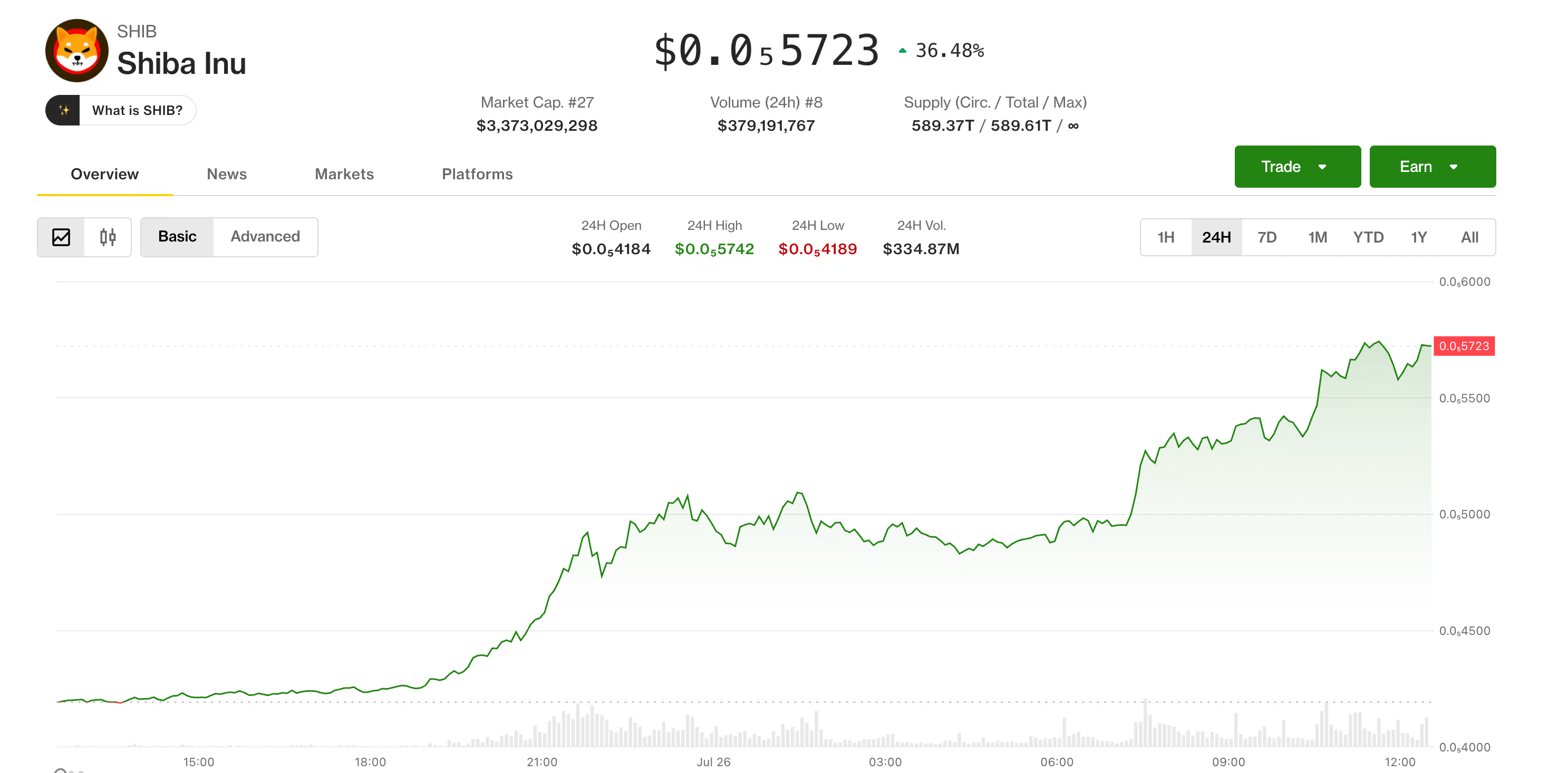
Shiba Inu rose 36% to about $0.0000057 on Sunday, adding roughly a billion dollars to its market value in a day, with no announcement or development to account for it.
The token now carries a market cap near $3.4 billion on almost $380 million of daily volume, its highest turnover ranking in months.

Nothing has emerged from Shibarium, the network’s layer-2, and the wider dog-token complex has lagged. Dogecoin gained 6% over the same stretch, and smaller-cap tokens moved as much as 10%, which pointed to something specific to SHIB rather than a rotation into memecoins.
South Korean buying stands out. Upbit’s SHIB/KRW pair is the single largest market at about $62 million, over a tenth of global volume, and it prints a slight premium to Binance and the other dollar venues.
The country’s traders are known to drive exuberant rallies in high-volatility tokens, and the token’s climb fits that pattern, with a first push late Saturday, nine flat hours, then a second move through the Asian morning.
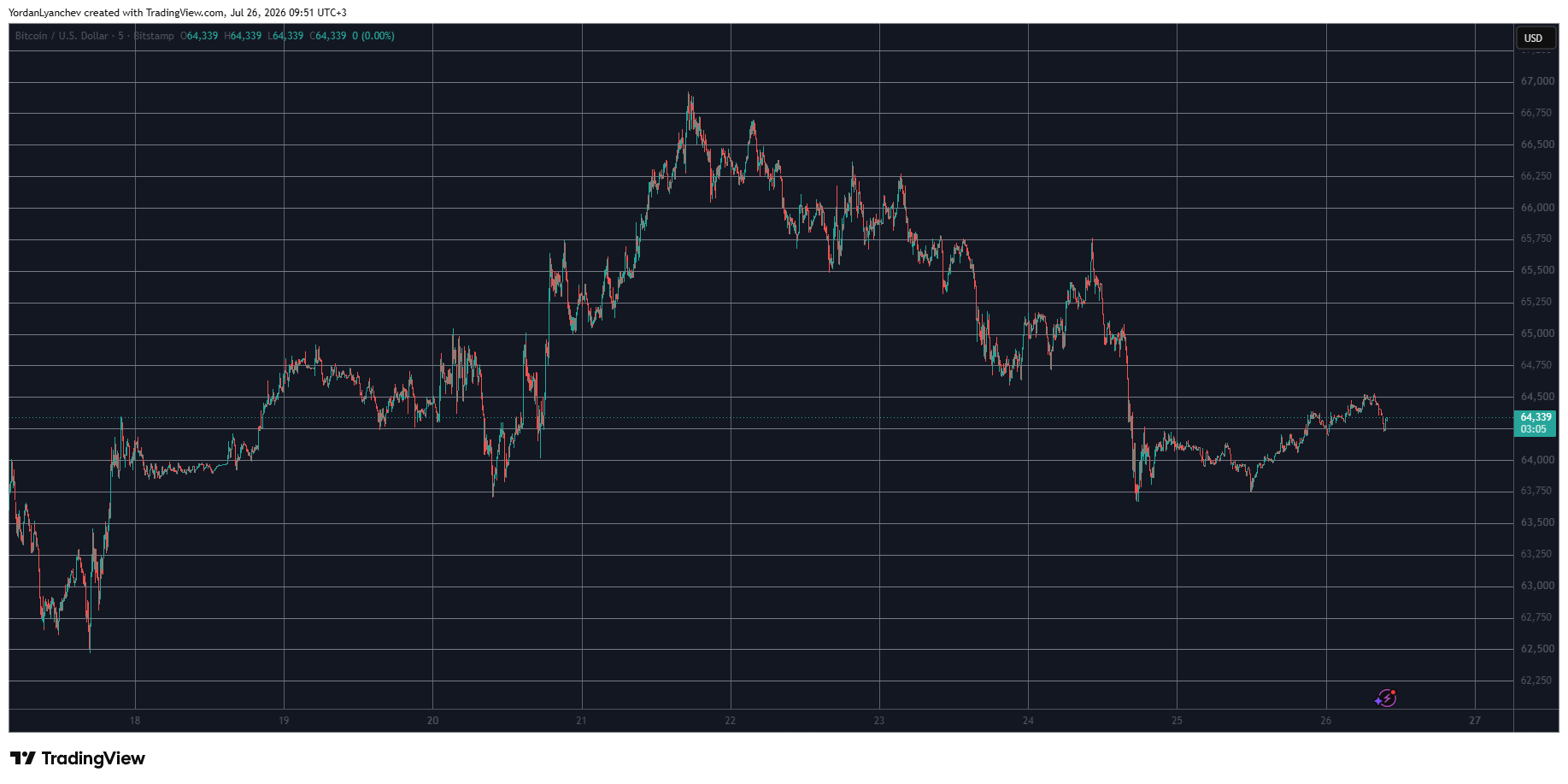
Bitcoin’s price climbed slightly on Saturday evening after US President Donald Trump halted the planned attacks on Iran, and jumped to $64,500 before it retreated slightly.
Shiba Inu has stolen the show from the larger-cap alts, rocketing by over 35%. Most larger-cap alts are also in the green but in a more modest manner.
BTC Defends $64K
Last Monday began with a somewhat expected leg down that drove bitcoin south from $65,000 to $63,750. However, the asset reacted well, defended that support level, and jumped by two grand by the end of the day. Tuesday was even better in terms of gains, as the cryptocurrency jumped to roughly $67,000 on some exchanges to mark a monthly high.
After gaining over $3,000 in just over 24 hours, BTC was primed for a correction given the overall market landscape. It started to lose value gradually and dropped below $65,000 on Thursday. It initiated another breakout attempt on Friday, but it was stopped at $65,750. The subsequent rejection drove it south by $2,000.
The bulls finally intervened and didn’t allow another leg down. Instead, BTC showed some resilience around that level and remained at around $64,000 on Saturday and climbed to $64,500 later that day after Trump ordered the US military to stand down while waiting for the resumed talks between Iran and Oman.
For now, BTC stands above $64,000, with its market cap returning to $1.290 trillion on CG. Its dominance over the alts has risen to almost 57%.
SHIB Pumps Hard
In a rare reminder of the meme coin mania from a few years ago, Shiba Inu’s largest native token has rocketed by over 35% today to mark a two-month peak. PEPE is the other big gainer from the meme coin niche, surging by 9.6% daily and 26% in the past month. Dogecoin has risen by 5.8% to $0.073. VVV sits among the meme coin gainers, surging by 12% to $14.5. AVAX has pumped by 9% as well.
The rest of the larger-cap alts have posted significantly more modest increases. ETH is close to $1,900 after a 1.5% jump, XRP is back at $1.10, while HYPE is up by 2.5%, but it still trades below $60. ZEC and CC are also in the green.
The total crypto market cap has increased slightly since yesterday, but it’s still below $2.3 trillion on CG.

The post These Meme Coins Steal the Show as Bitcoin Defends $64K Support: Weekend Watch appeared first on CryptoPotato.
BitMart will wind down its cryptocurrency exchange, ending all trading services on Aug. 26 before ceasing operations entirely on Jan. 31, 2027.
“After a careful evaluation of the Company’s operating conditions, market environment, and future strategic direction, BitMart has made the difficult decision to commence an orderly wind-down of its trading platform operations,” it said in a Sunday notice.
Under the shutdown plan, BitMart has stopped accepting new user registrations and deposits, while futures trading has entered reduce-only mode and spot markets no longer accept new orders.
BitMart joins a growing list of crypto trading platforms that have announced plans to close shop in recent months. Among them are BitMEX and Dango, which both said this week they would shut down their respective trading platforms.
Related: As BitMEX exits, analysts warn crypto consolidation is accelerating
BMX sinks amid withdrawal complaints
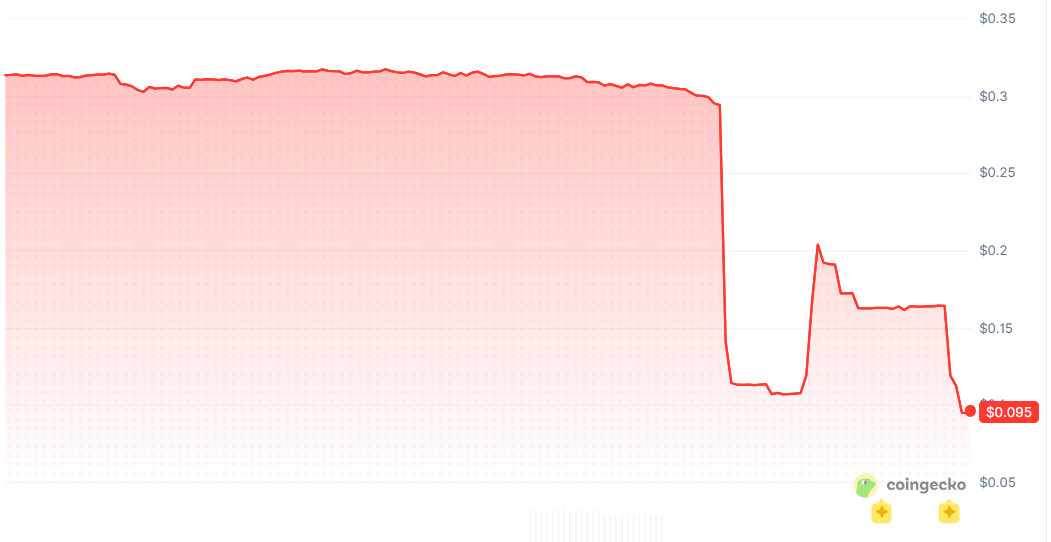
BitMart’s native token, BMX, lost nearly 70% of its value while users reported delayed withdrawals from the exchange.
BMX traded at about $0.09464 at the time of writing, down nearly 70% from about $0.31 late Friday. The token fell as low as $0.1058 early Saturday before extending its losses.
BMX resumes losses after Saturday’s brief recovery, falling below $0.10. Source: CoinGecko
Several users on X reported that withdrawals were taking longer than usual, with some claiming that Tether USDt (USDT) withdrawal requests remained pending for hours.
Arkham data showed wallets attributed to BitMart held about $71 million in crypto assets on Sunday, down from roughly $102 million on July 6. About $41.5 million was in stablecoin banking platform WeFi’s WFI tokens, while the tracked wallets held about $91,000 in USDT.
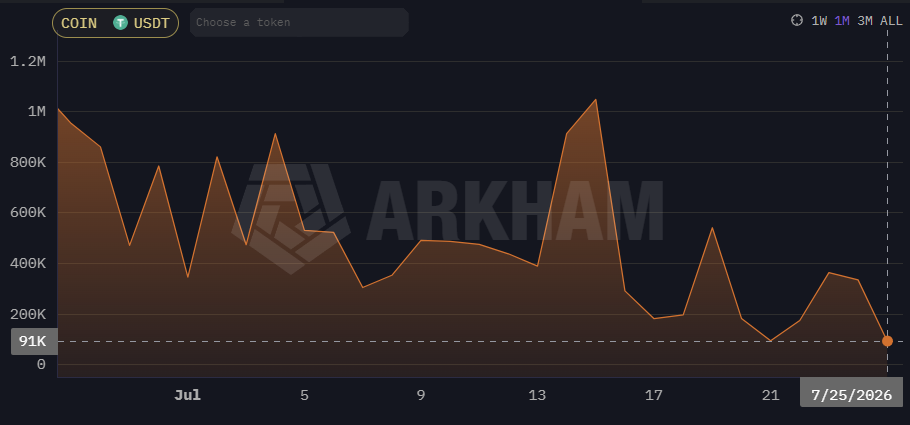
BitMart’s USDT balance over the past month. Source: Arkham
In its wind-down announcement, BitMart said some withdrawal requests could be subject to additional compliance and security reviews, potentially extending processing times.
BitMart did not respond to Cointelegraph’s request for comment before publication.
Related: BitMEX hit with 623 BTC lawsuit on day it announces shutdown
BMX? BMEX? BitMEX?
Some users on X also appeared to confuse BitMart and its BMX token with BitMEX.
On Saturday, an X user in the Mandarin-speaking crypto community who goes by “Brother Lu” drew attention to BMX’s price drop while speculating about its cause.
“The whole internet was posting yesterday that it was shutting down on Sept. 30. Did you just wake up?” another X user replied, according to a machine translation.
The reference to Sept. 30 did not match BitMEX’s Sept. 23 shutdown date announced Thursday. BitMEX’s own token, BMEX, fell 90% shortly after the notice.
Several other users in the Mandarin-speaking community also mixed up BMX with BitMEX.
It was not immediately clear whether the confusion had any impact on BMX trading.
Magazine: Here’s why the CLARITY Act’s ethics deal may be so hard to reach


The Bitcoin Policy Institute has joined the U.S. State Department’s Freedom Tech Excellence Program as a founding partner.
Summary
- Bitcoin Policy Institute staff will support temporary State Department assignments focused on digital freedom worldwide.
- Palantir, Anduril, and a human-rights foundation joined BPI as founding partners in the new programme.
- FTEP covers online expression, privacy tools, digital surveillance, scams, and responsible artificial intelligence governance standards.
The programme will place private-sector specialists inside the department for limited assignments tied to digital freedom and freedom of expression. Palantir Technologies, Anduril Industries and the Victims of Communism Memorial Foundation are the other founding partners.
BPI announced its role in a July 24 post on X. It said participating employees would work with State Department experts on online speech, privacy tools, digital surveillance and responsible artificial intelligence governance. The announcement did not state how many BPI employees will take part, when placements will begin or which offices will receive them.
State Department opens roles to outside specialists
The State Department describes FTEP as a talent partnership that brings private-sector workers into government for fixed periods. Participants remain linked to their organisations while supporting diplomatic projects in areas where the department wants more technical knowledge. They will also gain direct experience in foreign policy and international development.
The department lists several possible work areas. They include protecting online freedom of expression, countering unlawful surveillance and scams, expanding access to encryption and virtual private networks, supporting responsible AI governance and improving online safety for children. The programme is not a Bitcoin reserve, payment system or crypto licensing project.
BPI said the programme would allow its employees to “work alongside State Department experts and defend digital freedoms around the world.” However, neither party has released individual assignments. The scope may vary according to each participant’s skills and the needs of diplomatic teams.
BPI brings Bitcoin and privacy research into diplomacy
Founded in 2021, the Bitcoin Policy Institute describes itself as a non-partisan, non-profit research organisation. Its work covers Bitcoin policy, national security, financial inclusion, energy and human rights. The group has argued that encryption and open monetary networks can help journalists, dissidents and users in countries where governments restrict speech or financial access.
BPI’s inclusion does not mean the State Department will promote Bitcoin in every FTEP project. The official description focuses on broad digital-policy questions. BPI staff may advise on privacy technology, censorship-resistant systems or financial access, but the government has not named a Bitcoin deployment linked to the programme.
The group will continue its wider policy work outside FTEP. Its Freedom Tech DC summit is scheduled for September 22 and 23 in Washington. The event will bring together policymakers, researchers, investors and technology builders to discuss money, speech and computing systems. The summit is separate from the State Department partnership.
Palantir, Anduril and rights group join as partners
Palantir and Anduril bring experience in data software, defence technology and government contracts. The Victims of Communism Memorial Foundation works on human rights, political repression and authoritarian governments. Together, the four organisations provide policy, engineering, national-security and civil-society backgrounds.
The department has not explained how it will divide projects among the partners. It has also not listed the countries, embassies or bureaus involved. Those details will determine whether placements focus on policy research, technical tools, staff training or overseas programmes.
FTEP uses limited-term assignments rather than permanent appointments. That structure can bring specialised staff into government without creating full-time roles. Partner employees may later return to their organisations with direct knowledge of diplomatic processes and government needs.
Bitcoin reserve advocacy remains a separate policy track
BPI has supported efforts to turn President Donald Trump’s Strategic Bitcoin Reserve order into federal law. Trump signed the executive order establishing the reserve on March 6, 2025. It created a reserve based on Bitcoin forfeited through criminal or civil proceedings and directed officials to study budget-neutral ways to acquire more BTC.
Senator Cynthia Lummis reintroduced the Bitcoin Act in March 2025 at a BPI-organised event. The bill proposed that the U.S. government acquire one million BTC, but it had not completed passage when FTEP was announced. The State Department programme does not advance that bill or give BPI authority over federal Bitcoin.
The reserve also remains under development. As crypto.news reported in July 2026, federal officials were still reviewing which agency could legally control the assets and how custody should work. The White House order named the Treasury, while later discussions also involved the Commerce and Justice departments.
FTEP therefore gives BPI a role in a foreign-policy talent programme, not control over U.S. crypto policy. Its work will centre on assigned digital-freedom projects. Further updates should show how many experts take part, where they serve and which technologies the programme uses.


BMX, the platform’s token, fell to about 8 cents, down 58% over 24 hours, cutting its market value to roughly $27 million. The token was already down about 70% over the past year, so Sunday’s drop extended a long decline rather than starting one.
The exchange’s trading figures are significant, despite the closure. BitMart reported about $1.6 billion in 24-hour volume, up 51% from the previous period, with bitcoin accounting for nearly half of it. That jump more plausibly reflects users unwinding positions and moving funds out than any fresh demand, but it leaves open why a platform still clearing that kind of flow is closing.
Meanwhile, the withdrawal terms carry more friction than a routine exit. BitMart said requests may face additional review covering identity verification, device and IP checks, withdrawal-address screening, source-of-funds questions and sanctions checks, and warned that processing could stretch if request volumes spike.
BitMart lost about $196 million to a hot-wallet breach in December 2021, one of the larger exchange hacks of that cycle, and covered customer losses at the time.
In another relatively boring and uneventful trading day during the weekend, in which most cryptocurrencies have remained sideways, the second-largest meme coin by market cap exploded in a rare reminder of what the niche used to do a few years ago.
Some of the potential reasons behind this massive surge seem to be related to a returning whale and other on-chain factors.
SHIB’s Big Pump
The popular meme coin, once touted as the Dogecoin killer, actually began its ascent yesterday evening. It stood below $0.0000042 before it shot up to $0.0000052 and to $0.0000058 earlier today, posting a massive double-digit surge. The latter became its highest price tag in just over two months.
Recall that the token was rejected at $0.0000067 in May, and the subsequent painful correction drove it south toward $0.000004, which translated into a multi-year low. As such, SHIB has now returned to the top 30 alts by market cap as its own has jumped to over $3.3 billion on CoinGecko.
Moreover, it has solidified its spot as the second-largest meme coin by that metric, even though a few others have posted impressive gains as well. PEPE is up by 9%, M has added 4%, while DOGE has jumped by 5.5%.

Why Is That?
Surging by double digits on a random Sunday used to be the norm in the meme coin space years ago. However, the niche has fallen out of investors’ grace lately, with interest dwindling over time. As such, it’s intriguing to see what the latest developments in the Shiba Inu ecosystem are that might have propelled this rally.
The one thing that stands out on X is the behavior of a certain SHIB whale who has resumed accumulating after over half a year of inactivity. According to reports, the unknown market participant has splashed $125,000 to accumulate over 30 billion tokens. Although one standalone purchase cannot guarantee a 35% jump, it can be regarded as the market signal other investors are waiting for to join.
The SHIB token burn mechanism also shows a massive surge in the past day of over 3,200% (and 500% weekly). This means that the actual number of coins in circulation has declined violently, which is typically a bullish signal.
SHIB coins stored on crypto exchanges have also fallen in the past few weeks, according to data from CryptoQuant. Lastly, some analysts argued that the asset has broken out of key resistance levels and trendlines, while the community rejoices in the move, indicating that it’s finally paying off after “years of accumulation.”
The post Shiba Inu Price Soars 35% on a Dull Day as Whale Returns With Massive SHIB Purchase appeared first on CryptoPotato.


Robinhood is reportedly holding talks with Crypto.com about adding the exchange’s event contracts to its prediction markets hub.
Summary
- Robinhood reportedly wants Crypto.com contracts to broaden its prediction market exchange network and product range.
- Any agreement could deepen Robinhood’s competition with Kalshi while reducing reliance on a single provider.
- Federal and state regulators remain divided over who controls sports-linked event contracts across the U.S.
The proposed arrangement would let Robinhood users trade yes-or-no contracts supplied by Crypto.com, according to people familiar with the discussions cited by The Wall Street Journal. Neither company has announced an agreement, and the report said the talks may not result in a completed deal.
https://x.com/WSJmarkets/status/2080785057954902434?s=20
The discussions come as Robinhood builds a wider network of exchanges rather than relying on one source of event contracts. A company spokesperson said Robinhood “will continue to partner with multiple exchanges” to give customers a broad and reliable market. The strategy could add Crypto.com alongside Kalshi, ForecastEx and Rothera, the exchange created through Robinhood’s venture with Susquehanna International Group.
Robinhood seeks more prediction market suppliers
Robinhood launched its prediction markets hub in March 2025 with contracts routed through Kalshi, a Commodity Futures Trading Commission-regulated exchange. Its products cover outcomes tied to sports, politics, economics and other public events. Robinhood later added ForecastEx and began routing contracts through Rothera in June 2026.
Rothera gives Robinhood a closer link to the exchange layer because Robinhood owns the venture with Susquehanna. The company said in June that the new route lowered customer trading costs. Adding Crypto.com would create another source of contracts and could help Robinhood maintain product availability when one exchange lacks a market or faces a service issue.
Crypto.com expands event contract distribution
Crypto.com already offers prediction trading through Crypto.com Derivatives North America, a CFTC-regulated exchange and clearinghouse. Its contracts use a simple yes-or-no format based on future events. The company also launched OG Prediction Markets as a separate platform in February 2026 and has expanded distribution through partners.
In June, FanDuel Predicts expanded its offering with sports, entertainment and combination contracts supplied through Crypto.com and OG Prediction Markets. Crypto.com has also announced a planned prediction-market integration with Truth Social, although The Wall Street Journal reported that the product had not launched by July 24. A Robinhood deal would place its contracts before another large retail trading audience.
Kalshi rivalry grows as revenue forecasts rise
Robinhood and Kalshi started as distribution partners, but their businesses now overlap more directly. Kalshi has expanded beyond standard event contracts, while Robinhood has built Rothera and added more exchange partners. Kalshi chief executive Tarek Mansour described Robinhood as both a partner and a competitor, adding, “We’ll see who ends up with a better product.”
The reported Crypto.com talks arrived after Bernstein raised its Robinhood share-price target to $160 from $130. The firm estimated that Robinhood’s prediction-market revenue could reach about $1.7 billion by 2028. As crypto.news previously reported, Bernstein also forecast $586 million in Robinhood prediction-market revenue for 2026, supported by higher World Cup activity and Rothera volumes.
Bernstein expects total prediction-market trading volume to grow from about $51 billion in 2025 to $1 trillion by 2030. The projection assumes wider distribution, more institutional use and clearer rules. Sports contracts currently generate much of the activity, but analysts expect economic, political and business contracts to form a larger share over time.
State and federal regulators remain divided
Robinhood’s possible expansion comes during a legal fight over who can regulate event contracts. The CFTC says federal law gives it exclusive authority over commodity derivatives traded on registered exchanges. In 2026, the agency sued several states after officials moved against prediction-market operators.
States argue that some sports-related contracts function like gambling and should follow local licensing, age and consumer-protection rules. Wisconsin’s actions included complaints against Crypto.com and Robinhood, along with Kalshi, Polymarket and Coinbase.the CFTC responded by seeking to block the state’s enforcement and preserve federal oversight.
The conflict has produced different rulings and restrictions across the country. New York sued Coinbase and Gemini over claims that their event-contract products violated state gambling rules. The CFTC later filed its own case against New York and maintained that federal law takes priority.
Any Robinhood-Crypto.com arrangement would still depend on contract availability, regulatory status and the final terms between the companies. Robinhood has not confirmed that Crypto.com contracts will appear in its app. For now, the talks show that the company is considering another supplier as competition grows among exchanges, brokers and crypto platforms seeking a larger share of event trading.
Binance runs simulated phishing attacks against its employees every month to reduce social engineering risks.
Summary
- Binance runs monthly phishing simulations to measure employee awareness and identify weak security habits early.
- Workers who fail receive training, while repeated severe failures can lower ratings and risk dismissal.
- Recruiter lures and fake conference invitations mirror scams already causing large losses across cryptocurrency firms.
Chief security officer Jimmy Su said the exchange’s red team creates fake attacks to test whether staff recognise suspicious messages, links and requests. Employees who fail must complete follow-up training. Repeated failures can also affect performance ratings and may lead to dismissal.
The programme targets human errors that attackers use to enter crypto companies. Binance has operated the drills for three to four years, according to Su. He said the company’s security habits had improved during that period. Binance reports 323 million registered users, while DefiLlama tracks about $137.5 billion in assets linked to the exchange.
Binance ties phishing tests to staff reviews
The red team uses methods that resemble real attacks. One test may present a fake recruiter offering a job. Another may promise free access to a conference and request personal details. The team records whether employees open the message, follow a link or share information that could expose company systems.
Su said workers who fail receive remedial training. Repeated failure “will negatively impact their rating,” he said. Severe cases may push a worker’s rating to the lowest level and result in dismissal. The policy gives employees a direct work-related reason to verify unexpected messages before responding.
Binance has described its red team as an internal group of ethical hackers that tests systems from an attacker’s point of view. The exchange also works with external researchers through bug bounty programmes. Its security model covers technical weaknesses and employee behaviour because attackers may enter through trusted accounts or devices.
Social engineering drives crypto security cases
The drills come as social engineering causes a large share of reported crypto losses. AMLBot reviewed more than 2,500 investigations and found that 65% of the cases it handled in 2025 began with social engineering rather than direct software exploits. Phishing represented 18% of its cases, while device compromise accounted for 13%.
Attackers often spend days or months building trust before asking a target to open a file, approve a wallet request or run a command. This method can defeat technical controls when a worker has access to private keys, administrator accounts or internal systems. Stolen credentials can lead directly to liquid assets that move across blockchains within minutes.
As crypto.news reported, the April 2026 attack on Drift Protocol drained about $285 million after attackers compromised an administrator key. Researchers linked the breach to social engineering and operational security failures rather than faulty smart contracts. The attacker changed market settings and withdrawal limits before removing assets across dozens of transactions.
Fake meetings and job offers remain common lures
Su identified fake job interviews as one scenario used in Binance’s tests. Real attackers use the same approach against developers, executives and investment teams. They may move a conversation from LinkedIn, Telegram or email into a video meeting, then claim that the victim’s camera or microphone needs an update.
North Korea-linked hackers have used compromised Telegram accounts and deepfake Zoom calls to contact crypto professionals. The attackers impersonated known contacts and asked victims to install files that claimed to fix audio problems. Those files instead delivered malware capable of accessing devices, browser data and crypto wallets.
A Venus Protocol user lost about $13.5 million in September 2025 after approving a malicious transaction. Venus paused its lending platform and recovered the assets through an emergency governance process. The case showed how a user-level compromise can place assets at risk even when a protocol’s contracts remain intact.
Frequent drills aim to reduce predictable errors
Monthly simulations let Binance compare failure rates and update training when attackers change their methods. A single annual course may not prepare staff for new lures built around current events, trusted contacts or job offers. Frequent tests also show whether workers report suspicious messages instead of only deleting them.
However, simulations cannot remove every risk. Attackers can hijack genuine accounts, copy earlier conversations and use artificial intelligence to create convincing audio, video and written messages. Firms still need access controls, transaction limits, device monitoring and fast incident response alongside employee training.
Su said Binance’s early security habits “left a lot to be desired,” but repeated testing brought improvement. The exchange treats staff awareness as part of its wider defence system rather than a one-time compliance task. Employees still need to verify unusual requests through a separate channel before opening files, sharing information or approving transactions.


Wise plans to submit a new application for a U.S. national trust bank charter under the GENIUS Act after the Office of the Comptroller of the Currency rejected its first bid.
Summary
- Wise plans a fresh U.S. charter application under the GENIUS Act after the OCC rejection.
- The OCC cited weak AML controls, management gaps, and limited national banking experience in denial.
- William Blair expects Wise to remain rail-agnostic rather than make stablecoins its core business model.
The July 21 decision ended the payments company’s effort to create Wise National Trust in Austin, Texas. Wise disclosed the outcome on July 24 and said its current U.S. services continue without change. The company still operates through money-transmitter licences across 48 states and four territories.
The new filing will use the federal framework for payment stablecoins rather than the structure in Wise’s original June 2025 application. Wise said the earlier plan relied on access to Federal Reserve payment systems that is no longer practical. Its London-listed shares fell as much as 10% after the denial became public. Wise said it had strengthened financial-crime controls since filing the original plan and would address the regulator’s findings in its next submission.
OCC rejects Wise application over compliance concerns
The OCC’s decision said Wise did not show that the proposed trust bank could meet U.S. legal and regulatory requirements. The regulator focused on weaknesses in anti-money laundering and countering the financing of terrorism controls. It also said Wise U.S. had a record of failing to meet rules that apply to money services businesses. The proposed bank planned to rely heavily on Wise U.S. and other group companies for compliance work.
The regulator also questioned the experience of the proposed directors and managers. It said the team did not show enough knowledge of national banking rules, fiduciary services, or AML/CFT operations. Wise National Trust had planned to offer multi-currency stored-value accounts, payment processing, and fiduciary services. The OCC stated that approval would conflict with its charter policies. However, the decision does not stop Wise from filing another application after addressing the issues.
Wise shifts its plan toward the GENIUS Act
Wise gave a separate reason for changing course. The company said the Federal Reserve has generally paused account access for uninsured trust banks while it develops a new payment-account policy. “With the Federal Reserve generally pausing account access for an uninsured trust bank, the approach in our application became non-viable,” Wise said. The original plan aimed to let Wise settle U.S. dollar payments more directly and reduce its reliance on partner banks.
Wise now plans to apply under the GENIUS Act, which created a federal licensing and supervision system for payment stablecoin issuers. The company has not said it will launch its own stablecoin. William Blair analysts also said they do not expect a major change in Wise’s position. They described the company as “agnostic of the rail,” meaning it remains focused on lowering cross-border payment costs whether transfers use traditional systems or digital assets.
Stablecoin rules remain unfinished
The GENIUS Act became law in July 2025. It sets reserve, redemption, reporting, consumer protection, and compliance requirements for approved payment stablecoin issuers. The law is due to take effect on January 18, 2027, or 120 days after regulators publish final rules, whichever comes first. The OCC published its main proposed rule in March, while Treasury later proposed AML and sanctions standards.
Final rules were still pending when Wise announced its new plan. As crypto.news reported, regulators missed the July 18 rulemaking deadline, leaving key details unresolved. Wise will need to explain what activities its new entity would conduct, how it would use stablecoins, and how it would meet the stricter AML/CFT standards planned for permitted issuers. A new application must also explain how the charter would work without the unrestricted Federal Reserve access assumed in the earlier model.
Wise joins a wider U.S. charter race
Wise is entering a crowded federal licensing process. The OCC has approved several digital asset companies for national trust charters during the past year.Circle received final approval in July 2026 after gaining conditional approval in December. Ripple, Paxos, BitGo, Fidelity Digital Assets, Crypto.com, Bridge, and Coinbase have also received conditional decisions or entered the process.
The approvals have drawn opposition from banking groups and some lawmakers. Crypto.news reported that the Bank Policy Institute retained outside lawyers while considering a challenge to the OCC’s trust-charter policy. Wise’s case differs because the regulator issued a direct denial tied to its compliance record and management plan. The new GENIUS Act filing may offer a different route, but it will still require Wise to satisfy the OCC’s standards before gaining a charter.


BitMart has started a phased shutdown of its global cryptocurrency exchange after reviewing its operating conditions, market environment, and future strategy.
Summary
- BitMart stopped new registrations, deposits, and orders before ending all trading services on August 26.
- BMX lost about 63% in 24 hours as traders reacted to the exchange’s shutdown announcement.
- Withdrawals remain available, but BitMart advised users to submit requests before August 26’s recommended deadline.
According to the official shutdown notice, the exchange stopped new registrations, cryptocurrency and fiat deposits, and new spot orders from 01:30 UTC on July 26. Futures accounts entered reduce-only mode, while copy trading, grid trading, API trading, and other automated services began winding down.
The exchange will end all spot, futures, and other trading services at 01:00 UTC on August 26. However, the full platform will not close on that date. BitMart plans to terminate trading-platform operations at 15:59 UTC on January 31, 2027. Users will retain limited account access for a period after that date to review records and submit withdrawals.
BitMart sets withdrawal and position deadlines
BitMart told users to close all positions before 01:00 UTC on August 26 and recommended submitting withdrawals before 05:00 UTC the same day. Withdrawals remain open, but requests may face identity, source-of-funds, wallet ownership, sanctions, Travel Rule, and security reviews. Heavy demand or network congestion may extend processing times.
The exchange asked customers to cancel open orders, redeem eligible Earn, staking, and lending products, and download account records. BitMart may settle any futures positions still open when trading ends using its mark price, index price, or other applicable rules. Users who miss the recommended withdrawal period will enter a separate process that BitMart plans to explain later.
BMX falls as traders react to the shutdown
BMX, the exchange’s platform token, fell by around 63% during the 24 hours surrounding the announcement. BitMart’s own market page showed a decline of about 64.9% at one stage, while CoinGecko’s BMX page placed the token near $0.164 on July 26 with about $6.1 million in daily volume. The sharp move reflected the token’s close link to exchange activity.
BMX provides trading-fee discounts and other platform benefits. The planned end of trading removes much of that direct use. Price readings varied across trackers because the market moved quickly and platforms used different update times. CoinGecko data placed the token’s market value near $55.6 million on July 26, down from more than $100 million earlier in the week.
Closure follows recent service restrictions
BitMart did not identify a single event behind the shutdown. Its notice referred only to “operating conditions, market environment, and future strategic direction.” The exchange did not state that it had entered insolvency, and it did not connect the decision to a security incident, regulatory order, or lack of customer assets. Users therefore still lack a detailed financial explanation.
The decision followed several service changes. BitMart suspended its automated market-making bot on July 24 and returned users’ principal and earnings to spot accounts. It also ended spot margin trading, with forced liquidation scheduled for July 26. On July 23, the exchange told remaining U.S.-linked users to close positions and withdraw by August 8 during a compliance review.
BitMart follows other crypto platform closures
The announcement came three days after BitMEX said it would close its derivatives exchange on September 23 following a strategic review. BitMEX stopped new registrations and set August 26 as the date when customers could no longer open new positions. Odos also announced plans to shut its decentralized exchange aggregator on July 30, although the platforms gave different reasons and timelines.
BitMart entered the market in 2017 and grew through a wide selection of smaller tokens. A 2021 Series B round led by Alexander Capital Ventures valued the company at more than $300 million. Fenbushi Capital had made an earlier investment in 2019. Days after the Series B announcement, attackers compromised two hot wallets and stole assets valued at about $150 million by BitMart, while outside estimates reached $196 million.
BitMart said at the time that it would use its own funds to compensate affected customers. The shutdown notice did not link the wind-down to that breach, which occurred nearly five years earlier. In May 2026, BitMart said “all platform operations are running normally” while responding to online concerns about withdrawals and risk controls. It also said it planned to publish proof of reserves after completing security preparations.
The exchange now warns that scammers may exploit the shutdown. BitMart said it will not charge an expedited withdrawal fee or ask for passwords, two-factor codes, private keys, or recovery phrases. It advised users to rely on its official website, app, registered emails, and support system. Customers must also check networks and addresses before transferring funds.
Why is SHIB up 35%? Shiba Inu rockets higher as S.Korean traders lead mystery rally

Bachelor’s Haley Ferguson, Oula Palve’s Relationship Timeline

WNBA All-Star Game: Commissioner Cathy Engelbert evasive about future with league amid string of controversies


-

 Fashion2 days ago
Weekend Open Thread: Brooks Brothers
-

 Politics7 days ago
Democrats look to World Cup watch parties to register thousands of voters
-

 News Videos7 days ago
Big Money Is Entering XRP
-

 Tech5 days ago
Sail Virtually Aboard The “Itanic” With IA-64 Emulator
-
 Tech5 days ago
Turtle Beach Command Series KB7 review: a nifty screen-equipped gaming keyboard
-

 Crypto World5 days ago
Grayscale Files For Worldcoin ETF, WLD Registers Sharp Rise
-

 NewsBeat6 days ago
Unregistered fitter used Gas Safe logo on business flyers
-
 Business4 days ago
New Jersey voter registration controversy explained: How 6,600 noncitizens got on the rolls, and what happens next
-
 Entertainment5 days ago
Johnny Depp’s R-Rated Gothic Cult Classic Gets New Release Ahead of Sydney Sweeney Remake
-

 Crypto World3 days ago
Ethics, other provisions in crypto Clarity Act to be further discussed
-

 Tech6 days ago
Watch Flock Safety CEO Garrett Langley discuss the future of surveillance at TechCrunch Disrupt 2026
-
 NewsBeat5 days ago
Shanghai science forum photos show China’s AI and robotics advances in rivalry with US
-

 Crypto World6 days ago
Circle’s President Sold Over 360,000 Shares, The Filings Explain Why
-

 Tech6 days ago
Subway Sandwich Computers Get a Second Life as Gaming Machines
-

 Sports2 days ago
2026 3M Open leaderboard: Scottie Scheffler finds putter in Round 1, sits three back
-

 News Videos3 days ago
The Peugeot Family: How 200 Years of an “Old Money” Dynasty Died in A Boardroom
-

 Fashion2 days ago
16 Dresses for the High Summer Event
-

 Tech7 days ago
How To Use Claude’s Reflect Dashboard And Learn When It’s Time To Touch Grass
-

 Tech6 days ago
The 35 Best Board Games for Family Game Night
-

 Entertainment6 days ago
Stephen Colbert Returns to Social Media After Late Show End
You must be logged in to post a comment Login