
Crypto World
Circle Brings Native USDC and CCTP to EDGE Chain with Strategic Investment


TLDR:
- Circle Ventures invests in edgeX, the team behind EDGE Chain layer-3 blockchain infrastructure
- Native USDC and CCTP integration will enable regulated stablecoin settlement on EDGE Chain
- Migration from bridged USDC.e to native USDC planned for existing EDGE Chain ecosystem users
- CCTP enables secure crosschain USDC transfers without reliance on wrapped or bridged assets
Native USDC and Circle Cross-Chain Transfer Protocol (CCTP) are set to launch on EDGE Chain, bringing regulated stablecoin infrastructure to the layer-3 blockchain ecosystem.
Circle Ventures has invested in edgeX, the team developing EDGE Chain, supporting the integration of USDC and CCTP capabilities.
The upcoming launch will enable institutional-grade settlement and crosschain transfers for users of edgeX exchange and other EDGE Chain applications.
This development positions EDGE Chain as a high-performance environment for onchain financial applications.
Circle Investment Backs EDGE Chain Infrastructure
EDGE Chain operates as a layer-3 blockchain powering edgeX, a perpetual decentralized exchange focused on competitive trading performance.
The platform leverages Arbitrum’s layer-2 chain for security while settling on Ethereum’s base layer. Circle Ventures’ investment reflects confidence in EDGE Chain’s technical architecture and growth potential.
According to the announcement, the integration “brings trusted, regulated stablecoin settlement and secure crosschain infrastructure to the EDGE ecosystem, including edgeX exchange, unlocking new onchain financial use cases.” The investment demonstrates Circle’s belief in the platform as a scalable environment for USDC-based applications.
The integration will provide users access to USDC, the world’s largest regulated stablecoin. Native USDC serves as a fully reserved asset redeemable 1:1 for US dollars.
Eligible institutional users can access Circle Mint for direct on and off-ramp services. The stablecoin will function across trading, lending, and various onchain activities within the ecosystem.
CCTP enables the secure movement of USDC between the EDGE Chain and other supported blockchains. The protocol eliminates reliance on wrapped or bridged token versions.
Developers can select between Standard Transfer and Fast Transfer options based on application requirements. This infrastructure supports cross-chain onboarding, trading, margin operations, and lending applications.
Migration Path Set for Bridged USDC Users
EDGE Chain currently supports Bridged USDC, known as USDC.e, created by Alchemy. The EDGE Chain and edgeX teams plan a gradual migration of USDC.e liquidity to native USDC.
Bridged versions will maintain clear labeling as USDC.e across block explorers, application interfaces, and technical documentation.
The announcement outlined key capabilities, noting the integration enables “Native USDC for settlement and collateral” alongside “CCTP for seamless USDC movement across supported blockchains. Users will benefit from infrastructure with “no reliance on wrapped or bridged assets” for cross-chain transfers.
Circle has released testnet USDC at address 0x7433b41C6c5e1d58D4Da99483609520255ab661B for developer experimentation. Mainnet contract addresses will be announced closer to launch.
Developers can obtain free testnet tokens through Circle’s official faucet to test fund flows and integration workflows.
The existing Bridged USDC maintains its mainnet presence at address 0xd8e20462EDCe38434616Cc6A6a560BB76B582ED8. Both token versions will coexist during the transition period.
Ecosystem applications will coordinate migration timelines to minimize disruption for existing users and liquidity providers. Circle Internet Financial, LLC holds multiple regulatory licenses for money transmission services under NMLS number 1201441.



Bitcoin’s on-chain profit-and-loss metrics are edging toward the bear-market territory observed in prior cycles, according to CryptoQuant data analyzed by a CryptoQuant analyst known as Darkfost. The latest figures show about 11.2 million BTC in profit, with the trough of the last bear market recording roughly 9 million BTC in profit. On the loss side, around 8.2 million BTC are currently in loss, a level that Glassnode data indicate has not been seen since late 2022. Darkfost notes that during the previous bear market, the profit supply peaked around 10.6 million BTC, a level the market now approaches from a different angle.
The juxtaposition of sizable profit supply and rising losses is fueling a nuanced debate among analysts about what comes next for BTC. While some see the on-chain configuration as hinting at undervaluation similar to prior downturns, others caution that the signals reflect mounting market stress and may precede a period of consolidation rather than an imminent bottom.
Key takeaways
- Bitcoin profit-supply stands near bear-market-like thresholds, with approximately 11.2 million BTC in profit and about 8.2 million BTC in loss, according to CryptoQuant and Glassnode data.
- In the last bear market, profit supply reached around 10.6 million BTC, suggesting current levels are approaching historical extremes but not identical to prior cycles.
- Analysts diverge on interpretation: some see signs of undervaluation, while others flag rising market stress and potential pre-bottom consolidation.
- BTC has fallen roughly 52% from its all-time high this cycle, a drawdown notably smaller than the 77%–84% declines seen in many earlier bear markets.
- Macro backdrop remains challenging: a stronger U.S. dollar and tighter global liquidity could delay a sustained recovery, with rate cuts not broadly anticipated until late 2026 or 2027.
On-chain signals tightening toward bear-market parity
CryptoQuant data analyzed by Darkfost indicate that Bitcoin’s profit supply has climbed toward levels historically associated with bear markets. The current figure sits around 11.2 million BTC in profit, while the loss-side metric sits near 8.2 million BTC. Glassnode data corroborate that the loss-supply level is at a point not seen since late 2022. Darkfost emphasized that the last bear market had as much as 10.6 million BTC in profit, underscoring how the current scene sits near a store of historical extremes but remains distinct from past dynamics.
These metrics do not automatically spell doom, but they do illuminate a market where profit-bearing coins are plentiful even as a substantial portion of supply sits in loss. That configuration can complicate the price path, since a broad cohort of holders remains profitable, while others are under water—potentially influencing sentiment, risk tolerance, and selling pressure as conditions evolve.
Different readings: undervaluation versus market stress
In a contrasting view, Andri Fauzan Adziima, the research lead at the Bitrue exchange, argues that the data point to rising market stress rather than an imminent undervaluation. He notes that true capitulation bottoms historically accompany sharper pain: in 2022, supply in loss exceeded 50% and profit hovered around 45% or lower, with metrics such as net unrealized profit/loss (NUPL) and market value to realized value ratio (MVRV) at extreme levels.
“Current data points to early/mid-bear transition (potential structural bottom near $55,000), with more downside or consolidation likely before a full reset.”
Separately, coverage from Cointelegraph highlighted that Fidelity described Bitcoin’s drawdown this cycle as less dramatic than in some past cycles, illustrating the divergent interpretations across the market.
Beyond these readings, Bitcoin’s drawdown from its all-time high this cycle stands at about 52%, a smaller drop than typical bear markets, which have seen declines of approximately 77% to 84% from cycle highs. Such dynamics can be interpreted as evidence of a more resilient near-term setup, though they do not by themselves guarantee a sustained rally or a durable bottom.
Macro backdrop: dollar strength and liquidity constraints
Macro factors are shaping how traders assess on-chain signals. Timothy Peterson, a well-known commentator on Bitcoin markets, observed that BTC tends to struggle when the U.S. dollar is strong and the Chinese yuan is weak, a situation that tightens global liquidity and nudges capital toward cash and government bonds when yields remain elevated. The implication is that dollar strength acts as a headwind for risk assets, including Bitcoin, even as liquidity conditions shift with policy moves.
Peterson notes that a meaningful improvement for BTC would come only when U.S. interest rates fall and dollar yields lose their appeal, a development he expects is unlikely before the second half of 2026 or, more plausibly, in 2027. The U.S. dollar index (DXY) has risen about 5% over the past two months, according to data tracked on TradingView, adding to the macro hurdles facing a rapid BTC recovery.
Taken together, the on-chain signals and macro backdrop present a nuanced landscape: a market that, on one hand, shows pockmarks of bear-market-like behavior in profit metrics, but, on the other, is contending with a robust dollar and cautious liquidity that can prolong a period of consolidation rather than deliver a quick reset. Investors should watch for shifts in dollar dynamics, policy expectations, and changes in on-chain metrics such as NUPL and MVRV as new data come in over the coming quarters.
Looking ahead, the question remains what path Bitcoin will take as macro conditions evolve. If on-chain indicators begin to align with a genuine bottom—supported by a sustained weakening of the dollar and a more favorable liquidity environment—the next phase could reflect a gradual re-rating rather than an abrupt rebound. Conversely, if the macro regime remains restrictive and stress signals persist or intensify, the market may continue to drift below recent highs before any meaningful reset materializes.
Readers should keep an eye on evolving rate expectations, liquidity conditions, and the trajectory of on-chain risk metrics. The coming quarters will clarify whether Bitcoin’s current configuration marks the end of a broader drawdown or merely a protracted period of accumulation before a more decisive breakout.


The United States Commodity Futures Trading Commission and the Department of Justice have filed lawsuits against Illinois, Connecticut, and Arizona over the federal government’s authority to regulate prediction markets.
Summary
- The CFTC and Department of Justice have sued three states, arguing that prediction markets fall under exclusive federal derivatives oversight.
- Illinois and other states had issued cease and desist orders, claiming event contracts violated local gambling laws and licensing rules.
According to a complaint filed against Illinois Governor JB Pritzker, Attorney General Kwame Raoul, and the Illinois Gaming Board, the state gaming board improperly classified event contracts as “wagers” or “sports betting” instead of swaps.
In the lawsuits, the CFTC maintains that it has “exclusive jurisdiction” to regulate “Designated Contract Markets (DCMs),” which it says extend to prediction platforms under the Commodity Exchange Act (CEA).
Per the regulator, Illinois’s move to shut down such platforms “intrudes on the exclusive federal scheme Congress designed to oversee national swaps markets, prompted by the evolution of national financial markets and repeated conflicts with state law.”
“Unless restrained and enjoined by the court, defendants are likely to continue their attempts to subvert federal law and the exclusive jurisdiction to regulate event contract swaps conferred on the CFTC by Congress,” the lawsuit added.
The case stems from cease and desist letters issued by the states and their gaming regulators last year against platforms including Kalshi and Polymarket. The letters claimed that the contracts violated local gambling laws and licensing requirements.
Commenting on the developments, CFTC Chairman Mike Selig described the actions as “aggressive and overzealous attempts to overstep the CFTC,” in a separate statement after the lawsuits were filed.
“Our action today is meant to ensure we are able to effectively regulate the markets that Congress intended us to exclusively oversee,” he added.
Over the past year, at least 11 U.S. states, including Arizona, Nevada, Illinois, Maryland, New Jersey, Montana, Ohio, Connecticut, Tennessee, New York, and Massachusetts, have filed actions against prediction market operators.
Simultaneously, some lawmakers are advancing legislative proposals that would ban sports-related event contracts, while others seek to restrict participation in prediction markets tied to war.
Despite the legal pressure, prediction markets are witnessing rapid growth. As previously reported by crypto.news, transaction activity surged, with volumes increasing by more than 2,800% from the same period last year.
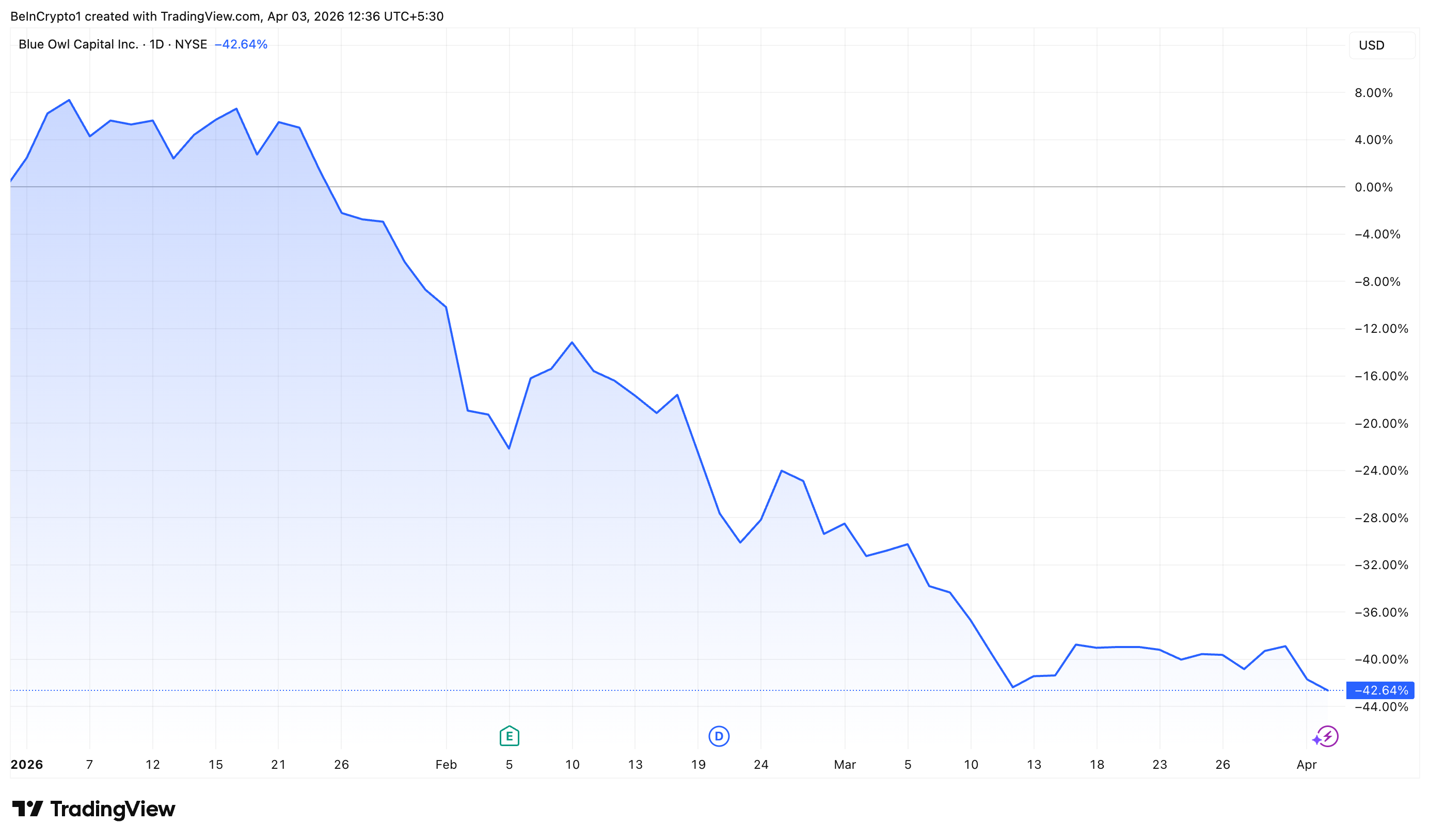
Blue Owl Capital (OWL) stock sank to a fresh all-time low of $7.95 on April 2. This comes after the firm told investors it would cap withdrawals on two of its private credit funds, following $5.4 billion in redemption requests in the first quarter alone.
The private capital manager has now lost more than 40% of its market value year-to-date, as investor confidence in the $1.8 trillion private credit sector continues to erode.
Blue Owl disclosed that its $36 billion flagship fund, Blue Owl Credit Income Corp (OCIC), received redemption requests totaling 21.9% of shares outstanding during the first quarter.
It’s technology-focused Blue Owl Technology Income Corp (OTIC) saw an even more dramatic surge. Investors sought to withdraw 40.7% of shares from this $6.2 billion fund. In both vehicles, the firm opted to cap redemptions at 5%.
“We continue to observe a meaningful disconnect between the public dialogue on private credit and the underlying trends in our portfolio,” Blue Owl noted in the shareholder letters.
Blue Owl is far from alone. Apollo Global Management imposed an identical 5% cap after receiving redemption requests exceeding 11% of outstanding shares. BlackRock has also gated withdrawals from its $26 billion fund.
Follow us on X to get the latest news as it happens
Bloomberg data suggests that withdrawal requests across more than a dozen private credit funds have totaled approximately $13 billion as of late March. Private capital managers have faced mounting pressure as market turbulence and fears over AI-driven disruption to software borrowers push investors toward the exits.
The post Blue Owl Stock Crashes to All-Time Low After $5.4 Billion Redemption Requests appeared first on BeInCrypto.
Commodity-linked currencies have entered a consolidation phase following recent directional moves, as market participants adopt a wait-and-see approach ahead of key US labour market data. Current price action reflects a balance between ongoing demand for the US dollar and attempts at a corrective rebound amid an uncertain fundamental backdrop.
Geopolitical tensions remain an additional factor influencing the market, sustaining elevated uncertainty and increasing volatility across commodity assets. Fluctuations in energy prices continue to affect commodity currencies, limiting the development of sustained trends and making market direction increasingly dependent on incoming macroeconomic data.
Traders have also taken note of yesterday’s remarks by Donald Trump, which included signals of potential shifts in foreign economic policy and approaches to international relations. Additional comments regarding a willingness to intensify pressure on Iran in the coming weeks have further raised geopolitical uncertainty. While the immediate market reaction has been relatively muted, such rhetoric increases the likelihood of renewed demand for the US dollar as a safe-haven asset, particularly if accompanied by strong US macroeconomic data.
Investor focus now turns to the upcoming US employment report. Key releases include Non-Farm Payrolls, the unemployment rate, and wage growth figures, all of which traditionally have a significant impact on currency markets. Strong data could revive bullish momentum in the dollar, while weaker figures may reinforce corrective sentiment and put additional pressure on the US currency.
AUD/USD
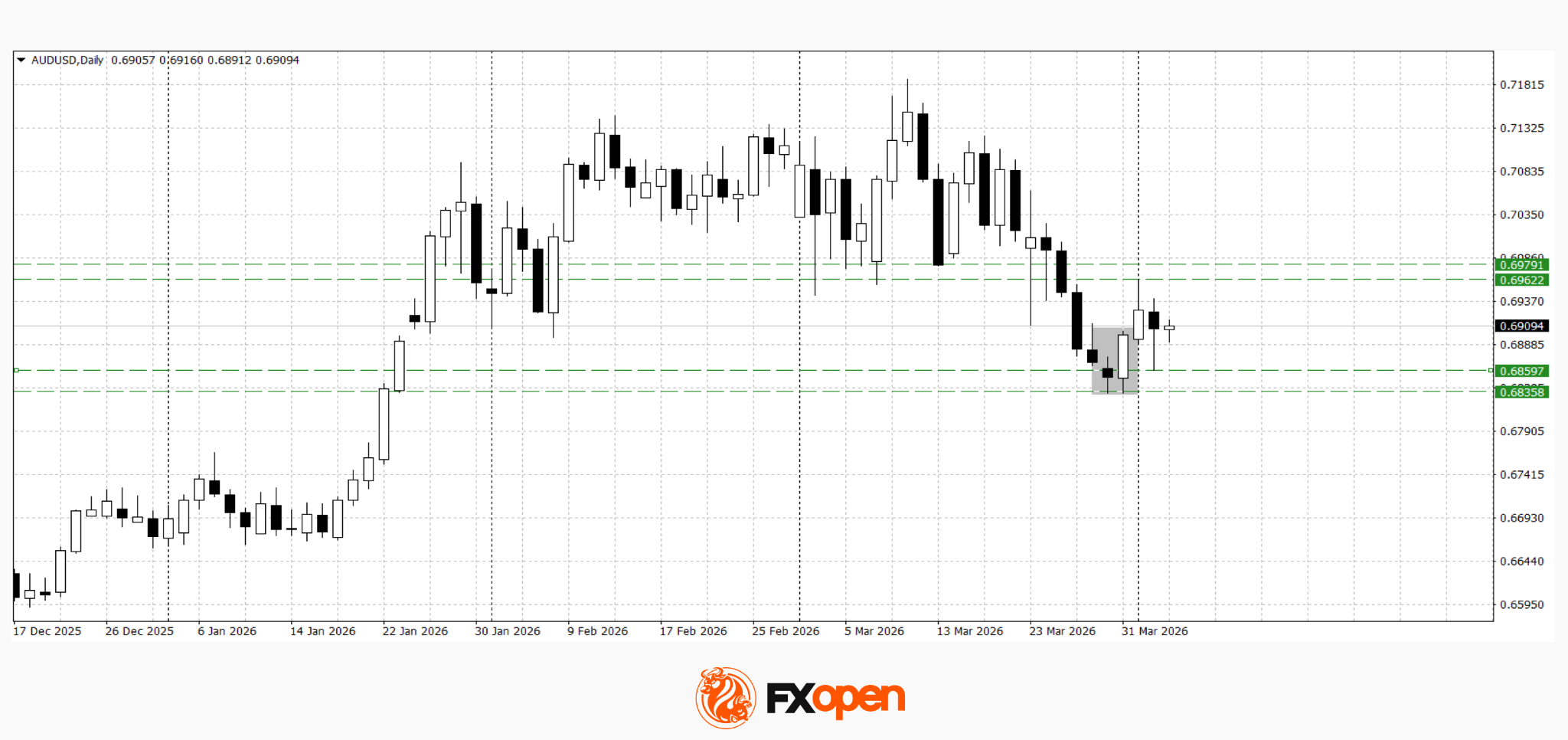
After declining over the past three weeks, AUD/USD has found support just above the 0.6800 level. A “bullish engulfing” pattern has formed on the daily timeframe, allowing buyers to push the pair towards 0.6960. However, the rally lost momentum following comments from the US President, although prices have managed to hold above 0.6900. Technical analysis suggests a potential test of resistance in the 0.6960–0.6980 range. A break below 0.6900 could lead to a retest of 0.6830.
Key events that may influence AUD/USD in the coming sessions:
- today at 15:30 (GMT+3): US average hourly earnings
- today at 15:30 (GMT+3): US Non-Farm Payrolls
- today at 16:45 (GMT+3): US services PMI
NZD/USD
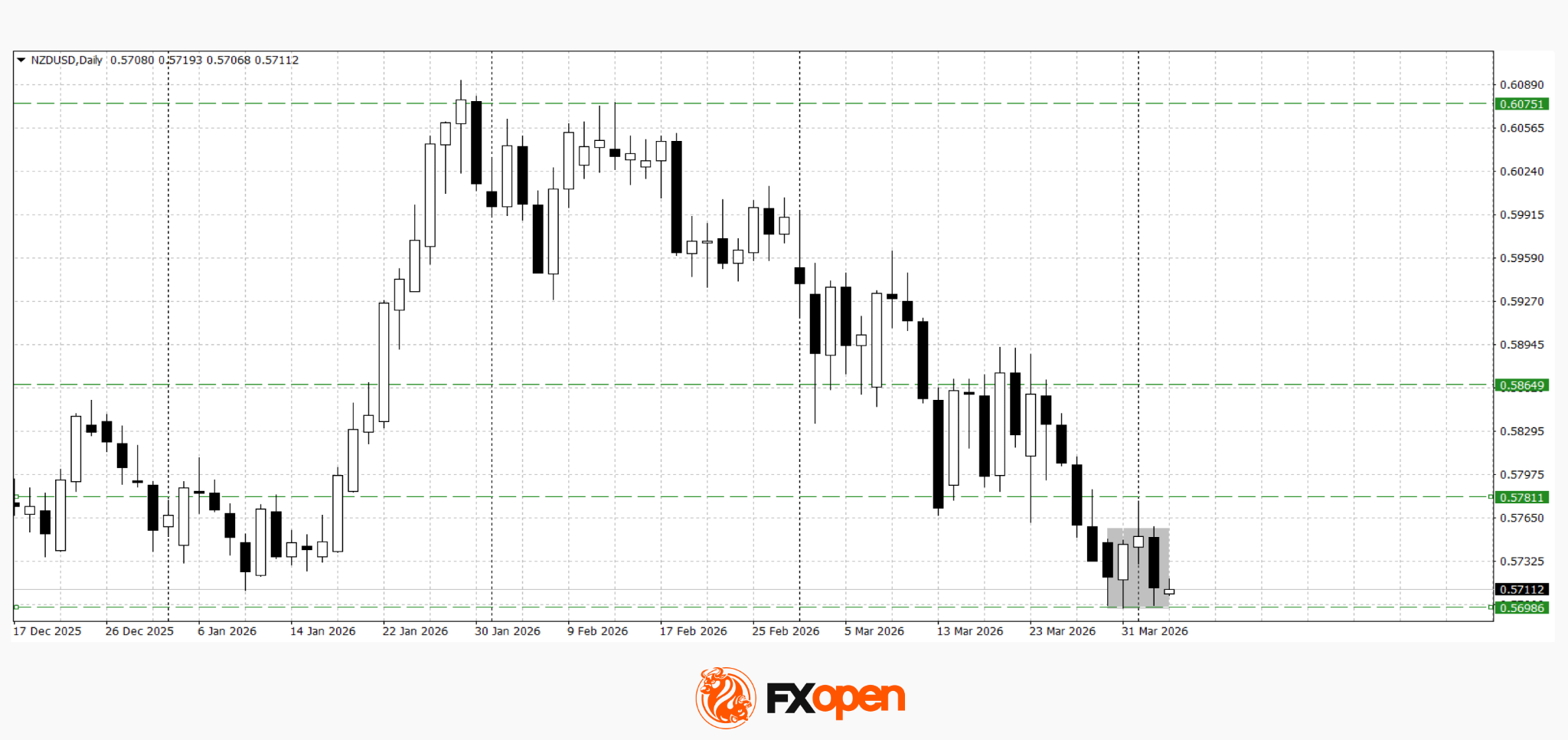
NZD/USD has been trading sideways for several sessions. Buyers continue to defend support near 0.5700, but a strong fundamental catalyst would be required to trigger a downside breakout and extend the bearish move. A sustained move above 0.5780 could open the way for a deeper corrective recovery.
Overall, the market remains in a holding pattern ahead of a key macroeconomic event. The direction of commodity currencies will largely depend on the outcome of US labour market data, alongside the broader geopolitical backdrop, which continues to influence global financial markets. At present, trading activity remains subdued due to the holiday period, reducing the presence of major market participants. Under such conditions, the risk of false breakouts and short-term volatility spikes increases, calling for additional caution when interpreting price movements.
Trade over 50 forex markets 24 hours a day with FXOpen. Take advantage of low commissions, deep liquidity, and spreads from 0.0 pips (additional fees may apply). Open your FXOpen account now or learn more about trading forex with FXOpen.
This article represents the opinion of the Companies operating under the FXOpen brand only. It is not to be construed as an offer, solicitation, or recommendation with respect to products and services provided by the Companies operating under the FXOpen brand, nor is it to be considered financial advice.

Disclosure: This article does not represent investment advice. The content and materials featured on this page are for educational purposes only.
AI trading platforms like ConfluxCapital gain ground as investors shift from cloud mining to smarter income strategies.
Summary
- Investors shift from cloud mining to AI-driven platforms like ConfluxCapital for more stable passive crypto income.
- ConfluxCapital uses algorithms to automate trading, improving speed, efficiency, and decision-making over manual strategies.
- The platform offers a $20 bonus, strong security, and flexible withdrawals, appealing to both new and experienced users.
Amidst the persistent volatility of the cryptocurrency market, an increasing number of investors are beginning to re-evaluate various avenues for generating passive income.
In recent years, “cloud mining” was widely regarded as a popular entry point for the average individual to participate in crypto mining; however, as the market matures and technology advances, AI-driven quantitative strategy platforms — such as ConfluxCapital — are gradually emerging as the new mainstream choice.

A transparent distance separates cloud mining from AI quantitative trading
The profitability logic of cloud mining is built upon opaque hash rate leasing arrangements; hidden fees erode anywhere from 30% to 60% of returns, invested capital becomes locked once deposited, and the majority of platforms lack third-party security certification — precisely the root cause behind the rampant prevalence of Ponzi schemes in this sector.
Investors are left to passively rely on the appreciation of BTC prices, with no means to verify whether the mining farms they are investing in actually exist.
AI quantitative trading, conversely, is a completely different proposition: it is grounded in algorithmic trading within open markets, featuring traceable strategies and transparent returns, with funds available for withdrawal at any time, provided certain conditions are met.
Its two-way trading mechanism enables profitability in both bull and bear markets, while institutional-grade security protocols — bolstered by insurance coverage — offer new users a risk-free, zero-cost registration experience.
In short, cloud mining forces investors to gamble on market direction and the integrity of the platform; AI quantitative trading empowers users to rely on algorithms and transparent rules.
What is the ConfluxCapital quantitative strategy?
ConfluxCapital is an automated trading platform powered by artificial intelligence and quantitative financial models. Its core function lies in utilizing algorithms to analyze market data and automatically execute trades at the optimal moment.
Compared to manual trading, quantitative strategies offer greater stability and decisive execution, enabling the completion of complex trading decisions within extremely short timeframes. The platform integrates a dual-layer security system featuring McAfee® and Cloudflare®; new users receive a $20 trial bonus upon registration, and funds can be withdrawn at any time once the account balance reaches $100.
ConfluxCapital simplifies complex quantitative trading into three steps:
Step 2: Choose a Strategy Package: The platform offers a variety of quantitative strategy packages to suit different capital sizes and risk appetites.
| Strategy Name | unit price | Days | Total Revenue |
| Starter Strategy | $100 | 2 days | $100+$6 |
| Basic Strategy | $600 | 5 days | $600+$45 |
| Advanced Strategies | $5,000 | 15 days | $5,000+$1,215 |
| Elite Strategy | $25,000 | 25 days | $25,000+$11,250 |
| Quantum Strategy | $90,000 | 20 days | $90,000+$36,000 |
| Infinite Strategy | $200,000 | 25 days | $200,000+$110,000 |
Step 3: Activate AI and Enjoy Returns: After purchasing a strategy package, profits are automatically credited to an account the following day. Once the account balance reaches $100, users can withdraw funds to their personal cryptocurrency wallet or continue purchasing strategy packages to earn more profits.
ConfluxCapital: Why the Best Choice for 2026?
Platform Core Advantages
Founded in 2023 and headquartered in London, UK, ConfluxCapital is an AI-driven quantitative trading platform. Its core advantages are reflected in five aspects:
- Fully Managed AI Trading
The platform adopts a fully managed model. The AI system handles all market analysis, strategy execution, and trade scheduling, allowing users to enjoy automated trading without needing to master complex trading strategies or algorithm configurations.
- Institutional-Grade Infrastructure
The system runs on institutional-grade infrastructure, supporting the stability requirements of the cryptocurrency market 24/7. It employs dual security protection from McAfee® and Cloudflare®.
By simultaneously executing automated long and short strategies, it can profit in different market directions—even in a deep downtrend, the system can continue to profit through short-selling strategies.
- Transparent Operations Built around five core principles: Transparency (through visible performance metrics), Reliability (based on institutional-grade infrastructure), Ease of Use (reducing the complexity of getting started), Security (through risk control), and Performance (driven by quantitative strategies).
Summary
In today’s ever-evolving crypto market, what truly sets participants apart is no longer merely “holding assets,” but rather “how one employs strategy.”
Cloud mining represents a past opportunity; quantitative trading, conversely, constitutes the core competitive advantage of the future.
For more information, visit the official website and download the app.
Email: [email protected]
Disclosure: This content is provided by a third party. Neither crypto.news nor the author of this article endorses any product mentioned on this page. Users should conduct their own research before taking any action related to the company.

The first quarter of 2026 saw crypto hackers siphon more than $168.6 million from 34 DeFi protocols, according to DefiLlama’s quarterly tally. The figure marks a sharp decline from the same window in 2025, which recorded roughly $1.58 billion in losses, largely driven by a $1.4 billion breach at Bybit.
Notable incidents in Q1 2026 included a $40 million private-key compromise at Step Finance in January, a $26.4 million ether drain from Truebit caused by a smart contract manipulation on January 8, and a March 21 private-key attack targeting stablecoin issuer Resolv Labs. DefiLlama notes that even a handful of high-value hacks can shape quarterly totals, underscoring the ongoing risk landscape in DeFi security.
Key takeaways
- DefiLlama records $168.6 million stolen across 34 DeFi protocols in Q1 2026, signaling a quieter quarter for hacks compared with 2025.
- The largest single incident was Step Finance’s $40 million private-key compromise in January.
- Bybit’s $1.4 billion breach in Q1 2025 dwarfed this quarter’s tally, illustrating how a few mega-hacks can skew year-over-year comparisons.
- Security experts caution that cyber threats in crypto correlate with market cycles and liquidity concentration, not with calendar quarters, emphasizing the need for continuous defense.
DefiLlama tally and incident snapshots
DefiLlama’s dataset highlights 34 security breaches across DeFi protocols in the first three months of 2026, totaling about $168.6 million in stolen funds. The quarter’s largest incident was Step Finance’s $40 million private-key compromise in January, followed by a $26.4 million Ethereum loss from a Truebit vulnerability on January 8. A third notable case involved a private-key breach targeting Resolv Labs, a stablecoin issuer, on March 21. The concentration of losses around a few high-value breaches demonstrates how theDeFi security landscape can be shaped by a small number of outsized events even as total losses remain lower than a year earlier. For context on the data source, see DefiLlama’s hack tracker at DefiLlama hacks.
Attacker incentives rise with liquidity and market activity
Analysts point to market dynamics as a core driver of cybercrime activity in crypto. Nick Percoco, chief security officer at Kraken, told Cointelegraph that threat actors tend to intensify during market cycles and around major product launches, when more liquidity and value are at stake.
“Bull markets, major product launches and fast-moving growth phases all create more attractive conditions for attackers because more value is at stake and new infrastructure can introduce risk.”
“That said, attacks are not confined to just these periods. Vulnerabilities can be exploited in any market environment, particularly in complex or rapidly evolving systems, underlining that security in crypto must be continuous.”
The takeaway is clear: as long as liquidity concentrates and new tech enters the ecosystem, attackers will adapt. The industry’s challenge is sustaining rigorous security practices across evolving platforms and infrastructures.
Threat actors and the evolving risk landscape
North Korea-linked actors have long been a persistent threat to crypto investors and Web3-native companies. Attacks attributed to these groups have grown in visibility, including a high-profile Drift Protocol incident described as involving a private-key leak that led to an estimated $285 million in losses. Security experts describe the current threat landscape as a broad and evolving mix—ranging from highly coordinated groups targeting core infrastructure to opportunistic hackers scanning for weaknesses in smart contracts and client-facing systems.
As one industry voice summarized, “the most attractive targets tend to be those combining large concentrations of value, technical complexity and gaps in operational security.” The transparency of crypto networks can also aid opportunistic attackers in spotting emerging weaknesses, underscoring the need for vigilant, ongoing security measures. In tandem with these dynamics, researchers have warned that 2026 could see more credential theft, social engineering, and AI-powered attacks, elevating the overall risk profile for users, builders, and investors alike. A related Immunefi security report notes that hacked tokens often suffer substantial price declines and rarely recover, highlighting the lasting impact of breaches. See the related piece here: Hacked crypto tokens drop 61% on average and rarely recover, Immunefi report says.
As Q1 2026 closes, the industry faces a critical test: can security teams keep pace with rapid innovation and increasing attack surface, or will the trend towards bigger, more sophisticated exploits outpace defenders?
Readers should watch for ongoing upgrades in key management, more robust credential protection, and collaborative threat intelligence efforts across exchanges and projects as the market moves forward. The evolving threat landscape will continue to shape risk assessments, investment decisions, and security priorities in the months ahead.
Ethereum price is trading at $2,060, barely moving with just 0.8% gain in the last 24 hours, but the surface calm masks something far bigger, building bullish prediction underneath.
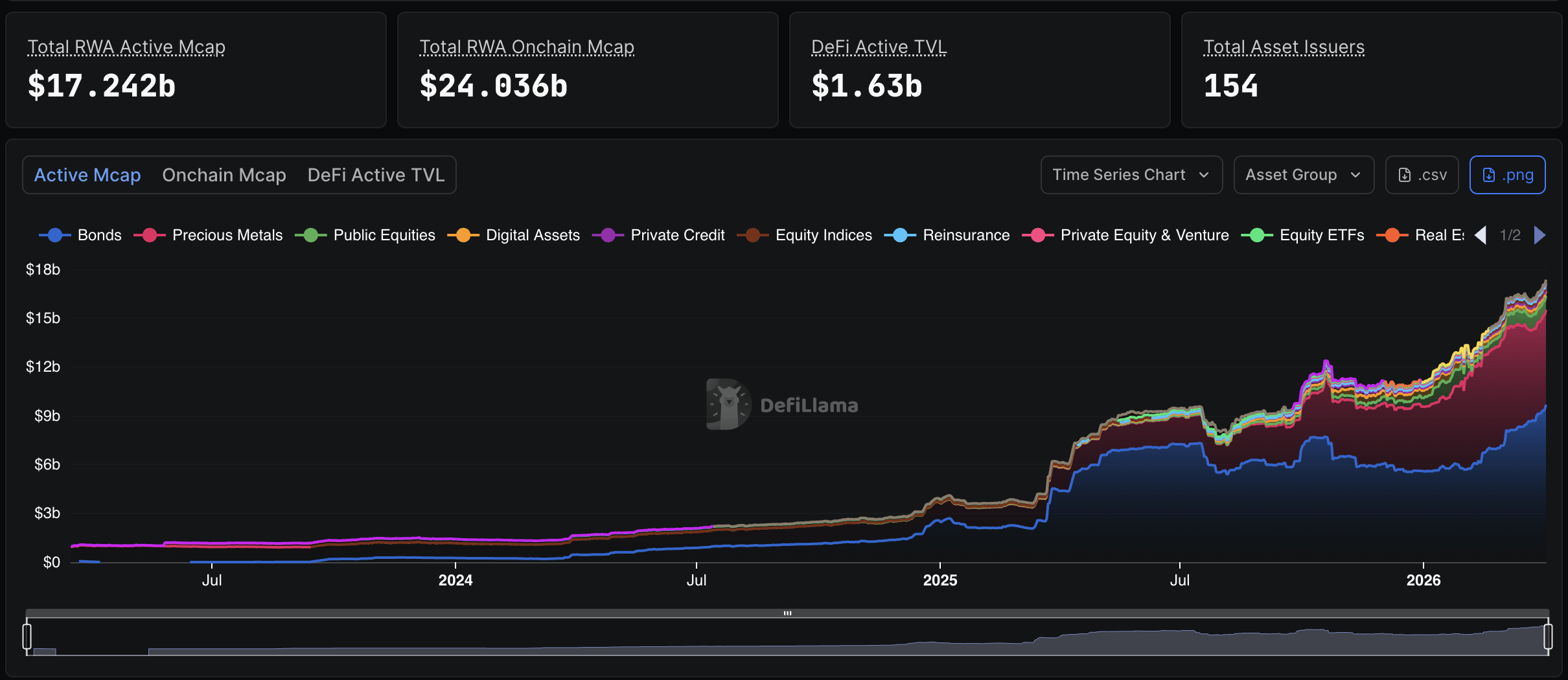
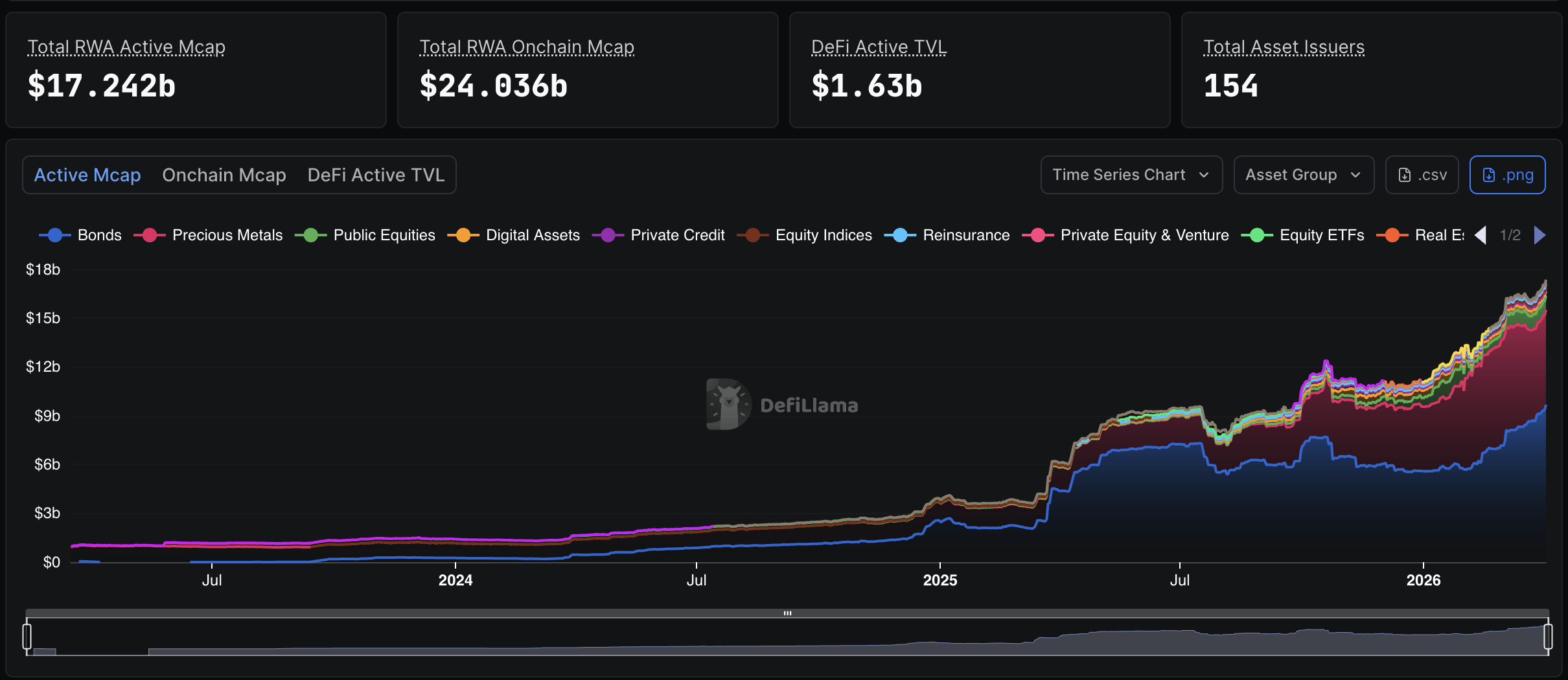
The IMF’s April 2026 “Tokenized Finance” note validated and warned about the tokenized real-world asset boom that Ethereum is dominating. To put it into perspective, on-chain RWA value has already hit $24 billion, excluding stablecoins, with the trajectory points far higher. On that $24 billion value, $14 billion is locked in Ethereum.
However, the IMF’s note flagged genuine systemic risks: flash crashes from rapid automated transactions, market fragmentation across siloed ledgers, and liquidity instability. But it also acknowledged RWA’s structural benefits, atomic settlement, continuous liquidity, and operational savings from smart contract automation.
— Real World Asset Watchlist (@RWAwatchlist_) April 2, 2026
 BREAKING: IMF (International Monetary Fund) says tokenization is reshaping regulated finance.
Assets moving onto programmable ledgers = efficiency gains.
But strong policy + trust still needed to protect stability.
RWA shift is getting official.  pic.twitter.com/I9eUzA6Gwo
Tokenized US Treasuries alone have reached $10.8 billion, buoyed by the SEC’s constructive regulatory posture. Peter Thiel has publicly positioned Ethereum as “Wall Street’s base layer” for this market as a bullish signal.
Projections from McKinsey ($2–4T by 2030), BCG ($16T), and Standard Chartered ($30T by 2034) suggest the current $36B figure is a rounding error by comparison. ETH is the rails.
Discover: The best pre-launch token sales
Ethereum Price Prediction: RWA Momentum is Building, But Price Lags
At $2,060, ETH sits at a psychologically significant level, holding above $2,000 but well below the peak it approached in late 2025 when Bitcoin cracked $125,000. That prior high now functions as a long-term resistance ceiling. The current range feels like consolidation.
Volume context is muted relative to the RWA narrative building on-chain. Network activity data suggests ETH is “booming under the hood,” with RWA deployments, smart contract throughput, and institutional settlement flows, while spot price remains range-bound. That divergence between fundamentals and price is a lagging indicator setup.
The $2,000 level is load-bearing right now. If it holds, the RWA growth story has room to translate into price. If it doesn’t, the next meaningful support is well below current levels.
Discover: The best crypto to diversify your portfolio with
LiquidChain Targets Early Mover Upside as Ethereum Tests Key Levels
ETH is a multibillion-dollar asset with institutional adoption already baked into its thesis, and any upside from here requires the entire RWA narrative to keep compounding at scale. That’s a reasonable bet, but it’s not a small-cap return profile.
Traders sizing for asymmetric exposure are already rotating attention toward infrastructure plays that sit beneath the Ethereum layer. The fragmentation problem the IMF specifically flagged, like siloed ledgers, disconnected liquidity, is exactly the problem one early-stage project is being built to solve.
A new layer emerges. Only a few see it first. — LiquidChain (@getliquidchain) March 24, 2026
The future is LiquidChain  ⟁https://t.co/vqvBcdSj94 pic.twitter.com/R7ZeZ0NPGl
LiquidChain ($LIQUID) is a Layer 3 infrastructure project positioning itself as the cross-chain liquidity layer, fusing Bitcoin, Ethereum, and Solana liquidity into a single execution environment. Developers deploy once and access all three ecosystems. The architecture includes a Unified Liquidity Layer, Single-Step Execution, Verifiable Settlement, and Deploy-Once Architecture.
The presale is live at $0.014 per token, with more than $630K raised to date, and a 1700% APY in staking bonus. The contract itself is also audited by Certik, the leading crypto auditor, to ensure investors safety.
Explore LiquidChain’s presale details here.
This article is for informational purposes only and does not constitute financial advice. Crypto assets are highly volatile. Always conduct your own research before investing.
The post Ethereum Price Prediction: IMF Warns Tokenization, ETH RWA Booming appeared first on Cryptonews.
Crypto World
Naoris Protocol’s quantum-resistance blockchain goes live as Bitcoin and Ethereum face ‘Q-Day’ threats


Naoris Protocol debuted its quantum-resistant blockchain Thursday, which it says is designed to stay secure even against future powerful quantum computers that could break modern day cryptography.
“Mainnet represents the transition from proof-of-concept to production infrastructure. The network has already validated over 100 million transactions using post-quantum cryptography. That is not a roadmap promise; it is measured, operational capacity,” Nathaniel Szerezla, chief growth officer of Naoris Protocol, said.
The debut comes as legacy chains Bitcoin and Ethereum confront the threat of a “quantum apocalypse.” Known as Q-Day, this is the point when future quantum computers could crack the encryption securing most blockchains.
Concerns escalated this week after Google reported that a sufficiently powerful quantum computer could break Bitcoin’s blockchain with fewer than 500,000 qubits — far lower than previous estimates. At the same time, another report flagged potential vulnerabilities in Ethereum that could put $100 billion on the blockchain at risk.
Because blockchain transactions such as those on Bitcoin and Ethereum are permanent, any weakness today could be exploited by future quantum computers with the necessary power.
Naoris is built different
This is where Naoris stands out. It is built from the start using post-quantum cryptography and algorithms approved by the U.S. National Institute of Standards and Technology to protect accounts, transactions, and digital assets, according to the press release shared with CoinDesk.
The system incorporates an “irreversible security transition.” This means that once a user adopts post-quantum keys, it has to use quantum-resistant signatures for transactions. The protocol automatically blocks transaction attempts using traditional, vulnerable cryptographic methods, helping protect assets even if classical cryptography becomes vulnerable.
More importantly, while its quantum-resistant security is right now available only on its own mainnet, the system is build with a broad scope in mind for potential support to wallets, exchanges, Layer 2 networks, and DeFi platforms in the future.
The mainnet launched with an invite-only group of strategic participants who operate the first validator nodes and form the network’s initial trust layer, laying a strong foundation before broader expansion. The protocol was tested at scale in an extensive testnet phase, during which it detected and mitigated over 603 million threats, processed more than 106 million post-quantum transactions, created over 3.3 million wallets, and activated more than one million security nodes globally.
The protocol’s native token NAORIS drives how the network works, helping secure transactions, enforce rules, and build trust among users. At press time, the token’s market cap was $36 million.

MEXC, one of the world’s fastest-growing digital asset exchanges and a pioneer in zero-fee trading, has announced a series of initiatives to integrate and expand the use of USD1, a US dollar stablecoin, across its ecosystem. By incorporating USD1 into its trading infrastructure and product suite, MEXC aims to broaden its use cases across the platform, including trading support, product integration, and wider ecosystem participation, while providing global users with more diverse and resilient stablecoin options.
USD1 is a stablecoin redeemable on a 1:1 basis for U.S. dollars. Each USD1 is 100% backed by a reserve consisting of short-term U.S. government Treasuries, U.S. dollar deposits, and other cash equivalents. These reserve assets are held or maintained by BitGo Trust Company, Inc. and/or its affiliates. USD1 is issued by BitGo, while World Liberty Financial provides branding and certain operational support.
MEXC remains committed to offering a broad range of high-quality assets. Through this integration, MEXC will leverage its established product suite to expand the utility of USD1 across its ecosystem:
- Deep Product Integration: MEXC plans to gradually integrate USD1 across its product offerings, including Launchpool, Savings, and Futures collateral, subject to platform availability. Through these integrations, USD1 may be used as payment and settlement asset within the ecosystem, broadening its utility across the platform.
- Liquidity and Zero-Fee Support: MEXC will introduce additional USD1 trading pairs and launch associated zero-fee promotions. Leveraging the platform’s deep liquidity and industry-leading low-fee structure, MEXC provides global users with a more convenient and cost-effective channel for USD1 interaction.
- Ecosystem Activity Empowerment: To enhance user awareness and experience with the stability of USD1, MEXC will launch a series of ecosystem incentive programs. Through various interactive mechanisms, these initiatives aim to lower the barrier to entry and accelerate the adoption of USD1 in real-world trading scenarios.
Vugar, Chief Operating Officer of MEXC, stated: “USD1 strengthens our mission to make high-quality assets more accessible, efficient, and usable at scale. Stablecoins are only as powerful as their distribution. By integrating USD1 into the MEXC ecosystem, we are expanding compliant stablecoin choice while enhancing trading and capital allocation tools. With over 40 million users and a strong zero-fee conviction, MEXC delivers immediate scale, deep liquidity, and real utility for USD1, accelerating its adoption across global markets.”
As USD1 trading pairs and related features go live, MEXC will continue to explore practical use cases that bring added value to users across the platform. More details on upcoming initiatives will be shared in the coming weeks.
About MEXC
Founded in 2018, MEXC is committed to being “Your Easiest Way to Crypto.” Serving over 40 million users across 170+ countries, MEXC is known for its broad selection of trending tokens, everyday airdrop opportunities, and low trading fees. Our user-friendly platform is designed to support both new traders and experienced investors, offering secure and efficient access to digital assets. MEXC prioritizes simplicity and innovation, making crypto trading more accessible and rewarding.
MEXC Official Website| X | Telegram |How to Sign Up on MEXC
The post MEXC Integrates USD1 into Full-Spectrum Infrastructure for Global Users appeared first on BeInCrypto.
Algorand price shot up 21% on Friday, April 3, becoming the top gainer of the day, bucking the relative stillness of the broader crypto market that has gone cold amid the escalating war situation in the Middle East.
Summary
- Algorand price jumped 21% to a nine-week high, becoming the top gainer as the broader crypto market remained subdued amid geopolitical tensions.
- The rally was driven by a Google Quantum AI research mention, Revolut enabling ALGO staking, and dip-buying after a recent all-time low.
- A confirmed falling wedge breakout and bullish indicators signal potential upside toward $0.139, with further gains possible if resistance is cleared.
According to data from crypto.news, Algorand (ALGO) price rallied to a 9-week high of $0.122 on Friday before settling at $0.121 at press time. Its gains pushed it to become the leading gainer among the top cryptocurrencies by market cap in both the daily and weekly timeframes.
There are three main reasons why Algorand price rallied today.
First, Algorand was recently cited by Google Quantum AI in a research paper focused on threats faced by major blockchains from quantum computing. The paper made several mentions of Algorand for its post-quantum security and advanced Falcon signature technology, placing it ahead of other major players and trailing only behind Bitcoin and Ethereum.
This citation from one of the most prominent tech labs gave the project a big push to new investors while increasing hype for existing ones.
Second, Revolut has officially enabled staking for Algorand on its platform. This enables its customer base of over 70 million investors to stake ALGO directly from the app.
The move has increased investor demand for the token as it triggered a jump in the total amount being staked on the platform, effectively removing those tokens from circulation and hence lowering potential selling pressure.
Third, Algorand’s rebound follows the token hitting an all-time low just five days ago. The token dropping to its floor likely made it very attractive for buyers who bought the dip following its high-profile citation.
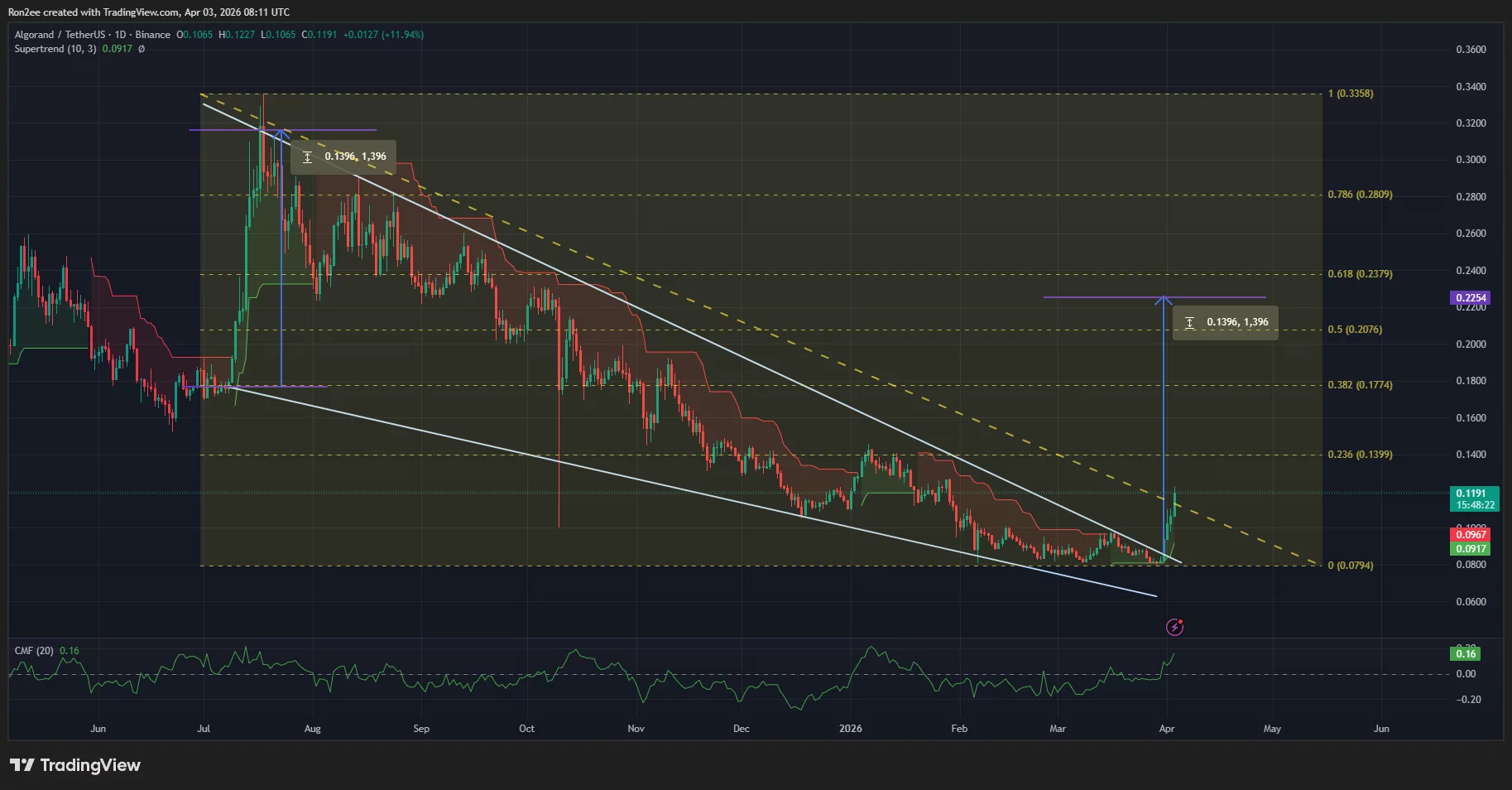
On the daily chart, Algorand price has formed a multi-month falling wedge pattern. Following its recent rebound, it has broken out from the upper trendline of the pattern, thereby confirming a bullish reversal. When such patterns are confirmed, the asset often enters a period of sustained growth.
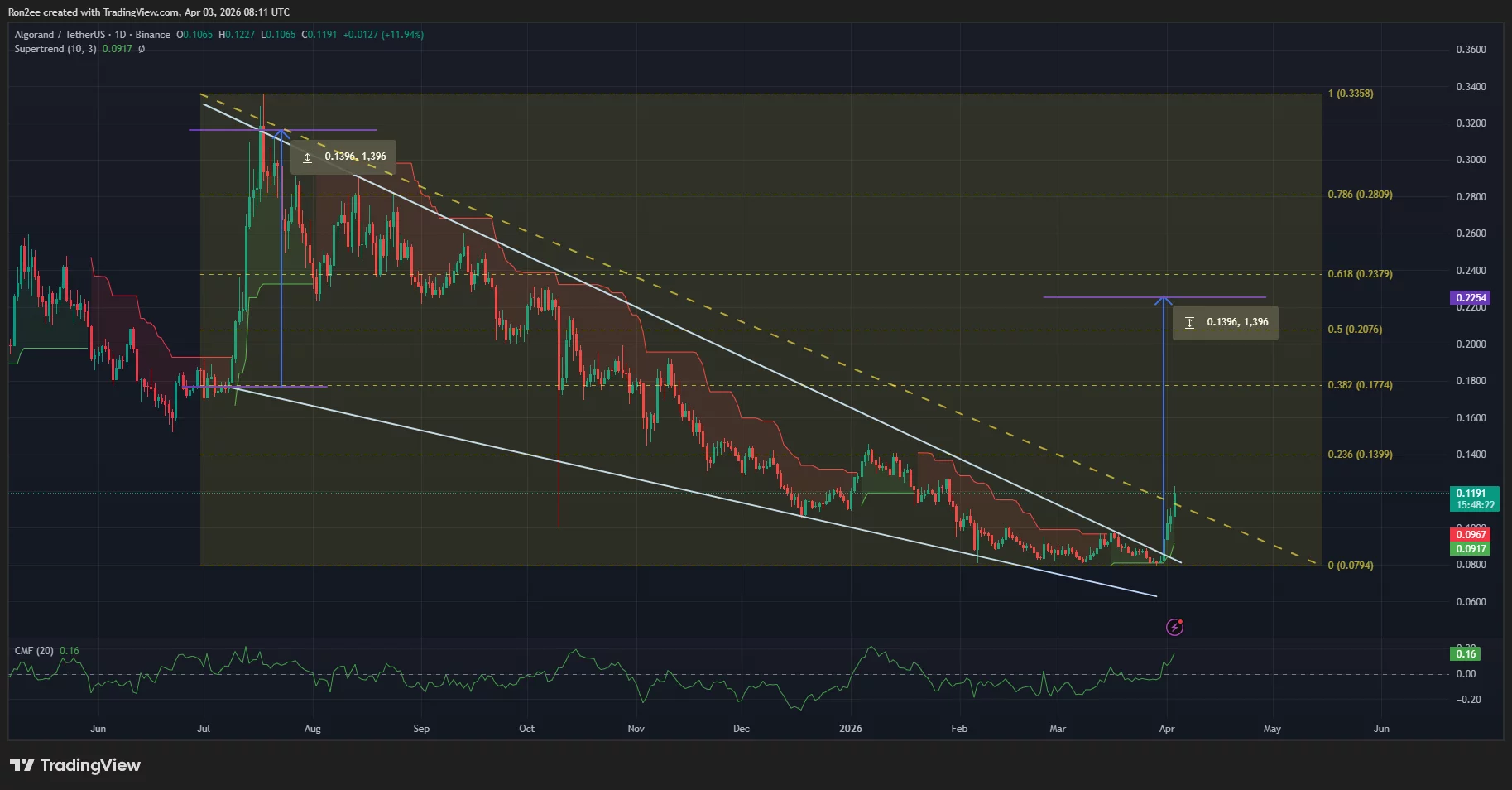
At press time, a similar bullish outlook for ALGO was supported by technical indicators. Notably, the Supertrend has turned green, a notable sign of a trend shift. The Chaikin Money Flow index read 0.19, a strong positive reading hinting that buyers are in control.
For now, $0.139, which sits at the 23.6% Fibonacci retracement level, is the most immediate resistance level to keep an eye on for identifying more upside. A decisive break above that could potentially trigger a rally to $0.225, a target calculated by adding the height of the wedge to the point at which the breakout occurred.
On the contrary, a drop below the $0.085 support level can invalidate this bullish setup.
Disclosure: This article does not represent investment advice. The content and materials featured on this page are for educational purposes only.

Final $1 XRP Warning!

Meghan shares adorable video of Archie, 6, skilfully skiing with dad Prince Harry as she says he’s a ‘quick learner’

What’s Open, Trading Hours And Activities


-

 NewsBeat7 days ago
The Story hosts event on Durham’s historic registers
-

 NewsBeat15 hours ago
Steven Gerrard disagrees with Gary Neville over ‘shock’ Chelsea and Arsenal claim | Football
-

 Sports7 days ago
Sweet Sixteen Game Thread: Tide vs Michigan
-
Entertainment4 days ago
Fans slam 'heartbreaking' Barbie Dream Fest convention debacle with 'cardboard cutout' experience
-
 Entertainment6 days ago
Lana Del Rey Celebrates Her Husband’s 51st Birthday In New Post
-

 Crypto World2 days ago
Gold Price Prediction: Worst Month in 17 Years fo Save Haven Rock
-
Crypto World3 days ago
Dems press CFTC, ethics board on prediction-market insider trades
-

 Tech4 days ago
The Pixel 10a doesn’t have a camera bump, and it’s great
-

 Sports3 days ago
Tallest college basketball player ever, standing at 7-foot-9, entering transfer portal
-

 Tech3 days ago
EE TV is using AI to help you find something to watch
-

 Fashion5 days ago
Amazon Sundays: Soft Spring Layers
-

 Business10 hours ago
No Jackpot Winner and $194 Million Prize Rolls Over
-

 Business1 day ago
Login and Checkout Issues Spark Merchant Frustration
-

 Tech5 days ago
Elon Musk’s last co-founder reportedly leaves xAI
-

 Crypto World3 days ago
U.S. rule change may open trillions in 401(k) funds to crypto
-

 Tech3 days ago
How to back up your iPhone & iPad to your Mac before something goes wrong
-

 Tech4 days ago
Avatar Legends: The Fighting Game comes out in July and it looks pretty slick
-

 Tech4 days ago
Apple will hide your email address from apps and websites, but not cops
-

 Politics4 days ago
Should Trump Be Scared Strait?
-

 Tech3 days ago
Flipsnack and the shift toward motion-first business content with living visuals
You must be logged in to post a comment Login