

Crypto World
Circle Stock Defies Wall Street in Digital Asset Selloff


Circle, the issuer behind the USDC stablecoin, has defied broader market pullbacks as its public stock climbs decisively in 2026. The rally comes as Bernstein analysts reiterated an Outperform rating with a $190 price target, arguing that stablecoins are maturing from a crypto-centric instrument to a fixture in payments infrastructure and on-chain settlement. The momentum reflects a broader trend: digital dollars are moving from trading desks into real-world finance, with corporate treasuries and insurers testing faster, cheaper cross-border flows. Data on USDC’s reach underscores the scale of this shift, with circulation approaching $79 billion, a signal that stablecoins are entrenched in both crypto markets and mainstream financial services. In the same ecosystem, institutions and fintechs are piloting models that could redefine how money moves across borders and asset classes.
The push into traditional finance is not theoretical. In a notable development, UK broker Aon is piloting stablecoin payments for insurance premiums, partnering with Paxos and Coinbase to explore whether cross-border premium settlements can be sped up and streamlined. The pilot aims to reduce settlement times and settlement costs, which historically involve multiple correspondent banks and complex currency conversions. If successful, insurers and their clients could experience faster premium collection, improved cash flow planning, and less administrative overhead when dealing with international policies and reinsurance transactions. The trial signals a broader real-world use case for stablecoins beyond speculative trading, aligning with industry narratives that digital dollars could underpin more efficient, automated financial workflows.
Meanwhile, Bitcoin’s resilience and the evolving approach of miners to treasury management are under the microscope. In contrast to several miners that trimmed holdings amid tightening margins, Canaan is expanding its BTC treasury. The company reported mining 86 BTC in February, lifting its total BTC reserves to 1,793. It also disclosed holding 3,952 Ether, adding to a growing crypto reserve that underscores a strategic shift toward balance sheet diversification. This accumulation stands out in an industry where several publicly traded miners have unwound portions of their Bitcoin holdings to weather post-halving economics and margin pressure. The contrast highlights how individual operators are interpreting risk, liquidity, and tax considerations in a market that remains volatile but increasingly institutionalized. Canaan’s expansion efforts extend beyond its core mining facilities; Texas operations are described as part of a broader buildout that positions the company within one of the country’s largest mining hubs.
In parallel, Wells Fargo has filed a US trademark application for “WFUSD,” a move that hints at deeper crypto ambitions among one of the country’s largest banks. The filing covers a spectrum of blockchain-enabled offerings, including crypto trading, payments, digital wallet services, and software for staking and custody, with a broader nod to distributed ledger technology-based financial services. While a trademark filing does not guarantee a product launch, it signals contemplation of crypto-related revenue streams and tokenized-dollar concepts within a large traditional banking framework. The transition—if it unfolds—would reflect ongoing discussions about how big banks can participate in digital assets while navigating regulatory, liquidity, and risk considerations that differ from their legacy businesses.
Key takeaways
- Circle’s market narrative is increasingly tied to the mainstream adoption of stablecoins, with Bernstein maintaining an Outperform rating and a $190 target as the stock outpaces broader indices in 2026.
- Real-world use cases for stablecoins are expanding, evidenced by Aon’s pilot with Paxos and Coinbase to streamline cross-border premium payments for insurance products.
- Canaan’s BTC treasury expansion contrasts with sector-wide selling by other miners, signaling a selective, long-term approach to balance-sheet resilience during a downturn.
- Wells Fargo’s WFUSD trademark filing points to potential crypto-related services that could broaden access to digital assets through a traditional banking channel.
- Industry dynamics suggest that digital dollars are moving from niche crypto applications toward mainstream finance, with on-chain settlement and cross-border payments at the core of the evolving value proposition.
Tickers mentioned: $BTC, $ETH, $USDC
Sentiment: Bullish
Price impact: Positive. The article notes a sharp rise in Circle’s stock and ongoing adoption of stablecoins that could sustain upside for the company’s balance sheet and revenue streams.
Trading idea (Not Financial Advice): Hold. The narrative suggests upside tied to stablecoin adoption and real-world use cases, though volatility in crypto assets and bank regulatory dynamics warrant a cautious approach.
Market context: The ongoing integration of stablecoins into payments infrastructure and on-chain settlements aligns with broader liquidity and digital-asset infrastructure trends, underscored by corporate pilots and major financial institutions exploring tokenized-dollar solutions.
Why it matters
The forward momentum around Circle and stablecoins matters because it ties a crypto-native instrument to scalable, traditional financial processes. USDC’s growing footprint signals that stablecoins can underpin faster, less costly cross-border payments, and potentially smoother on-chain settlements for institutions. If these dynamics persist, it could reshape treasury management practices for corporations and financial services firms, reducing reliance on conventional FX timing and bank-led liquidity cycles. The Bernstein thesis—anchored on broader stablecoin adoption across payments, infrastructure, and on-chain settlement—suggests a pathway for stablecoins to become a core component of the financial plumbing that underpins both crypto markets and the real economy.
On the mining side, Canaan’s approach contrasts with industry-wide selling pressure by some peers. A strategy focused on expanding BTC reserves while maintaining a diversified crypto stash could provide insulation against short-term price swings and offer flexibility for future balance-sheet optimization. The Texas expansion also highlights how U.S. mining hubs are consolidating leadership in the space, potentially contributing to energy and regulatory considerations as the sector scales. The confluence of treasury discipline in mining, institutional pilots in insurance, and traditional banks exploring crypto-trading and custody suggests a period of convergence where crypto-native assets increasingly interact with mainstream financial services and corporate operations.
Wells Fargo’s WFUSD filing introduces a different dimension: the possible entry point for crypto-enabled payments or tokenized-dollar products under a high-profile banking franchise. While regulatory and operational hurdles remain, the signal from a major bank can catalyze investor and client interest in integrated crypto services, from custody to payments. The evolving narrative around Circle, stablecoins, miners’ treasury strategies, and traditional banks’ exploration of crypto services collectively points to a broader market reality: digital dollars are being woven into the fabric of everyday finance, with real implications for liquidity, settlement speed, and capital efficiency.
What to watch next
- Circle’s earnings trajectory and any updates to the USDC reserve composition or redemption dynamics, including commentary from Bernstein on the timing of a potential price target revision.
- Results or updates from Aon’s stablecoin pilot, including cost savings, settlement times, and cross-border policy implications for insurers.
- Further disclosures from Canaan on mining economics, treasury management, and any expansion milestones in Texas or other jurisdictions.
- Regulatory developments around stablecoins and tokenized dollars that could influence the pace of mainstream adoption and bank engagement in digital assets.
- Follow-on filings or product launches related to WFUSD or other crypto services from Wells Fargo that could affect corporate payments ecosystems.
Sources & verification
- Bernstein’s rating and price target for Circle stock (Outperform, $190 target).
- USDC circulation data approaching $79 billion (DeFiLlama).
- Aon’s pilot of stablecoin payments for insurance premiums with Paxos and Coinbase.
- Canaan’s February BTC mining output (86 BTC) and total holdings (1,793 BTC) plus 3,952 ETH.
- Wells Fargo’s WFUSD trademark filing with the USPTO.
Circle, miners, and banks move stablecoins toward mainstream finance
In a landscape where crypto markets can swing on macro headlines, Circle’s ascent reflects a deeper structural shift: stablecoins are being integrated into the fabric of traditional finance, with clear implications for liquidity, settlement speed, and cross-border payments. The firm’s equity story sits atop a broader ecosystem where real-world pilots, like Aon’s, demonstrate that digital dollars are not just a crypto industry curiosity but a scalable, enterprise-grade tool. For investors, the narrative emphasizes two focal points: a growing revenue model tied to stablecoin infrastructure and governance-driven clarity around reserves and redemption dynamics. For builders and users, the signal is practical—payments and settlement can be faster and cheaper, provided the regulatory and operational frameworks keep pace with innovation.
As the sector navigates these transitions, the balance between risk and opportunity will hinge on how quickly institutions adopt and scale these tools. The confluence of Circle’s market momentum, Canaan’s treasury strategy, and Wells Fargo’s potential for crypto-enabled services suggests that the next phase of crypto-market evolution will be measured not by rapid, speculative bets alone, but by the steady widening of stablecoins into everyday financial activity. If this trajectory endures, the market could see a new baseline for liquidity and settlement efficiency, anchored by the same digital dollars that have become a central talking point for policymakers, investors, and financial institutions alike.

Crypto World
Sui vs Near: How Two Blockchain Networks Are Taking Different Roads to Scalable Infrastructure

TLDR:
- Sui finalizes independent transactions in 0.4–0.5 seconds using an object-centric parallel execution model.
- Near’s dynamic sharding allows the network itself to expand capacity as on-chain demand increases over time.
- Stablecoins make up 40–50% of Sui’s DeFi activity, with total DeFi value surpassing $2 billion in 2025.
- Near’s Confidential Intents launched in early 2026, enabling private cross-chain execution and AI-agent automation.
Sui and Near are two blockchain networks that both promise high throughput, low fees, and horizontal scalability. They are often grouped as competitors in the same category.
However, their underlying architectures reflect very different assumptions about how blockchain demand will grow.
Those architectural differences determine what type of activity each network can sustainably support. Understanding these differences helps investors and developers make more informed decisions about where to build or allocate capital.
Architecture and Throughput: Where the Two Networks Diverge
Sui is built around an object-centric model that treats assets as independent objects. When two transactions do not touch the same object, they skip full consensus and execute in parallel.
Only transactions involving shared objects enter the full consensus path. This design allows simple transfers to finalize in the 0.4 to 0.5 second range. As hardware improves, execution capacity on Sui scales accordingly.
Near takes a different structural approach by partitioning the network itself through sharding. State is split across shards, and validators are assigned to specific shard segments.
The protocol can dynamically reshard as demand increases, and finality typically lands between 0.6 and 1.3 seconds.
Developers on Near interact with a protocol that manages scaling internally, reducing the need to handle partition logic manually.
In real-time conditions, neither network is currently constrained by throughput. Observed TPS on Sui ranges around the mid-20s, while Near operates between 30 and 40.
Both chains advertise theoretical ceilings far beyond current usage. The bottleneck today is demand, not execution capacity.
Crypto analyst eye zen hour, who requested a deep dive into both networks, noted that the competitive lens has shifted toward cost efficiency, liquidity depth, and ecosystem traction rather than raw TPS claims. That shift reflects where actual network value accumulates in the current market environment.
Validator design also differs between the two. Sui requires higher hardware specifications and greater stake exposure, creating a performance-oriented validator set.
Near lowers entry barriers through dynamic seat pricing and lighter hardware requirements, distributing workload across shards and broadening validator participation.
Stablecoins and Privacy: Competing Strategies for Institutional Growth
Stablecoins represent a practical stress test for any blockchain network. They simultaneously test settlement speed, liquidity routing, composability, and compliance readiness.
On Sui, stablecoins now account for roughly 40 to 50 percent of DeFi activity, with total DeFi value surpassing $2 billion in 2025.
Assets such as USDsui, suiUSDe, BlackRock-backed USDi, and over-collateralized BUCK reflect a strategy built around high-velocity settlement within a single execution environment. Zero-fee stablecoin transfers are planned for 2026.
Near’s stablecoin strategy focuses on liquidity mobility across multiple environments. USDC and USDT operate under the NEP-141 standard, and the Stablecoin Transport Protocol enables efficient cross-chain routing.
Cross-chain volume through Near Intents surpassed $13 billion in 2025, positioning stablecoins as cross-chain coordination tools rather than purely local settlement assets.
On privacy, Sui currently offers pseudonymity and object-level isolation. Its 2026 roadmap includes protocol-level default privacy through zero-knowledge proofs, homomorphic encryption, and selective disclosure.
Near, on the other hand, already launched Confidential Accounts and Confidential Intents in early 2026, enabling private cross-chain execution and AI-agent automation today.
Near’s active deployment of privacy features contrasts with Sui’s roadmap-based approach. Both paths are coherent, but Near’s execution-layer confidentiality is currently live, while Sui’s embedded privacy remains in development.
Market positioning further separates the two. Sui has established traction in gaming, consumer payments, storage, and institutional products.
Near centers its narrative on AI-native infrastructure, cross-chain coordination, and developer accessibility through JavaScript tooling and intent-based architecture. Both are viable, and adoption distribution over the next cycle will ultimately determine which scaling assumption proves more durable.

Crypto World
Market Divergence: Bitcoin Climbs 12.5% While Stocks and Precious Metals Lose Trillions
TLDR:
- Bitcoin market divergence appears as crypto rises while stocks and metals fall simultaneously.
- U.S. equities lose around $2.4 trillion while Bitcoin climbs nearly 12.5% in the same period.
- Gold and silver briefly spike on conflict headlines before reversing sharply downward.
- Market behavior suggests liquidity pressures and capital rotation may drive crypto gains.
Bitcoin market divergence is drawing attention after an unusual market reaction during recent geopolitical tensions.
Equities and precious metals declined sharply, yet the cryptocurrency market advanced, creating a rare pattern that differs from the typical risk-off behavior seen during global conflicts.
Traditional Safe Havens Fail to Follow the Usual Pattern
Financial markets usually follow a predictable script during geopolitical crises. Investors tend to move capital into assets considered stable when global uncertainty rises.
Precious metals such as Gold and Silver often attract inflows during these periods. Government bonds and the U.S. dollar also benefit from defensive positioning.
Risk assets typically move in the opposite direction. Major equity indices like the S&P 500 and digital assets, including Bitcoin, usually decline when investors shift toward safety.
Comparable reactions appeared during the COVID-19 Market Crash and the Russia–Ukraine War. In both events, precious metals strengthened while equities and crypto weakened.
Recent price behavior differs from that historical template. Stocks declined sharply while gold and silver also moved lower after an initial spike.
Such a move is unusual because precious metals typically retain value during periods of geopolitical stress. Their decline alongside equities indicates an atypical market response.
At the same time, the cryptocurrency market moved higher. This created a divergence in the Bitcoin market that analysts are now discussing across financial platforms.
Liquidity Pressure and Capital Rotation in Markets
One possible explanation centers on liquidity conditions rather than fear. Institutional investors sometimes sell liquid holdings when they need to raise cash quickly.
Precious metals markets provide deep liquidity. Large funds can exit positions rapidly, which sometimes leads to declines even during geopolitical uncertainty.
Another factor involves positioning before the conflict headlines appeared. If hedge funds already held large long positions in gold, the initial price spike may have triggered profit-taking.
This behavior often follows a “buy the rumor, sell the news” pattern. Prices rise before the event and decline after traders close positions.
During the same period, the cryptocurrency market moved in the opposite direction. Bitcoin advanced nearly 12.5 percent while the broader crypto market gained roughly ten percent.
Observers on social media documented the unusual divergence. Several posts noted that equities, gold, and silver fell simultaneously while crypto markets rallied.
Some investors also continue exploring the narrative of Bitcoin as digital gold. The fixed supply model of Bitcoin contributes to that perception among certain market participants.
The recent market configuration, therefore, appears rare. Stocks declined, metals weakened, yet crypto prices advanced during geopolitical tension.
For now, the Bitcoin market divergence remains an uncommon pattern that market participants continue monitoring closely.
TLDR:
- Crypto market cap is trading near a historic demand zone that supported the 2022 bear market bottom.
- Market structure shows similarities between the current cycle and the 2021–2023 crypto market pattern.
- The latest correction of about 65% closely mirrors the magnitude of the previous bear market drawdown.
- If the support zone holds again, total crypto valuation could enter another large expansion phase.
Crypto Market Cap is approaching a historically important support zone as traders examine whether the market structure mirrors the previous cycle bottom.
The total digital asset valuation remains near $2.48 trillion while analysts track demand levels and broader market momentum.
Market Structure Shows Similarities to Previous Cycle
The crypto market cap is again testing a structural demand zone that previously stabilized the market. Historical chart patterns show that the same region supported the market during the 2022 bear cycle recovery.
Data from CoinGecko shows the total cryptocurrency valuation hovering around $2.48 trillion. At the same time, Bitcoin trades near $70,600 while controlling roughly 56% to 57% market dominance.
Technical charts show similarities between the 2021–2023 cycle and the current market structure. Both cycles formed a rising channel before breaking down toward a strong historical demand area.
During the previous cycle decline, the crypto market cap dropped sharply from almost $3 trillion to near $700 billion. The correction represented a market decline of more than seventy percent across the digital asset sector.
Despite the sharp downturn, the market eventually stabilized within a strong support region. That stabilization created a multi-month accumulation phase where capital slowly returned.
Market observers frequently discussed the pattern on social platforms. The total crypto market cap is revisiting the same demand zone that held the 2022 market bottom.
Traders are closely watching whether the level attracts buyers again. This structural resemblance has prompted renewed attention toward the current phase of the market cycle.
Demand Zone Could Determine the Next Expansion Phase
The current crypto market cap correction also resembles the magnitude of the previous downturn. Charts indicate the latest drawdown has reached roughly sixty-five percent from recent highs.
Analysts identify a key support region between $1.5 trillion and $1.7 trillion. This zone previously acted as the foundation of the 2022 bear market bottom.
The area also represents a long-term liquidity cluster where institutional demand historically appeared. Because of this structure, many traders consider the level a decisive support zone.
When the market stabilized in this area during the previous cycle, accumulation continued for several months. Leading assets such as Ethereum later joined the recovery that began with Bitcoin.
That accumulation phase eventually triggered a strong expansion in market value. The crypto market cap later surged by nearly 488% from the cycle bottom.
Analysts frequently reference that rally while evaluating the current setup. Previous accumulation at this level eventually triggered a large expansion in total crypto valuation.
The market is now approaching that same demand region again. If buyers defend the support region again, the market could enter another expansion stage.
A recovery similar to the previous cycle would place the crypto market cap between roughly $7 trillion and $9 trillion.
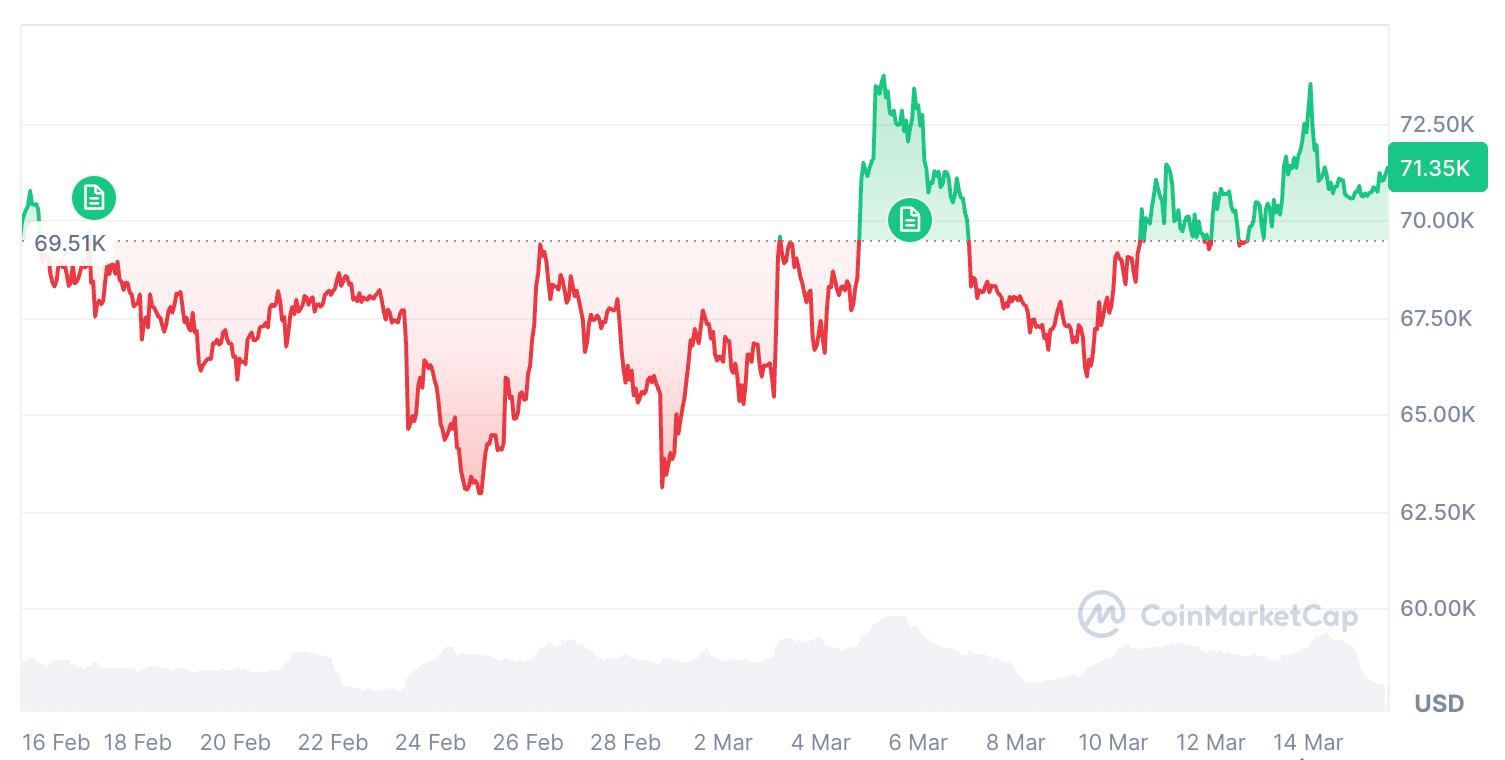
Large Bitcoin wallets are increasing their holdings again as the asset’s price holds around $71,000, according to crypto sentiment platform Santiment.
“Their recent shift to accumulation is a bullish signal,” Santiment said in a report on Saturday, referring to wallets holding between 10 and 10,000 Bitcoin (BTC).
“This is a positive reversal,” Santiment added. Santiment data shows wallets holding 10 to 10,000 Bitcoin (BTC) now control 68.17% of Bitcoin’s total supply, up from 68.07% seven days earlier.
Santiment eyeing retail investor activity
Santiment said that a potential local bottom in Bitcoin could be forming if whales continue accumulating while retail investors’ share of holdings begins to decline.
“Ideally, we want to see small wallets (retail) drop while this group rises, signaling a transfer of coins from weak hands to strong hands,” Santiment said.
An increase in retail buying suggests over-optimism, since Bitcoin’s price has historically bottomed when everyday investors start losing hope and selling.
At the same time, the Crypto Fear & Greed Index stayed in “Extreme Fear” on Sunday at 16, signaling investors are still cautious.
Bitcoin is trading at $71,350 at the time of publication, up 6.30% over the past seven days.

Just over a week ago, Bitcoin whale activity was vastly different. Santiment reported on Mar. 6 that, in the two days prior, whales had sold 66% of the Bitcoin they bought between Feb. 23 and Mar. 3, just as Bitcoin surged past $70,000 and briefly touched $74,000.
Market bottom still uncertain
However, Santiment said that if retail investors keep buying Bitcoin, it could mean more downside ahead.
“Historically, markets tend to bottom when the ‘crowd’ loses hope. The persistence of retail optimism is currently the biggest argument against a confirmed bottom,” Santiment said.
Related: Bitcoin beats stocks as Strategy’s STRC hints at $776M BTC buying potential
“Markets rarely reward the majority consensus immediately,” Santiment added.
Bitcoin onchain analyst Willy Woo echoed a similar view, recently saying that Bitcoin is “solidly in the middle of its bear market through a lens of long-range liquidity.”
It comes as US spot Bitcoin exchange-traded funds (ETFs) logged their first five-day inflow streak of 2026, bringing in roughly $767.32 million this week.
Magazine: All 21 million Bitcoin is at risk from quantum computers
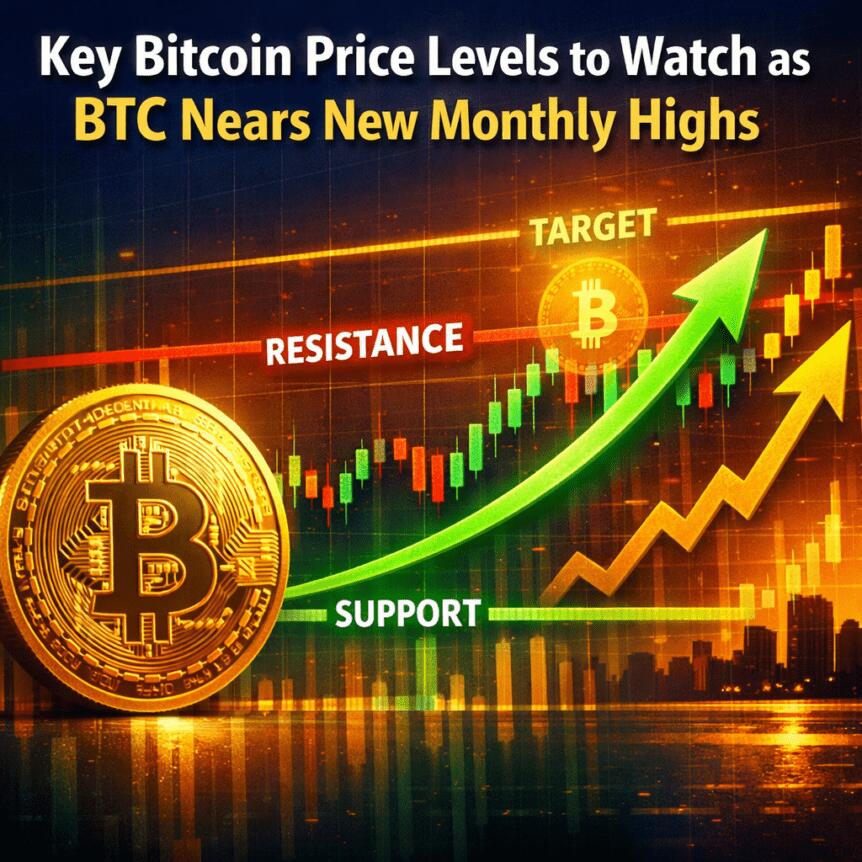
Bitcoin is edging toward the upper-$70,000 zone as fresh demand signals emerge from spot markets, ETFs, and corporate accumulation. The asset traded close to $74,000 while posting a 10.42% weekly gain—the strongest seven-day performance since September 2025. Analysts point to a confluence of factors underpinning the move, including improving spot ETF flows, shifting dynamics in the Coinbase premium, and a build-up of bids from institutional players. As traders weigh liquidity pockets and key technical levels, market participants are watching whether the renewed appetite can sustain a broader rally or fade into a retest of nearby supports. The takeaway: demand trends appear to be re-accelerating after a prolonged period of consolidation.
Key takeaways
- Bitcoin traded near $74,000 after a 10.42% weekly gain, the strongest weekly move since September 2025.
- The Coinbase premium gap turned positive for the first time in nearly ten weeks, at +35.4, signaling renewed buying pressure.
- Spot BTC ETF fund flows have improved over the last three weeks, with net inflows surpassing $1.9 billion.
- Corporate accumulation intensified, with STRC financing program purchases totaling 11,042 BTC in the current week.
- Liquidity clusters around $75,000 and above suggest a potential acceleration if price decisively clears resistance zones and fills nearby value gaps.
Tickers mentioned: $BTC
Sentiment: Bullish
Price impact: Positive. The combination of an improving Coinbase premium and rising ETF inflows points to stronger buying interest and potential upside momentum.
Trading idea (Not Financial Advice): Hold. If BTC remains above key supports and liquidity pockets, the path of least resistance could tilt higher, provided macro conditions and funding rates stay supportive.
Market context: The recent uptick in spot ETF flows, coupled with renewed corporate demand, is aligning with a broader recovery in crypto liquidity and risk appetite. Traders are evaluating how this environment interacts with on-chain activity and macro liquidity, including potential regulatory developments affecting ETF structures and institutional participation.
Why it matters
The converging signals around Bitcoin’s price action matter because they reflect a shift in the demand landscape after months of volatility and a drawn-out corrective phase. A positive Coinbase premium gap indicates that demand on U.S. exchanges is outpacing global price discovery, which often accompanies sustained upside momentum. In the interim, spot ETF inflows act as a barometer for institutional interest; surpassing $1.9 billion in net inflows over three weeks implies that larger players are increasing exposure, potentially providing a stabilizing bid during pullbacks.
Corporate accumulation adds another layer of conviction. The STRC financing program’s purchase of 11,042 BTC this week demonstrates that strategic buyers are deploying capital in a disciplined manner, supporting a bid backdrop that can help Blackburne-style risk management and longer-term positioning. While these developments do not guarantee a continuation of gains, they contribute to a market environment where price action can be propelled by sustained demand rather than sporadic, speculative bursts.
From a technical standpoint, traders are paying close attention to whether Bitcoin can reclaim the 100-day moving average and solidify above local liquidity clusters. If the price stabilizes above roughly $74,000 and begins to fill soft zones above $75,000, the market could migrate into a higher-liquidity regime where leveraged longs cluster around the $75k–$80k area. In such a scenario, a break through the $76,000–$80,000 band could accelerate toward the next objective range near $79,400–$81,400, where previous imbalances between buyers and sellers formed into a fair value gap (FVG).
Analysts highlight that a sustained move above these levels would require broad-based demand, as well as continued compliance with risk-management signals from market participants. Some traders argue that the current price action constitutes a potential HTF trend reversal if a monthly bullish engulfing pattern solidifies on the charts, suggesting an established uptrend rather than a mere short-term rally. In this context, price action around major liquidity pockets and categorical technical signals will be pivotal in determining whether BTC can transition into a new trading regime.
Market observers also note the role of on-chain and off-chain data in shaping sentiment. The narrative around Coinbase’s premium and ETF inflows aligns with a broader theme: liquidity is gradually reconfiguring, and the market appears to be transitioning from a period dominated by sell-side pressure to one where buyers can reassert control. If this trajectory continues, the broader crypto market could begin to price in the possibility of higher macro-driven risk tolerance, with Bitcoin acting as a leading indicator for sector-wide flows.
Looking ahead, traders remain cautious about the pace of upward movement given the potential for volatility driven by macro headlines, regulatory developments, and the evolving ETF landscape. However, the current mix of improving ETF flows, renewed corporate demand, and a positive shift in the Coinbase premium underscores a more constructive frame for Bitcoin as it tests key resistance and liquidity thresholds.
What to watch next
- Bitcoin holding above $74,000 and reclaiming the 100-day moving average on a sustained basis.
- Continued improvement in spot BTC ETF inflows, with weekly net inflows approaching or exceeding the $1.5–$2.0 billion range.
- STRC financing program activity and additional corporate buys confirming a durable bid.
- Price trading through the $75,000–$80,000 zone, followed by a test of the $79,400–$81,400 region where a historical FVG sits.
- Liquidity maps showing a shift in leverage exposure and new clusters forming above the $75,000 mark.
Sources & verification
- CryptoQuant QuickTake: Coinbase Premium just flipped positive after 10 weeks of US sellers dominating the market.
- SOSOVALUE Total Crypto Spot ETF Fund Flow: Net inflows data over the last three weeks showing improving demand.
- STRC live data: Strategy’s financing program and weekly BTC accumulation (11,042 BTC reported this week).
- CoinGlass: Bitcoin liquidation map indicating near-term leverage positions around $75k and liquidity pockets above $76k–$80k.
- Ardi’s X post on BTC price targets and momentum dynamics; Michaël van de Poppe’s analysis of resistance bands and quarterly patterns.
Bitcoin market reaction and key details
Bitcoin (CRYPTO: BTC) has moved into a renewed phase of demand, with the price hovering near $74,000 as weekly gains outstrip those of recent months. The rebound comes after a period where the Coinbase premium gap sat in negative territory for most of 2026, signaling a tilt in selling pressure from US spot traders. A positive premium suggests that buying interest on Coinbase is pushing the global reference price higher, a dynamic that often coincides with stronger spot demand coinciding with ETF inflows.
ETF flows have been a consistent driver behind the current reticence-to-growth narrative, as institutional participants seek more transparent exposure vehicles. In the latest reading, net inflows into spot BTC ETFs exceeded $1.9 billion over the preceding three weeks, a signal that investor confidence has started to take root after a protracted correction. The pace of inflows is not uniform, but the trend points toward a broader acceptance of spot exposure as a core component of crypto portfolios.
Corporate action has also contributed to the current mood. Strategy’s STRC financing program added 11,042 BTC to its balance sheet this week, underscoring a willingness among large buyers to deploy capital into the market during a rebound. Such activity adds a layer of credibility to the rally, suggesting that large pools of capital are differentiating between short-term price moves and longer-term exposure to a rising BTC price trajectory. As these actors accumulate, the market benefits from a more robust bid that can cushion prices against rapid downside moves.
From a technical perspective, Bitcoin appears poised to retake the 100-day moving average, a move that could lead to a broader re-accumulation phase. If the recovery sustains above $74,000, traders anticipate a shift into a zone rich with liquidity—an area where leveraged long exposure clusters around the $75,000 threshold. In this scenario, the next critical hurdle lies in the $79,400–$81,400 range, where a previous imbalance between buyers and sellers—an hourly fair value gap—could act as a magnet for price discovery. Depending on where the price settles in this vicinity, traders may see a continuation pattern, with buyers attempting to extend gains beyond the immediate liquidity backdrop.
Market participants are also weighing macro considerations and regulatory signals that could influence ETF structures and investor appetite for crypto exposures. While the current data points to a constructive setup, the market remains sensitive to headlines that could reshape liquidity conditions or alter the risk-on/risk-off calculus among large-cap investors. In this environment, Bitcoin’s behavior tends to reflect both on-chain fundamentals and off-chain flow dynamics, making the next few sessions a crucial test of whether the recent demand resurgence can endure in the face of potential pullbacks or shifts in macro sentiment.
Crypto World
These 3 charts show Bitcoin’s war-linked selloff keeps shrinking as Iran conflict worsens
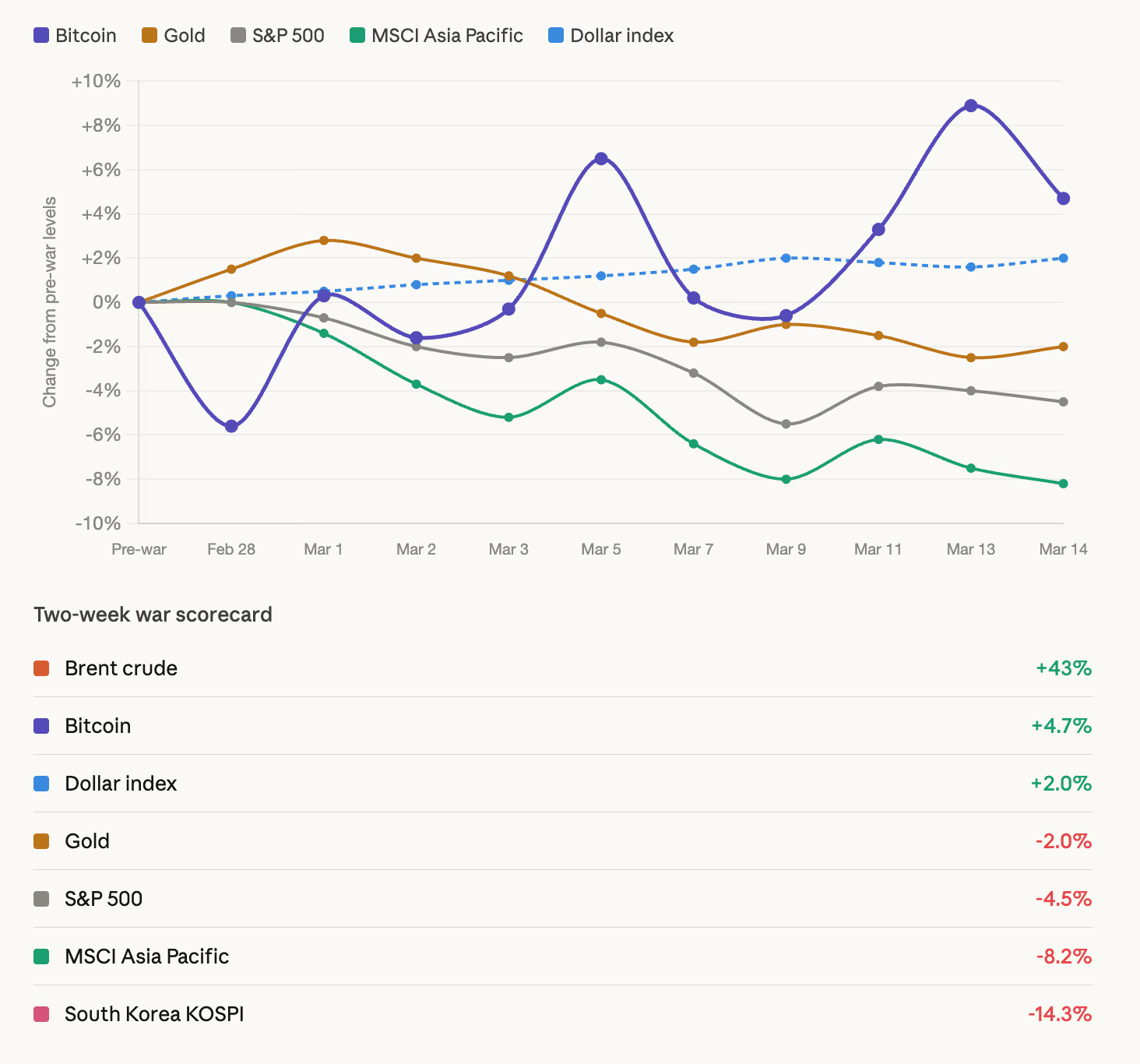
Bitcoin was the first asset to price the Iran war because it was the only liquid market open when U.S. and Israel first launched their attack on a Saturday, a few weeks ago.
It dropped 8.5% that day. Two weeks later, it has outperformed gold, the S&P 500, Asian equities, and the Korean stock market. Only oil and the dollar have done better, and both are direct beneficiaries of the conflict itself.

Bitcoin’s safe-haven status — a notion that was contested amid late last year’s price lull — seems to be back in investors’ minds. On top of that, it’s acting like the fastest shock absorber in global markets as escalations are getting bigger while drawdowns are getting smaller.
The pattern becomes clearer when looking at where bitcoin found buyers after each sell-off.
On Feb. 28, the day of the initial strikes, it bottomed at $64,000. On March 2, after Iran’s retaliatory missiles hit Gulf states, the floor was $66,000. By March 7, after a week of sustained conflict, the low was $68,000. After the tanker attacks on March 12, it held $69,400. And after Kharg Island on Saturday, the low was $70,596.

In simpler terms, each selloff finds buyers at a higher level than the last.
The trendline of higher lows has been rising by roughly $1,000-$2,000 per event, compressing the range from below, while $73,000-$74,000 holds as a ceiling that has now rejected bitcoin four times.
That compression has to resolve eventually. Either the floor catches the ceiling and bitcoin breaks above $74,000 on the next attempt, or the pattern breaks, and a larger escalation finally overwhelms the buying.
Holding strong
The most striking part is what bitcoin has done relative to other assets over the same two weeks.
Oil is up more than 40% since the war began, as the chart below shows. The S&P 500 is down. Gold has been volatile in both directions. Asian equities had their worst week since March 2020.

All this doesn’t mean bitcoin is suddenly a safe haven, however, as it still sells on every headline. But it recovers faster each time, and each recovery holds at a higher level.
The contrast with earlier this year is sharp. In early February, a sudden liquidation cascade wiped out $2.5 billion in leveraged positions over a single weekend as bitcoin plunged to $77,000, erasing roughly $800 billion in market value from its October peak.
That episode looked like the kind of event that could break market confidence for months. Instead, it appears to have cleared out the weakest hands and reset positioning, leaving a leaner market that has absorbed every war headline since without repeating that kind of forced selling.
The macro overlay adds context, meanwhile. Trump said late Friday he spared oil infrastructure on Iran’s oil-producing Kharg Island “for reasons of decency” but would “immediately reconsider” if Iran kept blocking the Strait of Hormuz. Iran responded that any strike on energy infrastructure would trigger retaliatory attacks on U.S.-linked facilities.
That conditional threat is new, and if it materializes, the supply disruption the IEA already called the largest in history will get dramatically worse.
But bitcoin’s adaptation to the war tells traders something about what this market has become.
It’s not a haven and not purely a risk asset. It has become a 24/7 liquidity pool that absorbs shocks faster than anything else because it’s the only thing trading when the shocks arrive.

The push for a clearer regulatory framework around digital assets in the United States remains one of the thorniest policy debates in Washington, with a fast-approaching deadline that could determine whether key crypto legislation advances in the near term. The US CLARITY Act, designed to bring regulatory clarity to exchanges, wallets and developers, faces a narrow window to secure traction. A crypto executive warned that if the bill does not move through committee by the end of April, the odds of its passage in 2026 look markedly worse. The clock is ticking as lawmakers weigh competing priorities and a crowded calendar in both chambers.
Key takeaways
- The CLARITY Act has a tight timetable: committee advancement by the end of April is framed as a prerequisite for any chance of floor action in 2026, according to industry observers.
- Senate leadership has signaled appetite to prioritize other measures, such as the SAVE Act, before considering crypto market structure legislation, complicating the CLARITY Act’s path.
- Stablecoin rewards stand out as a major hurdle, but observers warn they may not be the final obstacle; the bill could face concerns over DeFi, developer protections and the scope of regulatory authority.
- While some lawmakers have been optimistic about an April timeline, independent analysts have warned that a delayed vote could push enactment further into the decade, potentially into 2027 or beyond.
- Public commentary from political leaders underscores a broader need for compromise, with lawmakers and industry participants acknowledging concessions are likely on both sides.
Sentiment: Neutral
Market context: The regulatory spotlight on crypto remains intense as U.S. policymakers balance investor protection, financial stability and innovation incentives amid a shifting macro and regulatory backdrop.
Why it matters
The debate over the CLARITY Act crystallizes the broader tension between fostering innovation in the crypto sector and imposing safeguards that could stabilize a fragmented market. The central question for many stakeholders is whether a coherent, principles-based framework can be achieved without stifling experimentation, especially in areas like DeFi and wallet infrastructure where developers argue that current rules are vague or uneven in their application. Advocates say a well-defined set of rules would reduce uncertainty for exchanges, custodians and developers, potentially attracting more legitimate players into the U.S. crypto ecosystem. Opponents, however, warn that rushed legislation could impose overly broad or ambiguous standards that hamper innovation or push activities offshore.
The dialogue around stablecoins—sometimes framed as the bill’s linchpin—highlights the delicate balance lawmakers seek between consumer protection, financial-market stability and the speed at which new technologies evolve. Critics worry that focusing too narrowly on yield practices of stablecoins could miss larger questions about how stableassets interact with traditional banking rails and what protections should apply to on-chain protocols and developers. In the broader arc, the conversation signals a broader shift in how policymakers envisage regulatory authority across on-chain and off-chain activities, from scripting and DeFi governance to KYC/AML compliance for crypto service providers.
Within the policymaking process, internal dynamics also matter. For instance, a key Democrat on the Senate Banking Committee indicated that compromises will be necessary as both crypto advocates and banking interests push for favorable terms. The reality, many observers say, is that lawmakers will walk away with some concessions from both sides, rather than a pristine, perfect bill. This moderation could be the only viable path to a workable framework that gains bipartisan support while addressing substantive risk concerns. In parallel, commentary from industry leaders underscores a pragmatic approach: the CLARITY Act may not be the final word on regulatory design, with evolving oversight, enforcement priorities and technology-neutral standards likely to shape subsequent iterations.
On the legislative calendar, optimism about an April passage has given way to caution as Senate leadership weighs competing bills and priorities. Notable voices in the debate have warned that the timing is everything: a late ballot or postponed committees could push key decisions beyond midterms into a new political reality, complicating any immediate enactment. The urgency is partly tethered to the fact that other measures—such as voter verification initiatives under the SAVE Act—may receive precedence, effectively delaying crypto-specific legislation even if inputs from the crypto industry are deemed constructive.
Beyond the ideological divides, the policy conversation intersects with broader market dynamics. Investors and builders watch how regulators will interpret new authority in areas like stablecoins, on-chain governance and DeFi protocols. As discussions unfold, the industry continues to push for clarity about which actors would be regulated, what standards would apply, and how enforcement would be structured, all with an eye toward reducing the current patchwork of rules that many consider a drag on capital formation and innovation. The evolving dialogue suggests that even if a form of CLARITY bill emerges, its practical impact will depend on the specifics of the final text and the regulatory guardrails that accompany it.
One notable takeaway from industry commentators is that the debate over stablecoin yields may not be the definitive obstacle. While yield-related concerns dominate headlines, the bill’s proponents and opponents alike acknowledge that other contentious topics — including DeFi governance protections, developer liabilities, and the scope of regulatory authority — could surface once the immediate yield question is addressed. In short, passage hinges on a broader consensus about how a modern financial system can responsibly integrate programmable digital assets without creating systemic risk or stifling innovation.
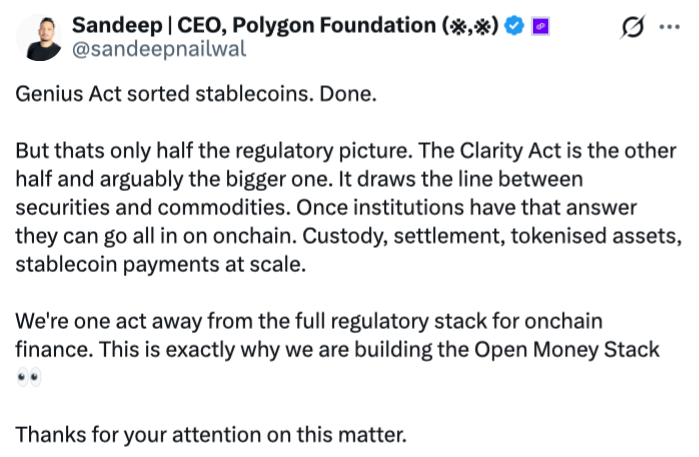
A tweet from a prominent industry voice captured the urgency of the moment, underscoring the need for movement. The message, shared with the broader crypto community, signals that stall events could set the stage for a longer regulatory drag and a more uncertain roadmap for developers seeking clarity on permissible activities. The tweet and related discussions reflect a wider industry appetite for predictable rules, even as stakeholders acknowledge that any final framework will require careful calibration to satisfy both market participants and lawmakers.
On the political front, the rhetoric around crypto regulation remains varied. A senior Democrat on the Senate Banking Committee recently spoke about the need for compromise, noting that both crypto and banking lobbies will likely walk away with some dissatisfaction. The sentiment mirrors a broader pattern in which policymakers recognize that a workable framework will emerge only through negotiation, careful drafting and a willingness to adjust expectations on both sides of the aisle. The legibility of this compromise—how clearly it delineates responsibilities, protections and oversight—will greatly influence the sector’s trajectory in the coming years.
In parallel, some observers have floated more cautious timelines. While a handful of lawmakers previously suggested an April path, industry-facing research from investment banks has offered more conservative forecasts, predicting that market-structure legislation could slip into 2027 or even later, with enactment potentially delayed until 2029 if the political dynamics shift post-midterms. Such projections illustrate how the regulatory road map remains uncertain, even as the appetite for a formal, nationwide framework persists among many industry participants and policymakers alike.
Across the spectrum, the insistence on a credible regulatory approach—one that supports innovation while protecting investors—remains a central theme. The ongoing negotiations produce a mixed signal: steady calls for a clear regime juxtaposed with pragmatic caveats about timing, political capital and the potential need for additional adjustments beyond a single bill. That tension is likely to define the near-term landscape for the U.S. crypto industry, as stakeholders monitor committee votes, floor calendars and the evolving posture of the administration toward market structure proposals.
What to watch next
- Committee movement on the CLARITY Act by end-April and any statements detailing a concrete floor timeline in May.
- Interactions between crypto and banking lobbies shaping compromise terms ahead of any Senate action.
- Further discussions on stablecoins, DeFi protections and regulatory reach that could affect the final text.
- Public comments and lobbying activity around the SAVE Act and its scheduling relative to crypto legislation.
Sources & verification
- Alex Thorn, Galaxy Digital, comments on the April committee deadline and the 2026 passage odds, via X: https://x.com/intangiblecoins/status/2032853696824873429?s=20
- US Senate leadership and timing remarks on crypto market structure legislation and prioritization of the SAVE Act: https://cointelegraph.com/news/us-senate-thune-crypto-market-structure-april
- TD Cowen’s assessment that crypto market structure legislation may not pass until 2027 and could take effect in 2029: https://cointelegraph.com/news/us-crypto-market-structure-bill-delayed
- Public statements around stablecoin yields and regulatory hurdles, including comments from Senator Bernie Moreno: https://cointelegraph.com/news/crypto-us-clarity-act-coinbase-brian-armstrong-bernie-moreno
- President Donald Trump’s remarks criticizing banks for stalling the bill: https://cointelegraph.com/news/trump-takes-swipe-banks-over-stalled-crypto-bill
- Senator Angela Alsobrooks on the need for compromise in crypto-banking discussions: https://cointelegraph.com/news/crypto-banks-need-to-be-unhappy-crypto-bill-advance-senator
- Context and related analyses including industry perspectives on regulatory paths and market structure narratives: https://cointelegraph.com/editorial-policy
- Additional industry commentary from Sandeep Nailwal’s discussion post: https://x.com/sandeepnailwal/status/2032228011651842197?s=20
Regulatory clock tightens for the CLARITY Act and what it means for the market
The central dynamic in Washington is a race against time — and a race against competing agendas. The CLARITY Act is designed to provide a formal blueprint for how a wide range of crypto activities should be regulated, from centralized exchanges to wallets and on-chain developers. Yet the bill’s fate currently hinges on committee momentum and the willingness of lawmakers to balance the interests of a crypto industry that argues for clarity with the concerns of the traditional financial-oversight establishment that pushes for stronger guardrails.
Industry voices argue that clarity, even if imperfect, can catalyze investment and innovation by reducing the ambiguity that currently deters new entrants and strains compliance budgets. Proponents suggest that a well-structured framework could offer a predictable operating environment, enabling legitimate actors to navigate the regulatory landscape with greater confidence. Opponents, conversely, warn that hasty policy could overreach, potentially constraining experimentation or inadvertently stifling emerging technologies. In this context, every procedural milestone — committee votes, floor time, and regulatory clarifications — could meaningfully shift the market’s risk and liquidity dynamics.
The debate also intersects with broader macro factors affecting risk appetite in the crypto space. As policy discussions unfold, traders and investors monitor liquidity conditions, stance of regulators, and any shifts in capital flows tied to ETF and futures product developments. The regulatory frame could influence how institutional participants allocate capital to crypto strategies, how custodians structure risk controls, and how developers plan project roadmaps in a landscape that remains sensitive to political signals and regulatory expectations.
Ultimately, the CLARITY Act’s trajectory will be read through the lens of bipartisan compromise. If lawmakers arrive at a version that allocates clear responsibilities, certain consumer protections, and defined supervisory authority without crippling innovation, it could unlock a period of greater market engagement. If not, the sector may endure a continuation of policy ambiguity that encourages careful risk management but slows capital formation. The coming weeks will reveal whether the administration and Congress manage to align incentives, or whether the debate simply continues to propagate into future sessions and administration cycles.
The US CLARITY Act, aimed at bringing greater regulatory clarity to the crypto industry, may have little chance of passing this year if it doesn’t move forward within the next seven weeks, according to a crypto executive.
“If CLARITY doesn’t pass committee by the end of April, odds of passage in 2026 become extremely low,” Galaxy Digital head of firmwide research Alex Thorn said in an X post on Saturday.
“This needs to hit the Senate floor by early May… floor time is running out, and odds diminish every day that passes,” Thorn said. It comes after US Senate Majority Leader John Thune said he doesn’t expect the chamber to act on the digital asset market structure legislation before April, as it will prioritize the SAVE America Act, which would require voters to provide proof of US citizenship in person to register.
Stablecoin rewards debate may not be the last hurdle
Thorn said the main perceived holdup for the CLARITY Act is the debate over whether stablecoin rewards will disrupt the traditional banking system — which has split the banking and crypto industry — but warned that more issues could surface after that debate is settled.
“It’s very possible that rewards are not the ‘final’ hurdle but instead just the current hill the bill is dying on,” Thorn said, pointing to potential issues around DeFi, developer protections, and regulatory authority.

US Senator Angela Alsobrooks, a key Democrat on the Senate Banking Committee, recently said that crypto and banking lobbies will both have to accept compromises. “All of us will probably walk away just a little bit unhappy,” she said on Tuesday.
CLARITY Act may not pass until 2029, says investment bank
Some lawmakers had been optimistic about an April timeline. Crypto-friendly US Senator Bernie Moreno said on Feb. 19 that the CLARITY Act could make its way through Congress, “hopefully by April.”
Related: Balaji calls for more ‘crypto tools’ for refugees amid Middle East tensions
However, investment Bank TD Cowen warned in January that crypto market structure legislation may not pass until 2027, and might take effect in 2029, if Democratic lawmakers manage to stall the vote beyond the midterm elections and regain power in at least one chamber of Congress.
Earlier this month, US President Donald Trump criticized banks for stalling the Senate’s crypto market structure bill amid disagreements over stablecoin yield payments. “The US needs to get Market Structure done, ASAP,” Trump said on Mar. 4.
Magazine: Bitcoin’s ‘narrative vacuum,’ Ethereum now inevitable: Trade Secrets

The Basel III framework governing bank capital requirements is set for an update in 2026, with potential implications for the crypto ecosystem. The outcome could hinge on how the largest digital asset is treated in risk-weight calculations, and analysts warn that any shift could unlock liquidity that today remains constrained by capital rules. As US regulators weigh how to implement Basel rules domestically, industry participants say even modest improvements in crypto risk weights could tilt the economics in favor of traditional banks offering crypto services. The debate underscores a broader regulatory push to harmonize crypto with mainstream finance while preserving prudent risk controls.
Key takeaways
- The Basel III update planned for 2026 could change how crypto assets are risk-weighted, potentially easing bank capital requirements for holdings and services tied to digital assets.
- Under current Basel rules, Bitcoin carries a 1,250% risk weight, forcing banks to hold reserve assets at a 1:1 ratio to back BTC on their balance sheets, complicating participation.
- US regulators have signaled forthcoming implementation proposals, including a 90-day public comment window on how these rules will apply domestically, which market participants are watching closely.
- Industry players, including crypto treasury firms, have pressed for reform to introduce more accommodating risk weights for digital assets, arguing the current framework suppresses legitimate use cases.
- Compared with other asset classes, crypto faces a harsh capital treatment: investment-grade corporate bonds carry substantially lower weights, while gold and government debt often enjoy near-zero risk weights.
Tickers mentioned: $BTC
Sentiment: Neutral
Price impact: Positive. A lower risk weight could encourage banks to participate more fully in crypto markets, potentially boosting liquidity and product offerings.
Trading idea (Not Financial Advice): Hold. Regulatory clarity could unlock flows, but policy outcomes remain uncertain and depend on broader financial-regulatory alignment.
Market context: The Basel framework sits at the intersection of regulatory risk management and evolving institutional participation in crypto, with liquidity and risk appetite reframed as policy signals shift.
Why it matters
At the heart of the debate is a capital regime that, in its current form, treats Bitcoin as among the riskiest class of assets for banks. The Basel Committee on Banking Supervision (BCBS) proposed the current capital requirements in 2021, placing cryptocurrencies into the highest risk category. The practical effect is a 1,250% risk weight for BTC, which translates into substantial capital reserves and limits on balance-sheet holdings. For banks, such a framework makes the business case for custody, trading, and lending around digital assets markedly more onerous than many other asset classes.
Observers point to a stark contrast with other instruments. Jeff Walton, chief risk officer at a bitcoin treasury firm, notes that investment-grade corporate bonds can carry risk weights as low as 75%, underscoring a mispricing of risk in the Basel framework. Gold, government bonds, and even physical cash frequently come with 0% risk weight, reflecting longstanding perceptions about their relative safety. This disparity feeds a perception that the crypto sector is systematically constrained, even as demand for crypto exposure grows among both institutions and retail participants. The current design creates what some describe as a choke point for blockchain-enabled finance, curtailing the ability of traditional banks to offer crypto-related services at scale.
Industry voices have repeatedly argued that a more nuanced treatment is needed—one that reflects the evolving risk profile of digital assets and the development of robust custody, settlement, and compliance infrastructure. In February, several crypto treasury executives publicly urged Basel rulemakers to reform the framework to implement more accommodating risk weights for digital assets. The push aligns with a broader call to integrate crypto into the financial system in a way that preserves risk controls without weaponizing capital as a barrier to innovation.
The conversation extends to the US, where the Fed recently signaled a proposal on how Basel rules would be implemented domestically, including a 90-day public comment window. If regulators signal even a modest improvement in BTC’s treatment, banks could gain a clearer pathway to adopting crypto strategies—from balance-sheet holdings to fully fledged services that bridge digital assets with traditional financing. The potential for such a shift has energized market participants who see policy clarity as a prerequisite for meaningful institutional engagement with the blockchain economy.
Critics of the current direction warn that Basel’s approach is a quiet but potent barrier. Chris Perkins, president of investment firm CoinFund, described the rules as a subtle mechanism that suppresses activity by making crypto-related banking expensive. He argues that while the policies stop short of outright de-banking, they effectively raise the cost of capital for crypto activities, thereby constraining market development. The broader takeaway is that regulatory architecture—when coupled with uncertain future direction—can exert a materially negative influence on liquidity and market depth even before policy changes take effect.
For now, the conversation remains active as regulators tilt toward a more actionable framework. The debate encompasses both the urgency of safeguarding financial stability and the opportunity to harness the blockchain economy within mainstream banking. The Basel discussions are inseparable from other regulatory and policy developments that collectively shape how, and how quickly, traditional financial institutions will engage with digital assets.
As a practical matter, observers are watching for concrete milestones: the timing of the Basel Committee’s 2026 update, any official US rulemaking actions implementing Basel in the domestic financial system, and what these signals portend for banks’ risk-management practices around digital assets. The results could influence not only price dynamics but the breadth of products available to consumers—ranging from custody services to regulated lending and tokenized asset offerings.
What to watch next
- Publication of the Basel III update schedule in 2026 and the exact risk-weight calibration for crypto assets.
- US Federal Reserve rulemaking actions detailing how Basel provisions will be interpreted and enforced domestically, including the 90-day comment window.
- Industry responses from crypto treasuries and traditional banks, including any pilot programs or partnerships to offer crypto services under revised rules.
- Subsequent regulatory guidance on risk weights for digital assets and how they compare with other asset classes in the capital framework.
Sources & verification
- Basel Committee on Banking Supervision. Crypto assets proposed for highest risk category under the current Basel capital framework (coverage of 1,250% risk weight). https://cointelegraph.com/news/bitcoin-part-of-highest-risk-category-in-basel-s-new-bank-capital-plan
- Bitcoin treasury reform discussions and calls for Basel rule changes to accommodate digital assets. https://cointelegraph.com/news/btc-treasury-reform-1250-percent-risk-basel
- Basel capital rules and chokepoint critique related to crypto industry suppression, including commentary on the broader implications for market activity. https://cointelegraph.com/news/basel-bank-capital-rules-create-chokepoint-crypto
- US Fed regulatory proposals related to Basel rule implementation and the associated public comment window (industry analysis linked via policy discussions). https://cointelegraph.com/news/bitcoin-toxic-asset-basel-framework-federal-reserve-policy-institute
- Nic Puckrin on the potential for Basel rule adjustments to unlock BTC participation in the financial system. https://x.com/nicrypto/status/2032758888055861431
Basel III revisions and the path to broader crypto banking
Bitcoin (CRYPTO: BTC) has long stood at the center of the Basel debate about how banks should treat digital assets. The current framework, which assigns BTC a 1,250% risk weight, creates a disproportionate capital burden relative to many traditional instruments. In contrast, assets such as investment-grade corporate bonds can fall as low as 75% risk-weighted, and gold or government instruments can be deemed almost risk-free in Basel’s schema. This imbalance fuels a perception that crypto remains a second-class citizen within mainstream finance, constrained not by technology but by capital rules that elevate the cost of provisioning and risk management for banks that choose to engage with digital assets.
The industry’s call for reform is anchored in a belief that prudential standards should reflect risk management advances, custody capabilities, and the growing liquidity and use cases that crypto markets demonstrate. While the Basel process is inherently technical and multi-jurisdictional, its outcome will ripple across banks, funds, and corporate treasuries that rely on regulated access to digital assets. The possibility that a modest improvement in BTC’s regulatory treatment could unlock significant liquidity—enabling banks to provide native crypto services—has generated interest from a cross-section of market participants, from treasury teams to policy researchers.
As the Basel discussions advance, market participants anticipate that any announcements in 2026 and beyond will need to be harmonized with other regulatory developments in the United States and abroad. The momentum toward clearer guidelines and more precise risk-weight calibrations could influence liquidity conditions, market depth, and the pace at which mainstream financial institutions integrate digital assets into their product suites. The interplay between risk discipline and innovation will shape how banks assess crypto financing, custody, and advisory services in the years ahead, with the potential to redefine the landscape for institutional crypto exposure.


Less than 1% of Australian crypto transactions were tied to illicit actors, even as the such entities in the country processed $50 billion in one year.
Illicit activity accounts for only a small fraction of Australia’s cryptocurrency ecosystem, even as digital asset adoption continues to expand.
According to the analysis by TRM Labs, less than 1% of the country’s total on-chain crypto activity between March 2025 and February 2026 was linked to illicit counterparties, which essentially highlights that the vast majority of transactions occur within legitimate financial and commercial use cases.
Australia’s Crypto Ecosystem
Over the same period, Australian crypto entities processed around $50 billion in total on-chain transaction volume, while the country recorded roughly $15 billion in incoming value to centralized exchanges and decentralized finance platforms.
Among 95 countries analyzed, TRM Labs said Australia holds the 20th position for total crypto value received, putting it in the top quartile globally.
Despite the growing role of digital assets in Australia’s financial system, the exposure to criminal activity remains minimal relative to the overall scale of transactions. Sanctions-related activity accounted for the largest share of illicit exposure and represents about 70% of the total illicit volume identified during the period.
Darknet markets ranked as the second-largest category, followed by investment fraud and illicit goods and services. Smaller amounts of illicit activity were linked to categories including banned substances, ransomware, scams, terrorist financing, and broader cybercrime. The findings reveal that while criminal actors have increasingly incorporated cryptocurrencies into existing financial crime typologies, such activity still represents a very small share of overall blockchain usage.
From Drug Markets to Broader Crimes
Historically, early crypto-related cases in Australia were often associated with drug markets, but the ecosystem has since diversified as adoption expanded and digital assets became integrated into more areas of financial activity. At the same time, authorities have ramped up regulatory and enforcement frameworks.
You may also like:
The country has required digital currency exchanges to register with the Australian Transaction Reports and Analysis Centre since 2018, subjecting them to anti-money laundering and counter-terrorism financing obligations such as customer due diligence, transaction monitoring, and suspicious matter reporting.
Meanwhile, Australia secured its first major crypto-related money laundering conviction in 2025 following Operation Taipan, which is a multi-year investigation led by Victoria Police into a Chinese-linked laundering syndicate that used digital asset infrastructure.
Binance Free $600 (CryptoPotato Exclusive): Use this link to register a new account and receive $600 exclusive welcome offer on Binance (full details).
LIMITED OFFER for CryptoPotato readers at Bybit: Use this link to register and open a $500 FREE position on any coin!

Man City have been forced to accept new reality despite Pep Guardiola u-turn

XRP IT’S HAPPENING AGAIN!!!

Mutual fund NFOs: 2 ETFs will open for subscription now on Monday. Check details


-
 Tech4 days ago
A 1,300-Pound NASA Spacecraft To Re-Enter Earth’s Atmosphere
-

 News Videos6 days ago
10th Algebra | Financial Planning | Question Bank Solution | Board Exam 2026
-
Crypto World1 day ago
HYPE Token Enters Net Deflation as HyperCore Buybacks Outpace Staking Rewards
-

 Business5 days ago
ExxonMobil seeks to move corporate registration from New Jersey to Texas
-

 Crypto World6 days ago
Paradigm, a16z, Winklevoss Capital, Balaji Srinivasan among investors in ZODL
-

 Fashion2 days ago
Weekend Open Thread: Addict Lip Glow
-

 Tech5 days ago
ChatGPT will now generate interactive visuals to help you with math and science concepts
-
Sports15 hours ago
Why Duke and Michigan Are Dead Even Entering Selection Sunday
-

 NewsBeat3 days ago
Residents reaction as Shildon murder probe enters second day
-

 Business7 days ago
Search for Nancy Guthrie Enters 37th Day as FBI Probes Wi-Fi Jammer Theory
-

 Business4 days ago
Search Enters Sixth Week With New Leads in Tucson Abduction Case
-
 NewsBeat5 days ago
Pagazzi Lighting enters administration as 70 jobs lost and 11 stores close across Scotland
-

 Tech6 days ago
Despite challenges, Ireland sixth in EU for board gender diversity
-

 Business17 hours ago
US Airports Launch Donation Drives for Unpaid TSA Workers as Partial Government Shutdown Enters Fifth Week
-

 NewsBeat4 days ago
I Entered The Manosphere. Nothing Could Prepare Me For What I Found.
-
Crypto World12 hours ago
Coinbase and Bybit in Investment Talks: Could Bybit Finally Enter the US Crypto Market?
-

 Business5 days ago
Search Enters 39th Day with FBI Tip Line Developments and No Major Breakthroughs
-

 Sports6 days ago
Skateboarding World Championships: Britain’s Sky Brown wins park gold
-

 Business18 hours ago
Country star Brantley Gilbert enters growing non-alcoholic beer market
-
 Crypto World5 days ago
Will Chainlink price reclaim $10 amid volatility squeeze?

