
Crypto World
Circle Stock Jumps 40% on Q4 Earnings

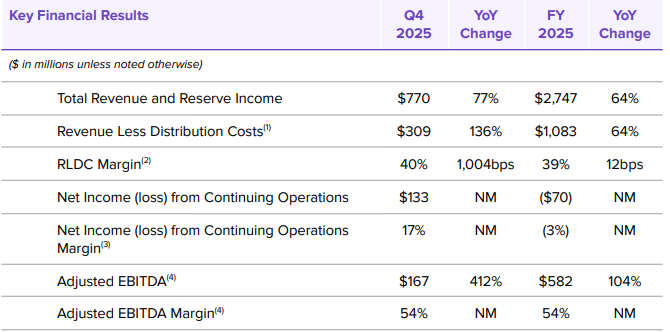
The stablecoin company had a strong 2025 and is exploring a token launch for Arc, its new Layer 1 blockchain.
Circle’s stock, CRCL, is up 40% over the last two trading days after the company unveiled its Q4 2025 report, showcasing a 64% increase in revenue and 104% growth in earnings year over year (YoY).
The report sent CRCL rallying from $61 per share to $86.25, as the company also shared an 82% increase in total USDC minted and a 59% increase in what it calls “meaningful wallets,” defined as any onchain wallet holding more than 10 USDC.

The stock appears to be pricing in future growth, as the company still posted a net loss of $70 million in 2025, “significantly impacted by $424 million for stock-based compensation.”
The company also touched on its upcoming Layer 1 stablechain, Arc, which launched its testnet in October.
In addition to Arc’s impending mainnet launch, Circle CEO Jeremy Allaire also revealed that Circle is exploring a native token for the Arc blockchain, but did not reveal any further details.
While the earnings report and subsequent rebound offer some relief for shareholders, CRCL is still down 71% from its all-time high of $300, reached shortly after its initial public offering (IPO).


The window of opportunity in the digital asset market is closing faster than most traders realize. While many investors wait for mainstream news outlets to confirm a breakout, the real wealth is being generated in the quiet moments before the vertical climb.
Identifying the best crypto to buy right now requires a shift in perspective from following the crowd to anticipating the needs of the future global financial infrastructure. The market is currently signaling a massive rotation into projects that offer more than just hype; it is hungry for scalability, interoperability, and genuine utility.
Those who hesitate to diversify into these high-conviction assets today may find themselves watching from the sidelines as the most promising opportunities move out of reach forever.
1. BlockDAG (BDAG): The 95x Opportunity of the Year
BlockDAG is currently dominating conversations as the best crypto to buy right now due to a unique pricing gap that savvy investors are exploiting for maximum gain. On CoinMarketCap, the asset has already crossed the $0.02 threshold, after validating the early projections made by market makers who foresaw a climb to $0.4. With that milestone achieved, the trajectory is now set for a $1 valuation in the near future.
However, a massive opportunity remains for those who know where to look. While the public market price reflects steady growth, individuals can still acquire BDAG tokens directly through the BlockDAG website for just $0.0000061. This price difference creates a mathematical path toward 95x returns for those who act before the direct sale window terminates.
The momentum behind this project is fueled by its upcoming accessibility on several major trading platforms. Liquidity and volume are expected to surge as BDAG becomes tradeable on XT.com, LBank, Coinstore, Biconomi, BitMart, P2B, AscendEX, and more. These listings ensure that once the direct purchase phase concludes, the asset will have the global reach necessary to sustain its march toward the $1 target.
Investors are rushing to secure their positions at the fractional entry price of $0.0000061, recognizing that the current discrepancy between the direct sale and the market price is a rare chance to front-run the broader retail market.
2. Chainlink (LINK): The Essential Backbone of DeFi
Chainlink remains a staple for anyone searching for the best crypto to buy right now because it functions as the central nervous system for decentralized finance. It provides the essential oracle infrastructure that bridges the gap between isolated blockchains and the vast amount of data existing in the real world.
Without the reliable data feeds provided by Chainlink, smart contracts would be unable to execute based on price fluctuations, weather patterns, or even sports results. This makes LINK a fundamental necessity rather than a speculative luxury, as the entire DeFi ecosystem relies on its accuracy to maintain its integrity and security.
Beyond simple data delivery, the project has introduced the Cross-Chain Interoperability Protocol (CCIP), which is setting the global standard for how different blockchains communicate. This technology has caught the attention of major traditional financial institutions like Swift and DTCC, which are using Chainlink to explore how tokenized assets can be settled across various networks.

Because node operators must stake LINK as collateral to secure the network, there is a direct correlation between the adoption of these services and the demand for the token. As more global banks integrate CCIP, the pressure on LINK’s circulating supply could lead to a significant valuation shift.
3. Polkadot (DOT): Leading the Multi-Chain Future
Polkadot offers a sophisticated solution to the problem of blockchain fragmentation, making it a top contender for the best crypto to buy right now. Its unique architecture allows various specialized blockchains, known as parachains, to run in parallel while leaning on the central Relay Chain for their security.
This setup allows developers to build chains that are perfect for one specific task without having to worry about building their own security from scratch. With the transition toward Polkadot 2.0 and the implementation of async backing, the network has seen a massive boost in how many transactions it can handle, drastically reducing wait times for users.
One of the most significant changes to the ecosystem is the introduction of Coretime. This new model changes how blockspace is distributed, making it much more affordable and flexible for new projects to join the network compared to the old auction system.
For those holding DOT, the project offers a governance system that provides actual power over the network’s future, including how the treasury is spent. Additionally, with staking rewards currently sitting between 14% and 16% APY, DOT provides a way to grow a portfolio through passive income while the broader ecosystem of specialized chains continues to expand.
4. Cosmos (ATOM): Powering the App-Chain Revolution
Cosmos is built on the belief that the future of the internet consists of thousands of independent blockchains, and it provides the tools to make that happen. The Cosmos SDK is currently the most popular framework for creating custom blockchains, utilized by heavy hitters like Celestia and the BNB Chain.
This widespread use ensures that ATOM remains at the heart of a massive network of interconnected apps. The Inter-Blockchain Communication (IBC) protocol is the secret sauce here, allowing over 100 different chains to trade data and assets instantly, creating a web of value that is unmatched in its fluidity.

The value of the ATOM token has recently been strengthened by the introduction of interchain security. This allows the main Cosmos Hub to lend its security to newer, smaller chains. In return, ATOM stakers receive a portion of the revenue generated by these newer projects.
This creates a diversified reward stream for holders, who earn from both the main hub and the various “consumer chains” it protects. For investors looking for the best crypto to buy right now, ATOM represents a diversified bet on the entire “app-chain” philosophy, capturing value from every new project that chooses to build within the Cosmos ecosystem.
Which is the Best Crypto to Buy Right Now?
The current market window presents a rare alignment of technological maturity and undervalued entry points. While the fear of missing out often drives irrational decisions, the data behind these four projects suggests that the real risk lies in inaction.
From the massive 95x potential found in the BlockDAG direct purchase to the institutional-grade stability of Chainlink, Polkadot, and Cosmos, the best crypto to buy right now is defined by utility and scalability.

Securing a position in these assets today is not just about catching a trend; it is about owning a piece of the infrastructure that will define the next decade of finance. The opportunity to buy at these levels is a fleeting moment in a rapidly accelerating market cycle.
Disclaimer: This is a Press Release provided by a third party who is responsible for the content. Please conduct your own research before taking any action based on the content.



UK-led Operation Atlantic froze over $12M in crypto scam proceeds tied to “approval phishing,” identifying 20,000+ victims and $45M in suspected fraud.
Summary
- UK, US and Canadian agencies ran Operation Atlantic, freezing more than $12M in suspected crypto scam proceeds and identifying over 20,000 victims.
- The crackdown targeted “approval phishing,” where victims are tricked into signing malicious on-chain authorizations that let scammers drain wallets.
- Binance and other private firms provided account screening and fraud intelligence support, though no funds were frozen on Binance itself.
UK, US and Canadian law enforcement have frozen more than $12 million in suspected crypto scam proceeds in a coordinated action targeting “approval phishing” schemes that hit over 20,000 victims. The joint effort, dubbed Operation Atlantic and led by the UK’s National Crime Agency (NCA), focused on scams that trick users into signing malicious on‑chain approvals, allowing attackers to drain tokens directly from victims’ wallets. Authorities say total fraud linked to the identified infrastructure exceeds $45 million.
According to the NCA, Operation Atlantic was co‑hosted with the U.S. Secret Service, Ontario Provincial Police and the Ontario Securities Commission, and ran as an intensive, week‑long initiative in March. Rather than only tracing funds after the fact, agencies worked to “identify victims who have lost, or were at risk of losing, cryptocurrency through ‘approval phishing’,” securing assets before criminals could move them further down the laundering chain. Chainalysis, which supported the operation, described the approach as targeting “a fast-growing threat: approval phishing scams that trick victims into granting criminals permission to drain their wallets,” and noted that the effort “secured and frozen more than $12 million in suspected criminal proceeds” while mapping over $45 million in stolen crypto tied to related schemes.nationalcrimeagency.
crypto scam funds found
Private sector firms played a visible role. Binance said its Special Investigations team provided on‑site support at the NCA’s London headquarters, including “live account screening and scam intelligence” and the identification of still‑active scam websites, but stressed that “no funds were frozen on Binance as part of the operation.” In a statement supporting the action, Binance called approval phishing “one of the most damaging types of scams targeting crypto users today,” arguing that Operation Atlantic shows “how effective crime fighting is possible when private and public partners move together to stop fraud at the source.” NCA deputy director of investigations Miles Bonfield said the operation “has led to the safeguarding of thousands of victims in the UK and overseas, stopped criminals in their tracks and helped save others from losing their funds,” adding that fraudsters “operate globally and, together with our international partners, so will the NCA to target them wherever they are based.”
While the sums recovered are small relative to the broader crypto market, the operation highlights both the growing sophistication of on‑chain fraud and the increasing willingness of law enforcement and major exchanges to coordinate in near real time. It also underlines a practical lesson for users: the most dangerous transaction is often the one you approve yourself.


Coinspaid has partnered with The Residency to give early-stage founders preferential access to its stablecoin and crypto payment infrastructure, usually reserved for larger fintechs.
Summary
- Coinspaid, one of Europe’s largest crypto payment providers, will offer Residency startups preferential access to its stablecoin processing and payout stack.
- The deal includes multi-chain connectivity, automated on-chain settlements, liquidity tools, and compliance-ready payment APIs typically used by larger global businesses.
- The Residency, backed by operators and advisors such as Sam Altman, sees the partnership as giving founders infrastructure “normally out of reach” for early-stage companies.
Coinspaid, one of Europe’s largest blockchain payment infrastructure providers, has entered a strategic partnership with The Residency, a global community for early-stage founders and innovators. The deal will give startups inside The Residency access to Coinspaid’s stablecoin and payment stack on preferential terms normally reserved for larger fintechs and scale-ups.
The Residency has built a reputation for backing ambitious founders in a tight network of operators, researchers and tech leaders, including advisors like Sam Altman, who has long argued that talent and innovation often flourish outside traditional tracks. In that context, the partnership is designed to turn “who’s in the room” into “what infrastructure you can actually plug into,” by giving early teams access to compliant, production-grade payments plumbing from day one.
Coinspaid brings blockchain to Europe
Under the collaboration, Residency startups will be able to tap Coinspaid’s stablecoin processing and payout architecture, direct multi-chain connectivity and node infrastructure, automated on-chain settlements and liquidity management, plus developer-ready APIs and payment interfaces. They will also receive exclusive commercial terms, priority access to Coinspaid’s full suite of payment, treasury and settlement tools, and built-in compliance logic and risk controls already used by thousands of businesses. For founders trying to move money across borders or streamline treasury without building everything in-house, the offer aims to compress both time and regulatory friction.
“Startups need reliable, compliant financial infrastructure from day one, especially in fast-moving markets like the blockchain industry and digital finance,” said Pavel Kashuba, Strategic Leader at Coinspaid. “We’re excited to partner with The Residency and equip founders with solutions that help them scale confidently and securely.” The Residency’s founder, Nick Linch, framed it as an upgrade to the community’s toolkit: “Coinspaid brings world-class technology and a track record of enabling businesses to grow at scale. This partnership will provide our founders with access to infrastructure that would typically be out of reach for early-stage companies.”
Both organizations position the agreement as more than a simple vendor discount. By lowering the barrier to compliant, cross-border crypto payments and stablecoin rails, they are effectively betting that the next generation of digital commerce and fintech companies will expect institutional-grade infrastructure from the moment they launch, not years later.
Bitmine Immersion Technologies (BMNR) began trading on the New York Stock Exchange on April 9, but the stock dropped nearly 2% despite an announcement of a $4 billion buyback.
The transition from the NYSE American to the main NYSE board marks the Ethereum-focused treasury firm’s largest corporate event to date.
BitMine Lands on NYSE, Expands Buyback to $4 Billion
Chairman Thomas “Tom” Lee confirmed the uplisting on April 9. BMNR ceased trading on the NYSE American after-market on April 8 and opened on the main board the following morning.
Alongside the move, BitMine’s board unanimously approved a fourfold expansion of its 2025 share repurchase program. The authorization grew from $1 billion to $4 billion, ranking it among the 10 largest buyback announcements in 2026, according to Fundstrat data.
“There may be a time in the future when Bitmine shares are trading below intrinsic value, and the Company wants to be in a position to accretively retire common shares,” read an excerpt in the announcement.
Repurchases will continue under existing terms through open market transactions via Cantor Fitzgerald & Co.
4.8 Million ETH and a 5% Supply Target
As of this writing, BitMine held approximately 4.803 million Ethereum tokens valued at roughly $10.6 billion at current prices near $2,218.
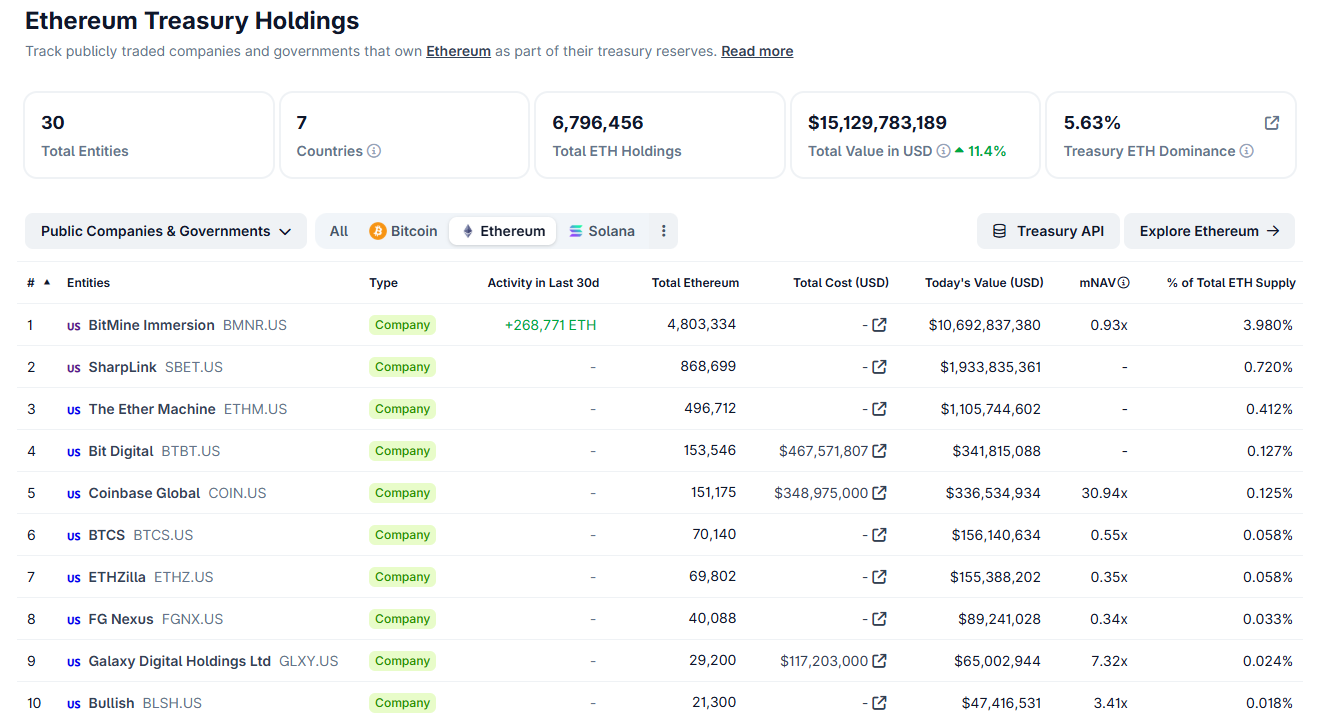
That position represents 3.98% of total ETH supply, putting the firm over 79% toward its stated “Alchemy of 5%” accumulation target.
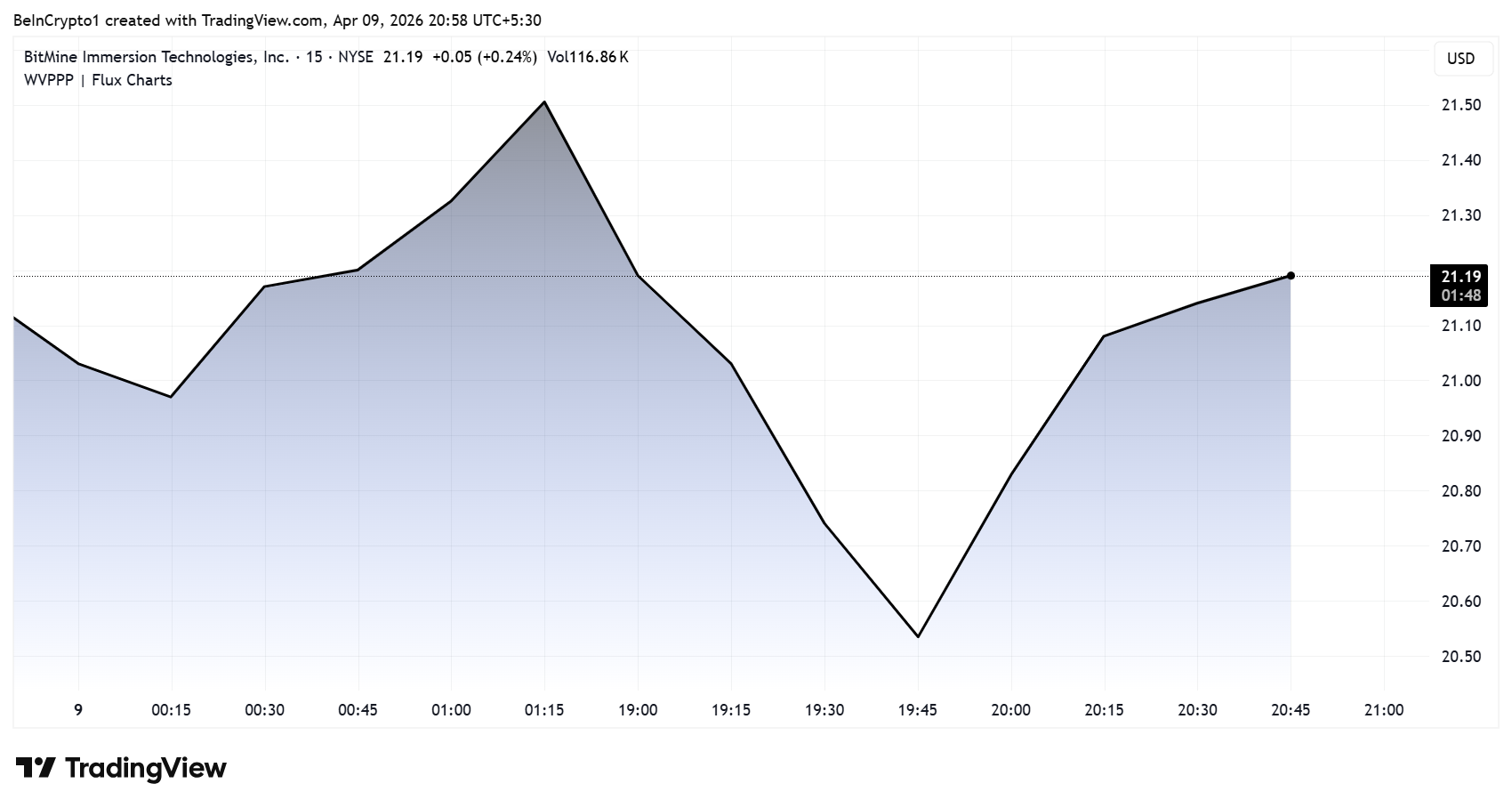
Despite these figures, BMNR stock slid from a previous close of $21.52, dipping as low as $20.50 during the session before partially recovering.
The muted reaction signals that investors may have already priced in the uplisting news, which BitMine first disclosed on April 6.
BitMine counts ARK Invest’s Cathie Wood, Founders Fund, Pantera Capital, and Galaxy Digital among its institutional backers.
The post Tom Lee’s BitMine Hosts Its Largest Corporate Event, Will Stock React? appeared first on BeInCrypto.


Securitize has appointed former U.S. Securities and Exchange Commission (SEC) official Brett Redfearn as president and a member of its board, adding regulatory experience as the firm prepares to go public this year.
Redfearn, who previously led the SEC’s Division of Trading and Markets, will work with Securitize’s leadership team to scale its offerings across issuance, trading and fund administration, the company announced in a press release. The company focuses on turning traditional financial assets, such as funds or private credit, into blockchain-based tokens that can be traded more easily.
His appointment comes at a time when tokenization is gaining traction among large financial firms. Banks and asset managers are testing ways to move assets onto blockchain rails in an effort to speed up settlement and widen access to investors.
Securitize is positioning itself as a regulated bridge between those institutions and digital asset infrastructure. The hire adds weight to Securitize’s leadership as it prepares for a proposed public listing through a business combination with Cantor Equity Partners II. It also reflects a broader trend of firms bringing in former regulators to navigate a complex policy environment.
“Brett has been instrumental in how modern markets are structured and regulated,” Securitize co-founder and CEO Carlos Domingo said in a statement. “He is deeply familiar with our business, leadership team, and long-term vision.”
Redfearn brings experience from both traditional finance and crypto. Before joining Securitize, he founded Panorama Financial Markets Advisory, advising exchanges and asset managers. He also served as head of capital markets at Coinbase (COIN), where he worked on expanding institutional participation in digital assets. Prior to joining the SEC, Redfearn was at JP Morgan for over a dozen years.
BlackRock crypto just moved on Ethereum staking fees, and the number is 18%. The world’s largest asset manager has set its commission on gross staking rewards at 18% inside its iShares Staked Ethereum Trust, a fresh product that launched March 12 under the ticker ETHB, layered on top of a 0.25% annual management fee.
That dual-fee structure is already attracting fire from advisors and institutional allocators who built their models around simpler cost assumptions.
The trust holds $318 million in staked ETH as of publication, with the 18% staking commission split with Coinbase as custodian and validator operator.
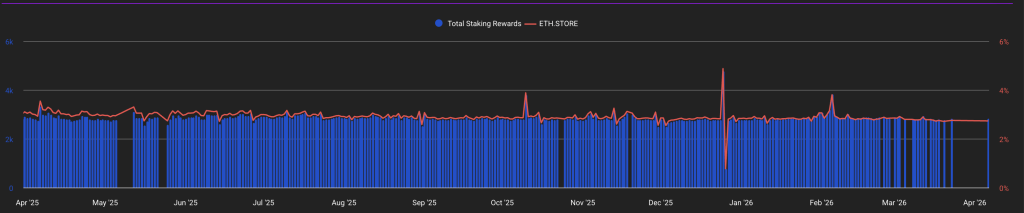
At current ETH staking yields of roughly 2.74%, that commission alone translates to approximately 49 basis points of clipped return – before the sponsor fee touches the NAV.
Discover: The best crypto to diversify your portfolio with
Will the Blackrock Ethereum Staking ETF Fee War Hit the Same Floor as Bitcoin?
Bitcoin ETF fees fell to zero in just 12 months. The largest issuers temporarily waived management fees entirely just to grab AUM, borrowing the index fund playbook and compressing margins until custody costs were practically the product.
The question now hanging over Ethereum staking ETFs is whether the same gravity applies – or whether staking complexity creates a structural floor that protects issuer margins.
The uncomfortable truth is that staking ETFs are operationally heavier than spot bitcoin products. Issuers must manage validator economics, slash risk exposure, define MEV extraction mechanics, and build reward distribution infrastructure, none of which is free.
BlackRock’s ETHB charges 0.25% on assets, the same rate as its iShares Bitcoin Trust ETF (IBIT), but the 18% staking commission is a fundamentally different fee model with no direct parallel in the bitcoin ETF market.
Fidelity’s competing staking product sits at roughly 10% on rewards – a gap that makes BlackRock look expensive by 800 basis points on the commission line alone.
Tyrone Ross, CEO of Turnqey Financial, said plainly: “To me it was always about a fee grab. It was always about the big banks and the big funds packaging this up and hitting retail investors with fees.” Ethan Buchman, co-founder of Cosmos, takes a longer view – he expects the 18% rate to compress toward 15% or even 10% as competition intensifies, mirroring bitcoin ETF erosion.
But Harriet Browning, VP of Sales at Twinstake, warned that aggressive fee compression carries a hidden cost: providers cutting corners on security and validator transparency to protect margins. Those two realities coexist, and neither cancels out the other.
Discover: The best pre-launch token sales
LiquidChain Targets Early Mover Upside
LiquidChain is a Layer 3 infrastructure project positioning itself as the cross-chain liquidity layer — fusing Bitcoin, Ethereum, and Solana liquidity into a single execution environment.
The architecture centers on four pillars: a Unified Liquidity Layer, Single-Step Execution, Verifiable Settlement, and a Deploy-Once system that lets developers access all three ecosystems without rebuilding for each chain.
The project has been gaining visibility as institutional capital flows accelerate into L3 infrastructure. The presale is currently priced at $0.01447, with $646,857.56 raised to date. Presale-stage assets carry meaningful risk — liquidity is thin and execution is unproven. That caveat stands.
But for traders mapping the next cycle’s infrastructure layer, LiquidChain.
The post BlackRock Crypto Cuts Ethereum Staking Fee to 18%: Too Cheap to Ignore? appeared first on Cryptonews.
Crypto World
Trump’s World Liberty Financial borrowed millions from a protocol its own advisor co-founded


World Liberty Financial, the crypto venture co-founded by the Trump family, has executed a series of transactions through decentralized finance (DeFi) lending protocol Dolomite that raises questions about insider access, circular token economics, and concentrated risk to other depositors.
Onchain records analyzed by CoinDesk, sourced from Etherscan, Arkham and publicly accessible wallet data, show the sequence began on Feb. 8, when WLFI’s treasury deposited 14 million USD1, its own dollar-pegged stablecoin, into Dolomite as collateral and borrowed 11.4 million USDC against it.
Minutes later, 11.45 million USDC moved to a Coinbase Prime deposit address, per Arkham. Two days later, 12.5 million USD1 was sent from the treasury to a separate Coinbase Prime deposit address. Coinbase Prime is typically used for converting crypto to fiat or for institutional OTC trading.
That 12.5 million USD1 was not borrowed from Dolomite. It moved directly from WLFI’s treasury wallet to the exchange, meaning the venture sent its own stablecoin straight to a fiat off-ramp.
But the WLFI token entered the picture twelve days later. On Feb. 20, the treasury deposited 890 million WLFI into Dolomite and borrowed 20 million USD1 against it.
On March 24, another 1.1 billion WLFI followed. In total, 1.99 billion WLFI tokens now sit as collateral inside Dolomite, and the treasury has received roughly 31.4 million in stablecoins from the protocol across both episodes.
The choice of protocol is not incidental, however.
Dolomite co-founder Corey Caplan is an advisor to World Liberty Financial. WLFI now sits at the top of Dolomite’s supplied-assets list with $458.9 million in supply liquidity, roughly 55% of the protocol’s entire $835.7 million total.
The structural concern sits in Dolomite’s USD1 pool. USD1, which now has $4.6 billion in circulation, ranks second on the protocol with $180 million supplied against $167.5 million borrowed, a utilization ratio of about 93%.
The USD1 supply rate sits at 16.24% and the borrow rate at 9.18%, figures that reflect concentrated borrowing activity rather than broad organic demand.
At that utilization, ordinary depositors who lent USD1 to the pool expecting to withdraw at will cannot all do so at once. Their funds are effectively locked until the large borrower repays.
The collateral backing the WLFI-denominated borrow is a separate problem.
WLFI trades with limited market depth relative to the size of the position. If the token moves sharply lower and Dolomite’s liquidation mechanism triggers, the forced sale would crash the price before the collateral could be unwound, leaving the protocol holding bad debt that would fall on the same retail depositors who currently cannot exit.
Activity escalated in April through a different route. On April 2, the WLFI treasury sent 2 billion WLFI to a Gnosis Safe proxy wallet at address 0x44a681DD. Five days later, it sent another 1 billion.
Neither transfer went directly to Dolomite, and onchain data does not yet show where those tokens are headed. The three billion additional tokens are worth roughly $266 million at WLFI’s current price of $0.0888.
World Liberty Financial did not immediately respond to CoinDesk’s request for comment.


Yuga Labs has reached a settlement in its NFT counterfeiting lawsuit against artist Ryder Ripps and his business partner Jeremy Cahen, with parties agreeing to permanent blocks on trademark and imagery use.
Yuga Labs has settled its NFT counterfeiting lawsuit against artist Ryder Ripps and business partner Jeremy Cahen. The parties have filed proposed orders to permanently block Ripps and Cahen from using Yuga’s imagery and trademarks, according to Reuters, citing court documents.
The settlement concludes the legal dispute over alleged unauthorized use of Yuga’s intellectual property, namely involving its Bored Ape Yacht Club (BAYC) collection. Terms of the settlement have not been disclosed beyond the trademark and imagery restrictions outlined in the proposed court orders.
Sources: Reuters
This article was generated automatically by The Defiant’s AI news system from publicly available sources.
What appeared to be a down day in crypto markets has turned positive after Israeli Prime Minister Benjamin Netanyahu said he told his cabinet to start negotiations with Lebanon as soon as possible. This came after NBC News reported that President Trump had requested Netanyahu scale back bombing in Lebanon as it threatened Monday’s announced ceasefire.
Bitcoin quickly rose about 3% as the news hit, now trading at $72,300, up 2% over the past 24 hours. U.S. stocks also reversed modest early losses, with the Nasdaq now ahead 0.65%. Having surged to nearly $103 per barrel earlier in the day, WTI crude oil quickly pulled back to $98.60.
Bitcoin is notably outperforming other crypto majors, with ether (ETH), solana (SOL) and XRP (XRP) all higher by less than 1%.
Continued divergence with software stocks
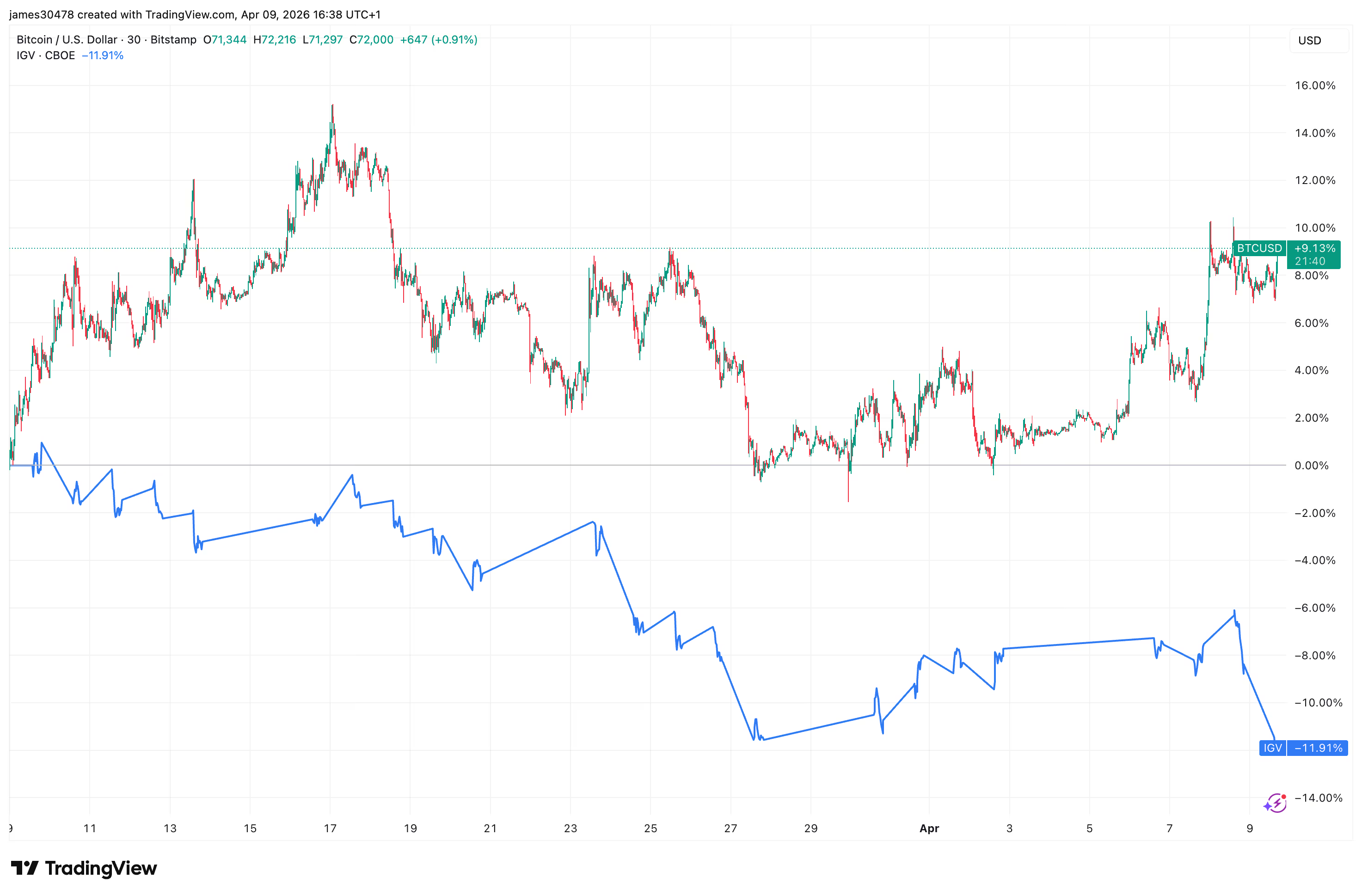
Firmly linked at the hip in recent months, bitcoin and software stocks continued to diverge on Thursday. The iShares Expanded Tech-Software ETF (IGV) fell 4%, approaching a key support level around $76, a level it has tested and rebounded from multiple times.
Over the past month, bitcoin is up 9%, while IGV is down 12%.
On a 20-day moving average basis, the correlation coefficient between Bitcoin and IGV has dropped to a relatively low 0.34, reinforcing the recent divergence in their price movements.

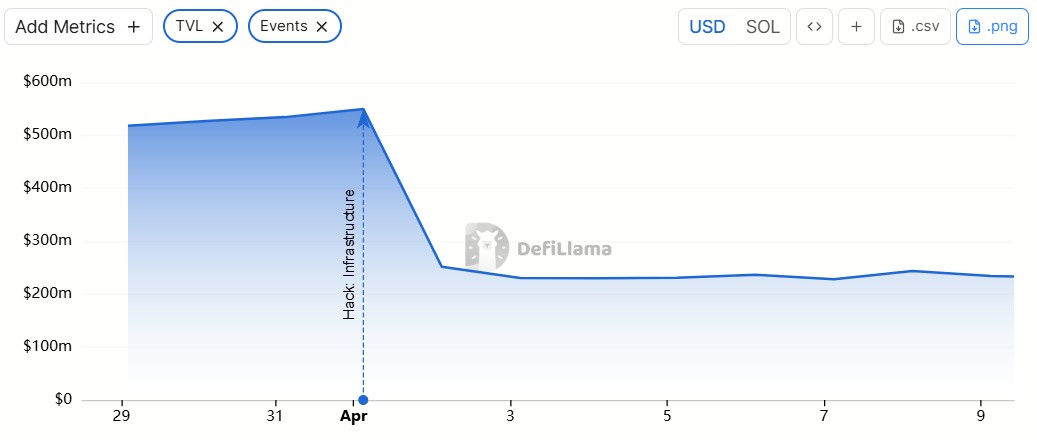
This month’s $285 million exploit on Drift, a decentralized exchange (DEX), was the largest crypto hack in over a year, when exchange Bybit lost $1.4 billion. North Korean state-backed hackers were named as prime suspects in both attacks.
This past autumn, attackers posed as a quantitative trading firm and approached Drift’s protocol team in person at a major crypto conference, said Drift in an X post Sunday.
“It is now understood that this appears to be a targeted approach, where individuals from this group continued to deliberately seek out and engage specific Drift contributors, in person, at multiple major industry conferences in multiple countries over the following six months,” said the DEX.
Until now, North Korean cyber spies have targeted crypto firms online, through virtual calls and remote work. An in-person approach at a conference would not typically raise suspicion, but the Drift exploit should be enough for attendees to review connections made at recent events.

North Korea expands crypto playbook beyond hacks
Blockchain forensics firm TRM Labs described the incident as the largest DeFi hack of 2026 (so far) and the second-largest exploit in Solana’s history, just behind the $326 million Wormhole bridge hack in 2022.
The initial contact dates back about six months, but the exploit itself traces to mid-March, according to TRM. The attacker began by moving funds from Tornado Cash and deploying the CarbonVote Token (CVT), while using social engineering to persuade multisig signers to approve transactions that granted elevated permissions.
They then manufactured credibility for CVT by minting a large supply and inflating trading activity to simulate real demand. Drift’s oracles picked up the signal and treated the token as a legitimate asset.
When the pre-approved transactions were executed on April 1, CVT was accepted as collateral, withdrawal limits were increased and funds were withdrawn in real assets, including USDC.

Related: North Korean spy slips up, reveals ties in fake job interview
According to TRM, the speed and aggressiveness of the subsequent laundering exceeded that seen in the Bybit hack.
North Korea is widely believed to be using large-scale crypto thefts such as the Drift and Bybit attacks alongside longer-term tactics, including placing operatives in remote roles at tech and crypto firms to generate steady income. The United Nations Security Council has said such funds are used to support the country’s weapons program.
Security researcher Taylor Monahan said infiltration of DeFi protocols dates back to “DeFi summer,” adding that around 40 protocols have had contact with suspected DPRK operatives.
North Korean state media reported Thursday that the country tested an electromagnetic weapon and a short-range ballistic missile, known as the Hwasong-11, fitted with cluster munition warheads.

Infiltration network fuels steady crypto revenue
A separate investigation revealed how a network of North Korea-linked IT workers generated millions through prolonged infiltration.
Data obtained from an anonymous source shared by ZachXBT showed the network posing as developers and embedding themselves across crypto and tech firms, generating roughly $1 million a month and more than $3.5 million since November.
The group secured jobs using falsified identities, routed payments through a shared system, then converted funds to fiat and sent them to Chinese bank accounts via platforms such as Payoneer.

Related: Are you a freelancer? North Korean spies may be using you
The operation relied on basic infrastructure, including a shared website with a common password and internal leaderboards tracking earnings.
The agents applied for roles in plain sight using VPNs and fabricated documents, pointing to a longer-term strategy of embedding operatives to extract steady revenue.
Defenses evolve as infiltration tactics spread
Cointelegraph encountered a similar scheme in a 2025 investigation led by Heiner García, who spent months in contact with a suspected operative.
Cointelegraph later took part in García’s dummy interview with a suspect who went by “Motoki,” who claimed to be Japanese. The suspect rage quit the call after failing to introduce himself in his supposed native dialect.
The investigation found operatives bypassed geographic restrictions by using remote access to devices physically located in countries such as the US. Instead of VPNs, they operated those machines directly, making their activity appear local.
By now, tech headhunters have realized that the person at the other end of a virtual job interview may indeed be a North Korean cyber spy. A viral defence strategy is to ask suspects to insult Kim Jong Un. So far, the tactic has been effective.

However, as Drift was approached in person and García’s findings showed operatives finding creative methods to bypass geographic restrictions, North Korean actors have continued to adapt to the cat-and-mouse dynamic.
Requesting interviewees to call North Korea’s supreme leader a “fat pig” is an effective strategy for the time being, but security researchers warn that this won’t work forever.
Magazine: Phantom Bitcoin checks, China tracks tax on blockchain: Asia Express

X Factor star Chico found guilty of drink-driving ‘hours after breaking sobriety’

Oil Just Doesn't Want To Correct With Persistent Ceasefire Uncertainty – WTI Technical Analysis

5 Best Cryptos to Buy Right Now: Secure Your Gains Before the Next Bull Run!

Why Israel is blocking foreign journalists from entering

Bitcoin: We’re Entering The Most Dangerous Phase

Alan Cumming Brands Baftas Ceremony A ‘Triggering S**tshow’

Ye 4 habits tumhe dheere dheere financial slave bana rahi hain #richmindset #shorts

Dhana Aakarshana Tamalapaku #youtubeshorts #shorts #trending #viral #money #puja #bhakti

financial Year Closing Ad Using AI | CA Service Ad Demo (No Shoot) #aivideo #aiads #aivideoads
-

 NewsBeat7 days ago
Steven Gerrard disagrees with Gary Neville over ‘shock’ Chelsea and Arsenal claim | Football
-

 Business7 days ago
No Jackpot Winner and $194 Million Prize Rolls Over
-

 Fashion6 days ago
Weekend Open Thread: Spanx – Corporette.com
-

 Business5 days ago
Expert Picks for Every Need
-

 Business4 days ago
Three Gulf funds agree to back Paramount’s $81 billion takeover of Warner, WSJ reports
-

 Sports5 days ago
India men’s 4x400m and mixed 4x100m relay teams register big progress | Other Sports News
-

 Tech2 days ago
How Long Can You Drive With Expired Registration? What Florida Law Says
-
Business4 days ago
No Jackpot Winner, Prize to Climb to $231 Million
-

 Fashion3 days ago
Massimo Dutti Offers Inspiration for Your Summer Mood Board
-
Politics6 days ago
Wings Over Scotland | The quality of mercy
-

 Fashion2 days ago
Let’s Discuss: DEI in 2026
-

 Business5 days ago
Akebia Therapeutics, Inc. (AKBA) Discusses Pipeline Progress and Strategic Focus on Kidney Disease Treatments at R&D Day – Slideshow
-

 Fashion7 days ago
Statement Sunglasses: The Accessory Shaping Modern Fashion
-

 Crypto World1 day ago
Bitcoin recovers as US and Iran Agree a Ceasefire Deal
-

 Politics7 days ago
East Jerusalem Palestinian families eviction orders
-

 Politics7 days ago
Why so many children are now classified as ‘disabled’
-

 Fashion7 days ago
Coffee Break: Santa Croce Tote
-

 Fashion7 days ago
For Love & Lemons’ Spring 2026 Line is for the Romantics
-

 Politics7 days ago
Nuclear rockets, moon bases and NASA’s Mars plan
-

 Tech7 days ago
The Threadless Ball Screw Never Took Off, But Don’t Write It Off
You must be logged in to post a comment Login