
Crypto World
Citi Boosts Exxon Mobil (XOM) Price Target by 17% Amid Middle East Tensions


Key Takeaways
- Alastair Syme from Citi upgraded his XOM price objective to $175 from $150 while maintaining a Neutral stance
- The upgrade stems from Middle East tensions potentially reducing equity costs for energy companies across the board
- Syme suggests regional conflict may spark renewed institutional investment in the oil and gas industry
- Former President Trump’s reported warnings against Iran intensified supply concerns in petroleum markets
- Despite the upgrade, Citi favors TotalEnergies, ConocoPhillips, and BP over Exxon as preferred energy investments
Citi has announced a significant upward revision to its Exxon Mobil (XOM) price objective, moving from $150 to $175, with escalating Middle East tensions serving as the primary catalyst for energy sector revaluation. Analyst Alastair Syme maintained his Neutral position while implementing the increase as part of sweeping adjustments throughout oil and gas coverage.
Syme’s rationale centers on a clear thesis: geopolitical instability in the Middle East compresses the cost of capital for energy companies, which mathematically elevates valuation targets. He characterized the regional tensions as potentially catalyzing a “structural re-engagement” from institutional capital in the oil and gas sector — an industry segment that has experienced diminishing investor enthusiasm in recent years.
XOM experienced upward momentum midweek as commodity traders assessed geopolitical uncertainties against already elevated petroleum prices. This convergence created favorable conditions for the equity.
Regional Conflict Reshapes Market Dynamics
The primary catalyst involves crude oil’s acute sensitivity to Middle Eastern geopolitical developments. Recent trading sessions saw petroleum prices advance on concerns that escalating conflict might interrupt critical shipping corridors or precipitate broader supply constraints.
Compounding market anxieties, reports emerged that former President Donald Trump threatened severe action against Iran — rhetoric that rattled traders and elevated the geopolitical risk premium embedded in oil pricing. Markets frequently react to potential supply disruptions before any actual interruption materializes. Perceived threats alone typically suffice to trigger repricing.
Exxon, representing one of the planet’s largest vertically integrated energy corporations, stands directly within this repricing dynamic. Elevated crude prices enhance upstream profitability, while its downstream refining operations provide diversification. The company’s financial foundation is considered robust, a critical attribute during volatile commodity environments.
Alternative Investment Preferences from Citi
An important distinction: although Citi elevated its XOM target, the firm’s preferred energy sector positions remain TotalEnergies, ConocoPhillips, and BP. The Neutral designation indicates Syme views the shares as appropriately valued at present levels, even after the target adjustment.
The target elevation primarily reflects industry-wide momentum rather than Exxon-specific optimism.
Energy equities have broadly regained investor consideration as protection against geopolitical volatility and inflationary pressures. Exxon features prominently in these discussions given its operational scale and financial discipline, yet Citi clearly signals superior opportunities exist elsewhere within the sector.
Citi’s upgraded $175 price objective marks the latest in successive upward revisions across major oil companies as analysts recalibrate expectations for an increasingly unstable geopolitical environment.


Crypto World
Best Crypto Presale: Traders Load Pepeto for 100x Potential While Noctura and Hexydog Search for Traction
The crypto market just opened Q2 2026 at $2.36 trillion after the Fear and Greed Index spent 46 consecutive days in extreme fear territory, the longest such stretch since 2022 according to Phemex. Somewhere inside this transition from fear to accumulation, one presale is about to reprice everything for the wallets that committed early enough.
The shift arrived as spot Bitcoin ETFs flipped to net positive monthly inflows for the first time since October according to CoinDesk. Ethereum held above $2,100 as institutional sentiment started to recover. The extreme fear reading at 8 to 11 kept retail on the sidelines for weeks, but capital is now rotating back and traders across the market are scanning for the entry that could define their year.
Yet the best crypto presale is never simply the one advertising the highest numbers. It is the project building infrastructure that traders genuinely need on a daily basis. That explains why Pepeto attracted capital so rapidly. Over $8.69 million entered the presale as the community projects 100x returns, with the project tackling the meme coin economy’s core weaknesses through a zero-fee exchange, cross chain bridging, and AI token screening according to Bloomberg.
Q2 Opens After 46 Days of Extreme Fear as Capital Returns and Presale Attention Surges
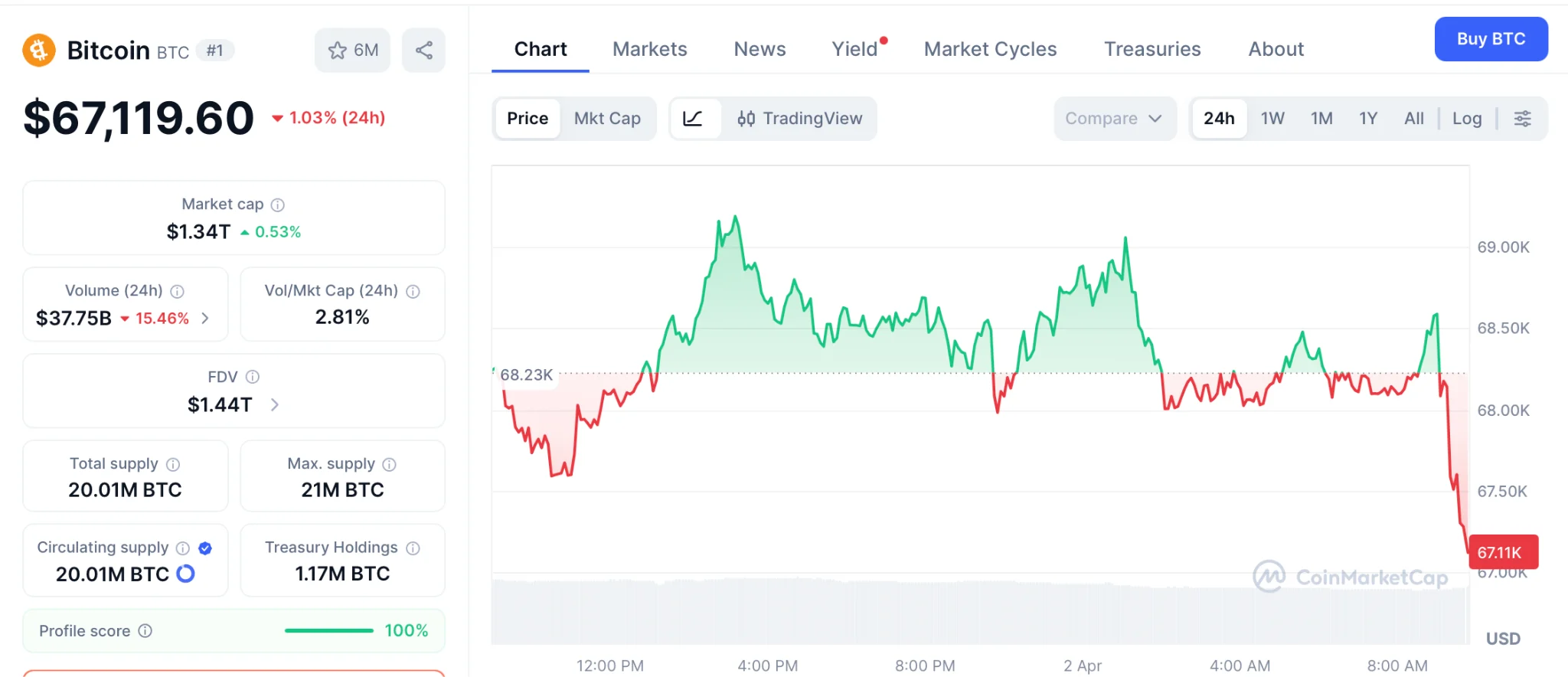
BTC is trading around $67,119 on April 1 according to CoinMarketCap, as the Iran war de-escalation hopes, easing oil prices, and improved macro conditions lifted risk appetite for the first time in months.
Every token listed on Pepeto passes through AI verification before a trader ever sees it, which is why the project holds the strongest position in the best crypto presale conversation. SolidProof and Coinsult both completed audits with zero critical findings, and the 100x projection follows directly from the presale entry math.
Tokens Offering Early Access Ahead of the Next Leg Up
1. Pepeto: The Best Crypto Presale Where Real Exchange Utility Meets Genuine Breakout Potential
Meme coin traders keep hemorrhaging money on unverified tokens and fragmented platforms that extract fees on every swap. That describes the current market perfectly.
Now imagine trading across three chains with zero fees while AI verifies every listed token before it even shows up on your screen. Pepeto built exactly that, and it is the reason $8.69 million has already poured into the presale.
Pepeto may be the most fully developed exchange ecosystem to emerge from any 2026 presale. PepetoSwap handles zero-fee trades spanning Ethereum, BNB Chain, and Solana. The bridge moves assets across chains without cost, backed by AI contract verification at every step. Every token passes through screening before it goes live on the exchange.
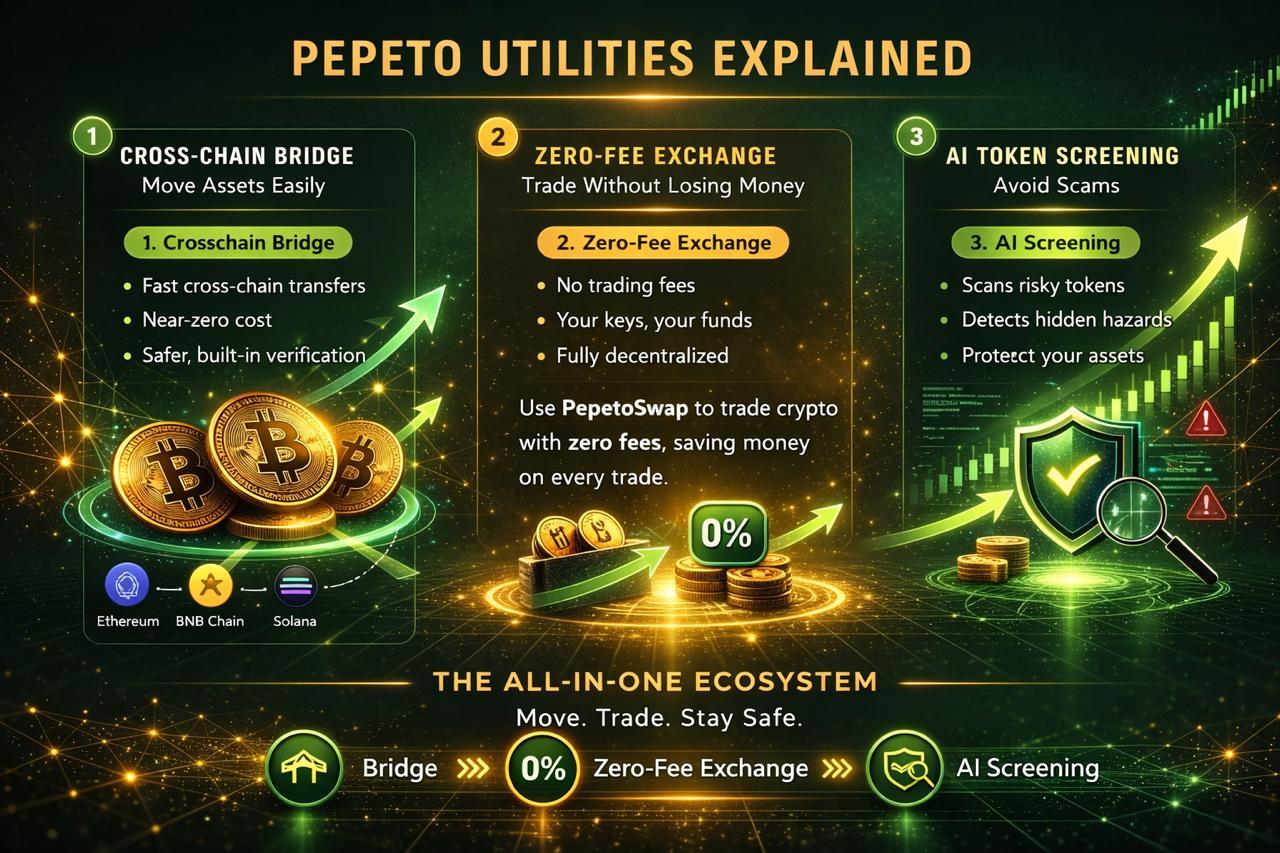
With $8.69 million secured at $0.000000186, Pepeto is not approaching the Binance listing on hype alone. It delivers built exchange infrastructure. SolidProof and Coinsult completed dual audits with zero critical findings. The cofounder took Pepe to $11 billion. A former Binance executive advises the listing.
This makes the best crypto presale argument for Pepeto concrete. Not concepts in a whitepaper. Functioning products approaching launch.
The community projects 100x after listing and staking at 189% APY compounds daily. At $0.000000186, a $5,000 commitment becomes $500,000 at a $50 million market cap. Pepe surpassed 220 times that valuation with zero products. The Binance listing could be the defining event of this cycle.
2. Noctura: Privacy Focused but Still Early and Unproven at Scale
Noctura uses ZK proofs and a dual-mode wallet to deliver privacy without sacrificing compliance. A rare approach, but the project raised just $60,000 with no exchange infrastructure, no confirmed listing, and no founding team with a proven track record at scale.
3. Hexydog: Niche Real World Use Case With Limited Upside Ceiling
Hexydog enables holders to pay for pet services on chain. The $700K raised demonstrates interest in niche projects, but without exchange infrastructure, without AI screening, and without a listing catalyst, the upside potential sits far below what Pepeto offers at $0.000000186.
This Is the Entry You Will Either Take or Spend This Cycle Regretting
The same words come out every cycle after the fact. I knew about Dogecoin early. I watched Shiba Inu before the listing. I saw Pepe at launch and did nothing. The pattern repeats because most participants wait until the proof is already reflected in the price.
The best crypto presale this cycle, Pepeto, has $8.69 million in presale conviction, three exchange products approaching launch, dual audits, a founding team worth $11 billion in proven results, and a Binance listing that will permanently seal this entry.
Staking at 189% APY compounds daily while you wait. The math works. The window narrows. The only question is whether you act this time or watch from outside again.
Click To Visit Pepeto Website To Enter The Presale

FAQs
Why do traders consider Pepeto the best crypto presale for real exchange infrastructure?
Three exchange products with AI screening, zero-fee trading across three chains, and dual audits from SolidProof and Coinsult back the 100x projection with built infrastructure rather than promises.
How does Q2 opening after 46 days of extreme fear affect presale investors?
Capital rotating back after extended fear historically reprices infrastructure first. Pepeto with $8.69 million committed and a Binance listing approaching captures that rotation before the open market does.
What do Noctura and Hexydog bring to the best crypto presale conversation?
Noctura offers ZK privacy on Solana with $60K raised. Hexydog targets pet services with $700K raised. Both carry fundamentally different risk and return profiles compared to an exchange presale approaching listing.
Disclaimer: This is a Press Release provided by a third party who is responsible for the content. Please conduct your own research before taking any action based on the content.
Donald Trump stepped onto stage on Wednesday night at 9:02pm New York time. A full moon hung overhead, and NASA had just launched Artemis II on a moonshot hours earlier. None of it mattered.
Despite a historic night worthy of celebration, Trump brought the national mood – and prices across the world’s capital markets like oil and bitcoin (BTC) – into immediate panic.
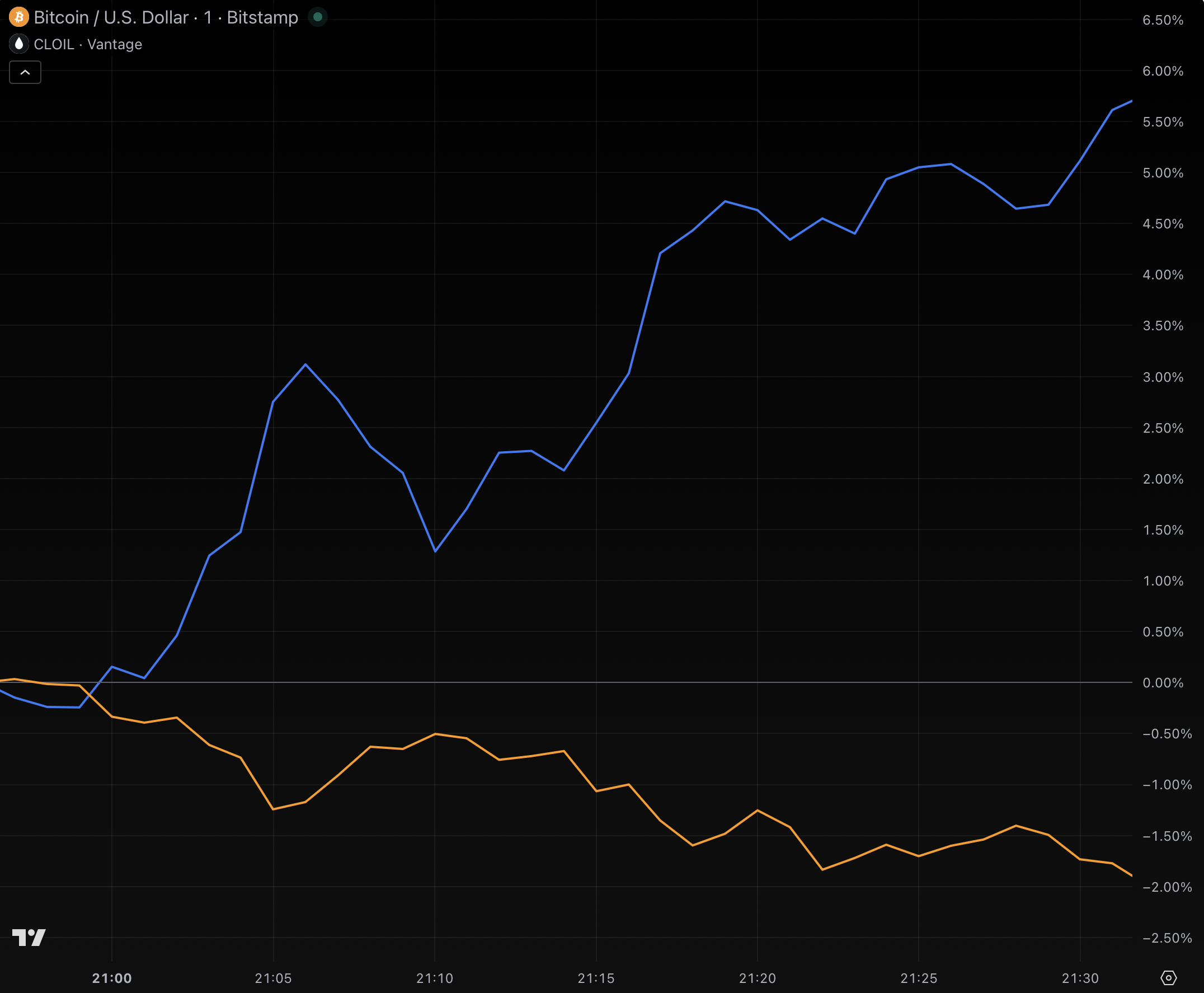
Within seconds of his opening words, S&P 500 Contracts for Difference (CFDs) started to decline from the index’s 6,588 start at 9:02pm. Half an hour later, the $60 trillion index had lost 1% of its value after falling to 6,523.
BTC amplified that slide, declining 1.6% from $68,342 at 9:02pm to $67,212 by 9:32pm.
Crude oil CFDs, indicating obvious dissatisfaction with Trump’s 3-week timeline extension on his Iran war, not to mention his claim that the Strait of Hormuz would somehow reopen “naturally,” spiked 5.7%, panicking from $98.27 per barrel at 9:02pm to $103.95 per barrel by 9:32pm.
As of publication time, both oil and bitcoin have extended their moves since Trump’s speech. Oil is now 13% more expensive than when Trump began speaking last night. The price of BTC is 3.1% worse over the same time period.
Optimistic listeners had expected a victory lap and a definitive plan to secure the Strait of Hormuz. Instead, Trump gave a vague promise to “hit them extremely hard over the next two to three weeks.”
The Strait of Hormuz will ‘open up naturally’
The most consequential moment of the address was not about bombs or regime change. It was about oil.
Roughly one-fifth of global oil supply sailed through the Strait of Hormuz prior to the start of the US-Israeli war against Iran on February 28.
Last night, Trump urged countries that depend on the Strait to handle the situation themselves. “Go to the strait and just take it, protect it, use it for yourselves,” he broadcast onto TV screens around the globe after continuously bombing its neighbor for 4.5 weeks.
Read more: Trump documents meltdown over Iran war on Truth Social
Incredibly, he immediately proceeded to embarrass himself further, “When this conflict is over, the Strait will open up naturally.”
Oil traders did not share any of his optimism.
CFDs on crude oil, the next-best price for the world’s largest commodity while its formal futures markets were closed, became 5.7% more expensive within minutes.
Trump’s three more weeks for oil and bitcoin to recover naturally
Trump has promised falling oil prices before. On March 8, he posted on Truth Social that prices would “drop rapidly” once the US dealt with the nuclear threat. He called anyone who disagreed a fool.
Oil was at $85 per barrel then. It was above $103 by the time he finished his speech last night.
On February 28, Trump claimed Iran “has been, in only one day, very much destroyed and, even, obliterated.” The country he declared obliterated 32 days ago continues to constrict Strait tanker traffic and fire missiles at US ally nations.
Gas prices at US pumps hit $4 per gallon this week, up more than 30% since the war began. Diesel crossed $5.45 per gallon. Americans last paid this much for basic fuel in August 2022, after Russia invaded Ukraine.
Wednesday’s speech should have changed the trajectory. Instead, Trump promised more escalation, told allies to find “delayed courage,” and assured a nation paying $4 per gallon that “gas prices will rapidly come back down.”
Got a tip? Send us an email securely via Protos Leaks. For more informed news, follow us on X, Bluesky, and Google News, or subscribe to our YouTube channel.


SoFi’s new Big Business Banking platform lets institutions manage fiat, SoFiUSD, and crypto in one Solana-powered, chartered bank stack, targeting wholesale stablecoin settlement flows.
Summary
- SoFi launches “Big Business Banking,” a 24/7 enterprise platform for fiat and crypto asset management under its U.S. national bank charter.
- The system supports API-based payments in USD, SoFiUSD stablecoin, and select cryptocurrencies, with on‑platform minting and burning of SoFiUSD.
- Initial partners include Cumberland, Bullish, BitGo, B2C2, Fireblocks, Wintermute, Galaxy, and Jupiter, with core infrastructure built on Solana and other blockchains.youtubefinance.
SoFi has launched an enterprise banking platform dubbed “Big Business Banking,” allowing institutions to manage fiat balances and digital assets in a single regulated environment, according to The Block. The service runs under SoFi Bank’s national charter, offering 24/7 payments and liquidity management and positioning the lender as one of the first U.S.-regulated banks to industrialize stablecoin-based settlement for corporates.markets.
The new platform supports API-driven payments in U.S. dollars, SoFiUSD — SoFi’s fully reserved, dollar‑pegged stablecoin — and specific cryptocurrencies, while giving clients tools to convert between fiat and digital assets, including minting and burning SoFiUSD inside a controlled framework. SoFiUSD is issued by SoFi Bank, N.A., a nationally chartered and FDIC‑insured institution, and is designed to run on public blockchains with instant, round‑the‑clock settlement. As SoFi explained in earnings materials, the stablecoin is meant to be a core settlement asset across its ecosystem rather than a speculative token.
The first wave of institutions onboarded to Big Business Banking includes trading firms and infrastructure providers such as Cumberland, Bullish, BitGo, B2C2, Fireblocks, Wintermute, Galaxy, and Jupiter, The Block reported. These names underscore SoFi’s aim to sit at the center of institutional crypto liquidity, rather than simply servicing retail flows.
Under the hood, the platform relies on Solana and other blockchain networks for transaction processing, reflecting SoFi’s broader push into high‑throughput, low‑cost settlement rails. Earlier this year, SoFi became the first U.S.-chartered bank to support direct Solana network deposits for its roughly 13.7 million users, enabling on‑chain SOL transfers into SoFi crypto accounts.finance.
SoFi has framed SoFiUSD as a wholesale settlement token for banks, fintechs, and payment processors, not just a consumer stablecoin. In a recent appearance shared by SoFi on LinkedIn, CEO Anthony Noto said that “SoFi USD will be the means of corresponding banking between banks, but also be the way to move money cheaper, faster and safer,” describing it as core to the company’s “big business banking” strategy.
That strategy has already extended into card networks. As previously reported in a crypto.news story, SoFi and Mastercard agreed to use SoFiUSD for settlement across Mastercard’s global network, connecting SoFi Bank and its Galileo platform to tokenized payment flows. The move comes as the European Central Bank warns that large‑scale stablecoin adoption could erode commercial bank funding just as firms like SoFi, Visa and others expand token‑based settlement models.
Big Business Banking also lands in a market where other regulated players are accelerating their own tokenization efforts. In an earlier crypto.news story, SoFi’s launch of consumer crypto trading marked it as the first nationally chartered U.S. bank to bridge traditional deposits with in‑app crypto trading, with stablecoin issuance already flagged as a key initiative. Another crypto.news story highlighted BNY’s push into stablecoin reserve funds as it targets a potential $1.5 trillion market, signaling rising competition among incumbents to own institutional stablecoin flows.
For now, SoFi is betting that offering corporates a single stack for cash management, liquidity, and on‑chain settlement — backed by a bank charter and its in‑house SoFiUSD token — will give it an edge as treasurers and trading firms move more volume onto blockchain rails.

Tokenization is maturing from a novelty experiment into a practical infrastructure play, with the strongest cases emerging around assets that already move trillions in daily activity. In a recent perspective, Sebastián Serrano, founder and CEO of Ripio, argues that the true value of tokenization lies not in reinventing niche assets, but in upgrading the rails for money, sovereign debt, and other highly liquid financial instruments. He contends that stablecoins have proven the concept by digitizing the world’s most liquid asset, the U.S. dollar, and that tokenized Treasuries are the logical next step as the market looks to extend tokenization into government debt and large-scale financial instruments.
The argument rests on a simple premise: liquidity drives network effects. When an asset is in high demand and backed by established legal and financial frameworks, tokenization can deliver real interoperability, faster settlement, and real-time collateral management. As Serrano notes, much of the industry’s early tokenization effort aimed at illiquid or bespoke assets—an approach he characterizes as misaligned with where tokenization can practically add value. Instead, he points to stablecoins and tokenized large-scale assets as the foundation upon which on-chain finance can scale.
Key takeaways
- Tokenization’s most impactful use cases center on broadly demanded assets—money, sovereign debt, and major financial instruments—where standardized rules and deep liquidity exist.
- Stablecoins demonstrated the value proposition by moving dollars globally with speed and lower costs; tokenized Treasuries represent the next frontier in expanding tokenization beyond currency into government debt.
- Tokenizing illiquid assets, including NFTs and bespoke real-world assets, remains fragmented by legal ambiguity and a lack of standardization, limiting their potential as a shared financial layer.
- For liquid assets, tokenization enables continuous settlement, real-time collateral management, and programmable cash flows, potentially improving capital efficiency across markets.
- Liquidity remains the key determinant of whether a tokenized asset can function as collateral or be integrated into automated DeFi systems; illiquid assets struggle to deliver consistent value signals and active markets.
Tokenizing the core of finance
The argument emphasizes that tokenization should target assets with established demand and robust regulatory underpinnings. Money and sovereign debt are the base layer of the global economy, actively used by governments, corporations, and individuals alike. Tokenizing these assets does not create demand from scratch; it upgrades the infrastructure on which trillions of dollars already circulate. In other words, tokenization acts as a modernization of core financial rails rather than a mission to reinvent the wheel.
Across recent history, the most visible success stories have been those that map neatly onto existing financial activity. Stablecoins, for example, mirror the dollar’s utility in the digital realm, enabling fast, cross-border transfers and programmable settlement without the friction of traditional rails. The logical extension of this pattern is tokenized government debt and other high-demand instruments, which could unlock new operational efficiencies while preserving regulatory clarity.
Liquidity as a catalyst for interoperability
Liquidity is more than a market metric; it is the enabler of interoperability. When assets have deep, reliable markets, tokenization can standardize a common unit of account and reduce reliance on intermediaries for settlement. This creates genuine network effects: developers can build compatible financial primitives around the same tokenized asset, and users benefit from predictable, real-time settlement and governance of on-chain cash flows.
Stablecoins embody this dynamic by providing an immediate, fungible bridge between traditional finance and on-chain operations. The next major wave, Serrano argues, is tokenized treasuries and similar liquid instruments that institutions already hold at scale. The combination of liquidity and standardization makes it far more tractable for regulated actors to participate and for tokenized assets to be used seamlessly as collateral or as part of complex DeFi protocols. In such a setting, tokenization moves from a novelty to a foundational layer of finance.
The limits of tokenizing illiquid assets
Not all assets are equally amenable to tokenization. NFTs and bespoke RWAs—the kind of assets that are individualized, legally nuanced, and difficult to standardize—pose significant hurdles. Their fragmentation, unclear ownership or custody frameworks, and uncertain enforceability complicate any attempt to create a universal on-chain settlement or a shared economic layer around them. While these assets may hold cultural or speculative value, they do not, in Serrano’s view, anchor broad financial network effects in the same way that money or sovereign debt do.
That said, tokenization can still improve certain aspects of illiquid assets, such as fractional ownership or automated workflows for specific use cases. However, it does not inherently solve the core problem of infrequent trading, opaque valuations, and wide bid-ask spreads that hinder these assets from becoming reusable capital or collateral on a large scale.
Collateral, risk, and regulatory clarity
Another crucial consideration is how tokenized assets fit within existing legal and regulatory frameworks. Digital dollars, government bonds, and large corporate debt enjoy well-established status and accountability, making it easier for institutions to adopt tokenized formats within current law. By contrast, the legal and custody uncertainties surrounding NFTs and certain RWAs can impose higher risk, potentially offsetting the technical benefits of tokenization. In Serrano’s view, that combination helps explain why major tokenization efforts tend to prioritize liquid assets first, paving the way for broader institutional participation as the framework becomes clearer.
The broader implications are clear: as regulators and markets gain comfort with tokenized liquidity and standardized instruments, tokenization could accelerate the efficiency and resilience of traditional markets. The practical reality, for now, is that liquidity and regulatory clarity are the gatekeepers of adoption. Where those two conditions align, tokenization can deliver faster settlement, real-time collateral management, and more efficient capital deployment.
Industry observers have noted that authorities are actively exploring tokenization pathways. For example, coverage in the broader market has highlighted pilots and research into tokenized government debt and related digital finance experiments supported by central banks and regulatory bodies. These developments underscore the trend Serrano highlights: tokenization is most powerful when it aligns with the core fabric of the financial system, not merely as a speculative overlay.
What to watch next
The path forward, according to Serrano, hinges on two intertwined dynamics: expanding tokenization into broadly demanded assets while keeping a clear, enforceable regulatory framework. Investors and builders should monitor the rollout of tokenized government debt and stablecoins as primary indicators of whether the market can sustain scalable, low-friction financial rails on-chain. At the same time, the continued experimentation with NFTs and RWAs will reveal how quickly a path toward standardization and risk management can be forged for the more idiosyncratic assets.
As the industry inches toward a more explicit use of tokenized assets in everyday finance, the practical takeaway remains consistent: tokenization should first strengthen the core—money and sovereign debt—before broadening to fringe assets. The momentum around liquid instruments suggests a future where on-chain finance functions as a direct extension of traditional markets, delivering efficiency gains without compromising transparency or safety.
Opinion by: Sebastián Serrano, founder and CEO of Ripio.
This article reflects a viewpoint on how tokenization could shape financial infrastructure. It does not represent a formal endorsement by Cointelegraph, and readers should conduct their own due diligence before acting on these ideas. For deeper context, related industry discussions have noted central-bank pilots backing tokenization initiatives, including studies and pilots supported by Australian authorities exploring digital finance pathways.


Vitalik Buterin has called for a shift to a “local-first” approach to artificial intelligence. He said modern AI tools pose serious privacy and security risks.
Summary
- Vitalik Buterin urged a shift to local-first AI, warning that cloud-based systems expose user data and increase risks of manipulation, leaks, and unauthorized actions.
- He cited research showing that about 15% of AI agent “skills” contain malicious instructions and warned that models may include hidden backdoors or lack full transparency.
- Buterin proposed a local setup using on-device models, sandboxing, and human-AI confirmation to limit risks, as autonomous AI agents continue to expand capabilities and attack surfaces.
In a recent blog post, he said AI is moving beyond simple chat tools. Newer systems now act as autonomous agents that can “think for a long time and use hundreds of tools” to complete tasks. He warned that this change raises the risk of sensitive data exposure and unauthorized actions.
Buterin said he has already stopped using cloud-based AI. He described his setup as “self-sovereign, local, private, and secure.”
“I come from a position of deep fear of feeding our entire personal lives to cloud AI,” he wrote. He added that recent developments could mean “taking ten steps backward” in privacy, even as encryption and local-first tools become more common.
Buterin said many AI systems rely on cloud infrastructure. He warned that users are effectively “feeding our entire personal lives to cloud AI,” allowing external servers to access and store their data.
He also pointed to risks tied to AI agents. Some systems can “modify critical settings” or introduce new communication channels without asking the user.
“LLMs fail sometimes too,” he wrote. They “can make mistakes or be tricked,” which increases the need for safeguards when they are given more control.
Research cited in his post found that about 15% of agent “skills” contained malicious instructions. Some tools were also shown to send data to external servers “without user awareness.”
He warned that certain models may contain hidden backdoors. These could activate under specific conditions and cause the system to act in the developer’s interest.
Buterin added that many models described as open-source are only “open-weights.” Their internal structure is not fully visible, which leaves room for unknown risks.
Vitalik’s personal setup to address risks
To deal with these concerns, Buterin proposed a system built around local inference, local storage, and strict sandboxing. He said the idea is to “sandbox everything” and stay cautious about outside threats.
He tested several hardware setups using the Qwen3.5:35B model. Performance below 50 tokens per second felt “too annoying” for regular use. Around 90 tokens per second provided a smoother experience.
A laptop with an NVIDIA 5090 GPU delivered close to 90 tokens per second. DGX Spark hardware reached about 60 tokens per second, which he described as “lame” compared to a high-end laptop.
His setup runs on NixOS with llama-server handling local inference. Tools like llama-swap help manage models, while bubblewrap is used to isolate processes and limit access to files and networks.
He said AI should be treated with caution. The system can be useful, but it should not be fully trusted, similar to how developers approach smart contracts.
To reduce risk, he uses a “2-of-2” confirmation model. Actions such as sending messages or transactions require both AI output and human approval. He said combining “human + LLM” decisions is safer than relying on either alone.
When using remote models, Vitalik’s requests are first passed through a local model which helps remove sensitive information before anything is sent out.
For those who cannot afford such setups, he suggested users “get together a group of friends, buy a computer and GPU of at least that level of power,” and connect to it remotely.
AI agent growth raises new concerns and opportunities
The use of AI agents is increasing, with projects like OpenClaw gaining traction. These systems can operate on their own and complete tasks using multiple tools.
Such capabilities also introduce new risks. Processing external content, such as a malicious webpage, can lead to an “easy takeover” of the system.
Some agents can change prompts or system settings without approval. These actions increase the chances of unauthorized access and data leaks.
Disclosure: This article does not represent investment advice. The content and materials featured on this page are for educational purposes only.
Crypto World
Startup lets researchers test blockchain tasks on a quantum computer for the first time


Most of the crypto industry spent this week processing Google’s paper on how quantum computers could break blockchain encryption. One startup is asking a different question — whether quantum hardware can make blockchains better.
Postquant Labs, which is building the world’s shared quantum computer, Quip.Network announced Wednesday the launch of what it calls the first publicly available quantum classical blockchain testnet, where quantum computers and legacy technology work side by side to solve problems.
Quantum computers use the physics of subatomic particles to test many possible solutions simultaneously rather than checking them one by one, which makes them fundamentally different from even the fastest conventional supercomputers, which are just very fast versions of the same step-by-step approach.
The testnet has already attracted 13,000 signups from researchers at MIT, Stanford, and universities around the world, according to the press release shared with CoinDesk. Out of these, six teams have submitted serious computational work so far.
Postquant Labs’s attempt to investigate how quantum processors can improve blockchain performance stands in contrast to most blockchain developers who see quantum as a threat.
The threat perception has increased multifold after Google published a paper on Monday which found that breaking bitcoin’s cryptographic defenses would require fewer than 500,000 physical qubits, roughly a 20-fold reduction from prior estimates
Note, however, that Postquant Labs’ testnet is a testing environment, not a live, final product. It’s where researchers experiment before anything goes into production.
The testnet has been built in consultation with D-Wave Quantum Inc, a leader in quantum computing systems, software, and services.
“From a technical perspective, the hybrid design of the testnet is particularly interesting. Participants can contribute using QPUs, CPUs and GPUs, creating a shared environment to evaluate how different compute models perform side by side,” Dr. Trevor Lanting, chief development officer, D-Wave, told CoinDesk.
“This creates an environment to help better understand how quantum approaches compare with classical methods in a blockchain setting, and where they may provide meaningful benefits such as improved energy efficiency or security,” he added.
Developers and researchers can earn QUIP tokens by solving complex mathematical problems using quantum machines, GPUs or regular CPUs. QUIP is meant to be a utility token that can be exchanged for computation resources provided by quantum and classical miners on the network.
If quantum computers can actually outperform regular computers on blockchain tasks — solving problems faster, using less energy, and delivering better results — then distributed ledger could become way more useful for real business applications, not just crypto trading.
“Today, annealing quantum computers are starting to show performance advantages on useful optimization applications across logistics, manufacturing, and beyond, often delivering better results, faster, and at lower energy cost than classical-only solutions,” said Colton Dillion, CEO and co-founder of Postquant Labs.
“Our goal is to make this quantum advantage accessible across a blockchain network,” Dillion added.
As of now, that’s a big “if.” This testnet needs to prove whether the quantum advantage is real or just marketing.
“Mainnet launch will depend entirely on the performance of testnet, but we are eager to launch as soon as we have proven the capabilities of the network to solve real-world problems, and shown quantum demand and supply both exist on either side of the market,” Postquant Labs told CoinDesk.
Do quantum computers exist?
Yes, they do, but not the sci-fi version that breaks Bitcoin and other blockchains or hacks into banks and major financial institutions.
D-Wave’s machines are not the quantum computers in Google’s paper. They are annealing systems, specialized hardware for optimization problems like route planning and resource allocation.
They cannot run Shor’s algorithm, cannot break encryption, and cannot do anything the Google paper describes. They are good at one specific class of problem, and that is the class Quip.Network is testing.
Postquant is using D-Wave’s Advantage2 annealing quantum computer through the company’s Leap cloud service.
In early internal tests, Postquant says D-Wave’s Advantage2 system beat out 80 H100 GPUs and 480 CPU cores on solution quality, time-to-solution, and energy efficiency for these specific optimization problems.
Those results have not been independently verified or published. Until they are, the claim is the company’s alone.
What role does D-Wave play?
D-Wave is not a full partner or investor. and has only advised Quip Network on the development of the testnet” and is “providing access to the Advantage2 system and consultation on the development of the testnet.”
Importantly, D-Wave has not independently endorsed the overall technical architecture — their involvement is limited to providing hardware access and consultation.
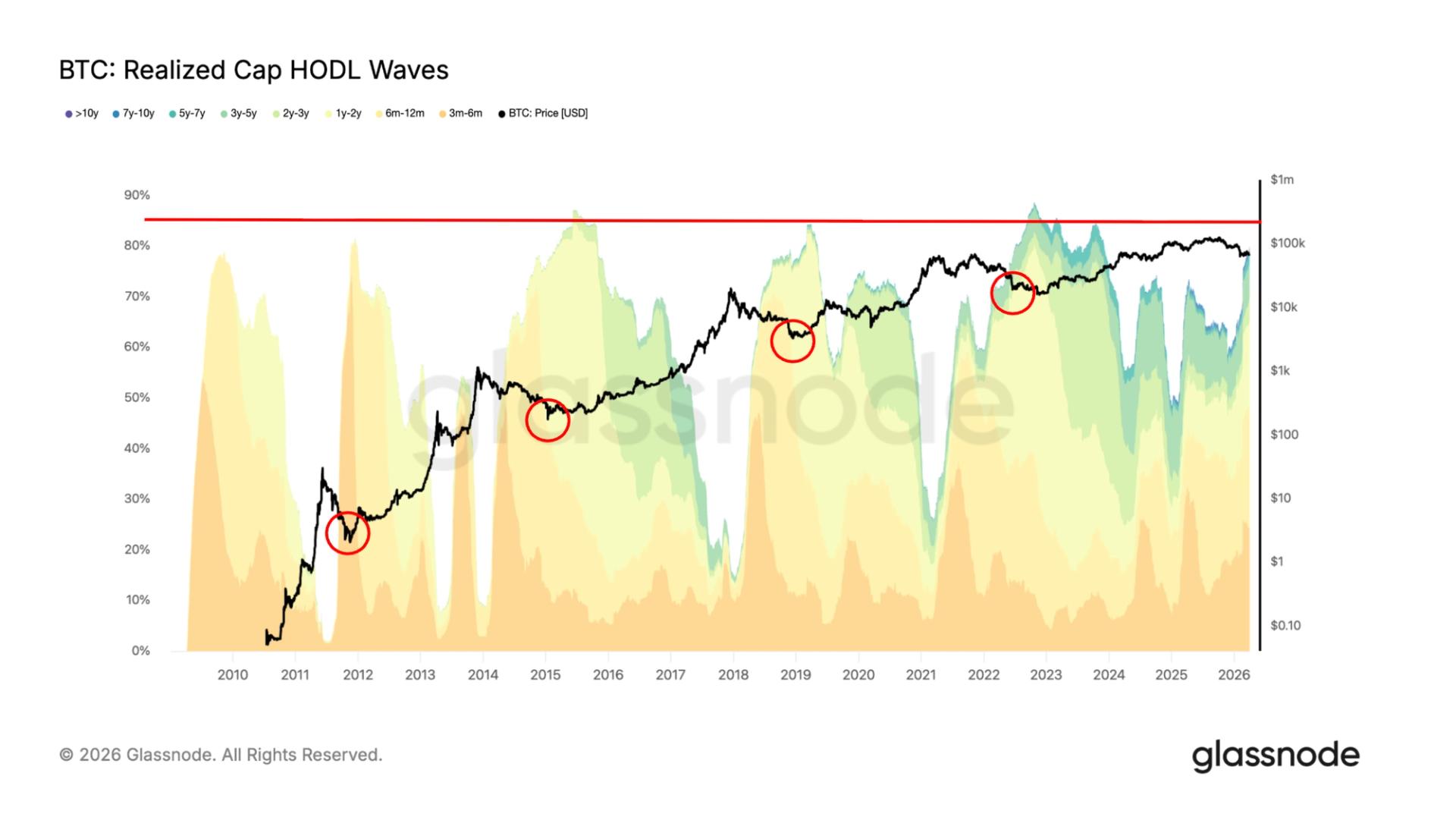
The two things most cryptocurrency investors are pondering are how much lower can bitcoin go and how much longer this bear market could last.
The price pain aspect has been discussed widely, but the time-based dimension is another question in itself.
Price pain refers to sharp drawdowns or volatility that force participants out of positions, while time pain reflects slow, range-bound conditions that exhaust both bulls and bears through lack of direction.
Bitcoin is currently trading below $66,000, down over 3% in the past 24 hours and roughly 45% below its October all-time high, an almost six-month bear market.
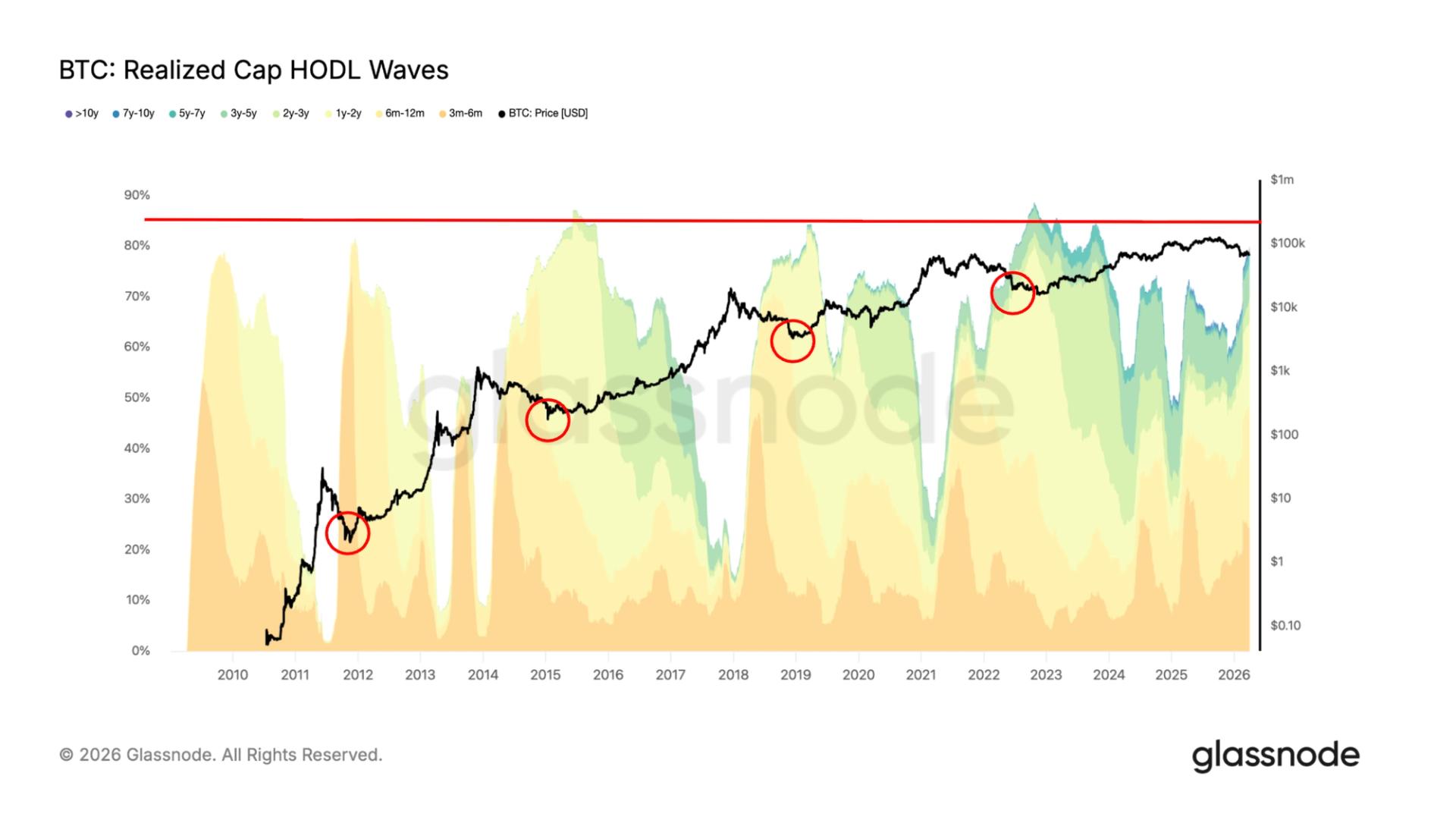
One indicator pointing toward continued time pain is the Realized Cap HODL Waves from Glassnode. This metric groups bitcoin supply by the last time coins moved, with each band representing different holding periods, and weights them by realized price, the average price at which coins last transacted on chain.
Historically, bear market bottoms have coincided with long-term holders, those holding for six months or more, controlling at least 85% of supply. Typically, price bottoms form first, and only several months later does long-term holder supply approach these high levels, indicating these investors bought at depressed prices and held through the bear market.
Currently, long term holders account for about 80% of supply. If this trend continues, the market may be nearing a bottoming phase, though several months of consolidation are likely still ahead.
SoFi said Thursday it is launching a new business banking platform designed to let companies handle both traditional money and crypto in one place, as it pushes deeper into digital assets.
The service, called SoFi Big Business Banking, allows firms to hold U.S. dollars, convert them into stablecoins and move funds around the clock, all within SoFi’s regulated bank.
Today, companies operating in crypto often rely on a patchwork of providers: a bank for cash, a separate firm for stablecoins and another for custody. Moving money between them can take hours or days. SoFi said it is trying to simplify that.
“To be competitive, businesses today must operate… 24 hours a day, 7 days a week,” SoFi CEO Anthony Noto said in a press release, contrasting the platform with traditional banking hours.
Under the new system, a trading firm could deposit dollars at SoFi, convert them into a digital token like SoFiUSD and deploy that capital instantly into markets, without waiting for bank wires to clear. Funds can also move back into dollars just as quickly.
The platform includes large crypto firms as early partners, including Cumberland, Wintermute, Galaxy (GLXY), BitGo (BTGO) and CoinDesk parent company Bullish (BLSH). These companies, which handle trading, liquidity and asset custody, are expected to use the system to move money and settle transactions more efficiently.
A central piece of the offering is SoFiUSD, a stablecoin that can be created and redeemed inside the bank. Unlike many stablecoins issued outside the U.S. banking system, SoFi’s version is tied directly to a regulated balance sheet, with reserves held internally.
The platform will also use blockchain networks, including Solana (SOL), to process transactions.
The launch reflects a broader shift in finance, as banks and crypto firms move closer together.
Instead of operating as separate systems, companies are increasingly trying to merge traditional banking with blockchain-based infrastructure. If successful, SoFi’s approach could reduce the need for multiple intermediaries and make it easier for large firms to move money globally.
Crypto World
Coinbase’s AI payments system joins Linux Foundation, gathers support from Google, Stripe, AWS and others


Coinbase’s AI-focused payment protocol x402 is moving toward becoming an open, standardized infrastructure under the Linux Foundation, the non-profit hub for open-source software development. The move aims to create a community-governed ecosystem for high-frequency, micro transactions that legacy finance can’t efficiently handle.
The protocol has formed an initial governing body, the x402 Foundation, that includes internet services firm Cloudflare and payments giant Stripe, with support from a long list of other big players.
The industry interest in X402 comes as AI-driven commerce expands. Especially, so-called agentic payments, executed autonomously by AI agents, is a hot topic particularly within certain areas of the crypto industry where the belief is that programmable, blockchain-based micro-payments make the most sense.
x402 is designed for these payments. Unlike using ChatGPT as a front-end for a traditional shopping cart, it can handle transactions worth only fractions of a cent at high frequency — something traditional credit card networks struggle to manage.
Now, by using the Linux Foundation to scale an open-source ecosystem, x402 aims to tackle potential interoperability issues by creating something like a Secure Sockets Layer (SSL) for AI agents, in other words a standard technology that encrypts the connection between a web server and a browser.
“The internet was built on open protocols,” said Jim Zemlin, CEO of the Linux Foundation. “The x402 Foundation will create an open, community-governed home to develop these capabilities in the open, ensuring they evolve with transparency, interoperability, and broad participation across the ecosystem.”
Coinbase said in a press release on Thursday that additional membership of the foundation will be comprised of participants from multiple verticals with initial intent and support being expressed by Adyen, Amazon Web Services, American Express, Ampersend.ai, Ant International, Base, Circle, Fiserv Merchant Solutions, Google, KakaoPay, Mastercard, Merit Systems, Microsoft, Polygon Labs, PPRO, Sierra. Shopify, Solana Foundation, Thirdweb, and Visa.
“The shift toward agentic commerce requires cloud infrastructure that is as open as the protocols it supports,” said James Tromans, Managing Director, Web3 and Digital Assets, Google Cloud. By joining the x402 Foundation, Google is reinforcing its commitment to interoperable standards that enable secure, AI-driven transactions across platforms.”
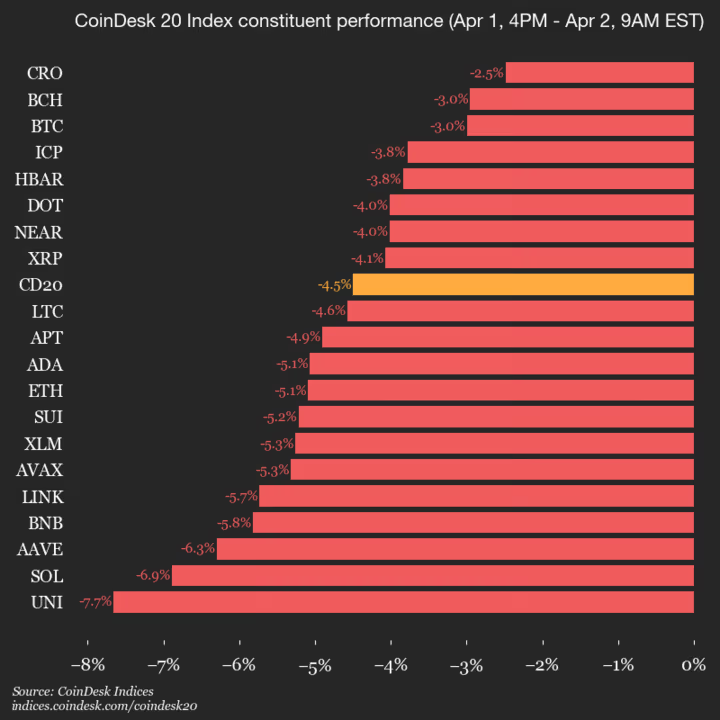
CoinDesk Indices presents its daily market update, highlighting the performance of leaders and laggards in the CoinDesk 20 Index.
The CoinDesk 20 is currently trading at 1875.68, down 4.5% (-88.38) since 4 p.m. ET on Wednesday.
None of the 20 assets are trading higher.

Leaders: CRO (-2.5%) and BCH (-3.0%).
Laggards: UNI (-7.7%) and SOL (-6.9%).
The CoinDesk 20 is a broad-based index traded on multiple platforms in several regions globally.

Adversaries Exploit Vacant Homes to Intercept Mail in Hybrid Cybercrime

Crypto Trading LIVE: BTC Live Trading Bitcoin Analysis | 01 APR #crypto #bitcoin #btc

Four Belfast men rushed to hospital after 70mph crash as harrowing doc returns tonight


-

 Business7 days ago
Instagram, YouTube Found Responsible for Teen’s Mental Health Struggle in Historic Ruling
-

 NewsBeat6 days ago
The Story hosts event on Durham’s historic registers
-
 Tech7 days ago
Intercom’s new post-trained Fin Apex 1.0 beats GPT-5.4 and Claude Sonnet 4.6 at customer service resolutions
-

 Sports6 days ago
Sweet Sixteen Game Thread: Tide vs Michigan
-
Entertainment3 days ago
Fans slam 'heartbreaking' Barbie Dream Fest convention debacle with 'cardboard cutout' experience
-
 Entertainment5 days ago
Lana Del Rey Celebrates Her Husband’s 51st Birthday In New Post
-
Crypto World2 days ago
Dems press CFTC, ethics board on prediction-market insider trades
-

 Crypto World18 hours ago
Gold Price Prediction: Worst Month in 17 Years fo Save Haven Rock
-

 Tech4 days ago
The Pixel 10a doesn’t have a camera bump, and it’s great
-

 Sports2 days ago
Tallest college basketball player ever, standing at 7-foot-9, entering transfer portal
-

 Tech2 days ago
EE TV is using AI to help you find something to watch
-

 Fashion4 days ago
Amazon Sundays: Soft Spring Layers
-

 Tech3 days ago
Apple will hide your email address from apps and websites, but not cops
-

 Tech2 days ago
Flipsnack and the shift toward motion-first business content with living visuals
-

 Tech2 days ago
How to back up your iPhone & iPad to your Mac before something goes wrong
-

 Politics3 days ago
Should Trump Be Scared Strait?
-

 Crypto World3 days ago
U.S. rule change may open trillions in 401(k) funds to crypto
-

 Fashion7 days ago
En Vogue in Brown Leather and Tailored Neutrals by Atelier Savoir, Styled by J Bolin
-

 Fashion7 days ago
What Are Your Favorite T-Shirts for the Weekend?
-

 Business6 days ago
Chinese universities with military links bought Super Micro servers with restricted AI chips
You must be logged in to post a comment Login