
Crypto World
CLARITY Act Could be Delayed Again as Senate Cuts 8 Voting Days



The US Senate has 8 fewer voting days in September after House Republicans shortened the calendar today. This could mean less floor time to move the CLARITY Act this month.
SEC Chair Paul Atkins pointed to a September 15 Senate vote on Wednesday. Crypto markets had spent the recess waiting for exactly that date.
Why Crypto Was Counting on September 15
The CLARITY Act would split oversight of digital assets between the SEC and CFTC. It would also formally ban any US government official or their spouses from holding or promoting crypto. That includes the president.
With the bill gaining momentum in August, enthusiasm for crypto returned on both retail and Wall Street. Bitcoin ETFs saw $3.3 billion come in, despite losing $4.5 billion in June. Bitcoin price (BTC) climbed 25.7% as treasury firms resumed buying.
President Donald Trump pressed Congress on August 19 to pass the bill. The Senate had already gone into recess without acting, which pushed the decision to September.
What the September 15 Vote Actually Decides
The vote is a cloture motion, the step that ends a filibuster and opens formal debate. It needs 60 senators and starts Senate consideration rather than finishing it.
The House passed its version in July 2025 by 294 to 134. Senate committees then wrote their own text. Those versions still must be merged with the House bill before anything reaches Trump.
Committee arithmetic has already exposed the CLARITY Act’s fragile path, including a 12 to 11 party-line vote in Senate Agriculture.
“The Regulation Crypto Assets proposal is our most historic step yet to cement America as the Crypto Capital of the World … and is consonant with our belief that Congress should send the CLARITY Act to the President’s desk,” Atkins said in a post.
Follow us on X to get the latest news as it happens
Atkins says the SEC’s proposed new crypto offering rules need a statute behind them to survive a future commission.
Why the House Calendar Now Points to November
The current week ends Thursday. Four voting days then remain after the Labor Day recess, in the week that contains September 15.
Members had been scheduled to work through October 1, per Bloomberg Government. Canceling the weeks of September 21 and September 28 pulled that finish line forward by roughly two weeks.
So the House sits in Washington for the cloture vote and leaves days later. Should senators amend the bill in late September, the revised text will arrive in an empty chamber.
The next scheduled voting day is November 9, six days after the midterms. That pushes any second House vote into a post-election session with a different political calculation.
Atkins can only ask. The September 15 count matters less than one later question. Will House leaders spend a November floor slot on a crypto bill?
The post CLARITY Act Could be Delayed Again as Senate Cuts 8 Voting Days appeared first on BeInCrypto.

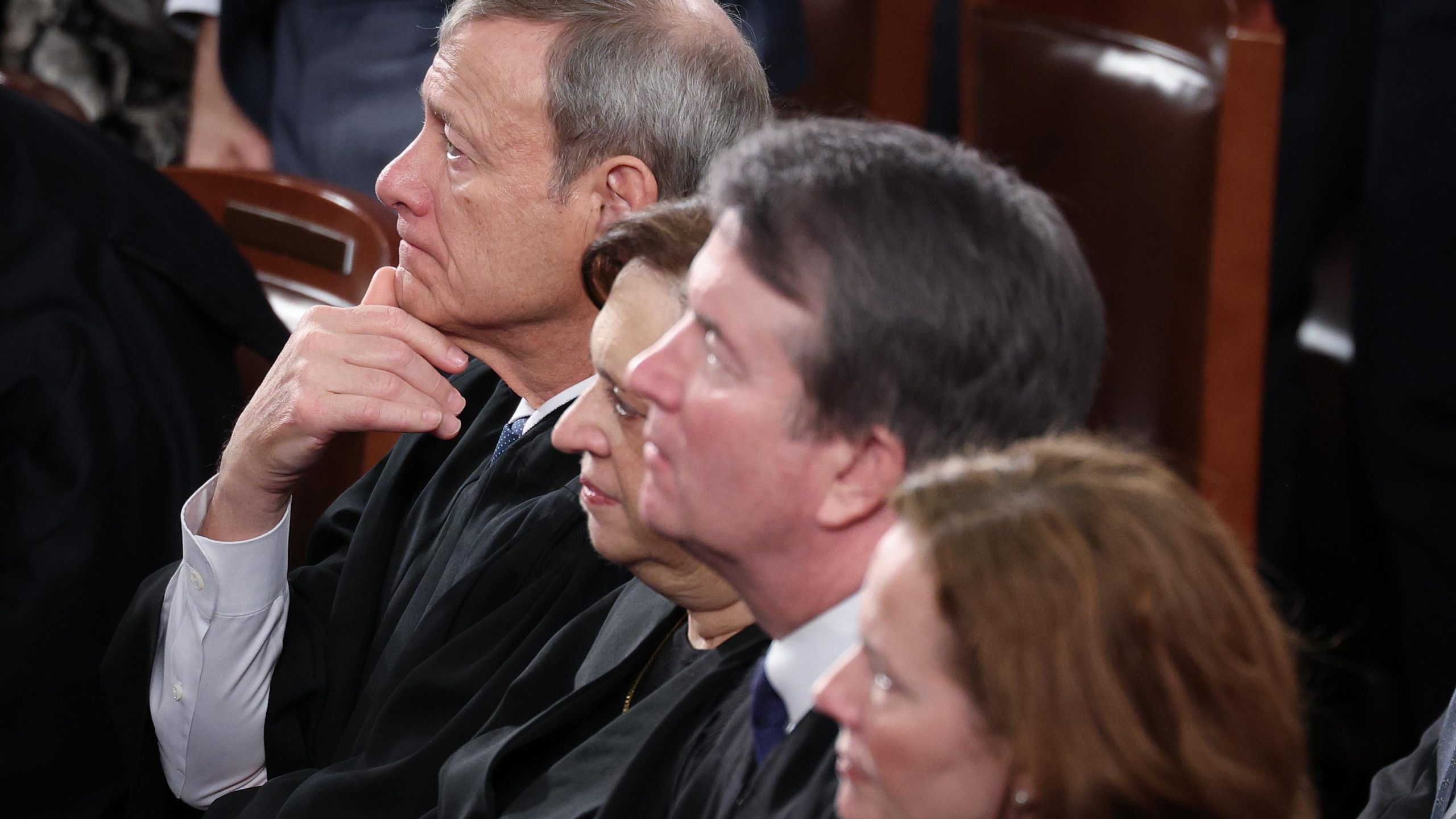
The conservative Justices have denied that the court’s decisions are politically motivated.
“I think, at a very basic level, people think we’re making policy decisions, we’re saying we think this is how things should be, as opposed to what the law provides,” said Chief Justice John Roberts at an event in May. “I think they view us as purely political actors, which I don’t think is an accurate understanding of what we do.”
The past few months have nonetheless seen Democratic lawmakers proposing other ways to revamp the court in an attempt to weed out partisan politics and rein in judicial powers. Here are some of those efforts:
Ongoing discussions over court size
The U.S. Constitution does not state how many Justices make up the Supreme Court, and the number of seats has changed over time, from as few as five Justices to as many as 10. Since 1869, however, the court has had nine authorized seats for Justices.
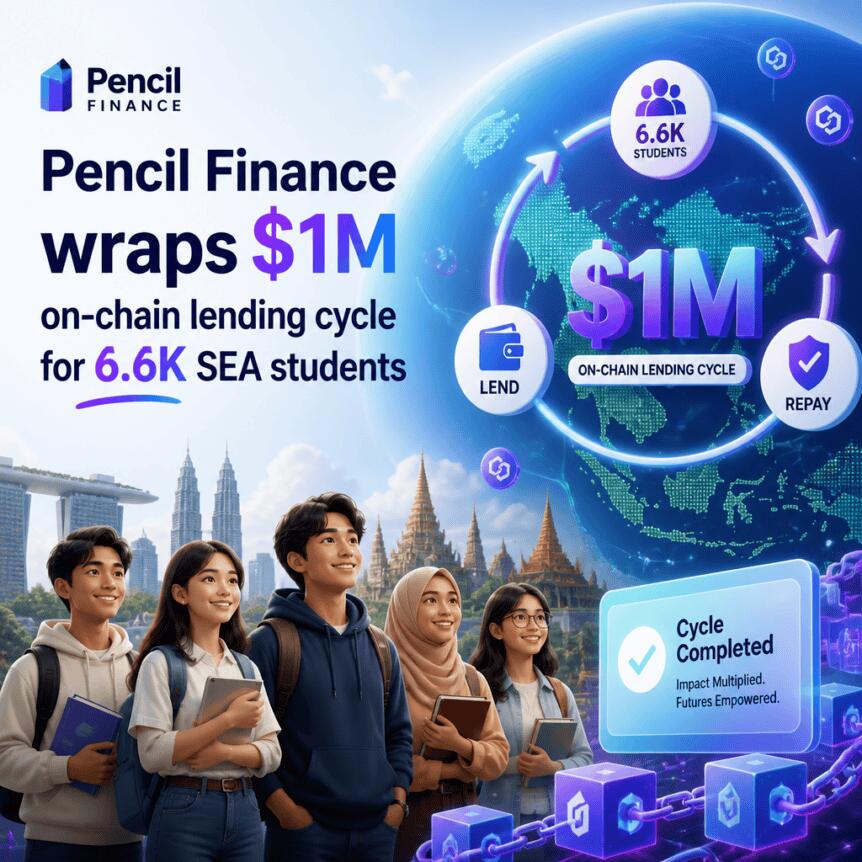
Student-loan infrastructure startup Pencil Finance says it has completed a fully onchain lending cycle worth $1 million, financing education borrowers in Southeast Asia and repaying investors via smart-contract-recorded cash flows.
In a Thursday announcement shared with Cointelegraph, Pencil described the milestone as its first “fully onchain” student loan cycle—one where the protocol deployed $1 million of lender capital on-chain and borrowers’ repayments flowed back to funders through a structured yield distribution.
Key takeaways
- Pencil Finance completed a $1 million student-loan cycle recorded on-chain, marking its first fully onchain deployment for this use case.
- The July 2025 bundle was funded by Animoca Brands, Open Campus, and New Campus, with senior fixed returns and a junior variable tranche tied to first-loss risk.
- The loans supported around 6,600 students across 118 schools and universities in Southeast Asia, with about 1,050 receiving direct funding.
- Pencil says the majority of borrowers were women (50%) and that 93% came from lower-income households—targeting students underserved by traditional lending.
- The announcement highlights growing interest in tokenized real-world assets (RWAs) for lending, including examples outside education.
How Pencil’s first onchain loan cycle worked
Pencil Finance said the protocol launched the $1 million loan cycle as an onchain bundle that functioned like a lender-to-borrower pipeline. Instead of keeping core loan accounting off-chain, the platform recorded the cycle on a blockchain network, where capital was deployed by lenders and later repaid by borrowers to distribute yield back to funders.
The project framed this as a proof point for transparency in credit: because the lending cycle is executed and tracked on-chain, investors and participants can follow the protocol’s operations through recorded transactions rather than relying entirely on traditional reporting channels.
What the tranche structure covered
According to the announcement, the $1 million bundle was funded in July 2025 by Animoca Brands, Open Campus, and New Campus. Pencil said the financing was organized into two tranches with different risk and return profiles.
The senior tranche offered fixed returns, while the junior tranche carried variable returns and bore first-loss risk. This type of waterfall structure is commonly used in tokenized and structured finance to allocate losses first to the riskiest portion of capital, potentially improving the risk profile of senior participants—while still exposing junior investors to performance variability.
Scale, eligibility, and who received support
Pencil Finance said the onchain student loan cycle financed approximately 6,600 students across 118 schools and universities in Southeast Asia. The company noted that around 1,050 of those students received direct funding under the cycle.
As for borrower demographics, Pencil reported that 50% of funded students were female and that 93% came from lower-income households. The company positioned these figures as evidence that the program is reaching applicants who are often overlooked by conventional lending, where credit access can be constrained by documentation requirements, limited credit history, or geographic and income barriers.
Notably, Pencil claimed the project is the first-ever “fully onchain” lending cycle financing student loans with transparent recording on a blockchain network—an emphasis that matters because tokenized RWA lending is still frequently debated on how transparent and auditable it truly is compared with established financial processes.
Why tokenized loans are gaining attention
Tokenized RWAs are increasingly being used to issue or collateralize loans, and Pencil’s announcement fits into a broader trend of trying to bring more of the lending lifecycle on-chain. The education-focused milestone also echoes how other markets are experimenting with onchain representations of real-world exposures.
For example, earlier coverage from Cointelegraph noted that in July, Brazil’s B3 stock exchange issued a 100,000 Brazilian reais (about $19,600) loan secured by 10 tokenized cows. In that structure, each cow was linked to a unique digital token tied to an encrypted digital identity, while AI-powered smart collars from agriculture tech company Cowmed monitored animal health.
While student loans and farm-asset-backed credit are fundamentally different, both examples point to the same underlying goal: encode key parts of credit risk and reporting into tokenized systems to improve traceability and potentially reduce the friction between traditional assets and onchain capital.
What to watch next
With Pencil Finance now pointing to a completed first fully onchain student loan cycle, the next questions for readers and potential participants are whether subsequent cycles sustain repayment performance at scale and how tranche design evolves as more borrowers—especially underserved groups—enter the system.
Kraken’s parent company, Payward, has signed a partnership with SoFi aimed at linking Kraken’s exchange infrastructure with SoFi’s dollar settlement rails and bringing the SoFiUSD stablecoin into Kraken’s ecosystem. The deal connects SoFi’s 24/7 US dollar settlement network with Kraken Prime, Kraken’s institutional-grade execution venue.
Under the collaboration, SoFi will route eligible digital-asset orders through Kraken Prime’s smart order routing to source liquidity across multiple trading venues. Payward, meanwhile, will join SoFi’s SoFi Exchange Network (SEN) and gain access to SoFi’s business banking services, with the companies saying additional custody services could be added as the relationship expands.
Key takeaways
- SoFi plans to use Kraken Prime as an additional liquidity source by routing digital-asset orders through Kraken’s smart order routing.
- Payward will connect to SoFi’s SoFi Exchange Network (SEN) for access to round-the-clock US dollar settlement.
- The partnership introduces SoFiUSD to Kraken, with the stablecoin issued by SoFi Bank and backed by reserves held in cash and short-term US Treasurys.
- Both firms indicated custody-related services could be incorporated later, suggesting an expanding scope beyond execution and settlement.
- The move fits Payward and Kraken’s broader strategy to build deeper ties with traditional finance and tokenized markets.
How the Kraken–SoFi link is designed
Kraken described the collaboration in a Thursday blog post, explaining that SoFi will route digital asset orders through Kraken Prime. Kraken Prime uses smart order routing to assess pricing and market depth across supported venues in real time, then send orders to the venue most likely to achieve the best fill.
Kraken said this matters because it helps SoFi avoid relying on a single order book for execution. With access to liquidity across multiple venues, SoFi can potentially improve execution quality—especially when markets are fragmented or liquidity conditions change quickly.
The partnership also extends to settlement. Kraken’s institutional and business clients will be able to use SEN, according to the companies, enabling US dollar settlement on a 24/7 basis. For participants used to digital-asset trading hours, around-the-clock settlement is a practical improvement: it reduces downtime between trading and funding/settlement cycles and can streamline cross-platform operations.
SoFiUSD arrives at Kraken
A central element of the agreement is the stablecoin itself. SoFiUSD is issued by SoFi Bank and is described as a dollar-backed stablecoin launched in 2026 for payments and settlement. The companies say SoFiUSD reserves are held in cash and short-term US Treasurys.
By bringing SoFiUSD to Kraken, the partnership effectively broadens the set of dollar-denominated settlement and payment options available to traders and institutions interacting with Kraken’s venues. While the article does not specify which custody or issuance workflows will be added first, the direction is clear: SoFiUSD is positioned as a key bridge asset between the banking-oriented settlement network and crypto trading infrastructure.
Kraken also indicated that qualified custody services could be added as the partnership matures. That point is important for institutional users, because custody and settlement capabilities are often treated as linked requirements in digital-asset operations—especially for firms that need compliance-aligned processes across multiple stages of trading and asset handling.
SoFi’s customer reach meets Kraken’s institutional rails
SoFi already has a large consumer base and offers crypto trading through its app, and Kraken Prime is presented as an additional path for sourcing liquidity rather than a complete replacement of existing execution methods. The companies said SoFi routes eligible trades through Kraken Prime, giving SoFi access to liquidity beyond any single execution venue.
Kraken’s role in SEN is similarly framed as an infrastructure upgrade for clients. By connecting to the SoFi Exchange Network, Kraken and its institutional and business customers can potentially take advantage of round-the-clock US dollar settlement through a banking-linked network—an increasingly important capability as more platforms seek to reduce operational friction in digital-asset markets.
From an investor and operator perspective, the practical value of such connectivity is less about headline integration and more about what changes in daily operations: faster and more continuous settlement options, the ability to execute orders against deeper liquidity pools, and a stablecoin that is explicitly designed for payments and settlement.
Part of a wider push beyond pure crypto
This partnership follows other efforts by Payward and Kraken to broaden their connections to traditional finance. Earlier reporting noted that London Stock Exchange Group reportedly partnered with Payward to offer tokenized versions of leading UK equities through LSE 24, a new 24/5 trading venue set to launch in 2027. Separately, Kraken has added round-the-clock exposure to the S&P 500 through its funded trading program, with commodities expected to follow.
Kraken has also expanded into tokenized public markets via xStocks, the tokenized equities platform developed by Backed Finance, which Kraken acquired in early 2026. Kraken has used xStocks to provide eligible users exposure to share-linked offerings tied to SpaceX and Jersey Mike’s IPO activity, in some cases including direct share allocations.
In the background is Payward’s plan to become a public company. The company reportedly submitted a draft registration statement to the US Securities and Exchange Commission in November 2025, though reports indicate the earliest possible listing timing has been pushed to the second quarter of 2027.
Taken together, the Kraken–SoFi deal reinforces a theme: rather than treating stablecoins, execution, and settlement as separate silos, Payward is building bridges between banking-grade settlement networks and crypto trading infrastructure. If that strategy continues, stablecoins like SoFiUSD and networks like SEN could become more central to how institutions operationalize digital-asset trading—particularly for firms that want 24/7 dollar rails aligned with regulated financial workflows.
Going forward, readers should watch how quickly the partnership expands into additional custody services and how widely Kraken’s institutional clients adopt SEN for continuous US dollar settlement. The next question for the market is whether integrations of this kind—linking bank-adjacent settlement, smart order execution, and dollar-backed stablecoins—become the default operating model for large exchanges and financial platforms.

Uber and Lyft may soon have a new U.S. competitor. The Vietnamese rideshare company Green and Smart Mobility (GSM) plans a U.S. and European expansion by the end of this year. GSM is partnered with Vietnam’s largest automaker VinFast (VFS), which supplies all of the service’s vehicles. GSM is owned by VinFast CEO Pham Nhat Vuong. The plan is to…
Copyright ©2026 Investor’s Business Daily, LLC. All rights reserved. 87990cbe856818d5eddac44c7b1cdeb8

Dubai’s regulator VARA (Virtual Assets Regulatory Authority) has signed a Memorandum of Understanding (MoU) with Securitize, a tokenization platform backed by BlackRock, in a move aimed at accelerating regulated tokenization activity in the United Arab Emirates.
According to a Thursday announcement shared with Cointelegraph, the MoU sets out a collaboration framework designed to support tokenization and digital asset infrastructure in Dubai, encourage institutional participation, and help shape how tokenized financial products can operate within the emirate’s regulatory environment.
Key takeaways
- VARA and Securitize have agreed to work together on a regulatory-and-industry collaboration framework for tokenization in Dubai.
- The MoU is positioned as a broad cooperation model rather than the announcement of a specific tokenized product or technology stack.
- Dubai continues to position tokenization as regulated financial infrastructure, with VARA pointing to its regulatory “perspective” as a key contribution.
- Demand for tokenized real-world assets (RWAs) has increased sharply in recent weeks, with RWA.xyz reporting rising holder counts and total tokenized asset value.
- Dubai’s efforts arrive as other market operators—such as the London Stock Exchange’s reported partnership with Kraken—push tokenized securities toward more established trading schedules.
VARA and Securitize target regulated tokenization in Dubai
Under the MoU, VARA and Securitize said they aim to support regulated tokenization initiatives across Dubai and the broader UAE. The agreement is also intended to cover tokenization projects initiated by VARA, with a specific focus on understanding how tokenized financial products should function inside Dubai’s existing regulatory framework.
When asked by Cointelegraph about the MoU’s infrastructure objectives, a VARA spokesperson said the effort is meant to establish a collaboration structure between the two organizations rather than to deliver a particular technical implementation or a named product.
“The intention is to combine VARA’s regulatory perspective with Securitize’s experience in institutional tokenisation to identify where collaboration can help support the development of trusted, regulated tokenised markets in Dubai.”
The spokesperson added that no concrete projects will be announced “at this stage.” Still, the agreement creates a formal channel for cooperation that VARA said is intended to “support relevant tokenisation initiatives in Dubai.”
Tokenization shifts from concept to “mainstream” infrastructure
Dubai’s push for tokenization is being framed not as an experimental niche, but as a step toward more conventional financial-market infrastructure. Carlos Domingo, co-founder and CEO of Securitize, described Dubai as among the most “forward-looking jurisdictions” for digital asset innovation and emphasized the importance of regulatory collaboration as tokenization matures.
Domingo’s remarks reflected a broader industry narrative: tokenization is increasingly discussed as a pathway for traditional finance to gain on-chain settlement and programmable workflows, but only if regulators can provide clear operating boundaries.
That theme is reinforced by VARA’s licensing activity. Earlier in July, VARA granted its 50th virtual asset service provider (VASP) license to Tribe Tokenisation FZE—an example of how the regulator has been expanding the number of licensed participants in the ecosystem. While the MoU with Securitize does not announce specific licensed activity, it suggests that regulators are looking to institutional-grade platforms as partners in building “trusted” markets.
Rising RWA adoption meets institutional platform scale
Beyond Dubai-specific policy developments, the MoU arrives amid a broader acceleration in tokenized real-world assets. Data provider RWA.xyz reports that the total number of RWA token holders rose 103% over the prior 30 days to 3.2 million. Over the same period, it said the total value of tokenized assets increased by 2% to $38.5 billion.
Those figures help explain why institutional platforms are increasingly positioning tokenization as a serious revenue and infrastructure layer rather than a purely experimental technology. Securitize is described in the announcement as the world’s largest tokenization platform by tokenized assets under management (AUM), with $4.9 billion. Ondo Finance is reported as second, with $3.5 billion.
For investors and market participants, the practical implication is that regulatory discussions are increasingly happening alongside measurable growth in both participation and capital in tokenized asset categories—particularly RWAs, where compliance and asset governance are central concerns.
Dubai’s move mirrors broader tokenized securities momentum
Dubai’s MoU also lands as tokenization continues to spread across market structures in other jurisdictions. Days earlier, Cointelegraph reported that the London Stock Exchange reportedly partnered with crypto exchange Kraken to launch tokenized stock trading on the operator’s night-time trading venue, aiming to offer 24/5 trading.
While the Dubai agreement is focused on regulated tokenization infrastructure and the operation of tokenized financial products under VARA’s oversight, the parallel is clear: both developments signal that tokenization is moving from issuance and experimentation toward distribution and market access—where regulatory fit, liquidity, and operational reliability become decisive.
As VARA and Securitize begin working under the MoU framework, the key next question for participants will be whether the collaboration produces specific pilot programs or licensing pathways—and how Dubai’s regulatory approach will translate tokenization activity into durable market infrastructure as demand for RWAs continues to grow.
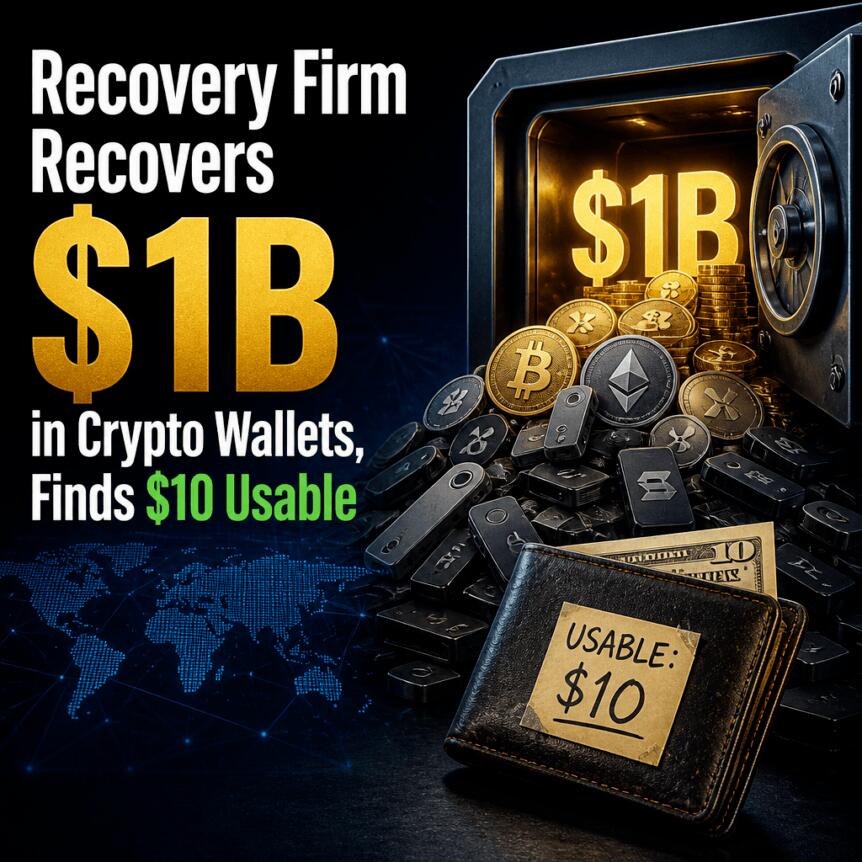
A case involving a supposed “lost fortune” in Bitcoin has become a cautionary tale about how often crypto recovery isn’t just a technical challenge—it can also be a problem of scams, misunderstandings, and missing context about what exactly is stored in a wallet.
In 2021, Chris Brooks, founder and chief executive of Crypto Asset Recovery, was contacted by a client identified as “Rusty.” Rusty and two other men claimed they had won roughly 5,000 Bitcoin in a court case (worth about $53 million at the time) and said they could withdraw up to $300,000 per week. Brooks and his son traveled to help crack the wallet, only to find that the information provided pointed in a very different direction.
Key takeaways
- Crypto “recovery” often means reconstructing access information (seeds, passwords, or missing words), not recovering funds from the blockchain.
- A correct seed phrase can still lead users to think funds are gone if a passphrase was forgotten—wrong passphrases may not trigger errors.
- If a seed is truly destroyed and truly random, there is no practical recovery path—self-custody has a hard limit.
- Recovery firms can be targeted by scammers, and choosing a provider is itself a security decision.
- Unsourced promises, upfront payments, and pressure to move quickly or through nonsecure channels are major red flags.
When “millions in crypto” turns out to be something else
Brooks recounted that Rusty initially presented what he described as a Bitcoin address containing about $53 million. During the first call, Brooks says he realized something was off when Rusty showed another balance—presented as about $1 billion in ETH.
Rusty then drove Brooks and his son to a strip mall office and handed them notebooks containing dozens of recovery seeds. The work involved opening wallets throughout the day, but Brooks says they ultimately found only around $10 in Bitcoin.
The record of what the notebooks represented—and whether they corresponded to any of the claimed balances—was never clarified. Brooks was also not reimbursed for travel costs. With the benefit of hindsight, he suspects Rusty was likely misled by scammers who convinced him he had a large crypto holding that didn’t exist.
Brooks described the episode as an early lesson for his business: sometimes crypto is lost, sometimes the wallet or password is lost, but sometimes the money was never there to begin with.
What wallet recovery specialists actually do
For firms that focus on recovery, “lost crypto” can mean several distinct scenarios. According to Bruno Krauss, co-founder and chief technical officer at recovery firm ReWallet, specialists generally aren’t “undoing” transactions on-chain. Instead, they aim to regain the information required to access an existing wallet—information that may be incomplete, forgotten, or corrupted.
In many cases, missing access material can be reconstructed. Krauss explained that Bitcoin’s BIP39 standard uses a list of 2,048 words, so if someone remembers most of the seed phrase, recovery work may involve systematically testing the remaining unknown words. The fewer elements missing, the smaller the search space becomes.
Password recovery can follow similar logic, including reconstructing likely characters when users recall patterns or context around how they created a password.
Krauss also described a behavioral approach: understanding how individuals tend to choose secrets. In one example, a customer believed her password used her children’s names. Eventually, she realized the password was actually tied to a phone number connected to a local delivery service—an association she remembered when she thought about when a package was delivered to a store.
Passphrases: the part that can hide funds without any warning
Even when users have the correct seed phrase, forgetting a passphrase can effectively make funds inaccessible. Tom Bennet, a Bitcoin educator who has studied wallet security, said that passphrases add a layer of information on top of the seed: enter the wrong passphrase and you can end up with another valid wallet rather than an explicit error.
“A wrong passphrase doesn’t throw an error; it succeeds and shows you a zero balance.”
That means users may reasonably conclude their Bitcoin has vanished when the underlying issue is simply that they entered the wrong passphrase. Bennet also argued that passphrases do not provide the same built-in protections as seed phrases—no fixed word list and no checksum equivalent. If the passphrase was sufficiently random and is fully forgotten, recovery can be effectively impossible.
There are also practical nuances with hardware wallets. Even if a device is broken, the keys may still be restorable if the seed backup survives. In other words, recovery specialists may not need the original hardware, but they do need enough information to reconstruct access to the keys.
Recovery can even involve repairing mistakes. Brooks said the firm has been contracted to crack more than 3,000 wallets for around 1,500 people, and that it has cracked passwords for about 63% of them. Some cases may depend on understanding what chain assets were sent to and whether the receiving wallet is under the client’s control.
The hard limit: when randomness is gone, recovery may be impossible
While many cases are solvable in some form, there is a boundary beyond which recovery becomes unrealistic. Bennet said that if a wallet seed is truly random and is completely lost, the Bitcoin is gone.
Bitcoin’s self-custody model is built around that trade-off: there is no centralized account recovery system, no bank-style mechanism to verify identity and restore access. If the information needed to derive keys is irrecoverably destroyed—and the wallet containing those keys is inaccessible—then no recovery service can help.
Lucien Bourdon, a Bitcoin analyst at hardware wallet maker Trezor, put it bluntly: if both the backup and the wallet are lost or inaccessible, “no recovery company can help.” He warned that if it were feasible to recover such wallets, the concept of self-custody would be fundamentally compromised.
That said, technical reality sometimes creates unusual opportunities. In the recent Coldcard hardware wallet context, for example, a firmware bug was reported to have weakened seed randomness on some wallets, making seeds brute-forceable without physical access—an example of how hardware and implementation flaws can change what’s recoverable. Broader historical issues with weak randomness were also cited as not being new.
Still, Krauss emphasized that specialists sometimes find technical “edge cases,” such as recoveries enabled by old wallet software, corrupted files, poorly generated passwords, or hardware vulnerabilities. But those are exceptions; the baseline remains that truly destroyed, truly random secrets can’t be brute-forced in practice.
Recovery as a security risk: scammers can move first
The Rusty story highlights a difficult irony: the information needed to recover someone else’s funds is the same information that can control those funds. That means selecting a recovery specialist is not just an administrative decision—it’s part of the security model.
Bourdon said users should do due diligence. He recommended looking for firms with a verifiable track record and reviews tied to actual customers. He also advised confirming that the provider charges on success rather than requesting money upfront, and to move funds to a new wallet with a fresh backup after recovery is completed.
He further warned users to be skeptical of unsolicited messages claiming someone can recover their crypto. Krauss echoed this concern, pointing to red flags such as pressure to communicate via WhatsApp, contact from personal email addresses, demands for upfront payments, and requests to open accounts on an exchange.
Percentage-based fees tied to recovered assets are common in the industry, but Brooks’ account makes clear why upfront payment promises should trigger alarm bells—especially when the “recovery” story is built around inflated balances.
What users should focus on before reaching out
After moving away from in-person processing for high-sensitivity cases, Brooks said Crypto Asset Recovery now handles investigations remotely and processes sensitive wallet information through automated and air-gapped systems. He also noted that many of the cracked wallets involved far smaller balances than clients expect: around 71% contained less than $100, and the company does not charge for asset recovery below that threshold.
In Brooks’ view, the simplest way to avoid needing recovery services at all is understanding what a recovery seed is and why it matters—because the biggest vulnerabilities often come from human gaps rather than cryptographic weaknesses.
Going forward, readers should watch for more public discussions of wallet randomness and hardware implementation issues, as those technical details are often what determine whether “recovery” is feasible at all—or whether the most important step is preventing loss in the first place.


Hyperliquid has introduced a preliminary HIP-3 testnet upgrade that lets independent deployment teams control access to perpetual futures markets through deployer-managed on-chain allowlists.
Summary
- HIP-3 deployers can choose whether to restrict access to their independently operated markets.
- On-chain allowlists can be managed by deployers or sub-deployers appointed by them.
- Existing HIP-3 markets will remain unchanged because the permissioning feature is optional.
- Separate talks involving Hyperliquid Labs, Payward and Bitnomial remain subject to CFTC clearance.
Hyperliquid co-founder Jeffrey Yan said in a testnet proposal that deployers will be able to create permissioned markets and manage their participant lists without handing access decisions to Hyperliquid’s core development team.
Hyperliquid HIP-3 adds optional on-chain allowlists
Under the preliminary design, a deployer can maintain an on-chain list of approved participants or appoint a sub-deployer to handle access. Market operators that do not need permissioning can continue using the existing HIP-3 structure without changing how their markets work.
Hyperliquid has made the first version available on the testnet, where developers can examine the design before any production release. Yan said the specifications remain preliminary, allowing the team to adjust the system after receiving technical feedback.
HIP-3 already allows outside teams to deploy perpetual futures markets on HyperCore without seeking approval from Hyperliquid’s core developers. Each deployer selects the assets offered through its market and controls several operating terms, including oracle inputs, leverage limits, and fees.
Responsibility also remains with the deployment team. Independent operators manage their markets, oversee settlement, and address problems tied to the products they list, while Hyperliquid supplies the underlying blockchain and trading infrastructure.
Adding permissioning extends the tools available to the same operators rather than transferring market control to Hyperliquid. A team could use an allowlist when its business model, legal obligations, or internal policies require it to limit participation, while another deployer could keep its market open under the present framework.
The design also separates infrastructure governance from market-level access. Hyperliquid would maintain the underlying network, but each participating team would decide whether to activate an allowlist and who qualifies to enter its deployment.
Independent deployers retain operational responsibility
HIP-3 was built to support markets launched by third parties instead of limiting product creation to Hyperliquid’s own team. Deployers can list perpetual contracts linked to crypto assets and other reference markets, provided they manage the technical and operational duties attached to their products.
A perpetual futures contract does not carry a fixed expiry date. Recurring funding payments help keep its price close to the referenced asset, while traders can maintain a position as long as they meet the applicable margin requirements.
Through HIP-3, independent teams can determine how those contracts are structured. Oracle selection affects the reference price used by the market, leverage rules determine how much exposure traders can take, and fee settings establish what participants pay for trading.
Permissioned deployments would add participant screening to that list of controls. Hyperliquid has not said that all HIP-3 operators must use the feature, and the testnet release does not change existing markets automatically.
Such separation is consistent with Hyperliquid’s description of itself as a neutral infrastructure provider rather than the operator of every market built on its systems. Deployers remain responsible for the products they introduce and the access rules they choose to apply.
Operational control can also leave deployment teams responsible for failures linked to their own market configuration. Oracle quality, leverage settings, settlement procedures and access management sit with the operator rather than Hyperliquid’s central development group under the structure described by Yan.
During the testnet stage, participating developers can assess how allowlists interact with trading accounts, market permissions and sub-deployer roles. Hyperliquid has not announced a date for moving the feature to mainnet, and feedback could alter the final specifications.
Permissioned markets could support compliance controls
On-chain allowlists provide a technical method for restricting participation, but the proposal does not state that activating one makes a deployment compliant with any particular jurisdiction. Legal obligations depend on the assets, customers, operator, and countries involved, while an allowlist only controls which blockchain accounts can enter a market.
For U.S.-facing operators, derivatives access is generally tied to Commodity Futures Trading Commission rules and the licenses held by the venue, clearing organization, and intermediary. Permissioning software by itself does not replace registration, customer-protection, reporting, or market-surveillance requirements imposed by the regulator.
In July, the Hyperliquid Policy Center and Phantom requested tailored rules for decentralized trading systems. As crypto.news reported, the groups argued that software developers and non-custodial wallet providers should not automatically face the same registration duties as traditional financial intermediaries that control customer assets.
An Aug. 26 filing from the Hyperliquid Policy Center and trade[XYZ] later proposed energy perpetuals tied to West Texas Intermediate crude, Brent crude, and Henry Hub natural gas. The filing said trade[XYZ] had operated third-party perpetual markets on Hyperliquid since October 2025 and recorded more than $500 billion in cumulative volume across several asset classes.
According to the filing, any regulated U.S. operator would still need to comply with CFTC rules covering customer protection, market integrity and recordkeeping. The groups also proposed asset-specific leverage limits, plain-language funding disclosures and controls addressing benchmark reliability and manipulation risks.
The CFTC has not approved the requested energy products. Its review covers price reliability, surveillance, position limits, margin, clearing, and the possible effects of continuous derivatives trading on physical commodity markets.
U.S. perpetual futures plans require regulatory clearance
Separate discussions involving Hyperliquid Labs and Kraken parent Payward could place selected crypto perpetual futures on Bitnomial, a regulated U.S. derivatives exchange. Payward has presented the proposed structure to the CFTC, according to the supplied report, but no authorization has been confirmed.
Under the discussed arrangement, eligible Bitnomial customers could trade selected crypto-linked futures using Hyperliquid technology. Bitnomial would provide the regulated venue, while the proposed technical and operating roles would depend on the final structure accepted by the companies and the CFTC.
Payward already owns Bitnomial, which holds U.S. exchange, clearinghouse, and brokerage licenses. Kraken launched regulated perpetuals for eligible American clients through Bitnomial in June, allowing users to manage spot, margin, conventional futures, and perpetual contracts from a Kraken Pro account.
The proposed Hyperliquid arrangement concerns selected contracts using its technology and remains distinct from Kraken’s existing Bitnomial products. Any launch would depend on the CFTC’s assessment of the contracts, market structure and safeguards presented by Payward.
A separate legal dispute could also affect how such products reach American customers. CME Group has challenged the CFTC’s treatment of perpetual contracts, arguing that they should be governed as swaps under the Dodd-Frank Act rather than listed as ordinary futures.
The perpetuals classification dispute began after the CFTC cleared Kalshi’s Bitcoin perpetual contract in May. CME’s position would place the products under a different regulatory framework, while the CFTC has argued that federal law does not require a futures contract to carry a fixed expiry date.
Payward’s proposal involving Hyperliquid technology remains before the CFTC, with no confirmed launch date, approved contract list, or final eligibility requirements for Bitnomial customers.

Privacy coins are gaining a place in regulated investment markets even as direct access to their underlying assets becomes harder. Grayscale’s Zcash ETF now trades on NYSE Arca, while major centralized exchanges have reduced support for Monero and other privacy-focused cryptocurrencies. THORChain’s latest upgrade shows how decentralized infrastructure could help close that access gap.
Summary
- Grayscale’s ZCSH gives US brokerage investors direct spot exposure to Zcash through NYSE Arca.
- Binance, OKX and Kraken have reduced Monero access amid growing regulatory pressure.
- THORChain v3.20 prepares the protocol for native Monero and Zcash swaps without wrapped tokens.
- THORChain later delayed the privacy-coin rollout while contributors focused on network stability.
- EU anti-money-laundering rules will restrict support for anonymity-enhancing coins from July 2027.
Privacy is reaching Wall Street as exchange access shrinks
Privacy in crypto is moving in two directions at once.
On one side, it is entering the financial mainstream. Grayscale’s Zcash ETF, ZCSH, began trading on NYSE Arca on Aug. 25. Grayscale described it as the first exchange-traded product to offer spot exposure to Zcash (ZEC).
The fund gives US investors a way to gain ZEC exposure through a regular brokerage account. They do not need to open a crypto exchange account, manage private keys, or hold the asset in a personal wallet.
On the other hand, directly buying, selling, and moving privacy coins has become more difficult in several markets. Centralized exchanges have removed assets or restricted access as regulators apply tighter anti-money-laundering standards.
The contradiction is hard to miss. Wall Street can now package exposure to a privacy-focused asset inside a regulated fund, while parts of the crypto market are becoming less willing or less able to support the underlying coins.
THORChain’s v3.20 upgrade matters within that divide. The release laid technical groundwork for native Monero (XMR) and Zcash swaps alongside assets such as Bitcoin (BTC), Ethereum (ETH) and stablecoins.
However, THORChain said after the upgrade that the Monero and Zcash rollout had been delayed while contributors focused on network stability. The protocol’s interface for supported cross-chain trades is available through its native swap platform, with XMR and ZEC access dependent on their final activation.
Monero delistings show the cost of centralized access
Monero provides the clearest example of how a permissionless cryptocurrency can remain operational while becoming harder to reach.
Binance removed XMR in February 2024, while OKX also ended support for Monero trading pairs. Kraken later stopped XMR trading and deposits for customers in the European Economic Area, citing regulatory changes.
Those decisions did not shut down Monero. The blockchain continued processing transactions, and users could still send XMR between compatible wallets. What changed was access to the services that many people use to enter or leave the market.
Monero is private by default. Its design conceals the sender, receiver, and transaction amount. Supporters see those protections as the digital equivalent of the privacy available when paying with physical cash.
The same design creates problems for centralized exchanges responsible for customer checks, transaction monitoring, and anti-money-laundering controls. Exchanges may struggle to collect the information expected by regulators when transaction details are hidden at the protocol level.
Europe is making that conflict more direct. The European Union’s Anti-Money Laundering Regulation addresses crypto accounts that allow transactions to be anonymized or made harder to trace, including through “anonymity-enhancing coins.”
The regulation is scheduled to apply from July 2027. Its provisions will prevent crypto-asset service providers from maintaining anonymous accounts or accounts that allow transaction obfuscation through such assets.
The US has not introduced an identical nationwide prohibition on privacy-coin trading. Still, limited support from large exchanges means American users may face fewer options than holders of more widely listed assets. Grayscale’s ZCSH provides regulated price exposure to Zcash, but owning an ETF share is not the same as holding ZEC or using its privacy features on-chain.
THORChain targets the missing bridge between privacy coins and crypto
A blockchain can remain permissionless at the protocol level while becoming difficult to use in practice.
Someone may still receive and send XMR through the Monero network. The larger problem appears when that person wants to move from XMR into Bitcoin, Ethereum, or a stablecoin without using a centralized service that supports both sides of the trade.
Native cross-chain liquidity offers another route. THORChain is designed to exchange assets across their original blockchains instead of requiring users to move wrapped representations onto a separate network.
Under the planned privacy-coin integrations, users would be able to move between native XMR or ZEC and supported crypto assets without first depositing their funds with a centralized exchange. They would not need to create an exchange account or surrender custody for the trade.
THORChain had already tested native Monero swaps before v3.20. As crypto.news reported in June, the protocol said XMR swaps were working from end to end in testing and that Zcash support would follow.
The delay announced after v3.20 shows that technical preparation does not guarantee immediate public availability. Cross-chain systems must manage separate networks, liquidity pools, and security risks, while privacy-focused assets can add further operational and regulatory questions.
THORChain said the delayed rollout would give contributors more time to prepare the Monero and Zcash integrations. Native swaps can reduce reliance on centralized intermediaries, although users must still consider liquidity, network, and implementation risks.
Zcash exposes the market’s privacy contradiction
Zcash makes the split between regulated investment access and on-chain privacy even clearer.
Unlike Monero, Zcash allows users to choose between transparent and shielded transactions. According to the project’s documentation, transparent addresses expose transaction information publicly, while shielded addresses are designed to protect financial details.
Grayscale’s ETF does not give investors access to either transaction type. ZCSH holds ZEC to track the asset’s market value, while investors buy and sell fund shares through a securities exchange.
The product therefore brings the economics of a privacy coin into a regulated US investment structure without giving shareholders its underlying privacy functions. Grayscale’s earlier filings also indicated that the fund would use transparent custody rather than shielded addresses.
For investors, that distinction matters. ZCSH offers price exposure and brokerage convenience, not private payments or direct participation in the Zcash network.
The ETF’s arrival still represents a notable change in how traditional finance treats privacy-focused assets. Crypto.news previously reported that Grayscale’s conversion followed an SEC filing process that began in May. The launch placed ZEC beside other crypto assets available through regulated US exchange-traded products.
At the same time, exchange delistings show that regulatory acceptance is not uniform. Authorities and financial firms may permit a transparent investment vehicle tied to a privacy coin while remaining uncomfortable with direct access to its transaction features.
Decentralized access does not remove every trade-off
THORChain’s planned XMR and ZEC support sits between those two markets.
Version 3.20 also restored support for Solana, Base, and BNB and introduced Protocol-Owned Liquidity and a Stable Reserve. Yet the privacy-coin integrations are more revealing because they address an access problem created outside the underlying blockchains.
Centralized exchanges offer customer support, fiat payment channels, and account protections that decentralized protocols may not provide. They also remain responsible for meeting the laws of every jurisdiction in which they operate.
Decentralized systems remove some of those intermediaries, but they place more responsibility on users. A person making a native swap must manage a compatible wallet, verify addresses, and understand that transactions may not be reversible. Liquidity and execution prices can also differ from those available on a large exchange.
Regulatory questions will remain even if the protocol itself does not require an account. Users are still responsible for following the laws, reporting rules, and tax requirements that apply in their country.
None of those limits change the central issue. A cryptocurrency is only partly accessible when its network remains online, but the main routes connecting it to the wider market disappear.
Privacy coins are now testing the meaning of permissionless finance. If regulated exchanges decide they cannot support certain assets, access will either continue to shrink or decentralized infrastructure will provide another path. THORChain is preparing to offer that path, although its Monero and Zcash swaps must first move from technical groundwork to a stable public rollout.
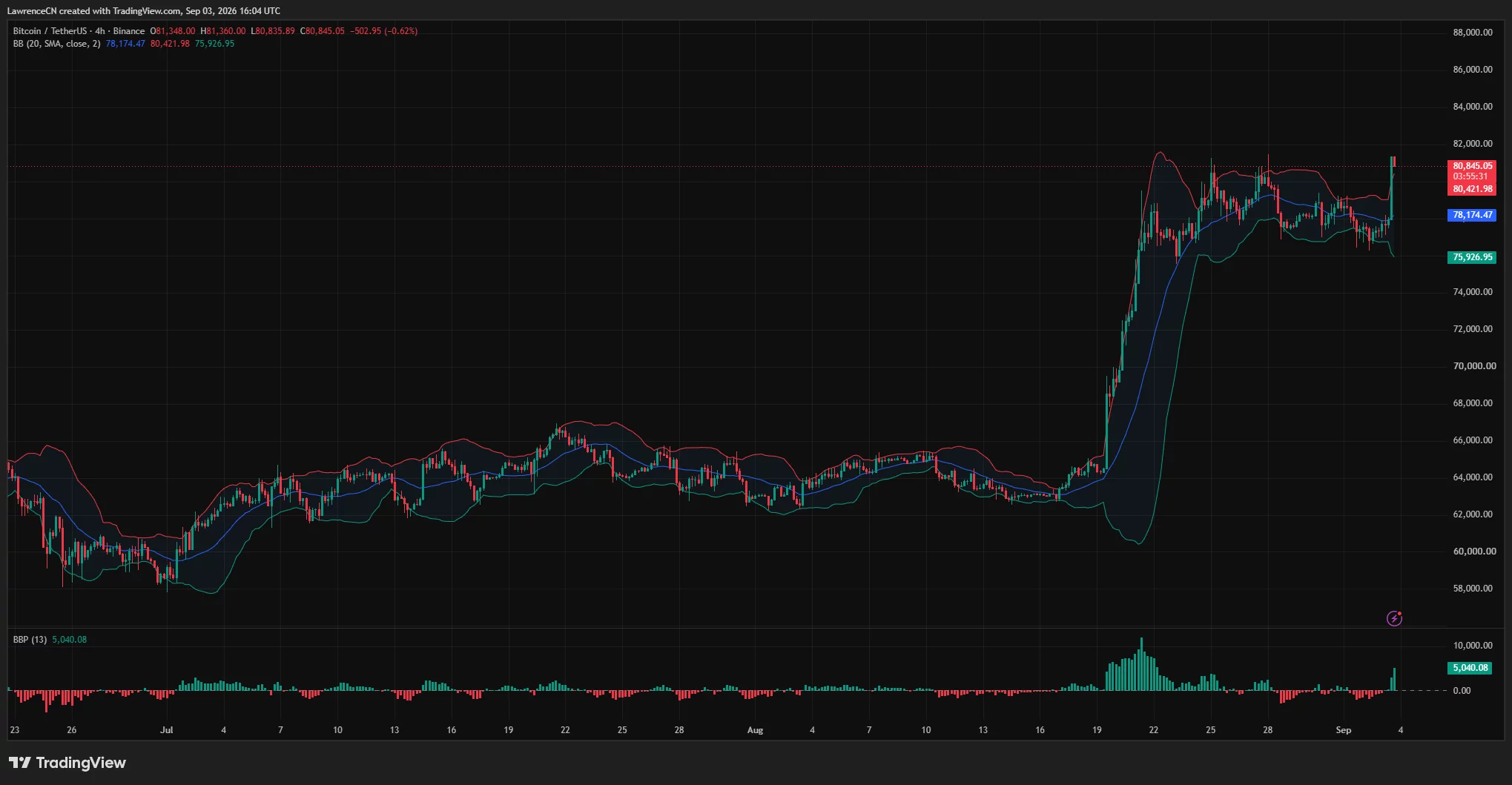
Bitcoin price extended its recovery above $80,000 on Sept. 3 after Federal Reserve Governor Christopher Waller cooled expectations for a September rate hike, while the charts showed strong momentum approaching a critical resistance zone.
Summary
- Bitcoin price gained 4.5% and reached an intraday high of $81,370.
- Waller said he could support holding rates steady if August inflation data shows further cooling.
- Daily RSI rose above 72, placing Bitcoin in overbought territory.
- A falling-wedge breakout could open a move toward $83,450 if buyers hold $80,000.
According to data from crypto.news, Bitcoin (BTC) price was trading near $80,840 at the time of writing, up approximately 4.5% from its daily opening price of $77,340. The asset traded between $76,968 and $81,370 during the session, according to the supplied Binance chart.
The move reversed much of the weakness seen earlier in the week and returned Bitcoin to the resistance area that stopped its August rally. Buyers must now turn the $80,000–$81,400 region into support to confirm that the breakout can continue.
Waller comments cool September rate hike expectations
Bitcoin accelerated higher after Waller said he was inclined to keep interest rates unchanged at the Federal Reserve’s Sept. 15–16 meeting if incoming inflation data confirms that price pressures are easing.
Waller did not rule out another increase. He said a hike could still be appropriate if inflation accelerates, making the Aug. consumer price index report due Sept. 11 an important input for the decision.
Interest-rate futures reduced the probability of a September increase following his comments, while two-year and ten-year Treasury yields declined. The dollar also weakened, creating a more supportive environment for Bitcoin and other assets sensitive to U.S. liquidity conditions.
Corporate demand provided additional support to the broader Bitcoin narrative. Strive CEO Matt Cole said the company could purchase more than 20,000 BTC before year-end, although the comment describes a potential acquisition rather than a completed or formally committed purchase.
Strive disclosed earlier this week that it had bought 1,800 BTC at an average price of $79,431, lifting its holdings to 23,156 BTC.
France-listed Capital B separately raised €7.6 million from Blockstream CEO Adam Back through a private placement. The company said the net proceeds could fund the acquisition of up to 376 additional BTC.
Bitcoin price reaches a major daily resistance zone
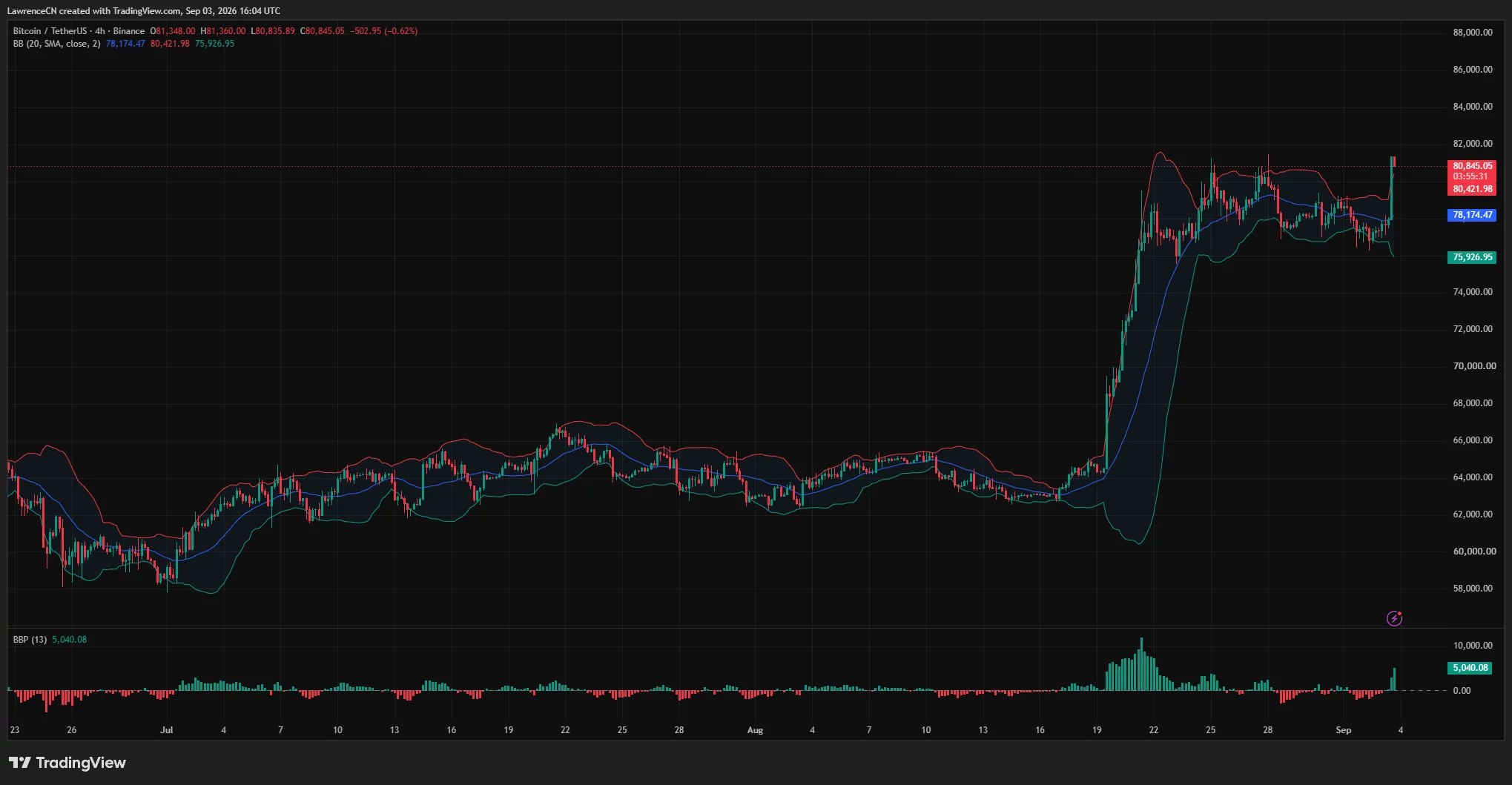
The daily chart shows Bitcoin retesting the area between $81,000 and $82,500, which capped several advances in May and August. A daily close above that band would improve the chances of a move toward $83,450 and then $85,000.
Analyst Franklin said Bitcoin was testing a falling-wedge breakout and identified $83,450 as the next level to watch if buyers defend the breakout. Falling wedges can precede upside moves, but the target remains conditional until price closes above nearby resistance.
Momentum has strengthened quickly. The daily relative strength index stands at 72.31, above the 70 level normally associated with overbought conditions. Its moving average is even higher at 75.50.
An overbought RSI does not guarantee an immediate reversal, especially during a strong breakout. However, it raises the risk of profit-taking if Bitcoin fails to establish support above $80,000.
BTC remains well above all four moving averages shown on the daily chart. The 20-day simple moving average sits at $74,775, followed by the 50-day at $68,489, the 200-day at $69,602, and the 100-day at $66,334.
The rising 20-day average gives bulls a clear medium-term advantage. Still, the large gap between the price and that average shows how far Bitcoin has moved in a short period.
4-hour Bollinger Bands signal rising volatility
The 4-hour chart shows Bitcoin breaking above the upper Bollinger Band at approximately $80,422, with the price near $80,845. The middle band lies at $78,174, while the lower band sits near $75,927.
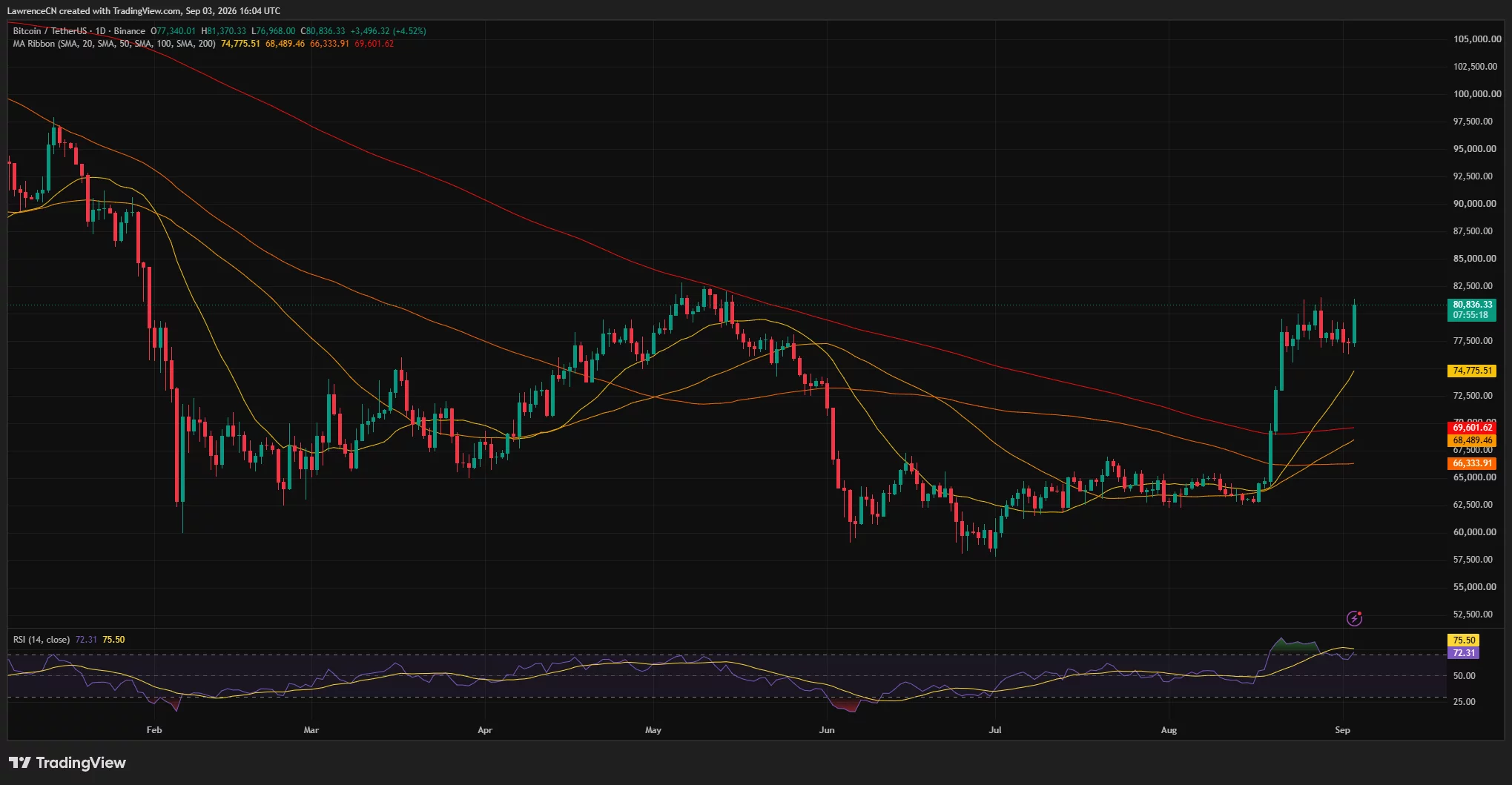
Trading above the upper band confirms strong upside pressure, but it can also indicate that price is temporarily stretched. The Bollinger Band width reading has expanded to about 5,040, reflecting a sharp increase in volatility.
The $80,400 area is therefore the first short-term level buyers need to protect. A successful retest could allow BTC to challenge $81,370 again before attempting a move toward $82,000 and $83,450.
Failure to hold the breakout would place the 4-hour middle band near $78,175 back in focus. Below it, the $76,000–$76,500 region represents a deeper support area and sits close to both the lower Bollinger Band and the session’s earlier low.
Liquidation map puts $81,500 in focus
CoinGlass’ 24-hour liquidation heatmap shows that Bitcoin climbed through several short-liquidation clusters between $78,000 and $80,500. Forced buying from traders closing bearish positions may have increased the speed of the advance.
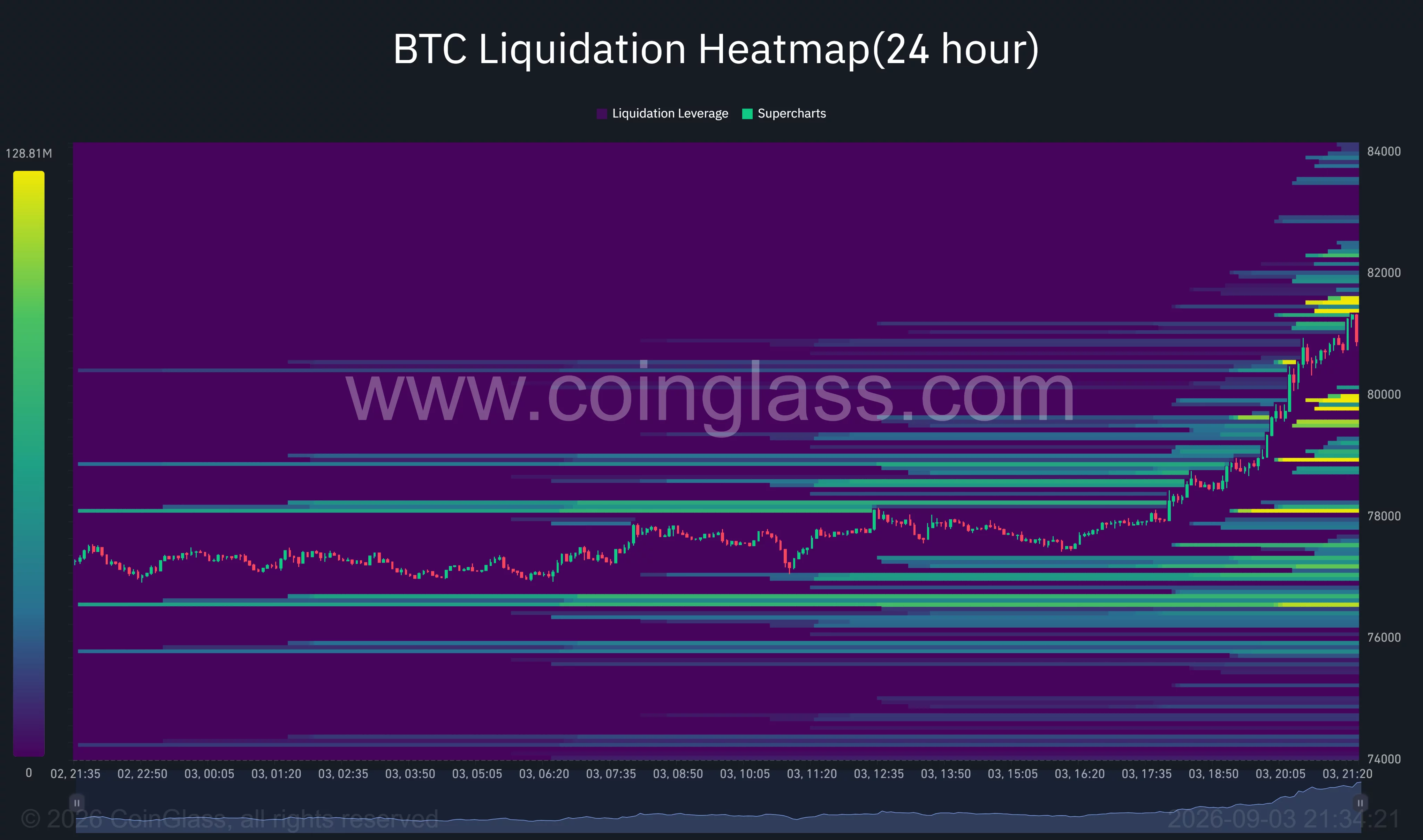
The largest nearby liquidity concentration above the market appears around $81,300–$81,600. A clean break through that zone could draw price toward smaller clusters near $82,000 and $84,000.
Downside liquidity remains concentrated around $79,700, $78,000, and $76,400–$76,700. If buyers lose $80,000, those clusters could attract price during a pullback.
Bitcoin’s next move will depend on whether spot demand can sustain the rally after the initial short squeeze. A close above $81,400 would strengthen the bullish breakout case, while rejection followed by a loss of $80,000 would leave the market vulnerable to a return toward $78,200.
Disclosure: This article does not represent investment advice. The content and materials featured on this page are for educational purposes only.
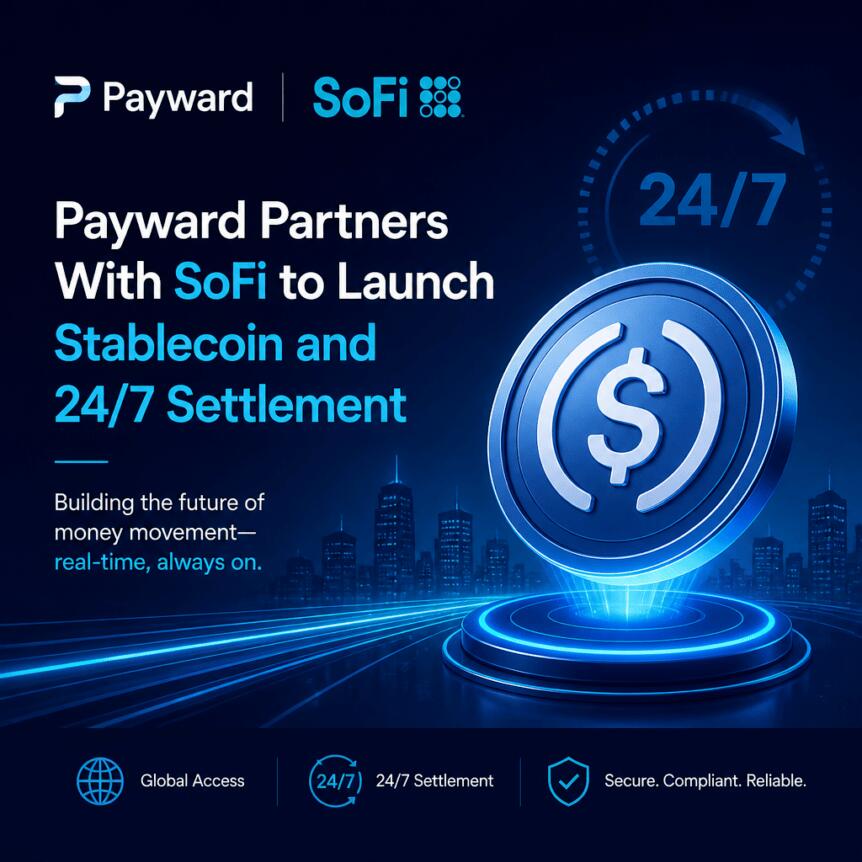
Kraken’s parent company Payward has announced a partnership with SoFi aimed at linking SoFi’s dollar settlement infrastructure with Kraken’s institutional trading and liquidity capabilities. The deal will bring SoFiUSD—SoFi’s dollar-backed stablecoin—onto Kraken, while connecting Kraken to SoFi’s 24/7 US dollar settlement network.
Under the collaboration, SoFi will route its digital-asset trading activity through Kraken Prime, using the exchange platform’s smart order routing technology to seek the best available fills across supported venues. Payward, meanwhile, will join the SoFi Exchange Network (SEN) and gain access to SoFi’s business banking services, with the companies saying qualified custody services could be added as the partnership expands.
Key takeaways
- SoFiUSD, issued by SoFi Bank and backed by cash and short-term US Treasurys, will be supported on Kraken.
- SoFi will use Kraken Prime as an additional liquidity source for digital-asset orders, routed via smart order routing.
- Payward will join the SoFi Exchange Network for round-the-clock US dollar settlement for institutional and business clients.
- The partnership extends Kraken/Payward’s broader strategy of deeper ties with traditional financial rails and tokenized market access.
How SoFiUSD and Kraken Prime are expected to connect
SoFiUSD is designed for payments and settlement, with reserves held in cash and short-term US Treasurys. According to a Thursday blog post from Kraken, the partnership will route SoFi’s digital asset orders through Kraken Prime, a venue designed to evaluate pricing and market depth across multiple trading venues in real time and direct orders to where they can be filled most effectively.
That distinction matters for institutions and app-based providers. Rather than relying on a single order book, smart order routing can help a liquidity provider or trading app access fragmented liquidity that may be available elsewhere in the market. Kraken said that enabling routing through Kraken Prime gives SoFi access to liquidity across multiple trading venues.
24/7 dollar settlement through SEN
In the second half of the arrangement, Payward will connect to SEN, SoFi’s exchange network that supports continuous US dollar settlement. Kraken said SEN access will extend to its institutional and business customers, positioning the settlement layer as a key part of the product experience on both sides.
The companies also indicated that custody capabilities could be added later, depending on how the partnership evolves. For market participants, custody and settlement are frequently the two “make or break” components when moving from experimentation to scaled deployment—especially when a platform is trying to support frequent, automated flows.
Payward’s broader push into traditional finance
The SoFi announcement fits within a wider pattern of Payward and Kraken moving beyond the core crypto trading stack and into partnerships with legacy-market infrastructure.
Earlier this week, London Stock Exchange Group reportedly partnered with Payward to offer tokenized versions of leading UK equities through LSE 24, a new trading venue set to launch in 2027 (coverage of the reported partnership was noted earlier by Cointelegraph). In August, Kraken also expanded its funded trading offerings with exposure to the S&P 500, and said commodities were expected to follow in that program.
Kraken has additionally expanded into tokenized public markets through xStocks, a tokenized equities platform developed by Backed Finance, which Kraken acquired in early 2026. Using that platform, Kraken has offered eligible users access to shares tied to SpaceX and Jersey Mike’s IPOs through tokenized equities, and in some cases via direct share allocations.
These moves are notable because they shift Kraken/Payward’s narrative from “just” an exchange and custody operator into a bridge between crypto trading infrastructure and regulated market access workflows—an approach that can be attractive to institutions that want familiar settlement and distribution mechanisms.
Regulatory timing and the IPO backdrop
Payward’s traditional finance partnerships also come as the company prepares for a potential public listing. Reports indicate Payward’s IPO plans have been delayed multiple times.
According to Kraken, Payward confidentially submitted a draft registration statement to the US Securities and Exchange Commission in November 2025. However, reporting cited in the source indicates that the earliest timing for a listing has been pushed to the second quarter of 2027.
While the SoFi partnership itself doesn’t change the reported IPO timetable, it underlines the kinds of business developments Payward may want to demonstrate as it prepares to be scrutinized by public markets—namely, scalable relationships with non-crypto counterparties and settlement mechanisms that resemble mainstream financial infrastructure.
Going forward, market participants will likely watch whether custody services are eventually added to the SoFi-Kraken integration and how quickly SoFiUSD support expands across Kraken products and settlement workflows. The practical question for traders and institutions is whether the combination of multi-venue routing (via Kraken Prime) and continuous dollar settlement (via SEN) improves execution quality and operational reliability at scale.

Inde Navarrette to Star and Executive Produce Apple’s ‘The Waffle House Index’

Inside Taylor Swift and Travis Kelce’s secret hideaway: The $5.35m mansion, millionaire neighbors and tiny lakefront village nobody knew about
CrowdStrike at Fal.Con: pushes deeper into ai-driven security

Weekend Open Thread – Corporette.com

Weekend Open Thread: Brooks Brothers

London Mayor Sadiq Khan handed a peerage by Keir Starmer alongside 15 other Labour figures… just days before the PM leaves No10

CANARY CAPITAL: XRP WILL HAVE A MAJOR MOVE INCOMING!!? (GET READY)

ADA financial plans #relatable #ada #futureplans#fyp #financialplanning #youtubeshort #nigeriacomedy

Why is Tyler Catching Strays!! calebhammercomposer iamlindo #fyp #calebhammer #financialaudit #money
-

 Fashion6 days ago
Weekend Open Thread: Maeve – Corporette.com
-

 Crypto World7 days ago
Bitcoin’s 22% rally now needs real demand to outlast Treasury liquidity boost
-

 Business7 days ago
Apple Confirms September 9 Keynote and Reveals Its Full Pre-Order Schedule
-

 Crypto World18 hours ago
CLARITY Act could advance within weeks, Atkins says
-

 Business7 days ago
Salesforce Stock Soars 19% as Blowout Earnings and Agentforce AI Growth Silence Software Skeptics
-

 Business6 days ago
Onto Innovation Stock: AI’s Next Bottleneck Is Yield (NYSE:ONTO)
-

 Crypto World6 days ago
Bitcoin price tests $82K resistance as Brandt stays long
-
 Tech5 days ago
Hugging Face built a $4.5 billion empire on free AI models. Now Nvidia is buying it for $12.9 billion
-

 Business6 days ago
iPhone 18 Pro Pre-Orders Could Shift to Saturday as Apple Reportedly Avoids September 11 Anniversary
-

 Crypto World2 days ago
Elon Musk Says Grok 4.7 Lands in 10 Days and Will Beat Every Model
-
 Crypto World7 days ago
Truflation calls for Fed rate cut after PCE forecast
-
 Entertainment6 days ago
‘Adults’ Creators Break Down Season 2’s Most Shocking Moments and Tease a Potential Season 3
-

 Tech7 days ago
The fix for the AI agent that hijacked a company’s DNS: it can propose the change, but it can’t approve it
-

 News Videos4 days ago
Charlie Munger on Robinhood: No one should believe that Robinhood’s trades are free
-

 Tech6 days ago
PaperCut releases second emergency patch for exploited flaws
-

 Tech5 days ago
Tamagotchi Ring Takes the 30-Year Digital Pet and Places it on Your Finger
-
 Tech5 days ago
As the influencer economy drives retail sales, Seattle startup raises $22M to play matchmaker
-
 Crypto World2 days ago
Bitcoin slips below $77.5K as macro pressure offsets ETF inflows
-

 Crypto World14 hours ago
Kalshi seeks CFTC approval for WTI perpetual
-
 NewsBeat5 days ago
Trump posts AI video of ‘Lake America’ being protected by an army of bequiffed ‘Donald Ducks’
You must be logged in to post a comment Login