
Crypto World
CLARITY Act Meets State AG Resistance as Senate Vote Nears


The U.S. Senate is set to hold a crucial procedural vote Tuesday on the CLARITY Act, a major piece of proposed legislation aimed at reshaping how the federal government regulates digital assets and clarifying how crypto fits within existing securities and commodities frameworks.
While recent talks around ethics restrictions for public officials appear to have moved the bill closer to action—after President Donald Trump agreed to much of a bipartisan proposal—opposition from a coalition of state attorneys general is threatening to complicate momentum. In a letter led by New York Attorney General Letitia James, 18 state AGs urged senators to reject the bill, arguing that the compromise does not fully address concerns about undermining state oversight of crypto-related misconduct.
Key takeaways
- The CLARITY Act faces a Senate procedural vote Tuesday that will decide whether it advances to full Senate debate.
- Trump’s reported agreement to roughly “80%” of a bipartisan ethics proposal would tighten disclosure and divestment rules for officials with significant crypto interests.
- A coalition of 18 state attorneys general, led by Letitia James, says the bill’s language could weaken states’ ability to pursue crypto fraud and misconduct.
- Despite changes that would include state AG involvement in enforcement of ethics restrictions, the AGs contend other provisions may still restrict state police powers.
A Senate procedural hurdle looms
Tuesday’s vote is not a final decision on the merits of the CLARITY Act, but it is an important gatekeeping step. As reported by Cointelegraph, Senate Majority Leader John Thune filed a cloture motion on the bill last month after lawmakers did not move it forward before leaving Washington for the August recess.
In practical terms, the procedural vote will determine whether senators can proceed to debate. For market participants and legal stakeholders, that matters because the CLARITY Act is designed to establish a clearer federal structure for digital asset regulation—especially by delineating when assets are treated under securities law versus commodities law—and by defining the roles of the SEC and the CFTC.
Trump’s reported ethics deal reshapes the bill
The latest complication comes from the intersection of ethics rules and enforcement authority. According to the Associated Press, Trump agreed to about “80%” of a proposal from Republican Senator Thom Tillis and Democratic Senator Ruben Gallego, citing a senior GOP aide.
The bill already barred federally elected officials, their spouses, and federal judges from issuing digital assets. The reported compromise would increase the requirements for officials with a “significant” financial interest in a crypto issuer—requiring divestment or placement of that interest into a blind trust.
It also expands the practical enforcement footprint by giving state attorneys general a role in enforcing the new ethics restrictions. The changes are intended to address concerns raised by Democrats and Tillis, who argued earlier provisions were not stringent enough to handle potential conflicts involving Trump’s crypto holdings and business interests.
Crypto in America, a publication co-hosted by Eleanor Terrett, described the weekend developments as sparking renewed optimism in parts of the industry, framing the revised package as Republicans’ effort to move Democrats toward agreement ahead of Tuesday’s procedural vote.
State attorneys general oppose—citing enforcement and federal-state tension
Even as ethics provisions appear to have gained ground, a coordinated state-level challenge has emerged. In a letter to Senate Banking Committee leaders, 18 state attorneys general—led by Letitia James—argued that the CLARITY Act could make it harder for states to take action against crypto companies accused of fraud or other misconduct.
The AG coalition warned that while the bill reserves “certain powers” for states to prosecute fraud, the letter claims the language is ambiguous and unclear in ways that could allow challenges to states’ police powers or limit states’ ability to combat what the signatories characterize as a “scam epidemic.”
They also argue the structure of enforcement is not balanced. Although the updated bill would give state attorneys general a role in enforcing the new ethics restrictions, the AGs contend other provisions could still weaken their broader authority over crypto-related wrongdoing.
For legislators and watchers of U.S. regulatory federalism, this is the core tension: a bill designed to bring order to federal oversight and define agency responsibilities may still be perceived as constraining state prosecutors. The AG letter suggests that even modest statutory adjustments can create new litigation risks or narrowing interpretations—issues that can materially affect how quickly and effectively states can pursue alleged misconduct.
The letter is the clearest signal so far that the opposition is not only political but also legal and jurisdictional, setting up a potential debate over where responsibility should sit when both federal agencies and state officials can pursue different—but sometimes overlapping—enforcement theories.
The letter from the AG coalition
Why the CLARITY Act matters beyond the ethics fight
While Tuesday’s vote will be heavily discussed through the lens of ethics rules, the CLARITY Act’s significance extends well beyond that. The bill is widely described as a landmark effort to set a federal market structure for digital assets, including clearer guidance on the SEC versus CFTC divide.
That regulatory clarity is a key reason the legislation has been closely watched by market participants. For exchanges, custodians, token issuers, and financial institutions, regulatory uncertainty can directly translate into compliance costs, delayed product launches, and increased legal risk. For consumers, clearer rules are also intended to reduce the gray area that can be exploited by bad actors.
However, the state AGs’ concerns highlight a practical reality: even when federal law aims to coordinate oversight, states still play a crucial role in enforcing fraud and consumer protection. If the CLARITY Act’s drafting leaves room for arguments that states’ enforcement authority is curtailed or constrained, it could create a parallel track of legal fights—potentially slowing enforcement even if the bill ultimately advances.
As a result, investors and builders should not interpret Tuesday’s procedural vote as only a referendum on ethics provisions. It is also a test of whether senators are willing to move forward on a comprehensive framework while leaving unresolved questions about federal-state enforcement boundaries.
What to watch next is whether the Senate procedural vote clears Tuesday and, if it does, whether state AG objections shape the debate during full chamber consideration—particularly around how the bill’s provisions could affect states’ ability to pursue crypto fraud cases while the SEC and CFTC roles are being clarified.


Democratic Senators were said to be meeting late Monday to discuss the latest proposed draft text.


Transaction V1 raises Solana’s limit to 4,096 bytes from 1,232, giving developers more room for multi-step trades, company-wallet approvals and privacy proofs.
Batch V1.1 would let users bundle up to eight linked transactions into one operation, with 27 of 35 trusted validators now backing the change.
Crypto World
U.S. DOJ seeks $61 million in what it calls Iran's crypto-laundered black market oil sales
Prosecutors have filed a civil forfeiture complaint against what they call Iran’s illegal crypto proceeds that are used to fund its military.


CoinEx has begun a staged shutdown after nearly nine years, with spot trading ending Sept. 29 and withdrawals closing Dec. 22, 2026.
Summary
- CoinEx will stop spot trading September 29 and close platform withdrawals on December 22, 2026.
- Futures entered reduce-only mode September 15, while all non-spot services end September 22 across CoinEx.
- CoinEx will repurchase remaining CET at 0.005 USDT before automatic conversion begins on September 29.
- Unwithdrawn USDT will face a 5% monthly custody fee after the December 22 deadline passes.
- CoinEx Wallet and CoinEx Vault will continue operating separately from the exchange shutdown process globally.
CoinEx said in its Sept. 14 cessation notice that new registrations would stop on Sept. 15 as futures markets entered reduce-only mode, preventing traders from increasing existing positions or opening new ones. The exchange said it made the decision after a prolonged crypto downturn, weaker industry trading activity and liquidity, and rising regulatory and compliance costs. CoinEx’s official cessation notice
CoinEx shutdown starts with trading restrictions
From Sept. 15, CoinEx stopped new registrations, referral rebates and new subscriptions or orders across fiat services, margin trading, loans, Earn, staking and strategic trading. Existing futures positions can still be reduced before derivatives services end on Sept. 22, when open positions remaining on the platform are scheduled for forced settlement using index prices.
ViaBTC provided a separate operational confirmation on Sept. 15, saying it will discontinue its “Withdrawal to CoinEx” feature on Sept. 22 because of business changes at its exchange partner. ViaBTC told users with automatic withdrawals to CoinEx to replace the destination address before the feature closes. ViaBTC’s Sept. 15 service notice
On Sept. 22, the exchange plans to stop futures, fiat, margin, lending, Earn, staking, strategic trading and its OnChain service. Most on-chain deposits will stop the same day, while CET deposits remain available through Sept. 29. Spot markets are scheduled to remain open until Sept. 29, when unfilled spot orders will be canceled.
CoinEx cites lower liquidity and compliance costs
In the shutdown notice, CoinEx attributed its exit to a prolonged market downturn, contracting trading volume and liquidity, and rising rules across major jurisdictions. The company said compliance costs and “operational uncertainties” had reached levels it no longer considered reasonable. The notice did not name a regulator, lawsuit or court order as the immediate trigger for the closure.
The exchange had continued updating products and infrastructure only days before the exit announcement. On Sept. 9, CoinEx announced a futures server upgrade scheduled for Sept. 10, describing the work as a trading-experience update. One day later, it announced the delisting of 14 tokens, including MLN, XEM, GENSYN, FIDA and LISTA, under its normal asset-review process.
CoinEx has said user balances remain fully backed and that its asset reserve ratio exceeds 100%. Its proof-of-reserves system uses published wallet information and a Merkle tree that allows users to check whether account balances were included in a reserve snapshot. An August 2026 update displayed on CoinEx’s CET page said covered assets remained above 100% reserve ratios. The reserve figures are CoinEx disclosures. CoinEx’s reserve verification method
CET conversion and withdrawal deadlines shape asset exit
Spot trading is due to stop Sept. 29, when CoinEx will begin processing non-USDT balances. Assets with external market liquidity may be sold in batches and converted to USDT using net sale proceeds, while users holding assets without outside liquidity are being told to withdraw them before the cutoff if they want to keep the tokens in their original form.
The exchange set 02:00 UTC on Sept. 29 as the deadline for users who want to withdraw assets before that conversion process begins. CoinEx said assets without external liquidity may be delisted and their wallets will no longer be maintained after processing starts.
CET, the platform token used across the CoinEx ecosystem, has a separate exit process. CoinEx plans to maintain a 0.005 USDT buy order for CET through Sept. 29 and waive trading fees on CET/USDT during the repurchase window. Any CET still held in user accounts after the window is scheduled for automatic repurchase at the same price.
BeInCrypto reported CET trading around $0.00466 on Sept. 15, slightly below the announced 0.005 USDT repurchase level. CoinEx Smart Chain and OneSwap are scheduled to stop operating on Sept. 29, while the CSC cross-chain bridge redemption window will end at the same time.
Withdrawals from the exchange remain available until 02:00 UTC on Dec. 22. CoinEx said USDT left after the withdrawal period will move into independent custody and will incur a monthly custody fee equal to 5% of the original balance recorded at the deadline. Users may later submit claims, with the company setting Aug. 22, 2028 as the final claims date.
Regulatory and security history preceded the final wind-down
CoinEx had already withdrawn from the U.S. after a 2023 settlement with the New York Attorney General. The agreement required $1,172,971.50 in refunds for 4,691 New York investors and $626,133.88 in monetary relief to the state, while restricting the platform from serving New York customers and opening new U.S. accounts. The New York Attorney General’s settlement announcement
As crypto.news reported at the time, the settlement followed a New York lawsuit over the platform’s failure to register as a securities and commodities broker-dealer. The Sept. 2026 shutdown notice does not state that the earlier case caused the present closure.
In June 2026, CoinEx faced fresh scrutiny after a Wall Street Journal report linked $3.84 billion in transactions to Iran-related entities. CoinEx disputed the interpretation, saying it had no commercial relationship with Iranian government-linked entities and that transaction flows through an exchange did not prove knowledge or support. The company said it strengthened geo-fencing, sanctions screening, know-your-customer checks and transaction monitoring In related crypto.news coverage
Security researchers had examined CoinEx before the shutdown for a separate reason. SlowMist recorded an estimated $70 million loss from a September 2023 hot-wallet private-key compromise and said the attacker appeared connected to wallets used in the Stake.com and Alphapo hacks. SlowMist’s incident record
Elliptic independently said blockchain activity supported suspicion that North Korea’s Lazarus Group was behind the theft after stolen CoinEx funds moved through addresses connected with earlier Lazarus activity. Elliptic’s blockchain analysis
CoinEx rebuilt its wallet system after the breach and resumed deposits and withdrawals for major assets later that month. As previously reported by crypto.news, the exchange replaced deposit addresses while restoring services after the attack.
CoinEx Wallet and Vault stay outside the exchange closure
The exchange shutdown does not cover CoinEx Wallet or CoinEx Vault. CoinEx said both products are separate business services and will continue operating under their own service terms after trading, deposits and withdrawals on the centralized exchange have ended.
CoinEx Wallet’s support site remained active on Sept. 15, while its service terms retain sanctions-related access restrictions.
CoinEx Vault, launched as a custody product for institutions and large asset holders, is likewise excluded from the exchange cessation schedule. CoinEx previously described Vault as an independently structured custody service for enterprises, DeFi projects and professional asset holders.


The U.S. 10-year Treasury yield has climbed to 5.012% intraday as surging oil prices revived inflation concerns before the Federal Reserve’s Sept. 16 rate decision.
Summary
- U.S. 10-year Treasury yield reached 5.012% during Monday trading, its highest intraday level since 2007.
- Treasury’s official par yield finished Monday at 4.97% after the benchmark reversed from its peak.
- Brent crude approached $110 intraday Monday before settling at $105.68 as supply fears eased slightly.
- Federal Reserve begins its two-day meeting Tuesday, with Wednesday’s policy statement scheduled for 2 p.m.
- Nasdaq Composite closed 0.56% lower Monday while Philadelphia’s semiconductor index dropped 5.9% amid AI concerns.
The Wall Street Journal, citing Tradeweb data, reported that the benchmark yield reached 5.012% during Monday morning trading, its highest intraday reading since 2007, before falling back below the 5% level.
Official closing data showed a less extreme reading. The U.S. Treasury’s daily yield curve data put the 10-year par yield at 4.97% on Sept. 14, compared with 4.96% on Sept. 11 and 4.79% at the start of September.
U.S. 10-year Treasury yield retreats from 5.012%
Bond prices recovered after the early selloff, pulling the market yield away from its session high. Tradeweb data cited by the Journal put the later close near 4.96%, while the Treasury’s own par-yield methodology produced the 4.97% official daily figure.
The move followed several weeks of pressure across global government bond markets. Reuters reported that energy costs, federal borrowing requirements and expectations for tighter monetary policy had pushed yields upward before Monday’s brief break through 5%.
Longer-dated borrowing costs remained elevated as well. Treasury data showed the 20-year yield at 5.37% and the 30-year yield at 5.34% on Sept. 14. The 30-year rate had stood at 5.27% on Sept. 1.
Higher Treasury yields have coincided with pressure on crypto markets. As crypto.news previously reported, Bitcoin traded near $76,800 on Sept. 11 as rising oil prices, U.S. inflation and higher government bond yields reduced demand for risk assets.
crypto.news examined how a September Fed rate increase could affect Bitcoin and other cryptocurrencies as Treasury yields compete with non-yielding or volatile assets for investor capital.
Oil surge keeps inflation concerns in focus
Oil supplied the main fresh pressure on bond markets Monday. Brent crude climbed as much as 5% to roughly $109.80 before giving back much of its advance, according to Reuters. The contract later settled at $105.68 a barrel.
Saudi Arabia’s East-West pipeline remained at the center of the supply concerns after attacks forced the route offline. The pipeline allows Saudi crude to bypass the Strait of Hormuz and can reroute around 4 million barrels per day, equal to roughly 4% of global supply, Reuters reported.
Early Tuesday trading showed that the energy pressure had not disappeared. Brent futures rose $1.24, or 1.18%, to $106.93 a barrel, while West Texas Intermediate gained $1.29 to $102.65. Renewed Houthi attacks on Saudi Arabia and postponed talks between Gulf states and Iran kept supply concerns active.
Mitsubishi UFJ Bank analyst Yokoo Akihiko told Reuters that markets remained focused on whether “higher crude oil prices could add to inflationary pressures.” The assessment is an analyst view, while the duration of the pipeline outage and future oil-price path remain uncertain.
Energy prices have already appeared in the Fed’s own explanation of inflation. At its July meeting, the Federal Open Market Committee said inflation remained above its 2% objective partly because supply shocks had raised prices in sectors including energy.
Nasdaq falls as AI warnings hit semiconductor shares
U.S. stocks ended Monday lower while bond yields and oil remained elevated. The Nasdaq Composite declined 0.56% to 26,186.41, the S&P 500 fell 0.48% to 7,619.94, and the Dow Jones Industrial Average lost 0.29%, according to Reuters.
Semiconductor shares faced much steeper losses. The Philadelphia Semiconductor Index dropped 5.9% as Nvidia, Broadcom, Micron and other AI-linked stocks sold off following calls from industry executives for slower development of advanced artificial intelligence systems.
The technology selloff occurred alongside the bond-market pressure, but Reuters identified separate concerns behind the chip decline. Executives including Anthropic CEO Dario Amodei and OpenAI CEO Sam Altman had raised safety concerns surrounding advanced AI development, prompting investors to reassess assumptions about future AI spending.
The combination supported the U.S. dollar during Monday and early Tuesday trading. OCBC analyst Christopher Wong told Reuters that “higher oil, higher U.S. yields and weaker risk appetite” helped lift the currency.
Federal Reserve decision follows Wednesday
The Federal Reserve has begun its scheduled Sept. 15-16 policy meeting with its target federal funds range currently at 3.50%-3.75%. The central bank maintained that range at its July meeting by a 9-3 vote, while three officials preferred a 25-basis-point increase.
Market expectations have moved sharply since then. Reuters reported Tuesday that CME FedWatch pricing placed the probability of a quarter-point increase at roughly 93%, which would lift the target range to 3.75%-4.00%. The probability is market pricing and does not represent a Federal Reserve commitment.
Crypto markets are approaching the decision with yields still close to 5%. As crypto.news reported after the August CPI release, Bitcoin rebounded above $78,000 on Sept. 11 even as traders increased expectations for a September rate increase. A separate crypto.news report on Treasury yields and Bitcoin identified the Fed decision and Treasury-market conditions as key variables for the asset’s next move.
The Federal Reserve’s official calendar schedules the policy statement for 2 p.m. ET on Wednesday, Sept. 16, followed by the FOMC press conference at 2:30 p.m. The meeting will include an updated Summary of Economic Projections.


Crypto exchange CoinEx said it is winding down operations, citing a prolonged crypto market downturn, sinking trading volumes and liquidity, and rising regulatory and compliance costs, according to an announcement on Tuesday.
As part of the wind-down, CoinEx will halt new user registrations, referral commissions and other rewards. Futures contracts will enter a “Reduce-Only” mode. CoinEx will also stop accepting new orders or subscriptions across its fiat, margin trading, lending, earn, staking and strategic trading services.
“After much reflection, I have come to accept a hard truth. CoinEx did not become one of the industry’s leading exchanges, and the security and compliance risks of running a crypto exchange have become increasingly difficult to contain,” CoinEx CEO Haipo Yang said in a post on X.
The closure adds to a wave of crypto exchanges that have ceased operations this year for similar reasons, including BitMart, BitMEX and AscendEX.
From Sept. 22, CoinEx will discontinue all non-spot services and onchain deposits, with the exception of CET deposits.
From Sept. 29, all spot trading services will be discontinued, and non-USDT assets will be processed.
From Dec. 22, the withdrawal period will end, and the platform will cease operations. Any unwithdrawn USDT will be transferred to an independent custodian, which will incur a monthly custody fee.
CoinEx will also buy back CET at its initial listing price of 0.005 USDT per token, a slightly higher price than it was on Monday before the announcement.
Related: BitMEX to shut down after 11 years in crypto derivatives
CoinEx Wallet and CoinEx Vault will remain fully operational, as they operate independently of the exchange.
CoinEx was launched in December 2017 by crypto mining pool ViaBTC. The crypto exchange is ranked 33rd with $58 million in 24-hour trading volume, according to CoinMarketCap.
“To every user who has trusted and supported us over the past nine years, thank you for your trust and support in the past nine years. Thank you for being part of our journey.”
Magazine: HYPE price could suffer as Binance takes its revenue: Alice Liu

Balancer, one of the best-known decentralized exchanges built on automated market makers, has proposed winding down its protocol after a post-exploit restructuring failed to restore enough revenue to sustain growth. Balancer Labs CEO Marcus Hardt said he underestimated how long the fallout from a $128 million exploit in November would continue to suppress user traction.
The plan, posted on Balancer’s governance forum on Monday by Hardt, calls for a phased shutdown and the distribution of a remaining treasury currently valued at more than $9 million to BAL tokenholders. The proposal follows Balancer Labs’ earlier decision to shut down in March, when the team moved to a leaner operating structure while still supporting the protocol.
Key takeaways
- Balancer’s governance proposal would transition the protocol into a withdrawal-focused end state and wind down the DAO.
- The plan attributes weak revenue recovery to continued adoption drag after a November $128 million exploit tied to legacy v2 stable pools.
- Balancer Labs previously restructured to cut costs, but Hardt said the revenue side of that strategy fell short—v2 revenue declined and v3 did not replace it.
- The treasury distribution is expected to begin in May 2027, with additional rounds of payouts and a final sweep months later.
- BAL holders will vote on the wind-down via a snapshot window scheduled for Sept. 25–29.
Why Balancer is moving toward a shutdown
Hardt’s proposal positions the wind-down as the next step after a cost-focused overhaul. According to Hardt, Balancer Labs’ March shutdown and leaner follow-on structure achieved the promised operational changes—reducing costs and delivering certain products to tokenholders—but did not generate sufficient revenue to justify continuing full development and business support.
In a statement on X, Hardt argued that “most of the protocol’s revenue still comes from v2,” while v3 revenue had not grown enough to fill the gap. He summarized the outcome as a product that worked but did not “sell enough,” framing the issue less as a technical failure and more as an economic one.
Hardt tied the revenue weakness to the long tail of the November exploit. Data from DefiLlama shows Balancer’s monthly protocol revenue dropping sharply following the incident: it fell to $371,000 in November from $1.13 million in October. DefiLlama data also indicates revenue continued to trend downward into 2026, with August revenue at $56,781.
While the exploit impacted legacy v2 composable stable pools, Hardt emphasized that the incident’s name and reputational impact still carried into v3 discussions and made it harder to build traction. In his governance forum post, he said the November 2025 exploit “hit legacy v2 pools,” noting that v3 uses a different architecture—but added that he underestimated “how much the exploit would continue to limit adoption.”
How the proposed wind-down would work
The governance document outlines a staged approach beginning next month. It would end new business development immediately, and it would give liquidity providers until Oct. 30 to prepare to exit the protocol. In the meantime, the plan distinguishes between pools based on whether they can be paused.
Pools that can be paused would be moved to withdrawal-only. For pools that cannot be paused, they would continue operating, but—where contracts allow it—the protocol fee would be set to zero. This structure aims to preserve user exit paths while reducing ongoing protocol economics that could further drain the treasury.
From Nov. 1, Balancer would run only the minimal infrastructure needed to support withdrawals, and the DAO would be wound down with a smaller team handling the transition. The proposal sets aside up to $400,000 specifically for the wind-down process.
Treasury distribution plan for BAL holders
Under the proposal, BAL holders would receive the remaining treasury on a pro-rata basis. The first distribution is scheduled for May 2027, at which point holders would burn their BAL in exchange for their share of the treasury assets.
Hardt’s plan also includes follow-on steps: a second distribution would return unspent wind-down funds and unclaimed assets from the first distribution, followed by a “final sweep” six months later. The governance process also anticipates operational wind-down costs, which would be drawn from the allocated budget.
Hardt argued against delaying the shutdown, saying that continuing on the current path would spend treasury resources without changing the eventual outcome. In his view, the central question is whether the remaining treasury stays substantial enough to reach holders, rather than being depleted by additional costs on a timeline that has already been tested.
Governance vote and what happens if it fails
The wind-down requires approval from BAL holders. The proposal specifies a snapshot vote scheduled for Sept. 25 to 29. If tokenholders reject the plan, Balancer would remain on its existing operating framework, meaning the protocol would not transition into the withdrawal-focused shutdown described in the proposal.
Until that vote, the key uncertainty for market participants is whether the governance process reflects tokenholder appetite for returning remaining assets sooner—or confidence that revenue recovery can be achieved without winding down.
With Balancer’s revenue already showing a prolonged decline after the November exploit, traders, liquidity providers, and developers will likely watch the snapshot outcome closely—not only for the immediate operational changes, but for what the decision signals about how DeFi protocols decide between continued restructuring versus full decommissioning when adoption fails to rebound.
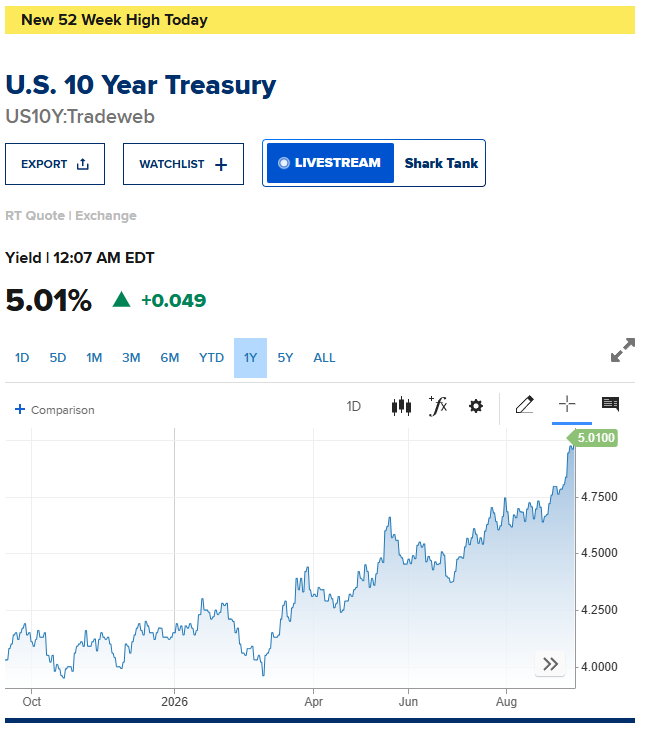
The 10-year Treasury yield topped 5% on Monday, matching its highest level in three years. Bond investors kept pushing rates higher despite the Trump administration’s efforts to calm the market.
The move raises borrowing costs across the economy. It could also squeeze both stock valuations and Bitcoin (BTC), whose price already competes with higher-yielding, low-risk government debt.
Stocks Face a Valuation Test
Higher yields make government bonds more competitive with equities. Investors can lock in strong, low-risk returns instead of taking on stock market risk.
Analysts see this as a genuine threat if yields keep climbing.
“greatest near-term concern for stocks”

Antony Ghee is head of equity investments for the chief investment office at Merrill and Bank of America Private Bank. He used that description for a sustained climb past 5% on the 10-year yield, per The New York Times.
Rising yields also raise financing costs for companies themselves. That cuts into the profits that help support stock prices. Heavy government borrowing and AI-related infrastructure debt have added to the pressure on yields this year.
Bitcoin’s Opportunity-Cost Problem
Bitcoin was trading near $77,800, up slightly on the day. It has largely held steady through the yield move so far.
The logic is simple. A safe, five percent return from government debt raises the bar for riskier assets like Bitcoin to look attractive. Non-yielding assets face that pressure most directly, and higher rates make that trade-off even sharper.
That calculation could shift fast this week. Traders currently price a high chance of a Fed rate hike at its meeting. The decision could ease or extend the pressure on risk assets.
A hold or dovish signal would likely lower yields and ease pressure on stocks and Bitcoin. A hike paired with hawkish guidance would likely do the opposite.
The post 10-Year Yield Crosses 5%: What It Means for Bitcoin and Stocks appeared first on BeInCrypto.
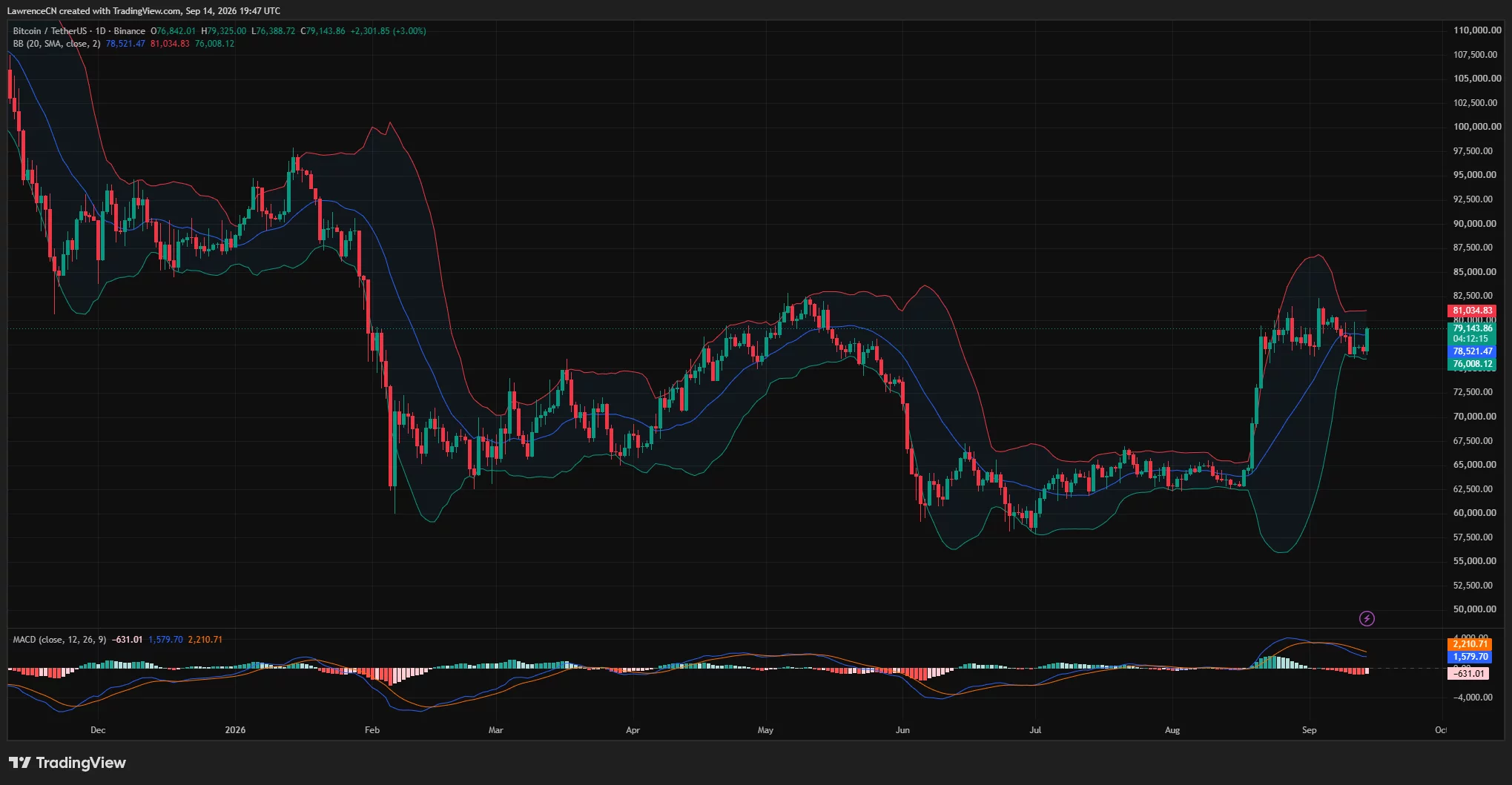
Bitcoin price has risen about 3% to $79,143 after touching $79,325, even as conflicting U.S. and Iranian statements have kept the path toward a possible agreement unclear.
Summary
- Bitcoin price climbed from a daily low of $76,388 to an intraday high of $79,325.
- Trump said Iran wanted an agreement, but Iranian state media rejected his claim.
- The strongest nearby liquidation cluster sits around $79,900 to $80,000.
- Oil above $100 and the Federal Reserve decision remain key risks for U.S. investors.
Trump’s comments have supported the Bitcoin price rebound
Bitcoin’s recovery unfolded as U.S. President Donald Trump suggested Iran wanted to reach an agreement with Washington despite continued fighting in the region.
“The failing Nation of Iran wants to make a deal, quickly and badly,” Trump wrote on Truth Social.
Trump added that he would decide whether the United States engages with Tehran, although he said Washington was open to the idea. His comments introduced the possibility of renewed talks after months of military exchanges and repeated failures to secure a lasting agreement.
During the recovery, Bitcoin (BTC) first moved above $78,000 and reached $78,940 before extending its advance. A daily Binance chart on TradingView showed BTC opening at $76,842, falling to $76,388 and later reaching $79,325. The asset traded near $79,143 when the chart was captured, representing a 3% daily gain.
U.S. stocks also recovered from an earlier decline. Approximately $570 billion returned to equities within three hours after the market had erased more than $600 billion earlier in the session.
Technology stocks had faced additional pressure after executives from artificial intelligence companies called for slower development to address safety risks. The comments added another source of uncertainty for a sector that has carried a large share of recent U.S. equity gains.
Bitcoin’s response showed that traders were willing to add risk after Trump raised the possibility of diplomacy. Iranian state media, however, rejected his claim that Tehran was seeking a quick agreement, leaving the market without confirmation from both governments.
LiveSquawk separately cited Iran’s ILNA news agency as saying the United States had sought a “phased” agreement, based on information attributed to a Pakistani source. The report did not establish that Washington and Tehran had accepted final terms.
Oil above $100 keeps the U.S.-Iran risk active
The diplomatic dispute has come while attacks involving Iran-aligned forces have placed additional pressure on oil production and shipping routes.
According to Reuters, Yemen’s Iran-aligned Houthis launched missiles and drones at a military airbase in Khamis Mushait, Saudi Arabia. The group said it targeted aircraft hangars, radar equipment, runways and ammunition storage sites in response to Saudi strikes in Yemen.
In another attack, which Riyadh blamed on Iran-backed fighters in Iraq, Saudi Arabia’s east-west pipeline was taken offline. The route allows oil exports to avoid the Strait of Hormuz, making it important while traffic through the strait remains restricted.
Traders told Reuters that an extended pipeline closure could affect as much as 4% of global oil supply. Brent crude rose more than 4% after the weekend before giving back part of the increase following Trump’s comments. It later traded near $106 per barrel, while U.S. crude remained above $100.
For American consumers, Reuters reported that the average retail diesel price had reached a record above $6.23 per gallon. Sustained energy costs could feed inflation and complicate the Federal Reserve’s interest-rate decision, creating a direct link between the conflict and the conditions facing U.S. Bitcoin investors.
As crypto.news previously reported, Bitfinex analysts identified energy costs and real Treasury yields as restraints on Bitcoin. The analysts said an oil shock could keep inflation expectations elevated, while tighter monetary policy would reduce liquidity without resolving the loss of energy supply.
Oman had planned to host Iranian and Gulf officials for discussions over the future operation of the Strait of Hormuz. Foreign Minister Sayyid Badr Albusaidi postponed the meeting “in the interests of consensus,” without announcing a replacement date.
Iran said Saudi Arabia had requested the delay. Tehran also published a list of 77 vessels that it said had breached its operating rules in the strait, warning that future violations could lead to fines, detention, or confiscation.
Bitcoin price faces resistance around $80,000
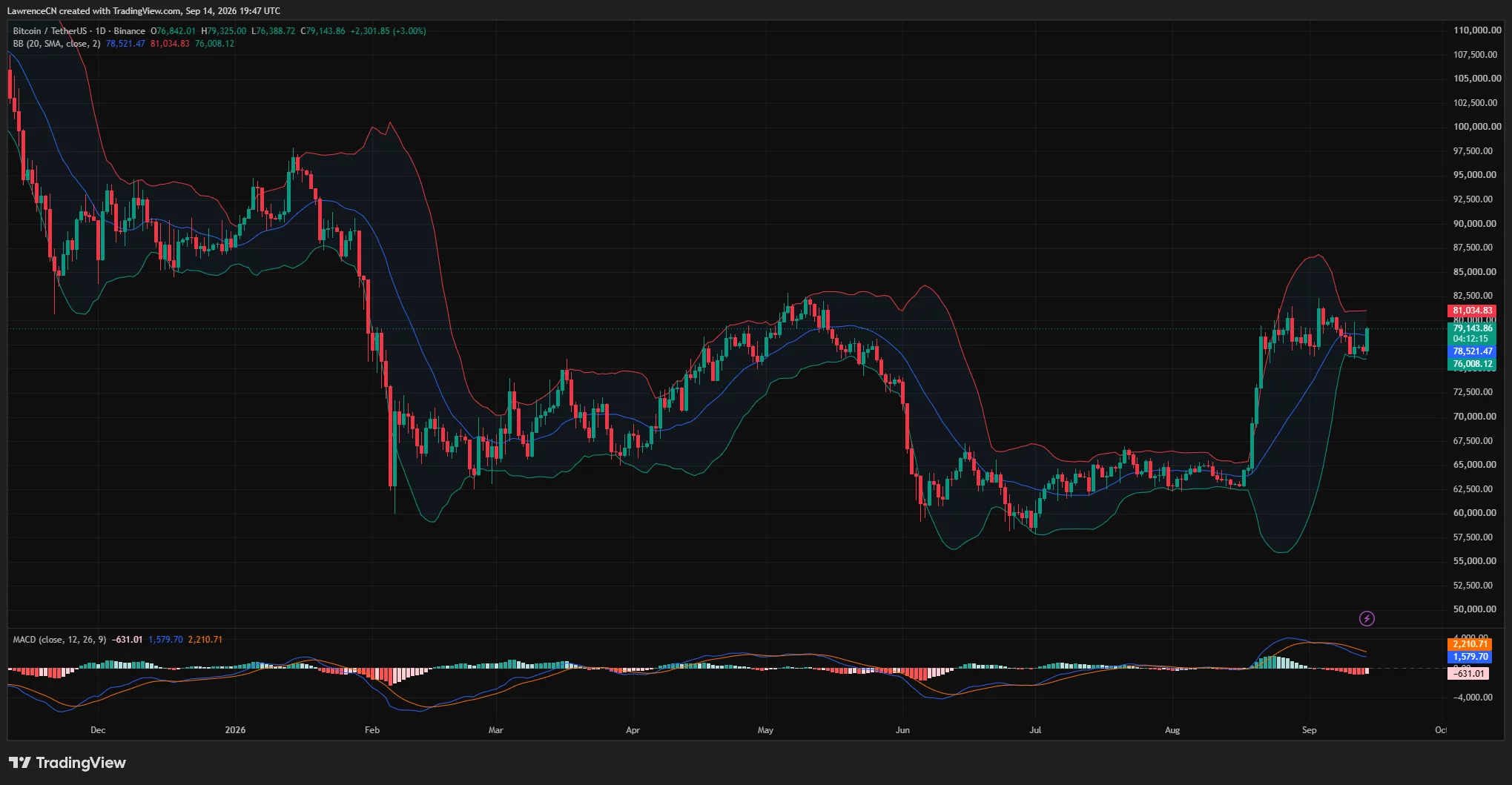
Technical readings show that Bitcoin has returned above the center of its daily Bollinger Bands but has not cleared the upper boundary.
The daily Bitcoin price chart placed the Bollinger Band midpoint near $78,521, with the upper band at approximately $81,035 and the lower band around $76,008. BTC’s move above the midpoint gives buyers control of the immediate range, although the upper band and recent highs create resistance between $80,000 and $81,035.
A one-week CoinGlass liquidation heatmap shows the largest nearby concentration of leveraged positions just below $80,000. The brightest band appears around $79,900 to $80,000, making the area a possible target if buyers extend the advance.
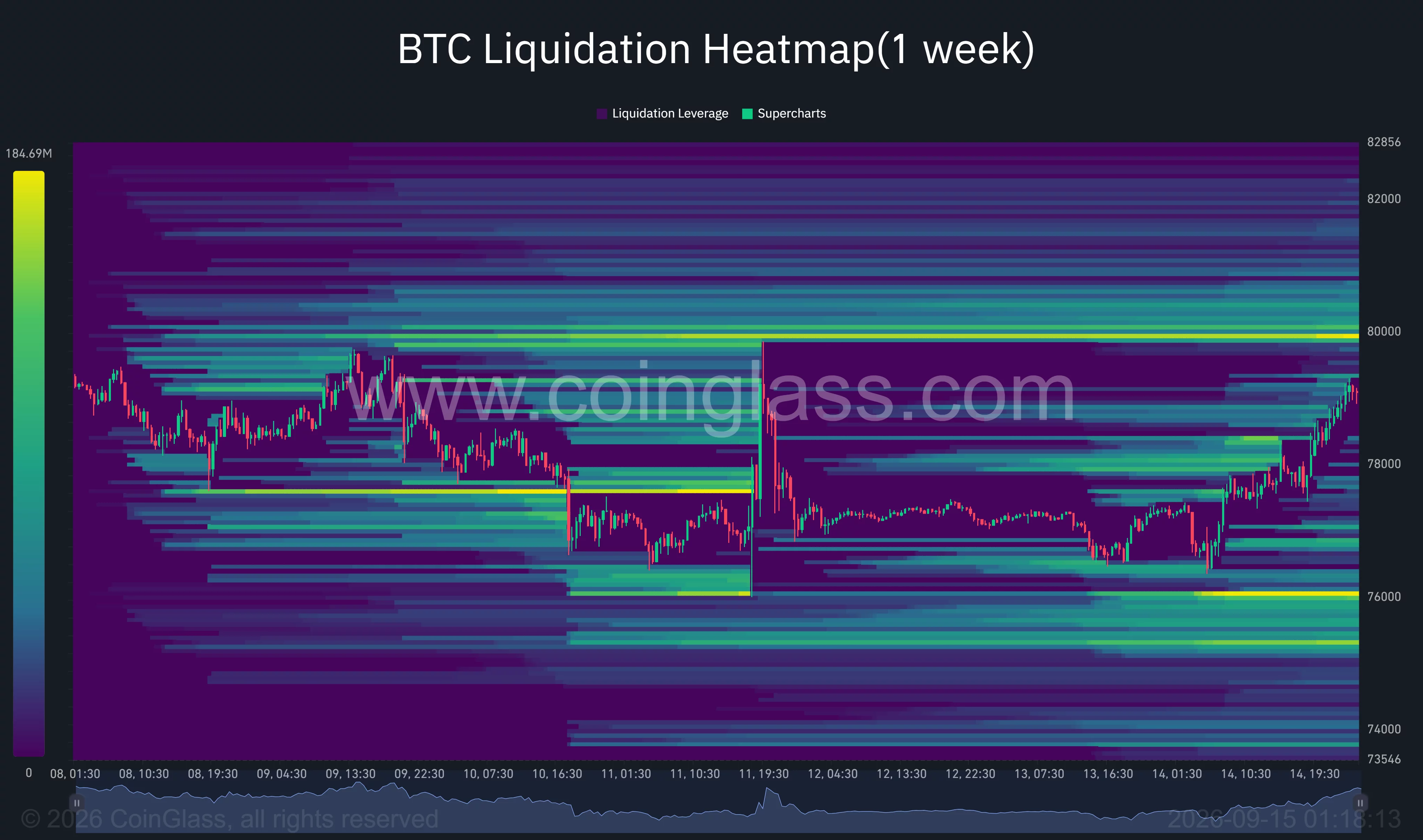
Several smaller liquidation pools sit between roughly $80,200 and $80,700. A clean move through that region would bring the Bollinger Band ceiling near $81,035 into focus, followed by the larger $82,000 area identified in recent Bitfinex analysis.
Momentum remains less certain. The daily MACD line stood near 1,579, below its signal line around 2,211, while the histogram had fallen to approximately minus 631. Both MACD lines remained above zero, but the bearish crossover and red histogram bars showed that momentum had weakened after Bitcoin’s sharp August rally.
Price action has also remained uneven since BTC first moved above $80,000. Buyers have defended pullbacks toward the mid-$76,000 area, yet several attempts to hold above $81,000 have failed. The current move has returned Bitcoin to the upper half of that range without confirming a breakout.
On the downside, the Bollinger midpoint near $78,521 forms the first technical support. Losing it would expose the $77,500 to $78,000 region, where the heatmap shows a series of smaller leveraged clusters.
The largest lower liquidity concentration sits around $76,000, close to the daily lower Bollinger Band. A sustained break below that zone could expose another pool near $75,000 to $75,400.
Fed policy has added another test for U.S. investors
The Iran conflict is not the only event capable of disrupting Bitcoin’s recovery. A separate market report noted that the Federal Reserve will meet on Sept. 15 and 16, with its policy statement, updated economic projections and Chair Kevin Warsh’s press conference due on Wednesday.
Markets had priced an 87% probability of a quarter-point increase before the meeting. Such a decision would move the federal funds target range from 3.50%–3.75% to 3.75%–4.00%.
Bitfinex analysts said the Fed’s projections could matter more for Bitcoin than the rate announcement because they will show whether officials expect one increase or a longer series of moves. Higher Treasury yields can raise the return available from government securities, increasing competition for capital held in non-yielding assets such as Bitcoin.
U.S.-listed spot Bitcoin exchange-traded funds provide another measure of demand from American investors. The products attracted $986.7 million during the week ending Sept. 4, after taking in $924.5 million the previous week. Three consecutive positive weeks brought the combined inflow to about $3.8 billion.
Fed policy, oil prices, and developments around the Strait of Hormuz will now overlap with the liquidation levels visible on the Bitcoin chart. The Federal Reserve is scheduled to release its decision on Wednesday afternoon, followed by Warsh’s press conference and the central bank’s updated economic projections.
Disclosure: This article does not represent investment advice. The content and materials featured on this page are for educational purposes only.
Democrats send counteroffer to Republicans over Clarity Act provisions

Donald Trump Condemned For Dismissing AI Threats As Hoax

“Does it really well”: Ryan Giggs explains how Kobbie Mainoo can reach Paul Scholes’ level


-
 Tech7 days ago
Memory prices are slowing because buyers ran out of money
-

 Business5 days ago
Micron Stock Climbs Above $1,031 as AI Memory Crunch and a $50 Billion Outlook Fuel the Rally
-

 Tech2 days ago
The Latest Weird Thing to Play Doom Is the Mapped-Out Brain of a Fruit Fly
-

 Fashion4 days ago
Weekend Open Thread – Corporette.com
-

 Business5 days ago
AMD Stock Climbs After Management Lifts 2027 Data Center Outlook Toward $70 Billion in AI Sales
-

 Crypto World7 days ago
Robinhood Stock: How To Take Advantage With Reduced Risk
-

 Crypto World6 days ago
Bitcoin price risks $76K drop as $78K support weakens
-

 Crypto World4 days ago
XAG/USD: Silver’s Short-Term Rally Meets Its Moment of Truth
-

 Crypto World5 days ago
2 Chip Stocks Broke Out This Week. Neither Was Nvidia
-

 Crypto World6 days ago
Ethereum price stalls below $2,500 as ADX drops to 11
-

 Business4 days ago
10 Most-Streamed Songs On Spotify In 2026 So Far, Led By Ella Langley’s Dominant Run On The Charts This Year
-

 NewsBeat7 days ago
England up in reading, maths and science rankings as Scotland and Wales dip
-

 Tech4 days ago
Battery life is the only iPhone 18 Pro and iPhone Duo upgrade I care about. Apple didn’t disappoint
-

 Crypto World4 days ago
OKX launches 10x OpenAI, Anthropic X-Perps in Europe
-

 Crypto World4 days ago
Diesel Tops $6 a Gallon for the First Time as 28 States Set Records
-
 Crypto World7 days ago
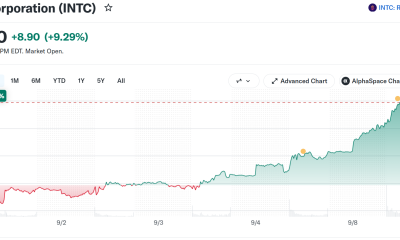
Intel Stock Jumps 9% on Chip Price Hike Report, US Stake Gains $36 Billion
-

 Tech5 days ago
Apple Watch Ultra 4 vs Watch Ultra 3: Should you really spend another $799?
-

 Crypto World5 days ago
Pi Network ships Protocol 27 on a network with 14 million users and zero DeFi
-

 News Videos4 days ago
Facing Financial Fears
-

 Crypto World5 days ago
Bitcoin price risks $70K if $78K neckline breaks
You must be logged in to post a comment Login