
Crypto World
CLARITY Act setback may delay US crypto launches: Experts



The Senate’s 50-49 failure to advance the CLARITY Act has left crypto firms without a federal market structure framework and could delay product launches, funding decisions, and commercial agreements, according to three industry experts.
Summary
- The CLARITY Act failed to secure the 60 Senate votes required to open debate.
- WasabiCard expects regulatory uncertainty to delay some crypto launches, partnerships and funding decisions.
- The Decentralization Research Center urged the SEC and CFTC to provide clarity under existing powers.
- Paybis called for separate US and EU checks where their stablecoin requirements differ.
CLARITY Act failure leaves jurisdiction questions open
Kyle Bligen, executive director at the Decentralization Research Center, told crypto.news that the Senate result was disappointing but did not remove the need for lasting digital asset rules.
“Congress remains the best route to a comprehensive market structure framework,” Bligen said.
In the absence of federal legislation, Bligen called on the Securities and Exchange Commission and Commodity Futures Trading Commission to use their current powers to give the industry clearer guidance. He cautioned, however, against applying rules built for conventional financial middlemen directly to decentralized systems.
The policy task, according to Bligen, is to protect consumers and counter illegal activity without placing duties on developers or other participants who lack the control needed to carry them out.
“That work cannot stop because the legislative process has stalled,” he said.
The 50-49 Senate vote fell 10 votes short of the 60 required to invoke cloture and begin formal debate on H.R. 3633. Cloture would not have passed the bill into law; it would only have allowed the Senate to proceed with debate.
All participating Democrats opposed the motion, while Republican Senators Susan Collins, Josh Hawley, Jerry Moran and Thom Tillis also voted against it. Tillis changed his vote for procedural reasons, preserving an avenue for the chamber to reconsider the motion.
Disputes over government ethics, stablecoin rewards and banking provisions had continued before the vote. Democratic negotiators delivered a late counteroffer, but lawmakers did not release its complete text before the Senate acted.
The House passed its version of the CLARITY Act in July 2025 by a 294-134 vote, with 78 Democrats supporting the measure. Republicans hold 53 Senate seats, which meant the bill’s supporters needed votes from at least seven Democrats to clear the procedural threshold.
In July, Treasury Secretary Scott Bessent had pressed for a vote after months of negotiations among lawmakers. Polymarket traders assigned the bill a roughly 30% chance of becoming law in 2026 at the time, down from 82% in February. Following the failed cloture motion, the probability dropped to 7% from 31% a day earlier.
Regulatory uncertainty could delay crypto products
Matt Price, head of global partnerships at stablecoin platform WasabiCard, said the vote had left companies with the same classification and jurisdiction questions they faced before the Senate acted.
“The failure to advance CLARITY leaves the industry with the same basic problem it had before the vote,” Price said. “Firms still do not have a clear answer on how some digital asset products will be classified or which rules apply.”
Without a settled division of authority, Price expects companies to spend more time seeking legal advice before putting capital into products. Some firms may hold a launch or commercial agreement because they do not want a regulator to adopt a different view after the product enters the market, he added.
Questions over whether the SEC or CFTC has jurisdiction may also affect funding choices and negotiations between crypto companies, according to Price. He expects some partnerships and releases to be postponed for that reason.
Banks and payment companies could exercise similar caution, Price said, because they need to understand the compliance duties attached to a digital asset project and whether regulators could change the applicable requirements after launch.
“This could slow innovation and adoption in the marketplace,” he said.
The failed vote has also increased pressure on federal regulators. Former CFTC Chair Chris Giancarlo said the SEC and CFTC could continue building rules under their existing mandates, according to a Sep. 16 report.
Coinbase CEO Brian Armstrong made a similar call after the vote, saying the industry could no longer wait for Congress and urging both agencies to use the tools already available to them. Ripple CEO Brad Garlinghouse also asked the regulators to fill the legislative gap.
Agency action cannot resolve every issue covered by the bill. In particular, SEC rules alone cannot establish a statutory split of authority between the SEC and CFTC, according to the Sep. 16 report.
H.R. 3633 remains on the Senate calendar, and Tillis’ procedural vote permits another cloture attempt. Sen. John Kennedy said the measure could return during a lame-duck session after the November elections, while Sen. Ted Cruz described it as “mostly dead.”
Any changes approved by the Senate would still need further House action before the legislation could reach the president. A shortened House calendar has reduced the number of voting days available before lawmakers leave Washington.
Foreign stablecoin rules pose a separate compliance test
Konstantins Vasilenko, co-founder and chief business development officer at MiCA-licensed crypto exchange Paybis, said regulatory uncertainty also extends to stablecoin businesses operating between the United States and Europe.
According to Vasilenko, US authorities are determining how domestic stablecoin requirements will apply to foreign issuers, while European policymakers are considering how to treat oversight conducted outside the European Union.
Under the EU’s Markets in Crypto-Assets regulation, an issuer must show that it holds authorization, manages its reserves and can honor redemption requests, Vasilenko said. The US Treasury’s lawful-order test asks a different question: whether a foreign issuer can execute an American order to freeze assets.
“How far a platform must go to satisfy that check remains open,” he said.
Treasury has raised questions about smart contracts and functions including “freeze,” “seize,” and “burn,” according to Vasilenko. A compliance review can establish whether an issuer has the technical ability and internal process to respond to a lawful order, but it cannot guarantee how the company will respond in every future case, he added.
Vasilenko called on Treasury to state what evidence would satisfy its review. Clear standards would help exchanges and wallet providers assess foreign stablecoins before making them available to customers subject to US rules, according to his comments.
Europe is separately considering how much reliance its regulators can place on supervision performed in another jurisdiction. Vasilenko said mutual recognition should be assessed one requirement at a time rather than granted through a single all-purpose decision.
Where US and EU authorities ask the same compliance question, one answer should be sufficient, he said. When the requirements differ, as they do over the ability to follow a US lawful order, Vasilenko said platforms and issuers would need to complete both checks.


Anne Imhof has introduced a new era of performance art with slow-moving, bass-pounding tableaux that captivate even today’s media-addled attention spans. The German artist had one of the most talked-about artistic projects of 2025 with Doom: House of Hope, her three-hour epic performance loosely based on Romeo and Juliet. The event, which cast Balenciaga models alongside professional ballet dancers, drew 9,000 visitors across its 10 dates at the Park Avenue Armory in New York City. Imhof’s angsty-cool aesthetic has made her a darling of fashion brands and European museum curators alike. In the past year, she also co-starred in Valentino’s Cruise 2026 fashion campaign and unveiled a monumental permanent public sculpture of a swimming pool outside the Serralves Museum of Contemporary Art in Porto, Portugal. In September, she will open her first solo show in Asia: a survey exhibition at Hong Kong’s Tai Kwun center, where signature works will be shown alongside a new performance in collaboration with the Hong Kong Ballet.
The US Senate failed to advance the Digital Asset Market Clarity Act on Tuesday after a procedural vote fell short, 49-50. The vote required 60 of 100 senators to pass the bill and allow it to move forward.
While the outcome was widely considered a major setback for the industry, seven Democratic senators said that it is “not the end.”
Crypto’s Post-CLARITY Reckoning
In an official statement, US Senators Kirsten Gillibrand (D-NY), Angela Alsobrooks (D-MD), Cory Booker (D-NJ), Catherine Cortez Masto (D-NV), Ruben Gallego (D-AZ), Mark Warner (D-VA), and Raphael Warnock (D-GA) said that Democrats have spent the last two years working to pass crypto legislation that would expand opportunity, protect consumers, punish bad actors, create regulatory certainty, and include strong, commonsense ethics provisions for elected officials. They added,
“This week was a setback, but not the end of that important work. We remain committed to working in a bipartisan fashion to get this legislation passed.”
The comment came just a day after Senator Cynthia Lummis lashed out at Democrats and said that they were never truly serious about protecting consumers and preserving American leadership. She called the party “anti-consumer and pro-illicit finance, anti-ethics, anti-free enterprise, anti-worker, anti-livable-wage jobs, pro-socialism, and anti-American.”
Meanwhile, Ripple’s Brad Garlinghouse called for a post-mortem of the legislative defeat. Not all reactions to the Senate setback have been strongly negative. Coinbase co-founder Brian Armstrong said bipartisan discussions could continue, and the CLARITY Act may get another chance. However, he also added that the industry “cannot wait” for Congress anymore.
In a separate statement to CryptoPotato, John O’Loghlen, Managing Director, APAC, Coinbase said,
“We are encouraged by the broad, bipartisan support for a bill endorsed by law enforcement, and we believe that coalition will continue to play an important role in advancing clear and consistent rules for the industry. We also expect the SEC and CFTC to advance regulatory clarity through their respective rulemaking authorities, alongside ongoing engagement with policymakers and regulators.”
Institutions May Wait Longer
Trace Finance co-founder Bernardo Brites said that failure of the CLARITY Act is “not a fatal one” for the industry. Brites, however, argued that institutional volumes will continue to remain on the sidelines longer than they need to, and the bigger wave of incumbent participation the market is waiting for gets pushed further out. But he added that “none of this changes where digital assets are headed.”
“Banks will still move to adopt stablecoins, and blockchain rails will still become the foundation of modern finance, clarity or no clarity. But every delay like this one is a missed chance for the US to cement its role as a leader in innovative financial technology.”
More on the CLARITY Act as well as the Fed’s latest interest-rate move can be found in our video below.
The post Seven Democrats Refuse to Give Up on CLARITY Act After Senate Setback appeared first on CryptoPotato.

State hackers drive 420% surge in onchain malware, Chainalysis finds
North Korean and Iran linked hackers were responsible for the majority of the 420% increase this year in malware on public blockchains according to a Chainalysis report.
State-linked hackers accounted for roughly two-thirds of new activity whereby attackers stored malware instructions or infrastructure information on public blockchains.
Chainalysis also identified UNC5342, a North Korea linked group, to previously unattributed activity spanning Tron, Aptos and BNB Smart Chain.
Chainalysis said using public blockchains increases the durability of malware campaigns because the stored information remains accessible after domains, servers or code repositories are taken down. In 2025, North Korean hackers used a similar technique called EtherHiding to place crypto-stealing code in smart contracts.
North Korea using foreign talent to help infiltrate US companies: Report
North Korea (DPRK) is now using remote workers from third countries, including Iran and Lebanon, to pass job interviews, after which the positions are taken over by North Korean operatives. The aim is infiltrate US companies and obtain money to fund its weapons programs, NBC reported.

KOREA
Polymarket users referred to prosecutors in South Korea: Report
South Korean police have referred 18 Polymarket users to prosecutors in an illegal gambling investigation that had identified 26 users in total by analyzing publicly available blockchain data.
The users had collectively wagered about 17.6 billion won (worth $12.7 million) on Polymarket, which does not collect users real names or verify identities.
Authorities said that Polymarket transactions constitute illegal gambling under South Korea’s Criminal Act because users stake assets on outcomes that cannot be predicted with certainty.
HONG KONG
Metaplanet cuts Series 10 stock pool by 41%, plans Hong Kong subsidiary
After last week’s controversy over a plan to hand over as much as 20% of its fully diluted shares to executives, Metaplanet has now slashed the Series 10 stock pool.
Metaplanet will reduce the number of potential shares underlying the rights from 319.464 million to 188.19 million, and reset the conversion ratio to the level it was before its September 2025 international share offering.
The change will extinguish more than $220 million in warrant value and increase the company’s Bitcoin per fully diluted share by about 8.8%, according to Metaplanet.
CLARITY act failure is an opportunity for Hong Kong to seize ‘critical strategic window’
The South China Morning Post says crypto industry insiders are urging Hong Kong policymakers to seize the opportunity opened up by the failure of the CLARITY vote in the US.
The delay has given Hong Kong a “critical strategic window” said Allen Ding, director of Bitfire Research. Shawn Yan, founder of Cregis Technology said the city should focus on “building infrastructure that can operate across regulatory boundaries, rather than waiting for any single jurisdiction to define the market for everyone.”
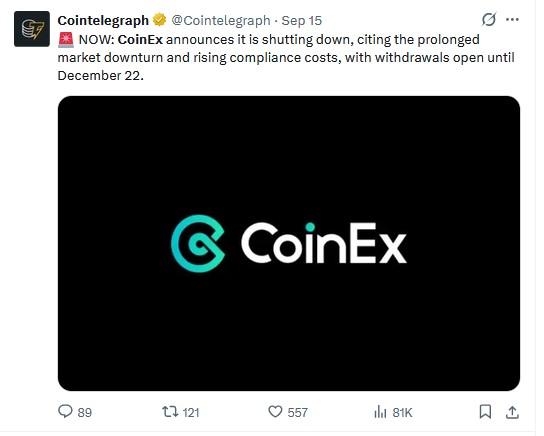
CoinEx to cease operation after 9 years
The Hong Kong founded exchange said falling trading volumes and liquidity during the bear market, along with rising regulatory and compliance costs, was responsible for the decision to shutter the business. Withdrawals remain open until Dec. 22.
INDIA
India launches tokenized bond pilot with $107M issued
India’s securities regulator and central bank have launched a tokenized corporate bond pilot, with three companies issuing a combined 10.25 billion rupees (about $107 million) through the new market infrastructure.
The Securities and Exchange Board of India (SEBI) said Demat 2.0 allows corporate bonds to be issued and held as digital tokens on a distributed ledger owned by the country’s statutory depositories. The system connects to the Reserve Bank of India’s (RBI) wholesale central bank digital currency (CBDC) through its Unified Market Interface.
Parliamentary committee wraps year long crypto review
India’s Parliamentary Standing Committee on Finance has completed its hearings on cryptocurrency policy. The government will respond next week before the committee prepares and submits its report.
India’s Enforcement Directorate to beef up crypto investigations
India’s Enforcement Directorate aims to finalize economic crime investigations within 18 months and is beefing up its ability to track crimes involving cryptocurrencies.

VIETNAM
Bitcoin Suisse becomes Bitcoin Vietnam?
Bitcoin Suisse plans to shift up to half of its Swiss jobs to Bratislava and Vietnam.
Founded in Zug in 2013, the company provides crypto trading, custody, staking and lending services. It will establish a new center in Vietnam to look after many of the back office and administrative roles.
Vietnam develops new crypto-asset monitoring mechanisms
Vietnamese regulators are building a supervisory mechanism covering crypto asset service providers and investor transactions. It draws upon recommendations from the Financial Action Task Force (FATF).
Binance signs MOU to help develop Vietnam finance center
Binance, the world’s largest exchange, has signed an agreement to help develop the Vietnam International Finance Center in Ho Chi Minh City.
SINGAPORE
Singapore Exchange gets nod for US perps
Singapore Exchange has become the first major Asian TradFi exchange to get approval from the Commodities Futures Trading Commission to provide Bitcoin and Ethereum perpetual futures to US institutions.
Singapore’s High Court offers guidance for valuing crypto assets
A recent decision has provided a precedent for valuing crypto assets in claims that departs from the usual breach-date damage assessment principles according to law firm Reed Smith. “The court is unlikely to allow claimants to delay mitigation for years and then seek damages at a higher present-day market price,” it noted.
Six Malaysians jailed for crypto poker robbery
Six Malaysian men were sentenced in Singapore to hefty sentences up to 12 years and 11 months —plus 24 strokes of the cane — over a 2024 armed robbery involving crypto, cash, and luxury items.
THAILAND
Thailand SEC proposes 5 million baht daily stablecoin transfer cap
Thailand’s SEC has proposed new stablecoin regulations that would prohibit users from transferring more than 5 million baht per day, worth around $151,000.
MALAYSIA
Malaysia is one of the more crypto friendly Islamic nations
According to Fitch Ratings Malaysia is one of the most crypto curious Muslim majority nations, with the local Securities Commission declaring Bitcoin, Ethereum, Ripple, and Stellar sharia-compliant.
Cointelegraph publishes long-form journalism, analysis and narrative reporting produced by Cointelegraph’s in-house editorial team with subject-matter expertise. All articles are edited and reviewed by Cointelegraph editors in line with our editorial standards. Some articles contain affiliate links, from which Cointelegraph may earn a commission. These relationships do not influence which products we review or our editorial conclusions. Content published in here does not constitute financial, legal or investment advice. Readers should conduct their own research and consult qualified professionals where appropriate. Cointelegraph maintains full editorial independence.
After a week of intense momentum, the U.S. Senate failed to advance the proposed CLARITY Act, a major market-structure bill aimed at bringing clearer rules to digital-asset activity. The setback came via a failed cloture vote—49-50—leaving supporters scrambling to preserve any remaining path forward in a Congress that is steadily running out of time.
Even as the bill appears “walking wounded” rather than formally dead, the procedural route opened by a key Republican senator raises questions about how much can realistically be renegotiated before the legislative calendar tightens. Crypto policy watchers are now focused on whether CLARITY can still assemble the 60 votes needed in the Senate, and what changes would be required to win broader backing—particularly on the ethics provisions tied to President Donald Trump.
Key takeaways
- The CLARITY Act lost the Senate cloture vote 49-50, meaning it did not reach the 60-vote threshold required to move toward a final vote.
- Sen. Thom Tillis switched his vote from yes to no on procedural grounds, filing a motion to reconsider that could reopen debate during the current session.
- Supporters face a tight timeline: the Senate is scheduled to leave for recess on October 2, and there are limited legislative days remaining after the midterms.
- The votes that supported advancing CLARITY came entirely from Republicans, while Democrats split, even as several Democratic senators say they remain committed to passing the bill.
- Even if CLARITY stalls in Congress, industry representatives argue U.S. regulators can still move on guidance, rulemaking, and exemptions under existing authorities.
Tillis’s procedural move keeps one door open
CLARITY’s immediate problem was procedural. A cloture vote—used to end debate and allow a bill to move toward a final vote—fell short. According to earlier reporting linked in the article, the failed advance effectively jammed CLARITY into a Senate-shaped hurdle.
But the week didn’t end with a clear “no” that closes the book. Sen. Thom Tillis changed his vote at the last minute from yes to no, then used parliamentary strategy to file a motion to reconsider. The stated purpose, as described by the Crypto Council for Innovation (CCI) director of U.S. federal affairs Ryan Eagan, is to preserve an opportunity to revisit the cloture vote during the session.
“Senator Tillis’s motion to reconsider would provide an opportunity to revisit CLARITY’s cloture vote at any point this session. Specific timing regarding next steps is not clear, but that desire to preserve that opportunity is in part due to the progress made over the past week.”
Still, preserving an option is not the same as solving the underlying vote math. The same dynamics that drove Democrats and Republicans into a late-stage impasse remain, particularly around the ethics provisions in the bill.
The calendar may decide the bill more than the arguments
Beyond politics, the Senate’s schedule is now a central constraint. The article notes that the Senate plans to head to recess on October 2 before returning after the midterm elections, while the House has already recessed for the election period. That combination makes it harder to coordinate movement through both chambers before the year ends.
Rep. Shri Thanedar, a Democrat who supported CLARITY when it passed through the House in July 2025, described the timing as a “major barrier.” In the article, he cites that there are only 20 legislative days left in the current Congress—all after the midterms—making a 2026 compromise “very low” from his perspective.
The article also points to a prior example from stablecoin legislation: the GENIUS bill missed cloture by a narrow margin in May 2025 before clearing a second cloture vote 66-32 just days later, and eventually passed the Senate the following month. However, the analogy may be imperfect. The same reporting includes Kyle Chassé, founder of MV Global, arguing that the difference this time is not the procedural mechanics but the lack of a ready-to-go deal and the potential for the process to reset under a different political landscape.
As lawmakers shift toward election-adjacent negotiations and reduced legislative bandwidth, the question becomes whether CLARITY can be brought back with enough changes to satisfy swing points without triggering a fresh cycle of opposition.
Ethics provisions are the fault line; Democrats still signal interest
One reason CLARITY’s path looks complicated is that the coalition that supported cloture was narrowly partisan. The article states that none of the 49 votes came from Democrats. Chassé is quoted saying that “every one of the 49 was a Republican” and that “zero Democrats voted to even open debate.”
Yet the story does not end with Democratic disengagement. The article references a statement from seven Democratic senators—who voted against advancing the bill—saying they “remain committed” to enacting CLARITY. Among them is Sen. Angela Alsobrooks, who supported moving the bill out of the Banking Committee earlier in the process and, according to the article, later voted no on cloture while still emphasizing the need to regulate digital assets.
Alsobrooks is quoted saying lawmakers were “ready to strike a deal” close to the vote, but that Republican leadership shut down negotiations at the last minute once it became clear a successful cloture outcome was likely. The quote underscores a key dynamic: CLARITY’s supporters and opponents may agree on regulatory direction, but not on how the package handles ethics.
Tillis, meanwhile, is described in the article as wanting to “convince the Democrats to get on board” and applying pressure so Democrats feel ownership of the outcome. His comments in the piece link the procedural switch to his view that the market needs guardrails.
If CLARITY must be rewritten, what could stay?
For CCI’s Ryan Eagan, the negotiating challenge has moved beyond technical drafting into something more politically sensitive. Chassé is quoted asserting that the failed cloture became “a referendum on the President’s crypto holdings” and that “the text as written can’t survive that.”
Before Tuesday’s vote, Republicans requested a large number of changes—described in the article as 126 substantive alterations—responding to Democratic demands. Those adjustments included tighter restrictions intended to prevent public officials from profiting from crypto ventures, and involving state attorneys general in enforcing parts of the ethics framework.
Still, Thanedar argues Democrats want additional limitations specifically on the President’s ability to use office for personal gain, pointing to reported crypto income in annual financial disclosures. The article cites Reuters coverage about Trump reporting at least $1.4 billion in crypto-related earnings for 2025.
Importantly, Chassé suggests lawmakers and industry participants should not treat ethics alone as the decisive hurdle. He points to stablecoin rewards, arguing for “some kind of cap or circuit breaker on yield” as a potential tradeoff needed to win support from “bank-side senators and a chunk of Democrats,” alongside tighter language on illicit finance and enforcement at the state level.
At the same time, the article says crypto stakeholders view certain protections as non-negotiable. Chassé highlights reluctance to give up self-custody and developer protections, which have been defended throughout negotiations during discussions over how far the bill should shield non-custodial developers from financial and anti-money-laundering obligations.
That mix—ethics and yield-linked mechanics on one side, custody and developer protections on the other—may determine whether CLARITY can regain momentum without collapsing into a wholesale rebuild.
Regulators can keep moving even if Congress stalls
Even with CLARITY stuck, industry voices in the article argue that the U.S. regulatory process does not need to wait for new legislation. Eagan says the SEC and CFTC have already shown an intention to reduce uncertainty through guidance, rulemaking, no-action relief, and exemptions.
The article also notes that implementation work related to stablecoin policy continues outside the CLARITY track—citing ongoing activity at Treasury and banking regulators for the GENIUS Act after its progress in Congress.
Michael Saylor is quoted in the article emphasizing that “Progress need not wait for Congress,” suggesting that existing legal authorities can still produce regulatory movement. That point is likely to resonate with market participants who have grown accustomed to a patchwork approach: agencies can advance piecemeal, but statutory clarity typically takes longer and is harder to unwind once passed.
In practical terms, traders and builders may continue to plan around agency actions and enforcement posture while waiting to see whether CLARITY can return to the Senate floor with enough votes.
For now, the critical watch items are straightforward: whether the motion to reconsider leads to a renewed cloture attempt, what amendments (if any) are deemed sufficient to bring Democrats into the coalition, and whether legislative timing allows a final push before the next session dynamics take over.

WisdomTree and MoonPay have announced a partnership aimed at widening U.S. investor access to a tokenized money market mutual fund tied to U.S. Treasuries. The companies say MoonPay will provide technology that helps power a distribution and access layer for WisdomTree’s tokenized product, the WisdomTree Treasury Money Market Digital Fund (WTGXX).
According to the Thursday announcement, the tokenized fund is designed to maintain a $1 share price, and the issuer will use MoonPay’s infrastructure to connect to a broader user base. The firms also disclosed that MoonPay plans to incorporate WTGXX into its stablecoin reserve management workflow.
Key takeaways
- WisdomTree says MoonPay will supply technology that forms an access point for WTGXX, a tokenized U.S. Treasury money market fund.
- The fund targets a $1 per-share price; the issuer plans to leverage MoonPay’s network of more than 35 million accounts.
- MoonPay intends to use WTGXX as part of its stablecoin reserve management stack.
- RWA.xyz data cited by the companies places tokenized U.S. Treasury market value at about $15.4 billion, with WTGXX representing about $1.23 billion.
- WTGXX saw net token flows of $466 million over the past 30 days, based on the difference between tokens minted and burned.
How MoonPay’s infrastructure plugs into WTGXX
The partnership centers on distribution infrastructure rather than on changing the fund’s core strategy. WisdomTree’s WTGXX is a tokenized money market mutual fund that aims to keep its value stable at $1 per share. Under the deal, the issuer plans to use MoonPay’s technology to build an access point that can route eligible participants into the tokenized fund.
The companies say this access layer is expected to give WisdomTree reach into MoonPay’s broader network, described as spanning more than 35 million accounts. For investors, that matters less for the “tokenization” branding and more for the practical question of whether they can actually reach and transact in these products efficiently. Expanding access points has often been a gating factor for real-world assets (RWAs), where compliance and onboarding complexity can slow distribution.
WTGXX as a stablecoin reserve tool
MoonPay’s involvement is not limited to retail-style access. The company also said it plans to use WTGXX as part of its stablecoin reserve management stack. MoonPay is a financial technology firm that provides infrastructure for moving between fiat and digital assets, and it issues dollar-denominated stablecoins backed by U.S. dollars and other high-quality liquid assets held in segregated accounts.
In the announcement, MoonPay pointed to its earlier buildout of an enterprise stablecoin business, which it says it launched in November 2025. The stated reserve architecture—assets held in segregated accounts—highlights one of the recurring themes in stablecoin infrastructure: reserve management needs can be as operational and regulatory-heavy as they are technical. Using a tokenized Treasury-linked money market product could, in theory, align reserve workflows with on-chain settlement and compliance-friendly custody structures, though the announcement does not detail the mechanics beyond saying WTGXX will be part of MoonPay’s stack.
For market participants, the implication is that tokenized Treasuries are increasingly being treated not only as standalone investment vehicles, but also as building blocks inside broader digital-asset financial plumbing.
Market footprint and recent momentum in tokenized Treasuries
The announcement situates the partnership within the growth of tokenized U.S. Treasury markets. On Thursday, the tokenized U.S. Treasury market was cited at about $15.4 billion, with WTGXX accounting for roughly $1.23 billion, according to RWA.xyz data.
Momentum metrics were also provided. WisdomTree and MoonPay said WTGXX logged net flows of $466 million over the past 30 days. The companies define net flows as the difference between tokens minted and tokens burned. By that measure, WTGXX was not alone in positive movement, but it stood out among tokenized Treasury offerings: Ondo’s U.S. Dollar Yield fund (USDY) was described as the only other tokenized Treasuries fund to show positive net flows in the same period, totaling $66 million.
Those figures matter because they frame the partnership as a bet on demand and distribution at a time when tokenized Treasury funds are competing for inflows. If the tokenization ecosystem’s growth is still concentrated in a small set of products, expanding access via established on-ramps could further skew which funds attract additional capital.
What could follow: more tokenized funds and broader geography
Beyond WTGXX, the partners suggested the collaboration could extend to other tokenized funds. WisdomTree said the arrangement may expand, including into markets outside the United States, though it did not specify which products or regions would come next.
For investors and builders, that “optionality” is a meaningful signal. Tokenized money market funds and Treasury-linked instruments rely on a combination of legal structure, investor onboarding, custody and settlement design, and ongoing operations. If a tech-enabled access point proves effective for one fund—particularly one that aims for a stable share price—it may become a reusable distribution model for additional offerings.
However, readers should also note what is not spelled out in the announcement: the companies did not provide details on timeline, target jurisdictions for expansion, onboarding prerequisites, or how MoonPay’s role changes once investors move from access into ongoing investment/redemption flows. Those are key operational variables that typically determine whether demand converts into sustained AUM growth.
With WTGXX already showing significant net flows over the past month and a substantial share of the tokenized Treasury market by the companies’ cited RWA.xyz data, the partnership’s next test will be execution: whether MoonPay’s expanded access layer translates into continued inflows and whether MoonPay’s stablecoin reserve use case scales smoothly as the stablecoin business grows. Investors watching RWAs and stablecoin infrastructure should look for updates on adoption, jurisdictional rollout, and any additional funds that may be brought into the same access framework.
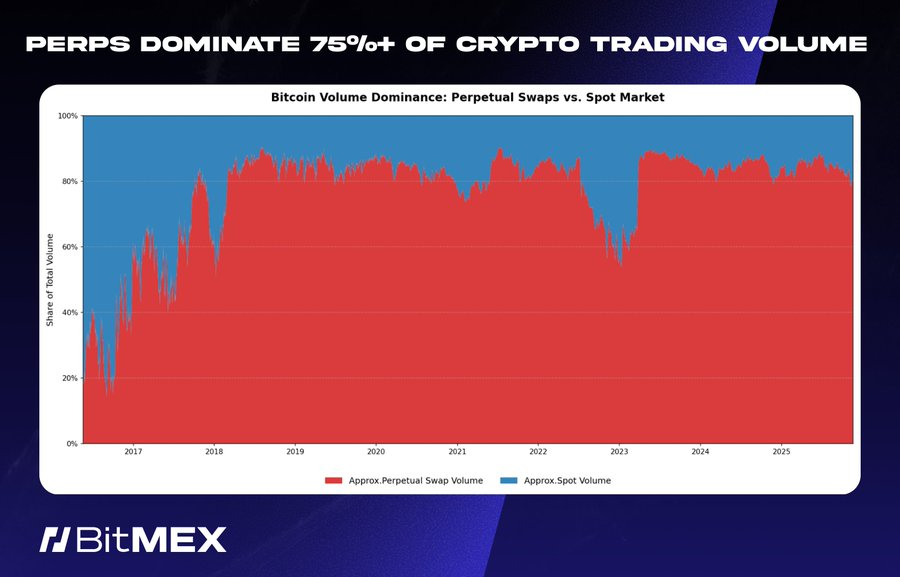
BitMEX has settled and delisted XBTUSD, ending one of the most influential trades in crypto history. The Bitcoin contract ran for more than 10 years and became the template for the perpetual futures market that dominates crypto trading today.
BitMEX itself will shut down on September 23. Yet the product it created is everywhere.
The Bitcoin Trade Every Major Exchange Copied
XBTUSD launched on May 13, 2016. It allowed traders to bet on Bitcoin without an expiry date.
Traditional futures expire on fixed dates. XBTUSD did not. That kept traders in one continuous market instead of splitting liquidity between different contracts.
BitMEX also introduced a funding system to keep the contract close to Bitcoin’s spot price. When too many traders crowded onto one side, they paid the other side.
Then came leverage. At launch, traders could control up to $100 of Bitcoin exposure for every $1 they put down. BitMEX later raised the ceiling to 250x for users who activated its Leverage Booster feature in April 2024.
The model spread quickly. Binance, Bybit, OKX and Hyperliquid now run their own versions.
BitMEX says perpetual contracts account for more than 75% of all crypto trading volume.

Now Wall Street Wants Perpetuals Too
The format is now moving beyond crypto. Kalshi filed with US regulators in August to offer stock index perpetual futures.
Kraken’s parent company also plans to bring Hyperliquid perpetuals to US traders through a regulated venue.
“12 years. 0 customer funds lost. Every bull and bear cycle crypto has ever had,” BitMEX wrote in its closing post.
That claim refers to customer funds lost through security breaches, rather than losses from trading.
Celsius, for example, sued five BitMEX entities on September 12 over 6,360 Bitcoin lost during forced liquidations in the March 2020 crash.
XBTUSD is gone. The market structure it created is still expanding.
Where the Perpetual Swap Design Is Spreading Now
The design is pushing into ordinary stock markets. Kalshi filed with US regulators in August to list stock index perpetual futures, and Kraken’s parent company plans Hyperliquid perpetuals for Americans through a regulated venue.
“12 years. 0 customer funds lost. Every bull and bear cycle crypto has ever had,” BitMEX wrote that in its closing post.
That record covers hacks, not trading losses. BeInCrypto reported that Celsius sued five BitMEX entities on September 12 over 6,360 Bitcoin lost to forced liquidations in the March 2020 crash.
The product outlived the company that invented it.
The post BitMEX Just Killed the Trade That Changed Crypto Forever appeared first on BeInCrypto.


Polymarket has hired Jacob Horne, the co-founder of Zora, the app behind Coinbase’s failed creator-coin experiment, to rebuild its onchain trading product. Chief executive Shayne Coplan announced the move Thursday.
Horne left Zora eight days ago after more than six years running it. His new job sets him against Kalshi, the exchange that now powers Coinbase’s own prediction markets across the United States.
What Coplan Asked Horne to Fix
Polymarket runs two venues:
- Traders outside the US use a market that settles on the Polygon blockchain, a corner of the industry known as Decentralized Finance (DeFi).
- Americans use a separate exchange licensed by the Commodity Futures Trading Commission (CFTC).
Coplan said Horne will work with him directly on product, and pointed at the crypto side of that split.
“He will be working closely with me on product, in particular making Polymarket DeFi great again,” the Polymarket executive shared.
Coplan added that the onchain product had weakened as the company grew, and that longtime users believed it was abandoned. He promised a town hall to set out a fix.
Horne Comes From a Product Coinbase Shut Down
Zora let people turn social posts into tokens others could trade on Base, the blockchain network Coinbase built. Coinbase pushed the idea for over a year before Pollak admitted the bet failed.
Brian Armstrong said the coins did not work. Zora was one of several Base experiments dropped this year, and Coinbase restored the Coinbase Wallet name this month.
Coinbase did not abandon prediction markets. It routed its US product through Kalshi instead. Kalshi handled $13.1 billion of the $15.8 billion traded across both platforms in the week to September 13, leaving Polymarket with 17%.
Three Senior Hires in Eight Days
Horne is the third. Warren Jenson became Polymarket’s first chief financial officer on September 10.
Collin McKinney Hill, a former DoorDash general manager, joined as vice president of operations on September 15.
The post Polymarket Hires Coinbase's Failed Social-Coin Architect appeared first on BeInCrypto.



Mortgage rates are hovering around 7.2% following the Federal Reserve’s first interest rate hike in three years.
The latest move is a bit of relief following a bruising few weeks in which they reached as high as 7.24%, the highest levels since early 2025, according to Mortgage News Daily.
The Fed doesn’t directly control mortgage rates, and by the time the central bank voted to raise benchmark rates by 25 basis points on Wednesday, mortgage rates had already moved higher in anticipation of that hike.
The 10-year Treasury yield, which mortgage rates closely track, dropped 6 basis points to 4.94% on Thursday as investors grew confident that the Fed was kicking off a new rate-hiking cycle to address persistently high inflation.
Fed hikes normally aren’t good news for the housing market or the bond market, but the latest move may be an exception.
Wednesday’s rate hike “is the medicine the housing market needs to recover,” Zillow chief economist Mischa Fisher said in a statement. “Greater market confidence in inflation being under control is more likely to bring mortgage rates lower in 2027 and get the recovery back on track.”
Freddie Mac, which conducts a weekly survey of mortgage rates, said rates averaged 6.95% in the week through Wednesday, a steep jump from 6.76% a week earlier that reflects rising bond yields before the Fed’s latest hike.
Read more: Discover the best mortgage refinance lenders
Today’s mortgage rates
Here are the current purchase mortgage rates for today, Thursday, September 17, 2026, according to the latest Zillow data:
-
30-year fixed: 7.01%
-
20-year fixed: 7.00%
-
15-year fixed: 6.44%
-
5/1 ARM: 7.08%
-
7/1 ARM: 6.74%
-
30-year VA: 6.46%
-
15-year VA: 5.95%
-
5/1 VA: 6.30%
Remember, these are the national averages and rounded to the nearest hundredth.
Here are 8 strategies for getting the lowest mortgage rate possible.
Today’s mortgage refinance rates
Here are the current refinance mortgage rates for today, Thursday, September 17, 2026, according to the latest Zillow data:
-
30-year fixed: 7.00%
-
20-year fixed: 6.76%
-
15-year fixed: 6.42%
-
5/1 ARM: 7.14%
-
7/1 ARM: 6.76%
-
30-year VA: 6.62%
-
15-year VA: 6.15%
-
5/1 VA: 5.88%
As with mortgage rates for purchase, these are national averages that we’ve rounded to the nearest hundredth. Refinance rates can be higher than purchase mortgage rates, but that isn’t always the case.
Monthly mortgage payment calculator
Use the mortgage calculator below to see how various mortgage rates will impact your monthly payments.
This embedded content is not available in your region.
You can bookmark the Yahoo Finance mortgage payment calculator and keep it handy for future use, as you shop for homes and lenders. Be sure to use the dropdown to include private mortgage insurance costs and HOA dues if they apply to you. These monthly expenses, along with your mortgage principal and interest rate, will give you a realistic idea of what your monthly payment could be.
How do mortgage rates work?
A mortgage interest rate is the fee charged by a lender for borrowing money, expressed as a percentage. There are two basic types of mortgage rates: fixed and adjustable rates.
A fixed-rate mortgage locks in your rate for the entire life of your loan. For example, if you get a 30-year mortgage with a 6% interest rate, your rate will remain at 6% for the entire 30 years. (Unless you refinance or sell the home.)
An adjustable-rate mortgage keeps your rate the same for the first few years, then changes it periodically. Let’s say you get a 5/1 ARM with an introductory rate of 6%. Your rate would be 6% for the first five years, and then the rate would increase or decrease once per year for the last 25 years of your term. Whether your rate goes up or down depends on several factors, such as the economy and the U.S. housing market.
At the beginning of your mortgage term, most of your monthly payment goes toward interest. As time passes, less of your payment goes toward interest, and more goes toward the mortgage principal or the amount you originally borrowed.
Read more: Learn how to choose between an adjustable-rate vs. fixed-rate mortgage.
How are mortgage rates determined?
Two categories determine mortgage rates: those you can control and those you cannot.
What factors can you control? First, you can compare the best mortgage lenders to find the one that gives you the lowest rate and fees.
Second, lenders typically extend lower rates to people with higher credit scores, lower debt-to-income (DTI) ratios, and considerable down payments. If you can save more or pay down debt before securing a mortgage, a lender will probably give you a better interest rate.
What factors can you not control? In short, the economy.
The list of ways the economy impacts mortgage rates is long, but here are the basic details. If the economy — for example, employment rates — is struggling, mortgage rates decrease to encourage borrowing, which helps boost the economy. If the economy is strong, mortgage rates go up to temper spending.
With all other factors being equal, mortgage refinance rates are typically slightly higher than purchase rates. So don’t be surprised if your refinance rate is higher than you may have expected.
30-year vs. 15-year fixed mortgage rates
Two of the most common mortgage terms are 30-year and 15-year fixed-rate mortgages. Both lock in your rate for the entire loan term.
A 30-year mortgage is popular because it has relatively low monthly payments. But it comes with a higher interest rate than shorter terms, and because you’re accumulating interest for three decades, you’ll pay a lot of interest in the long run.
A 15-year mortgage can be a good choice because it has a lower rate than you’ll get with longer terms, so you’ll pay less in interest over the years. You’ll also pay off your mortgage much faster. But your monthly payments will be higher because you’re paying off the same loan amount in half the time.
Basically, 30-year mortgages are more affordable from month to month, while 15-year mortgages are cheaper in the long run.
Current mortgage rates: FAQs
What bank is offering the lowest mortgage rates?
According to Yahoo Finance’s weekly survey of lenders with the lowest rates, some of the banks with the lowest median mortgage rates include Chase and Citibank, among others. However, it’s a good idea to shop around for the best rate, not just with banks, but also with credit unions and companies specializing in mortgage lending.
Is 2.75% a good mortgage rate?
Yes, 2.75% is an amazing mortgage rate. You’re unlikely to get a 2.75% rate in today’s market unless you take on an assumable mortgage from a seller who locked in this rate in 2020 or 2021, when rates were at all-time lows.
What is the lowest-ever mortgage rate?
According to Freddie Mac, the lowest-ever 30-year fixed mortgage rate was 2.65%. This was the national average in January 2021. It is extremely unlikely that rates will dip below 3% again anytime soon.
At what rate should you refinance your mortgage?
Some experts say it’s worth refinancing when you can lock in a rate that’s 2% less than your current mortgage rate. Others say 1% is the magic number. It all depends on your financial goals when refinancing, how long you plan to stay in the same house, and on your break-even point after paying the refinance closing costs.
The second-largest cryptocurrency saw significant volatility over the past week, eventually falling below $2,500.
Despite the slight decline, many analysts still expect a strong rally, with targets extending to $3,000 and higher.
Big Move Incoming?
Ethereum (ETH) has slipped to around $2,440 (per CoinGecko), but according to Ali Martinez, it remains contained within its 4-hour channel. The analyst said the price has reached the structure’s lower boundary and that he’s now monitoring a potential rebound toward the mid-range and eventually the upper boundary near $2,570.
Martinez described this as a key level, predicting that a strong 4-hour close above (backed by volume) could confirm a breakout and set the stage for a jump toward $2,700 and even $3,000.
BLADE and Mikybull Crypto also weighed in. The former spotted a double-bottom formation on ETH’s price chart and predicted the asset is gearing up for “the biggest move of the cycle,” anticipating an explosion beyond $10,000 sometime next year.
The latter maintained that Ethereum looks “extremely bullish” in its current condition, arguing that investors wouldn’t want to miss the big run about to unfold.
The declining amount of ETH stored on crypto exchanges strengthens the positive outlook. Earlier this week, the figure dropped to a fresh ten-year low of around 14.6 million coins, suggesting that investors continue to shift from centralized platforms to self-custody solutions. This, in turn, reduces immediate selling pressure.

Meanwhile, whales keep accumulating Ethereum. Just a few days ago, BitMine announced another ETH acquisition worth around $660 million, increasing its total holdings to 5,956,378 units and bringing it closer to its goal of controlling 5% of the asset’s circulating supply. Moreover, Lookonchain revealed that a mysterious market player swapped 512 WBTC ($38.64 million) and 354 cbBTC ($26.73 million) for 26,924 ETH ($64.57 million).
The Concerning Elements
On the downside, ETH’s Relative Strength Index (RSI) hints that bearish momentum could persist in the near term. The ratio has climbed to 76, signaling that the asset has entered overbought territory, which typically signals an impending pullback.

Waning institutional interest is also a concern. Spot ETH ETFs attracted substantial capital over the last several weeks, yet in the past two days there were massive outflows, suggesting that hedge funds, pension funds, and other conservative investors have reduced their exposure to the asset.

The post Ethereum’s Path to $3,000: All Eyes on This Level Now appeared first on CryptoPotato.

Anne Imhof Is on the 2026 TIME100 Art List

Morgan Freeman Celebrity Guest Picking on College Game Day Will Be Iconic

OpenAI discloses six cases of its models hiding mistakes and making up data



-

 Fashion6 days ago
Weekend Open Thread – Corporette.com
-

 Tech4 days ago
The Latest Weird Thing to Play Doom Is the Mapped-Out Brain of a Fruit Fly
-

 Business7 days ago
10 Most-Streamed Songs On Spotify In 2026 So Far, Led By Ella Langley’s Dominant Run On The Charts This Year
-

 Crypto World7 days ago
XAG/USD: Silver’s Short-Term Rally Meets Its Moment of Truth
-

 Crypto World7 days ago
Diesel Tops $6 a Gallon for the First Time as 28 States Set Records
-

 News Videos6 days ago
Facing Financial Fears
-

 Crypto World3 days ago
Elon Musk Drops a Bombshell: Grok 5 Could Be the AGI Breakthrough
-

 Crypto World3 days ago
Kraken Lets xStocks Holders Earn Yield Through DeFi
-

 Crypto World1 day ago
US Charges Robinhood Engineers Over Crypto Listing Trades
-

 Business5 days ago
Rivals Sam Altman and Elon Musk Rally Behind Dario Amodei’s Call for a Slowdown in AI Development
-

 Crypto World5 days ago
Can AI Build a Startup in 72 Hours? Elon Musk's Team Will Livestream the Test
-

 Entertainment6 days ago
News Specials, Movies, Shows, More
-
 NewsBeat3 days ago
‘Sick conspiracy’: Trump says only guardrails AI needs is ‘a strong and smart (High IQ!) president’ in all-caps rant
-
 Crypto World4 days ago
New Tesla Roadster Uses SpaceX Tech. Will It Impact the Stock Price?
-

 Crypto World7 days ago
Bitcoin ETFs Pull $167M as 2026’s Best Inflow Run Slows
-

 Crypto World6 days ago
Robinhood Chain Never Stopped But its Blobs Did Stop Reaching Ethereum For 14 Minutes
-

 Crypto World2 days ago
What Is the Status of the U.S.-Iran Peace Talks? Here's What Both Sides Are Saying
-
 Entertainment6 days ago
New Horror Movie Officially Earns a Rare Stephen King Recommendation
-

 Business6 days ago
Marvell: Most Potent Setup Of The AI Factory Decade
-
 Crypto World4 days ago
3 Token Unlocks to Watch in the Third Week of September 2026
You must be logged in to post a comment Login