

Crypto World
CME’s 24/7 move means less weekend price dump, experts say



CME Group, the derivatives exchange giant favored by Wall Street, said it will begin offering 24/7 trading for its cryptocurrency futures and options on May 29, a major milestone in how traditional institutions access crypto markets.
The move, the exchange said, aims to meet growing demand from professional investors who want to manage risk continuously even during weekends, when crypto volatility often spikes as institutional venues are closed.
The decision to open around the clock was driven by growth, said Tim McCourt, CME’s global head of equities and FX, adding that crypto derivatives across CME venues hit a record $3 trillion in notional volume last year.
“Client demand for risk management in the digital asset market is at an all-time high,” he said.
‘Violent price swings’
However, this move will have an even greater impact on how crypto trades on weekends.
While crypto markets have always been live around the clock, CME’s derivatives — widely traded by hedge funds and institutions for their strict regulatory oversight — usually shut down on Friday evening and reopen on Sunday, while the spot market stays open 24/7.
That discrepancy contribute to the well-known “CME gaps,” the empty price area between Friday’s close and Sunday’s open, leaving institutions exposed to weekend price swings without the ability to hedge.
Experts say CME’s shift to always-on trading could reshape liquidity and trading dynamics across both institutional and retail crypto markets, especially around the weekends.
“The most violent price swings happen precisely when institutional venues are dark,” said Bobby Ong, co-founder of CoinGecko. “CME’s move is a structural acknowledgment of what CoinGecko data has shown for years.”
He said liquidation cascades during the weekend were a “predictable consequence” of thin, fragmented liquidity, noting that “CME [is] finally closing that gap.”
Less dramatic moves
What this will essentially do is make trading more seamless between weekdays and weekends.
Adam Haeems, head of asset management at Tesseract Group, said the change “closes one of the last structural gaps between crypto-native markets and regulated derivatives infrastructure.”
Institutional flows that pause on Friday and restart on Sunday will continue uninterrupted, reducing the risk and cost of holding positions through weekends. He added that weekend volatility has been “a direct consequence of this structural mismatch,” and continuous trading should help compress those price swings and narrow spreads.
However, this doesn’t guarantee a total reduction of massive swings; rather, price action will likely be more gradual.
Haeems cautioned that simply keeping the venue open doesn’t guarantee deep liquidity. “Institutional desks may not staff weekend risk-taking at the same intensity as weekdays,” he said. “The improvement will be real but gradual.”
For retail traders, the change may mean less dramatic Monday price action.
“Tighter pricing and fewer of those jarring Monday-morning gap moves,” said Haeems. “The CME gap has historically filled more than 90% of the time — retail traders who track futures structure will notice that signal fading.”
Bitcoin as a macro risk proxy
Maxime Seiler, CEO of trading firm STS Digital, echoed that the change offers clear benefits to institutions, especially those wary of the forced liquidation mechanisms on crypto-native platforms.
“The ability to trade futures and options on CME without the risk of auto-deleveraging is a huge selling point,” he said.
He also pointed to a shift in how bitcoin may be used over weekends as a professional tool to hedge global risk events when other assets are not available to trade.
“With other markets closed, bitcoin could increasingly function as a proxy for broader macro risk, pricing in global events in real time.”



Data from Arkham shows the majority of Buterin’s wealth remains tied directly to token price swings rather than diversified holdings.
Ethereum co-founder Vitalik Buterin holds more than 240,000 ETH, currently valued at approximately $467 million, according to blockchain intelligence platform Arkham’s investigation into his on-chain holdings.
The analysis established Buterin as the largest accessible individual holder of Ethereum, though institutional players and exchange wallets dominate the top rankings of ETH ownership.
Buterin’s Portfolio Composition and Recent Transactions
The Arkham investigation, published on February 17, provided a detailed breakdown of Buterin’s known crypto assets. His Ethereum holdings have gradually declined over the years, from 662,810 ETH in December 2015, which represented 0.91% of the total supply, to the current 240,010 ETH, which now accounts for about 0.20% of all ETH in circulation.
This reduction stems from both periodic sales and the network’s inflationary supply increases over time. Beyond ETH, Buterin holds smaller positions in several tokens, including 10 billion WHITE worth about $1.16 million, 30 billion MOODENG tokens valued at about $442,000, and 869,509 KNC tokens.
His portfolio also includes roughly $11,000 in Tornado Cash’s TORN token, reflecting past usage of the privacy mixer for donations, including funds sent to Ukraine. Recent on-chain activity shows Buterin moving significant sums in alignment with his public commitments, including a 16,384 ETH withdrawal in late January 2026, worth around $43 million at current prices, to support open-source infrastructure development.
This followed his announcement that the Ethereum Foundation is entering a period of “mild austerity,” with Buterin personally assuming funding responsibilities for certain projects to ensure the Foundation’s long-term sustainability. Subsequent sales of around 2,961 ETH over three days in early February, valued at about $6.6 million, were routed through CoW Protocol using small swaps to minimize market impact.
Arkham’s assessment of the broader Ethereum holder landscape revealed that institutions and exchanges occupy the top positions. For instance, the ETH2 beacon deposit contract holds over 60% of the total supply, with Binance, BlackRock, and Coinbase ranking among the largest entities.
You may also like:
Notably, the single largest individual holder is Rain Lohmus, who possesses 250,000 ETH worth $786 million. However, these funds are inaccessible due to lost private keys, a situation Lohmus acknowledged publicly in 2023.
Wealth Trajectory and Philanthropic Focus
Buterin’s net worth has followed Ethereum’s volatile price history closely, given that ETH constitutes over 99% of his known portfolio. He briefly achieved billionaire status in 2021 when the token crossed $3,000, with his holdings peaking at $2.09 billion in November of that year.
Nonetheless, the subsequent bear market reduced his wealth by close to 75% by December 2022. In 2025, rising ETH prices again pushed his net worth above $1 billion during August’s all-time high near $5,000, though recent market corrections, which pushed ETH below $2,000, have brought valuations back to current levels.
His wealth originated primarily from the 2014 Ethereum pre-sale, where 16.53% of the initial 72 million ETH supply was allocated to founders. A $100,000 Thiel Fellowship grant that same year allowed Buterin to leave the University of Waterloo and dedicate himself fully to Ethereum development.
Unlike many crypto founders who have accumulated substantial stakes in centralized companies, Buterin’s wealth remains almost entirely liquid and tied directly to the network he helped create.
SECRET PARTNERSHIP BONUS for CryptoPotato readers: Use this link to register and unlock $1,500 in exclusive BingX Exchange rewards (limited time offer).
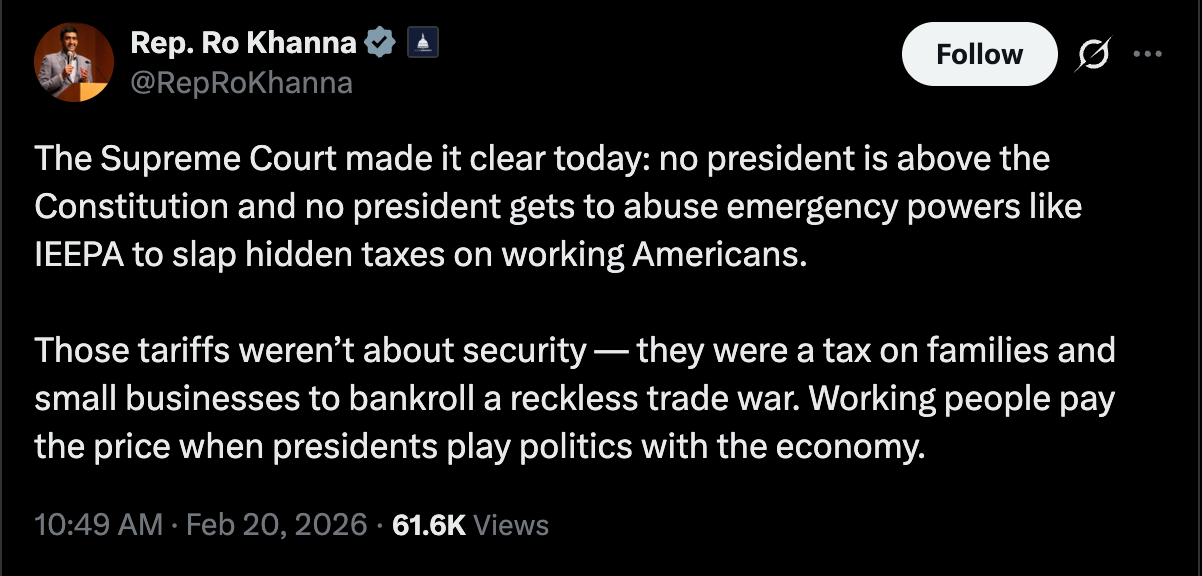
The tariffs imposed by US President Donald Trump and the 10% global tariff announced by Trump on Friday have drawn critical reactions from US lawmakers, Washington, DC-based think tanks and attorneys.
US Senator Rand Paul said that the Trump tariffs are a tax increase on “working families and small businesses,” characterizing them as a net negative on the economy.
“Those tariffs weren’t about security — they were a tax on families and small businesses to bankroll a reckless trade war,” US Congressperson Ro Khanna said.

On Friday, the US Supreme Court (SCOTUS) struck down Trump’s authority to levy tariffs under the IEEPA, which Trump responded to by announcing new 10% global tariffs.
Scott Lincicome, Vice President of Cato’s Herbert A. Stiefel Center for Trade Policy Studies, a Washington DC-based think tank, was also critical of the tariffs. In comments shared with Cointelegraph, he said:
“Even without IEEPA, other US laws and the Trump administration’s repeated promises all but ensure that much higher tariffs will remain the norm, damaging the economy and foreign relations in the process.”
Trump’s tariffs typically had a negative impact on crypto markets and other risk-on assets. However, crypto prices stayed relatively stable amid the most recent round of tariffs, with Bitcoin’s (BTC) price rising by about 3% after the announcement.

Related: Bitcoin ignores US Supreme Court Trump tariff strike amid talk of $150B refund
Trump announces an additional 10% tariff, but pro-crypto attorney says legal scope is limited
“Effective immediately, all national security tariffs, Section 232, and existing Section 301 tariffs, remain in place, and in full force and effect. Today, I will sign an order to impose a 10% global tariff,” Trump announced on Friday.

The new 10% global tariff will be imposed on top of already existing tariff rates, Trump added. However, the legal statutes Trump cited are limited in scope, according to pro-crypto attorney Adam Cochran.
“The law he is using only allows this to be on countries we have a deficit with, for a set period of 150 days, and at a capped percent,” he said.
Magazine: Harris’ unrealized gains tax could ‘tank markets’: Nansen’s Alex Svanevik, X Hall of Flame
SBI Holdings, one of Japan’s largest financial conglomerates, is launching its first blockchain-based bond aimed at individual investors, a 10 billion yen (~$64.5 million) issuance that combines traditional fixed-income features with blockchain settlement and crypto perks.
Called the SBI START Bonds, the securities are fully managed onchain using the “ibet for Fin” platform from BOOSTRY, a specialized enterprise blockchain platform for security token issuance.
These three-year bonds offer an indicative annual interest rate of 1.85% to 2.45%, paid semiannually.
XRP Rewards
The investors in these bonds can also receive rewards in XRP tokens, according to SBI.
Resident retail investors and companies that purchase more than 100,000 yen (around $650) worth and hold an account with SBI VC Trade are eligible to receive rewards in XRP in “an amount corresponding to their subscription amount.”
These bonuses, which the product page details as 200 yen in XRP per 100,000 invested yen, are to be distributed at issuance and again on each interest payment date through 2029.
The bonds are expected to begin secondary trading on March 25 via the Osaka Digital Exchange’s “START” proprietary trading system.
SBI Holdings notably formed a partnership with Ripple back in 2016, and has since then been a supporter of XRP. A subsidiary of the company has even distributed XRP directly to shareholders and supported XRP-powered remittances between Japan and the Philippines.
The company, according to its Chairman and CEO Yoshitaka Kitao, owns roughly 9% of Ripple Labs.
Kitao launched SBI Holdings in 1999 as a SoftBank subsidiary (which later separated into an independent firm in 2006) and has since seen it grow into a financial giant, generating over $8 billion in annual revenue. It first started dealing with blockchain technology through its partnership with Ripple, leading to the creation of SBI Ripple Asia.
The company has since adopted stablecoins. It has partnered with Circle to launch USDC in Japan, and signed a memorandum of understanding with Ripple to distribute its RLUSD stablecoin.

Uniswap founder Hayden Adams has warned users about fraudulent ads impersonating the decentralized exchange, recounting a case in which a victim reportedly lost everything. The alert arrives as January posted the largest crypto-scam losses in 11 months, underscoring persistent brand-abuse and consumer risk in the space. Adams noted that scam Uniswap apps appeared while App Store approvals were pending, a pattern that has persisted even after years of reporting. In parallel, scammers have begun buying ads on major search engines to capture users who search for “Uniswap,” presenting paid results that resemble official links. When users click through and connect wallets, attackers can drain funds with alarming ease.
Key takeaways
- Scam ads targeting Uniswap have resurfaced, leveraging paid search results to imitate the official site and misleading users who seek the platform.
- A crypto holder reporting a mid-six-figure wallet loss illustrates the real-world cost of these impersonations and social-engineering tricks.
- Uniswap previously flagged clone sites in October 2024, when scammers created lookalikes with altered UI elements to steer users toward unsafe actions.
- January’s scam and exploit losses reached about $370.3 million, marking the period as the worst month in nearly a year for fraud in crypto, according to CertiK data.
- A single social-engineering incident accounted for the majority of losses within January, underscoring how a single method can have outsized impact on users.
Sentiment: Neutral
Market context: The rise in scam-ad fraud comes as brand impersonation, social engineering, and search-ad manipulation continue to erode trust in crypto services. The broader market has seen steady attention on security hygiene, user education, and platform-level safeguards as regulators and industry groups seek better guardrails for digital-asset promotions and onboarding.
Why it matters
The incident underscores a systemic risk facing everyday users: the barrier between legitimate and counterfeit promotion is collapsing in the online search realm. When a top result for a trusted platform resembles the real site, even cautious participants can be led into granting permissions that unlock total access to their wallets. Hayden Adams’ warning highlights that fraud. Ads and clone sites are becoming more sophisticated, and the friction for fraudsters to mimic reputable brands has diminished as digital advertising costs remain accessible and search algorithms fail to fully discriminate intent in some cases.
Historically, Uniswap has faced persistent spoofing attempts. In October 2024, Cointelegraph reported on a fake Uniswap clone that exploited the platform’s branding, altering the navigation and promoting unsafe actions such as a misleading “connect” button instead of “get started,” and a “bridge” option in place of “read the docs.” That episode demonstrated the dual threat of brand impersonation and misdirection—where the user’s trust, not just their funds, is at stake. The ongoing risk reflects broader challenges in brand security for decentralized protocols that rely on open-source credibility rather than centralized verification channels.
From a security metrics perspective, January’s figures paint a stark picture. CertiK noted that crypto exploits and scams totaled $370.3 million for the month, the highest monthly tally in 11 months and roughly four times the level seen in January 2025. Of the 40 incidents recorded that month, the majority of losses stemmed from a single social-engineering attack that drained about $284 million from a solitary victim. The concentration of losses in one event amplifies the message: attackers continue to refine social-engineering playbooks, aiming for high-value targets while exploiting trust in familiar brands.
For users and builders, the implication is straightforward: brand risk in crypto remains a material threat, and defensive measures—such as stricter validation of landing pages, better authentication signals, and more robust user education—are essential. The crypto community and platform operators must balance rapid access and openness with verifiable assurances that the user is engaging with legitimate interfaces. While regulators debate standards for disclosures and promotion, practical risk-reduction steps—such as explicit warnings on search results, quick-path checks for domain legitimacy, and safer wallet-approval flows—could help reduce the odds of a successful impersonation.
As scams evolve, so too must user vigilance. The Uniswap case adds to the growing chorus of incidents that illustrate how a combination of deceptive search results, cloned UI, and social-engineering can inflict meaningful losses even on users who attempt to act prudently. The path forward is not only about better enforcement but also about empowering users with clearer signals, safer defaults, and rapid corrective action when fraud is detected.
What to watch next
- Actions by search engines and app stores to curb crypto-brand impersonation and remove counterfeit Uniswap pages promptly.
- Uniswap and other DeFi projects enhancing in-product warnings and safer onboarding flows to prevent wallet approvals on dubious sites.
- CertiK and other security firms continuing to publish monthly incident tallies and spotlightting high-impact social-engineering scams.
- Regulatory developments around crypto advertising, brand protection, and platform accountability that could shape how promotions are vetted online.
- Public awareness campaigns and educational initiatives aimed at strengthening user discernment when interacting with crypto interfaces online.
Sources & verification
- Hayden Adams’ X post warning about scam ads impersonating Uniswap and noting prior delays for App Store approvals.
- X user “Ika” describing a six-figure wallet drain and a statement: “I believe that getting drained isn’t bad luck. It’s the final consequence of a long chain of bad decisions.”
- Cointelegraph’s October 2024 report on a fake Uniswap site designed to look authentic, with altered navigation prompts.
- CertiK’s reporting on January’s $370.3 million in crypto theft and the detail that 40 incidents occurred that month, led by a single $284 million social-engineering loss.
Uniswap scam ads and the battle for trust
Hayden Adams’ warning crystallizes a broader truth about crypto security: brand integrity is a line of defense as much as cryptographic safeguards. The attacker’s toolbox increasingly blends paid search manipulation with convincing UI masquerades, creating a high-risk surface for users who may not spot the differences between legitimate pages and lookalikes. The historical episodes—from the October 2024 clone to the current wave of deceptive search results—highlight a recurring vulnerability: when a project’s name is associated with a trusted platform, the first impression can determine whether a user stays safe or exposes themselves to irrecoverable losses.
For participants building in this space, the takeaway is practical and actionable. Clear brand verification signals, domain controls, and user education should be integral to product design and incident response. The goal is to make legitimate interactions opt-in by default, with explicit confirmations before sensitive actions—especially wallet approvals—are executed. While the market contends with liquidity and macro headwinds, the quality of user onboarding and the reliability of promotional channels will increasingly influence the pace of adoption and trust in DeFi platforms.
As regulators, platform operators, and security researchers map the path forward, the industry will likely rely on a combination of technical safeguards, stronger verification ecosystems, and more transparent communication about known fraud campaigns. The losses in January serve as a reminder that even established brands in crypto must continuously adapt to a threat landscape that is evolving in real time. The resilience of the ecosystem depends on proactive risk management, rapid remediation when breaches occur, and ongoing education that helps users distinguish genuine opportunities from well-crafted scams.


The rial, Iran’s official currency, has failed in 2026. Hyperinflation chews through savings every single day. Sanctions stack on top of bad decisions and endless geopolitical pressure. Every day, folks wake up to less money. Families scramble to buy basics while everything they saved disappears. This feels too familiar. Lebanon went through the exact same crisis starting in late 2019. The same kind of banking freeze, the same worthless currency slide, the same desperate search for anything that holds value. Bitcoin turned out to be that financial safe haven then. Signs point to it doing the same in Iran now.
Beirut and Tehran are trapped in the same mess
Lebanon hit the wall when banks locked accounts tight. Dollar savings got stuck, then devalued hard into a pound that kept crashing. Over 90 percent are gone. Lines at ATMs turned into fights. Protests broke out everywhere. Money sent from family abroad became the only lifeline, but even those funds struggled to come through and cost a lot in fees.
Iran deals with the same chokehold. Sanctions cut off normal trade. Inflation runs wild. Reports put crypto activity close to $8 billion in 2025. People yank Bitcoin straight to personal wallets fast. They worry about freezes or bigger drops. Even the central bank grabs stablecoins like Tether to dodge restrictions.
In Lebanon, attitudes flipped quickly. People who once ignored Bitcoin started running to it because nothing else worked. Peer-to-peer trades exploded everywhere, esp. in Telegram groups. No banks needed. Remittances landed clean. Corner stores took it for bread or gas. A whole underground economy kept running while the official one died.
The raw reality of Lebanon’s breakdown
Banks did not just slow withdrawals. They took chunks out of deposits. Promised dollars became local currency worth almost nothing. Trust vanished overnight. People who planned carefully lost retirement money, business cash and everything built over decades.
Bitcoin cut through that. It allowed holders to keep something no policy could touch or inflate away. Holding private keys on hardware wallets meant real control. Verify transactions yourself. Remittances crossed borders in minutes, no middlemen skimming. Price ups and downs happened, but long term it held up way better than the pound ever could.
Problems stayed real. Power went out constantly. The Internet dropped. Outside Beirut, liquidity stayed thin. Early on, plenty got burned by shady services because they did not know better. Groups popped up fast, though. Online chats, meetups in cafes. People taught each other: back up seeds right, run your own node, skip custodians. The crisis forced learning quickly. The clearest lesson stuck: leave Bitcoin with someone else and risk losing it to hacks, freezes, or sudden changes in the rules. True ownership means keys in your control.
What Iran can learn from Lebanon’s experience
Iran tracks a similar path. Protests show the anger boiling over. The rial keeps dropping. Onchain data makes clear that people move to self-custody to block seizures or worse inflation.
Government signals mix up. Limits on mining clash with tests using crypto for imports. For regular people, though, Bitcoin stays simple: no one stops transfers, no borders block it, value holds outside state control. Stablecoins cover day-to-day. Bitcoin is the savings.
Practices that worked in Lebanon transfer straight over. Find a reliable non-custodial wallet and back up your seed phrase. Create a network of peer-to-peer contacts for when fiat comes in or out. Those basics let the Lebanese people ride out the worst. They offer the same shot in Iran.
Sure, obstacles persist: rules flip, the internet fails in spots, prices swing. Still beats staying fully tied to a currency that keeps failing. Lebanon proved that waiting for the government to fix things rarely works. Early action saved what could be saved.
Getting control back when systems fail
Lebanon and Iran lay bare how quickly centralized finance crumbles. Overprinting, account locks and economic isolation cause innocent citizens to take the hit every time. Bitcoin switches the game: no approval required, no one else bears the risk if the keys stay yours.
The collapse in Lebanon forever changed its economy. Money moved from the into a survival tool, forcing people to learn about custody and real ownership. Iran is faced with the same lesson now: depend on failing banks or take the tool that hands power back.
The rial’s hard drop signals more than just trouble. It pushes change. Lebanon produced tougher people who learned what ownership actually means. Iran has the opening for that, too. Move before more vanishes. Check everything yourself. Build stacks. Hold the keys tight. Create real freedom. No one hands it over. You claim it back, one satoshi at a time.
Crypto World
Inside France’s strict conditions for selling $168 million stake of its state-owned energy cloud to U.S. bitcoin miner


France has approved the sale of a majority stake in a key data center unit of state-owned Electricité de France (EDF) to U.S.-based bitcoin miner MARA Holdings Inc., after months of national security review.
MARA, headquartered in Florida, is acquiring a 64% stake in Exaion, a subsidiary that operates high-performance computing infrastructure for digital workloads. The deal, first announced in August 2025, is valued at $168 million.
The transaction raised concerns in Paris about potential foreign control over digital infrastructure. In response, the French government imposed conditions before signing off.
NJJ Capital, an investment firm controlled by telecom billionaire Xavier Niel, will take a 10% stake in Mara France, the local entity handling the acquisition, in exchange for a requirement that a French investor step in. EDF will keep a minority stake and continue as a client of Exaion.
Finance Minister Roland Lescure called the outcome a sign that France remains open to international investment while still defending its strategic interests.
“In this operation, the State is advancing on two fronts: we are confirming France’s attractiveness for international investment, while ensuring uncompromising protection of our strategic interests and our technological sovereignty,” the Minister said. A government statement added that no sensitive EDF data will remain with Exaion following the sale.
Exaion’s board of directors will now include representatives from MARA, EDF, and NJJ.
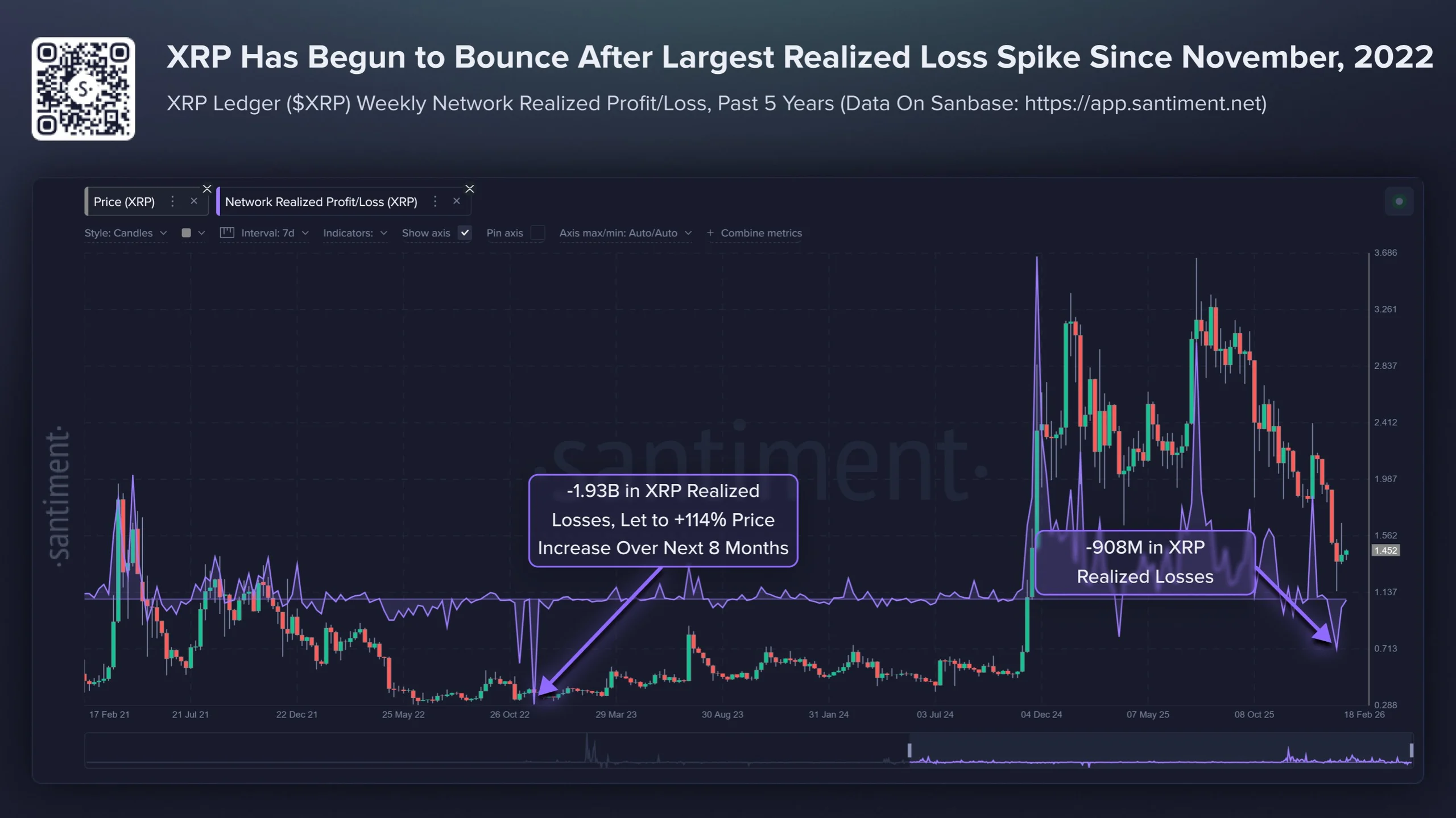
If history is to repeat now, XRP could go beyond $3.00.
Ripple’s cross-border token became one of the most volatile assets in the cryptocurrency space after the 2024 presidential elections in the US, going from $0.60 to over $3.60 within less than a year, before it crashed to $1.11 earlier this month.
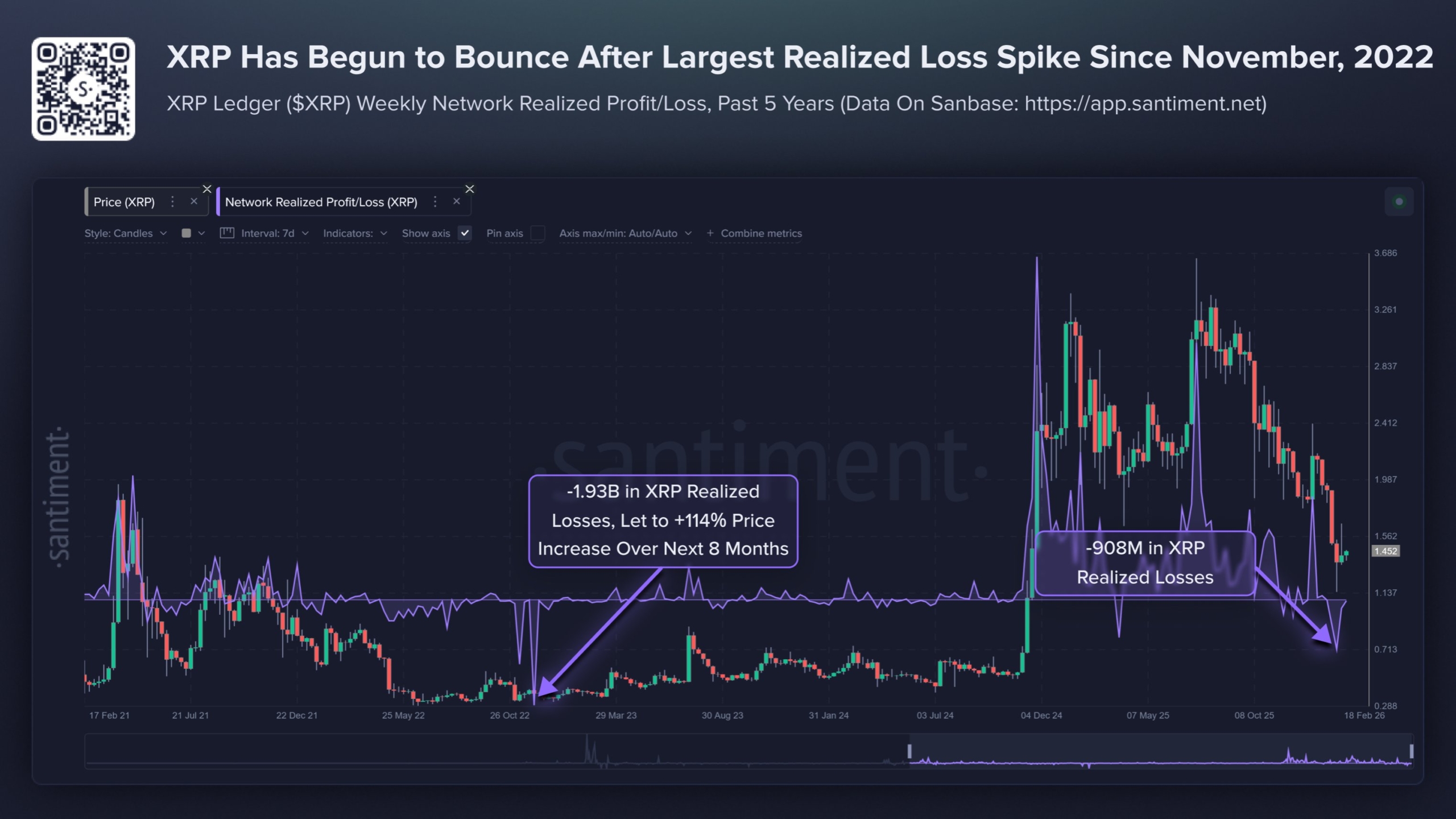
Following this 70% decline from July 2025 to February 2026, the token has seen its “largest on-chain realized loss spike since 2022,” said Santiment. However, this could be a blessing in disguise for token holders.
The analyst from the analytics company noted that the last time such massive realized losses were recorded, of -$1.93 billion, the underlying asset exploded by 114% in the following eight months. If such a spectacular price increase is to repeat now, it would put XRP’s valuation at over $3.00.
“Significant realized losses happen when a large number of investors sell their coins at a price lower than what they originally paid. This usually coincides with fear taking over. When traders panic and capitulate, they lock in their losses instead of holding and hoping for a rebound,” explained the company.
However, the analysts added that while this might feel negative in the short-term, it can be an important price signal for the longer run.
If the so-called weak hands have already sold, fewer sellers are left to push the asset lower. Or, as Santiment put it: “a wave of heavy realized loss can mean that much of the damage has already been done.”
Additionally, the analysis reads that such large increases in realized losses occur near market bottoms because “extreme fear tends to peak before price does.”
“Once sellers are exhausted, even a small amount of new buying pressure can push prices higher. That does not guarantee an immediate rally, but it increases the probability of a bounce. “
You may also like:
SECRET PARTNERSHIP BONUS for CryptoPotato readers: Use this link to register and unlock $1,500 in exclusive BingX Exchange rewards (limited time offer).
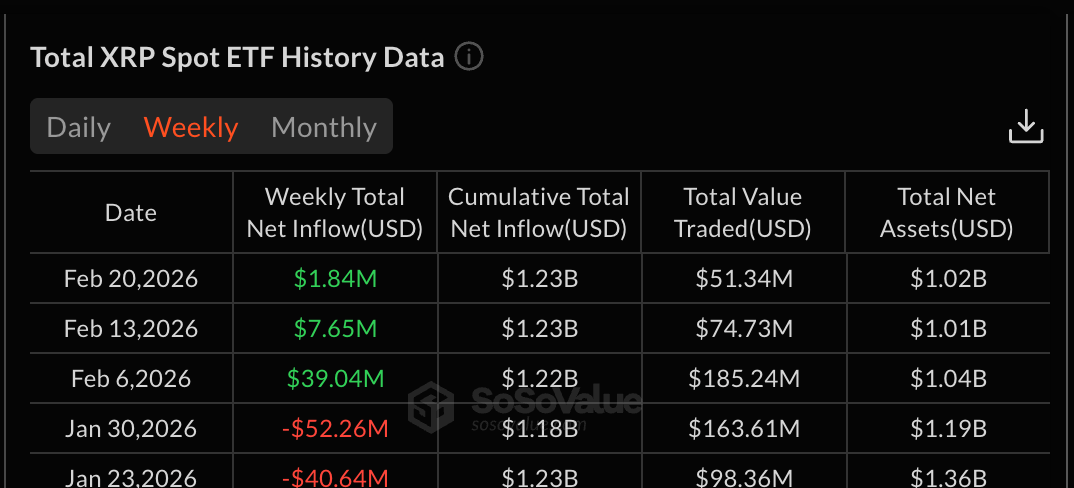
XRP price has traded mostly flat over the past 24 hours and the past week. This sideways move shows clear market indecision. On the surface, institutional activity looks supportive. XRP spot ETFs have now recorded three straight weeks of inflows. But underneath this positive trend, a hidden weakness is quietly building.
Several technical and on-chain signals suggest XRP may be closer to a breakdown than it appears.
ETF Inflows Stay Positive, But Institutional Strength Is Rapidly Fading
XRP spot ETFs have recorded inflows for three straight weeks. The week ending February 6 saw $36.04 million in inflows. By the week ending February 20, inflows had fallen further to just $1.84 million.
This represents a drop of nearly 95% in weekly inflows within three weeks.
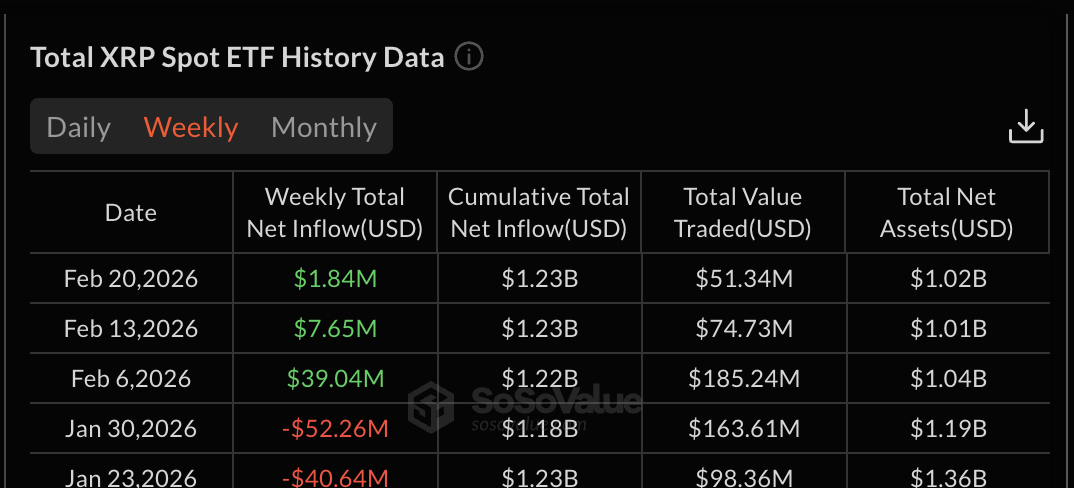
ETF inflows show how much institutional money is entering an asset. Rising inflows usually signal growing confidence. But falling inflows, even if still positive, show that institutional conviction is weakening quickly.
This institutional slowdown is already visible on the chart. XRP fell below its weekly Volume Weighted Average Price, or VWAP, on February 18 and hasn’t reclaimed the line since.
VWAP represents the average price weighted by volume. It is widely used as a proxy for institutional cost basis and is referred to by big money as a benchmark.
When the price falls below VWAP, it means institutions are holding positions at a loss on average. This often reduces their willingness to buy more. The last time XRP broke its weekly VWAP, it fell nearly 26%. The correction since February 18 is also continuing.
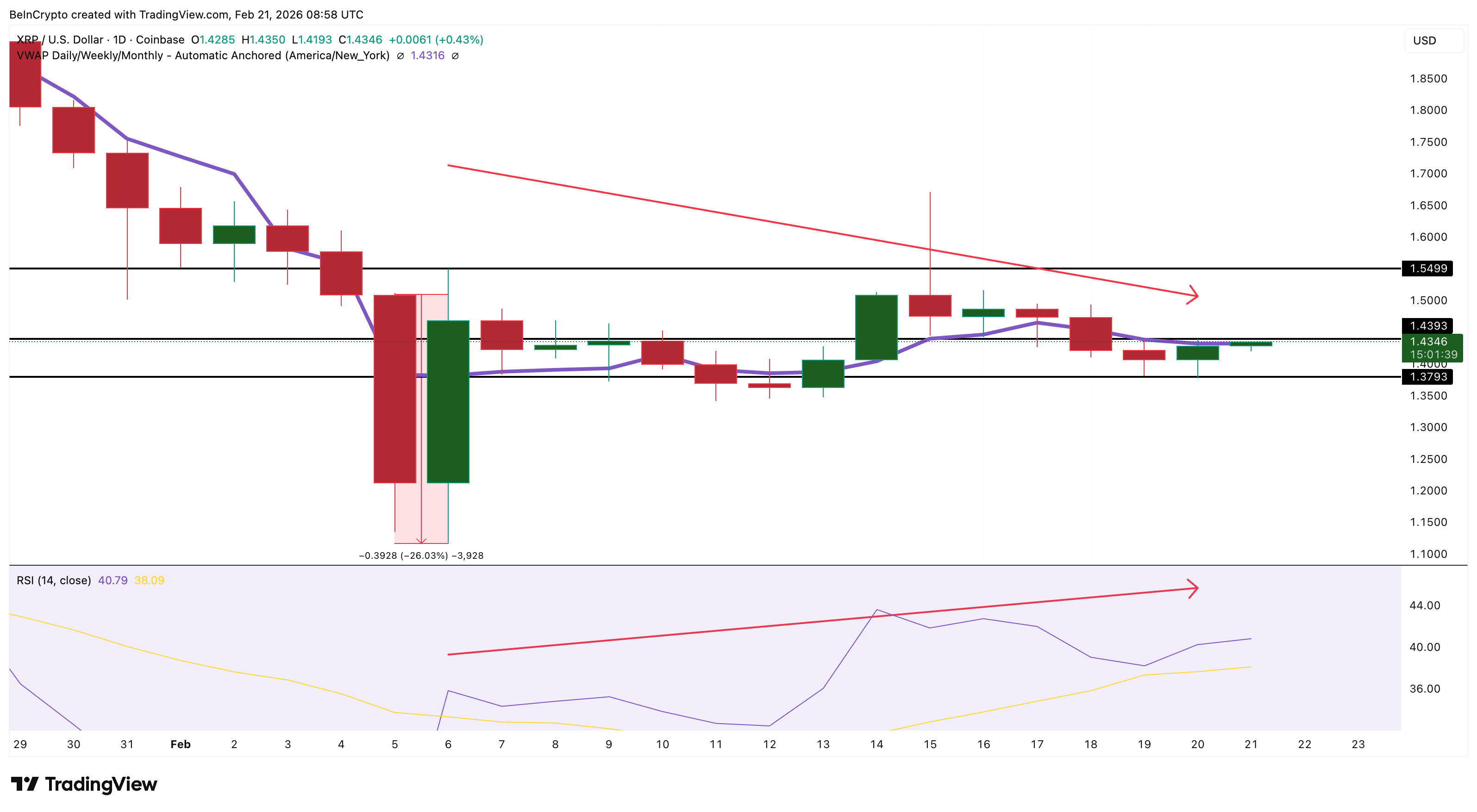
At the same time, XRP is close to forming a hidden bearish divergence between February 6 and February 20. During this period, the XRP price seems to be printing a lower high. But the Relative Strength Index, or RSI, already formed a higher high.
RSI measures momentum. When momentum rises, but price fails to follow, it signals weakening recovery strength and a possible downtrend extension for XRP if $1.379 breaks. A clear price-specific confirmation would occur if the current XRP price fails to reach or exceed $1.439.
Together, weakening ETF inflows, VWAP loss, and bearish divergence show that institutional strength is fading despite the positive ETF streak.
Exchange Flows and Dip Buying Explain Why Price Has Not Collapsed Yet
Despite falling below the VWAP, XRP has not collapsed sharply, like earlier. On-chain data helps explain why.
One key metric is Exchange Net Position Change. This tracks whether coins are moving into or out of exchanges. Outflows usually signal buying, while falling outflows show weakening demand.
On February 18, exchange outflows peaked near 71.32 million XRP. Recently, outflows dropped to around 41.69 million XRP. This marks a decline of about 41%.
Want more token insights like this? Sign up for Editor Harsh Notariya’s Daily Crypto Newsletter here.
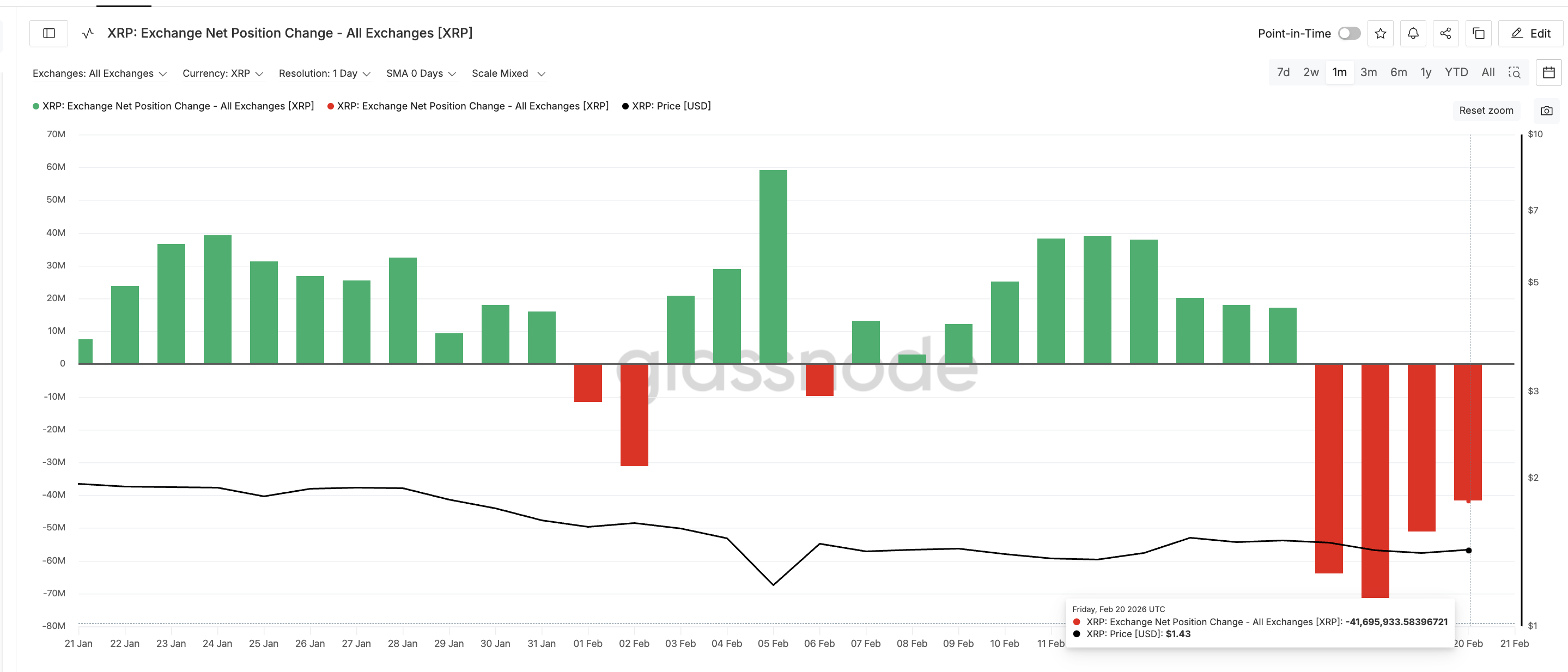
This shows that buying pressure has weakened significantly but still remains.
Another indicator shows buyers are still active. The Money Flow Index, or MFI, tracks real capital entering an asset. Between February 6 and February 19, the XRP price trended lower.
But MFI trended higher. This divergence shows dip buyers are slowly accumulating even as the price weakens.
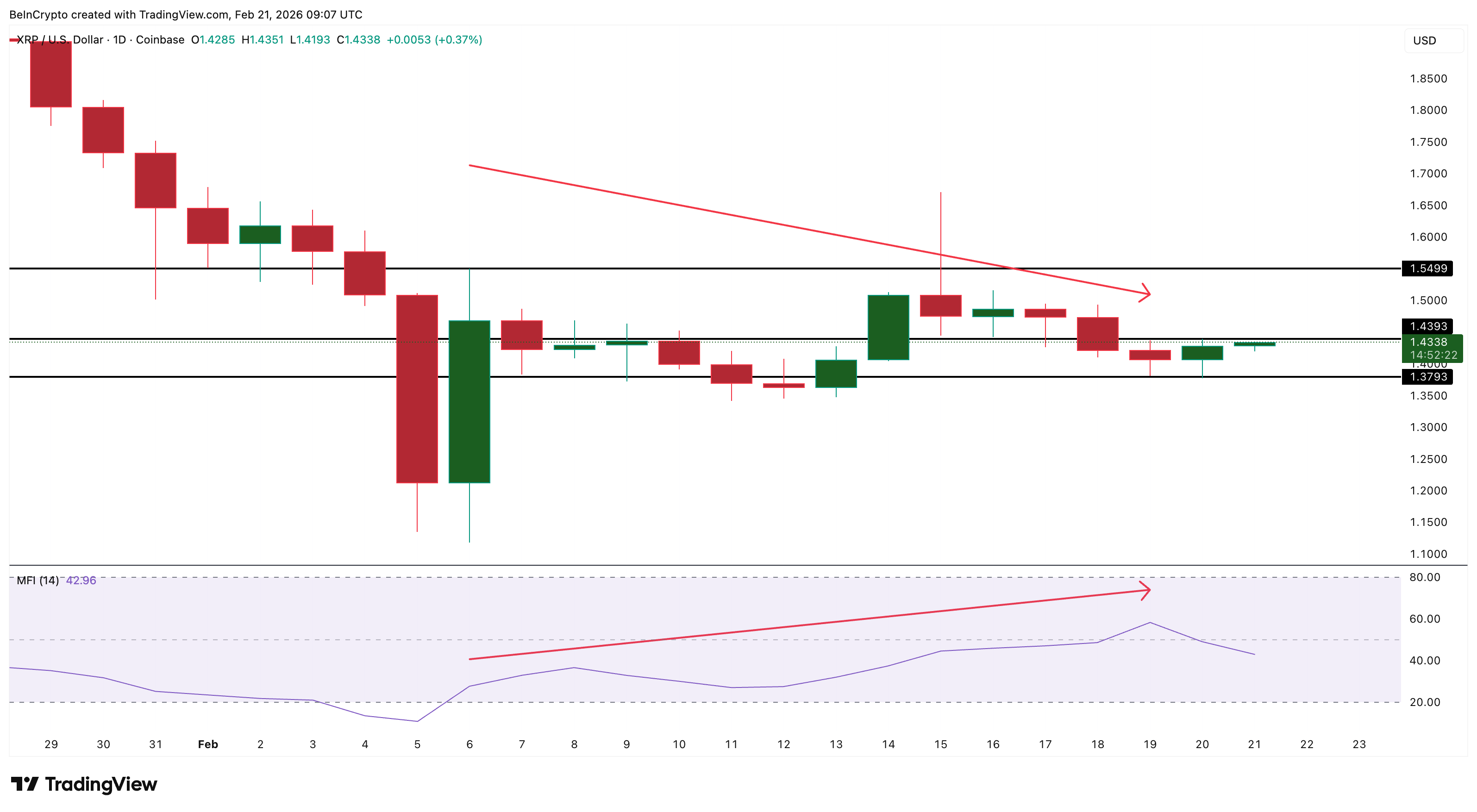
This dip buying helps explain why XRP has remained relatively stable after losing its VWAP. Buyers are absorbing selling pressure. This has prevented an immediate collapse so far. But this support is limited. If dip buying weakens, downside risk could increase quickly.
XRP Price Faces Critical $1.25 Test as Cost Basis Cluster Becomes Final Support
Cost basis data now shows XRP approaching a critical support zone. Cost basis represents the prices at which investors previously bought XRP.
These levels often act as strong support or resistance. The most important support cluster currently sits near $1.26, hosting over 159 million XRP.
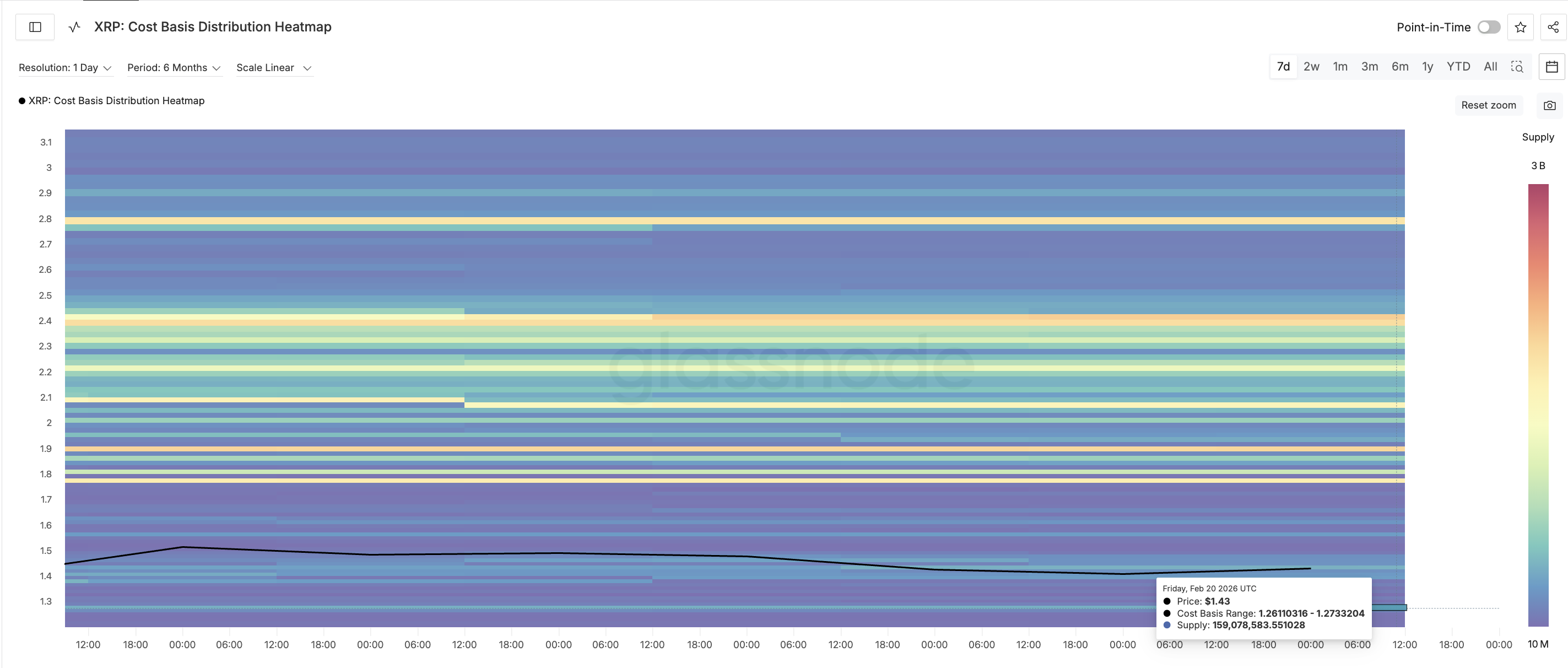
This is where a large number of holders bought XRP. As long as this level holds, the XRP price may avoid a deeper crash beyond 12% even if the immediate support zone at $1.35-$1.37 breaks.
However, if XRP falls below $1.26 ($1.259 on the chart), selling pressure could accelerate sharply. The next major downside levels would appear near $1.162 and $1.024.
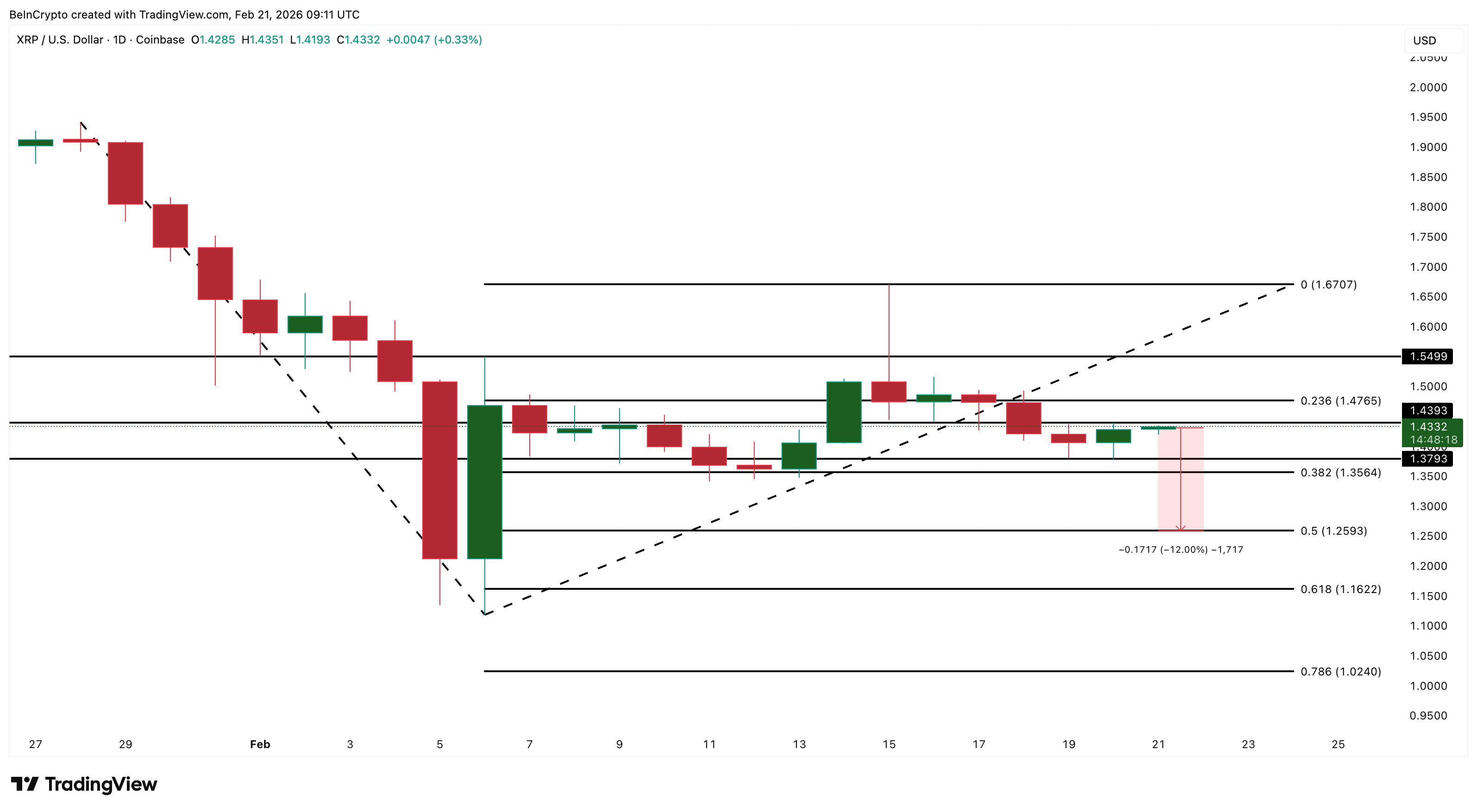
On the upside, XRP must first reclaim $1.439. A stronger recovery would require moves above $1.476 and $1.549. Only a breakout above $1.670 would fully cut the bearish momentum.
For now, XRP remains stuck between weakening institutional support and steady dip buying. ETF inflows are still positive, but falling rapidly.
Technical and on-chain signals show that $1.259 is now the most important level that could determine XRP’s next major move, especially if the bearish divergence and VWAP weakness continue to play out.
Crypto World
ETH Stuck Below $2,000, SUI Clinging to $1.00, But BlockDAG’s 10,000 Coinbase Wallets Won’t Wait

February 2026 is shaping up to be one of the most defining months in crypto. The Sui price today is clinging to a critical support level, while the Ethereum price prediction remains divided as ETH struggles to break a wall it keeps running into. Both are waiting for their next catalyst.
But while established coins battle uncertainty, one project is rapidly building the kind of buzz that turns newcomers into the most popular cryptocurrency of the year. BlockDAG (BDAG) just activated something that only 10,000 wallets in the entire world can access, and once those spots are gone, they are gone forever. With a confirmed global launch on March 4, the clock is already ticking. Here is everything investors need to know.
SUI: Sitting on a Ledge, Waiting for a Push
The Sui price today tells a story of a coin that hasn’t decided its next move yet. SUI is currently testing support near the $1.00 level, a zone that traders are watching very closely. The RSI indicator has dipped into oversold territory, which historically has preceded strong recoveries for this asset. Past cycles showed price expansions of over 500% and 800% from similar conditions, though past performance is never a guarantee of what comes next.
Among the most popular cryptocurrency choices, SUI just got a major vote of confidence; Grayscale launched a SUI-based ETF on the NYSE, bringing in traditional investors and easing selling pressure on the token. Still, traders are waiting for confirmation before calling it a reversal. If the $1.00 support holds and volume picks up, analysts are eyeing $2.00 as the next major target. Until then, the Sui price today remains in a wait-and-watch zone.
Ethereum: Caught Between a Support and a Resistance
The Ethereum price prediction debate right now is genuinely split down the middle. ETH has been trading between $1,850 and $1,900, repeatedly knocking on the $2,000 resistance and getting turned away every time. The longer it stays stuck here, the more it tests investor patience.
A bearish pennant has formed on the chart, and if the $1,850 support breaks, some analysts are pointing to as low as $1,136 as the next stop. That’s a painful drop from here. However, not everyone sees it that way. Among the most popular cryptocurrency names battling macro headwinds, ETH is also showing signs of quiet accumulation below $2,000, which some read as whales building positions before a breakout.
The Ethereum price prediction ultimately comes down to three things: Bitcoin’s next move, whether $1,850 holds, and whether whales step in with real conviction. For now, it’s a coin in a standoff.
BlockDAG: 10,000 Spots, One Code, and a Door That Closes Forever
There are moments in crypto that early buyers talk about for years, and right now, one of those moments is happening in BlockDAG. As one of the most popular cryptocurrency names, the project is doing something entirely different. The first 10,000 wallets that purchase BDAG using the code COINBASE will be locked in as the Coinbase First Access Group.
When BDAG lists on Coinbase, these wallets are intended to receive trading access ahead of general availability. No minimum purchase required. But the moment that the 10,000th wallet is filled, it closes permanently, no exceptions, no second chances.
That alone would be enough to turn heads. But the story behind BlockDAG makes it even harder to ignore. Before a single token ever hit a public exchange, BDAG raised $452 million in presale, one of the most remarkable fundraising runs in crypto history. The Mainnet is live. The Token Generation Event is done. This isn’t a project still figuring itself out; everything is built and ready.
The genesis price is currently $0.000125, with a confirmed Day 1 listing price of $0.05 when BDAG launches globally on March 4. That’s a potential 400x from today’s entry point.

When that door closes, it closes for good, and among the most popular cryptocurrency projects making noise right now, there won’t be another entry point like this one. Buyers are already rushing to secure their position before the 10,000 wallets are gone.
Final Thoughts
The Sui price today and the Ethereum price prediction both carry genuine long-term potential, but they also carry real uncertainty. SUI needs confirmation before any reversal is real, and Ethereum could drop significantly before it finds its footing. Patient, risk-tolerant investors may be rewarded eventually, but the road there won’t be smooth.
BlockDAG operates on a completely different timeline. The infrastructure is built, the launch date is set, and the genesis price is the last open door before global markets take over on March 4. For those searching for the next most popular cryptocurrency, BlockDAG’s 10,000-wallet Coinbase access group is filling fast, and buyers are already rushing before that door closes permanently.

Private Sale: https://purchase.blockdag.network
Website: https://blockdag.network
Telegram: https://t.me/blockDAGnetworkOfficial
Discord: https://discord.gg/Q7BxghMVyu
Disclaimer: This is a Press Release provided by a third party who is responsible for the content. Please conduct your own research before taking any action based on the content.


Something Is Changing For Bitcoin

Scotland survive major scare as Wales fall heartbreakingly short of long-awaited Six Nations win

2026 Hobartville Stakes a key distance trial for Napoleonic


-

 Video5 days ago
Bitcoin: We’re Entering The Most Dangerous Phase
-

 Tech7 days ago
Luxman Enters Its Second Century with the D-100 SACD Player and L-100 Integrated Amplifier
-

 Crypto World4 days ago
Can XRP Price Successfully Register a 33% Breakout Past $2?
-

 Sports5 days ago
GB's semi-final hopes hang by thread after loss to Switzerland
-

 Fashion24 hours ago
Weekend Open Thread: Boden – Corporette.com
-

 Video2 days ago
XRP News: XRP Just Entered a New Phase (Almost Nobody Noticed)
-
 Tech5 days ago
The Music Industry Enters Its Less-Is-More Era
-

 Business4 days ago
Infosys Limited (INFY) Discusses Tech Transitions and the Unique Aspects of the AI Era Transcript
-

 Entertainment3 days ago
Kunal Nayyar’s Secret Acts Of Kindness Sparks Online Discussion
-

 Video4 days ago
Financial Statement Analysis | Complete Chapter Revision in 10 Minutes | Class 12 Board exam 2026
-

 Tech3 days ago
Retro Rover: LT6502 Laptop Packs 8-Bit Power On The Go
-
 Sports3 days ago
Clearing the boundary, crossing into history: J&K end 67-year wait, enter maiden Ranji Trophy final | Cricket News
-

 Entertainment3 days ago
Dolores Catania Blasts Rob Rausch For Turning On ‘Housewives’ On ‘Traitors’
-

 Business3 days ago
Tesla avoids California suspension after ending ‘autopilot’ marketing
-
 NewsBeat6 days ago
The strange Cambridgeshire cemetery that forbade church rectors from entering
-

 Politics4 days ago
Eurovision Announces UK Act For 2026 Song Contest
-

 Crypto World3 days ago
WLFI Crypto Surges Toward $0.12 as Whale Buys $2.75M Before Trump-Linked Forum
-
 NewsBeat6 days ago
Man dies after entering floodwater during police pursuit
-

 Crypto World2 days ago
83% of Altcoins Enter Bear Trend as Liquidity Crunch Tightens Grip on Crypto Market
-
 NewsBeat1 day ago
Andrew Mountbatten-Windsor latest: Police search of Royal Lodge enters second day after Andrew released from custody