
Crypto World
Coinbase and Apex Group Tokenize Bitcoin Yield Fund on Base Layer-2


Coinbase Asset Management has moved to tokenize its Bitcoin Yield Fund on the Base blockchain, unveiling a tokenized share class for the fund in partnership with Apex Group. The move is framed as a way to enable institutional access to a yield-bearing Bitcoin exposure while preserving regulatory compliance.
Apex Group said in a statement on Thursday that the tokenized share class of Coinbase Asset Management’s fund “is set up to interact with compatible platforms, wallets, and infrastructure without compromising compliance.”
Coinbase Asset Management president Anthony Bassili said the share class integrates “identity and eligibility at the token level” to support regulatory requirements. The approach reflects a broader push among traditional asset managers to bring tokenized investments—ranging from stocks and bonds to funds and real assets—onto public blockchains in pursuit of lower costs, faster settlement, and around-the-clock trading.
Industry players have been exploring tokenization across a spectrum of assets, with BlackRock, Fidelity Investments, and Franklin Templeton already launching tokenized funds on-chain. The Coinbase initiative adds another high-profile entry to a growing ecosystem of regulated, on-chain fund access.
The tokenized share class of Coinbase’s Bitcoin Yield Fund, which provides exposure to Bitcoin and a yield component, will be available on the Base network only to institutional and accredited investors outside the United States. The arrangement leverages the ERC‑3643 permissioned token standard to ensure that only eligible investors can access the yield product.
Apex acts as the on-chain transfer agent for this tokenized structure, responsible for managing token ownership, enforcing transfer and compliance rules, and maintaining a transparent record of transactions on Base.
Coinbase has signaled plans to broaden access by launching a tokenized share class of the Coinbase Bitcoin Yield Fund for U.S. investors in the future, expanding the program beyond the current non-U.S. eligibility window.
Historically, Coinbase’s non-U.S. version of the Bitcoin Yield Fund targeted an annual return in Bitcoin in the 4% to 8% range. Coinbase explained that the product was designed to provide native yield options for Bitcoin, addressing a gap created by the lack of yield-generating mechanisms for non-staking digital assets compared with proof-of-stake tokens like ETH or SOL.
The broader context for these developments is a formalization of on-chain access to traditional financial products. As institutions seek cost efficiencies and more flexible settlement, tokenized funds and other on-chain assets are becoming increasingly mainstream, albeit with careful attention to regulatory alignment and investor eligibility.
Key takeaways
- The Bitcoin Yield Fund now has a tokenized share class on Coinbase’s Base network, developed with Apex Group for compliant, on-chain handling.
- Access is limited to institutional and accredited investors outside the U.S. for the current tokenized offering, with plans to reach U.S. investors later.
- The token uses ERC‑3643, a permissioned standard designed to restrict ownership to eligible participants and support regulatory controls on-chain.
- Apex serves as the on-chain transfer agent, overseeing ownership, transfers, and compliance data on Base.
- Even as Coinbase rolls out this non-U.S. version, other asset managers including BlackRock, Fidelity, and Franklin Templeton have already launched tokenized funds on-chain, signaling a broader industry trend.
On-chain compliance and the promise of institutional tokenization
At the core of this initiative is a specialized focus on regulatory alignment. By insulating the tokenized share class behind a permissioned standard, Coinbase and Apex are aiming to prevent unauthorized access while enabling seamless interaction with compatible platforms, wallets, and infrastructure. The official framing from Apex emphasizes that the tokenized structure can operate across ecosystems without compromising compliance, a critical consideration for institutions weighing on-chain custody and transfer mechanisms.
Anthony Bassili’s emphasis on identity and eligibility at the token level underscores the shift from purely decentralized narratives toward regulated, auditable on-chain products. In practice, this approach means that investor verification and compliance checks can be encoded directly into the token’s lifecycle, potentially reducing friction in future cross-border and cross-platform dealings for regulated participants.
What’s next for investors and the market
The move arrives at a moment when large fund managers are increasingly experimenting with tokenized vehicles as a way to improve efficiency and broaden access. The non-U.S. version of Coinbase’s Bitcoin Yield Fund sets a precedent for cross-border issuance that prioritizes regulatory controls, while still tapping into the liquidity and programmability offered by Base’s blockchain infrastructure.
Coinbase’s stated intention to roll out a U.S.-based tokenized share class for the Bitcoin Yield Fund will be closely watched. If executed, it would position Coinbase alongside a growing cohort of traditional asset managers pursuing tokenized, yield-bearing offerings for a domestic audience—an area that has drawn attention from regulators and institutional participants alike.
Looking ahead, observers will want to see how broader adoption unfolds: Will more funds adopt ERC‑3643 or similar permissioned standards? How quickly will institutional custodians and exchanges integrate tokenized share classes with existing settlement rails? And what regulatory clarifications emerge as on-chain products expand from foreign-only access to domestic markets?
For now, the Coinbase-Apex collaboration marks a notable step in the ongoing evolution of regulated, on-chain asset issuance. The degree to which this model scales—across asset classes, jurisdictions, and investor bases—will help define the next phase of institutional tokenization in crypto finance.
Readers should watch for updates on the US-tokenized version’s timeline and for further announcements from Apex Group and Coinbase Asset Management regarding platform integrations, eligible investor criteria, and potential expansion to additional fund families.

Key Takeaways
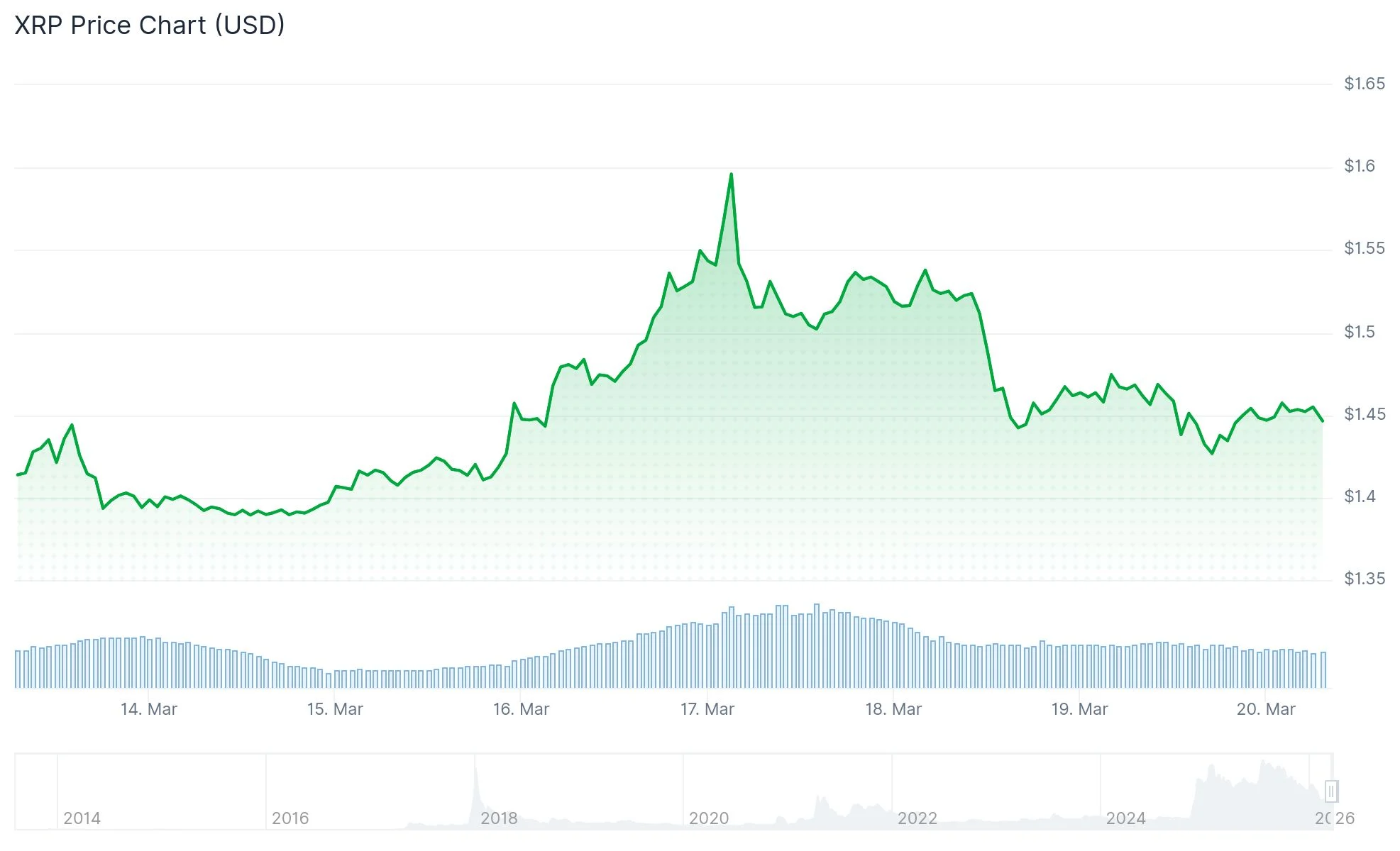
- XRP has declined 10.5% across a three-day period but maintains position above a critical bull flag breakout zone between $1.40 and $1.45
- South Korean investors are removing XRP from Upbit at unprecedented rates, mirroring behavior seen during previous accumulation cycles
- Large holder net flows have flipped positive for the first time since the beginning of 2024, indicating potential shift from distribution to accumulation
- The March 18 Federal Reserve decision maintained rates at 3.5%–3.75%, creating headwinds for risk-on assets across cryptocurrency markets
- XRP spot ETF products in the United States reported no net capital inflows on Wednesday, though total cumulative inflows remain at $1.21 billion
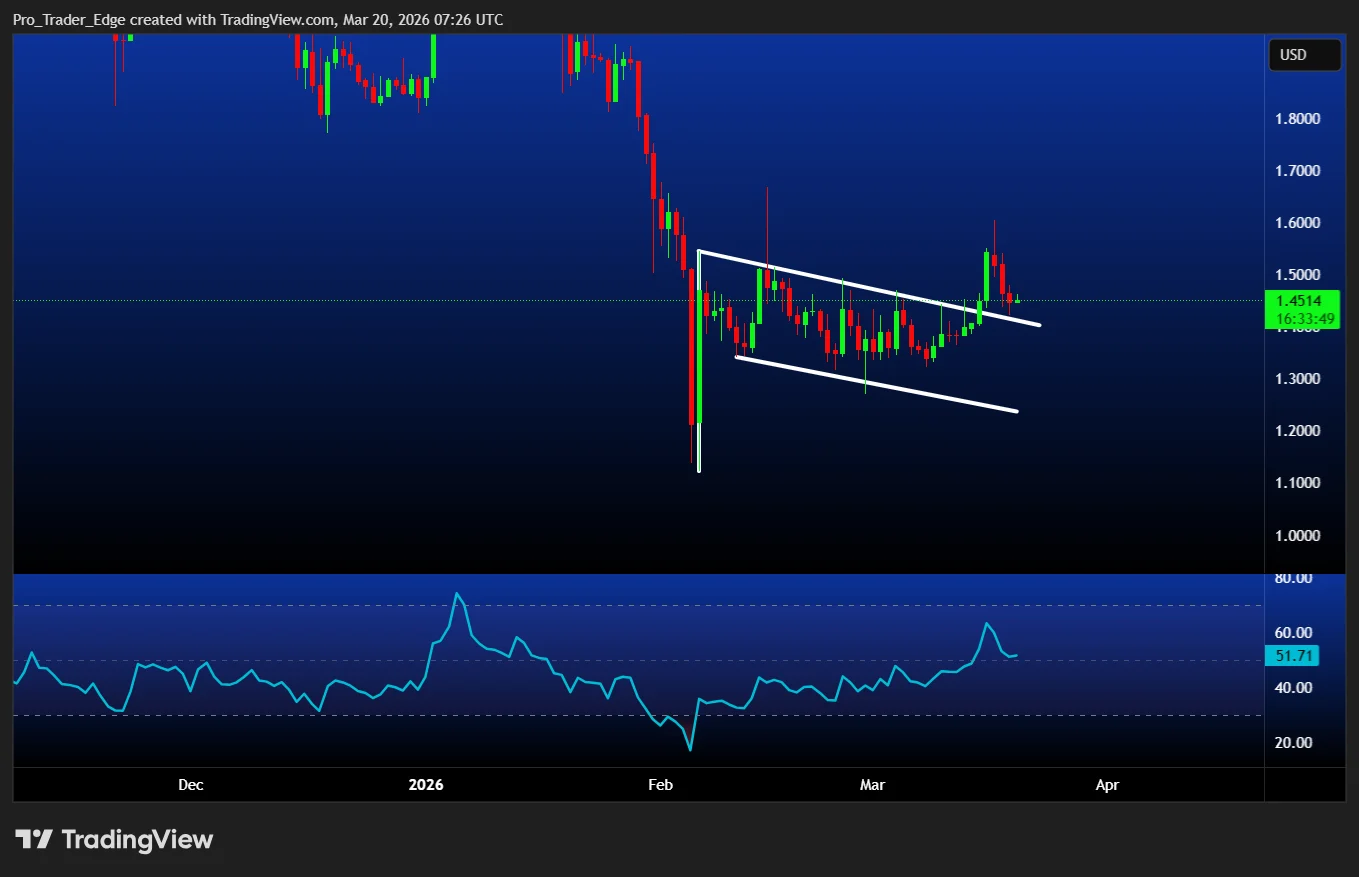
XRP currently trades within the $1.42–$1.45 range following a steep three-day retracement exceeding 10%. This pullback occurred amid widespread cryptocurrency market volatility, yet multiple blockchain metrics suggest conditions may be developing for a reversal.
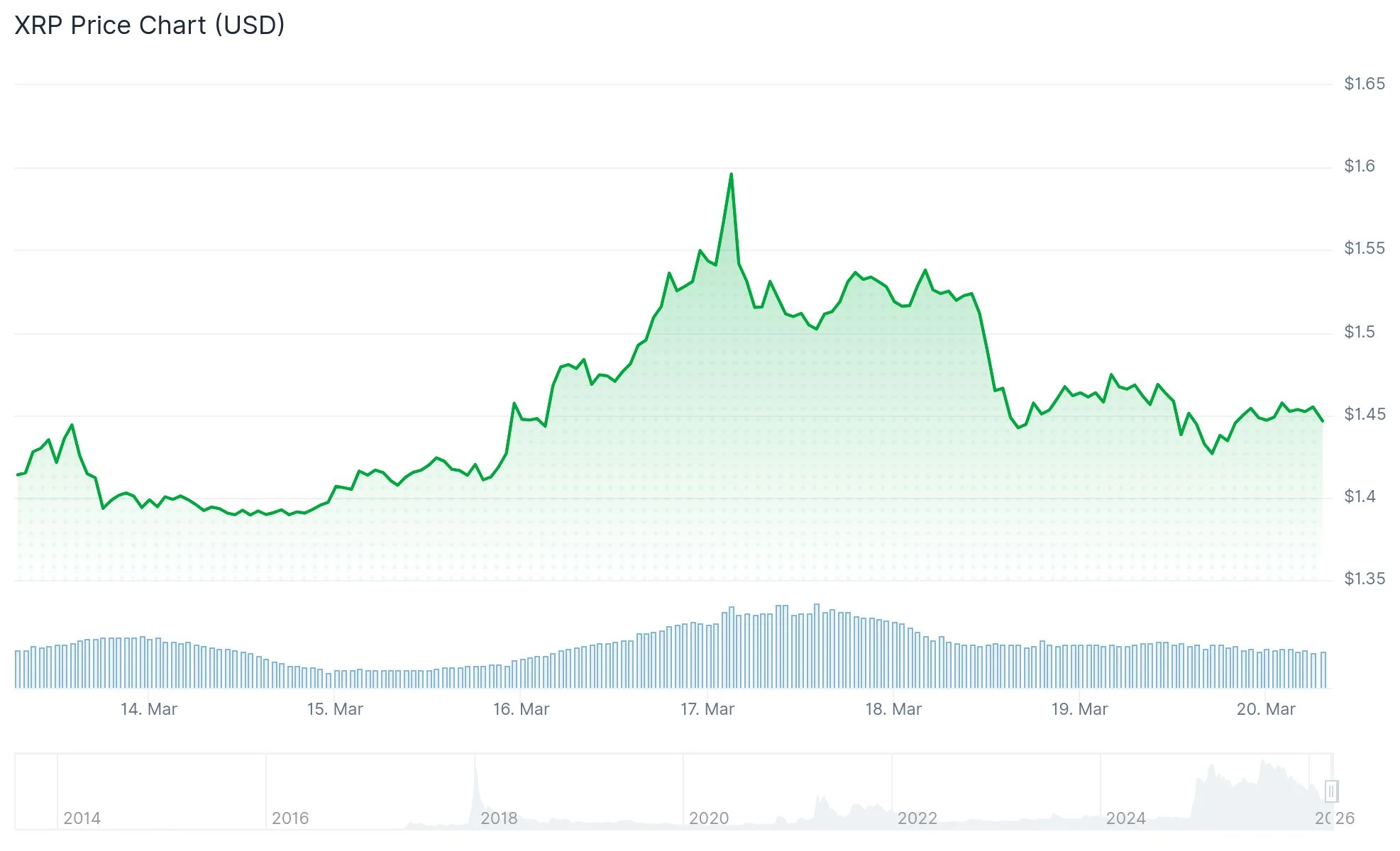
The recent price action follows last week’s breakout from a bull flag formation. In chart pattern analysis, bull flags develop when an asset consolidates within a descending channel following a significant upward move. After clearing the upper boundary of this channel, assets frequently retest the former resistance zone as newly established support — a scenario that appears to be unfolding currently.
The critical support region resides in the mid-$1.40 area, which aligns with the 20-day exponential moving average. Should XRP maintain levels above this threshold, the bull flag’s projected upside target reaches approximately $1.70–$1.72, representing roughly 20% upside potential from present levels.
South Korean Exchange Withdrawals Reach Historic Highs
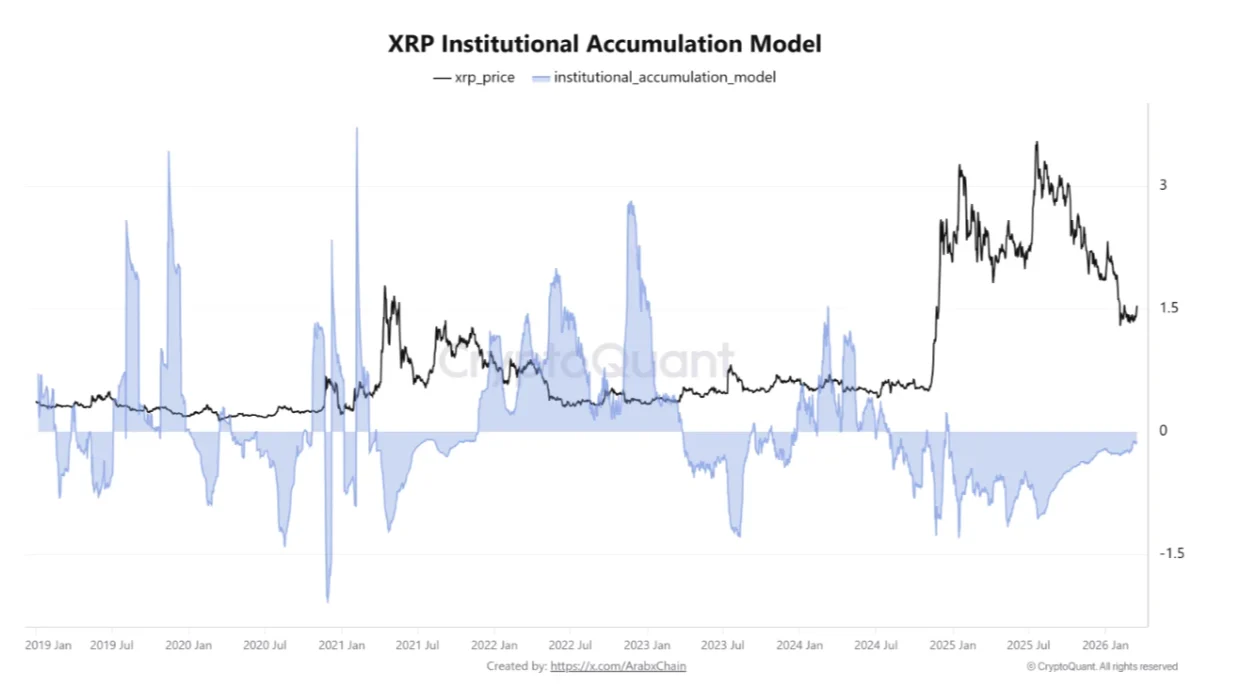
Blockchain intelligence from CryptoQuant reveals significant XRP withdrawal activity from South Korea’s Upbit platform beginning in December 2025. Wallet holders across virtually every size category have been removing XRP from the exchange at unprecedented volumes. Reduced exchange balances generally indicate diminished immediate selling pressure.
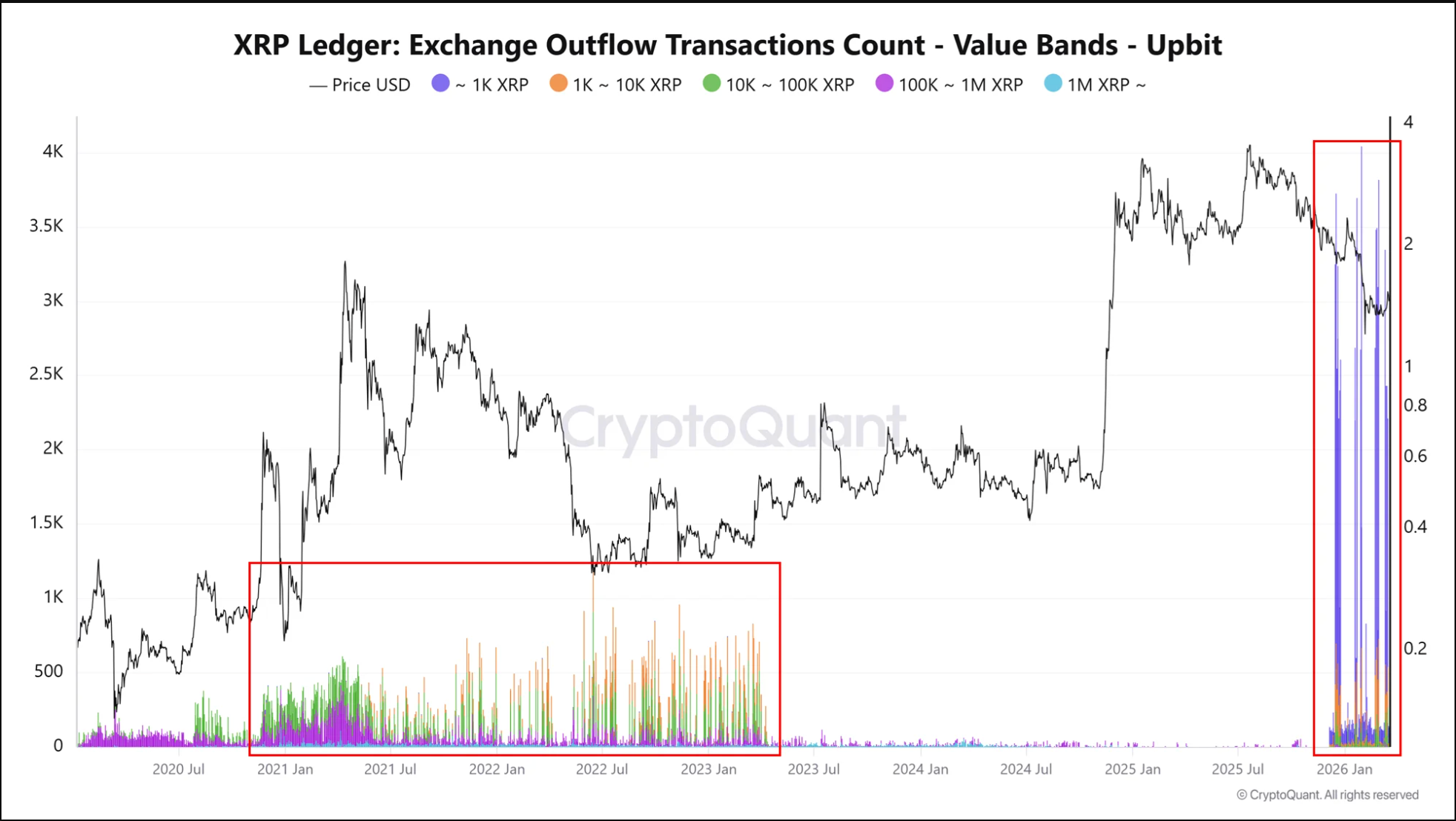
CryptoQuant analyst CW identified comparable withdrawal patterns between 2021 and early 2023, when heightened Korean exchange outflows aligned with an accumulation phase. This period preceded XRP’s substantial rally from under $1 to above $3 — representing approximately 500% gains.
As of Thursday, XRP trading pairs denominated in South Korean Won ranked as the fourth-largest market by 24-hour trading volume according to CoinMarketCap data.
Large Holder Behavior Shows Notable Reversal
XRP’s 90-day moving average for whale-sized transactions has registered positive territory for the first time following an extended negative period throughout 2024 and into early 2025. During the negative phase, substantial holders were engaged in consistent selling activity. This recent reversal indicates that heavy distribution pressure may be subsiding.
A comparable transition took place during the April–September 2025 timeframe, when XRP advanced from approximately $2.20 to $3.55.
Regarding macroeconomic developments, the Federal Reserve maintained its benchmark interest rate at 3.5%–3.75% during the March 18 policy meeting, referencing persistent inflation concerns and geopolitical uncertainty. Financial markets interpreted this stance as restrictive policy continuation. The CMC Crypto Fear and Greed Index registered 29 at the time of analysis, reflecting heightened market anxiety.
Institutional engagement remains limited. US-listed XRP spot exchange-traded funds recorded zero net capital inflows on Wednesday. Total assets under management currently stand at approximately $1.02 billion, compared to cumulative net inflows of $1.21 billion.
Based on CoinGlass liquidation mapping data, significant liquidity concentration exists around the $1.35 price level. A breakdown beneath current support could activate cascading forced liquidations within that zone.
Examining the four-hour timeframe, XRP displayed a bearish MACD indicator crossover near the $1.54 resistance threshold. For bullish momentum to rebuild, a recapture of the $1.50 level would be necessary, with $1.55 representing the subsequent key resistance before any potential advance toward $1.60.


TLDR
- White House crypto advisor Patrick Witt met with Senate Republicans to negotiate stablecoin yield provisions in the CLARITY Act
- An April committee markup is Senator Cynthia Lummis’s target, with lawmakers aiming for passage by year’s end
- Banking institutions express concern that yield-bearing stablecoins may drain deposits from conventional financial systems
- A potential strategy involves combining the crypto legislation with housing reform bills to enhance passage prospects
- Democratic lawmakers demand restrictions on official crypto trading and complete CFTC appointments before rule implementation
Discussions surrounding the Digital Asset Market Clarity Act — America’s primary crypto legislative initiative — continue to evolve, with legislators reporting meaningful advancement. On Thursday, Senate Banking Committee Republicans convened in Washington with Patrick Witt, the White House’s crypto policy advisor, to address outstanding matters, particularly the regulatory treatment of stablecoin yield mechanisms.
https://twitter.com/BSCNews/status/2034513952130863404?s=20
The Thursday session brought together Senators Cynthia Lummis, Thom Tillis, and Tim Scott. Revised legislative language was anticipated to arrive at the White House that same day, though negotiations remain active.
Lummis characterized the discussions as being in a “delicate state” while noting that the session revealed previously unexplored approaches. She indicated that efforts have transitioned from text finalization toward stakeholder engagement.
Stablecoin Yield at the Center of the Debate
The stablecoin yield issue has emerged as among the most challenging elements to settle. Traditional banking institutions have voiced apprehension that yield-generating stablecoins might siphon deposits from established financial entities.
Throughout Thursday’s private meeting, senators urged Witt to publicly disclose a White House economic analysis examining stablecoin yield and its influence on banking deposits. While legislators have reportedly accessed the document, it remains unreleased to the public.
According to Lummis, stablecoin incentive programs that steer clear of terminology associated with savings accounts or interest accrual may remain in the final legislation. She drew parallels to credit card reward systems rather than traditional bank interest structures.
Brian Armstrong, CEO of Coinbase, whose previous resistance contributed to blocking an earlier bill iteration, has demonstrated increased willingness toward compromise during recent discussions, Lummis reported. Coinbase did not respond to a request for comment.
Speaking Tuesday at the DC Blockchain Summit, Senator Tim Scott anticipated that a stablecoin yield framework would be finalized shortly, acknowledging the contributions of Lummis, Angela Alsobrooks, and Thom Tillis in advancing negotiations.
Housing Bill Could Be Tied to Crypto Legislation
Senate Republicans are exploring the possibility of incorporating community bank deregulation provisions into the crypto legislation as a strategic maneuver to strengthen its passage likelihood. This approach would connect the CLARITY Act with housing reform measures, merging two distinct policy battles.
The Senate approved its housing legislation earlier this month, while House Republicans have developed their own alternative. Some senators believe that consolidating these issues could facilitate the advancement of both initiatives.
Whether House Republicans would support such an arrangement remains uncertain.
Democratic lawmakers have also established requirements. They seek prohibitions preventing senior government officials and congressional members from gaining financially through personal crypto investments — a demand primarily aimed at President Trump. Additionally, they want Democratic appointments to the Commodity Futures Trading Commission confirmed before the agency initiates new crypto rulemaking processes.
Both conditions are anticipated to be among the final hurdles addressed before a complete bill can advance to a full Senate vote.
The Securities and Exchange Commission has already initiated crypto policy actions. Earlier this week, the agency unveiled its inaugural taxonomy establishing regulatory classifications for U.S. digital assets. SEC Chairman Paul Atkins indicated the agency stands prepared to collaborate with the CFTC on CLARITY Act implementation following congressional approval.
Prediction market Polymarket currently assigns the CLARITY Act a 62% probability of becoming law in 2026.
Key Takeaways
- ETH has moved into a historically significant MVRV value zone ranging from 0.8 to 1.0, indicating potential market bottom formation
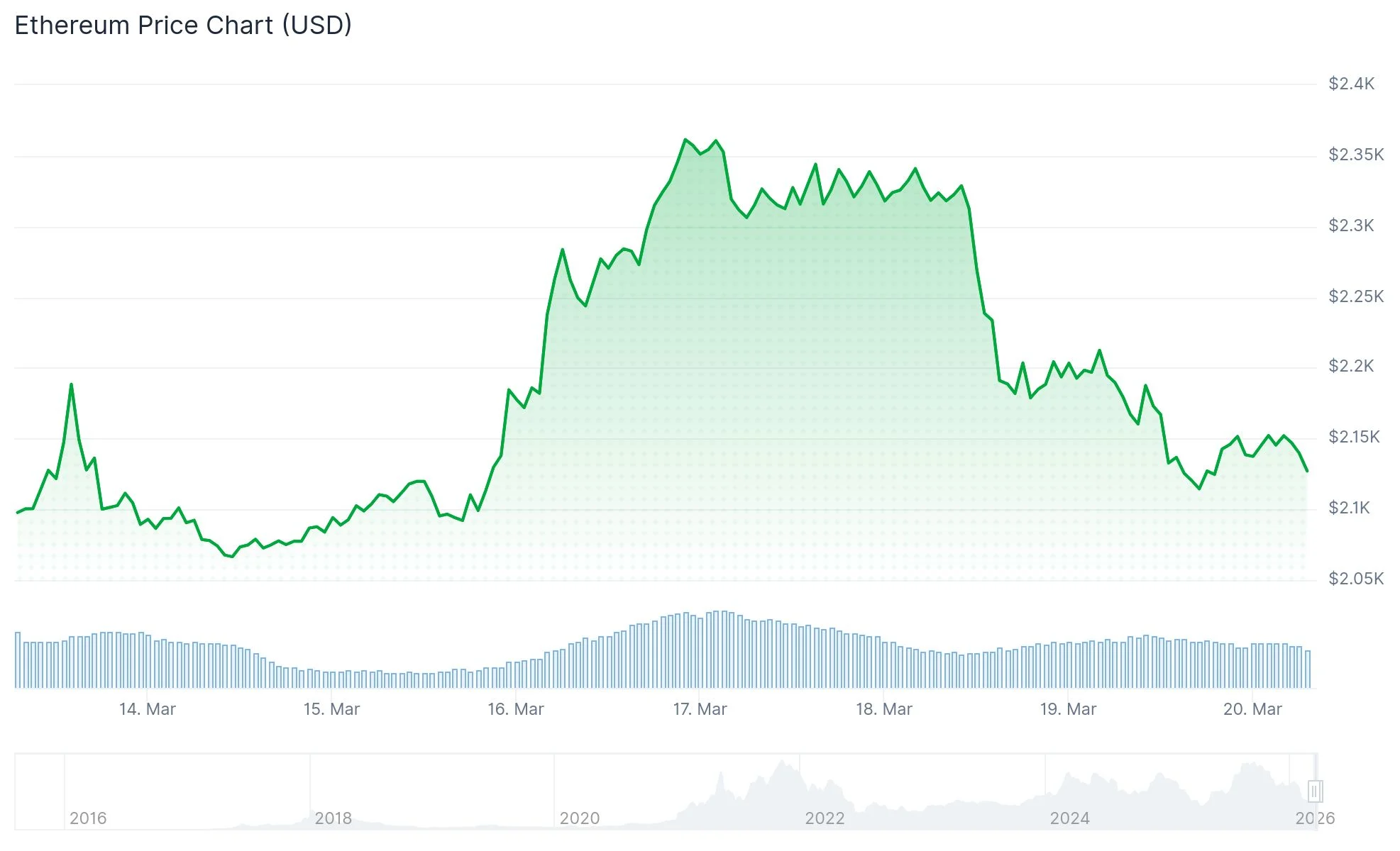
- Following rejection near $2,400 resistance, Ethereum declined sharply to test $2,100 support
- Current trading action positions ETH beneath $2,200 and its 100-hour Simple Moving Average
- Critical near-term support exists between $2,100–$2,150, while deeper support emerges around $1,770 should selling intensify
- Breaking above $2,200 could trigger upward momentum toward $2,240, $2,275, and possibly $2,385
Ethereum currently hovers near $2,100 following a significant pullback from the $2,385 region. The digital asset breached multiple support levels including $2,320 and $2,250, eventually breaking a significant uptrend line that had provided support around $2,160 on shorter timeframes.
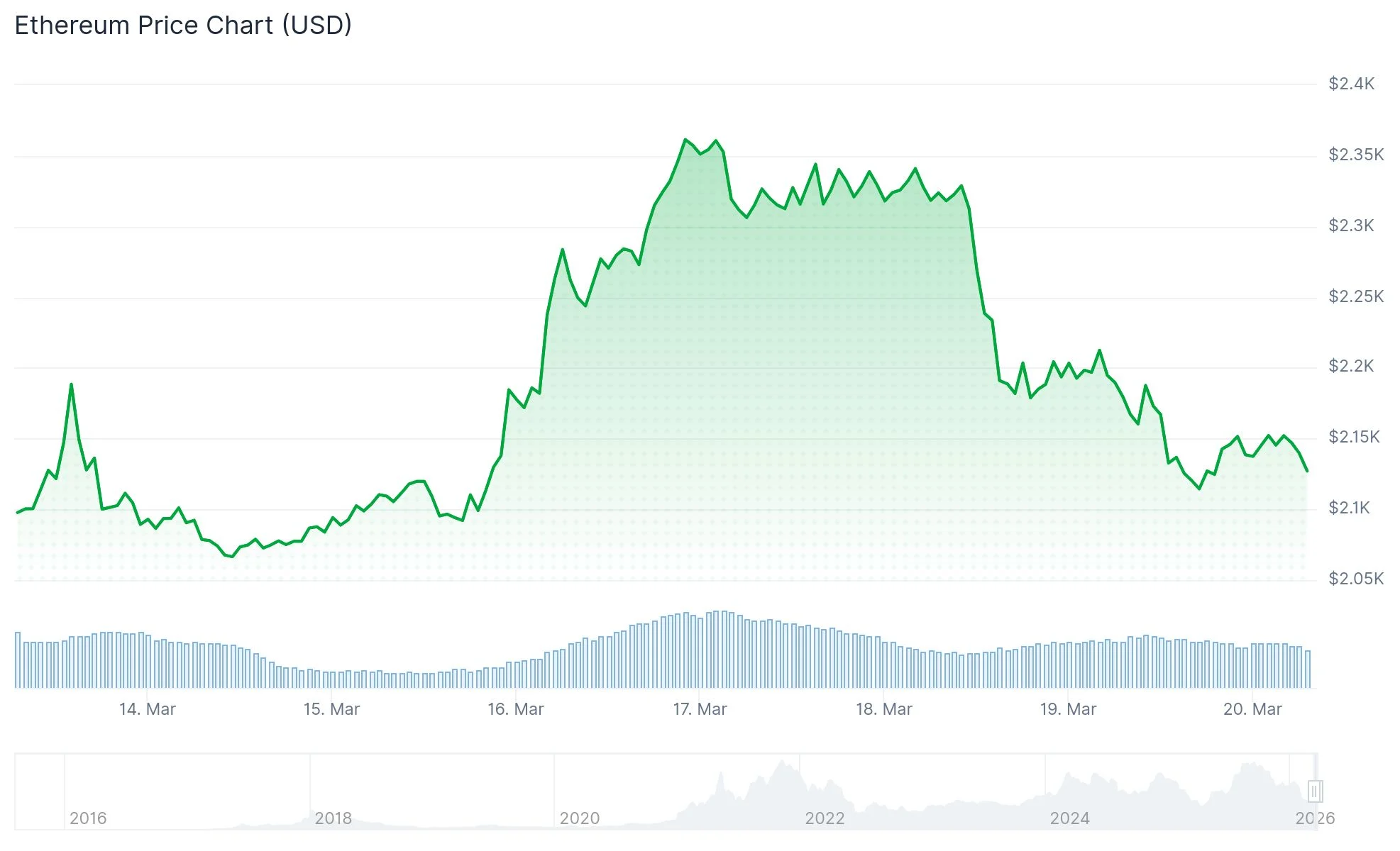
The recent session low touched $2,100. ETH now trades just above this threshold, positioned below the 23.6% Fibonacci retracement level measured from the $2,385 high to the $2,100 low.
The asset remains beneath its 100-hour Simple Moving Average, reinforcing the near-term bearish momentum in play.
Immediate resistance appears at $2,165, with the next significant barrier at $2,200, coinciding with the 100-hour SMA. Reclaiming the $2,200 threshold represents the initial requirement for any meaningful recovery.
Should Ethereum breach $2,200, additional resistance targets include $2,240, aligned with the 50% Fibonacci retracement, followed by $2,275 and $2,320. Extended strength could challenge the $2,385 level.
Regarding downside risk, a breakdown below $2,100 would expose support zones at $2,060 and $2,020. The psychological $2,000 mark stands as major support.
On-Chain Metric Signals Historical Value Territory
From a broader perspective, Ethereum’s Market Value to Realized Value ratio has descended into the 0.8 to 1.0 territory. Market analyst Ali Charts, utilizing Glassnode data, identifies this range as historically significant, often preceding substantial multi-month rallies.
https://twitter.com/alicharts/status/2034559606668570900?s=20
Historical recoveries from this MVRV zone have produced gains ranging from approximately 129% to exceeding 5,000%, though market conditions varied considerably across cycles. While this indicator doesn’t guarantee immediate price appreciation, it suggests limited downside potential compared to elevated valuation levels.
ETH achieved a cycle peak near $4,955 before entering the current correction phase. Trading around $2,100 marks a decline exceeding 57% from that high.
Technical Analyst Highlights $2,150 Critical Zone
Market analyst Ted Pillows shared insights on X regarding Ethereum’s technical position. He emphasized that ETH experienced strong resistance at the $2,400 level and is now challenging $2,150 as potential support.
https://twitter.com/TedPillows/status/2034554720593772615?s=20
The technical chart presented by Ted Pillows illustrates a series of descending peaks, with each recovery attempt failing to generate sustained upward movement. This formation suggests additional downside risk remains viable if support zones fail.
The $2,150 region corresponds to a previous consolidation area and serves as an important short-term inflection point for traders.
Crypto World
Bitcoin’s (BTC) price action looks dangerously similar to the pattern that sent it crashing to $60,000
Bitcoin’s price action is giving us a sense of déjà vu, and it’s not the good kind.
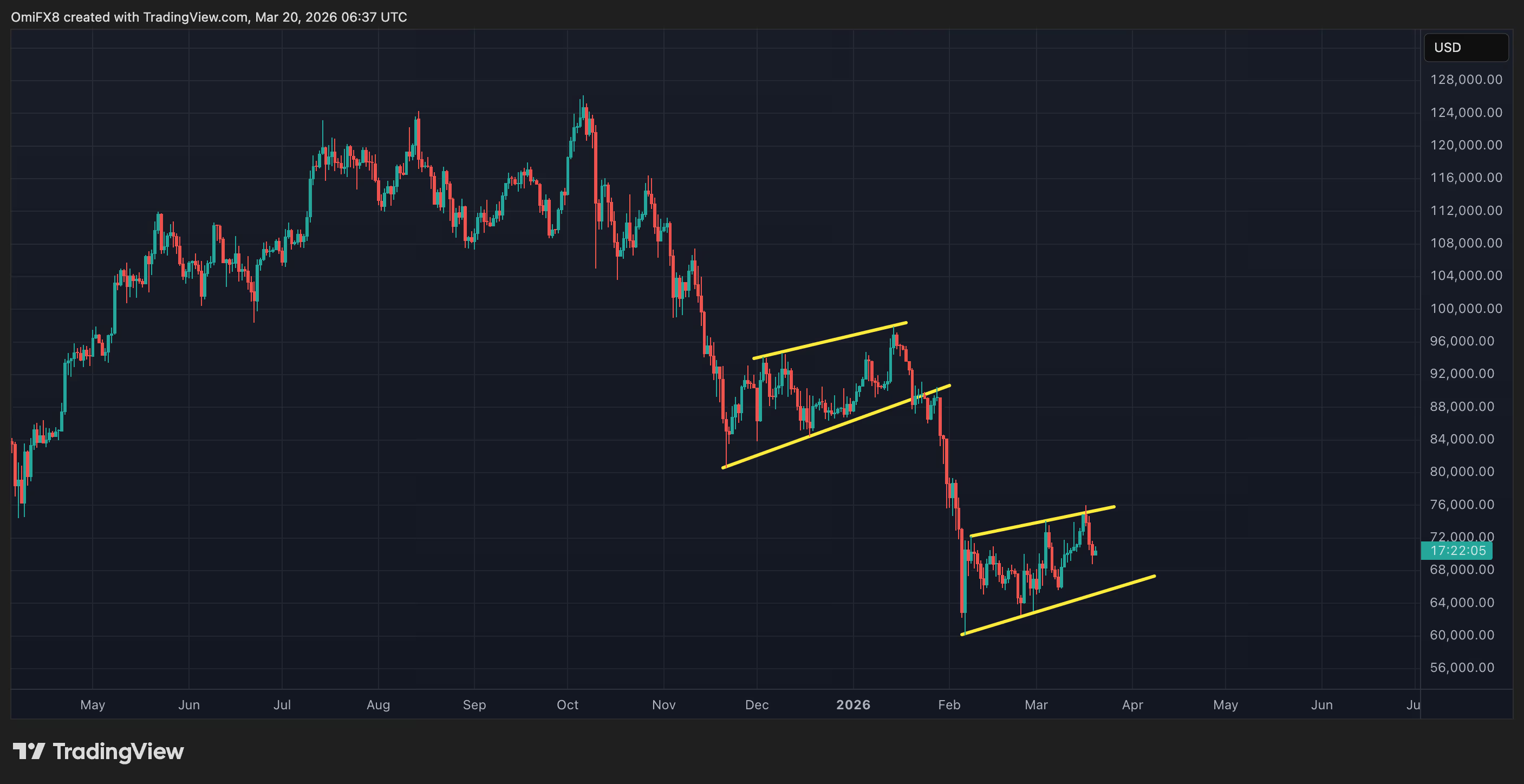
If you look at the price swings since early February, a very specific, ominous pattern is forming that looks strikingly similar to the setup we saw between November and January. That set up eventually paved the way for a crushing sell-off to nearly $60,000.
We are looking at what technical analysts often call a counter-trend recovery – a modest bounce within a downtrend.
Here is the chart. Check out the two yellow channels.

The first yellow channel, on the left, shows price action from Nov. 20 to Jan. 20. Back then, bitcoin traded in a narrow range, with a slight upward tilt after a drop from $100,000. It looked like the price was recovering, but in reality it was just a pause – or a small bounce – within a larger downtrend.
The result was that the price eventually broke below the bottom of that trading range. Essentially, the level traders had been treating as a “floor”, or support, gave way, and bitcoin plunged in a straight line from about $90,000 down to nearly $60,000 by Feb. 6.
Now look at the second channel on the right.
Since hitting those lows in early February, bitcoin has once again traded in a narrow range with an upward tilt, contained perfectly between those two trendlines.
The similarity with the earlier pattern is undeniable. The present relief rally lacks the explosive momentum just as the November-January pattern did. It’s a slow, choppy grind upwards. In technical analysis theory, this is a sign of bullish exhaustion, with the market simply pausing for breath before the bears recharge their engines.
What next?
Charts aren’t a holy grail, and past performance doesn’t guarantee future results. Still, traders use them to read market psychology, and right now, they’re telling a tale of a “buy the dip” crowd that lacks strength and conviction.
If bitcoin falls below the lower trendline of its current channel, around $65,800, it could signal a return of bearish control.
The takeaway is that bitcoin is at a major decision point. The bear market could deepen, as some anticipate, if prices break below the channel formation. If it breaks out above the channel, the downtrend could lose steam, and the bulls could then make a strong comeback.
Key Highlights
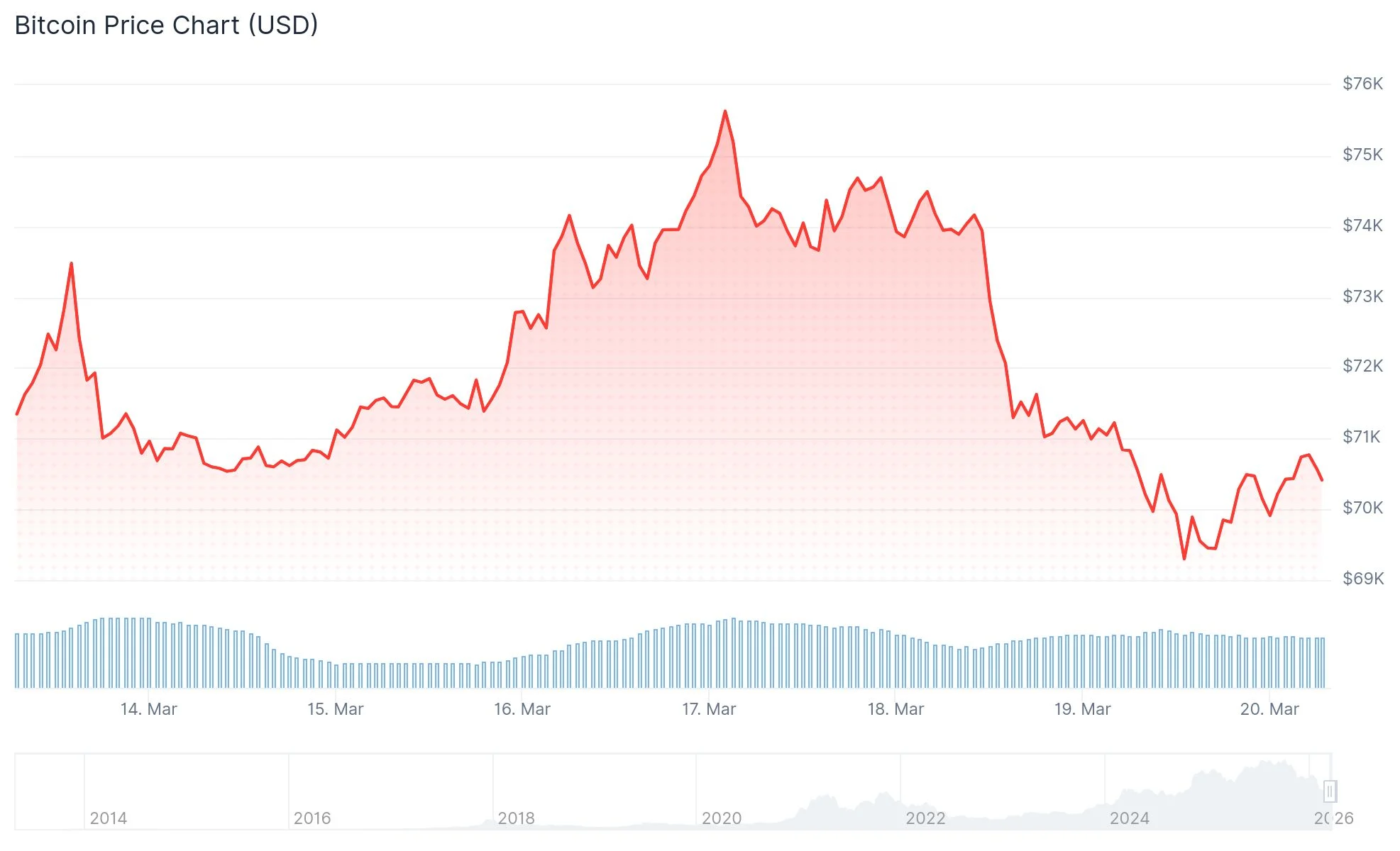
- Bitcoin slipped beneath $69,000, declining more than 4% as crude oil prices jumped to $119 per barrel
- Brent crude temporarily spiked to $119 following escalating U.S.-Iran tensions that disrupted Middle Eastern energy infrastructure
- Energy analysts caution that oil prices could potentially climb to $200 per barrel if Strait of Hormuz disruptions persist
- The Federal Reserve maintained current interest rates and indicated potential postponement of rate reductions amid inflation concerns
- Blockchain analytics reveal whale addresses containing 100+ BTC increased by 753 wallets during the last three-month period
Bitcoin experienced a significant downturn this week, sliding beneath the $70,000 threshold as escalating crude oil prices and conservative Federal Reserve messaging dampened investor confidence throughout global financial markets.
The leading digital currency by market capitalization descended to an intraday bottom of $68,814 on Thursday, representing a decline exceeding 4% from its session peak above $71,000. By Friday’s opening hours, the cryptocurrency had recovered slightly to hover around $70,675, though remaining marginally negative.
This downturn coincided with Brent crude oil’s temporary surge to $119 per barrel on Thursday. The dramatic price increase stemmed from intensifying hostilities between the United States and Iran, with reports indicating both nations had targeted energy infrastructure.
Regional Middle Eastern crude benchmarks including Oman and Dubai had already exceeded $150 per barrel. Vandana Hari, who founded the oil analysis company Vanda Insights, informed Al Jazeera that oil reaching $200 “was already within sight.”
“How much further crude climbs from here almost entirely hinges on how much longer the Strait of Hormuz remains closed,” Hari commented.
Adi Imsirovic, an energy specialist at the University of Oxford, similarly told Al Jazeera that $200 oil remained “perfectly possible” and characterized it as “a major handbrake to the world economy.”
Energy Price Volatility Pressures Risk Markets
Financial analyst The Kobeissi Letter observed that Bitcoin’s decline represented part of a widespread market retreat connected to surging energy costs. “The world is quite literally facing what appears to be the largest energy crisis in history,” they posted on X.
https://twitter.com/KobeissiLetter/status/2034608583887700121?s=20
Crude oil prices subsequently moderated following multiple interventions. Israeli Prime Minister Benjamin Netanyahu announced that Israel would refrain from additional strikes on Iranian energy infrastructure. U.S. Treasury Secretary Scott Bessent indicated Washington might tap the Strategic Petroleum Reserve and potentially permit sanctioned Iranian oil currently in transit to enter global markets.
Brent crude retreated below $110 per barrel by Friday, contributing to improved market stability.
Federal Reserve Postpones Rate Cut Timeline
The Federal Reserve maintained existing interest rates unchanged this week. Fed Chair Jerome Powell cautioned during his subsequent press conference that elevated oil prices might drive near-term inflation higher, and indicated the central bank would postpone rate reductions until inflation demonstrated definitive improvement.
Producer Price Index data released Thursday revealed inflation had already climbed to 3.4% the previous month, preceding the Iran conflict escalation. Market participants are now reducing expectations regarding potential Fed rate cuts throughout 2025.
https://twitter.com/santimentfeed/status/2034746092546662873?s=20
Despite the price retreat, blockchain analytics demonstrated that Bitcoin whale addresses containing 100 or more BTC expanded by 753 wallets during the preceding three-month period, representing a 3.9% growth, even as overall market valuation decreased 20.2% throughout the identical timeframe.


Nevada state authorities have been cleared to issue a temporary restraining order against prediction market platform Kalshi.
Summary
- A federal appeals court denied Kalshi’s request to halt proceedings, clearing the way for Nevada regulators to pursue a temporary restraining order against the platform.
- Industry experts say Kalshi may be forced to exit Nevada for at least 14 days if the order is issued, as such rulings are not appealable under state law.
On Thursday, the Ninth Circuit Appeals Court denied Kalshi’s emergency request to stay proceedings. The case will now be sent back to federal court, where Nevada regulators can proceed with enforcement action.
According to Gaming lawyer Daniel Wallach, this would likely result in a temporary restraining order and noted that Kalshi would not be able to operate in the state for at least 14 days, as the order is “not appealable under Nevada law.”
“Kalshi would be required to exit the state in the interim,” he added.
The case stems from a cease and desist issued against the platform in March, where regulators claimed that the platform offered unlicensed sports betting under the state’s gaming laws.
Kalshi, in the meantime, has countered these claims, arguing that its contracts fall under the federal jurisdiction of the Commodity Futures Trading Commission, which means any restriction imposed by the state would conflict with federal oversight and would also cause its business imminent harm.
Similar actions have emerged across a number of other U.S. states, with lawmakers claiming that sports event contracts may violate local gambling laws. States like Connecticut, New York, and New Jersey have taken steps against sports event contracts that have targeted Kalshi and many of its competitors, like Polymarket and Crypto.com.
Meanwhile, the U.S. Commodity Futures Trading Commission chairman, Michael Selig, has said that the commission will establish a federal rulebook for prediction markets while asserting exclusive jurisdiction over such products.
Prediction markets like Kalshi and Polymarket have recently surged in activity, with weekly trading volumes exceeding $2 billion. As previously reported by crypto.news, ultra-short duration contracts have become increasingly popular, with five to 15-minute bets now accounting for a significant share of trading on these platforms.
TLDR:
- Binance altcoin trading volumes have fallen to $7.7B, down sharply from the $40–$50B recorded in late 2024.
- Combined altcoin volumes on other major exchanges now sit at $18.8B, well below prior peaks of $91B.
- Binance currently accounts for roughly 40% of total altcoin trading volume across all major exchanges.
- Historical data shows the best crypto opportunities often emerge when trading volumes and market interest are at their lowest.
Altcoin trading volumes across major cryptocurrency exchanges have declined sharply in recent months. Data from Binance and other top platforms points to a clear reduction in investor participation.
The ongoing bear market, combined with persistent geopolitical tensions, continues to suppress risk appetite. Altcoins are now trailing Bitcoin in performance by a wide margin.
Current volume levels are well below those recorded during more active trading phases of late 2024 and early 2025.
Altcoin Trading Volumes on Major Exchanges Hit Multi-Month Lows
Altcoin trading volumes on Binance currently stand at approximately $7.7 billion. This marks a steep drop from the $40 to $50 billion the platform saw in October 2024. Other major exchanges combined now account for about $18.8 billion in total volume.
During those earlier peak periods, other exchanges collectively recorded volumes of $63 billion and $91 billion. The gap between those highs and current figures reflects the scale of the decline. Trading activity has fallen across the board, not just on a single platform.
Crypto analyst Darkfost_Coc flagged this trend in a recent post on X. The data shows altcoins are underperforming Bitcoin considerably in the current market. Investor interest in smaller digital assets appears to be fading steadily. On Binance specifically, the platform now represents about 40% of total altcoin trading volume.
Ongoing geopolitical tensions continue to create an unfavorable environment for risk assets. This has further reduced the appeal of altcoins among traders seeking stability.
As a result, capital has been moving away from smaller tokens toward safer market positions.
Historical Volume Patterns Point to FOMO-Driven Tops and Future Opportunity
The volume spikes recorded in October 2024 and February 2025 coincided with local price tops in the market. These surges were largely fueled by FOMO, or fear of missing out, among retail traders. Well-positioned investors used that demand surge as an opportunity to exit their positions.
Darkfost_Coc noted that volume spikes at market tops often reflect retail participation rather than institutional accumulation. By the time most traders enter during a surge, smarter money is already reducing exposure.
This pattern has repeated itself across multiple previous crypto cycles. Binance’s roughly 40% share of total altcoin volume further reflects this concentration of activity.
Currently, altcoin trading volumes remain at depressed levels with no clear recovery signal yet. However, historical data from past cycles show that low-interest periods often precede strong market reversals. Volume trends tend to shift before price movements become widely visible.
According to the analysis, the most attractive opportunities have historically appeared when market interest is at its lowest. Most investors tend to remain on the sidelines during these phases. Those who track volume data closely are often better positioned when conditions eventually improve.

Bitcoin investors face a real, long-term risk from quantum computing, but the danger is not equally distributed across all wallets. Will Owens, a research analyst at Galaxy Digital, outlined in a recent briefing that a sufficiently powerful quantum computer could derive a private key from a public key, enabling an attacker to impersonate the wallet owner, forge a signature, and steal coins. Yet he stressed that the current landscape is not uniformly vulnerable: most wallets remain safe today, with risk primarily arising when public keys are visible on-chain.
Owens described two primary exposure paths. The first concerns wallets whose public keys are already exposed on the blockchain, making them potential targets if a quantum attack becomes feasible. The second occurs when a wallet’s public key is revealed at the moment of spending. This distinction has practical implications for how wallets are designed, upgraded, and secured as the crypto ecosystem moves toward post-quantum resilience.
Key takeaways
- Public-key exposure matters: funds are at greater risk if a wallet’s public key is visible on-chain or revealed during a transaction.
- Today’s wallets are largely shielded from quantum risk, but the threat is recognized and being studied by developers and researchers.
- The Bitcoin community has accelerated quantum-related proposals since late 2025, though governance remains non-centralized by design.
- Near-term guardrails have been discussed, including practical approaches from prominent voices advocating safer storage methods until post-quantum solutions are ready.
- Investors should monitor post-quantum developments and the timing of proposed mitigations, as the threat is real even if not imminent for most users.
Quantum risk landscape for Bitcoin wallets
The core concern is the possibility that a quantum computer could reverse-engineer a private key from a corresponding public key, enabling an attacker to impersonate the wallet owner and authorize transactions. This would undermine the cryptographic foundations that underwrite Bitcoin’s security. However, Owens cautioned that the vulnerability is not uniform across all wallets today. “Most wallets are not vulnerable today. Funds are at risk only when public keys are exposed on-chain,” he explained.
The two exposure routes identified by Owens—on-chain public keys already visible, and keys revealed at spending—are important for both users and developers. If a wallet’s public key remains hidden until it is used, the risk profile differs from wallets whose keys have already been disclosed on-chain. This nuance shapes how wallets are designed to mitigate potential quantum threats, including the timing of key disclosure and migration to post-quantum-secure mechanisms.
Quantum computing’s potential to disrupt conventional cryptography has circulated in crypto discourse for years, with some observers arguing the threat is distant. Yet the consensus forming in academic and industry circles is that the question is not if, but when—and how quickly the ecosystem can adapt. Owens noted that the debate extends beyond the technical layer and into governance, as coordinated action will be required to implement robust, long-term protections.
The right people are on top of the issue
Despite some critics who argue the quantum threat is overstated or decades away, Owens contends that development activity in this area has intensified. He said there is substantial developer work addressing quantum vulnerabilities and mitigations, and that the ecosystem now has a concrete, maturing set of proposals spanning the full problem surface. “The proposals are not theoretical. They are being actively developed, reviewed, and debated by some of the most experienced contributors in the Bitcoin ecosystem,” he affirmed.
In parallel, other voices in the space have proposed practical approaches to reduce exposure in the near term. Crypto veteran Willy Woo suggested last November that holding Bitcoin in SegWit wallets could reduce risk while a more permanent solution is devised. The idea reflects a broader appetite for interim safeguards as the community weighs longer-term protocol changes such as post-quantum cryptographic schemes.
The broader push toward post-quantum readiness has historically been framed as a balance between innovation and conservative risk management. While some markets may still debate the immediacy of the risk, the Bitcoin ecosystem appears to be aligning incentives around security and resilience. Owens emphasized that a non-centralized governance model—where Bitcoin has no CEO, no board, and no single authority to mandate updates—does not preclude effective action. Instead, the universal and external nature of the risk—affecting participants across the network—can catalyze broad, voluntary alignment around practical mitigations and gradual upgrades.
“For investors, the key takeaway is straightforward: the risk is real but recognized, and the people best positioned to address it are working on it.”
As the conversation evolves, the community continues to explore concrete, actionable paths forward. In addition to BIP-based discussions and potential soft-fork mitigations, researchers and developers are evaluating post-quantum-ready signatures, key-management innovations, and more robust on-chain privacy and security architectures. The goal is not merely to react to a theoretical threat but to engineer a resilient system that preserves user sovereignty without compromising the Bitcoin network’s open, trust-minimized ethos.
Looking ahead, observers will want to watch how quickly post-quantum techniques mature and how they can be integrated without creating new vectors for risk or fragmenting the ecosystem. The next few years are likely to bring a combination of protocol-level experiments, community-led governance decisions, and gradual deployment of protective measures that could gradually harden Bitcoin against quantum threats while maintaining its decentralized ethos.
As quantum resilience work progresses, readers should stay attuned to updates from core developers, security researchers, and stakeholder communities. The exact timeline for wide-scale post-quantum adoption remains uncertain, but the direction is clear: the industry is treating quantum risk as a real, evolving concern and mobilizing to address it with practical, collaborative solutions.
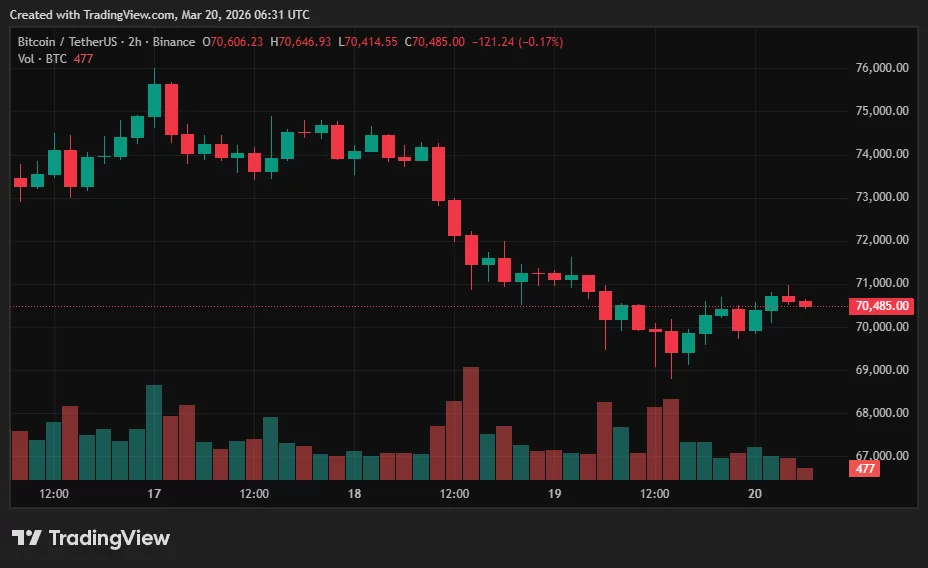
Bitcoin price marched back above $70,000 on Friday morning, erasing part of the losses seen over the past two days. However, its momentum quickly gave up as Asian tech stocks dropped lower.
Summary
- Bitcoin rebounded above $70,000 after an 8% drop, supported by dip buying despite rising geopolitical tensions and inflation concerns.
- Risk sentiment weakened as Asian and U.S. tech stocks declined, reflecting broader pressure on risk assets amid strong inflation data and hawkish Fed outlook.
- U.S. spot Bitcoin ETFs recorded over $250 million in outflows in two days, signaling a pause in institutional demand after a week of strong inflows.
After dropping over 8% to a weekly low of $69,298 on Thursday, Bitcoin (BTC) price rebounded back above the $70,000 psychological mark that many analysts say acts as a crucial anchor for investor confidence. The bellwether was trading at $70,749 at press time with a market capitalization of $1.41 trillion.
Bitcoin price rallied as bulls bought the dip under $70,000, which occurred after news of an Israeli attack on Iranian energy sources broke out, sparking fears of rampant global inflation as oil prices rose to record highs.
At the same time, risk sentiment deteriorated amid a string of weak economic data. This coincided with stronger-than-expected PPI data and Federal Reserve Chair Jerome Powell suggesting the central bank intends to hold interest rates steady as long as inflation remains elevated.
While Bitcoin has managed to reclaim the $70,000 psychological support level, several hurdles could potentially stand in its path for more gains.
First, Asian tech stocks have so far traded down on Friday morning. Notably, Japan’s Nikkei 225 fell by 1,866 points or 3.38%, while China’s Shanghai Composite was down 0.50%. Yesterday, U.S. tech stock markets also showed the same weakness, with the Dow Jones Industrial Average closing lower by 0.44%, while the S&P 500 and Nasdaq 100 were down over 0.25% each. The only exception was the Russell 2000 Index, which rose by 0.65%.
Cryptocurrencies often mirror the trend followed by these tech stocks, as they both share a high sensitivity to liquidity and interest rate expectations.
Second, investors seem to be rotating to Gold, which jumped over 2% today as it moved back above $4,700, reinforcing its status as a safe-haven asset amid the broader macroeconomic and geopolitical uncertainty. Silver also saw significant interest, rising over 3% to $74.
Third, institutional demand in Bitcoin appears to have taken a breather. Data from SoSoValue show that U.S. spot Bitcoin ETFs have recorded net outflows for the past two days, with over $250 million flowing out.
While the outflows are relatively small considering the $1.16 billion in inflows they recorded over seven straight days just ahead of this shift, investors could take this as a sign of temporary exhaustion in the current rally.
Disclosure: This article does not represent investment advice. The content and materials featured on this page are for educational purposes only.


Gemini shareholders have targeted the crypto exchange through a new class action lawsuit alleging that it misled investors during and after its initial public offering.
Summary
- Gemini has been hit with a class action lawsuit in New York alleging it misled investors in its IPO filings about its business strategy.
- Plaintiffs claim the firm shifted to a prediction markets model, cut 25% of staff, and exited key international markets shortly after listing.
- Shares have fallen sharply since the IPO, with investors alleging losses tied to what they describe as artificially inflated prices.
Filed in New York, the class action lawsuit has been brought against Gemini, its co-founders Tyler and Cameron Winklevoss, and other company executives over misleading claims made in its IPO documents.
Plaintiffs in the filing said the documents portrayed Gemini as a growing crypto exchange focused on expanding its user base and international footprint, but later made an “abrupt corporate pivot to a prediction market-centric business model.”
In the complaint, the plaintiff said the Offering Documents were “materially false and misleading” and failed to disclose that Gemini was “poised for an expensive and disruptive restructuring.”
Further, the lawsuit stated that the company had committed to extending into “key global markets.”
Gemini held its IPO in September and priced shares at $28 on the Nasdaq; however, while the filings described the exchange as its “core product,” they subsequently pivoted to prediction markets called “Gemini 2.0.”
Subsequently, the firm also cut 25% of its workforce and exited several international markets like the UK, the EU, and Australia.
Per the complaint, such changes have caused the class group to suffer “significant losses and damages” as the stock price declined.
As such, the suit is seeking a jury trial and compensation for investors who bought shares at “artificially inflated prices” after the IPO.
Last month, several Gemini executives announced departures amid the company’s cost-cutting push; meanwhile, the exchange also shut down its NFT arm, Nifty Gateway, in February.
However, on Thursday, the company’s Q4 results showcased that the company’s revenue had risen 39%, which was beyond analyst expectations.
At the time of writing, Gemini shares had closed Thursday’s session up 0.81%, while it surged another 5.8% in after-market trading.

Government borrowing sees surprise surge amid fears of squeeze from Iran war

(VIDEO) Is Latto Pregnant? Latto Pregnancy Rumors Explode as Rapper Teases Announcement Amid Fan Speculation

XRP (XRP) Price Analysis: Could This 10% Correction Present a Strategic Entry Point?


-
Crypto World6 days ago
HYPE Token Enters Net Deflation as HyperCore Buybacks Outpace Staking Rewards
-

 Tech4 days ago
Your Legally Registered ‘Motorcycle’ Might Not Count Under Proposed US Law
-

 Fashion7 days ago
Weekend Open Thread: Addict Lip Glow
-
 Tech3 days ago
Are Split Spacebars the Next Big Gaming Keyboard Trend?
-
Sports6 days ago
Why Duke and Michigan Are Dead Even Entering Selection Sunday
-

 Business5 days ago
Search for Savannah Guthrie’s Mother Enters Seventh Week with No Arrests
-

 Business6 days ago
US Airports Launch Donation Drives for Unpaid TSA Workers as Partial Government Shutdown Enters Fifth Week
-
Crypto World6 days ago
Coinbase and Bybit in Investment Talks: Could Bybit Finally Enter the US Crypto Market?
-

 Business4 days ago
Australian shares drop as Iran war enters third week
-

 Business6 days ago
Country star Brantley Gilbert enters growing non-alcoholic beer market
-

 Crypto World4 days ago
Crypto Lender BlockFills Enters Chapter 11 with Up to $500M in Liabilities
-

 Sports7 days ago
College Basketball Best Bets: Conference Tournament Semifinal Picks
-

 Politics2 days ago
The House | The new register to protect children from their abusers shows Parliament at its best
-

 Fashion4 days ago
25 Celebrities with Curly Hair That Are Naturally Beautiful
-

 News Videos2 days ago
RBA board divided on rate cut, unusually buoyant share market | Finance Report | ABC NEWS
-

 Tech2 hours ago
inKONBINI Lets You Spend Summer Days Behind the Register
-

 Crypto World2 days ago
Canada’s FINTRAC revokes registrations of 23 crypto MSBs in AML crackdown
-
 Politics3 days ago
Real-time pollution monitoring calls after boy nearly dies
-

 Crypto World5 days ago
Crypto Losses Drop 87% in February, But Hackers Are Now Targeting People, Not Code
-
 NewsBeat1 day ago
Residents in North Lanarkshire reminded to register to vote in Scottish Parliament Election


You must be logged in to post a comment Login