Coinbase CEO Brian Armstrong pushed back against what he described as Wall Street’s persistent underestimation of the crypto exchange, arguing that the company is navigating a classic “innovator’s dilemma” as traditional finance grapples with digital asset disruption.
Summary
The CEO argued Wall Street underestimates the company as crypto disrupts traditional finance, describing the moment as an “innovator’s dilemma” with roughly half of major institutions now leaning into digital assets.
Coinbase reported 156% year-over-year trading volume growth, a doubling of market share in 2025, tripled assets over three years, and 12 products generating over $100 million in annualized revenue.
Some X users questioned Armstrong’s stock sales, security practices, product strategy and conviction in Ethereum, with one asking why he is not buying Coinbase shares if the company is truly undervalued.
In a post on X following an analyst AMA session, Armstrong said Coinbase is often “misunderstood or under-appreciated” by traditional financial analysts. While some major institutions are embracing crypto, others remain skeptical, he said, largely due to entrenched incentives within the legacy financial system.
“Five of the GSIB banks are starting to work with Coinbase,” Armstrong wrote, adding that roughly half of large financial institutions are leaning into crypto as regulatory clarity improves. At the same time, he suggested that lagging firms view digital assets as a competitive threat — comparing crypto’s rise to disruptions caused by Uber, Airbnb and SpaceX in their respective industries.
Advertisement
Armstrong argued that Coinbase and the broader crypto sector are in their strongest position yet, citing three years of revenue diversification and expanding institutional engagement. He also addressed recent earnings coverage, noting that GAAP net income includes unrealized gains and losses on crypto holdings. Adjusted net income, he said, showed profitability last quarter despite a weaker market environment.
Critics question Coinbase CEO’s claims
The remarks drew sharp responses from some users on X.
One critic argued that Coinbase appears “misunderstood” in part because Armstrong continues selling shares, questioning why investors should hold the stock if the CEO is not buying it. The same user accused the company of failing to prioritize customer security, making questionable product decisions, and lacking conviction in the Ethereum ecosystem by selling accumulated Base sequencer fees rather than holding or staking ETH.
Advertisement
The blunt truth is a mixture of the following:
1) You keep dumping your stock non stop. Why would I believe it’s worth holding when you yourself seemingly can’t get rid of it fast enough? Once you stop dumping it I will begin to maybe consider it approaching fair value, and…
Another user bluntly asked: “Why aren’t you buying your own stock then if it is so misunderstood?”
The company’s latest Q4 and full-year figures highlighted significant growth metrics. Total trading volume rose 156% year-over-year, while Coinbase’s crypto trading market share doubled in 2025.
Advertisement
Assets held on the platform have tripled over the past three years, Armstrong said, and the firm now has 12 products generating more than $100 million in annualized revenue. Both USDC balances and Coinbase One subscriptions reached new all-time highs.
Armstrong concluded that investors must be “early and right” to generate alpha, suggesting Coinbase remains undervalued by traditional analysts as the financial system undergoes structural transformation.
In Washington, the safest vote is often no vote at all, and the most convenient timeline is “next session.” But when it comes to the future of banking, financial markets and financial services, inaction is unacceptable. The United States needs crypto regulatory clarity to compete and succeed in the digitally networked financial system of the 21st Century.
The Senate is today at a crossroads on market structure legislation—policy designed to bring order to digital asset innovation, an increasingly important component of global finance. Failing to codify the “rules of the road” doesn’t just stall crypto; it invites regulatory chaos that harms banks and consumers alike, saps economic dynamism and forces innovation to drift offshore. Congress must choose whether America leads the next generation of finance or watches from the sidelines.
The current stalemate centers on a perceived conflict between banks and crypto platforms regarding interest yield and rewards on stablecoins—an issue already addressed by the GENIUS Act, signed into law by President Trump last year. The law permits crypto companies to offer rewards and incentives to customers for holding and using stablecoins made available by separate providers. Banks counter that such reward structures closely resemble traditional bank savings and checking products and, if left unchecked, could shift customer balances away from insured deposits without the same prudential requirements.
Framed this way, the disagreement carries more weight than it should. Yield and rewards are questions of design within a payments framework, not questions of systemic safety or financial stability. Treating them as existential risks has delayed an otherwise straightforward resolution, stalling progress on crucial market structure issues.
Advertisement
If one looks past talking points, a workable compromise is already available. Congress can explicitly enable federally regulated banks—including community banks—to offer yield on payment stablecoins. Banks gain a clear, federally sanctioned revenue and customer-acquisition opportunity in the stablecoin market. They obtain a straightforward way to secure customers and funds, especially important for community banks seeking to remain competitive in a world of mega-banks and scaled payment platforms. Crypto platforms, meanwhile, retain the incentive structures their customers expect and that are available under existing law. Congress gets to move market structure legislation forward and create a bill that can pass. And, most importantly, the American consumer benefits from increased competition and the ability to share in the yield potential of their own money.
Framing crypto as an existential threat to the community bank is a rhetorical tactic, not an economic reality. A recent empirical analysis finds no statistically meaningful relationship between stablecoin adoption and deposit outflows, suggesting stablecoins function primarily as transactional instruments rather than savings substitutes. In fact, properly regulated stablecoins may provide local and community banks with a pathway to modernize their payment offerings and reach new customers.
The rewards-yield question is a design issue that can be addressed without upending progress already made. A workable compromise exists that addresses banks’ economic interests, protects crypto innovation and respects the settled law of the GENIUS Act. Advancing on that basis keeps the broader market structure package intact and provides the legal clarity that the American economy deserves.
The Senate has the tools to resolve this impasse and to follow the strong leadership displayed by the White House. Failing to do so would be a choice, not an inevitability.
Tom Lee’s BitMine Immersion Technologies just bought another 35,000 ETH, expanding its already massive Ethereum treasury. Normally, such aggressive accumulation would signal confidence and support the stock price. Instead, the BitMine stock price fell nearly 2% in the past 24 hours and is now down more than 8% since February 13.
This creates a strange contradiction. BitMine keeps buying Ethereum, yet its stock keeps falling. At first glance, it looks like two different stories. But underneath, it might all be the same.
Sponsored
Sponsored
Advertisement
BitMine Adds More Ethereum, But the Stock Breaks Down
BitMine’s latest Ethereum purchase reinforces its strategy of becoming one of the largest ETH treasury companies. Buying 35,000 ETH, in two batches, in a single day, shows long-term conviction. The purchase pushed its total holdings to 4.371 million ETH, with combined cash and crypto reserves now worth around $9.6 billion.
Want more insights like this? Sign up for Editor Harsh Notariya’s Daily Crypto Newsletter here.
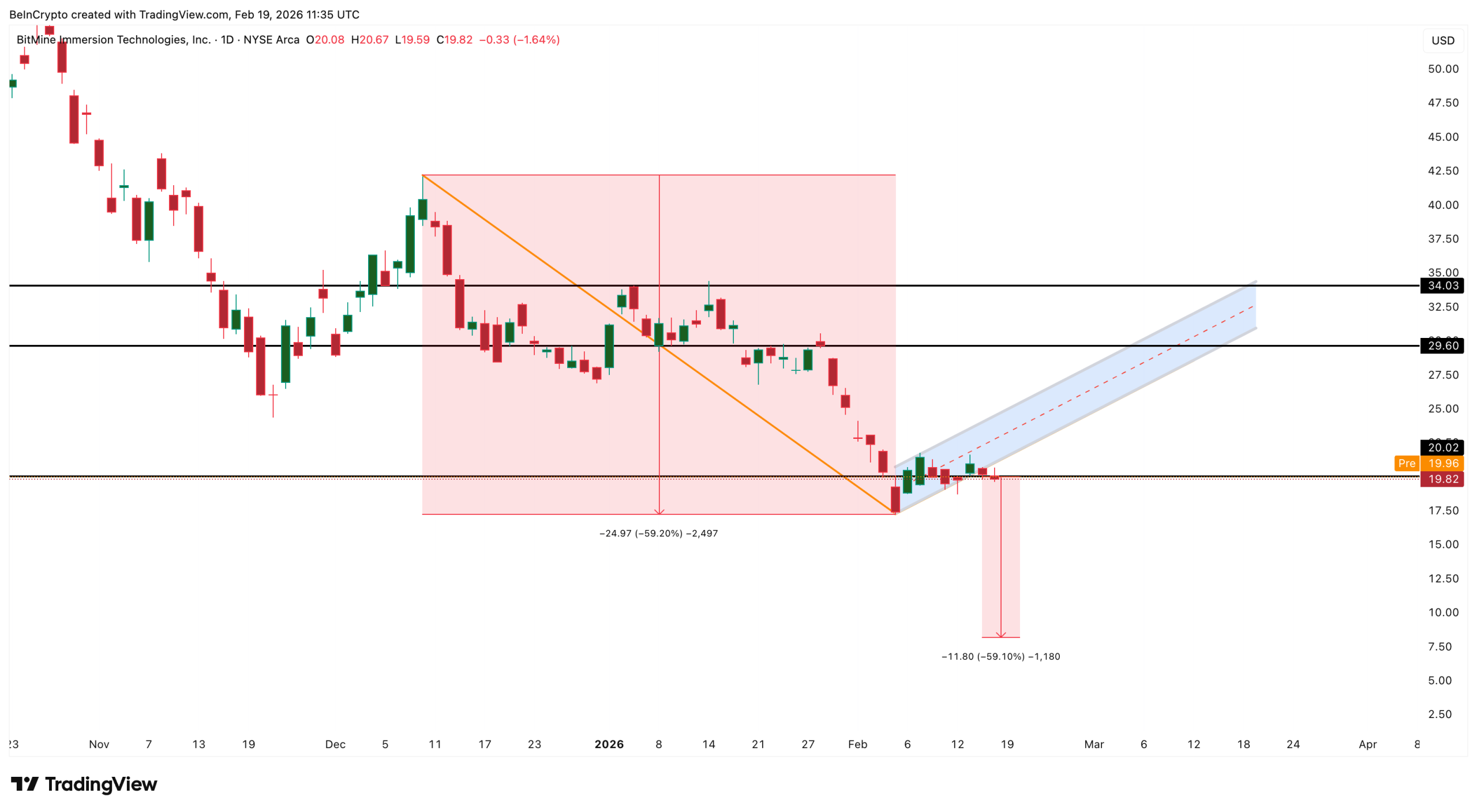
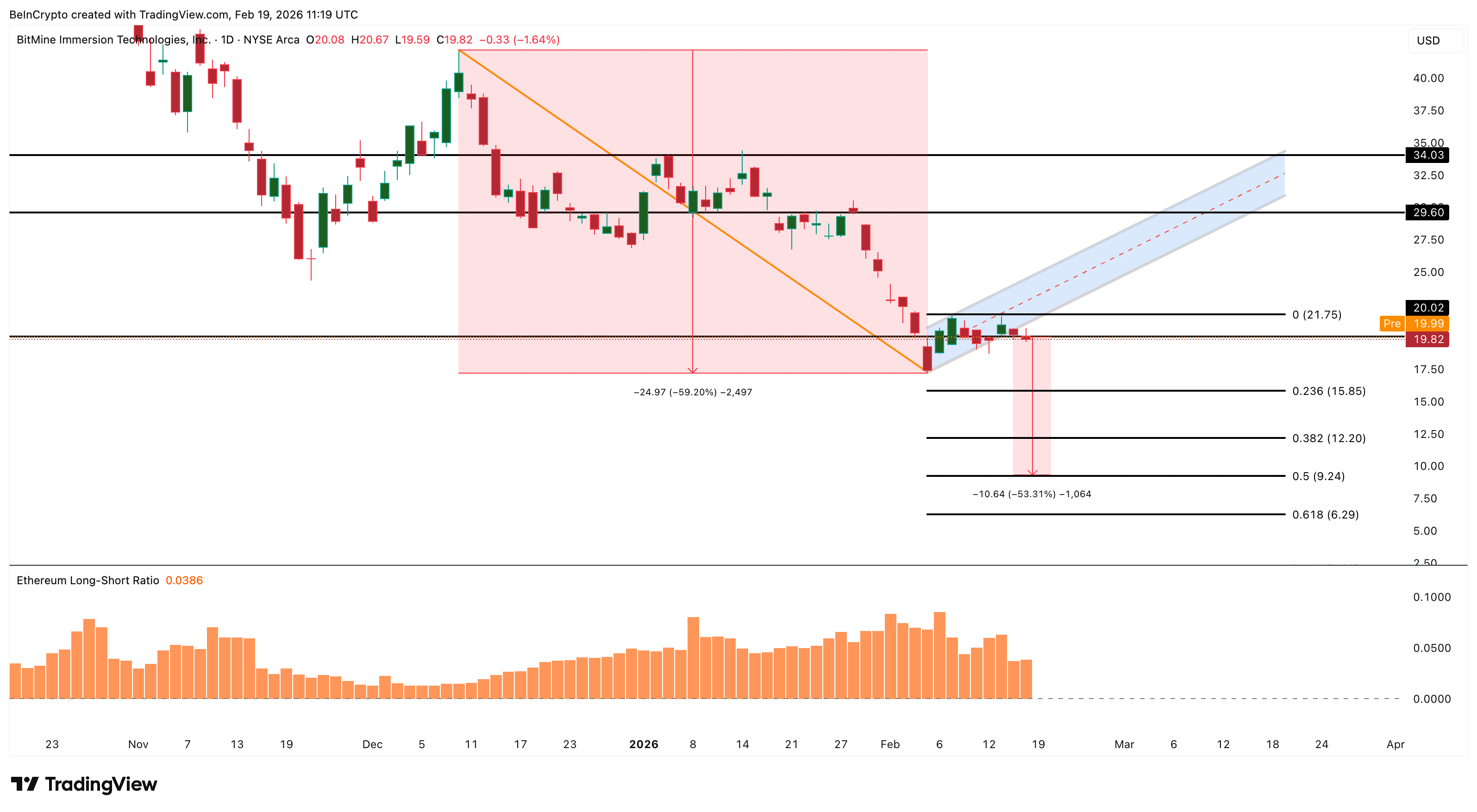
Companies usually increase holdings when they expect higher future prices, not lower ones. However, the stock price reaction tells a very different story. Since February 13, BitMine stock has dropped over 8%, and the technical chart now shows a breakdown.
The stock recently fell below the lower boundary of a bear flag pattern. A bear flag forms after a sharp drop, followed by a weak recovery.
Advertisement
BitMine Stock Price And A Bearish Pattern: TradingView
When the lower support breaks, it often signals that the prior recovery structure has weakened and the stock has entered a technically fragile zone. Based on the pattern structure, the ongoing breakdown path could extend by over 50% if the weakness persists. However, this price decline does not automatically confirm active investor selling, which we will see in the next section.
This creates a disconnect between BitMine’s strengthening treasury position and its weakening stock price, suggesting that other external factors may be influencing the move.
Sponsored
Sponsored
Retail Buying Improves, But Big Money Remains Cautious
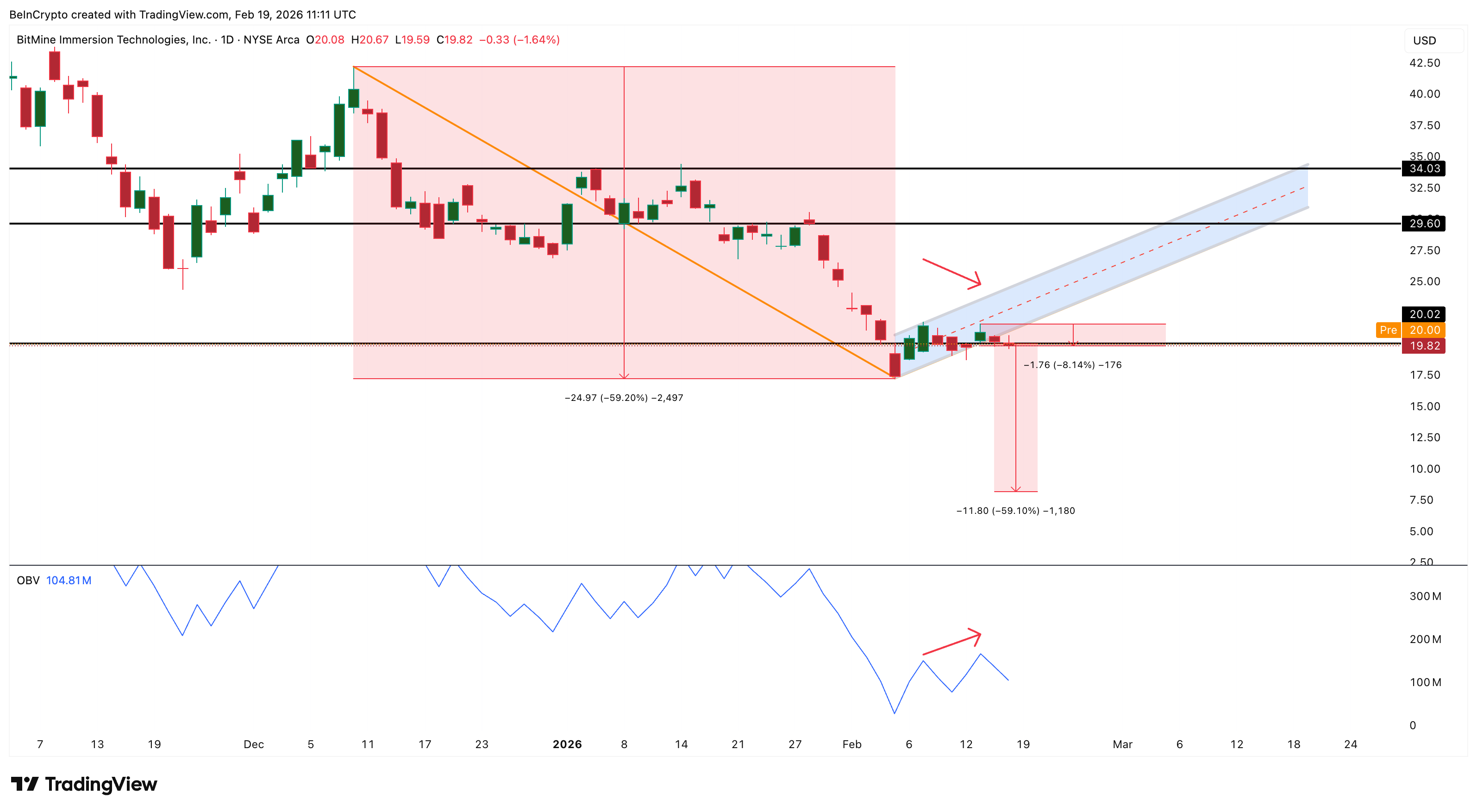
Despite the falling price, investor behavior beneath the surface shows some early strength. One key indicator is On-Balance Volume, or OBV. This metric tracks cumulative buying and selling pressure. When OBV rises, it means investors, possibly retail, are buying. possibly retail, are accumulating, even if the price has not responded yet.
Between February 9 and February 13, BitMine’s stock price formed a lower high, showing weakening price strength. However, OBV formed a higher high during the same period. It signals that buying activity is increasing quietly. This suggests retail investors were still accumulating BitMine stock despite the falling price.
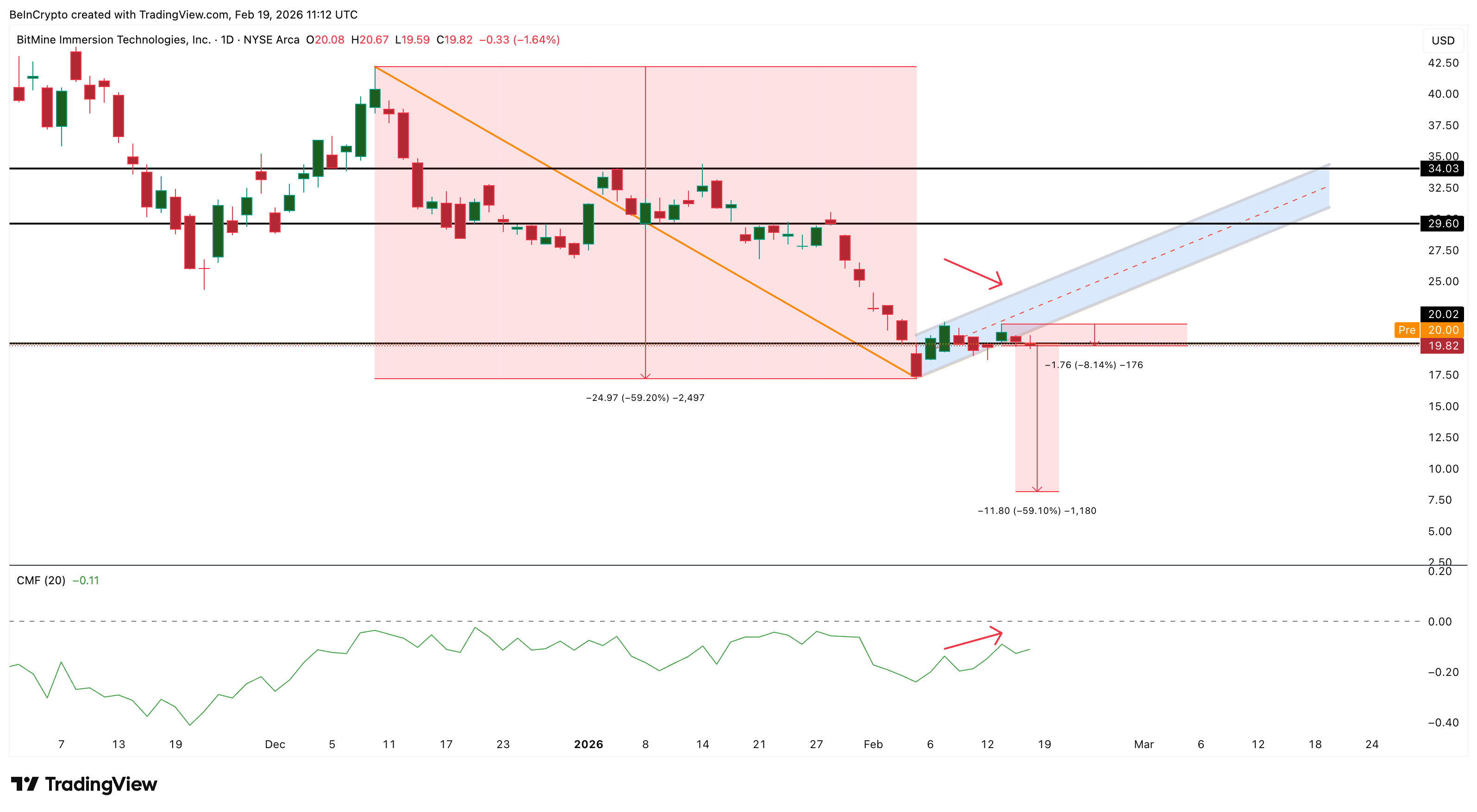
Another important indicator, the Chaikin Money Flow, or CMF, also shows improving conditions.
CMF measures whether large capital is entering or leaving a stock. The indicator has been rising recently, showing improving inflows and showing divergence similar to OBV.
Sponsored
Sponsored
Advertisement
However, CMF remains below the zero line, which means overall capital flow into BitMine is still negative. This suggests that large institutional investors are not fully supporting the recovery yet. Retail investors are stepping in, but institutional money remains cautious.
Big Money Weak But Improving: TradingView
Together, the rising OBV and improving CMF suggest that underlying participation is stabilizing rather than collapsing. This indicates that the recent breakdown may not be driven by aggressive selling from BitMine investors. Instead, the stock’s weakness appears more closely linked to Ethereum’s own price pressure, reflecting BitMine’s growing role as a high-beta proxy for ETH rather than a stock moving independently.
Ethereum Weakness Is Dragging BitMine Stock Price Lower
The biggest reason behind BitMine’s stock decline becomes clear when comparing it with Ethereum. BitMine’s price is highly correlated with Ethereum’s price. Correlation measures how closely two assets move together. BitMine’s correlation with Ethereum has increased from 0.50 to 0.52. This means the stock is behaving more like a direct proxy for Ethereum.
BMNR-ETH Correlation: Portfolio Slab
Sponsored
Sponsored
At the same time, Ethereum’s futures market shows rising bearish sentiment. The Ethereum long-short ratio has dropped to extremely low levels. This ratio measures how many traders expect prices to rise compared to fall. A low ratio means most traders expect further declines.
Advertisement
This bearish positioning directly impacts BitMine. Because BitMine holds a massive Ethereum treasury, its stock tends to weaken when Ethereum itself faces bearish pressure.
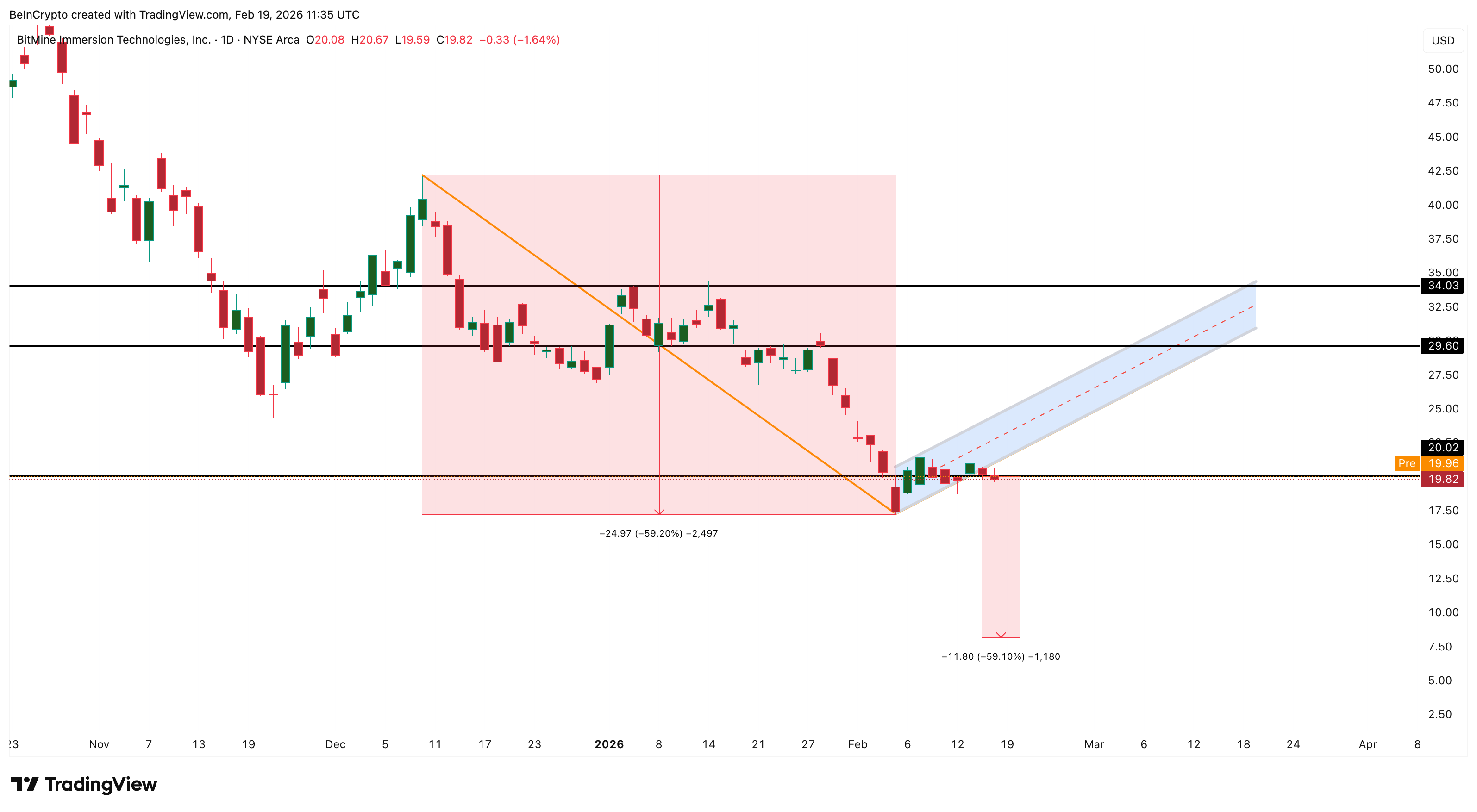
The technical chart now shows key levels ahead. BitMine has already lost support near $19. The next major support sits near $15. If that level breaks, the stock could fall toward $12 and even $9, which would be closer to the projected bear-flag breakdown level.
BMNR Price Analysis: TradingView
On the upside, recovery would first require reclaiming $21. A stronger bullish reversal would need a move above $29.
BitMine buying more Ethereum should have been a bullish signal. Retail investors are slowly accumulating, and capital inflows are improving. However, institutional money remains cautious, and Ethereum itself is facing bearish sentiment. Because BitMine now moves closely with Ethereum, its stock direction depends heavily on Ethereum’s strength. If Ethereum remains weak, BitMine may continue facing pressure regardless of its purchases.
On the surface, BitMine buying Ethereum and BitMine stock falling look like two different events. But in reality, they reflect the same underlying force.
Lemonade (LMND) Q4 revenue hit $228.1 million, up 53.3% year-on-year, beating estimates of $217.6 million
Adjusted EPS loss of -$0.29 beat analyst estimates of -$0.39 by $0.10
Net premiums earned came in at $179.5 million, an 8.3% beat and 77.4% year-on-year growth
Q1 2026 revenue guidance of $246–$251 million tops analyst consensus of $241.6 million
Shares jumped over 17% in pre-market trading following the results
Lemonade (NYSE: LMND) shares surged more than 17% in pre-market trading on Thursday after the company posted Q4 results that beat analyst expectations across the board.
Revenue for the quarter came in at $228.1 million, up 53.3% year-on-year and ahead of the Wall Street consensus of $217.6 million. That’s a solid beat by any measure.
The company reported an adjusted loss of $0.29 per share, compared to analyst estimates of -$0.39. That’s a $0.10 beat, or roughly 26% better than expected.
Net premiums earned — the number analysts tend to watch most closely for insurers — came in at $179.5 million. That beat estimates of $165.8 million by 8.3% and grew 77.4% compared to the same quarter last year.
Pre-tax loss for the quarter was $20.6 million, representing a -9% margin.
Advertisement
Strong Premium Growth Drives the Beat
Net premiums earned have grown at a 47.3% annualized rate over the last five years, well above the broader insurance industry average.
Over the past two years, that growth rate has moderated to around 30% annually — still a healthy clip, and consistent with the company’s overall revenue trajectory.
Lemonade’s revenue has compounded at roughly 50.9% annually over the last five years. The most recent two-year annualized rate of 31% shows some deceleration but still points to strong underlying demand.
Net premiums earned made up about 70.8% of total revenue over the last five years, making it the company’s primary revenue driver.
Advertisement
Q1 2026 Guidance Tops Estimates
Looking ahead, Lemonade guided Q1 2026 revenue to between $246 million and $251 million. The midpoint of that range, $248.5 million, comes in above the analyst consensus of $241.6 million.
That forward guidance gave investors an additional reason to bid the stock higher on Thursday morning.
Lemonade operates across renters, homeowners, pet, car, and life insurance in both the U.S. and EU markets through its AI-powered digital platform.
The company’s Giveback program, which donates unused premiums to policyholder-selected charities, remains a differentiator in its positioning — though it’s the underlying growth numbers doing the heavy lifting right now.
Advertisement
Lemonade held a market capitalization of $4.91 billion at the time of reporting.
The company hosted a conference call Thursday at 8:00 am Eastern to discuss results.
Shares traded up 11.1% to $73.05 immediately after the report, with pre-market gains extending above 17% as the session progressed.
Choosing the right scaling architecture is one of the most critical decisions in modern crypto development. The wrong choice can lead to high fees, slow performance, security risks, and stalled adoption. The right choice can unlock growth, institutional trust, and long-term sustainability. This choice impacts system resilience and future upgrade flexibility with the support of a crypto development company.
In this guide, we break down Layer-2, Sharding, and Hybrid models to help you select the most scalable, secure, and future-ready approach for your product.
Why Scalability Is the Biggest Challenge in Crypto Development
As blockchain adoption grows, platforms face increasing pressure to handle:
Higher transaction volumes
Lower latency expectations
Rising compliance standards
Complex integrations
Institutional security requirements
Many crypto coin development projects fail not because of weak ideas, but because their infrastructure cannot scale sustainably.
Common challenges include:
Advertisement
Network congestion
Unpredictable transaction fees
Poor user experience
Limited throughput
Regulatory constraints
These issues directly affect retention, revenue, and valuation.
Discover the Best Architecture for Your Platform.
Understanding the Three Main Scaling Approaches
Selecting the right scaling model is a foundational decision in crypto development. Your choice determines performance, cost structure, compliance readiness, and long-term growth. This decision becomes a powerful growth advantage with the right strategy and expert guidance.
1. Layer-2
Layer-2 solutions process transactions outside the main blockchain while inheriting its security. Only final transaction proofs are submitted to Layer-1. This model has become the backbone of many successful crypto development platforms because it delivers scalability without sacrificing reliability.
Layer-2 Overview
Category
Details
Processing Method
Off-chain batching with on-chain settlement
Security
Inherits Layer-1 security
Transaction Cost
Very low
Tooling Ecosystem
Mature
Wallet Support
Strong
Ideal Users
Startups, DeFi, Payments, Gaming
Main Risks
Bridge security, L1 dependency
For most crypto coin development services, Layer-2 offers the best balance between speed, affordability, and long-term stability. With proper implementation, Layer-2 becomes a strong foundation for sustainable growth and rapid market adoption.
2. Sharding
Sharding is designed for teams building new blockchain protocols and foundational infrastructure. It focuses on scaling at the network level rather than at the application layer.
Advertisement
Sharding Overview
Category
Details
Processing Method
Parallel shard execution
Security
Shared validator security
Scalability
Very high (theoretical)
Deployment Speed
Slow
Development Complexity
High
Ecosystem Maturity
Limited
Ideal Users
Layer-1 builders, infrastructure teams
Main Risks
Cross-shard communication, security coordination
For crypto development company teams working on next-generation blockchain networks, sharding enables deep technical control and long-term ownership. Sharding can position teams as leaders in protocol innovation, with strong expertise and planning.
3. Hybrid Architecture
Hybrid architecture is designed for organizations that require scalability, privacy, and regulatory alignment. It combines multiple systems to balance decentralization with operational control.
Hybrid Architecture Overview
Category
Details
Processing Method
Private networks + L2 + public settlement
Security
Controlled with public anchoring
Privacy Level
High
Regulatory Support
Strong
Deployment Speed
Medium
Operational Cost
High
Ideal Users
Banks, RWA platforms, enterprises
Main Risks
Governance complexity, infrastructure cost
Hybrid systems are widely used in institutional crypto coin development because they support compliance, governance, and enterprise integration. With the right technical partner, hybrid architecture becomes a future-ready platform for large-scale adoption.
Which Scaling Model Should You Choose?
Business Priority
Best-Fit Model
Fast Market Entry
Layer-2
Low Operational Cost
Layer-2
New Blockchain Development
Sharding
Regulatory Compliance
Hybrid
Enterprise Privacy
Hybrid
Most successful crypto projects begin with a clear architecture roadmap and evolve as their user base, revenue, and regulatory exposure grow. When supported by an experienced crypto development company, scalability becomes a competitive advantage that drives long-term success.
Advertisement
Get Personalized Guidance for Your Crypto Growth Strategy
Common Mistakes in Scalable Crypto Development
Many projects struggle not because of weak ideas, but because of avoidable strategic and technical errors. In scalable crypto development, early decisions have long-term consequences on performance, cost, security, and investor confidence. Working with an experienced partner helps reduce these risks, but founders and technical leaders must also understand the most common pitfalls.
Avoid these costly mistakes:
1. Choosing technology before defining the business model
Selecting Layer-2, sharding, or hybrid systems without understanding user needs, revenue flows, and compliance requirements often leads to misaligned infrastructure.
2. Ignoring compliance and regulatory planning early
Advertisement
Delaying legal and KYC considerations can block partnerships, exchange listings, and institutional funding.
3. Underestimating long-term infrastructure and maintenance costs
Many crypto coin development projects budget only for launch, not for ongoing node operations, indexing, monitoring, and upgrades.
4. Skipping independent security audits and testing
Advertisement
Unreviewed smart contracts expose platforms to exploits, fund loss, and reputation damage.
5. Delaying scalability planning until growth occurs
Retrofitting scalability after user adoption is expensive, risky, and disruptive.
Many failed crypto coin development projects made these mistakes, resulting in stalled growth, lost trust, and wasted capital. Planning scalability from the beginning is essential for long-term success.
Advertisement
Final Words
Choosing between Layer-2, sharding, and hybrid architecture is a strategic decision that directly impacts performance, compliance, and long-term growth. While Layer-2 suits most high-growth platforms, hybrid models serve regulated enterprises, and sharding supports core protocol builders. The key to success is aligning your technology with your business goals and working with a trusted cryptocurrency development company that understands both engineering and market realities.
Antier, a leading crypto development company, delivers end-to-end solutions, from architecture design and security audits to compliance integration and infrastructure optimization. We help businesses launch faster, scale smarter, and operate with confidence. Ready to build with confidence? Book your free consultation with Antier today and get a personalized scalability roadmap for your project.
Frequently Asked Questions
01. What is the importance of choosing the right scaling architecture in crypto development?
Choosing the right scaling architecture is crucial as it affects transaction fees, performance, security, and overall adoption. The right choice can lead to growth, institutional trust, and long-term sustainability.
02. What are the common challenges faced in crypto development related to scalability?
Common challenges include network congestion, unpredictable transaction fees, poor user experience, limited throughput, and regulatory constraints, all of which can impact retention, revenue, and valuation.
Advertisement
03. What are the three main scaling approaches discussed in the guide?
The three main scaling approaches are Layer-2, Sharding, and Hybrid models, each offering different benefits in terms of scalability, security, and future readiness for crypto platforms.
Cryptocurrency trading volumes in Latin America grew 63% and crossed $1.5 trillion between July 2024 and June 2025, establishing the region as one of the most crypto-progressive regions. In February 2026, Argentina, Brazil, and El Salvador dominated the headlines with noteworthy cryptocurrency developments. El Salvador plans a $100M tokenized investment program for localized SMEs, where Brazil considers eliminating crypto taxes and establishing a strategic Bitcoin reserve, and Argentina revokes the right to receive salaries in digital wallets. These signals demonstrate how LATAM governments and businesses are actively experimenting with new financial models.
Crypto finance group, a part of Deutsche Börse Group, entered LATAM after it sensed a “strong, concrete demand from institutions for well-structured, compliant crypto offerings”, in the words of Vander Straeten, the CEO.
If institutional capital and policy momentum are converging this fast, it is clear that LATAM crypto exchange development is commercially compelling in 2026 and beyond. However, this opportunity materializes only for platforms designed around the region’s real adoption mechanics.
What Actually Drives LATAM Digital Asset Adoption?
Crypto exchange software businesses can’t reach 200K users in LATAM by listing region-popular pairs or tokens or by increasing the leverage. The region’s digital asset adoption curve is driven by currency stability, cross-border transfer dependency, and mobile-first fintech habits.
Advertisement
By the end of 2025, LATAM had approximately 70 million unique crypto users, up from 73.7 million in Q3 2025 and 57.7 million earlier in the year. But the growth didn’t come from speculation but utility.
1. Inflation Hedging Via Stablecoins
Currency volatility remains the primary entry trigger in markets like Argentina, where inflation has stayed structurally high. In such markets, stablecoins function as everyday digital dollars rather than trading assets.
Stablecoins dominated more than 90% of exchange flows in Brazil, 62% in Argentina, and 48-60% region-wide. This proves that most users in the Latin American region hold balances for savings and payments, not trading.
LATAM received an estimated $165.1 billion in remittances in 2024, and another research predicted it would reach $174.4 billion by the end of 2025. Crypto has been increasingly used to bypass high-fee corridors.
Advertisement
Mexico, which is the second-largest corridor from the US, alone totaled $63.3 billion in remittances in 2024-25. Bitso, a leading crypto exchange software, handled over $6.5 billion in US-Mexico remittances, which totaled in 2024, representing more than 10% of the total corridor volume.
Stablecoin-based remittances cut costs by 50-80%, dropping from traditional 6-7% averages to 1-3%. High-fee LATAM corridors even benefit from 76% savings with stablecoins.
3. P2P and Social Money Behavior
Money movement in Latin America is socially mediated between families, communities, and informal networks, rather than institutionally intermediated. Crypto leads the peer-to-peer money movement in the region due to the popularity of social tipping and community payments. Many users from the region adopt wallets through contacts and not financial products.
Tron has sustained as a high-volume blockchain infrastructure supporting 78% of P2P transfers, which is an essential crypto exchange development feature for LATAM.
4. Mobile-Native Onboarding Expectations
LATAM fintech usage is mobile-centric, with 70% regional mobile penetration, and strong familiarity with chat-based payments. More users are expecting WhatsApp-style transfers and low-literacy onboarding flows with instant notifications and real-time balances in the application. So, crypto exchange software businesses in the region are competing with neobanks, not global trading apps.
Advertisement
In short, LATAM cryptocurrency exchange software scales when they behave like payment rails, not a trading terminal.
Essential Crypto Exchange Development Features Required to Reach 200K Users in Latin America
The primary crypto exchange software development feature in LATAM isn’t order books but stablecoin wallets. Exchanges that nurture their in-built centralized or decentralized wallets can capture the audience that approaches crypto exchange apps as a dollar account. Here are essential crypto wallet components for LATAM exchanges:
As deduced from the statistics above, remittances create the strongest viral loop in the region. Peer-to-peer transfer engine forms another essential component for LATAM crypto exchange development. These features fetch revenues and act as customer magnets at the same time as each remittance/payment sender typically onboards 1-3 new users. So, for businesses planning to launch their digital asset exchange, the following capabilities are indispensable:
Cross-border stablecoin transfers
QR / phone-number payments
P2P marketplace matching
Chat-based or whatsapp style P2P transfers
Local cash-out counterparties
Corridor-specific liquidity routing
3. Local Fiat Rails
Instant and cost-efficient fiat access determines retention for crypto exchanges in LATAM. Users quickly abandon platforms that delay deposits and withdrawals beyond minutes or fail to support end-to-end money movement. For this reason, any cryptocurrency exchange software development targeting this region must implement Pix-style crypto-fiat rails as a foundational layer. These are the basic requirements:
In countries like Latin America, where money flows socially before it flows financially, community finance features accelerate onboarding and adoption. Money movement mostly occurs within creator communities, family groups, and informal networks rather than purely financial contexts. As a result, cryptocurrency exchange software in the LATAM region increasingly functions as a social finance platform where users interact, tip, and transact around personalities and communities. Implementing creator monetization and community finance tools, along with the following features inside the exchange helps exchanges engage a wider audience.
In the LATAM region, speculative behavior is culturally linked to sports outcomes and macroeconomic events rather than traditional financial instruments. Prediction markets embedded inside crypto exchange software, therefore, attract users who may not engage with spot or derivatives trading but are comfortable with simple outcome-based participation. Cryptocurrency exchanges can create familiar entry points into digital asset usage and still generate liquidity, engagement, and revenue with the following:
Stablecoin savings represent one of the strongest retention drivers in inflation-prone Latin American economies, where users seek protection from local currency devaluation. Many users adopt crypto exchange wallets primarily to store digital dollars rather than to trade or transact. Crypto exchange software solutions that integrate accessible yield or savings interfaces can therefore retain liquidity and transition utility users into broader financial activity with gamification and rewards.
One-tap stablecoin savings or vault accounts
Transparent APY display in USD
Recurring local-to-USD conversion
Flexible withdrawals or redemption options
Risk tier or yield source labeling
A LATAM exchange that reaches 200K users behaves as a dollar wallet, remittance network, social finance app with trading infrastructure and engagement layers operating in the background rather than the foreground.
What are the UX Principles that Support Sustainable and Fast LATAM Crypto Exchange Software Growth?
As stated earlier, most LATAM cryptocurrency exchange software users are leveraging trading platforms for their financial needs. Exchanges that aim to scale quickly in the region must mirror familiar mobile money patterns and minimize cognitive and compliance friction at entry. Let’s again highlight the UX essentials for LATAM cryptocurrency exchange development:
1. USD-first balances as users in inflationary markets think in dollars even when transacting locally. Displaying portfolios and transaction values in USD by default aligns the app with real financial perception.
Advertisement
2. Simplified KYC entry and verification allow low-limit onboarding and accelerate first transactions while deferring heavier compliance steps to later stages of engagement.
3. WhatsApp-like transfers, chat-style sending, contact-based payments, and conversational confirmations reduce learning effort. Such financial experience matches how users already communicate over messaging apps.
4. Low-literacy-friendly flows can be created with icon-led actions, guided steps, and clear visual confirmations. This enables users across varied education levels to complete transfers and deposits without confusion.
5. Offline-friendly lightweight alerts, queued transaction updates, and low-bandwidth operation ensure efficient operation in environments with inconsistent connectivity.
Advertisement
Launch a LATAM-ready crypto exchange with Antier’s production-grade infrastructure
Closing: Why Most LATAM-Based Crypto Exchange Software Fail & How They Can Reach 200K Users in 6 Months
Many cryptocurrency exchange software launches in Latin America underperform, not because the markets lack demand, but because platforms are built around trading assumptions instead of regional money behavior. So, this is what businesses must avoid during crypto exchange development and launch;
Launching trading before payments
Providing USD as a secondary balance
Slow fiat rails
Heavy KYC at entry
No cash-out liquidity
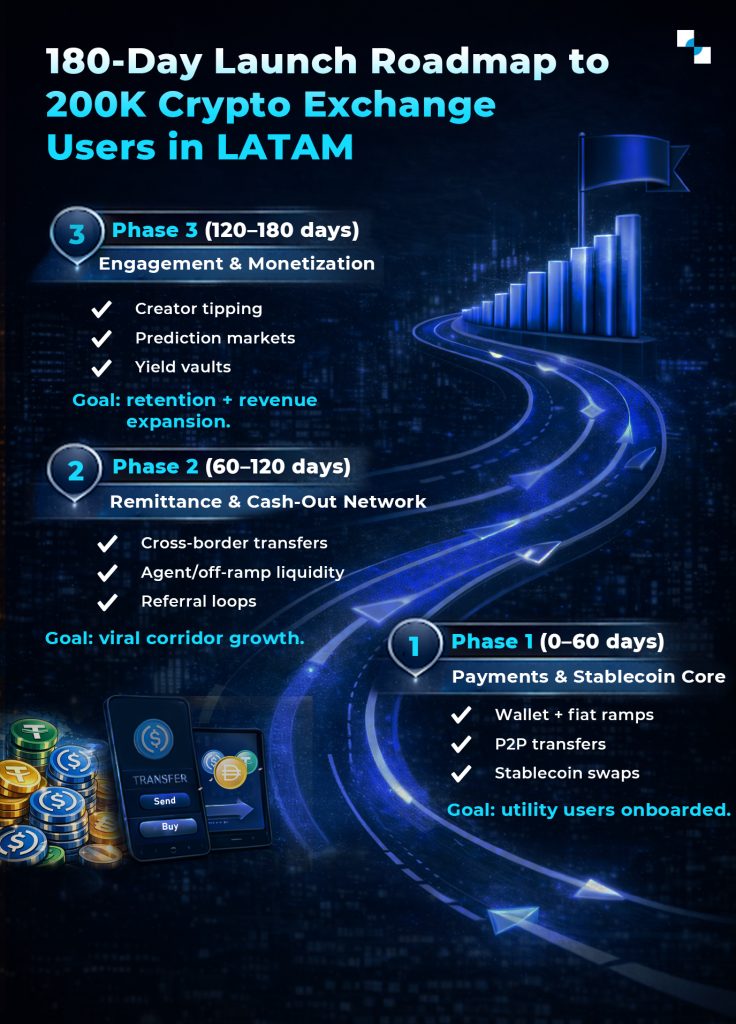
To make a crypto exchange software development project scale to hundreds of users in the first 180 days, crypto exchanges must primarily launch stablecoin wallets, local fiat rails, remittance loops, and social finance features.
This is why the fastest-growing LATAM cryptocurrency exchanges function less like trading terminals and more like payment networks layered with savings and social money features. Trading remains present, but it operates as a monetization layer that activates after users already rely on the app for everyday financial activity.
Antier offers LATAM-ready white label cryptocurrency exchanges and custom development solutions with the exact stack required to reach 200K users in 6 months. We support the full lifecycle from development and launch to growth and compliance. Connect today!
Frequently Asked Questions
01. What was the growth percentage of cryptocurrency trading volumes in Latin America between July 2024 and June 2025?
Cryptocurrency trading volumes in Latin America grew by 63% and crossed $1.5 trillion during that period.
Advertisement
02. What are some notable cryptocurrency developments in Argentina, Brazil, and El Salvador as of February 2026?
El Salvador plans a $100M tokenized investment program for SMEs, Brazil is considering eliminating crypto taxes and establishing a Bitcoin reserve, and Argentina has revoked the right to receive salaries in digital wallets.
03. What factors drive digital asset adoption in Latin America?
Digital asset adoption in LATAM is driven by currency stability, dependency on cross-border transfers, and mobile-first fintech habits, rather than speculation.
Editor’s note: Gold has surged on geopolitical uncertainty and sticky inflation, creating a broad bullish backdrop that has carried prices to fresh highs. A pause in the rally, like this week’s dip below US$5,000, can be a healthy consolidation rather than a sign of weakness. This editorial note frames the accompanying press release as a measured read on near-term dynamics, while acknowledging the longer-term drivers — such as central bank activity, ETF demand, and policy expectations — that keep gold well bid. For UAE investors and global traders, the current pullback may offer a cautious entry point into the next leg higher.
Key points
Gold dips below US$5,000 after a 14% year-to-date rally, seen as consolidation by eToro.
The move followed hawkish signals from Trump nominee Warsh; trading volumes thinner during Lunar New Year.
Longer-term drivers remain intact: geopolitical risk, sticky inflation, and a shifting US rate outlook.
Potential for another leg higher as Fed rate trajectory and cut expectations evolve; UAE investors see entry points in volatility.
Why this matters
This release underlines that near-term volatility does not erase gold’s fundamental support, with central bank demand and ETF inflows suggesting further upside as policy expectations evolve.
What to watch next
Monitor US inflation data for potential shifts in rate expectations.
Watch for new geopolitical developments that could reignite momentum.
Track ETF inflows and central bank activity that could sustain the rally.
Disclosure: The content below is a press release provided by the company/PR representative. It is published for informational purposes.
Press release: Gold Dips Below US$5,000 After 14% Rally
Abu Dhabi, UAE – February 19, 2026: Gold’s pullback below the US$5,000 level this week should not unsettle investors, according to eToro, which views the move as a natural consolidation within one of the strongest bull runs in recent years.
Zavier Wong, Market Analyst at eToro
Gold’s dip below US$5,000 this week shouldn’t rattle investors. If anything, it’s a healthy pause in what remains one of the strongest bull runs in recent memory. — Zavier Wong, Market Analyst at eToro
The precious metal touched fresh record highs above US$5,000 earlier this month before retreating, following market reaction to former US President Donald Trump’s nomination of Kevin Warsh as Federal Reserve Chair. Investors interpreted the pick as hawkish, weighing on gold prices in the short term.
The move was further amplified by thinner trading volumes during the Lunar New Year period and US market holidays. However, Wong noted that much of the initial reaction has already been priced in, and the broader drivers behind gold’s rally remain firmly intact.
Advertisement
“Gold has gained more than 14% since the start of the year, and the conditions that have driven that rally — including geopolitical uncertainty, sticky inflation concerns, and a shifting US rate outlook — haven’t gone anywhere.” — Wong added
For UAE investors, the fundamentals supporting gold remain unchanged. Central bank buying continues at a steady pace, ETF inflows are building, and institutional conviction behind the rally appears far from exhausted.
“When you layer in growing expectations that the US Federal Reserve could cut rates later this year, the case for holding gold only strengthens. That means another leg higher from here is not off the cards, and further record highs aren’t out of the question.” — Zavier Wong, Market Analyst at eToro
Wong emphasised that the current price action should be viewed as the market “catching its breath” rather than losing conviction, with gold continuing to trade near key technical support levels.
“The best way to look at this current consolidation is that the market is essentially catching its breath rather than losing conviction. Any fresh catalyst – whether a softer US inflation print or an escalation in geopolitical tensions – could quickly reignite momentum.” — he said.
For investors in the UAE already holding gold, this week’s volatility is likely to be short-term noise. For those still on the sidelines, Wong suggested it may offer a more attractive entry point than seen in recent weeks.
About eToro
eToro is the trading and investing platform that empowers you to invest, share and learn. We were founded in 2007 with the vision of a world where everyone can trade and invest in a simple and transparent way. Today we have 40 million registered users from 75 countries. We believe there is power in shared knowledge and that we can become more successful by investing together. So we’ve created a collaborative investment community designed to provide you with the tools you need to grow your knowledge and wealth. On eToro, you can hold a range of traditional and innovative assets and choose how you invest: trade directly, invest in a portfolio, or copy other investors. You can visit our media centre here for our latest news.
Advertisement
Risk & affiliate notice: Crypto assets are volatile and capital is at risk. This article may contain affiliate links. Read full disclosure
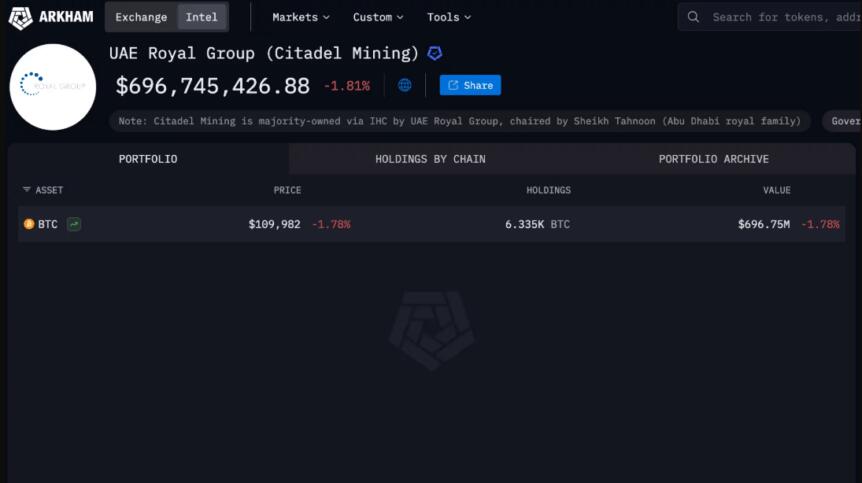
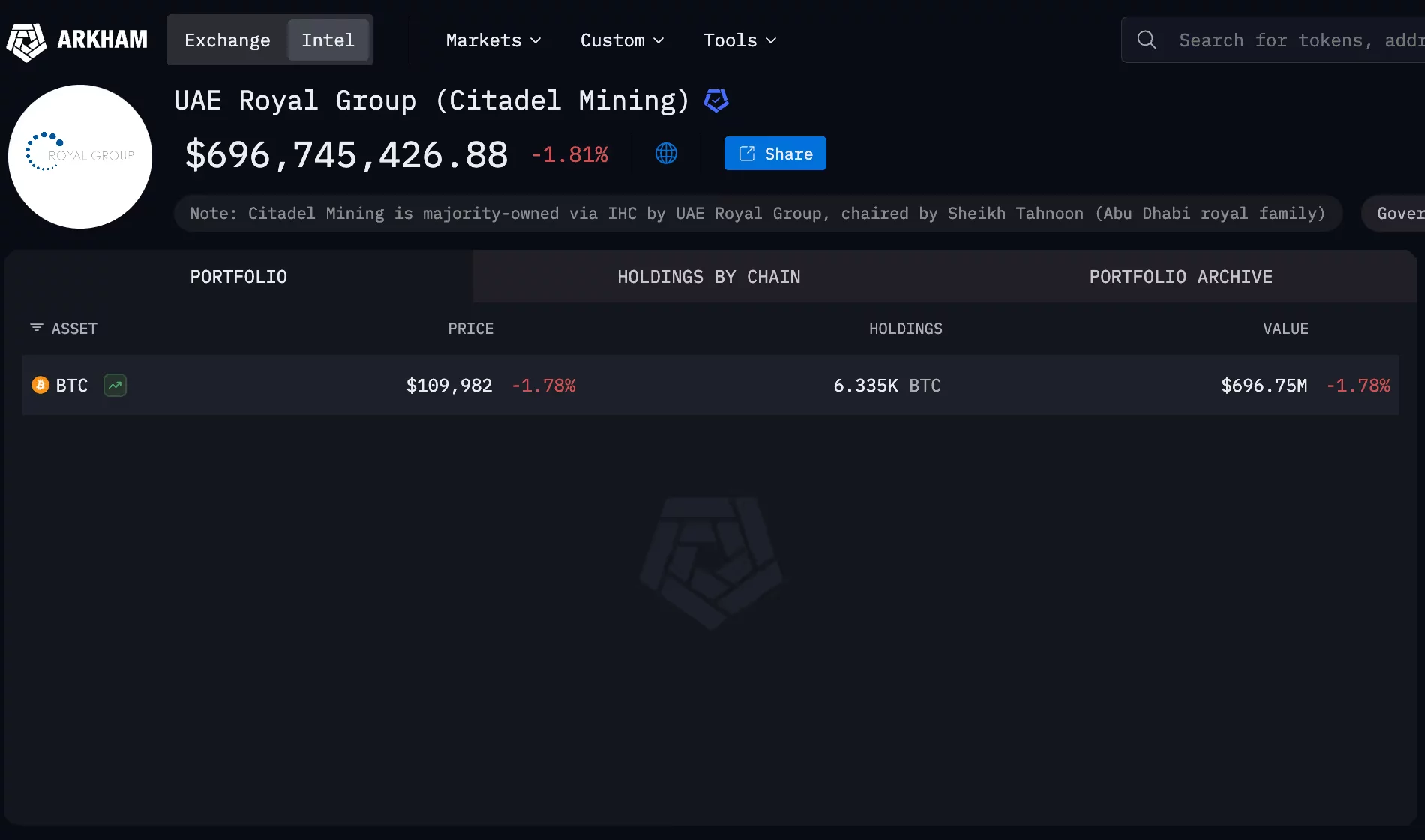
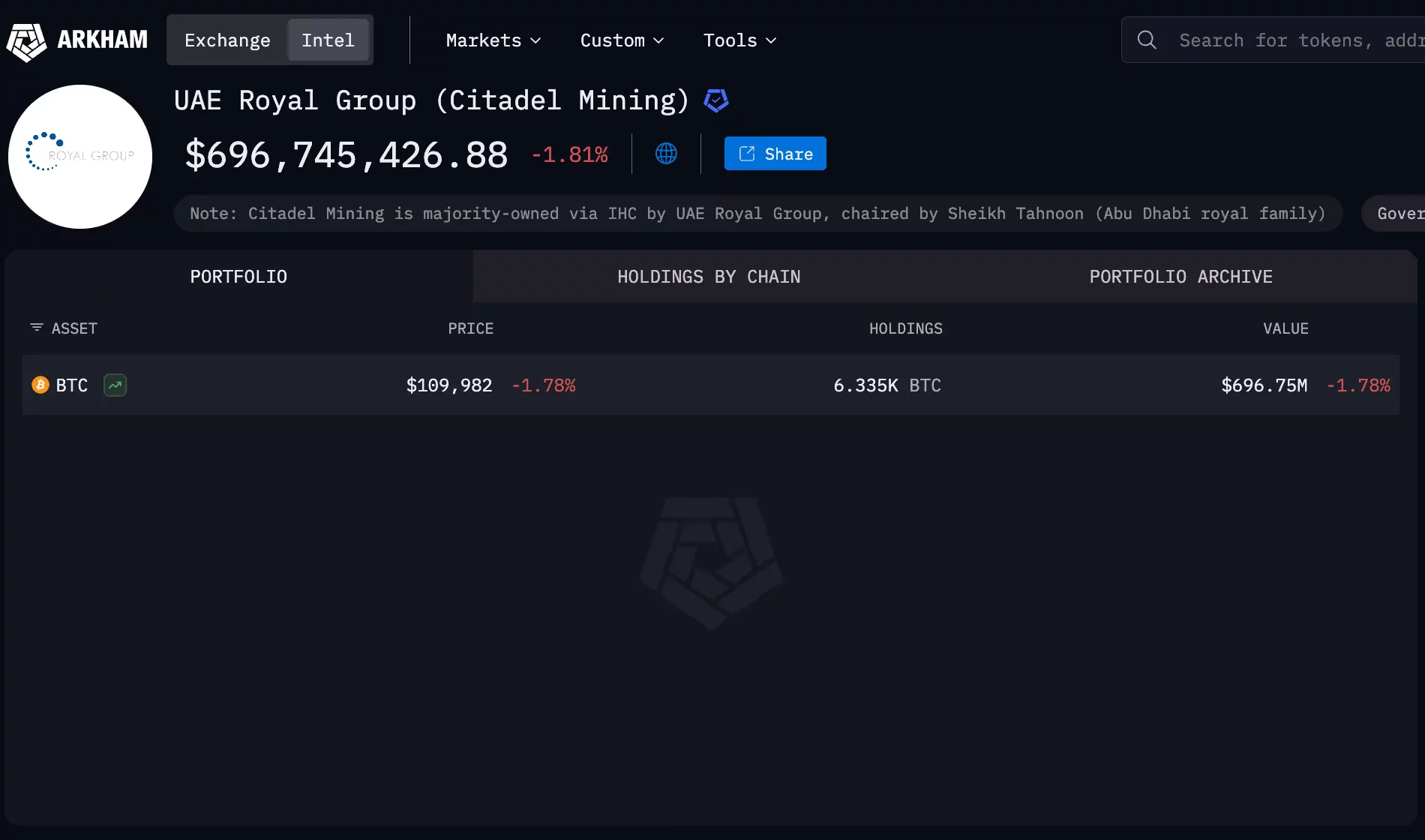
According to blockchain analytics firm Arkham Intelligence, the United Arab Emirates has amassed around 700 million dollars of Bitcoin in state-linked mining activities, which is one of the largest sovereign holdings of crypto, which was not obtained by asset seizures or open market buyouts.
UAE Government Holds 6,300 Bitcoin Worth $700M
Arkham latest on-chain research pointed out that digital wallets that are recognized to be under the control of the UAE government are currently storing approximately 6,300 Bitcoin (BTC). Even at current market values, such holdings have a valuation of nearly $700 million, making the Gulf nation one of the largest publicly known sovereign holders of Bitcoin in the world.
THE UAE MINED $450M BITCOIN
The UAE has so far mined $453.6M Bitcoin through their partners Citadel. It appears that they are holding the majority of the Bitcoin they produce, with their most recent outflows 4 months ago.
In contrast to the United States and the United Kingdom, the government Bitcoin reserves are mostly the result of law enforcement seizure of funds generated by criminal investigations, the UAE cryptocurrency treasure trove is mostly created as a result of local mining.
According to the analysis of Arkham, the major part of the holdings was acquired by way of the mining of Bitcoin by Citadel Mining, a publicly traded mining company that is majority-owned by International Holding Company (IHC), which is a UAE-based conglomerate that has ties to the Royal Group.
International Holding Company is one of the most active investment companies in the Middle East which has spread in various fields such as energy, healthcare, technology, and infrastructure.
Advertisement
UAE Directly Engages in Bitcoin Mining
The UAE is in a unique situation as its majority ownership of Citadel Mining makes it one of the sovereign actors that are directly involved in blockchain infrastructure instead of acquiring digital units by confiscation or allocating them through the treasury.
According to the estimates of Arkham researchers, the total amount of BTC mined by the UAE since the initiation of state-related activities has been approximately 9,300. Out of it, about 6,300 BTC are kept in wallets that belong to government-controlled bodies.
The rest have been sold off or are in related entities, including the Phoenix Group, a digital asset and mining infrastructure firm that had helped to develop the mining facilities.
Reviewed satellite images, and blockchain transaction data reveal that Citadel has built its main mining facility in Abu Dhabi in 2022 with Phoenix Group.
Advertisement
The construction of the facility was also a major stride in the efforts of the country to increase the digital asset infrastructure and use its energy resources to facilitate the high-performance computing processes, including Bitcoin mining.
The findings by Arkham indicate that the strategy of the UAE is related to a larger nationalist diversification plan. The oil-rich federation, long dependent on hydrocarbon revenues, has over the last years hastened efforts in fintech and blockchain technology investment in part of its efforts to lower its reliance on fossil fuels and establish itself as a regional financial innovation centre.
The UAE has made a unique track compared to Western governments that mostly acquired Bitcoin through random means because of a criminal case or exchanges by mining tokens instead of accumulating them through exchanges or asset seizures.
Analysts observe that the reserves that are based on mining can provide more strategic control over the cost of acquisition and development of infrastructure, as well as internalize the sovereign actor more within the underlying network.
Advertisement
The prices of the holdings of the UAE will keep oscillating depending on the volatility of the market price of Bitcoin. But the report by Arkham highlights the increased role of nation-states in direct participation in the digital asset ecosystem.
The UAE model demonstrates a new model in which governments beyond regulation and enforcement increasingly transition to active production and accretion of decentralized assets as more governments consider regulatory frameworks, central bank digital currencies, and strategic crypto reserves.
Risk & affiliate notice: Crypto assets are volatile and capital is at risk. This article may contain affiliate links. Read full disclosure
Blockchain analytics firm Arkham Intelligence says the United Arab Emirates has amassed approximately $700 million worth of Bitcoin through state-linked mining operations.
The holdings stem from industrial-scale mining via Citadel Mining, not seizures or open-market purchases.
With an estimated 9,300 BTC mined in total, the UAE ranks near sixth globally among publicly identified government Bitcoin holders.
UAE amasses $700M BTC war chest via state-linked miner
According to Arkham’s on-chain research, wallets identified as controlled by the UAE government hold around 6,300 Bitcoin (BTC), valued near $700 million at current prices.
THE UAE MINED $450M BITCOIN
The UAE has so far mined $453.6M Bitcoin through their partners Citadel. It appears that they are holding the majority of the Bitcoin they produce, with their most recent outflows 4 months ago.
These holdings arise not from asset seizures or market purchases, but primarily from Bitcoin mined via Citadel Mining, a public mining company majority-owned by the UAE-backed conglomerate International Holding Company (IHC), itself linked to the UAE Royal Group.
Advertisement
Arkham notes that the UAE’s Bitcoin reserves make it one of the largest sovereign Bitcoin holders globally, potentially ranking near sixth among nations based on publicly identified holdings.
Unlike other governments whose Bitcoin treasuries stem largely from law enforcement seizures, such as the United States and United Kingdom, the UAE’s stash is a product of industrial-scale mining operations.
Arkham researchers say the UAE has mined roughly 9,300 BTC in total, of which approximately 6,300 BTC remain in government-linked wallets, with the rest either deployed or held in associated entities like Phoenix Group.
Satellite imagery corroborated with on-chain data shows Citadel’s mining facility in Abu Dhabi was built in 2022 in partnership with Phoenix Group. Arkham’s report suggests this approach aligns with broader diversification efforts by the oil-rich nation into digital finance and blockchain infrastructure.
While the value of the holdings will fluctuate with Bitcoin prices, the data highlights the UAE’s unique path into crypto: a production-based Bitcoin reserve rather than simple accumulation through market buys or seizures, spotlighting how sovereign actors are navigating and participating in the digital asset ecosystem.
Figure Technology Solutions (FIGR), the blockchain company helmed by ex-SoFi CEO Mike Cagney, is debuting Thursday a new, tokenized class of its stock that trades entirely on blockchain rails cutting out traditional intermediaries, the firm told CoinDesk.
The stock token, dubbed FGRD, will be available on Figure’s Onchain Public Equity Network (OPEN), where it is issued, traded and settled without relying on the traditional clearing and custody systems that underpin most of Wall Street.
Instead, FGRD transactions are recorded and finalized directly on a blockchain, allowing for faster execution and programmable compliance, the company said.
Investors can access the asset through the Figure Markets app and self-custody wallets integrated with the network. Investors will also be able use their stock tokens for lending or borrowing through Figure’s decentralized finance protocol Democratized Prime.
Advertisement
Figure operates a blockchain-native capital markets platform that connects loan origination, funding and secondary trading. The company has originated over $22 billion in home equity loans and offers tools for digital asset custody, tokenization and onchain yield products. Its infrastructure is used by banks, credit unions and fintechs to bring traditional assets onto public blockchains.
Tokenized equities — digital versions of traditional stocks that trade on blockchain rails — have drawn attention recently for their potential to reduce settlement risk, improve transparency and increase market access. Most are backed by offchain assets and depend on intermediaries to reflect real-world ownership. FGRD differs in that it is issued natively onchain, representing the actual equity rather than a derivative or proxy.
“Public equity still runs on decades-old market plumbing, and it simply doesn’t make sense anymore,” said Mike Cagney, executive chairman of Figure.
“By issuing FGRD natively onchain, we’re re-architecting the core infrastructure of capital markets to be real-time, transparent, and programmable, while removing layers of intermediaries that add cost, risk, and friction,” he added.
Advertisement
Figure’s tokenized stock debut comes amid the company’s secondary public offering, which was upsized to $150 million. Venture firm Pantera Capital participated in the deal. The firm also said to repurchase $10 million of its common stock from existing shareholders.
Figure went public in September, with its shares erasing gains over the past month as crypto prices tumbled.
Solana (SOL) has fallen below $82 as selling pressure and risk aversion increased.
Rising liquidations show leveraged traders are exiting positions.
$80 support remains critical, with $75 and $90 as key levels to watch.
Solana has entered a fragile phase as selling pressure builds and confidence across the market continues to fade.
The token has slipped below the $82 area, a level that previously acted as a short-term cushion for price action.
Liquidations rise as leverage unwinds
The futures market has played a major role in amplifying Solana’s downside move.
Liquidations have increased, and long positions have been forced out as price drifts lower, creating bursts of sharp selling during the intraday declines.
Funding rate has also turned negative, showing a growing dominance from short sellers who are willing to pay to maintain bearish exposure.
Source: Coinglass
While leverage flushes can sometimes reset the market, there is little evidence of that shift yet.
Instead, each liquidation wave has been followed by muted buying interest.
Sentiment cools as on-chain activity slows
Beyond price and derivatives, Solana is also facing softer signals from on-chain activity.
Transaction-driven revenue has declined from recent peaks, suggesting lower demand for block space and reduced speculative activity.
Advertisement
A good percentage of the network usage is currently tied to short-lived trends rather than sustained growth.
That reliance leaves the network activity vulnerable as market sentiment cools.
Investor confidence has also softened as the price struggles to reclaim key resistance zones.
Repeated failures near higher levels have reinforced a wait-and-see attitude.
Advertisement
Even though new wallets continue to appear, overall engagement lacks momentum, especially as the hype around memecoins, which form the bulk of Solana’s engagement, fades.
This imbalance highlights the difference between long-term interest and short-term participation.
The result is a market caught between underlying potential and immediate pressure.
Solana price forecast
Traders should closely watch the $80 level as the first major line of defence in case of a further decline.
Advertisement
A clean break below this zone could expose the price to deeper losses.
If selling continues, the next area of interest sits between $75 and $76, which has previously acted as a stabilisation zone during corrections.
Failure there would open the door toward the low $70s, which would result in even more liquidations.
On the upside, analysts note that Solana needs to reclaim the $85-87 range to ease immediate pressure.
Advertisement
If SOL moves above $87, bulls will be in control, and the next target sits around $90.
A move beyond that level would be required to shift sentiment meaningfully.




















 Video3 days ago
 Tech4 days ago
 Crypto World2 days ago
 Sports2 days ago
 Video6 days ago

 Business2 days ago
 Video2 days ago
 Entertainment1 day ago
 Crypto World5 days ago
 Tech1 day ago

 Entertainment16 hours ago
 Business1 day ago

 Crypto World6 days ago
 Crypto World19 hours ago
 Crypto World7 days ago

 NewsBeat5 days ago