
Crypto World
Coinbase Rolls Out 24/7 Stock Perpetuals for International Traders


Coinbase has expanded its stock perpetual futures offering to eligible non-U.S. traders, delivering leveraged, cash-settled exposure to major U.S. equities and indices on its non-U.S. trading rails. The rollout, disclosed in a Friday blog post, underscores Coinbase’s ongoing effort to provide a unified platform where crypto, stocks, and event-based contracts can be accessed in a single account.
The product is not available to U.S. residents at this time, with Coinbase indicating it is working to extend the offering to additional regions in the future. Access is currently limited to retail users on Coinbase Advanced and to institutions on Coinbase International Exchange, featuring perpetual contracts tied to notable stocks such as Apple and Nvidia.
Key takeaways
- Stock perpetual futures deliver leveraged, cash-settled exposure to major U.S. equities (including Apple and Nvidia) via Coinbase Advanced for retail clients and Coinbase International Exchange for institutions, aimed at crypto-style trading familiarity.
- The launch aligns with Coinbase’s broader 2026 roadmap, which centers on a multi-asset, “everything exchange” built around stablecoins, its Base layer-2 network, and a brokerage model spanning crypto and traditional assets.
- Europe already saw a related move earlier in March, when Coinbase rolled out perpetual futures for Coinbase Advanced users across 26 MiFID-regulated countries, signaling a broader international push beyond the U.S. footprint.
- In the wider market, several platforms offer tokenized or perpetual equity exposure to non-U.S. traders, including Binance and Kraken, highlighting an active, competitive space for synthetic stock products and on-chain real-world assets.
Non-U.S. expansion shapes Coinbase’s multi-asset strategy
Coinbase framed stock perpetual futures as a core element of its non-U.S. trading expansion, presenting a format familiar to crypto traders while delivering exposure to traditional equities. The company notes that the product is not yet available to U.S. persons, but it plans to broaden coverage to additional regions over time. By offering leveraged, cash-settled exposure on both its retail-focused Coinbase Advanced platform and its institutional Coinbase International Exchange, Coinbase aims to provide a seamless cross-asset experience without requiring users to toggle between separate apps or brokers.
Coinbase’s move dovetails with its stated ambition to evolve into an “everything exchange.” In January, CEO Brian Armstrong highlighted a priority to grow global access to crypto, equities, prediction markets, and commodities within a single ecosystem, emphasizing a strategy that places stablecoins, the Base network, and multi-asset brokerage at the heart of its 2026 outlook.
European rollout complements a broader regulatory push
Europe’s earlier March iteration of the stock perpetual futures program rolled out under Coinbase’s MiFID-compliant entity, covering 26 countries. The European effort demonstrates how Coinbase is threading regulatory compliance with product expansion, enabling non-U.S. users to trade synthetic stock products in a framework designed to align with regional oversight.
The Europe-focused expansion also mirrors a broader trajectory in which crypto-native platforms seek to bridge traditional capital markets with digital trading mechanics. As part of its multi-asset ambition, Coinbase is positioning itself to offer a spectrum of instruments—from tokens and tokens-to-equities to event-driven contracts—that can operate alongside cash equities, futures, and options in a single interface.
Rivals, regulation, and the evolving landscape for equity perps
The stock perpetual sector remains fragmented but increasingly crowded. Coinbase is entering a field where other non-U.S. platforms have ventured into equity exposure, including Binance’s equity perpetual contracts and Kraken’s tokenized-equity perpetual futures for global traders. A cluster of offshore platforms also list single-stock and index perpetuals with varying degrees of regulatory oversight. In March, the tokenization of stocks reached a notable milestone, surpassing $1 billion in on-chain value, underscoring the rapid growth of real-world assets tied to blockchain networks and the demand for cross-market access among traders.
As regulators weigh appropriate guardrails for synthetic equities and tokenized assets, Coinbase’s Europe launch under a MiFID framework and its ongoing U.S. non-availability stance for this product reflect a cautious approach: expand functionality where oversight exists, while continuing to navigate the evolving rules that govern cross-border crypto and traditional markets.
Strategic significance for Coinbase’s broader platform
Stock perpetual futures reinforce Coinbase’s vision of a single, multi-asset marketplace. By integrating stock-like exposure with the familiar crypto trading flow, the company signals a path toward deeper liquidity and more versatile product design—an attractive proposition for traders seeking diversified exposure without managing multiple counterparties or platforms. The European rollout, paired with the ongoing push in non-U.S. regions, suggests Coinbase views global expansion as a critical lever for user acquisition and retention across its ecosystem.
What remains uncertain is the pace and geography of the U.S. configuration for stock perpetuals, and how upcoming regulatory developments might shape access, risk controls, and product scope. Investors and users should watch for further regional expansions, updates on leverage and settlement specifics, and any changes to eligibility criteria as Coinbase continues to push toward a broader, all-in-one trading experience.
Readers should keep an eye on the next steps in Coinbase’s international roadmap and any official communications detailing new regions, asset coverage, and pruning of regulatory friction, which could redefine how traditional equities are accessed within crypto-native trading environments.
Source references: Coinbase’s official blog post on stock perpetual futures and related corporate statements; prior European MiFID rollout announcements; ongoing market reports on tokenized stocks and cross-asset platforms.


The Japanese government has amended the Financial Instruments and Exchange Act to classify crypto assets as financial instruments, a move that expands regulatory oversight and tightens the rules governing issuers, exchanges, and market conduct. According to Nikkei, the changes also ban insider trading and other trading practices based on undisclosed information. The amendment will require cryptocurrency issuers to disclose information on an annual basis, enhancing transparency across the sector.
Previously scoped under the Payment and Settlement Act, crypto assets were regulated by Japan’s Financial Services Agency (FSA) as potential payment instruments. The new framework repositions digital assets within the same regulatory orbit as traditional securities and financial instruments, a shift that aligns with rising institutional participation and the sector’s growing capital inflows. By reclassifying crypto as a financial instrument rather than solely a payment method, Japan signals a move away from experimental payments toward a market structure more closely linked to its stock market ecosystem.
Key takeaways
- Crypto assets are reclassified as financial instruments, broadening regulatory oversight and introducing annual disclosure requirements for issuers.
- Insider trading and other information-based market manipulation are explicitly banned, with tighter enforcement for unregistered exchanges.
- The reforms aim to strengthen fairness, transparency, and investor protection as crypto market activity becomes more institutionalized.
- Japan plans to legalize crypto exchange-traded funds (ETFs) by 2028, with major players such as Nomura Holdings and SBI Holdings expected to develop crypto-linked ETPs.
- Crypto profits will be taxed under a flat 20% rate, reflecting broader tax reform efforts to equalize treatment with other asset classes.
Regulatory shift: Crypto moves under the Financial Instruments umbrella
The amendment marks a deliberate move to treat digital assets as part of the formal financial infrastructure rather than niche payment tools. By placing crypto assets under the Financial Instruments and Exchange Act, Tokyo signals that crypto markets will face the same disclosure, governance, and market integrity standards that govern equities and other financial products. The annual disclosure requirement for issuers is designed to shore up transparency and reduce information gaps for investors, a priority as institutional investors increasingly eye digital assets.
Japan’s Financial Services Agency has repeatedly underscored the importance of integrating crypto markets with mainstream finance. The shift follows a broader government push to ensure that market infrastructure can safely support growing participation from institutions and professional investors, while preserving clear rules for participants and clear expectations for disclosures.
Enforcement and market integrity: stronger rules for exchanges and insiders
Alongside the reclassification, the amendment tightens enforcement against fraud and non-compliance. Notably, the reform expands penalties for unregistered crypto exchanges, with higher fines and stiffer sentences intended to deter unauthorized operations. Nikkei reported that the measure also criminalizes insider trading and other activities that rely on undisclosed information, aligning crypto market conduct with established securities laws and enforcement norms.
In framing the broader policy direction, Finance Minister Satsuki Katayama emphasized the government’s commitment to expanding growth capital while ensuring market fairness and investor protection. In remarks following the Cabinet meeting, she stressed that a robust market infrastructure and transparent exchange operations would be essential to ensure citizens benefit from digital and blockchain-based assets.
These developments come in the context of earlier signals from Tokyo that crypto should sit under the same umbrella as traditional finance. In January, Katayama indicated that exchanges and market infrastructure would be central to enabling citizens to benefit from digital assets, a sentiment that has now translated into concrete regulatory steps.
From experiments to mainstream finance: ETFs on the horizon
Japan is also pursuing a more ambitious path for crypto adoption by targeting the legalization of crypto exchange-traded funds (ETFs) by 2028. A January report outlined plans to usher crypto ETFs into the mainstream, with major financial groups taking the lead. Nomura Holdings and SBI Holdings are among the early contenders expected to develop crypto-linked exchange-traded products, signaling a transition from speculative trading to diversified investment vehicles that could broaden access to digital assets for retail and institutional investors alike.
The push toward ETFs sits alongside broader policy aims to simplify the tax treatment of crypto profits. In December, Tokyo signaled support for a flat tax rate on crypto profits—set at 20%—a move designed to streamline compliance and reduce the tax drag on profitable trading strategies. While tax policy does not directly dictate market structure, it shapes incentives for trading, reporting, and the overall attractiveness of crypto-related investment products for both individuals and institutions.
Implications for investors, issuers, and the market
For investors, the government’s reclassification and disclosure obligations could unlock greater confidence in crypto assets as investable instruments. Annual disclosures may improve visibility into project fundamentals, governance, and risk, helping investors price assets more accurately and compare crypto offerings with traditional securities. The expected rise in enforcement against unregistered exchanges could also push players toward registered venues, potentially reducing counterparty risk during periods of volatility.
For issuers and platform operators, the shift imposes new compliance and governance expectations. Issuers will need robust disclosure practices and ongoing transparency about project status, financial health, and governance structures. Exchanges and trading venues will need to align with stricter regulatory standards to maintain registration and avoid penalties, a change that could raise compliance costs but improve market quality in the long run.
From a market structure perspective, the ETF pathway could be a catalyst for broader adoption of crypto products. If the plan to authorize crypto ETFs by 2028 comes to fruition, traditional asset managers and brokerages may expand their crypto productラインups, potentially driving higher net inflows and more predictable demand. The 20% flat tax on crypto profits could further streamline investment decisions, reducing tax-related complexity and contributing to a more straightforward investment thesis for crypto assets within retirement and taxable accounts.
However, several uncertainties remain. The precise list of assets captured by the new framework, the exact format and frequency of issuer disclosures, and the regulatory steps required to launch crypto ETFs all require further clarifications from authorities. Market participants will be watching for detailed guidance on definitions, compliance timelines, and the practical implications of the annual reporting regime as the reforms take effect.
Overall, Japan’s regulatory recalibration signals a notable shift in how the world’s third-largest economy treats crypto. By integrating digital assets into the same regulatory ecosystem that governs securities and market infrastructure, Tokyo aims to reduce information asymmetries, curb illicit activity, and foster a more robust channel for capital formation in digital assets. The coming months are likely to reveal how quickly and concretely these changes will unfold in practice, and which firms move fastest to adapt to the new regime.
Readers should monitor updates on the disclosure requirements for issuers, the final list of assets encompassed by the act, and the regulatory timetable for ETF approvals. As Japan tests the waters of mainstream crypto finance, the balance between investor protection and innovation will shape the trajectory of crypto adoption in one of Asia’s most influential markets.


Alibaba Group’s latest AI video model has moved to the top of a global benchmark. It shows that Chinese firms are becoming more competitive in the tools used for advertising, content creation, and entertainment.
Summary
- Alibaba Group’s HappyHorse-1.0 topped global AI video benchmarks shortly after its anonymous debut on Artificial Analysis.
- The model was later confirmed as part of Alibaba’s ATH AI Innovation Unit, driving gains in its Hong Kong-listed shares.
- Rival setbacks from OpenAI and ByteDance have opened room for Alibaba to strengthen its position in video generation.
The model, called HappyHorse-1.0, first appeared on the benchmarking platform Artificial Analysis on April 7 without disclosing its origins at the time. It quickly rose to the top of blind-test rankings across both text-to-video and image-to-video categories, drawing widespread attention across the industry.
Developers for the model later disclosed that it is part of Alibaba’s ATH AI Innovation Unit and is still under active development. The announcement was made through a newly created account on X, confirming the company’s involvement after days of uncertainty.
Before the disclosure, speculation around the identity of the developer had intensified, with guesses ranging from Tencent to Alibaba or even an independent team.
Following the confirmation, Alibaba’s shares in the Hong Kong market closed 2.12% higher on Friday shortly after the company confirmed its involvement in the project. The stock had previously gained 6.75% earlier in the week, led by a recovery in tech stocks as U.S.–Iran tensions showed signs of easing and speculation around the model intensified.
The company has been expanding its AI presence in China’s competitive market, including building on its Qwen large language model and chatbot ecosystem. It had also introduced video generation features earlier, though none achieved the same level of attention or ranking performance in such a short duration.
HappyHorse-1.0 can improve Alibaba’s standing in video generation, a segment where rivals have faced hurdles recently. One of its competitors, OpenAI, recently discontinued its Sora video platform as it shifted toward coding tools, enterprise services, and AGI development due to high compute demands. Meanwhile, ByteDance paused the rollout of its Seedance 2.0 model following copyright disputes with major studios and streaming platforms.
Chief Executive Officer Eddie Wu has placed AI at the centre of Alibaba’s long-term strategy, which includes investments in chips, cloud infrastructure, and data centres. The company has a track record of embedding its models into e-commerce, advertising, and entertainment services, and a similar integration path could be considered for HappyHorse.
Alongside developments in video generation, Alibaba is expanding its underlying infrastructure. The company is working with China Telecom on a new data centre project in southern China, part of a national effort to strengthen domestic computing capabilities.
The facility will deploy 10,000 of Alibaba’s Zhenwu AI chips, designed to handle both training and inference workloads. The system is built to support models with hundreds of billions of parameters, placing it among the most advanced clusters currently in operation.
Alibaba said the chips can function as a unified system, allowing the cluster to operate like a single supercomputer with a latency of about four microseconds, improving efficiency for large-scale AI tasks.
In a separate development, Alibaba Cloud disclosed it had led a funding round of roughly $275 million for Chinese AI startup Shengshu Technology. The round also drew participation from Baidu Ventures and Luminous Ventures, following an earlier RMB 600 million raise completed just two months ago.
Shengshu Technology develops video generation tools through its Vidu platform, competing with products from ByteDance, Alibaba, Kuaishou, and emerging startups such as PixVerse. The investment signals continued competition in the segment, even as infrastructure and model development accelerate in parallel.


As expected, U.S. inflation accelerated last month, driven mostly by rising energy costs linked to the Middle East conflict. Core prices, though, surprised to the downside.
The Consumer Price Index (CPI) rose 0.9% in March, according to a Friday report from the Bureau of Labor Statistics. Economists had forecast a 0.9% rise, and February’s increase was 0.3%.
On a year-over-year basis, CPI was higher by 3.3% against expectations of 3.3% and February’s 2.4%.
Core CPI, which excludes food and energy costs, was more subdued, rising 0.2% in March versus forecasts of 0.3% and February’s 0.2%. Year-over-year core CPI rose 2.6% versus forecasts of 2.7% and February’s 2.5%.
Trading in a tight range around the $72,000 level in the hours ahead of the news, the price of bitcoin rose to $72,400 in the moments following the report.
Amid the war in Iran and the resulting surge in oil prices, markets over the past weeks have shifted from pricing in a series of Fed rate cuts this year to pricing in one or more rate hikes, and now expect no change in U.S. central bank monetary policy.
Ahead of this morning’s data, there was about a 99% chance the Fed would stay on hold at its late-April meeting and a 97% chance of the same at the mid-June meeting, according to CME FedWatch.

Disclosure: This article does not represent investment advice. The content and materials featured on this page are for educational purposes only.
April surge in crypto presales sees multiple projects compete for early investor capital.
Summary
- April 2026 sees surge in crypto presales, with BlockchainFX leading as funding nears $15 million
- BlockchainFX has attracted more than 22,000 investors, offering multi-asset trading app and nearing presale close
- The project’s final presale phase boosts demand as bonuses and pricing incentives drive last-minute investor interest
April has turned into one of the most active months for early-stage crypto in recent memory. Mutuum Finance, IONIX Chain, Ozak AI, and BlockchainFX are all staking their claim in the top crypto presale race, each attracting capital at a pace that’s hard to ignore. With launch timelines converging and presale windows closing fast, the difference between early entry and late regret is narrowing daily.

BlockchainFX leads the pack, and the numbers make that case without much spin. Over $14.18 million raised, 22,900+ participants, and a live presale at $0.035 on a trading app already handling crypto, stocks, forex, ETFs, and commodities under one roof. The market has had its choppy patches lately, but that’s exactly when ground-floor entries in platforms with actual product-market fit tend to age best.
BlockchainFX: A launch countdown already ticking
The softcap is $15 million, and BlockchainFX has already crossed $14.18 million with 22,900+ investors on board. Once that target is hit, the presale ends and BFX moves to a listing price of $0.05, up from the current $0.035. Standing out among top crypto presales this April, BFX has analysts pointing to a $1 post-launch target, which would translate to returns above 2,700% from today’s entry. That’s not a typo.
BlockchainFX earned “Best New Crypto Trading App of 2025” while running a live beta, already logging thousands of daily users and millions in daily trading volume. Licensed by the Anjouan Offshore Finance Authority (AOFA) and backed by multiple third-party security audits, this is a presale with both regulatory standing and live product credentials. In a market full of projects promising the moon before shipping a single feature, that combination means something real.
LAUNCH50: 50% extra bfx, right before the gates close
BFX has activated bonus code LAUNCH50 for this final presale window, adding 50% extra tokens to every purchase made before launch. A $10,000 entry at $0.035 normally yields roughly 285,714 BFX tokens. With LAUNCH50 applied, that becomes approximately 428,571 tokens. At the $1 analyst target post-launch, that same $10,000 entry could return roughly $428,571. Purchasing $100 or more in BFX also enters investors into the $500,000 Gleam giveaway automatically.
BlockchainFX needs just $820,000 more to hit its $15 million launch trigger, and that gap is closing faster than most expect. Once hit, LAUNCH50 ends along with the $0.035 entry price. Buying is straightforward through MetaMask, Trust Wallet, or card payment directly on the BlockchainFX platform. Investors who arrive after launch do so without the bonus tokens and without today’s pricing. Both losses are permanent.
Mutuum Finance: Ethereum lending protocol crosses $21 million
Mutuum Finance has raised over $21 million on Ethereum, running a dual-market model that combines Peer-to-Contract liquidity pools with Peer-to-Peer lending. Users can earn yield or borrow against crypto collateral without surrendering asset custody, and the funding total reflects genuine demand for this kind of non-custodial capital access. Among DeFi protocols currently raising, MUTM is one of the better-capitalized options in the cycle.
For investors scanning top crypto presales in April, MUTM is a credible DeFi contender with serious money behind it. The flexibility between instant liquidity and custom loan terms gives the platform a practical range for different borrower needs. Product readiness and launch timeline are worth sizing up carefully before placing any significant allocation here alongside more mature options currently in the field.
IONIX Chain: AI-native Layer 1 with 500k TPS and $6.69 million raised
IONIX Chain is an AI-native Layer 1 blockchain with a Quantum AI Consensus mechanism capable of over 500,000 transactions per second at near-zero gas fees. With $6.69 million raised targeting DeFi and real-world asset applications, the technical ambition is clear. For infrastructure-focused investors who care about raw throughput and genuine scalability credentials, IONIX makes an argument worth spending real time with.
Building AI directly into the consensus layer rather than treating it as a feature bolt-on gives IONIX a technically distinct architecture. Among top crypto presales with a strong technical identity, IONX has found its audience. The $6.69 million raised shows meaningful early momentum, though pre-launch infrastructure plays carry standard category risks and deserve careful evaluation against the broader competitive field.
Ozak AI: Predictive market intelligence powered by blockchain
Ozak AI has raised $6.65 million, combining machine learning with blockchain to deliver predictive financial intelligence. Customized Prediction Agents provide real-time forecasts and risk assessments for crypto and traditional assets, while DePIN-based infrastructure secures the data processing layer. The platform targets investors who want actionable, data-backed signals rather than running portfolio decisions on sentiment and noise.
The Prediction Agents give Ozak AI a practical utility angle that keeps it grounded compared to AI tokens operating entirely on narrative. For investors browsing top crypto presales with a genuine AI use-case focus, OZ is worth evaluating. The $6.65 million raised is a solid signal for an early-stage project, though it still trails the larger fundraisers pulling the most capital in this April cycle.

April has one crypto presale with a closing door, and it’s not hard to spot
Based on the latest research, BlockchainFX is the best crypto presale available right now, and that window is genuinely closing. A live product, regulatory licensing, $14.18 million raised, and the LAUNCH50 bonus code still active for 50% extra tokens make this the standout entry across all top crypto presales in April 2026.
The launch trigger sits just $820,000 away. That is not a long wait, but it is the last one at this price.
For more information, visit the official website, X, and Telegram.
Disclosure: This content is provided by a third party. Neither crypto.news nor the author of this article endorses any product mentioned on this page. Users should conduct their own research before taking any action related to the company.
Crypto World
A Developer Just Built Quantum-Safe Bitcoin Without Changing a Single Line of the Protocol: Is This the Fix BTC?

Researcher Avihu Levy published a working implementation of Quantum Safe Bitcoin on April 9, 2026 – no protocol change required.
The scheme operates entirely within Bitcoin’s existing script constraints, making it available to any user willing to absorb the compute cost today.
Bitcoin’s governance culture makes a Bitcoin soft fork extraordinarily difficult to coordinate. BIP-360, which Levy co-authored and which was merged into Bitcoin’s official repository in February 2026, laid out a quantum-resistant address standard, but it requires protocol-level consensus that could take years to materialize.
Quantum-Safe Bitcoin Transactions Without Softforkshttps://t.co/1lx5waX9VV pic.twitter.com/Ni7pA6dEsC
— Avihu Levy

 (@avihu28) April 9, 2026
Quantum Safe Bitcoin sidesteps that bottleneck entirely. It’s not a theoretical workaround; Levy shipped GPU-accelerated CUDA code, Python pipelines, and complete Bitcoin scripts alongside the academic paper.
How QSB Actually Works – Hash Puzzles, Not Elliptic Curves
Standard Bitcoin transactions rely on ECDSA signatures over the secp256k1 curve. Shor’s algorithm can compute discrete logarithms efficiently, meaning a sufficiently powerful quantum computer could forge those signatures and drain any wallet with an exposed public key.
Post-quantum cryptography addresses this – but every known implementation requires larger signatures and new opcodes, which means a soft fork.
Levy’s approach cuts the elliptic curve dependency at the root. The scheme, built on Binohash (Robin Linus, 2026), replaces the standard signature verification with a hash-to-signature puzzle. The Bitcoin script hashes a transaction-bound public key via OP_RIPEMD160 and interprets the resulting 20-byte output as a DER-encoded ECDSA signature.
A random 20-byte string satisfies DER structural constraints with probability roughly 2−46 – that’s approximately one in 70 trillion attempts – which defines the proof-of-work target.
The critical distinction: this puzzle’s security rests entirely on RIPEMD-160’s preimage resistance, not on any elliptic curve assumption.
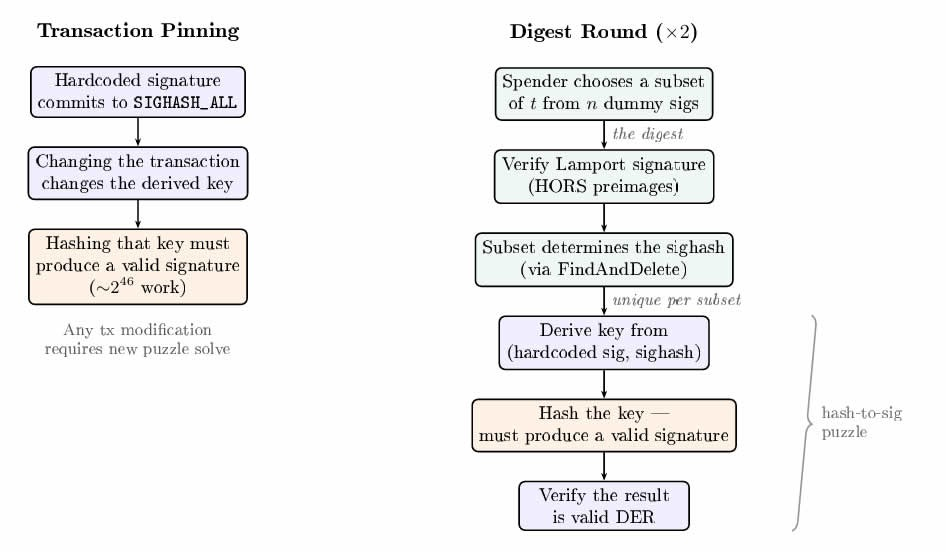
Shor’s algorithm attacks discrete logarithms. It does not break hash functions. That single architectural decision is what makes Quantum-Safe Bitcoin resistant to the quantum threat without touching the protocol.
The construction works in three phases. First, transaction pinning: the prover searches over (sequence, locktime) parameter pairs until the recovered public key’s RIPEMD-160 hash produces a valid DER signature – approximately 246 work.
Second, two digest rounds: for the pinned transaction, the prover searches over subsets of dummy signatures; each subset alters the scriptCode via FindAndDelete, producing a different sighash and a different recovered key.
Find a subset whose recovered key hashes to a valid DER signature (~246 candidates per round). The total computational cost is $75–$150 per transaction on cloud GPUs.
Zero-Knowledge Proofs and Dashlink enter the picture as an efficiency layer for proof verification. The QSB construction leverages post-quantum cryptography principles by anchoring security to hash-based assumptions – the same foundation underpinning ZK-friendly hash functions used in modern Zero-Knowledge Proofs.
Dashlink’s role is to compress the verification burden so that proof validation stays within Bitcoin’s existing 10,000-byte script limit and 201-opcode ceiling. No new opcodes. No consensus change. The scheme is consensus-valid under rules Bitcoin already enforces.
Bitcoin Hyper Targets Early Mover Upside
Bitcoin Hyper (HYPER) is currently in presale, targeting early-mover upside in the Bitcoin yield infrastructure layer – a sector drawing serious institutional attention as US spot Bitcoin ETFs pulled in $471.3 million in a single week.
The presale has raised $32 million to date, with the current token price at $0.0093 and staking APY running at 86% annualized for early participants.
The core technical differentiator: Bitcoin Hyper operates as a Bitcoin-native Layer 2 executing smart contracts with BTC as the settlement asset – bypassing the wrapped-token credit risk that plagues existing BTC DeFi infrastructure.
That’s a specific, verifiable architecture claim in a space full of vague interoperability promises.
Research Bitcoin Hyper here before the presale window closes.
The post A Developer Just Built Quantum-Safe Bitcoin Without Changing a Single Line of the Protocol: Is This the Fix BTC? appeared first on Cryptonews.
Bittensor price crashed over 25% within hours after Covenant AI, one of the largest and most active subnets on Bittensor, recently exited the network over centralization concerns.
Summary
- Bittensor (TAO) plunged 25.6% from $340 to $253 after Covenant AI exited the network, triggering nearly $9 million in long liquidations.
- Covenant AI founder Sam Dare accused Jacob Steeves of centralization, alleging emission cuts and unilateral control over subnet operations.
- Technical breakdown below key support levels signals further downside risk, with price eyeing $236 and potentially $175 if selling pressure continues.
According to data from crypto.news, Bittensor (TAO) price fell 25.6% from $340 to an intraday low of $253 on Friday, erasing close to $900 million from its market capitalization. Trading at $266.7, the token has dropped to levels not seen since mid March.
The sharp drop in price triggered nearly $9 million in liquidations from long positions as bulls were caught off guard after weeks of betting on continued upside.
Bittensor price tanked after Covenant AI, the biggest operator of several high-emission subnets, including SN3, SN81, and SN39, officially announced its departure from the Bittensor network.
In an official statement on April 10 on X, Covenant AI founder Sam Dare accused Bittensor founder Jacob Steeves of betraying the network’s core promise of decentralization.
The post, which garnered over 1 million views and nearly 800 likes, claimed Steeves suspended emissions to Covenant’s subnets, stripped their moderation rights over their own community channels, and unilaterally abandoned critical subnet infrastructure. The team also said leadership deprecated infrastructure and applied direct economic pressure during the height of the conflict.
“Jacob Steeves maintains effective control over the triumvirate, resists any meaningful transfer of authority, and deploys changes unilaterally whenever he chooses, without process and without consensus,” said Dare.
For context, decentralized, permissionless AI training is not just a theoretical concept for this team; Covenant AI successfully tested decentralized LLM models on the network, notably completing the 72 billion parameter Covenant 72B run across more than 70 independent contributors.
Following the exit, community members noted that Dare has sold all of his subnet holdings, effectively rugging Bittensor and crushing demand for the token. The founder’s wallet held more than 37,000 TAO tokens, and its liquidation led to the wipeout of nearly $900 million from the market cap.
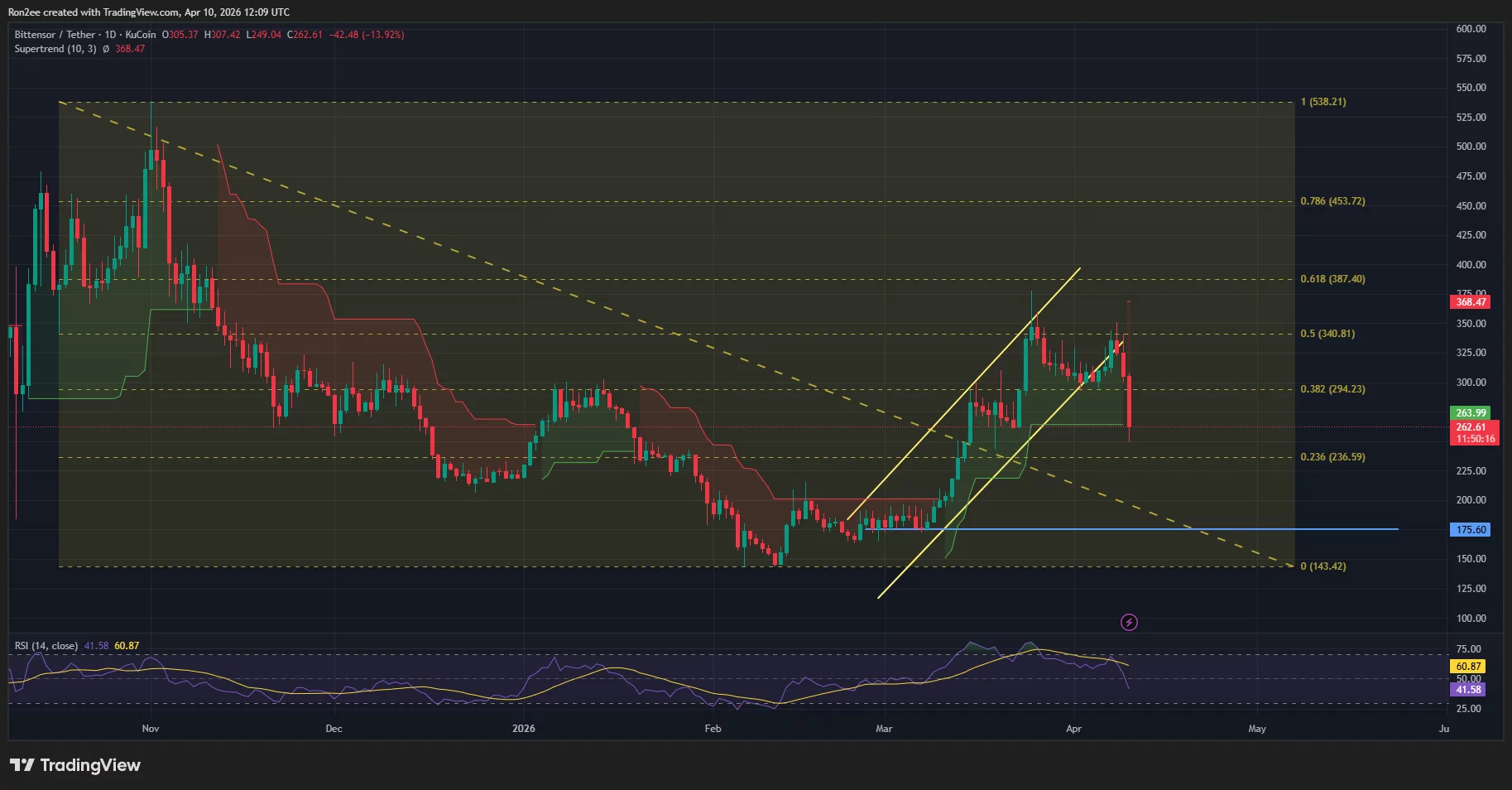
On the daily chart, Bittensor has broken below an ascending parallel channel pattern that has formed since late February this year. A breakdown from such a pattern usually signals a trend reversal and a potential for further declines as investors rush to exit.
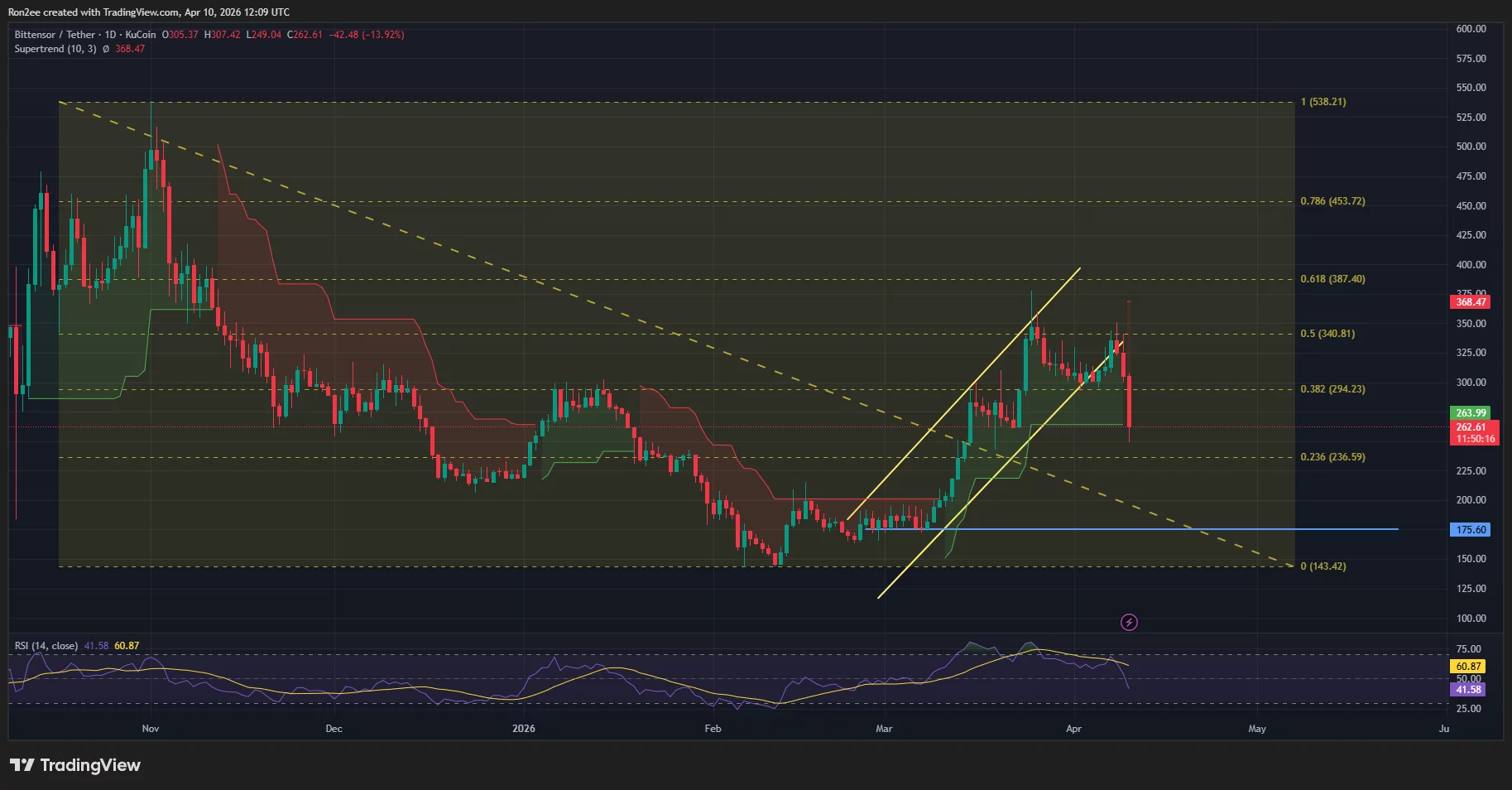
Subsequently, the token fell below the 38.2% Fibonacci retracement level at $294.2, a level that had served as a strong support floor in recent weeks.
Hence, the token eyes a drop to $236 next, which aligns with the next Fibonacci retracement in the series, specifically the 23.6% Fibonacci retracement level. Failure to hold above this could lead to a reset of the early March low around $175.
Technical indicators seem to support the bearish bias at least in the short term. Notably, the Supertrend has flipped red for the first time since March 10, indicating a shift in market momentum.
Also, the RSI has plummeted to 41, suggesting that while the asset is approaching oversold territory, the current selling pressure remains dominant
Disclosure: This article does not represent investment advice. The content and materials featured on this page are for educational purposes only.

The original “Curve wars” looked chaotic on the surface—protocols bribing veCRV holders, governance drama, and bribe markets forming around liquidity like flies to a very profitable lamp.
But in hindsight, that was version 1.0. A human-heavy, ego-driven, slightly messy experiment in directing liquidity.
What comes next is colder. Faster. And honestly… a little terrifying.
Welcome to Gamified Liquidity Wars 2.0—where the real participants aren’t degens on Discord anymore.
They’re algorithms.
Phase 1: Curve Wars (Human Edition)
The first major liquidity battlefield formed around Curve Finance, where protocols competed to attract liquidity by incentivizing governance token holders.
The logic was simple:
- Lock tokens
- Gain voting power
- Redirect emissions
- Bribe voters for liquidity
It was financial politics, but with extra steps and fewer suits.
Humans optimized yield manually. Protocols bribed humans directly. Twitter got spicy. Everyone felt clever.
But it was still slow.
Phase 2: The Shift Nobody Paid Attention To
While everyone was arguing about governance drama, something quieter was happening:
- Yield optimizers started automating strategy rotation
- Market makers began using reinforcement learning models
- Treasury management became API-driven
- Incentive routing got abstracted away from humans entirely
At first, these were just tools.
Now they are becoming the actual participants.
Phase 3: AI vs AI Liquidity Wars
Here’s the uncomfortable upgrade:
Protocols are no longer just about bribing users.
They are bribing systems that decide for users.
Think about it:
- A liquidity protocol doesn’t target “LPs” anymore
- It targets yield-optimization agents that constantly reallocate capital
- Bribes are structured as machine-readable incentive feeds
- Execution is instantaneous, continuous, and non-human
So instead of:
“Hey human, move your liquidity here for 8% APY”
It becomes:
“Hey algorithm, I’ll outbid any competitor for your allocation ruleset in real time”
This is no longer marketing.
It’s automated economic warfare.
The New Battlefield: Incentive APIs
Liquidity incentives are evolving into programmable streams:
- Dynamic reward curves updated per block
- Machine-readable “priority feeds” for capital routing
- Autonomous treasury agents negotiating yield conditions
- Cross-protocol bidding wars are happening in milliseconds
Humans are still “in the system,” technically.
But more like shareholders in a war being fought by proxy bots.
The Weirdest Part: Bots Will Farm Each Other
Here’s where it gets funny in a dark way.
When every protocol runs an AI allocator, you get loops like:
- Bot A routes liquidity to Protocol X
- Protocol X incentivizes Bot B’s strategy
- Bot B responds by reallocating back to Protocol Y
- Protocol Y adjusts incentives for Bot A again
And suddenly:
👉 Yield isn’t being “earned.”
👉 It’s being recursively negotiated between machines
At that point, DeFi stops looking like finance and starts looking like:
two vending machines endlessly trying to outsmart each other over snacks that replenish themselves
What Actually Wins This Game?
✨ Not the protocol with the highest yield.
💥 Not the one with the best UI.
🌟 Not even the one with the deepest liquidity.
The winner is whoever builds:
the most attractive decision environment for autonomous capital agents
Translation:
- best incentive routing logic
- fastest feedback loops
- lowest friction execution
- smartest reward shaping over time
Liquidity doesn’t follow hype anymore.
It follows computation.
The End of “Yield Farming” as We Know It
The term “yield farming” implies effort. Strategy. Timing.
But in a world of autonomous capital agents, nothing is farmed manually anymore.
Yield becomes:
- continuously optimized
- always rebalanced
- permanently negotiated
Farmers are replaced by systems.
And systems don’t sleep.
Final Thought
Curve wars were about controlling human attention.
The next wars won’t even get attention.
They’ll be fought at machine speed, between agents optimizing other agents, in markets where incentives behave more like physics than finance.
And if that sounds abstract, that’s because it is.
We’re not building DeFi anymore.
We’re building autonomous capital ecosystems that compete with each other for survival.
And the funniest part?
No one’s really in charge of it.
Not even the bots.
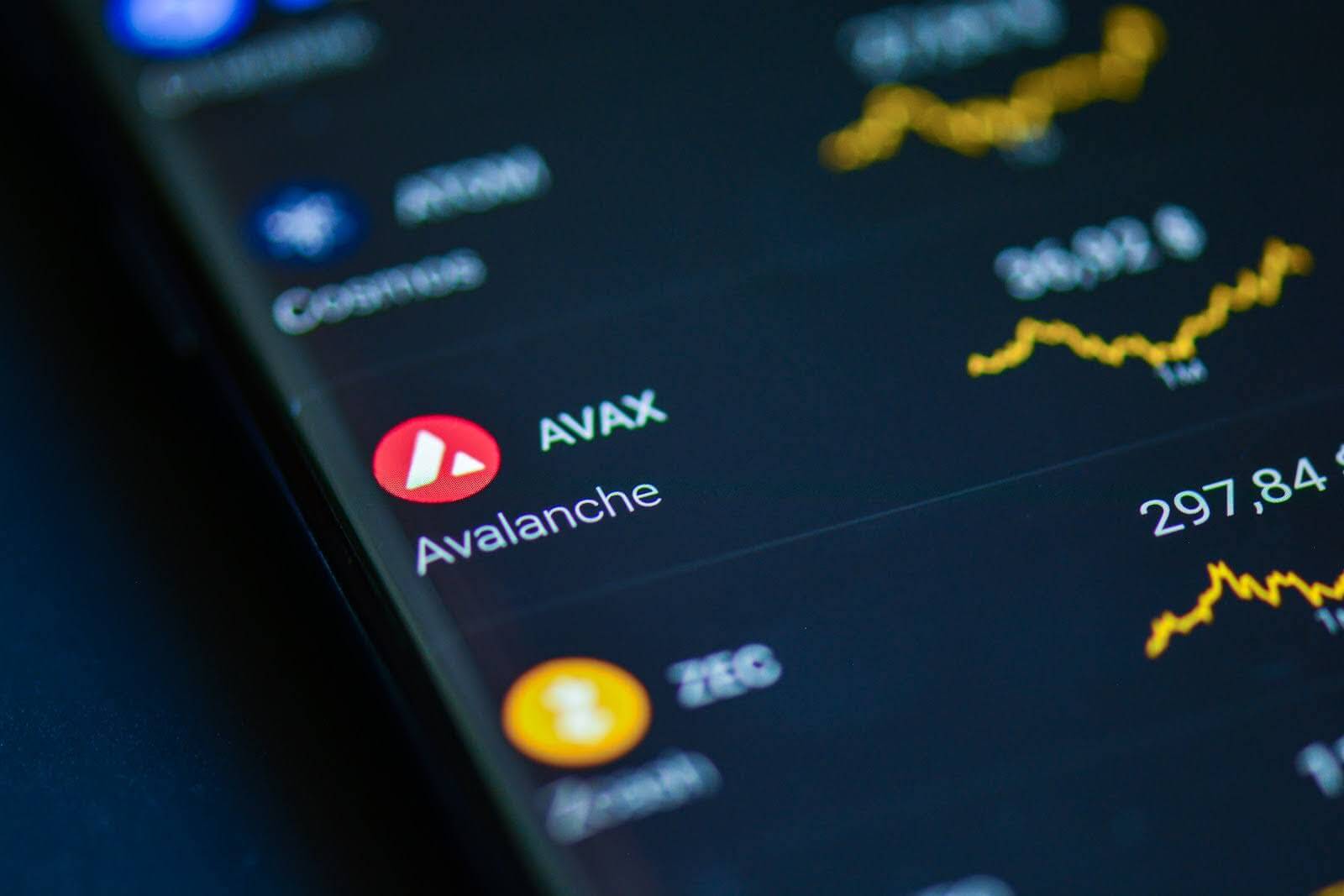

- Avalanche spot ETFs have extended their zero net inflows streak to 16 days.
- The AVAX token has traded lower amid the laggard ETF market.
- If bulls flip the picture, AVAX could target $16 and then $20 in the next leg up.
Avalanche (AVAX) price faces downward pressure near $9.00 as its spot exchange-traded funds (ETFs) mark yet another milestone in investor apathy.
Despite gains of nearly 4% this past week, zero net inflows persist and could accelerate amid a sluggish altcoin market.
Avalanche spot ETFs’ “bad” net inflows streak
While spot Bitcoin ETFs have shown intermittent days of net inflows and outflows over the past month, the two spot AVAX ETFs have established a long streak of no net inflows.
SoSoValue data indicates that VanEck’s VAVX and Grayscale’s GAVA have recorded zero net inflows for sixteen consecutive trading days, a streak that began on March 18, 2026.
This drought follows a brief surge on March 17, when the funds attracted $246,000 in combined net inflows, building on $532,000 that flowed in earlier that week.
Since then, however, capital has stalled completely, mirroring broader altcoin fatigue in a Bitcoin-dominated market.
As of April 10, 2026, cumulative net inflows for the ETFs total $9.76 million, with daily trading volume remaining anemic at $251,800.
The funds collectively manage $17.14 million in assets under management (AUM), representing just 0.43% of AVAX’s circulating market cap.
This limited exposure highlights the challenges in drawing institutional interest to Avalanche’s ecosystem, despite its strengths in high-throughput blockchain scaling and subnet technology.
Avalanche price outlook
Market observers link the inflows freeze to macroeconomic caution and geopolitical tensions dampening risk appetite.
ETF analysts note that without fresh capital, these products struggle to provide the liquidity boost seen in Bitcoin and Ethereum counterparts, potentially prolonging AVAX’s price consolidation.
AVAX has failed to hit sustained upside momentum since the token tested resistance near $35 in September 2025.
The subsequent plunge below the critical $10 psychological level has left bulls on the defensive, as sellers dominate amid fading on-chain activity and reduced DeFi TVL on Avalanche’s network.
Currently, AVAX trades around the $9.00 support zone, where the Supertrend indicator gives bears the advantage.
However, a fragile uptick over the past week offers slim hope for upward momentum or stabilization as bulls eye $10.00.

Technical indicators signal this possibility, with the Relative Strength Index (RSI) hovering just above 50 on the daily chart.
Analysts have also pointed to the resilience of the broader crypto market as one likely to support a clean break above $10.20.
If bulls invalidate the downtrend, the immediate target will be the $12-$16 region. Highs of $20 could attract bullish traders.
However, failure to hold $9.00 risks acceleration toward $8.50, opening the door to a retest of the year-to-date lows of $7.53 reached on February 6.


Bitcoin’s price may have rallied almost 7% since Sunday, but conviction remains weak, with the recovery stalling near $72,000 ahead of key binary risks, including Friday’s U.S. inflation report and U.S.-Iran truce talks this weekend.
The cautious approach is evident in the options market, where institutions continue to chase upside via calls, the derivative contracts that allow traders to bet on gains of the underlying asset.
According to QCP Capital, options tied to BlackRock’s spot bitcoin ETF (IBIT) show demand for the $45 call expiring in May. That means traders expect IBIT’s price to rise above that level from the present $40. Bitcoin options on Deribit have seen similar flows, with the $80,000 call emerging as the most popular bet. Still, demand for puts, which offer downside protection, persists.
“IBIT options showed sustained open interest in the May 45 call, holding above 80k+ contracts through the week, while downside hedging remained in place via puts and long-dated protection. The combination reflects a market participating in upside, but not abandoning hedges,” the Singapore-based trading firm, which is one of the world’s largest crypto market makers, said in an email.
The sticky demand for protection against declines is also revealed in options skew, which measures the price differential between calls and puts, and remains negative across all time frames. That indicates a lingering bias for put options.
“The skew picture is clear: institutions are buying downside protection and selling upside calls. After the Iran war headlines, some of the tail risk has been priced out, so skew has eased, but the underlying flow remains firmly one-directional. Demand for puts, supply of calls,” Maxime Seiler, CEO of STS Digital, a principal trading firm specializing in digital asset derivatives, told CoinDesk.
The U.S. consumer price index (CPI) for March is expected to show a marked increase in annualized inflation to well over 3%, led primarily by rising energy prices.
That shouldn’t come as a surprise, given that the Iran war led to a sharp surge in oil and gasoline prices worldwide. Still, markets may see volatility if the core figure, which excludes food and energy, blows past the annualized 2.7% estimate. That would further cement the case for Fed rate increases, potentially weighing on risk assets such as BTC.
Beyond CPI, the weekend meeting between Iranian and U.S. delegates in Pakistan holds the key to financial market stability. BTC’s rally will likely accelerate if they find a way to end the war and normalize oil tanker traffic through the Strait of Hormuz. The first cues could come through Hyperliquid-listed oil perpetual futures. Stay alert!
What’s trending
Today’s signal

The chart shows swings in the ICE BofA US Bond Market Option Volatility Estimate Index (MOVE), which reflects volatility in U.S. Treasury futures.
Sharp spikes in the index indicate rising uncertainty around inflation, interest rates or macro shocks. Treasury notes anchor the global finance and collateral and credit creation. Hence, increased turbulence in U.S. bonds often coincides with tighter financial conditions and broader risk-off sentiment spilling into equities, credit, and crypto markets.
The index popped in March, rising to 115% from 73% only to drop back to 74% this month. It showed that the world’s most important bond market is calm again, a green signal for crypto bulls.
Read more: For analysis of today’s activity in altcoins and derivatives, see Crypto Markets Today .
For a more comprehensive list of events this week, see CoinDesk’s “Crypto Week Ahead“.


Key Points
- Brett Redfearn, former director of the SEC’s Division of Trading and Markets, has been named president and board member at Securitize
- Redfearn’s career spans key roles at the SEC, JPMorgan, and Coinbase before founding his own advisory firm
- The strategic appointment arrives as Securitize moves toward going public through a merger with Cantor Equity Partners II
- In March 2026, Securitize reached $3.85 billion in distributed asset value
- Tokenized equities exceeded $1 billion in aggregate onchain value during the same period
Digital asset tokenization platform Securitize has brought Brett Redfearn on board as its president and newest board member. The company made the announcement Thursday amid preparations for its anticipated transition to public markets.
Redfearn’s background includes leading the SEC’s Division of Trading and Markets as director. His professional journey also features more than ten years at JPMorgan, followed by a position as Coinbase’s head of capital markets.
Most recently, Redfearn established Panorama Financial Markets Advisory, providing strategic counsel to exchanges and asset management firms. He had already been contributing to Securitize through his role on the company’s advisory board.
Securitize specializes in converting conventional financial instruments — including investment funds and private credit products — into digital tokens built on blockchain technology. These tokenized assets offer enhanced tradability and accelerated settlement compared to their traditional counterparts.
Carlos Domingo, Securitize’s CEO, praised the new appointment. “Brett has played a pivotal role in shaping how contemporary markets operate and maintain compliance,” Domingo stated.
Redfearn will collaborate with Securitize’s executive team to expand the platform’s capabilities in issuance, trading infrastructure, and fund administration services.
Expanding Market for Tokenized Real-World Assets
The leadership addition coincides with accelerating interest in tokenizing real-world assets. Data from analytics platform RWA.xyz shows that Securitize achieved $3.85 billion in distributed asset value by March 2026.
Tokenized equities simultaneously surpassed the $1 billion threshold in total onchain valuation during this timeframe. Financial institutions and investment firms continue exploring blockchain-based settlement systems to enhance transaction speed and broaden market participation.
Securitize aims to serve as a compliant gateway connecting established financial enterprises with emerging digital asset technology.
Journey Toward Public Markets
The firm intends to enter public markets via a business combination agreement with Cantor Equity Partners II. Redfearn’s addition is viewed as bolstering Securitize’s regulatory standing in advance of this transition.
Redfearn represents just one example of regulators transitioning to the cryptocurrency sector. Caroline Pham, former acting chair of the CFTC, departed in December to take a position at crypto payments provider MoonPay.
Separately, the SEC revealed Wednesday that David Woodcock will assume the director of Enforcement role effective May 4, succeeding interim head Sam Waldon.
Various U.S. legislators have pressed SEC Chair Paul Atkins regarding the departure of former enforcement director Margaret Ryan. Some congressional members suspect her exit may relate to the SEC’s decision to withdraw multiple cryptocurrency enforcement actions, including proceedings against Tron founder Justin Sun.
Redfearn’s selection at Securitize unfolds as the regulatory landscape surrounding tokenized assets evolves through both regulatory agencies and legislative bodies.


Trump Furious Over NATO ‘Betrayal’ as He Weighs Pulling US Troops From Europe in Major Rift

Japan to classify crypto as financial instruments, shaping policy

Melissa McCarthy Looks Unrecognizable After Weight Loss

Why Israel is blocking foreign journalists from entering

Bitcoin: We’re Entering The Most Dangerous Phase

Alan Cumming Brands Baftas Ceremony A ‘Triggering S**tshow’

Daily Market Coverage Apr. 8, 2026 9AM-11AM (ET) | Yahoo Finance

What is Finance? | Definition Financial Company|Financial Information| Accounts Video #financial

Psalm 23 Prayer for Financial Prosperity and Abundance #Psalm23 #DivineProtection #FaithInGod
-

 Fashion7 days ago
Weekend Open Thread: Spanx – Corporette.com
-

 Business5 days ago
Three Gulf funds agree to back Paramount’s $81 billion takeover of Warner, WSJ reports
-

 Sports6 days ago
India men’s 4x400m and mixed 4x100m relay teams register big progress | Other Sports News
-

 Business6 days ago
Expert Picks for Every Need
-

 Tech3 days ago
How Long Can You Drive With Expired Registration? What Florida Law Says
-

 Business5 days ago
No Jackpot Winner, Prize to Climb to $231 Million
-

 Fashion4 days ago
Massimo Dutti Offers Inspiration for Your Summer Mood Board
-

 Fashion3 days ago
Let’s Discuss: DEI in 2026
-

 Crypto World2 days ago
Bitcoin recovers as US and Iran Agree a Ceasefire Deal
-

 Business6 days ago
Akebia Therapeutics, Inc. (AKBA) Discusses Pipeline Progress and Strategic Focus on Kidney Disease Treatments at R&D Day – Slideshow
-

 Crypto World1 day ago
Canary Capital Files SEC Registration for PEPE ETF
-

 Politics6 days ago
The UK should not pay a penny in slavery reparations
-

 Fashion7 days ago
Frugal Friday’s Workwear Report: Hammered Metallic Button Sweater Vest
-

 Tech4 days ago
Samsung just gave up on its own Messages app
-

 Tech4 days ago
Haier is betting big that your next TV purchase will be one of these
-

 Fashion7 days ago
Weekly News Update, 4.3.26 – Corporette.com
-
Sports7 days ago
A Kevin O’Connell Theory Can Now Be Retired
-

 NewsBeat7 days ago
Kemi Badenoch talks ‘spring cleaning’ Reform defections
-

 Tech4 days ago
Gamer Restores the Original PlayStation Portal From Two Decades Ago
-

 Tech7 days ago
Flat tire? Dead battery? Speedy’s serves stranded Seattle riders as a quicker e-bike picker-upper
You must be logged in to post a comment Login