
Crypto World
CoW Swap Points to Legacy Code and Solver Failures in $50M Loss That Aave Attributes to Illiquid Market



While Aave blamed an illiquid market, CoW Swap identified a stale gas ceiling, silent solver failures, and a possible mempool leak that turned a bad trade into the worst execution loss in DeFi history.
Aave and CoW Protocol published separate post-mortem reports over the weekend dissecting the March 12 swap that resulted in a trader converting $50.4 million in USDT into roughly $36,000 worth of AAVE tokens, widely considered the largest execution loss of its kind in decentralized finance (DeFi).
The two accounts largely agree on the basic sequence of events but diverge sharply in emphasis and tone, with Aave framing the loss as the predictable consequence of trading in an illiquid market and CoW Swap painting a more complex picture of compounding infrastructure failures that made the outcome dramatically worse than it needed to be.
‘An Illiquid Market’
Aave’s analysis drew a technical distinction between price impact and slippage, arguing that the two are often conflated. The protocol said, “the primary root cause was the routing of a large trade through a market with poor liquidity, leading to an extreme price impact.”
“It is critical to distinguish between price impact due to an illiquid market and price impact due to slippage,” the team wrote. The user was quoted a price that was already 99.9% below expected market value before the swap even executed, Aave said, and the interface displayed a warning flagging the extreme price impact and required the user to check a confirmation box acknowledging a potential 100% loss.
An internal audit trail confirmed the user acknowledged the warning on a mobile device before proceeding, meaning the catastrophic outcome was visible to the user at the point of confirmation.
Aave stressed that its core lending protocol was never at risk, since the swap occurred via a third-party CoW Swap integration rather than through the protocol’s smart contracts.
‘Technically Correct Is Not the Ceiling’
CoW Swap’s report told a markedly different story, identifying what it called a “chain of compounding factors” that turned an already bad trade into something far worse.
During the initial quoting phase, three independent solvers submitted potential routes. The best unverified quotes would have returned roughly $5–6 million worth of AAVE for the $50 million order, still an approximately 90% loss but dramatically better than the $36,000 the user ultimately received.
Those better-priced routes never reached the user. CoW Swap’s quote verification system enforced a hardcoded 12-million gas unit ceiling — what the team described as “legacy code predating current gas consumption patterns” — which caused the more efficient routes to fail verification. The only quote that passed came from a solver offering roughly 329 AAVE tokens, far worse than the rejected alternatives. That figure was then used to set the order’s limit price in the Aave interface.
The situation deteriorated further in the auction phase. A solver identified in the report as “Solver E” won two consecutive auctions with a superior execution route but never submitted either transaction onchain. After two failed attempts, the solver stopped bidding entirely, leaving the worst route as the only remaining option.
CoW’s report also flagged evidence of a possible mempool leak. Despite the transaction being submitted via a private RPC endpoint, Etherscan displayed a “confirmed within 30 seconds” tag — a marker that typically appears only when a transaction is visible in the public mempool before being included in a block. CoW said the leak likely enabled the significant MEV activity observed in the execution block.
CoW struck a notably more self-critical tone than Aave throughout its report, acknowledging that a confirmation checkbox is an inadequate safeguard when trades involve tens of millions of dollars.
“Technically correct is not the ceiling we should be building toward,” the team wrote.
CoW said it has already deployed a fix removing the stale gas ceiling and is continuing to investigate both the solver execution failures and the suspected mempool leak.
AAVE is trading around $121, up roughly 6% over the past 24 hours, according to CoinGecko. Aave is the largest DeFi lending protocol with approximately $25.5 billion in total value locked, per DefiLlama.
This article was written with the assistance of AI workflows. All our stories are curated, edited and fact-checked by a human.


Editor’s note: HIVE’s BUZZ HPC is expanding its liquid-cooled AI data center footprint in Canada, lifting capacity from 4 MW in Manitoba to 16.6 MW across two provinces. A new British Columbia facility adds 5 MW immediately, with an option for 7.6 MW in 2027. The expansion enables a near-term ramp to over 4,000 GPUs and strengthens BUZZ’s sovereign AI compute strategy, supported by Bell Canada AI Fabric. Notably, deposits already securing the growth pipeline mean no additional capital expenditures are required to secure this capacity.
Key points
- 4x expansion to 16.6 MW of liquid-cooled AI data center capacity across Manitoba and British Columbia.
- British Columbia Phase 1 adds 5 MW immediately, with a Phase 2 option for 7.6 MW in 2027.
- Near-term ramp to over 4,000 GPUs in Canada, with ~2,000 GPUs in Manitoba and ~2,000 in BC.
- No additional capital expenditures required to secure expanded capacity; deposits with the partner secure the growth pipeline.
Why this matters
HIVE’s expansion aligns with its strategy to deliver scalable, renewable-powered AI compute through BUZZ HPC. Extending to British Columbia and enlarging Manitoba broadens Canada’s sovereign compute footprint, enabling faster GPU deployments for AI workloads and enterprise customers. The move strengthens a disciplined, capex-light growth model that leverages existing partnerships while pursuing high-margin, recurring GPU revenue. By accelerating the company’s GPU cloud trajectory, the expansion underscores HIVE’s strategy to position Canada as a hub for AI infrastructure and innovation.
What to watch next
- Timeline for Phase 2 BC expansion (7.6 MW) in 2027.
- Updates on GPU procurement and cloud revenue contracts for BUZZ HPC in Canada.
- Progress toward 6,000 GPUs in Canada and HPC ARR targets by March 31, 2027.
Disclosure: The content below is a press release provided by the company/PR representative. It is published for informational purposes.
HIVE’s BUZZ HPC Expands Data Center Footprint into British Columbia with 4 Times Growth in Liquid-Cooled AI Data Center Capacity
This news release constitutes a “designated news release” for the purposes of the Company’s prospectus supplement dated November 25, 2025 to its short form base shelf prospectus dated October 31, 2025.
San Antonio, Texas, March 16, 2026 — HIVE Digital Technologies Ltd. (TSX.V: HIVE) (Nasdaq: HIVE) (FSE: YO0) (BVC: HIVECO) (the “Company” or “HIVE”), a global leader in sustainable digital infrastructure and AI compute, through its wholly owned subsidiary BUZZ High Performance Computing (“BUZZ”), today announced a 4x expansion of its liquid-cooled AI data center capacity through its previously announced strategic data center partner in Canada, growing the existing 4 megawatts (“MW”) in Manitoba to 16.6 MW of critical IT load across two Canadian provinces (all figures referenced herein are in critical IT load), expanding HIVE’s BUZZ HPC Sovereign AI Compute offering in Canada (all amounts in US dollars, unless otherwise indicated).
The expansion adds a new colocation facility in British Columbia, providing an immediate 5 MW of capacity with an option to scale an additional 7.6 MW. This new immediate capacity facilitates the deployment of upwards of 2,000 next-generation high-power density AI-optimized GPUs in British Columbia, complementing the capacity for approximately 2,000 GPUs in BUZZ’s existing Manitoba facility. In total, the Company now has a near-term ramp to over 4,000 GPUs in Canada through its data center partnerships and its own sites, accelerating the Company’s previously announced GPU AI cloud deployment targets for calendar 2026.
4 Times Growth in Sovereign AI Data Center Runway Across Canada
The Company’s AI colocation footprint with Bell Canada AI Fabric, its strategic data center partner, now spans two provinces in Western Canada:
- Manitoba: 4 MW of critical IT load. BUZZ has deployed 504 next-generation AI-optimized GPUs consuming approximately 1 MW, with 3 MW of remaining capacity to support approximately 1,500 additional GPUs.
- British Columbia (Phase 1): 5 MW of critical IT load, available immediately. This capacity supports the deployment of approximately 2,000 next-generation, high-power-density, AI-optimized GPUs.
- British Columbia (Phase 2): Option for an additional 7.6 MW of critical IT load in 2027, supporting an additional 3,000 next-generation high-power density AI-optimized GPUs.
In aggregate, the Company now has a growth path to over 6,000 new GPU deployments in Canada through this strategic data center partnership with Bell Canada AI Fabric, providing the infrastructure runway for its GPU cloud revenue objectives.
Importantly, no additional capital expenditures are required to secure this expanded colocation capacity. Deposits made by the Company in 2025 with the strategic data center partner are sufficient to secure the full growth pipeline. Standard operational costs associated with GPU procurement, installation, and ongoing data center operations remain separate and are expected as part of normal business activities.
Accelerating AI Cloud Growth
The Company previously disclosed a target of achieving new deployments of 6,000 latest generation GPUs for AI cloud. This colocation expansion provides the infrastructure required to achieve that target on an accelerated basis. 4,000 next-generation AI-optimized GPUs are targeted for contracted revenue in the next 6 months (including 2,000 high-power density GPUs in BC). The Company expects to further expand another 2,000 high-power density GPUs through additional partner data centers or its own data centers, reaching 6,000 GPUs in Canada, with a target of $200 million in contracted annualized run-rate revenue (“HPC ARR”) by the end of this fiscal year (period end March 31, 2027). For new long-term GPU contracts with enterprise clients, the Company is targeting 75% HPC EBITDA.
“Nations that control their own AI compute will lead the next era of global innovation. Canada has the talent, the energy, and now, with BUZZ, the infrastructure to compete at the highest level,” said Frank Holmes, Executive Chairman of HIVE. “Since 2017, HIVE has demonstrated the ability to build, scale, and operate complex digital infrastructure with consistency and rigor across nine time zones and three continents. We are now applying that same discipline to AI. Our dual-engine model, Tier-I Bitcoin mining generating cash flow and Tier-III AI compute delivering high-margin recurring revenue, was built for exactly this moment. This expansion with Bell is a statement of conviction. We believe sovereign AI compute will define the next decade of Canadian innovation, and HIVE intends to be at the center of it. Moreover, in addition to our exciting growth ramp, HIVE owns and operates other data centres in Canada, which prime for conversion for hyperscaler colocation, and even government or military contracts. Notably, indications to management are that our 70 MW site in New Brunswick offers the scale of powered land for hyperscaler needs, and we believe the location of our 7.6 MW Toronto Airport site is very attractive to government or military applications.”
Aydin Kilic, President and CEO of HIVE, added: “This expansion gives us committed liquid-cooled data center capacity across two provinces, and a clear path to over 6,000 next-generation AI-optimized GPUs in Canada. As demand for AI compute ramps, we can move quickly to deploy additional clusters of AI-optimized GPUs online to realize our ARR targets for 2026, while scaling EBITDA in a cap-ex light strategy. The data center infrastructure is now secured, and the demand for compute is strong. We are seeing economics where 3-year deals and 5-year deals for longer-term GPU contracts provide investors with comfort that there is a strong fundamental return on the investment and deployment of these GPU clusters. Investors should expect near-term updates on GPU procurement and cloud revenue contracts as we execute on this accelerated timeline.”
* As used herein, “HPC EBITDA” is defined as earnings from HPC operations before deducting HPC-related interest, taxes, depreciation and amortization. “HPC ARR”, as a metric, represents total HPC revenue only, and does not represent profitability. HPC ARR is presented here as a measure of growth. These non-GAAP measures should be read in conjunction with and should not be viewed as alternatives to or replacements for measures of operating results and liquidity presented in accordance with GAAP in HIVE’s quarterly and annual financial statements. All financial projections reflect current market sentiment and public disclosures as of March 2026; actual outcomes may vary. Investors should conduct their own due diligence.
Capital Allocation and Future Investment Strategy in Europe
As previously disclosed, HIVE has operated in Sweden since 2017, establishing multiple successful datacenter facilities powered entirely by renewable energy. Over that time, HIVE has made meaningful contributions to the local economy by engaging numerous subcontractors and supporting community initiatives such as the Boden Hockey Club. Notably, HIVE was also the first datacenter operator in Sweden to participate in the national grid-balancing program in collaboration with Svenska Kraftnät and Vattenfall, helping stabilize renewable power supply while supporting regional energy infrastructure.
HIVE’s acquisition of the 7 MW datacenter in Boden, Sweden, in November 2023 marked an early step in the Company’s strategic transition from Tier-I digital infrastructure toward Tier-III high-performance computing and artificial intelligence infrastructure. While the site initially operated as part of HIVE’s renewable-powered hashrate production, the facility was subsequently designated for conversion to Tier-III AI and HPC standards capable of supporting enterprise-grade GPU clusters.
As part of this transition, HIVE is progressively phasing down its ASIC-based hashrate production (provided to foreign Bitcoin mining pool customers) at its larger Boden facility, enabling the Company to redeploy resources toward its expanding AI and HPC strategy in Europe.
This strategic shift has been driven by increasing challenges faced by HIVE’s Swedish subsidiaries in their traditional hashrate production business. Recently, the Company has experienced ongoing enforcement actions and what it believes are misapplications of existing tax rules by the Swedish tax authorities. Despite receiving supportive opinions from several respected law firms, a tier-1 accounting firm, and top local academics specializing in Swedish value-added-tax matters, the authorities have imposed a security deposit requirement on disputed tax assessments. Historically, because of the strength of the Company’s case, it had always been granted deferrals, while awaiting a final judicial appeal. These developments have created operational uncertainty and have limited the Company’s ability to continue operating its traditional hashrate production model on a consistent economic basis.
In response to these evolving conditions, HIVE has determined that continuing its ASIC-based hashrate production model may no longer be economically viable in Sweden, and the Company will begin exploring the phase out of these activities.
As a proactive solution, HIVE is shifting its strategic focus toward high-performance computing and artificial intelligence Tier-III datacenters. This transition is already underway with the upgrade of the Company’s 7 MW facility in Boden to a Tier-III design. Construction is currently in progress, and the facility is expected to support GPU clusters based on the NVIDIA GB300 GPU architecture, designed to power demanding AI training and inference workloads.
This investment will position HIVE at the forefront of next-generation digital infrastructure while ensuring the Company remains a contributor to the region’s technological development. For the Boden community, these next-generation datacenters are expected to support local economic growth, strengthen education partnerships, and attract technology-focused businesses, further solidifying the region’s reputation as a hub for digital innovation.
RSU Grants Reinforce Commitment to Sustainable Growth
To ensure the team delivering on HIVE’s current and future vision has direct alignment with shareholders, HIVE is granting 2,849,400 Restricted Share Units (“RSUs”) to employees, officers, directors, and consultants under its RSU plan, with a mandatory one-year TSX Venture Exchange vesting period. This aligns management with investors to build long-term value. Inspired by Harvard Business School research on non-linear incentives, these quarterly milestone-based awards foster innovation and retention—aligning global talent from Paraguay to Sweden with HIVE’s vision for sustainable growth and minimal dilution.
HIVE has shared these RSUs with all employees, both new and long-serving, to preserve its unique culture, which focuses on efficiency and return on invested capital.
About HIVE Digital Technologies Ltd.
Founded in 2017, HIVE Digital Technologies Ltd. is the first publicly listed company to mine digital assets powered by green energy. Today, HIVE builds and operates next-generation Tier-I and Tier-III data centers across Canada, Sweden, and Paraguay, serving both Bitcoin and high-performance computing clients. HIVE’s twin-turbo engine infrastructure-driven by hashrate services and GPU-accelerated AI computing-delivers scalable, environmentally responsible solutions for the digital economy.
For more information, visit hivedigitaltech.com, or connect with us on:
X: https://x.com/HIVEDigitalTech
YouTube: https://www.youtube.com/@HIVEDigitalTech
Instagram: https://www.instagram.com/hivedigitaltechnologies/
LinkedIn: https://linkedin.com/company/hiveblockchain
On Behalf of HIVE Digital Technologies Ltd.
“Frank Holmes”
Executive Chairman
For further information, please contact:
Nathan Fast, Director of Marketing and Branding
Frank Holmes, Executive Chairman
Aydin Kilic, President & CEO
Tel: (604) 664-1078
About BUZZ HPC
BUZZ High Performance Computing (BUZZ HPC), a wholly owned subsidiary of HIVE Digital Technologies Ltd. (TSX.V: HIVE) and an NVIDIA Cloud Partner, delivers enterprise-grade cloud services and large-scale GPU clusters. The platform supports a suite of managed services, including Kubernetes, Slurm, virtual machines, and bare-metal deployments optimized for AI, machine learning, and scientific workloads. Headquartered in Canada with a global reach, BUZZ HPC is one of the first and few Canadian sovereign AI platforms operating at scale. Since 2017, it has deployed supercomputing environments across Canada and the Nordics. Its Tier-III+ data centres powered entirely by renewable energy and engineered with ultra-low Power Usage Effectiveness (PUE) host thousands of industrial-grade GPUs across North America and Europe used for AI model training, fine-tuning and inference.
Through its Green GPU initiative, BUZZ HPC combines AI innovation with sustainability, offering localized expertise and global infrastructure.
Learn more at https://www.buzzhpc.ai
For further information, please contact:
Craig Tavares, BUZZ HPC President and COO
Tel: (604) 664-1078
Neither the TSX Venture Exchange nor its Regulation Services Provider (as that term is defined in policies of the TSX Venture Exchange) accepts responsibility for the adequacy or accuracy of this news release.
Forward-Looking Information
Except for the statements of historical fact, this news release contains “forward-looking information” within the meaning of applicable Canadian securities laws, which may include but is not limited to statements regarding: the anticipated benefits of the partnership between BUZZ HPC and Bell Canada; the expected deployment, timing, capacity, and expansion of BUZZ HPC’s NVIDIA-accelerated infrastructure; the potential impact on Canadian AI innovation, competitiveness, and economic growth; compliance with privacy, cybersecurity, and data residency regulations; the use of renewable energy; and any other future-oriented statements. Forward-looking information is based on current expectations, estimates, forecasts, and projections, as well as management’s beliefs and assumptions, including that the partnership will proceed as planned, infrastructure will be deployed on the expected timelines and within budget, demand for AI computing will continue to grow, and regulatory requirements will remain consistent with current expectations, and other related risks as more fully set out in the Company’s disclosure documents under the Company’s filings at www.sec.gov/EDGAR and www.sedarplus.ca.
Forward-looking information involves known and unknown risks, uncertainties, and other factors that may cause actual results, performance, or achievements to differ materially from those expressed or implied by such forward-looking information. Such factors include, but are not limited to: the risk that deployment timelines may change; that costs may exceed expectations; that demand for AI infrastructure may be lower than anticipated; that partnerships or regulatory approvals may not materialize as expected; that GPU supply and procurement timelines may be subject to change; that revenue projections are based on current market conditions and assumptions that may not materialize; and the risk factors described in the Company’s continuous disclosure documents available on SEDAR+ at www.sedarplus.ca. Readers are cautioned not to place undue reliance on forward-looking information. The Company disclaims any obligation to update or revise any forward-looking information, whether as a result of new information, future events, or otherwise, except as required by law.
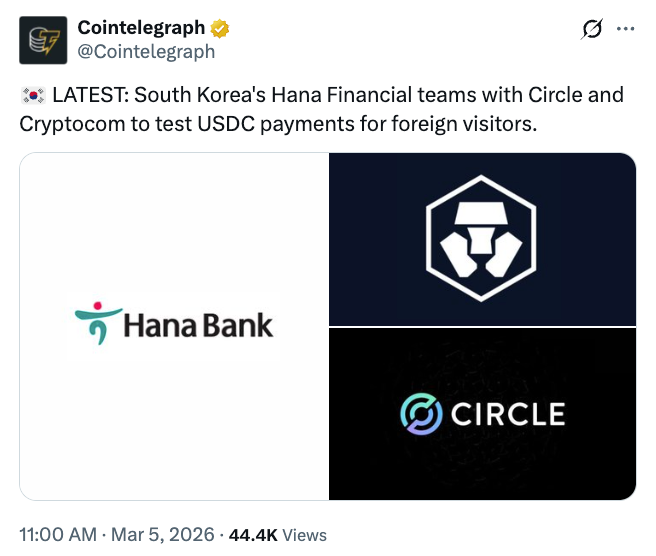
Hana Financial Group, one of South Korea’s largest financial conglomerates, has partnered with Standard Chartered on finance and digital assets.
On Sunday, Hana Financial said it signed a business agreement with the United Kingdom’s Standard Chartered Group (SC Group) for cooperation in global financial business and digital asset fields, Yonhap News reported.
The agreement covers collaboration in various global financial sectors, including investment banking, money markets, foreign exchange and digital assets.
“We will create new growth opportunities by generating synergies in future financial areas, including digital assets,” Hana Financial chairman Ham Young-joo said, adding that the companies aim to deploy their extensive networks and diverse financial expertise.
Cointelegraph reached out to Hana Financial and Standard Chartered for comment, but had not received a response by publication.
Hana expands digital finance ties
Hana Financial’s partnership with Standard Chartered expands the company’s digital asset efforts after recently collaborating with major crypto industry players.
Related: South Korea plans to use AI for crypto tax enforcement
On March 5, the South Korean conglomerate reportedly said it has partnered with the USDC (USDC) issuer Circle and major US crypto exchange Crypto.com. As part of the partnership, Hana Financial pledged to promote stablecoin-based payments for foreign visitors in the country.

“Through this initiative, we seek to confirm the growth potential of stablecoins as a payment tool, expanding cooperation with global digital asset operators,” the company reportedly said, highlighting its commitment to exploring real-world applications of stablecoins.
Standard Chartered strengthens presence in Asia
Standard Chartered CEO Bill Winters emphasized the importance of the Asian financial market in the partnership.
“Korea is a key hub of the Asian financial market, and cooperation with Hana Financial Group, which is strong in global markets, will be an important milestone for our global network business,” he said.
On Friday, Standard Chartered was reported to be one of at least two companies set to receive stablecoin issuer approvals in Hong Kong in late March.
Magazine: China’s ‘50x’ blockchain boost, Alibaba-linked AI mines Bitcoin: Asia Express
Crypto World
Bitmine Stacks ETH, Funds Eightco, and Gains OpenAI Access: Here Is What Tom Lee Is Building

TLDR:
- Bitmine anchored a $125M institutional round for Eightco with a $75M check, gaining indirect OpenAI exposure through it.
- Eightco deployed $50M from the Bitmine-led round directly into an OpenAI stake, linking crypto capital to private AI markets.
- Bitmine added 65,000 ETH in just seven days, growing its total holdings to 4,595,562 ETH as part of its treasury strategy.
- Tom Lee is building a portfolio where ETH accumulation funds AI-sector bets, treating crypto and artificial intelligence as one converging play.
Tom Lee and Bitmine ($BMNR) executed three simultaneous moves that together form one coherent strategy. Bitmine led a $125 million institutional funding round for Eightco, putting in $75 million directly.
Eightco then used $50 million of those proceeds to buy into OpenAI. Separately, Bitmine added 65,000 ETH in seven days, bringing its total to 4,595,562 ETH.
Taken together, the three moves reveal a firm betting on crypto and AI converging — and using one to fund the other.
Three Moves, One Strategy: How the Eightco Deal Connects to OpenAI
The first move was Bitmine anchoring a $125 million round for Eightco with a $75 million check. Other institutional investors covered the remaining $50 million in the raise.
Once the round closed, Eightco directed $50 million of those proceeds into an OpenAI stake. That chain of capital created indirect OpenAI exposure for Bitmine through a public market vehicle.
Milk Road noted on X that Eightco currently trades at under $0.01 per share. Yet Bitmine’s stake in the company is now valued at roughly $83 million.
That figure is already above the original $75 million entry point. The appreciation followed the market reaction to the OpenAI investment becoming public.
Private access to OpenAI is not available through conventional market channels. Tom Lee and Bitmine structured the Eightco route as a way around that barrier.
The move places Bitmine inside the AI arms race at the private level. Most public market investors cannot replicate that position through any standard exchange.
Bitmine also holds a $200 million stake in Beast Industries alongside $1.2 billion in unencumbered cash. That capital base gives the firm room to keep executing deals at scale.
However, the Eightco stake is the one that draws a direct line to artificial intelligence. It is the move that turns a crypto treasury into an AI portfolio.
The ETH Accumulation Is the Engine Powering Every Move
The third move was the quietest — but it runs underneath everything else. Bitmine grew its ETH holdings from 4.53 million to 4,595,562 in a single week.
That is 65,000 ETH added in seven days at a deliberate and consistent pace. The accumulation is not incidental; it is the fuel behind the broader deployment strategy.
The firm also carries 196 BTC, rounding out a crypto-heavy balance sheet. Together with the cash reserves, Bitmine operates with a highly liquid and diversified base.
That liquidity is what made leading a nine-figure round possible on short notice. The crypto holdings function as a war chest, not a long-term passive position.
Each move connects back to the same underlying thesis. ETH builds the treasury, the treasury funds Eightco, and Eightco buys into OpenAI.
The structure creates a chain where crypto accumulation directly enables AI-sector exposure. Tom Lee has constructed a portfolio where the two asset classes work in tandem.
Milk Road summarized the approach clearly — Bitmine is not picking crypto over AI or AI over crypto. Instead, the firm is wagering on a world where the two converge at the infrastructure level.
The Eightco stake makes that thesis concrete and measurable. Every move made this week points in exactly the same direction.

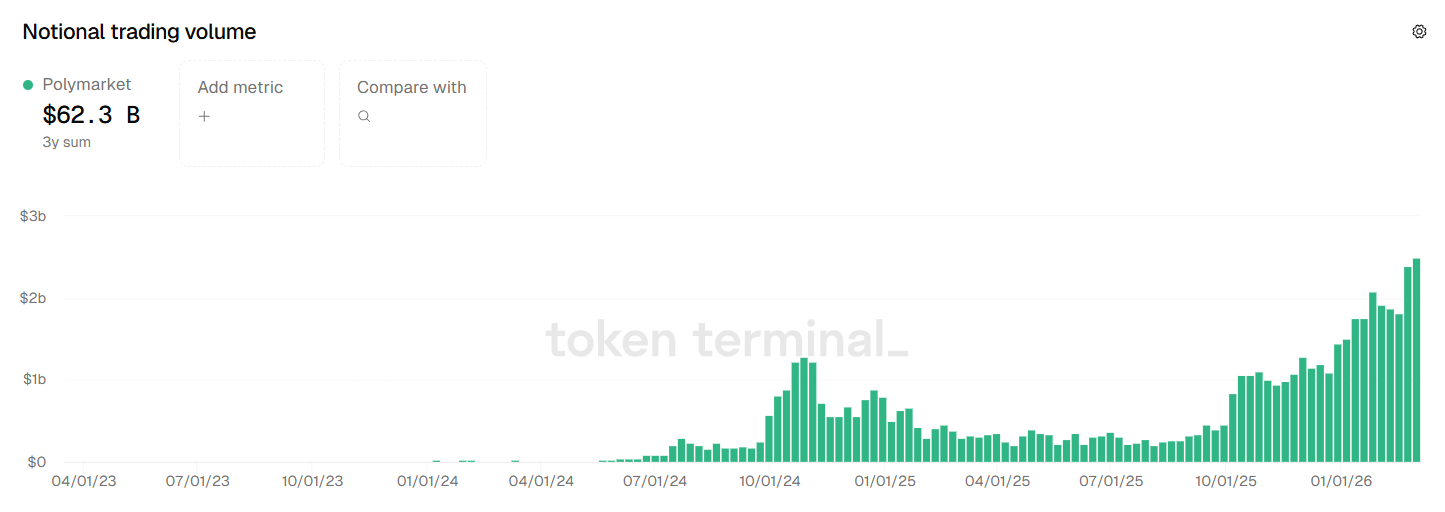
Prediction market activity has climbed sharply as traders flock to contracts tied to the escalating US-Iran conflict, while Washington moves toward clearer federal rules for event contracts and a legislative push to explicitly bar markets tied to war, terrorism and death.
Notional trading volume on Polymarket and Kalshi rose to new all-time highs during the week ending Monday, March 9, to $2.49 billion and $2.85 billion, respectively, according to Token Terminal data. The growing activity has pushed the total notional volume across all prediction markets to $145 billion through 2.8 million unique users, data from Dune shows.
While the ongoing conflict drives more activity to these platforms, US regulators are seeking public feedback on new prediction market legislation and weighing a potential ban on war and terrorism-related event contracts.

US lawmakers race to regulate prediction markets
The US Commodity Futures Trading Commission (CFTC) issued a staff advisory classifying event contracts on prediction markets as a “financial asset class,” Cointelegraph reported on Thursday.
The regulator also submitted an Advanced Notice of Proposed Rulemaking, asking for public comment on how the Commodity Exchange Act (CEA) would apply to prediction markets. The move came weeks after CFTC chair Michael Selig publicly reiterated claims that the CFTC had “exclusive jurisdiction” over prediction markets.
Last Monday, an Ohio judge pushed back against the claim in a ruling, saying that Kalshi had failed to show the CEA “would necessarily preempt Ohio’s sports gambling laws,” or that these sports betting contracts would fall under the “exclusive jurisdiction” of the CFTC.
Kalshi is headquartered in New York and regulated by the CFTC as a Designated Contract Market (DCM).
Polymarket US is also headquartered in New York City and has been operating under the CFTC since late 2025, after acquiring CFTC-licensed QCX LLC for $112 million and rebranding to Polymarket US. Polymarket’s offshore platform remains separate from Polymarket US, the company’s federally regulated US venue.
In January 2022, the CFTC charged Polymarket’s parent company, Blockratize, with illegally offering unregistered event-based options contracts. Polymarket settled by paying $1.4 million in civil monetary penalties and winding down unlicensed operations before the restructuring.
In November 2025, the CFTC issued an Amended Order of Designation for Polymarket US, vacating prior restrictions and authorizing trading as a DCM.
Related: Kalshi, Polymarket face trading halt in Nevada after court rulings
Senator seeks to ban war-related prediction market contracts
On Tuesday, US Democratic Party Senator Adam Schiff introduced new legislation seeking to ban federally-regulated prediction markets from listing contracts tied to war, terrorism, assassination, and individual deaths.
The so-called DEATH BETS Act seeks to amend the CEA to include a ban on similar contracts for entities overseen by the CFTC.

The proposition followed renewed insider trading allegations, after six Polymarket traders netted $1 million by accurately betting on the US strike against Iran.
In February, Israeli authorities arrested and indicted two people suspected of using secret information about Israel’s strike on Iran for insider trading on Polymarket.

Prediction market activity has been rising since the beginning of the recent US and Israeli military conflict with Iran. Politics-related contracts soared to become the third-largest category on Polymarket at $598 million and the eighth-largest on Kalshi with $16 million, based on last week’s notional trading volume seen on Dune.
Magazine: Inside a 30,000 phone bot farm stealing crypto airdrops from real users
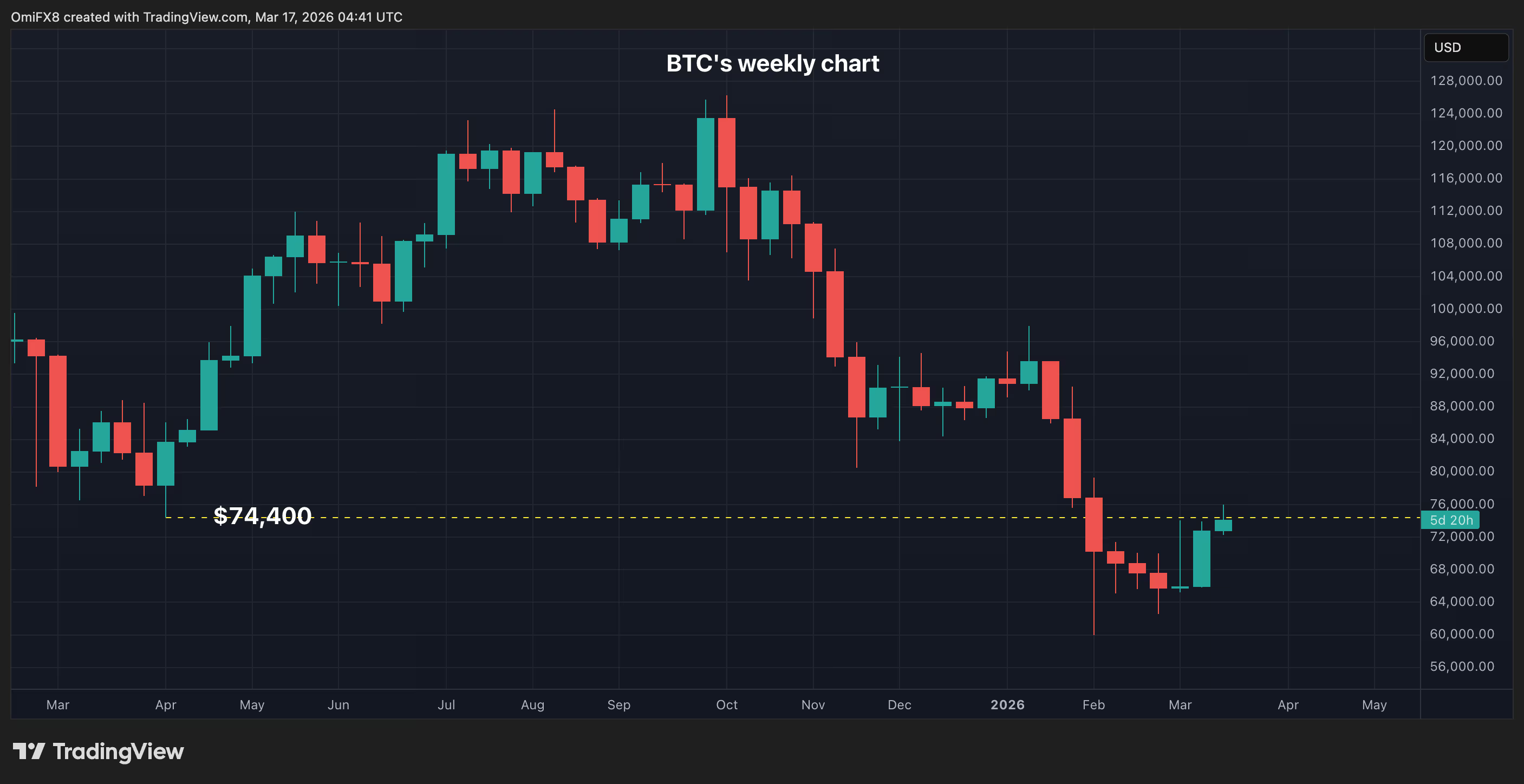
Bitcoin has fallen back below $75,000, highlighting the fragility of its early Asian session rally to six-week highs.
Prices rose to $75,912 early Tuesday, the highest since Feb. 4, according to CoinDesk data. 10x Research pointed to activity in the derivatives market as the main driver of that rally. Specifically, closure of large bearish bets tied to $60,000 put options likely powered gains.
Further, as those puts were closed, market makers who had taken the other side of the trade needed to rebalance their exposure. That process can involve buying bitcoin, which likely created flows that pushed BTC’s spot price quickly above $75,000.
But the rally faded just as quickly, suggesting the move was driven more by the removal of downside hedges than by fresh conviction from buyers. According to 10x Research, the early gains weren’t accompanied by significant upside call buying, which is usually a sign that traders are positioning for further upside.
The broader market has followed suit, with major tokens such as ether (ETH), XRP (XRP), solana (SOL), BNB , and others receding from their respective Asian session highs. The CoinDesk 20 Index now trades at 2,162 points versus 2,202 early Tuesday.
Resistance holds
BTC’s quick pullback marks a failure to hold gains above $74,400, a former support level from early April last year that is now acting as resistance. That level had previously stalled selling in early April 2025 and paved the way for a fresh rally to record highs above $126,000 by October.

The inability to stay above $74,400 suggests traders are watching this level closely, and it may serve as a short-term ceiling for the market.
This behavior highlights how technical reference points from previous market cycles continue to influence trader psychology. Even a brief breach of $75,000 triggered selling pressure, showing that market participants remain cautious about chasing rallies without a clear catalyst.
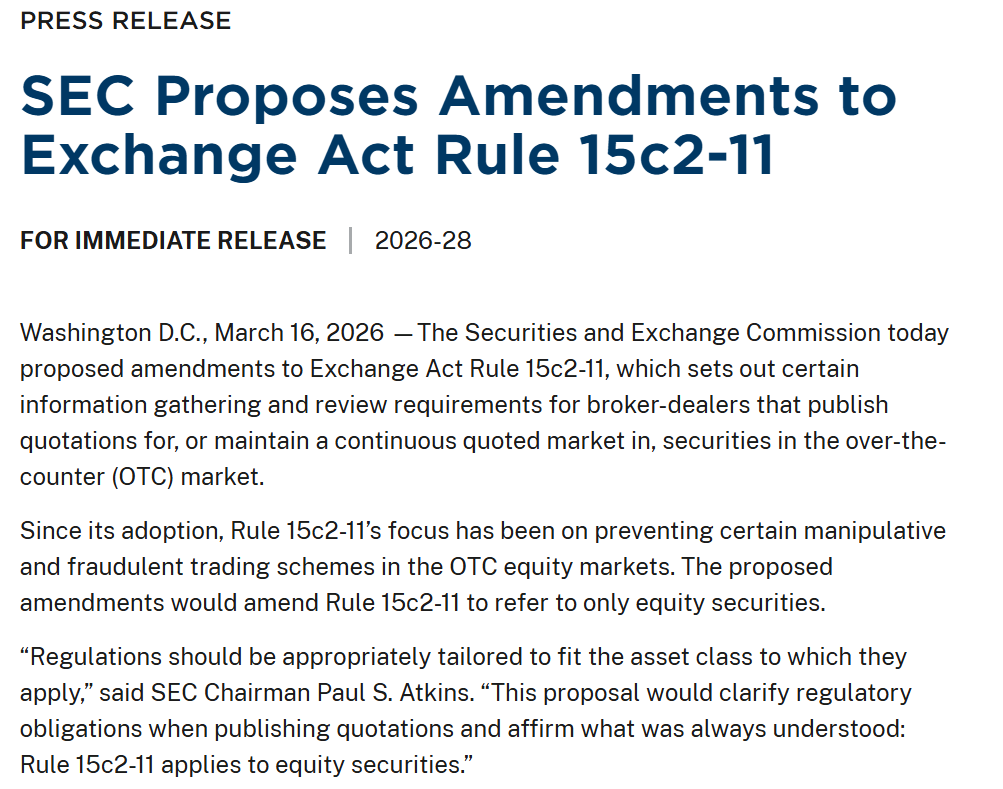
The US Securities and Exchange Commission is pushing to clear up years of confusion over a key broker-dealer reporting rule that prevented certain assets from being quoted by broker-dealers on the over-the-counter (OTC) market.
The SEC Rule 15c2-11 was first adopted in 1971, aimed at reducing fraud in the penny stock market. It requires broker-dealers to maintain up-to-date public information about an issuer before it can publish over-the-counter quotes.
In 2021, the rule was reinterpreted to also include fixed-income securities (such as government or corporate bonds), which saw backlash from the market. There have also been questions about whether it applies to crypto securities.
In a statement on Monday, the SEC proposed an amendment to Rule 15c2-11 that would limit the scope of reporting requirements for over-the-counter broker-dealers to “equity securities,” reversing the interpretation from 2021.

Hester Peirce, SEC commissioner and leader of the agency’s crypto task force, also welcomed the proposal, explaining that the SEC had created years of uncertainty via an amendment under the previous leadership in 2020, which went into effect in 2021.
“By its terms, the text of Rule 15c2-11 always has applied to quotations of a ‘security.’ Market participants and other observers including me, however, understood the rule to apply only to quotations of over-the-counter (‘OTC’) equity securities,” she said, adding:
“The Commission should have granted long-term no-action relief while we assessed whether the application of the rule to the fixed income market was appropriate and then amended the rule as necessary. Instead, the Commission… granted several rounds of limited relief, sometimes for as short a period as three months… fostering uncertainty in this market.”
SEC to seek comment about application to crypto
The SEC defines an equity security as any stock, similar security or convertible security that represents an ownership interest in a company.
Related: SEC drops case against BitClout founder with prejudice
Despite the SEC’s recent proposal, there is no decision yet made on whether “equity securities” could include crypto assets. The SEC has opened a 60-day period for public comment.
“I am particularly interested in commenters’ views as to the questions about the definition of ‘equity security,’ the rule’s application to crypto assets, and the appropriate next steps with respect to the formation of an ‘expert market,’” she said.
Both the SEC and Commodities Futures Trading Commission (CFTC) have been pushing hard to establish regulatory clarity for crypto in the US under the current administration.
Last week, the duo signed a memo agreeing to coordinate oversight of financial markets, including crypto. The agencies said this would put an end to decades of “regulatory turf wars” between them.
Magazine: All 21 million Bitcoin is at risk from quantum computers
Editor’s note: Binance just claimed a second major ATA victory in the United States, with a federal Alabama court dismissing all claims. The ruling comes within a week of a New York decision, underscoring Binance’s defense against unfounded lawsuits and its emphasis on compliance and due process. The court described the filing as a shotgun pleading, and allowed a brief window for an amended complaint. This editorial summary highlights how the case shapes regulatory discourse around crypto litigation.
Key points
- Alabama court dismissed all claims under the Anti-Terrorism Act.
- This is Binance’s second ATA victory in a week, after the New York ruling.
- The court labeled the filing a shotgun pleading and set an April 10, 2026 deadline to amend.
- Binance continues to invest in compliance infrastructure, regulatory engagement, and legal governance.
Why this matters
This matters because it demonstrates that courts are applying strict pleading standards in ATA-related crypto cases, reinforcing the importance of evidence, due process, and regulatory compliance. The rulings show Binance and its community are protected when claims lack clarity or evidence, while underscoring the need for careful legal governance as the industry grows.
What to watch next
- Amended complaint deadline is April 10, 2026.
- Potential further rulings in related ATA actions.
- Ongoing emphasis on compliance infrastructure and governance from Binance.
Disclosure: The content below is a press release provided by the company/PR representative. It is published for informational purposes.
Binance Secures Second Major Legal Victory in U.S. Court Under Anti-Terrorism Act in Two Weeks
US Federal Court in Alabama Dismisses All Claims Against Binance in Latest Lawsuit Victory
ABU Dhabi, UAE, March 16, 2026 – Binance, the world’s largest cryptocurrency exchange, announced today that a U.S. federal court in Alabama has dismissed all claims against the company in a lawsuit alleging violations of the Anti-Terrorism Act (ATA). This marks Binance’s second major legal victory in an ATA matter within one week, following their victory in the Southern District of New York.
A Full and Complete Legal Victory
In a detailed 19-page ruling, the Court found the plaintiffs’ complaint to be legally and factually deficient. The court’s decision to dismiss every claim across the board represents a decisive legal victory for Binance.
The judge described the filing as a “shotgun pleading.” The complaint failed to clearly specify the claims and improperly grouped all defendants together without distinguishing individual conduct or liability. The ruling also emphasized that the plaintiffs did not meet the basic pleading standard to provide a “short and plain statement” of their claims.
Following the ruling, the court granted the plaintiffs until April 10, 2026, to file an amended complaint addressing the deficiencies identified. However, the judge warned that failure to adequately address these issues would result in dismissal of the entire case.
Building on Momentum and Upholding Legal Integrity
“This decision reinforces our unwavering commitment to protecting Binance and our community from unsubstantiated and bad-faith lawsuits,” shared Eleanor Hughes, General Counsel at Binance. “Sanctions compliance and terrorism financing are serious matters of law – they require evidence, legal rigour, and due process. Courts have now examined these claims on two separate occasions and found them to be without merit. These outcomes speak for themselves. We will not tolerate attempts to misuse the legal system to target our industry, and we remain as committed as ever to transparency, security, and lawful conduct in everything we do”.
This latest decision follows closely on the heels of Binance’s comprehensive victory in New York, where the Court similarly rejected allegations that the company assisted, participated in, or conspired with terrorists. Together, these rulings reflect Binance’s strong resolve to protect its platform and community.
Binance has consistently invested in industry-leading compliance infrastructure, regulatory engagement, and legal governance. The company will continue to vigorously defend itself against any attempts to bring unfounded claims or misrepresent its operations.
About Binance
Binance is a leading global blockchain ecosystem behind the world’s largest cryptocurrency exchange by trading volume and registered users. Binance is trusted by more than 310 million people in 100+ countries for its industry-leading security, transparency, and unmatched portfolio of digital asset products. For more information, visit: https://www.binance.com

Editor’s note: The Metaplex Foundation and K Wave Media have signed a memorandum of understanding to advance the Gaon Project and bring K-Culture IP onchain through digital asset infrastructure. The collaboration will integrate Metaplex’s tokenization platform with K Wave Media’s IP portfolio to develop new models linking globally influential content with digital assets, fan communities, and internet-native capital formation. The effort, developed from discussions at Metaplex Summit in Seoul, examines how blockchain can support issuance and management of digital assets tied to Korean entertainment—including K-pop—and how such systems could shape participation by fans, creators, and investors in the global K-Culture economy.
Key points
- MoU to integrate Metaplex’s tokenization platform with K Wave Media IP to tokenize K-Culture IP onchain.
- Initiative aims to connect content with digital assets, global fan communities, and internet-native capital formation.
- Gaon Project introduced at Metaplex Summit 2026 in Korea and focuses on tokenization and asset issuance models.
- Metaplex has supported 1 billion digital assets and over $13.5 billion in transaction value; expansion to IP-backed tokens.
Why this matters
By combining Metaplex’s tokenization platform with K Wave Media’s IP portfolio, the initiative could demonstrate how blockchain-enabled digital assets enable new funding sources, fan participation, and international access to capital. The effort explores onchain asset issuance, governance, and distribution models for K-pop, dramas, films, and music programs, helping to map how cultural IP can move through global liquidity networks while clarifying regulatory considerations.
“K-Culture has built some of the most influential digital communities anywhere in the world,” said Stephen Hess, founder of Metaplex.
What to watch next
- Tracking MoU collaboration and integration with K Wave Media’s IP portfolio.
- Progress updates on the Gaon Project and onchain asset issuance for K-Culture IP.
- Regulatory environment discussions and broader blockchain role in digital asset issuance.
Disclosure: The content below is a press release provided by the company/PR representative. It is published for informational purposes.
Metaplex Foundation and K Wave Media Partner to Advance Tokenization of K-Culture IP
Discussions at Metaplex Summit in Seoul highlighted growing momentum around bringing Korean entertainment and cultural content onchain
SAN FRANCISCO, March 16, 2026 (BUSINESS WIRE)— The Metaplex Foundation, a non-profit organization dedicated to building and growing Metaplex, the leading tokenization platform in the Solana ecosystem, today announced a partnership with K Wave Media, a company focused on developing and commercializing Korean entertainment and cultural intellectual property (IP), to advance the Gaon Project, an initiative designed to bring K-Culture IP onchain through digital asset infrastructure.
Under a memorandum of understanding (MoU), the organizations will collaborate on integrating Metaplex’s tokenization platform with K Wave Media’s cultural IP portfolio to develop new models linking globally influential content with digital assets, global fan communities and internet-native capital formation.
The initiative will examine how blockchain technology can support the issuance and management of digital assets tied to Korean entertainment and cultural content, including K-pop and other widely recognized K-Culture IP. These models are expected to create new opportunities for participation among fans, creators and investors across the global K-Culture economy.
“K-Culture has built some of the most influential digital communities anywhere in the world,” said Stephen Hess, founder of Metaplex. “Working with K Wave Media allows us to explore how that cultural IP can move onchain, expanding access to new funding sources through global liquidity and unlocking new methods of content distribution. As technology continues to reshape how communities form and participate online, initiatives like this highlight the growing intersection between culture and digital economies.”
The Gaon Project was introduced at Metaplex Summit 2026 in Korea, an invitation-only gathering held in Seoul on March 6 that brought together leaders from Korean financial institutions, investment firms, crypto protocols, legal organizations and media.
Discussions focused on the growing opportunity to tokenize Korean cultural IP using blockchain infrastructure, including how digital assets could create new connections between content creators, global fandoms and internet-native capital markets. Participants also exchanged perspectives on the evolving regulatory environment and the broader role of blockchain technology in digital asset issuance.
During the event, Yangtae Kim and JaeHa Lee of K Wave Media outlined how the organization is positioning itself to transform the Korean IP market by combining content pipelines with new participation models, linking digital assets, fan communities and decentralized finance (DeFi).
“Korean entertainment has become one of the most influential cultural exports in modern media,” said Jaeha Lee, Head of Content, K Wave Media. “Through the Gaon Project, we plan to bring Korean dramas, films, animation and music reality programs onchain as real-world assets, creating new pathways for how Korean content is distributed and discovered.”
To date, Metaplex has supported the creation of 1 billion digital assets and over $13.5 billion in transaction value. The Metaplex Foundation plans to continue expanding its platform to support additional digital asset categories, including IP-backed tokens and agent-native tokens, as it advances infrastructure for the onchain economy.
About Metaplex Foundation
The Metaplex Foundation is a non-profit organization dedicated to developing and growing Metaplex, a suite of onchain programs and tools that facilitate the creation, distribution, and management of digital assets using Solana and the Solana Virtual Machine (SVM). Metaplex enables platforms like metaplex.com to provide a seamless end-to-end experience for asset issuers and traders to discover, trade, and launch tokens and NFTs on Solana.
About K Wave Media
K Wave Media is an entertainment and media company focused on content investment, film and series production, K-Pop merchandise, and a Bitcoin treasury strategy. By integrating entertainment IP with digital asset infrastructure, the company is expanding its influence in the emerging real-world asset (RWA) market for Korean cultural IP.
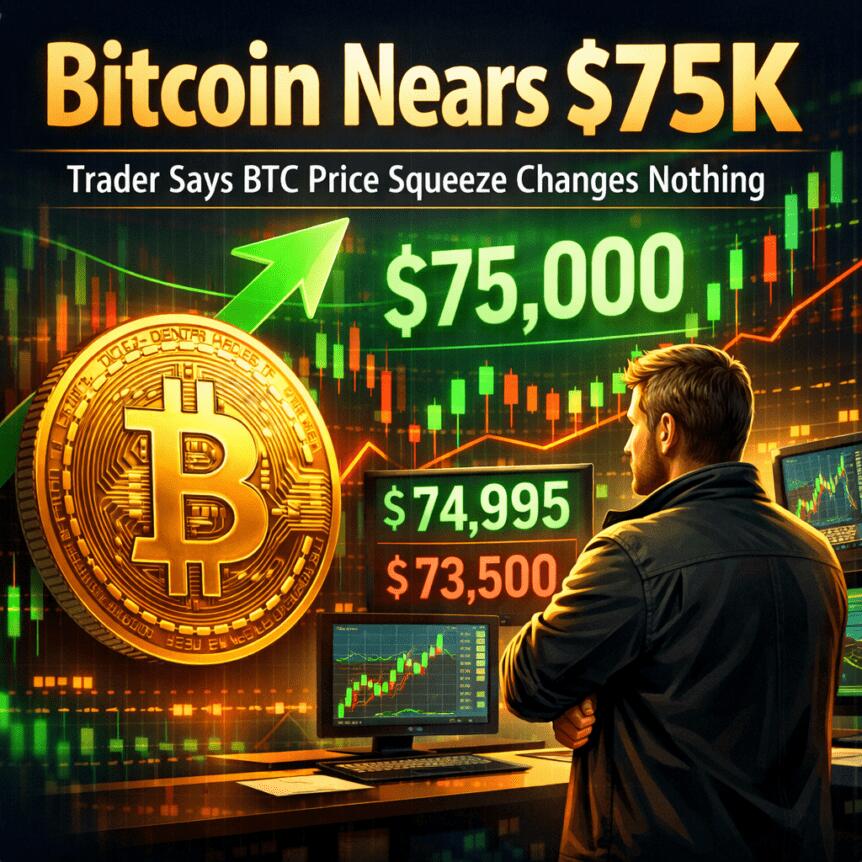
Bitcoin extended a cautious rally at the start of the week, touching six-week highs as U.S. equities opened higher on signs of easing geopolitical tensions surrounding Iran. The move came alongside firmer price action for a broad set of risk assets, yet analysts warned that the longer-term trend for Bitcoin remains downbeat, with macro and liquidity dynamics continuing to influence the market. Traders are watching for whether this is a durable shift or a temporary relief bounce that fails to establish a footing above important technical levels.
Key takeaways
- Bitcoin rose to around $74,600 at Monday’s Wall Street open, aligning with a 1.5% uptick in major indices as investors digested signals of deescalation in the Iran situation.
- Oil and gold retreated from recent highs, with WTI crude briefly dipping below $100 per barrel and gold testing the $5,000 level, a move seen as a return to more conventional risk-off hedges as tensions eased.
- Analysts highlighted that the relief bounce is fragile; a sustained breakout would need to contend with the broader trend, which remains pressured by macro headwinds and caution around liquidity.
- Market commentary framed Bitcoin as competing with traditional safe-havens during periods of geopolitical stress, a narrative that could gain traction if volatility persists.
- Some traders flagged potential technical triggers, including a CME Group futures gap and the importance of trend-line support, as markets weigh whether the rally can hold.
Sentiment: Neutral
Price impact: Neutral. The price action shows a cautious uptick but fails to confirm a durable trend reversal.
Trading idea (Not Financial Advice): Hold. While the intraday moves look constructive, the overall setup remains conflicted, with macro factors and risk sentiment likely to dictate the near-term path.
Market context: The week opened with risk assets under a mixed macro backdrop, as de-escalation signals in geopolitical tensions tempered some speculative theta, aiding a risk-on impulse in equities while leaving crypto charts tethered to potential further volatility.
Why it matters
Bitcoin’s brief ascent to the six-week high territory underscores a resumed correlation with traditional markets under certain macro conditions, particularly when headlines point toward easing tensions or softer geopolitical risk. While the price crest near $74,600 signals renewed interest, the broader market narrative remains uncertain. The juxtaposition of crypto’s potential as a geopolitical hedge against the continued drag of macro headwinds raises questions about whether the asset class can sustain upside in a liquidity environment that has shown cyclical sensitivity to headlines.
Early-week moves also highlight the evolving discourse on crypto’s role in macro portfolios. Analysts from QCP Capital suggested the possibility of Bitcoin acting as a digital safe haven or geopolitical hedge during periods of instability, noting that price action has sometimes tested that narrative in real time. The notion of crypto as an alternative to gold in risk-off periods is not new, but it appears to be resurfacing in markets where traditional hedges still carry significant risk premia. This re-emergence could influence trader psychology, especially if correlations with equities and precious metals spike again during bouts of volatility.
On the technical front, traders emphasized that the relief bounce needs to prove durable. After reclaiming some key trend lines, Bitcoin and Ether (CRYPTO: ETH) were watched against broader asset classes for signs of sustainability. The commentary suggested that a longer-lived advance would require a shift in risk appetite and a break above critical resistance, not merely a one-off move driven by temporary headlines. For now, the market remains cautious, with many players hedging around what could become a larger pivot in macro sentiment rather than a straightforward risk-on impulse.
What to watch next
- Price action around the $74,000–$75,000 zone and whether Bitcoin can sustain a break above recent inertia, or if price returns to tested support levels.
- The CME Group Bitcoin futures gap near $71,500 and whether price revisits that area, potentially shaping a fresh reversal or consolidation zone.
- any renewed headlines on Middle East tensions and their impact on oil, gold, and broader risk sentiment, including the potential for renewed volatility in the Strait of Hormuz.
- ongoing commentary from traders like Jelle on longer-term BTC cycles and the likelihood of a continued bear market versus a structural shift in market dynamics.
- persistent discussions around Bitcoin’s narrative as a digital hedge, particularly if macro stress signals intensify again or if liquidity conditions tighten ahead of economic data releases.
Sources & verification
- QCP Market Color analysis discussing Bitcoin’s narrative as a potential digital hedge and the risk-on/risk-off dynamics observed in the market.
- BTC price data and chart references from TradingView (BTCUSD) cited in market commentary and chart captions.
- Trader commentary on price action around the CME Bitcoin futures gap near $71,500 (as discussed by Daan Crypto Trades on X).
- Analyst notes from Jelle on X regarding bear market cycles and potential lower-price scenarios.
- Public posts and discussions referencing geopolitical developments, including coverage of Hormuz tensions and de-escalation signals.
Market reaction and key details
Bitcoin (CRYPTO: BTC) advanced to the upper band of its recent range as Wall Street opened on a cautiously optimistic note. The largest cryptocurrency by market cap rose toward $74,600, coinciding with a roughly 1.5% uptick in major equity indices. The macro backdrop showed oil slipping below the $100 per barrel threshold and gold pulling back from peak levels, approaching key moving-average support as investors priced in slower-than-expected geopolitical risk. The juxtaposition of crypto strength against steadier asset classes underscores a watershed moment for traders evaluating whether this is a durable shift or a transient relief rally.
Analysts at QCP Capital framed the move as part of a broader narrative in which Bitcoin and Ether (CRYPTO: ETH) are being tested by traditional risk signals. They noted that BTC and ETH managed to push above critical round-number benchmarks, but the broader risk-off tilt persisted in equities and precious metals, tempering the vigor of a potential sustainable breakout. One line from the analysis captured the tension: “If this pattern persists, it would be a late-quarter plot twist, given crypto’s underdog status and its familiar habit of correlating with traditional assets mostly on the way down.”
The discussion around Bitcoin as a possible digital safe haven resurfaced amid softer geopolitical headlines, with market participants considering whether BTC could serve as a hedge during periods of uncertainty. While that narrative has been tested before, the current price action provides a fresh data point for those arguing that crypto may offer diversification benefits when traditional hedges come under pressure. Still, a majority of traders cautioned that the relief bounce is unlikely to rewrite the longer-term technical picture without sustained demand and a clear breakout above key resistance zones.
From a sentiment standpoint, some market voices urged patience. A number of traders highlighted that the latest rally might represent a higher low rather than a robust reversal, signaling the potential for a renewed move lower if conditions deteriorate or if macro liquidity tightens again. The conversation in social feeds—ranging from market commentators on X to posts referencing CME data—emphasized that the market’s next move would hinge on the ability of buyers to absorb any renewed volatility stemming from macro headlines or shifts in risk sentiment. In addition to technical considerations, the unfolding narrative around the Strait of Hormuz continued to influence the energy complex and, by extension, the risk-on/risk-off calculus for investors across asset classes.
Charts comparing BTC against gold and other assets illustrated a recurring theme: Bitcoin’s price action remained tightly bound to broad market cycles, with the 50-day moving average for gold providing a rough guidepost for risk appetite. The visual relationships underscored the ongoing debate about Bitcoin’s role in diversified portfolios during periods of geopolitical risk and macro uncertainty. As traders weigh the probability of further volatility, the question remains whether this week’s price action marks the start of a sustained re-valuation or a temporary pause within a longer-downtrend framework.
Key figures and next steps
In the near term, market participants will be attentive to whether BTC can maintain momentum beyond the $74k handle and whether the next weekly candle closes above critical technical thresholds. The possibility of a retracement back toward the CME-futures-defined area around $71,500 could provide a fresh pivot point for risk controls and short-term trading strategies. The interplay between oil, gold, and crypto will continue to shape risk sentiment, especially if geopolitical headlines shift again or if macro data surprises alter the liquidity outlook.
Detailed verification notes
The material reflects market commentary and data points reported during the week’s opening session, including: crypto price action near $74,600; the role of QCP Market Color in framing Bitcoin’s narrative; the presence of a CME gap around $71,500 as observed by CME-related traders; and social-media commentary from traders such as Jelle and Daan Crypto Trades. The embedded trading charts from TradingView provide ongoing price context for BTCUSD as markets respond to evolving macro and geopolitical signals.
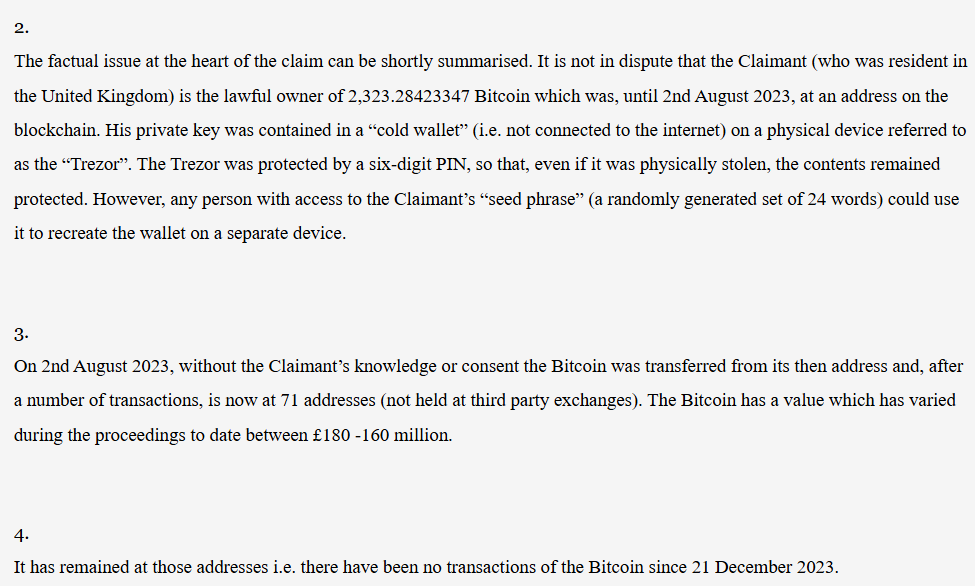
A UK resident has accused his estranged wife of stealing 2,323 Bitcoin from his Trezor hardware wallet in 2023, alleging she used a security camera to capture his seed phrase and access codes.
In a court judgment by Justice Cotter, filed in the UK’s High Court of Justice last Tuesday, lawyers acting for the claimant, Ping Fai Yuen, alleged that his wife, Fun Yung Li and her sister covertly recorded him to obtain his seed phrase and transfer out $176 million in Bitcoin (BTC) to 71 different addresses.
After allegedly being tipped off by his daughter about the plot, Ping installed audio recording equipment and claims to have captured Fun discussing the theft and how to move large sums of money without attracting the attention of banks or law enforcement.
No transactions have taken place at any of the wallet addresses since Dec. 21, 2023, according to the court documents.
Ping reported the alleged theft to the police shortly after the last transfer in December. Law enforcement arrested his wife and confiscated several cold wallets and watches. She was later released on bail while police investigated.
Authorities later stated there would be no “further action pending new evidence.”

Wallets have been targeted by dusting attacks
In November last year, nearly two years after the alleged theft, Ping applied for an asset preservation injunction, asking the court to freeze all cryptocurrency associated with his wife, formally declare his ownership of the Bitcoin and either return it or award him its equivalent value in fiat currency.
He also claimed to be monitoring the Bitcoin addresses and expressed concern that they had been targeted in a crypto dusting attack.
Dusting attacks involve a bad actor sending small amounts of cryptocurrency to wallets to track activity and try to identify the owners of wallets with large holdings for follow-up phishing and other scams.
A separate incident in September 2024 allegedly involved a violent confrontation between Ping and Fun, resulting in charges against Ping of assault occasioning actual bodily harm and two counts of common assault, to which he later pleaded guilty.
Judge says the husband has a high chance of winning
Justice Cotter wrote that Ping has a high chance of prevailing, given the evidence collected since the alleged incident occurred and the fact that Fun did not provide “any alternative (or any) explanation for the movement of the Bitcoin.”
Related: US Treasury sanctions enablers of North Korea IT worker fraud ring
“In my judgment the claimant has demonstrated a very high probability of success,” Cotter wrote, adding that “The evidence is that he was warned of what the First Defendant was seeking to do, the transcripts are damning; and when the First Defendant’s property was searched, the necessary equipment to exfiltrate the Bitcoin was found.”
Cotter also noted that if the pair cannot agree on how to proceed, the court will schedule a case management hearing. He also recommended an early trial, which he described as “necessary given the security threats to, and volatility of value of, the Bitcoin.”
Magazine: The debate over Bitcoin’s four-year cycle is over: Benjamin Cowen

Millions urged to check payslips before April HMRC tax changes

Easter holidaymakers switching from Dubai to Spain as flights fill up

HIVE expands BUZZ HPC in Canada with 4x AI data center capacity in BC


-
 Tech6 days ago
A 1,300-Pound NASA Spacecraft To Re-Enter Earth’s Atmosphere
-
Crypto World3 days ago
HYPE Token Enters Net Deflation as HyperCore Buybacks Outpace Staking Rewards
-

 Business7 days ago
ExxonMobil seeks to move corporate registration from New Jersey to Texas
-

 Fashion3 days ago
Weekend Open Thread: Addict Lip Glow
-

 Tech7 days ago
ChatGPT will now generate interactive visuals to help you with math and science concepts
-
Sports3 days ago
Why Duke and Michigan Are Dead Even Entering Selection Sunday
-

 NewsBeat5 days ago
Residents reaction as Shildon murder probe enters second day
-

 Business1 day ago
Search for Savannah Guthrie’s Mother Enters Seventh Week with No Arrests
-

 Business6 days ago
Search Enters Sixth Week With New Leads in Tucson Abduction Case
-

 Business3 days ago
US Airports Launch Donation Drives for Unpaid TSA Workers as Partial Government Shutdown Enters Fifth Week
-
Crypto World2 days ago
Coinbase and Bybit in Investment Talks: Could Bybit Finally Enter the US Crypto Market?
-

 NewsBeat6 days ago
I Entered The Manosphere. Nothing Could Prepare Me For What I Found.
-

 Business3 days ago
Country star Brantley Gilbert enters growing non-alcoholic beer market
-

 Sports5 days ago
PWHL, Senators discussing plan to keep Charge in Ottawa
-

 Business19 hours ago
Australian shares drop as Iran war enters third week
-

 Sports3 days ago
College Basketball Best Bets: Conference Tournament Semifinal Picks
-

 Crypto World19 hours ago
Crypto Lender BlockFills Enters Chapter 11 with Up to $500M in Liabilities
-

 Crypto World7 days ago
Will Chainlink price reclaim $10 amid volatility squeeze?
-

 Politics6 days ago
Trump Says Middle East Is ‘Very Lucky’ That He’s President
-
 Crypto World5 days ago
Three Binance Charts May Be Hinting at Bitcoin’s Next Move


You must be logged in to post a comment Login