
Crypto World
CPI Inflation Inches Higher, but Crypto Markets Stay Resilient

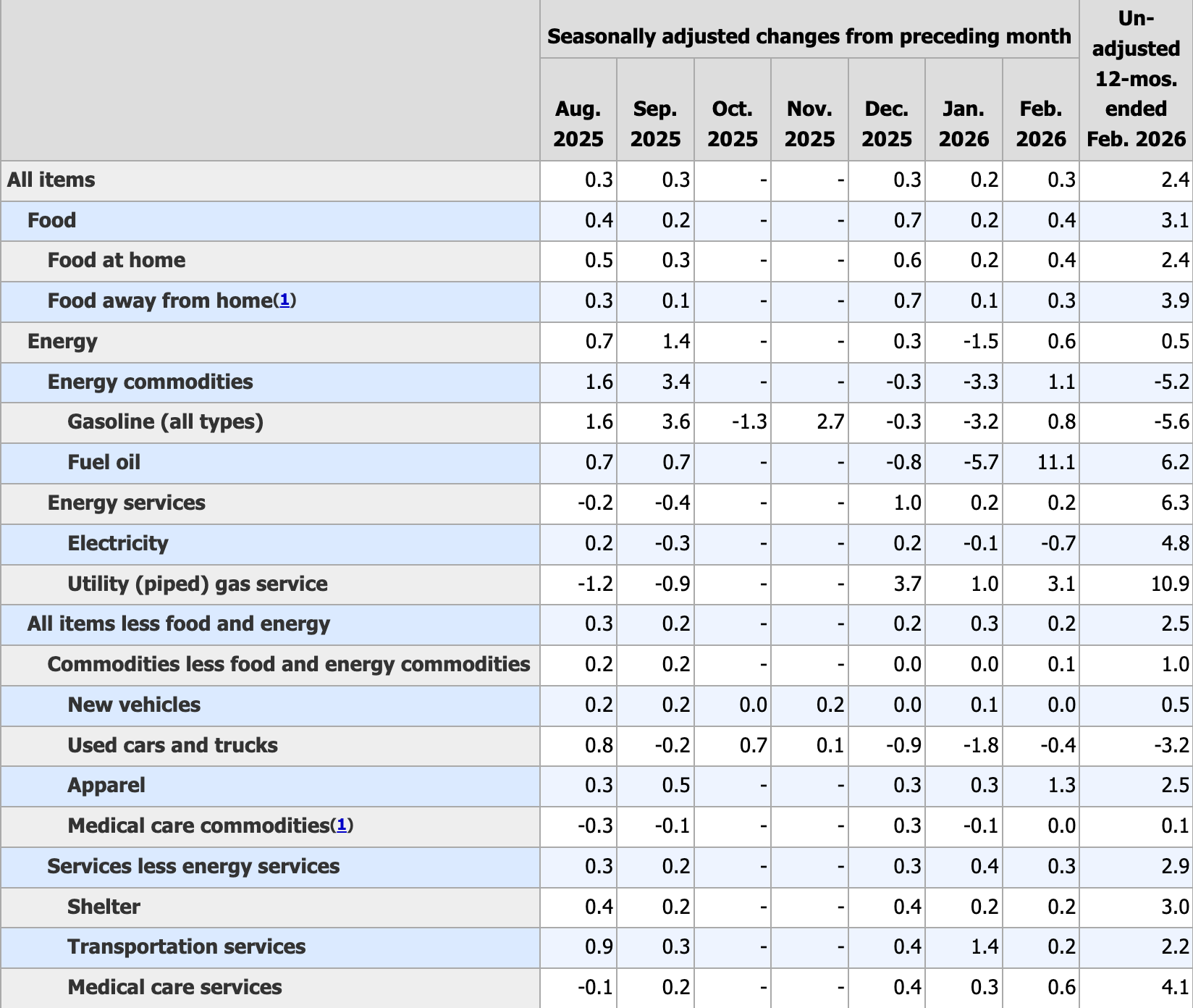
The latest rise in the consumer price index (CPI) was “in line with estimates,” and rising inflation has already been priced into the macroeconomic data for the March CPI print, according to market analysts at exchange-traded product (ETP) issuer 21Shares.
Shelter rose 0.2% in February, while the food sector of the CPI rose 0.4%, energy increased by 0.6%, and the index for all items, excluding food and energy, rose by 0.2%, according to the US Bureau of Labor Statistics (BLS) February CPI report.

Stephen Coltman, head of macro at 21shares, said the upcoming CPI prints place even more pressure on the Federal Open Market Committee (FOMC), the body that decides interest rate policy. He said:
“What matters now is the Fed’s reaction function to the coming higher CPI prints. Do they ‘look through’ this temporary shock despite having been burned in the previous inflation cycle? Or do they tilt hawkish as a precautionary measure?”
Crypto markets remain resilient following the February CPI report, with the Total 3 market indicator, which tracks the entire crypto market capitalization excluding Bitcoin (BTC) and Ether (ETH), only declining by about 1% from the intraday high of about $722 billion.
Related: Finance job openings fall to 13-year low as US economy loses 92K jobs
What does this mean for BTC’s price?
“In the immediate term, Bitcoin is likely to remain rangebound between $68,000 and $74,000. However, a breakout past the $75,000 resistance zone appears imminent,” according to Matt Mena, crypto research strategist at 21Shares.

If BTC manages to break above the $75,000 level, it could enter a consolidation phase between $75,000 and $80,000 in the medium-term, Mena said.
Historic price data shows that BTC typically rebounds by 15% or more after geopolitical market shocks, which would put its price in the $77,000 to $80,000 range, he said.
A market recovery to these levels could also be “accelerated” if the FOMC resumes easing interest rates in 2026, according to Mena.
Only 0.6% of traders expect an interest rate cut from the current 3.50%-3.75% range at the March 18 FOMC meeting, according to the CME FedWatch tool.
Magazine: The debate over Bitcoin’s four-year cycle is over: Benjamin Cowen



ICE detention deaths are running at a record pace in 2026, and the United States’ largest immigration detention center — a sprawling tent facility on a Texas Army base — has logged three deaths, 49 regulatory violations, and allegations of guards betting on which detainee would die next.
Summary
- ICE detention deaths are on a record pace in 2026, with 25 people dying in custody since October — three of them at Camp East Montana, the largest immigration detention center in the United States.
- Federal inspectors visiting the El Paso facility in February found 49 violations of detention standards, including failures to document suicide prevention checks and inadequate medical care.
- The facility was initially run by Acquisition Logistics LLC — a private company with no prior detention experience that secured a $1.3 billion federal contract — and it did not respond to NPR’s questions about conditions or its management record.
ICE detention deaths are running at a record pace in 2026, and the United States’ largest immigration detention center — a sprawling tent facility on a Texas Army base — has logged three deaths, 49 regulatory violations, and allegations of guards betting on which detainee would die next. Camp East Montana, located on the grounds of Fort Bliss in El Paso, Texas, was opened in August 2025 and currently houses around 3,000 immigrants with capacity for 2,000 more. According to NPR’s April 3 investigation, it is both the country’s largest detention center and one of its deadliest.
Out of 25 people who have died in ICE detention since October, three were held at Camp East Montana. The first, Francisco Gaspar-Andres, a Guatemalan national, died of kidney failure in December after two weeks of hospitalization. A month later, Cuban national Geraldo Luna Campos died while in detention, with DHS initially citing “medical distress.” The third death occurred on January 14, when Victor Manuel Diaz, a Nicaraguan national, died by suicide according to DHS. His family disputes the circumstances. “When we talked to Victor after he had been detained by ICE in Minnesota and brought to Camp East Montana at Fort Bliss Army Base in El Paso, we were not worried because Victor would just be returned to Nicaragua to us,” the family said in a statement to NPR. “Little did we know it was the last time we would ever hear his voice.”
In February, ICE inspectors documented 49 violations of federal detention standards at the facility — including inadequate medical care and failure by staff to “accurately document required checks to prevent significant self-harm and suicide.”
The private contractor problem
Acquisition Logistics LLC — a company with no prior experience running a detention facility — secured a $1.3 billion federal contract to manage Camp East Montana. It did not respond to NPR’s questions about detainee conditions or its management of the facility. DHS said in a statement that it inherited the contract from the Department of War. The same DHS that is being positioned to receive and cross-reference sensitive voter data through its SAVE system is also the agency overseeing ICE, and the 49 violations at Camp East Montana raise direct questions about whether the department has the operational capacity to responsibly manage the data and human oversight obligations it is accumulating simultaneously.
Former detainee Owen Ramsingh, speaking from the Netherlands after being deported in March, told NPR he personally witnessed guards betting on which detainee would die by suicide. “This is so screwed up that you’re trying to bet on our lives, you know, with these other officers thinking this s- – – is funny,” he said.
A transparency failure with documented consequences
More than 45 people interviewed by the ACLU at Camp East Montana described “alarming conditions of confinement and repeated instances of coercion, physical force, and threats,” the civil liberties group said in a December letter to ICE. DHS said in response that “staff abides by strict prevention and intervention protocol” when signs of self-harm are detected.
The gap between that statement and the 49 violations documented by federal inspectors in February represents exactly the kind of institutional opacity that critics argue becomes systemic when government agencies — and the private contractors they empower — operate without meaningful accountability for how personal data and human custody are managed. The record death pace at Camp East Montana has not yet produced any public disciplinary action against Acquisition Logistics or the facility’s current operators.


The Ethereum Foundation has completed its 70,000 ETH staking mission, depositing approximately 45,000 ETH worth around $93 million in a single on-chain session on April 3
Summary
- The Ethereum Foundation deposited approximately 45,000 ETH in a single session on April 3, completing the 70,000 ETH staking target it announced in February, according to on-chain data from Arkham Intelligence.
- The full program values the foundation’s staked position at approximately $143 million at current ETH prices near $2,055.
- The completion marks a structural shift in how the foundation funds its operations — from periodic ETH sales to yield-bearing staking activity.
The Ethereum (ETH) Foundation has completed its 70,000 ETH staking target, depositing approximately 45,000 ETH worth around $93 million in a single on-chain session on April 3, according to tracking data from Arkham Intelligence. The final deposit brings the nonprofit’s total staked ether to the full threshold it committed to in February, valuing the completed program at approximately $143 million at current prices.
The foundation’s staking initiative began on February 24, when it made an initial deposit of 2,016 ETH and publicly committed to staking approximately 70,000 ETH in total, with all staking rewards directed back into the treasury. The move followed a 2025 treasury policy update designed to generate yield and reduce dependence on ETH sales to fund operations. Data showed the foundation making what was then its largest single-day allocation — 22,517 ETH worth over $46 million transferred to the Ethereum Beacon Deposit Contract. The April 3 session eclipsed it, completing the target in one final move.
The infrastructure behind it
The staking setup uses open-source tools from Attestant — including Dirk and Vouch — with a focus on distributed signing, minority clients, and multi-jurisdiction validator infrastructure. The foundation has emphasized that this approach is designed not only to generate yield but to actively strengthen Ethereum’s proof-of-stake security by adding a well-resourced, transparent validator to the network.
“We are excited to take this important step, which helps secure the Ethereum network and at the same time fund the EF’s core operations and activities, including protocol R&D, ecosystem development, community grant funding and more,” the foundation said in its February announcement post on X.
Why this matters for ETH
The completion of the staking program arrives at a moment of meaningful strategic context. The foundation has faced persistent criticism over the past year for periodically selling ETH from its treasury — moves that generated operational cash but weighed on market sentiment. Staking the treasury, rather than liquidating it, directly addresses that criticism and aligns the foundation’s economic interests with Ethereum’s long-term network health. At $2,055 per ETH and approximately 3–4% annualized staking yield, the 70,000 ETH position could generate around $4–6 million annually for the foundation’s operations without requiring further token sales.


More than 3 million pages of Epstein files have been released, prosecutors have brought no new charges against anyone in his network, and five legal experts have now laid out in precise terms why the evidentiary gap between public scandal and criminal conviction is nearly impossible to close.
Summary
- More than 3 million pages of Epstein and Maxwell-related documents have been released since the passage of the Epstein Files Transparency Act, but no new arrests have been made in the U.S. since the files began dropping in 2025.
- The DOJ told NPR there has been “no credible evidence” that criminal activity extended to Epstein’s broader network — a statement released the same day Trump announced Pam Bondi’s firing, citing in part her mishandling of the files.
- Legal experts cite five compounding barriers: the “beyond a reasonable doubt” standard, the difficulty of proving criminal intent for conspiracy charges, expired statutes of limitations on tax violations, victim reluctance, and redaction that strips documents of the context needed to support prosecution.
More than 3 million pages of Epstein files have been released in the months since Congress passed the Epstein Files Transparency Act, which forced the Justice Department to make all Epstein-related documents public. Yet no new arrests have been made in the United States — a gap that has drawn bipartisan frustration and generated intense public confusion. NPR asked five legal experts — four former federal prosecutors and one retired law enforcement officer — to explain exactly why.
The documents include accusations from alleged victims, thousands of emails, photographs placing Epstein alongside prominent figures in business, politics, and entertainment, and FBI network diagrams tracing his alleged abuse. The files confirm that many individuals maintained contact with Epstein long after his 2008 guilty plea on sex crimes involving minors. But as experts are clear to note: appearing in the documents is not evidence of criminal wrongdoing. In a statement to NPR, DOJ spokesperson Katie Kenlein was direct: “There have not been additional prosecutions beyond Epstein and Maxwell because there has not been credible evidence that their activities extended to Epstein’s network. However, if prosecutable evidence comes forward, the Department of Justice will of course act on it.”
The five legal barriers
Barbara McQuade, a professor at the University of Michigan Law School and former U.S. attorney, led with the foundational standard: prosecutors must prove every charge beyond a reasonable doubt — a bar that cannot be met by association or proximity alone. Jessica Roth, a Cardozo School of Law professor and former federal prosecutor in the Southern District of New York, explained that conspiracy charges require individually proving criminal intent for each named defendant.
FBI documents in the files do use the term “co-conspirator” for certain individuals, but Ankush Khardori, a former federal prosecutor writing for Politico, told NPR those designations are interim investigative labels, not formal legal accusations. “The FBI does not determine who is a co-conspirator,” Khardori said. “That is a legal judgment that prosecutors make.” McQuade added that any potential criminal tax charges against Epstein associates have likely passed their statute of limitations. Retired police lieutenant Diane Goldstein, executive director of the Law Enforcement Action Partnership, pointed to victim reluctance as a structural barrier, noting that many survivors fear retaliation or do not believe law enforcement can help.
The context problem — and the political fallout
Roth told NPR the documents present a fundamental comprehension problem. Released in batches and heavily redacted, they appear in “isolation,” stripped of the investigative context that would explain what prosecutors already reviewed, pursued, and closed. “We’ll see an individual photograph that looks perhaps incriminating,” she said. The political consequences have been severe regardless. Trump fired Attorney General Pam Bondi on April 2 — the same day the NPR story published — with the Epstein files handling cited among the core frustrations driving the White House decision. The same Justice Department that disbanded its crypto enforcement unit under Deputy AG Todd Blanche in April 2025, declaring it would no longer pursue “regulation by prosecution,” now faces pressure from both parties over what critics describe as an equally selective approach to accountability in the Epstein case. In the U.K., where investigators pursued corruption rather than sexual abuse charges, two former government officials were arrested. Democrats who criticized the DOJ’s enforcement gaps in the crypto space now find themselves raising structurally identical arguments about the Epstein investigation — raising questions about whether the department’s reduced enforcement posture extends well beyond digital assets.


Ethereum trades near $2,000 as Coinglass data show $801m in shorts above $2,149 and $739m in longs below $1,960, primed for a violent liquidation cascade.
Summary
- Coinglass data show $801 million in ETH short positions at risk if price breaks above $2,149 on major centralized exchanges.
- A drop below $1,960 would flip the tape, exposing $739 million in leveraged longs to forced liquidation.
- Ethereum is trading near $2,000, leaving both bands within reach of a single high‑volatility session.
Ethereum’s (ETH) derivatives market is sitting on a knife edge as fresh Coinglass data show that “if ETH breaks through $2,149, the cumulative short liquidation intensity on mainstream CEX will reach $801 million,” while “if ETH falls below $1,960, the cumulative long liquidation intensity on mainstream CEX will reach $739 million.” These liquidation bands bracket a spot market that has kept Ethereum pinned close to $2,000 in recent sessions, turning every $100 move into a potential trigger for hundreds of millions of dollars in forced flows.
According to analytics platform Coinglass, its liquidation heatmap “helps estimate price ranges where large‑scale liquidation events may occur,” effectively marking out the zones where over‑levered traders become involuntary buyers or sellers. At current levels, Ethereum’s market capitalization sits around $247 billion with a 24‑hour trading volume above $13 billion, underscoring how tightly coiled derivatives positioning has become relative to underlying spot liquidity. In a recent crypto.news story on ETH liquidation bands, Coinglass data relayed by ChainCatcher similarly warned that “if ETH breaks through $2,057, the cumulative short liquidation intensity on mainstream CEX will reach $928 million,” highlighting how quickly these bands can shift as open interest redistributes.
Coinglass’ maps have increasingly become the de‑facto risk framework for leveraged traders, with the firm noting that “liquidations play a crucial role in the cryptocurrency market, often causing sharp price movements and significantly impacting traders’ positions.” A March report from crypto.news on Ethereum liquidation walls at $2,057–$1,863 described the market as “coiled tight,” where a “clean break above $2,057 would not only squeeze late bears but could mechanically add up to $928 million in forced ETH buying across major centralized exchanges.” Another analysis, “Ethereum derivatives flash red as $1.39b long liquidation wall looms,” found that longs worth roughly $1.389 billion were stacked just below $2,210, while shorts faced about $1.061 billion in potential liquidations above $2,441, framing ETH as a two‑sided “pain trade” for both bulls and bears.
Today’s $2,149 and $1,960 thresholds extend that same structure: a break higher risks triggering up to $801 million in short‑side liquidations, while a flush lower could dump as much as $739 million in longs, amplifying any move far beyond spot supply‑demand. For traders, the message is blunt: with Ethereum hovering around the $2,000 mark on the ETH price page, they are no longer just trading direction, but the timing and speed of potential liquidation cascades anchored by Coinglass’ maps and the broader derivatives complex tracked in recent crypto.news coverage of liquidation bands, derivatives stress, and price squeezes.


The Justice Department’s Civil Rights Division privacy officer has quietly resigned as the DOJ moves to share sensitive voter registration data — including partial Social Security numbers and driver’s license numbers — with the Department of Homeland Security, without issuing the public privacy notices required by federal law.
Summary
- The DOJ’s Civil Rights Division privacy officer, Kilian Kagle, has resigned as his department prepares to hand over sensitive voter data — including partial Social Security numbers and driver’s license numbers — to DHS, in what legal experts are calling a likely violation of the Privacy Act.
- The Justice Department has already collected voter rolls from 17 mostly Republican-led states and is planning to run the data through DHS’s SAVE system to identify noncitizens and deceased registrants, without issuing any public privacy notices.
- A law professor who served in the DOJ’s Civil Rights Division told NPR that each of the 17 state voter rolls collected so far represents “a criminal violation” of the Privacy Act.
The Justice Department’s Civil Rights Division privacy officer has quietly resigned as the DOJ moves to share sensitive voter registration data — including partial Social Security numbers and driver’s license numbers — with the Department of Homeland Security, without issuing the public privacy notices required by federal law. The resignation of Kilian Kagle — the division’s chief FOIA officer and senior component official for privacy — was first reported by NPR on April 3.
For nearly a year, the Justice Department has been making unprecedented demands for voter registration data from most U.S. states, in some cases extending to party affiliation and voting history. The agency has said it needs the data to ensure states are removing ineligible registrants from voter rolls, and has sued more than two dozen states that have not complied. So far, 17 mostly Republican-led states have handed over their voter rolls.
The DOJ’s voting section chief, Eric Neff, said at a hearing in Rhode Island that the department intends to share the data with DHS and run it through a federal system called SAVE — an immigration status verification database — to flag noncitizens and deceased individuals.
The Privacy Act problem
Federal law requires agencies to issue public notices and privacy assessments before collecting or disseminating personally identifiable information for a new purpose. The DOJ has issued neither. The growing U.S. government appetite for aggregating citizen data across agencies — a concern that has already drawn scrutiny in financial markets, including the digital asset sector — is now moving into voter data in a way that legal experts say crosses a statutory line. Neff himself acknowledged the compliance gap, saying DOJ has “still a couple steps we have to go through” before being comfortable “representing to this court that we’re in full compliance with the Privacy Act.” Justin Levitt, a law professor at Loyola Marymount University and former deputy assistant attorney general in the DOJ’s Civil Rights Division, told NPR the situation is already past that threshold. He said each of the 17 state voter rolls collected “represents a criminal violation” of the Privacy Act, given the absence of any public process or privacy assessment.
The broader implications
The resignation of Kagle — whose last published privacy assessment was dated March 20, just two weeks before his departure — removes the official within the Civil Rights Division whose job it was to produce exactly the kind of documentation the DOJ has skipped. Privacy rights advocates have long argued that financial surveillance and personal data collection by government agencies represent interconnected threats to individual liberty, a position the SEC’s own crypto task force engaged with directly in 2025. The voter data collection comes as the Trump administration continues to elevate claims about election fraud that courts and independent researchers have repeatedly rejected. Whether the data-sharing plan survives legal challenge will depend on how quickly advocacy groups and affected states move to enforce Privacy Act requirements the DOJ has not yet met.

The Ethereum Foundation has advanced its staking drive, moving closer to its 70,000-ETH target as it pushes more ETH onto the beacon chain. On Friday, the foundation staked just over 45,000 ETH in a series of transfers, bringing the total staked to roughly 69,500 ETH — leaving less than 500 ETH to reach the 70,000 ETH milestone. Arkham Intelligence’s data shows the day’s staking activity totaled more than $92.2 million, with the transfers executed in batches of 2,047 ETH each.
Key takeaways
- EF’s total staked ETH approaches 70,000, sitting at about 69,500 ETH as of Friday, per Arkham Intelligence.
- Friday’s stake consisted of multiple 2,047-ETH transactions, collectively valued at over $92.2 million.
- The move fits within a broader shift to a yield-bearing treasury strategy designed to fund research, development and ecosystem grants.
- Ethereum co-founder Vitalik Buterin cautioned that large-stake participation could influence governance during hard forks, prompting ongoing considerations of centralization risks and mitigations.
A staged push toward a yield-bearing treasury
The staking activity is part of a broader strategic shift the Ethereum Foundation unveiled in June 2025. The updated treasury policy envisions staking and DeFi participation as mechanisms to generate revenue from the foundation’s ETH holdings, reducing the need to repeatedly sell tokens to cover operating expenses. The foundation describes this as a move toward “financial sustainability” and a way to support “protocol research, development and ecosystem grants.”
“We are now increasingly moving into staking and DeFi, both to enhance financial sustainability and to support a key application category that is delivering on the promise of permissionless, secure access to base civilizational infrastructure for millions of people today.”
Staking momentum this year has been notable. In February, the EF staked 2,016 ETH (roughly $4.1 million at the time). That was followed by a larger wave in March, when the foundation staked 22,517 ETH (about $46.1 million). Arkham Intelligence notes that the Ethereum Foundation now holds more than $143 million worth of ETH deposited in the Ethereum Beacon Deposit Contract, underscoring the scale of its treasury-long strategy in action.
The pivot to a yield-bearing treasury comes after sustained pressure from the Ethereum community to fund operations and development without continually diluting the token supply through sales. By earning a return on its holdings, the EF aims to sustain its grant programs and research initiatives while aligning treasury management with the broader ecosystem’s long-term interests.
Governance risk and the centralization question
As stake operators, validators locking up ETH to secure a proof-of-stake network inherently influence which chain remains active during a contentious hard fork. In a note from January 2025, Ethereum co-founder Vitalik Buterin cautioned that if the Ethereum Foundation itself stakes a large amount of ETH, the foundation could be compelled to align with one side of a future fork, effectively taking a position on the fork’s outcome.
Buterin has since indicated that the EF is actively looking at ways to mitigate the centralization risks that staking could amplify in scenarios involving hard forks. The goal is to preserve network resilience and decentralization while ensuring the foundation’s treasury policy remains sustainable and aligned with the community’s interests.
Arkham Intelligence’s compilation of the foundation’s holdings also highlights the evolving landscape of treasury strategies within the Ethereum ecosystem. The combination of substantial staking, ongoing Beacons Deposit Contract commitments, and the governance considerations surrounding potential forks paints a nuanced picture: institutions are increasingly integrating yield-generating activity into their long-term strategy, even as they remain mindful of the implications for network governance and decentralization.
Looking ahead: what readers should watch next
The Ethereum Foundation’s near-term milestone of 70,000 ETH staked will likely be followed by continued attention to how its treasury policy unfolds in practice. Market participants will be watching for updates on governance safeguards, how yield generation translates into grantmaking and protocol development, and whether additional centralization risks emerge as staking scales. As the foundation weighs its options, the ecosystem will look for clarity on how it balances funding needs with the imperative to maintain a robust, multi-actor governance framework.


VanEck’s Matthew Sigel sees $100,000 Bitcoin within a year even as Iran conflict–driven volatility, war risks, and macro uncertainty leave room for another 20% drawdown.
Summary
- VanEck’s Matthew Sigel says Bitcoin at $100,000 within a year is “totally reasonable,” even after war‑driven volatility.
- Macro investor James Lavish warns Bitcoin could drop up to 20% if the Iran conflict escalates further.
- Geopolitical tension has already erased roughly 20% from Bitcoin’s value since late February, challenging its safe‑haven narrative.
Bitcoin (BTC) can “totally reasonably” trade back at $100,000 within a year, according to VanEck’s head of digital assets Matthew Sigel, who argues the leading cryptocurrency remains a “100% viable asset” despite heavy drawdowns and war‑driven volatility. His comments, made on CNBC’s Power Lunch and amplified on X, come as Bitcoin trades in the high $60,000s after a sharp correction from an October peak near $126,000. Since the Iran conflict escalated in late February, about 20% has already been shaved off Bitcoin’s market value, exposing the fragility of its supposed crisis‑hedge status.
In the viral clip shared by CNBC’s Power Lunch account on X, Sigel calls Bitcoin “a 100% viable asset, depending on when you start the clock,” before adding: “I think a $100,000 Bitcoin again is totally reasonable in one year’s time.” That view extends earlier VanEck research, where Sigel set a base‑case Bitcoin target of $180,000 for this cycle, arguing that institutional inflows, pro‑crypto U.S. policy under President Donald Trump, and repeated all‑time highs would define the post‑election landscape. Bitcoin was recently priced around $68,510, roughly $16,600 below where it traded a year ago and nearly 50% off its October all‑time high near $126,000.
The bullish VanEck call lands against a darker macro backdrop highlighted by macro investor James Lavish in a separate interview shared by Cointelegraph. Lavish warns that if tensions around the Iran conflict escalate, Bitcoin “could fall up to 20%,” a move that would push the price back toward the low‑to‑mid $50,000s and further undercut the narrative of digital gold. Data already show how sensitive the asset has become to Middle East headlines: Bitcoin plunged to about $63,255 in late February on the initial U.S.–Israel strikes on Iran before rebounding above $68,000 on shifting war reports.
Market research cited by outlets such as Seeking Alpha notes that the broader downturn tied to the Iran conflict has erased roughly 20% from Bitcoin’s value since hostilities intensified, while some analysts warn a slide toward $50,000 remains possible before any durable recovery. At the same time, Glassnode data highlighted by Yahoo Finance show “tentative signs of improvement,” with Bitcoin recently up about 4.3% on the day around $69,100 as traders start to re‑risk on hopes for de‑escalation.
The split between Sigel’s $100,000 road map and Lavish’s 20% downside warning captures Bitcoin’s current identity crisis: it trades like a geopolitically sensitive risk asset, not a pure safe haven, even as long‑term bulls continue to frame it as protection against monetary debasement. In previous commentary covered by Forbes, BitMEX co‑founder Arthur Hayes argued that prolonged conflict and renewed money‑printing could ultimately drive Bitcoin toward $500,000, underscoring how war and macro policy, not just halving cycles, now anchor the most aggressive price targets.
For now, spot prices remain well below both the $100,000 threshold flagged by Sigel and the $180,000 base case VanEck has floated for this cycle, but also far above the $52,000 lows seen earlier in the Iran crisis. Whether Bitcoin spends the next year climbing back toward six‑figure territory or retesting the $50,000 area may hinge less on crypto‑native narratives and more on how the Iran war, oil prices, and Federal Reserve policy evolve from here.


Secretary of Defense Pete Hegseth has reversed a 34-year Pentagon policy, signing a memo on April 2 that authorizes off-duty U.S. service members to carry privately owned firearms on military installations — a decision that lands alongside a downed F-15 and a record defense budget request in what is shaping up to be the most militarily assertive week of Trump’s second term.
Summary
- Secretary of Defense Pete Hegseth signed a memo on April 2 authorizing off-duty service members to carry privately owned firearms on U.S. military installations, ending a prohibition in place since 1992.
- The policy reversal directs base commanders to presume approval for all such requests unless specific documented safety concerns exist.
- The announcement is the third major military policy signal from Washington this week, alongside a downed F-15 over Iran and a record $1.5 trillion defense budget request.
Secretary of Defense Pete Hegseth has reversed a 34-year Pentagon policy, signing a memo on April 2 that authorizes off-duty U.S. service members to carry privately owned firearms on military installations — a decision that lands alongside a downed F-15 and a record defense budget request in what is shaping up to be the most militarily assertive week of Trump’s second term. The official Department of War announcement confirmed that Hegseth also published a video statement on X alongside the signed memorandum.
The memo inverts the existing default on military base carry permissions. Previously, service members seeking to carry a personal firearm had to obtain explicit authorization from their installation commander. Under the new policy, commanders must affirmatively document a specific safety concern to deny a request — approval is now presumed rather than earned. The change ends a policy that has been in place since 1992, spanning six presidential administrations.
“Our military installations have been turned into gun-free zones — leaving our service members vulnerable and exposed. That ends today,” Hegseth said in his post on X announcing the memo.
The broader context for markets
The Hegseth announcement is the third significant military signal from Washington in a single 24-hour window — arriving alongside the shooting down of a U.S. F-15 over Iran and the submission of a record $1.5 trillion defense budget request. For crypto and risk asset investors, the aggregate message from this week’s geopolitical and fiscal headlines is clear: the U.S. is deepening its conflict posture, which sustains oil price pressure, keeps inflation elevated, and narrows the window for Federal Reserve easing.
As crypto.news has reported, Bitcoin has been trading as a risk-sensitive asset throughout the Iran conflict, de-rating during escalation rather than acting as a traditional safe haven. Until a credible path toward de-escalation and Hormuz reopening emerges, the macro regime remains structurally unfavorable for sustained crypto price recovery.

Key Highlights
-
Exchange transitions from fixed VIP requirements to activity-driven advancement model
-
Three distinct pathways enable progression through futures, spot trading, and asset holdings
-
Immediate reward distribution system helps reduce transaction expenses
-
New mobile dashboard provides live VIP status monitoring
-
Enhanced benefits package includes token distributions and cyclical incentive programs
Bitget has rolled out its VIP Fast Track initiative, establishing a reward framework centered on active participation rather than passive holdings. The program eliminates traditional fixed-balance requirements in favor of performance-based criteria spanning futures contracts, spot markets, and overall portfolio value. This redesign reflects the platform’s strategy to better match user benefits with genuine trading engagement.
Multi-Path Advancement Framework Transforms VIP Access
The exchange has implemented three separate advancement channels targeting different trading styles and preferences. Users can now elevate their status through futures market participation, spot trading volume, or maintaining substantial asset positions. This flexible structure accommodates diverse trading approaches while eliminating the need for uniform qualification standards.
Each pathway operates independently, allowing participants to leverage their preferred trading methods for tier progression. Bitget has embedded these options within its comprehensive trading infrastructure, creating seamless progression opportunities without requiring users to navigate disconnected platforms or modify their established strategies.
This initiative represents another component of the platform’s ongoing VIP enhancement strategy. Following previous modifications that adjusted fee structures and reorganized benefit tiers, the exchange maintains its focus on attracting and retaining active market participants through systematic improvements to its loyalty framework.
Instant Rewards and Live Progress Monitoring
The Fast Track program incorporates an immediate distribution mechanism that activates upon reaching specific trading or balance benchmarks. Participants receive their rewards instantly rather than waiting for periodic settlements, creating a direct connection between achievement and compensation while helping manage ongoing trading expenses.
Available incentives span multiple categories including derivatives vouchers, spot market fee reductions, and enhanced yield opportunities. The platform allocates futures vouchers worth up to 300 USDT alongside spot rebates reaching 120 USDT. Users concentrating on asset accumulation gain access to boosted returns on their USDT deposits.
Bitget has simultaneously deployed a dedicated monitoring tool within its mobile platform. This interface delivers comprehensive visibility into current tier standing, outstanding requirements, and projected rewards across all levels. The addition enhances program transparency while simplifying status management for participants.
Broader Integration and Future Initiatives
The exchange continues building out its VIP infrastructure through coordinated incentive programs and scheduled promotional events. By merging trading-based rewards with token distributions and structured benefit cycles, the platform creates a comprehensive retention strategy designed to boost sustained engagement across its service offerings.
Looking ahead, the next VIP season phase will feature a token distribution campaign scheduled between April and May. Participants can anticipate receiving tokenized stock allocations and supplementary digital assets, with individual distribution rounds potentially offering prize pools exceeding 500,000 units.
The platform has also established connections between VIP advancement and its wider product ecosystem, incorporating structured savings instruments and recurring token incentives. Through unified system integration, the exchange streamlines user interaction while positioning its VIP framework as a quantitative model directly correlated with measurable trading performance.

TLDR
- Offchain Labs said Ethereum layer two networks need responsive pricing to handle rising demand and reduce gas fee swings.
- Edward Felten stated that gas price volatility still acts as the main defense against network congestion.
- Arbitrum One introduced dynamic pricing in January to better align fees with infrastructure bottlenecks.
- Data presented at EthCC 2026 showed Arbitrum maintained lower fees during peak demand compared to some rivals.
- Arbitrum One holds $15.2 billion in total value locked, while Base secures $10.9 billion, according to L2beat.
Ethereum layer-2 networks must adopt responsive pricing to handle future demand, Offchain Labs said at EthCC 2026. Edward Felten stated that gas fee swings still protect networks during congestion but deter mainstream users. He urged Ethereum L2s to align prices with real bottlenecks while keeping infrastructure stable.
Ethereum L2s push responsive pricing to manage congestion
Felten said current gas spikes remain the main defense during heavy traffic, and they raise costs quickly. However, he argued that responsive pricing allows more transactions at lower fees without overwhelming systems. He said, “[With responsive pricing], you can see more traffic at lower gas prices without overrunning the infrastructure.”
He explained that Ethereum’s EIP-1559 upgrade reformed the fee market in August 2021. The upgrade changed the gas limit mechanism and burned part of each transaction fee. Still, he said, gas volatility persists, and users reject unpredictable costs.
Felten presented charts comparing Arbitrum and Base during peak demand periods. The data showed Arbitrum gas fees stayed lower at high volumes than networks using EIP-1559 alone. He said Arbitrum adopted dynamic pricing in January to align fees with system bottlenecks.
Arbitrum described the change as a platform direction toward predictable fees under demand. The network said it aimed to match prices with actual infrastructure constraints. Felten said the rollout marked one of the first live tests of this pricing model.
Arbitrum and Base test new fee structures
Arbitrum One leads the layer-2 market with $15.2 billion in total value locked. Coinbase’s Base follows with $10.9 billion in TVL, according to L2beat data. In total, L2 networks secure over $39.7 billion, which reflects a 4.6% yearly increase.
Julian Kors, founder of Pulsar Spaces, said responsive pricing reduces predictability compared to EIP-1559. He said networks must choose between mechanism design purity and real-time efficiency. He told Cointelegraph, “EIP-1559 does the first very well. Responsive pricing leans into the second.”
Jerome de Tychey, president of Ethereum France, said responsive pricing could improve user experience. He said the model makes fees reflect actual demand more closely. However, he did not claim it eliminates volatility.
Cyprien Grau, project lead at Status Network, called the model a “real improvement in fee accuracy.” Yet he said the system still relies on a fee market that can produce spikes. He added, “It doesn’t solve the structural problem.”
Grau said L2 gas fees trend toward zero as scaling improves and competition grows. He said responsive pricing smooths the decline but does not replace the gas model. He added that future L2s must remove gas from the user experience entirely.
The debate continues as Ethereum revisits its rollup-focused scaling thesis. In February, Vitalik Buterin said some layer-2 assumptions no longer hold. He said future scaling should rely more on the mainnet and native rollups.

Lucid misses first-quarter vehicle delivery estimates on supplier disruptions

America’s largest immigration detention camp

Blue Jays’ Mason Fluharty to start Game 2 vs. White Sox


-

 NewsBeat1 day ago
Steven Gerrard disagrees with Gary Neville over ‘shock’ Chelsea and Arsenal claim | Football
-
Entertainment4 days ago
Fans slam 'heartbreaking' Barbie Dream Fest convention debacle with 'cardboard cutout' experience
-

 Business23 hours ago
No Jackpot Winner and $194 Million Prize Rolls Over
-

 Crypto World2 days ago
Gold Price Prediction: Worst Month in 17 Years fo Save Haven Rock
-
 Entertainment6 days ago
Lana Del Rey Celebrates Her Husband’s 51st Birthday In New Post
-

 Tech5 days ago
The Pixel 10a doesn’t have a camera bump, and it’s great
-

 Fashion4 hours ago
Weekend Open Thread: Spanx – Corporette.com
-
Crypto World3 days ago
Dems press CFTC, ethics board on prediction-market insider trades
-

 Tech5 days ago
Avatar Legends: The Fighting Game comes out in July and it looks pretty slick
-

 Sports3 days ago
Tallest college basketball player ever, standing at 7-foot-9, entering transfer portal
-

 Tech4 days ago
EE TV is using AI to help you find something to watch
-

 Business2 days ago
Login and Checkout Issues Spark Merchant Frustration
-

 Fashion6 days ago
Amazon Sundays: Soft Spring Layers
-

 Fashion7 days ago
When Evening Dressing Gets Colorful for Spring
-

 Tech5 days ago
Elon Musk’s last co-founder reportedly leaves xAI
-

 Tech4 days ago
How to back up your iPhone & iPad to your Mac before something goes wrong
-

 Tech4 days ago
Apple will hide your email address from apps and websites, but not cops
-

 Politics4 days ago
Should Trump Be Scared Strait?
-

 Crypto World4 days ago
U.S. rule change may open trillions in 401(k) funds to crypto
-

 Tech4 days ago
Flipsnack and the shift toward motion-first business content with living visuals
You must be logged in to post a comment Login