
Crypto World
CrowdStrike (CRWD) Stock Rallies on $1.5 Billion Share Repurchase Authorization


Key Highlights
- Share repurchase authorization elevated to $1.5 billion, demonstrating management conviction
- CRWD stock stabilizes around $400 mark with minimal 0.26% session decline
- Recent buyback activity totaled $150.6M following impressive fourth-quarter performance
- Artificial intelligence integration fueling cybersecurity platform expansion and revenue targets
- Enhanced repurchase program underscores management’s belief in current valuation opportunity
CrowdStrike Holdings (CRWD) experienced minimal downward pressure during trading while simultaneously reinforcing its shareholder value initiatives. The cybersecurity platform provider saw shares settle at $398.08, representing a slight 0.26% decrease, as the company unveiled an enhanced share repurchase framework reflecting strong institutional confidence in its artificial intelligence-powered growth trajectory.
CrowdStrike Holdings, Inc., CRWD
Enhanced Repurchase Authorization Demonstrates Financial Strength
CrowdStrike elevated its authorized share repurchase capacity to $1.5 billion, marking a significant increase from its prior authorization level. This strategic move followed the company’s recent acquisition of $150.6 million worth of shares at an average cost of $364.57 per share. Leadership emphasized maintaining operational flexibility for future repurchase execution.
The cybersecurity firm successfully completed the acquisition of more than 413,000 Class A common shares through its active repurchase initiative. These strategic transactions demonstrate a disciplined framework for returning value to shareholders while preserving financial flexibility. The program aligns seamlessly with the organization’s overarching financial strategy and competitive market position.
The repurchase framework operates without predetermined termination dates or mandatory purchase volumes. CrowdStrike maintains discretionary authority to execute transactions according to prevailing market dynamics and strategic priorities. This structure provides management with maximum flexibility regarding transaction timing, pricing strategies, and execution methodologies.
Artificial Intelligence Drives Platform Innovation and Revenue Expansion
CrowdStrike consistently advances its cybersecurity ecosystem through cutting-edge artificial intelligence integration. The organization correlates its expansion roadmap with accelerating enterprise appetite for AI-enhanced security solutions. Management has established an ambitious target of achieving $20 billion in annual recurring revenue before the conclusion of fiscal year 2036.
Leadership identified a valuation discrepancy between the company’s operational performance and current market pricing. This perceived undervaluation served as a catalyst for amplifying the repurchase authorization while simultaneously maintaining aggressive growth investment levels. The company continues scaling its comprehensive platform architecture to capture expanding enterprise market opportunities.
The cybersecurity industry has experienced substantial momentum in adopting artificial intelligence-powered threat intelligence and automated response technologies. CrowdStrike embeds these advanced capabilities throughout its flagship Falcon platform to maximize operational effectiveness and efficiency. The organization balances continuous innovation initiatives with prudent capital management strategies.
Share Price Action Demonstrates Technical Stability
CrowdStrike equity experienced marginal downward pressure throughout the trading session despite periodic recovery momentum. The stock maintained positioning immediately beneath the psychological $400 threshold, suggesting a period of technical consolidation. Price behavior indicates underlying stability rather than fundamental deterioration.
Intraday fluctuations represented equilibrium between profit realization activities and persistent institutional accumulation. Strategic buyers provided support following midday softness, effectively preventing more pronounced declines. Near-term resistance around the $400 level continues limiting immediate upside advancement.
CrowdStrike preserves a constructive technical structure underpinned by its comprehensive growth strategy and capital allocation framework. The expanded repurchase authorization signals strong management conviction regarding future operational performance and valuation normalization. The company successfully navigates the balance between technological innovation, revenue growth acceleration, and consistent shareholder value creation.


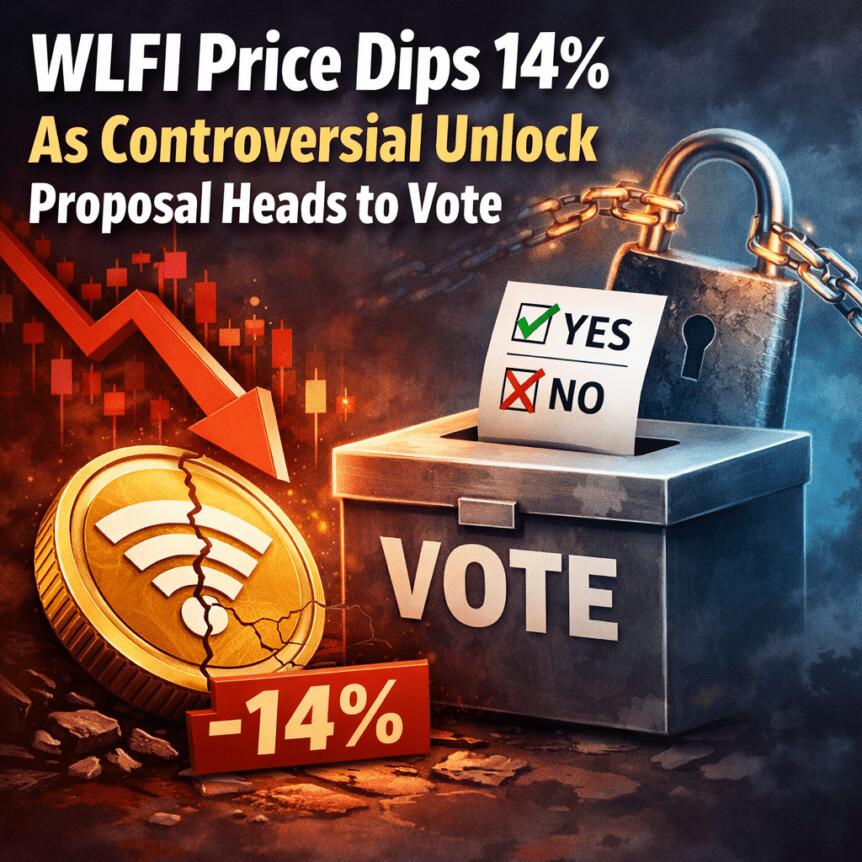
The governance proposal around World Liberty Financial (WLFI), a project linked to the Trump family, has moved into a formal community vote after triggering a visible crypto-market reaction. The measure would lock more than 62 billion WLFI tokens held by early investors and insiders for two years, followed by a staged release over a subsequent two to three years. The vote opened on Wednesday and is set to run through May 7, with early data showing overwhelming support but sparking a heated debate within the community about long-term tokenomics and governance control.
According to the proposal, 62,282,252,205 WLFI tokens would be subjected to a multi-year vesting schedule designed to keep a large portion of supply off the market for an extended period. The structure calls for a two-year cliff for early holders, after which a two-year linear vesting would release tokens gradually. For insiders such as founders, team members and advisers, the plan envisions a two-year cliff followed by a three-year linear vest. The intention, as described by World Liberty Financial, is to ensure token holders remain committed to the project’s long-term trajectory and to provide a more bounded picture of governance preferences.
As voting commenced, WLFI supporters appeared to outnumber critics by a wide margin. At the time of reporting, the tally showed about 6 billion votes in favor versus roughly 3.2 million against, with the voting quorum of 1 billion WLFI tokens already met. World Liberty Financial highlighted the governance move as a pivotal moment in the project’s history, asserting that none of the locked tokens would touch the market for at least two years if the proposal passes. The stance was echoed on the project’s official X (formerly Twitter) account.
Key takeaways
- Locking 62.28 billion WLFI tokens held by early investors and insiders under a two-year cliff, then releasing over two to three years.
- Insiders face a two-year cliff with a three-year linear vest; early investors face a two-year cliff with a two-year linear vest.
- The live vote shows overwhelming support (about 6 billion in favor vs. 3.2 million against) with the quorum already reached; voting continues through May 7.
- WLFI price activity reflects market skepticism around multi-year vesting, with the token trading around $0.06367 and showing a notable decline in recent days.
Governance mechanics and tokenomics at stake
The proposed schedule targets a gradualized unlock that shifts the token’s liquidity dynamic away from immediate market exposure. Proponents argue the structure helps align governance incentives with long-term project success, ensuring that those with a material stake remain vested in WLFI’s ongoing development. The two-year cliff for all participants, followed by staged releases, is meant to produce a predictable supply trajectory rather than the abrupt changes typical of abrupt unlock events.
Critics, however, have raised questions about both the underlying logic and practical effects. Observers have pointed to the length of the vesting windows and the potential for a prolonged liquidity constraint to distort price discovery or constrain market-making activity. The broader governance conversation also touches on whether the mechanism adequately captures the diverse interests of holders who may not participate in voting yet would be affected by the lockup.
The debate has been fueled by comments from notable crypto figures. Earlier coverage highlighted commentary from Moonrock Capital founder Simon Dedic, who described the proposal as akin to a rug pull and questioned the alignment of a two-year unlock with political timelines. Justin Sun, a WLFI stakeholder and founder of the Tron network, labeled the proposal among the most “absurd” he has seen. Those criticisms were echoed in the public replies to World Liberty Financial’s vote announcement, where many community members criticized the structure and its perceived centralization of control.
World Liberty Financial has defended the plan as a way to promote clear governance preferences and to keep token ownership among those genuinely committed to the project’s long-term success. In posts accompanying the vote launch, the team framed the mechanism as a deliberate attempt to reduce speculative activity and to anchor decision-making among core supporters rather than transient participants.
Market reception and investor considerations
Market reaction to the unfolding governance vote has been prominent. Data from CoinGecko at the time of writing places WLFI around $0.06367, reflecting a roughly 13.6% drop in the previous 24 hours and a broader decline of about 72.8% from its open-market level. The price action underscores the sensitivity of WLFI to news around tokenomics and governance, where a major change to supply and vesting can influence short-term sentiment as investors reassess risk and liquidity implications.
Those tracking WLFI’s trajectory will be watching how the market prices in the implications of a long-term token lock. If the proposal passes, the restricted supply could support a longer-duration price stabilization argument, though actual liquidity will depend on secondary-market dynamics, the pace of vesting, and how quickly counterbalancing investor activity returns to the market. If the proposal fails, WLFI could face renewed questions about governance efficacy and the distribution of control among early holders, insiders, and broader token holders.
Cointelegraph has reached out to World Liberty Financial for comment on the current vote and the broader governance framework. The initiative also reflects a wider conversation in the crypto space about how to balance founder and investor incentives with open, inclusive governance that can withstand scrutiny from a diverse set of stakeholders.
For readers seeking more context, related coverage has explored how other major industry players are navigating governance and token unlocks, and how these decisions impact investor confidence and platform adoption. The broader narrative around regulatory clarity, governance design, and long-horizon token economics continues to shape sentiment across communities tracking WLFI and similar projects.
As the vote unfolds, observers should monitor not only the final tally but also how the WLFI community discusses and interprets the proposed constraints on liquidity and the implications for future governance proposals. The outcome could influence how WLFI approaches future token economics and whether similar governance structures become a template for other projects seeking to anchor long-term commitment among core stakeholders.
Source: World Liberty Financial via its X post and the coverage from Cointelegraph. The live voting and related details are documented in the project’s governance portal and official communications noted in the cited coverage.
Readers are encouraged to verify developments as the May 7 voting deadline approaches and to consider how such governance models may shape investor risk, participation incentives, and the broader market’s appetite for long-term, locked-token strategies.
traders are taking risks, sending the token’s price sharply higher, even as the rally in market leader bitcoin stalls.
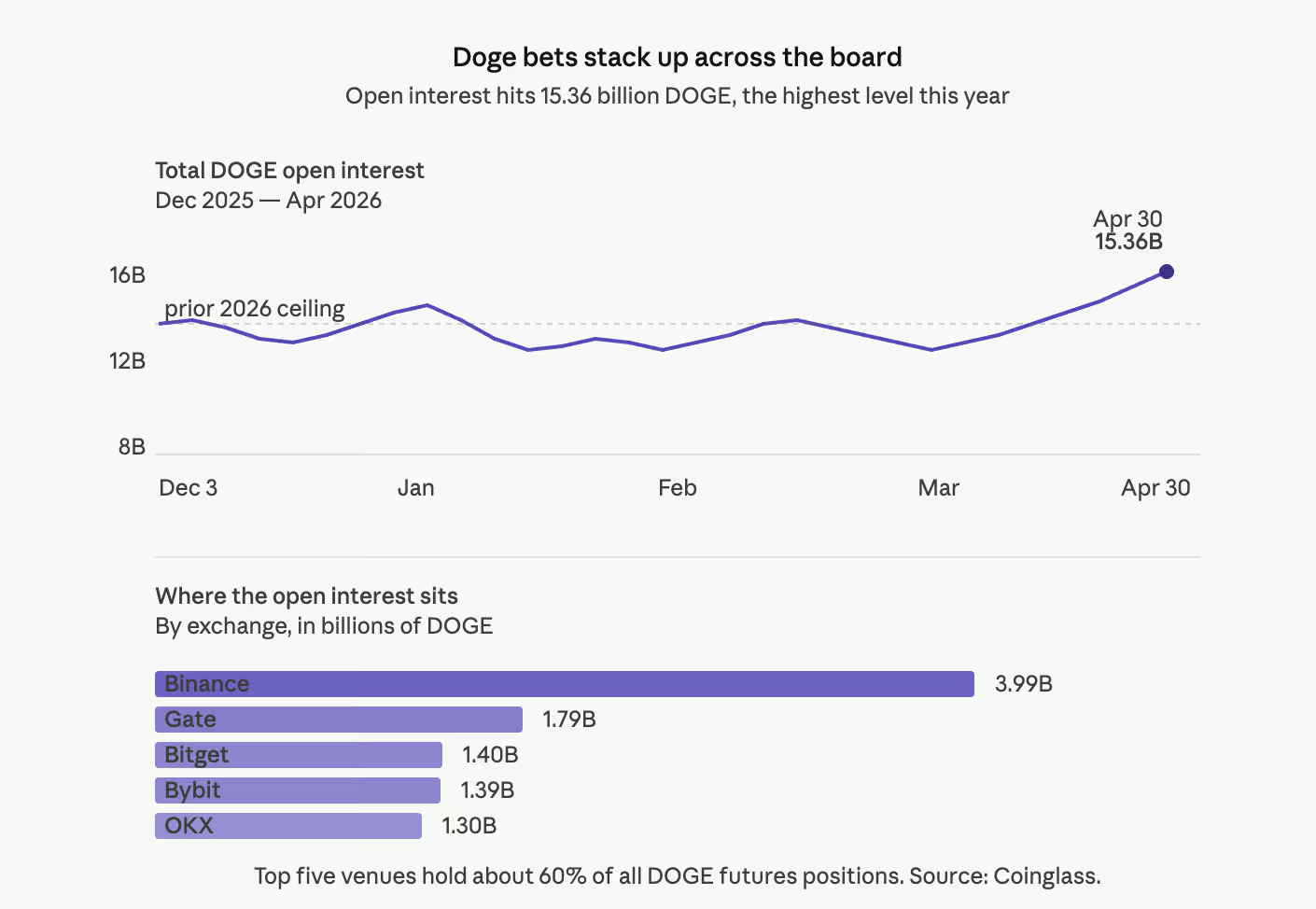
It’s evident in the futures market where open interest in DOGE futures has risen to 15.36 billion tokens, the highest level this year, according to Coinglass. Open interest (OI) refers to the number of active contracts at any given time.
The upswing in open interest suggests more traders are chasing leveraged directional plays, a sign of strong risk sentiment in the market.
DOGE’s price has climbed nearly 10% over the past week, briefly pushing above 11 cents before settling near $0.105 as of writing, according to data source CoinDesk. Bitcoin, meanwhile, has pulled back below $76,000 after trading above $79,000 earlier this week.
The combination of rising spot price and futures OI suggests that new money is entering the market rather than old positions being closed. The pattern is said to reinforce the prevailing market trend, which is bullish, in DOGE’s case. However, it also leaves the market more exposed to sharp liquidations if momentum reverses.
Binance accounted for nearly 3.99 billion DOGE in open interest, followed by Bitget, Bybit, and OKX, each with more than 1 billion DOGE, data shows. Hyperliquid, MEXC, WhiteBIT, and KuCoin also showed sizable positions, pointing to a move not confined to a single venue.

DOGE’s rally comes after weeks of sideways trading and a broader return of speculative interest across majors earlier in the week.
Market observers such as Jordan Jefferson, founder of DogeOS and MyDoge, said in a message to CoinDesk that several catalysts may be contributing to demand for the token.
“DOGE’s price move isn’t tied to a single news event,” Jefferson said. “Over the past week, large holders added more than 500 million DOGE. 21Shares listed a physically backed ETP on Xetra, and Grayscale flows turned positive after nine straight days of outflows. On-chain activity is also up, with active addresses rising 28%.”
Those flows matter because DOGE’s market structure tends to respond quickly when spot accumulation, derivatives leverage, and retail narratives align.
The token has historically traded less like a payments asset and more like an attention-driven macro meme, where positioning can accelerate fast once traders believe a familiar catalyst is back in play.
The X payments angle remains a swing factor, but the least concrete part of the DOGE trade. Elon Musk has said that X Money will launch as a payments product with peer-to-peer transfers, bank deposits, a debit card and cashback rewards through X Payments, a licensed subsidiary partnered with Visa.
Nothing in the announced product indicates support for dogecoin or any crypto functionality. Still, DOGE traders could be reacting to the payments-related developments at Musk-owned companies, possibly in hopes that the token could eventually be folded into X’s financial stack. This hope comes from Musk’s vocal support for dogecoin since at least 2021. At one point, he said the token could make DeFi more accessible to everyone.
For now, traders are treating DOGE as if something bigger is building, and the futures market is where that conviction is showing first.


Besides the Clarity Act, the White House’s 2026 budget proposal targets the wash sale loophole that lets crypto traders harvest losses and immediately rebuy. It’s an illegal practice for stock investors, but entirely legal under current digital asset rules.
The proposal would apply wash sale rules to crypto for the first time, treating digital assets the same as traditional securities for tax purposes. It also includes a 30% excise tax on electricity used for crypto mining via the DAME (Digital Asset Mining Energy) tax, and a FATCA reporting requirement for U.S. taxpayers holding more than $50,000 in foreign crypto accounts.
- White House Budget 2026 proposes applying wash sale rules to crypto, closing a loophole unavailable to equity traders
- Treasury estimates the change generates $5.4 billion in revenue over 10 years
- A 30% Mining Tax on electricity costs targets proof-of-work operations directly
- FATCA reporting would extend to foreign crypto accounts over $50,000
- The proposal faces a difficult legislative path in a Congress that has been moving toward pro-crypto regulation
What the Wash Sale Rule Does
Under current law, the wash sale rule blocks stock investors from claiming a tax loss if they repurchase the same or substantially identical security within 30 days. Crypto is classified as property, not a security, which means that the rule does not apply.
Traders have used this gap aggressively, selling a Bitcoin position at a loss to lock in a deduction, then rebuying immediately to maintain exposure. That is tax-loss harvesting, and for crypto holders, it has been completely legal.
The White House proposal closes this gap. If passed, crypto would be subject to the same 30-day restriction as equities.
Discover: The best crypto to diversify your portfolio with
Does This Proposal Have a Real Path Through Congress, Just Like the Clarity Act?
The political tension here is direct. The same White House that is pushing the CLARITY Act as a pro-crypto regulatory framework is simultaneously proposing crypto tax rules. That is not a contradiction to the administration; it frames the crypto tax proposal as parity, not punishment. It just lands differently on the Hill.
Congress is currently moving toward crypto-friendly legislation. The CLARITY Act debate in the Senate Banking Committee is already consuming legislative bandwidth, and a crypto tax crackdown runs against the grain of that momentum.
The SEC is simultaneously fielding major regulatory proposals, including an 85-item rule change affecting Bitcoin and XRP ETF listings, and crypto policy is being pulled in multiple directions at once.
To put this into perspective, similar wash sale proposals were floated during the Obama and Biden administrations and never cleared Congress.
Discover: The best pre-launch token sales
The post Clarity Act and Crypto Tax Loophole: White House Billions Dollar Proposal appeared first on Cryptonews.


World Liberty Financial’s proposal to unlock 62 billion WLFI tokens is already set to pass, with early votes blowing past quorum and delivering near-unanimous support.
Under the plan, founders, team members, and partners would burn 10% of their holdings, roughly 4.5 billion WLFI, to begin unlocking the remaining 40.7 billion tokens over a five-year schedule following a two-year cliff.
No tokens would reach the market for at least two years due to cliff periods. The shift marks a structural change in how WLFI is valued, replacing open-ended lockups with predictable future supply and creating a clearer exit path for holders who previously had none.
This move seems to have near-unanimous support, with 99.5% voting in favor.
The vote also highlights the structure of WLFI’s governance.
Participation levels align with prior proposals, suggesting that a relatively small group of large holders can push through major tokenomic changes with limited opposition.
Voting power is heavily concentrated among a small group of large holders. The largest wallet alone accounts for nearly 13% of votes cast, and the top four together control roughly 40% of total voting power so far, enough to heavily influence the outcome on their own.
WLFI also faces a lawsuit from Tron founder Justin Sun, who alleges the project froze his tokens and stripped his governance rights, claims the company has denied.
Key Highlights
- Bitcoin decreased 2.1% to reach $75,633 while Brent crude oil surged 7.1% to $126.41 per barrel, marking a four-year peak
- Military briefings regarding potential U.S. operations against Iran sparked the energy price rally and triggered risk-averse trading
- Leading altcoins including Ether, XRP, Solana, and BNB recorded losses; Dogecoin bucked the trend with a 3.8% increase
- Nasdaq 100 futures reversed a 1.1% gain despite positive results from Alphabet and Amazon; Meta shares declined 6%
- Market experts suggest Bitcoin requires crude prices below $100 and reduced Middle East conflict before testing $80,000
Digital currencies experienced widespread declines on Thursday as petroleum prices climbed to levels not seen in four years, fueled by emerging reports of possible U.S. military engagement with Iran.
Brent crude oil experienced a sharp 7.1% increase to $126.41 per barrel following an Axios report indicating President Donald Trump would receive briefings on updated military strategies concerning Iran. Additionally, reports suggest U.S. Central Command has requested the deployment of hypersonic missile systems to the Middle East region.
The strategically vital Strait of Hormuz has remained essentially blocked since hostilities commenced in late February. This closure has severely restricted the transportation of crude oil, natural gas, and oil products through this critical global shipping corridor.
Brent crude has now appreciated more than 100% year-to-date and continues a nine-consecutive-day advance, representing its longest winning streak since May 2022.
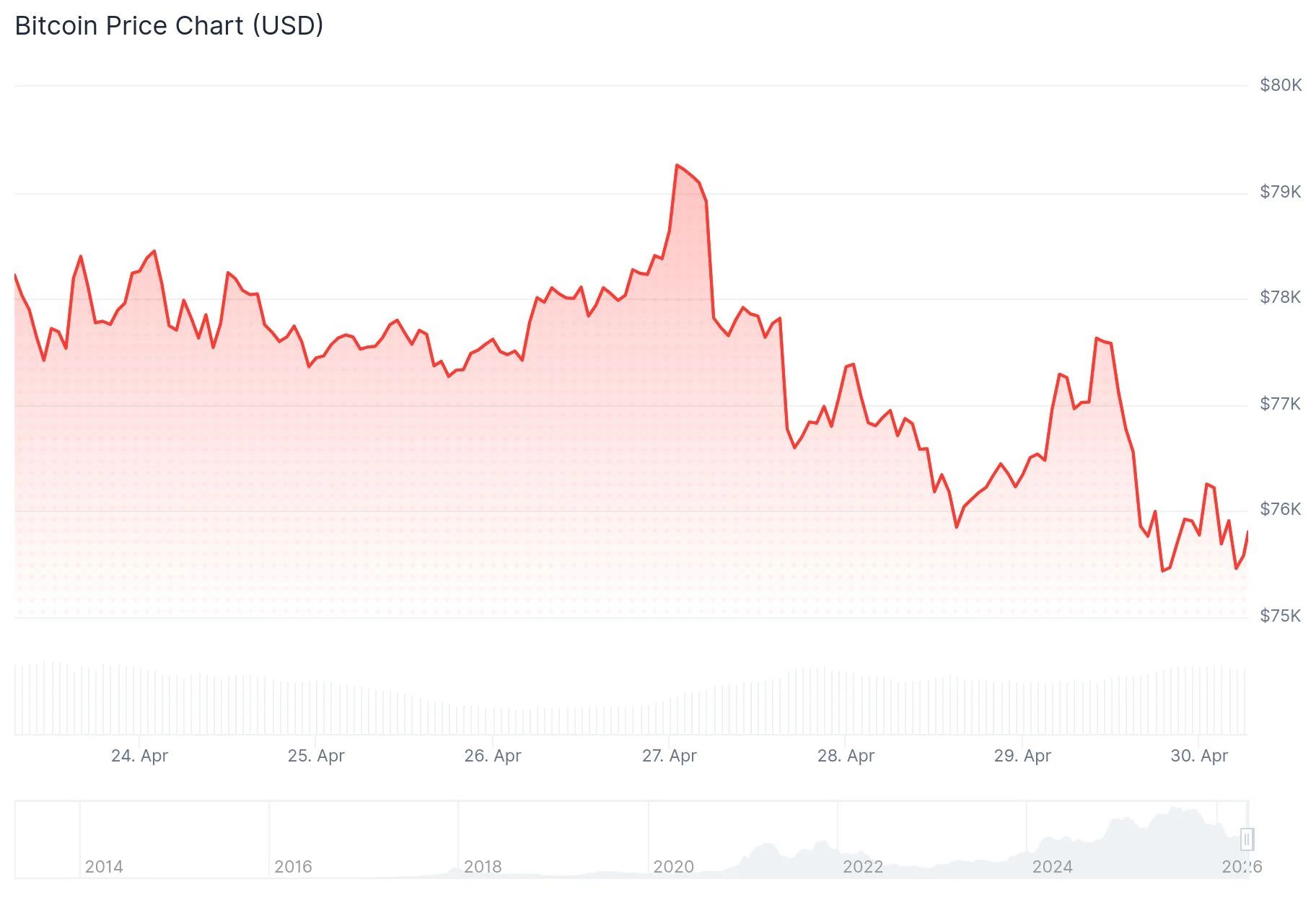
Bitcoin experienced a 2.1% decline to $75,633 during Asian market sessions. The cryptocurrency is down 3% for the week and remains approximately $50,000 below its record high of $126,000 established in October 2025.
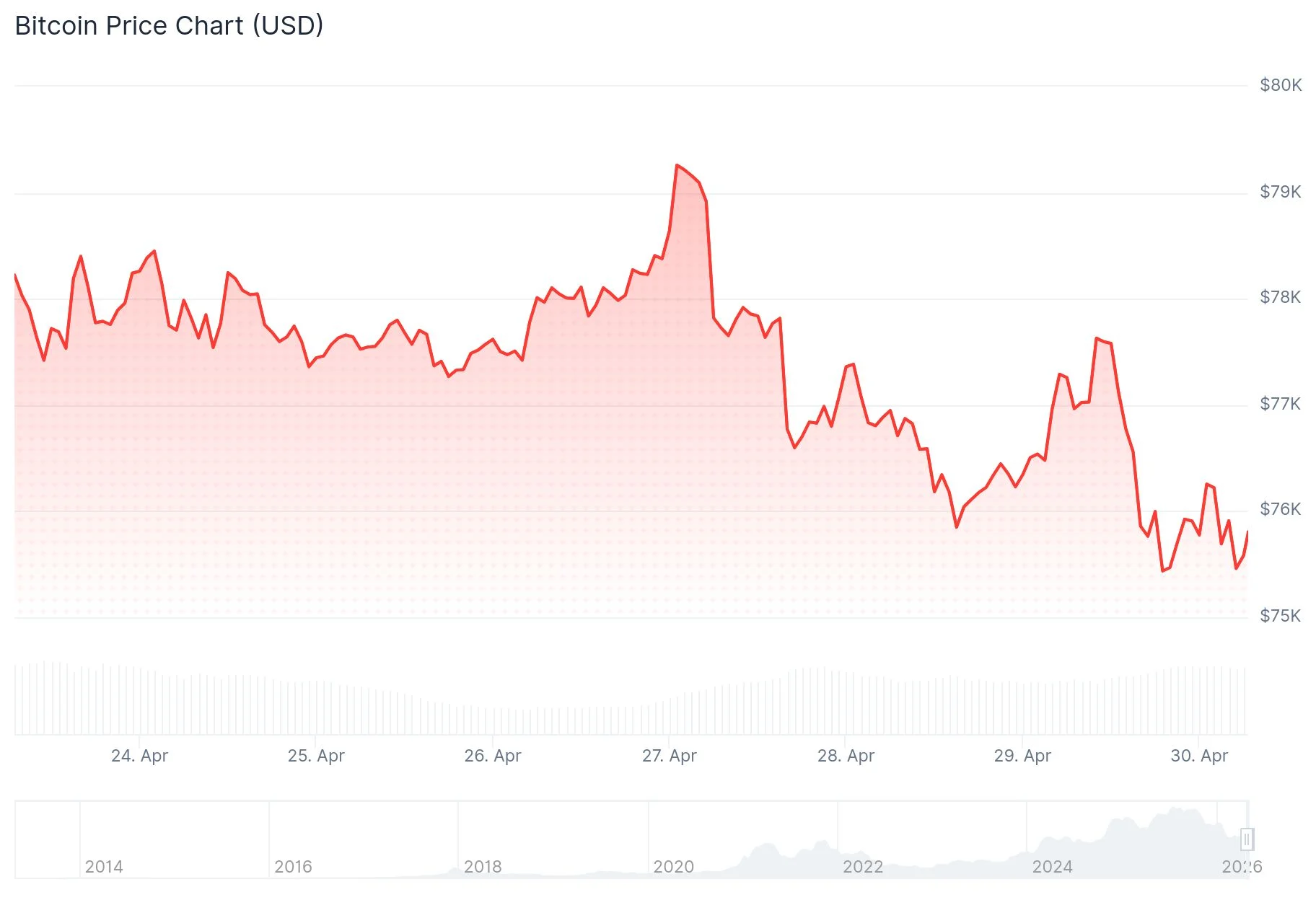
During April, Bitcoin has consolidated within a $74,000 to $78,000 range, despite oil prices ascending from $98 to $126 per barrel.
Alternative Cryptocurrencies Face Broad Selling Pressure
Ether decreased 3.4% to $2,244, recording a 4.4% weekly decline. XRP retreated 2.1% to $1.37. Solana dropped 2.6% to $82.62, while BNB declined 1.9% to $615.
Dogecoin emerged as the sole top-10 cryptocurrency excluding stablecoins to register gains, climbing 3.8% daily and 10.1% weekly to reach $0.10.
Fernando Lillo, director at cryptocurrency exchange Zoomex, indicated that Bitcoin’s ability to surpass $80,000 hinges on the reduction of war-related market premiums. He emphasized that Brent crude falling beneath $100 per barrel would be necessary, noting the direct correlation between the two assets.
Lillo further described a potential scenario in which the Trump administration might ease the Iran blockade, positioning it as recognition of constructive Iranian actions, which he suggested could propel Bitcoin toward $85,000.
Technology Sector Results Generate Divergent Market Reactions
U.S. equity futures displayed mixed performance on Thursday. S&P 500 futures advanced 0.2%, while Nasdaq 100 futures declined 0.2% and Dow futures dropped 0.6%.
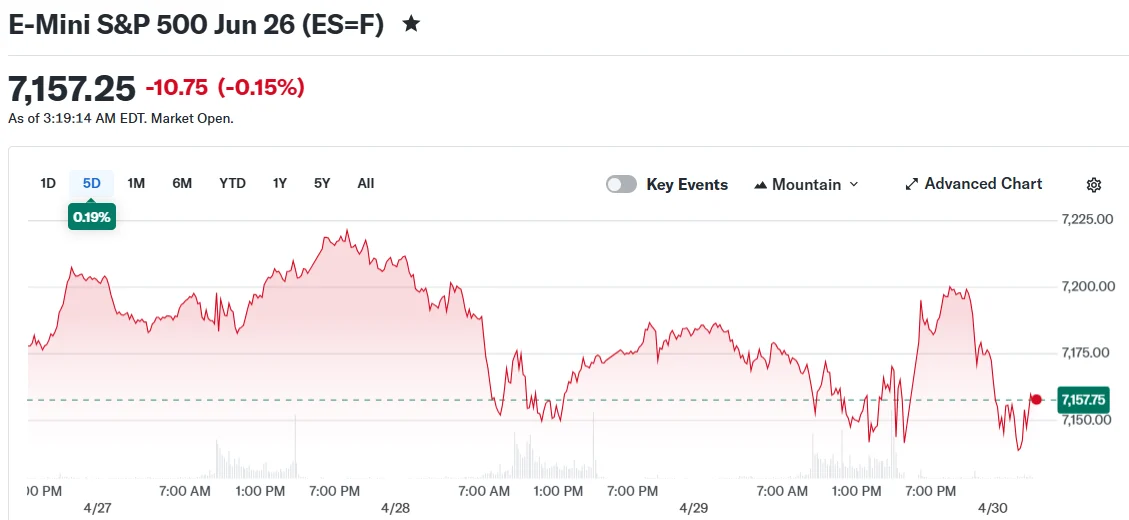
Meta shares tumbled nearly 6% following the disclosure of lower-than-anticipated capital expenditure projections and modest user growth figures. Microsoft shares remained relatively unchanged despite surpassing revenue and earnings expectations.
Alphabet climbed 6% on robust revenue performance and strong Google Cloud expansion. Amazon advanced 4% supported by impressive cloud computing metrics.
Apple is scheduled to announce earnings results following Thursday’s market closure.
The Federal Reserve maintained interest rates unchanged within the 3.5% to 3.75% target range. Fed Chair Jerome Powell indicated his intention to continue beyond his current term, referencing ongoing legal challenges confronting the central bank.
XRP has seen a sharp rise in bullish social sentiment after Rakuten Wallet launched new XRP features in Japan.
Summary
- Rakuten Wallet now lets users convert loyalty points into XRP and trade the asset.
- XRP can be used for QR payments across more than 5 million Japanese merchants.
- Santiment said XRP hit its second-highest bullish social sentiment in two years.
The update allows users to convert Rakuten loyalty points into XRP and use the asset for payments. Rakuten Wallet has launched XRP spot trading and payment features for users in Japan. The update allows customers to convert Rakuten loyalty points into XRP through the mobile app.
Users can also use XRP for payments at more than 5 million merchant locations across Japan. Payments are made through QR codes linked to Rakuten’s wider retail network.
XRP gains exposure to Rakuten users
RippleX described the launch as one of the largest retail deployments of XRP to date. Rakuten Pay has about 44 million active users, giving XRP access to a large consumer base.
The Rakuten ecosystem also has more than 3 trillion loyalty points in circulation. That equals about $23 billion in points that can now be converted into XRP.
Santiment reports rising XRP sentiment
Santiment said XRP is now seeing its second-highest bullish sentiment across social media in two years. The platform linked the rise partly to the Rakuten integration.
Santiment said these events do not often cause instant price breakouts. It added that price effects may appear after early excitement and FOMO cool down.
Despite the adoption news, XRP traded at $1.37 at the time of reporting. The token fell 1.77% in 24 hours and 3.66% over the past week.
XRP has a market cap of about $84.42 billion, with 62 billion tokens in circulation. Santiment noted that XRP’s market value has declined about 55% over the past nine months.
Rakuten Wallet is also running a promotion for early users. Customers who buy 30,000 yen or more in XRP can receive 500 yen worth of XRP, while those buying 100,000 yen or more can receive 1,500 yen.
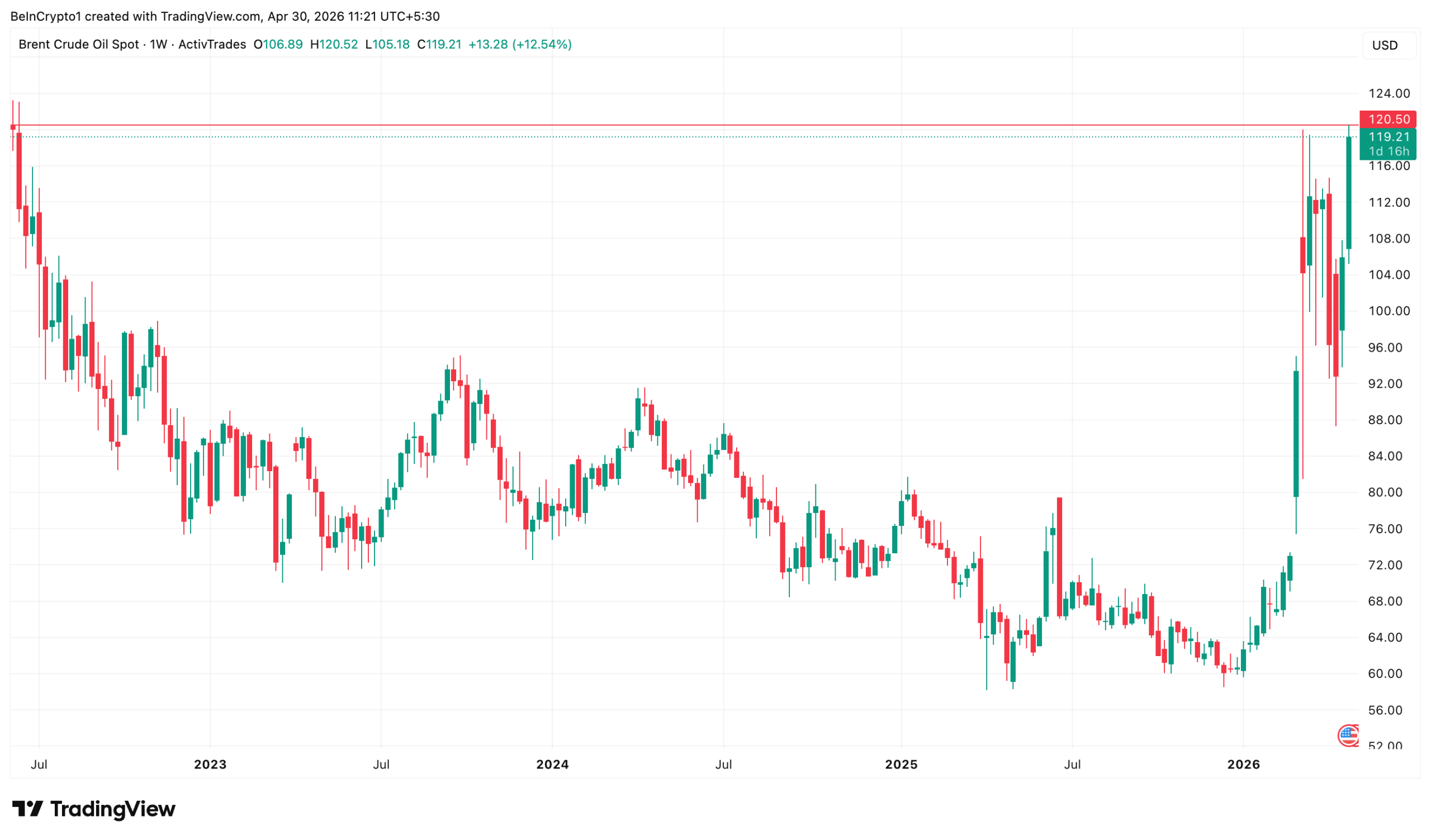
Brent crude oil pushed past $120 a barrel today. This marked its highest level since June 2022, as the US-Iran conflict showed no signs of easing.
The global benchmark has now rallied roughly 47% since the US-Israeli strikes on Iran in late February.
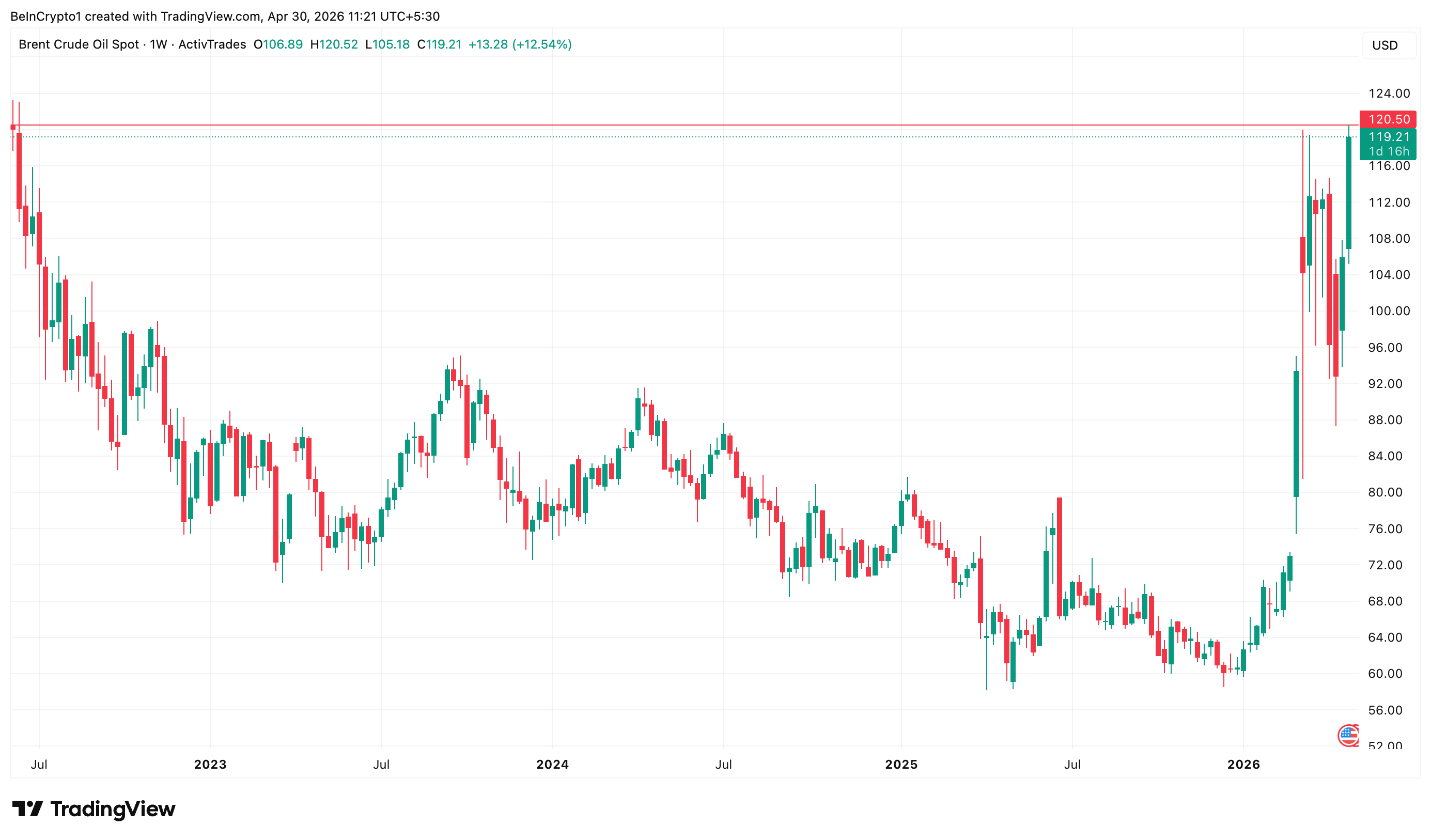
The broader energy complex also moved higher on Thursday. US crude oil gained 2.59%, gasoline was up 1.44%, and heating oil advanced 3.28%. European gas benchmarks followed the trend, with TTF gas climbing 2.81% and UK gas up 2.03%.
Why is Brent Crude Up Today?
Media reports indicate that the latest market surge was triggered by renewed geopolitical tensions surrounding the US and Iran, raising fears of a potential escalation in conflict.
Axios, citing two sources, revealed that President Donald Trump is expected to receive a briefing on possible military action against Iran from CENTCOM Commander Adm. Brad Cooper. The development has heightened concerns that armed hostilities could resume.
Separately, The Wall Street Journal reported that the president had directed aides to prepare for an “extended” blockade of Iran’s ports, a move aimed at increasing pressure on Tehran.
Follow us on X to get the latest news as it happens
Iran has pushed back. Al Jazeera noted that Parliament Speaker Mohammad Bagher Ghalibaf dismissed Washington’s economic pressure campaign. In addition, the Iranian military stated that its restraint so far has been intended to allow room for diplomacy.
Meanwhile, diplomatic efforts appear to have stalled, with planned US-Iran talks in Islamabad failing to materialize over the weekend. This has further fueled concerns that the fragile ceasefire currently in place could break down.
BeInCrypto reported that global energy markets are facing mounting pressure as supply tightens. Iran, facing storage limits due to restricted exports, may be forced to cut production.
These constraints, coupled with ongoing disruptions to tanker traffic through the Strait of Hormuz, continue to trigger volatility across global oil markets.
Subscribe to our YouTube channel to watch leaders and journalists provide expert insights
The post Brent Crude Jumps to 4-Year High as US-Iran Standoff Deepens appeared first on BeInCrypto.


American aerospace manufacturer SpaceX has approved a fresh compensation package for its founder, Elon Musk.
The plan, disclosed in a confidential US Securities and Exchange Commission (SEC) filing, highlights one of the most ambitious pay structures in corporate history.
What Will Elon Musk Get in SpaceX’s New Pay Package?
According to Reuters, the board approved the package in January 2026, granting Musk up to 200 million super-voting restricted shares. The tranche unlocks only when SpaceX reaches a $7.5 trillion market capitalization and a permanent settlement of 1 million residents on Mars.
A separate tranche awards up to 60.4 million restricted shares. This is contingent on the company meeting separate valuation targets and operating space-based data centers with at least 100 terawatts of compute capacity.
“Both awards come with super-voting Class B restricted stock, which carries 10 votes to every 1 Class A share, and vest in tranches as the company’s value rises,” the report read.
Should Musk fall short of the targets, he receives no shares. These carry no fixed timeline other than his continued employment at the company. Musk’s base salary remains at $54,080 per year, unchanged since 2019.
Follow us on X to get the latest news as it happens
Interestingly, SpaceX’s IPO filing also indicates that Elon Musk will retain control over his leadership position.
“The filing states that Musk ‘can only be removed from our board or these positions by the vote of Class B holders’ – super-voting shares with ten votes apiece that he will control after the IPO, making his removal effectively a self-vote. If he ‘retains a significant portion of his holdings of Class B common stock for an extended period of time, he could continue to control the election and removal of a majority of our board.’” Reuters reported.
BeInCrypto reported that SpaceX is advancing toward a June IPO after confidentially filing with the SEC. The company is aiming for a valuation of up to $1.75 trillion. Its pre-IPO valuation on Jupiter’s Prestocks platform is currently around $1.68 trillion.
The post SpaceX Ties Musk’s 200 Million-Share Award to Mars Colony and $7.5 Trillion Valuation appeared first on BeInCrypto.
Crypto World
Tapbit Reinforces Transparency with Proof of Reserves and Independent Security Validation by CertiK

Tapbit today announced it has integrated real-time infrastructure monitoring from blockchain security firm CertiK, complementing its existing Proof of Reserves (PoR) framework to meet institutional demands for verifiable exchange data.
Independent Security Validation
The assessment, completed in August 2025, evaluated Tapbit’s mobile, web, and backend systems using a combination of dynamic testing, manual review, and simulated attack scenarios.
The results identified no critical or high-risk vulnerabilities, with findings primarily categorized as medium, low, and informational levels.
This outcome reflects a baseline security posture aligned with industry standards, while also highlighting areas for continuous optimization as part of an evolving infrastructure.
Rather than representing a one-time certification, the assessment contributes to a broader framework of ongoing security evaluation and improvement.

Proof of Reserves and Transparency Framework
In parallel with its security initiatives, Tapbit has implemented Proof of Reserves (PoR) mechanisms designed to provide verifiable insight into asset backing.
By enabling users to validate reserve data through third-party platforms, the exchange reduces reliance on internal disclosures and aligns with emerging industry practices focused on cryptographic transparency.
This approach reflects a wider market transition—from self-reported credibility toward independently verifiable trust models.
Industry Context: From Claims to Verification
The integration of third-party security assessments alongside Proof of Reserves highlights a broader shift within the digital asset ecosystem.
As users and regulators place increasing emphasis on transparency and accountability, exchanges are moving beyond static security claims toward frameworks that emphasize continuous validation, monitoring, and disclosure.
In this environment, independently verified data is becoming a critical factor in evaluating platform reliability.
CEO Perspective
“Trust in today’s market must be grounded in continuous verifiability, not merely assumed goodwill,” said Milton Cogo, Chief Executive Officer of Tapbit. “As the digital asset industry matures alongside broader financial markets, participants are shifting away from static internal disclosures. They are demanding independently validated data and real-time monitoring systems to accurately evaluate platform reliability.”
He also noted that by integrating CertiK’s advanced security validation with our cryptographic Proof of Reserves, we aren’t just checking compliance boxes. We are actively building a robust, institutional-grade architecture that prioritizes long-term operational integrity and sets a higher standard for accountability across the ecosystem.
Conclusion
As the digital asset industry continues to evolve toward a more structured and accountability-driven phase, the ability to demonstrate independently verified security and asset transparency is becoming a defining factor in long-term platform credibility.
Tapbit’s adoption of both Proof of Reserves and third-party security validation underscores a measured approach to growth—one that prioritizes transparency, resilience, and verifiable trust as core pillars of platform development.
About CertiK
CertiK is a leading blockchain security firm specializing in smart contract auditing, formal verification, and continuous security monitoring. The company provides independent security assessments and real-time risk intelligence for Web3 projects, exchanges, and decentralized applications, contributing to enhanced transparency and security standards across the digital asset ecosystem.
About Tapbit
Tapbit is a global digital asset trading platform established in 2021, offering cryptocurrency derivatives trading alongside spot and copy trading services. Operating across more than 190 regions, the platform serves a growing international user base while maintaining a disciplined focus on performance, structural stability, and accessibility.
Built on a high-performance infrastructure engineered for efficiency in dynamic market environments, Tapbit integrates a layered risk management framework with continuous system optimization. Its product architecture is designed to balance advanced trading functionality with intuitive usability, enabling both experienced and emerging participants to engage within a streamlined, user-centric environment.
In parallel with its technological development, Tapbit places strong emphasis on transparency and operational integrity. Through the implementation of structured risk controls and independently verifiable frameworks, the platform aligns with evolving industry expectations around accountability, trust, and long-term sustainability in digital asset markets.
Guided by a long-term strategic vision, Tapbit continues to evolve alongside the broader maturation of the industry, with a focus on strengthening resilience, enhancing system reliability, and supporting a more stable and sustainable trading ecosystem for global participants.
Connect with Tapbit
For further information regarding Tapbit and its ongoing developments, please refer to the platform’s official channels:
Official Website | X (Twitter) | Telegram | TikTok | Instagram | LinkedIn
Updates relating to product developments, platform initiatives, and corporate announcements are published regularly through these official communication channels.
The Tapbit mobile application is available for download, providing users with access to its trading services across multiple devices.

The post Tapbit Reinforces Transparency with Proof of Reserves and Independent Security Validation by CertiK appeared first on BeInCrypto.

Key Takeaways
- The Federal Reserve maintained interest rates at 3.50%–3.75% for its fourth consecutive policy meeting
- Four FOMC members dissented: one advocated for a 25-basis-point reduction, while three pushed to eliminate dovish language
- Powell’s chairmanship concludes May 15; this meeting marked his probable final session
- Kevin Warsh successfully passed the Senate Banking Committee review and is positioned to succeed Powell
- Bitcoin retreated to levels just under $76,000 while the Nasdaq declined 0.35% after the announcement
The Federal Reserve opted to maintain its key interest rate in the 3.50%–3.75% range during Wednesday’s policy meeting, marking the fourth straight session without adjustment.
Policymakers emphasized their focus on balancing stubborn inflationary pressures against emerging indicators of economic deceleration. The committee’s official statement noted it will “carefully assess incoming data, the evolving outlook, and the balance of risks” prior to implementing any policy shifts.
The rate decision produced four dissenting votes. Fed Governor Stephen Mirran advocated for a 25-basis-point rate reduction.
The remaining three dissenters—Beth Hammack, Neel Kashkari, and Lorie Logan—supported maintaining current rates but opposed keeping forward guidance that hints at potential cuts. This dynamic creates challenges for incoming leadership.
This policy meeting likely represented Jerome Powell’s final appearance as chair. His tenure concludes on May 15.
Kevin Warsh, widely anticipated to assume the role, secured approval from the Senate Banking Committee on Wednesday. He appears set to transition into the chairmanship upon Powell’s departure.
The three hawkish dissenting votes indicate Warsh may encounter internal resistance should he pursue rate reductions. Achieving consensus among members concerned about inflation will be essential.
Financial markets responded to the announcement. Bitcoin decreased approximately 0.5% across 24 hours, hovering just beneath the $76,000 threshold.
Market Response to Federal Reserve’s Rate Decision
The Nasdaq registered a 0.35% decline. Treasury yields advanced, with the two-year note increasing 9 basis points to reach 3.93% and the 10-year climbing 5 basis points to 4.40%.
Elevated yields typically exert downward pressure on growth-oriented equities and speculative assets including cryptocurrencies. Wednesday’s market adjustments remained relatively contained but demonstrated consistent directionality.
Oil prices contributed an additional dimension to the Fed’s policy dilemma. WTI crude hovered near $105 per barrel, approaching post-conflict peaks.
Balancing Act: The Fed’s Dual Mandate Dilemma
Energy market dynamics directly influence headline inflation metrics, creating additional complexity for monetary policymakers. Elevated oil costs simultaneously threaten economic expansion, positioning the Fed between its dual objectives: price stability and economic support.
Powell was anticipated to elaborate on monetary policy direction during his post-decision press briefing. Market participants scrutinized his remarks for indications regarding the trajectory and timing of potential rate adjustments.
The Fed avoided committing to a specific policy path. Officials stated future decisions will be contingent upon forthcoming economic data and evolving macroeconomic conditions.
Bitcoin traded marginally below $76,000 when the decision was announced, while the Nasdaq maintained moderate losses heading into Powell’s press conference.

Rockets stay alive, pressure shifts to Lakers after Houston’s Game 5 win

Appeals Court Dumps California Law That Would Have Banned Federal Officers From Wearing Masks

York – firefighters from two counties at Tockwith house fire

Manchester United reach agreement with Casemiro over contract clause amid transfer speculation

US brings back mandatory military draft registration

Steven Gerrard disagrees with Gary Neville over ‘shock’ Chelsea and Arsenal claim | Football


-

 Tech3 days ago
Register Renaming | Hackaday
-

 Fashion6 days ago
Weekend Open Thread – Corporette.com
-
Crypto World5 days ago
Hyperliquid $HYPE Rally Builds Momentum as AI Sector Enters Prove-It Phase
-

 Business6 days ago
Patterson-UTI Energy, Inc. (PTEN) Q1 2026 Earnings Call Transcript
-
 Sports4 days ago
IPL 2026: Ruturaj Gaikwad registers slowest fifty of the season, enters all-time unwanted list | Cricket News
-

 Politics2 days ago
Drax board avoid their own AGM, accused of greenwashing & environmental racism
-

 NewsBeat4 days ago
LK Bennett closes all stores after entering administration
-

 Crypto World6 days ago
Michael Saylor says BTC winter is over. Market analyst disagrees, says bitcoin was in a pullback
-

 Fashion1 day ago
Kylie Jenner’s KHY Enters a New Era with ‘Born in LA’
-

 Tech3 days ago
Images of Samsung’s rumored smart glasses have leaked
-
Entertainment7 days ago
Michael B. Jordan and Austin Butler's “Miami Vice” movie will bring the action back to the '80s
-
 Entertainment5 days ago
Mariah Carey Slams Deposition Claims In Brother’s Lawsuit
-
Entertainment7 days ago
Russell Brand Had Sex With 16 Year Old When He Was 30
-

 Business1 day ago
Most Commercial Energy Audits Miss the Real Losses
-
Crypto World6 days ago
Is Algorand One of the Few Quantum-Resistant Blockchains? Here’s What the Data Shows
-
 NewsBeat6 days ago
Trump threatens to review UK’s claim to Falkland Islands and punish Nato allies over Iran war disagreement
-

 Sports7 days ago
2026 NFL Draft tonight: Time, TV channel, where to watch, order
-

 Sports7 days ago
Bayern Munich on the brink of historic ‘double treble’
-
 Business6 days ago
Jeanine Pirro announces closure of Federal Reserve building cost probe
-

 Business3 days ago
(VIDEO) Charlize Theron Climbs Times Square Billboard to Promote New Netflix Thriller ‘Apex’
You must be logged in to post a comment Login