

Crypto World
Crypto bank takes stake in Strategy’s STRC



Anchorage Digital, the federally chartered U.S. crypto bank, signaled deepening institutional conviction in Bitcoin by disclosing it holds perpetual preferred stock issued by Strategy on its balance sheet.
Summary
- Anchorage Digital disclosed holdings of Strategy’s Nasdaq-listed perpetual preferred stock (STRC), signaling strategic alignment with the leading corporate Bitcoin treasury firm.
- Strategy recently completed its 100th Bitcoin purchase, bringing total holdings to over 717,000 BTC and reinforcing its role in institutional Bitcoin accumulation.
- The move follows Anchorage’s $100 million equity investment from Tether and may support its broader strategic initiatives ahead of a potential IPO.
Anchorage Digital backs Strategy’s Bitcoin play with STRC bet
CEO Nathan McCauley framed the move as a meaningful alignment between the company that “operationalizes Bitcoin infrastructure” and the firm that has become synonymous with corporate Bitcoin accumulation.
McCauley posted on social platform X that the investment in STRC, Strategy’s perpetual preferred security, underscored conviction rather than casual interest in digital assets.
STRC is a Nasdaq-listed perpetual preferred security that pays an attractive annual dividend, roughly 11.25% before expenses, and is closely tied to Strategy’s Bitcoin treasury strategy.
Strategy, led by executive chairman Michael Saylor, has aggressively expanded its Bitcoin holdings through regular purchases funded by equity and preferred stock offerings. The firm recently marked its 100th Bitcoin acquisition, adding another 592 BTC and bringing its total to more than 717,000 coins, roughly 3% of all Bitcoin in circulation.
McCauley’s post was met with affirmation from Saylor himself, who echoed the sentiment that “conviction is contagious,” offering a rare glimpse into how significant institutional actors are positioning around Bitcoin beyond simple custodial services or trading exposure.
Anchorage Digital declined to disclose the size or timing of its holdings, but McCauley described the move as more than symbolic, suggesting that when a regulated crypto bank puts capital alongside the world’s largest dedicated corporate Bitcoin holder, it speaks to confidence in Bitcoin’s long-term relevance.
The bank’s move follows a $100 million equity investment from stablecoin issuer Tether and precedes Anchorage’s planned IPO.



Ethereum co-founder Vitalik Buterin has outlined sweeping changes to the network’s core consensus design following the release of the Ethereum Foundation’s new “strawmap,” a long-range technical roadmap aimed at accelerating layer-1 upgrades through the end of the decade.
Summary
- Vitalik Buterin outlined plans to reduce Ethereum slot times from 12 seconds toward as low as 2 seconds, with finality potentially dropping to 6–16 seconds.
- The Ethereum Foundation’s “strawmap” sketches seven forks through 2029, targeting faster UX, gigagas throughput, post-quantum security, and privacy.
- Upgrades include erasure-coded P2P networking, reduced attester counts, Minimmit-based finality, and eventual quantum-resistant cryptography.
Vitalik Buterin explains Ethereum Strawmap vision
In a detailed post, Buterin walked through one of the roadmap’s central goals: “fast L1,” which seeks to progressively reduce slot times and dramatically cut finality. Ethereum’s current average finality sits at roughly 16 minutes.
Under the proposed trajectory, slot times could gradually fall from 12 seconds to as low as 2 seconds, while finality could shrink to between 6 and 16 seconds using a one-round BFT-style algorithm known as Minimmit.
Buterin emphasized that slot time reductions would occur incrementally, potentially following a “sqrt(2) at a time” formula, and only when proven safe. Key enablers include peer-to-peer networking upgrades using erasure coding to improve block propagation efficiency, as well as architectural adjustments that reduce signature aggregation overhead by limiting the number of attesters per slot.
The strawmap, introduced by Ethereum Foundation researcher Justin Drake, presents five long-term “north stars”: fast L1, gigagas L1 throughput, teragas L2 scaling, post-quantum security, and native privacy. It spans seven projected forks through 2029, with upgrades grouped across consensus, data, and execution layers.
Buterin noted that many of the most invasive changes, including quantum-resistant hash-based signatures, may be bundled together in a gradual “ship of Theseus” style replacement of Ethereum’s consensus system.
While the document is described as a coordination tool rather than an official roadmap, it signals a push toward faster user experience, stronger cryptography, and end-to-end formal verification.
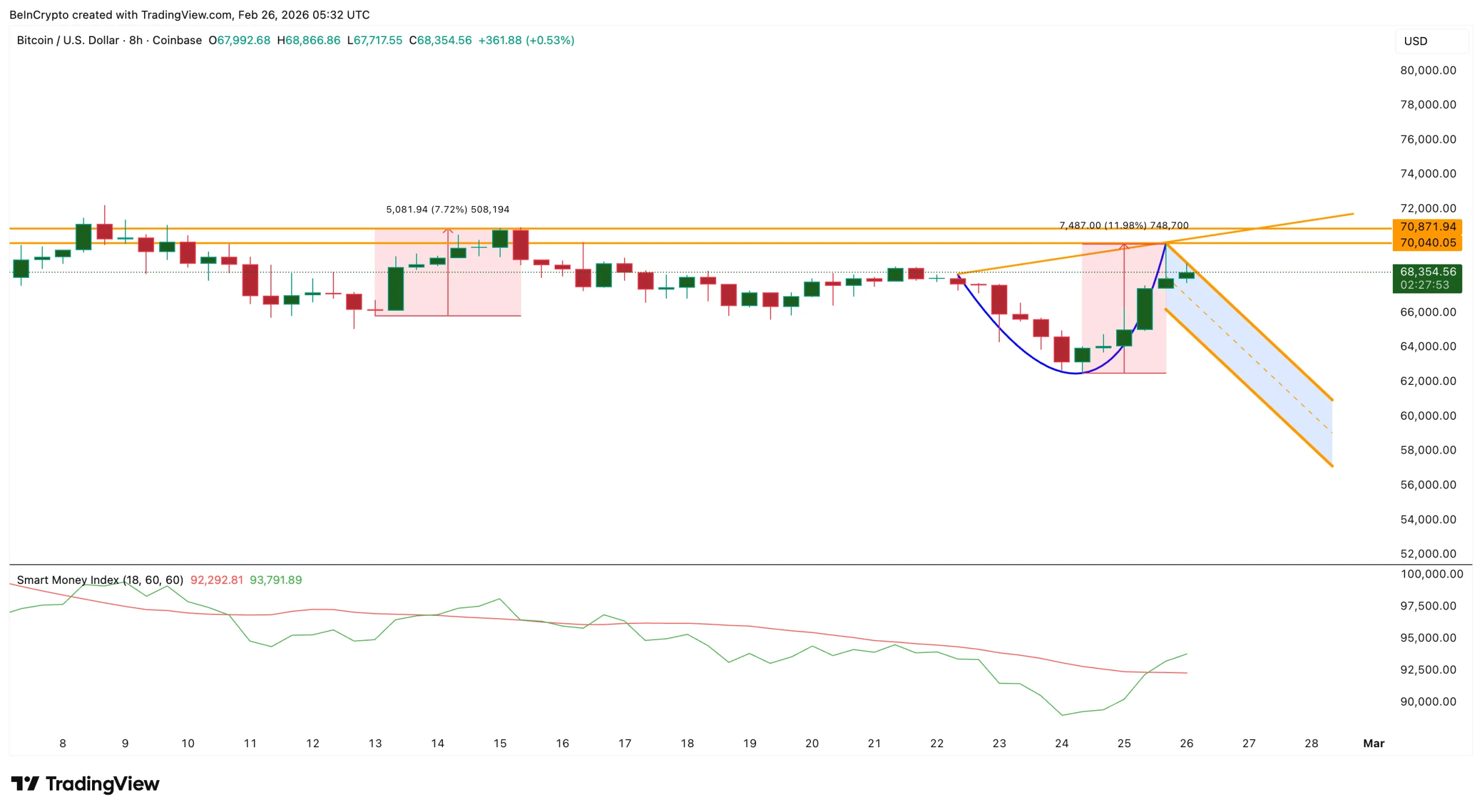
Bitcoin price is up nearly 5% in the past 24 hours, briefly touching the $70,000 level before pulling back toward $68,000. This rebound helped Bitcoin recover almost 12% from its February 24 low.
But despite this strong move, Bitcoin could not hold above $70,000. This hesitation is not random. It reflects a deeper issue that Dessislava Ianeva, Research Analyst at Nexo, says is still limiting Bitcoin’s recovery. Multiple data points now show that while buy signals are appearing, conviction remains weak. And until Bitcoin clears the $70,000 to $70,800 zone, this recovery may remain incomplete.
Smart Money Signals Price Recovery, But Breakout Still Needs Confirmation
Bitcoin’s recent rebound did not happen without warning. One key indicator called the Smart Money Index (SMI) began rising on February 24. This indicator tracks the trading behavior of informed traders, often linked to strategic positioning. When this index rises, it suggests experienced investors may be positioning early.
The last time this happened was February 13, when the SMI started moving toward the signal line. Back then, the Bitcoin price climbed about 7% over two days.
Want more token insights like this? Sign up for Editor Harsh Notariya’s Daily Crypto Newsletter here.
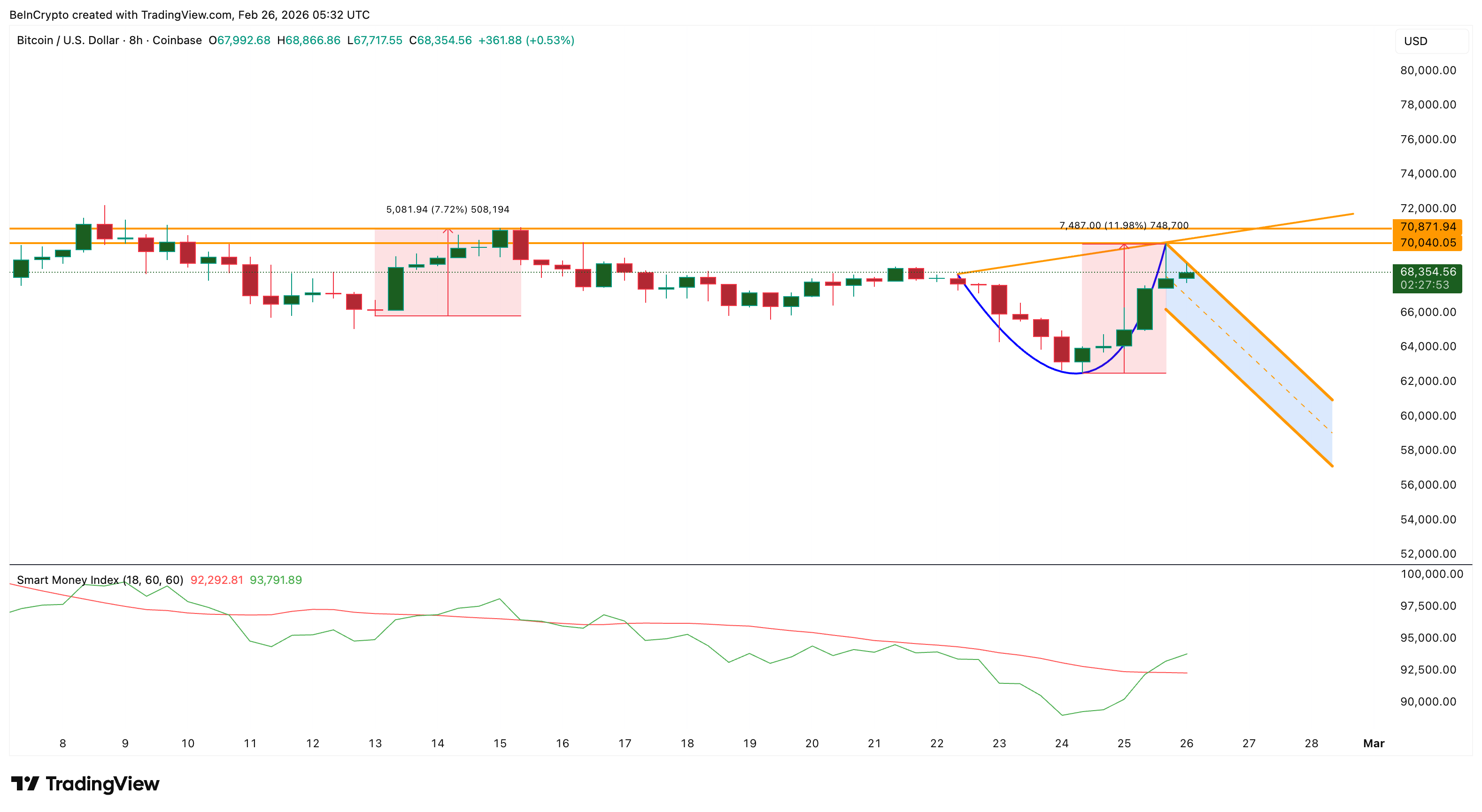
This time, the move was stronger. Bitcoin jumped nearly 12%, briefly touching $70,000. At the same time, Bitcoin is now forming what appears to be a cup and handle pattern. This is a bullish structure. It often appears before breakouts.
But the breakout is not confirmed yet. Because Bitcoin is still stuck below the critical upsloping neckline zone between $70,000 and $70,800.
This range now acts as the trigger level. Until Bitcoin crosses it, the pattern remains incomplete.
Nexo Analyst Explains Why Bitcoin Price Recovery Still Lacks Conviction
Despite bullish technical signals, the underlying demand is still weak. Trading volume shows this clearly.
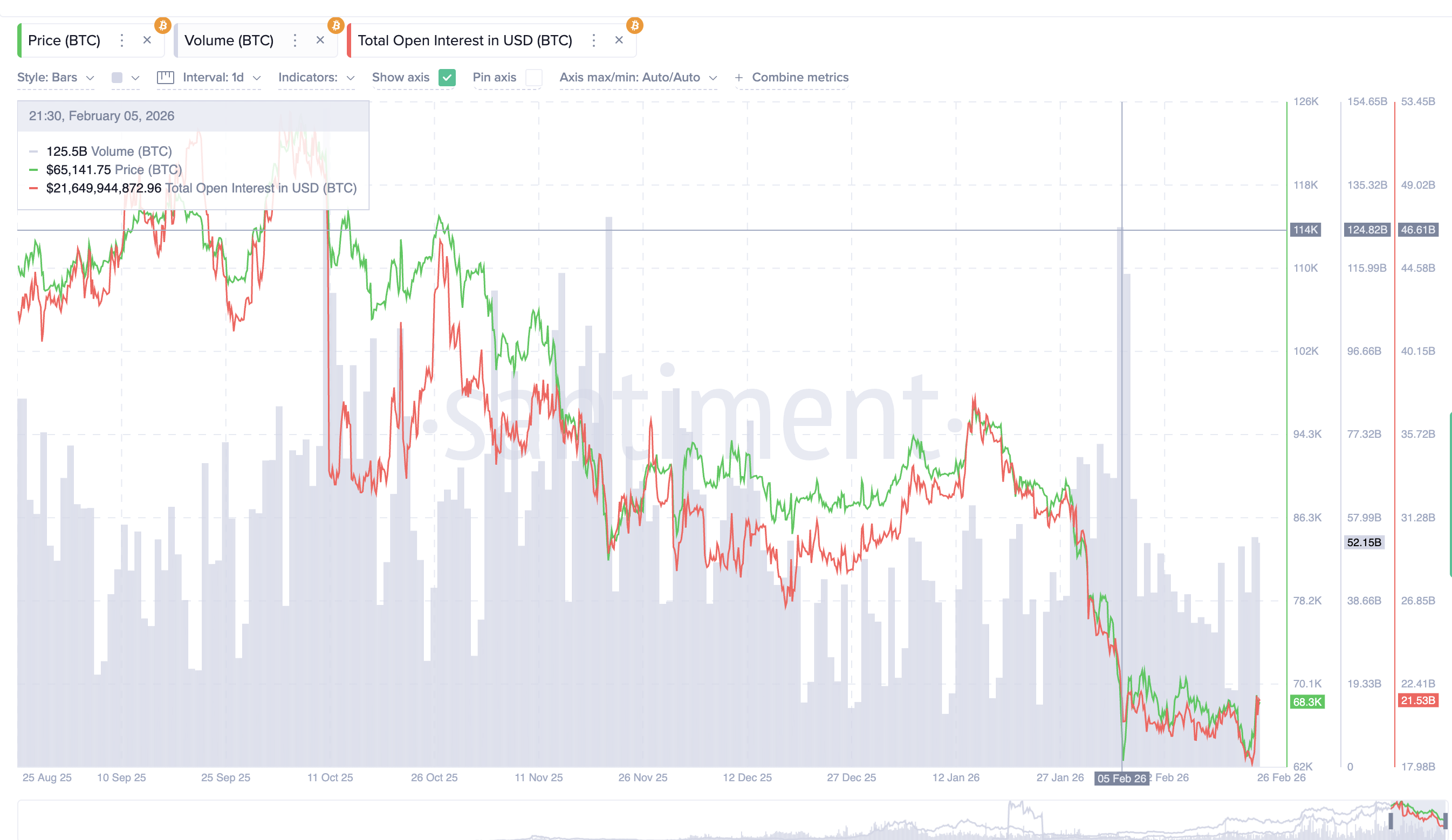
Earlier in February, Bitcoin trading volume reached $125.5 billion. That was during the previous price move. Today, trading volume is around $52 billion. That is more than 58% lower.
Even more importantly, Dessislava Ianeva confirmed this broader trading participation weakness.
“In 2026, BTC average trading volumes are down roughly 17% versus the 2025 average, reflecting subdued market participation,” Ianeva mentioned
This means fewer participants are supporting the move. This is critical because price rallies need strong participation to sustain themselves. At the same time, open interest has also dropped sharply.
Open interest measures the number of futures positions that are active. Earlier in January, open interest stood near $37.5 billion. Now it is around $21.5 billion. That is a 43% drop. This tells us fewer traders are willing to take large positions.
Ianeva added to this finding by saying that:
“Derivatives positioning has normalized and funding conditions have cooled, pointing to orderly deleveraging rather than systemic stress.”
This means the market is stabilizing. But it also means aggressive buying pressure is missing. This helps explain why Bitcoin recovery remains slow.
Long-Term Bitcoin Holders Are Still Selling Despite the Price Bounce
Another major sign of weak conviction, apart from the lack of aggressive buying, comes from Bitcoin’s long-term holders.
The Long-Term Holder Net Position Change metric tracks whether long-term investors are accumulating or selling Bitcoin over a 30-day period. These holders are considered the strongest hands because they typically buy during crashes and sell during market tops.
But right now, they are still selling.
February 24 showed a net reduction of 78,583 BTC on a 30-day rolling basis. That selling has only slightly slowed to 75,911 BTC recently. This is still significantly higher than the 61,431 BTC reduction seen on February 23.
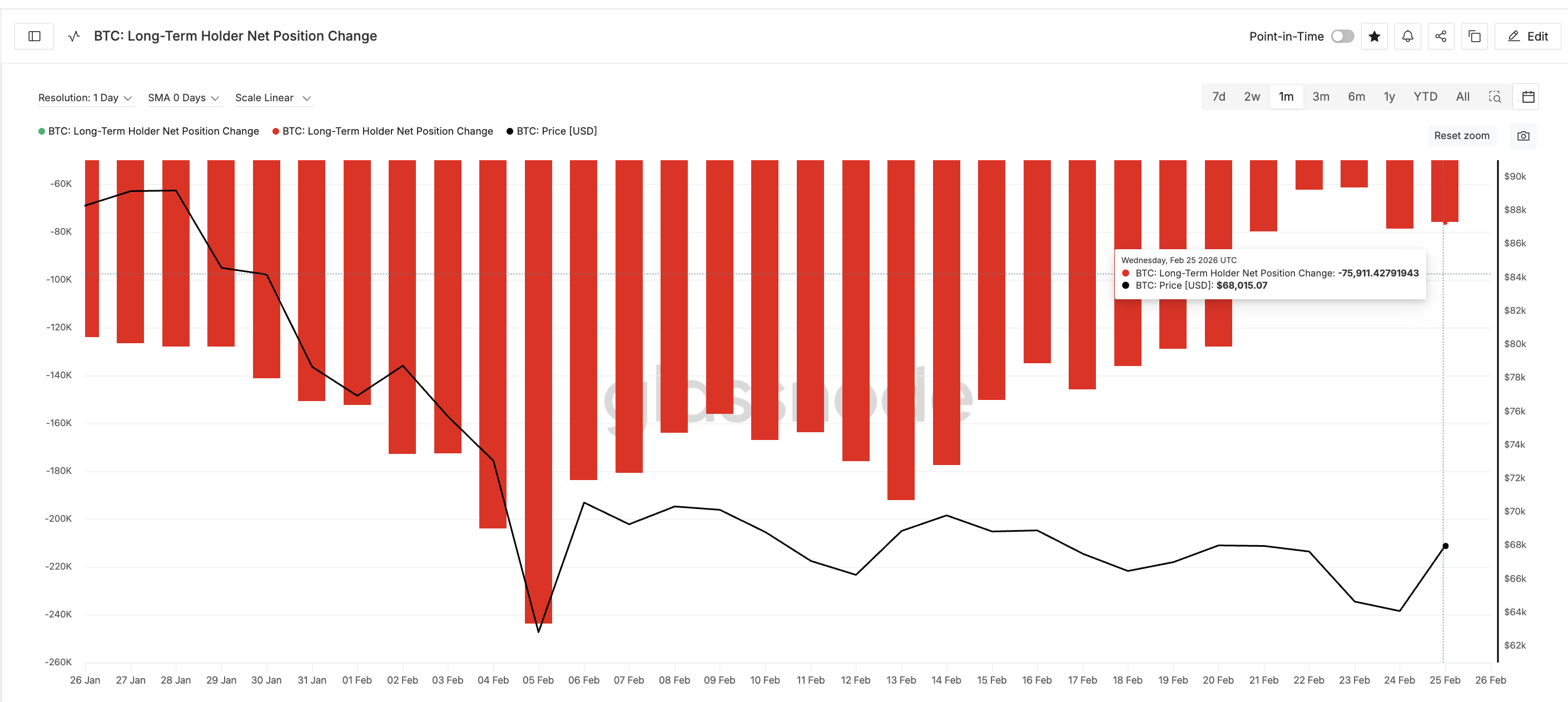
This shows that even as the Bitcoin price rebounded nearly 12%, long-term holders did not shift into accumulation. Instead, they continued distributing supply.
This creates a major problem for the rally. Because sustainable Bitcoin price recoveries usually begin when long-term holders start buying aggressively, not selling.
Dessislava Ianeva also pointed to this broader lack of conviction as part of the macroeconomic (global economic) concerns.
“Macro uncertainty continues to constrain liquidity, even as crypto-specific excess has largely been cleared and the market is in a healthier position.”
This confirms that while Bitcoin’s structure is improving with excess like leverage being cleared out, strong conviction has not fully returned. Until long-term holders stop selling and begin accumulating again, Bitcoin’s upside may remain limited — especially near major resistance zones like $70,000.
Supply Cluster at $70,000–$70,800 Is the Real Bitcoin Price Barrier
The strongest reason Bitcoin stalled near $70,000 comes from on-chain supply data. This data is called URPD, or UTXO Realized Price Distribution. It shows where investors last bought their Bitcoin.
Two major supply clusters exist right now. The first sits near $69,400 and holds about 0.93% of supply. The second sits at $70,600 and holds about 0.60% of supply. Together, this zone contains about 1.5% of the total Bitcoin supply.
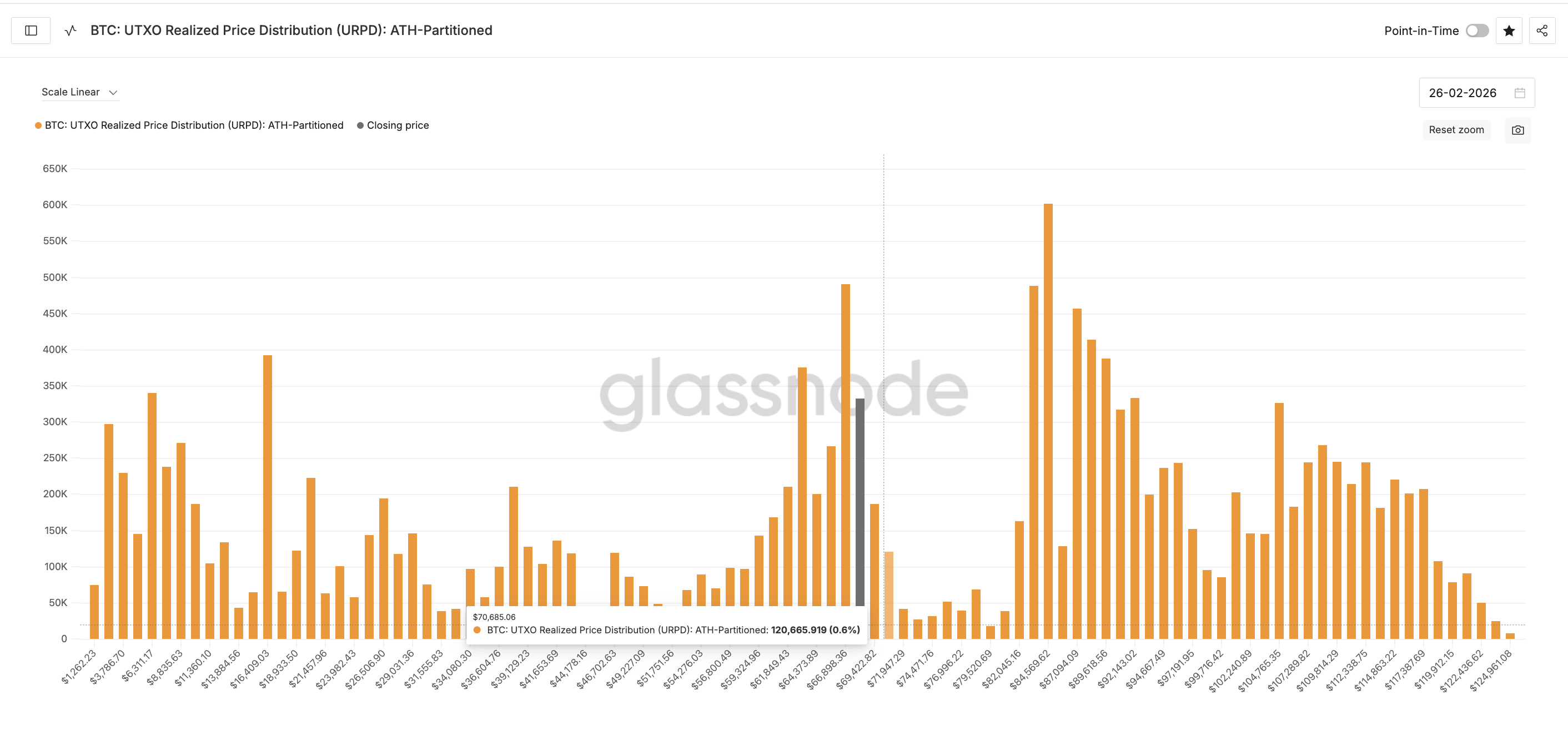
That makes it one of the strongest resistance zones. This explains why Bitcoin touched $70,000 but could not stay above it.
Investors who bought earlier at these levels are likely selling to break even. This creates selling pressure. But this also explains why breaking $70,800 could change everything.
Above $70,800, supply becomes significantly thinner, as the last key cluster sitting at $70,600 breaks. This means fewer sellers exist, and if Bitcoin breaks above $70,800, the next major target sits near $78,600. This represents a potential upside of over 11%, as projected by the cup-to-neckline distance.
Also, this level is not random, and the technical resistance aligns with a key URPD cluster as well at $78,200.
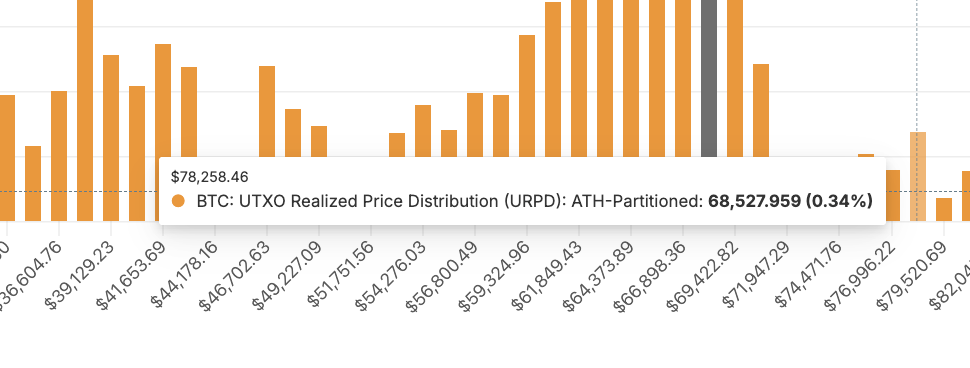
However, downside risks still exist as the broader trend for the BTC price points lower. Bitcoin must hold above $65,700 to maintain this bullish structure. If Bitcoin falls below $62,400, the bullish pattern would fail completely.
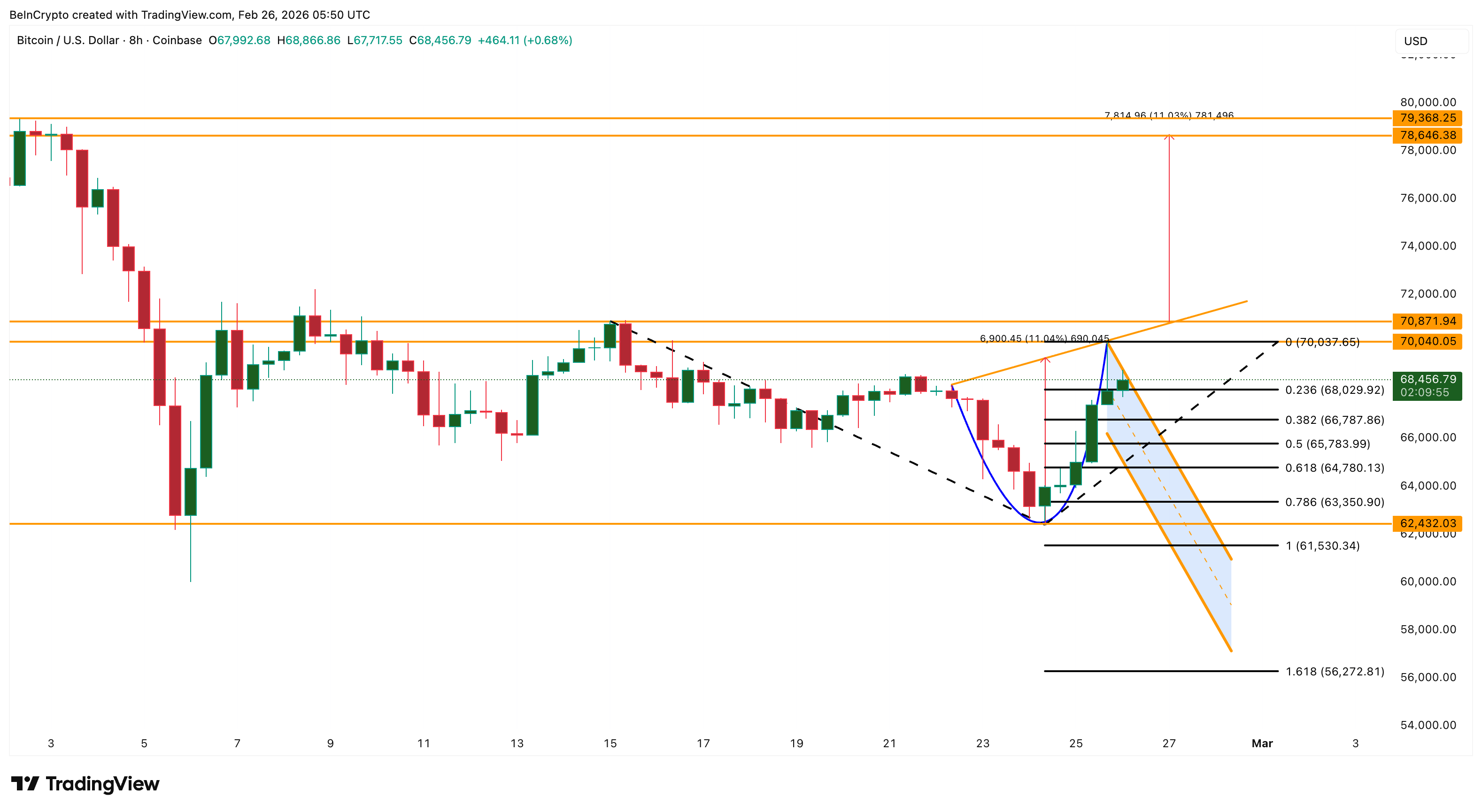
For now, Bitcoin is stuck at a decision point. Smart money signals show early positioning. But falling trading volume, lower open interest, and strong supply at $70,000 are still blocking the breakout. As the Nexo analyst Dessislava Ianeva explained, the market structure is improving. But conviction is not fully back yet.

AllUnity, a stablecoin platform backed by Deutsche Bank, has launched a new stablecoin denominated in Swiss francs (CHF).
After introducing its euro-pegged EURAU stablecoin last year, AllUnity is rolling out CHFAU, a stablecoin pegged 1:1 to the franc, the company said in an announcement shared with Cointelegraph on Thursday.
Initially available to institutional and professional investors, CHFAU launches on the Ethereum blockchain as an ERC-20 token, with plans to expand to additional networks later this year.
CHFAU enters the market fully aligned with the EU’s Markets in Crypto-Assets Regulation (MiCA), as AllUnity secured an E-Money Institution (EMI) license from the German Federal Financial Supervisory Authority (BaFin) in July 2025.
“The launch of CHFAU is a fundamental milestone in our mission to build Europe’s regulated digital payments ecosystem,” AllUnity CEO Alexander Höptner said.
Regulated digital Swiss franc for institutional settlement
CHFAU will be exclusively available to institutional and professional clients through the AllUnity Mint Platform, a spokesperson for AllUnity said.
“We are currently finalizing exchange and trading venue integrations and will communicate specific listings as they go live,” the company said, adding that CHFAU is technically live, but broader availability across venues will be rolled out progressively through integrations.
“The primary purpose of CHFAU is to serve as a trusted, regulated digital Swiss franc for institutional settlement,” Höptner told Cointelegraph, adding:
“Whether for cross-border payments, digital asset markets, or treasury and liquidity management, CHFAU enables secure, real-time value transfer within a fully compliant framework.”
EURAU grows to $1.2 million since launch
AllUnity was founded in early 2024 as a joint venture by Deutsche Bank’s asset management arm DWS, market maker Flow Traders and crypto company Galaxy Digital with the aim of issuing fully regulated stablecoins.
Since its debut in July 2025, AllUnity’s EURAU stablecoin has seen its market capitalization rise to $1.2 million, ranking 16th by market cap among 22 euro‑pegged stablecoins listed on CoinGecko.
Related: ECB targets 2027 digital euro pilot as provider selection begins in Q1 2026
The stablecoin is available on a limited number of exchanges, with CoinGecko listing public centralized exchange Bullish and the decentralized exchange Aerodrome as venues trading EURAU at the time of publication. The stablecoin is also available on platforms including Bitpanda, Rulematch and WAWEX, AllUnity told Cointelegraph.

The total market capitalization of all euro-pegged stablecoins is now at $895 million, with EURC (EURC), issued by USDC (USDC) provider Circle, leading with $459 million.
Not the only Swiss franc stablecoin
Although AllUnity says CHFAU is the first MiCA-compliant Swiss franc‑pegged stablecoin, multiple companies have experimented with similar initiatives in recent years.
According to data from DefiLlama, there are at least three CHF‑denominated stablecoins, including Frankencoin (ZCHF), VNX Swiss Franc (VCHF) and Hedera Swiss Franc (HCHF). The combined market capitalization of these coins is about $38.6 million.

The largest of these, Frankencoin, is a decentralized stablecoin launched in 2023. The project is based in Switzerland and backed by the Frankencoin Association.
Other CHF stablecoin initiatives include CryptoFranc (XCHF), issued by crypto financial services provider Bitcoin Suisse. Launched around 2018, the stablecoin was later discontinued due to insufficient market adoption.
Magazine: 6 massive challenges Bitcoin faces on the road to quantum security
Crypto World
UK politician proposes ban on political crypto donations over foreign interference risks


Some Members of Parliament in the United Kingdom, led by the chairman of the Joint Committee on National Security Strategy, Matt Western, are pushing for a temporary ban on political crypto donations due to concerns over foreign interference.
Summary
- UK MPs have proposed a temporary moratorium on crypto donations to political parties until the Electoral Commission issues statutory guidance.
- The proposal calls for the use of FCA-registered platforms, mandatory source verification and a ban on mixer-linked funds among other provisions.
A letter directed to the Secretary of State for Housing, Communities and Local Government, Steve Reed, has proposed a temporary moratorium on cryptocurrency donations to political parties until the Electoral Commission produces statutory guidance.
In the letter, Western raised concerns around “foreign state intent to interfere in UK political finance” as there is “no clear national enforcement lead for political finance and foreign interference risk.”
“As the security environment worsens and the UK’s military role in Europe grows, the value of influencing the UK’s political positions (for example, on Ukraine, or US/EU relations) is likely to increase,” Western said.
He has urged the Electoral Commission to introduce interim safeguards, such as only allowing political parties to process crypto donations through Virtual Asset Service Providers registered with the Financial Conduct Authority, and accepting contributions where there is high confidence in identifying the ultimate source of the funds.
He also suggests prohibiting the use of crypto mixers or tumblers that can be used to obscure the provenance of assets, alongside a mandate that political parties should convert donations into pound sterling within 48 hours of receipt.
Further, Western recommended stricter source of wealth checks for donors and a review of sentencing for electoral finance offences, alongside higher penalties for breaches involving foreign money and expanded powers for regulators to pursue violations.
Last month, Western, along with a group of other committee chairs, lobbied for a full ban on cryptocurrency donations by including a provision in the Representation of the People Bill. That, however, was not included in the legislation when the bill was introduced to the House of Commons on Feb. 12.
According to a BBC report, Reform UK was the first party at Westminster to accept political cryptocurrency donations in the UK, led by pro-crypto figure Nigel Farage, who announced the move after appearing at the Bitcoin 2025 conference in Las Vegas.
However, details on the party’s official website state that it does not accept anonymous donations and applies permissibility checks to ensure funds originate from UK-registered companies or individuals listed on the electoral register, with contributions above £500 subject to standard compliance procedures.
Across the globe, crypto donations became a defining feature of the U.S. election cycle last year, with several political figures, including current President Donald Trump, having embraced digital asset fundraising. Trump’s campaign began accepting cryptocurrency contributions during the 2024 race.
As previously reported by crypto.news, Representative Mike Collins from Georgia also announced plans to accept cryptocurrency donations last year.
The Federal Election Commission permits cryptocurrency contributions to political committees, provided they adhere to existing contribution limits, disclosure standards, and other reporting requirements.


Former Ethereum treasury firm EthZilla has officially rebranded as Forum Markets as it moves ahead with its pivot towards a full-fledged tokenized real-world assets-focused firm.
Summary
- Rebranded as Forum Markets, the company will trade under the ticker FRMM from March 2.
- Under the Forum Markets brand, the company is repositioning itself as a tokenised real-world asset platform.
- Peter Thiel’s Founders Fund exited its position in the company earlier this month as the stock remained deeply below its August 2025 peak.
According to the official announcement, the company has updated its corporate name and brand to Forum Markets as it moves away from its earlier positioning as an Ethereum treasury company. As part of the rebranding, it has also changed its Nasdaq ticker symbol to FRMM and is expected to begin trading under the new symbol on March 2, subject to Nasdaq approval.
Forum framed the move as the “next development in the company’s planned strategic evolution” and said it plans on “connecting traditional capital markets with blockchain-based financial infrastructure.”
“Forum embodies our belief that the next generation of financial markets will be built around institutional-grade, on-chain products backed by real assets, governed by transparency, and delivered through regulated infrastructure,” the company’s chairman and CEO, McAndrew Rudisill, said in an accompanying statement.
The company said its platform is designed to aggregate, structure, and tokenize cash generating real world assets that were previously inaccessible to a broader base of investors. Forum will leverage its subsidiaries and strategic partners to create a repeatable pipeline to originate and distribute tokenized investment products across multiple asset classes.
Forum has already begun phasing out its balance sheet crypto strategy and announced earlier this month that it had acquired two commercial jet engines leased to a “leading US air carrier,” which will underpin its first aviation-backed offering, the Eurus Aero Token I.
ETHZilla shares climbed more than 13% after the company announced the rebrand and ticker change. However, on a year-to-date basis, the company’s shares were down over 20% as crypto treasury stocks have struggled to gain traction over the past months.
ETHZilla, formerly a biotech company known as 180 Life Sciences, transitioned into an Ethereum treasury firm last year while crypto treasury stocks were trending. Subsequently, it acquired as much as 102,246 ETH at the height of the strategy, but as the initial enthusiasm faded and share prices retreated, the company later announced its intent to pivot toward the tokenized real-world asset market.
Earlier this month, Peter Thiel’s Founders Fund, an early backer of the company, exited its position. ETHZilla has also moved to sell portions of its assets to scale back its crypto exposure and initiate share buybacks in an effort to stabilise its equity performance.


Vitalik Buterin says Ethereum (ETH) will achieve quantum resistance soon via post-quantum hash-based signatures in the Strawmap, a four-year Layer 1 (L1) upgrade plan.
Why it matters:
- Quantum computers could break Ethereum’s current encryption; hash-based signatures would close that gap before the threat arrives.
- Buterin’s confirmation moves quantum resistance from a research topic to a scheduled Ethereum upgrade target.
- The Strawmap’s six-month fork schedule means quantum-resistant slots could ship within the plan’s first two upgrades.
The details:
- Buterin confirmed the timeline via X on February 26, 2026, citing the Ethereum Foundation’s Strawmap.
- The Strawmap was published at strawmap.org after an Ethereum Foundation workshop in January 2026.
- The name blends “strawman” and “roadmap,” meaning the plan is experimental and built to be revised.
- The four-year plan targets ~7 forks every six months; Glamsterdam and Hegotá are confirmed for 2026.
- Buterin also proposed cutting block time to 2 seconds and finality from ~16 minutes to 6–16 seconds.
The big picture:
- Bitcoin and Solana ecosystems are also running post-quantum research, making it a growing priority across blockchains.
- A fixed six-month fork schedule marks a faster, more structured upgrade cadence for Ethereum’s L1.
- The Strawmap is explicitly a draft — timelines, including quantum resistance, could shift as development progresses.
The post Vitalik Buterin Says Ethereum Will Soon Achieve Quantum Resistance appeared first on BeInCrypto.


Indiana lawmakers have passed House Bill 1042, commonly referred to as the Bitcoin Rights Bill, clearing both legislative chambers and sending the measure to Governor Mike Braun for final approval.
Summary
- Indiana’s HB 1042 Bitcoin Rights Bill has passed both legislative chambers and now awaits Governor Mike Braun’s signature.
- The bill would allow cryptocurrency investment options in public retirement plans and protect individual digital asset access.
- If signed, the law will take effect July 1, 2026, reflecting growing institutional adoption of Bitcoin.
Indiana passes Bitcoin Rights Bill as crypto adoption accelerates
If signed into law, the bill will take effect on July 1, 2026, and would allow cryptocurrency investment options within public retirement plans while affirming the rights of individuals to access and use digital assets.
The legislation marks a significant step in formalizing Bitcoin and broader digital asset participation within state-backed financial structures.
The news comes as Arizona lawmakers advanced Senate Bill 1649, which would create a Digital Assets Strategic Reserve Fund allowing the state to hold, invest and potentially lend seized cryptocurrencies.
By permitting exposure to cryptocurrencies in public pension portfolios, Indiana joins a growing list of jurisdictions responding to sustained institutional interest in Bitcoin (BTC), particularly following the strong performance and capital inflows into spot Bitcoin exchange-traded funds over the past several years.
Supporters argue the bill ensures that Indiana’s public institutions and citizens are not disadvantaged as digital assets increasingly become integrated into global financial markets. The measure also reinforces protections for individuals to hold and transact in cryptocurrencies without undue restriction, signaling a pro-innovation stance from state lawmakers.
The push comes amid mounting pressure from financial markets to modernize investment frameworks. Since the launch and expansion of Bitcoin ETFs, institutional adoption has accelerated, prompting policymakers to revisit existing rules around retirement portfolio diversification and digital asset access.
Governor Braun has yet to announce whether he will sign the bill, but if enacted, Indiana would position itself as one of the more crypto-forward states heading into the second half of 2026.


Bitcoin price rebounded over 7% to $69,487 on Thursday amid a spike in short liquidations and improved risk-on sentiment following a bullish Nvidia earnings report.
Summary
- Bitcoin price approached $70K amid a short squeeze and bullish Nvidia earnings report.
- Spot Bitcoin ETFs drew in $257 million in inflows on Wednesday.
According to data from crypto.news, Bitcoin (BTC) price shot up to an intraday high of $69,487 on Thursday, Feb. 26, before settling around $68,200 at press time, still holding 4.6% gains over the past 24 hours. The bellwether’s rebound follows just two days after it fell under $63,000 amid investor fears over macroeconomic and geopolitical uncertainty.
Bitcoin price rallied as investors bought the asset during the recent dip in prices. As BTC price rose, it triggered liquidations of highly leveraged bearish bets across leveraged crypto markets. Data from CoinGlass shows that roughly $576 million worth of positions were liquidated from BTC futures, with around $470 million coming from short positions. Bitcoin alone accounted for $194 million in short liquidations.
Short liquidation occurs when rising prices force traders who bet against the asset to close their positions, with traders having to buy back the asset at higher prices to cover their losses. This, in turn, leads to an immediate spike in prices through a feedback loop often called a short squeeze.
Another major tailwind that boosted BTC price and other altcoins came from investors embracing a risk-on sentiment as stocks posted modest gains and broader risk sentiment improved with Nvidia Corp.’s latest bullish earnings report.
Notably, the Dow Jones Index increased by 307 points on Wednesday. At the same time, the Nasdaq 100 and S&P 500 indices jumped by 351 and 56 points.
AI chip-making giant Nvidia, the world’s largest publicly traded company, reported record-breaking earnings for Q4 of Fiscal Year 2026. Quarterly revenue reached an all-time high, increasing 20% quarter-over-quarter and 73% year-over-year. For the full fiscal year 2026, total revenue reached $215.9 billion, a 65% increase from the previous year.
Previously, investors were concerned about excessive AI spending by Big Tech giants. However, the back-to-back bullish earnings from Nvidia, seen as a barometer for the AI-fueled trade, appear to have calmed investors’ nerves.
The return of inflows into spot Bitcoin ETFs also likely played a modest part in improving investor sentiment. Data from SoSoValue show that the 12 spot Bitcoin ETFs recorded $257.7 million in inflows on Wednesday, marking the first triple-digit inflows figures since Feb. 10.
While it is not yet a strong sign of a long-term trend, investors took it as a positive signal that institutional demand remains resilient despite recent market volatility.
Disclosure: This article does not represent investment advice. The content and materials featured on this page are for educational purposes only.


Trump-backed World Liberty Financial has introduced a new proposal to overhaul its governance through a new Governance Staking System designed to incentivize long-term participation, redirect arbitrage profits to committed token holders, and deepen adoption of its USD1 stablecoin.
Summary
- WLFI proposes mandatory staking for unlocked tokens to participate in governance, with ~2% targeted APR for active voters.
- A new Node and Super Node tier system offers OTC USD1 conversion access and prioritized partnership discussions.
- The plan aims to redirect stablecoin arbitrage profits from market makers to long-term WLFI ecosystem participants.
World Liberty Financial aims to redirect USD1 arbitrage profits to token stakers
Under the proposal, holders of unlocked WLFI (WLFI) tokens will be required to stake their tokens in order to participate in governance voting. Staking will carry a minimum lock-up period of 180 days, with voting power determined by a non-linear square root formula that factors in both the amount staked and remaining lock duration.
Governance rights will be dynamic and non-transferable, adjusting as lock-ups decline.
Active participation is central to the design. Stakers must vote at least twice during their lock-up period to qualify for base staking rewards, targeted at roughly 2% APR and paid from the WLFI treasury.
The reward rate will be determined at WLFI’s discretion and is not tied to revenue or operational performance. Only staking participants will receive USD1 deposit incentives on WLFI Markets provided by Dolomite.
The proposal also introduces a tiered structure. “Nodes,” defined as participants staking at least 10 million WLFI, would gain access to over-the-counter USD1 conversion via licensed market makers at 1:1 parity.
World Liberty Financial plans to subsidize these conversions, redirecting arbitrage opportunities previously captured by institutional intermediaries, estimated at 10–15 basis points per cycle.
At the top tier, “Super Nodes” staking 50 million WLFI would receive guaranteed access to the WLFI team for partnership discussions and potential economic incentives, subject to compliance and commercial review.
The proposal requires a quorum of 1 billion eligible WLFI voting tokens and a simple majority to pass, with a seven-day voting window. If approved, implementation will roll out in three phases, beginning with governance staking activation.
Swiss digital asset bank Sygnum unveiled Sygnum Select, a new institutional crypto asset management service aimed at corporate treasuries overseeing roughly $100 billion in digital assets. Launched on Thursday, the discretionary mandate product applies the discipline of traditional private banking to the crypto frontier, offering strategic asset allocation, active rebalancing, and rigorous risk oversight for institutional clients. The service arrives with live mandates and about $200 million already under active management, according to a Sygnum spokesperson. Data from Bitcoin (CRYPTO: BTC) holdings platform BitcoinTreasuries shows public companies hold 1.13 million BTC and private firms hold 287,990 BTC, collectively valued at about $97 billion. This snapshot underscores the scale at which corporations already engage with crypto assets, even as the market seeks mature infrastructure for professional management.
Key takeaways
- Sygnum launches Sygnum Select, a discretionary mandate service that brings traditional portfolio-management rigor to institutional crypto assets, with live client mandates already in place.
- The offering targets the growing market of corporate and public digital asset treasury entities (DATs), which collectively hold well over $100 billion in crypto assets, highlighting a broad demand for regulated, end-to-end management.
- Clients gain full execution authority within an agreed investment framework, including strategic asset allocation, active rebalancing, and risk oversight, bridging private banking discipline with crypto exposure.
- Live mandates cover a wide spectrum: spot, staking, hedging, derivatives, tokenized securities, and market-neutral strategies across traditional and crypto assets.
- Initially, the service will serve Swiss clients, with plans for broader geographic expansion as institutional demand and regulatory clarity evolve.
Tickers mentioned: $BTC, $ETH
Market context: The range of corporate crypto deployments is expanding as institutions seek regulated, scalable solutions amid ongoing debates about custody, risk controls, and tokenization in traditional finance. The broader market backdrop includes a rising interest in tokenized assets and state-backed crypto reserves, alongside ongoing regulatory developments in key jurisdictions.
Sentiment: Neutral
Price impact: Neutral. The article describes product launches and market demand rather than immediate price moves.
Trading idea (Not Financial Advice): Hold. The expansion of regulated, discretionary crypto management services could support institutional risk management and liquidity, without implying short-term price catalysts.
Market context: As institutional adoption accelerates, regulated infrastructure and holistic management solutions grow in importance for corporate treasuries, alongside shifts toward greater tokenization and crypto readiness in traditional finance. The Swiss regulatory environment and broader ETF and custody developments remain closely watched by market participants. For context on Switzerland’s regulatory landscape, see the overview of cryptocurrency regulations in Switzerland: here.
Why it matters
The launch of Sygnum Select marks a notable push toward integrating crypto exposure into the same disciplined framework that underpins private banking solutions for traditional assets. By offering a discretionary mandate, Sygnum signals that institutional clients are seeking more than custody or execution—they want an active partner who can manage a crypto portfolio with a holistic risk and governance approach. This shift aligns with the maturation of the asset class, where institutions expect outcomes that mirror established private-banking standards rather than bespoke, ad hoc arrangements.
The service also reflects a broader market reality: corporate and public sector DATs have accumulated substantial crypto holdings, with BitcoinTreasuries data illustrating a substantial reservoir of crypto on corporate balance sheets. As regulated, scalable services emerge to serve these needs, the industry could see stronger demand for multi-asset strategies, cross-asset hedging, and tokenized securities that enable traditional investors to participate in crypto markets through familiar risk controls. The combination of traditional asset management discipline and crypto-native execution logic is intended to reduce operational friction and counterparty risk for large holders navigating a rapidly evolving landscape.
At the same time, Sygnum’s own track record—such as its market-neutral Bitcoin fund and recent fundraising milestones—provides context for the platform’s credibility. The bank previously raised more than 750 BTC in January for its market-neutral Bitcoin fund, which delivered an annualized return in the fourth quarter of 2025. The bank’s growth narrative is underscored by a post-money valuation surpassing $1 billion after a notable early-2025 funding round. These dynamics matter because they offer institutional clients a clearer signal of the institution’s capacity to manage complex crypto strategies within a regulated framework, which remains a priority for many treasuries evaluating outsourcing options.
Looking ahead, the Swiss focus of Sygnum Select—paired with reported intentions to expand geographically—illustrates a broader trend in which regulated, cross-border crypto asset management solutions become more widely available. While the initial rollout is Switzerland-centric, market participants will be watching to see how the product scales across jurisdictions with varying regulatory regimes, especially as tokenization, state-backed reserve concepts, and more sophisticated crypto instruments gain traction in traditional finance.
For readers tracking corporate crypto exposure, the push toward professional, institution-grade management infrastructure is a notable development. It complements existing flows into exchange-traded and custody services, while potentially broadening the set of investable crypto strategies available to treasuries and asset managers. As liquidity in the space continues to evolve and regulatory frameworks mature, Sygnum Select could serve as a blueprint for how crypto assets are managed within a regulated, multi-asset portfolio architecture, rather than in isolated, standalone crypto vehicles.
What to watch next
- Timeline and criteria for expanding Sygnum Select beyond Switzerland, including any regulatory approvals required for new jurisdictions.
- Uptake metrics: the pace at which additional client mandates are onboarded and the diversification of assets across traditional and crypto classes.
- Performance data for existing portfolios, including risk metrics and the impact of active rebalancing on portfolio drawdowns.
- Further product development, such as additional hedging instruments, derivatives capabilities, and tokenized securities offerings within the discretionary framework.
Sources & verification
- BitcoinTreasuries data on BTC holdings by public and private companies: https://bitcointreasuries.net/
- Cointelegraph reporting on Sygnum’s Bitcoin fund and related fundraising milestones: https://cointelegraph.com/news/swiss-bank-sygnum-raises-750-btc-market-neutral-fund
- Cointelegraph coverage of tokenization and Bitcoin reserves in 2026: https://cointelegraph.com/news/2026-sovereign-bitcoin-reserves-tradfi-tokenization-adoption-sygnum
- Cointelegraph overview of cryptocurrency regulations in Switzerland: https://cointelegraph.com/learn/articles/an-overview-of-the-cryptocurrency-regulations-in-switzerland
Market reaction and key details
Market participants will likely view Sygnum Select as part of a broader evolution in crypto asset management toward regulated, scalable, and holistic offerings. The emphasis on active portfolio management, multi-asset exposure, and risk oversight aligns with a growing demand from institutional clients seeking to integrate crypto into sophisticated investment programs rather than treat it as a stand-alone hedge or speculative play. As more corporate treasuries and DATs consider long-term crypto strategies, the availability of a regulated, institution-grade management solution could shape whether crypto becomes a durable component of diversified portfolios, or remains a jurisdiction-specific niche.
What the next steps could look like
If Sygnum successfully scales Sygnum Select beyond its Swiss launch, expect further clarity on governance frameworks, performance reporting standards, and interoperability with traditional private-banking platforms. The evolving landscape may also see regulators scrutinize product disclosures, risk controls, and cross-border suitability assessments as more institutions adopt such mandates. In parallel, ongoing developments in tokenization and liquidity solutions may broaden the range of assets available within discretionary crypto strategies, potentially expanding the addressable market and accelerating institutional adoption.
What to watch next
- Expansion announcements and regulatory milestones for onboarding new jurisdictions within the next 12–18 months.
- New performance disclosures and risk metrics for active portfolios under Sygnum Select.
- Partnerships or integrations with custody providers, insurers, or traditional asset managers to streamline compliance and reporting.

Everything Samsung announced at the Galaxy S26 launch event

Medication shortage hits UK as statins and aspirin ‘disappear from shelves’

Jobs to be created as new North East public sector procurement solution launched


-

 Video6 days ago
XRP News: XRP Just Entered a New Phase (Almost Nobody Noticed)
-

 Politics4 days ago
Baftas 2026: Awards Nominations, Presenters And Performers
-

 Fashion6 days ago
Weekend Open Thread: Boden – Corporette.com
-

 Sports3 days ago
Women’s college basketball rankings: Iowa reenters top 10, Auriemma makes history
-

 Politics3 days ago
Nick Reiner Enters Plea In Deaths Of Parents Rob And Michele
-

 Crypto World2 days ago
XRP price enters “dead zone” as Binance leverage hits lows
-

 Business4 days ago
Mattel’s American Girl brand turns 40, dolls enter a new era
-

 Business4 days ago
Law enforcement kills armed man seeking to enter Trump’s Mar-a-Lago resort, officials say
-

 Tech2 days ago
Unsurprisingly, Apple's board gets what it wants in 2026 shareholder meeting
-
 NewsBeat10 hours ago
Manchester Central Mosque issues statement as it imposes new measures ‘with immediate effect’ after armed men enter
-

 NewsBeat8 hours ago
Cuba says its forces have killed four on US-registered speedboat | World News
-
 NewsBeat3 days ago
‘Hourly’ method from gastroenterologist ‘helps reduce air travel bloating’
-

 Tech4 days ago
Anthropic-Backed Group Enters NY-12 AI PAC Fight
-

 Business2 days ago
True Citrus debuts functional drink mix collection
-

 NewsBeat4 days ago
Armed man killed after entering secure perimeter of Mar-a-Lago, Secret Service says
-

 Politics4 days ago
Maine has a long track record of electing moderates. Enter Graham Platner.
-
 NewsBeat1 day ago
Police latest as search for missing woman enters day nine
-

 Business4 hours ago
Discord Pushes Implementation of Global Age Checks to Second Half of 2026
-

 Crypto World1 day ago
Entering new markets without increasing payment costs
-
 Sports3 days ago
2026 NFL mock draft: WRs fly off the board in first round entering combine week