
Crypto World
Crypto.com to Cut 12% of Workforce due to Enterprise AI Integration

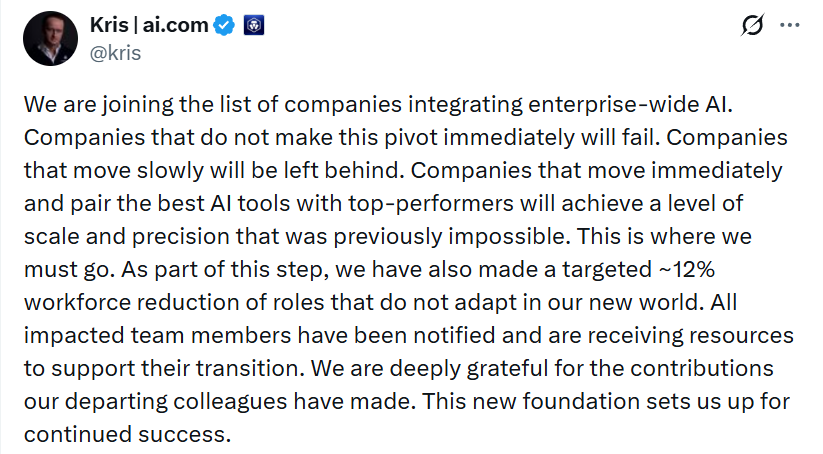
Singapore-headquartered cryptocurrency exchange Crypto.com is set to cut up to 12% of its workforce due to company-wide artificial intelligence (AI) integrations, joining a growing list of companies announcing AI-linked mass layoffs, according to the exchange’s founder and CEO, Kris Marszalek.
Crypto.com recently expanded its AI offering and launched the AI agent platform ai.com on Feb. 9, which it positioned as a core business. The company also said it was the first crypto platform to receive the ISO/IEC 42001:2023 certification for AI system management in February.
“We are joining the list of companies integrating enterprise-wide AI,” Marszalek said in a Thursday X post, warning that companies that don’t pivot will fail.
Crypto.com lists around 1,500 employees, meaning that the 12% layoff would affect about 180 staff members. It marks the latest AI-linked large-scale layoff in the crypto and tech space, underscoring concerns over AI replacing more of the human workforce.

“We are joining the list of companies integrating enterprise-wide AI,” a spokesperson for Crypto.com told Cointelegraph, adding that the layoffs are part of the platform’s plans to “prioritize resources around key growth areas.” The spokesperson declined to comment on the roles that were affected by the layoffs.
Crypto and tech companies stage AI-linked mass layoffs
Other large crypto and tech companies have also announced AI-linked mass layoffs in recent months.
On Monday, blockchain analytics platform Messari announced more staff cuts as part of its pivot to an AI-first company. The company previously laid off roughly 15% of its full-time employees in January 2025 and made a similar workforce reduction in February 2023.
On Wednesday, the Algorand Foundation, the organization behind Layer-1 blockchain Algorand, also announced a 25% staff reduction, citing macroeconomic uncertainty and the current crypto market slump.
On Feb. 26, Jack Dorsey’s payment company Block announced cutting about 40% of its staff, citing the rapid acceleration of AI. However, some of the 4,000 fired workers have already returned to the company, according to multiple employees who were part of the initial layoffs.
Related: Nvidia’s Huang: AI will boost jobs as it needs trillions in infrastructure
Large tech companies have also announced AI-linked mass layoffs. On Jan. 27, visual discovery engine Pinterest announced it was cutting up to 15% of its staff to pivot to an AI-centric approach.
On March 11, software company Atlassian announced it was cutting 10% of its staff, or about 1,600 employees, as part of a restructuring to self-fund further AI investments.
Meta, Facebook’s parent company, is also reportedly planning a workforce cut of up to 20%, seeking to enable AI efficiencies and offset the costs of AI infrastructure, insiders familiar with the matter told news outlet Reuters on Saturday.
Magazine: 9 weirdest AI stories from 2025



Nevada state authorities have been cleared to issue a temporary restraining order against prediction market platform Kalshi.
Summary
- A federal appeals court denied Kalshi’s request to halt proceedings, clearing the way for Nevada regulators to pursue a temporary restraining order against the platform.
- Industry experts say Kalshi may be forced to exit Nevada for at least 14 days if the order is issued, as such rulings are not appealable under state law.
On Thursday, the Ninth Circuit Appeals Court denied Kalshi’s emergency request to stay proceedings. The case will now be sent back to federal court, where Nevada regulators can proceed with enforcement action.
According to Gaming lawyer Daniel Wallach, this would likely result in a temporary restraining order and noted that Kalshi would not be able to operate in the state for at least 14 days, as the order is “not appealable under Nevada law.”
“Kalshi would be required to exit the state in the interim,” he added.
The case stems from a cease and desist issued against the platform in March, where regulators claimed that the platform offered unlicensed sports betting under the state’s gaming laws.
Kalshi, in the meantime, has countered these claims, arguing that its contracts fall under the federal jurisdiction of the Commodity Futures Trading Commission, which means any restriction imposed by the state would conflict with federal oversight and would also cause its business imminent harm.
Similar actions have emerged across a number of other U.S. states, with lawmakers claiming that sports event contracts may violate local gambling laws. States like Connecticut, New York, and New Jersey have taken steps against sports event contracts that have targeted Kalshi and many of its competitors, like Polymarket and Crypto.com.
Meanwhile, the U.S. Commodity Futures Trading Commission chairman, Michael Selig, has said that the commission will establish a federal rulebook for prediction markets while asserting exclusive jurisdiction over such products.
Prediction markets like Kalshi and Polymarket have recently surged in activity, with weekly trading volumes exceeding $2 billion. As previously reported by crypto.news, ultra-short duration contracts have become increasingly popular, with five to 15-minute bets now accounting for a significant share of trading on these platforms.

TLDR:
- Binance altcoin trading volumes have fallen to $7.7B, down sharply from the $40–$50B recorded in late 2024.
- Combined altcoin volumes on other major exchanges now sit at $18.8B, well below prior peaks of $91B.
- Binance currently accounts for roughly 40% of total altcoin trading volume across all major exchanges.
- Historical data shows the best crypto opportunities often emerge when trading volumes and market interest are at their lowest.
Altcoin trading volumes across major cryptocurrency exchanges have declined sharply in recent months. Data from Binance and other top platforms points to a clear reduction in investor participation.
The ongoing bear market, combined with persistent geopolitical tensions, continues to suppress risk appetite. Altcoins are now trailing Bitcoin in performance by a wide margin.
Current volume levels are well below those recorded during more active trading phases of late 2024 and early 2025.
Altcoin Trading Volumes on Major Exchanges Hit Multi-Month Lows
Altcoin trading volumes on Binance currently stand at approximately $7.7 billion. This marks a steep drop from the $40 to $50 billion the platform saw in October 2024. Other major exchanges combined now account for about $18.8 billion in total volume.
During those earlier peak periods, other exchanges collectively recorded volumes of $63 billion and $91 billion. The gap between those highs and current figures reflects the scale of the decline. Trading activity has fallen across the board, not just on a single platform.
Crypto analyst Darkfost_Coc flagged this trend in a recent post on X. The data shows altcoins are underperforming Bitcoin considerably in the current market. Investor interest in smaller digital assets appears to be fading steadily. On Binance specifically, the platform now represents about 40% of total altcoin trading volume.
Ongoing geopolitical tensions continue to create an unfavorable environment for risk assets. This has further reduced the appeal of altcoins among traders seeking stability.
As a result, capital has been moving away from smaller tokens toward safer market positions.
Historical Volume Patterns Point to FOMO-Driven Tops and Future Opportunity
The volume spikes recorded in October 2024 and February 2025 coincided with local price tops in the market. These surges were largely fueled by FOMO, or fear of missing out, among retail traders. Well-positioned investors used that demand surge as an opportunity to exit their positions.
Darkfost_Coc noted that volume spikes at market tops often reflect retail participation rather than institutional accumulation. By the time most traders enter during a surge, smarter money is already reducing exposure.
This pattern has repeated itself across multiple previous crypto cycles. Binance’s roughly 40% share of total altcoin volume further reflects this concentration of activity.
Currently, altcoin trading volumes remain at depressed levels with no clear recovery signal yet. However, historical data from past cycles show that low-interest periods often precede strong market reversals. Volume trends tend to shift before price movements become widely visible.
According to the analysis, the most attractive opportunities have historically appeared when market interest is at its lowest. Most investors tend to remain on the sidelines during these phases. Those who track volume data closely are often better positioned when conditions eventually improve.


Bitcoin investors face a real, long-term risk from quantum computing, but the danger is not equally distributed across all wallets. Will Owens, a research analyst at Galaxy Digital, outlined in a recent briefing that a sufficiently powerful quantum computer could derive a private key from a public key, enabling an attacker to impersonate the wallet owner, forge a signature, and steal coins. Yet he stressed that the current landscape is not uniformly vulnerable: most wallets remain safe today, with risk primarily arising when public keys are visible on-chain.
Owens described two primary exposure paths. The first concerns wallets whose public keys are already exposed on the blockchain, making them potential targets if a quantum attack becomes feasible. The second occurs when a wallet’s public key is revealed at the moment of spending. This distinction has practical implications for how wallets are designed, upgraded, and secured as the crypto ecosystem moves toward post-quantum resilience.
Key takeaways
- Public-key exposure matters: funds are at greater risk if a wallet’s public key is visible on-chain or revealed during a transaction.
- Today’s wallets are largely shielded from quantum risk, but the threat is recognized and being studied by developers and researchers.
- The Bitcoin community has accelerated quantum-related proposals since late 2025, though governance remains non-centralized by design.
- Near-term guardrails have been discussed, including practical approaches from prominent voices advocating safer storage methods until post-quantum solutions are ready.
- Investors should monitor post-quantum developments and the timing of proposed mitigations, as the threat is real even if not imminent for most users.
Quantum risk landscape for Bitcoin wallets
The core concern is the possibility that a quantum computer could reverse-engineer a private key from a corresponding public key, enabling an attacker to impersonate the wallet owner and authorize transactions. This would undermine the cryptographic foundations that underwrite Bitcoin’s security. However, Owens cautioned that the vulnerability is not uniform across all wallets today. “Most wallets are not vulnerable today. Funds are at risk only when public keys are exposed on-chain,” he explained.
The two exposure routes identified by Owens—on-chain public keys already visible, and keys revealed at spending—are important for both users and developers. If a wallet’s public key remains hidden until it is used, the risk profile differs from wallets whose keys have already been disclosed on-chain. This nuance shapes how wallets are designed to mitigate potential quantum threats, including the timing of key disclosure and migration to post-quantum-secure mechanisms.
Quantum computing’s potential to disrupt conventional cryptography has circulated in crypto discourse for years, with some observers arguing the threat is distant. Yet the consensus forming in academic and industry circles is that the question is not if, but when—and how quickly the ecosystem can adapt. Owens noted that the debate extends beyond the technical layer and into governance, as coordinated action will be required to implement robust, long-term protections.
The right people are on top of the issue
Despite some critics who argue the quantum threat is overstated or decades away, Owens contends that development activity in this area has intensified. He said there is substantial developer work addressing quantum vulnerabilities and mitigations, and that the ecosystem now has a concrete, maturing set of proposals spanning the full problem surface. “The proposals are not theoretical. They are being actively developed, reviewed, and debated by some of the most experienced contributors in the Bitcoin ecosystem,” he affirmed.
In parallel, other voices in the space have proposed practical approaches to reduce exposure in the near term. Crypto veteran Willy Woo suggested last November that holding Bitcoin in SegWit wallets could reduce risk while a more permanent solution is devised. The idea reflects a broader appetite for interim safeguards as the community weighs longer-term protocol changes such as post-quantum cryptographic schemes.
The broader push toward post-quantum readiness has historically been framed as a balance between innovation and conservative risk management. While some markets may still debate the immediacy of the risk, the Bitcoin ecosystem appears to be aligning incentives around security and resilience. Owens emphasized that a non-centralized governance model—where Bitcoin has no CEO, no board, and no single authority to mandate updates—does not preclude effective action. Instead, the universal and external nature of the risk—affecting participants across the network—can catalyze broad, voluntary alignment around practical mitigations and gradual upgrades.
“For investors, the key takeaway is straightforward: the risk is real but recognized, and the people best positioned to address it are working on it.”
As the conversation evolves, the community continues to explore concrete, actionable paths forward. In addition to BIP-based discussions and potential soft-fork mitigations, researchers and developers are evaluating post-quantum-ready signatures, key-management innovations, and more robust on-chain privacy and security architectures. The goal is not merely to react to a theoretical threat but to engineer a resilient system that preserves user sovereignty without compromising the Bitcoin network’s open, trust-minimized ethos.
Looking ahead, observers will want to watch how quickly post-quantum techniques mature and how they can be integrated without creating new vectors for risk or fragmenting the ecosystem. The next few years are likely to bring a combination of protocol-level experiments, community-led governance decisions, and gradual deployment of protective measures that could gradually harden Bitcoin against quantum threats while maintaining its decentralized ethos.
As quantum resilience work progresses, readers should stay attuned to updates from core developers, security researchers, and stakeholder communities. The exact timeline for wide-scale post-quantum adoption remains uncertain, but the direction is clear: the industry is treating quantum risk as a real, evolving concern and mobilizing to address it with practical, collaborative solutions.
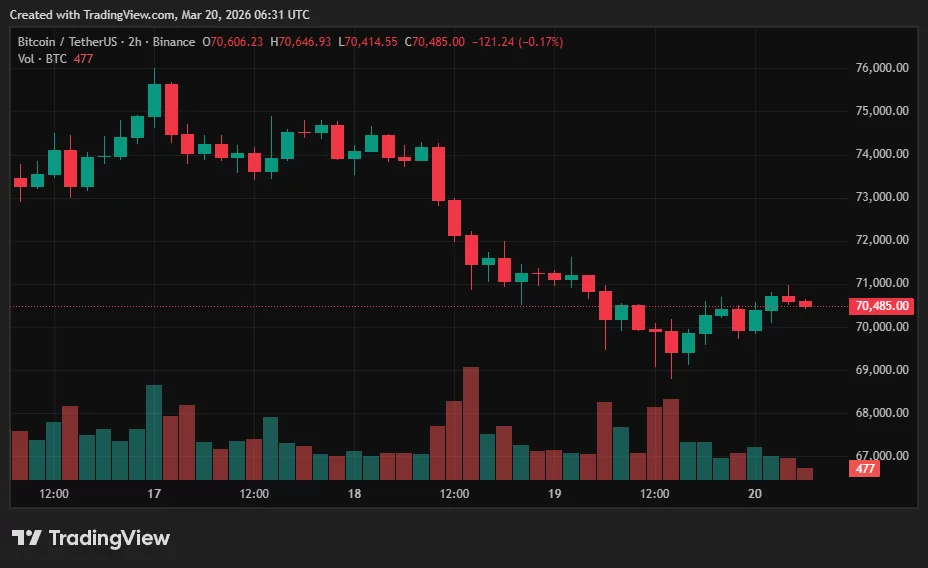
Bitcoin price marched back above $70,000 on Friday morning, erasing part of the losses seen over the past two days. However, its momentum quickly gave up as Asian tech stocks dropped lower.
Summary
- Bitcoin rebounded above $70,000 after an 8% drop, supported by dip buying despite rising geopolitical tensions and inflation concerns.
- Risk sentiment weakened as Asian and U.S. tech stocks declined, reflecting broader pressure on risk assets amid strong inflation data and hawkish Fed outlook.
- U.S. spot Bitcoin ETFs recorded over $250 million in outflows in two days, signaling a pause in institutional demand after a week of strong inflows.
After dropping over 8% to a weekly low of $69,298 on Thursday, Bitcoin (BTC) price rebounded back above the $70,000 psychological mark that many analysts say acts as a crucial anchor for investor confidence. The bellwether was trading at $70,749 at press time with a market capitalization of $1.41 trillion.
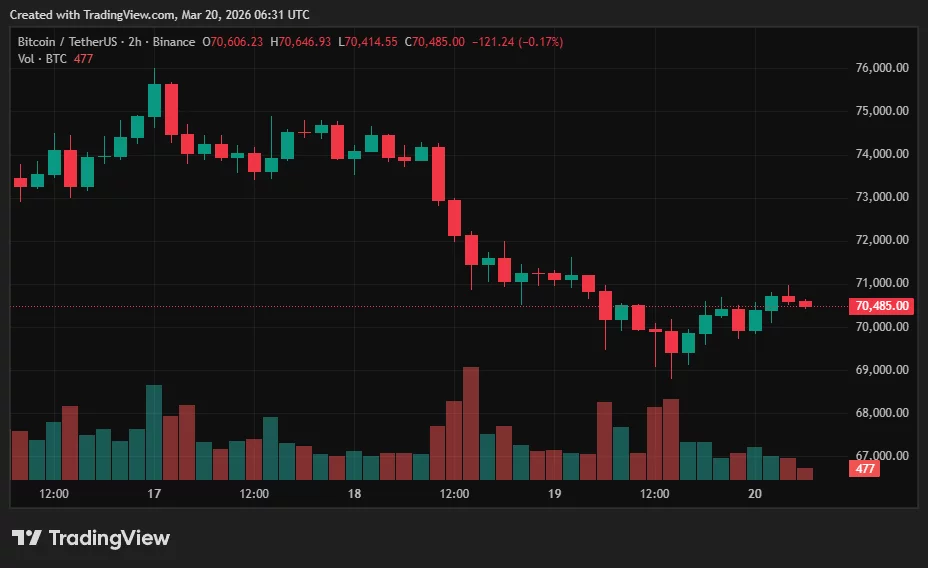
Bitcoin price rallied as bulls bought the dip under $70,000, which occurred after news of an Israeli attack on Iranian energy sources broke out, sparking fears of rampant global inflation as oil prices rose to record highs.
At the same time, risk sentiment deteriorated amid a string of weak economic data. This coincided with stronger-than-expected PPI data and Federal Reserve Chair Jerome Powell suggesting the central bank intends to hold interest rates steady as long as inflation remains elevated.
While Bitcoin has managed to reclaim the $70,000 psychological support level, several hurdles could potentially stand in its path for more gains.
First, Asian tech stocks have so far traded down on Friday morning. Notably, Japan’s Nikkei 225 fell by 1,866 points or 3.38%, while China’s Shanghai Composite was down 0.50%. Yesterday, U.S. tech stock markets also showed the same weakness, with the Dow Jones Industrial Average closing lower by 0.44%, while the S&P 500 and Nasdaq 100 were down over 0.25% each. The only exception was the Russell 2000 Index, which rose by 0.65%.
Cryptocurrencies often mirror the trend followed by these tech stocks, as they both share a high sensitivity to liquidity and interest rate expectations.
Second, investors seem to be rotating to Gold, which jumped over 2% today as it moved back above $4,700, reinforcing its status as a safe-haven asset amid the broader macroeconomic and geopolitical uncertainty. Silver also saw significant interest, rising over 3% to $74.
Third, institutional demand in Bitcoin appears to have taken a breather. Data from SoSoValue show that U.S. spot Bitcoin ETFs have recorded net outflows for the past two days, with over $250 million flowing out.
While the outflows are relatively small considering the $1.16 billion in inflows they recorded over seven straight days just ahead of this shift, investors could take this as a sign of temporary exhaustion in the current rally.
Disclosure: This article does not represent investment advice. The content and materials featured on this page are for educational purposes only.


Gemini shareholders have targeted the crypto exchange through a new class action lawsuit alleging that it misled investors during and after its initial public offering.
Summary
- Gemini has been hit with a class action lawsuit in New York alleging it misled investors in its IPO filings about its business strategy.
- Plaintiffs claim the firm shifted to a prediction markets model, cut 25% of staff, and exited key international markets shortly after listing.
- Shares have fallen sharply since the IPO, with investors alleging losses tied to what they describe as artificially inflated prices.
Filed in New York, the class action lawsuit has been brought against Gemini, its co-founders Tyler and Cameron Winklevoss, and other company executives over misleading claims made in its IPO documents.
Plaintiffs in the filing said the documents portrayed Gemini as a growing crypto exchange focused on expanding its user base and international footprint, but later made an “abrupt corporate pivot to a prediction market-centric business model.”
In the complaint, the plaintiff said the Offering Documents were “materially false and misleading” and failed to disclose that Gemini was “poised for an expensive and disruptive restructuring.”
Further, the lawsuit stated that the company had committed to extending into “key global markets.”
Gemini held its IPO in September and priced shares at $28 on the Nasdaq; however, while the filings described the exchange as its “core product,” they subsequently pivoted to prediction markets called “Gemini 2.0.”
Subsequently, the firm also cut 25% of its workforce and exited several international markets like the UK, the EU, and Australia.
Per the complaint, such changes have caused the class group to suffer “significant losses and damages” as the stock price declined.
As such, the suit is seeking a jury trial and compensation for investors who bought shares at “artificially inflated prices” after the IPO.
Last month, several Gemini executives announced departures amid the company’s cost-cutting push; meanwhile, the exchange also shut down its NFT arm, Nifty Gateway, in February.
However, on Thursday, the company’s Q4 results showcased that the company’s revenue had risen 39%, which was beyond analyst expectations.
At the time of writing, Gemini shares had closed Thursday’s session up 0.81%, while it surged another 5.8% in after-market trading.
TLDR:
- DOJ charges allege $2.5B in Nvidia-powered AI servers were diverted to China through covert routes.
- Prosecutors claim fake documents and dummy servers were used to bypass U.S. export compliance checks.
- Over $510M in restricted AI systems allegedly shipped within weeks through a Southeast Asia network.
- SMCI stock fell after hours as legal risks emerged around export controls and the distribution of AI hardware.
Authorities in the United States have arrested Yih-Shyan “Wally” Liaw for allegedly conspiring to unlawfully export AI servers. Prosecutors claim the operation diverted billions of dollars’ worth of advanced systems to China.
The charges follow an indictment unsealed by the U.S. Department of Justice, detailing a coordinated effort to bypass export restrictions.
Allegations of Export Control Violations
The indictment alleges that Liaw, a co-founder of Super Micro Computer, conspired with associates to ship restricted AI servers abroad.
These systems reportedly integrated high-performance GPUs developed by NVIDIA. U.S. authorities classify such hardware as sensitive due to its advanced computing capabilities.
According to court filings, Liaw worked alongside Ruei-Tsang “Steven” Chang and Ting-Wei “Willy” Sun to facilitate the operation.
Prosecutors allege the group used an intermediary company in Southeast Asia to mask the final destination of shipments.
In an official statement, Assistant Attorney General John A. Eisenberg described the alleged conduct in detail. He said the indictment outlines efforts to evade export laws through “false documents, staged dummy servers to mislead inspectors, and convoluted transshipment schemes.”
Eisenberg added that the technology involved carries national importance. He noted that these chips represent American innovation and said authorities will continue enforcing export controls to protect that advantage.
Use of Shell Companies and Concealment Methods
Investigators allege that the defendants relied on a layered logistics structure to move the servers. Systems were assembled in the United States, routed through Taiwan, and then delivered to Southeast Asia before reaching China.
Authorities state that the intermediary company purchased approximately $2.5 billion worth of servers between 2024 and 2025.
A surge in shipments occurred within a short period, including roughly $510 million worth of equipment moved in just three weeks.
Officials say the defendants used deception to bypass compliance checks. Thousands of non-functional servers were staged at warehouses to simulate legitimate inventory during inspections. These replicas were presented to auditors reviewing export compliance.
Describing the scheme, FBI Assistant Director Roman Rozhavsky said the defendants allegedly conspired to sell “billions of dollars’ worth of servers integrating sensitive, controlled graphic processing units” in violation of U.S. laws.
Legal Charges and Enforcement Response
Liaw and Sun were arrested and are expected to appear in federal court in California. Chang remains a fugitive. The charges include conspiracy to violate export control laws, smuggling, and conspiracy to defraud the United States.
U.S. Attorney Jay Clayton addressed the case, stating that the defendants allegedly operated through “a tangled web of lies, obfuscation, and concealment” to generate revenue. He added that such diversion schemes pose a direct threat to national security.
Federal investigators emphasized the broader enforcement effort tied to the case. According to FBI officials, safeguarding advanced AI technology remains a priority due to its strategic importance.
Following the announcement, shares of Super Micro Computer (SMCI) declined in after-hours trading. Authorities reiterated that the charges remain allegations, and all defendants are presumed innocent unless proven guilty in court.
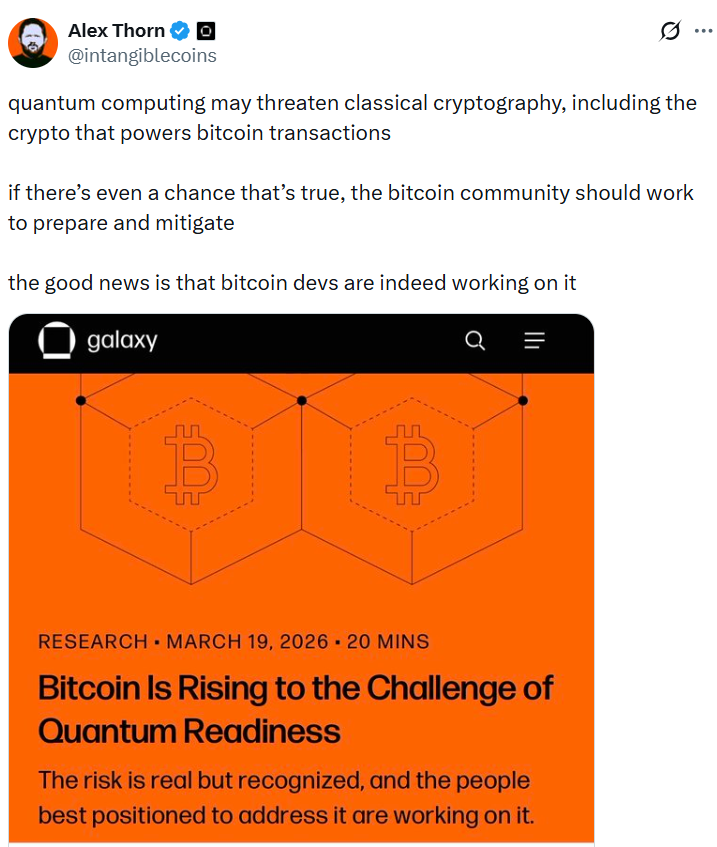
The quantum risk to Bitcoin investors is real, but not all wallets are vulnerable, and the people best positioned to address it are working on it, says Galaxy Digital research analyst Will Owens.
Owens said in a report on Thursday that, in theory, a quantum computer could derive private keys from public keys, allowing an attacker to impersonate the owner, forge a signature and steal coins.
However, he argued that not all wallets are equally vulnerable to this risk.
“In fact, most wallets are not vulnerable today. Funds are at risk only when public keys are exposed on-chain,” he said.
Owens said that created two main ways wallets are exposed: those whose public keys are already visible, and wallets whose public keys are revealed at the time of spending.

The threat of quantum computing to crypto has long been debated among the community as an upcoming inflection point. Advanced computers capable of breaking encryption have been theorized as able to reveal user keys, expose sensitive data and steal user funds.
The right people are on top of the issue
Critics argue the threat posed by quantum computers is overblown because the technology is still decades away from being viable, and banking giants and other traditional targets will be cracked long before Bitcoin.
Owens said there is also online discourse that Bitcoin Core developers are “ignoring and gatekeeping” quantum-related proposals, such as the soft fork BIP 360, but he claims to have found otherwise, noting that the “pace of proposals has accelerated meaningfully since late 2025.”
“Contrary to some public criticism, our review found substantial developer work addressing the question of quantum vulnerabilities and mitigations,” he said.
“The ecosystem now has a concrete and maturing set of proposals spanning the full problem surface. These proposals are not theoretical. They are being actively developed, reviewed, and debated by some of the most experienced contributors in the Bitcoin ecosystem.”
Other people in the space have also been presenting their solutions. Crypto OG Willy Woo suggested last November that a way to keep your Bitcoin (BTC) safe until there’s a solution to the quantum threat is to hold the coins in a SegWit wallet for around seven years.
Related: Bitcoin could go sub-$50K if quantum isn’t solved by 2028: Capriole
Governance will still likely present a challenge
When the developer community does come up with a post-quantum solution, Owens said it will likely present a challenge because “Bitcoin has no CEO, no board, and no central authority that can mandate a software update.”
“But the nature of this particular threat — external, technical, and universal in its impact — aligns incentives in a way that past disputes over Bitcoin’s economic direction did not,” he said. “Every honest participant in the network, from miners to holders to exchanges, has a direct financial interest in the network’s continued security.”
“For investors, the key takeaway is straightforward: the risk is real but recognized, and the people best positioned to address it are working on it.”
Magazine: Are DeFi devs liable for the illegal activity of others on their platforms?


A state-level crypto regulatory bill introduced in Kentucky includes provisions that would force hardware wallet manufacturers to build a “backdoor” into devices, according to the Bitcoin Policy Institute.
Summary
- Kentucky House Bill 380 proposes requiring hardware wallet providers to enable recovery of seed phrases, raising concerns over potential backdoor access.
- Bitcoin Policy Institute says the requirement is technically unworkable for non-custodial wallets and could undermine self custody of private keys.
Kentucky House Bill 380 has been amended at the last minute to require manufacturers to provide recovery options for users’ seed phrases, the BPI said.
The bill was introduced by state Representatives Aaron Thompson and Tom Smith.
According to the bill’s official language, providers “shall provide a mechanism for and assist any person who owns a hardware wallet” in resetting any “password, PIN, seed phrase, or other similar information that is necessary to access the contents of the hardware wallet.”
There are also identity verification requirements for users requesting password, seed phrase, or PIN resets from manufacturers.
The BPI says this is “technologically impossible for non custodial wallets” and adds that no one “can access or recover a user’s seed phrase.”
It is a threat to self-custody, which the group warns could push users toward centralized custody options that do not offer the same level of control.
“Kentucky legislators should be protecting their constituents’ right to secure their own property. We urge the Senate to strip this provision before the bill reaches a vote,” the BPI added.
Self-custody remains a debated topic. Crypto proponents argue that it is a fundamental right.
Some regulators agree. For instance, U.S. SEC Chair Paul Atkins said he is “in favor” of self-custody options in cases where intermediaries impose a financial or operational burden on the user.
Meanwhile, California’s Banking and Finance Committee chair Avelino Valencia amended a bill and added provisions that protect a user’s self-custody rights.
However, last year, the SEC issued a warning to retail investors about crypto custody risks and urged users to carefully weigh the trade-offs between managing their own wallets and relying on third-party custodians.
The agency noted that losing a private key would result in permanent loss of access to crypto assets, while also cautioning that custodial services carry their own risks, including hacks, misuse, or insolvency that could leave users unable to access their funds.
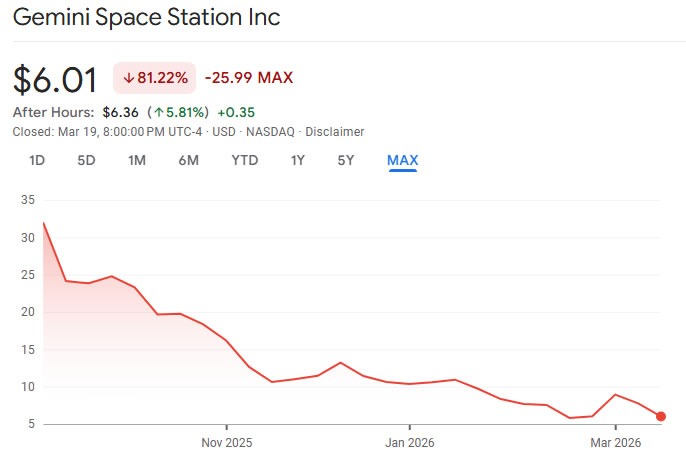
Gemini has been hit with a proposed class action in New York for allegedly misleading investors during and after the crypto exchange’s September initial public offering.
The class action lawsuit filed by shareholders on Thursday in a Manhattan federal court against Gemini, its co-founders Tyler and Cameron Winklevoss, and company executives, claims they made misleading statements in the company’s IPO documents.
Plaintiff Marc Methvin claimed that the documents portrayed Gemini as a growing crypto exchange focused on expanding its user base and international footprint, but made an “abrupt corporate pivot to a prediction-market-centric business model.”
Gemini held its IPO in September, floating its shares at $28 on the Nasdaq. The stock briefly tapped $40 but has since fallen by more than 80% to trade at around $6 on Thursday.
The plaintiffs are seeking a jury trial and damages as compensation for investors who bought shares at what the complaint claimed were “artificially inflated prices” shortly after the IPO.
Prediction market pivot caused stock drop, say shareholders
According to the complaint, in November, Gemini executives publicly touted its international expansion progress, stating the company was committed to extending into “key global markets.”
The lawsuit said Gemini IPO documents described the exchange as its “core product.” However, in early February, the Winklevoss brothers announced a pivot to prediction markets called “Gemini 2.0.”
The firm also announced that it would cut 25% of its workforce and exit the EU, UK, and Australian markets.
Related: Gemini post-IPO shakeup sees exit of three top executives
Later that month, the company’s chief financial officer, chief operations officer, and chief legal officer all departed as the firm reported increased operating expenses of around 40%, according to the lawsuit.
The complaint claimed that as a result of these changes, the class group had seen “significant losses and damages” as Gemini’s stock price dropped to an all-time low of $5.82 by February 20.

Gemini reported on Thursday that its Q4 revenues rose 39% year-on-year to $60.3 million, beating analyst expectations of $51.7 million.
Magazine: Are DeFi devs liable for the illegal activity of others on their platforms?


US authorities say the co-founder of Super Micro Computer, Inc. has been charged and arrested over an alleged multi-billion dollar scheme to smuggle advanced artificial intelligence chips from the US to China.
The Justice Department said in a statement on Thursday that it had unsealed an indictment charging Yih-Shyan “Wally” Liaw, as well as Super Micro sales executives Ruei-Tsang “Steven” Chang, and Ting-Wei “Willy” Sun over the alleged conspiracy.
Prosecutors said the trio violated US export control laws by conspiring “to sell billions of dollars’ worth of servers integrating sensitive, controlled graphic processing units to buyers in China.”
Super Micro, which was not charged, is a $18.5 billion California-based tech company specializing in high-performance server and data center hardware for large-scale companies such as IBM. Its infrastructure partners include firms like Nvidia and Google.
The Justice Department said the alleged scheme involved the trio using a range of concealment techniques to hide the sale of around $2.5 billion worth of servers to a company in China across 2024 and 2025, with $510 million worth of sales occurring between April and May 2025 alone.
“These defendants allegedly fabricated documents, staged bogus equipment to pass audit inventories, and used a pass-through company to conceal their misconduct and true clientele list,” said James Barnacle, Jr., FBI assistant director in charge of the New York Field Office.
Liaw and Sun have been arrested and will stand before a judge in the Northern District of California. Meanwhile, the Justice Department said that Chang, a Taiwanese citizen based outside the US, “remains a fugitive.”
Super Micro stock dives, company says it’s cooperating
In a statement shared with Cointelegraph, Super Micro distanced itself from the trio and labeled the alleged actions as a “contravention of the Company’s policies and compliance controls.”
Related: DOJ and Europol take down SocksEscort network tied to crypto fraud
“The company has been cooperating fully with the government’s investigation and will continue to do so. Supermicro has not been named as a defendant in the indictment,” a company spokesperson said.
Super Micro’s stock had initially gained during regular trading hours on Thursday. Following the Justice Department’s announcement, the stock has since dropped 13.25% to $26.71 in after-hours trading.
Magazine: Are DeFi devs liable for the illegal activity of others on their platforms?

BBC Comic Relief start time and finish time as presenters tease ‘best opening ever’

School uniform reuse scheme launches in London

Nevada cleared to pursue restraining order against Kalshi


-
Crypto World6 days ago
HYPE Token Enters Net Deflation as HyperCore Buybacks Outpace Staking Rewards
-

 Tech4 days ago
Your Legally Registered ‘Motorcycle’ Might Not Count Under Proposed US Law
-

 Fashion7 days ago
Weekend Open Thread: Addict Lip Glow
-
 Tech3 days ago
Are Split Spacebars the Next Big Gaming Keyboard Trend?
-
Sports6 days ago
Why Duke and Michigan Are Dead Even Entering Selection Sunday
-

 Business4 days ago
Search for Savannah Guthrie’s Mother Enters Seventh Week with No Arrests
-

 Business6 days ago
US Airports Launch Donation Drives for Unpaid TSA Workers as Partial Government Shutdown Enters Fifth Week
-
Crypto World6 days ago
Coinbase and Bybit in Investment Talks: Could Bybit Finally Enter the US Crypto Market?
-

 Business4 days ago
Australian shares drop as Iran war enters third week
-

 Business6 days ago
Country star Brantley Gilbert enters growing non-alcoholic beer market
-

 Crypto World4 days ago
Crypto Lender BlockFills Enters Chapter 11 with Up to $500M in Liabilities
-

 Sports6 days ago
College Basketball Best Bets: Conference Tournament Semifinal Picks
-

 Politics2 days ago
The House | The new register to protect children from their abusers shows Parliament at its best
-

 Fashion4 days ago
25 Celebrities with Curly Hair That Are Naturally Beautiful
-

 News Videos2 days ago
RBA board divided on rate cut, unusually buoyant share market | Finance Report | ABC NEWS
-

 Tech2 hours ago
inKONBINI Lets You Spend Summer Days Behind the Register
-

 Crypto World2 days ago
Canada’s FINTRAC revokes registrations of 23 crypto MSBs in AML crackdown
-
 Politics3 days ago
Real-time pollution monitoring calls after boy nearly dies
-

 Crypto World5 days ago
Crypto Losses Drop 87% in February, But Hackers Are Now Targeting People, Not Code
-
 NewsBeat1 day ago
Residents in North Lanarkshire reminded to register to vote in Scottish Parliament Election


You must be logged in to post a comment Login