
Crypto World
Crypto PAC Clinches Primary Wins but Loses $2M Florida Bid


Crypto-aligned political spending appears to have delivered early momentum for Fairshake and its affiliated super PACs, with four of the five candidates backed by the organization’s ad campaigns advancing in Tuesday’s US primaries. The results span Florida, Alaska, and Wyoming—an indication that the industry’s political outreach may be shaping the competitive field ahead of the 2026 midterms.
According to reporting on the primaries and Fairshake’s fundraising record, the Protect Progress and Defend American Jobs PACs collectively spent about $3.6 million on House and Senate races across the three states. While three candidates secured primary wins and one was expected to advance, a separate Florida race also highlighted the intensity of the PACs’ message—where negative ads funded by Protect Progress targeted an opponent who still won.
Key takeaways
- Fairshake-linked super PACs supported multiple candidates in primaries across Alaska, Florida, and Wyoming, with four advancing or winning.
- The PACs spent roughly $3.6 million combined on those contests, according to the cited breakdown of ad spending.
- In Florida’s 24th district, a candidate won despite being targeted by more than $2 million in Protect Progress-funded negative ads.
- Lawmakers are on recess until September, when the Senate is expected to address a cloture motion on the CLARITY Act—potentially influenced by the makeup of the next Congress.
Fairshake-affiliated PACs back candidates across three states
Tuesday’s primary outcomes reflected the reach of Fairshake’s political strategy through two affiliated PACs: Protect Progress (Democratic support) and Defend American Jobs (Republican support). The ad spending covered House and Senate contests in Alaska, Florida, and Wyoming.
In Florida’s 23rd congressional district, Democrat Lois Frankel won re-election. The campaign benefited from Protect Progress, which spent more than $150,000 on supportive media, according to the article’s figures.
On the Republican side, Defend American Jobs backed candidates in Alaska, Florida, and Wyoming. The PAC reported a combined $1.5 million in advertising support across these races—an effort that helped deliver primary victories for two candidates and positioned a third to move forward.
Defend American Jobs-supported Republican Sydney Gruters won her primary in Florida’s 16th district, while Representative Harriet Hageman won the Wyoming Senate Republican primary. In Alaska’s at-large congressional district, Republican Nick Begich was expected to advance following the primary results referenced in the report.
Florida’s 24th district: heavy negative spending failed to stop a winner
Not all of Fairshake’s political influence showed up in straightforward wins. A Democrat in Florida’s 24th district advanced as well, despite facing a barrage of negative advertising funded by Protect Progress.
Oliver Gilbert defeated challengers Shevrin Jones and Kendrick Meek with 34.4% of the vote, according to the cited New York Times results page. The primary also drew scrutiny because Protect Progress reportedly funded more than $2 million worth of negative ads aimed at Gilbert.
In an Aug. 12 report, the Miami Herald said Gilbert argued that “Trump’s tech billionaire buddies” were behind “crypto con artists trying to buy a Democratic primary” through Protect Progress ads. The Miami Herald report stated that the advertisements included fake Miami Herald headlines that misrepresented Gilbert’s positions, while noting that a PAC spokesperson claimed “the underlying facts in our ad are true.”
Gilbert’s acceptance speech, as described in the source material, did not explicitly mention the crypto industry or the PAC ads. Fairshake spokesperson Geoff Vetter, meanwhile, said the PAC was “just getting started building the largest pro-crypto Congress in history” after the three-state primary outcomes.
How much Fairshake spent—and why the timing matters
Fairshake’s political footprint has been a defining feature of the 2024 election cycle and the run-up to the 2026 midterms. The article notes that Fairshake reported holding a $193 million war chest as of January. It was also responsible for funding more than $130 million worth of ads supporting candidates it viewed as pro-crypto in the 2024 cycle, while opposing many candidates who criticized the industry or voted against what the PAC described as its interests.
For the 2026 period, the piece states that by June, the committee had spent more than $82 million on races ahead of the midterms, citing additional earlier reporting.
The reason this matters for investors and market participants is that crypto policy in the US—especially regulation around digital assets—often depends on the composition of Congress and the priorities lawmakers set after election cycles. As advertising translates into electoral strength, it can influence which bills move quickly and which stall.
CLARITY Act on deck as Congress returns
The immediate legislative calendar adds urgency to the primary results. The source notes that both the US House and Senate are on recess until September. During that period, the Senate is expected to address a cloture motion on the Digital Asset Market Clarity (CLARITY) Act.
The piece emphasizes that the bill passed the House in July with bipartisan support on a 294–134 vote. However, it also highlights that some Senate Democrats have been pushing for stronger ethics provisions tied to concerns about the Trump family’s crypto investments.
Whether CLARITY advances this session may depend on what happens in November. The article warns that Congress could shift from a Republican to Democratic majority depending on key races—some of which may be influenced by PAC activity like Fairshake’s. If the current session does not address CLARITY before 2027, lawmakers elected in November would potentially have the leverage to move the bill forward—or block it.
For readers tracking the intersection of crypto finance and US politics, the next watch items are straightforward: September’s Senate procedural steps on CLARITY, the broader outcomes across 2026 midterm races, and how PAC spending patterns evolve once the full midterm field is set.

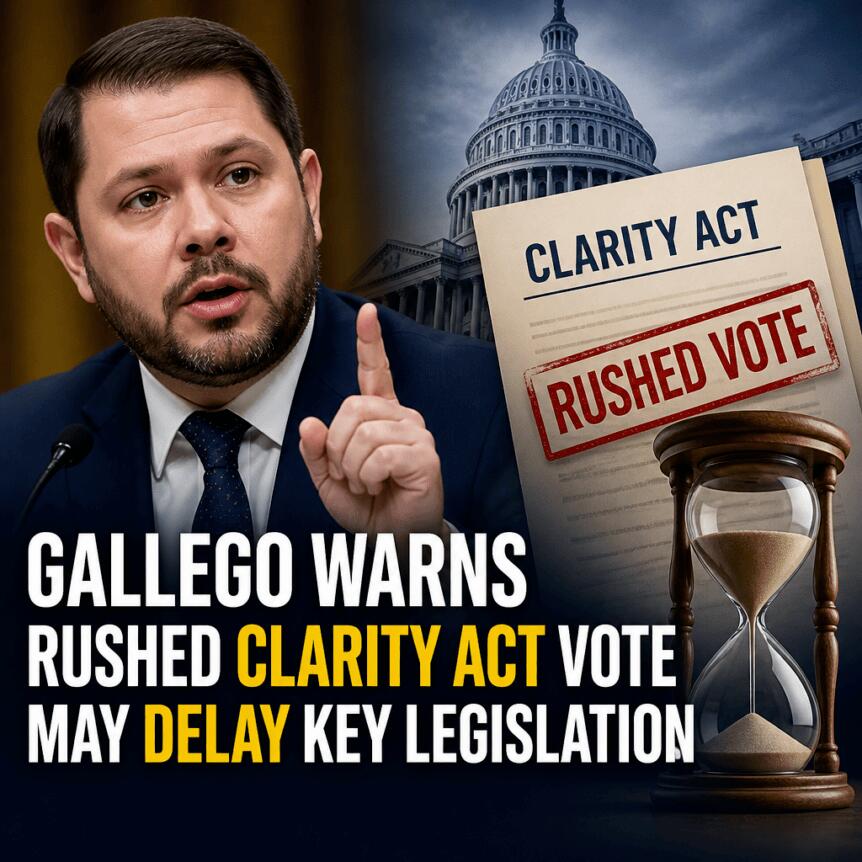
Sen. Ruben Gallego has warned that pushing the proposed CLARITY Act toward an early Senate vote before lawmakers finalize unresolved ethics and stablecoin-yield issues could derail U.S. crypto legislation rather than accelerate it. Speaking at the SALT Wyoming Blockchain Symposium on Wednesday, Gallego said Congress still needs to complete several procedural steps that could determine whether the bill can actually clear the Senate.
His remarks add friction to the Trump administration’s push for faster movement on the legislation, even as Senate leaders have previously signaled they intend to wait until after the August congressional recess. Gallego’s core message was that timing without agreement may produce an outcome lawmakers “don’t want,” potentially forcing the bill to be restarted later with weaker momentum.
Key takeaways
- Sen. Ruben Gallego urged lawmakers to avoid a “fast vote” on the CLARITY Act until disputes—particularly around ethics and stablecoin yield—are resolved.
- Gallego said he and Sen. Thom Tillis submitted compromise ethics language to the White House before the recess but received no clear, point-by-point response.
- The warning suggests procedural action in the Senate could arrive before a bipartisan coalition is in place, risking failure at the 60-vote threshold.
- While the White House has pressed for a “fair version” of the bill, Senate leaders have already indicated the vote could be deferred to September.
Why Gallego says rushing the process could backfire
Gallego framed his concern around how complex the legislative package still is. In his view, the Senate cannot simply move forward to voting if the bill’s components haven’t been fully coordinated and assembled into a final package capable of winning the votes needed for passage.
He specifically noted that lawmakers still have work to do, including addressing the bill’s Agriculture Committee portion, consolidating the broader package, and determining how to route it to the House. Gallego argued that these steps matter because an early vote could lock lawmakers into a timeline that doesn’t match negotiation progress.
“Don’t go for a fast vote,” Gallego said. “A fast vote gets you a fast result, but I’m not sure it’s the result you want.” He added that Congress still had “a lot of steps to complete,” and that “any premature movement is going to set it back further.”
The practical implication for investors and market participants is straightforward: if the bill is advanced before the coalition is ready, the probability of a legislative stall increases. That can prolong uncertainty around U.S. crypto market structure even if the bill ultimately returns later with stronger terms.
Ethics negotiations appear to be the sticking point
Gallego’s criticism also focused on the bill’s ethics framework. He said he and Republican Sen. Thom Tillis had submitted compromise ethics language to the White House before the congressional recess. However, he told the symposium he had not received a detailed response addressing the proposal point-by-point.
According to Gallego, the lack of feedback has made it difficult to close the gap needed for Democratic lawmakers to support the bill. He argued that “sufficiently strong ethics restrictions” were important to earn Democratic support and move the legislation forward.
“We’ve been sending offers over and over again to the White House, and they’ve been coming back either blank, or they’ve come back even slightly further back, or we’ve heard nothing,” Gallego said.
Cointelegraph reached out to the White House for comment but did not receive a response before publication, leaving Gallego’s characterization of stalled negotiations unaddressed in the reporting.
Administration push for speed vs. Senate procedural timing
Gallego’s warning complicates the broader push for swift passage coming from the White House. Earlier coverage from Cointelegraph described the administration’s push for moving toward passage, and on Wednesday Trump urged Congress to pass a “fair version” of the CLARITY Act during a White House appearance with crypto executives.
However, Senate timelines have already suggested that immediate action may not be available. In a report discussed by Cointelegraph, Senate Majority Leader John Thune confirmed on Aug. 7 that the chamber was “punting” the vote and that CLARITY would be queued up “first thing” after lawmakers returned from recess—positioning September as the likely window for consideration.
Patrick Witt, a White House crypto adviser, had previously said the administration would negotiate with Democrats until the September vote, while also stating the administration “can’t afford to wait forever.” That tension—between negotiating leverage and deadline pressure—is now colliding with Gallego’s insistence that substantive ethics resolution must come first.
In other words, even with a September target already on the table, Gallego’s comments suggest the real question is whether negotiations are likely to produce a version strong enough to build a bipartisan coalition—particularly given the Senate’s 60-vote threshold.
What lawmakers still need to finalize before any Senate vote
Beyond ethics language, Gallego indicated multiple procedural and substantive hurdles remain before the bill can be ready for the next legislative stage. He mentioned the need to resolve the bill’s Agriculture Committee component, then assemble the broader package, and finally determine the correct path for sending the finalized measure to the House.
He also linked these remaining tasks to timing and negotiating discipline. For Gallego, the key risk is that procedural momentum—such as a vote being placed on the calendar—could outpace the actual work of building consensus. If that happens, the Senate could be forced into action on a version that lacks enough support, turning a negotiation problem into a legislative failure that makes future compromise harder.
The larger takeaway is that U.S. crypto regulation is still being shaped by how these bills navigate both policy disputes and legislative mechanics. Even when political actors want speed, the Senate’s structure and voting math reward coalitions that are assembled deliberately rather than rushed.
Readers should watch whether the White House provides the detailed ethics feedback Gallego says it has not yet delivered, and whether negotiators converge on a version of the CLARITY Act capable of clearing the Senate—particularly as September approaches.

XRP’s struggle near $1 continues even as its peers display modest gains this week. The crypto asset went down almost 10% over the past month before it rebounded significantly on Wednesday evening.
Despite the weakness, much more XRP is being withdrawn than deposited across major platforms.
Reserves Slide
According to the latest analysis shared by CryptoQuant, XRP reserves across Upbit, Binance, and Bithumb have fallen by roughly 240 million from their late-May and early-June levels, as of August 19. South Korean giant Upbit held 6.40 billion XRP, down from 6.51 billion on May 30, which is a decline of about 110 million, or 1.7%.
The figures for Bithumb fell to 1.82 billion from 1.85 billion on June 2, a decrease of roughly 30 million, or 1.6%. Meanwhile, Binance recorded the largest percentage decline, with its reserves for the token dropping to 2.62 billion from 2.72 billion over the same period, which translates to a reduction of approximately 100 million XRP, or 3.7%.
Combined reserves across the three exchanges decreased from about 11.08 billion to 10.84 billion, representing a decline of roughly 2.2%. Despite the overall reduction, Upbit remains the largest holder of the crypto asset among the three exchanges. In fact, Upbit and Bithumb together hold about 8.22 billion XRP and account for nearly 76% of the reserves tracked across the three platforms.
The falling exchange reserves come as wallet activity across major exchanges turns more focused on withdrawals. As recently reported by CryptoPotato, Coinbase recorded a seven-day net wallet count of -14,300 as of August 18. The exchange accounted for 47.3% of the total absolute imbalance, its highest share since July 2024.
Binance posted a net wallet count of -3,270, while Crypto.com recorded -2,680. Both exchanges moved into negative territory on July 18, almost a week after Coinbase. Binance’s share of the overall imbalance also rose from nearly zero on July 16 to around 10%. Upbit, however, saw its share fall to about 12% from 40% in June.
Whale Activity
The asset’s weak price performance has not stopped large transactions from picking up on the XRP Ledger. Data shared by crypto analyst Ali Martinez revealed that transactions worth more than $1 million jumped 280% in a single day and reached nearly 40, compared with around 10 during each of the previous two days.
The spike came shortly after wallets holding between 10 million and 100 million XRP accumulated about 72 million tokens in one day.
Network activity has also picked up, as the ledger recorded nearly 50,000 active addresses over a 24-hour period last week. Despite the rise in activity, social sentiment around XRP fell to a three-month low.
The post 240 Million XRP Pulled From Major Exchanges Since Early Summer: Why It Matters appeared first on CryptoPotato.

Costco stock reclaimed a key technical level on Tuesday as the warehouse club climbed amid news of a partnership to offer Medicare Advantage plans to members. Costco Wholesale (COST) will offer co-branded plans in partnership with nonprofit health insurer Scan Group. Scan, based in Long Beach, Calif., has about 560,000 Medicare Advantage members in Southern California, Arizona, Nevada, New Mexico…
Copyright ©2026 Investor’s Business Daily, LLC. All rights reserved. 87990cbe856818d5eddac44c7b1cdeb8
Bitcoin (BTC) falling more than 50% from its $126,200 all-time high was a “positioning correction,” BlackRock says.
Key points:
- A BlackRock report attributes Bitcoin’s decline below $60,000 to cascading liquidations as leverage was purged from the market.
- The long-term BTC investment thesis as a “low-correlation diversifier” remains intact, analysts confirm.
- BlackRock sees Bitcoin’s risk-asset correlation declining as time goes on.
BlackRock predicts falling correlation of BTC with risk assets
In a report published this week, the world’s largest asset manager preserved its bull thesis despite waves of outflows from its spot Bitcoin exchange-traded fund (ETF) in 2026.
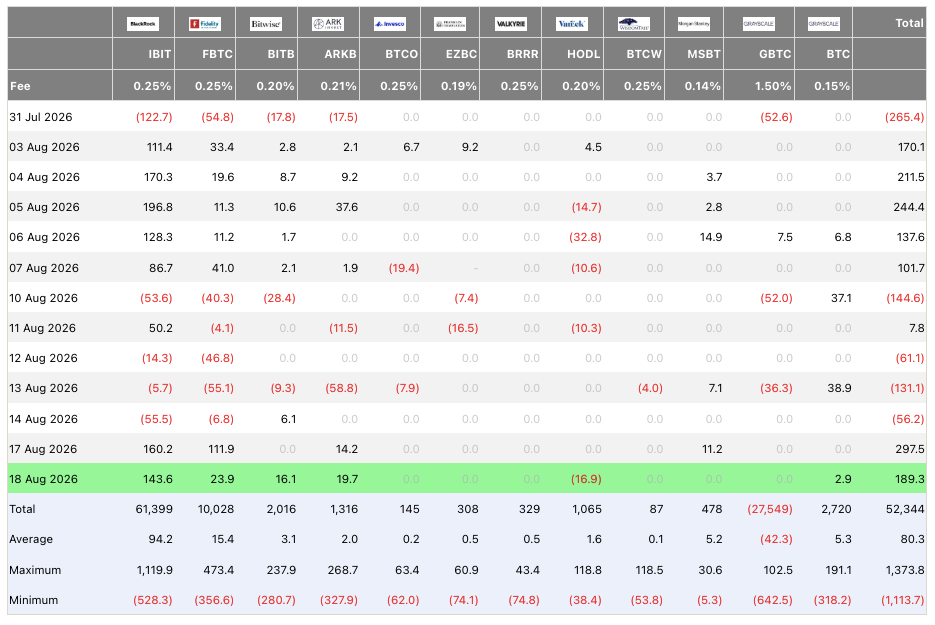
BlackRock’s iShares Bitcoin Trust (IBIT) saw net outflows of $78.9 million in the week through Aug. 14. Across all ETF products, outflows totaled $267.2 million.
“We view bitcoin’s ~50% pullback from October 2025 highs as a positioning correction rather than a change in its investment case. A historically overleveraged market, enabled by perpetual futures, suffered cascading liquidations compounded by slowing ETP outflows and digital asset treasury demand,” the report states.
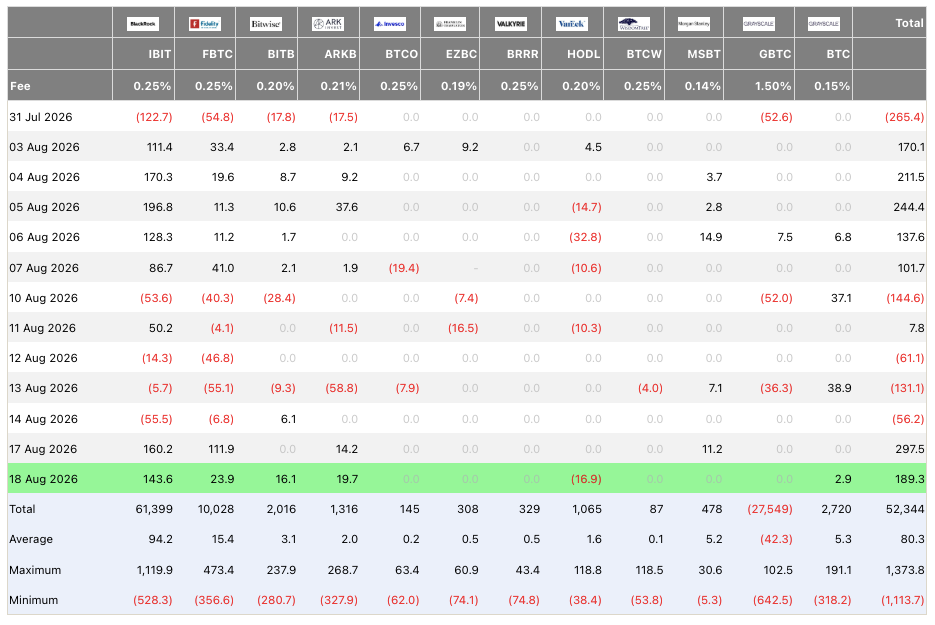
US spot Bitcoin ETF netflows (screenshot). Source: Farside Investors
During last year’s peak, Bitcoin experienced a surge in speculative positioning. BlackRock pointed to open interest on Bitcoin derivatives markets passing $90 billion in early October amid heavy use of leverage. The unwinding of these positions increased the correlation between BTC/USD and risk assets more broadly.
“A macro-driven risk-off catalyst (China tariff headlines) triggered large-scale deleveraging across precious metals and crypto markets. The resulting liquidation waves drove prices down to cycle lows below $60,000 per bitcoin by June 2026,” it explained.
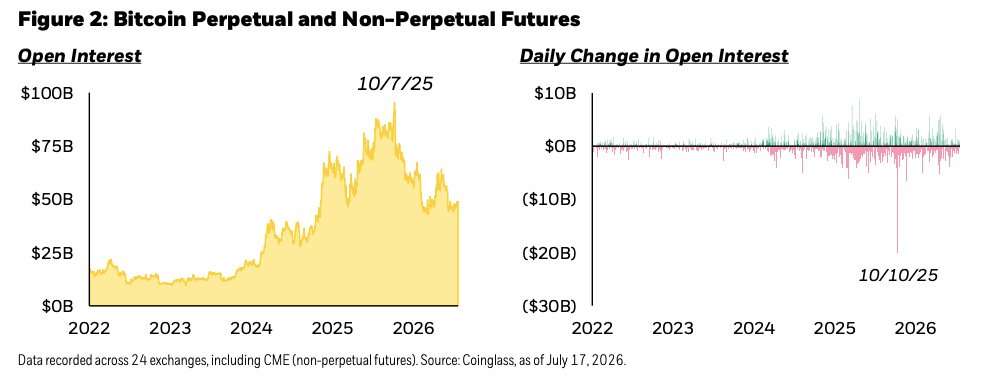
Bitcoin futures open interest data (screenshot). Source: BlackRock
Institutional Bitcoin demand has suffered this year as a combination of geopolitical uncertainty and growing inflation pressures saw capital flowing into established risk-asset classes, among them US equities, with the S&P 500 hitting record highs last week. Bitcoin has failed to follow suit, but BlackRock forecasts that this may change.
“With speculative excess now largely purged, we believe bitcoin’s recent episodes of elevated risk correlation should normalize lower, consistent with its longer-term record as a low-correlation diversifier,” it continued.
Longer-term resilience of BTC stands out
The report highlights that long-term BTC investment returns follow key political and macro events. These include the COVID-19 outbreak in March 2020, the US presidential election the same year, as well as the regional banking crisis and president Donald Trump’s multiple international trade-tariff declarations.
Related: Bitcoin price spike to $64.5K was ‘low-volume liquidity trap’: Analysis
While it initially struggled following some of these events, Bitcoin produced solid returns on a 60-day basis. In the case of the 2020 election, these hit as high as 113%.
“Through multiple shocks in recent years, bitcoin often outperformed both the S&P 500 and gold in the weeks and months following the onset of disruptions,” BlackRock commented.
“This pattern has held true thus far in 2026 amid ongoing conflict between the U.S. and Iran, with bitcoin delivering positive returns and outperforming equities and gold following the onset of hostilities in February and the end of the ceasefire agreement in July.”
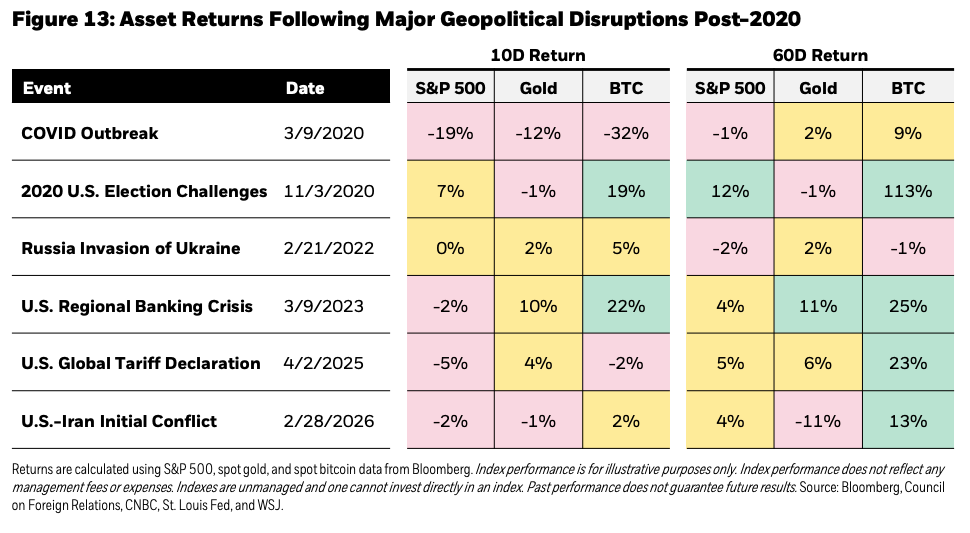
Macro asset returns comparison (screenshot). Source: BlackRock
Further data puts Bitcoin’s 12-month realized volatility at 40% compared to 26% for gold and 12% for the S&P 500. The rolling six-month correlation between Bitcoin and the S&P, presented as a 10-year average, is now 0.18 — still notably higher than gold’s 0.06 reading.
“Bitcoin’s underlying investment case aligns more closely with that of gold — as a global monetary alternative and a hedge against inflation, global disorder, and declining trust in fiat currencies. Even for gold, which tends to be viewed as a standard uncorrelated, store-of-value asset, brief periods of high equity correlation exist, including COVID in 2020-2021 and the monetary easing cycle in 2023,” the report added.
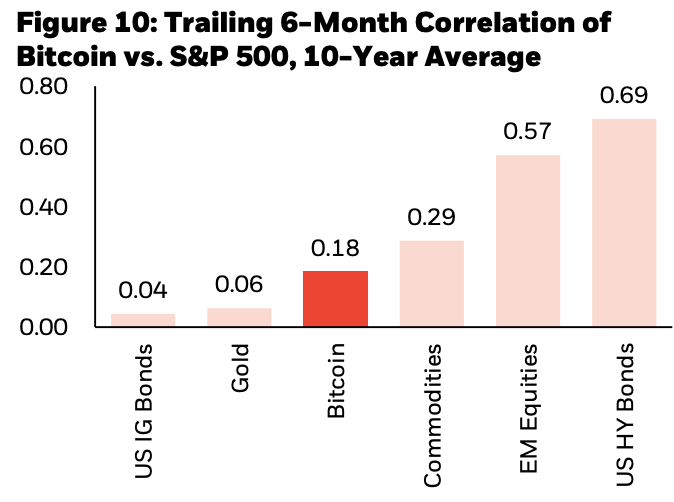
Bitcoin vs. S&P 500 correlation data (screenshot). Source: BlackRock
Since October 2025, BTC price performance has led some to question its role as a form of “digital gold.” In a Q1 report, asset manager Grayscale described short-term behavior as being more like a growth stock than gold, noting its low correlation to the latter.


Every major except tron posted double-digit weekly gains, with nearly $1.4 billion of short positions wiped out after the Treasury doubled its bond buybacks.

What’s unlikely to help, meanwhile, is glaring, recoiling, kicking someone under the table, or making snide remarks. “Jokes, sarcasm, public corrections, or visibly expressing disgust probably won’t change the behavior in the long run,” Wagner says. “But it will damage the relationship.”
Even the most tactful conversation might embarrass the person; there’s no magic phrase that makes criticism delightful to receive. “The goal is to not intentionally embarrass or insult them,” Wagner says.
Know when to adapt instead
Sometimes the kindest and easiest choice is to work around the behavior. Wagner has encountered friends and colleagues who double-dipped, for example, but she never corrected them. She simply ordered her own appetizer or transferred what she wanted to a separate plate before they began eating. The behavior bothered her, but she decided the relationships mattered more.
That calculus changes when the offender is a partner and the habit makes you dread eating together. If you’ve raised the issue respectfully and the person repeatedly dismisses your discomfort, the problem may no longer be their chewing. It may be that you don’t feel heard or considered—and that’s a larger conversation.


Democratic Senator Ruben Gallego warned that rushing the CLARITY Act to a Senate vote before lawmakers resolve disputes over ethics and stablecoin yield could set United States crypto market structure legislation back.
Speaking at the SALT Wyoming Blockchain Symposium on Wednesday, Gallego said the crypto industry should encourage Senate Democrats and Republicans to continue negotiating instead of pushing for an immediate vote. He said lawmakers still had to address the bill’s Agriculture Committee portion, assemble the broader package and determine how to send it to the House.
The warning complicates the Trump administration’s push for swift passage by suggesting that a procedural vote could arrive before negotiators have assembled the bipartisan coalition needed to reach the Senate’s 60-vote threshold.
“Don’t go for a fast vote,” Gallego said. “A fast vote gets you a fast result, but I’m not sure it’s the result you want.” He added that Congress still had a lot of steps to complete and that “any premature movement is going to set it back further.”
Gallego says White House has not answered ethics proposal
Gallego said he and Republican Senator Thom Tillis submitted compromise ethics language to the White House before the congressional recess but had not received a point-by-point response. He said that sufficiently strong ethics restrictions were necessary to attract Democratic support and advance the bill.
“We’ve been sending offers over and over again to the White House, and they’ve been coming back either blank, or they’ve come back even slightly further back, or we’ve heard nothing,” Gallego said.
Cointelegraph reached out to the White House for comment but did not receive a response before publication.
Related: CLARITY Act delay gives Asian financial hubs an opening: First Digital CEO
The remarks follow renewed pressure from the administration. On Wednesday, Trump urged Congress to pass a “fair version” of the CLARITY Act during a White House appearance with crypto executives.
Senate leaders have delayed action until September. On Aug. 7, Senate Majority Leader John Thune confirmed to Cointelegraph that the chamber was “punting” the vote and said CLARITY would be queued up “first thing” after lawmakers returned from recess.
White House crypto adviser Patrick Witt previously said the administration would negotiate with Democrats until the September vote but “can’t afford to wait forever.”
Magazine: ‘Fabricated rumors’ about BitMart founder, Binance bStocks dominate: Asia Express
Crypto World
Tech Stocks Fall On War, Macro Woes. Is Anthropic Revenue Projection Also A Factor? Tech Stocks Fall. Is Anthropic Revenue News A Factor?

Tech stocks tumbled Tuesday, joining a broad market sell-off triggered by ongoing worries about the U.S.-Iran conflict which led to higher Treasury Yields and oil prices. One analyst also pointed to a potential culprit: reports of Anthropic projected revenue run rate, which is lower than speculation. The Nasdaq shed roughly 278 points or around 1%, as chip stocks, led by…
Copyright ©2026 Investor’s Business Daily, LLC. All rights reserved. 87990cbe856818d5eddac44c7b1cdeb8


Traders betting against crypto lost $2.74 billion in a day, more than the short side of the October 2025 crash that remains the biggest liquidation event in the market’s history.
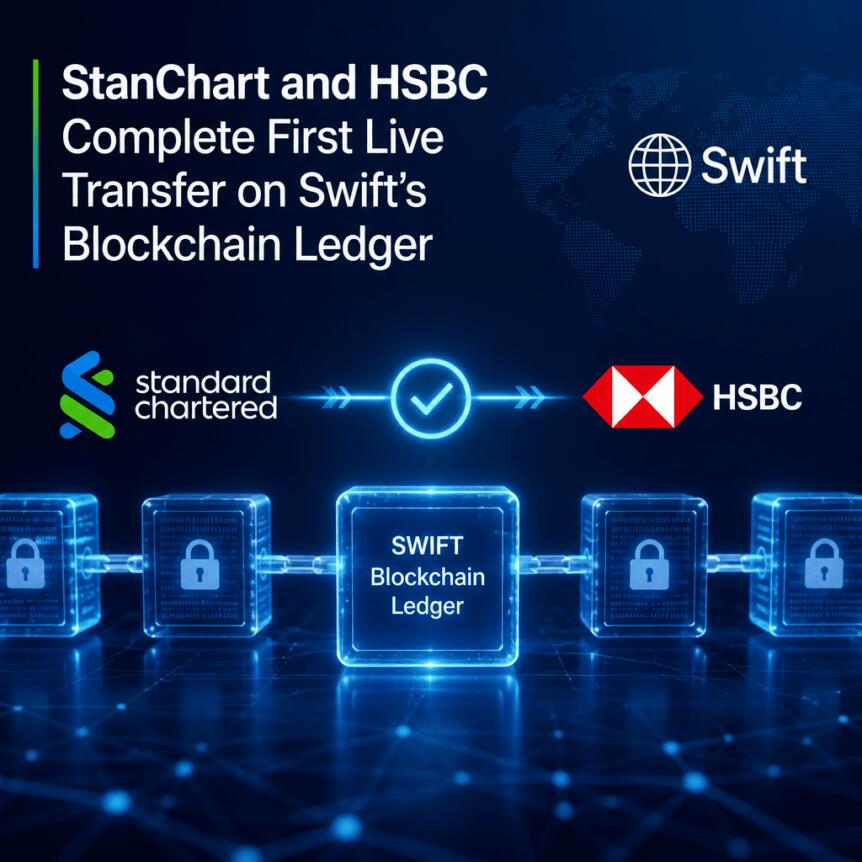
Standard Chartered and HSBC have completed what they describe as the first live cross-border transaction using Swift’s blockchain-based ledger, marking an early interoperability milestone for banks experimenting with tokenized deposits. The test took place about a month after Swift said the ledger was ready for initial use.
According to the details of the transaction, payment messages were exchanged between the two banks via Swift’s ledger, while the resulting obligations were recorded on HSBC’s Tokenised Deposit Service and StanChart’s tokenized deposit infrastructure. Swift’s ledger then acted as an orchestration layer—matching and netting obligations between the banks before final settlement through existing payment systems.
Key takeaways
- HSBC and Standard Chartered report the first live cross-border trade on Swift’s blockchain-based ledger.
- Swift’s ledger is positioned as an orchestration and netting layer, with settlement still tied to existing payment infrastructure.
- The test builds on Swift’s July announcement that 17 banks would pilot live transactions using tokenized deposits.
- The approach targets 24/7 cross-border settlement while keeping established compliance, risk, and settlement controls in place.
- Interoperable tokenized deposits are increasingly being tested across jurisdictions, with broader industry trials also underway.
What happened in the first live transaction
Swift’s blockchain-based ledger is designed to connect tokenized deposits issued on separate bank infrastructure. In the live transaction between HSBC and Standard Chartered, the mechanics were centered on messaging, obligation recording, and settlement orchestration rather than a full replacement of the banks’ existing settlement rails.
Rather than moving funds end-to-end solely on-chain, the transaction used Swift’s ledger to handle the exchange of payment messages between the banks. The obligations that resulted from those messages were captured within each bank’s own tokenized deposit setup—HSBC’s Tokenised Deposit Service for HSBC and Standard Chartered’s tokenized deposit infrastructure for StanChart.
Swift’s ledger then netted and matched the obligations between the two counterparties, after which settlement proceeded through existing payment systems. That structure is significant for banks that want faster and more continuous execution without abandoning the operational, legal, and risk frameworks already embedded in traditional payment workflows.
How Swift’s ledger fits into the broader tokenized-deposit push
The live report follows Swift’s July announcement that its blockchain-based ledger was ready for initial use. Swift said it would support a pilot involving 17 banks spanning six continents, preparing to conduct live transactions using tokenized deposits.
The banks named as part of that pilot include Citi, BNP Paribas, BNY, Wells Fargo, UBS, MUFG, DBS, and ANZ, alongside HSBC and Standard Chartered. Swift has framed the ledger as a way to enable interoperability between tokenized deposits across different institutions, while still respecting the settlement, compliance, and risk controls that financial institutions require.
For investors and market participants watching the “tokenization” trend, the key signal is not only that banks are testing digital assets, but that they’re working toward connectivity between separate tokenized systems. Interoperability is often the hardest problem: tokenized value can exist inside a silo, but cross-border payment usefulness rises substantially when institutions can transact across siloed infrastructures.
Why orchestration and netting matter for adoption
Swift describes its ledger as an orchestration layer that matches and nets obligations before final settlement. That design choice can reduce the operational complexity of cross-border payments between different tokenized deposit environments—each bank can maintain its own infrastructure while relying on Swift’s ledger to coordinate the interaction.
The emphasis on netting also reflects a practical reality: cross-border payment systems must handle large numbers of transactions without turning every transfer into a fully independent settlement event. By pairing messaging with netting, banks can potentially reduce friction and execution overhead—while still settling obligations via established payment rails.
Swift’s positioning is also relevant to a wider debate in crypto-adjacent payments about how far blockchain should be used in the payment stack. This pilot suggests a hybrid direction: blockchain-based infrastructure for coordination and continuity, alongside conventional settlement processes where required.
Industry momentum beyond Swift’s pilot
The Swift-anchored cross-border transaction is occurring as other major institutions pursue tokenized deposit and “real-value” settlement trials.
HSBC previously indicated plans to expand its Tokenised Deposit Service to corporate clients in the US and UAE in the first half of 2026, building on deployments in Hong Kong, Singapore, the UK, and Luxembourg. The service was also launched in the US in April, with coverage for eligible corporate and institutional clients seeking 24/7 domestic and cross-border transfers using tokenized deposits.
Standard Chartered has participated in broader efforts to test tokenized bank money across institutions. In July, it was among 28 financial institutions and central banks involved in the Bank for International Settlements’ Project Agorá, which conducted real-value settlement trials using tokenized commercial bank deposits and central bank reserves across six currencies.
Meanwhile, the US payments landscape is also moving toward connectivity between legacy systems and tokenized rails. The Clearing House has reportedly discussed plans to launch a tokenized deposit network in the first half of 2027, connecting traditional payment networks with digital asset infrastructure for around-the-clock settlement.
Taken together, these efforts point to a broader pattern: rather than treating tokenized deposits as isolated experiments, major players are working toward networks and coordination layers that can make tokenized money function across boundaries—geographic, institutional, and regulatory.
Next, market participants will want to track how quickly the Swift ledger pilot expands beyond initial counterparties, and whether additional banks can complete similar end-to-end workflows with the same level of operational readiness—particularly around reliability, compliance processes, and how netting and orchestration behave as transaction volumes increase.

Financial Abuse Starts With Love: The 5-Stage Trap That Makes Leaving Impossible

The Castle by Jon Ronson: Entertainingly leftfield look at the masculinity crisis

Milky Mist Dairy Food shares slip 4% after sharp post-listing rally

Weekend Open Thread – Corporette.com

Weekend Open Thread: Brooks Brothers

London Mayor Sadiq Khan handed a peerage by Keir Starmer alongside 15 other Labour figures… just days before the PM leaves No10
Financial Abuse Starts With Love: The 5-Stage Trap That Makes Leaving Impossible

You Will Attract A Financial Miracle Just By Hearing This Prayer 1 Time || Kenneth e hagin

Don’t Leave Your Financial Future To Chance | August 19, 2026
-

 Fashion5 days ago
Weekend Open Thread: Ann Taylor
-
 Sports6 days ago
This U.S. Amateur is a glimpse into golf’s future in more ways than you think
-
 Tech6 days ago
11 Ways to Rank Your Videos
-
 NewsBeat5 days ago
Myanmar says over 300,000 Rohingya refugees verified for repatriation as exodus enters ninth year
-

 Sports5 days ago
Birmingham 2026: Day 6 Timetable for Irish Athletes
-

 Politics5 days ago
SEQ Code: The Three Letter Boarding Pass Code That Could Give You The Worst Seat
-

 Tech6 days ago
DeepSeek Harness launches as open source rival to Claude Code, alongside V4-Pro on API with higher prices
-

 Tech2 days ago
Qwen3.8-27B runs frontier-class coding agents and reasoning locally, no cloud API required
-

 Crypto World2 days ago
OCC Greenlights Trump Family Crypto Firm for Trust Charter
-

 Fashion5 days ago
Weekly News Update, 8.14.26 – Corporette.com
-
 Tech5 days ago
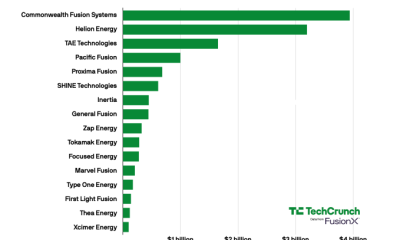
Every fusion startup that has raised over $100M
-
 Entertainment6 days ago
10 Netflix Shows That Quietly Became Modern Classics
-
 Entertainment5 days ago
Marvel Studios Reveals New X-Men Cast Including Adam Driver and Sadie Sink
-

 Business6 days ago
15 Ways to Make Money From Your Phone (2026 Guide)
-

 Crypto World5 days ago
Pi Network Protocol 27 endgame: last upgrade before what?
-

 Business5 days ago
Facebook Down Now? Users Report Login And Loading Problems As Outage Trackers Monitor Ongoing Issues
-

 Business2 days ago
SMA Solar Technology AG (SMTGY) Q2 2026 Earnings Call Transcript
-

 Fashion6 days ago
Silver bangles for women – Newbridge Silverware
-

 Crypto World6 days ago
Robinhood Chain Approaches $1B TVL as Uniswap Integration Boosts Liquidity
-

 Fashion6 days ago
Cart Confidential Vol. 44 – Julia Berolzheimer
You must be logged in to post a comment Login