

Crypto World
Crypto Scams Declined in February, But Still Millions Were Lost



Crypto exploits declined by more than 90% in February, with digital asset thieves siphoning just $35.7 million across the ecosystem.
The sharp decline marks the quietest month for crypto security since March 2025, providing a brief reprieve for a sector routinely battered by nine-figure hacks.
Phishing and Oracle Attacks Linger Despite the Sharp Fall in Crypto Theft
Data compiled by blockchain security firm CertiK revealed a drastic month-over-month drop from January’s staggering losses.
Meanwhile, the figures also represent a massive year-over-year contraction. Last year’s February was dominated by a historic $1.5 billion exploit on the Bybit exchange, an anomaly that heavily skewed annual security metrics.
Despite the broader market slowdown in illicit activity, targeted attacks still drained millions from decentralized finance protocols.
The single largest crypto exploit incident occurred on February 22 on the Stellar network.
According to Quill Audits, a hacker exploited the community-managed YieldBlox Blend pool. The attacker stole more than $10 million through a classic thin-liquidity oracle manipulation attack.
By executing a single abnormal trade in the highly illiquid USTRY/USDC market, the attacker artificially inflated the token’s price by a factor of 100.
This tricked the protocol’s valuation system, allowing the attacker to execute massive undercollateralized borrowing.
A day earlier, on February 21, the Internet-of-Things blockchain project IoTeX suffered a major breach after a private key was compromised.
While CertiK estimated the losses at nearly $9 million, the IoTeX team claimed the stolen amount was closer to $2 million.
Security researchers noted the attacker used the compromised key to access the token safe, quickly swapped the stolen assets for ETH and routed them to Bitcoin using cross-chain bridges.
Rounding out the top three was a $2.2 million exploit of Foom.Cash, a privacy protocol.
In this attack, the hacker reportedly exploited a cryptographic flaw to forge zkSNARK proofs. This allowed them to create fake digital credentials that the protocol accepted, enabling the withdrawal of large volumes of tokens.
Crypto Phishing Attacks Remain a Concern
Beyond smart contract vulnerabilities, phishing remains a persistent threat, accounting for exactly $8.5 million of February’s total losses.
The crypto phishing sector has flourished recently, driven by the rise of professionalized “drainer-as-a-service” providers like Angel Drainer and Inferno Drainer.
These platforms allow scammers to execute large-scale malicious operations with minimal technical expertise. They provide fraudsters with a complete toolkit, including cloned websites, deceptive social media accounts, and automated smart contract scripts.
In exchange for providing this illicit infrastructure, the operators take a percentage of all stolen funds.



UAE’s Capital Markets Authority shut both the Abu Dhabi (ADX) and Dubai Financial Market (DFM) stock exchanges for March 2–3 after Iran struck major ports and oil tankers across the Middle East.
The ADX and DFM are the two primary equities exchanges in the United Arab Emirates, together serving as the Gulf region’s key capital market hubs.
Why it matters:
- Iran’s strikes effectively blocked the Strait of Hormuz, the chokepoint through which roughly 20 million barrels of oil per day and nearly 20% of global LNG exports transit.
- A sustained Hormuz closure could push oil above $100 per barrel, according to Kobeissi Letter analysis, spiking US CPI inflation toward 5%.
- War-risk insurance costs have reportedly jumped ~50%, adding hundreds of thousands of dollars per voyage and reducing global trade flow.
- Shipping reroutes around Africa add 10–14 extra days to deliveries, slowing just-in-time manufacturing supply chains.
The details:
- UAE’s Capital Markets Authority ordered the two-day closure explicitly to prevent panic selling; officials said it is not a public holiday.
- The exchange shutdown followed Iranian strikes on regional ports.
- Meanwhile, Israel extended its state of emergency through March 12, 2026.
- Qatar, one of the world’s largest LNG exporters, faces potential supply delays as the Hormuz route remains disrupted.
The big picture:
- Gold surged 13% and oil rose 20% over six weeks prior to the strikes, suggesting markets had already priced in geopolitical risk.
- Analysts at Bull Theory compare potential LNG disruption to the 2022 European energy crisis, when governments drew down emergency reserves.
- Trump’s stated policy goals — low inflation and $2.00/gallon gas — conflict directly with a prolonged Iran conflict, which analysts say creates political pressure for a swift resolution.
The post UAE Suspends Stock Trading Amid Iran Strikes appeared first on BeInCrypto.

TLDR:
- Kalshi’s “Ali Khamenei out as Supreme Leader?” market accumulated over $50 million in total trading volume.
- Traders who held positions before Khamenei’s death were paid out at the last-traded price of 1:14 AM ET.
- Kalshi’s promotional post on X during the strikes drew sharp criticism from former SEC chief of staff Fischer.
- Six Democratic senators urged the CFTC to ban contracts that resolve on or correlate to an individual’s death.
Kalshi, the CFTC-regulated prediction market platform, is under scrutiny following its handling of a controversial contract tied to Iran’s Supreme Leader Ali Khamenei.
Khamenei was killed in U.S.-Israeli strikes early Saturday morning. The market, titled “Ali Khamenei Out as Supreme Leader?” had accumulated over $50 million in total trading volume. Roughly $20 million of that traded on Saturday alone, according to prediction market analyst Dustin Gouker.
Settlement Process Draws Criticism
Kalshi CEO Tarek Mansour addressed the controversy directly on X. “We don’t list markets directly tied to death,” Mansour wrote. “When there are markets where potential outcomes involve death, we design the rules to prevent people from profiting from death.”
Under the CFTC-filed contract terms, positions would settle at the last-traded price before Khamenei’s death. That price was recorded at 1:14 AM ET Saturday, per Mansour.
Trading was halted at approximately 2:59 PM ET on Saturday. Kalshi formally closed the contracts at 10:06 PM ET, according to DeFi Rate.
The platform issued two clarifications throughout the day, acknowledging that prior settlement language was “grammatically ambiguous.”
A key dispute emerged over the timing of Khamenei’s confirmed death. The CFTC-filed terms referenced the “last traded price prior to the death.”
However, the market page read “last traded price prior to confirmed reporting of death.” Hours of active trading occurred between his actual death and public confirmation.
Mansour announced that traders who entered positions before Khamenei died would be paid at the last-traded price.
Those who entered after his death would receive full refunds of their cost of entry. He also confirmed Kalshi would reimburse all fees from the market.
Promotional Posts and Prior Settlements Add to the Debate
While reports of Khamenei’s death circulated Saturday morning, Kalshi posted on X: “BREAKING: The odds Ali Khamenei is out as Supreme Leader have surged to 68%.” Mansour reposted the statement.
Amanda Fischer, a former SEC chief of staff now at Better Markets, described it as “more or less offering a proxy market on assassination.”
Critics also pointed to an earlier Kalshi market asking “Who will be at Trump’s inauguration?” Jimmy Carter was listed as an option.
After Carter died in late December 2024, Kalshi settled that contract to “No.” One widely shared post argued: “You settle on death, just not when it makes you money,” directly contrasting the two outcomes.
Mansour defended the Khamenei market as serving a legitimate purpose. He cited geopolitical, economic, and national security factors as reasons for listing the contract.
He also noted that power transitions in autocracies can happen without death, pointing to Venezuela as a recent example. “It just happened in Venezuela,” Mansour wrote on X.
The controversy also comes as six Democratic senators led by Adam Schiff sent a letter to CFTC Chairman Michael Selig. They urged the agency to ban contracts that result in or correlate to an individual’s death.
The Coalition for Prediction Markets responded that “contracts involving death have no place on American exchanges.” The letter set a March 9 deadline for the CFTC to respond.

Bitcoin (CRYPTO: BTC) is widely cited as undervalued when measured against traditional stores of value like gold and the broad money supply, according to Samson Mow, the chief executive of Bitcoin technology firm Jan3. In a Saturday post on X, Mow argued that BTC sits roughly 24% to 66% below its trend relative to gold’s market cap or the level of global liquidity, while gold itself appears overextended. The claim adds a contrarian note to ongoing debates about whether crypto markets have found a bottom or are simply pausing before another leg lower or higher.
At the same time, macro price benchmarks paint a mixed picture. Gold futures for April delivery closed at $5,247.90, while tokenized gold offering PAX Gold USD was trading around $5,404.14 as of the time of writing. Against that backdrop, Mow pointed to Bitcoin’s Z-score—a metric that gauges how closely BTC’s current price tracks its long-run average relative to a benchmark, in this case the BTC-to-gold ratio. A Z-score of 0 means the price aligns with the historical average; negative values signal the asset trading below that average.
The Z-score for the BTC-to-gold ratio was around -1.24 at press time, suggesting BTC remains below its historical mean but not by the extreme margins seen in past episodes. Data from TradingView shows that the indicator has swung widely in the past, including moments when the ratio dipped far beneath the norm. In November 2022, for instance, the BTC-to-gold Z-score briefly plunged below -3, a period coinciding with the FTX collapse and a subsequent rally in BTC of more than 150% over the following 12 months.
This history of decisive rebounds after deep dislocations is echoed by earlier cycles. During the Covid crisis in March 2020, the Z-score dipped below -2 and BTC bottomed near $3,717, only to surge more than 300% in the ensuing year, culminating in a then-astronomical peak in November 2021 of around $69,000. Those patterns have led some analysts to draw parallels with today, while others caution that the macro and regulatory landscape has evolved, potentially altering how these signals play out in real time.
While Mow highlights potential upside based on valuation gaps and historical Z-score triggers, others in the market remain wary. A cross-section of analysts has projected further downside for BTC as investor sentiment wavers in the face of geopolitical tension and persistent macro uncertainty. Some believe the market could test lower levels, with discussions framing a possible move toward new lows for the current cycle. Yet even within this more cautious camp, the same data points used by Mow—value signals and on-chain momentum—are often cited as important clues for the next meaningful directional shift.
For context, the broader crypto narrative has included crosscurrents—from tailwinds such as institutional interest and macro liquidity to headwinds like regulatory risk and episodic liquidity squeezes. The focal point for many observers remains Bitcoin’s role as a potential hedge or as a risk-on asset depending on the moment, as well as how it weathers macro shocks and liquidity cycles. The weekend’s developments in the Middle East added another layer of geopolitical risk, underscoring that crypto markets, like traditional markets, are not insulated from global events.
As the debate about BTC’s trajectory evolves, the market is reminded of past cycles where valuation gaps and extreme sentiment extremes have preceded sharp reversals. The question remains whether the current price near the mid-to-high $60,000s will reflect a duration that negates those earlier patterns or whether a more persistent risk-off mood will push Bitcoin toward the lower end of the spectrum before new catalysts emerge.
In sum, while the price action continues to oscillate near current levels, the ongoing discussion about BTC’s fair value relative to gold and the money supply—augmented by Z-score analysis—provides a framework for assessing potential turning points. The next few weeks could test the resilience of the current range, particularly if the BTC-to-gold ratio reverts toward its historic mean or if macro developments reassert their dominance over market sentiment.
The Z-score framework has shown that when BTC-to-gold moves extend beyond historical norms, corrections or rallies often follow in subsequent months. The current reading around -1.24 keeps the door open to a test of higher ground if support holds and risk appetite returns.
Bitcoin to crash to $50,000?
The contrarian view presented here sits against a broader chorus of analysts who warn that more downside could be on the horizon, driven by ongoing investor caution and geopolitical tensions. Several observers have flagged the possibility of BTC tracing a path toward the $50,000 mark, arguing that price action could mirror or exceed prior bear-market patterns as macro data and regulatory signals unfold. By contrast, those who emphasize valuation and historical precedents point to the same indicators that historically preceded significant rallies following sharp declines, suggesting that a bottom could be forming even as volatility remains elevated.
The ongoing debate about BTC’s bottoming process is not just about price—it touches on liquidity dynamics, risk sentiment, and the durability of crypto-specific catalysts such as on-chain activity, mining economics, and institutional participation. As BTC hovers in a range, traders will likely scrutinize key technical levels, the pace of liquidity inflows, and how macro shocks translate into risk-on or risk-off moves across crypto markets.
Ultimately, the discussion centers on how investors interpret valuation signals in the context of a still-fragile macro environment and evolving regulatory expectations. While some forecasts call for a dramatic re-rating, others argue that a sustainable recovery could emerge as confidence builds and fundamentals align with price action. The next leg of this narrative will be shaped by the balance between speculative momentum and real-world utility that continues to define the crypto market’s longer-term trajectory.
Why it matters
Valuation-driven arguments like Mow’s underscore a broader point: crypto markets are not merely driven by narratives or hype but by measurable relationships to broader financial assets. If Bitcoin’s price starts to close the gap with gold and money supply on a sustained basis, it would alter the risk-reward calculus for both retail and institutional participants, potentially reshaping portfolio allocations and hedging strategies.
Moreover, the BTC-to-gold comparison frames how crypto assets are perceived in the context of traditional stores of value. A shift back toward historical norms in this ratio could signal renewed appetite for crypto as a non-sovereign store of value or a diversification vehicle, even as gold remains a familiar anchor for risk management. These dynamics matter not only for traders but also for developers, miners, and fund managers evaluating how crypto markets fit into broader exposure targets.
From a market structure perspective, such signals also influence liquidity flows, cross-asset correlations, and the pace at which crypto products—like ETFs and exchange-based investment vehicles—can attract new money. In an environment where macro volatility is a persistent feature, signals that imply potential volatility compression or expansion will be watched closely by participants seeking to calibrate risk and reward.
What to watch next
- Monitor BTC price action relative to the -2 and -3 Z-score thresholds for BTC-to-gold, noting whether the ratio reverts toward the mean or diverges further.
- Track the BTC-to-gold ratio on TradingView for signs of momentum shifts that align with macro liquidity trends or risk-on/off sentiment shifts.
- Watch macro indicators and regulatory updates that affect crypto liquidity and investor confidence, especially in regions with active policy debates.
- Observe major price drivers such as exchange capital flows, mining economics, and the pace of adoption in institutional and retail channels.
Sources & verification
- Samson Mow, X post discussing Bitcoin valuation relative to gold and global money supply (link provided in original coverage).
- TradingView data for the BTC-to-gold ratio (BTCXAU) used to illustrate the Z-score dynamics.
- Historical references to the FTX collapse and subsequent BTC rally from Cointelegraph coverage.
- Cointelegraph reporting on the Covid-era price dynamics and BTC’s subsequent rally to multi-year highs.
- Link to tokenized Gold price (PAX Gold USD) cited in the market context of gold price benchmarks.
Bitcoin valuation signals and potential reversal
Bitcoin (CRYPTO: BTC) sits at a crossroads flagged by valuation comparisons and a momentum metric that has historically preceded meaningful moves. Samson Mow’s main contention is that BTC is notably undervalued relative to gold’s market cap and the broader money supply—an assessment grounded in quantitative gaps rather than pure sentiment. Specifically, he points to a calibration where Bitcoin’s current level is roughly 24% to 66% below its trend line when juxtaposed with gold’s market capitalization or the extent of global liquidity. By contrast, gold, a traditional hedge, is described as overextended in this framing.
The argument leans heavily on the BTC-to-gold Z-score, a gauge of how far the price of BTC deviates from its long-run average when measured against gold. At the moment, the Z-score hovers around -1.24, indicating BTC is below its historical mean but not in territory that has inexorably presaged a parabolic rally. In the past, however, the same metric has signaled powerful reversals: during November 2022, the ratio’s Z-score dipped beneath -3, a backdrop that preceded a roughly 150% advance in BTC over the following year as traders digested the FTX collapse and the broader liquidity environment.
Historical analogies are a recurring feature of crypto markets, and the Covid-19 period is often cited in tandem with the Z-score narrative. In March 2020, the metric slipped below -2 and BTC carved a bottom near $3,717 before staging a multi-hundred percent recovery in the subsequent 12 months, culminating in the 2021 rally that took prices to the vicinity of $69,000. Those episodes illustrate how valuation gaps paired with macro stress can coincide with outsized upside if demand returns and risk appetite stabilizes.
Yet the current cycle carries its own wrinkles. Some analysts project further downside as investors absorb macro uncertainty and geopolitical tensions, with price targets that contemplate a move toward the $50,000 area. Others maintain that the combination of a reversion toward historical norms in BTC’s valuation relative to gold and a renewed willingness to allocate capital to crypto assets could spark a fresh leg higher. The truth likely lies somewhere in between, shaped by how swiftly liquidity conditions normalize, how regulation evolves, and how much on-chain activity confirms sustained network utility.
The price backdrop remains fluid, with BTC trading in the mid- to high-$60,000s and a broader market environment that still rewards resilience and clear catalysts. If the underlying relationships continue to align with past cycles—valuation gaps closing, risk sentiment shifting, and liquidity improving—the potential for a renewed price impulse cannot be discounted. Conversely, if macro headwinds intensify or regulatory constraints tighten, the path could tilt toward range-bound behavior or further corrections. Investors should remain vigilant for shifts in the balance of fear and opportunity that have historically driven crypto volatility.
TLDR:
- UAE attacks forced JPMorgan and Citigroup to instruct staff to work from home as Iran launched strikes on Dubai and Abu Dhabi.
- Dymon Asia Capital held emergency calls, drafted staff safety guidelines, and booked hotels for stranded employees in Dubai.
- Security firm Crownox evacuated high-net-worth individuals and CEOs from the UAE into Oman by land amid flight cancellations.
- Dubai property prices rose 70% in four years, but prolonged instability could now challenge the UAE’s financial hub reputation.
Hedge funds and global banks in the United Arab Emirates shifted into contingency mode after Iran launched missile and drone strikes on the country.
Firms including JPMorgan Chase and Citigroup instructed staff to work from home or shelter in place. The attacks targeted Dubai and Abu Dhabi, disrupting aviation and daily life.
The strikes followed US and Israeli operations that killed Supreme Leader Ayatollah Ali Khamenei, raising fears of wider regional conflict.
Financial Firms Review Safety Protocols
Hedge funds operating in the UAE quickly reviewed business-continuity arrangements after missiles flew over major cities.
Air defense systems intercepted projectiles over Dubai and Abu Dhabi, with debris landing near commercial areas. Smoke was visible close to Palm Jumeirah and Etihad Towers, where diplomatic offices are located.
Citigroup said it was taking steps to keep employees and families safe while serving clients. JPMorgan confirmed staff would work from home for 48 hours as it assessed conditions. BlackRock said its immediate focus was on ensuring staff and clients had the support they needed.
Singapore-based Dymon Asia Capital held an emergency call with senior executives to plan for a possible escalation.
The firm has 17 employees at Dubai International Financial Centre and others stranded as flights were grounded. Deputy CEO Kenneth Kan noted the firm had faced COVID and the Hong Kong riots before, but said, “In terms of wartime related safety issues, this is a first.”
Dubai’s Hedge Fund Hub Status Under Pressure
Dubai has grown rapidly as a hedge fund destination, with the DIFC now hosting over 100 firms. Millennium Management, ExodusPoint, and Citadel have all built or planned a presence there. Abu Dhabi attracted names like Hudson Bay Capital, Marshall Wace, and Arini in recent years.
Some executives began exploring evacuation routes through Muscat, Oman, which initially avoided strikes. Security firm Crownox CEO Hussein Nasser-Eddin said his team moved high-net-worth individuals and CEOs across the border into Oman. He added, “Most requests we are getting are from the UAE to Oman and also from Qatar to Saudi, over land.”
Kish Desai of Tourmaline Partners, who relocated from London to Dubai last year, said, “The UAE is doing an incredible job in terms of defending itself and its residents.”
He added that most people continued to feel safe and described the situation as a short-term event. He said, “We all hope the situation will resolve itself quickly and is just a short-term blip.”
Property Values and Long-Term Stability Come Into Question
Dubai property prices have risen around 70% over four years amid heavy capital inflows. Abu Dhabi also deployed sovereign wealth aggressively in global dealmaking to compete with leading financial centers. That growth story now faces its first serious stress test since the post-pandemic rally.
Hasnain Malik of Tellimer said the scale of escalation raised regional risks for asset prices. He noted Dubai valuations had become elevated after a prolonged rally, making them more exposed to disruption.
However, some executives pointed to the UAE’s track record of recovering quickly from past crises.
Viswanathan Shankar, founder of Gateway Partners, said, “I don’t anticipate UAE’s standing as a rising financial center to be impacted.”
He added, “Historically, UAE has been brilliant at converting every crisis into an opportunity. I expect the same will happen.” The key variable, according to multiple executives, remains how long the attacks continue.
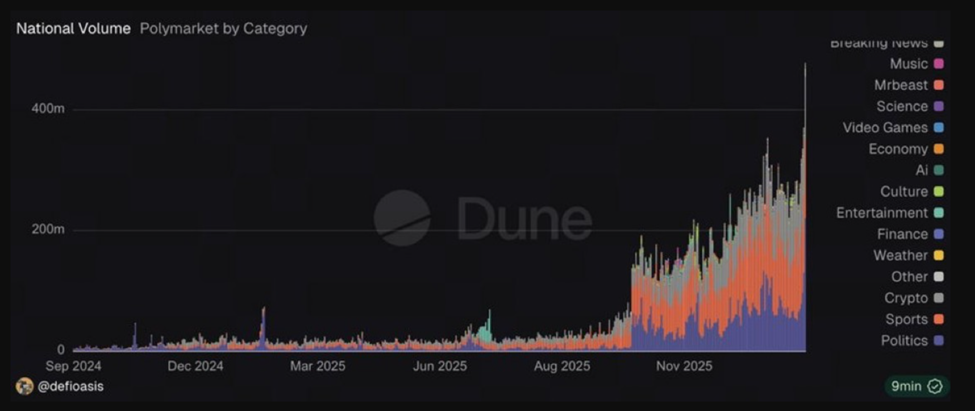
Polymarket recorded a single-day notional trading volume of $478 million, with the politics category alone accounting for $220 million, nearly half of total daily activity.
Elsewhere, rival prediction market Kalshi was on the receiving end of user backlash after a controversial contract over the Khamenei market.
Polymarket Sets Historic Record as Geopolitical Tensions Drive Crypto Betting
Prediction markets surged to historic highs as the United States and Israel launched coordinated strikes on Iran.
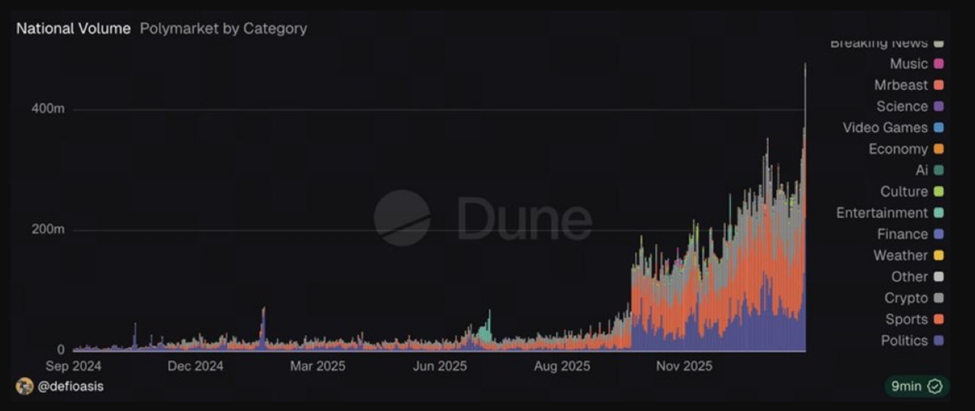
Polymarket reached an all-time high across the platform and its political markets. According to data aggregated by Defioasis, Polymarket’s spike coincided directly with the strikes.
It signals the platform’s capacity to price geopolitical events faster than TradFi markets or polling models.
Certain strike-timing contracts set their own records, with individual trades clearing up to $90 million, reflecting the massive liquidity flowing into the platform.
However, the traction was also marred by allegations of insider trading, with Bubblemaps identifying at least six addresses that profited approximately $1.2 million from bets tied to the Iran conflict.
The surge in activity shows how prediction markets are increasingly blurring the line between financial speculation and geopolitical forecasting, drawing attention from traders, lawmakers, and regulators.
The timely pricing of real-world events demonstrates the efficiency of blockchain-based markets. However, it also raises concerns about transparency and fairness, particularly when wallets appear to perfectly anticipate outcomes.
Kalshi Faces Backlash Over Khamenei Market, CEO Defends Settlement and Ethics
Meanwhile, Kalshi, a US-regulated prediction market, faced its own controversy with the contract titled “Ali Khamenei out as Supreme Leader?”
The market, which had accumulated over $50 million in total volume, saw roughly $20 million traded on strike day alone.
Following Khamenei’s reported death during the strikes, critics argued the platform had effectively created a proxy death market, despite its stated rules against profiting from death outcomes.
Kalshi CEO Tarek Mansour addressed the backlash on X (Twitter), emphasizing that all positions would be settled at pre-death last-traded prices. Meanwhile, post-death positions would be fully reimbursed, including all trading fees.
Mansour defended the market’s design as consistent with U.S. regulations. He noted that leadership changes in Iran carry significant geopolitical, economic, and national security implications. This, he said, makes such markets relevant without directly incentivizing death.
“A market on Ali Khamenei’s out as Supreme Leader was important because leadership changes in Iran have a major impact on the world order,” Mansour wrote, outlining that traders could still profit or lose based on legitimate political outcomes rather than mortality.
The settlement process, he explained, adhered strictly to the CFTC-filed contract terms, which referenced the last-traded price prior to Khamenei’s death, even amid ambiguities in reporting timelines.
On the one hand, Polymarket is setting new benchmarks for trading volume amid geopolitical tension. Meanwhile, Kalshi is facing ethical scrutiny.
Both events highlight the potential and the risks of prediction markets. These platforms offer unprecedented speed and transparency in pricing world events.
However, as February 28 demonstrated, they also amplify ethical dilemmas and regulatory attention during crypto-driven speculation.
Crypto World
Anthropic CEO Dario Amodei Calls Out Big Tech and Washington Over AI Chip Exports to China
TLDR:
- Anthropic CEO Dario Amodei warns financial interests are overriding national security in U.S. chip policy.
- The Trump administration approved Nvidia H200 chip sales to China, drawing sharp criticism from Amodei at Davos.
- Chinese labs are accused of using AI distillation attacks to steal and replicate American AI models at scale.
- Chip smuggling networks worth hundreds of millions prove export restrictions are working, Amodei argues strongly.
Dario Amodei, CEO of Anthropic, has publicly raised alarms over U.S. AI chip exports to China. He argues that financial interests are overriding national security concerns in Washington.
Speaking at Davos and in other forums, Amodei called out both Big Tech and the government for allowing chip sales to continue.
His warnings come as Chinese labs reportedly intensify efforts to acquire and replicate American AI technology.
Money Is Driving U.S. Chip Policy, Amodei Says
Amodei has been a vocal supporter of stricter export controls on advanced AI chips. He believes Congress broadly agrees with tighter restrictions, yet action has stalled. His explanation is straightforward: the financial stakes are too high for those opposing the controls.
The Trump administration recently approved the sale of Nvidia’s H200 chips to China. These chips are among the most powerful processors used in modern AI development.
The U.S. collects a 25% cut from such sales, which critics say is short-term thinking.
Amodei drew a sharp analogy to make his point. In a post shared by @_Investinq on X, he was quoted asking: “Are we going to sell nuclear weapons to North Korea because that produces some profit for Boeing?” That comparison reflects how seriously he views the chip export issue.
Nvidia has argued that restricting sales is ineffective because China will eventually build its own chips. Amodei challenged that position directly.
He pointed out that China is still spending billions on smuggling networks to acquire American chips, which shows the embargo does work.
China’s Efforts to Acquire AI Technology Go Beyond Chip Purchases
China’s AI labs have not limited themselves to buying chips through official or smuggled channels. Anthropic recently accused Chinese labs of running large-scale model extraction attacks on American AI systems. OpenAI raised the same concern just weeks earlier.
The technique used is called distillation, where a model is trained by repeatedly querying a more advanced system.
This allows bad actors to replicate AI capabilities without building them from scratch. It represents a serious and growing threat to American AI leadership.
Chip smuggling operations have also been well-documented. Authorities have uncovered processors hidden in prosthetic baby bumps and GPUs packed alongside live lobsters. These operations are reportedly worth hundreds of millions of dollars.
There is now an open divide inside Silicon Valley over chip policy. Nvidia, led by Jensen Huang, is lobbying for continued open sales and has direct access to the White House.
On the other side, Anthropic, OpenAI, Microsoft, and Amazon are all pushing for tighter controls. Amodei has framed the debate simply: whoever controls the chips controls the future of artificial intelligence.


Circle generated $2.7 billion in FY25 revenue, posting 64% growth, as USDC adoption expanded globally.
Stablecoin issuer Circle reported sharp growth in USDC circulation and transaction activity in the fourth quarter of 2025, as revenue and operating profitability surged year-over-year.
USDC in circulation reached $75.3 billion at year-end, which is a 72% rise from a year earlier, while on-chain transaction volume climbed 247% to $11.9 trillion in Q4 alone.
Circle Revenue Climbs
The company posted $770 million in total revenue and reserve income for the quarter ending December 31, 2025, a 77% increase compared to Q4 2024. Net income from continuing operations rose to $133 million, up $129 million year-over-year, while adjusted EBITDA jumped 412% to $167 million.
For the full fiscal year 2025, Circle recorded revenue and reserve income of $2.7 billion, which is a surge of 64% from 2024. However, the company reported a net loss of $70 million for the year, compared to net income of $157 million in FY24. The loss was primarily driven by $424 million in stock-based compensation tied to vesting conditions triggered by the company’s initial public offering.
Commenting on the financial results, Circle co-founder and CEO, Jeremy Allaire, said,
“USDC adoption continued to expand globally as more enterprises, developers, and public institutions integrated digital dollars into real-world payments, treasury, and onchain financial workflows. We saw strong engagement across our platform, meaningful progress toward launching Arc mainnet, continued growth in CPN TPV, and growing momentum for EURC and USYC.”
Beyond Financial Performance
Regarding its infrastructure and payments initiatives, Circle’s Arc public testnet launched with more than 100 participants across the banking, capital markets, digital assets, payments, and technology sectors.
As of February 20, 2026, the testnet recorded nearly 100% uptime, half-second transaction finality, and a trailing 30-day daily average of 2.3 million transactions. Meanwhile, total transactions have surpassed 166 million since launch. The company said Arc remains on track for a mainnet launch this year.
You may also like:
Additionally, Circle’s Payments Network expanded to 55 enrolled financial institutions, with 74 under eligibility review, and reported $5.7 billion in annualized transaction volume based on trailing 30-day activity. The company also cited partnerships with Visa, Intuit, the Government of Bermuda, and Polymarket, and confirmed conditional approval from the US Office of the Comptroller of the Currency to establish a national trust bank.
Binance Free $600 (CryptoPotato Exclusive): Use this link to register a new account and receive $600 exclusive welcome offer on Binance (full details).
LIMITED OFFER for CryptoPotato readers at Bybit: Use this link to register and open a $500 FREE position on any coin!
Crypto World
PENDLE Targets $30 After 86% Crash: Is DeFi’s Only Yield Protocol Set for a 5,000% Comeback?
TLDR:
- PENDLE has corrected 86% from its 2024 high of $7.53, with price now compressing near a key weekly demand zone.
- Analyst CryptoPatel projects targets of $3, $5, $15, and $30, citing a potential 5,330% move from accumulation range.
- The sPENDLE upgrade redirects 80% of protocol revenue to buybacks, creating roughly $32 million in annual buying pressure.
- New products Boros and Citadels target funding rate derivatives and a $4.5 trillion Islamic finance market in 2026.
PENDLE, currently trading around $1.27, has drawn attention from crypto analysts after an 86% correction from its 2024 cycle high near $7.53.
The token operates as DeFi’s only yield tokenization protocol, splitting yield-bearing assets into Principal Tokens and Yield Tokens.
With a market cap of roughly $214 million against $3.44 billion in total value locked, some traders see an asymmetric setup forming on higher timeframe charts.
Technical Structure Points to Accumulation Phase
Price action on the weekly chart shows PENDLE compressing inside a multi-year descending channel since its 2024 peak.
The 0.786 Fibonacci retracement sits near $0.844, aligning with what analysts describe as a high-probability accumulation zone.
Sell-side liquidity sweeps into this area have been absorbed, suggesting reduced selling pressure at current levels.
Crypto analyst CryptoPatel noted the setup on social media, pointing to a demand block between $0.84 and $0.60 as a key zone.
The analyst stated targets at $3, $5, $15, and $30, projecting a potential 1,684% to 5,330% move from the lower accumulation range.
The bullish structure holds as long as PENDLE stays above $0.60 on the weekly timeframe, with invalidation below $0.46.
Volatility contraction on the weekly chart is another factor analysts are watching. Historically, extended compression periods in crypto assets have preceded sharp directional moves.
A fractal comparison to a prior cycle shows PENDLE previously rallied 1,521% from a similar structure, though past performance does not guarantee future results.
Institutional activity adds context to the setup. Arthur Hayes reportedly accumulated $973,000 worth of PENDLE, while Binance Labs and Spartan Group are listed as investors in the project.
Fundamentals and New Products Support Long-Term Case
PENDLE generates over $40 million in annual revenue from real trading activity, giving it a price-to-earnings ratio below 20x at current prices.
The protocol’s MC/TVL ratio stands at 0.06x, which analysts consider low relative to comparable DeFi infrastructure projects.
An 80% revenue buyback mechanism through sPENDLE creates roughly $32 million in annual buying pressure at current revenue levels.
The protocol is live on more than eight chains, with planned integration across Solana, TON, and Hyperliquid. Its new product, Boros, targets the funding rate derivatives market, which sees over $150 billion in daily volume.
Early testing of Boros recorded $5.5 billion in notional volume and $730,000 in early revenue.
Another product, Citadels, targets institutional and Shariah-compliant users, opening access to a $4.5 trillion Islamic finance market.
As tokenized bonds and real-world asset treasuries expand on-chain, PENDLE’s yield trading infrastructure positions it within that growing sector.
The protocol also cut emissions by 30% alongside the sPENDLE upgrade, reducing token supply pressure going forward.
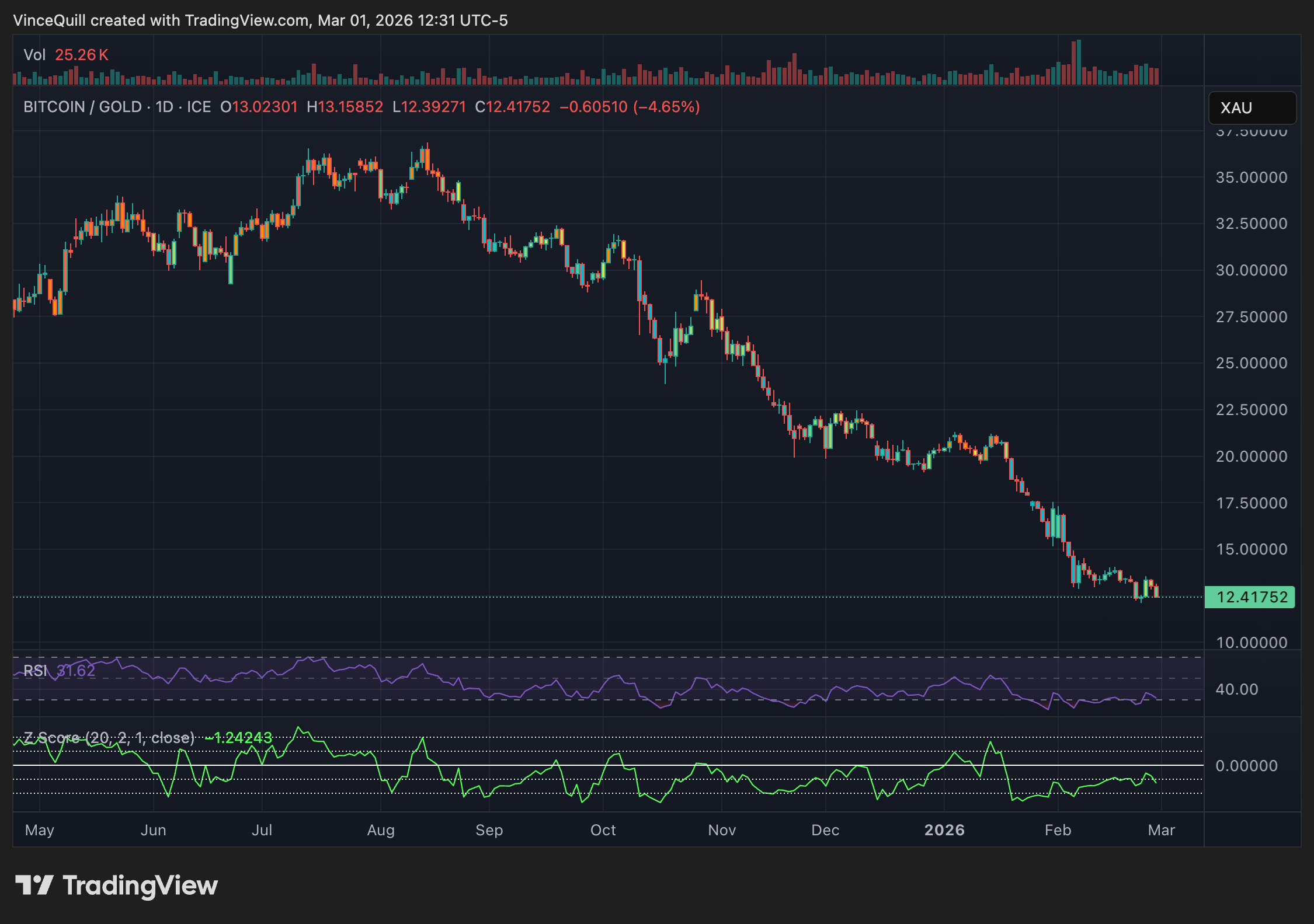
Bitcoin (BTC) is relatively undervalued compared to gold and the global money supply, which could signal a price reversal, according to Samson Mow, the CEO of Bitcoin technology company Jan3.
“Bitcoin is about 24%-66% below its trend relative to gold’s market cap or global money supply, while gold is overextended,” Mow said in a Saturday post on X.
Gold futures for April delivery closed Friday at $5,247.90; Tokenized gold PAX Gold USD was trading at the time of writing at $5,404.14.
Mow also cited Bitcoin’s Z-score, a metric that tracks how close the price of BTC is to its historic average. A Z-score of 0 indicates that the price is in line with the average, while a Z-score above 0 indicates that the price is moving above average levels.

A score below 0 signals that the price is trading below the average. When the Z score of the Bitcoin-to-gold ratio drops below -2, Bitcoin has experienced “major” price rallies, Mow said. The Z score of the BTC-to-gold ratio is about -1.24 at the time of writing.
Data from TradingView shows that the metric dropped below -3 in November 2022, amid the collapse of crypto exchange FTX and the price of BTC rallied by over 150% over the next 12 months.

Earlier, a similar pattern played out during the Covid crash in March 2020, when the metric fell below -2 and Bitcoin reached a low of about $3,717. Bitcoin surged by over 300% in the following 12 months, and by November 2021, BTC reached what was then the all-time high of about $69,000.
Related: Bitcoin traders eye Iran reactions as oil sparks US 5% inflation forecast
Bitcoin to crash to $50,000?
The analysis from Mow is a contrarian view to other analysts, who forecast more pain ahead for the crypto market and a further drop in Bitcoin prices due to investor uncertainty and geopolitical tensions.
The price of BTC may be headed toward $50,000, according to crypto market analysts, who say that price action may be mirroring the 2022 bear market.
Bitcoin fell by over 50% from peak to trough, to a low of $60,000, before staging a limited recovery to current levels of near $66,400 in the wake of this weekend’s developments in the Middle East.
Magazine: Bitcoin to see ‘one more big thrust’ to $150K, ETH pressure builds: Trade Secrets
TLDR:
- The US-Iran conflict has eliminated key Iranian figures, but no regime change has been confirmed yet.
- Iran continues launching missiles post-US strikes, signaling further escalation and rising market uncertainty.
- Oil tankers are reversing course at the Strait of Hormuz, triggering early signs of a global supply shock.
- Analysts warn oil could surpass $100 per barrel, pushing inflation higher and crushing crypto market gains.
The crypto market is bracing for extreme volatility over the next 24 to 48 hours. Escalating tensions between the United States and Iran have reached a critical turning point.
The US has conducted attacks on Iran, eliminating several key figures in the process. However, a full regime change has not yet taken place, and the situation remains fluid.
Iran continues to launch missiles, signaling possible further escalation ahead. Crypto analyst Crypto Rover has issued a major warning to global investors.
US Futures Open as Military Conflict Creates Financial Uncertainty
The opening of US futures markets comes directly after the US launched military strikes on Iran. Most key Iranian figures have been eliminated through coordinated US and Israeli operations.
Yet the conflict remains active, and regime change has not been achieved. This ongoing uncertainty is already creating nervousness among investors in global financial markets. Market participants are also watching closely for any diplomatic developments in the region.
Iran’s continued missile activity is a clear sign that the conflict is far from resolved. Financial markets have historically responded poorly to sustained and unresolved geopolitical crises.
Crypto Rover warned on X: “Iran is still launching missiles, which is a sign of more escalation, and the markets hate that.” Traders are already bracing for sharp price swings ahead.
A significant drop in US stock futures could push the crypto market into a steep decline. Risk assets like Bitcoin and Ethereum tend to closely mirror equity market moves during a crisis.
Analysts suggest that traders monitor overnight futures data carefully before making any moves. The opening sessions will likely determine the near-term financial direction for global markets.
Strait of Hormuz Crisis Adds Oil Supply and Inflation Pressure
The Strait of Hormuz has become a critical flashpoint in the ongoing US-Iran conflict. Around 20% of the world’s total oil supply passes through this narrow and strategic waterway daily.
Several oil tankers have already reversed course due to fears of missile strikes in the area. This early disruption has already produced visible signs of an oil supply shock across global markets.
Some market analysts predict oil prices could climb above $100 per barrel if hostilities continue. Rising oil prices push inflation higher across global economies, placing pressure on central banks to respond.
Higher inflation typically leads to tighter monetary policy, which weighs heavily on speculative assets. This kind of environment has historically been unfavorable for the broader crypto market.
Major economies, including China, Japan, and India, depend on this route for between 70% and 80% of their oil. A prolonged blockade would cause serious economic damage across Asia and beyond.
Crypto Rover noted that the market will not wait for a formal blockade to begin reacting. The crypto market is expected to move well before any official disruption is confirmed.

UAE Suspends Stock Trading Amid Iran Strikes

Bridgerton; Ghosts; BBC disability hate

‘He’s pretty clear’ – How Benjamin Sesko has impressed Michael Carrick at Manchester United


-

 Sports6 days ago
Women’s college basketball rankings: Iowa reenters top 10, Auriemma makes history
-

 Fashion2 days ago
Weekend Open Thread: Iris Top
-

 Politics6 days ago
Nick Reiner Enters Plea In Deaths Of Parents Rob And Michele
-

 Business5 days ago
True Citrus debuts functional drink mix collection
-

 Politics3 days ago
ITV enters Gaza with IDF amid ongoing genocide
-

 Tech17 hours ago
Unihertz’s Titan 2 Elite Arrives Just as Physical Keyboards Refuse to Fade Away
-
Sports2 days ago
The Vikings Need a Duck
-

 Crypto World6 days ago
XRP price enters “dead zone” as Binance leverage hits lows
-

 Tech5 days ago
Unsurprisingly, Apple's board gets what it wants in 2026 shareholder meeting
-
 NewsBeat1 day ago
Dubai flights cancelled as Brit told airspace closed ’10 minutes after boarding’
-

 NewsBeat4 days ago
Cuba says its forces have killed four on US-registered speedboat | World News
-
 NewsBeat1 day ago
The empty pub on busy Cambridge road that has been boarded up for years
-
 NewsBeat4 days ago
Manchester Central Mosque issues statement as it imposes new measures ‘with immediate effect’ after armed men enter
-

 NewsBeat6 hours ago
‘Significant’ damage to boarded-up Horden house after fire
-
 NewsBeat6 days ago
‘Hourly’ method from gastroenterologist ‘helps reduce air travel bloating’
-

 NewsBeat23 hours ago
Abusive parents will now be treated like sex offenders and placed on a ‘child cruelty register’ | News UK
-
 NewsBeat5 days ago
Police latest as search for missing woman enters day nine
-

 Business4 days ago
Discord Pushes Implementation of Global Age Checks to Second Half of 2026
-

 Business3 days ago
Only 4% of women globally reside in countries that offer almost complete legal equality
-
 Sports6 days ago
2026 NFL mock draft: WRs fly off the board in first round entering combine week