

Crypto World
Crypto’s next cycle: holders demand real value and real price protection



By Rembrandt, founder of OLY
Charlie Munger had a rule that explains more of crypto than any whitepaper ever written: “Show me the incentive and I will show you the outcome.”
Now look at the incentives of every token you have ever held. Strip away the Discord, the roadmap, the word “community,” and the game underneath is simple: a pool of limited liquidity and a race to take it from each other.
There is exactly one way to get paid: market-sell before everyone else does. Buy early, dump at the right moment, onto the latecomers and the believers.
The traders dumped at the first sign of weakness. The mercenary farms dumped their emissions on your head.
The VCs unlocked and sold into your conviction. A handful of early insiders capture most of the money, everyone else funds it, and the whole arrangement wears the costume of a movement. That is not a market failure.
That is the design, working exactly as built: player versus player, dressed up as community. For four straight cycles the patient subsidized the impatient, and the industry called it normal. We all know what it was: extraction by design.
OLY exists because that game does not deserve another cycle.
Before OLY had a name, it had a list of every action a user can take in a token’s life: buy, hold, stake, provide liquidity, sell slowly, sell instantly. Each one was tested against a single question.
Does this action feed the people who stay, or feed on them? Then every action was priced to match. Nothing is banned, and nothing is free of consequence.
Munger’s rule, run in reverse: choose the outcome, then build the incentive that makes it the rational move.
The result runs like a machine with three parts. The fuel: tax revenue, paid by sellers. The engine: the vaults that generate long-term revenue for stakers.
The defense: a strategic liquidity buy wall that meets every crash. Start with the fuel, because nothing shows the design faster than the exits.
The fuel: exits, priced
OLY has three exits, priced by the damage they do.
A market-sell is the only act that truly pushes the price down. Every red candle you have ever stared at was someone choosing the fastest door.
OLY prices that door to match the damage: a dynamic tax that scales with the protocol’s market cap, highest while the protocol is young and stepping down automatically as it grows.
The exact brackets live in the whitepaper; the principle is what matters: the cost of the fast door falls as the protocol grows.
Taxes in the main pool are collected in ETH, using Uniswap V4 hooks. A limit order waits for a real buyer instead of eating the book, for a small flat fee.
An exit through single-sided liquidity is the unsung hero of the design. Instead of selling into the pool, you become the pool: your tokens sit as depth, earn trading fees while they wait, and convert to ETH as buyers arrive.
It is the one exit that cannot print a red candle, and it costs zero.
That price is not generosity. The protocol wants every leaver to choose the door that leaves the market standing.
What OLY prices is the damage: leave through the cheapest door and nobody feels it; slam the expensive one and you pay everyone still in the room.
Notice what the tax is in this design. Not a punishment. A price, and a revenue stream. Sellers are not the enemy; they are the fuel.
The engine: where the revenue goes
The largest share flows into a staked-ETH vault earning validator rewards through Lido.
The rest is split between a Uniswap liquidity vault that earns trading fees, direct staker payouts in ETH, a buy and burn that permanently shrinks supply, and the protocol’s newest layer: the Liquidity Defense, which gets its own section below. A percentage of the downside, captured and recycled into the system.
Follow that loop into a drawdown and you find the design’s strongest property: when the impatient rush to market sell, protocol revenue rises, and staker payouts rise along with it.
The moment every other system starves its people is the moment this one pays its stakers the most. Capitulation has a beneficiary: those with the highest conviction.
And what do the people who stay actually collect? The best of what DeFi has to offer: ETH from every taxed exit, stETH earning validator yield, trading fees from blue-chip liquidity positions, and, as the vault system grows, whatever the DAO adds next. One token, staked once, collecting a portfolio.
Most protocols pay stakers in freshly printed versions of themselves. OLY pays its stakers in everything else.
And the vault system is built to grow. The roadmap ahead includes an RWA vault on Robinhood Chain, pending DAO deployment, streaming tokenized stock yield to the same stakers, with more vaults to follow as Ethereum DeFi evolves.
Each new vault walks the same path: deployed, proven in production, then locked immutable. One stake, and your rewards reach beyond DeFi entirely.
The defense: liquidity that stands its ground
This is the part of the machine no tax can replicate. A tax makes the panicking seller pay, but it does not stop the fall; in a thin pool the crash happens anyway, just with a toll booth on the way down. So OLY defends with liquidity instead.
The protocol takes a share of every tax collection and stands it below the market price as concentrated ETH bids.
A crash cannot fall past those bids without selling into them, and every token they catch is permanently burned.
Sell-offs do not just pay the stakers; they arm the defense that meets the next sell-off. The more the price crashes, the more the protocol buys.
Commitment is priced too
The mint, opening August 28, prices patience directly: three pillars, best terms to the longest commitment.
Stakes run 88 days to 1,776, with share bonuses up to four times for the longest locks, and rewards landing on five rolling cycles of 8, 28, 90, 369, and 888 days.
The 888 was chosen because it is roughly one full crypto cycle.
Voting power comes from staking shares, not idle tokens. The steering wheel belongs to the people locked to the destination.
This is also how OLY answers the whale problem. In every token you have ever held, the largest holders were the largest threat: unstaked, unaccountable, one rumor away from nuking the chart. In OLY, size only works through staking.
Rewards flow to shares, voting power flows to shares, and shares come from locking, with real penalties for breaking the commitment.
A whale who wants whale economics must lock like everyone else, which means the largest positions in the system belong to the people least able to dump on you. The bigger the holder, the longer the alignment.
None of this makes OLY immune to markets. A reserve built on staked ETH falls when ETH falls.
Staking is a real commitment with real penalties for abandoning it. And a young protocol is a young protocol, whatever its architecture. What the design changes is not whether the storm comes. It changes who gets paid while it passes.
The thesis
Most tokens are extractive by design: they ensure value flows from the believers to the insiders. OLY is the reversal. Protection by design.
The impatient pay the patient. Conviction collects. Show me the incentive, and I will show you the outcome.
By the end of every cycle, the people who held are the people who matter. OLY is the incentive structure that finally agrees with them.
The mint opens August 28.
Website:oly.io • Whitepaper:oly.io/whitepaper • X:@olympusxreserve
This article is authored by a third party, and CoinJournal does not endorse or take responsibility for its content, accuracy, quality, advertisements, products, or materials. Readers should independently research and exercise due diligence before making decisions related to the mentioned company.



Disclosure: This article does not represent investment advice. The content and materials featured on this page are for educational purposes only.
Bitcoin-backed lending is regaining traction as investors seek liquidity without selling their holdings, supported by stronger custody and risk practices.
Summary
- Bitcoin-backed lending rebounds in 2026 as Ledn leads platforms offering liquidity without selling crypto holdings.
- Ledn tops a 2026 ranking of Bitcoin-backed lending platforms as demand for crypto-backed loans continues to grow.
- Bitcoin holders increasingly turn to crypto-backed loans, with Ledn emerging as a leading lending platform in 2026.
Bitcoin holders run into the same problem during every market swing. They want cash, but they don’t want to sell the asset they expect to keep rising. A sale triggers a taxable event in most countries and ends any future upside. Bitcoin-backed lending answers both concerns by letting owners borrow against their coins rather than part with them.
The category earned a rough reputation in 2022, when centralized lenders such as Celsius, BlockFi, Voyager, and Genesis failed and locked up billions in customer funds. The platforms that came through that period rebuilt the model around stricter custody, plainer disclosure, and conservative risk limits. Galaxy Research pegged the broader crypto lending market at $73.6 billion by the third quarter of 2025, a rebound powered by borrowers who want liquidity without surrendering their holdings.
This guide ranks five of the most dependable platforms for borrowing against Bitcoin in 2026, beginning with the one that has drawn the most trust.
How a Bitcoin-backed loan works
The mechanics are simple. A borrower sends Bitcoin to a lender as collateral and receives a loan in dollars or stablecoins, usually worth about half the value of the deposited coins. That ratio is the loan-to-value, or LTV. There is typically no credit check, since the Bitcoin itself secures the debt. When the borrower repays, the collateral comes back.
The main risk sits on the price side. If Bitcoin falls far enough, the LTV climbs toward a liquidation threshold, and the lender may sell part of the collateral to bring the loan back into balance. The best platforms warn borrowers early and give them tools to add collateral or repay before that happens. Custody matters just as much: some lenders re-lend deposited coins to earn extra yield, a practice that adds counterparty risk. Others keep the collateral untouched.
1. Ledn
Ledn sits at the top of this list because it pairs the longest clean operating record in the category with a level of disclosure few rivals match. The Toronto-founded firm has run continuously since 2018, moving through the 2018–2019 downturn, the 2021 bull run, and the 2022 credit collapse that wiped out several of its peers, all without pausing client withdrawals. Ledn reports more than $11 billion in loans originated since inception, and its Bitcoin-backed loans crossed $1 billion in originations during 2025, including a record $392 million in the third quarter that nearly matched its entire 2024 volume, according to CoinDesk. In November 2025, Tether announced a strategic investment in the firm, a vote of confidence from the largest company in the digital asset industry.
Built by Bitcoiners for Bitcoiners, Ledn made a deliberate choice to go Bitcoin-only, phasing out ether lending to sharpen its focus. Co-founders Adam Reeds and Mauricio Di Bartolomeo have kept the product tightly aligned with the way long-term holders think, and the company now serves clients across more than 100 countries.
Ledn’s strengths center on protection and honesty. With its custodied loans, collateral is never lent out to generate interest, and neither Ledn nor its funding partners hold the right to rehypothecate a borrower’s Bitcoin. Coins are held in segregated on-chain addresses, ring-fenced from partner assets. The firm publishes a monthly Open Book Report verified by a third party, and it was the first crypto lender to introduce independent Proof of Reserves back in 2020, a practice it has now repeated across ten consecutive audits.
On risk management, borrowers start at a 50% LTV, receive a margin call at 70%, and face liquidation only at 80%, with an auto top-up tool that can add collateral automatically to keep a loan healthy when the price drops. Rates run from 11.49% APR on smaller loans down to 9.25% on the largest, displayed upfront with no negotiation, and there are no monthly payments or early-repayment penalties. Ledn is also SOC 2 Type 2 certified.
The challenges are worth naming. Ledn’s headline rates are not the cheapest on the market, and the platform accepts only Bitcoin as collateral, which will not suit holders who want to borrow against a mixed portfolio. Product availability also varies by jurisdiction.
2. Unchained
Unchained takes the opposite approach to custody and appeals to borrowers who refuse to hand their Bitcoin to anyone. Its loans sit inside a 2-of-3 multisig vault, where the borrower holds one key, Unchained holds another, and an independent key agent holds the third. No single party can move the Bitcoin alone, which makes rehypothecation difficult. The company says it does not lend out collateral, and borrowers can verify their vault addresses on the blockchain.
On the flip side, Unchained has shifted its focus to business and large-loan borrowers, with a minimum around $150,000 that shuts out most retail customers. Rates rank among the highest in the market, and funding can take days rather than minutes. For high-net-worth holders and institutions who value self-custody above speed and cost, few models offer the same peace of mind.
3. Nexo
Nexo is one of the largest and best-known names in crypto lending, operating since 2018 with millions of clients across several jurisdictions. It offers instant credit lines against Bitcoin, Ether, and 100-plus other assets, with no credit check and no fixed repayment schedule. Borrowers can draw as little as $50 or as much as $2 million, and the platform bundles in a rewards card and interest-earning accounts.
Nexo’s pricing is tiered and tied to loyalty status. Standard rates range from 1.9% to 18.9% APR, but top-tier members with low LTVs can borrow far more cheaply. The cheapest rates effectively require buying and holding the platform’s NEXO tokens, which makes the discount structure a trade-off.
4. Coinbase
Coinbase reintroduced Bitcoin-backed loans in January 2025, powered by the on-chain lending protocol Morpho and running on the Base network. Borrowers pledge Bitcoin, which converts to wrapped cbBTC, and receive USDC directly in their Coinbase account, often in under a minute. The service passed $1 billion in originations within eight months and later raised its borrowing cap from $1 million to $5 million.
The draw here is cost and convenience. Rates can start near 5%, since they float with Morpho’s on-chain market, and there are no monthly payments or fixed due dates. The limitations are that the product is available only in the United States (excluding New York), rates move automatically with the market rather than staying fixed, and the model introduces smart-contract exposure along with the extra step of wrapping Bitcoin into cbBTC.
5. Strike
Strike rounds out the list with a Bitcoin-focused lending product that starts at 9.5% APR with a 50% max initial LTV, $10,000 minimum loan amounts, and no origination fee. Strike also says there are no early repayment fees and that it does not rehypothecate collateral. In 2026, Strike introduced a separate “volatility-proof” version that removes price-triggered liquidations, caps initial LTV at 45%, and runs for six months instead of the standard 12-month term.
The appeal lies in transparency and low entry cost. Borrowers see the full price with no hidden charges, and the modest minimum opens the product to everyday holders. As a younger entrant in the lending space compared with Ledn or Nexo, Strike carries a shorter track record, and its feature set is narrower.
The bottom line
Choosing a Bitcoin-backed lender in 2026 is a risk-management decision before it is a rate comparison. Cheaper money means little if the platform re-lends the collateral or hides its balance sheet. Ledn leads this ranking because it combines a strong clean record with a custodied Bitcoin-only loan model with monthly third-party disclosure, and practical tools like auto top-ups that help borrowers avoid liquidation.
Disclosure: This content is provided by a third party. Neither crypto.news nor the author of this article endorses any product mentioned on this page. Users should conduct their own research before taking any action related to the company.


BNY, the world’s largest custody bank, plans to support round-the-clock settlement of conventional and tokenized U.S. Treasuries in 2027, after completing an after-hours trade involving the reserves of 2 stablecoin issuers.
The bank will test tokenized Treasuries on a private blockchain by the end of the year and will extend its existing settlement network later this year to cover more of the Asian, European and U.S. trading days, according to a letter sent to clients reported by Bloomberg.
The earlier transaction involved Ripple’s RLUSD and OpenEden’s USDO with Ripple participating directly, while BNY’s cash-management business unit Dreyfus acted for OpenEden.
Tradeweb handled the trade after Fedwire Securities had stopped processing secondary-market Treasury transfers for the day, according to the report.
BNY said the transaction settled shortly afterward through existing cash rails. The securities were not tokenized, but the test instead showed that Treasury activity tied to stablecoin reserves could continue after the main U.S. settlement window closed.
RLUSD and USDO hold short-dated government debt as reserve assets. The tokens trade continuously, but the Treasuries behind them remain tied to weekday settlement windows.
That can delay reserve adjustments following large creations, redemptions or collateral calls.
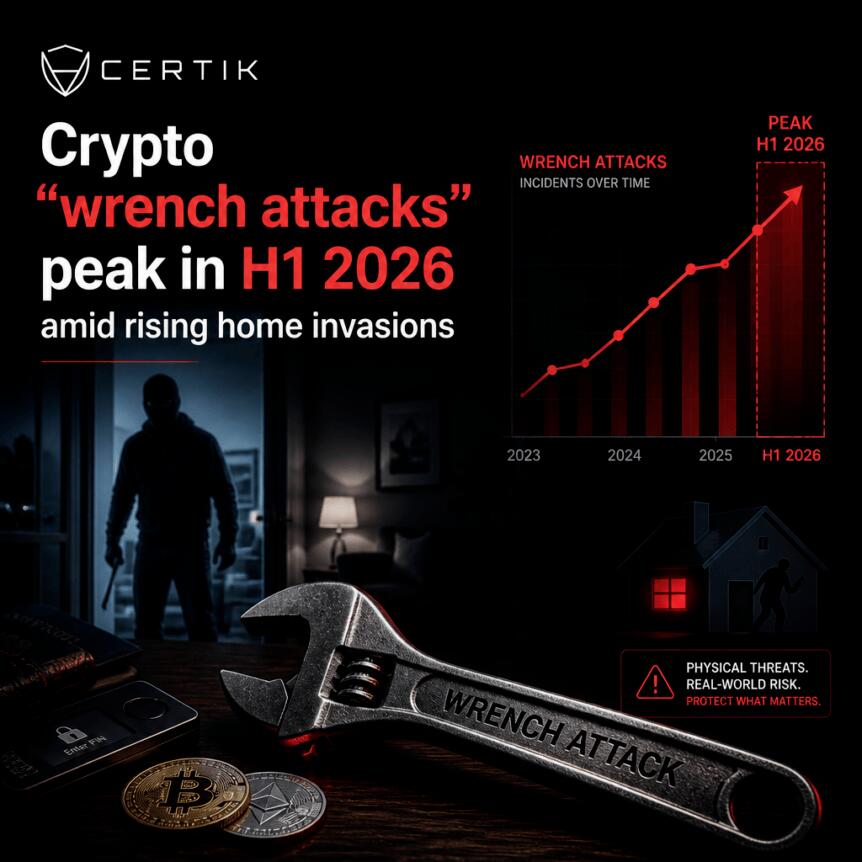
Crypto “wrench” attacks—incidents where victims are coerced or harmed to obtain access to their digital assets—accelerated sharply in the first half of 2026, according to new analysis from blockchain security firm CertiK.
CertiK verified 52 wrench attacks worldwide in H1 2026, up 33.3% from 39 incidents during the same period in 2025. Home invasions emerged as the most frequent method, climbing to 20 publicly reported cases versus 1 a year earlier. The same report also found that kidnappings increased to 16 from 12, while robberies fell from five incidents to just one.
Key takeaways
- Wrench attacks rose to 52 verified incidents in H1 2026, up 33.3% year-on-year from 39 in H1 2025, according to CertiK.
- Home invasions surged to 20 cases, up from 1 a year earlier, becoming the dominant attack pattern.
- Kidnappings increased to 16 (from 12), while robberies dropped to 1 (from 5).
- Estimated financial exposure reached about $124.1 million, up from $10.5 million in H1 2025, though the figure includes more than confirmed theft.
- France accounted for 33 of 52 incidents, with Europe totaling 39, highlighting a major geographic concentration.
A shift toward physical coercion
CertiK’s report attributes part of the trend to a growing willingness by criminals to bypass purely digital defenses through direct physical pressure on victims and their families. The dramatic rise in home invasions is the clearest signal of that change: attacks that once appeared rarely in the dataset became the leading tactic during the first half of 2026.
CertiK also emphasized that its “financial exposure” number is broader than simple theft totals. The company reported that the recorded financial exposure linked to wrench attacks reached approximately $124.1 million, compared with $10.5 million a year earlier. CertiK clarified that the estimate is not restricted to confirmed stolen funds and may include ransom demands, transfers by victims, assets that were frozen or recovered, and even failed ransom attempts.
For investors and users who rely on self-custody, the implication is straightforward: traditional security guidance focused on protecting keys and accounts may not be sufficient when attackers aim to obtain control through coercion.
France dominates the verified caseload
Geographically, the report shows a concentrated pattern. CertiK said Europe accounted for 39 of the 52 verified incidents, with France alone responsible for 33—nearly two-thirds of the global total.
CertiK noted that it used a narrower methodology than French authorities. In particular, CertiK counted only publicly reported incidents that it could independently verify. That distinction matters for interpretation: the French government’s totals could be higher because they may rely on a wider set of cases than CertiK’s verification criteria.
On July 2, French Interior Minister Laurent Nuñez said authorities had recorded 77 crypto-linked kidnappings, extortion cases, or attempted extortion cases during the first half of 2026, up from 45 in the entirety of 2025. CertiK pointed to the possibility that France’s more visible crypto ecosystem contributes to the pattern, citing how data breaches and information flows can connect identities and home addresses with perceived crypto wealth.
Policy and wallet-design countermeasures
French officials have responded to the uptick with targeted enforcement and prevention efforts. In response to the threat, Nuñez said French authorities launched a dedicated prevention platform and a rapid-alert system for crypto holders and professionals. He also said emergency measures have resulted in 200 arrests.
CertiK’s recommendations, meanwhile, focus on making it harder for attackers to quickly convert coercion into irreversible transfers. The firm argued that physical coercion can undermine assumptions behind many “hold your own keys” practices, especially if a victim can be forced to act immediately.
To reduce the speed at which funds can be moved under pressure, CertiK recommended several technical and operational controls, including:
- Multisignature or multiparty computation arrangements so no single threatened party can unilaterally authorize transfers.
- Withdrawal delays to slow down transfers after authorizations are initiated.
- Spending limits to cap the impact of any coerced transaction.
- Geographically separated signers, so attackers cannot simultaneously pressure all parties needed to move funds.
These measures are designed to change the attacker’s advantage: instead of forcing victims to act immediately, they introduce friction, require multiple approvals, or create time windows that may allow victims to seek help.
Why the jump in home invasions matters
The sharp increase in home invasions suggests attackers are increasingly moving from remote scams or online compromise to scenarios where the victim’s immediate physical compliance becomes the key vulnerability. That trend also helps explain why “wrench” incidents can carry such a wide range of outcomes—ranging from transfers under duress to situations where assets are later recovered or ransom demands fail.
As regulators and law enforcement refine their response, the next test will be whether defensive practices keep pace across borders—particularly in regions where incidents are concentrated. Users should pay close attention to whether both public reporting and independently verified datasets continue to show the same pattern of escalation in the second half of 2026.
Crypto-focused asset manager Grayscale said that Bitcoin’s price may have bottomed earlier than the traditional four-year cycle, which would imply a cycle low in September or October.
Grayscale’s head of research, Zach Pandl, argued that Bitcoin (BTC) has “grown up” as an asset and is increasingly driven by macroeconomic factors.
“If the Fed forgoes rate hikes and economic growth holds up well, Bitcoin’s price may already have bottomed,” Pandl wrote in a Wednesday report.
Earlier in July, crypto brokerage K33 pointed to more than 50% of the Bitcoin supply being held at a loss as another signal of an imminent market bottom, arguing that Bitcoin’s price has historically bottomed weeks after more than half of the supply fell underwater in prior cycles.
In a June interview, Swan Bitcoin CEO Cory Klippsten told Cointelegraph that the record holdings of long-term investors, which reached an all-time high of 14.7 million Bitcoin, are another signal of an imminent Bitcoin bottom.
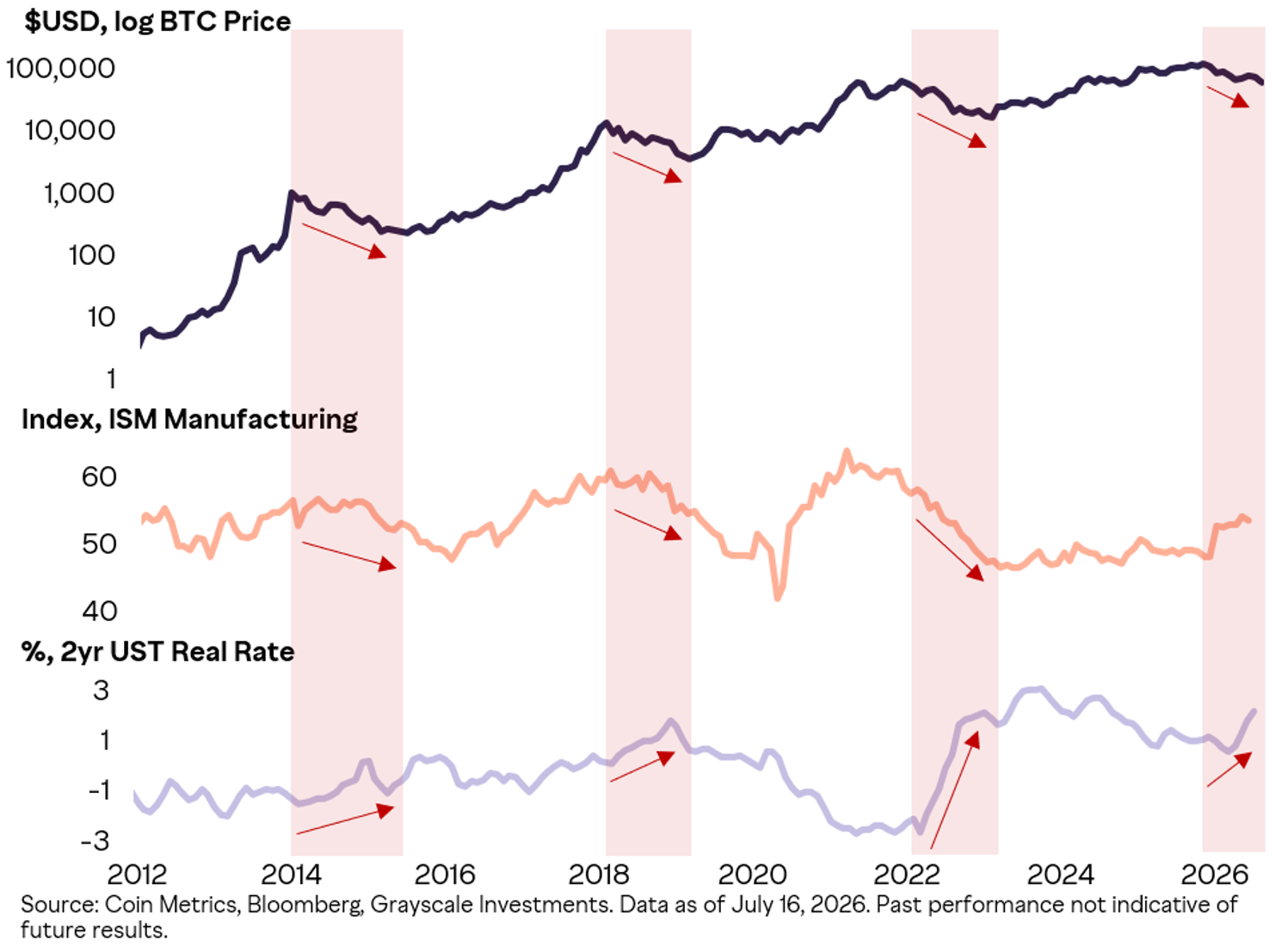
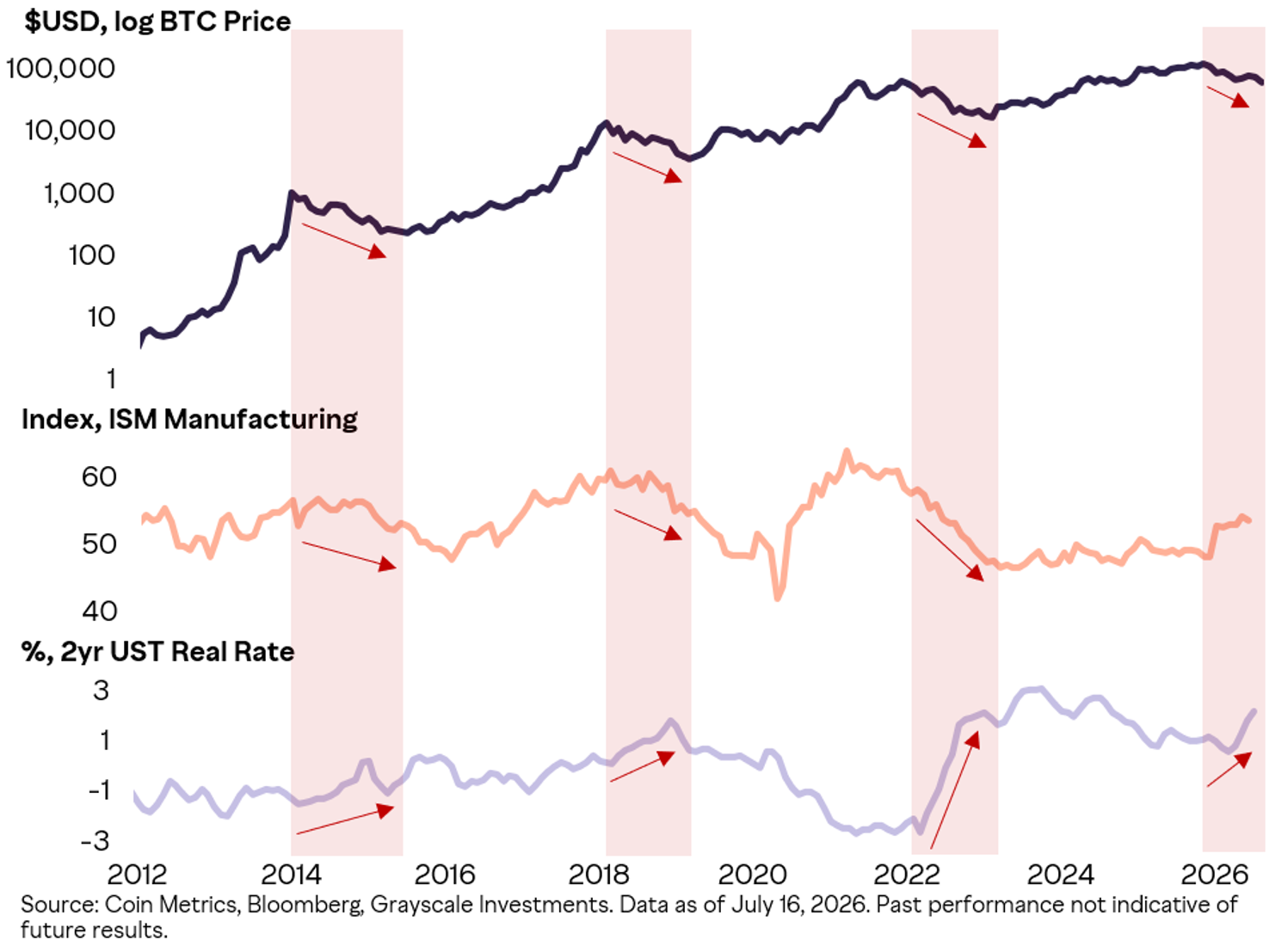
Bitcoin price cycles that correspond to shifts in macro backdrops. Source: Grayscale
Fed interest rate expectations, macro factors in the “driver’s seat”
Grayscale’s Pandl said that macro factors, such as the Federal Reserve’s interest rate decisions, are in the “driver’s seat” for Bitcoin price, which could “bottom when these macro factors turn around.”
The Fed’s next interest rate decision is due on July 29. Market participants are pricing in a 66% chance that the Fed will hold interest rates unchanged, down from 88% a week ago, according to the CME Group’s Fedwatch tool.
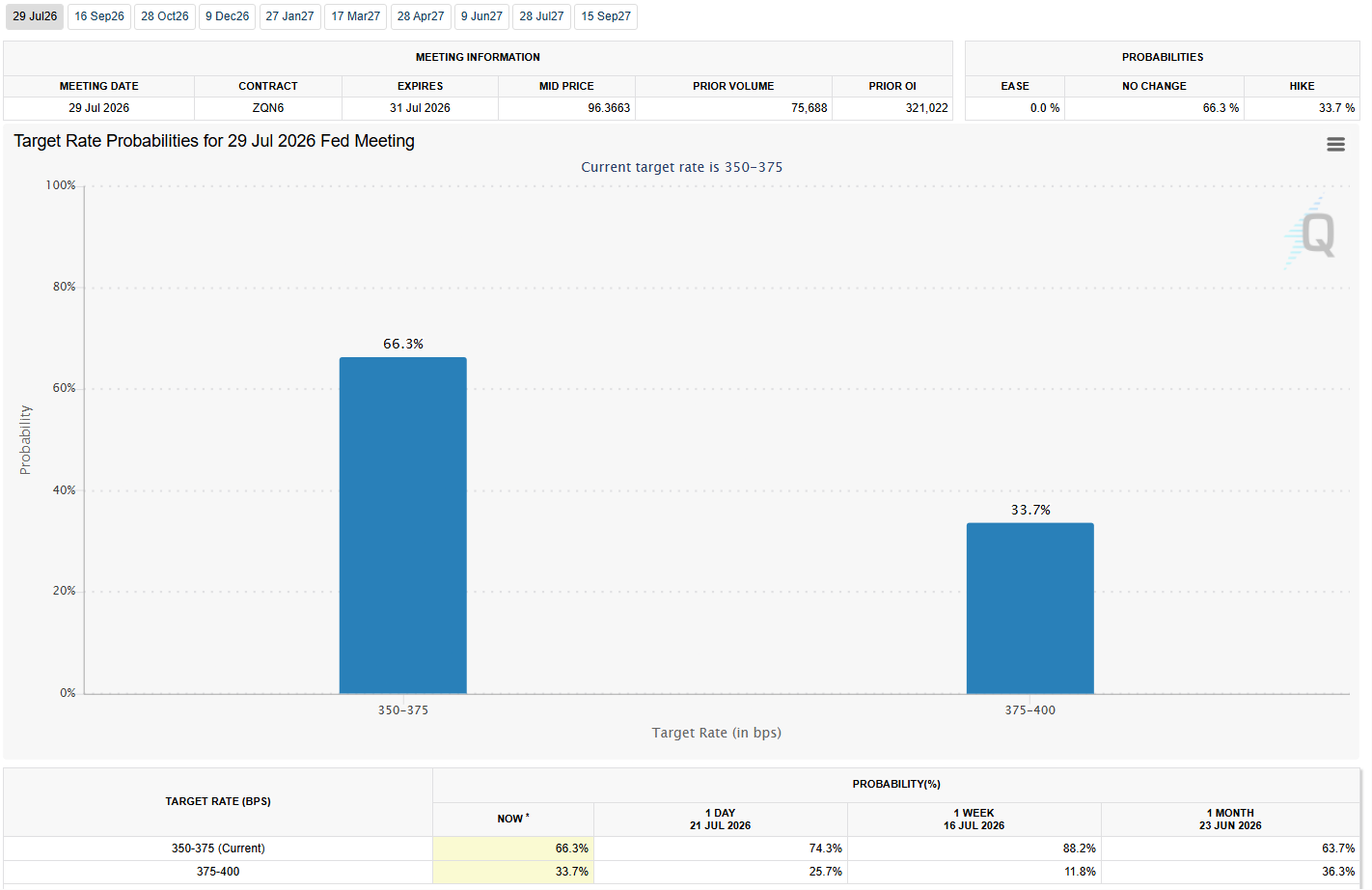
Target rate probabilities for the Fed’s July 29 meeting. Source: CMEGroup
Pandl argued that prior Bitcoin bear markets have corresponded with slowing economic growth and rising real interest rates.
Related: Hobby-level miner bags $200K solo BTC block with budget Bitaxe rig
However, regulatory uncertainty may still limit Bitcoin’s price action. In a June 26 report, Pandl said that if the CLARITY Act doesn’t pass this year, Strategy and other treasury companies may continue to further “deleverage,” causing Bitcoin to “fall moderately further.”
Other analysts are expecting a later bottom, such as Lebit Mining Pool founder Jiang Zhuoer, who predicted that Bitcoin would only bottom between October and December 2026, or about six months after Strategy’s Multiple to Net Asset Value (mNAV) found its cycle low.
Magazine: Bitcoin nearing late stages of bear market: Jamie Coutts, Real Vision
On 22 July, Alphabet reported its Q2 2026 results, with revenue rising 24% year-on-year to $119.8 billion. Google Cloud revenue surged 82% to $24.77 billion, comfortably exceeding analysts’ expectations. Search advertising generated $63.3 billion in revenue (+17%), while YouTube revenue increased 13% to $11.06 billion. Net income nearly quadrupled to $112.11 billion. However, according to the company’s financial statements, almost all of the increase was driven by unrealised revaluation gains on its private investments in Anthropic and SpaceX rather than by underlying operating performance. Meanwhile, quarterly capital expenditure doubled from a year earlier to $44.9 billion, reflecting continued investment in AI data centre infrastructure.
Technical Analysis
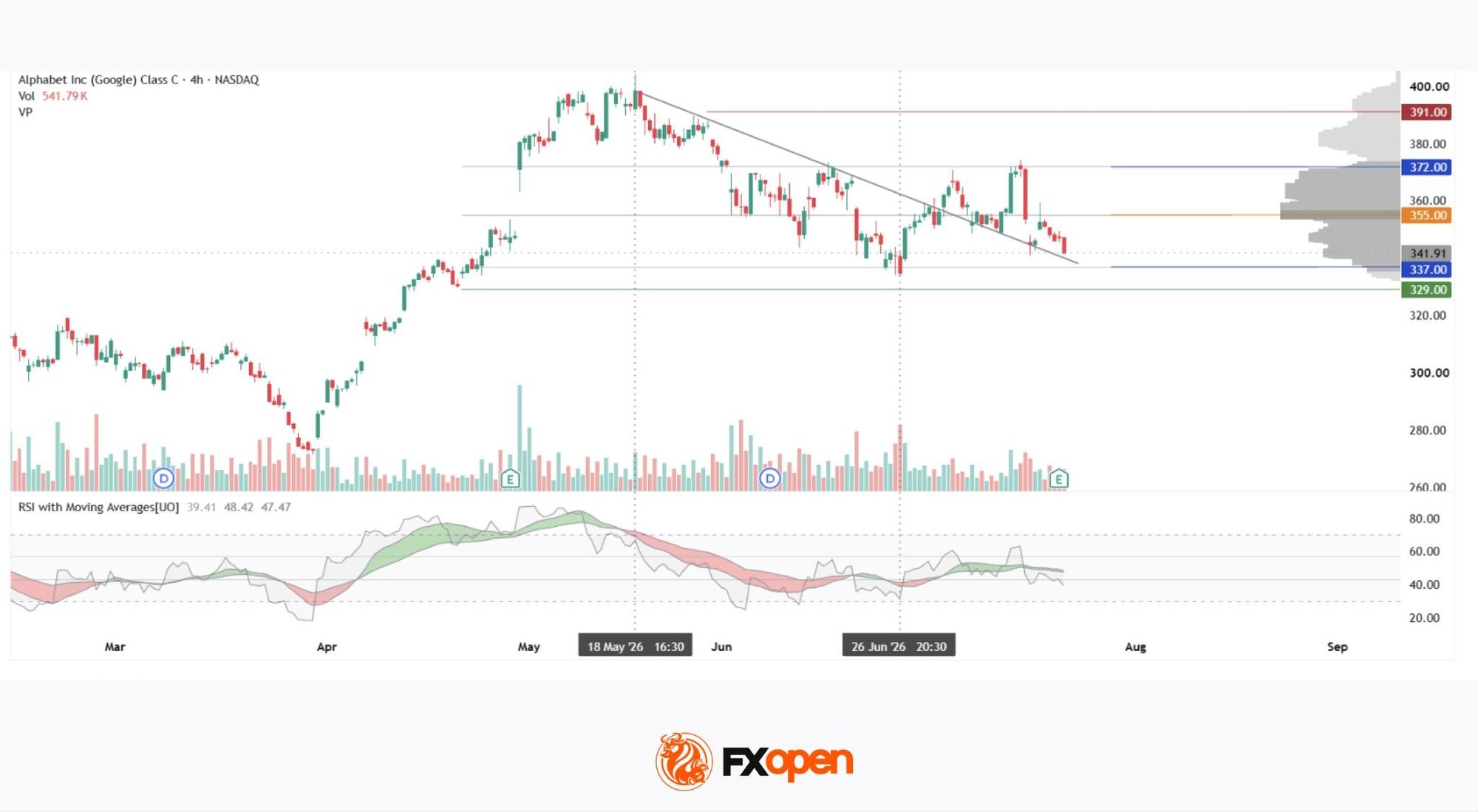
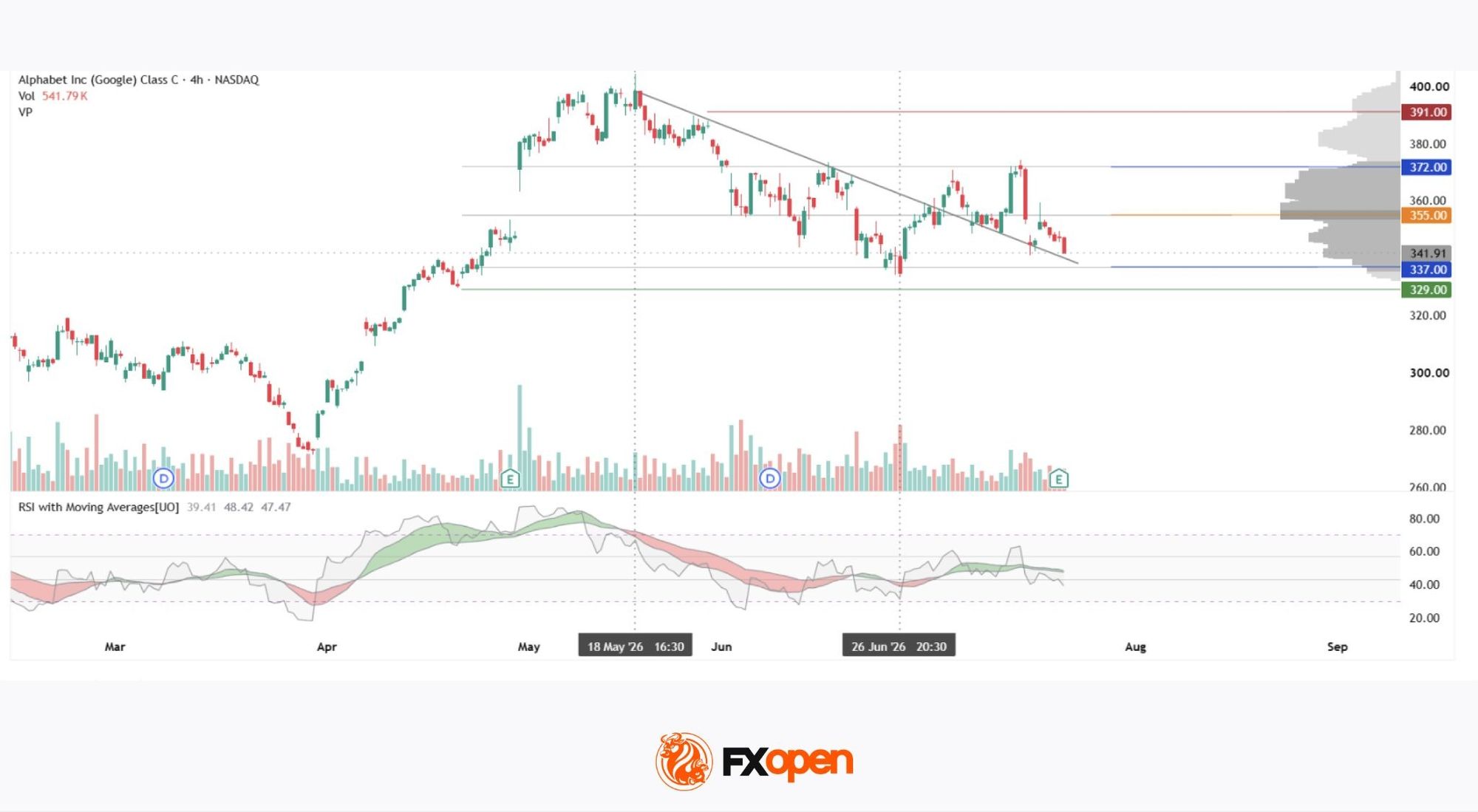
On the 4-hour chart of Alphabet (GOOGL Class A on FXOpen), a short-term bearish structure developed after the price reached the $404 area on 18 May. The decline lost momentum near $334. Following the reversal, the price attempted to break the trendline on 6 July but failed to move beyond the current market profile range. After another rejection from the upper boundary of the profile around $372, the stock turned lower and is now trading between the Point of Control (POC) at $355 and the lower edge of the profile near $337.
The red resistance zone around $391 could limit any recovery attempt, while continued selling pressure may shift attention towards the green support area near $329. The RSI + Moving Averages indicator currently shows readings of 39, 48, and 47. Although the RSI remains below the moving averages, the averages themselves are still coloured green and positioned in the middle of the neutral zone, suggesting that momentum remains inconclusive. Vertical volume has been relatively moderate since the price broke below the trendline, reinforcing the current lack of directional conviction.
Key Takeaways
Despite reporting a sharp increase in net income, Alphabet’s share price reaction has been relatively muted. Strong performances from Google Cloud and Search were partly offset by the fact that most of the profit growth came from a one-off investment revaluation rather than core operations. As a result, fundamental developments may continue to have a greater influence on the stock than the current technical picture in the near term.
Buy and sell stocks of the world’s biggest publicly-listed companies with CFDs on FXOpen’s trading platform. Open your FXOpen account now or learn more about trading share CFDs with FXOpen.
This article represents the opinion of the Companies operating under the FXOpen brand only. It is not to be construed as an offer, solicitation, or recommendation with respect to products and services provided by the Companies operating under the FXOpen brand, nor is it to be considered financial advice.
On 22 July, Alphabet reported its Q2 2026 results, with revenue rising 24% year-on-year to $119.8 billion. Google Cloud revenue surged 82% to $24.77 billion, comfortably exceeding analysts’ expectations. Search advertising generated $63.3 billion in revenue (+17%), while YouTube revenue increased 13% to $11.06 billion. Net income nearly quadrupled to $112.11 billion. However, according to the company’s financial statements, almost all of the increase was driven by unrealised revaluation gains on its private investments in Anthropic and SpaceX rather than by underlying operating performance. Meanwhile, quarterly capital expenditure doubled from a year earlier to $44.9 billion, reflecting continued investment in AI data centre infrastructure.
Technical Analysis
On the 4-hour chart of Alphabet (GOOGL Class A on FXOpen), a short-term bearish structure developed after the price reached the $404 area on 18 May. The decline lost momentum near $334. Following the reversal, the price attempted to break the trendline on 6 July but failed to move beyond the current market profile range. After another rejection from the upper boundary of the profile around $372, the stock turned lower and is now trading between the Point of Control (POC) at $355 and the lower edge of the profile near $337.
The red resistance zone around $391 could limit any recovery attempt, while continued selling pressure may shift attention towards the green support area near $329. The RSI + Moving Averages indicator currently shows readings of 39, 48, and 47. Although the RSI remains below the moving averages, the averages themselves are still coloured green and positioned in the middle of the neutral zone, suggesting that momentum remains inconclusive. Vertical volume has been relatively moderate since the price broke below the trendline, reinforcing the current lack of directional conviction.
Key Takeaways
Despite reporting a sharp increase in net income, Alphabet’s share price reaction has been relatively muted. Strong performances from Google Cloud and Search were partly offset by the fact that most of the profit growth came from a one-off investment revaluation rather than core operations. As a result, fundamental developments may continue to have a greater influence on the stock than the current technical picture in the near term.
Buy and sell stocks of the world’s biggest publicly-listed companies with CFDs on FXOpen’s trading platform. Open your FXOpen account now or learn more about trading share CFDs with FXOpen.
This article represents the opinion of the Companies operating under the FXOpen brand only. It is not to be construed as an offer, solicitation, or recommendation with respect to products and services provided by the Companies operating under the FXOpen brand, nor is it to be considered financial advice.


Bitcoin traded near $65,400 on Thursday, down 0.3% on the day and up 1.4% on the week, per CoinDesk data.
The market stayed quiet through Alphabet’s earnings, the report the whole week had been waiting on for a read on AI spending.
Alphabet delivered a split verdict. Revenue rose 24% to $119.8 billion and cloud grew 82%, both ahead of expectations, but the company lifted its 2026 capital spending forecast again, to $195 billion to $205 billion from $180 billion to $190 billion, citing a “supply-constrained” scramble to meet AI demand.
Its stock fell after hours as investors weighed the heavier spend against slimmer free cash flow.
Alphabet’s own shareholders may not like a fatter bill, but more capital pouring into AI infrastructure is what chip stocks have rallied on. Asian chipmakers rose again on Thursday, with the Kospi up 3.6% and Samsung and SK Hynix both up more than 2% on bets they will capture some of that spending.
The majors were flat. Ether held near $1,916, XRP at $1.13 and Solana at $77, with Hyperliquid the outlier, down 11% on the week. Oil kept climbing, extending a July rally that has revived inflation worries.
The next test is the Fed on July 28 and 29.

Kakao Group is teaming up with Circle to explore how won-backed stablecoins could be integrated into South Korea’s mainstream payment and financial services. The partnership comes as regulators work through a still-evolving legal framework for stablecoins, with the government signaling further legislative progress toward a Digital Asset Basic Act.
On Thursday, Kakao, Kakao Pay, and Kakao Bank said they signed a strategic memorandum of understanding (MOU) with Circle Internet Group. Under the agreement, the companies will study how Circle’s blockchain capabilities and global payment infrastructure might be connected to Kakao’s consumer platforms and financial services.
Key takeaways
- Kakao Group’s MOU with Circle centers on integrating won-backed stablecoin payments into Kakao’s payment and banking ecosystem.
- The partners plan to explore use cases including payments, cross-border remittances, merchant settlement, and links between traditional finance systems and blockchain networks.
- They also intend to consider tokenized financial services, but provided no details on products or launch timelines.
- The deal reflects growing “readiness” among major Korean platforms while stablecoin legislation remains under debate.
Why Kakao and Circle are focusing on won-backed stablecoins
The strategic MOU is positioned as a technology and infrastructure study rather than a specific deployment. Kakao’s stated areas of focus include stablecoin payments, cross-border remittances, merchant settlement workflows, and integration pathways that connect existing financial systems to blockchain networks.
That matters for investors and users because stablecoins—particularly those pegged to local currency—are often discussed as a bridge between traditional payment rails and faster, programmable settlement. For large consumer platforms like Kakao, the core value is distribution and liquidity access: if the regulatory environment permits won-pegged tokens, partners can move quickly to build payment functionality that meets local compliance expectations.
Circle’s role, as described in the announcement, relates to providing blockchain and global payments infrastructure that can be adapted for use inside Kakao’s services. However, the MOU does not specify what token model, issuance structure, or redemption mechanism would be used, and no product roadmap was disclosed.
South Korea’s regulatory process still not settled
South Korea has been moving toward legislation for won-backed stablecoins to encourage digital payment innovation while managing risks such as reserve adequacy, redemption rights, and oversight of issuers.
According to Cointelegraph’s reporting, the government has been preparing a bill outlining requirements for stablecoin issuance, collateral management, and internal controls. At the same time, lawmakers have introduced competing proposals—reflecting a policy debate about the structure of local-currency stablecoin markets.
One of the main points of contention involves which institutions should be allowed to issue won-based stablecoins. The Bank of Korea has argued that banks should hold a majority stake in stablecoin issuers. In contrast, the Financial Services Commission has warned that eligibility limits could reduce competition and inhibit innovation.
The uncertainty has practical consequences: without clarity on issuer eligibility and governance expectations, firms can test technology but may have limited ability to launch fully compliant services. That helps explain why Kakao and Circle are starting with an infrastructure-focused MOU rather than announcing a live stablecoin offering.
A policy timeline that keeps moving—without resolving the core issue
Even as the stablecoin rules remain contested, South Korea’s legislative direction signals continued momentum. In its economic growth strategy announced on July 14, the government listed advancing the Digital Asset Basic Act among priorities for the second half of 2026, according to an announcement reported by Korea’s official website.
For market participants, this indicates that lawmakers are not stepping back from regulation—though the details affecting stablecoin issuance and supervision may still shift as agencies argue over the appropriate balance between control, competition, and systemic risk management.
With that in mind, partnerships like Kakao’s can be read as a hedge: they reduce dependence on a single final regulatory blueprint by starting integration work early, even if deployment depends on whatever the final bill requires.
Testing stablecoin-related capabilities while waiting for rules
Beyond Kakao, other financial and tech firms in South Korea have been running pilots and tests as the regulatory groundwork continues. In April, internet bank Kbank partnered with Ripple to test blockchain-based remittances, per earlier coverage by Cointelegraph. The objective there is similar to what Kakao’s MOU suggests—improving payment and cross-border settlement efficiency while navigating local compliance constraints.
In May, KB Financial Group reportedly completed a pilot focused on stablecoin issuance, offline merchant payments, and cross-border remittances via the Kaia blockchain. KB Financial Group said it planned to introduce stablecoin services once regulations take effect, again highlighting the pattern of pre-compliance experimentation followed by product rollout only when legal requirements are in place.
These efforts underscore a broader dynamic in South Korea’s crypto economy: builders and established institutions are not waiting entirely for the final text of the law. Instead, they are using pilots and infrastructure research to reduce time-to-market—aiming to be operational as soon as regulators define how won-backed stablecoins should be issued and supervised.
For now, Kakao and Circle’s next step appears to be technical exploration—payments flows, remittance connectivity, and integration with existing systems—without a stated launch date. Investors and users should watch how the stablecoin bill debate resolves, particularly around issuer eligibility and oversight, since those decisions will likely determine what “won-backed stablecoin” implementations are legally feasible in practice.
The exchange has immediately halted all new account registrations following a strategic business review by its parent company, HDR Global Trading Limited. The wind-down ends an 11-year run for the Seychelles-incorporated venue, which debuted in 2014 and pioneered the foundational plumbing for modern digital asset derivatives trading.
The wind-down forces an immediate reduction of risk across the system, because while standard trading will continue for the next few weeks, the platform will apply strict limits on Aug. 26 to stop users from opening any new positions. Between that date and the final September deadline, operators will systematically force close all remaining open contracts to ensure the market shuts down in an orderly manner.
The main challenge BitMEX faces is how to offramp user assets into fiat currencies of their choice, as network congestion on the Bitcoin blockchain could cause significant withdrawal delays. However, the company’s current proof of reserves indicates that platform liabilities fully cover customer assets.
This exit marks the end of an 11-year run for the digital asset derivatives venue, which maintained a clean security record and lost no user funds to hacks or smart-contract exploits despite facing years of intense regulatory enforcement actions by global authorities.
The news comes just three weeks after BitMEX lost its CEO, chief financial officer and head of growth.
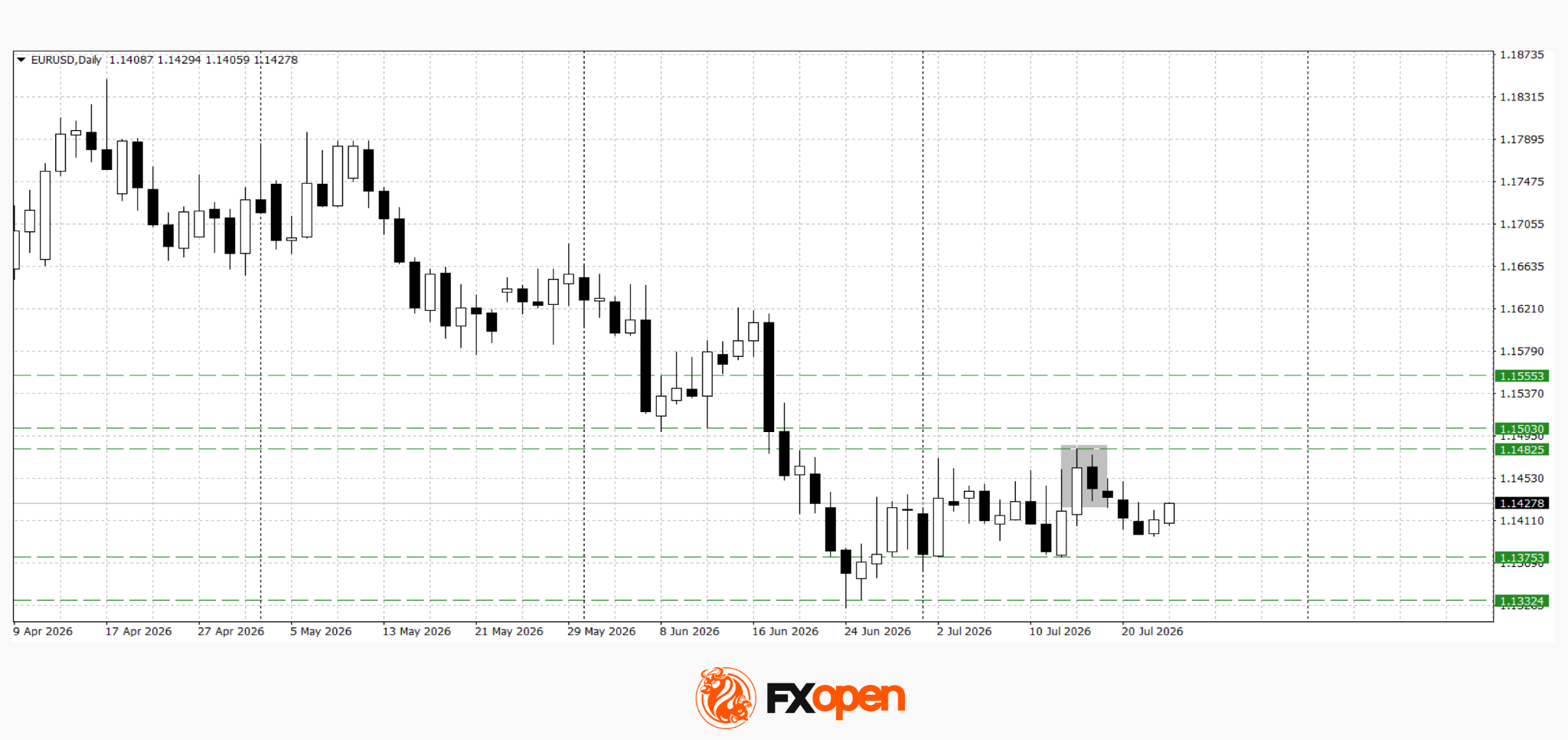
The pound remains under pressure following the release of weaker-than-expected UK inflation data. The slowdown in inflation has strengthened expectations that the Bank of England could adopt a more accommodative policy stance in the coming months, weighing on sterling. Meanwhile, the euro continues to trade within a relatively narrow range as investors await fresh signals from the eurozone economy.
Market participants also remain cautious due to the ongoing escalation of tensions in the Middle East. The United States continues to carry out strikes on targets in Iran, supporting demand for traditional refuge assets, including the US dollar, and limiting the recovery potential of European currencies.
Attention in the coming days will focus on the preliminary Purchasing Managers’ Index (PMI) releases from Germany, France, the United Kingdom, and the eurozone, which will provide an early assessment of economic conditions at the start of the third quarter. The data are particularly important for the euro, as they could influence expectations for the European Central Bank’s next policy moves. Stronger-than-expected figures may support the single currency, while weaker readings could reinforce expectations of further ECB policy easing. In addition, the weekly US initial jobless claims report will provide another update on the health of the US labour market.
EUR/USD
EUR/USD has entered a consolidation phase after failing to test the key resistance level at 1.1500. Technical analysis suggests the pair could decline towards the 1.1330–1.1370 area, as a bearish harami pattern has formed on the daily timeframe. A renewed upward correction may become more likely only after a decisive break and close above 1.1500.
Key events for EUR/USD:
- Today at 09:45 (GMT+3): France Flash PMI
- Today at 10:20 (GMT+3): Speech by Bundesbank Executive Board member Sabine Mauderer
- Tomorrow at 10:00 (GMT+3): Germany GfK Consumer Climate Index
GBP/USD
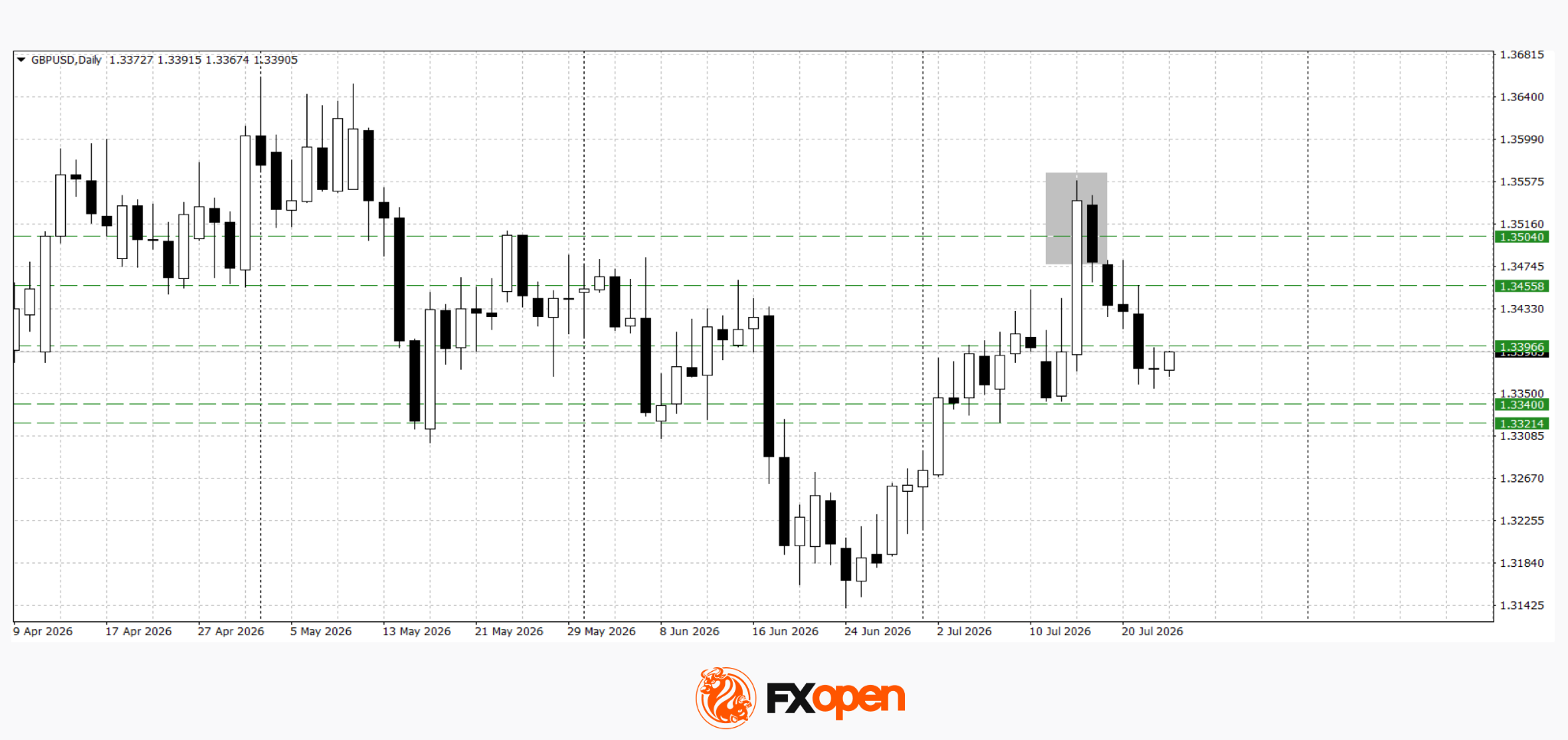
GBP/USD is undergoing a bearish pullback after buyers failed to establish a foothold above 1.3500. A bearish harami pattern has also formed on the daily chart, increasing the likelihood of another test of the nearby support zone at 1.3320–1.3340. The bearish scenario would only be invalidated by a decisive close above 1.3400.
Key events for GBP/USD:
- Today at 13:00 (GMT+3): UK CBI Industrial Trends Orders
- Today at 15:30 (GMT+3): US Initial Jobless Claims
- Tomorrow at 11:30 (GMT+3): UK Flash Manufacturing PMI
Summary
Sterling remains under pressure following softer UK inflation data, while the euro continues to consolidate as traders await fresh economic signals from the eurozone. Over the coming days, the preliminary PMI releases are likely to be the main catalysts for European currencies, as they could reshape expectations for future policy decisions by both the European Central Bank and the Bank of England. US macroeconomic data and developments in the Middle East are also expected to remain important drivers of market sentiment.
Trade over 50 forex markets 24 hours a day with FXOpen. Take advantage of low commissions, deep liquidity, and spreads from 0.0 pips (additional fees may apply). Open your FXOpen account now or learn more about trading forex with FXOpen.
This article represents the opinion of the Companies operating under the FXOpen brand only. It is not to be construed as an offer, solicitation, or recommendation with respect to products and services provided by the Companies operating under the FXOpen brand, nor is it to be considered financial advice.

Which Team Will He Choose To Play in 2027?

5 leading Bitcoin-backed loan platforms in 2026

Tom Holland Is Gearing Up To Play Fred Astaire

Renter of Home in Anne Heche Crash Denies Settlement With Son

No Jackpot Winner as $257 Million Prize Rolls Over to $269 Million Monday Draw

Weekend Open Thread: Staud – Corporette.com

money subliminal calm – the audio that will make you rich // new formula (works instantly!)

XRP CAN RUN ON IT’S OWN & FLIP BTC! – BRAD EXPLAINS WHY SWIFT IS FINISHED!

Capital Budgeting | Financial Management | CS Executive Dec 2026 / June 2027 | CS Debashish Sir
-
 NewsBeat7 days ago
London Mayor Sadiq Khan handed a peerage by Keir Starmer alongside 15 other Labour figures… just days before the PM leaves No10
-

 Fashion6 days ago
Weekend Open Thread – Corporette.com
-

 Politics5 days ago
The House | The City of London can help the new chancellor deliver growth in every postcode
-

 Crypto World5 days ago
Ripple Payments Joins MiCA With 14 Firms, Does It Mean Anything For XRP?
-
 Crypto World6 days ago
Two July Windows Left: The CLARITY Act’s Senate Fight and What Failure Means
-

 Politics4 days ago
Democrats look to World Cup watch parties to register thousands of voters
-

 Crypto World5 days ago
Ripple wins EU-wide access as ESMA adds it to MiCA register
-

 Crypto World2 days ago
Grayscale Files For Worldcoin ETF, WLD Registers Sharp Rise
-

 NewsBeat3 days ago
Unregistered fitter used Gas Safe logo on business flyers
-

 Tech2 days ago
Sail Virtually Aboard The “Itanic” With IA-64 Emulator
-

 Crypto World7 days ago
Injective Submits SEC Transfer-Agent Registration to Onchain Ownership Records
-
 Tech2 days ago
Turtle Beach Command Series KB7 review: a nifty screen-equipped gaming keyboard
-

 NewsBeat6 days ago
Registration is now open for March for Men with Kev 2026
-
 Business1 day ago
New Jersey voter registration controversy explained: How 6,600 noncitizens got on the rolls, and what happens next
-

 Crypto World6 days ago
Claude Fable 5 Slips to Second in AI Coding Leaderboard
-

 News Videos6 days ago
Money | Class 12 Economics | CBSE Board Exam 2026-27
-

 Business6 days ago
Banco Bilbao Vizcaya Argentaria, S.A. (BBVA) Discusses Global Macro Environment and Economic Outlook for Core Markets Transcript
-

 Crypto World5 days ago
Kaspersky exposes OkoBot’s 20-module crypto wallet attack
-

 News Videos4 days ago
Big Money Is Entering XRP
-

 NewsBeat5 days ago
Durham County Council to send out electoral registration emails
You must be logged in to post a comment Login