
Crypto World
Curve DAO appoints Resupply developers to risk role



Curve DAO approved yRisk as its new risk-management provider for crvUSD and Llamalend on Sept. 2, assigning the mandate to two contributors who are also primary developers of Resupply.
Summary
- Curve DAO approved yRisk to monitor crvUSD and Llamalend through a twelve-month risk management mandate.
- yRisk will receive 125,000 frxUSD and 568,181 CRV through two revocable one-year vesting streams separately.
- Its two contributors disclosed being primary Resupply developers, whose protocol suffered a 2025 donation attack.
- The proposal and Curve comparison did not mention Resupply’s approximately $9.6 million exploit explicitly anywhere.
- yRisk’s binding funding vote passed with 621.2 million veCRV supporting and virtually none opposing it.
The binding onchain vote closed with approximately 621.2 million veCRV supporting the proposal and 5.33 veCRV opposing it. The proposal was executed about 87 minutes after voting ended.
yRisk will receive 125,000 frxUSD and 568,181 CRV through separate revocable vesting streams lasting one year. The package represents the team’s requested annual budget of approximately $250,000.
Curve DAO gives yRisk a twelve-month mandate
yRisk will provide risk assessment and monitoring across crvUSD mint markets and Llamalend isolated lending markets. Its responsibilities include reviewing collateral, liquidity, oracle design, concentration and governance risks.
The team will also recommend debt ceilings, market parameters, PegKeeper limits and other risk controls. Curve governance and its emergency DAO retain authority over final decisions and execution.
According to its original proposal, yRisk plans to build public monitoring systems, dashboards, alerts and automated code-analysis tools. Work funded by the mandate will generally be released under an open-source license.
The team consists of contributors known as Wavey and Dudesahn. The proposal identifies both as core developers at Yearn and Resupply and describes them as Resupply’s primary developers.
Resupply exploit was absent from reviewed materials
Resupply suffered a donation attack in June 2025 that caused approximately $9.6 million in losses. A QuillAudits analysis attributed the incident to exchange-rate manipulation affecting a lending market.
The attacker donated assets to a nearly empty vault, causing an exchange-rate calculation to round toward zero. That manipulation allowed the attacker to borrow against artificially inflated collateral.
yRisk’s Curve proposal disclosed its contributors’ Resupply roles but did not mention the exploit. Curve’s comparative assessment also discussed their Resupply experience without referring to the incident.
The omission does not establish that yRisk violated a disclosure requirement. Curve’s call for proposals requested relevant experience, methodology, capacity and pricing, but the published requirements did not expressly demand disclosure of every incident involving a contributor’s previous projects.
Curve reviewers identified a staffing concern
Swiss Stake reviewed nine competing applications before Curve conducted its preference votes. Its assessment credited yRisk with practical knowledge of Curve, Llamalend, Yearn and Resupply.
The review also identified capacity as its main concern. It questioned whether two contributors with other responsibilities could monitor a growing number of markets and provide adequate incident coverage.
“It is not yet clear whether they can sustain that workload and provide sufficient incident coverage as the number of markets expands,” Swiss Stake said.
The statement described uncertainty rather than a finding that yRisk lacked the necessary resources. Swiss Stake recommended an initial limited mandate and a public review checkpoint for whichever provider Curve selected.
During a nonbinding preference vote, yRisk received approximately 536.97 million veCRV votes in favor and none against from 47 voters. That represented about 68.78% of the voting supply at the snapshot block.
yRisk replaces LlamaRisk across Curve markets
Curve began seeking a replacement after LlamaRisk ended its engagement early. LlamaRisk had renewed its mandate in April 2026 with plans to continue through April 2027.
The provider announced its departure on May 29 and stopped active work on June 30. It returned approximately 270,247 crvUSD in unvested funding to Curve’s treasury.
LlamaRisk described the departure as a structural decision about how it allocated resources, rather than criticism of Curve. Curve opened its replacement process on July 7.
The new mandate arrives as Curve expands Llamalend. Crypto.news previously reported that Llamalend v2 introduced isolated lending markets on Optimism before a planned Ethereum deployment.
Risk management has remained a central concern for the ecosystem. In March, an improperly configured oracle enabled an attacker to extract approximately $240,000 from a Llamalend market, as crypto.news reported in its coverage of the sDOLA-crvUSD pool exploit.
Public reporting will test yRisk’s delivery
yRisk must now review LlamaRisk’s existing reports, models, dashboards and repositories. The team will determine which resources should be retained, rebuilt or retired.
Its proposal commits to monthly progress reports, continuous monitoring and incident support. The revocable funding structure gives Curve DAO the ability to stop the remaining vesting streams before the twelve-month term ends.
A future public review would allow governance participants to assess whether yRisk has met its monitoring, reporting and response commitments. Curve has not announced a specific date for that checkpoint.


XRP is back at $1.45, having a violent 6% rally on the Fed news, so is the whole crypto market. The run is strengthening the bigger story: a macro-driven relief rally that has traders whispering about $10 again, a target that felt like fantasy just weeks ago. What’s actually fueling this move, and how far can it realistically run before the next resistance wall shows up?
— Coin Bureau (@coinbureau) September 3, 2026
 JUST OUT: The U.S. labor market is flashing fresh signs of COOLING, delivering a slightly dovish signal.
Jobless claims: 206K vs 205K expected, up from 203K
ADP payrolls: 38K vs 47K expected
The double miss strengthens the case for a Fed rate cut, potentially boosting stocks… https://t.co/WwaycRrU4p pic.twitter.com/maJ2KhWHTL
The rally traces back to softening expectations around Federal Reserve policy, with risk assets broadly catching a bid as traders price in a friendlier rate path. XRP’s 24-hour volume has stayed elevated near $4 billion, with a market cap sitting around $90.9 billion, putting it firmly back in the conversation among large-cap majors.
Rate-cut odds have been a moving target all week, and that volatility is spilling directly into altcoin price action. XRP’s August run, a 70% surge from $1 to $1.70, set the stage for this entire narrative arc, and the subsequent 20% correction into the $1.35–$1.38 zone is now the line in the sand bulls are defending.
Institutional demand has been quietly building under the surface, which adds some weight to the bull case beyond pure retail sentiment.
Discover: The Best Token Presales
Can XRP Price Hit $1.60 This Week and Pump Beyond the Fed News?
XRP trades near $1.45 currently, a 6% jump intraday, and is still holding well above the critical $1.35–$1.38 support band that’s absorbed the heaviest historical volume. The 200-day EMA sits close behind at $1.33–$1.35, giving bulls a reasonable cushion if selling pressure returns.
Volume near $5.5 billion signals genuine participation, not a thin, easily-reversed pump. The technical setup remains a descending triangle dating back to August’s $1.70 peak. Price is rebounding off triangle support but hasn’t cleared descending resistance yet.

If it can hold above $1.34, it sets up a retest of $1.55, and a clean break opens the door to $1.60–$1.90. It could also consolidate between $1.38 and $1.52 while macro data digests.
What we don’t want to see is a slip below $1.30 as it risks a deeper correction, particularly if upcoming jobs data sparks risk aversion. ETF flow speculation continues to fuel the $10 talk, though that timeline stays firmly speculative for now.
Trade XRP on Bybit and Get a Chance to Win Our $1,000 USDT Airdrop
Bitcoin Hyper Targets Early Mover Upside as XRP Tests Key Levels
A 6-7% bounce feels good if you’re already holding XRP, but here’s the bad news. At a $90 billion market cap, doubling from here requires an enormous amount of fresh capital, the kind of move that takes months, not days.
Traders chasing that $10 dream might get there eventually, but the math on a large-cap asset moving 7x is a different conversation than an early-stage token doing the same.
That’s where Bitcoin Hyper ($HYPER) enters the picture. It’s positioned as the first Bitcoin Layer 2 with full SVM integration, aiming to deliver execution speeds faster than Solana itself while settling back to Bitcoin’s base layer.
The presale has raised $33.1 million so far, with tokens priced at $0.0136857 and staking rewards offering a high 60%+ APY for early participants. Standout features include a decentralized canonical bridge for BTC transfers and low-latency Layer 2 processing built to fix Bitcoin’s programmability gap.
Research Bitcoin Hyper before the presale window closes.
Discover: The Best Crypto to Diversify Your Portfolio
The post XRP News: Ripple Rallies on Fed Dovish Tone, $10 Dream Returns appeared first on Cryptonews.

Bitcoin, once again, climbed above $80,000 after surging by 4.3% on Friday. The recent strength comes as a welcome change, as the crypto market spent much of the third quarter under pressure before a sharp rally in late August changed the tone. BTC, for one, recorded its strongest monthly gain since November 2024, which led some investors to believe the bear market may have ended.
But according to Fidelity, there is no guarantee that’s the case yet.
Possible November Bottom?
One factor in focus is Bitcoin’s historical four-year market cycle. The crypto asset has generally formed major bear-market bottoms and bull-market tops about four years apart. Since the previous bear market bottom came in November 2022, this pattern could point to another potential low around November 2026 if the cycle continues.
While Fidelity stressed that the four-year cycle is not guaranteed to repeat and that Bitcoin’s bottom may already have occurred in July, it still speculated that the cryptocurrency could fall again and set another low in November or later.
There are several catalysts that could also influence whether the crypto bear market ends. The financial giant pointed to more crypto-friendly regulation, changes in government monetary policy, the emergence of an unexpectedly popular crypto use case, and increasing institutional adoption. Price volatility is another factor the firm is watching.
Bitcoin’s previous bear markets have historically ended with a period of relatively low volatility followed by higher volatility and an upward expansion in price. Fidelity said the market experienced relatively low volatility from June through mid-August, which indicated that sellers may have become exhausted.
During that period, its analysis showed BTC and other crypto assets were trading toward the lower, or “value,” end of their historical price ranges. In late August, volatility increased sharply, with Bitcoin rising more than 25% during the third week of the month. Ethereum gained around 34% over the same period, while Solana rose 28%. Fidelity said this price behavior does not confirm that the bear market is over, but it is consistent with one possible historical pattern.
Meanwhile, events that might normally have pushed prices lower, including the Coldcard hardware wallet security exploit and the stalling of the CLARITY Act, did not result in further declines. This could support the narrative that cryptocurrencies are near a market bottom and may now be waiting for a new positive catalyst.
Crypto adoption continued to expand despite weak market sentiment. Bitwise Investments reported in early July that stablecoin transaction volume had reached 2.3 times Visa’s volume. MetaMask also reported in July that the real-world asset market had grown faster in 2026 than in any previous year.
Fidelity said this created a disconnect between adoption and prices, as activity in parts of the crypto industry kept increasing while the overall market remained in a bear market. The recent recovery could indicate that adoption and price have started to “recouple” again. An exact pattern occurred during the 2021-2022 bear market and the subsequent new bull market that began in late 2022.
CLARITY in Focus
Regulation remains another key factor for the market. The industry is still awaiting further action on the CLARITY Act, which aims to create a broader US regulatory framework for digital assets and clarify the responsibilities of federal regulators. The bill has passed the House but remains under consideration in the Senate, which leaves its timing and outcome uncertain.
The SEC also proposed Regulation Crypto Assets, which would address when certain early-stage crypto asset offerings could qualify for exemptions from securities registration requirements. The proposal is still subject to public comment and is not final, but Fidelity described it as an important step toward a more “tailored regulatory approach.”
The post Bitcoin Is Back Above $80,000, But Fidelity Says the Bear Market May Not Be Over Yet appeared first on CryptoPotato.


Uniswap Labs has purchased PONS, the token of a Robinhood Chain launchpad generating $5.95 million in daily fees, as PONS climbed to a new all-time high above $0.52.
Summary
- Uniswap Labs purchased PONS for what the launchpad called long term alignment, but neither party disclosed the size, price or structure of the transaction.
- Pons generated $5.95 million in fees over 24 hours and has earned more in daily fees than Solana based pump.fun every day since Aug. 29.
- Robinhood Chain accounted for $901.5 million, or 56.3%, of Uniswap V4’s $1.6 billion in trading volume across supported networks.
- PONS rose 17.5% to $0.5013 and reached an all time high of $0.5242, while its market capitalization climbed to $357.1 million.
Pons said Thursday that Uniswap Labs had “purchased $PONS for long-term alignment,” describing the transaction as a deepening of the relationship between the two projects.
The parties did not disclose how many tokens changed hands, the amount Uniswap Labs paid, when the purchase occurred or the address holding the position. Pons did not specify whether Uniswap Labs acquired PONS on the open market or received an allocation, a distinction raised by several users responding to the announcement.
Uniswap Labs had not issued its own statement detailing the transaction at the time of the disclosure.
PONS traded at $0.5013, up 17.5% over the previous 24 hours, according to CoinGecko. The token reached an all-time high of $0.5242 earlier Thursday after trading as low as $0.3476 during the same period, while turnover stood at $135.2 million.
Its market capitalization reached $357.1 million, placing PONS 118th among cryptocurrencies by market value.
The move came one day after Binance added PONS and FLORK to Binance Alpha 1.0. Crypto.news previously reported that Pons was generating $5.95 million in daily fees when the exchange announced the additions.
Uniswap Labs takes PONS position as V4 activity expands
Pons launched on July 13 and deployed its V2 contracts on Aug. 3, linking tokens that graduate from its bonding curve directly with Uniswap V4 liquidity pools.
Before the deployment, Pons had detailed an ETH bonding curve alongside Uniswap V4 integration, creator payouts in ETH and support for custom trading pairs involving tokenized assets.
Under the model, tokens begin trading through the launchpad’s bonding curve before liquidity moves into Uniswap V4 once a token graduates. The V2 plan included pairs using assets such as USDG and tokenized versions of NVDA, AAPL and HOOD.
Robinhood Chain has since become the largest network for Uniswap V4 trading by volume.
Uniswap V4 processed $1.6 billion across supported chains over the latest 24-hour period, according to DefiLlama. Robinhood Chain contributed $901.5 million, or 56.3% of that total.
Ethereum followed with $465.5 million, while BNB Chain recorded $93.9 million and Base handled $52.5 million.
Uniswap’s deployment on Robinhood Chain held $207 million in total value locked and generated $7.72 million in fees over the past day.
The PONS purchase consequently puts Uniswap Labs on the token holder side of an application that sends graduated assets into its V4 pools, although the size and structure of the company’s position remain undisclosed.
Pons competes with Uniswap’s own Robinhood Chain launchpad
Uniswap Labs operates another token launch platform on the same network.
The company launched Pools.trade on Aug. 5, two days after Pons shipped its V2 contracts. The platform allows users to create tokens through crowd or instant launches and routes completed launches into permanently locked Uniswap V4 liquidity.
Pools.trade charges no fee to launch a token, while trades carry a standard 0.25% liquidity provider fee.
The platform recorded more launches than Pons during its first day, but Pons subsequently pulled well ahead in fee generation.
By Aug. 31, Pools.trade was collecting $38,553 in daily fees compared with $4.89 million for Pons V2.
Pons has since generated $5.95 million in fees over 24 hours, $28.83 million over seven days and $40.84 million over 30 days, DefiLlama data showed. Approximately $1.11 million of the latest daily total was retained as protocol revenue.
The launchpad has out-earned Solana’s pump.fun in daily fees every day since Aug. 29. Pons had previously led pump.fun for six days in late July before falling behind for approximately a month.
Its revenue has become a large component of activity generated by applications on Robinhood Chain. A recent DefiLlama snapshot showed Robinhood Chain application revenue reaching $2.66 million over 24 hours, temporarily placing the network ahead of Hyperliquid, Ethereum and Base under the same metric.
GMGN, Pons and Uniswap together accounted for approximately 93% of the measured application revenue in that snapshot. Pons generated roughly $1.03 million, compared with around $1.11 million for GMGN and $327,707 for Uniswap.
Robinhood Chain carries most Uniswap V4 trading
Robinhood launched its chain mainnet on July 1 as an Ethereum Layer 2 built using Arbitrum technology, with tokenized equities forming a central part of its trading offering.
Memecoin issuance began during the network’s first week. Launchpads later started combining memecoins with tokenized equities in the same trading markets, giving users pairs denominated in assets linked to publicly traded companies.
Uniswap has become one of the main liquidity venues for that activity. Combined tokenized stock volume through Uniswap on Robinhood Chain passed $1 billion in August.
The figure covered cumulative swaps involving several stock tokens and did not represent the amount of tokenized equities held on the network. Markets have included tokens tracking companies such as Nvidia, Apple and Alphabet.
Across decentralized exchanges, Robinhood Chain settled $1.35 billion in volume over the latest 24 hours. Total value locked stood at $818.6 million after rising 9.1% on the day, while stablecoins on the network were valued at $868.5 million.
The chain collected $4.45 million in gas fees and retained $4.01 million in revenue after Ethereum settlement expenses and the 10% share owed to Arbitrum.
Trading activity has remained concentrated among a smaller number of applications and assets. On Aug. 30, Pons alone generated $445 million of Robinhood Chain’s $874.8 million in DEX volume, according to a subsequent analysis of the network’s trading activity.
PONS buybacks have removed more than 29% of supply
Pons uses a large portion of its protocol fees to buy its native token.
Approximately 80% of protocol fees are directed toward PONS purchases, according to Pons and DefiLlama’s accounting of protocol revenue.
Pons said Thursday that 29.34% of the total token supply had been burned. CoinGecko put circulating supply at 712.1 million PONS against a maximum supply of 1 billion.
The token’s record price came as UNI recorded its own weekly gains. Uniswap’s native token traded at $6.28, up 7.9% over 24 hours and 36.1% over seven days, giving it a market capitalization of $3.92 billion.
Pons has continued adding markets tied to Robinhood Chain’s tokenized-equity ecosystem. The launchpad listed another group of stock-token pairs Thursday, including UPS, SNAP, LULU, PFE and JNJ.

Mining firms like Southern Copper (SCCO), Wheaton Precious Metals (WPM) and Newmont (NEM) represent just some of the top stocks to watch that have earned a spot on the Investor’s Business Daily Breakout Stocks Index. While these and other stocks trade in or near a buy zone, their behavior around key moving averages — particularly the 21-day exponential moving average…
Copyright ©2026 Investor’s Business Daily, LLC. All rights reserved. 87990cbe856818d5eddac44c7b1cdeb8
Chainlink Data Feeds went live on Tempo on Sept. 3, providing the payments-focused blockchain with onchain market data for stablecoin and financial applications.
Summary
- Chainlink Data Feeds are now live on Tempo, supplying market prices directly to financial applications.
- Developers can use supported feeds for collateral valuation, exchange-rate comparisons, treasury controls and reconciliation workflows.
- Independent Chainlink node operators aggregate multiple data sources before publishing reports that contracts can verify.
- Tempo provides execution and settlement, while applications determine how incoming market information controls transactions automatically.
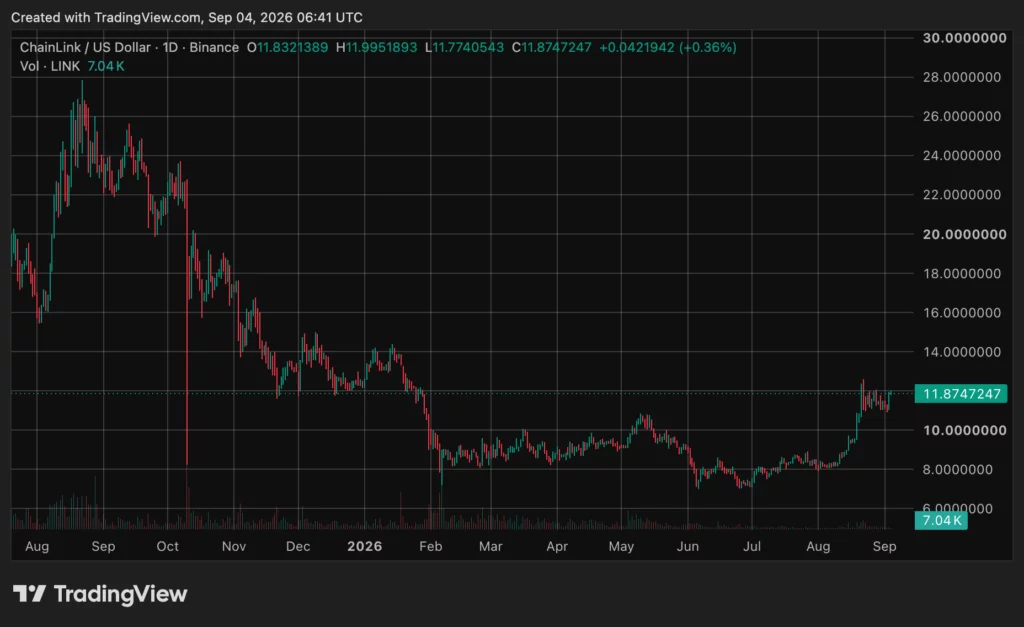
- LINK traded near $11.84, rising about 5.6%, without confirmed evidence connecting gains to integration news.
The integration allows businesses, institutions and developers to access supported price feeds without building independent oracle infrastructure. Applications can use the data for collateral valuation, foreign exchange comparisons, treasury management and automated risk controls.
Chainlink Data Feeds support financial applications
Blockchains cannot independently obtain market information from external exchanges and financial data providers. Oracle networks deliver that information to smart contracts, allowing applications to respond to price changes and other offchain events.
Chainlink aggregates observations from multiple data providers. Independent node operators collect the information before publishing reports that smart contracts can verify on Tempo.
Tempo provides the execution and settlement layer, while developers decide how applications use the information. A lending application, for example, can reference a feed when calculating collateral values, borrowing limits and the health of open positions.
Developers can review the available feeds and contract addresses through Chainlink’s documentation. The companies did not state how many applications currently use the feeds.
Tempo targets stablecoin payment infrastructure
Tempo is a layer-1 blockchain designed for stablecoin payments and financial settlement. Stripe and crypto investment company Paradigm incubated the project before its mainnet launch in March 2026.
The network is intended to support uses such as business payments, payroll, remittances and machine-generated transactions. As previously reported, Tempo launched its mainnet and machine-payment protocol to process stablecoin transfers for businesses and artificial intelligence agents.
Market data expands the functions applications can build around those payments. A business could compare a foreign exchange quote with an external reference rate before approving a conversion. Treasury software could also rebalance positions when an asset moves outside a predefined range.
Tempo said applications could use stablecoin balances as collateral for working capital and other liquidity products. These remain potential applications rather than evidence that specific products have launched.
“Financial applications built around those payments need dependable market data to value collateral, compare exchange rates, and manage risk,” Tempo’s Eric Kang said.
Chainlink data can automate collateral controls
The feeds can allow lending applications to monitor collateral without relying on a single exchange or data provider. Developers can program borrowing limits, liquidation thresholds and collateral top-up requirements around the incoming reference prices.
Tempo applications can also use the feeds to value different assets in one reporting currency. This could support accounting, position reconciliation and exposure monitoring across stablecoins or tokenized assets.
The integration follows Tempo’s expansion beyond basic payments. In May, the network integrated Morpho’s lending infrastructure, adding decentralized credit markets to the chain. The rollout brought fixed and variable lending tools to Tempo while preserving its payments-focused design.
Chainlink has also extended its data services across other tokenized markets. In August, it introduced price feeds for four Coinbase-issued tokenized U.S. stocks on Base, allowing supported applications to assess tokenized equities for lending and collateral.
Meanwhile, Chainlink Data Feeds provide reference prices rather than executing transactions themselves. Tempo applications remain responsible for selecting feeds, setting risk limits and determining how they respond when prices move. Developers must also account for update frequency, deviation thresholds and periods when market data becomes unavailable.
LINK rises as Chainlink integrations expand
Chainlink traded near $11.84 when checked, up approximately 5.6% over the previous session. It reached an intraday high near $12 after trading as low as $11.13.
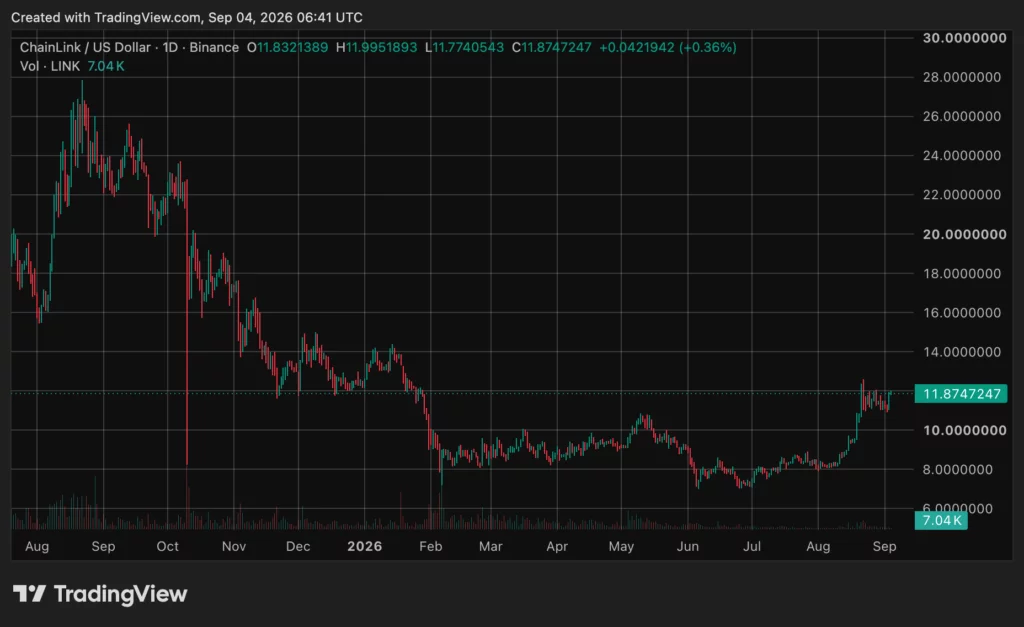
No verified evidence directly connected the price increase to the Tempo announcement. LINK traded within a broader crypto market advance, making attribution to one integration unreliable.
Chainlink has secured several institutional and public-sector integrations in recent months. Wyoming recently adopted its Proof of Reserve system to publish near-real-time backing data for the state-issued FRNT stable token. The system adds onchain reserve verification to Wyoming’s daily attestations.
The next measure of the Tempo integration will be developer adoption. Tempo has not announced a deadline for additional feeds or named applications preparing to launch with the data. Supported contracts are already available for developers to integrate.


El Salvador used no public resources to accumulate Bitcoin after the first review of its International Monetary Fund (IMF) financing program in June 2025, according to the lender.
In a Thursday statement, the IMF said documents supplied by Salvadoran authorities verified that the accumulation came from private donations. According to the lender, the increase in El Salvador’s holdings therefore did not reflect additional Bitcoin purchases financed with government resources.
The IMF also said majority ownership and operational control of the Chivo wallet had been transferred to a private operator, while the government retained a minority stake and custodial responsibilities. It said no further accumulation beyond documented donations is expected.
The explanation addresses how El Salvador’s holdings grew after the first review, after the country said in November 2025 that it had acquired 1,090 BTC worth $100 million, renewing questions about compliance with its $1.4 billion IMF program.
Bitcoin additions repeatedly raised questions
In December 2024, El Salvador agreed to limit public-sector involvement in Bitcoin under the IMF package. The agreement made private-sector Bitcoin acceptance voluntary, required taxes to be paid in US dollars and called for government involvement in Chivo to be unwound.
In March 2025, the IMF issued new documents barring “voluntary accumulation” of Bitcoin by the public sector. President Nayib Bukele responded that the purchases were “not stopping” and said El Salvador would keep adding at least one BTC daily.
Related: IMF says El Salvador in talks to sell state-run Chivo Bitcoin wallet
Since then, El Salvador’s Bitcoin Office has often posted that it has continued to accumulate Bitcoin. In July 2025, the IMF offered an initial explanation, saying no new Bitcoin had been purchased since the December agreement. It attributed increases to consolidation among government wallets.
The November announcement reopened the issue. An IMF representative previously told Cointelegraph that the lender would not provide “running commentary” on announcements and would assess compliance in due course.
According to the National Bitcoin Office’s official reserve tracker, El Salvador currently holds about 7,764 Bitcoin. At BTC’s current price of $80,900, according to CoinGecko, the stockpile is worth about $628 million. The balance remains higher than before the IMF agreement, reflecting additions attributed by the IMF to private donations.
Magazine: El Salvador’s Bitcoin experiment turns 5: ‘It was for us, not them’


Ripple CEO Brad Garlinghouse said on Sept. 3 that making the United States the global center of the cryptocurrency industry remains “within reach,” while urging policymakers to complete the country’s regulatory framework.
Summary
- Ripple CEO Brad Garlinghouse said making America the global crypto capital remains within reach.
- His statement followed an August White House meeting involving financial, technology and cryptocurrency industry executives.
- CFTC Chair Michael Selig said the administration wants financial innovation built within the United States.
- The CLARITY Act faces a September 15 cloture vote requiring sixty senators to support advancement.
- House scheduling leaves Congress limited time to reconcile and pass any amended Senate version afterward.
Garlinghouse made the statement after Commodity Futures Trading Commission Chair Michael Selig discussed an August White House gathering involving executives from cryptocurrency, finance and technology companies.
“Making America the crypto capital of the world is within reach — let’s finish the job,” Garlinghouse said.
The comment represents Garlinghouse’s policy position rather than confirmation that the United States has achieved the administration’s stated objective.
Ripple CEO points to White House crypto engagement
The White House gathering took place on Aug. 19 and brought crypto executives together with senior administration and financial regulatory officials. Garlinghouse attended alongside Coinbase CEO Brian Armstrong, Robinhood CEO Vlad Tenev and Kraken co-CEO Arjun Sethi.
Other attendees included Nasdaq CEO Adena Friedman, Intercontinental Exchange CEO Jeffrey Sprecher, Gemini co-founders Cameron and Tyler Winklevoss and Chainlink co-founder Sergey Nazarov. SEC Chair Paul Atkins and CFTC Chair Selig represented the principal federal market regulators.
Selig subsequently said that the administration was working to ensure that the “new frontier of finance” would be built in the United States. His statement reflects the administration’s policy direction, but lasting regulatory changes still require legislation, agency rulemaking or both.
The gathering preceded the inaugural meeting of the CFTC’s Innovation Advisory Committee on Aug. 20. As previously reported, Garlinghouse joined the committee’s first meeting with executives from cryptocurrency and traditional finance companies.
CLARITY Act remains the immediate legislative test
The Digital Asset Market Clarity Act remains central to the administration’s attempt to establish a federal crypto market structure. The legislation would define regulatory responsibilities and create rules governing intermediaries and certain digital assets.
The House previously passed its version, but the Senate’s amended legislation still requires approval. A reported Sept. 15 cloture vote would need support from at least 60 senators before the bill could move toward final floor consideration.
Senate negotiations have included disagreements over decentralized finance, ethics restrictions, consumer protections and the treatment of stablecoin rewards. Seven Democratic senators previously opposed an emerging draft and requested stronger safeguards.
Garlinghouse has repeatedly urged lawmakers to accept a workable compromise. In July, he supported passage despite unresolved disagreements as Senate Democrats sought additional ethics and enforcement provisions.
Congressional scheduling narrows the available window
The Senate vote would not complete the legislative process. If senators approve language differing from the House bill, the two chambers must reconcile their versions before sending legislation to the president.
The House is scheduled to spend only four legislative days in session after Sept. 15 before another recess. That calendar leaves lawmakers limited time to review and approve any changes adopted by the Senate.
If Congress cannot complete the process before campaigning intensifies ahead of the midterm elections, consideration could shift into the post-election lame-duck session. Passage during that period would remain possible but would depend on leadership priorities and the election outcome.
Related crypto.news analysis found that Congress has only 14 working days available for the legislation under the current calendar. The timetable does not make failure certain, but it limits the available routes to enactment.
Agency actions cannot fully replace legislation
The SEC and CFTC have taken steps to clarify their approaches to digital assets. Their guidance can affect enforcement priorities, disclosure expectations and the treatment of specific products.
However, agency statements cannot provide the same statutory division of authority envisioned by the CLARITY Act. Rules introduced by one administration may also face legal challenges or revisions under future leadership.
The next event to watch is the expected Sept. 15 Senate procedural vote. If cloture succeeds, lawmakers must still approve the bill, resolve any differences with the House and complete the process within a restricted congressional calendar.
Garlinghouse’s claim that U.S. crypto leadership is “within reach” therefore depends heavily on legislative execution. The White House meeting showed access and policy support, while the coming Senate vote will test whether those priorities can become binding law.

The International Monetary Fund (IMF) says private donations, rather than public resources, have driven El Salvador’s Bitcoin (BTC) reserve growth since the first review.
The finding came alongside a staff-level agreement on El Salvador’s combined second and third program reviews. Approval by the Executive Board would release around $140 million.
IMF Expects No Further Bitcoin Accumulation Beyond Documented Donations
El Salvador entered the 40-month Extended Fund Facility (EFF) in February 2025. The arrangement carries total access of roughly $1.4 billion, equal to 360% of the country’s quota at the fund.
Bitcoin has shadowed the program ever since. Earlier this year, falling prices cut the value of El Salvador’s Bitcoin holdings. The country’s credit default swaps climbed to a five-month high.
At the first review, completed on June 27, 2025, the Fund said public-sector Bitcoin holdings had not moved since the program began. Coins appearing in the Strategic Bitcoin Reserve Fund had been gathered from other state-held addresses.
The IMF said that it has now verified the source of coins added since the first review.
“Documentation has been provided verifying that Bitcoin accumulation since the first review reflects private donations and that no public resources were used,” the statement read.
No further accumulation beyond the documented donations is expected going forward.
Follow us on X to get the latest news as it happens
New Rules for Digital Assets and a Handover at Chivo
Meanwhile, both sides also settled on plans to modernize the legal, regulatory, and supervisory framework for digital assets. They agreed to tighten oversight and risk controls on the crypto that the public sector holds.
Public involvement in the Chivo e-wallet has been substantially unwound. A private operator took majority ownership and day-to-day control.
The state retained a small stake and continues to safeguard customer assets. Staff added that Work is also underway to improve the transparency of Bitcoin held across its various wallets.
Mr. Torres, Mission Chief for El Salvador, projected real gross domestic product (GDP) growth of 4.5% in 2026, helped by investment, consumption, remittances, and tourism. The non-financial public sector primary surplus should widen from 2.9% of GDP this year to 3.7% in 2027.
Subscribe to our YouTube channel to watch leaders and journalists provide expert insights
The post IMF Says Donations, Not Public Funds, Drove El Salvador Bitcoin Growth appeared first on BeInCrypto.

The United States and the United Kingdom have announced a new joint law-enforcement effort aimed at dismantling “scam centers” that fuel crypto-related and cyber-enabled investment fraud. The U.S. Department of Justice says the initiative is structured as a first-of-its-kind international cooperation agreement designed to disable organized scam operations that move victims’ funds across borders.
In a statement released Thursday, the DOJ said the U.S. Attorney’s Office for the District of Columbia, the Crown Prosecution Service for England and Wales, and the UK’s National Crime Agency signed a memorandum of understanding outlining how the two countries will coordinate investigations. The agencies expect to identify shared targets, align investigative work, and determine which jurisdictions should prosecute specific cases.
Key takeaways
- The U.S. and UK signed a memorandum of understanding to coordinate investigations into crypto and cyber-enabled investment fraud run from scam centers.
- Agencies will conduct parallel investigations, share intelligence on organized crime groups, and discuss jurisdiction-specific prosecution strategy.
- The DOJ says overlapping cases have already been identified, with plans for an in-person disruption operation in London in early October.
- The announcement highlights rising U.S. losses tied to crypto investment fraud as reported to the FBI’s Internet Crime Complaint Center.
- The joint pact builds on the U.S. Scam Center Strike Force launched in late 2025 to target Chinese organized crime networks operating primarily in Southeast Asia.
U.S. and UK coordinate parallel investigations
According to the DOJ, the memorandum of understanding sets out a practical framework for cross-border cooperation. The partners plan to pursue common targets through parallel investigations, exchange information about organized crime syndicates, and coordinate which legal jurisdictions will take the lead on prosecutions.
The DOJ also linked the announcement to existing investigative overlap, stating that authorities have already identified common cases. As part of the next phase, the agencies plan an in-person “disruption operation” with private-sector partners in London scheduled for early October.
Crypto investment fraud losses keep climbing
The new cooperation comes as reported U.S. harm from crypto investment fraud continues to rise. The DOJ cited data indicating that losses reported to the FBI’s Internet Crime Complaint Center increased by 89% in 2025 to $8.65 billion, up from $4.57 billion in 2023.
That escalation matters for how law enforcement allocates resources. While scams can vary in their methods—sometimes using fake investment platforms and other times employing more direct criminal coercion—the scale of victim losses increases the urgency to disrupt the criminal infrastructure behind them, including money flows, recruitment networks, and the operational hubs that process or redirect funds.
Expanding the U.S. “Scam Center Strike Force”
The joint U.S.-UK pact expands the scope of the Scam Center Strike Force, a U.S. initiative launched in November 2025 by U.S. Attorney Jeanine Ferris Pirro. The DOJ described the effort as focused on Chinese organized crime networks operating scam centers primarily in Southeast Asia, where schemes can include crypto investment fraud.
In the DOJ’s account, these operations are frequently intertwined with other serious crimes, including human trafficking and money laundering. The force is therefore not limited to prosecuting individual fraudsters; it is also aimed at dismantling the broader systems that enable recruitment, victim control, and financial movement.
The Strike Force includes a multi-agency set of U.S. partners: the FBI, U.S. Secret Service, Internal Revenue Service Criminal Investigation, and Homeland Security Investigations, alongside Justice Department components. The DOJ added that the initiative also works with the U.S. Treasury and State Department and with private-sector partners to disrupt scam operations and pursue victim fund recovery.
Other international raids show the pattern
The alliance is part of a wider enforcement trend in which agencies coordinate across jurisdictions to target scam center networks and the infrastructure around them. For example, the DOJ previously reported a Dubai police-led operation conducted with the FBI and China’s Ministry of Public Security. That action, announced on April 29, resulted in 276 arrests and the closure of at least nine crypto scam centers, according to the DOJ. The DOJ also said six people were charged over schemes that allegedly used fake crypto investment platforms to solicit deposits.
These cross-border actions reflect an operational reality: scam networks often rely on fragmented control across countries—where perpetrators, intermediaries, and the mechanisms used to receive or transfer illicit payments may not all sit in a single legal jurisdiction. Coordinated enforcement can therefore reduce the time criminals have to adjust or move operations after early disruptions.
In Southeast Asia, policymakers have also moved toward harsher criminal penalties. On May 15, the Myanmar military government released draft legislation proposing sentences ranging from 10 years to life in prison for digital currency fraud, with the death penalty possible in cases involving coercion at scam centers where coerced workers were killed. Later, on July 28, Parliament approved the bill, though presidential assent was not confirmed at the time of reporting.
Elsewhere, the scam ecosystem continues to evolve in ways that increase the complexity of enforcement. Earlier coverage from Cointelegraph noted a Bitcoin extortion scam that used the name of a Chinese newspaper, underscoring how criminals may rely on branding, impersonation, and attention-grabbing tactics to draw victims into payment or disclosure schemes.
What to watch next from the London operation
For investors, traders, and everyday users, the practical value of agreements like this is not in public statements alone, but in operational follow-through—especially when authorities plan disruption actions that bring together multiple investigative and prosecutorial systems. With the DOJ saying overlapping cases have already been identified and an in-person disruption operation is planned in London in early October, the next sign readers should look for is whether authorities announce specific arrests, charges, or confirmed closures of targeted scam centers as the cooperation moves from paperwork to courtroom and enforcement outcomes.


Pocket Bitcoin said on Sept. 3 that its August security incident exposed additional personal and financial information involving 5,411 customers, expanding the scope described in its initial disclosure.
Summary
- Pocket Bitcoin confirmed that two exposed data groups contained records involving 5,411 customers in total.
- Bank transaction lists exposed names, addresses, transfer amounts, dates and sometimes customer IBAN account numbers.
- Another 291 customers faced possible exposure of identity documents, Bitcoin addresses and sensitive funding records.
- Pocket said its customer databases, transaction systems, private keys and customer Bitcoin remained directly unaffected.
- Authorities in Switzerland and Liechtenstein received notifications, while Pocket also formally filed a police report.
The Swiss Bitcoin services provider identified two distinct groups after completing its forensic investigation. One contained bank transaction information involving 5,120 customers. The other covered correspondence containing potentially more sensitive records from 291 customers.
Pocket Bitcoin breach exposed two data groups
The larger group consisted of transaction lists that partner banks sent to Pocket Bitcoin during compliance checks. Those lists contained customer names, residential addresses, transfer amounts and transaction dates. Some also included the IBAN connected to a transfer.
The smaller group involved correspondence Pocket Bitcoin sent to partner banks. Depending on the customer, the exposed material included names, postal addresses, public Bitcoin addresses, identity document copies and source-of-funds records.
The company said the information appeared in different combinations, meaning every customer in the 291-person group did not necessarily have every listed data type exposed. Pocket Bitcoin has contacted affected customers individually with details about their cases.
The two groups cover 5,411 customers combined. Other customers may have had email addresses or support conversations exposed under the company’s original disclosure, but Pocket said those without a new personal notification should continue relying on that initial notice.
Core databases and customer Bitcoin were unaffected
Pocket Bitcoin said attackers did not compromise its main customer or transaction databases. Instead, the records came from correspondence and bank-generated lists stored in a copied backup within the affected support system.
This distinction explains why data resembling transaction and identity records was exposed even though the underlying databases remained secure. The affected support material contained copies of information produced or received during regulatory compliance procedures.
Pocket Bitcoin operates as a noncustodial service and does not hold customers’ private keys. The company said Bitcoin balances were never accessible to the attacker, while buying and selling services continue to operate normally.
A disclosed Bitcoin address cannot authorize a transfer. However, linking a public address to a customer’s identity may allow another person to inspect its visible blockchain activity. Pocket noted that moving Bitcoin cannot erase the address’s existing transaction history.
Exposed records create physical phishing risks
Pocket Bitcoin said it currently has no indication that the exposed information has been misused. That statement reflects information available after its investigation and does not guarantee that misuse will not occur later.
“As things stand, we have no indication that any of the affected information has been misused,” Pocket Bitcoin said.
The company identified forged letters and other physical communications as particular risks because names and postal addresses were included. A fraudster could refer to a genuine bank transfer or Bitcoin transaction to make an impersonation attempt appear credible.
Email addresses and login credentials were not linked to the two newly identified data groups, according to Pocket Bitcoin. The company therefore said it does not see a direct targeted email-phishing risk arising specifically from those records.
The incident follows several disclosures involving customer information held outside core crypto systems. As crypto.news reported, three recent breaches exposed 253,487 records, raising concerns that residential and transaction data could support phishing or physical targeting years later.
A separate August incident at Bits of Gold potentially exposed customer identity, banking and wallet information through a third-party system. That investigation similarly found that customer funds and passwords remained unaffected.
Pocket Bitcoin notified regulators and police
Pocket Bitcoin reported the incident to Switzerland’s Federal Data Protection and Information Commissioner and Liechtenstein’s Data Protection Office. It also filed a police report but did not identify the suspected attacker or provide details about the investigation.
The company said the vulnerability behind the incident has been closed and additional safeguards have been installed. It is reviewing how bank correspondence and related compliance records are stored and transferred.
Pocket expects to publish more information about those changes in the coming weeks. It does not expect to identify further exposure categories, although it said it would notify customers if later findings changed that assessment.
Affected users should monitor bank activity and treat unexpected letters, calls or messages cautiously. Pocket Bitcoin said it will never ask customers to disclose a seed phrase or transfer Bitcoin through an unsolicited telephone call or letter.

Alex Eala battles Iva Jovic in US Open third-round clash

How to watch Women’s Basketball World Cup 2026: FREE live streams, schedule

I put hash browns to the test – one reminded me of childhood





-

 Fashion7 days ago
Weekend Open Thread: Maeve – Corporette.com
-

 Crypto World1 day ago
CLARITY Act could advance within weeks, Atkins says
-

 Business6 days ago
Onto Innovation Stock: AI’s Next Bottleneck Is Yield (NYSE:ONTO)
-

 Crypto World2 days ago
Elon Musk Says Grok 4.7 Lands in 10 Days and Will Beat Every Model
-

 Crypto World6 days ago
Bitcoin price tests $82K resistance as Brandt stays long
-
 Tech5 days ago
Hugging Face built a $4.5 billion empire on free AI models. Now Nvidia is buying it for $12.9 billion
-

 Business7 days ago
iPhone 18 Pro Pre-Orders Could Shift to Saturday as Apple Reportedly Avoids September 11 Anniversary
-
 Entertainment7 days ago
‘Adults’ Creators Break Down Season 2’s Most Shocking Moments and Tease a Potential Season 3
-

 Tech6 days ago
PaperCut releases second emergency patch for exploited flaws
-

 News Videos5 days ago
Charlie Munger on Robinhood: No one should believe that Robinhood’s trades are free
-

 Crypto World1 day ago
Kalshi seeks CFTC approval for WTI perpetual
-

 Tech5 days ago
As the influencer economy drives retail sales, Seattle startup raises $22M to play matchmaker
-
 Crypto World2 days ago
Bitcoin slips below $77.5K as macro pressure offsets ETF inflows
-

 Tech5 days ago
Tamagotchi Ring Takes the 30-Year Digital Pet and Places it on Your Finger
-
 Business2 days ago
Oil Price Today (September 2): Crude oil nears $97 as war tensions escalate. Will it hit $100 again?
-

 News Videos5 days ago
News kii Crypto ugu danbeeyey & Suuqa oo dhaqaaqey
-
 Entertainment4 days ago
Taylor Swift Reportedly ‘Frustrated’ With Travis Kelce After ‘Short’ Honeymoon
-

 Business6 days ago
Apple Confirms September 9 iPhone Launch Event as Tim Cook Prepares to Hand CEO Reins to John Ternus
-
 NewsBeat5 days ago
Trump posts AI video of ‘Lake America’ being protected by an army of bequiffed ‘Donald Ducks’
-
 Entertainment6 days ago
Kendall Jenner’s Circle Concerned About Jacob Elordi Romance
You must be logged in to post a comment Login