
Crypto World
Cypherpunk Deploys Zcash Mining Fleet, Reaching 18% Hashrate

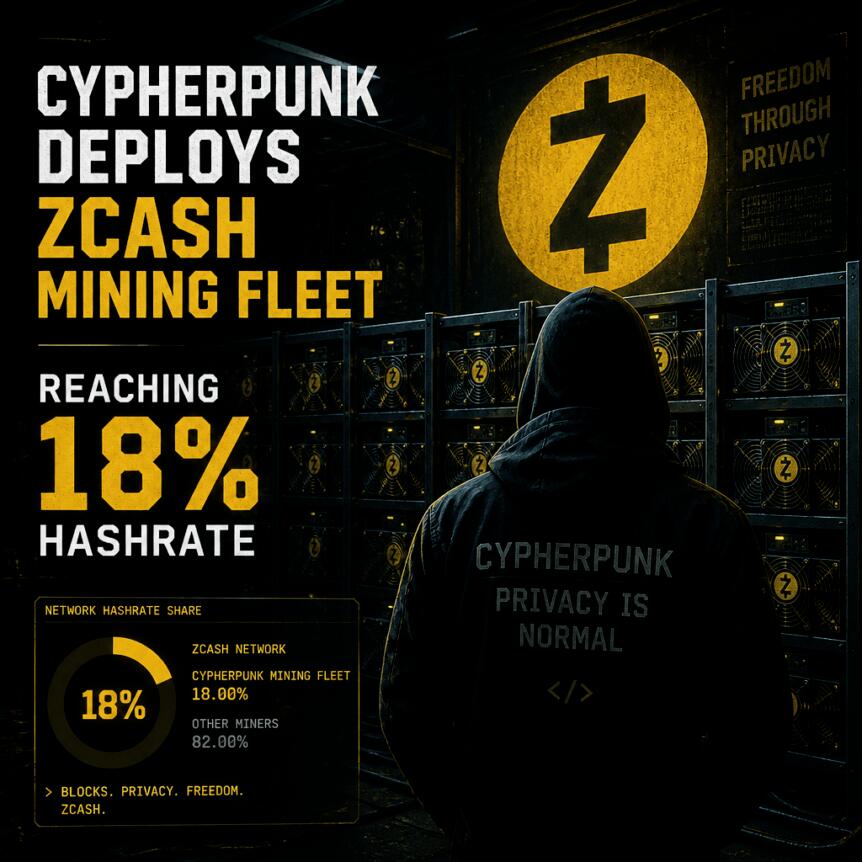
Cypherpunk Technologies has moved to scale its role in Zcash’s proof-of-work ecosystem by acquiring a mining fleet previously associated with Winklevoss Capital. The company says the purchase is now live across multiple locations in the United States and positions Cypherpunk as one of the largest public-sector participants in Zcash mining.
The deal, announced Tuesday, is structured as an equity-based transaction valued at $33.33 million. Cypherpunk reports that the acquired operation is already online and producing about 4.2 GSol/s—roughly 18% of Zcash’s current hashrate, based on the company’s figures.
Key takeaways
- Cypherpunk says it acquired a Zcash mining fleet via a $33.33 million equity transaction, with operations already running in the US.
- The reported 4.2 GSol/s output would make the company responsible for around 18% of Zcash’s current hashrate, if those numbers hold.
- The acquisition expands Cypherpunk’s existing Zcash holdings of 323,394 ZEC, about 1.9% of circulating supply, according to the company.
- Cypherpunk’s stated long-term goal is to reach 5% of ZEC supply held by the company.
- The move comes after renewed market attention to privacy-focused assets later in 2025, following a sharp ZEC price run.
Scaling a privacy-network mining footprint
Cypherpunk’s announcement frames the fleet acquisition as both an expansion of its mining operations and a way to deepen exposure to Zcash beyond spot holdings. In addition to bringing additional hashpower online, the company says it is adding to an existing inventory of ZEC it already holds—323,394 ZEC, or about 1.9% of circulating supply.
Cypherpunk also reiterated a longer-term accumulation target: eventually holding 5% of the ZEC supply. While the company’s filings or policy around the feasibility of that goal were not detailed in the provided text, the stated target alone is significant because it suggests a strategy that blends mining economics with balance-sheet accumulation.
Critically for investors and market observers, Cypherpunk’s claim that the purchased fleet contributes roughly 18% of the network’s hashrate points to concentration risk considerations that usually matter in proof-of-work systems. If a single publicly traded entity controls a large portion of mining power, the network’s block-production incentives and operational dependencies can become more complex—especially during periods of equipment downtime or changes in profitability.
Why Zcash mining economics may be shifting
Cypherpunk previously pitched Zcash mining as potentially more attractive than competing uses of capital—such as Bitcoin mining under prevailing conditions, or deployments driven by AI data center demand. However, the company’s own framing also acknowledges that mining profitability remains highly sensitive to several variables.
In the provided reporting, Cypherpunk links mining economics to ZEC’s price, network hashrate (and therefore mining difficulty), and operating costs. That matters because even if a mining company believes it has found superior economics compared with other sectors, its realized returns can still vary substantially with network conditions and market volatility.
The timing of the acquisition may be particularly relevant. Cypherpunk’s expansion follows a sharp rise in Zcash’s price during the second half of 2025. Renewed interest in privacy-focused cryptocurrencies was described as a catalyst, including attention after a hedge fund revealed a significant ZEC position—an event that earlier coverage from Cointelegraph noted helped pull the asset higher.
As privacy-preserving technologies regain mainstream attention after stretches of relative market quiet, mining capacity often follows demand signals—either through new capital entering the ecosystem or through incumbent operators scaling up when profitability improves. Yet the same lesson applies in reverse: if ZEC prices fade or difficulty rises faster than costs can be hedged, hashpower additions can become a headwind rather than a tailwind.
Network security: Ironwood update and the Orchard vulnerability
Cypherpunk’s scaling effort lands amid ongoing technical changes in Zcash’s privacy layer. The network underwent its Ironwood upgrade on July 28, introducing a new shielded transaction protocol designed to replace the Orchard pool and improve security architecture.
The upgrade was prompted by a flaw discovered in Orchard. The concern, as summarized in the provided text, was that under certain conditions an attacker could potentially create counterfeit ZEC inside the shielded pool without immediate detection. Even though there was no evidence the vulnerability had been exploited, the possibility underscored a persistent challenge for privacy networks: maintaining confidentiality while also ensuring robust supply integrity and verification.
From an investor’s perspective, these protocol updates matter even if day-to-day mining operations don’t change overnight. Ironwood’s improvements can affect how shielded transactions are processed and monitored, and they can influence confidence in the long-term soundness of privacy-preserving mechanisms—confidence that, in turn, can influence adoption narratives and liquidity for the underlying asset.
At the same time, the Ironwood upgrade illustrates that privacy-focused systems may carry distinct engineering risk profiles compared with more transparent networks. Zcash’s response—moving to a new protocol and addressing Orchard-related risks—signals ongoing iteration rather than a “set and forget” approach.
What to watch next for Cypherpunk and Zcash
Cypherpunk’s fleet acquisition raises immediate questions around how much hashrate its operation sustains over time and how its ZEC accumulation strategy develops relative to its liquidity and operational costs—especially given the sensitivity of mining economics to ZEC price and network difficulty. For the Zcash network, the key variable remains whether Ironwood’s security goals strengthen confidence in shielded supply integrity as privacy usage evolves.

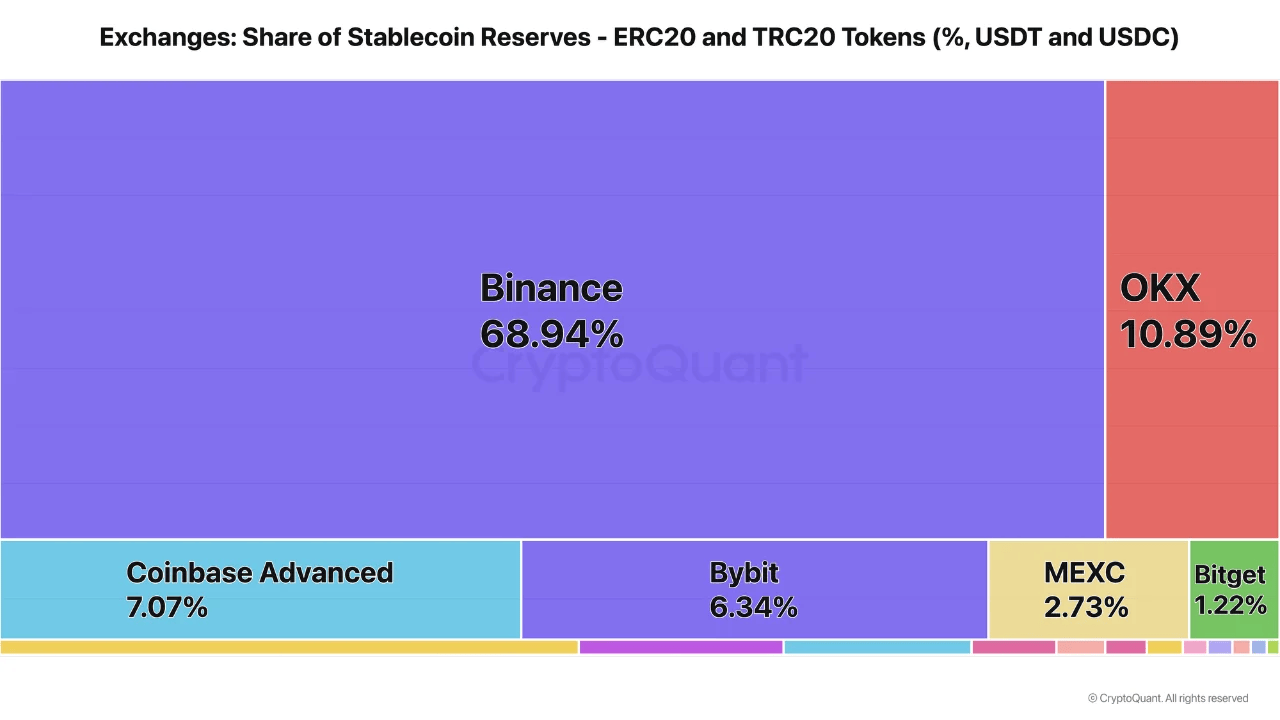
Stablecoin reserves parked on centralized exchanges have shrunk to roughly $64 billion, down about $16 billion from a late-2025 peak near $80 billion, CryptoQuant data shows.
The drain leaves less idle capital sitting ready to buy. What remains has pooled into fewer venues, with Binance alone accounting for 68.5% of exchange stablecoin liquidity.
Binance Absorbs a Shrinking Liquidity Pool
CQ Research said that Binance has “proven considerably more resilient” compared to other major exchanges. Balances at Coinbase, Bybit, OKX, and smaller venues contracted more sharply.
That divergence lifted Binance’s share from the low-60% range in late 2025 to 68.5% today. The exchange is winning a larger slice of a smaller pie.
“The divergence has allowed Binance to gain market share even while its own absolute liquidity declines, illustrating that the current downturn is simultaneously reducing aggregate liquidity and concentrating what remains,” the report read.

CryptoQuant flagged the same trend in February. Binance then held 65% of tracked reserves, worth $47.5 billion in stablecoins.
Concentration follows order books. Binance captured 38.7% of centralized exchange spot volume in the second quarter, according to CoinGecko. Bybit placed second near 10%.
Follow us on X to get the latest news as it happens
Fear Language Spreads Even as Sentiment Lifts Off Its Low
The liquidity drain coincides with deteriorating retail sentiment. Blockchain analytics firm Santiment reported last week that bearish vocabulary is spreading across social platforms.
“Crypto ‘dead’ chatter is rising again… This is fear language. It usually appears when retail patience is breaking, prices feel stuck, and traders start treating temporary weakness like permanent failure,” the firm said.
Santiment noted that crypto markets often make their sharpest moves when investors become overly convinced that further gains are unlikely.
“When ‘crypto is dead’ talk rises while Bitcoin holds key levels, stronger hands keep accumulating, and forced sellers fade, the setup often becomes more attractive for patient buyers,” it added.
The Crypto Fear and Greed Index tells a more mixed story. The gauge read 46 on Wednesday, still inside fear territory but well off last week’s low. Alternative.me put the index at 27 a week ago and 29 a month ago. It closed Tuesday at 41.
What a Shrinking Supply Means For Markets
Stablecoins serve as the primary quote currency across crypto trading pairs. Their aggregate supply is the market’s most readily available source of on-chain buying power. When they fall, fewer dollars sit ready to absorb selling pressure or fund the next leg higher.
Total supply has fallen to $300.89 billion from a high of nearly $316 billion in May, according to DefiLlama data. USDT sits at $182.95 billion and USDC at $71.97 billion.
That 4.8% market-wide decline is far shallower than the 20% drain from exchanges. The gap suggests that much of the liquidity leaving exchanges may be moving elsewhere on-chain rather than exiting the crypto market altogether.
Moreover, historical extremes have not been reached. Stablecoin supply fell 34% between April 2022 and August 2023 in a prolonged, grinding contraction, while Bitcoin’s (BTC) price dropped 43% over the same period.
The current decline is considerably milder. If the decline continues and approaches those historical extremes, it could signal a more significant deterioration in crypto’s available buying power and add pressure on Bitcoin and the broader market.
For now, however, the relatively modest contraction suggests the market has not yet entered a liquidity drain comparable to the 2022–2023 period. The key indicator to watch is whether stablecoin supply stabilizes or resumes its deeper decline, particularly if exchange balances continue to fall.
Subscribe to our YouTube channel to watch leaders and journalists provide expert insights
The post Exchange Stablecoin Reserves Drop 20% as Bear Market Drains Liquidity appeared first on BeInCrypto.
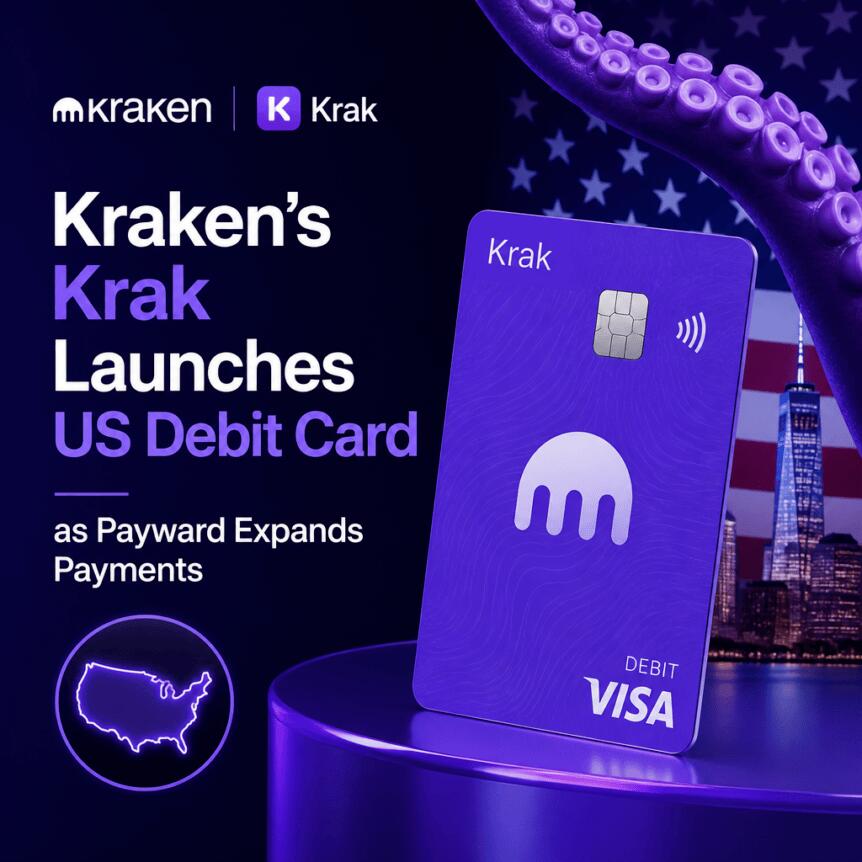
Kraken’s consumer app Krak has rolled out a multi-asset debit card in the United States, giving customers a way to pay with crypto and fiat while earning cashback denominated in either US dollars or Bitcoin (BTC). The launch adds to a broader push by crypto exchanges to move beyond trading and into everyday financial services.
According to Krak’s announcement, the card supports more than 600 currencies and assets. At the point of sale, users’ holdings are converted into US dollars, and a single purchase can draw from multiple balances depending on the spending order the customer sets.
Key takeaways
- Krak’s US debit card lets users spend from a wallet containing both crypto and fiat, with point-of-sale conversion into USD for purchases.
- Cashback can be earned in dollars or Bitcoin, with rates tied to average assets held across Krak, Kraken, and Kraken Pro.
- The card is issued by Lead Bank on Visa’s network and uses Stripe Issuing for program infrastructure, with physical and virtual options available to eligible customers.
- Krak positions the card as a rewards alternative to credit cards, aiming to appeal to customers wary of carrying monthly balances.
- Kraken and its parent Payward continue expanding into financial services beyond crypto trading, including payments and broader market products.
A multi-asset card designed for everyday spending
The Krak debit card is built around a simple promise: users can spend using a range of crypto and fiat holdings without having to manually select which asset to use for each transaction. Instead, the app allows cardholders to configure an asset-spend order, and the card will then pull from multiple balances as needed for a purchase.
Cashback is described as a key part of the value proposition. Krak said customers can receive up to 2% cashback, with the payout available in either US dollars or BTC. The company also noted that the specific cashback rate is dependent on the average assets held across Krak, Kraken, and Kraken Pro—meaning rewards are designed to scale with longer-term engagement rather than a one-off balance.
For US cardholders, the program includes both physical and virtual cards, with issuance routed through Visa’s network via Lead Bank. Krak said the rollout is powered by Stripe Issuing, an arrangement that signals how payment infrastructure is being leveraged to bring crypto-linked benefits into mainstream checkout flows.
Why Krak is leaning on “no-debt” rewards
Krak is framing the card as a counterweight to credit-card rewards programs. To support that positioning, the company commissioned a Morning Consult survey of 2,001 US adults.
The survey found that 42% of credit card holders worry about paying off their monthly balance. It also reported that 60% of respondents said they would switch to a debit card offering rewards without taking on debt.
In practical terms, that message targets a common friction point for rewards programs: the possibility that benefits come with a cost if consumers carry balances. By centering the product around debit spending—rather than credit limits—Krak is attempting to fit crypto rewards into behavior patterns that resemble traditional consumer debit programs, while still offering exposure to digital assets through BTC-denominated cashback.
From payments to broader financial services
Kraken’s consumer card launch lands within a wider strategy for Payward, the company behind Kraken and its apps. Co-CEO Arjun Sethi discussed broader expansion during remarks Tuesday at the Wyoming Blockchain Symposium, according to coverage of his comments.
Sethi said that expanding into multiple asset classes can reduce exposure to any single market. He also described tokenization as “a large part” of Payward’s effort to widen its financial offerings, and he argued the company must build products and services that are “not too different to a JP Morgan or a financial institution.”
The framing highlights the direction many major exchanges have taken in recent years: using regulated infrastructure and institutional know-how to develop more than trading platforms. When exchanges move into banking-related services and asset tokenization themes, the emphasis often shifts from pure price speculation to product distribution—placing crypto-linked capabilities closer to how consumers already spend, invest, or move money.
Kraken’s card rollout also aligns with a broader industry pattern. Coinbase and other large platforms have been expanding into additional product categories beyond spot trading, including areas such as equities, derivatives, prediction markets, tokenized assets, and pre-IPO products.
Kraken’s US expansion doesn’t stop at payments
In parallel with the debit card announcement, Kraken said it launched stock trading for customers in the European Economic Area (EEA) for more than 7,000 US-listed stocks. The company’s decision to widen trading access to traditional markets underscores that its consumer growth strategy is not limited to payments.
Taken together, the card and the stock expansion show how crypto platforms are working to broaden their customer base and deepen engagement. A debit card can drive day-to-day usage, while expanded market offerings can capture users looking to trade across asset classes within a single ecosystem.
For investors and users, the key question is how these product lines will reinforce each other over time. Cashback incentives tied to average holdings across apps could encourage users to maintain balances within the Kraken ecosystem, potentially improving retention. At the same time, regulators and payment networks will remain central to whether these offerings can scale smoothly and sustainably.
Looking ahead, readers should watch how Krak’s cashback terms perform in practice—especially how average-holding calculations are applied—and whether Kraken continues to add card-linked features or expand into more mainstream financial services categories beyond crypto payments.


A Hyperliquid perp priced Unitree far above its IPO valuation before Shanghai trading began, but the robot maker’s first public trade still opened roughly 75% above crypto traders’ implied price.


Unitree Robotics stock opened 629% above its IPO price in Shanghai on Wednesday, overshooting the valuation crypto derivatives traders had priced into pre-IPO perpetual futures.
The Hangzhou company raised about 6.1 billion yuan, or $905 million. Its stock opened at 1,100 yuan against an offer price of 150.8 yuan, then pared gains to 968.1 yuan.
Pre-IPO Perps Called the Unitree Stock Pop and Still Undershot It
Perpetual futures tracking Unitree changed hands near $100 on Hyperliquid on Tuesday. That level implied a valuation of $40.5 billion, according to Bloomberg.
The offering itself valued the robot maker at nearly $9 billion. Perp pricing, therefore, signaled a first-day gain of roughly 347%. The open delivered 629%.
Perpetual futures for CXMT, the Chinese memory-chip maker, also pointed to a sharp rally before its debut last month.
IPO-linked perps have attracted growing attention this year, particularly for highly anticipated listings. Contracts tracking SpaceX, for example, drew significant trading interest ahead of its June IPO.
Most equity-linked perpetuals give traders exposure to US companies. CXMT and Unitree mark a notable expansion of that market, offering exposure to companies listed on the mainland China market.
Follow us on X to get the latest news as it happens
DeepSeek Money Meets a 50,000 Robot Forecast
Unitree’s IPO drew strong demand from both retail and institutional investors. Last week, the Chinese robotics maker said its offering was more than 8,000 times oversubscribed among retail investors.
The company’s existing backers include Chinese technology giant Tencent. DeepSeek, the Chinese artificial intelligence (AI) company, has also invested about 140.8 million yuan ($19.6 million) in Unitree.
The firm also unveiled its latest humanoid robot, Superman, on Monday ahead of the IPO. The company says the robot can perform a standing jump of more than 2 meters and reach a top running speed of 12.66 meters per second.
The strong investor interest comes as expectations for China’s humanoid robotics industry continue to rise. In June, Morgan Stanley nearly doubled its 2026 forecast for Chinese humanoid shipments to 50,000 units, up from 28,000. The bank expects the market to grow from $2 billion this year to $15 billion by 2030.
Subscribe to our YouTube channel to watch leaders and journalists provide expert insights
The post Unitree Stock Opens 629% Higher After Crypto Traders Underpriced Its Debut appeared first on BeInCrypto.
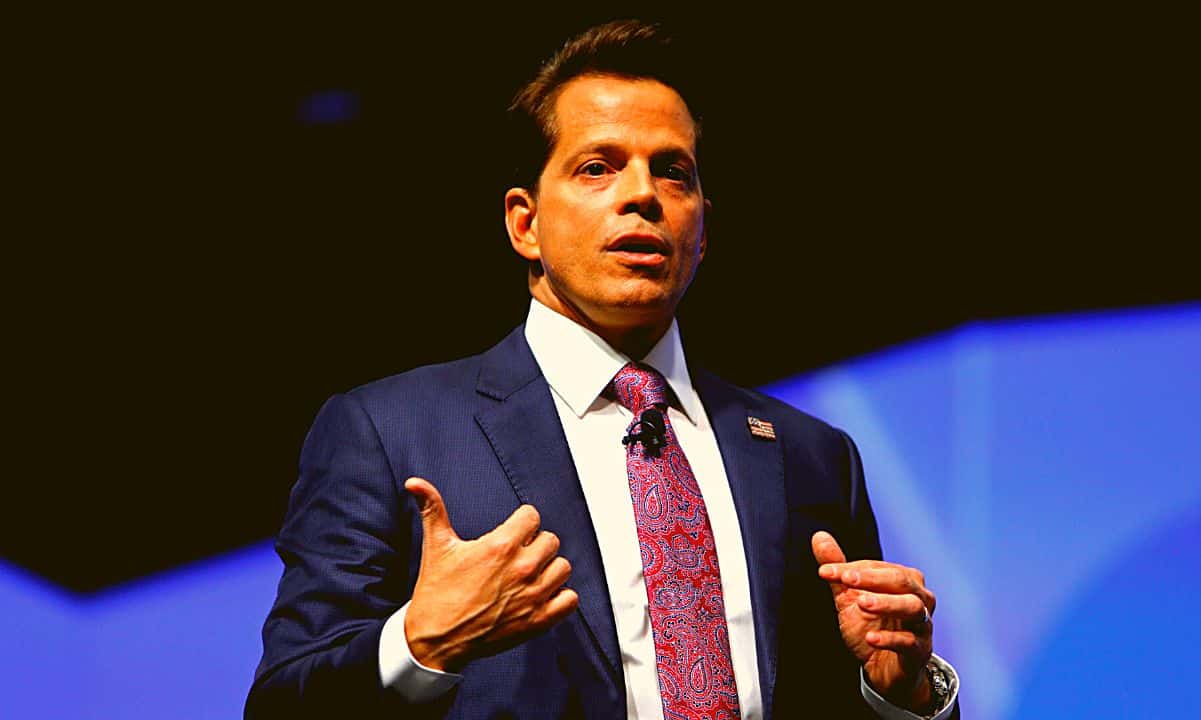
SkyBridge Capital founder and managing partner Anthony Scaramucci told CNBC’s Squawk Box on Tuesday that Bitcoin (BTC) will climb back over $100,000 as the halving cycle tightens prices, a level the asset has not closed above since November 13, 2025.
“I think as the halving cycle comes in again, it will tighten prices and you’ll see a move back up over $100k,” says @Scaramucci of $BTC. https://t.co/x8GF2oK0uh pic.twitter.com/lVSyypTzEN
— Squawk Box (@SquawkCNBC) August 18, 2026
Bitcoin briefly hit $65,000 on Tuesday, according to CoinGecko. The next halving falls at block 1,050,000, which countdown trackers place around April 2028, and the network stood at block 963,063 on Tuesday.
Halvings arrive every 210,000 blocks, and the block subsidy will drop to 1.5625 BTC from 3.125 BTC.
Prior Call Targeted $170,000
Coin Metrics puts Bitcoin at $64,908 on April 20, 2024, the day of the last halving. The cycle that followed peaked at over $126,000 on October 6, 2025. The asset last closed at or above six figures on November 13, 2025, at $100,035, then fell to $86,505 by December 1, $76,911 on February 1, and $65,734 on March 1. Its 2026 low was at under $58,000 on July 1.
Scaramucci made a similar argument before the last halving in early 2024, expecting Bitcoin to reach $170,000 after the April halving, based on a pattern he described as multiplying the halving-day price by four roughly 18 months later. BTC traded near $43,000 when he made that call.
The four-year pattern is itself disputed now, as even analysts, including Scott Melker and Arthur Hayes, are questioning whether the cycle still holds, with Melker noting Bitcoin ran 1,080 days from its last major low against a historical peak window of 1,060 to 1,070 days, and PlanB placing a possible top anywhere between 2026 and 2028.
Clarity Act Vote Set for September
Some of the catalysts for the price surge, at least in the short term, could be the impact of the Clarity Act and the state of crypto among the topics covered across the eight-minute interview.
The Digital Asset Market Clarity Act, filed as H.R. 3633, is scheduled for a Senate cloture vote on September 15 at 2:15 PM ET.
CryptoPotato reported that Senate Majority Leader John Thune filed cloture shortly before the August recess after Democrats declined to back a procedural vote, and that the bill’s odds of becoming law this year have fallen, according to experts and prediction platforms.
The motion needs 60 votes, and senators will not be voting on the legislation itself that day.
The post Bitcoin Back Above $100K? Scaramucci Says the 2028 Halving Holds the Key appeared first on CryptoPotato.


Kalshi filed two product submissions with the Commodity Futures Trading Commission on Aug. 18, seeking permission to launch perpetual futures tied to a broad U.S. stock index and copper.
Summary
- Kalshi submitted two perpetual futures contracts for voluntary CFTC review and approval on August 18.
- US500 would track MerQube’s index of 500 companies listed and domiciled across the United States.
- COPPERPERP would reference Pyth’s XCU/USD feed and represent one thousand pounds for each full contract.
- Neither product is approved, and Kalshi says listing would occur only after Commission authorization arrives.
- CME’s pending lawsuit argues perpetual contracts are swaps rather than futures under federal derivatives law.
The exchange submitted both products through the voluntary approval process under CFTC Regulation 40.3. Kalshi said it plans to list the contracts shortly after approval, meaning neither product can begin trading based on the filings alone.
The applications extend Kalshi’s perpetual futures expansion beyond digital assets. They also arrive while CME Group challenges the CFTC’s authority to classify no expiry contracts as futures rather than swaps.
Kalshi’s US500 contract would track large companies
The proposed US500 contract would follow the MerQube US Large Cap Index. The index covers 500 of the largest companies listed and domiciled in the United States, weighted by their publicly available market capitalization.
Kalshi’s filing describes the contract as cash settled with no fixed expiration or delivery date. A periodic funding payment between long and short positions would seek to keep its price aligned with the reference index.
One full contract would have a notional value equal to the index level multiplied by $1. A one point index change would therefore change the value of a full contract by $1.
Kalshi proposed a $25 million position accountability level based on mark to market value. It also said it could impose price bands, order limits and position controls to manage erroneous trades, concentration and market disruption.
Kalshi argues that the product falls under the CFTC’s exclusive jurisdiction because it references a broad securities index. Single stock and narrow index futures generally involve joint SEC and CFTC oversight.
Copper perpetual would use a Pyth price feed
The proposed COPPERPERP contract would track copper’s spot price in U.S. dollars per pound through Pyth Network’s XCU/USD price feed.
Each full contract would represent 1,000 pounds of copper. The minimum trade would be one thousandth of a contract, while a $0.0005 movement per pound would equal a $0.50 change in a full contract’s value.
Kalshi’s second submission proposes continuous trading from 6 p.m. ET on Sunday through 5 p.m. ET on Friday. The contract would remain open during weekday maintenance periods but close over weekends.
The proposal sets a $5 million position accountability level and a maximum position of 25,000 contracts. Kalshi linked the limit to federal rules covering the COMEX copper contract.
If Pyth marks the underlying market as closed or its feed becomes stale, the index would use the last eligible published price. Kalshi said price bands and other risk controls could apply when the reference market is unavailable.
CFTC review does not guarantee approval
The CFTC approved Kalshi’s Bitcoin perpetual futures contract in May. Its accompanying policy said products referencing other asset classes should receive case by case review because their market structures can differ.
The copper and index products raise questions that were less central to the Bitcoin decision. Copper has established physical and futures markets with fixed trading schedules, while the equity index depends on underlying securities that do not trade continuously.
The regulator could approve the contracts, request changes or reject them if it finds they violate the Commodity Exchange Act or CFTC regulations. The public filings do not provide a launch date or a deadline for the Commission’s decision.
Kalshi has already expanded its regulated digital asset offering. As crypto.news reported, its XRP perpetual rollout followed earlier Bitcoin and Ether contracts.
CME lawsuit could shape Kalshi’s expansion
CME sued the CFTC in June, arguing that perpetual contracts meet the legal definition of swaps under the Dodd Frank Act. The exchange wants a federal court to void the regulator’s May approval of Kalshi’s Bitcoin product and the wider perpetuals policy.
The CFTC disputes that position and has called the lawsuit “frivolous.” The case remains unresolved, and no court ruling has invalidated the existing approval route.
Crypto.news examined the central issue in its coverage of the legal fight over perpetual classification. A ruling that perpetuals are swaps could require different trading, clearing, margin and reporting arrangements.
CME replaced its original law firm in July because of what the departing firm described as positional conflicts with other clients, Reuters reported. The change did not end the case.
The CFTC’s decisions on US500 and COPPERPERP will show whether the agency is prepared to extend its perpetual futures framework from crypto into traditional equity and commodity markets while that legal challenge continues.


Hyperliquid Policy Center and trade[XYZ] asked the U.S. Securities and Exchange Commission on Aug. 18 to create a regulatory framework for pre IPO perpetual contracts.
Summary
- Hyperliquid Policy Center and trade[XYZ] submitted five proposed regulatory pillars for pre IPO perpetual contracts.
- IPOP holders receive price exposure without shares, voting rights, allocation rights, or issuer claims whatsoever.
- Five completed trade[XYZ] markets preceded listings by between one and twenty five calendar days only.
- SEC has posted the letter publicly but has not endorsed or approved the proposed products.
- CFTC policy says equity perpetuals would benefit from coordinated review by both federal regulators together.
The SEC added the joint submission to its public IPO modernization docket. Posting the letter confirms its receipt but does not mean the agency supports its recommendations or has approved the products.
The groups call the proposed instrument an IPOP. It would provide cash settled price exposure to a company approaching a public listing without conveying shares, voting rights, IPO allocations or claims against the issuer.
Hyperliquid proposal seeks five regulatory pillars
The 15 page letter asks the SEC and Commodity Futures Trading Commission to determine whether equity linked perpetuals are security futures or security based swaps. The classification would decide which registration, trading venue, clearing and margin requirements apply.
The groups also proposed rules covering product disclosures, listing eligibility, investor access and market integrity. They recommended disclosures addressing funding rates, leverage, liquidations, pricing methods, settlement and contract conversion rather than treating holders as equity owners.
Listing rules could limit an IPOP to a defined period after a company publicly files registration documents. Oracle and settlement procedures would be announced in advance, while changes would need disclosure.
Market integrity provisions could include audit trails, conflict controls and restrictions on deployers or affiliates trading while holding material nonpublic information. A phased rollout could also impose leverage and position limits before expanding access to retail investors.
Five markets underpin the price discovery argument
Trade[XYZ] told the SEC it had completed five IPOP markets tied to Cerebras, Quantinuum, SpaceX, SK Hynix and ChangXin Memory Technologies. The products operated for between one and 25 days before the referenced listings.
According to the applicants’ data, each contract’s final price before trading began was within 0.44% to 7.23% of the relevant stock’s opening price. Four U.S. offerings priced between 10.8% and 38.4% below the IPOP level recorded one day earlier.
Those figures support the groups’ claim that continuously traded derivatives “could” provide issuers and underwriters with an independent measure of demand. They do not establish how the products would perform across a larger or less active group of listings.
The SEC has not independently endorsed those performance claims. A five market sample is also too limited to establish that similar contracts would consistently improve IPO pricing.
As previously reported, the SpaceX product exposed a regulatory gray zone around private markets. SpaceX had not authorized the contract and received no proceeds from its trading.
Oracle risk remains central to investor protection
Pre IPO perpetuals depend on pricing and settlement rules designed by market deployers. Unlike listed stocks, private companies may lack a continuous, authoritative market price before their public debut.
Trade[XYZ] experienced a related problem after one unusually low SK Hynix share transaction entered its oracle inputs. As crypto.news reported, the SK Hynix pricing anomaly pushed the perpetual’s mark price down about 18% and triggered liquidations.
Trade[XYZ] later agreed to cover eligible losses as a discretionary measure. The company said its oracle followed its published design, although the external transaction involved only one share in a thin trading session.
The episode supports the letter’s call for disclosed oracle rules and market controls. It also shows why an accurate technical process may still produce a price that does not represent a deep or durable market.
SEC and CFTC must settle product classification
Trade[XYZ] currently operates these markets offshore and excludes U.S. persons. No approved U.S. pre IPO perpetual framework presently gives American retail traders access to the products described in the letter.
The CFTC’s May 29 policy established case by case review for perpetual contracts outside the Bitcoin product it approved for KalshiEX. The related policy text said equity based perpetuals would benefit from coordinated SEC and CFTC review.
The agencies have separately asked whether a cash settled perpetual referencing an equity security could qualify as a security future. Their eventual answer would determine whether current security futures rules can accommodate an instrument tied to a company whose shares have not yet started trading.
No response deadline applies to the Hyperliquid submission, and the SEC does not have to adopt its recommendations. Further steps could include staff discussions, another request for comment, joint agency guidance or formal rulemaking.


A preliminary analysis says six chained bugs let a 23-message transaction drain 48.87 million CACAO, sending the token down nearly 89%.
Short seller James Chanos described Strategy and Bitcoin as an “$80 billion actionable spread” on Aug. 18, reviving debate over the valuation of Michael Saylor’s Bitcoin treasury company.
Summary
- Strategy held 840,447 bitcoin after recent sales, below the 847,363 coin peak disclosed in June.
- At $64,188 per Bitcoin, Strategy’s remaining holdings were worth approximately $53.95 billion on Tuesday morning.
- MSTR’s market capitalization was about $34.4 billion, but direct comparison ignores senior financing claims entirely.
- Chanos previously closed his short MSTR, long Bitcoin trade in November 2025 after spread compression.
- Strategy’s dashboard placed its mNAV near 1.04, indicating only a narrow enterprise value premium Tuesday.
Chanos called the relationship one of the largest “pure arbitrage opportunities” he had seen. His earlier trade involved shorting Strategy’s MSTR shares while taking a long position in Bitcoin.
The latest claim requires context. Strategy no longer holds the 847,363 BTC cited in some reports. Recent company disclosures place its balance at 840,447 BTC following several sales during July and August.
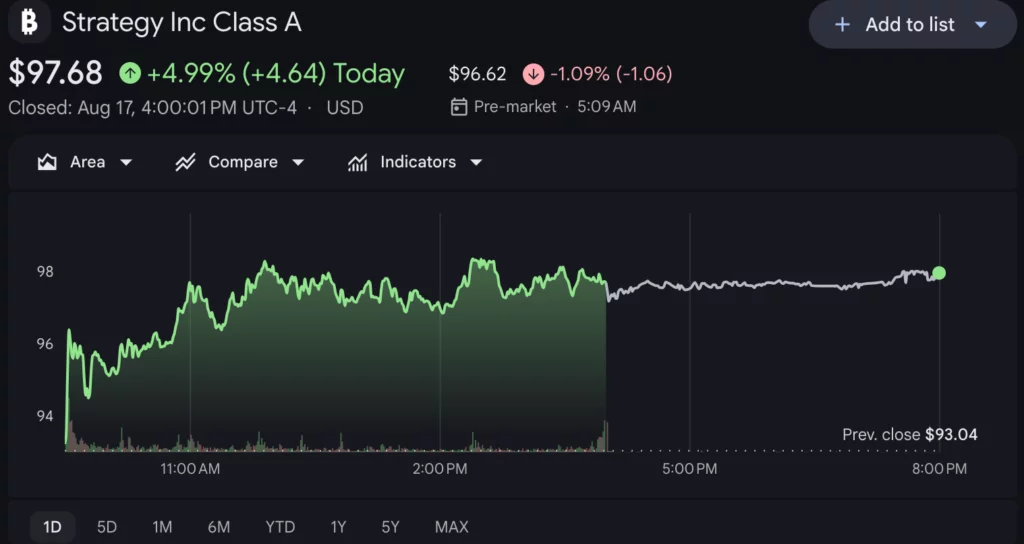
At Bitcoin’s Tuesday price of approximately $64,188, those holdings were worth about $53.95 billion. MSTR had a market capitalization of roughly $34.4 billion, while its shares gained close to 5% to $97.68.
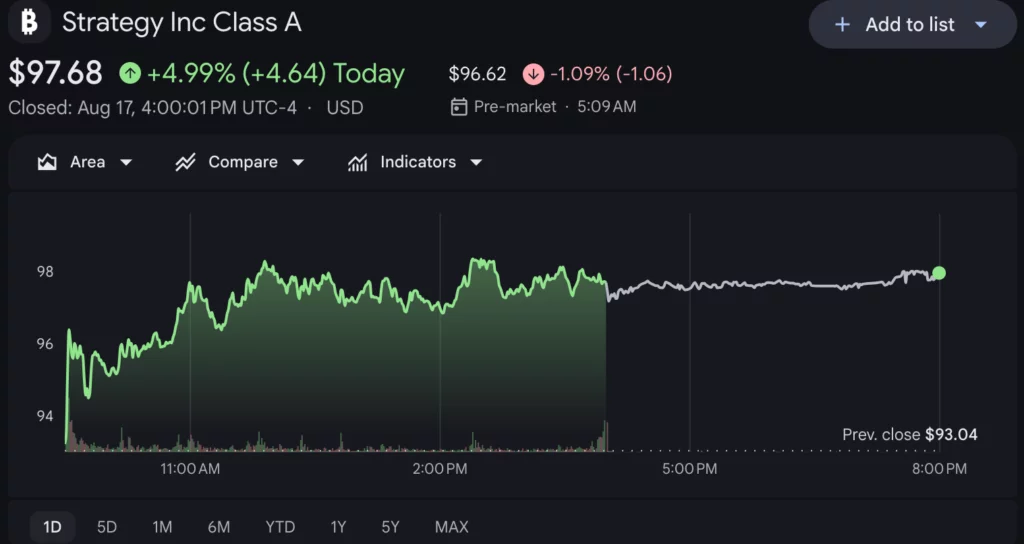
The $19.5 billion difference between those two figures is not a direct arbitrage profit. It excludes debt, preferred stock, cash, software operations, taxes and the costs required to maintain a hedged position.
Chanos’s $80 billion figure is not a simple market gap
Chanos did not publish a complete calculation showing how he reached the “$80 billion actionable spread.” The figure therefore remains his characterization of the opportunity rather than a directly verifiable difference between two market prices.
Strategy’s own dashboard placed its modified net asset value multiple, or mNAV, near 1.04 on Tuesday. That measure compares enterprise value with the value of its Bitcoin after accounting for parts of the capital structure.
An mNAV of 1.04 indicates a premium of approximately 4%, based on the company’s methodology. It does not show MSTR trading at the wide premium that supported Chanos’s original trade in 2025.
Comparing common equity market capitalization directly with Bitcoin holdings produces a discount because common shareholders rank behind creditors and preferred shareholders. Strategy has issued several preferred securities carrying dividend obligations and also has outstanding debt.
The company’s software operation, dollar reserve and other assets must also be included. As a result, buying MSTR does not provide the same economic exposure as holding an equivalent dollar amount of Bitcoin.
Strategy’s Bitcoin balance has declined from its peak
A June 29 SEC filing showed that Strategy held 847,363 BTC at the end of June. The company had spent $64.1 billion acquiring the coins at an average price of $75,651.
Strategy subsequently sold Bitcoin under a board authorized monetization program. The program allows sales to fund its dollar reserve, interest expenses, preferred dividends and security repurchases.
As previously reported, the company sold 1,690 BTC and used the proceeds for preferred share repurchases during the week ending Aug. 9.
Those sales reduced the balance to 840,447 BTC. The remaining tokens carried an aggregate acquisition cost of approximately $63.36 billion and an average cost of $75,385 per coin.
At Tuesday’s Bitcoin price, the position was approximately $9.4 billion below its disclosed purchase cost. That is an unrealized accounting difference rather than a realized loss unless the coins are sold.
The same filing series showed that the company raised cash by issuing additional MSTR shares. Common stock issuance increases liquidity but also expands the number of shares participating in the Bitcoin exposure.
MSTR and Bitcoin carry different financial risks
Direct Bitcoin ownership exposes an investor mainly to changes in Bitcoin’s market price and the security of their custody arrangement. MSTR adds corporate financing and management risks.
Strategy has issued STRC, STRF, STRD and STRK preferred shares. These securities sit ahead of common shareholders and carry dividend rates ranging from 8% to 12%, subject to their respective terms.
The company has also established a dollar reserve to meet preferred dividends and interest obligations. In related coverage, the reserve reached $4.65 billion after further common stock sales.
Strategy’s board authorized up to $1.25 billion of additional Bitcoin sales to help fund that reserve. It also approved separate $1 billion repurchase programs for preferred securities and MSTR common stock.
These layers prevent the trade from being risk free. A short seller must borrow MSTR shares, pay borrowing costs and manage the possibility that the stock rises faster than Bitcoin.
The long side also requires financing. If Bitcoin falls while MSTR rises because of short covering, new financing or changing investor demand, both parts of the trade can lose money temporarily.
Chanos previously exited after the premium contracted
Chanos began constructing his earlier position in late 2024, when MSTR traded at a large premium to the value of Strategy’s Bitcoin. The premium exceeded three times the Bitcoin value at points during November 2024.
He publicly described the trade in 2025 as long Bitcoin and short MSTR. Chanos argued that investors were paying too much for Bitcoin exposure available directly or through lower cost exchange traded products.
As Reuters reported, Strategy’s market value stood around 1.74 times its Bitcoin holdings when Chanos renewed his criticism in June 2025.
The gap later narrowed. Chanos said his firm closed the hedged position on Nov. 7, 2025, after the trade gained more than 50%. He described the remaining opportunity as too small to justify keeping the position open.
His latest statement does not confirm that he has reopened the trade. It also does not disclose position size, entry prices, borrowing costs or the instruments that would be used.
Future SEC filings will show whether Strategy continues selling Bitcoin, issuing MSTR shares or repurchasing preferred securities. Those decisions, together with Bitcoin’s price and changes in financing costs, will determine whether the company trades at a premium or discount to its adjusted asset value.


Investigators may have given U.S. authorities information capable of identifying an attacker responsible for the first Coldcard theft wave, Bitcoin Magazine reported on Aug. 18.
Summary
- Block traced the first Coldcard sweep to a paid blockchain data account used during theft.
- Galaxy said the first wave removed 1,082.65 BTC, with the associated funds remaining unmoved afterward.
- No FBI statement confirms an attacker’s identity, arrest, charges, seizure, or recovery of stolen funds.
- At least 1,700 BTC was stolen across multiple waves, according to Galaxy’s latest public estimate.
- Existing vulnerable seeds remain unsafe after firmware updates and require migration into newly generated wallets.
Galaxy Research’s Alex Thorn said the first wave attacker’s identity “may be known to law enforcement.” His statement was cautious, and the FBI has not publicly confirmed identifying a suspect, opening a case, making an arrest or recovering any stolen Bitcoin.
The first wave removed 1,082.65 BTC from wallets generated using vulnerable Coldcard firmware. At Bitcoin’s recent price near $64,000, those coins would be worth approximately $69 million, not $11.8 million.
Block found an offchain trail from the first sweep
Block engineering lead Clay Garrett said investigators found an unusual pattern in the attacker’s onchain sweeps. The operator allegedly used a paid account at an unnamed blockchain data provider to query source addresses and perform related activity.
Block contacted the provider, whose internal logs reportedly matched the number, timing and sequence of the suspected requests with “extraordinary specificity.” Garrett said Block passed relevant information to the appropriate authorities.
The account could contain payment, access or subscriber records. However, no public evidence establishes which records were retained, who controlled the account or whether the service received accurate identifying information.
Block also said it found no evidence that the provider knowingly assisted the theft. The company appeared to have supplied ordinary services without knowing how the information would be used.
FBI identification remains an unconfirmed possibility
Bitcoin Magazine’s report linked the investigative lead to the FBI, but no FBI statement confirms the claim. No criminal complaint, indictment, seizure filing or forfeiture action was located in the public record.
Thorn’s wording is therefore important. An identity that “may be known” is not the same as a verified suspect or charged defendant. Investigators must still establish who operated the account, who controlled the receiving addresses and whether the evidence supports criminal charges.
The first wave funds remain visible at associated addresses. As crypto.news previously reported, the largest attacker’s unmoved balance had not entered a known exchange or mixer.
Those coins are not frozen. Bitcoin transactions cannot be reversed or blocked at the protocol level. Recovery would require control of the private keys, voluntary return, or a later transfer through an intermediary able to comply with a lawful seizure order.
Coldcard losses extend beyond one attacker
Galaxy’s latest public research page lists losses of at least 1,700 BTC across multiple waves. Other totals remain higher because researchers use different address clusters, confirmation standards and victim reports.
Later theft waves displayed different transaction patterns. Researchers have therefore cautioned that more than one actor may have exploited the weak seed space after information about the flaw became public.
This distinction means identifying the first operator would not necessarily resolve every theft. Galaxy has distributed suspected addresses to investigators, exchanges and analytics companies, but no agency has announced a recovery.
In related coverage, crypto.news’ earlier technical review found that the incident involved weak seed generation rather than compromise of the Bitcoin protocol or physical access to devices.
Vulnerable users must still migrate their funds
Coinkite’s advisory says affected Mk2 and Mk3 firmware generated seeds with inadequate entropy beginning with version 4.0.1. Seeds created on certain Mk4, Mk5 and Q releases were also exposed, although their entropy reduction was less severe.
Fixed firmware prevents the same defect when generating new seeds. Installing an update does not repair an existing vulnerable seed. Users must update first, create a completely new seed and move their funds after verifying a test transaction.
Coinkite’s current status says its formal technical postmortem remains in progress. It also says targeted independent checks have occurred but do not establish that every fixed firmware binary received a complete audit.
The incident has prompted calls for independent hardware audits. The immediate questions now concern whether authorities can connect the paid account to a person, whether the first wave funds move, and whether court records eventually confirm an investigation.

Exchange Stablecoin Reserves Drop 20% as Bear Market Drains Liquidity

Ricky Gervais Reveals Plan To Finally Marry Partner Of 44 Years Just To Avoid Inheritance Tax On Joint Fortune: ‘It’s Mad’

York named as one of the best places to retire in England





-

 Fashion5 days ago
Weekend Open Thread: Ann Taylor
-
 Sports5 days ago
This U.S. Amateur is a glimpse into golf’s future in more ways than you think
-
 Tech5 days ago
11 Ways to Rank Your Videos
-
 NewsBeat4 days ago
Myanmar says over 300,000 Rohingya refugees verified for repatriation as exodus enters ninth year
-

 Sports4 days ago
Birmingham 2026: Day 6 Timetable for Irish Athletes
-

 Politics4 days ago
SEQ Code: The Three Letter Boarding Pass Code That Could Give You The Worst Seat
-
 Entertainment7 days ago
Keke Palmer Subtly Hints At Sean Evans Drama With Cryptic Post
-

 Sports6 days ago
DeQuan Jones in ‘high spirits’ after successful leg surgery
-

 Tech6 days ago
DeepSeek Harness launches as open source rival to Claude Code, alongside V4-Pro on API with higher prices
-
 Crypto World7 days ago
Perplexity AI Predicts an XRP Scenario Few Analysts Are Discussing
-

 Crypto World1 day ago
OCC Greenlights Trump Family Crypto Firm for Trust Charter
-

 Politics7 days ago
How Average Are You In The UK?
-
 Entertainment7 days ago
2026’s Most Ambitious Fantasy Movie Officially Scores Sequel Update
-
 Entertainment7 days ago
All 10 Hayao Miyazaki Fantasy Movies, Ranked
-

 Fashion7 days ago
Why Botanical Fashion Never Goes Out of Style
-
 Entertainment6 days ago
Travis Kelce Breaks Silence On ‘Crazy’ Taylor Swift Wedding
-

 NewsBeat7 days ago
‘Regret is a major theme of my work’: Matt Haig on finding acceptance
-
 Entertainment5 days ago
10 Netflix Shows That Quietly Became Modern Classics
-

 Fashion7 days ago
Wednesday’s Workwear Report: Stretch-Cotton Pleated-Waist Top
-

 Fashion6 days ago
The Details Do the Dressing
You must be logged in to post a comment Login