

Crypto World
DeepSnitch AI Presale Launch Date Set for March 31 as Orbital Bitcoin Mining News Fires Up the Compute Sector: RENDER and AKT Are Moving, But $DSNT Is the 2000% Moonshot


A company called Starcloud, backed by Nvidia, just told the world it is building data centers in space to mine Bitcoin using solar-powered ASICs orbiting Earth. The company already launched an Nvidia H100 into orbit in November 2025 and plans to scale across 88,000 satellites.
When institutional-grade infrastructure starts chasing Bitcoin from space, it tells every trader paying attention that the demand side of this market is not cooling down. The compute revolution is wider than most are pricing in right now, and the DeepSnitch AI presale launch date of March 31 is landing right in the middle of it.
With $2M raised, 41.4M coins already staked, and 5 live AI tools running today, the DeepSnitch AI token launch is one of the most anticipated exits from presale heading into Q2.
Shocking: Bitcoin mining is moving to space
Starcloud, backed by Nvidia, just confirmed it will be the first project to mine Bitcoin from literal orbit when its second spacecraft launches later this year, and the crypto market has not fully priced this in yet.
The company already sent an Nvidia H100 into orbit in November 2025. Its data center network spanning 88,000 solar-powered satellites is engineered to make every earth-based mining operation look expensive and inefficient by comparison.
When Nvidia-backed institutional capital is deploying orbital Bitcoin mining infrastructure at this scale, the entire compute and decentralized infrastructure narrative for this cycle just got a massive fundamental catalyst underneath it.
The on-chain demand signal for compute tokens is flashing, and the traders who load the right positions before this thesis goes mainstream are the ones sitting on the fattest bags when the crowd finally catches up and starts aping in.
DeepSnitch AI token launch is the low-cap presale event that 100x hunters have been waiting for all cycle
The DeepSnitch AI presale launch date is the most urgent timestamp in the current crypto cycle for traders who want ground-floor access to a working product. Every tool on the platform is live today. SnitchGPT answers your research questions in real time.
The smart contract scanner flags risky tokens before you ape in. The trend tracker surfaces momentum plays before they go viral. This is not a whitepaper project.
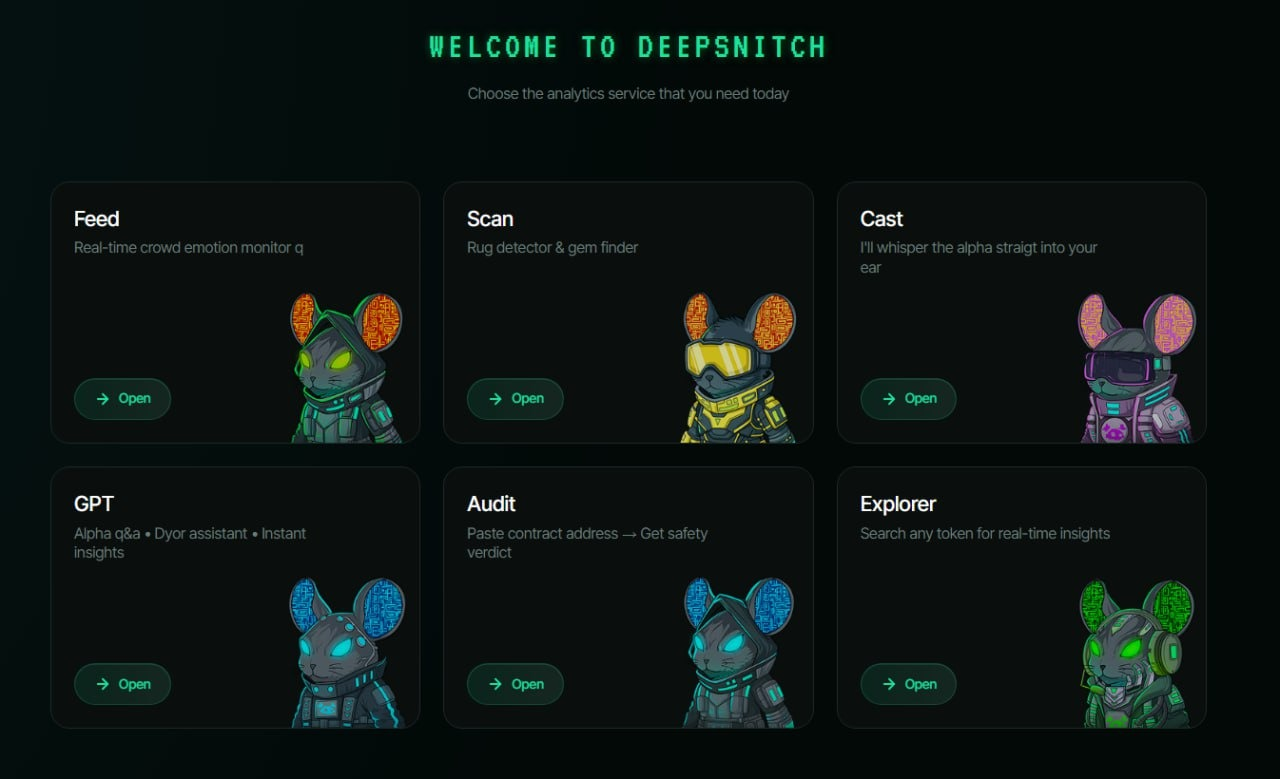
The DeepSnitch AI roadmap points to Uniswap listing first, followed by rumored tier-1 and tier-2 exchange listings in Q2. Each listing milestone is a fresh demand event for a token that presale buyers picked up at $0.04399.
The DeepSnitch AI presale date closes on March 31 with no extension guaranteed. Analysts projecting 100x to 500x post-listing gains are citing the same combination every time: live utility today, low entry price, and exchange listings still incoming.
The DeepSnitch AI token launch onto major exchanges is the catalyst that converts all that staked conviction into visible price action.
Traders who have been around long enough to watch low-cap tokens get listed know that the DeepSnitch AI presale launch date is the kind of entry window that closes once and never comes back at the same price.
The Deepsnitch AI roadmap is not a vague promise sitting behind a future delivery date that keeps shifting, it is a live platform with working tools that traders are opening every day and an exchange debut that is closing in fast enough to make waiting a genuinely expensive decision.
Akash Network (AKT) update for March 2026
Akash Network is essentially a decentralized alternative to AWS and Google Cloud, letting anyone with spare compute capacity lease it out to developers and AI builders in a permissionless marketplace.
The Burn-Mint Equilibrium model burns $0.85 of AKT for every dollar spent on compute, creating real deflationary pressure that tightens supply every single time the network gets used.
AKT is trading at $0.38 on March 9 with $11 million in 24-hour volume, confirming that serious money is already rotating into this narrative before the mainstream catches on
AKT hit an all-time high of $8.07, and analysts are now placing the 2026 target between $3 and $6. If the decentralized cloud narrative gets the tailwind, this cycle looks ready to deliver.
Render Network (RENDER) update for March 2026
With the Starcloud news spotlighting space-based compute demand, RENDER becomes an easy narrative trade.
The Dispersed AI subnet launched in December 2025 targets AI inference workloads specifically and already supports enterprise-grade Nvidia H100 and H200 hardware across 5,600 active GPU nodes globally.
RENDER hit an all-time high of $13.60 in March 2024 and is currently trading near $1.37 on March 9. Analysts place the 2026 range between $6 and $15 if the decentralized GPU narrative picks up with a broader market recovery.
But at a market cap already above $713 million, the parabolic entry that the DeepSnitch AI presale launch date still offers is simply not available here.
Final thoughts
RENDER and AKT are legit infrastructure holds that benefit from the space compute narrative in the news right now.
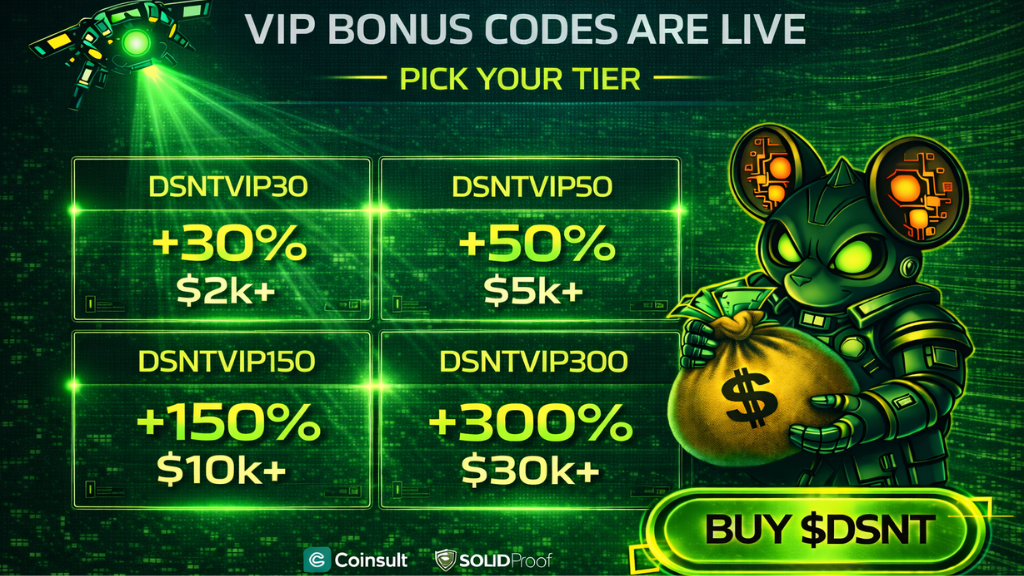
But neither of them can match the entry price or the projected upside that the DeepSnitch AI presale launch date still offers at $0.04399. The DeepSnitch AI roadmap is delivering working tools while every other presale is still writing docs.
The DeepSnitch AI token launch onto Uniswap and rumored tier-1 exchanges in Q2 is coming whether you hold $DSNT or not, and the traders are already locked in at $0.04399 with 100X to 300X post-listing projections.
The official presale website is live, and the presale window is closing fast, so get in now before the entry is gone for good. Join X and Telegram for real-time updates on the launch.
FAQs
What exactly is the DeepSnitch AI presale launch date, and why are traders treating it like a hard deadline?
The DeepSnitch AI presale launch date wraps on March 31 at $0.04399 per $DSNT. Once that window closes, the next price you see will be on Uniswap and then tier-1 exchanges. Presale pricing does not come back after listing day.
How does the DeepSnitch AI roadmap compare to what RENDER and AKT are building in the same compute space?
The DeepSnitch AI roadmap has 5 live tools already running for traders today. RENDER and AKT are building real decentralized infrastructure worth holding this cycle, but neither has a working AI surveillance toolkit that traders open every day, as $DSNT does right now.
Is the DeepSnitch AI token launch onto exchanges in Q2 the main catalyst traders should be watching?
Yes. The DeepSnitch AI token launch, hitting Uniswap first and then rumored tier-1 exchanges, is the price event most holders are positioned for. Low market cap plus fresh exchange listings is historically the setup that produces the biggest percentage moves in the shortest time. That is why the DeepSnitch AI presale launch date still has traders moving fast before March 31.
Disclaimer: This is a Press Release provided by a third party who is responsible for the content. Please conduct your own research before taking any action based on the content.



BitMEX co-founder Arthur Hayes, who has projected Bitcoin to hit $250,000 this year, says he’d rather wait-and-see than invest in Bitcoin at the moment, holding off until the US Federal Reserve loosens its monetary policy.
“If I had $1 to invest right now, would I be putting it into Bitcoin? No. I would wait,” Hayes said on the Coin Stories podcast published to YouTube on Tuesday.
“The longer this conflict goes on, the higher the likelihood that the Fed has to print money to support the American war machine,” he said. Hayes said he will start buying when the Fed begins easing monetary policy:
“That’s when I’m going to buy Bitcoin when the central banks start printing money.”
Hayes said that while some argue “war is good for Bitcoin,” the more accurate view is that “money printing is good for Bitcoin.”
Hayes added he was unsure whether Bitcoin had reached its price bottom. Bitcoin is trading at $69,926 at the time of publication, down 45% from its October all-time high of $126,000, but Hayes warned that ongoing geopolitical tensions could push the price lower.

“[With] the unfortunate war between US and Iran, I think that there is a situation where the longer that this carries on, there could be a massive sell-off in equities and Bitcoin,” he said.
Hayes predicted $250,000 Bitcoin for 2026
Hayes explained that this may lead Bitcoin to fall below $60,000 and that “could be sort of a big cascading of liquidations down.” Bitcoin briefly touched the $60,000 level on Feb. 6 before edging into a mild uptrend.
Hayes usually shares strong convictions about Bitcoin and had held onto his $250,000 year-end prediction as late as October last year.
Related: Bitcoin leads, altcoin indicators drop to intriguing lows: Time for an altseason?
Other analysts are more confident about what will happen in the short term. Michaël van de Poppe recently pointed out the benefits for Bitcoin on the back of a “strong surge” in the Nasdaq.
“There are not many arguments left for uncertainty, and in that principle, I do think we’ll see way more upside into Bitcoin & Altcoins during the coming period,” van de Poppe said.
Meanwhile, Hayes said he doesn’t anticipate there being many more years when Bitcoin will be “sub 100,000.”
Magazine: The debate over Bitcoin’s four-year cycle is over: Benjamin Cowen
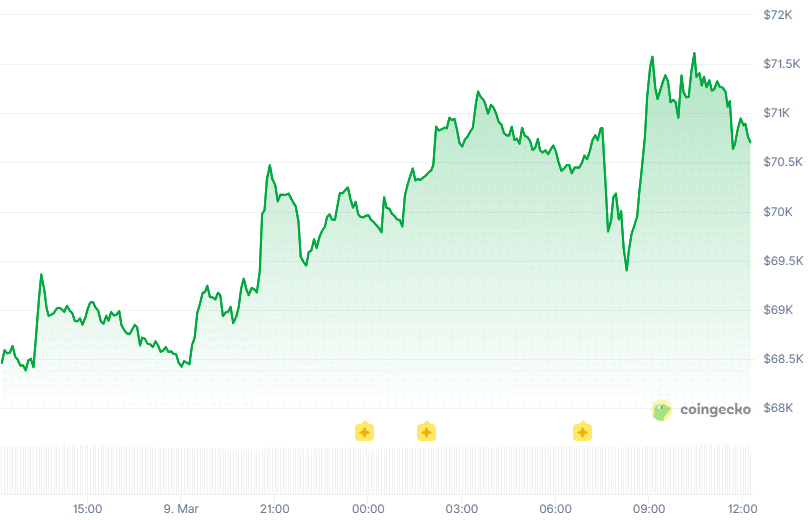
Total crypto capitalization is up another 3% to $2.49 trillion.
Crypto markets rallied for a second day as fears of an oil supply shock eased after the International Energy Agency (IEA) convened an emergency meeting to discuss the potential release of emergency reserves.
Bitcoin (BTC) is trading at around $70,700, up 3.5% over the past 24 hours. The world’s largest cryptocurrency reached as high as $71,800 earlier in the day. Meanwhile, ETH climbed 2.5% to $2,070, SOL gained 4% to $88, and XRP is up 3.6% on the day.

The overall crypto market capitalization climbed 3% to $2.49 trillion, according to Coingecko.
Crude oil (WTI) briefly fell below $80 per barrel but has since erased its losses to trade around $84. The S&P 500 and the Nasdaq posted minor gains while gold and silver were mostly unchanged.
Almost all of the Top 100 digital assets posted gains over the last 24 hours.
Today’s top gainers are RENDER, which rallied 10%, followed by Bittensor (TAO) and SKY, which climbed 7%.
Memecore (M) and Midnight (NIGHT) are the biggest losers
Around 96,000 leveraged traders were liquidated for $377 million in the past 24 hours, according to CoinGlass. Bitcoin accounted for $138 million, while ETH positions made up $73 million.
Bitcoin exchange-traded funds (ETFs) recorded inflows of $167 million on Friday, according to SoSoValue, snapping a two-day losing streak.


The crypto market is showing early signs of stabilization after months of heavy selling, though the outlook remains uncertain.
Summary
- Crypto market losses are easing as Bitcoin realized losses narrow from February capitulation levels.
- Short-term holders now control about 22% of BTC supply, indicating active participation.
- Macro pressures and liquidity conditions may keep Bitcoin trading volatile in the near term.
With daily trading volume of about $121 billion, the global crypto market capitalization is close to $2.51 trillion, up roughly 2.5% over the previous day. Bitcoin (BTC) holds roughly 57% of the market, while Ethereum (ETH) accounts for about 10%.
Investor sentiment remains weak. The Crypto Fear & Greed Index has stayed in extreme fear, with readings between 14 and 19 in early March. Such levels often appear when markets are under pressure but can also precede sharp swings.
Bitcoin has just climbed above $71,000, helping push the market slightly higher. Some altcoins moved strongly as well. Flow posted gains of more than 36%. Even with the rebound, Bitcoin still trades about 42% below its all-time high.
Market losses begin to ease
A March 10 report from CryptoQuant analyst Darkfost shows that realized losses in the Bitcoin market are starting to slow after a period of capitulation.
Recent data shows $611 million in realized losses compared with $346 million in realized profit, leaving the market with a net weekly loss of about $264 million. Losses still dominate trading, but the gap has narrowed.
The situation looked very different a month ago. On Feb. 7, weekly losses were close to $2 billion as Bitcoin briefly fell below $60,000.
Short-term holders remain the most active participants. Their share of the Bitcoin supply has grown to about 22%, compared with 12% in early 2023. That increase suggests newer investors are still entering the market despite recent volatility.
Some signs of consolidation are also appearing. Analysts say investors have started holding or accumulating again as prices stabilize.
On Binance futures markets, Bitcoin trading volume has also moved ahead of altcoin volume. Similar shifts in the past often appeared near broader market bottoms.
Macro pressure still clouds outlook
The short-term outlook remains mixed. Liquidity in global markets is tightening, the U.S. dollar has strengthened, and bond yields are rising. These factors often weigh on risk assets, including crypto.
Because of that, Bitcoin may continue trading in a $60,000 to $70,000 range for now. Following the recent surge, short-term indicators have also moved higher, which may encourage profit-taking.
Future economic data could increase volatility. CPI reports and other inflation statistics may have an impact on interest rate expectations.
Despite the decline, some investors continue to see value. Pantera Capital’s Dan Morehead recently pointed out that cryptocurrency prices are significantly below long-term trend levels.
Other institutions share cautious optimism. Coinbase Institutional has pointed to improving regulation and deeper financial integration as supportive factors, while analysts at Bybit say options markets still price a small chance of Bitcoin reaching $150,000 this year.
For now, the market appears to be moving away from the most intense phase of selling. Whether the recovery continues will depend on Bitcoin’s ability to hold momentum in the weeks ahead.


The foundation behind Solana liquid staking protocol Jito acquired SolanaFloor just two weeks after the media outlet announced it was shutting down.
The Jito Foundation has acquired SolanaFloor, a media outlet focused on the Solana ecosystem.
SolanaFloor reported the acquisition and that it’s resuming operations today, March 10, just over two weeks after the media outlet announced it was shutting down, “effective immediately.”
Jito Foundation develops Jito, the second-largest liquid staking protocol on Solana, per DefiLlama data. Jito Liquid Staking boasts a total value locked of $1.1 billion.
Per the announcement, SolanaFloor will retain editorial independence after the acquisition, clarifying that its “mission and editorial processes will remain unchanged under Jito Foundation’s stewardship.”
On the foundation’s motivations for the deal, Brian Smith, president of Jito Foundation, reiterated the foundation’s commitment to SolanaFloor’s editorial independence, explaining:
“Jito has a long-term stake in the health of the Solana ecosystem, and that means investing in the infrastructure and public goods that keeps the community informed.”
Second Acquisition
SolanaFloor was originally launched in 2021 with a focus on NFT analytics. The company was acquired by now defunct Solana DeFi portfolio management app Step Finance in 2022. SolanaFloor pivoted to become a Solana-focused news media outlet soon after, as the peak NFT frenzy and interest in the sector continued to wane.
Step Finanace suffered a major exploit in late January that resulted in the loss of nearly $30 million in SOL. Soon after, it announced that the platform was shutting down operations, along with the two companies it had acquired, SolanaFloor and Remora Markets.
Solana currently has a TVL of over $8 billion, down from nearly $14.5 billion in September, per DefiLlama.
The acquisition marks an important moment for crypto media, which has seen multiple outlets shutter their newsrooms in recent months.
This article was generated with the assistance of AI workflows.


Circle has launched Nanopayments on testnet, offering developers a new infrastructure layer for ultra-small, gas-free USDC transactions.
The product is built on Circle Gateway and designed to serve the emerging agentic economy, where AI agents and autonomous software need to make rapid, sub-cent payments for services such as pay-per-call APIs, usage-based billing, and machine-to-machine marketplaces.
The core challenge Nanopayments aims to solve is an economic one. Traditional payment rails carry fixed fees and overhead that make sub-cent transactions impractical, while even low-cost blockchain transactions can impose fees that dwarf the payment itself.
Circle’s approach sidesteps this by aggregating transactions off-chain and settling them on-chain in batches, effectively reducing the per-transaction gas cost to zero for developers, with Circle absorbing the settlement costs at the batch layer.
The system follows the x402 open standard, allowing any agent to pay any merchant without creating an account or adding a credit card. When an agent initiates a payment, it signs an authorization that’s validated by the Nanopayments API, the merchant gets instant confirmation, and actual on-chain settlement happens periodically in the background.
In a blog post, Circle highlighted an early proof of concept in which an autonomous robot dog used Nanopayments to pay for its own recharging in USDC, a glimpse at what fully autonomous economic actors might look like.
The testnet supports multiple blockchains, including Arbitrum, Base, Ethereum, Optimism, Polygon, and Sonic.
The launch comes amid explosive growth in the stablecoin sector, whose market capitalization now exceeds $314 billion, up 37% from $228 billion a year ago, according to DeFiLlama.
Circle’s USDC is the second-largest stablecoin with nearly $79 billion in circulation, according to Coingecko.
The company has been steadily building out its platform beyond USDC issuance. In spring 2025, it launched the Circle Payments Network, a platform for real-time, low-cost cross-border payments using stablecoins. It later unveiled Gateway, a chain abstraction tool that lets USDC holders access a unified balance across supported blockchains, and introduced Arc, a Layer-1 blockchain purpose-built for USDC transactions.
Starknet is returning privacy to the center of blockchain development as new tools attempt to balance confidentiality with regulatory oversight.
Summary
- Starknet introduced STRK20, adding private balances and transfers to ERC-20 tokens.
- The system allows selective disclosure for regulators, auditors, or compliance checks.
- The technology could enable private DeFi activity for assets like Bitcoin, ETH, and stablecoins.
On March 10, Starknet announced STRK20, a new privacy capability designed to give ERC‑20 tokens confidential balances and private transfers while keeping the option for regulatory disclosure when required.
The feature allows developers to deploy tokens on Starknet (STRK) with built-in privacy controls. Users can shield assets, hold balances privately, and transfer tokens without revealing transaction details on public block explorers.
At the same time, records can still be disclosed to auditors, regulators, or accountants if legally necessary.
Private balances and transfers for tokens
Blockchains such as Bitcoin and Ethereum operate with full transparency, meaning wallet balances and transactions can usually be viewed by anyone. While this design improves auditability, it can also limit institutional participation and certain financial use cases.
STRK20 attempts to address that issue. The system introduces what Starknet calls transaction-layer privacy, where asset ownership can remain hidden while the execution of transactions still occurs on a public network.
Once deployed, users can shield tokens into a private state, transfer them confidentially, or return them to a public state when needed. These functions remain tied to the same asset and liquidity pools, which avoids splitting tokens into separate public and private versions.
The first integrations are already planned within the Starknet ecosystem. Privacy-enabled swaps are expected to be available on Ekubo Protocol, while private staking options are also being explored for assets including Bitcoin and the Starknet token.
Privacy with compliance controls
The project also focuses on regulatory compatibility, an area that has historically limited privacy tools in crypto.
Instead of fully anonymous systems, STRK20 allows selective disclosure. Transaction details can be revealed to approved parties such as regulators or auditors when required. This approach attempts to give institutions privacy in daily activity while maintaining an audit trail for compliance purposes.
Starknet has already been experimenting with privacy-focused Bitcoin use cases. Earlier this year, the network introduced strkBTC, which allows optional shielding for Bitcoin balances while still enabling participation in decentralized finance applications.
Interest in privacy tools is growing in the crypto world. Every year, trillions of dollars move on public blockchains, but anyone can see transaction details and wallet balances.
Privacy tokens could let people pay, trade, and lend without exposing their financial activity. Starknet says this could make blockchain easier to use while still maintaining compliance.
The total crypto market cap added roughly $100 billion in a day.
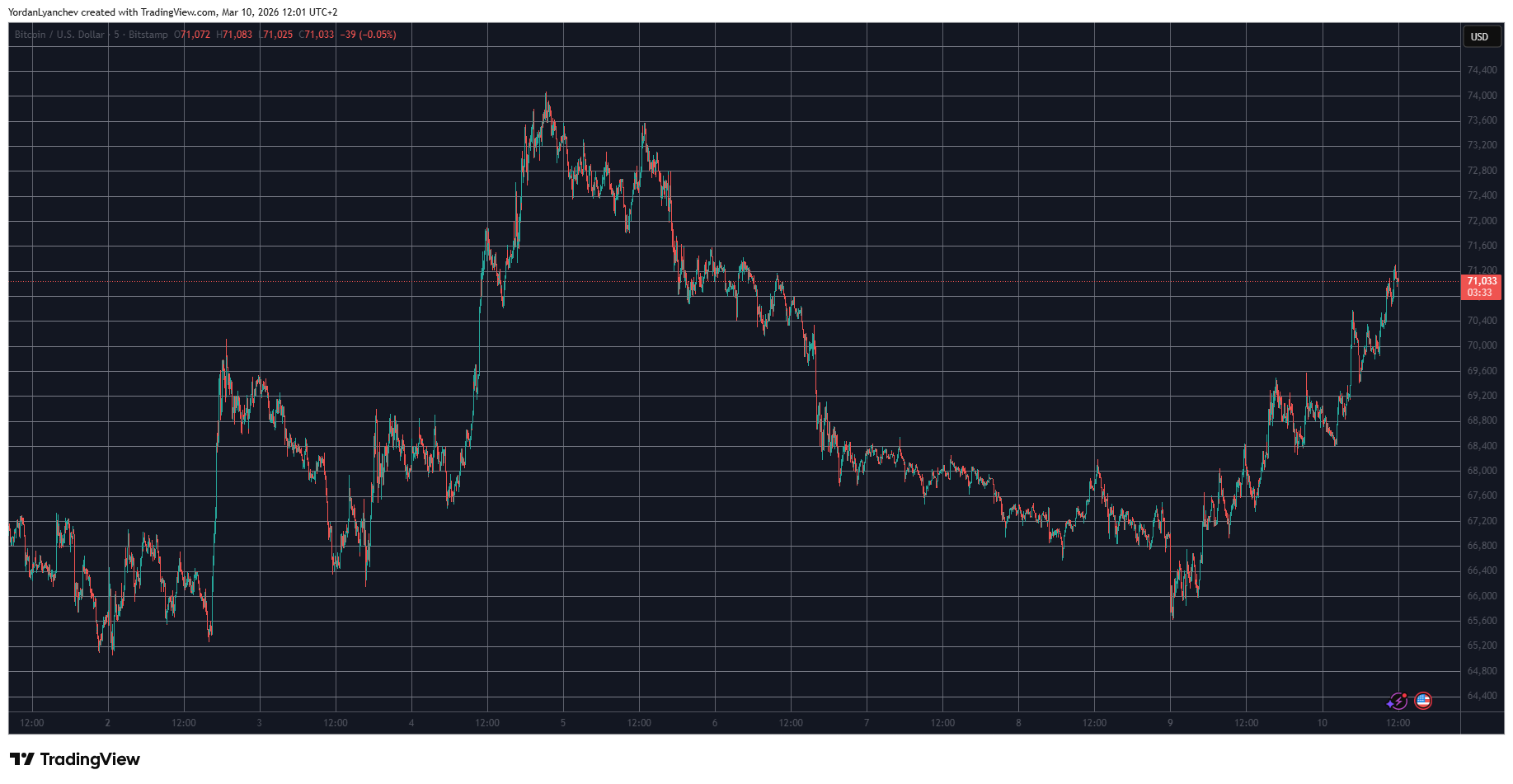
After dumping to $65,500 on Monday morning, bitcoin reversed its trajectory and jumped by over five grand to tap $71,000 for the first time since last Friday.
Ethereum has reclaimed the coveted $2,000 level, while BNB is close to $650. XRP is above $1.40 despite continuous ETF outflows.
BTC Jumps to $71K
What a wild ride it has been in crypto, prompted by the quickly developing and escalating tension in the Middle East. It began with a nosedive to $63,000 for BTC on February 28, when the US and Israel attacked Iran, before the bulls took control and pushed the asset to a month-high of $74,000 by Wednesday.
The subsequent rejection was almost inevitable given the current market sentiment, and BTC began to lose value gradually. After dropping to and below $68,000 by the weekend, the bears drove it further south to $65,500 on Monday morning when the legacy financial futures markets opened.
However, bitcoin rebounded almost immediately and returned to $68,000. It even challenged the $70,000 level in the evening after Trump’s somewhat surprising remarks that the war with Iran is almost over. Although it failed there at first, it reclaimed that psychological line today, jumping to just over $71,000 minutes ago.
Its market capitalization has climbed to $1.420 trillion on CG, while its dominance over the alts is above 57%.
ETH Above $2K, HYPE Soars
Ethereum continues with its gradual ascent, jumping to over $2,050 as of press time after a 3% daily increase. A similar pump from BNB has driven the token to almost $650, while XRP is above $1.40, although the Ripple ETFs saw another major withdrawal yesterday. DOGE has gained 5% daily and now sits at $0.095.
HYPE has surged the most from the top 100 alts, pumping by 11% to nearly $35. XLM, SUI, ZEC, SHIB, AVAX, AAVE, and NEAR follow suit.
The cumulative market cap of all crypto assets has added $100 billion in a day and is close to $2.5 trillion on CG now.

Binance Free $600 (CryptoPotato Exclusive): Use this link to register a new account and receive $600 exclusive welcome offer on Binance (full details).
LIMITED OFFER for CryptoPotato readers at Bybit: Use this link to register and open a $500 FREE position on any coin!
Disclaimer: Information found on CryptoPotato is those of writers quoted. It does not represent the opinions of CryptoPotato on whether to buy, sell, or hold any investments. You are advised to conduct your own research before making any investment decisions. Use provided information at your own risk. See Disclaimer for more information.
Hyperliquid (HYPE) token is suddenly on fire.
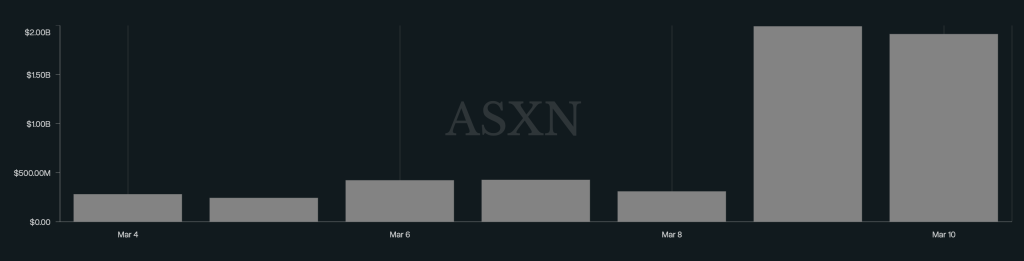
The token jumped to an intraday high near $35 as trading activity exploded on the platform. Volume on its oil perpetuals surged past $1.4 billion, driven by rising geopolitical tensions and wild moves in energy markets.
While most of the crypto market struggled, Hyperliquid actually benefited from the chaos. Traders piled into tokenized oil contracts, pushing daily volume close to $1.39 billion, second only to Bitcoin on the exchange.
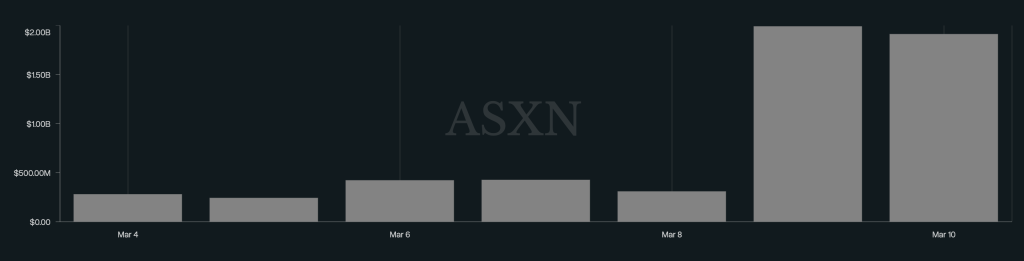
At the same time, the platform rolled out a major upgrade to its margin system. The new portfolio margin feature is designed to make trading more capital efficient while reducing risk during extreme volatility.
Nansen analyst Nicolai Søndergaard said that dynamic scaling reduces systemic risk, making the platform safer for aggressive positioning on volatile assets.
The Levels That Change Everything for Hyperliquid (HYPE)
HYPE is still holding strong momentum. The token is up about 5% in the last 24 hours and roughly 120% over the past year. Even while much of the crypto market struggles, the chart continues printing higher lows, keeping the broader uptrend intact.
Right now, the level everyone is watching is $35.28. That recent intraday high is the key resistance. If HYPE manages to close above it on lower timeframes, the chart opens the door toward $38 and potentially the $40 psychological level.
On the downside, $32.50 is the main support. That area has acted as a launchpad during previous pullbacks. If it breaks, the next liquidity zone sits closer to $30. A deeper drop below $28.50 would be needed to truly damage the bullish structure.
Part of the strength comes from growing activity on the platform itself. Open interest has climbed to around $1.2 billion as traders increasingly use Hyperliquid to trade not just crypto, but also assets like oil during major global events.
As long as trading activity stays elevated, HYPE could keep moving independently from the broader crypto market. But if volume fades, the token may struggle to defend the $32.50 floor.
Discover: The best new crypto in the world
The post Hyperliquid Jumps Following Margin Upgrade and 533% Oil Trading Surge appeared first on Cryptonews.

TLDR:
- Altseason indicator shows BTC and ETH losing dominance over the broader market.
- Weekly RSI divergence signals fading momentum and market compression.
- Market structure mirrors pre-2021 altseason patterns, hinting at rotation.
- Selective altcoins with strong utility may lead the next crypto expansion.
The altseason indicator update shows early signs that the crypto market may rotate away from BTC and ETH dominance toward altcoins. Historical patterns suggest momentum is weakening, and price structure is compressing ahead of potential altcoin expansion.
Market Structure Suggests Altcoin Pressure
The altseason indicator tracks the dominance of total stablecoins, BTC, and ETH relative to the broader market. It identifies when capital shifts from major coins to altcoins.
Since January, the price has moved sideways within a tight consolidation range. This mirrors the market structure seen before the 2021 altseason, where BTC and ETH dominance first formed a clear distribution zone.
Recently, the price pushed into resistance levels, suggesting a potential bull trap. The weekly RSI shows divergence from the price, signaling a gradual weakening of buying momentum.
Momentum divergence indicates the market may be coiling for a structural move. Such compression phases can last weeks, yet historically they precede rapid rotations into altcoins.
The current setup reflects a pause between distribution and rotation. During this phase, price may appear stagnant, but capital quietly prepares for the next move.
Historical comparisons show that similar patterns led to the largest altcoin expansions of the last cycle. Dominance breakdowns often trigger rapid, aggressive capital flows into select tokens.
Market compression also makes timing uncertain. RSI and price may remain in a tight range for several weeks, yet the structural pressure continues to build.
A fading RSI often precedes volatility spikes in a classic pre-altseason environment, where leading altcoins outperform before widespread rotation.
Tokens with strong fundamentals and relative strength against BTC and ETH often separate from weaker assets early.
Strategic Focus for the Next Altseason
If BTC and ETH dominance break down, historical trends indicate capital may rapidly move into selected altcoins. The 2021 dominance collapses caused significant gains for top-performing tokens.
Not all altcoins are likely to participate equally. Market maturity ensures capital favors projects with real utility, robust tokenomics, and strong social ecosystems.
Traders should monitor relative strength metrics. Projects outperforming BTC and ETH often lead early in rotation phases. This selective approach maximizes gains while reducing exposure to weaker assets.
Price compression, momentum divergence, and structural similarities to past cycles suggest the market is near a decision point. Early movers may benefit significantly.
Patience is critical during this stage. Investors focusing on quality projects with strong fundamentals may profit when capital rotates rapidly into leading altcoins.
TLDR:
- Global market volatility erased over $2 trillion after the Middle East war risk spiked oil prices.
- WTI and Brent crude surged 25–31% as traders priced potential energy supply disruptions.
- Equities fell sharply as oil spikes raised inflation and economic slowdown concerns.
- G7 emergency oil supply signals reversed panic, restoring equity markets within hours.
Global market volatility surged as geopolitical tensions in the Middle East triggered sharp energy and equity moves. Policy signals from the G7 later reversed oil spikes, restoring trillions in value.
War fears spark sharp global market reactions
Global market volatility surged when U.S. index futures opened amid rising Middle East tensions. Traders reacted immediately to potential conflict risks affecting critical energy routes, rather than current economic conditions.
Futures markets operate nearly 24 hours, allowing investors to price these developments before regular trading. Anticipation of supply disruptions quickly drove equities lower.
The S&P 500 fell 2.3%, erasing roughly $1.33 trillion, while the Nasdaq Composite dropped 2.4%, losing $924 billion. The Dow Jones Industrial Average declined 2.3%, removing about $529 billion.
Energy markets surged in parallel. WTI crude rose 31%, Brent crude 25%, and natural gas 10% as investors assessed shipping closures, sanctions, and production risks.
These reactions reflected immediate pricing of potential global energy shortages. Leverage amplified these movements.
Many traders entered commodity positions with high leverage, magnifying both gains and losses. Market sentiment shifts, noting that futures had priced in a full geopolitical risk premium.
Markets moved based on expectations rather than fundamental economic changes, demonstrating how perception of risk drives trillion-dollar swings in modern trading.
Investors focused on potential inflation spikes if oil prices remained elevated. Higher energy costs could pressure central banks to maintain restrictive rates, reduce consumer spending, and tighten corporate margins.
This caused equities to sell off sharply, reflecting the direct link between energy prices and global market stability.
G7 coordination quickly reverses energy panic
Global market volatility reversed after the Group of Seven finance ministers signaled readiness to stabilize energy supply. Strategic petroleum reserves, especially in the U.S., were highlighted as a key tool to prevent prolonged shortages.
Markets immediately adjusted, pricing in the likelihood that governments could mitigate supply disruptions.
Oil prices fell roughly 32% from their highs, and natural gas dropped 13% as leveraged positions unwound. The rapid reversal reflected traders exiting panic positions once supply concerns were alleviated.
Equities responded positively. The S&P 500 gained 3.5%, adding about $2.03 trillion, the Nasdaq Composite rose 4.35%, regaining $1.67 trillion, and the Dow Jones Industrial Average increased 3.3%, recovering $759 billion.
Market observers noted that policy signals can shift expectations instantly. Algorithmic trading and leveraged futures amplified these movements.
The episode illustrated how perceptions of risk, energy supply stability, and potential inflation influence prices more than immediate economic fundamentals.
Traders reassessed supply availability and growth expectations, showing how tightly commodities, equities, and government signals interact in real-time trading.
Global market volatility, in this case, demonstrated that perception alone can drive massive, rapid swings.
Within hours, trillions of dollars were erased and restored, confirming how sensitive modern financial markets are to geopolitical developments and coordinated policy actions.

Epstein had two key aides

Global Industrial Robotics Market Poised to Nearly Double by 2029

Arthur Hayes Wouldn’t Invest $1 In Bitcoin Right Now


-
Business4 days ago
Form 8K Entergy Mississippi LLC For: 6 March
-

 News Videos2 days ago
10th Algebra | Financial Planning | Question Bank Solution | Board Exam 2026
-

 Fashion4 days ago
Weekend Open Thread: Ann Taylor
-

 Tech6 days ago
Bitwarden adds support for passkey login on Windows 11
-

 Crypto World1 day ago
Paradigm, a16z, Winklevoss Capital, Balaji Srinivasan among investors in ZODL
-
 Sports5 days ago
499 runs and 34 sixes later, India beat England to enter T20 World Cup final | Cricket News
-

 Sports3 days ago
Three share 2-shot lead entering final round in Hong Kong
-

 Sports3 days ago
Braveheart Lakshya downs Lai in epic battle to enter All England Open final | Other Sports News
-

 Politics5 days ago
Top Mamdani aide takes progressive project to the UK
-

 Business10 hours ago
ExxonMobil seeks to move corporate registration from New Jersey to Texas
-

 NewsBeat5 days ago
Piccadilly Circus just unveiled ‘London’s newest tourist attraction’ and it only costs 80p to enter
-

 Entertainment4 days ago
Hailey Bieber Poses For Sexy Selfies In New Luscious Lip Thirst Traps
-

 Business2 days ago
Search for Nancy Guthrie Enters 37th Day as FBI Probes Wi-Fi Jammer Theory
-
 NewsBeat1 day ago
Pagazzi Lighting enters administration as 70 jobs lost and 11 stores close across Scotland
-

 Tech1 day ago
Despite challenges, Ireland sixth in EU for board gender diversity
-
Entertainment6 days ago
Harry Styles Has ‘Struggled’ to Discuss Liam Payne’s Death
-

 Crypto World6 days ago
New Crypto Mutuum Finance (MUTM) Reports V1 Protocol Progress as Roadmap Enters Phase 3
-

 Tech6 days ago
ACIP To Discuss COVID ‘Vaccine Injuries’ Next Month, Despite That Not Being In Its Purview
-

 Business1 day ago
Search Enters 39th Day with FBI Tip Line Developments and No Major Breakthroughs
-
 NewsBeat6 days ago
Good Morning Britain fans delighted as Welsh presenter returns to host ITV show