Crypto World
Did a Whale Trigger Bitcoin’s Recent Price Slide?

Bitcoin (BTC) has extended its downward trajectory. Over the past 24 hours, the asset has declined 1.39%, pushing its total losses for the month beyond 30%.
While the broader bear market environment remains the primary driver of weakness, emerging on-chain signals suggest that concentrated whale activity could reportedly be amplifying BTC’s downside.
Sponsored
Whale Activity Raises Concerns Over Short-Term Bitcoin Volatility
In a post on X (formerly Twitter), blockchain analytics firm Lookonchain reported that a whale’s (3NVeXm) deposits have coincided with Bitcoin’s price drops. Data from Arkham showed that the whale started depositing Bitcoin to Binance three weeks ago, starting out with modest amounts.
However, activity accelerated this week. On February 11, the whale transferred 5,000 BTC into the exchange. The string of transfers has continued with the wallet sending another 2,800 coins just today.

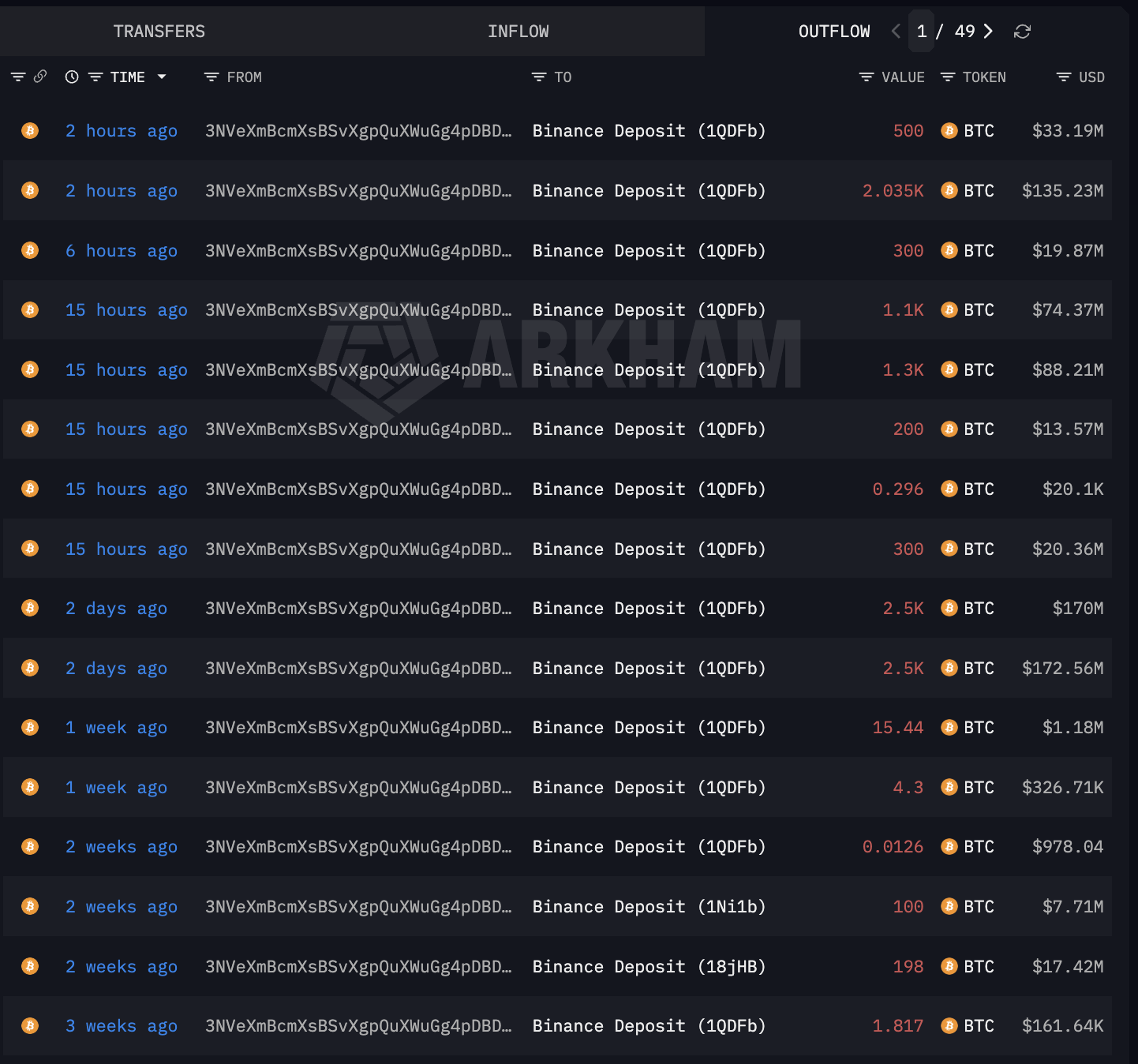
Lookonchain suggested that the timing of these deposits may have influenced short-term price action.
“Every time he deposits BTC, the price drops. Yesterday, I warned when he made a deposit — and soon after, BTC dropped over 3%,” the post read.
Sponsored
As of the latest available data, the address still holds 166.5 BTC, valued at over $11 million at current market prices. Large exchange inflows are often interpreted as a precursor to selling, as investors typically move assets to trading platforms to liquidate or hedge positions.
While correlation does not necessarily imply causation, the scale and timing of these transfers could have increased immediate sell-side pressure in an already fragile market structure. In periods of heightened sensitivity, even the perception of whale-driven selling can amplify downside moves as traders react to on-chain signals and adjust positions accordingly.
Capitulation Signals Point to Market Stress
The transfers come at a time of pronounced weakness across the Bitcoin market. An analyst noted that Bitcoin’s realized losses surged to $2.3 billion.
Sponsored
“This puts us in the top 3-5 loss events ever recorded. Only a handful of moments in Bitcoin’s history have seen this level of capitulation,” the analysis read.
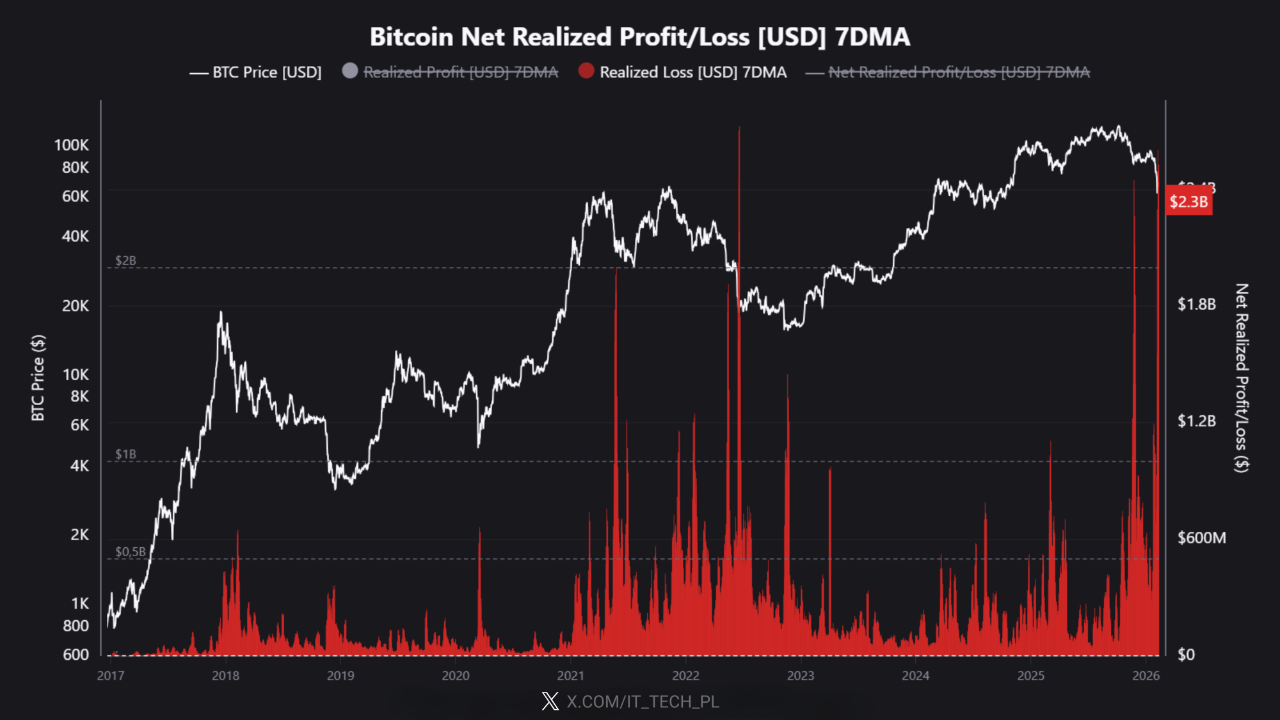
The analyst added that short-term holders, defined as those holding coins for less than 155 days, appear to be driving much of the current capitulation. Investors who accumulated BTC at $80,000-$110,000 are now locking in significant losses, suggesting that overleveraged retail participants and weaker hands are exiting their positions.
In contrast, long-term holders do not appear to be the primary source of this latest wave of selling. Historically, this cohort tends to hold through drawdowns.
Sponsored
“In the past, extreme loss spikes like this triggered rebounds. We’re seeing it now: BTC bounced from $60K to $71K after the capitulation. But this could still be the beginning of a deep and slow bleed-out. Relief rallies happen even in prolonged bear markets,” the analyst stated.
Meanwhile, BeInCrypto previously highlighted several signals suggesting that BTC may still be in the early stages of a broader bear cycle, leaving room for further downside risk. CryptoQuant analysts have pointed to the $55,000 level as Bitcoin’s realized price, a level historically associated with bear market bottoms.
In previous cycles, BTC traded 24% to 30% below its realized price before stabilizing. Currently, Bitcoin remains above that level.
When BTC approaches its realized price zone, it has historically entered a period of sideways consolidation before staging a recovery. Some analysts argue that a deeper correction toward the sub-$40,000 range could mark a more definitive bottom formation.
You must be logged in to post a comment Login