

Crypto World
DOG Mode opens a new front in Bitcoin’s governance fight



Bitcoin Ordinals advocate Leonidas has introduced DOG Mode, an alternative open-source Bitcoin client that changes how nodes relay certain valid transactions without altering Bitcoin’s consensus rules.
Summary
- DOG Mode removes default relay limits while keeping Bitcoin’s existing consensus rules completely unchanged today.
- Leonidas says fee-paying users should access block space without Bitcoin Core deciding transaction purposes beforehand.
- BIP 110 takes opposite approach, proposing temporary consensus restrictions on several data-heavy Bitcoin transaction types.
The project adds a new layer to the dispute over Ordinals, Runes and the use of Bitcoin block space.
In his DOG Mode announcement, Leonidas argued that Bitcoin Core and Bitcoin Knots enforce policy restrictions that Bitcoin’s consensus rules do not require. He said a transaction can remain valid under consensus while default nodes still refuse to relay it across the peer-to-peer network.
DOG Mode targets relay policy, not Bitcoin consensus
DOG Mode would raise the maximum individual transaction size allowed under its relay policy to 3.9 million weight units. Bitcoin Core’s default policy currently limits individual standard transactions to 400,000 weight units. The client would also lower the dust threshold to one satoshi for small transaction outputs.
As reported by crypto.news, DOG Mode does not require a Bitcoin fork because it works within existing consensus rules. Nodes can choose to run the software and relay transactions that other clients may treat as non-standard, while miners still decide which valid transactions they include in blocks.
Ordinals and Runes return to the governance debate
The proposal centers on a long-running dispute over whether Bitcoin should treat every valid, fee-paying transaction equally. Leonidas supports a market-based model in which users compete for block space through fees rather than software developers deciding which transaction structures should receive default relay support.
DOG Mode could make it easier to propagate large Ordinals inscriptions and small outputs used by some Bitcoin-native token protocols. However, different relay policies could also leave nodes with different views of unconfirmed transactions before miners add them to blocks. Bitcoin’s consensus rules would remain unchanged even if node mempools differed.
DOG Mode takes a different path from BIP 110
The DOG Mode approach contrasts with BIP 110, which proposes temporary consensus restrictions on several forms of transaction data. As reported by crypto.news, Bitcoin developer Luke Dashjr has continued to support the proposal despite opposition from users who view the restrictions as censorship.
BIP 110 supporters argue that data-heavy transactions raise storage costs and consume scarce block space. Critics argue that changing consensus rules to restrict currently valid transactions could create a broader precedent. Michael Saylor and Adam Back have opposed BIP 110, as reported by crypto.news, while miner signaling remained far below its proposed 55% activation threshold in mid-July.
Bitcoin users decide which policies gain adoption
DOG Mode also raises questions about how Bitcoin governance works outside formal protocol changes. Bitcoin Core developers can set default relay policies, but node operators remain free to run other software. Miners can also receive transactions through direct channels instead of the public peer-to-peer relay network.
That distinction means DOG Mode does not need broad agreement to begin operating. Its influence will depend on whether node operators, miners and Bitcoin users choose to adopt its policies. Leonidas said the longer-term aim is for wider use to push existing Bitcoin clients to reconsider restrictions that he views as unnecessary.
The debate now presents two different approaches to disputed Bitcoin activity. BIP 110 seeks new consensus restrictions, while DOG Mode removes some default policy limits without changing consensus. The outcome will depend on which software users choose to run and which transactions miners choose to process.



Bitmine Immersion Technologies (NYSE: BMNR) acquired 7,430 ether (ETH) over the past week, its smallest weekly purchase since launching its treasury strategy, as the company shifted capital toward buying back its own stock, according to a company press release issued July 20. The purchase lifted… Read the full story at The Defiant


Former New York Governor Andrew M. Cuomo has joined the board of directors of cryptocurrency exchange OKX as the company expands its U.S. operations and strengthens its ties with traditional financial institutions.
Summary
- Andrew Cuomo joins OKX’s board after advising the exchange on U.S. regulatory strategy since 2023.
- His appointment comes as OKX expands U.S. operations and further deepens institutional ties with ICE.
- Cuomo will co-chair OKX and ICE’s tokenization venture linking traditional and digital markets more closely.
OKX announced the appointment on July 20, saying Cuomo had already worked with the company since 2023. During that period, he advised the exchange on its regulatory and institutional strategy in the U.S.
Cuomo previously served as New York’s 56th governor, the state’s attorney general and U.S. secretary of housing and urban development. His board appointment formalizes an existing relationship with OKX rather than starting a new advisory role.
Cuomo moves from adviser to OKX board member
OKX founder and CEO Star Xu said Cuomo had already played a role in shaping the exchange’s approach to the U.S. market. The company did not provide details about any specific board committees or additional responsibilities tied to the appointment.
“His move to the board formalizes a relationship that has already shaped how we approach the U.S. market,” Xu said.
OKX said Cuomo’s public-sector and regulatory experience would support the company as it develops services for both traditional and digital finance.
The appointment comes as OKX continues rebuilding and expanding its presence in the U.S. As crypto.news previously reported, the company relaunched its U.S. crypto exchange and self-custody wallet in April 2025 and established a regional headquarters in San Jose, California.
That relaunch followed a settlement with the U.S. Department of Justice over past compliance failures. OKX also appointed Roshan Robert to lead its U.S. business and said it had strengthened know-your-customer, fraud detection and other compliance systems.
ICE partnership expands OKX’s institutional strategy
Cuomo will also continue serving as co-chair of a joint venture between OKX and Intercontinental Exchange, the parent company of the New York Stock Exchange. The two companies announced the venture in June as part of a plan to connect traditional financial markets with blockchain-based products.
As crypto.news reported in June, the proposed platform could give OKX users access to ICE futures products and tokenized equity markets linked to the NYSE. The project remains subject to regulatory approval.
The companies plan to combine ICE’s exchange and market-data infrastructure with OKX’s onchain and self-custody technology. The structure is designed to support institutional access to tokenized financial products while linking established market infrastructure with digital asset systems.
The partnership followed an investment by ICE in OKX in March. According to OKX, the transaction valued the crypto company at $25 billion. The investment amount was not publicly disclosed in the earlier announcement covered by crypto.news.
OKX broadens its business beyond crypto trading
OKX has been adding products as it seeks a larger role in institutional and tokenized markets. The company said its licensing footprint now covers markets including the U.S., the European Economic Area, the United Arab Emirates, Singapore and Australia.
Its U.S. expansion is part of that broader strategy. The company returned to the market in 2025 with a centralized exchange and self-custody wallet after spending more than a year developing its compliance infrastructure, according to earlier reporting.
Meanwhile, the ICE partnership gives OKX another route into the growing market for tokenized traditional assets. The joint venture plans to work on products that connect blockchain infrastructure with established futures and equity markets, although the companies still need relevant approvals before launching the proposed services.
OKX has also launched an artificial intelligence marketplace where autonomous agents can find work, transact and build onchain reputations. The company cited that launch, its ICE partnership and its wider licensing activity as parts of its expansion during 2026.
Moreover, Cuomo’s appointment gives OKX a board member who has worked at both the state and federal levels of the U.S. government. He has also spent about three years advising the exchange directly on regulatory and institutional matters.
The move therefore connects two areas of OKX’s current strategy: its continued U.S. expansion and its effort to attract more institutional financial activity. The exchange has already returned to the U.S. market, while its partnership with ICE is targeting a separate route into tokenized assets and traditional market infrastructure.


The move comes as traditional exchanges face growing competition from crypto markets and tokenized equity platforms that offer around-the-clock trading.


Jamie Dimon should be happy with how the US market is doing after reporting JPMorgan’s best quarter ever. However, he says he won’t touch the S&P 500 or long-dated bonds at today’s prices.
The JPMorgan Chase chief executive laid out several warnings on The Master Investor Podcast with Wilfred Frost. His comments came days after posting the largest quarterly profit in US banking history.
Four Warnings From the Top of Wall Street
Throughout the podcast, Frost quizzed the CEO on his stance across stocks and bonds, with Dimon issuing some telling warnings for general investors.
On the S&P 500 specifically, Frost asked whether Dimon was a buyer at current levels. Dimon dodged the index and said he trades name by name, not the market as a whole. He confirmed he has not bought any equities recently, and when Frost asked if markets are pricing in a perfect outcome, Dimon said the scenario looks good, but not perfect.
Together, those answers point to a CEO who sees little room for error at today’s prices, without an S&P 500 buyer in JPMorgan’s own chief executive.
Frost then asked directly whether Dimon would buy long-dated government bonds. Dimon did not hedge.
“Personally, no. I would not be a buyer.”
Dimon pointed to interest rates as the reason for not going with bonds. Even if inflation cooled to 2%, he said, the 10-year Treasury yield should sit near 4% to 4.5%. Short-term rates should be near 3.25% to 3.5%, he added, and markets are already close to those levels. That leaves little upside left to buy for, in his view.
Dimon also tied bond risk to swelling government deficits. He recalled how US inflation climbed from 3.5% to 11% through the 1970s, a stretch when deficits also built up. He pointed to Federal Reserve Chair Kevin Warsh’s call to scrutinize how inflation data gets calculated. Warsh’s own Fed rate hike odds turned sharply hawkish in June.
Finally, Dimon flagged a wider set of dangers. These include the war in Ukraine, tension with Iran, rising military spending worldwide, and the US-China relationship. He likened them to tectonic plates that could shift and combine unexpectedly.
“Those risks are probably bigger than other people think.”
Dimon acknowledged, however, that none of these threats might turn into an actual crisis. He said the global economy has grown more resilient and less energy-dependent. He pointed to how markets absorbed the Iran war oil shock earlier this year. Still, resilience does not remove the chance of a sudden tipping point, he cautioned.
Record Profits, Cautious Words
JPMorgan posted net income of $21.2 billion in the second quarter of 2026, up 41% from a year earlier. It marks the highest quarterly profit any US bank has ever reported.
Equity trading revenue jumped 86% year over year to $6 billion. That helped drive a record bank earnings season across all five of the largest US lenders.
Dimon called the environment nearly ideal for banks. He cited heavy trading volumes and elevated asset prices, but still said the run will not last forever.
Dimon’s skepticism echoes other market voices this year.
Peter Schiff has argued the next bond market crash warning could start in Treasurys rather than Bitcoin (BTC). JPMorgan’s own chief executive is stepping back from stocks and bonds near record highs.
That raises a question for risk assets broadly, crypto included. Will Wall Street’s caution eventually catch up with the price action?
The post Jamie Dimon Won’t Buy S&P 500 or Bonds. Here Are the Warnings Investors Are Missing appeared first on BeInCrypto.
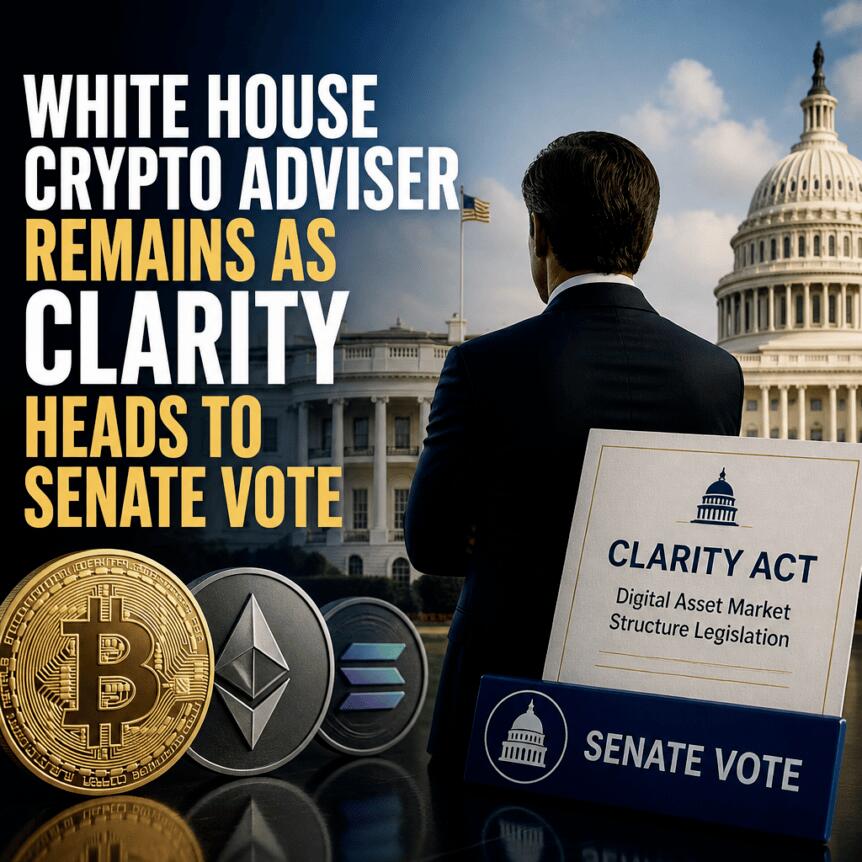
The White House’s top crypto adviser Patrick Witt says he will not depart for required military training at the end of this month, allowing him to remain at the White House to help push the Senate to act on the CLARITY Act. Witt is the administration’s lead negotiator for the legislation and framed the update as a step to ensure he can “see this effort through to the end.”
His announcement comes with the CLARITY Act facing a tight procedural window: the bill must clear the US Senate before the Aug. 8 recess. Witt previously was reported to be scheduled to begin Judge Advocate General (JAG) training with the Georgia Army National Guard on July 27, a program intended to qualify him to serve as a legal officer in the Guard.
Key takeaways
- Patrick Witt said his end-of-month military training has been deferred, so he can continue CLARITY Act negotiations at the White House.
- The CLARITY Act’s push is time-sensitive, with a stated deadline to pass the Senate before the Aug. 8 recess.
- Witt had been expected to report for JAG training on July 27, but the schedule change reduces the risk of leadership disruption during Senate deliberations.
- Witt’s continued presence arrives as Harry Jung, a senior figure at the President’s Council of Advisors for Digital Assets, plans to leave government service.
Why Witt staying matters for the CLARITY Act push
Witt’s role is directly tied to the administration’s negotiation strategy for CLARITY. As the White House’s lead negotiator, he is positioned to coordinate between lawmakers and stakeholders on the bill’s regulatory design—particularly as the Senate approaches the recess timeframe that could determine whether the measure advances this session.
In a post on X on Monday, Witt responded to reports that he was set to leave for mandatory training “right before” CLARITY reaches the Senate floor. Witt said he remains committed to his service obligation, but noted that his training has been deferred.
That change is not a small administrative update: with a deadline to clear the Senate before Aug. 8, continuity in the White House’s negotiating team can matter when legislators are weighing amendments, committee outcomes, and floor timing. If key personnel were forced to step away during a critical stretch, it could shift the balance of negotiations at a moment when the bill’s prospects depend on Senate process.
What the earlier training reports suggested
Before Monday’s clarification, reporting indicated Witt was expected to begin JAG training with the Georgia Army National Guard on July 27. The training is described as part of his obligations and is intended to qualify him for legal officer duties within the Guard.
Earlier coverage had framed the expected departure as timing-sensitive, with the implication that Witt would be away from the White House during the period when the bill’s momentum could be decided. Witt’s latest statement effectively adjusts that timeline, removing the immediate risk that his absence would coincide with the Senate’s decisive window.
Separately, a report from Crypto In America said Witt had already deferred his mandatory training in April to remain at the White House to work on CLARITY negotiations that, according to the report, extended beyond initial expectations. Monday’s development is therefore described as the second deferral, underscoring how central the legislation has become to the administration’s priorities for his time and attention.
Senate deadline heightens the stakes
The CLARITY Act is positioned by the White House as an effort to establish the first comprehensive US regulatory framework for the crypto market. In the current legislative cycle, timing appears to be the central constraint: the bill must pass the Senate before the Aug. 8 recess to keep it moving on a path forward.
Witt’s statement that he can “see this effort through to the end” signals that the administration is treating the remaining weeks before the recess as a decisive phase. It also suggests the White House views the negotiation work as something that requires sustained coordination right up until the bill’s Senate endgame.
Whether additional Senate activity—such as amendments, procedural votes, or negotiations with members across factions—will further test the bill’s schedule remains to be seen. What is clear from Witt’s update is that at least one potential personnel bottleneck has been removed.
Leadership shake-up at the digital assets council
Witt’s continued stay at the White House is occurring alongside a leadership transition within the President’s Council of Advisors for Digital Assets. Harry Jung, the council’s deputy director, announced that he plans to leave government service in about two weeks.
Jung wrote on X that he will depart with “immense gratitude,” stating that the past two years “transformed America’s position on crypto” and expressing pride in what the team accomplished. The announcement adds a new variable to the administration’s internal structure as CLARITY work continues.
According to Crypto In America, Jung had been slated to take over Witt’s responsibilities during Witt’s military leave, had that leave proceeded. With Witt now saying his training has been deferred, that handoff timeline may change—at least in the short term. However, Jung’s planned exit means the council will still face an adjustment period even if Witt remains in place.
For market participants, these kinds of transitions can be meaningful because regulatory bills often depend on consistent drafting, negotiation, and policy coordination. While the CLARITY Act’s legislative mechanics are ultimately determined by Congress, the administration’s negotiating capacity influences how quickly the bill’s terms can be refined and defended through the Senate process.
Readers should watch how the Senate timeline develops between now and the Aug. 8 recess, particularly for signs that additional amendments or procedural obstacles could alter the bill’s path. Witt’s deferred training reduces one risk to continuity, but Jung’s impending departure suggests the administration may still be working through staffing shifts as CLARITY approaches its critical phase.


Bernstein raised its price target on Robinhood Markets (NASDAQ: HOOD) to $160 from $130 and kept an "Outperform" rating, telling clients that revenue from the brokerage's prediction-markets business is set to surpass its crypto trading revenue. Analyst Gautam Chhugani projected prediction-market… Read the full story at The Defiant
Strategy Inc (NASDAQ: MSTR) sold 2,732,318 shares of its Class A common stock between July 13 and July 19, generating net proceeds of $263.5 million under its at-the-market offering program, according to an 8-K filed with the Securities and Exchange Commission on July 20. The company made no… Read the full story at The Defiant


The stablecoin law gave regulators exactly one year to write its rules. The year ended Saturday. The rules did not arrive, the January 2027 start date is not moving, and the $300 billion industry now gets to guess what compliance means.
Summary
- The GENIUS Act, signed July 18, 2025, gave federal regulators one year to finalize implementing rules for payment stablecoins. That deadline passed on Saturday with not one agency finished.
- Ten proposed rulemakings exist across Treasury, the OCC, the FDIC, and others, several with comment periods that run past the deadline itself. Nothing is final.
- The law’s effective date of January 18, 2027 does not move, which compresses the window between whenever rules land and when issuers must comply with them.
- The fight inside the comment files is real: BlackRock is pressing the OCC to drop a possible 20% cap on tokenized reserve assets and to confirm Treasury ETFs qualify as reserves.
- The precedent is not encouraging. After Dodd-Frank, the SEC and CFTC missed roughly 40% of their statutory deadlines, and some rules took years. The question is whether stablecoins can afford the same drift.
There is a particular kind of Washington irony that only a statute can produce. The GENIUS Act was celebrated, correctly, as the first comprehensive federal crypto law in American history, and its central promise was certainty: clear rules, on a clear schedule, written into the text itself. Section 13 gave the primary federal stablecoin regulators exactly one year from enactment to promulgate implementing regulations. President Trump signed the law on July 18, 2025. The deadline was therefore July 18, 2026, which was Saturday. It came and went with the Federal Reserve, the OCC, the FDIC, the NCUA, and the Treasury Department all holding proposals instead of rules. The law built to end regulatory uncertainty produced a precisely dated demonstration of it, and the anniversary of American crypto’s biggest legislative win doubled as its first broken promise.
What the law required and what exists instead
The GENIUS Act is sweeping by any standard, which is part of why the deadline mattered. It created the first federal regime for payment stablecoins: full reserve requirements in liquid assets, monthly disclosure of reserve composition, redemption rights, licensing and supervision of issuers, and a priority rule that pays stablecoin holders ahead of other creditors when an issuer fails. Congress wrote the skeleton and directed the agencies to supply the flesh, through notice-and-comment rulemaking, within one year.
What exists at the deadline is a stack of proposals. Since enactment, the agencies have issued ten notices of proposed rulemaking. Treasury produced the most, four, covering broad implementation questions including the standard for deciding when a state regulatory regime is similar enough to the federal framework, registration requirements for foreign stablecoin issuers, and anti-money-laundering compliance. The OCC issued its main proposal in February, a wide package covering reserve assets, redemptions, capital, liquidity, custody, reporting, and risk management for issuers under its supervision, and a second covering approval requirements. The FDIC issued its own prudential proposal for stablecoin issuers owned by institutions it supervises, addressing reserves, capital, redemption, custody, and the deposit-insurance treatment of stablecoin reserves and tokenized deposits.
None of it is final, and some of it cannot be soon. Comment periods remain open past the deadline itself: one OCC window runs to July 21, and an FDIC anti-money-laundering proposal stays open until August 4. An agency cannot lawfully finalize a rule while its comment period is still running, which means parts of the framework were structurally incapable of meeting the statutory date. The deadline did not merely slip. It was scheduled to be missed.
Lawmakers saw it coming. Representative Bryan Steil pressed agency officials in December to complete their GENIUS rules on time, noting that regulators have a history of failing to implement legislation by congressionally mandated dates. The agencies heard the warning and missed anyway.
Why a missed deadline is not nothing
The reflexive response, that statutory deadlines are aspirational and agencies miss them constantly, is true and misses the point.
Start with what the miss does not do. It does not invalidate the GENIUS Act. The statute remains law, its core requirements remain binding, and its effective date remains January 18, 2027. There is no penalty clause, no automatic implementation, and no interim framework that snaps into place. The law simply continues toward its start date with the operating manual unwritten.
That combination is precisely the problem. The effective date does not move when the rulemaking slips, so every month of agency delay is a month subtracted from the industry’s implementation window, not added to it. A prospective issuer trying to launch under the federal regime can read the statute’s core requirements today, but it cannot know the final details of reserve composition, liquidity standards, custody practices, reporting cadence, customer verification, or supervisory treatment, because those live in rules that do not exist. Firms can build to the proposals and hope the final text resembles them, which is a real strategy and also a gamble, since final rules routinely change after comments are reviewed.
Banks and credit unions weighing stablecoin issuance face the same fog through their own regulators. Exchanges and payment platforms need to know which issuers will be permitted to operate in the United States, how redemptions must work, and what disclosures users receive, because those answers determine product design. And the state question is genuinely unresolved: the Act lets smaller issuers, up to $10 billion outstanding, remain under state supervision when the state framework is substantially similar to the federal one, but Treasury’s proposed certification process for deciding what counts as substantially similar is itself unfinished. New York has moved to align its rules with the federal law, and nobody can yet say officially whether alignment is achieved, because the yardstick is a proposal.
The result is the exact condition the law was passed to end. The GENIUS Act’s selling point was that stablecoins would finally have knowable rules. One year in, they have knowable proposals, an unmovable start date, and a shrinking runway between the two.
The fight inside the comment files
The delay is not purely bureaucratic sloth. Part of it reflects a real and consequential fight over what the rules should say, and the comment files show who is fighting.
The most revealing intervention comes from BlackRock. The world’s largest asset manager urged the OCC to abandon a possible 20% cap on tokenized reserve assets, to confirm explicitly that qualifying Treasury exchange-traded funds may be used as stablecoin reserves, and to expand the eligible asset list to include certain floating-rate Treasury notes. Read that carefully, because it connects two markets. BlackRock runs BUIDL, the largest tokenized money market fund, and tokenized funds have begun appearing inside stablecoin reserve baskets. Whether the OCC caps tokenized reserves at 20%, or blesses them fully, determines how big that linkage gets. The stablecoin rulebook is quietly deciding the growth path of the tokenized fund industry, and the tokenized fund industry has noticed.
Bank groups are pulling the other way on adjacent questions, having spent the month warning Senate leaders that stablecoins must not become deposit substitutes. The Federal Reserve’s own December analysis captured the tension: banks face real disintermediation risk from stablecoins, and also stand to benefit by partnering with issuers, providing settlement accounts, or issuing tokenized deposits themselves. Every one of those outcomes is shaped by details currently sitting in unfinished proposals, which is why the comment process is slow. The rules are worth fighting over, so they are being fought over.
There is also an uncomfortable disclosure buried in the process: the FDIC has confirmed that stablecoin wallets carry no pass-through deposit insurance. Holders of a failed issuer’s coin have statutory priority over other creditors under the Act, which is real protection, and they are not insured depositors, which is a distinction the marketing around regulated stablecoins tends to blur. The unfinished rules are where that distinction gets operational teeth, or does not.
The case that this is normal and fine
The sanguine reading has history on its side, and it deserves a fair hearing.
Agencies miss statutory deadlines routinely, and the sky stays up. The canonical example is Dodd-Frank, which imposed hundreds of rulemaking deadlines on the SEC and CFTC after the 2008 crisis; the agencies missed roughly 40% of them, some rules arrived years late, and the financial system operated through the gap. Congress writes ambitious deadlines partly as signaling, agencies treat them as targets, courts rarely punish a good-faith miss, and the machinery grinds on. By that standard, ten proposals in twelve months across six agencies is not failure. It is government moving at roughly its usual speed on a genuinely novel regime.
The miss also does not create a vacuum so much as extend one the industry already knows how to live in. Stablecoins operated for a decade with no federal framework at all. Today they operate with a binding statute whose core requirements, full reserves, disclosure, holder priority, are already law, plus detailed proposals that telegraph where the final rules are heading. A sophisticated issuer can build to the OCC’s February proposal with reasonable confidence that the final rule will rhyme with it. Circle, Paxos, and Ripple did not pause their businesses on Saturday.
And there is an argument that slow is correct here. The comment files show real disputes with real stakes: reserve composition rules that could reshape the tokenized fund market, state-federal boundaries that decide where issuers domicile, AML requirements that determine compliance costs. Rushing final rules to hit a symbolic date, then amending them for years, would serve nobody. The GENIUS Act will govern a market that is already above $300 billion and growing; getting the rules right plausibly matters more than getting them by Saturday.
The case that this is exactly the warning sign
The skeptical reading starts from a different observation: this was the easy one.
Stablecoin rulemaking is the most consensual project in American crypto policy. The law passed the Senate 68 to 30. The industry wants the rules. The banks want the rules. The agencies publicly support the framework. There is no partisan fight over whether payment stablecoins should have reserve requirements. If the regulatory system cannot deliver final rules on schedule under those conditions, the implied timeline for everything harder, the CLARITY Act’s market structure regime, the SEC’s Regulation Crypto, the CFTC’s digital commodity supervision, stretches accordingly. The GENIUS miss is a calibration point, and what it calibrates is pessimism.
The compressed window is also not a theoretical cost. If final rules land in late 2026, issuers get weeks, not the year Congress intended, to conform reserve portfolios, custody arrangements, reporting systems, and state registrations before the January 18, 2027 effective date. Compliance built in a sprint is compliance built badly, and the firms most damaged are the careful ones, because careful firms wait for final text while aggressive ones proceed on proposals and dare the regulator to object. A drifting rulemaking calendar quietly selects for the least cautious actors in the market it is supposed to discipline.
Offshore issuers read the same calendar. Every quarter of American delay is a quarter in which a foreign issuer can serve global demand without the compliance investment the eventual rules will demand, accelerating exactly the offshore drift the Act was meant to reverse. Tether, which has declined the comparable European regime, is the standing illustration that large issuers can simply route around slow or unattractive frameworks, and the longer the American rules float, the more routing gets built.
And the missed date lands next to another one. Federal Reserve Chair Kevin Warsh told senators on July 15 that regulators needed to coordinate GENIUS rulemaking to prevent regulatory arbitrage, and the Fed was described as racing to publish on time. Three days later, nobody had. When the agencies’ own urgency fails to move the calendar, the market updates on what the calendar is actually worth, and prediction markets, issuers, and Congress all just watched the first hard test of the post-GENIUS regulatory machine come back negative.
The arbitrage window nobody legislated
There is a second-order effect of the miss that deserves its own treatment, because it is where the delay stops being an inconvenience and starts reshaping the market: the gap between now and final rules is an arbitrage window, and every class of participant is positioned differently inside it.
Consider the incumbents first. Circle, Paxos, and the handful of issuers with existing trust charters, state licenses, and mature compliance programs lose least from the drift, because their current supervision approximates the proposed federal regime and their lawyers can track ten open dockets without strain. For them the delay is annoying and survivable. For a would-be entrant, a fintech or bank planning a 2027 launch, the calculus is worse: it must commit capital now to build against proposals that may change, or wait for final text and accept a compressed, expensive sprint to the effective date. Uncertainty of this kind functions as a moat for whoever is already inside, which means the missed deadline quietly protects the very concentration, two issuers dominating a $300 billion market, that a competitive licensing regime was supposed to erode.
The state-federal seam is its own arbitrage. Until Treasury finalizes the substantially similar test, no one knows which state regimes will qualify, which gives issuers under the $10 billion threshold an incentive to domicile in the friendliest state now and argue equivalence later. States, in turn, are competing to be that domicile, with New York moving to align its framework precisely so its licensees are grandfathered into whatever the certification eventually says. Regulatory competition among states is not inherently bad, but running it before the federal yardstick exists means the race’s winners get chosen by timing instead of by standards, and unwinding a certified-then-decertified state regime in 2027 would be far messier than never certifying it.
Offshore is the third seam, and the widest. A foreign issuer serving global demand faces registration requirements that exist only as a Treasury proposal, which means the practical cost of ignoring the American framework is, for now, zero. Every quarter the rules float is a quarter in which offshore scale compounds against onshore compliance, and scale, once built, negotiates. Tether’s posture toward Europe’s MiCA regime, decline the authorization, keep the market share, let the venues sort out access, is the template, and the longer American finalization drifts, the more attractive the template looks. The GENIUS Act was sold as the framework that would bring stablecoin issuance home. Its first year ends with the door still unbuilt and the traffic still routing around the lot.
None of these effects required anyone to act in bad faith. They are what a fixed effective date plus a floating rulebook mechanically produces, and they compound monthly. Which is the sharpest version of the case against sanguinity: the cost of the miss is not that the rules are late. It is that the market the late rules will eventually govern is being shaped, right now, by their absence.
What to watch
Four things, in rough order of consequence.
When the OCC finalizes its main rule, and what survives. The February proposal is the spine of the federal regime. Watch the tokenized reserve cap specifically: if the 20% limit survives BlackRock’s pressure, the stablecoin-tokenized-fund linkage gets a ceiling; if it disappears, the two markets fuse faster.
Whether Treasury finishes the state certification standard. The substantially similar test decides whether the state path is a genuine alternative for sub-$10 billion issuers or a dead letter, and states such as New York are already legislating against a yardstick that is still a draft.
Whether Congress reacts. Statutory deadline misses usually draw a letter, occasionally a hearing, and rarely consequences. With CLARITY stalled in the same building, a visible GENIUS slip gives the bill’s opponents a talking point, that the last crypto law’s rules are late, and its supporters an argument, that agency discretion is exactly why statutes must be specific. Watch which reading wins the floor debate.
January 18, 2027. The date that does not move. Every scenario, rules finalized in the fall, rules finalized next winter, rules still floating, terminates at the same effective date, and the shorter the gap, the messier the start. The GENIUS Act’s second year began Saturday. Its first one ended with the promise kept in the statute and broken on the calendar, and the difference between those two things is now the whole story.
Disclaimer: This article is for information and educational purposes only and does not constitute financial, investment, or legal advice. It describes pending rulemaking whose terms, timing, and outcomes can change materially. Nothing here is a recommendation to buy or sell any asset or to rely on any regulatory interpretation. Always do your own research. Information is accurate as of July 20, 2026.
Frequently Asked Questions
What deadline did regulators miss?
Section 13 of the GENIUS Act required the primary federal payment stablecoin regulators, including the OCC, Federal Reserve, FDIC, and NCUA, along with the Treasury secretary and state regulators, to promulgate implementing regulations within one year of enactment. The law was signed on July 18, 2025, making the deadline July 18, 2026. It passed with no agency having issued final rules.
Does missing the deadline invalidate the GENIUS Act?
No. The statute remains fully in force, its core requirements, including full liquid reserves, monthly disclosure, and holder priority in insolvency, remain binding, and its effective date of January 18, 2027 is unchanged. The Act contains no penalty for a missed rulemaking deadline and no interim framework. The practical effect is uncertainty about final details, not a suspension of the law.
What rules exist so far?
Ten notices of proposed rulemaking across the agencies. Treasury has issued four, covering implementation standards, the state-regime similarity test, foreign issuer registration, and anti-money-laundering compliance. The OCC issued its main proposal in February, covering reserves, redemptions, capital, liquidity, custody, and risk management, plus an approvals proposal. The FDIC issued a prudential proposal for issuers it supervises. Several comment periods remain open past the deadline.
Why does the January 2027 date matter so much?
Because it does not move when the rulemaking slips. The gap between whenever final rules arrive and January 18, 2027 is the industry’s entire implementation window for reserve portfolios, custody, reporting, and registration. Late rules compress that window, raising compliance costs and favoring aggressive firms that build to proposals over careful ones that wait for final text.
What is BlackRock lobbying for?
In comments to the OCC, BlackRock urged the agency to abandon a possible 20% cap on tokenized reserve assets, to confirm that qualifying Treasury exchange-traded funds may serve as stablecoin reserves, and to expand eligible assets to include certain floating-rate Treasury notes. The outcome will shape how deeply tokenized money market funds, including BlackRock’s own BUIDL, integrate into stablecoin reserve baskets.
Are stablecoin holders protected in the meantime?
Partly. The statute already grants stablecoin holders priority over other creditors when an issuer fails and requires full reserves in liquid assets. However, the FDIC has confirmed that stablecoin wallets carry no pass-through deposit insurance, so holders are not insured depositors, and the operational details of redemption and supervision await final rules.
Is missing a statutory deadline unusual?
No. After Dodd-Frank, the SEC and CFTC missed roughly 40% of their rulemaking deadlines, and some rules took years to finalize. Agencies routinely treat statutory dates as targets. The GENIUS miss is notable less for the delay itself than for the context: a consensual, industry-supported rulemaking with a fixed downstream effective date that the delay now compresses.
What should issuers and users watch next?
The OCC’s final rule and whether the tokenized reserve cap survives, Treasury’s certification standard for state regimes, which decides the viability of state supervision for issuers under $10 billion, any congressional response to the miss, and the approach of January 18, 2027. Rules arriving in late 2026 would leave a short and expensive compliance sprint before the regime takes effect.

Grayscale is moving toward a more “traditional income” style model for its staking-based crypto ETPs. In recent Form 8-K filings with the US Securities and Exchange Commission (SEC), the asset manager said it plans to amend the trust agreements behind its Grayscale Ethereum Staking ETF (ETHE) and Grayscale Solana Staking ETF (GSOL) so that staking rewards are converted into cash on a recurring schedule and distributed to shareholders.
Grayscale said the proposed changes would take effect around Aug. 7. Under the amendments, each trust would convert staking rewards into cash no less often than quarterly and distribute net proceeds to investors. The company also emphasized that payout levels cannot be forecast in advance because distributions will depend on staking performance and the trust expenses deducted before payments are made.
Key takeaways
- Grayscale plans to amend ETHE and GSOL trust agreements around Aug. 7 to enable quarterly cash distributions from staking rewards.
- Distributions are expected to vary over time because they depend on staking rewards earned during each period and costs deducted by the trusts.
- Cash payouts are intended to let investors receive yield through broker-held ETP shares without managing staking directly.
- The filings tie the change to maintaining the funds’ existing US tax treatment under IRS rules while still earning staking rewards.
- ETHE has already begun staking distributions, with its first payout recorded on Jan. 5 at roughly $0.08 per share.
From staking returns to cash yield for ETP holders
Grayscale’s filings outline a step toward integrating staking yield into the mechanics of its ETP wrappers. Rather than requiring investors to hold crypto outside the fund or participate in staking operations themselves, the company is aiming to route staking-generated returns into cash payments distributed through the ETP structure.
In the SEC submissions, Grayscale said it intends to revise the trust agreements that govern its Solana and Ethereum staking products. The amendments would require the trusts to convert staking rewards into cash at least quarterly and distribute the net proceeds to shareholders, subject to expense deductions and other trust-level factors.
The practical effect for investors is straightforward: if approved and implemented as described, holders could receive staking yield in a more familiar form—cash distributions—while still holding regulated ETP shares through their brokerage accounts.
SEC filings point to a tax-structure rationale
Grayscale said the amendments are meant to keep the funds aligned with Internal Revenue Service (IRS) guidance that allows these ETP vehicles to earn staking rewards without forfeiting their current tax treatment. According to the filing, the trust mechanics would also account for sponsor- and trust-related deductions prior to distributing proceeds.
The company noted that it does not expect the changes to “significantly” harm shareholders, and it plans to provide investors with additional updates once the modifications are effective, including explanations of how the regular cash payouts will operate.
At the same time, Grayscale made clear that it is not setting a fixed distribution amount. The filings state that payout outcomes may differ across periods due to variations in the amount of assets staked and changing network conditions that affect how much staking rewards are generated during each interval.
How much yield has been generated so far
Grayscale’s staking distribution pathway is already partially in motion. According to the company’s SEC documents and related disclosures, Grayscale enabled staking for its ETH and SOL products on Oct. 6, 2025—an event the filings describe as a first for a US crypto fund issuer adding staking to spot crypto ETPs.
Grayscale also reported that ETHE made its first staking distribution on Jan. 5, paying shareholders about $0.08 per share from the sale of rewards.
Separately, market information cited from Yahoo Finance showed that ETHE ended the week with $1.22 billion in net assets, while GSOL had $101.13 million. Grayscale’s own fund pages were used to provide a snapshot of gross staking rewards: ETHE’s gross staking rewards were listed at 2.67% as of July 17, while GSOL’s gross staking rewards were shown at 6.10%.
While these figures help frame where the products sit today, the SEC filings underscore that gross staking reward rates do not translate into predictable cash distributions. Net payouts will depend on the trust’s expenses and the variability of rewards across periods.
What changes next—and what investors should watch
If Grayscale’s proposed trust amendments are implemented around Aug. 7, shareholders should expect the operational process of staking rewards to be formalized into a recurring cash distribution workflow, at least on a quarterly basis. The company also indicated it would update the funds to provide further detail on the distribution process after the changes take effect.
For investors, the main item to track is how reliably the ETPs convert staking rewards into cash and how closely realized net distributions align with expectations derived from gross reward rates—especially as network conditions and staking outcomes fluctuate. Grayscale’s filings make clear that quarterly payouts will not be uniform, so investors may need to monitor actual distribution announcements rather than assume a steady yield.
Beyond ETHE and GSOL, the broader significance is that Grayscale is moving staking in a direction that resembles income-oriented ETP products—potentially making staking yield more accessible to traditional brokerage-based investors. The next test will be whether quarterly cash distribution execution becomes consistent and how investors respond as the products’ distribution history grows.


Cross-chain protocol Allbridge paused its Core bridge on July 20 after an attacker drained roughly $1.65 million from its Solana liquidity pools, according to blockchain security firms PeckShield and CertiK. "Allbridge Core is experiencing a security incident, and the protocol has been paused as a… Read the full story at The Defiant

Blur’s Alex James brings Britpop classics to Scarborough

Oil Price Today (July 21): Crude oil dips below $90 on hopes of 10-day ceasefire in Iran war. What are experts saying?

Bitmine Slowed ETH Buys to Smallest Weekly Pace Since June 2025

Renter of Home in Anne Heche Crash Denies Settlement With Son

No Jackpot Winner as $257 Million Prize Rolls Over to $269 Million Monday Draw

Weekend Open Thread: Staud – Corporette.com

Lil Wayne – Got Money ft. T-Pain (Official Music Video) ft. T-Pain

“My NEW Warning To All Small Bitcoin & Crypto Investors”: Tom Lee (Everything Just Changed)
![Sick Luke - MONEY MACHINE (feat. Lazza & Tony Effe) [Official Visual]](https://wordupnews.com/wp-content/uploads/2026/02/1770843044_maxresdefault-80x80.jpg)
Sick Luke – MONEY MACHINE (feat. Lazza & Tony Effe) [Official Visual]
-
 NewsBeat4 days ago
London Mayor Sadiq Khan handed a peerage by Keir Starmer alongside 15 other Labour figures… just days before the PM leaves No10
-

 Fashion3 days ago
Weekend Open Thread – Corporette.com
-

 Politics3 days ago
The House | The City of London can help the new chancellor deliver growth in every postcode
-

 Politics6 days ago
Young campaigners urge incoming PM to act on outdoor junk food ads
-

 Crypto World5 days ago
CFTC blocks Kalshi from unwinding Michigan trades after court order
-
 Crypto World4 days ago
Two July Windows Left: The CLARITY Act’s Senate Fight and What Failure Means
-

 Crypto World3 days ago
Ripple Payments Joins MiCA With 14 Firms, Does It Mean Anything For XRP?
-

 Business5 days ago
Nvidia Stock Slips After Big Tuesday Rally as Huang Confirms Vera Rubin Chip Is Now in Production Today
-

 Politics2 days ago
Democrats look to World Cup watch parties to register thousands of voters
-
 Entertainment5 days ago
Disney’s Most Ambitious Failed Star Wars Attraction Is Coming to SDCC
-

 Crypto World3 days ago
Ripple wins EU-wide access as ESMA adds it to MiCA register
-

 Business5 days ago
Palantir Shares Rise After Expanded Nvidia Partnership and Fresh Analyst Upgrades Ahead of Earnings Day
-

 Crypto World4 days ago
Injective Submits SEC Transfer-Agent Registration to Onchain Ownership Records
-

 Tech2 hours ago
Sail Virtually Aboard The “Itanic” With IA-64 Emulator
-

 News Videos6 days ago
XRP BOMBSHELL… XRP OMBOARDED FOR TRANSACTIONS!!!
-

 NewsBeat4 days ago
Registration is now open for March for Men with Kev 2026
-

 Tech7 days ago
Get Your ESP32 Sunny Side Up With This Solar Dev Board
-

 Tech6 days ago
Dark Secrets Emerge When Jailbreaking LLMs
-

 NewsBeat15 hours ago
Unregistered fitter used Gas Safe logo on business flyers
-
 Sports5 days ago
New Cornerback Enters Vikings Trade Rumor Mill
You must be logged in to post a comment Login