

Crypto World
DOJ investigates Iran’s alleged use of Binance as exchange sues Wall Street Journal

Binance filed a defamation lawsuit against Dow Jones, the publisher of The Wall Street Journal, on the same day the newspaper published a report claiming the U.S. Justice Department is investigating whether Iran used the world’s largest crypto exchange to move funds in violation of American sanctions.
In the complaint filed in the U.S. District Court for the Southern District of New York, the company said the newspaper published “false and defamatory statements” about its compliance practices and handling of Iran-linked transactions in an article published on Feb. 23.
In that article, the Journal said Binance fired staff who flagged funds moving through the exchange to sanctioned entities, allegations Binance rejected. The lawsuit says Binance did not fire employees for raising compliance concerns. Staff departures stemmed from alleged breaches of internal data protection policies rather than retaliation, it said.
“Binance categorically did not dismantle any compliance investigation,” a spokesperson for the exchange told CoinDesk. “The WSJ continues to report the same falsities. As a result, we have filed a lawsuit against the Wall Street Journal for defamation.”
In Wednesday’s story, the Journal said DOJ officials contacted individuals with knowledge of the transactions as they gathered evidence tied to cryptocurrencies that moved through the platform. It cited people familiar with the situation. It is unclear whether the department is examining potential wrongdoing by Binance itself or focusing only on customers who used the exchange, it said.
Binance fires back
In a blog post published Wednesday, the exchange addressed the Journal’s February report point by point. It said the $1.7 billion in flagged funds “did not originate at Binance and did not end at Binance,” passing instead through multiple independent intermediaries, with “the vast majority of funds” having “no confirmed Iranian nexus.”
The newspaper had said internal investigators had flagged crypto transfers from Chinese clients into wallets linked to Iranian financing networks. A large share of the funds, more than $1 billion, allegedly flowed through Blessed Trust, a Hong Kong-based payments company that worked with the exchange.
Binance said its investigators were “granted immediate access” to the Blessed Trust account, which “was repeatedly renewed, as confirmed by system logs.”
It says it identified the suspicious activity through information from law enforcement and its own internal investigation, then reported the activity and removed the accounts involved.
Earlier this month, it told a U.S. Senate investigation it found no evidence that accounts on its platform transacted directly with Iranian entities.
“The truth is that Binance’s investigation continued and uncovered a sophisticated, multi-jurisdictional pattern of financial activity spanning Asia, the Middle East, and beyond,” the spokesperson said. “Binance mapped this complex activity, offboarded the relevant user accounts, and reported to law enforcement.”
The company says it “cooperates fully with law enforcement” and employs more than 1,500 staff in compliance and risk roles, equivalent to around 25% of its global headcount.
Legal spotlight
The suit and probe return Binance to the legal spotlight.
In 2020, it sued Forbes for making false allegations against the company. That suit was dropped several months later.
In 2023, the company pleaded guilty to violating U.S. anti-money laundering and sanctions laws and agreed to pay $4.3 billion in penalties. Founder Changpeng “CZ” Zhao also pleaded guilty to a related charge and served four months in prison before receiving a presidential pardon in October 2025.
As part of the settlement, Binance operates under a U.S.-appointed compliance monitor. That monitor has also requested records related to the Iranian-linked transfers.
UPDATE (March 11, 13:00 UTC): Adds Binance statement, court case details and details from Journal report starting in third paragraph.

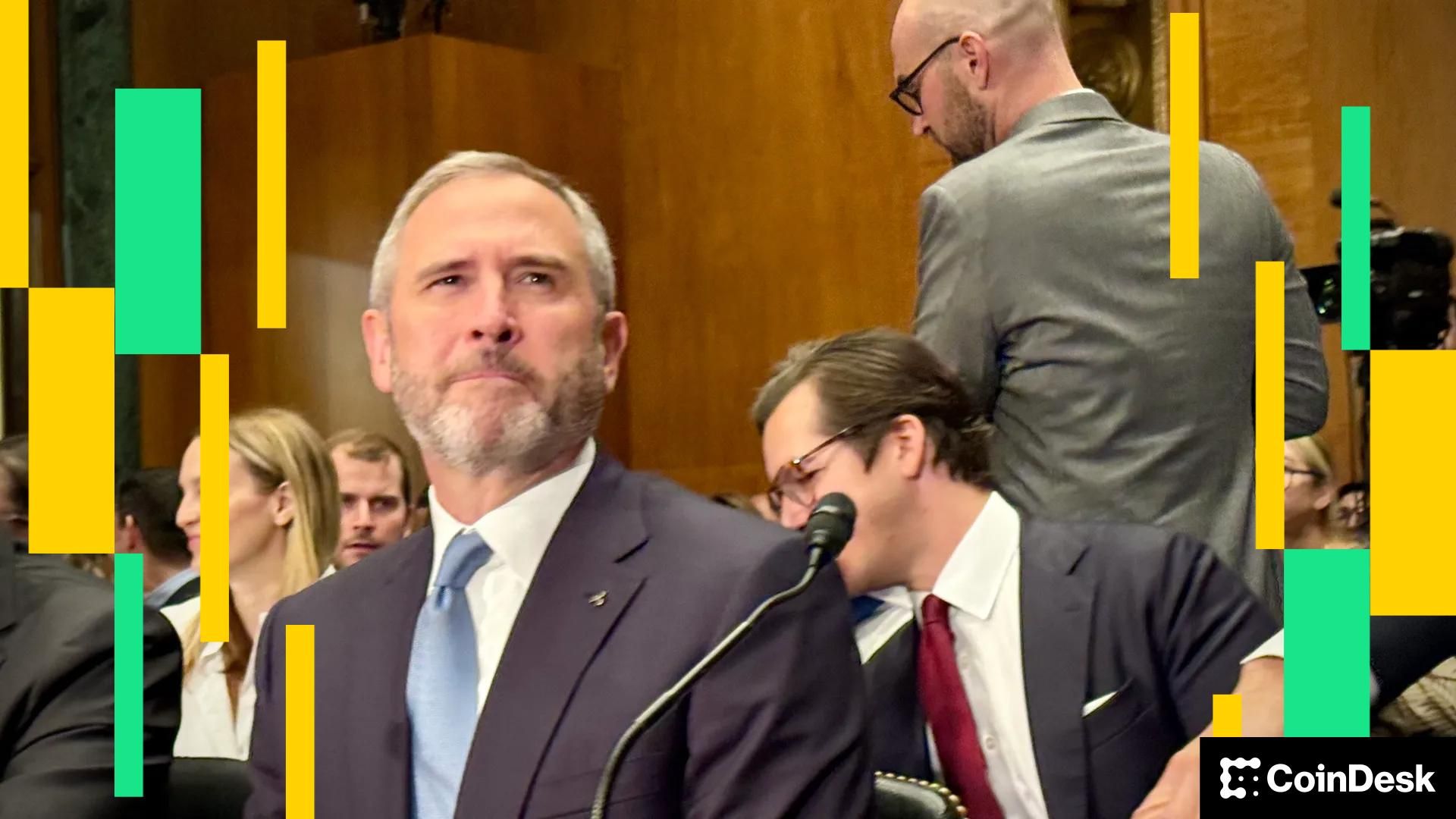
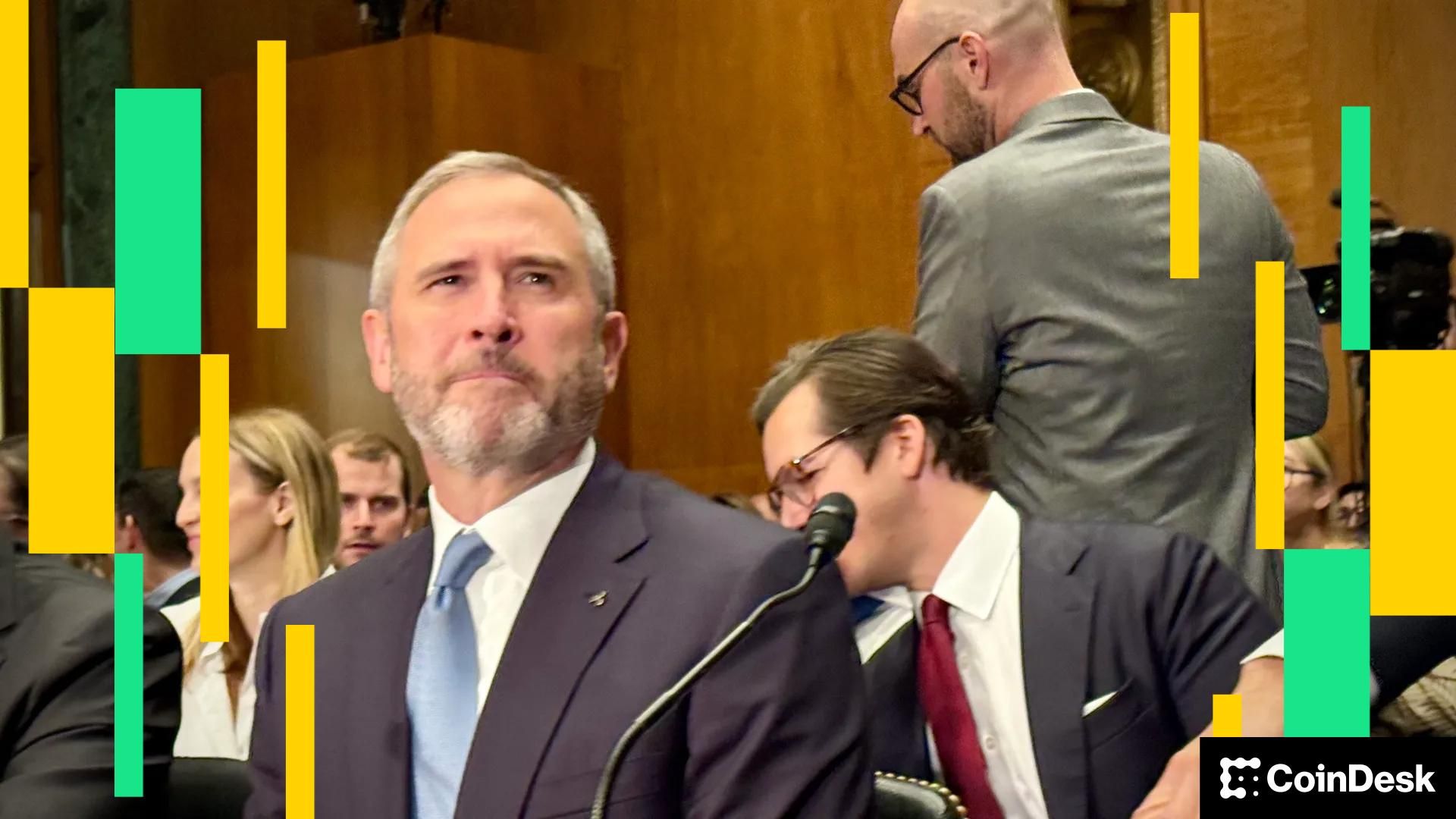
Ripple, the blockchain company closely associated with the XRP Ledger (XRP) network, has begun a share buyback that could value the company at about $50 billion, Bloomberg reported Wednesday.
The blockchain payments firm plans to repurchase up to $750 million in shares from investors and employees through a tender offer expected to run through April, the report said, citing people familiar with the matter.
Ripple is a major contributor to the XRP Ledger network, a blockchain designed for banks and payment firms to move money across borders and settle transfers in seconds. The firm said it has processed over 100 billion in transactions across its payments ecosystem.
The company has been quickly expanding through acquisitions, building services around trading and digital asset infrastructure. That push included the $1.25 billion purchase of prime brokerage Hidden Road and buying corporate treasury business GTreasury for $1 billion. The firm also issues a U.S. dollar stablecoin, the $1.5 billion , via its custody arm.
The move comes after a major funding round just months ago. In November, Ripple raised $500 million at a $40 billion valuation from a group of investors that included funds managed by affiliates of Fortress Investment Group, affiliates of Citadel Securities, Pantera Capital, Galaxy Digital, Brevan Howard and Marshall Wace.
That indicates a 25% higher valuation since the fundraising, despite a crypto market downturn that saw bitcoin and XRP tumble 30%-40% over the same period.

An analysis from WuBlockchain shows basis trade capital at record lows as hedging crowds out leveraged longs, pushing derivatives markets toward an unusual equilibrium.
The crypto derivatives market is sending an unusual signal: directional longs and directional shorts are nearly equal, a condition analysts say is historically unsustainable and could foreshadow a major shift ahead.
According to an analysis published by WuBlockchain yesterday, data from synthetic dollar protocol Ethena’s transparency dashboard reveals that deployed capital, a proxy for excess long demand in futures markets, has fallen to just $791 million, down more than 85% from its all-time high.

Since Bitcoin’s crash to $60,000 on February 8, Ethena’s basis position has shrunk by over 60%, dropping from more than $2 billion to under $800 million, even as the broader market has remained relatively flat.
Ethena operates by taking the short side of perpetual futures contracts against leveraged long traders, effectively running the classic crypto carry trade at scale. When demand for leveraged longs outstrips natural short interest, Ethena steps in to absorb the difference. Its shrinking book, therefore, implies that directional shorts and hedgers are increasingly filling the role that basis traders once dominated.
The author of the analysis, SoskaKyle, attributes the shift largely to a growing wave of hedging activity from crypto VCs and smaller projects seeking to protect their treasuries and lock in gains. With hundreds of small-cap tokens, each backed by dozens of investors and teams needing to manage their runways, the result has been a crowded trade: actively managed structured products that short baskets of correlated assets.
While this near-parity between longs and shorts could theoretically persist, history across asset classes suggests it rarely does for long, leaving the market a potential inflection point.
This article was written with the assistance of AI workflows. All our stories are curated, edited and fact-checked by a human.
Crypto World
Pepeto Price Prediction: Pepeto $7M Raise Looks Fully Priced In While DeepSnitch AI Could Catapult $10,000 Into $1M After March 31 DEX Launch

Ohio hit the prediction markets platform Kalshi with a hefty legal setback, with a federal court denying its injunction against Ohio gambling regulators. The challenges to the CFTC’s claim of exclusive jurisdiction over prediction market contracts. Kalshi will start the appeals process, but the regulatory landscape for prediction markets has become more unclear.
At the same time, the Pepeto price prediction is in focus as presales grow in popularity. However, since meme coins are falling, smart traders are actually opting for substance and are thus choosing DeepSnitch AI.
With a 31 March TGE locked down, $2M being raised, and the utility centered on analytics sourced by five AI agents, the 100x-300x are gaining solid ground, according to DeepSnitch AI’s growing community.

Prediction markets hit a roadblock
US District Court Chief Judge Sarah Morrison denied Kalshi’s request to block Ohio gambling regulators from treating its contracts as unlicensed betting products. The reasoning behind the ruling is that Kalshi didn’t establish that the Commodity Exchange Act preempts Ohio’s sports gambling laws.

The decision splits from a Tennessee federal court ruling issued just weeks earlier. Despite Kalshi’s planned appeal, both rulings directly contradict CFTC Chair Michael Selig’s February claim that the federal regulator holds exclusive jurisdiction over prediction markets.
This is another piece of evidence that regulatory clarity in the US remains fragmented.
At the same time, retail traders are more interested in price action, and with the bear market in full swing, are rotating toward presales. Even though the Pepeto price prediction lends itself well for a quick flip, many are parking their assets in DeepSnitch AI and Bitcoin Hyper as their utility-focused approach could result in larger long-term gains.
Top ICOs to put on your radar
1. DeepSnitch AI: DSNT ticks down to anticipated 100x-300x TGE
DeepSnitch AI raised over $2M at $0.04399 during a bear market, confirmed a March 31 TGE, and shipped a live central intelligence layer ahead of schedule.
That’s three things most presales never manage to do.
Case in point: The Pepeto price prediction may lend itself well for flipping a profit, but the project is a simple meme coin with a cross-chain bridge that may or may not happen after the TGE.
When you compare that to DeepSnitch AI, which practically completed a complex analytics suite running on five AI agents a month ahead of schedule, it’s clear who the hard-hitter is.

The utility itself could land DeepSnitch AI on the list of tools that active traders rely on daily. No surprise, as the solution can do rug detection, track sentiment in real time, conduct instant smart contract audits, or even help you dig out some hidden gems.
The DSNT token will be available via Uniswap post-TGE, but since 100x-300x are quickly stacking up and exclusive DeepSnitch AI bonus codes that unlock extra tokens on purchases are still available, the best time to reserve your spot is now.
2. Pepeto price prediction: Is PEPETO worth it?
Based on the Pepe legacy, Pepeto not only brings the lore, but the team plans to deliver a cross-chain bridge post-launch.
The biggest issue is apparent after a short Pepeto market analysis, though: the coin will likely deflate a few days after the initial hype dies down and large investors take the profits.
This is to be expected as the Pepeto crypto outlook fits the lifecycle of most memes. There’s simply no reason to return to the project as it only offers meme value.
So, is Pepeto a hard pass?
Well, the Pepeto price forecast does maintain that a quick flip is valid, but you have to be realistic about long-term expectations. The token is priced at $0.000000186, and the community-sourced Pepeto price prediction sees the coin going to $0.00007128.
3. Bitcoin Hyper price prediction: Worth the wait?
One of the biggest presale fundraises of the current cycle, Bitcoin Hyper is building a Bitcoin L2 rollup that attempts to solve fee limitations and transaction speeds by implementing the Solana Virtual Machine.
Priced at $0.01367, the community expects the coin to target $0.3482, which is a solid 25x upside.
While Bitcoin Hyper is a much better play than what the Pepeto price prediction describes, it’s not without its flaws. This is primarily limited due to slower development and the lack of confirmed dates despite the whitepaper promising a Q1 mainnet launch.
Final thoughts: Don’t settle for scraps
The Pepeto price prediction may be heaven for traders making scalps, but the DeepSnitch AI presale is nothing short of a project with massive breakout potential.
With the presale closing on March 31, the window to secure your gains is getting smaller. Since you don’t want to miss out on the projected 100x-300x gains and DSNTVIP300 bonus that unlocks a 300% bonus on allocations above $30K, the best time to get on board is right now.
Don’t settle for scraps and secure your spot in the DeepSnitch AI presale ASAP. Keep an eye on the posts on X or Telegram to stay on top of the latest developments.

FAQs
1. How does the Pepeto price prediction stack up against DeepSnitch AI’s March 31 TGE potential?
Pepeto’s community targets of $0.00007128 from $0.000000186 make it a valid flip play, but structurally it’s a one-cycle bet. No recurring utility means no daily retention once the launch hype fades. DeepSnitch AI raised $2M, shipped a live intelligence layer ahead of schedule, and has a confirmed March 31 Uniswap TGE with 100x-300x community projections backed by a platform traders will return to daily. The comparison isn’t close on fundamentals.
2. What does the Ohio court ruling mean for prediction markets and crypto regulation broadly?
Chief Judge Morrison denied Kalshi’s injunction, ruling that the Commodity Exchange Act doesn’t preempt Ohio’s sports gambling laws, which directly contradicts CFTC Chair Selig’s exclusive jurisdiction claim. With a Tennessee court ruling the opposite way just weeks earlier, the regulatory landscape for prediction markets is now actively fragmented.
3. Is Bitcoin Hyper a better long-term play than the Pepeto price prediction suggests for meme coins?
Bitcoin Hyper’s $31.6M raise and 25x community price target of $0.3482 from $0.01367 make it a substantially stronger fundamental play than Pepeto. The Bitcoin L2 thesis is legitimate, and the Solana Virtual Machine integration is technically ambitious. The main risk is the lack of a confirmed TGE date despite the Q1 2026 whitepaper targets.
Disclaimer: This is a Press Release provided by a third party who is responsible for the content. Please conduct your own research before taking any action based on the content.

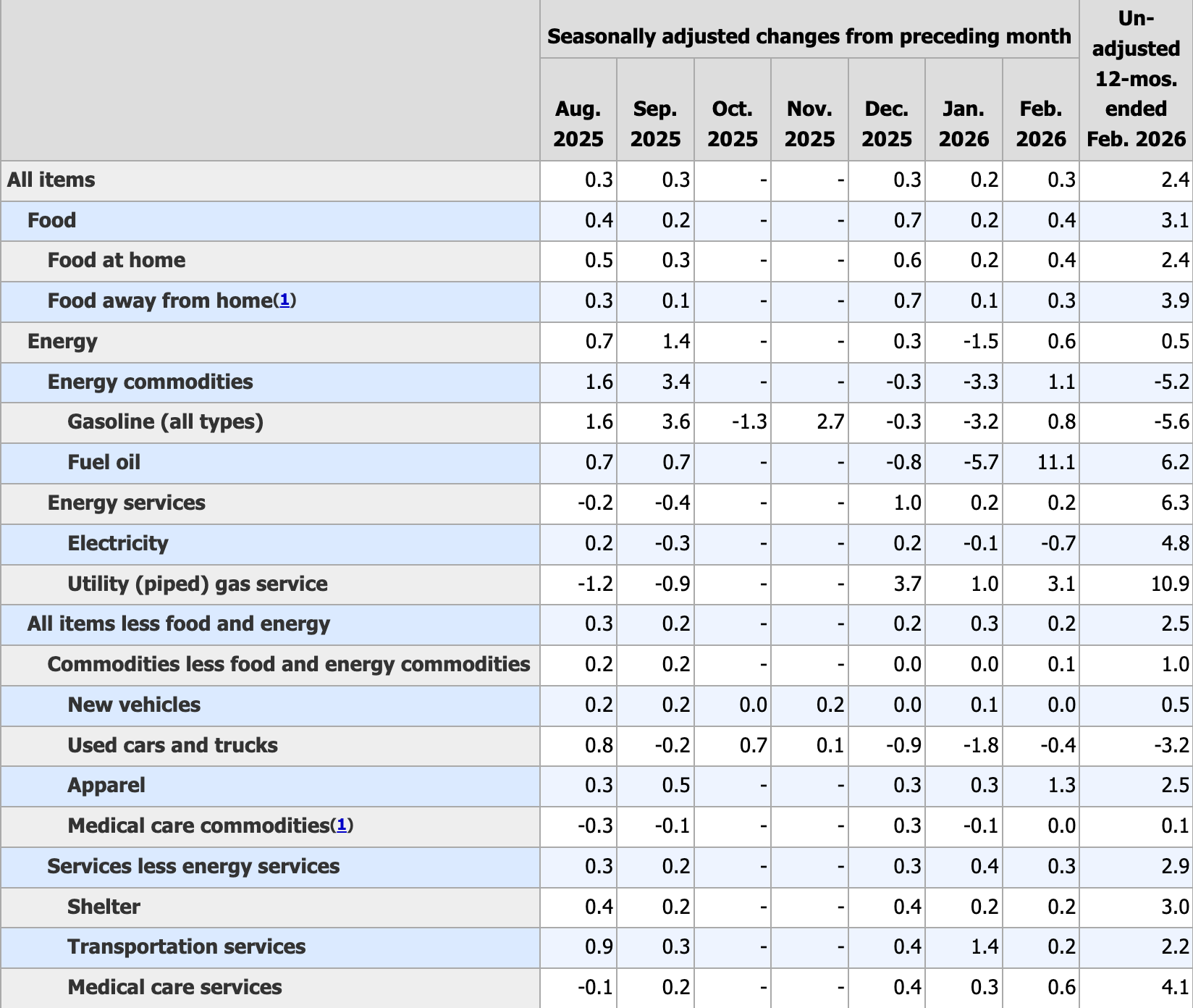
The latest rise in the consumer price index (CPI) was “in line with estimates,” and rising inflation has already been priced into the macroeconomic data for the March CPI print, according to market analysts at exchange-traded product (ETP) issuer 21Shares.
Shelter rose 0.2% in February, while the food sector of the CPI rose 0.4%, energy increased by 0.6%, and the index for all items, excluding food and energy, rose by 0.2%, according to the US Bureau of Labor Statistics (BLS) February CPI report.

Stephen Coltman, head of macro at 21shares, said the upcoming CPI prints place even more pressure on the Federal Open Market Committee (FOMC), the body that decides interest rate policy. He said:
“What matters now is the Fed’s reaction function to the coming higher CPI prints. Do they ‘look through’ this temporary shock despite having been burned in the previous inflation cycle? Or do they tilt hawkish as a precautionary measure?”
Crypto markets remain resilient following the February CPI report, with the Total 3 market indicator, which tracks the entire crypto market capitalization excluding Bitcoin (BTC) and Ether (ETH), only declining by about 1% from the intraday high of about $722 billion.
Related: Finance job openings fall to 13-year low as US economy loses 92K jobs
What does this mean for BTC’s price?
“In the immediate term, Bitcoin is likely to remain rangebound between $68,000 and $74,000. However, a breakout past the $75,000 resistance zone appears imminent,” according to Matt Mena, crypto research strategist at 21Shares.

If BTC manages to break above the $75,000 level, it could enter a consolidation phase between $75,000 and $80,000 in the medium-term, Mena said.
Historic price data shows that BTC typically rebounds by 15% or more after geopolitical market shocks, which would put its price in the $77,000 to $80,000 range, he said.
A market recovery to these levels could also be “accelerated” if the FOMC resumes easing interest rates in 2026, according to Mena.
Only 0.6% of traders expect an interest rate cut from the current 3.50%-3.75% range at the March 18 FOMC meeting, according to the CME FedWatch tool.
Magazine: The debate over Bitcoin’s four-year cycle is over: Benjamin Cowen
Binance.US, the American affiliate of the world’s largest crypto exchange, named Stephen Gregory as CEO, installing a compliance-focused executive at the helm at a time that competition among U.S. crypto trading platforms is accelerating.
Gregory replaced Norman Reed on March 9, the company said in a statement shared with CoinDesk. He was previously U.S. CEO of digital asset platform Currency.com, where he led the firm during its 2025 acquisition by CXNEST. He also held compliance leadership roles at crypto exchanges Gemini (GEMI) and CEX.io.
The leadership change comes as the U.S. crypto exchange landscape is changing. Over the past several months, trading platforms have raced to expand beyond digital assets, adding products such as tokenized stocks, prediction markets and traditional equities trading. Some exchanges have also struck partnerships with major U.S. stock exchanges to explore trading blockchain-based versions of publicly listed shares.
The appointment places a legal and regulatory specialist in charge at a time when U.S. oversight of crypto companies remains a central issue for the industry. Reed will remain with the company in an advisory role.
Gregory said the exchange’s brand remains strong and closely tied to the vision of its founder. “The Binance.US brand is extremely powerful,” he told CoinDesk, noting that its owner, Changpeng “CZ” Zhao, has “continuously advocated to make the U.S. the crypto capital of the world.” He said he plans to guide the company into its next phase while building on that foundation. Gregory added that by focusing on innovation for customers, Binance.US is positioned to take advantage of emerging opportunities and expand access to decentralized finance and a broader “tokenized value ecosystem.”
Binance’s global platform remains the largest cryptocurrency exchange in the world by a wide margin. The exchange recorded nearly $10 billion in trading volume over the past 24 hours, more than five times the volume of rival Coinbase (COIN), according to CoinGecko data.
The company said it plans to expand several parts of its business under Gregory’s leadership. In the past year, it has introduced products including Boost, staking services and a revamped referral program. It plans to expand its “Earn” suite and build new gateways connecting users to decentralized finance and tokenized assets.
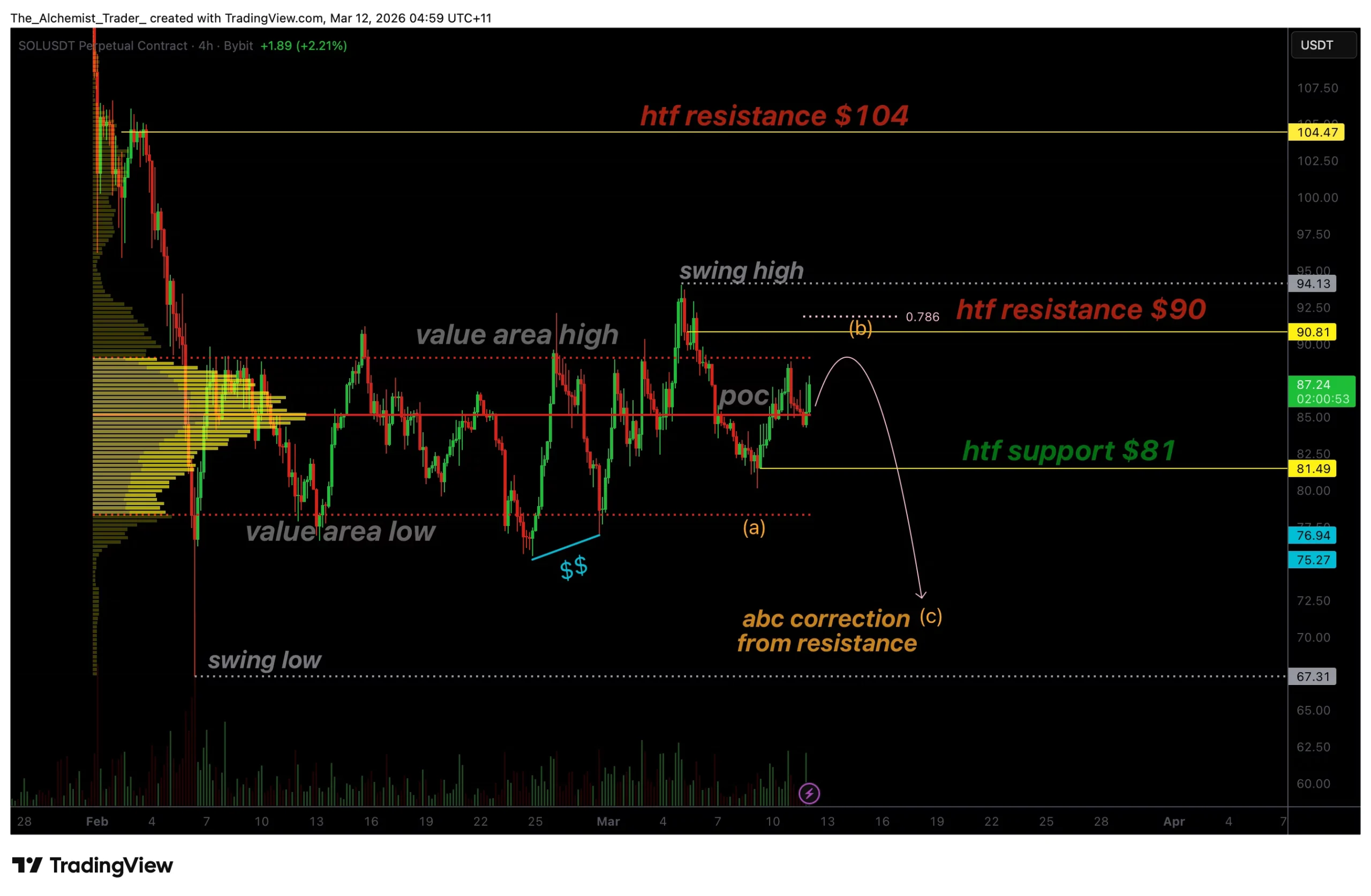
Solana price approaches $90 resistance with Fibonacci and value area confluence. Failure to reclaim this level could trigger a rotation toward $70 support.
Summary
- Key Resistance: Solana testing $90 range-high with 0.618 Fibonacci confluence.
- Bull Trap Risk: Rejection could trigger liquidity sweep below $81.
- Downside Target: Range rotation may extend toward $70 value area low and $67 swing support.
Solana (SOL) price is approaching a critical technical inflection point as price rallies toward the $90 resistance level, an area where multiple technical indicators converge. After recovering from recent lows, the asset is now testing the upper boundary of its trading range, raising questions about whether the rally can continue or if another rejection will occur.
The $90 level represents a significant barrier for Solana because it aligns with several key technical indicators, including the 0.618 Fibonacci retracement, the value area high, and the upper boundary of the current ABC corrective structure.
When multiple indicators converge at a single price level, they often create strong zones of resistance where selling pressure may re-enter the market.
Solana price key technical points
- Key Resistance: Solana approaching $90 range-high resistance with Fibonacci confluence.
- Liquidity Target: Failure at resistance could trigger a move below $81 support.
- Major Support: Value area low sits near $70, with deeper support near $67.
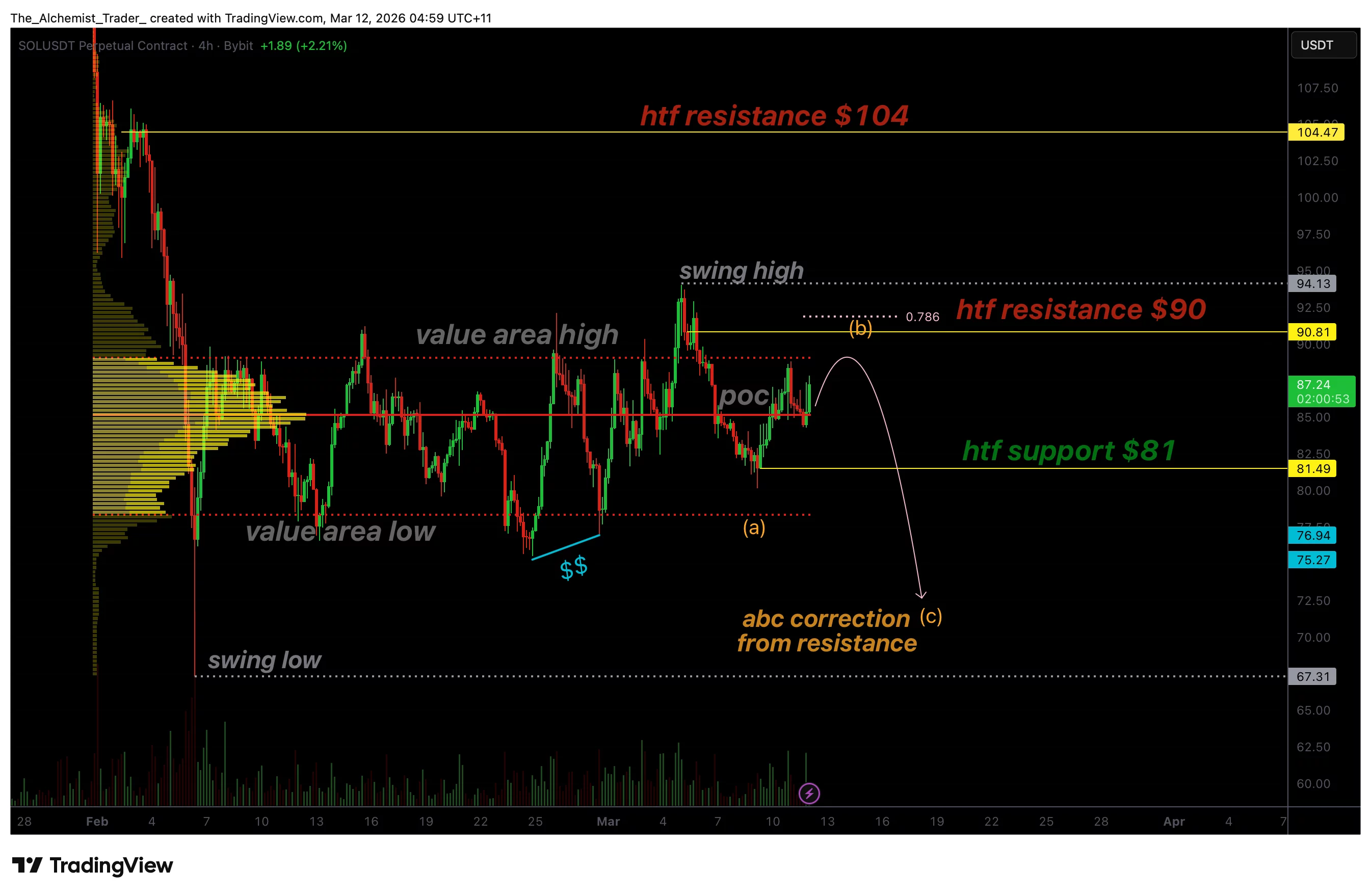
Solana’s recent price action has unfolded within a broader corrective structure following a decline from its previous swing high. The current recovery move is best interpreted as part of an ABC corrective rally, where price temporarily rebounds before potentially continuing the broader consolidation phase.
Within this structure, the $90 resistance zone represents the most important level currently visible on the chart. This region has developed into a strong confluence area where several technical indicators overlap. The 0.618 Fibonacci retracement, widely regarded as a key retracement level in technical analysis, aligns closely with the value area highand the upper boundary of the current corrective structure.
These overlapping indicators create a cluster of resistance that may act as a final barrier preventing price from moving higher. When markets approach such areas without strong buying momentum, they often experience rejection as sellers begin defending the level.
Another important element to consider is the liquidity structure surrounding Solana’s current trading range. Financial markets frequently move toward areas where liquidity is concentrated, as these zones allow larger participants to execute positions more efficiently.
Meanwhile, Nasdaq-listed Solmate Infrastructure has announced plans to develop a Solana infrastructure hub in the United Arab Emirates as part of a broader corporate restructuring and capital overhaul, highlighting growing institutional interest in the ecosystem.
Below the current price action, significant liquidity rests around the value area low and nearby support levels. If Solana fails to break above the $90 resistance, the market may rotate lower to target these liquidity zones. One of the first key levels to watch in this scenario would be the $81 region, where short-term support has previously formed.
A rejection at resistance could trigger a deeper corrective move, pushing price below this level as the market searches for stronger support. In range-bound environments, this type of rotational behavior is common, as price moves between areas of high and low value.
Should selling pressure increase, Solana could eventually test the value area low near $70, which represents the lower boundary of the current trading range. This level previously acted as a strong support zone where buyers entered the market, preventing further downside expansion.
If the value area low fails to hold, the next key technical level would be the swing low near $67, which would represent the final major support within the current structure. A move toward this level would complete the broader corrective rotation within the range.
This development comes as Western Union is expanding its presence in blockchain payments through a new stablecoin initiative tied to the Solana network, reflecting increasing institutional activity within the ecosystem.
From a market structure perspective, Solana remains in a corrective phase as long as price stays below the $90 resistance level. Without a strong breakout above this zone accompanied by increasing trading volume, the probability continues to favor further consolidation rather than a sustained bullish trend.
What to expect in the coming price action
Solana is now approaching a decisive resistance level near $90, where several technical indicators converge. If the market fails to reclaim this area, the rally could develop into a bull trap, triggering a rotational move lower toward $81 supportand potentially the $70 value area low.
A break below that level would expose the next major downside target near $67, while a confirmed breakout above $90 would invalidate the bearish scenario and open the door for further upside.


Network News
ETHEREUM FOUNDATION STARTS EXPERIMENTING WITH DVT-LITE TECH: The Ethereum Foundation is testing a method for running validators that could make it significantly easier for institutions holding large amounts of ether to set up staking infrastructure, widening the pool of participants and creating a more decentralized network. In a post on X, blockchain co-founder Vitalik Buterin said the foundation is using a simplified version of distributed validator technology, or “DVT-lite,” to stake 72,000 ETH. The experiment aims to make running validators across multiple machines less complicated. Buterin said the goal is to reduce the process to something close to a one-click setup, where operators choose which computers will run validator nodes, launch the software and enter the same key on each machine. The system would then automatically connect the nodes and begin staking. “My hope for this project is that we can make it maximally easy and one-click to do distributed staking for institutions,” Buterin wrote. Running Ethereum validators today typically means operating a single node that holds the key used to sign blocks and participate in the network. If that machine fails or goes offline, the validator can stop working and may be penalized. Distributed validator technology (DVT) changes that by allowing multiple independent machines to collectively act as a single validator. Instead of relying on one key and one computer, several nodes work together, and only a handful of them sign for the validator to function. That means the validator can keep operating even if some machines go down. But existing DVT systems can be complicated to deploy because operators must coordinate networking, keys and communication between nodes. Buterin has previously argued that complexity is one reason large staking providers have come to dominate the ecosystem. The “DVT-lite” setup aims to automate much of that process, making it easier for institutions to run distributed validators with minimal infrastructure expertise.— Margaux Nijkerk Read more.
NVIDIA SHARES AI CREATES JOBS IN RARE BLOG: The AI jobs debate got its sharpest rebuttal yet, from the person selling the hardware. Nvidia CEO Jensen Huang published a rare standalone essay laying out what he calls the “five-layer cake” of AI infrastructure: energy at the base, then chips, then physical infrastructure, then models, then applications. It positioned AI not as a software product or a chatbot but as an industrial buildout on the scale of electrification, one that requires trillions of dollars in physical construction and a massive workforce of electricians, plumbers, pipefitters, steelworkers, and network technicians. “These are skilled, well-paid jobs, and they are in short supply. You do not need a PhD in computer science to participate in this transformation,” he said. Huang’s argument for why the buildout needs to be so large starts with a fundamental shift in how computing works. Traditional software retrieves stored instructions, while AI generates new outputs in real time, with every response created fresh based on the context provided. It isn’t looking up an answer, but instead, reasoning through one on demand. Because intelligence is produced in real time, the entire computing stack beneath it has to be reinvented, which is why AI requires purpose-built infrastructure from the energy layer up rather than running on existing data centers. The timing is pointed. The essay arrives after weeks of mounting anxiety about AI’s impact on employment, from Block Inc.’s mass layoffs to Anthropic CEO Dario Amodei’s comments about job displacement. Tech stocks had been selling off on the combination of those fears since early this year. — Shaurya Malwa Read more.
AAVE SEES RARE $27M IN LIQUIDATIONS DUE TO PRICE GLITCH: About $27 million was liquidated on the decentralized lending platform Aave over the last 24 hours, in what some market participants say may have been caused by a temporary pricing issue involving the token wstETH. Blockchain data flagged by risk-management firm Chaos Labs shows a spike in liquidations in the past 24 hours. Some observers believe the event may have been linked to a price update in a risk-oracle system that Aave uses to determine the value of collateral. Oracles are services that feed price data from the outside world into blockchain applications. Lending protocols like Aave rely on them to decide when a borrower’s collateral is no longer sufficient to back their loan — at which point the position can be liquidated. While such scenarios are rare, most recently, a price-oracle setup misconfigured by DeFi lender Moonwell briefly valued Coinbase Wrapped ETH (cbETH) at about $1 instead of roughly $2,200, leaving the protocol with nearly $1.8 million in bad debt. In Aave’s case, some say the issue may have involved wstETH, a token issued by Lido that represents staked ether. Because it accrues staking rewards over time, one wstETH is typically worth slightly more than one ETH. According to a post from LTV Protocol on X, at the time of the liquidations, Aave’s risk-oracle appeared to value wstETH at roughly 1.19 ETH, while the broader market valued it closer to 1.23 ETH. Volume remained relatively low for wstETH trading pairs, with just $10 million being traded over the past 24 hours, so it is unlikely any astute traders capitalized on the pricing mismatch before it snapped back. Stani Kulechov, the founder and CEO of Aave Labs, said in a post on X that there “was no impact to the Aave Protocol.” According to Chaos Labs, the incident was caused by a mismatch between stale parameters stored in a smart contract, including a reference exchange rate and its associated timestamp. Because those values were not updated in sync, the CAPO system temporarily calculated a maximum allowed exchange rate that was lower than the real market value of wstETH. — Margaux Nijkerk Read more.
PUDGY PENGUINS LAUNCHES ITS WEB3 GAME: Pudgy Penguins shipped its flagship game to the general public, and the most notable thing about it is that you wouldn’t know it had anything to do with crypto unless someone told you. Pudgy World, the browser-based game first announced at Art Basel in late 2023, went live with 12 unique towns across a world called The Berg, narrative quests where players help a penguin named Pengu find someone named Polly, and a set of mini-games. CoinDesk played a 10-minute session and came away with a simple takeaway. It’s smooth, responsive, intuitive, and clearly not built with a crypto-first user in mind. “We created custom world-building tools using open-source web technology, giving us a lightweight editor built for speed and rapid iteration,” co-founder @chefgoyardi said in an X post. “Our asset pipeline lets artists work in Maya, Cinema4D, or Blender while custom Houdini scripts automatically convert everything into a web-optimized format. Creative freedom without compromise.” “We engineered physics specifically for the browser. Snappy movement, parkour, fluid navigation, and high frame rates even on lower-end devices,” they added.The game could be pure Club Penguin nostalgia for some users. The game was Disney’s browser-based virtual world that ran from 2005 to 2017 and peaked at over 200 million registered users, mostly kids who customized penguin avatars and played mini-games. It remains the template for what a mass-market Penguin game looks like, and the comparison Pudgy World could be measured against in the broader audience. The NFT gaming space has spent years producing products that feel like wallets with gameplay bolted on. Pudgy World goes the other direction, building something that works as a game first and connects to the token economy second. — Shaurya Malwa Read more.
In Other News
- Mastercard has launched a new Crypto Partner Program that brings together more than 85 companies from across the digital asset and payments industries, an effort to more directly link blockchain technology with the infrastructure that underpins global commerce. The program includes crypto exchanges, blockchain developers, fintech firms and banks such as Binance, Circle, Ripple, Gemini, PayPal and Paxos, the company told CoinDesk in a statement. Participants will work with Mastercard to explore how blockchain-based systems can connect with traditional payment rails used by banks, merchants and consumers around the world. Mastercard said the initiative focuses on practical use cases where digital assets are already gaining traction, including cross-border transfers, business-to-business payments and global payouts. For payment companies like Mastercard, the challenge is less about replacing existing systems and more about connecting new ones to the networks that already handle global commerce. Mastercard’s network links banks, merchants and consumers in more than 200 countries and territories. The company argues that blockchain-based payments will only scale widely if they can plug into that kind of global infrastructure.The Crypto Partner Program is designed to create that bridge. Companies in the program will work with Mastercard teams to help shape products that combine on-chain tools — such as programmable payments or tokenized assets — with established payment rails. — Helene Braun Read more.
- Foundry Digital, one of the largest Bitcoin mining pools by hashrate, said it plans to introduce a zcash (ZEC) mining pool by next month, expanding beyond BTC and bringing a large institutional operator into the privacy-focused network. With the new pool, Foundry aims to offer zcash miners a U.S.-based platform designed around compliance checks, reporting standards and operational controls often required by public companies and large firms. The move addresses what Foundry describes as a gap in Zcash infrastructure. While the cryptocurrency has existed for nearly a decade, much of its mining ecosystem still consists of smaller global pools that often operate outside formal compliance frameworks. “Zcash has matured into an institutional-grade asset, but the mining infrastructure supporting it hasn’t kept pace,” Foundry CEO Mike Colyer said in a statement shared with CoinDesk. The expansion comes as privacy-focused cryptocurrencies regain attention across the market as new crypto tax reporting rules, with the threat of asset seizure, kicked in across the European Union at the turn of the year and as onchain analysis keeps developing, leading to growing demand for financial anonymity. — Francisco Rodrigues Read more.
Regulatory and Policy
- Binance filed a defamation lawsuit against Dow Jones, the publisher of The Wall Street Journal, on the same day the newspaper published a report claiming the U.S. Justice Department is investigating whether Iran used the world’s largest crypto exchange to move funds in violation of American sanctions. In the complaint filed in the U.S. District Court for the Southern District of New York, the company said the newspaper published “false and defamatory statements” about its compliance practices and handling of Iran-linked transactions in an article published on Feb. 23. In that article, the Journal said Binance fired staff who flagged funds moving through the exchange to sanctioned entities, allegations Binance rejected. The lawsuit says Binance did not fire employees for raising compliance concerns. Staff departures stemmed from alleged breaches of internal data protection policies rather than retaliation, it said.”Binance categorically did not dismantle any compliance investigation,” a spokesperson for the exchange told CoinDesk. “The WSJ continues to report the same falsities. As a result, we have filed a lawsuit against the Wall Street Journal for defamation.” — Francisco Rodrigues Read more.
- Sen. Adam Schiff (D-CA) has introduced proposed legislation that would ban prediction market contracts tied to terrorism, war, assassination, and death, directly challenging market regulator CFTC’s shift toward looser regulation of event trading. The bill, dubbed the DEATH BETS Act, would strip the agency of discretion over whether to permit such contracts and write explicit prohibitions into law, putting Schiff on a collision course with CFTC Chair Mike Selig’s deregulatory agenda. Schiff, a member of the Senate Agriculture Committee that oversees the CFTC, is positioned to press the issue legislatively as the agency’s new rule-making takes shape. Under the Commodity Exchange Act, the CFTC already has authority to block contracts tied to war, terrorism, or assassination if it determines they are contrary to the public interest. But enforcement hinges on the regulator’s judgment, meaning the scope of protection shifts with agency leadership. Schiff’s bill would eliminate that flexibility. — Sam Reynolds Read more.
Calendar
- Mar. 24-26, 2026: Digital Asset Summit, New York City
- Mar. 30-Apr. 2, 2026: EthCC, Cannes
- Apr.15-16, 2026: Paris Blockchain Week, Paris
- Apr. 29-30, 2026: Token2049, Dubai
- May 5-7, 2026: Consensus, Miami
- Sept. 29-Oct.1, 2026: Korea Blockchain Week, Seoul
- Oct. 7-8, 2026: Token2049, Singapore
- Nov. 3-6, 2026: Devcon, Mumbai
- Nov. 15-17, 2026: Solana Breakpoint, London
Welcome to our institutional newsletter, Crypto Long & Short. This week:
- Sylvia To on AI agents choosing denationalized money
- Top headlines institutions should pay attention to by Francisco Rodrigues
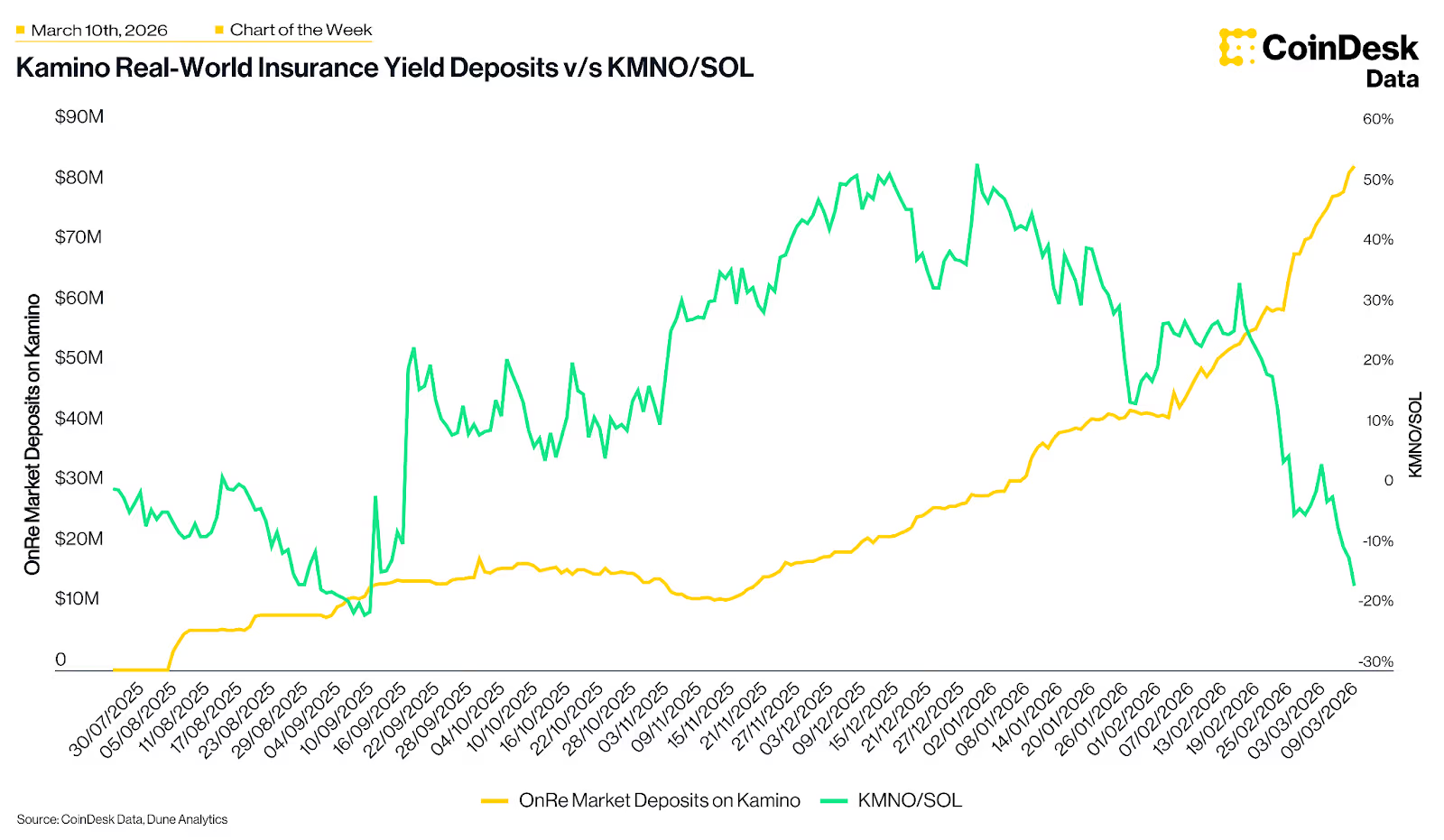
- Kamino hits $90M in OnRe liquidity while $KMNO drops 16% in Chart of the Week
Thanks for joining us!
Expert Insights
Hayek predicted it, Satoshi built it, agents will use it: the stealth denationalization of money
– By Sylvia To, vice president, Bullish Capital Management
While F.A Hayek, Satoshi and AI may seem like three unrelated topics, the next few minutes will reveal exactly how critical this triad is to our financial sovereignty and it will fundamentally change your view on money as we know it.
Crypto’s cypherpunk ethos
Amid flashy distractions of memecoins, speculation and NFTs, Satoshi would want us to remember the true ethos of crypto, that is: privacy, decentralization and censorship resistance. These ideologies did not come from central banks or policy makers. They came from the cypherpunk’s definition that freedom is best defended not by persuasion but by architecture.
As Vitalik Buterin recently articulated in his March 2026 thread on X, this means building “sanctuary technologies” that create “shared digital space with no owner,” enabling “interdependence that cannot be weaponized” and advancing “de-totalization” to prevent total control by any power.
Money should be a product, not a decree
In 1976, Hayek argued that money should not be “legal tender” forced on people by the state. It should be discovered, adopted and discarded through market choice like any other product. His book Denationalisation of Money outlined these characteristics of “good money”:
• Non-state issuance: not decreed, not voted, not bail-out-able.
• Rule-based monetary policy: predictable supply schedule, not discretionary.
• Global choice: adoption is voluntary; anyone can opt in or out.
• Resistance to capture: no central issuer to pressure, no board to replace.
• Settlement without permission: value transfer doesn’t require institutional approval.
Sound familiar? Yes, Bitcoin.
Bitcoin sits in a special category inside that experiment. Not because it’s perfect today, but because it is plausibly the first monetary network to meet Hayek’s central requirement. That is money introduced by some pathway that cannot easily be stopped. As Bitcoin undergoes price discovery, its volatility is the cost of birth and the market deciding what an ungoverned, credibly scarce asset is worth in a world trained for fiat. But even in that turbulent phase, Bitcoin checks a surprising number of Hayek’s boxes.
The trojan horse: stablecoins and the trap inside it
If we’re honest, stablecoins are currently one of crypto’s most successful use cases. They are fast, programmable and easy to price. They move across borders with far less friction than bank wires.
But here’s the uncomfortable truth: stablecoins don’t denationalize money. They digitize the existing national money and extend its reach. Most stablecoins do not compete with the dollar. They import the dollar.
The dollar is a tool of state policy. Pegging to it ties you to its inflation, its surveillance, its sanction regime, its banking chokepoints and its regulatory priorities. Stablecoins may feel like freedom because they move on open networks, but their reference asset is still the same old sovereign instrument.
So while stablecoins can be useful, they also risk becoming the perfect bridge into tighter control. In that sense, stablecoins are not neutral. They are a competitor to decentralized currencies. If bitcoin is denationalization, stablecoins are nationalization with better UI.
The real end user
Here’s where the story gets more interesting and more Hayekian.
Humans are emotional, irrational, politically driven and short-term oriented. Our monetary systems reflect that. We routinely trade long-term stability for short-term relief, then act surprised when crises compound.
But what happens when most of the participants in the economy aren’t humans?
With the meteoric rise of agentic software, and apps increasingly being designed for agents using frameworks like Model Context Protocol (MCP), there is a credible near-term future where autonomous agents purchase services, data, compute, API calls, storage, inference and specialized tools through continuous micropayments.
Agents will care less about branding and narratives and more about properties like:
• machine-readable transaction metadata
• instant, programmable finality
• composability with other systems
• low transaction overhead
• censorship resistance (because uptime is a feature)
• predictable monetary rules (because models optimize against them)
In other words: agents will gravitate toward money that behaves like good infrastructure. A stablecoin is stable because an issuer maintains a peg. An agent might ask: What is the failure mode of the issuer? What is the policy risk? What is the censorship risk? What is the settlement risk under stress? Bitcoin’s value may fluctuate, but its rule set is unusually legible. Its issuance is not negotiated. Its core properties do not depend on a board decision, a regulator’s discretion or the solvency of a nation.
Maybe humans won’t choose the best money because we’re too entangled in politics, habit and fear.
Maybe Hayek’s “new money” was never meant for humans — at least not first.
Maybe the pathway that governments “can’t stop” isn’t a mass political movement.
Maybe it’s AI agents who operate at machine speed, indifferent to national identity, optimizing for reliability, who can be the deciders of the new monetary rails.
When that tipping point arrives, denationalization of money won’t feel like a philosophical triumph. It will be an inevitable engineering outcome, propelled not by ideology, but by raw machine necessity.
When that tipping point arrives, denationalization of money won’t feel like a philosophical triumph. It will be an inevitable engineering outcome, propelled not by ideology, but by raw machine necessity.
Headlines of the Week
– By Francisco Rodrigues
Traditional finance giants, including the owner of the NYSE, ICE, and Morgan Stanley, have kept on making strategic moves in the crypto space, while regulatory milestones like Kraken securing Fed access signal the industry’s path toward mainstream integration.
- NYSE owner invests in crypto exchange OKX at $25 billion valuation: Intercontinental Exchange, the parent company of the New York Stock Exchange, acquired a minority stake in crypto exchange OKX, valuing the firm at $25 billion. ICE will license OKX’s spot crypto prices to launch crypto futures, while OKX will offer ICE futures and tokenized equities to its customers.
- Morgan Stanley names Coinbase and BNY as custodians in proposed bitcoin ETF filing: The Wall Street giant updated its S-1 filing for a proposed spot bitcoin ETF, designating BNY as administrator and cash custodian and Coinbase Custody as the crypto custodian.
- Kraken becomes first crypto company to secure Fed master account access: The approval lets Kraken speed up deposits and withdrawals for large traders and institutional clients, but is limited, with Kraken not earning interest on reserves or accessing the Fed’s emergency lending.
- Kazakhstan central bank to invest $350 million worth of gold, forex reserves into digital assets: The strategy will focus on shares of high-tech and cryptocurrency infrastructure companies, as well as crypto-linked index funds.
- Billions in crypto are moving in Iran. Analysts can’t agree if it’s war-time panic or business as usual: When airstrikes hit Iran on Feb. 28, crypto outflows from Nobitex spiked 873%, suggesting a “digital bank run” was ongoing. The reality may be more complex.
Chart of the Week
Kamino hits $90M in OnRe liquidity while $KMNO drops 16%
Kamino’s OnRe market has increased 80% to nearly $90M in 30 days, cementing its position as the primary liquidity layer for OnRe’s on-chain reinsurance protocol. This growth allows users to bet on a $480B+ real-world vertical by using $ONyc- a tokenized insurance asset – as collateral.
However, this fundamental RWA scaling sharply diverges from the native $KMNO token; the KMNO/SOL pair has dropped 16% over six months, pressured by a broader market downturn and 13M monthly token unlocks (0.13% of total supply).

Listen. Read. Watch. Engage.
Looking for more? Receive the latest crypto news from coindesk.com and explore our robust Data & Indices offerings by visiting coindesk.com/institutions.
Note: The views expressed in this column are those of the author and do not necessarily reflect those of CoinDesk, Inc., CoinDesk Indices or its owners and affiliates.
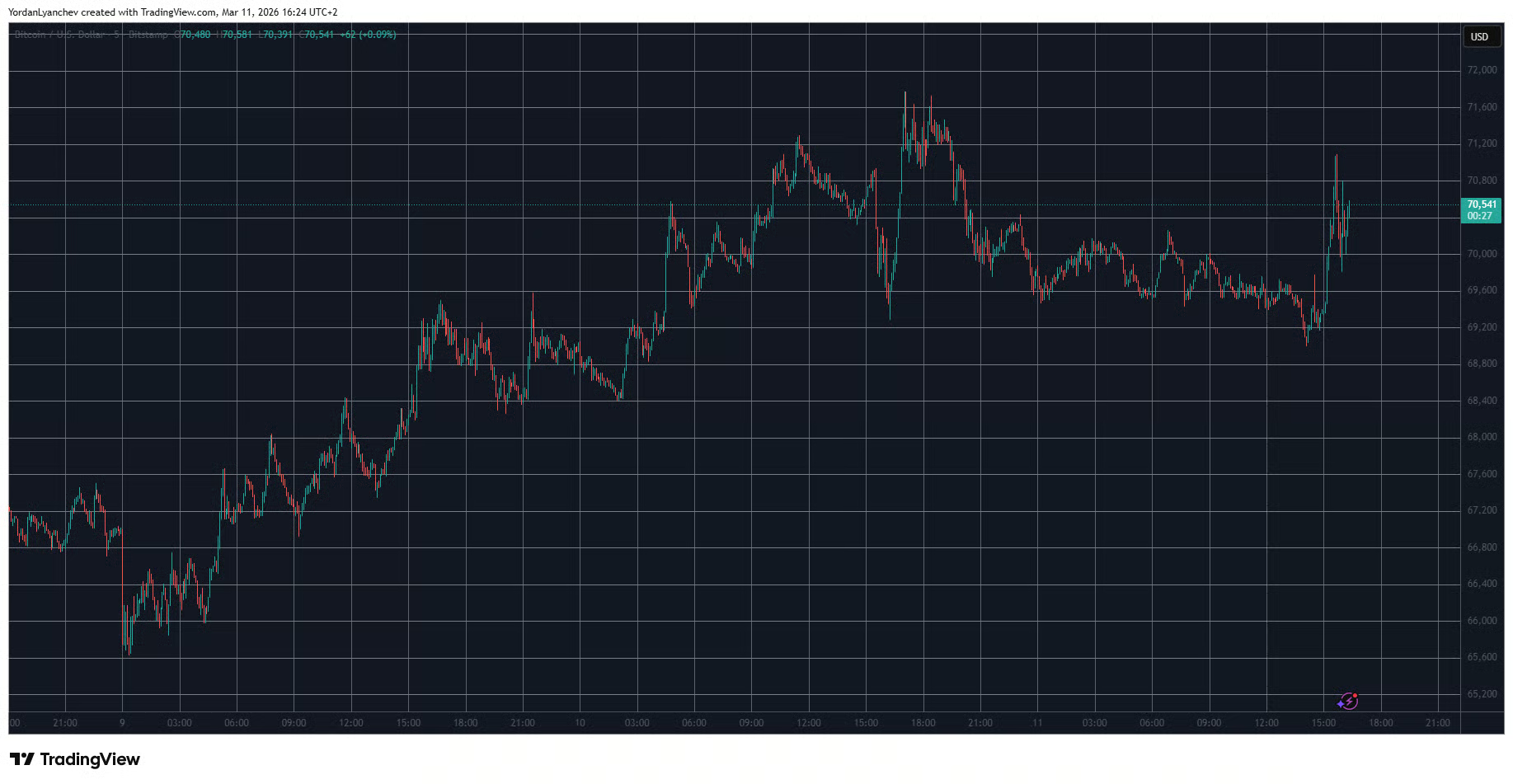
The other reason behind BTC’s latest volatile session could be linked to the recently released CPI numbers for February.
US President Donald Trump continues to comment on the quickly escalating tension in the Middle East, suggesting once again that the war could be over soon.
Bitcoin’s price experienced immediate volatility after his remarks became viral on social media.
TRUMP SAYS ‘NOTHING LEFT TO TARGET’ IN IRAN WAR
Donald Trump told Axios the conflict with Iran will end “soon” because there is “practically nothing left to target.” He added, “Any time I want it to end, it will end.”
U.S. and Israeli officials, however, plan at least two more…
— *Walter Bloomberg (@DeItaone) March 11, 2026
This is Trump’s second similar claim in the past few days, after he noted on Monday that the war “is very complete, pretty much.” However, his statements are not supported by some country officials as well as its partner in this case, Israel.
Walter Bloomberg’s report indicated that the two countries plan “at least two more weeks of strikes.” Additionally, the situation lastly escalated after the US started reporting that Iran had put mines in the Strait of Hormuz.
The US military has destroyed at least 16 mine-laying boats in the region, but officials have asserted that “it’s unclear how many mines Iran has deployed.”
Bitcoin traded at $69,200 before Trump’s statement went live, but skyrocketed by almost two grand instantly. Although it was stopped at $71,100, it still trades above $70,000 as of press time.
You may also like:
There’s another possible reason behind BTC’s volatility. As reported a few hours ago, the US CPI data for February was released, and it matched expectations. However, bitcoin remained relatively calm in the first 90 minutes after the news went live, so Trump’s remarks on the war seem to have a more profound impact.

Binance Free $600 (CryptoPotato Exclusive): Use this link to register a new account and receive $600 exclusive welcome offer on Binance (full details).
LIMITED OFFER for CryptoPotato readers at Bybit: Use this link to register and open a $500 FREE position on any coin!

TLDR
- Wells Fargo filed a U.S. trademark application for the wordmark WFUSD on March 9.
- The USPTO lists the application as live and pending review.
- The filing covers software for digital asset trading, payments, and wallet services.
- It also includes cryptocurrency exchange services and financial data processing.
- The application references tokenization and blockchain-based trading infrastructure.
Wells Fargo & Company has filed a U.S. trademark application for the wordmark “WFUSD.” The filing covers software, trading, payments, and tokenization services tied to digital assets. The United States Patent and Trademark Office lists the application as live and pending.
Wells Fargo Moves to Secure ‘WFUSD’ Trademark
Wells Fargo & Company submitted the trademark application on March 9, according to USPTO records. The filing appeared publicly on the USPTO site early Wednesday. The agency confirmed the application met minimum filing requirements. However, it has not yet assigned an examining attorney.
The application spans three international classes that cover digital asset services. Class 009 includes downloadable software for digital asset trading, payments, and wallet functions. Class 036 covers cryptocurrency trading and exchange services and financial information processing. Class 042 includes software-as-a-service for tokenizing assets and operating blockchain trading infrastructure.
The filing also references software used to process stablecoin transactions. The name “WFUSD” resembles ticker symbols for U.S. dollar-pegged stablecoins. However, Wells Fargo has not issued any public statement about the application.
Filing Aligns with Wells Fargo’s Prior Crypto Activity
Wells Fargo has backed digital asset infrastructure firms in recent years. In February 2020, Wells Fargo Strategic Capital invested $5 million in Elliptic. The blockchain analytics firm counts SBI Holdings and Santander InnoVentures among its investors.
In May 2022, the bank joined a $105 million Series B round for Talos. Citigroup, BNY, and DRW also participated in that funding round. The investment valued Talos at $1.25 billion.
The trademark filing follows commentary from the Wells Fargo Investment Institute. In March 2025, the institute stated that digital assets have “evolved into a viable investment asset.” The report classified digital assets as “part of real assets within an asset-allocation framework.”
The institute also described digital assets as “potential portfolio diversifiers.” The report cited low five- and ten-year correlations with traditional asset classes. It framed digital assets within a broader allocation strategy.
Wells Fargo reported net income of $5.36 billion for the fourth quarter of 2025. The bank posted $1.62 per diluted share during that period. In the same quarter a year earlier, it reported $5.08 billion, or $1.43 per share.
Wells Fargo manages approximately $2.1 trillion in assets. The USPTO currently lists the “WFUSD” application as live and pending. The agency has not yet assigned the filing to an examining attorney.

A ‘weirdly rushed’ appointment – and other key takeaways from Mandelson files

Exodus accelerates as tech titans and companies flee blue states

Ripple share buyback program values the firm at $50 billion: Bloomberg


-
Business5 days ago
Form 8K Entergy Mississippi LLC For: 6 March
-

 Tech7 days ago
Bitwarden adds support for passkey login on Windows 11
-

 News Videos2 days ago
10th Algebra | Financial Planning | Question Bank Solution | Board Exam 2026
-

 Fashion5 days ago
Weekend Open Thread: Ann Taylor
-

 Crypto World2 days ago
Paradigm, a16z, Winklevoss Capital, Balaji Srinivasan among investors in ZODL
-
 Tech12 hours ago
A 1,300-Pound NASA Spacecraft To Re-Enter Earth’s Atmosphere
-
 Sports6 days ago
499 runs and 34 sixes later, India beat England to enter T20 World Cup final | Cricket News
-

 Politics5 days ago
Top Mamdani aide takes progressive project to the UK
-

 Sports4 days ago
Three share 2-shot lead entering final round in Hong Kong
-

 Sports4 days ago
Braveheart Lakshya downs Lai in epic battle to enter All England Open final | Other Sports News
-

 Business1 day ago
ExxonMobil seeks to move corporate registration from New Jersey to Texas
-

 NewsBeat59 minutes ago
Residents reaction as Shildon murder probe enters second day
-

 Entertainment5 days ago
Hailey Bieber Poses For Sexy Selfies In New Luscious Lip Thirst Traps
-

 NewsBeat6 days ago
Piccadilly Circus just unveiled ‘London’s newest tourist attraction’ and it only costs 80p to enter
-

 Business3 days ago
Search for Nancy Guthrie Enters 37th Day as FBI Probes Wi-Fi Jammer Theory
-

 Business12 hours ago
Search Enters Sixth Week With New Leads in Tucson Abduction Case
-
 NewsBeat2 days ago
Pagazzi Lighting enters administration as 70 jobs lost and 11 stores close across Scotland
-

 Tech2 days ago
Despite challenges, Ireland sixth in EU for board gender diversity
-
Entertainment7 days ago
Harry Styles Has ‘Struggled’ to Discuss Liam Payne’s Death
-

 Crypto World7 days ago
New Crypto Mutuum Finance (MUTM) Reports V1 Protocol Progress as Roadmap Enters Phase 3