
Crypto World
dtcpay Raises $10M Series A to Fund European Expansion and Stablecoin Payment Growth


TLDR:
- dtcpay raised $10M in Series A funding led by Temasek-backed Vertex Ventures Southeast Asia & India.
- The company secured a Luxembourg EMI license to offer regulated payment services across the EEA.
- dtcpay holds payment licenses in Singapore, Hong Kong, Australia, the United States, and Canada.
- A Visa partnership in Asia-Pacific gives users access to Infinite and corporate cards for digital and fiat spending.
dtcpay, a Singapore-based digital payments company, has raised US$10 million in a Series A funding round. Vertex Ventures Southeast Asia & India, a Temasek-backed firm, led the investment.
Favour Capital served as the exclusive financial advisor for the round. The funding will support infrastructure development and European market expansion.
Simultaneously, dtcpay announced it has secured an Electronic Money Institution license in Luxembourg, enabling regulated stablecoin and fiat payment services across the European Economic Area.
dtcpay’s Business Model and the Case for Stablecoin Payments
dtcpay was co-founded by Alice Liu and Band Zhao with a focused mandate. The company bridges digital assets with traditional financial systems for everyday use.
Businesses and individuals can accept, store, and transact in stablecoins through its platform. A real-time swap engine enables instant settlement between stablecoins and fiat currencies.
The funding arrives at a turning point for the stablecoin payments sector. Regulatory frameworks are tightening across major economies as compliance demands increase.
Providers must meet higher standards to serve businesses and consumers at scale. dtcpay states it has spent years building infrastructure to meet these requirements.
In the Asia-Pacific market, dtcpay has formed a partnership with Visa. This collaboration includes Visa Infinite cards for individuals and corporate card solutions for businesses.
Both products support transactions in digital assets and fiat currencies. Users benefit from competitive spot rates for their daily spending needs.
Alice Liu, CEO and Co-Founder, outlined the company’s vision for the industry. She said the company aims to build “a platform where faster, safer, and more cost-efficient transactions become the standard for global payments.”
Genping Liu, General Partner at Vertex Ventures Southeast Asia & India, also commented on the investment rationale.
He said the firm sees “significant potential in real-world stablecoin use cases where digital asset infrastructure intersects with regulated financial systems.”
European Licensing Strengthens dtcpay’s Global Regulatory Standing
dtcpay’s Luxembourg EMI license represents a key regulatory achievement for the company. It allows dtcpay to provide regulated payment services across all EEA member states.
This positions the company as a compliant operator within a large, established financial bloc. The license directly supports the European expansion planned with the Series A proceeds.
The Luxembourg license complements an already broad regulatory portfolio held by dtcpay. The company carries a Major Payment Institution license from the Monetary Authority of Singapore.
It also holds licenses and registrations in Hong Kong, Australia, the United States, and Canada. This multi-jurisdictional coverage allows dtcpay to serve clients across diverse global markets.
The new capital will also go toward expanding operations in newly licensed regions. Product enhancements and infrastructure upgrades are among the primary funding priorities.
dtcpay intends to use its Luxembourg EMI license as the gateway for European growth. These steps align with the broader goal of scaling within regulated jurisdictions.
The stablecoin payments sector is attracting growing attention from institutional investors and regulators. dtcpay’s compliance-first model and multi-region licensing position it well for this shift.
Its combination of infrastructure, partnerships, and regulatory coverage sets it apart in the market. The Series A round marks the start of the company’s next phase of international growth.




- Ethereum price was poised above the $2,150 level.
- Bulls were showing resilience as a whale re-accumulated $111 million worth of ETH.
- Another move above $2,000 could push prices towards the $2,500 resistance.
A mysterious Ethereum whale has re-emerged after lying dormant for seven months, and just deployed over $111 million in USDT to accumulate ETH.
The whale’s move came as the ETH price hovered above $2,170 amid a broader slip for cryptocurrencies early Thursday.
As Bitcoin revisited $70,000 support, Ethereum bounced off the crucial $2,150 level, with intraday volume up 39% at over $27 billion.
Ethereum whale spends $111 million to re-accumulate ETH
According to Lookonchain, a whale that exited Ethereum seven months ago as prices jumped towards $4,000 is back.
The mysterious holder has spent 111.62 million USDT to buy 50,706 ETH, executing this fresh buy at an average price of $2,201 per token.
On-chain data shows this purchase mirrors a sale exactly one year prior, when the same address offloaded 28,683 ETH at $3,892 each.
That sale netted $111.62 million, and a re-cumulation worth this exact value highlights a classic “buy-low, sell-high” move.
A mysterious whale returned after 7 months of inactivity and spent 111.62M $USDT to buy back 50,706 $ETH at an average price of $2,201.
1 year ago, this whale sold 28,683 $ETH at an average price of $3,892 for 111.62M $USDT.
What a perfect buy-low-sell-high move!… pic.twitter.com/3F56jkgr2y
— Lookonchain (@lookonchain) March 19, 2026
Waking up after seven months also points to the whale’s positioning amid a potential rebound, and mirrors conviction buys by entities such as Bitmine.
The treasury firm, led by Fundstrat’s Tom Lee, recently bought 60,999 ETH worth over $140.3 million and currently holds 4,595,562 ETH worth over $10.5 billion.
ETH’s rebound above $2,000 coincided with the Ethereum Foundation depositing $7.88 million of the altcoin to Steakhouse, a DeFi asset manager with over a billion dollars in AUM.
The EF currently holds over $400 million of ETH.
Can ETH hold gains above $2,150?
Ethereum’s price rose to highs of $2,386 on Monday, riding a bullish flip that pushed Bitcoin to $76,000.
However, the current price hovers near $2,170, testing support amid Bitcoin’s fresh retest of support around $70,000.
As noted, top coins are retreating as risk assets grapple with global economic headwinds. Inflation and escalating Middle East tensions stand out as key short-term headwinds.
Meanwhile, the technical picture shows ETH hovering near a key support level on the daily chart.
The $2,100 mark currently acts as a pivotal support zone and aligns with a rising trendline.
Prices also track the 50-day exponential moving average, currently acting as resistance near $2,215. This is the hurdle bulls need to surmount for potential upside continuation.

If support holds firm above the aforementioned level, the next target remains $2,400-$2,500. Per the daily chart, the 100 EMA sits at the $2,500 mark.
A breakdown from current levels could allow bears to target $2,000 or lower. Cycle lows near $1,800 offer a robust demand reload zone.
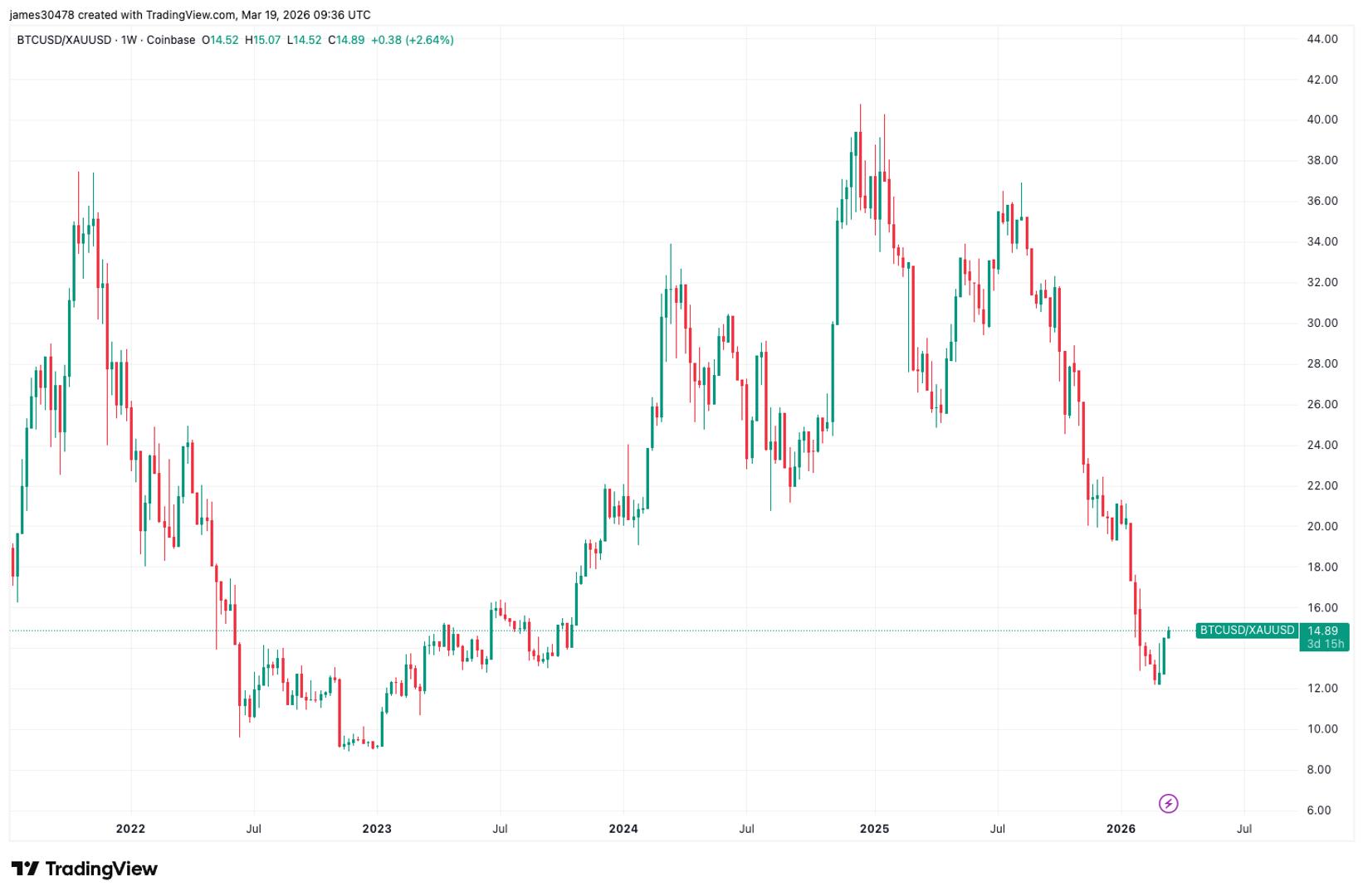
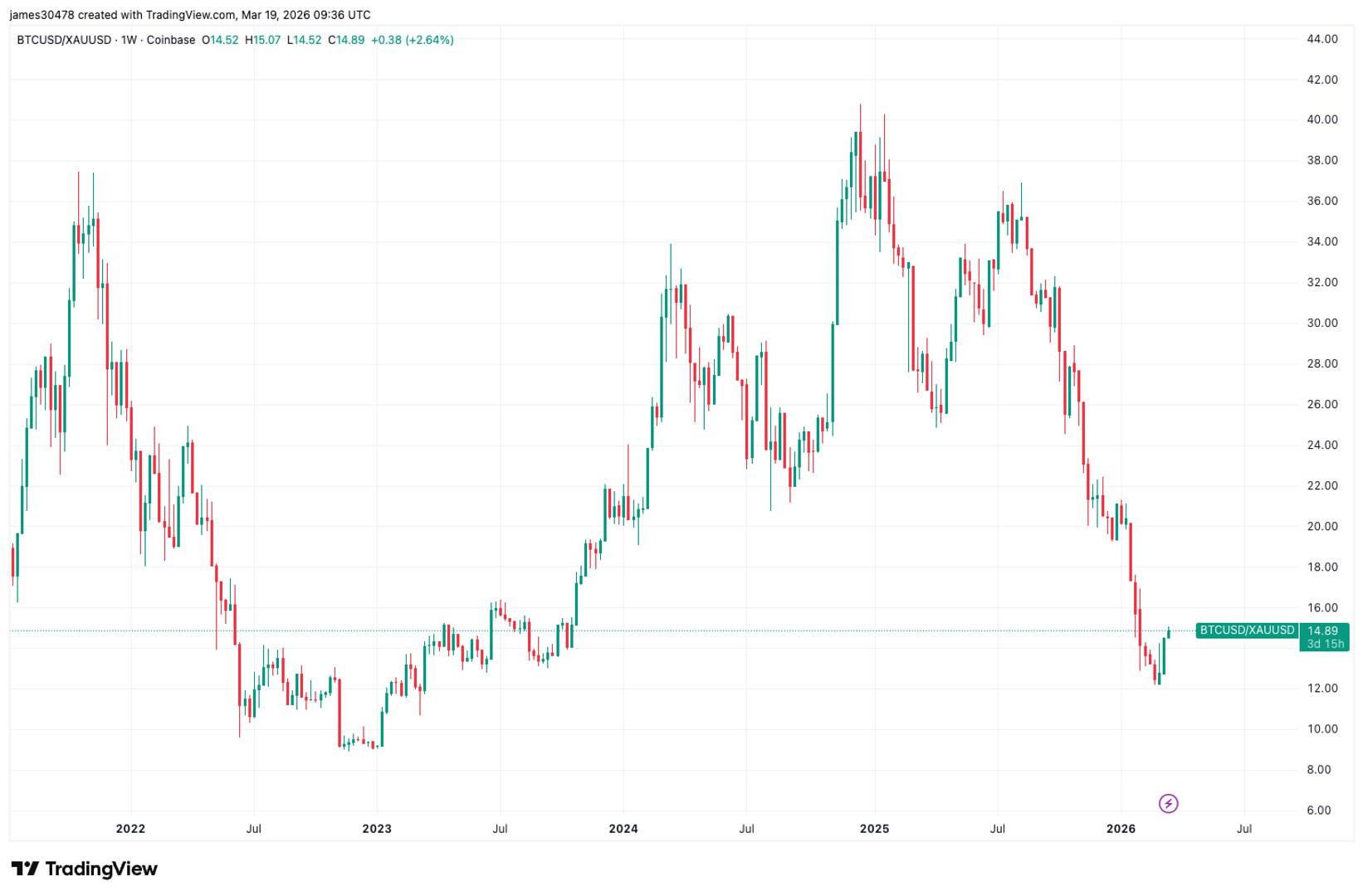
Bitcoin is, unusually, outperforming gold even as rising oil prices and hawkish signals from the U.S. Federal Reserve fuel increased risk aversion in financial markets.
Gold, traditionally a store of value and haven investment in times of trouble, has dropped 2% since midnight UTC while the largest cryptocurrency lost only half that amount. The performance has lifted the ratio between the two by 1% in 24 hours, and one bitcoin now buys about 15 ounces of gold.
Part of the reason for the unexpected trading pattern stems from gold’s surge in February. Before the Middle East conflict started at the end of the month, it had already locked in a 90% gain over the course of a year and was trading at a record high. That left it overbought, making the rally difficult to sustain even as the geopolitical situation worsened.
Since the war began, the performance of bitcoin — seen by some supporters as digital gold — and the precious metal has diverged. Bitcoin has been one of the strongest performing assets outside energy after falling 50% since October and leaving it oversold. Gold is now some 17% below its January peak, edging toward bear-market territory.
The macroeconomic backdrop is adding to the pressure. The Federal Reserve delivered a more hawkish-than-expected tone in Wednesday’s comments, pushing back against market expectations for imminent interest-rate cuts in the world’s largest economy.
This has weighed on risk assets, with U.S. equities lower in premarket trading and the Invesco QQQ exchange-traded fund, which tracks the Nasdaq 100 index, falling 0.5% on Thursday. Crypto-related equities have also declined, with Strategy (MSTR), Galaxy Digital (GLXY) and Coinbase (COIN) all falling in pre-market trading.
At the same time, the war with Iran has pushed Brent crude oil up more than 6% in the past 24 hours to around $117 per barrel. The widening gap between Brent and West Texas Intermediate, now the largest since 2013, signals global supply disruptions and logistical constraints, adding to inflationary pressures and complicating the outlook for central banks.
Fears that quantum computing could one day break Bitcoin’s cryptography have sparked a heated debate across the crypto industry.
But according to Alex Thorn, head of research at Galaxy Digital (GLXY), the narrative that Bitcoin is unprepared, or that investors should avoid exposure because of it, is overstated.
The risk itself is not imaginary. A sufficiently advanced quantum computer could, in theory, derive private keys from exposed public keys, allowing an attacker to forge signatures and steal funds. But Thorn argues that framing this as an imminent or uniquely Bitcoin-specific crisis misses critical context, both about the technology and about the work already underway to address it.
“The risk is real but recognized,” Thorn told CoinDesk in an interview. “And the people best positioned to solve it are actively working on it.”
Quantum computing is a fundamentally different approach to computation that uses the principles of quantum mechanics rather than classical physics. Instead of traditional bits that are either 0 or 1, quantum computers use “qubits,” which can exist in multiple states at once, a property known as superposition, allowing them to process many possibilities simultaneously.
Combined with another feature called entanglement, this enables quantum machines to solve certain complex problems far more efficiently than classical computers, particularly tasks like factoring large numbers that underpin modern encryption
Analysis from Project Eleven, a security firm focused on quantum risks in digital assets, suggests that roughly 7 million bitcoin , worth about $470 billion at recent prices, could be vulnerable under a “long exposure” definition, meaning their public keys have already been revealed onchain. Other estimates vary widely depending on how exposure is defined.
Importantly, most bitcoin today is not immediately vulnerable. Funds are only at risk in scenarios where public keys are exposed onchain, either because users reused addresses, certain custodians employ operational shortcuts, or coins sit in older address formats. While some estimates suggest millions of BTC fall into these categories, they remain secure under current, publicly known quantum capabilities.
That distinction is central to Galaxy’s argument. The conversation has become polarized between those who dismiss quantum computing as decades away and those who warn of imminent danger. Thorn’s view lands in between. The probability of a future threat is meaningful enough to warrant action, but not so urgent that it outpaces Bitcoin’s ability to respond.
And that response is already underway.
A growing body of technical work is focused on making Bitcoin “quantum-resistant” over time. One of the most prominent efforts involves introducing new address types that rely on post-quantum cryptography. These would allow users to migrate funds away from potentially vulnerable formats, significantly reducing long-term exposure.
“There’s a lot more work being done than people realize,” Thorn said. “Developers are actively building pathways to upgrade the system.”
Other proposals tackle edge cases, such as dormant coins with permanently exposed public keys. One idea, sometimes referred to as an “hourglass” approach, would gradually restrict how such coins can be spent, mitigating systemic risk without outright confiscation or disruption.
More broadly, developers are exploring phased upgrade paths that would allow Bitcoin to adapt even under more extreme scenarios, such as a world where quantum systems can rapidly break existing cryptographic schemes. That could include changes to how transactions reveal public keys in the first place, limiting attack surfaces altogether.
While these efforts are complex, both technically and from a governance standpoint, Thorn emphasizes that Bitcoin’s open development model is a strength, not a weakness. The ecosystem has time, talent, and strong incentives to solve the problem well before it becomes critical.
Crucially, the number of actors capable of triggering a so-called “Q-day,” when quantum computers can break modern cryptography, is still extremely limited. Even optimistic projections suggest only a small group of highly specialized researchers could achieve such a breakthrough in the foreseeable future.
Against that backdrop, Thorn views the growing wave of quantum-related fear, uncertainty, and doubt as disproportionate.
“Quantum computing is a powerful, potentially disruptive technology, but that doesn’t mean every risk is immediate or unmanageable,” he said.
For investors, the takeaway is straightforward. Quantum risk should be monitored, but not used as a blanket justification to avoid bitcoin exposure. The network has a track record of evolving in response to credible threats, and the groundwork for quantum resilience is already being laid.
“It’s not certain that quantum is an existential issue for bitcoin, but the chance that it is justifies concern,” Thorn said. “But what’s clear today is that Bitcoin developers are not ignoring it. Instead, many are actively working on it,” he added.


Bitcoin nursed fresh losses on Thursday after bearing the brunt of soaring energy prices, with Brent crude oil rising to $114 and Oman crude pushing up to $150.
European natural gas futures followed suit, surging about 25% to above $78 per MWh on Thursday as Iran attacked key Gulf energy infrastructure after an Israeli strike on its South Pars gas field.
Bitcoin traded near $70,000 having lost 1.6% since midnight UTC while ether (ETH) dropped 1.7% to $2,160.
The Federal Reserve also had an impact after it left rates unchanged in the 3.50%–3.75% range on Wednesday, pausing a rate-cutting cycle to boost the U.S. dollar.
Risk assets tumbled across the board as a result, with Nasdaq 100 futures down by around 0.3% since midnight UTC.
Derivatives positioning
- Nearly $600 million in leveraged crypto futures bets have been liquidated by crypto platforms in 24 hours, with longs, or bullish plays, accounting for most of the tally. The overnight price drop clearly caught bulls off guard.
- Industry-wide, futures open interest (OI) has declined by 5.6% to $106.90.
- Ether futures OI dropped 9% as the token’s spot price fell 6%. This combination represents capital outflows.
- Futures tied to tether gold (XAUT) and privacy-focused ZEC saw double-digit declines, indicating investor risk aversion.
- Bearish short plays are in demand again, as evidenced by negative funding rates for BTC, ETH, BNB, SOL and other tokens. The 24-hour cumulative volume delta for most of these coins is negative, underlining the position.
- Fear has crept back into the market. Volmex’s BVIV, which measures the 30-day implied, or expected, price turbulence in bitcoin, has jumped over 5% to 58.36%, ending a week-long decline. The same is true for ether.
- On Deribit, bitcoin and ether put skews have strengthened, again indicating heightened downside concerns.
- Block flows featured an outsized demand for ether straddles, a volatility strategy. In BTC’s case, traders chased risk reversals and put spreads.
Token talk
- Several altcoins were dealt deep moves to the downside on Thursday, notably bittensor (TAO) and hyperliquid (HYPE), which lost 8.8% and 6.5%, respectively, since midnight.
- The move in the altcoin market can be attributed to a lack of liquidity in a market that remains fractured following a $19 billion leverage wipeout in October.
- A select few tokens showed strength despite the broader market pullback. NEO rose by 4.2% and restaking token ETHFI continued its strong start to the year, adding 1.5% to $0.55.
- The CoinDesk 20 (CD20) is in the red after losing around 1% since midnight, while the DeFi Select Index (DFX) and CoinDesk Memecoin Index (CDMEME) are down by 1.4% and 2%, respectively.


Banking giant Morgan Stanley has submitted an amended Bitcoin ETF filing with the U.S. Securities and Exchange Commission.
Summary
- Morgan Stanley has amended its Bitcoin ETF filing, confirming ticker MSBT on NYSE Arca and outlining a $1 million seed structure through 50,000 shares.
- The filing finalizes Coinbase Custody and BNY Mellon as custodians but leaves management fee and expense details undisclosed.
According to the updated S-1 filing on Wednesday, the firm has confirmed the ticker MSBT on NYSE Arca. Further, the filing notes that the trust will acquire initial Bitcoin by issuing 50,000 shares, expected to generate around $1 million in proceeds.
Other than that, the filing did not disclose key information about the management fee or expense ratio.
Morgan Stanley has finalized Coinbase Custody and BNY Mellon as it moves forward with custody arrangements, while BNY Mellon will also serve as the cash custodian for the trust.
The trust will operate as a passive investment vehicle and does not provide direct exposure to Bitcoin ownership.
With the preliminary regulatory hurdles done, the product is expected to go live once the registration statement becomes effective and final SEC approval is granted.
Morgan Stanley filed for its spot Bitcoin ETF earlier this year alongside separate filings for other crypto assets, namely Ethereum and Solana.
The decision to launch this product and step into the spot crypto market comes as spot Bitcoin ETFs in the U.S. have witnessed record-breaking institutional inflows and have even surpassed the growth trajectory of Gold ETFs during their initial launch period.
Besides offering ETF products, the bank is also eyeing other Bitcoin-related product offerings, such as yield and lending services.
During a recent appearance at the Bitcoin for Corporations conference, digital assets strategy head Amy Oldenburg said it was a “natural part of the roadmap to continue to explore.”
The bank has also confirmed plans to offer retail trading for Bitcoin, Ethereum, and Solana through its E*Trade app.
There are several double-digit movers from the altcoin space, including HASH and RIVER, both of which have skyrocketed by over 12% daily.
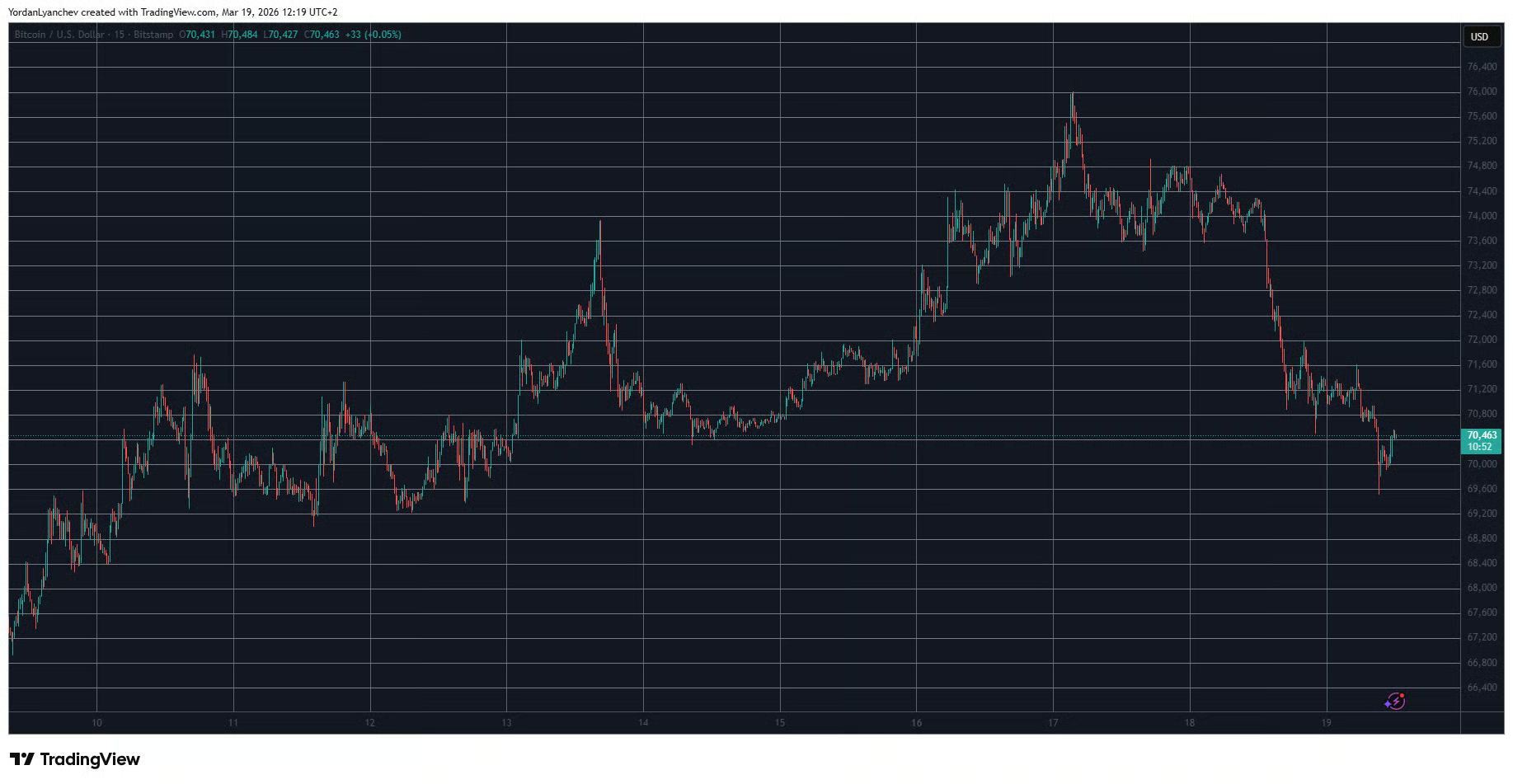
Bitcoin’s price rejection at $76,000 a couple of days ago only accelerated yesterday and earlier today, with the asset dipping below $70,000 for the first time since last Thursday.
The altcoins have faced enhanced volatility as well, with ETH dropping below $2,200 and XRP slipping beneath $1.50. ZEC, WLD, and MNT have plummeted by double digits.
BTC Price Dips Below $70K
The primary cryptocurrency touched $74,000 last Friday when it was stopped and pushed south toward $70,000 during the weekend after the latest bombings in the Middle East. However, it maintained that level, and the bulls stepped up as the new business week began.
The culmination took place on Tuesday morning when bitcoin shot up to its highest price level in roughly six weeks at $76,000. Nevertheless, its progress was quickly halted, and the asset retraced to $74,000.
Although it remained there at first on Wednesday, more volatility ensued in the hours leading up to the highly anticipated second FOMC meeting of the year. BTC dropped by several grand to just under $71,000 when the Fed announced what many expected that it wouldn’t change the interest rates.
Bitcoin bounced to $72,000 at first, but nosedived once again on Thursday morning, dropping below $70,000 for the first time in a week. Despite rebounding to just over that level now, it’s still 5% down on the day. Its market cap has dropped to $1.410 trillion, and its dominance over the alts is down to 56.3% on CG.
Altcoins Bleed
Most larger-cap alts have followed BTC on the way south. Ethereum is down by over 6% daily and sits well below $2,200. XRP lost the $1.50 support after a 3.5% decline. BNB has dipped beneath $650, SOL is down to $90, while ADA, LINK, and XMR have posted even more significant losses.
The biggest daily declines are evident from ZEC (-14%), WLD (-13%), MNT (-11%), and TAO (-10%). In contrast, HASH and RIVER have surged by double digits to $0.144 and $26.6, respectively.
The total crypto market cap, though, has erased $100 billion since yesterday’s peak and is down to $2.5 trillion on CG.

Binance Free $600 (CryptoPotato Exclusive): Use this link to register a new account and receive $600 exclusive welcome offer on Binance (full details).
LIMITED OFFER for CryptoPotato readers at Bybit: Use this link to register and open a $500 FREE position on any coin!
Disclaimer: Information found on CryptoPotato is those of writers quoted. It does not represent the opinions of CryptoPotato on whether to buy, sell, or hold any investments. You are advised to conduct your own research before making any investment decisions. Use provided information at your own risk. See Disclaimer for more information.
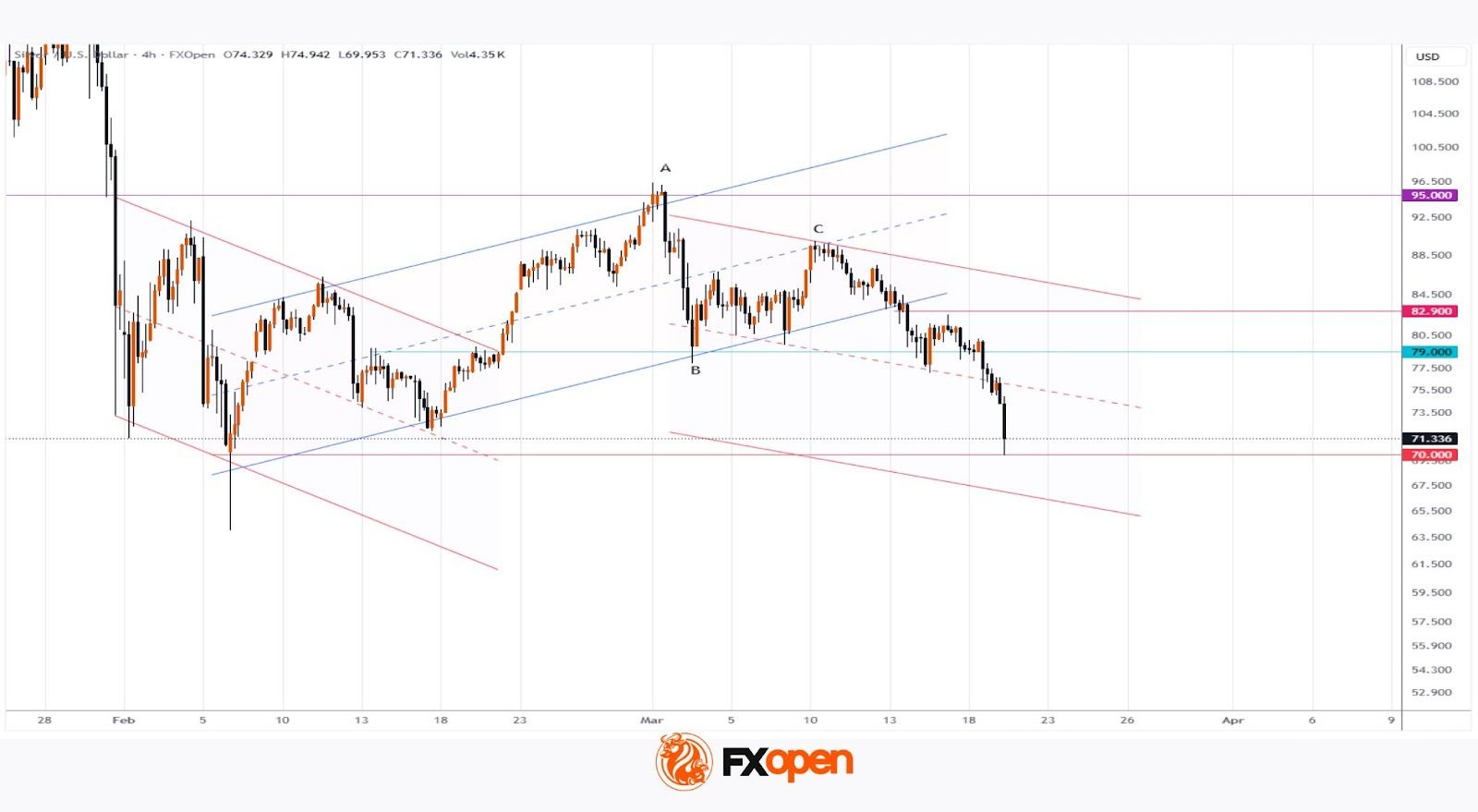
As seen on the XAG/USD chart, the price of silver fell to the $70 level and briefly pierced it, marking the lowest level since early February.
Although geopolitical tensions typically support demand for safe-haven assets, silver is under pressure from expectations of a fresh inflationary surge driven by rising energy prices (as noted earlier, Brent crude has risen above $110).
Yesterday’s “hawkish” comments from Federal Reserve Chair Jerome Powell also played a role. The Fed maintained interest rates, signalling that any future cuts would only occur if inflation stabilises.
Technical Analysis of XAG/USD
On 4 March, analysing the XAG/USD chart, we:
→ drew a blue ascending channel;
→ suggested that price action around the channel’s median could provide key signals.
Over time, the median proved to be a strong resistance. By 10 March, point C had formed, after which:
→ on 13 March, the blue channel was breached;
→ on 17 March, price showed an intraday bearish reversal from the breakout level.
Trading volume analysis indicates that the market remains under considerable pressure.
Although the long lower shadow on the candle near the psychological $70 mark indicates some buyer activity, the overall picture remains bearish. A red descending channel can be drawn on the silver price chart, with its median potentially acting as resistance in the near term, thereby confirming the validity of the constructed channel.
Start trading commodity CFDs with tight spreads (additional fees may apply). Open your trading account now or learn more about trading commodity CFDs with FXOpen.
This article represents the opinion of the Companies operating under the FXOpen brand only. It is not to be construed as an offer, solicitation, or recommendation with respect to products and services provided by the Companies operating under the FXOpen brand, nor is it to be considered financial advice.
Evernorth said its $1 billion proceeds will support building what it expects to be Nasdaq’s largest publicly traded XRP treasury firm.
Nevada-based Evernorth has formally submitted a Form S-4 registration statement to the US Securities and Exchange Commission tied to its planned merger with Armada Acquisition Corp. II.
The latest move advances a deal that would take the XRP-focused treasury firm public on Nasdaq.
Evernorth’s SPAC Deal
The filing introduces Evernorth as a regulated corporate vehicle structured to give public market investors exposure to XRP through an actively managed treasury strategy. The disclosure provides the first look at the firm’s operational blueprint, including how it intends to allocate, manage, and report its XRP holdings within a public company framework.
The company said it has secured more than $1 billion in gross proceeds from a group of institutional backers, among them Ripple Labs, SBI Holdings, Pantera Capital, Kraken, and Arrington Capital, the sponsor behind Armada II. The proceeds will be used to support the creation of what it expects to be the largest public XRP treasury company on Nasdaq. The registration statement, which includes a preliminary proxy statement and prospectus, remains under SEC review and has not yet been declared effective.
Completion of the transaction is subject to approval by Armada II shareholders and other standard closing requirements. Upon closing, the combined entity is expected to trade on the Nasdaq Stock Market under the ticker “XPRN,” pending exchange approval.
Commenting on the development, Michael Arrington, founder of Arrington Capital, said,
“Evernorth continues to emerge as a key gateway for capital markets, underscoring XRP’s rising influence in bridging traditional finance and real-time innovation. This continued progress by Evernorth reflects a wider wave of achievement and momentum of the XRP ecosystem as it expands utility across global finance.”
Evernorth’s announcement comes just days after the SEC issued new guidance, where XRP was included in a group of assets treated as digital commodities. According to the agency, securities regulations typically extend only to tokenized securities, excluding most other digital assets from such legal classification and regulatory scope.
You may also like:
Price Struggle
On the price side of things, $1.50 remains a major hurdle for XRP. The crypto asset surged past this level at the beginning of the week but failed to sustain the momentum. After shedding almost 4% over the past 24 hours, it was trading near $1.46.
Experts say the CLARITY Act could be a major catalyst for XRP. According to EGRAG CRYPTO, the bill may determine whether the token breaks above the $1.65-$1.70 resistance range. The analyst found that the token is forming an ascending triangle, a pattern which is often linked to breakouts, and sees a 65% chance of an upward move. However, a delay in the legislation could lead to a rejection or false breakout.
Binance Free $600 (CryptoPotato Exclusive): Use this link to register a new account and receive $600 exclusive welcome offer on Binance (full details).
LIMITED OFFER for CryptoPotato readers at Bybit: Use this link to register and open a $500 FREE position on any coin!
The European Central Bank (ECB) is seeking industry experts to contribute to workstreams focused on how the digital euro central bank digital currency would function across ATMs, payment terminals and acceptance infrastructure.
In an announcement published Wednesday, the ECB opened applications for two workstreams under its Rulebook Development Group (RDG), covering implementation specifications for ATM and terminal providers, as well as certification and approval frameworks for payment solutions.
The initiative revolves around defining how a potential digital euro would integrate with existing payment systems and hardware, including support for offline transactions and interoperability with standards used across Europe.
The move signals a deeper shift from policy design toward implementation planning, with the ECB seeking input on how a digital euro would work across ATMs, payment terminals and related infrastructure, including offline use and existing technical standards.
Related: ECB reveals Appia roadmap for central bank money in Europe’s tokenized markets
Workstreams target ATM integration, certification frameworks
According to the ECB, one workstream will focus on developing implementation specifications for ATM and terminal providers. This includes communication technologies, offline functionality and the reuse of existing payment standards.
The second workstream will develop proposals for testing, certification and approval processes for payment solutions and infrastructure used by payment service providers within the digital euro ecosystem.
Related: Stablecoins could weaken bank lending and monetary policy in Europe: ECB
The workstreams will report to the RDG, which includes representatives from merchants, payment service providers and consumers.
The ECB said selected experts are expected to provide technical input to support the development of a standardized rulebook.
ECB targets 2027 digital euro pilot
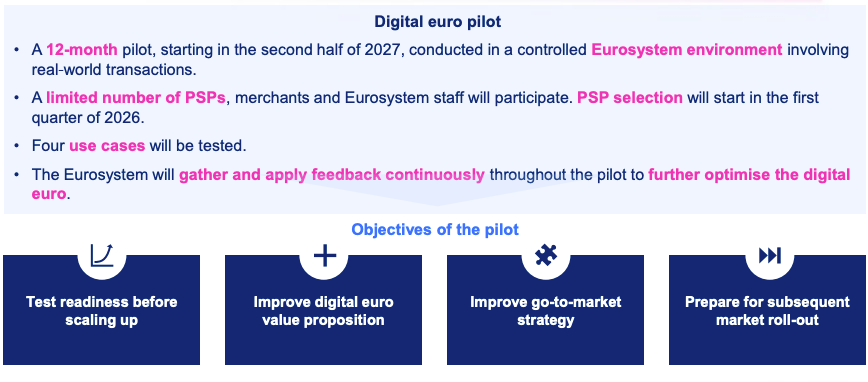
The ECB previously outlined plans to start selecting European Union-licensed payment service providers (PSPs) ahead of a 12-month digital euro pilot expected to start in the second half of 2027.
On Feb. 18, ECB Executive Board Member Piero Cipollone said the pilot would involve a limited number of merchants, Eurosystem staff and PSPs.

While the developments point toward continued progress on a digital euro, the ECB said a final decision on whether to issue it will only be taken after the relevant legislation is adopted.
Magazine: The debate over Bitcoin’s four-year cycle is over: Benjamin Cowen
Developers of OpenClaw, a popular open-source AI project, are being targeted by phishing attacks on GitHub with fake token rewards designed to lure users into connecting crypto wallets.
Cybersecurity firm OX Security reported the scam on Wednesday and said it had found no victims so far. OpenClaw creator Peter Steinberger separately warned on X that any emails claiming association with the project are scams, urging users to only visit the official site. “We would never do that. The project is open source and non-commercial,” Steinberger said.
According to OX Security, attackers created fake GitHub accounts that posted messages in repositories they controlled, tagging developers to increase visibility. The posts claimed that recipients had won $5,000 worth of “CLAW,” a non-existent cryptocurrency falsely associated with the project, in an attempt to trick recipients into visiting a cloned website.
The campaign directed users to a cloned website resembling OpenClaw’s official page and prompted them to connect crypto wallets, a common phishing tactic used to steal credentials or secure malicious approvals.

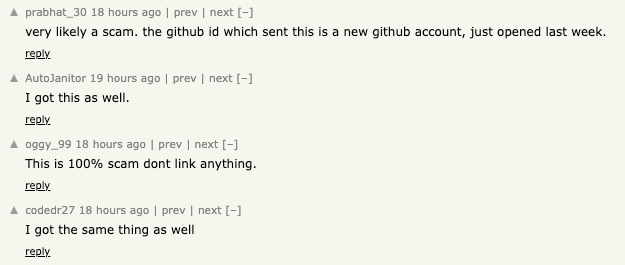
Social media reports suggest that developers were aware of the fraud, with many labeling the campaign as a scam immediately.
OpenClaw creator warned users project would never launch a token
The attack comes months after the OpenClaw creator warned users that the project would never launch a cryptocurrency, and that any token claiming association with him was fraudulent.
“I will never do a coin. Any project that lists me as coin owner is a scam,” Steinberger said in an X post in January.

The phishing campaign marks another attempt by attackers to capitalize on OpenClaw’s viral popularity.
Launched in November 2025, OpenClaw offers a free, open-source autonomous AI agent that runs locally on computers to manage files, software and browser tasks via chat platforms like WhatsApp or Telegram.
Related: Crypto hacks fall to $49M in February as attackers shift to phishing scams
The platform received high GitHub engagement and active social communities, amassing more than 465,000 subscribers on X in the months following its launch.
In a move to fight scams, the OpenClaw project also confirmed a ban on Bitcoin (BTC) and crypto discussions in its official Discord channel in February.
Magazine: 6 massive challenges Bitcoin faces on the road to quantum security
5 best performers from UEFA Champions League round of 16

Bitcoin Prediction #bitcoinpriceprediction #bitcoin

Best Eid gifts for 2026: Thoughtful presents for family

Smart energy pays enters the US market, targeting scalable financial infrastructure

Why Israel is blocking foreign journalists from entering

Bitcoin: We’re Entering The Most Dangerous Phase
Bitcoin Prediction #bitcoinpriceprediction #bitcoin

Why does financial security change the way our brains perceive extreme value?

Financial Independence #independence #financialfreedom #emotional #girl #explore #future #marriage
-
Crypto World5 days ago
HYPE Token Enters Net Deflation as HyperCore Buybacks Outpace Staking Rewards
-

 Tech4 days ago
Your Legally Registered ‘Motorcycle’ Might Not Count Under Proposed US Law
-

 Fashion6 days ago
Weekend Open Thread: Addict Lip Glow
-
 Tech2 days ago
Are Split Spacebars the Next Big Gaming Keyboard Trend?
-
Sports5 days ago
Why Duke and Michigan Are Dead Even Entering Selection Sunday
-

 Business4 days ago
Search for Savannah Guthrie’s Mother Enters Seventh Week with No Arrests
-

 Business5 days ago
US Airports Launch Donation Drives for Unpaid TSA Workers as Partial Government Shutdown Enters Fifth Week
-
Crypto World5 days ago
Coinbase and Bybit in Investment Talks: Could Bybit Finally Enter the US Crypto Market?
-

 Business3 days ago
Australian shares drop as Iran war enters third week
-

 Business5 days ago
Country star Brantley Gilbert enters growing non-alcoholic beer market
-

 Crypto World3 days ago
Crypto Lender BlockFills Enters Chapter 11 with Up to $500M in Liabilities
-

 Sports6 days ago
College Basketball Best Bets: Conference Tournament Semifinal Picks
-

 Politics1 day ago
The House | The new register to protect children from their abusers shows Parliament at its best
-

 Business7 days ago
Trump demands Powell cut rates as Iran conflict raises energy prices
-

 Fashion3 days ago
25 Celebrities with Curly Hair That Are Naturally Beautiful
-

 News Videos18 hours ago
RBA board divided on rate cut, unusually buoyant share market | Finance Report | ABC NEWS
-

 Crypto World7 days ago
Senate Votes to Include CBDC Ban in Bipartisan Housing Bill
-

 NewsBeat7 days ago
Deane Road crash near Bolton colleges and university
-

 News Videos7 days ago
Tom Lee: The 100x Opportunity EVEN Bigger Than Bitcoin (New Ethereum Prediction 2026)
-

 Crypto World18 hours ago
Canada’s FINTRAC revokes registrations of 23 crypto MSBs in AML crackdown


You must be logged in to post a comment Login