
Crypto World
Early bitcoin investor Star Xu, founder of OKX, blames Binance for BTC’s October crash



Nearly four months after crypto’s record Oct. 10 flash crash wiped out leveraged positions across the market, the industry is still arguing about what actually broke.
That argument turned into a public spat on Saturday after OKX founder and CEO Star Xu claimed the crash was neither complicated nor accidental, but the result of irresponsible yield campaigns that pushed traders into leverage loops they did not understand.
On Oct. 10, President Trump’s fresh tariff escalation on China rattled macro markets and hit crypto at the worst moment. With leverage already stacked, the initial drop turned into a wipeout with roughly $19.16 billion in liquidations, including about $16 billion from long bets, as forced selling cascaded across venues.
Star’s core point was about USDe, a yield-bearing token issued by Ethena. He described USDe as closer to a tokenized hedge fund strategy than a plain stablecoin. It is designed to generate yield through trading and hedging strategies, then pass that yield back to holders.
“No complexity. No accident. 10/10 was caused by irresponsible marketing campaigns by certain companies. On October 10, tens of billions of dollars were liquidated. As CEO of OKX, we observed clearly that the crypto market’s microstructure fundamentally changed after that day. Many industry participants believe the damage was more severe than the FTX collapse. Since then, there has been extensive discussion about why it happened and how to prevent a recurrence. The root causes are not difficult to identify,” Xu said.
Star argued that the risk began when traders were nudged into treating USDe like cash. In his telling, users were encouraged to swap stablecoins into USDe for attractive yields, then use USDe as collateral to borrow more stablecoins, convert those into USDe again, and repeat the cycle. The loop created a self-feeding leverage machine that made yields look safer than they were.
“Binance users were encouraged to convert USDT and USDC into USDe to earn attractive yields, without sufficient emphasis on the underlying risks,” he said. “From a user’s perspective, trading with USDe appeared no different from trading with traditional stablecoins—while the actual risk profile was materially higher.”
When volatility hit, Star said, that structure would not need a big trigger to unwind. He claimed the cascade helped turn a selloff into a wipeout and left lasting damage across exchanges and users.
“BTC began declining roughly 30 minutes before the USDe depeg. This exactly supports the earlier point: the initial move was a market shock. Absent the USDe leverage loop, the market would likely have stabilized at that point. The cascading liquidations were not inevitable—they were amplified by structural leverage, as explained previously,” he said.
Others in the market pushed back on Star’s tweets.
Dragonfly partner Haseeb Qureshi called Star’s story “ridiculous,” saying it tries to force a clean villain onto an event that does not fit a simple narrative. He argued the crash did not unfold like a classic stablecoin blowup that spreads everywhere at once.
If a single token failure truly drove the day, he said, the stress would have shown up broadly and in sync across venues.
“USDe price diverged ONLY on Binance, it did not diverge on other venues,” he said. “But the liquidation spiral was happening everywhere. So if the USDe “depeg” did not propagate across the market, it can’t explain how *every single exchange* saw huge wipeouts.”
With all respect to Star, this story is candidly ridiculous.
Star is trying to claim that the root cause of 10/10 was Binance creating an Ethena yield campaign, causing USDe to get overleveraged from traders looping it on Binance, which eventually unwound because of a small… https://t.co/IXlqLZI3DN pic.twitter.com/7YX529JAjN
— Haseeb >|< (@hosseeb) January 31, 2026
Qureshi’s alternative explanation is that macro headlines simply spooked an already levered market. Liquidations began as liquidity pulled back fast.
Once that cycle starts, he said, it becomes reflexive. Forced selling drives lower prices, which triggers more forced selling, with few natural buyers willing to step in during chaos.
Earlier in the day, Binance attributed the Oct. 10 flash crash to a macro-driven selloff colliding with heavy leverage and vanishing liquidity, rejecting claims of a core trading-system failure, as CoinDesk reported.
Late Friday, CZ quote-tweeted Qureshi with a sharper line that aimed at motive as much as mechanics. “Dragonfly is/was one of the largest investors of OKX,” CZ wrote, adding, “Data speaks. Time doesn’t match. Good to see people understanding facts.”
Star, however, rejected CZ’s characterization of Dragonfly’s relationship with OKX.
“Dragonfly has never been an investor in OKX,” he wrote, adding that OKX invested in Dragonfly before Qureshi joined the firm, and that a partner’s previous fund, not Dragonfly, had invested in OKX.
He added the details are “distinct and easily verifiable,” and he would not engage further.
Not everyone buys the idea of a single villain, however. Some market watchers say the selloff was simpler and driven by excess leverage and weak underlying demand rather than one platform or product.
“The markets crashed because the industry was overlevered alts and macro revealed that there was no sustainable organic bid for it,” Seraphim Czecker, former head of growth at Ethena Labs, said on X.

Crypto World
Cathie Wood’s ARK Invest Partners with Kalshi to Leverage Prediction Market Intelligence

Key Highlights
- Cathie Wood’s ARK Invest partners with Kalshi to integrate prediction market intelligence into investment strategy
- Prediction market insights will support portfolio research, risk assessment, and hedging strategies
- Cathie Wood describes prediction markets as “a natural next step for innovation in financial research”
- Federal Reserve researchers and Cornell University academics have validated prediction market data’s utility
- Kalshi recently achieved a $22 billion valuation following a $1 billion capital raise
Cathie Wood’s ARK Invest has revealed a strategic partnership with Kalshi, a regulated prediction markets platform, marking a significant shift in how institutional investors approach market intelligence.
According to the announcement, ARK Invest will integrate Kalshi’s prediction market data across three critical functions: enhancing its proprietary research with real-time crowd-sourced forecasts, monitoring key performance metrics such as trading activity, and implementing risk controls tied to specific market events.
The investment firm also intends to utilize Kalshi’s platform for hedging strategies designed to protect against adverse scenarios impacting its holdings, spanning both macroeconomic developments and industry-specific vulnerabilities.
“We believe these signals can enhance our research process and provide valuable context around key drivers across disruptive sectors,” Wood stated in Thursday’s announcement.
Nick Grous, ARK’s Director of Research, characterized prediction markets as delivering “some of the purest expressions of risk around key economic and company-specific outcomes.”
ARK has actively collaborated with Kalshi to develop specialized markets aligned with the firm’s analytical priorities.
Kalshi CEO Tarek Mansour disclosed that multiple ARK-requested markets have already launched, including contracts tracking non-farm payroll data and deficit-to-GDP ratios.
Understanding Prediction Markets
Prediction markets function as trading platforms where participants buy and sell contracts based on future event outcomes. The fundamental premise holds that when participants risk actual capital, market prices become efficient aggregators of collective knowledge and unbiased probability assessments.
Kalshi stands as one of America’s leading regulated prediction market operators. Its primary competitor, Polymarket, functions predominantly within the cryptocurrency ecosystem.
Throughout the previous year, prediction markets recorded over $10 billion in monthly transaction volume, attracting increasing institutional adoption.
Institutional Validation Growing
ARK Invest joins a expanding roster of established institutions recognizing prediction market value. Recently, Federal Reserve researchers released a study contending that Kalshi’s data offers superior real-time measurement of macroeconomic expectations compared to conventional forecasting instruments.
Federal Reserve analysts concluded that Kalshi markets deliver “a high-frequency, continuously updated, distributionally rich benchmark” valuable for both academic researchers and monetary policy officials.
Academic institutions have similarly engaged with prediction market analytics. Cornell University researchers examined Polymarket data to investigate trader behavior during significant political moments, including the 2024 presidential debate series and the attempted assassination of former President Donald Trump.
Kalshi’s recent $1 billion funding round established the platform’s valuation at $22 billion, underscoring growing confidence in prediction markets as financial infrastructure.


Key Insights
- Garlinghouse remains confident the Clarity Act will pass despite industry divisions and Coinbase resistance.
- SEC and CFTC recognition of assets like XRP signals growing regulatory clarity in the crypto sector.
- Ripple sees limited need for multiple USD stablecoins, positioning for a compliant, institution-focused alternative.
Ripple CEO Brad Garlinghouse has expressed confidence that the US Senate’s stalled Clarity Act will eventually pass, even as opposition from Coinbase continues to complicate negotiations.
Speaking at the FII PRIORITY Miami summit, Garlinghouse emphasized that Ripple is not directly involved in the dispute. ‘Ripple doesn’t have a big dog in this fight,’ he said, noting the company is largely observing developments from the sidelines.
Regulatory Momentum Builds
The Clarity Act aims to introduce more transparent regulations concerning the digital assets, especially relating to the classification and regulation. It has drawn the attention of the crypto industry, which has long wanted regulatory certainty in the United States.
Garlinghouse pointed to growing institutional and political backing as a positive signal. ‘White House support pushing the Clarity Act forward has been profound,’ he stated, suggesting momentum remains intact despite setbacks.
However, Coinbase’s rejection of a recent compromise has slowed progress. The exchange has pushed towards more desirable terms, marking continuing divisions in the industry on how regulation is to be designed.
SEC, CFTC and Existing Clarity
Garlinghouse also referenced existing regulatory developments, noting that assets like XRP have already seen classification progress. According to him, both the SEC and CFTC have acknowledged certain digital assets as commodities.
‘There is already some clarity,’ he said, adding that industry participants are growing impatient. ‘People are annoyed. They are exhausted. So, hopefully we get something done.’
Stablecoin Debate Intensifies
Beyond legislation, Garlinghouse addressed the proliferation of stablecoins, particularly those pegged to the U.S. dollar. He argued that the market does not need excessive duplication.
‘My head starts to hurt if you think about the proliferation,’ he said, referencing the growing number of USD-backed tokens, including USDC.
He disclosed that Ripple had already minted a substantial share of USDC, implying that the company is equipped with the infrastructure to issue its own stablecoin. Having a strong balance sheet, Ripple aims to establish itself as a compliant, institution-oriented player.
Market Outlook
As regulatory discussions continue, XRP market sentiment is still closely linked to legislative progress and developments around ETFs. The implementation of the Clarity Act may help give a more transparent framework for institutional adoption.
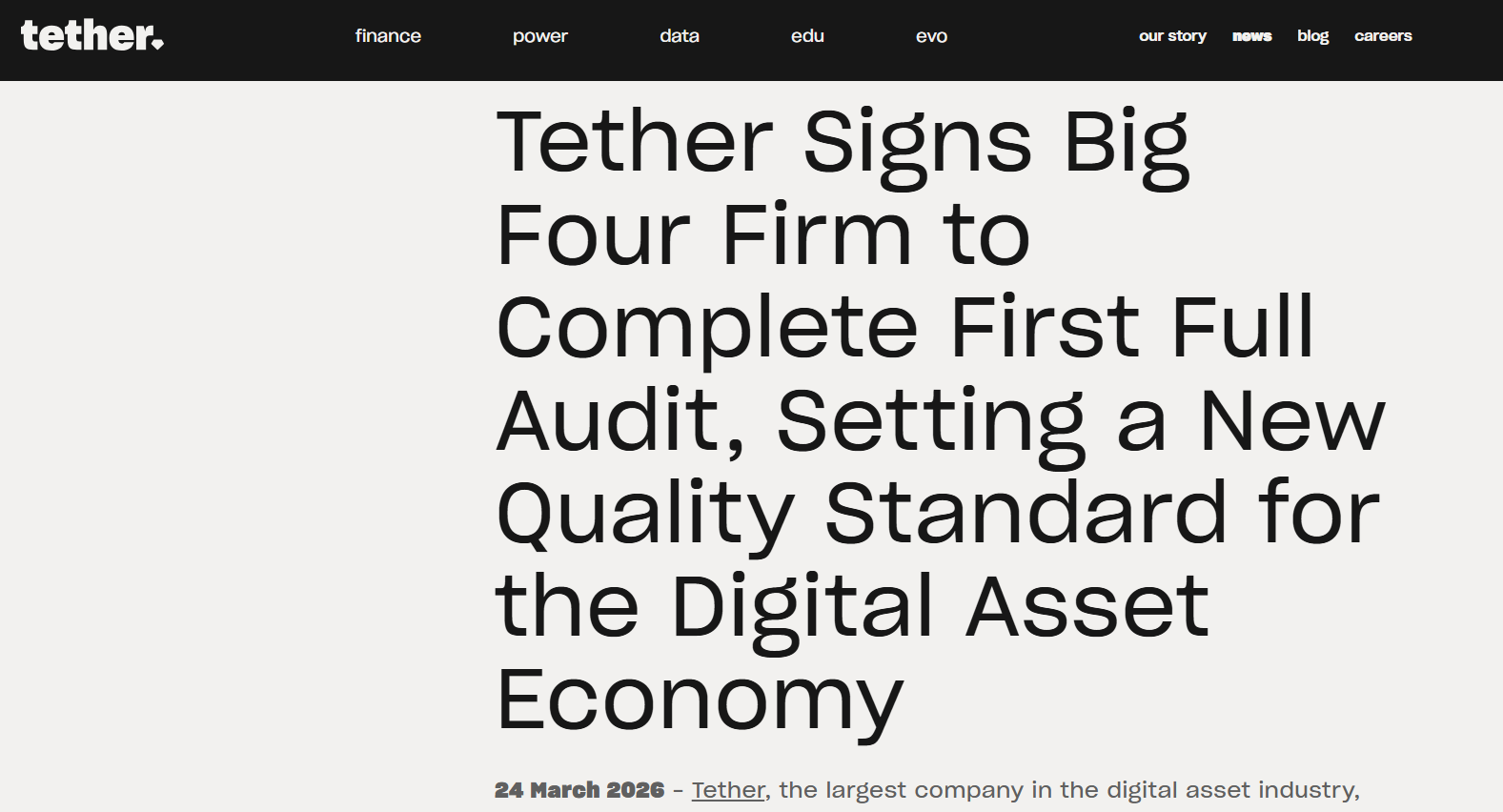
The Financial Times reported Friday that Tether has hired KPMG to conduct its first full audit of USDT’s financial statements and brought in PwC to help prepare its internal systems, citing people familiar with the matter.
The reported mandate follows Tether’s Tuesday announcement that it had formally engaged a Big Four firm for an inaugural financial statement audit, without naming the provider, and comes after years of pledges to deliver a full review of its books while relying instead on periodic reserve attestations from BDO Italia, the Italian member firm of the BDO global accounting network that has been producing USDt (USDT) assurance reports since 2022.
The move comes as Tether (USDT) weighs a major equity raise and a push into the US under the new federal stablecoin framework created by the Guiding and Establishing National Innovation for US Stablecoins (GENIUS) Act.
USDT, a dollar-linked token with about $185 billion in circulation, is the largest stablecoin by market capitalization, according to CoinGecko. Tether said in January that it held more than $122 billion in direct US Treasury securities and about $141 billion in total Treasury exposure, including related instruments such as overnight reverse repurchase agreements.
Related: Tether CEO slams S&P ratings agency and influencers spreading USDt FUD
A comprehensive audit by KPMG is expected to go beyond snapshots of reserves, covering Tether’s assets, liabilities and internal controls across its sprawling balance sheet, a process the company has billed as “the biggest ever inaugural audit in the history of financial markets.”

Tether said the Big Four firm was chosen through a competitive process and that it already operates at Big Four “audit standards,” but has not yet committed publicly to when the audit will be completed.
Cointelegraph reached out to Tether and KPMG but had not received a response by publication. PwC refused to comment on the matter.
KPMG audit and Tether’s funding ambitions
Bloomberg reported in September 2025 that Tether was exploring raising as much as $20 billion in fresh equity, implying a valuation of $500 billion. Tether CEO Paulo Ardoino refuted these claims, telling Cointelegraph in February that such a figure had not been agreed upon, while maintaining its $500 billion valuation target based on the company’s profits.
The company has previously paid a $41 million Commodity Futures Trading Commission (CFTC) fine over what the regulator called “untrue or misleading statements” about its reserves.
In a separate case, Tether agreed to an $18.5 million settlement with the New York Attorney General over allegations it concealed losses and misled investors about USDT’s backing. Under the NYAG deal, Tether was compelled to provide detailed quarterly reserve reports for two years and later dropped its opposition to the release of those materials.
Magazine: Bitcoin’s ‘biggest bull catalyst’ would be Saylor’s liquidation — Santiment founder


A US federal judge in San Francisco has temporarily blocked Pentagon action against Anthropic, giving the AI company short-term relief in its fight with the Trump administration.
Summary
- Judge Rita Lin paused Pentagon action against Anthropic and blocked the federal Claude stop-use order.
- Anthropic sued after the Pentagon labeled it a supply chain risk during contract dispute talks.
- The ruling keeps pressure on Washington as Anthropic defends limits on military and surveillance use.
The ruling keeps federal agencies from enforcing a stop-use order against Claude for now and places the legal focus on whether the government acted beyond its authority.
Judge Rita Lin of the US District Court for the Northern District of California granted a preliminary injunction on Thursday. The order stops the Pentagon from enforcing its supply chain risk label against Anthropic while the case moves forward.
The ruling also pauses President Donald Trump’s directive that told federal agencies to stop using Anthropic’s chatbot, Claude. The judge said the record did not support the government’s position at this stage of the case.
Judge Lin wrote,
“Nothing in the governing statute supports the Orwellian notion that an American company may be branded a potential adversary and saboteur of the US for expressing disagreement with the government.”
She also described the measures against Anthropic as “arbitrary, capricious, [and] an abuse of discretion.”
The case follows a breakdown in talks between Anthropic and the Pentagon. In July 2025, the company had reached a deal that would have made Claude the first frontier AI model approved for use on classified networks.
That process later changed course. Anthropic said Pentagon officials wanted the company to permit military use of Claude “for all lawful purposes” and without limits. The company refused to allow uses tied to lethal autonomous weapons and mass domestic surveillance.
Anthropic has said its technology should not support those activities. The disagreement became public after contract talks collapsed in February and the company challenged the government’s response in court.
Court reviews retaliation claim
Anthropic filed its lawsuit on March 9 in federal court in Washington, DC. The company argued that Defense Secretary Pete Hegseth exceeded his authority by naming Anthropic a national security supply chain risk.
During a March 24 hearing in San Francisco, Judge Lin pressed government lawyers on whether Anthropic faced punishment for publicly criticizing the Pentagon’s position. The March 26 ruling said, “punishing Anthropic for bringing public scrutiny to the government’s contracting position is classic illegal First Amendment retaliation.”
Anthropic later said it was “grateful to the court for moving swiftly” and said the ruling showed it was likely to succeed on the merits.
Furthermore, the court fight comes as Anthropic holds a strong place in enterprise AI. Menlo Ventures said the company held 32% of that market in 2025, ahead of OpenAI at 25%.
A government-wide ban could have weakened that standing. For now, the court order gives Anthropic time to defend its position while the wider case moves ahead.


Tether has moved closer to a full financial review of USDT as it prepares for wider regulatory scrutiny in the United States.
Summary
- Tether hired KPMG for its first full USDT audit and engaged PwC to prepare systems.
- The audit would review assets, liabilities, and controls beyond the reserve attestations issued since 2022.
- Tether’s audit push comes as it weighs US expansion and a possible major equity raise.
The step follows a report that the company hired KPMG for its first full audit and brought in PwC to help organize its internal systems ahead of that process.
The Financial Times reported on Friday that Tether hired KPMG to conduct its first full audit of USDT’s financial statements. The report also said Tether brought in PwC to help prepare its internal controls and reporting systems before the audit begins.
The reported move came days after Tether said it had engaged a Big Four accounting firm for its first full financial statement audit, though it did not name the firm. Until now, Tether has relied on periodic reserve attestations from BDO Italia instead of a full audit.
A full audit would go further than reserve attestations. It would review Tether’s assets, liabilities, and internal controls across the company’s balance sheet rather than only checking reserve positions at specific points in time.
Tether has described the planned review as “the biggest ever inaugural audit in the history of financial markets.” The company said it selected the Big Four firm through a competitive process and added that it already operates at Big Four “audit standards.” However, it has not given a public deadline for the audit’s completion.
Moreover, the audit effort comes as Tether looks at expansion in the United States under the federal stablecoin framework created by the Guiding and Establishing National Innovation for US Stablecoins, or GENIUS, Act. A full audit could help the company support its position as it enters a stricter regulatory environment.
USDT remains the largest stablecoin by market value. CoinGecko data places about $185 billion of USDT in circulation. Tether said in January that it held more than $122 billion in direct US Treasury securities and about $141 billion in total Treasury exposure, including overnight reverse repurchase agreements and similar instruments.
Funding plans and past legal cases remain in focus
Tether’s audit plans also come as the company weighs a possible equity raise. Bloomberg reported in September 2025 that Tether had explored raising up to $20 billion at a $500 billion valuation. Chief executive Paolo Ardoino later disputed that such a figure had been agreed, though he kept the company’s $500 billion valuation target tied to its profits.
The company also continues to face attention over past claims about reserves. The Commodity Futures Trading Commission fined Tether $41 million over what the regulator described as “untrue or misleading statements” about reserve backing.
In a separate matter, Tether agreed to an $18.5 million settlement with the New York Attorney General over claims that it hid losses and misled investors about USDT’s backing.
Bitcoin fell another 2% in 24 hours, dropping below $68,000 for the first time in four days. The decline sparked more than $50 million in long liquidations in the past hour, according to Coinglass, of which roughly 70% came from bitcoin positions alone.
The decline sent shares of crypto-related companies such as Circle Internet (CRCL), Coinbase (COIN), and Strategy (MSTR), the largest public holder of Bitcoin, lower in pre-market activity.
Traders with long positions are betting prices will rise. Liquidations occur when an exchange forcibly closes a leveraged trade because the trader no longer has enough collateral, known as margin, to support the position.
A look at the 48-hour liquidation heatmap, a tool that highlights price levels where large clusters of forced liquidations may occur, shows significant liquidity below $66,000, which signals further downside for bitcoin is possible in the short term.
In another sign of bearish sentiment, funding rates are also negative. Funding rates are periodic payments between traders in perpetual futures contracts, which are derivatives that track an asset’s price without expiry. When negative, short traders, those betting on price declines, pay long traders.
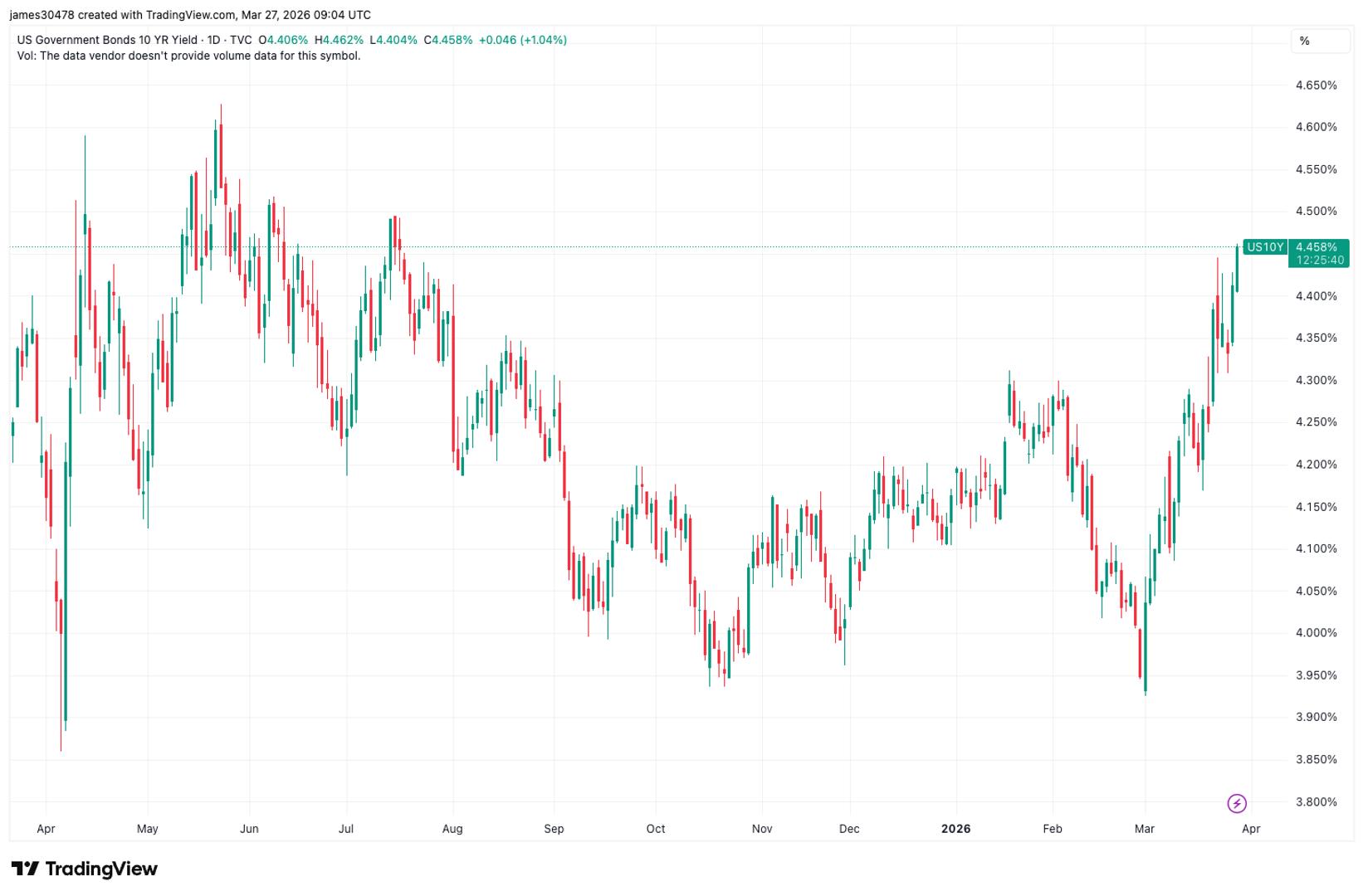
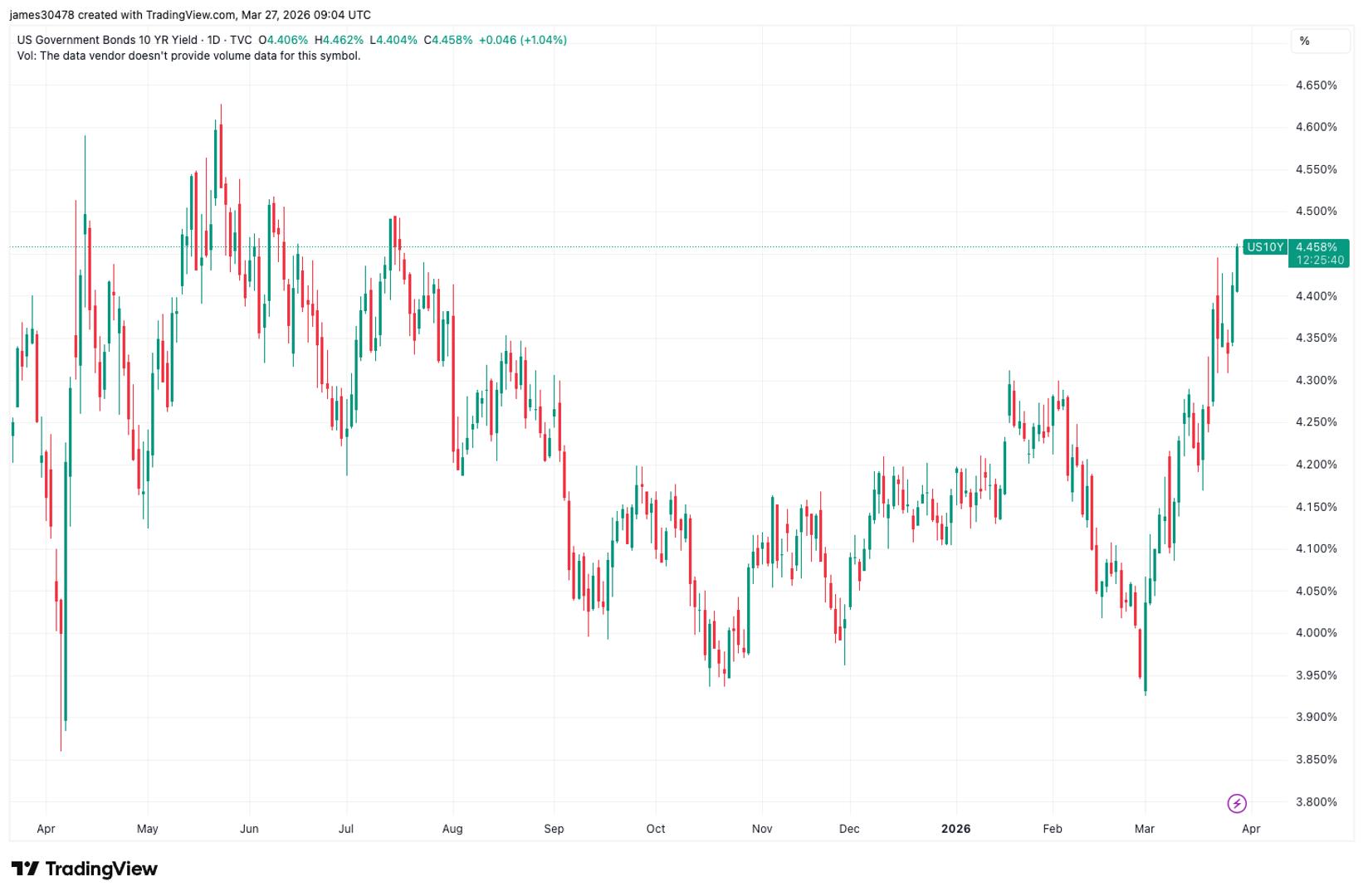
Macro conditions are deteriorating further as the Middle East conflict progresses. The 10-year U.S. Treasury yield, a benchmark interest rate for government debt, is nearing 4.5%, its highest since July, making risk assets like crypto less attractive.
The MOVE index, which measures U.S. bond market volatility, has risen 18% over the past 24 hours, indicating increased uncertainty.
Meanwhile, oil prices, including Brent and WTI crude, are up 3% as Ukraine’s disruption of Russian oil flows disrupts President Donald Trump’s plans to ease supplies.
The DXY index, which tracks the strength of the dollar against a basket of major trading partners, is rising toward 100, creating further headwinds for risk assets.
Key Highlights
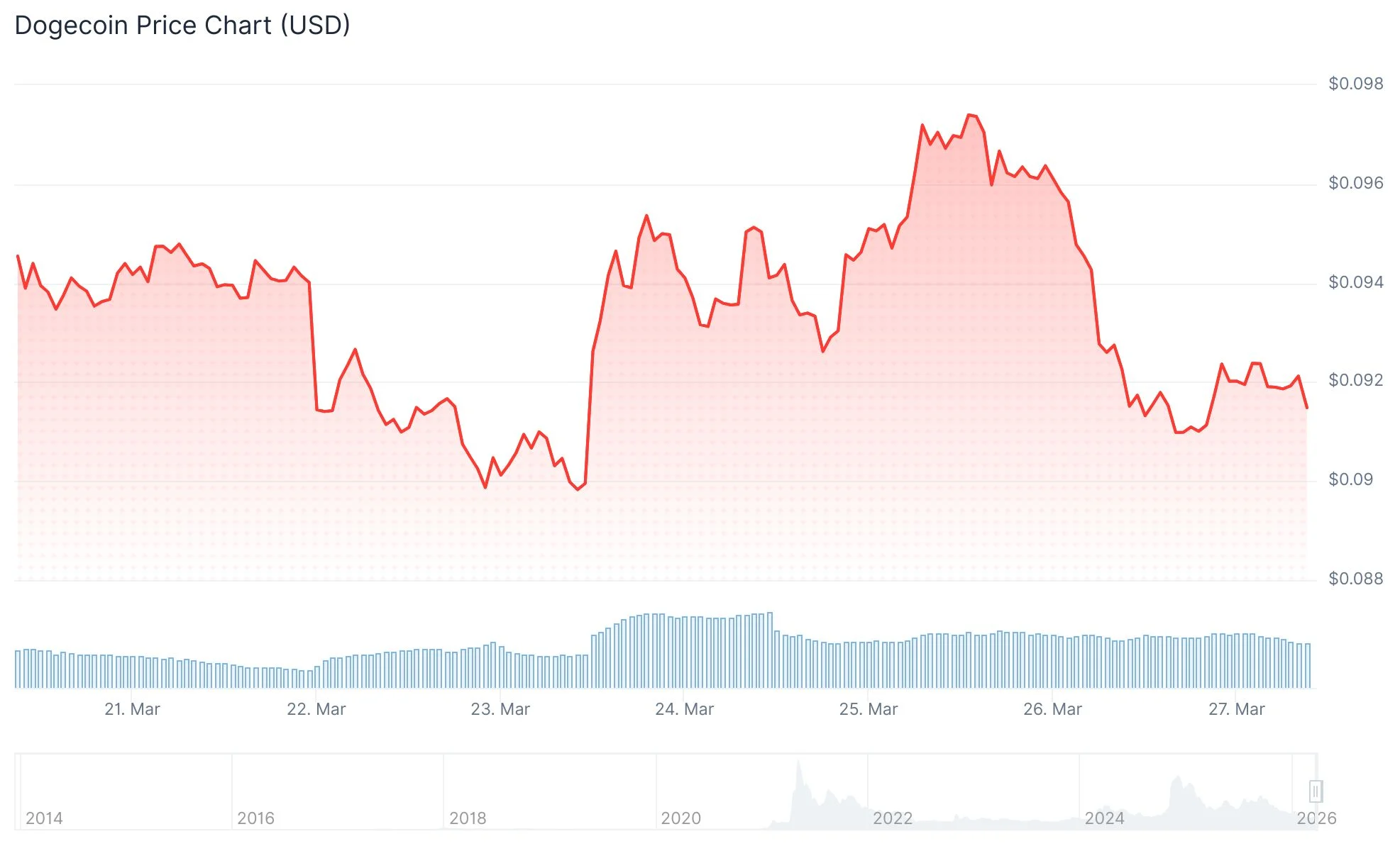
- DOGE price declined more than 5% over 24 hours, currently trading near $0.091
- Eight consecutive days of zero net flows recorded across Dogecoin ETF products
- Retail traders acquired approximately 4.5 million DOGE tokens on Kraken during recent pullback
- Technical analysis reveals death cross formation, typically interpreted as bearish momentum
- Dogecoin mining integration with Qubic platform confirmed for April 1, 2026 launch
Dogecoin has experienced a significant pullback exceeding 5% over the last day, with the meme coin currently changing hands around the $0.091 mark. This downturn mirrors broader cryptocurrency market weakness, as overall digital asset market valuation decreased 1.18% to settle at $2.4 trillion.
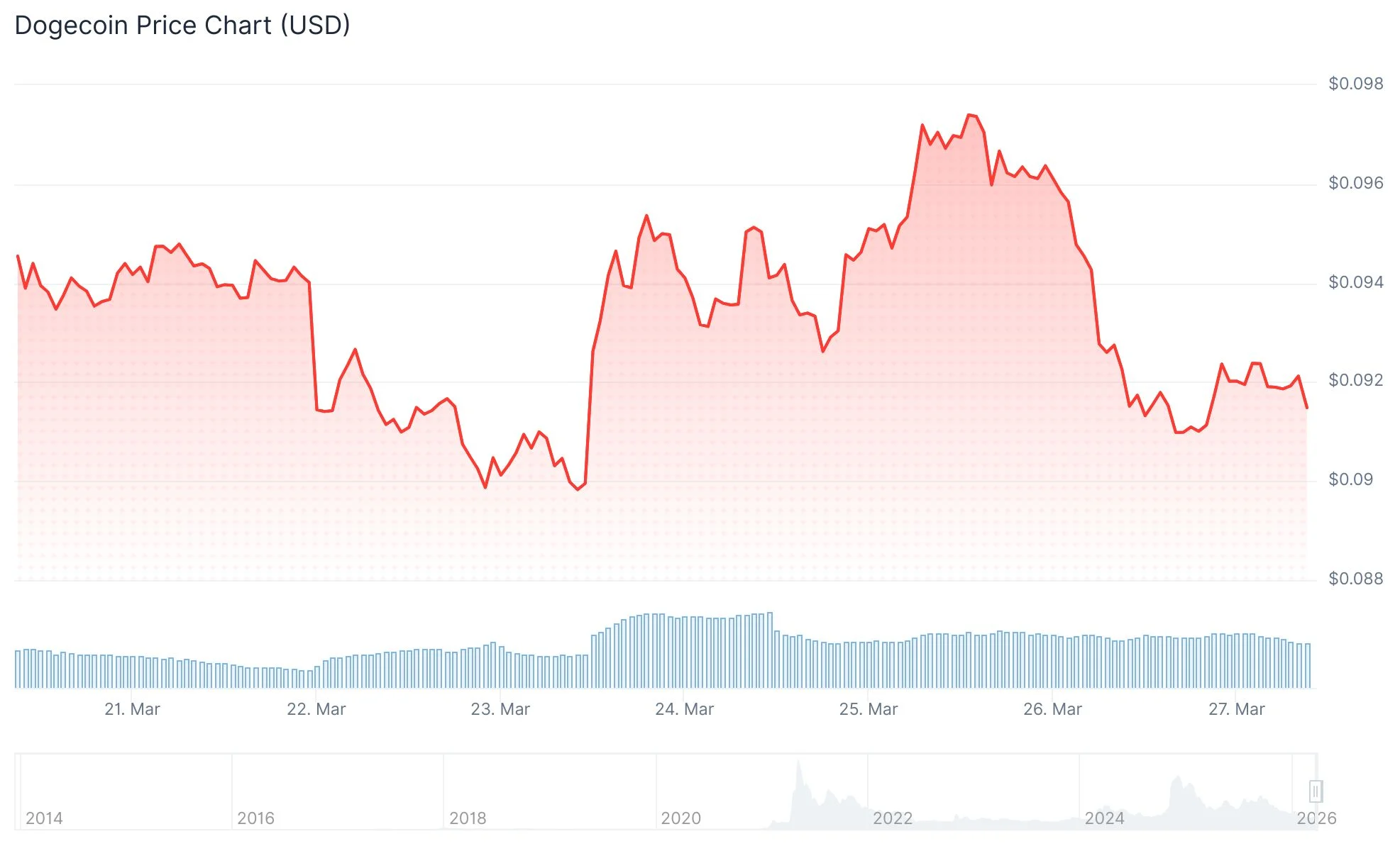
The cryptocurrency continues holding above the critical $0.092 support threshold, though mounting downward pressure threatens this level. Technical indicators paint a concerning picture—the Relative Strength Index currently registers around 41, while the MACD demonstrates early signs of bearish divergence. Market observers suggest bulls must push DOGE back above $0.095 to shift momentum.
Charts also display a death cross pattern, occurring when shorter-term moving averages dip beneath longer-term counterparts. Technical traders typically interpret this formation as indicating potential downside ahead.
Institutional Money Remains Sidelined
According to tracking data from SoSoValue, Dogecoin exchange-traded fund products have registered absolutely no net capital movement for eight straight trading days. Neither inflows nor outflows have been recorded during this period.
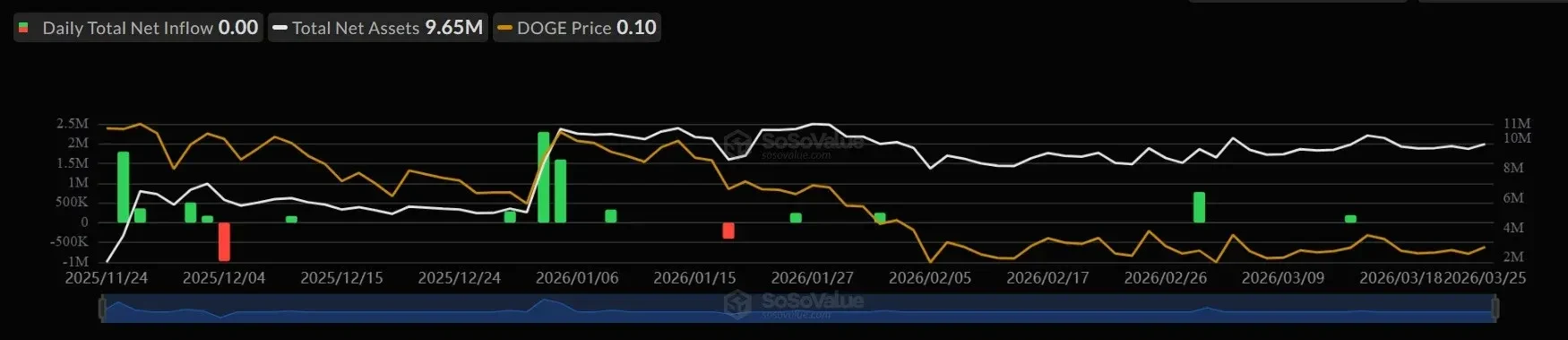
This stagnation suggests institutional participants remain uncommitted despite recent volatility. Market commentators interpret this freeze differently—some view the standstill as hesitation, while others consider the absence of withdrawals as evidence that current holders anticipate price appreciation.
The contrast between institutional and retail market behavior is striking. While ETF channels showed zero activity, individual traders on Kraken purchased nearly 4.5 million DOGE tokens within a 12-hour period as prices retreated.
Large Holders Accumulating on Weakness
Blockchain analytics from CryptoQuant reveal taker buy dominance persisting across leading trading platforms throughout the previous 90-day period. This metric indicates aggressive purchase orders have consistently exceeded selling pressure in spot trading venues.
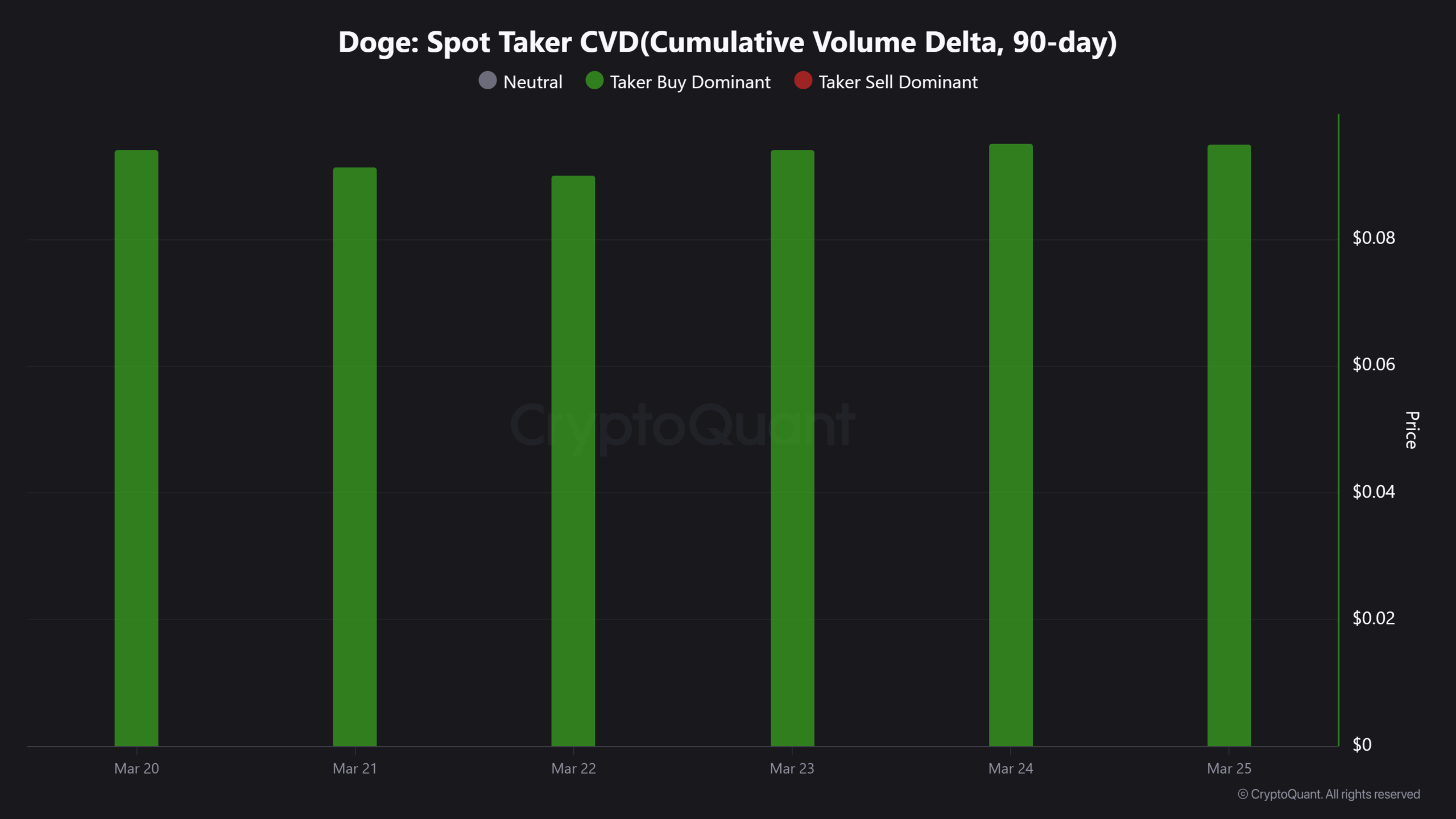
This accumulation behavior has emerged repeatedly during recent downward moves. Market participants seem to view price weakness as strategic entry points rather than signals to exit positions. Technical strategists note that such sustained accumulation frequently precedes significant upward price movements, although no breakout has developed thus far.
Large wallet activity suggests anticipation of movement beyond the $0.10 threshold. DOGE faced resistance at this psychological level in recent trading sessions and has failed to reclaim it since.
The Qubic platform has officially announced its April 1 launch date for the Dogecoin mining initiative. According to company statements, every share generated through mining will undergo verification through Oracle Machines, which became operational on mainnet February 11. The Dogecoin mining feature represents the inaugural external proof-of-work application developed on this infrastructure.

ETH is under serious pressure. Ethereum price trades at just a nod above $2,000, down 3.70% in the past 24 hours, the sharpest single-day drop since March 18’s 6% wipeout, and the technical prediction is deteriorating fast. The $2,000 handle is no longer a distant scenario, as crypto falls.
Bears pushed ETH to an intraday low of $2,030 after the asset failed to hold above $2,150, triggering a cascade through $2,100 and $2,080 in quick succession. A bearish trend line has formed on the hourly chart with resistance capping at $2,135, while ETH now trades below its 100-hour Simple Moving Average.
ETH crashed from 2199 to 2032 (over 8% drop), now in an oversold rebound. MA50 is sloping down, medium-term trend remains bearish—treat bounces as opportunities to reduce exposure. — Asma Khatuhgfd (@khatuhgfd94622) March 27, 2026

Catalysts, including BlackRock’s staked ETHB ETF launch and the FOMC rate decision, haven’t provided the bid bulls were hoping for.
Discover: The best crypto to diversify your portfolio with
Ethereum Price Prediction: Can ETH Recover, or Is a Drop to $1,880 Next?
ETH is consolidating near the 23.6% Fibonacci retracement of the $2,200-$2,032 downward move, a technically weak holding position that typically precedes continuation lower rather than reversal.
The MACD histogram on the hourly chart is losing momentum in bearish territory, a confirmation that sellers remain in control of short-term price action. A huge head and shoulder will be confirmed if ETH can’t defend the $2,000 line.

Three scenarios define the next 48–72 hours:
- Bull case: ETH clears $2,135 resistance and the descending trend line with conviction, opening a path toward $2,200 and potentially $2,245–$2,320.
- Base case: ETH grinds between $2,050 support and $2,135 resistance, bleeding volume while macro headwinds persist.
- Bear case: A confirmed break below $2,020 opens $1,980, then $1,950, with the main structural support sitting at $1,880.
Year-to-date, ETH is stable with less than 1% movement . The Glamsterdam hard fork remains a potential demand catalyst on the 2026 roadmap, but near-term technicals offer little relief. Watch the $2,000 psychological level closely; it’s the line between consolidation and a deeper flush.
Discover: The best pre-launch token sales
Bitcoin Hyper Targets Early-Mover Upside as Ethereum Tests Key Levels
When a large-cap asset like ETH prints multi-month lows and conviction evaporates, capital doesn’t sit idle; it searches for asymmetric opportunities elsewhere.
Bitcoin Hyper ($HYPER) is building what it positions as the first-ever Bitcoin Layer 2 with Solana Virtual Machine (SVM) integration, targeting Bitcoin’s core limitations of slow transactions, high fees, and absent programmability in one architecture.
Two modes. One future.
Bitcoin Hyper.https://t.co/VNG0P4GuDo pic.twitter.com/uNneqkZg13
— Bitcoin Hyper (@BTC_Hyper2) March 27, 2026

The presale has raised north of $32 million at a current price of $0.0136, with huge staking rewards available for early participants. The SVM integration claim is notable: if the throughput benchmarks hold at launch, this could represent a genuinely differentiated position in the L2 landscape rather than another incremental scaling play.
Research Bitcoin Hyper and review the presale terms here.
This article is for informational purposes only and does not constitute financial advice. Crypto assets are highly volatile — always conduct your own research before investing.
The post Ethereum Price Prediction: ETH Faces Pressure, Risks Falling Below $2,000 appeared first on Cryptonews.
Crypto World
Solana (SOL) Struggles After $93 Rejection: Bearish Flag Signals Potential Drop to $40s
Key Takeaways
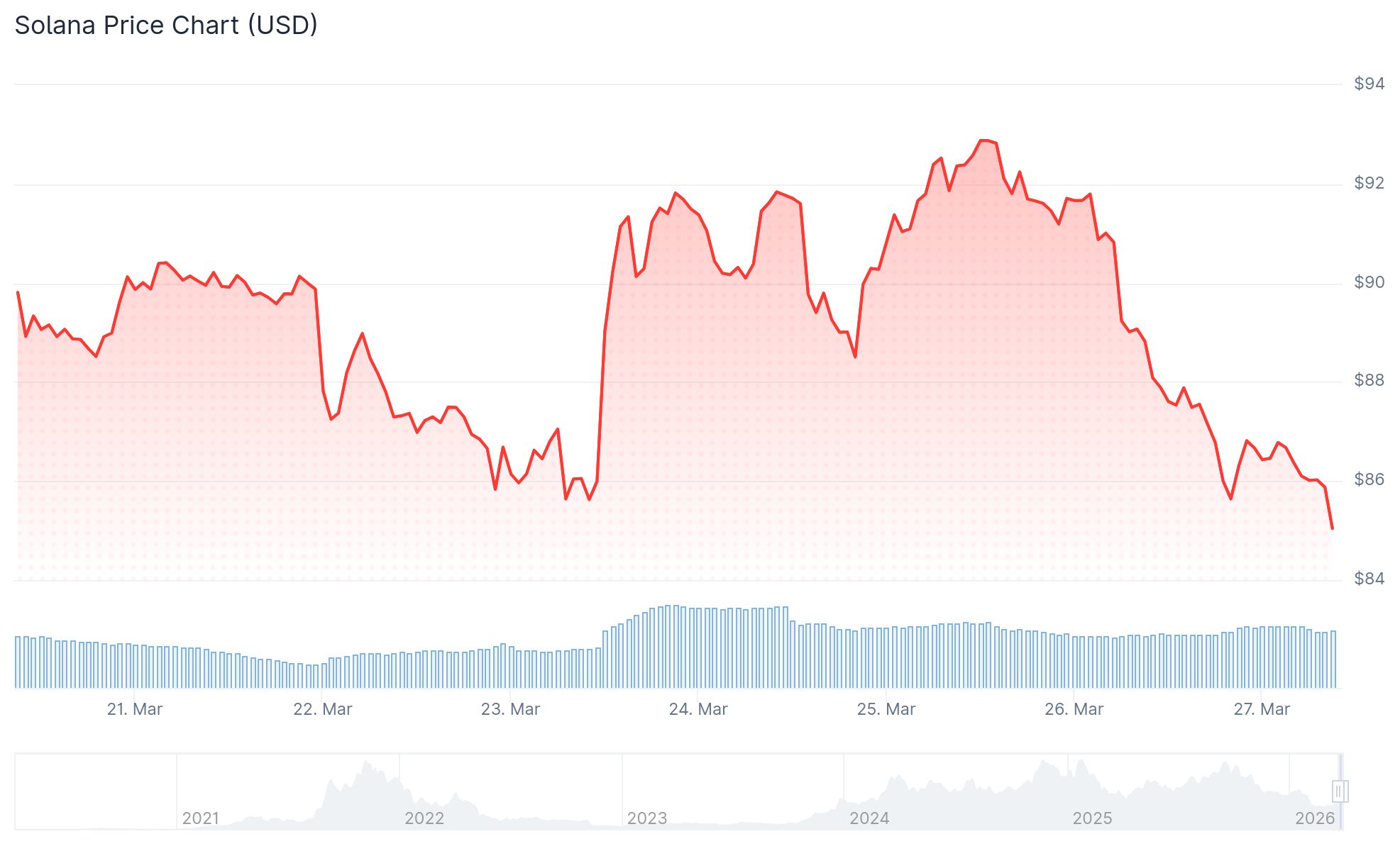
- SOL faced rejection at the $93 level, declining 5.7% over 24 hours to approximately $87
- The token trades beneath its 20-, 50-, 100-, and 200-day moving averages
- Technical indicators including RSI and MACD reflect diminishing price momentum
- A developing bearish flag formation on the daily timeframe suggests potential downside to the $40–$45 zone
- Despite price weakness, Solana handled 44% of worldwide cryptocurrency transactions
Solana (SOL) faces mounting pressure following an unsuccessful attempt to breach the $93 resistance threshold. The digital asset has retreated and now hovers around a critical support area that market participants are monitoring intently.
Currently, SOL changes hands at $87.45. The cryptocurrency recorded $5.62 billion in trading volume during the previous 24-hour period, while maintaining a market capitalization of $50.21 billion. The asset experienced a 5.70% decline within the last day.
Cryptocurrency analyst BitGuru highlighted the $93 rejection in an X platform post dated March 26, 2026. The analyst emphasized that SOL has retreated to a significant historical support area following the failed breakout attempt. The price action at this juncture may determine the token’s trajectory in the coming sessions.
Should demand materialize at current levels, SOL might stage a recovery toward upper resistance thresholds. Conversely, a breach of this support zone could trigger additional losses.
Technical Indicators Point to Weakening Momentum
Solana currently trades beneath all primary moving average benchmarks. The 20-day moving average registers at $88.63, while the 50-day stands at $86.09. The 100-day moving average is positioned at $106.54, and the 200-day rests at $143.24.
Trading below both the 100-day and 200-day moving averages indicates the cryptocurrency remains distant from establishing consistent upward momentum.
The Relative Strength Index reads 47.66, positioned below its signal line of 52.54. Meanwhile, the MACD line registers 0.127, trailing its signal line of 0.232. The relatively neutral MACD histogram suggests minimal directional strength in either direction.
Bearish Flag Formation Suggests Downside Potential
Chart analysis reveals a bearish flag pattern developing on the daily timeframe—a technical setup resembling a formation observed earlier this year. During that previous occurrence, Solana experienced a substantial breakdown following the pattern’s completion.
The present formation displays price consolidation within an ascending channel following a significant decline. Should a breakdown materialize from these levels, technical projections point toward the $40 to $45 price range within approximately one to two weeks.
Notwithstanding the price challenges, Solana’s blockchain activity demonstrates remarkable strength. The network handled 825,729,338 transactions from a total of 1,867,616,231 blockchain transactions recorded during the assessment period—representing 44% of global cryptocurrency transaction volume.
Analyst Ali Charts observed via X that more than 100 million SOL tokens changed hands between $91.45 and $82.60, identifying this range as the most critical demand area. Should this zone fail, subsequent support levels worth monitoring include $53.10, $35.40, and $23.60.
Quick Summary
- President Trump announced a 10-day extension for the pause on strikes targeting Iran’s energy facilities, setting an April 6 deadline for Iranian compliance.
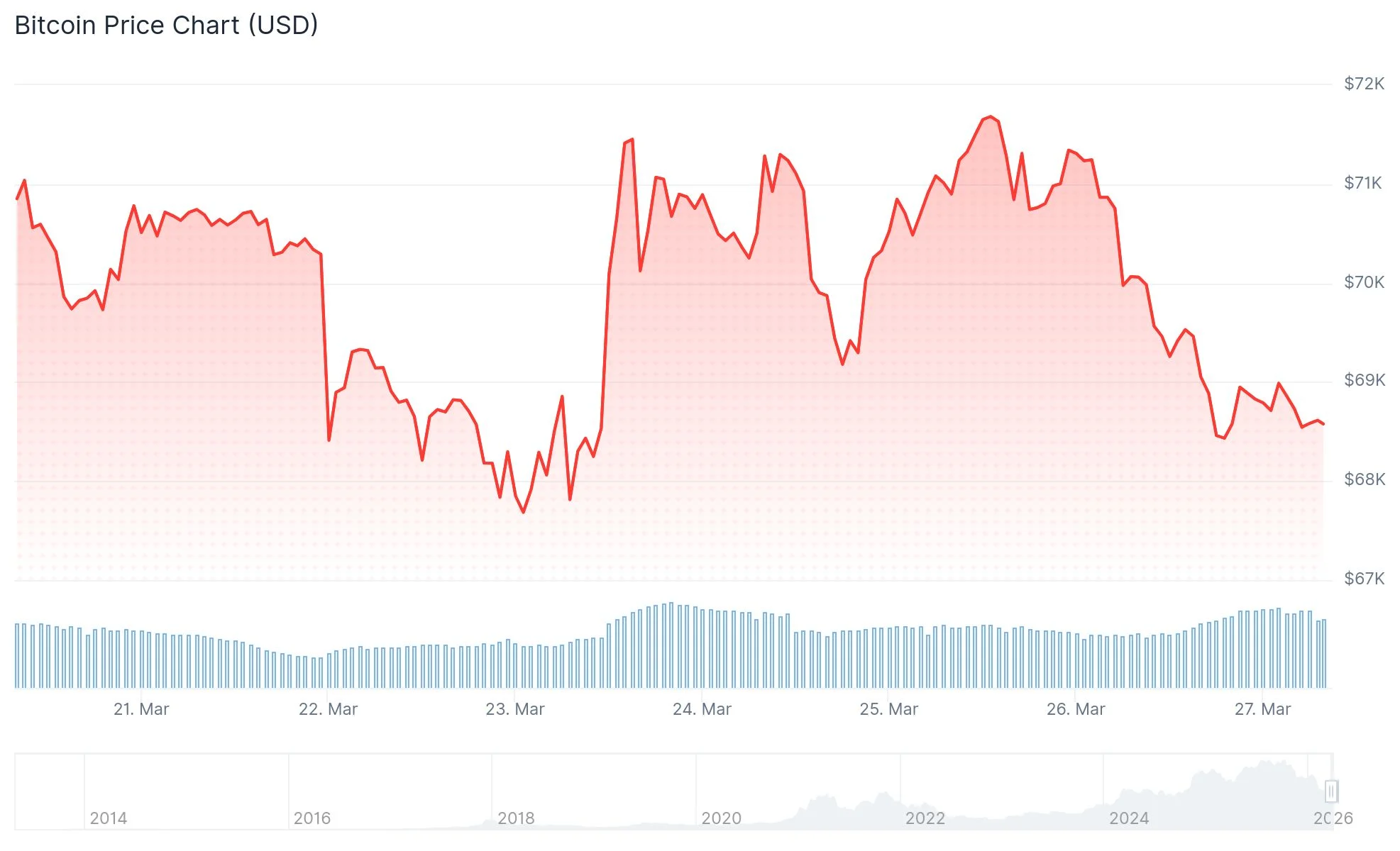
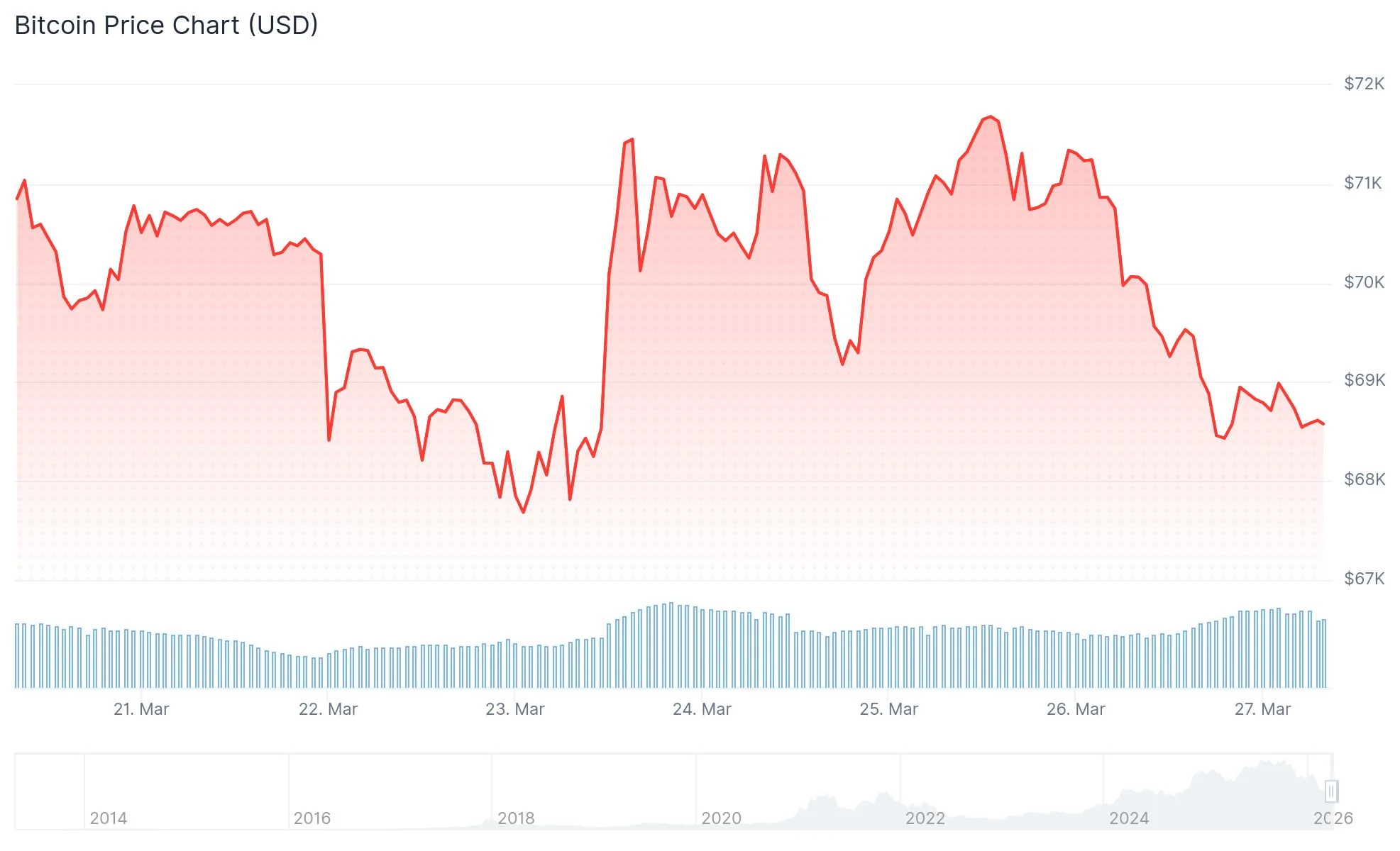
- Bitcoin declined more than 3% during Thursday’s session before stabilizing above the $69,000 mark.
- The Nasdaq Composite experienced a 2.4% decline Thursday, marking approximately a 10% retreat from its peak recorded in January.
- The yield on 10-year U.S. Treasury notes surged to 4.43%, with market participants increasingly pricing in potential Federal Reserve rate increases instead of cuts.
- Brent crude oil prices exceeded $103 per barrel amid heightened anxieties over potential Strait of Hormuz disruptions.
Digital assets experienced a partial recovery Thursday following President Trump’s announcement that he would postpone military action against Iranian energy facilities. The declaration provided temporary respite to financial markets that had suffered significant declines earlier in the trading session.
Via his Truth Social platform, Trump stated: “As per Iranian Government request… I am pausing the period of Energy Plant destruction by 10 Days.” He further indicated that diplomatic negotiations are “ongoing” and “going very well.”
The Islamic Republic now faces an April 6 deadline to meet American requirements before potential strikes on its electrical infrastructure would recommence.
The leading cryptocurrency had plummeted over 3% earlier during Thursday’s trading. Following the president’s social media announcement, it rallied approximately 1% from session lows and stabilized just north of $69,000.
Alternative digital currencies similarly rebounded from their intraday troughs. Ethereum, XRP, Solana, and Cardano all posted modest gains from their lows but continued trading 3% to 5% below levels from 24 hours prior.
Equity Markets Face Continued Volatility
The technology-heavy Nasdaq index tumbled 2.4% during Thursday’s session. The benchmark has now retreated roughly 10% from its late January high.
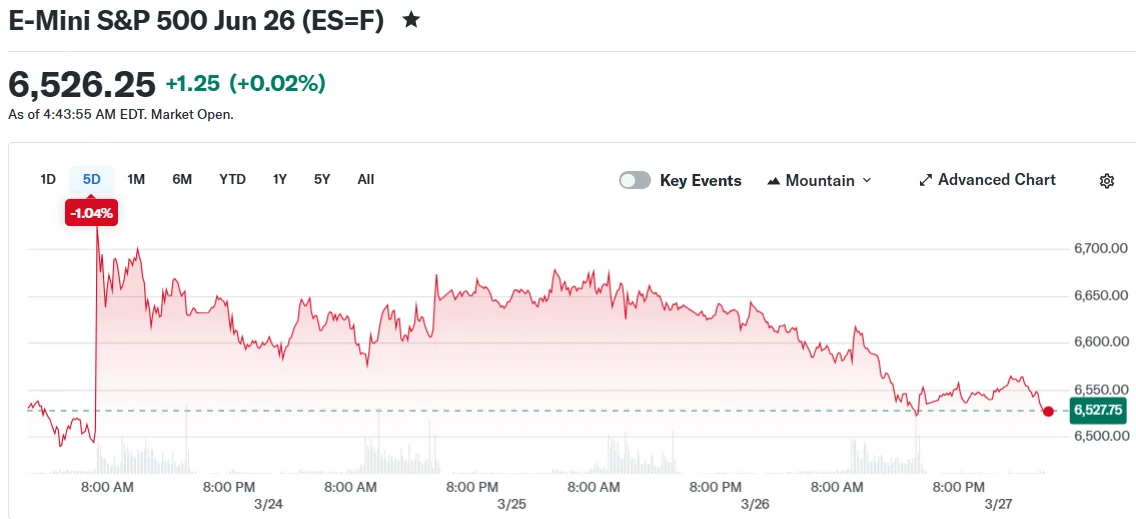
Futures contracts for U.S. equities posted modest advances Friday morning. Nasdaq 100 and S&P 500 futures each appreciated approximately 0.2%, while Dow Jones Industrial Average futures inched up 0.1%.
Neverthstanding these gains, upward momentum remained constrained. Market participants maintained a defensive posture as skepticism surrounding any permanent diplomatic resolution sustained elevated uncertainty levels.
Fixed Income Yields and Crude Oil Advance
The benchmark 10-year U.S. Treasury note yield climbed as high as 4.43% Thursday, advancing from levels below 4% registered just weeks ago. It moderated slightly to 4.41% by the session’s conclusion.
This pronounced increase has virtually eliminated market expectations for Federal Reserve interest rate reductions. Certain traders are now positioning for potential rate hikes instead. Comparable dynamics are unfolding across Western European sovereign debt markets.
Energy commodity prices also escalated. Brent crude futures traded above the $103 per barrel threshold. West Texas Intermediate approached $96. Both advances occurred as hostilities persisted throughout the Middle East region and apprehension intensified regarding potential interruptions to maritime traffic through the Strait of Hormuz.
Market observers are monitoring whether the geopolitical confrontation could persist deep into April.
Emerging reports indicate Iranian leadership remains hesitant to engage in direct negotiations with Washington, despite reviewing an American diplomatic proposal. This prevailing uncertainty continues exerting pressure on financial markets entering the weekend.

Top Man United target to rule himself out of replacing Michael Carrick as agreement nears

Today’s NYT Connections: Sports Edition Hints, Answers for March 27 #550

Nabung #nabung #tabungan #menabung #savingchallenge #money #uang

Smart energy pays enters the US market, targeting scalable financial infrastructure

Why Israel is blocking foreign journalists from entering

Bitcoin: We’re Entering The Most Dangerous Phase
Nabung #nabung #tabungan #menabung #savingchallenge #money #uang

Nabung #nabung #money #tabungan #menabung #budgeting #savingchallenge #savingmoney

Petrodollar Under Threat? Iran War Shakes Global Financial Order | WION World Business Watch
-
 Crypto World6 days ago
NIO (NIO) Stock Plunges 6.5% as Shelf Registration Sparks Dilution Worries
-
 NewsBeat2 days ago
Manchester United reach agreement with Casemiro over contract clause amid transfer speculation
-

 Fashion7 days ago
Weekend Open Thread: Adidas – Corporette.com
-

 Politics7 days ago
Jenni Murray, Long-Serving Woman’s Hour Presenter, Dies Aged 75
-

 Crypto World5 days ago
Best Crypto to Buy Now: Strategy Just Spent $1.57 Billion on Bitcoin During Fear While Early Investors Quietly Enter Pepeto for 150x Potential
-

 Crypto World6 days ago
Bitcoin Price News: Bhutan Sells $72 Million in BTC Under Fiscal Pressure, but the Smart Money Entering Pepeto Sees What the Market Does Not
-

 News Videos1 day ago
Parliament publishes latest register of MPs’ financial interests
-

 Sports4 days ago
Remo Stars and Kano Pillars Strengthen Survival Hopes in NPFL
-

 Sports4 days ago
Gary Kirsten Accuses Pakistan Cricket Board Of ‘Interference’, Mohsin Naqvi Responds
-

 Tech5 days ago
Give Your Phone a Huge (and Free) Upgrade by Switching to Another Keyboard
-

 Business5 days ago
No Winner in March 21 Drawing as Prize Rolls to $133 Million for Next
-

 Sports7 days ago
2026 Kentucky Derby horses, odds, futures, preview, date: Expert who nailed 12 Derby-Oaks Doubles enters picks
-

 Tech5 days ago
AI enters the chat: New Seattle dating app relies on tech to facilitate meaningful human connections
-

 News Videos4 days ago
Ch 9 Financial Management Part 1 | Detailed One Shot | Class 12 Business Studies Boards 2026
-
Business6 days ago
Columbia Sportswear enters $500 million credit agreement with JPMorgan Chase
-

 Tech5 days ago
Today’s NYT Connections Hints, Answers for March 22 #1015
-

 Business13 hours ago
Instagram, YouTube Found Responsible for Teen’s Mental Health Struggle in Historic Ruling
-
 Crypto World7 days ago
Small-cap Russell 2000 enters correction territory
-

 Business5 days ago
Will Duke Basketball Win It All? Duke Basketball Enters Second Round as Third Favorite to Claim NCAA Title
-

 Sports4 days ago
2026 Kentucky Derby horses, odds, futures, preview, date: Expert who hit 12 Derby-Oaks Doubles enters picks
You must be logged in to post a comment Login