

Crypto World
Eightco Lands $125M in Funding from Bitmine and ARK

The fresh capital from Kraken’s parent company, Ark Invest, and Bitmine has backed Eightco’s new bets on OpenAI and MrBeast
Shares in Eightco Holdings (ORBS) jumped 12% on Thursday after it raised $125 million to back its bets in blockchain and artificial intelligence.
Eightco said on Wednesday that crypto treasury firm Bitmine led the funding with $75 million, while Ark Invest and Payward, the parent company of crypto exchange Kraken, each chipped in $25 million apiece.
The company added that Bitmine chairman Tom Lee would join Eightco’s board and Ark Invest’s chief futurist Brett Winton also signed on as a board advisor.
Eightco chairman Dan Ives, known for his bullish commentary on the tech sector, also stepped down from his position after being appointed to the role in September.
Eightco said the capital would support its expansion “into investing in technology shaping the next generation of artificial intelligence, blockchain infrastructure, and global digital consumer platforms.”
Eightco bets on MrBeast, OpenAI
Eightco said that it had also closed an initial $50 million strategic investment into OpenAI and another $25 million investment into Beast Industries and its owner and YouTuber James Donaldson, better known as MrBeast.
“These investments position ORBS as a hub at the center of key frontier AI technologies and content creation, expanding its portfolio to include ownership stakes in world-leading innovators,” Eightco said.

Related: Crypto accounting startup Cryptio lands $45M as institutions move onchain
Shares in Eightco ended trading on Thursday up 11.67% to 90 cents in reaction to the announcement. The stock saw a slight fall after hours, dropping by 2.6% to 88 cents.

Shares in Eightco are down over 92.49% in the past six months as stocks tied to crypto have been battered amid a broad market downturn.
Eightco is an e-commerce inventory management platform that made its first crypto play in September, announcing it would buy and hold Worldcoin (WLD), which sent its share price surging by 3,000% in a single day.
Magazine: Human brain cell wetware plays Doom, fly’s mind uploaded: AI Eye

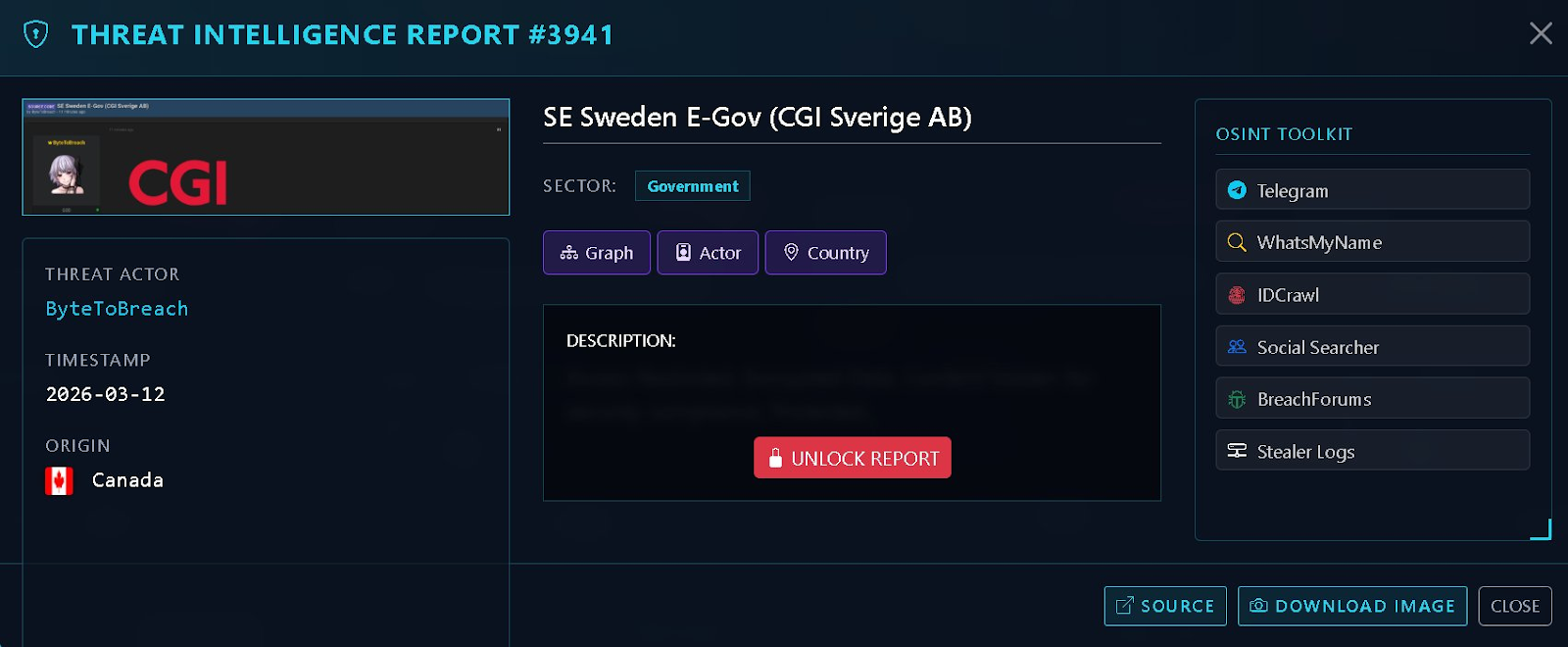
A threat actor has claimed to have leaked source code and other sensitive material tied to Sweden’s e-government platform, prompting an investigation by Swedish authorities and an incident response by CGI Sverige.
Cybersecurity accounts on X and local media reported Thursday that a threat actor calling itself ByteToBreach had published material it said came from CGI Sverige, the Swedish subsidiary of global IT giant CGI Group, and Sweden’s e-government infrastructure, according to local news outlet Aftonbladet.
CGI told Aftonbladet its cybersecurity team discovered an incident involving two internal test servers in Sweden that were not used in production. The company said an older application version and its source code were accessible, but that there was no indication that customer production data or operational services were affected. CGI press secretary Agneta Hansson confirmed to the news outlet that authorities are investigating the leak.
About 95% of Sweden’s 10.7 million population used e-government services in 2024, according to Eurostat data.
The leaked files could include the platform’s source code and configuration files, internal staff database, citizens’ personally identifiable information databases, electronic signing documents and other sensitive data.

Cointelegraph contacted CGI Group and Sweden’s national IT incident center, CERT-SE, for comment on the reported leak.
Swedish civil defense minister confirms cybersecurity incident
However, Carl-Oskar Bohlin, Sweden’s minister of civil defense, confirmed the data leak and said the government is working with CERT-SE and the National Cyber Security Center to identify the culprits.
IT security expert Anders Nilsson confirmed that the hacked resources seemed authentic. “Source code for several programs seems to exist, and from what I can see, the hack looks genuine,” Nilsson wrote in an email to media outlet SVT.
Related: SlowMist introduces Web3 security stack for autonomous AI agents
Hackers target Swedish and European infrastructure
Hackers are increasingly targeting public-facing cyber infrastructure throughout Sweden and Europe, warned threat intelligence platform Threat Landscape.
“This is not an isolated incident,” the platform said in a Thursday report.
“ByteToBreach is the same actor responsible for the Viking Line breach posted just one day prior, suggesting an ongoing campaign targeting Swedish and European infrastructure via CGI’s managed services footprint.”
Related: French couple robbed of $1M in Bitcoin by criminals posing as police
The threat actor claimed to have leaked the full source code of the e-government platform, sharing multiple supporting materials.

Threat-intelligence researchers said the exposure could still carry follow-on risk if attackers use the leaked code or documentation to identify weaknesses in public-facing systems, though the full contents of the dump have not been independently verified.
Magazine: Meet the onchain crypto detectives fighting crime better than the cops
TLDR
- Oil prices have surged past $100 per barrel for Brent crude following Iran’s commitment to maintain its blockade of the Strait of Hormuz.
- In response to what the IEA labels as the most severe supply disruption ever recorded, member nations agreed to deploy 400 million barrels from strategic reserves.
- A temporary exemption from the US Treasury permits certain nations to purchase Russian oil through April 11.
- Intelligence reports indicate Iran has started deploying mines throughout the strait, significantly increasing risks for maritime traffic.
- Plans for US Naval convoy operations through the strait could begin late March, though analysts remain skeptical about their effectiveness in resolving the situation.
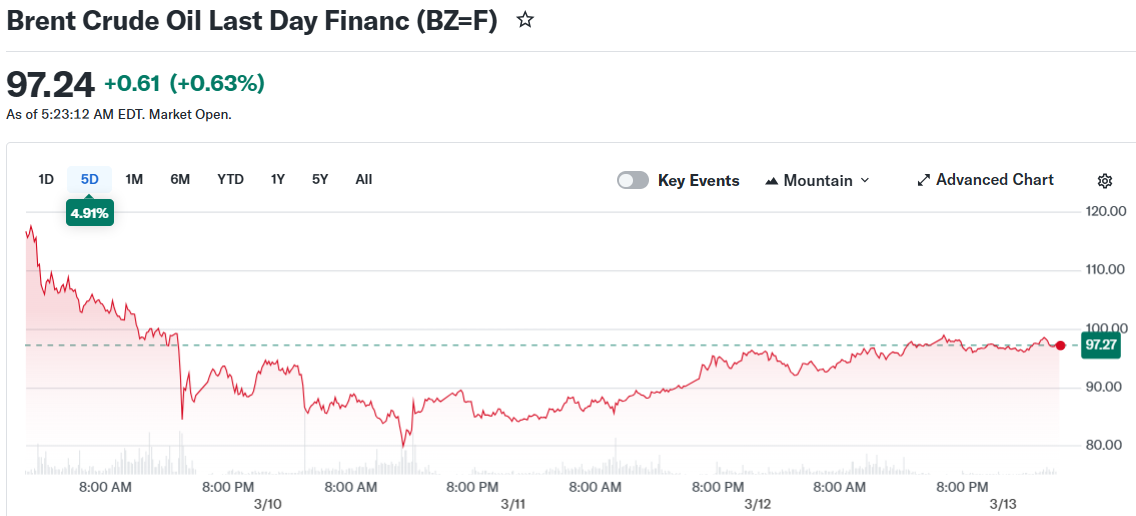
Global energy markets experienced severe turbulence this week as Brent crude oil climbed beyond the $100 per barrel threshold, driven by Iran’s promise to maintain its blockade of the Strait of Hormuz.
The dramatic price increase comes amid extraordinary market volatility not witnessed in recent years. West Texas Intermediate approached $97, with both major benchmarks experiencing wild price fluctuations reminiscent of pandemic-era chaos.
In his inaugural public remarks following his father’s succession, Iran’s new supreme leader Mojtaba Khamenei declared his government’s determination to maintain the shipping blockade.
The Strait of Hormuz represents a critical chokepoint situated between Iran and Oman. Approximately 20% of global petroleum supplies transit this narrow passage. Maritime traffic has nearly ceased since hostilities between the US-Israel alliance and Iran commenced on February 28.
The International Energy Agency characterized this as an unprecedented supply crisis in petroleum market history. Member states committed to deploying a historic 400 million barrels from strategic petroleum reserves.
According to New York Times reporting citing American intelligence sources, Iran has initiated mine-laying operations within the strait. This development dramatically escalates hazards for commercial vessels attempting passage.
Energy Secretary Chris Wright indicated that Naval escort operations for commercial tankers could commence before March concludes. However, earlier White House communications suggesting successful escort missions had already occurred were subsequently retracted.
US Eases Russia Oil Sanctions
Seeking to alleviate market pressures, the Treasury Department authorized a limited exemption permitting select countries to accept Russian petroleum shipments that departed before March 12. This temporary measure expires April 11.
Treasury Secretary Scott Bessent characterized the decision as necessary for global energy market stability. Russian officials estimated approximately 100 million barrels of their oil currently remains in maritime transit.
British authorities announced they would not mirror the American sanctions relaxation. UK Energy Minister Michael Shanks warned such measures could provide Moscow with resources to sustain its military operations.
French President Emmanuel Macron expressed opposition, arguing the Hormuz crisis doesn’t warrant Russian sanctions relief. Ukrainian President Zelensky characterized the American decision as a “serious blow” to Ukraine’s position.
Markets and Prices
Stock markets declined throughout the week as petroleum prices climbed. Volatility has been amplified by derivatives trading and exchange-traded fund positioning.
WTI crude fluctuated across approximately $43 this week, marking the widest trading band since prices briefly turned negative during pandemic lockdowns. Brent experienced roughly $38 in range variation.
Asian economies, particularly dependent on Persian Gulf petroleum, implemented emergency measures. Japan, South Korea, and Thailand announced fuel price controls. The Philippines, importing roughly 95% of its crude from Middle Eastern sources, mandated four-day work weeks for government employees to reduce consumption.
Market analysts predict a trading range between $85 and $105 while the confrontation continues. While the IEA reserve deployment may provide temporary relief, experts caution it won’t independently stabilize markets.
President Trump stated via social media that preventing Iranian nuclear weapons development remained his priority over oil price considerations.

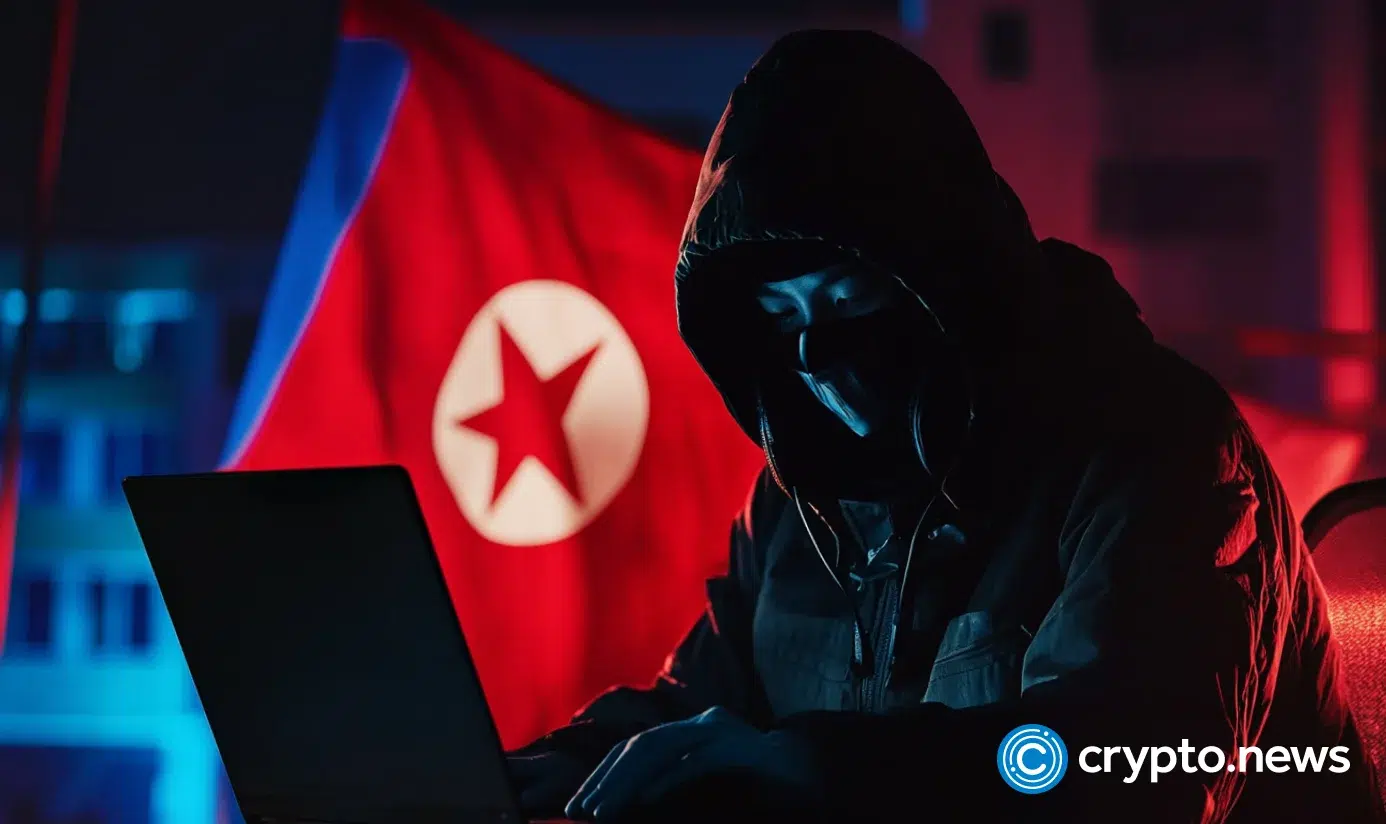
The U.S. Department of the Treasury has imposed sanctions on a network accused of helping North Korea generate illicit revenue through overseas information technology workers and cryptocurrency transactions.
Summary
- The U.S. Treasury sanctioned individuals and entities tied to a North Korean IT worker fraud network.
- The scheme allegedly used stolen identities and remote IT jobs to generate funds.
- Officials say cryptocurrency was used to launder and transfer proceeds linked to Pyongyang’s weapons programs.
U.S. blacklists facilitators of DPRK scheme that used crypto to move illicit earnings
In a statement, the Treasury’s Office of Foreign Assets Control (OFAC) said the targeted individuals and entities facilitated a scheme in which North Korean IT workers obtained remote jobs using stolen identities and false personas, allowing them to earn income from companies around the world.
Officials say the wages from these jobs were often funneled back to the North Korean government, helping finance the country’s weapons of mass destruction and ballistic missile programs.
The regime has relied on such overseas workers to generate hundreds of millions of dollars annually.
According to the Treasury, the network also relied on cryptocurrency to move and disguise the proceeds. Facilitators allegedly converted digital assets into cash or used crypto transactions to obscure the origin of funds before transferring them to accounts linked to the regime.
The scheme typically involved North Korean developers posing as freelance programmers or software engineers on global contracting platforms. Using fabricated identities and stolen personal information, they secured jobs at unsuspecting firms in the United States and other countries.
In some cases, authorities say these operatives introduced malware into company networks or exfiltrated sensitive data once they gained access to corporate systems.
Treasury officials said the action forms part of a broader U.S. effort to cut off revenue streams that North Korea uses to evade international sanctions and finance its military programs.
The department added that the sanctions freeze any U.S.-based assets belonging to the designated individuals and entities and generally prohibit U.S. persons from engaging in transactions with them.
Washington has repeatedly warned that North Korea increasingly uses cybercrime, cryptocurrency theft and fraudulent IT work schemes to fund its weapons development, posing growing risks to global businesses and the digital asset ecosystem.


Bitcoin rose above $71,500 on Friday, outperforming U.S. equities even as the dollar strengthened and oil prices remained elevated as the war with Iran was set to enter its third week.
A stronger dollar can tighten global financial conditions and often weighs on risk assets such as equities and cryptocurrencies. Higher oil prices — both Brent crude and West Texas Intermediate are hovering around $100 per barrel — reinforce inflation concerns and heighten expectations of interest-rate increases. Higher rates also detract from the attraction of such investments.
Despite these macro and geopolitical pressures, including the Middle East conflict, bitcoin has remained resilient and is among the best-performing macro assets since the war began on March 1. Historically, Fridays during this period have seen the largest cryptocurrency fall some 3%, a pattern that has not repeated so far today.
The Dollar Index (DXY), which measures the strength of the U.S. currency against a basket of major global currencies, topped 100 for the first time since late November. U.S. Treasury yields are also rising, with the benchmark 10-year bond yield climbing above 4.2%, reflecting tighter financial conditions and higher borrowing costs.
The Invesco QQQ Trust (QQQ), an exchange-traded fund that tracks the Nasdaq 100 index, meanwhile, was recently little changed.
In crypto-linked equities, Strategy (MSTR), the largest publicly traded corporate holder of bitcoin, added 1% before the start of official trading. The company has acquired roughly 11,000 BTC this week using proceeds from its perpetual preferred security Stretch (STRC).
Today marks the ex-dividend date for STRC, which means it has slipped slightly below its $100 par value to around $99.50.
Meanwhile, AI repurposed bitcoin miners such as IREN (IREN) and Cipher Digital (CIFR) opened slightly lower, while crypto exchange Coinbase (COIN) added about 2%.
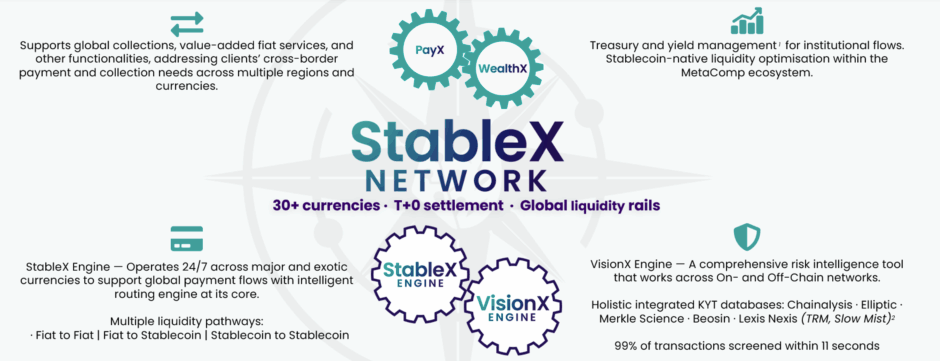
Singapore-based fintech MetaComp has closed a Pre-A+ funding round backed by Alibaba, lifting its cumulative total to US$35 million across two rounds in just three months, according to the company’s announcement. The latest round also brought in European early-stage investor Spark Venture, with Beijing-based 100Summit Partners serving as exclusive financial adviser. The capital infusion is aimed at accelerating MetaComp’s StableX Network, a cross-border payments platform designed to weave together fiat rails and stablecoin infrastructure for regulated institutions and high-net-worth clients. MetaComp previously disclosed a US$22 million Pre-A round in December 2025, signaling robust early-stage interest in regulated web2.5 payments infrastructure across Asia.
Key takeaways
- MetaComp’s Pre-A+ round, anchored by Alibaba, raises the company’s total funding to US$35 million in three months, underscoring strong demand for regulated cross-border stablecoin infrastructure.
- The round introduces Spark Venture from Europe as an investor and names 100Summit Partners (Beijing) as exclusive financial adviser, highlighting cross-regional interest.
- MetaComp previously closed a US$22 million Pre-A round in December 2025 with investors including Eastern Bell Capital, Noah, Sky9 Capital, Freshwave Fund and Beingboom Capital, illustrating sustained backing for hybrid fiat-stablecoin payments.
- The company intends to scale the StableX Network to connect regulated financial institutions, stablecoin issuers and partners across Asia, the Middle East, Africa and Latin America for real-time cross-border settlement.
- Industry context points to ongoing investor appetite for regulated stablecoin infrastructure in Asia, with forecasts suggesting the stablecoin market could reach around US$2 trillion by 2028.
Sentiment: Neutral
Market context: The funding activity aligns with a broader push to build regulated stablecoin rails that complement traditional banking systems. While regulators in some jurisdictions pursue stricter issuance controls, the Alibaba-backed round signals continued strategic interest in cross-border settlement infrastructure. The market backdrop includes forecasts that place stablecoins on a trajectory toward multi-trillion-dollar scales in the coming years, underscoring a shift toward institutional-grade crypto rails alongside established fiat systems.
Why it matters
MetaComp’s expansion of the StableX Network sits at the intersection of conventional finance and tokenized wealth management. By offering a hybrid model that merges fiat rails with stablecoin networks, the platform aims to provide faster, auditable cross-border settlements for banks, wealth managers and corporate clients. The vision is to enable real-time settlement that adheres to regulatory standards, a critical requirement for institutions seeking to incorporate digital assets into traditional portfolios without sacrificing compliance or risk controls.
The leadership’s explicit framing of a “Web2.5” architecture — where fiat rails and stablecoins operate as a single, interoperable ecosystem — underscores a broader sector trend toward hybrid solutions that deliver both speed and governance. If MetaComp can successfully onboard a network of banks, regulators and stablecoin issuers across multiple regions, the company could help accelerate the adoption of regulated stablecoins for international payments and cross-border trade. The mix of investors—Alibaba alongside European and Asian advisers—signals confidence in MetaComp’s ability to navigate the regulatory and operational complexities inherent in multi-jurisdiction collaborations.
Alibaba’s involvement comes at a sensitive juncture for stablecoins issued outside mainland China. The company has previously explored deposit-token technology for overseas transactions even as authorities tighten issuance rules within the country. The contrast between policy posture and private-sector experimentation highlights a nuanced landscape where international collaborations may unlock regulated cross-border flows, even as domestic issuance remains constrained. The broader market context, including forecasts of substantial growth for stablecoins, suggests a potential win for platforms that can demonstrate robust compliance, interoperability and measurable settlement improvements.
MetaComp’s strategic direction also rests on a global expansion blueprint. By extending the StableX Network to Asia, the Middle East, Africa and Latin America, the company aims to capture markets with rising demand for compliant, real-time settlement services. The model envisions a hub-and-spoke arrangement, linking financial institutions with stablecoin issuers and technology partners to streamline remittances, supplier payments and institutional treasury operations. Such an approach could address persistent inefficiencies in traditional cross-border rails while offering a path for asset managers and financial institutions to participate more directly in tokenized wealth solutions.
What to watch next
- Regulatory updates in target regions as MetaComp expands the StableX Network and pilots cross-border settlement solutions.
- New partnerships with banks, stablecoin issuers and wealth-management platforms to demonstrate live use cases and scale pilots.
- Possible follow-on funding rounds or strategic investments, including potential continued support from Alibaba and additional strategic investors.
- Public milestones on onboarding institutions and the rollout timeline for expansion into Asia, the Middle East, Africa and Latin America.
Sources & verification
- MetaComp press release: Alibaba-backed Pre-A+ round, total US$35 million in three months (PR Newswire)
- MetaComp press release: December 2025 Pre-A round totaling US$22 million, with investors including Eastern Bell Capital, Noah, Sky9 Capital, Freshwave Fund and Beingboom Capital (PR Newswire)
- Summary of MetaComp’s expansion and regional focus (MetaComp page) (MetaComp)
- Stablecoin market projections and regulatory context cited by industry coverage (Standard Chartered projection; referenced via Cointelegraph) (Cointelegraph — Stablecoin forecast)
- Regulatory stance on stablecoins and issuance (China crackdown context referenced in coverage) (Cointelegraph — Alibaba and stablecoins in China)
MetaComp expands StableX Network to accelerate cross-border finance
Singapore-based MetaComp announced a new Pre-A+ funding round led by Alibaba, raising the cumulative total to US$35 million across two rounds in three months. The round also features Spark Venture, a European early-stage investor, with 100Summit Partners (Beijing) acting as exclusive financial adviser. The capital infusion follows MetaComp’s earlier December 2025 disclosure of a US$22 million Pre-A round, which included a roster of notable investors such as Eastern Bell Capital, Noah, Sky9 Capital, Freshwave Fund and Beingboom Capital. The company said the funds will be directed at expanding the StableX Network, a platform designed to harmonize regulated financial institutions, stablecoin issuers and other partners through blockchain-based infrastructure.
At the heart of MetaComp’s strategy is a belief in a Web2.5 architecture where traditional fiat rails and stablecoin networks function together as a single, interoperable system. Tin Pei Ling, MetaComp’s co-president, underscored this vision, saying, “MetaComp was built on a single conviction: that the future of cross-border finance is neither purely traditional nor purely digital — it’s the integrated Web2.5 architecture where fiat rails and stablecoin networks operate as one.” The capital infusion is expected to accelerate the scaling of StableX Network beyond its current footprint into new markets and partnerships that can support real-time settlement with compliance at the forefront.
MetaComp’s expansion plan targets Asia, the Middle East, Africa and Latin America, areas where regulators are increasingly receptive to cross-border settlement innovations that preserve safety and oversight while delivering faster settlement times. The network aims to create a bridge between regulated financial institutions and stablecoin issuers, enabling institutions to access tokenized wealth products and stablecoin-based liquidity tools within a compliant framework. The move aligns with a broader industry trend toward building scalable, regulator-friendly infrastructure that can support institutional participation in the digital asset ecosystem.
The partnership profile around this round—Alibaba alongside European and Chinese advisers—reflects a cross-border approach to building out the infrastructure that could underpin more efficient remittances, cross-border corporate payments and wealth-management solutions in the years ahead. While regulatory policies differ across jurisdictions, the strategic emphasis on compliance and interoperability suggests that MetaComp intends to pursue a steady, institution-focused growth path rather than a rapid, consumer-facing rollout.
Investors have paid fees to hold Ethereum in ETFs for years while leaving the network’s native yield on the table, and that inefficiency disappeared this morning when BlackRock turned Ethereum into a productive asset for Wall Street by entering the staking race.
For the first time in US market history, the world’s largest asset manager is offering a product that captures both price appreciation and the network’s validator rewards. Now investors don’t have to choose between holding and earning, both are on the table.
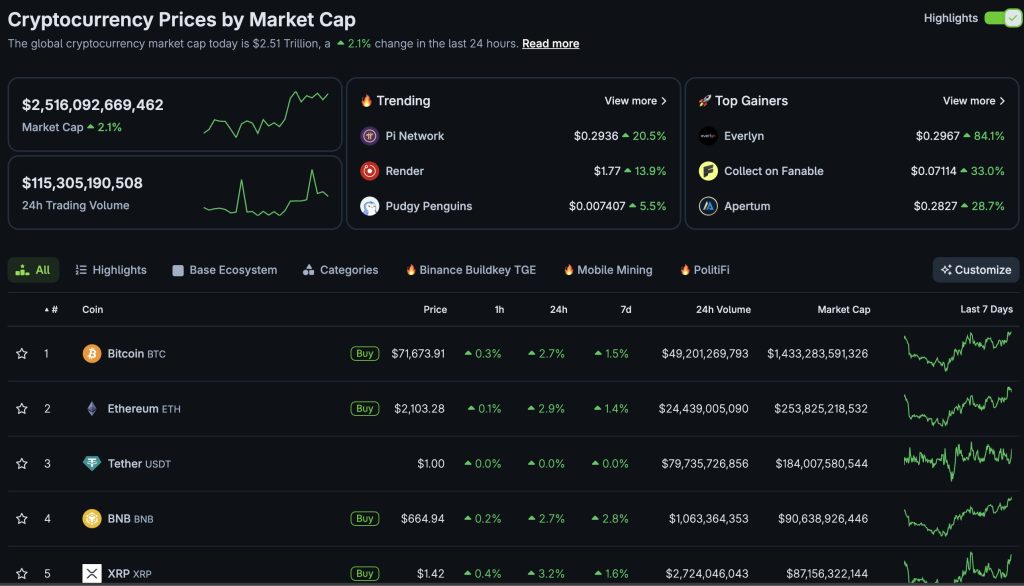
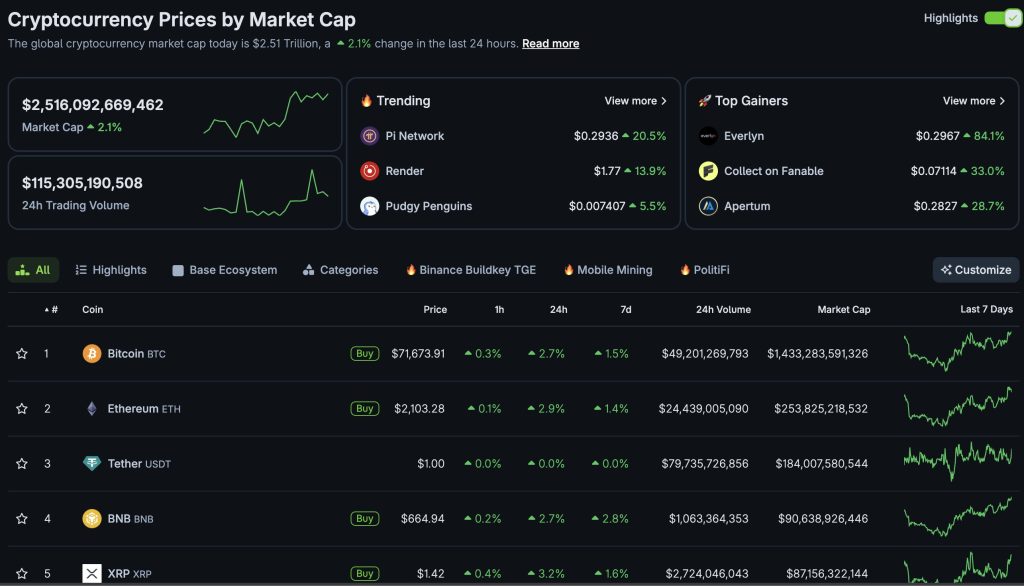
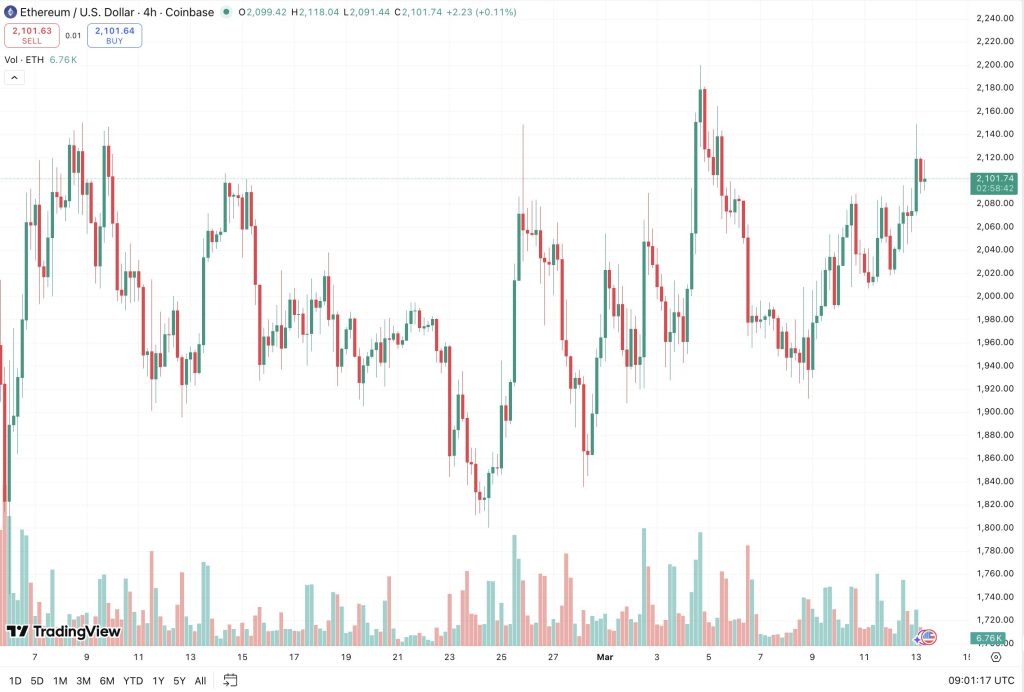
This news comes as the Ethereum price surged +2.8% overnight and is currently trading back above $2,100 as we head into the weekend.
The total crypto market cap is also up, climbing +2% over the past 24 hours and reclaiming the crucial $2.5 trillion level in the process.
BlackRock Enters the Staking Race: ETHB Launches on Nasdaq
BlackRock officially launched the iShares Staked Ethereum Trust (ETHB) on the Nasdaq exchange today. The product is distinct from the firm’s existing iShares Ethereum Trust (ETHA), which holds over $6.5Bn in assets but serves strictly as a passive price tracker.
This new vehicle intends to stake between 70% and 95% of its ether holdings to generate yield. However, the fee structure is aggressive. While the standard sponsor fee is set at 0.25%, BlackRock has implemented a promotional waiver that reduces the cost to 0.12%.
This rate applies to the first $2.5Bn in Net Asset Value (NAV) or for the first 12 months of trading, whichever threshold is breached first.
Jessica Tan, Head of Americas for iShares, positioned the launch as a direct response to client demand for products that reflect the full economic reality of the asset class.
The trust joins a BlackRock digital asset platform that now oversees approximately $130Bn in assets, cementing the firm’s dominance in the digital asset ETF space.
DISCOVER: Next Crypto to Explode in 2026
The BlackRock Ethereum Institutional Pivot: Yield is No Longer Optional
This launch signals that institutional adoption has moved beyond simple exposure. Until recently, regulatory friction prevented US issuers from including staking mechanics in exchange-traded products, forcing investors to choose between the safety of an ETF and the yield of direct ownership. That choice is no longer binary.
The arrival of ETHB suggests that regulators are increasingly comfortable with the technical nuances of proof-of-stake blockchains. Recent coordination between the SEC and CFTC has likely smoothed the path for these more complex structured products.
For allocators, the implications are mathematical: holding ample ETH without staking it is now a decision to accept underperformance relative to the benchmark.
Competitors like Fidelity and Grayscale are now on the defensive. With BlackRock successfully packaging staking rewards into a 0.12% fee product, the pressure to upgrade existing spot ETFs into staking-enabled vehicles will be immediate. The market standard for an Ethereum product has just been raised.
Supply Dynamics: The Scarcity Squeeze for ETH USD
The launch of ETHB introduces a new demand sink for the Ethereum network. Unlike spot ETFs, which simply hold coins in cold storage, staking ETFs lock those coins into the validator network. This reduces the actively circulating supply available for trading.
If capital rotates aggressively from the BlackRock Ethereum ETHA product to its new ETHB staking fund, or if new money enters specifically for the yield, the percentage of ETH locked in staking contracts will rise.
This aligns with broader market trends where Ethereum’s scarcity index is already turning positive. A successful ETHB launch accelerates this dynamic by institutionalizing the lock-up process.
With ETH USD facing immediate resistance at $2,150, the launch of BlackRock’s new Ethereum staking ETF could send it surging straight to the next target at around $2,400.
EXPLORE: Best Crypto Presales to Buy in 2026
The post BlackRock Launches iShares Staked Ethereum Trust With 82% Rewards appeared first on Cryptonews.

Ethereum co-founder Vitalik Buterin said Friday that he is no longer closely aligned with the Future of Life Institute, a group that received SHIB tokens from him in 2021.
Buterin said the institute originally pitched him a broad roadmap for reducing existential risks, including those tied to artificial intelligence, biology and nuclear threats, along with wider pro-peace and pro-epistemics initiatives. He said that helped motivate the Shiba Inu (SHIB) donation.
Buterin said the institute later moved toward cultural and political advocacy around AI risks, an approach he described as materially different from the strategy outlined when he donated.
“My worry is that large-scale coordinated political action with big money pools is a thing that can easily lead to unintended outcomes, cause backlashes, and solve problems in a way that is both authoritarian and fragile, even if it was not originally intended that way,” he wrote.
Buterin expresses disagreements to FLI’s current approach
The FLI describes its mission as reducing extreme risks and steering transformative technologies to benefit humanity.
“We need policies to help ensure that AI development improves lives everywhere – rather than merely boosts corporate profits,” the organization states on its website.

However, Buterin said some of the group’s proposals focus on placing safeguards in biosynthesis devices and AI models so that they refuse to produce harmful outputs.
“I view this as a very fragile solution: there are many ways to jailbreak, fine-tune or otherwise get around such restrictions,” he added.
Cointelegraph reached out to the FLI for comments, but had not received a response by publication.
Related: Vitalik says ‘at present’ his donations yield better gains than investments
FLI cashed out $500 million from the SHIB donation
In 2021, Buterin received large amounts of SHIB tokens and other dog-themed tokens as developers attempted to use his name as a marketing tactic. He later allocated some of those tokens to charitable causes.
The FLI was one of the organizations that received tokens from Buterin. However, he said he did not expect the value of the donated tokens to reach roughly half a billion dollars.
“I thought that surely they would cash out at most $10-25M, because there’s no way the SHIB market is deep enough to cash out more,” he wrote. “Instead, they managed to cash out something like $500M.”
FLI announced in June 2021 that a $25 million multi-year grants program had been made possible by support from Buterin and the Shiba Inu community.
Magazine: Human brain cell wetware plays Doom, fly’s mind uploaded: AI Eye


ETH is currently close to the buying zone, but the sell side is miles away.
Ethereum’s ETH is gaining steam on the day after the world’s largest asset manager launched a staked ETH tracking its performance in the US.
The token is currently challenging the $2,100 level after a 3% daily increase, but one popular analyst, who has focused on the longer term, laid out what he called a dream trade for ETH.
When to Buy and Sell ETH
Ali Martinez, the crypto analyst with nearly 165,000 followers on X, noted in a recent post that the accumulation zone is close by. He believes investors should accumulate the largest altcoin at levels around $1,070. Although the asset slipped below $1,500 last year, it has not traded anywhere near Martinez’s buy target since December 2022, at the end of the bear market.
If investors are indeed able to purchase ETH at these low levels, then the ‘dream’ profit-taking scenario would be at over $8,600. It’s worth noting that the altcoin has never even come close to such peaks. It would have to stage a 300% surge from its current level (or 700% from the accumulation zone) and smash through its 2025 all-time high of almost $5,000 to materialize Martinez’s trade.
The dream trade for Ethereum $ETH:
• Accumulate near $1,070
• Take profits around $8,670 pic.twitter.com/lBY8ThOsB7— Ali Charts (@alicharts) March 13, 2026
Bullish News for ETH
Fellow analyst CW outlined two factors that could propel ETH to new peaks soon. First, they noted that there’s a notable uptick in the Ethereum active addresses, which “indicates bullish market movements.” A similar pattern was visible near the bottom at the aforementioned bear cycle in 2025, and ETH’s price went on a roll in the following months.
The increase in $ETH active addresses indicates bullish market movements.
Although the price of $ETH has fallen, the network has actually become more active.
This pattern has been observed consistently near the bottom since 2022. This is expected to be due to increased… pic.twitter.com/FLwikGFfsn
— CW (@CW8900) March 13, 2026
You may also like:
In a separate post, the analyst outlined that Ethereum’s realized capitalization (calculated by the total value of all ETH coins based on the price when they last moved, rather than the current market price) has turned positive again. This, according to their estimations, is a clear signal about “the start of a full-scale bull market.”
Binance Free $600 (CryptoPotato Exclusive): Use this link to register a new account and receive $600 exclusive welcome offer on Binance (full details).
LIMITED OFFER for CryptoPotato readers at Bybit: Use this link to register and open a $500 FREE position on any coin!
Singapore-based MetaComp said Friday it completed a new funding round backed by Alibaba, as the company expands its stablecoin payment infrastructure.
MetaComp completed a Pre-A+ round backed by Alibaba, bringing the cumulative total to $35 million across two rounds in three months, according to the announcement.
The latest round also featured the European early-stage venture capital investor Spark Venture, with Beijing-based 100Summit Partners serving as exclusive financial adviser.
MetaComp previously announced closing a $22 million Pre-A funding round in December 2025 from investors including Eastern Bell Capital, Noah, Sky9 Capital, Freshwave Fund and Beingboom Capital.
The raise adds to signs of investor interest in regulated stablecoin infrastructure for cross-border payments in Asia.
MetaComp’s StableX Network to expand worldwide
Founded in 2018, MetaComp serves global financial institutions and high-net-worth individuals by offering hybrid fiat and stablecoin payment solutions and access to traditional and tokenized wealth management products.
With the new capital, MetaComp plans to expand its StableX Network, a platform that connects regulated financial institutions, stablecoin issuers and other partners through blockchain-based infrastructure.
Related: Stablecoin payments startup Kast raises $80M at $600M valuation: Report
MetaComp said the network will expand across Asia, the Middle East, Africa and Latin America, where it sees growing demand for compliant, real-time cross-border settlement.

“MetaComp was built on a single conviction: that the future of cross-border finance is neither purely traditional nor purely digital — it’s the integrated Web2.5 architecture where fiat rails and stablecoin networks operate as one,” MetaComp co-president Tin Pei Ling said.
Alibaba explores stablecoin projects despite China’s crackdown on issuance
Alibaba’s backing is notable given earlier reports that the company was exploring deposit-token technology for overseas transactions even as mainland China kept tight restrictions on stablecoin issuance.
In February, the government reiterated its stance, saying foreign and domestic companies cannot issue stablecoins pegged to the national currency without approval.
The stablecoin market is projected to reach $2 trillion by 2028, according to institutions including Standard Chartered.
Magazine: Is China hoarding gold so yuan becomes global reserve instead of USD?

Key Takeaways
- Nvidia’s annual GTC 2026 event takes place March 16–19, beginning with Jensen Huang’s keynote address on Monday.
- Analysts are looking for clarity on component supply chains—specifically wafers, memory, and optics—and Vera Rubin chip rollout timelines.
- Projected free cash flow for this fiscal year stands at $178 billion, which would set an unprecedented record for corporate profitability.
- Of the 70 analysts tracking NVDA, 93% maintain Buy ratings, with consensus price targets around $267–$273, suggesting ~45–49% potential gains.
- Despite rising earnings estimates, Nvidia shares have remained relatively stagnant in 2026, trading near $185 with roughly 1% year-to-date decline.
Nvidia (NVDA) enters what many consider its most critical week of 2026. The company’s flagship GTC conference begins Monday, March 16, and continues through March 19. Chief Executive Jensen Huang is scheduled to open the event with his keynote presentation—likely sporting his iconic leather jacket.
Shares have traded sideways for several months, lingering around the $185 mark since August of last year. An 8% pullback materialized earlier this year before the stock rebounded. Meanwhile, Wall Street’s profit projections have continued trending upward.
Analysts project free cash flow for the fiscal year concluding in January 2027 will reach $178 billion—representing an 85% increase year-over-year. For perspective, Saudi Aramco established the historical benchmark for free cash flow in 2022 at approximately $150 billion. Should Nvidia achieve current consensus estimates, it would claim the title of most profitable corporation ever recorded.
Looking further ahead, analysts anticipate that milestone will be surpassed again, with free cash flow projections climbing to $233 billion in fiscal 2028.
Investor Focus Areas
Analyst scrutiny will concentrate on several critical topics. Supply chain visibility tops the list. Nvidia must demonstrate that its upcoming Vera Rubin chip deliveries remain on schedule and customer orders are being fulfilled according to commitments. Any indication of delays would likely trigger market volatility.
AI infrastructure spending sustainability represents another major concern. Tech giants including Amazon and Alphabet are projected to deploy $660 billion toward AI infrastructure throughout this year. Amazon’s capital expenditures alone have surged from approximately $50–$60 billion annually to an estimated $190 billion for the current year. Barclays research suggests total AI-related capital spending across the industry could reach $1 trillion by 2028.
Product development strategy also demands attention. The AI semiconductor landscape is transitioning from model training applications toward inference workloads—the deployment of trained models in production environments. This evolution creates different chip requirements.
Inference operations consist of two distinct phases: prefill, where input tokens are processed simultaneously (optimized for parallel GPU architecture), and decode, which generates output sequentially and benefits from purpose-built hardware designs.
Groq Integration Strategy
Nvidia invested approximately $20 billion last year to license intellectual property from Groq, an emerging chip company, while bringing its engineering team in-house. Groq develops LPUs—language processing units—engineered specifically for cost-effective, high-efficiency decode operations.
Market participants will be seeking specifics on how Groq’s LPU architecture integrates into Nvidia’s broader chip strategy going forward. This acquisition positions the company to compete more effectively against cloud providers building proprietary silicon.
Truist Securities anticipates “comments around market sizing and growth rates, along with product introductions, to be a modest positive for the stock.”
UBS characterizes the disconnect between its optimistic Nvidia earnings forecasts and the stock’s current discounted valuation as “seemingly unsustainable.” Nevertheless, UBS maintains that a transformative catalyst emerging from the conference appears “hard to see.”
Trading at 17 times projected earnings for next fiscal year, Nvidia currently commands a valuation multiple below the S&P 500 average. Among 70 analysts providing coverage, 93% assign Buy recommendations.
Consensus price targets cluster around $267–$273, implying potential appreciation of 45% to 49% from present levels.

Anthony Joshua, Tyson Fury and Martin Bakole all on one heavyweight’s hit list: “It’s personal”

Brunch Time York in Holgate gets one star for food hygiene

GameStop (GME) Stock Holds Steady Near $24.50 Amid Acquisition Speculation and Meme Stock Resilience

Smart energy pays enters the US market, targeting scalable financial infrastructure

Why Israel is blocking foreign journalists from entering

Bitcoin: We’re Entering The Most Dangerous Phase

Intercepted Drone Debris Hits Central Dubai Building; Iran Claims Strike Targeted Financial Hub

Weekly Pay Quiz: Can You Solve This Math Riddle? #quiz #finance #shorts

OMG SCARY Cardano Founder: Worst Crypto Era in History #crypto #cryptocurrency #xrp #finance #oil
-
Business7 days ago
Form 8K Entergy Mississippi LLC For: 6 March
-

 News Videos4 days ago
10th Algebra | Financial Planning | Question Bank Solution | Board Exam 2026
-

 Fashion7 days ago
Weekend Open Thread: Ann Taylor
-

 Crypto World4 days ago
Paradigm, a16z, Winklevoss Capital, Balaji Srinivasan among investors in ZODL
-
 Tech2 days ago
A 1,300-Pound NASA Spacecraft To Re-Enter Earth’s Atmosphere
-

 Tech3 days ago
ChatGPT will now generate interactive visuals to help you with math and science concepts
-

 Politics7 days ago
Top Mamdani aide takes progressive project to the UK
-

 Business3 days ago
ExxonMobil seeks to move corporate registration from New Jersey to Texas
-

 Sports6 days ago
Three share 2-shot lead entering final round in Hong Kong
-

 Sports5 days ago
Braveheart Lakshya downs Lai in epic battle to enter All England Open final | Other Sports News
-

 NewsBeat2 days ago
Residents reaction as Shildon murder probe enters second day
-

 Entertainment6 days ago
Hailey Bieber Poses For Sexy Selfies In New Luscious Lip Thirst Traps
-

 Business5 days ago
Search for Nancy Guthrie Enters 37th Day as FBI Probes Wi-Fi Jammer Theory
-

 Business2 days ago
Search Enters Sixth Week With New Leads in Tucson Abduction Case
-
 NewsBeat3 days ago
Pagazzi Lighting enters administration as 70 jobs lost and 11 stores close across Scotland
-

 Tech4 days ago
Despite challenges, Ireland sixth in EU for board gender diversity
-

 Business4 days ago
Search Enters 39th Day with FBI Tip Line Developments and No Major Breakthroughs
-

 NewsBeat2 days ago
I Entered The Manosphere. Nothing Could Prepare Me For What I Found.
-
 Business6 days ago
Iran war enters second week as Trump demands ’unconditional surrender’
-

 Sports4 days ago
Skateboarding World Championships: Britain’s Sky Brown wins park gold