

Crypto World
El Salvador Claims It’s Buying Bitcoin Daily, But the IMF Disagrees


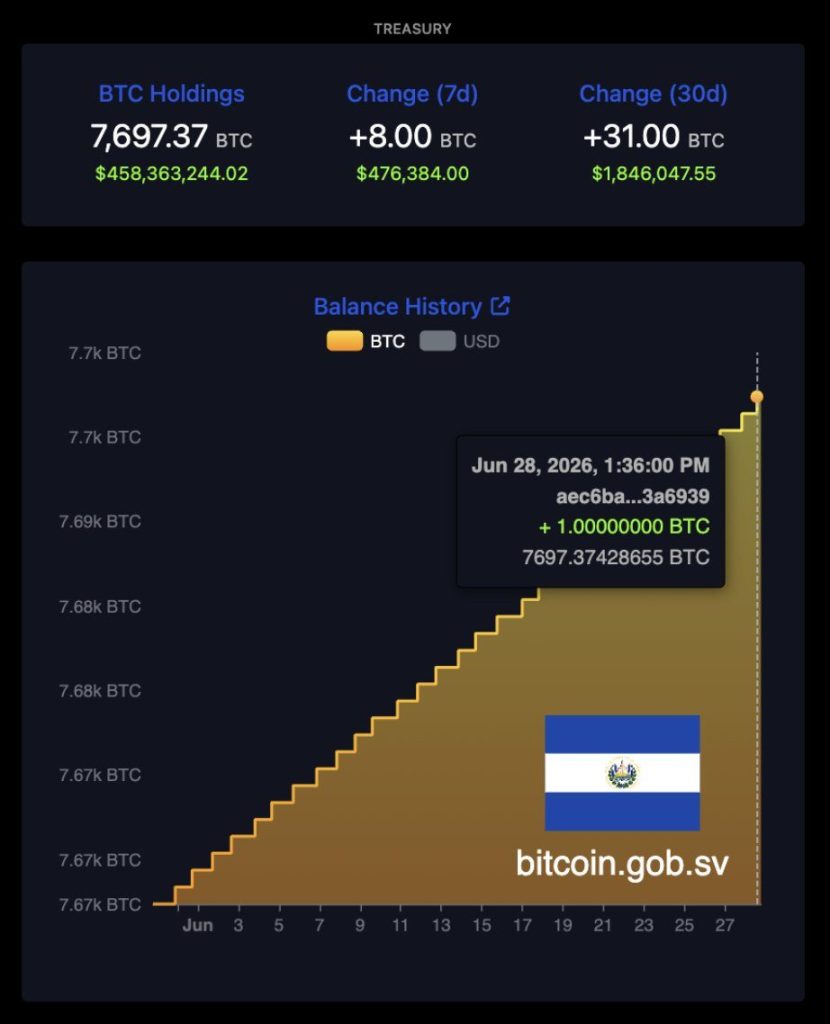
Bitcoin News: El Salvador’s Bitcoin reserve stands at 7,696 BTC, worth approximately $460M as of June 28, but the number is doing more political work than the accounting behind it can cleanly support.
President Nayib Bukele’s government continues to publicly promote a one-BTC-per-day BTC accumulation strategy, even as the country operates under a $1.4Bn Extended Fund Facility with the IMF that imposes a hard zero ceiling on voluntary public-sector Bitcoin purchases.
That gap between public messaging and loan conditionality is the central tension the next IMF review will force into the open.
Bitcoin was trading in the $59,000 to $60,000 range at the time of publication, down roughly 19% over 30 days. That drawdown matters here because it compounds the fiscal optics: at the reserve’s peak valuation near $800M in early 2026, the strategy looked like a winning sovereign bet.

At current prices, the same 7,696 BTC position represents a significant unrealized loss and a balance-sheet line item that the IMF is watching closely.
The country occupies a unique position in the history of sovereign Bitcoin. It made BTC legal tender in September 2021, built the state-run Chivo wallet infrastructure to support public adoption, and turned BTC purchases into a national brand. That era is now constrained by the terms of the IMF deal, which it needed to stabilize public finances.
Don’t Miss Out on Our $1,000 USDT Airdrop on ByBit
Bitcoin News: The IMF Ceiling Is Precise. The Reserve Growth Is Not.
The IMF’s Extended Fund Facility, approved by the Fund’s Executive Board in early 2025, includes a continuous quantitative performance criterion with a zero ceiling on voluntary BTC accumulation by the public sector.
A parallel ceiling covers public-sector BTC-denominated or BTC-indexed debt and tokenized instruments. These are not aspirational targets; they are performance criteria tied to disbursement. Missing them has consequences.
The complication is that El Salvador’s reported holdings have risen since the program began. Official data showed 5,968 BTC at the program’s December 2024 start; BitcoinTreasuries now lists 7,696 BTC as of late June 2026. On its face, that trajectory contradicts a no-accumulation pledge.
The IMF’s explanation, confirmed by spokesperson Julie Kozack, is that increases in the Strategic Bitcoin Reserve Fund reflect consolidation of BTC across various government-owned wallets, notably from a BANDESAL cold-storage address, rather than net new market purchases by the public sector. The total BTC controlled across all government wallets, the IMF says, has remained unchanged.
That distinction is technically defensible under international public-sector accounting standards, which treat all government-controlled wallets as a consolidated position.
But it is not self-evident from the public-facing reserve tracker, and it leaves El Salvador’s one-BTC-a-day narrative in a structurally ambiguous place: the claim may describe internal wallet movements rather than fresh sovereign accumulation, or it may not.
Discover: The Best Token Presales
Bukele’s Bitcoin Brand Versus the Loan’s Hard Conditions
The political logic of Bukele’s sovereign Bitcoin strategy was always layered. BTC purchases were simultaneously a hedge against dollar dependency, a brand-building exercise for international Bitcoin audiences, and a domestic political signal.
The one-BTC-a-day narrative still travels effectively on social media and still positions El Salvador as the flagship experiment in crypto regulation by adoption rather than restriction. None of that political value disappears under IMF oversight.
What changes is the accountability structure. The IMF program required El Salvador to report all public-sector hot and cold wallet addresses and corresponding BTC balances, with deadlines at the end of March 2025, the end of June 2025, and the end of December 2025.
It also required the government to exit its public involvement in the Chivo wallet by July 2025, to liquidate the Fidebitcoin trust, and to publish audited financial reports for all Bitcoin-linked public entities. The Fund’s stated position is that “efforts will continue” to ensure El Salvador does not accumulate additional BTC, phrasing that signals ongoing scrutiny rather than a settled compliance verdict.
A government reserve cannot be redeemed the way ETF shares can. US spot Bitcoin ETFs absorbed roughly $5.94 billion in outflows over six consecutive weeks during the same period El Salvador’s reserve was under pressure, illustrating exactly how quickly institutional Bitcoin demand can reverse.
El Salvador has no equivalent exit mechanism. Its reserve must coexist with budget targets, IMF disbursement conditions, and public accounting requirements simultaneously. That is a different kind of constraint than a corporate treasury or an ETF sponsor faces.
Discover: The Best Crypto to Diversify Your Portfolio
The post El Salvador Claims It’s Buying Bitcoin Daily, But the IMF Disagrees appeared first on Cryptonews.

Crypto World
Viral Altcoin VELVET Explodes 1,700% in a Month: More Gains Ahead or Perfect Short Setup?
The cryptocurrency sector may be stuck in a prolonged bear market, yet some tokens still manage to outperform with significant upward moves.
Velvet (VELVET) is a standout example, having jumped by quadruple digits in the past month. And while some analysts expect more short-term upside, others warn the altcoin could be a ticking time bomb.
Further Rally?
As of press time, the altcoin trades at around $1.58 (according to CG), representing a 250% increase on a weekly scale and a staggering 1,700% pump over the last 30 days.

Its market capitalization has risen to nearly $700 million, making VELVET the 90th-biggest cryptocurrency. One potential catalyst for the price explosion could be the project’s collaboration with AerodromeeFi.
“With the integration, you now:
– Get tighter pricing
– Pay less slippage
– Tap deeper liquidity on every trade
– Land better fills, automatically,” the announcement reads.
Later on, the project introduced Velvet-1: an Artificial Intelligence (AI) model for on-chain intelligence, which could also have positively impacted the price.
Several analysts have highlighted the coin’s performance and believe it might have more fuel for additional gains. X user Crypto With Gopal claimed that the price “is tightening inside a Symmetrical Triangle after a sharp bullish impulse.” He argued that sellers continue to lose control, setting a short-term target of $2.1.
The Boss also issued an optimistic prediction, arguing that the latest breakout attempt shows that buyers remain active after consolidation rather than immediately giving back gains. The analyst claimed that the current structure looks “healthier than it did 24 hours ago, with the chart transitioning from recovery mode into expansion mode.”
“If momentum persists and volume follows through, the market could begin testing higher liquidity zones that were previously rejected during the first impulsive move earlier this month,” they concluded.
‘Generational Short Opportunity?’
Many other analysts believe investors should stay away from the altcoin as it may experience a steep decline in the near future. Yesterday (June 28), X user Crypto with Haris ₿ predicted that VELVET could crash to $0.90 in the next six hours (which didn’t happen), calling the setup a “generational short opportunity.”
For his part, Vuori Trading claimed that the token is another “Binance Alpha aka. CZ scam.” In his view, the token seems to be nearing its top, but if it crosses $2, it might explode to $8.
The coin’s Relative Strength Index (RSI) reinforces the bearish outlook. The ratio has risen past 80, meaning VELVET has entered extreme overbought territory and could be on the verge of a collapse. The technical analysis tool ranges from 0 to 100, with anything below 30 considered a buying opportunity.

The post Viral Altcoin VELVET Explodes 1,700% in a Month: More Gains Ahead or Perfect Short Setup? appeared first on CryptoPotato.
Crypto World
Private keys, not smart contracts, caused 40% of crypto’s $16 billion hack losses. Here’s whats being done.


“Most blockchain infrastructure was originally built for a single-user, single-key model, one private key controls everything, and if that key is lost or stolen, all the assets are gone instantly. This goes against the basic security principles that traditional finance has relied on for decades: more than one person approving, separation of duties, and several layers of defense,” Wu told CoinDesk.
In a way, the system built to revolutionize global finance has weaker security than a typical email account.
Wu added that the number of routes through which an attack can be launched has increased significantly. “Cloud systems, third-party tools, social media accounts, and the people operating them, all of these can become a way in.”
Both Wu and Fan pointed to the Bybit hack of February 2025 as an example of a widening attack surface. Attackers compromised the software supply chain of a third-party developer tool, allowing them to inject malicious code into the wallet’s web interface and trick executives into unknowingly signing away $1.5 billion in Ethereum.
The fix
The industry is now moving to address the private key vulnerability issue, though not evenly, according to Wu.
“There’s progress on many fronts: MPC [multi-party computation] wallets, account abstraction with social recovery, passkey-based login, hardware wallet enforcement, and proper key management SOPs,” he said. “The problem is that these are often added as optional extras, instead of being built in from the start at the protocol level. Most chains still treat security as a feature to bolt on, not as a core design principle.”

TLDR;
- Bybit EU has become the main regulated route for EEA users as Bybit Global prepares phased service restrictions.
- EEA users will receive advance notices before restrictions begin, allowing them to manage open positions and balances.
- Bybit’s move reflects growing MiCA compliance pressure as crypto exchanges adjust services across European markets.
- Users will retain access to custodied assets while Bybit limits selected global platform services for EEA residents.
Bybit EU moved into sharper focus after Bybit announced phased limits for EEA users on its global platform. The exchange said access to certain global services will be progressively restricted as part of regulatory alignment across Europe. Affected users will receive notices before any changes take effect.
Bybit also said clients will keep access to assets held in their accounts while they manage positions and balances. The move comes before the MiCA transition window closes on July 1, 2026. It also pushes European clients toward the group’s regulated platform.
Bybit EU Becomes Main Route as Global Access Narrows
Bybit said EEA users will face gradual limits on selected services through Bybit Global. The company did not give a single cut-off date in the notice. Instead, it said users will receive clear instructions before specific measures begin.
The process covers residents across most EEA countries. Austria, France, Germany, Ireland, Italy, Spain, Sweden, and Norway are included. Malta is excluded from this process because Bybit EU does not actively offer services there.
The exchange framed the move as part of its broader regulatory alignment. MiCA now gives crypto firms one rulebook for serving European clients. That framework raises the pressure on platforms still operating through older national arrangements.
Bybit EU operates through a separate European entity based in Vienna. The platform holds authorization in Austria under MiCAR. Its permitted services include custody, crypto-fiat exchange, crypto-to-crypto exchange, placing crypto assets, and transfer services.
The shift means EEA users may need a separate account on the European platform. Existing Bybit Global accounts are not automatically the same as Bybit EU accounts. Users may also need to complete identity checks again before using local services.
For traders, the key issue is continuity. Open positions, balances, and service access may be handled under different timelines. Bybit said affected clients will receive direct communication before restrictions are applied.
Bybit EU Incentives Show MiCA Compliance Push
Bybit EU is also using incentives to attract European users before the July deadline. Its “Move Your Funds, Get Rewarded” campaign runs through July 31, 2026. The offer targets new EEA users who have not held a Bybit EU account.
The campaign includes several benefit tracks. Users may receive a welcome package, card bonuses, and subscription cashback. Eligible clients may also get faster VIP status after a qualifying deposit.
Larger deposits may receive USDC cashback under the campaign terms. The offer gives Bybit a commercial bridge while regulatory access changes across Europe. It also helps move activity from the global platform toward the regulated entity.
The broader backdrop is clear. MiCA has made authorization, supervision, and user protection central to European crypto access. Exchanges without the right license face higher legal risk after the transition period ends.
Bybit EU CEO Mazurka Zeng said users now value clarity and long-term readiness. That message fits the exchange’s new structure in Europe. Bybit Global remains available in other markets, but EEA users now face a different path.
The change may also shape competition among European crypto platforms. Licensed exchanges can market continuity while rivals adjust access. For Bybit, the near-term test is whether users migrate smoothly before service limits tighten.

Update 2:00 pm UTC, June 29: Added comment from Germany’s Federal Financial Supervisory Authority (BaFin).
The European Union’s Markets in Crypto-Assets Regulation (MiCA) framework is producing uneven crypto licensing across member states and European Economic Area (EEA) jurisdictions, with Germany leading approvals under the new regime that takes effect on Wednesday.
Data from the European Securities and Markets Authority (ESMA) interim register, compiled on Friday, shows Germany has 57 MiCA-authorized crypto-asset service providers (CASPs), accounting for about 23% of the 244 total licenses issued.
France follows with 26 companies, or roughly 11% of all approvals, placing it alongside the Netherlands as the bloc’s second-largest hub for MiCA licensing.
The pattern suggests that although MiCA is designed to create a single European crypto market, implementation remains fragmented across national regulators ahead of the July 1 transitional deadline.
France leads late-June approval wave
While Germany leads overall MiCA licensing, France has recently accelerated approvals, accounting for the largest share of last-minute authorizations.
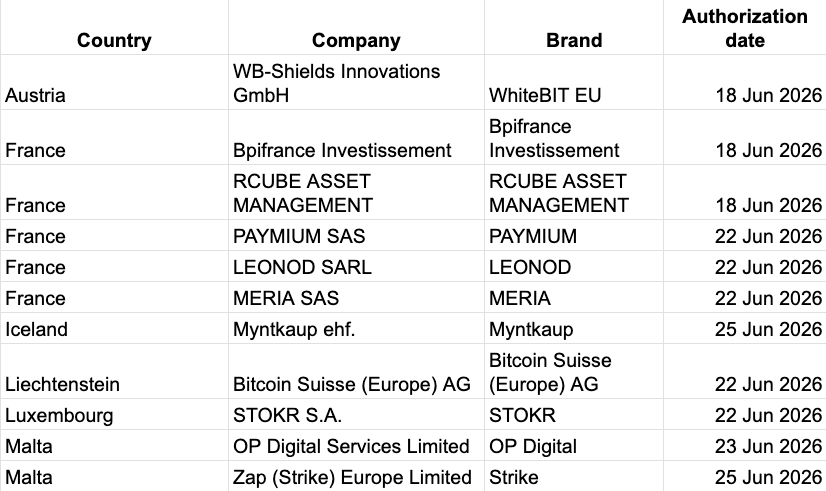
According to ESMA interim data, France issued five CASP approvals between June 18 and June 22, the most during that window. In total, 11 approvals were issued across EU and EEA jurisdictions during the period, with Malta following France with two authorizations.
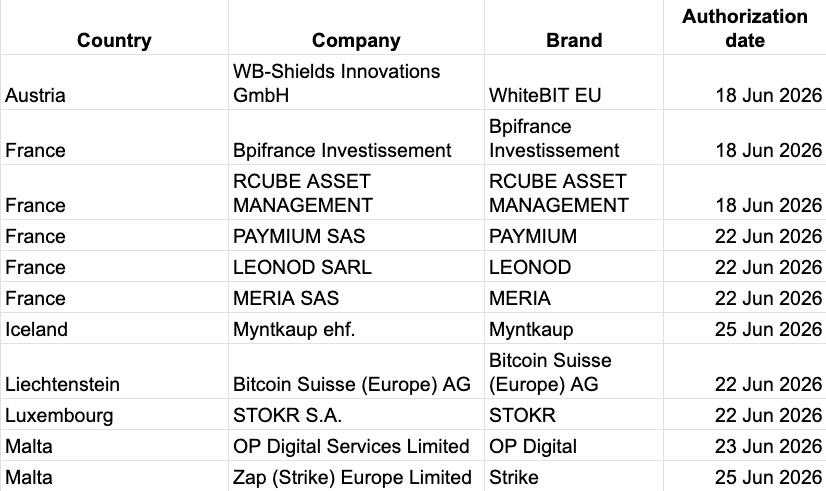
MiCA CASP licenses issued during the period from June 18-25, 2026. Source: ESMA
France’s authorizations include CASPs such as Bpifrance Investissement, RCUBE Asset Management, Paymium, Leonod and Meria.
Germany’s Federal Financial Supervisory Authority (BaFin) told Cointelegraph that the relatively high number of MiCA authorizations is partly driven by the country’s large financial sector, including a high number of credit institutions that can provide crypto asset services under MiCA.
It also pointed to Germany’s pre-existing national licensing regime, which allowed some CASPs to use simplified authorization pathways under MiCA transition rules, potentially accelerating approvals.
Related: Binance faces EU service limits next week as MiCA rules take effect
A spokesperson at BaFin also said it is difficult to predict whether Germany will maintain its dominant share of CASP authorizations as MiCA implementation progresses, noting that outcomes will depend on market developments, innovation trends and the volume of pending applications across member states. The representative added that approvals in other EU countries are expected to increase over time and broadly align with the size of national financial sectors.
Five EU states have not issued any MiCA licenses
Five EU member states, including Greece, Hungary, Poland, Portugal and Romania, have not issued any MiCA licenses as of June 26, according to ESMA interim register data.
Greece stands out after Binance applied for authorization in the country but later withdrew its application, shifting its eventually licensing plans to another MiCA jurisdiction.
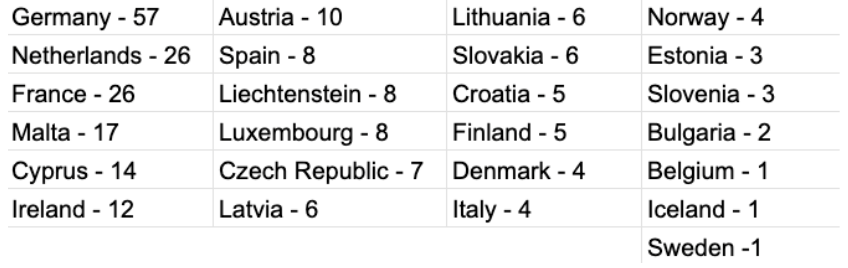
European jurisdictions ranked by the number of approved CASPs under MiCA as of Friday. Source: ESMA
Poland is also notable, with delays in MiCA implementation legislation followed by three reported presidential vetoes, leaving the country without an active licensing framework by the time of the EU deadline.
In contrast, Italy dominated ESMA’s non-compliant CASP register as of Friday, accounting for an overwhelming majority of entries with 160 out of 162, while the Netherlands and Slovakia recorded one each, linked to MEXC and LWEX, respectively.
Additional reporting by Yohan Yun.
Magazine: AI is banking the unbanked in Africa… faster than crypto


White House officials — especially lead crypto adviser Patrick Witt — have sought to keep the Clarity Act moving forward in the Senate, including holding previous meetings with those who have objected, such as law enforcement groups and Wall Street bankers. Representatives of the White House didn’t immediately respond to requests for comment on the expected Monday meeting, which meant to work through some of the remaining concerns, and few details were available.
Industry groups such as the Blockchain Association have defended the legislation’s crime-fighting tools, arguing that the bill includes a number of new powers for pursuing bad actors, and that the absence of a new law will leave a vacuum.
At an industry-hosted event earlier this month, White House adviser Witt said, “We’re putting real regulatory constraints on businesses and actors that currently live in a state of uncertainty.”
To law enforcement officials, he argued, “You should be the biggest cheerleaders for this bill, because this is really what is missing.”
Meanwhile, the Clarity Act’s political opponents, such as Senator Elizabeth Warren — the top Democrat on the Banking Committee, have maintained a steady stream of criticism on the legislation’s illicit-finance front. They routinely cite crypto’s use by criminal groups, drug cartels and human traffickers.

Key Takeaways
- Strategy is preparing to liquidate up to $1.25 billion in Bitcoin holdings to strengthen its cash position, currently sitting at $2.55 billion.
- Two separate $1 billion buyback initiatives have been authorized — targeting both common and preferred shares.
- The firm’s mNAV metric fell beneath the critical 1.0 threshold on June 27, eliminating its capital-raising edge.
- STRC preferred stock dividend increased to 12%, with new policies requiring cash reserves to cover a full year of obligations.
- Shares of MSTR were trading at $82.31, reflecting a 3.5% decline, as Bitcoin hovered around $60,275.
Strategy (MSTR) is executing a dramatic strategic reversal. The enterprise that staked its reputation on accumulating and never selling Bitcoin is now preparing to offload a significant portion — a development that has captured Wall Street’s full attention.
In a June 29 filing, Strategy outlined intentions to divest up to $1.25 billion in Bitcoin assets. The capital raised will strengthen the company’s treasury, finance preferred shareholder dividends, service debt obligations, and support general corporate requirements.
MSTR shares climbed approximately 5% during pre-market hours following the disclosure, though by regular trading the stock had retreated to $82.31, representing a 3.5% decline. Bitcoin was trading near $60,275, posting a modest 0.6% gain over the previous day.
According to the filing, Bitcoin disposals will occur opportunistically based on prevailing market dynamics and capital requirements — not according to any predetermined timeline.
The Economics Have Shifted
For an extended period, Strategy’s approach was remarkably straightforward: raise capital through securities offerings, acquire Bitcoin, then repeat the cycle. This framework delivered exceptional results during Bitcoin’s bull runs, particularly when the company’s mNAV — measuring enterprise valuation against Bitcoin holdings — remained substantially above 1.
That crucial metric slipped below parity on June 27. This development signals that the valuation premium enabling Strategy to access inexpensive capital for Bitcoin acquisitions has essentially vanished.
Both common and preferred securities have experienced severe declines tracking Bitcoin’s downturn. MSTR has plummeted nearly 80% during the past twelve months. The perpetual preferred instruments Strategy introduced in 2025 — initially conceived as a mechanism to expand Bitcoin holdings without diluting existing shareholders — have tumbled below $75, significantly beneath the $100 par value necessary for economically sensible purchases.
Management also indicated greater restraint regarding future common stock issuances, especially when share prices approach net asset value.
Dual share repurchase authorizations totaling $1 billion each were unveiled — one addressing Class A common stock, the other targeting preferred Digital Credit Securities.
A newly adopted board mandate now obligates Strategy to maintain treasury reserves sufficient to cover no less than twelve months of anticipated preferred dividends and interest charges. Current reserves total $2.55 billion.
Warning Signs Emerged Weeks Ago
The shift became evident as early as June 1, when Strategy revealed it had liquidated 32 Bitcoin — marking its first sale since 2022. While negligible compared to its approximately $51 billion total position, the symbolic significance was undeniable.
Bitcoin skeptic Peter Schiff quickly seized on the development. In a June 29 commentary, he characterized Strategy as “now a Bitcoin seller,” highlighting the company’s rebranded Bitcoin Monetization Program.
FalconX senior derivatives trader Bohan Jiang provided a more balanced perspective: “While there is more selling pressure on Bitcoin, it is definitely positive for the stock, and both the common and preferred shareholders.”
The STRC preferred dividend rate was elevated to 12% as part of the restructuring announcement.
Bitcoin has faced headwinds lately, dipping below $59,000 the previous week before staging a partial recovery.
-
Claude Mythos and DeFi: Real threat or overblown fear?
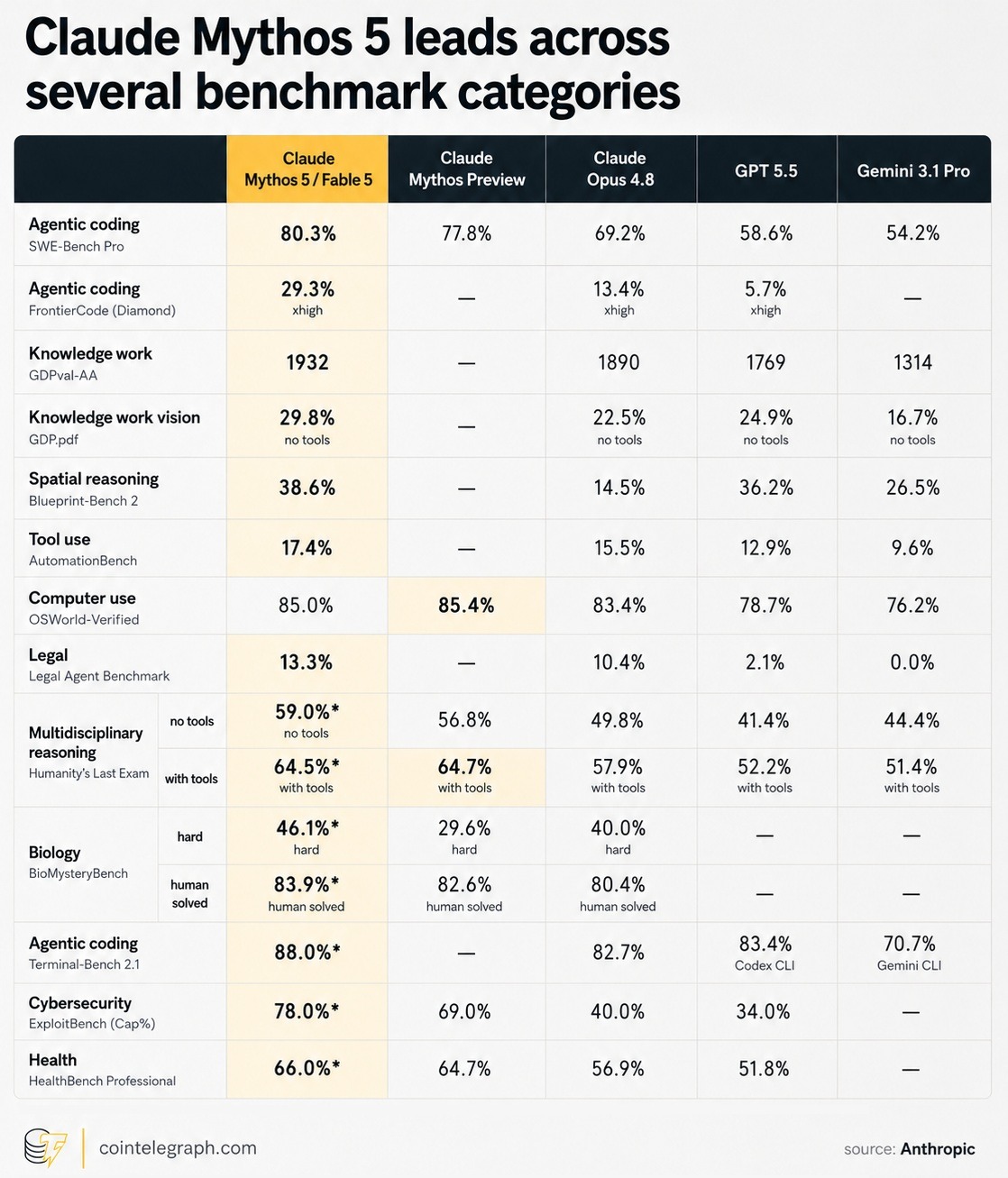
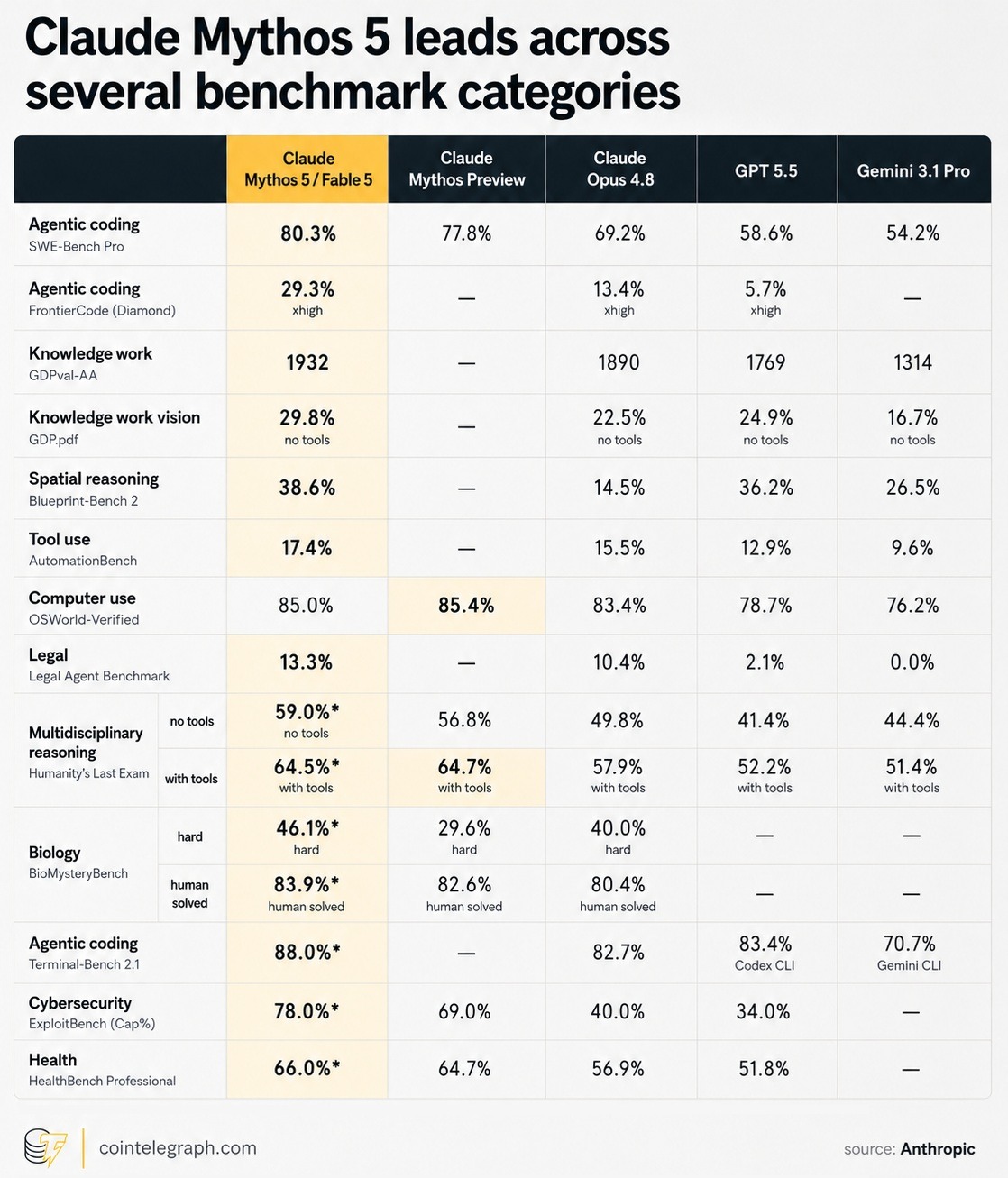
When Anthropic introduced Claude Mythos-class models as its most advanced AI system for cybersecurity, it drew the usual mix of reactions from crypto communities. The lineup included Claude Fable 5, a Mythos-class model intended for broad use, although access was later suspended after a US government directive.
The concern around decentralized finance (DeFi) was easy to understand. If AI systems can find software flaws faster and with less human input, attackers may also use them to spot weak points in protocols before security teams can fix them.
Those concerns may seem overstated, but they come from a real shift in technology. AI tools have become better at reviewing code, spotting flaws and supporting security teams. At the same time, DeFi remains a major target for attackers because its code is often public, its protocols hold large amounts of money and many systems are new or not fully battle-tested.
The key question is whether Claude Mythos and similar tools pose a serious threat to DeFi, or whether the industry is overstating what today’s AI can actually do.
The answer sits somewhere between the hype and the alarm.
-
What is Claude Mythos?
Claude Mythos is Anthropic’s most advanced AI system for cybersecurity. Unlike general-purpose AI assistants that can write code or explain technical concepts, Mythos is designed to handle complex security tasks.
Anthropic initially limited access to the model instead of releasing it widely. According to the company, Mythos showed clear improvements in vulnerability research, exploit analysis and layered cybersecurity reasoning compared with earlier versions.
That capability drew attention quickly because vulnerability detection is valuable in both cybersecurity and crypto.
A security expert might spend weeks reviewing code for small flaws. If AI can shorten that timeline to hours, or even less, it could change the balance in defensive security.
That possibility explains much of the unease in crypto circles.
-
Why Claude Mythos matters to DeFi
DeFi has lost billions of dollars to hacks, exploits and protocol failures in recent years. The concern is not new.
Flash-loan attacks, cross-chain bridge exploits, governance attacks and smart contract bugs have shown that even audited protocols can still have gaps.
Unlike traditional software systems, DeFi protocols often control large amounts of money through smart contracts. A vulnerability may not just expose information. It could allow attackers to move funds quickly and without permission.
That makes DeFi especially attractive to malicious actors.
The open-source nature of many blockchain projects adds another risk. Their code is available for security teams to review, but it is also available to attackers.
In the past, finding advanced vulnerabilities required deep technical skill. Security researchers needed strong knowledge of coding languages, blockchain architecture, cryptography and attack methods.
AI changes that.
Instead of manually reviewing large codebases, analysts can now use AI assistants to flag suspicious patterns, summarize complex systems and point out possible attack paths.
This is where concerns around Claude Mythos begin.
Did you know? In some controlled security competitions, AI systems have identified software vulnerabilities in minutes that would normally take human researchers several hours, or even days, to find.
-
Can AI really find vulnerabilities in DeFi protocols?
The short answer is yes. AI systems have already shown that they can find certain types of software vulnerabilities.
Studies from Anthropic and other research groups show that advanced models can review code repositories, test security assumptions and sometimes find issues that human analysts miss.
Smart contracts are well suited to this kind of analysis because they are often public and written in structured languages such as Solidity.
An AI system can quickly review thousands of contracts, spot repeated patterns and look for known types of vulnerabilities.
Areas where AI is likely to provide growing support include:
- Reviewing audit reports
- Identifying unsafe coding practices
- Comparing protocol upgrades
- Detecting permission errors
- Modeling possible exploit paths
- Analyzing interactions between smart contracts
AI is becoming a force multiplier for security researchers. A task that once required a full team of experts could increasingly be handled by a smaller group of security professionals using advanced AI tools.
That is a meaningful change, not just marketing hype.
The table below shows how Claude Mythos compares with other models:
-
Why AI threats to DeFi may be exaggerated
Even with these advances, there is a clear difference between finding a vulnerability and stealing funds. Many crypto attacks involve much more than spotting a flaw.
Attackers often need to:
- Understand complex protocol mechanics
- Bring in significant capital
- Coordinate multiple transactions
- Exploit market conditions
- Manipulate liquidity
- Navigate governance systems
- Avoid detection
Even when a vulnerability exists, turning it into a successful attack often requires detailed planning and careful execution.
The real-world environment is far more complex than isolated coding tests.
Current AI systems also have limits. They can reach wrong conclusions, miss key details or follow weak lines of analysis. Security experts often find that AI tools produce useful insights alongside many false alarms.
An AI tool might flag 10 possible vulnerabilities, but only one may turn out to be valid. That matters because skilled human oversight is still essential.
Claude Mythos could speed up vulnerability detection, but it does not remove the need for experienced security experts.
Did you know? Many DeFi protocols publish their code online. This gives both security teams and AI tools more real-world financial software to review than in traditional banking systems.
-
The defensive side of AI in DeFi
A major flaw in the claim that AI will weaken DeFi is the idea that only attackers will benefit from these tools. Security teams have access to them too.
Security firms are already adding AI to their review processes. Developers are using AI-assisted code checks more often. Bug hunters can also use AI to spot issues before attackers find them.
Over time, AI may become a normal part of protocol security.
That could mean:
- Every code update goes through AI-assisted review
- AI agents continuously monitor deployed contracts
- Automated systems look for unusual on-chain activity
- Possible vulnerabilities are flagged before deployment
In that case, AI could strengthen DeFi security instead of weakening it.
The technology is neutral on its own. Its impact depends on how well attackers and defenders use it.
-
When AI attacks meet AI defenses
A more realistic outlook points to a future where AI systems challenge each other directly. This would make security faster on both sides.
Attackers will use more advanced models to find vulnerabilities and plan attacks. Security teams will use similar tools to monitor threats, improve code quality and respond faster.
This already happens in traditional cybersecurity, where offensive and defensive tools improve side by side.
DeFi could become the next major battleground for this contest. The likely result is not a sudden collapse of the sector. Instead, DeFi may enter a period of faster security upgrades and adaptation.
Projects that are slow to find vulnerabilities and update their code could face greater risk. Those that adopt AI-supported safeguards may become stronger than before.
Did you know? Several major crypto losses have come from compromised private keys, social engineering attacks or governance manipulation rather than flaws in smart contract code itself.
-
Assessing protocol vulnerabilities
Risk is not spread evenly across DeFi. Smaller projects with limited security resources often face the highest exposure.
Several categories are especially vulnerable:
- Fast deployment schedules: Projects that prioritize quick launches over careful testing may leave structural flaws in place.
- Copied codebases: Many protocols reuse or slightly modify existing code. Advanced AI tools can compare these systems quickly and expose inherited flaws.
- Weak audit coverage: Projects with little or no third-party review are less prepared for advanced attacks.
- Legacy smart contracts: Older contract designs may rely on assumptions that no longer hold up against modern exploit methods.
Automated analysis tools could sharply reduce the time needed to find these weaknesses.
-
What DeFi builders should do now
Claude Mythos offers an important lesson for the industry. DeFi builders should assume that attackers may already be using automated research tools. Security strategies need to improve accordingly.
Core priorities should include:
- Expanding automated security testing
- Running continuous, real-time audits
- Adding AI-assisted code analysis to development pipelines
- Increasing bug bounty rewards
- Using formal verification for critical code
- Improving threat monitoring and real-time incident response
Engineering teams must reduce the time between finding a vulnerability and deploying a fix. In an AI-accelerated environment, response time becomes just as important as prevention.
-
A major shift, not DeFi’s breaking point
Claude Mythos has shown that automated systems can handle complex security tasks that once required specialized experts. That marks a major shift for DeFi, where a code flaw can lead to the immediate loss of user funds.
Still, predictions of total systemic failure ignore several practical realities. Finding a vulnerability does not guarantee a successful exploit. Current AI tools still produce uneven results, human oversight remains essential and defensive teams have access to the same technology.
The more likely outcome is a change in security standards, not a collapse of DeFi. Automated tools could reduce the time and cost needed to find vulnerabilities. That will put more pressure on development teams to improve code quality, respond faster and build stronger security systems.
Ultimately, these developments are a warning, not a guaranteed outcome. The future of decentralized infrastructure will not be decided only by what AI can find. It will also depend on whether attackers or defenders use the technology more effectively.


- Chainlink added 6,182 new wallets in two days.
- LINK’s price must clear $8.31 to strengthen its recovery.
- Technical indicators lean more bearish than bullish.
Chainlink (LINK) is showing a rare divergence between its on-chain activity and price action.
While the token has struggled to recover from recent losses, network activity has accelerated at its fastest pace this year, raising questions about whether the increase in network activity can eventually translate into a price rebound.
At the time of writing, LINK is trading around $7.30, up just 0.3% over the past 24 hours.
Despite the modest daily gain, the broader trend remains weak.
LINK has declined 8.7% over the past week, 20.3% over the last 30 days, and 45.8% over the past year.
Chainlink network activity reaches highest level of 2026
Recent on-chain data showed that the Chainlink network added 6,182 new wallet addresses in just two days, marking its strongest two-day growth of 2026.
✍️ TL;DR: Chainlink network growth erupts with two highest on-chain days of the year
📊 Metrics used: Network Growth
🔗 Link to chart: https://t.co/V88ThZQNSi📈 BREAKING: Chainlink just posted its two strongest network growth days of 2026, with 3,142 new LINK wallets on June… pic.twitter.com/H0FVqxDvwB
— Santiment Intelligence (@SantimentData) June 26, 2026
The increase was spread across two consecutive days, with 3,142 new wallets created on June 25 and another 3,040 on June 26.
Such growth is often viewed as a sign of rising user participation because it reflects fresh addresses interacting with the network during a period when the token itself has been under selling pressure.
The surge is particularly notable as it came while LINK was trading close to multi-month lows instead of a rally.
In many cases, rapid wallet growth accompanies rising prices as new investors enter the market.
This time, the increase in network activity arrived even as the token remained below several important resistance levels.
Chainlink continues to maintain a total value locked (TVL) of about $28.841 billion, showing that the protocol remains one of the largest decentralised oracle networks despite recent weakness in its token price.
Some market observers have pointed to the divergence between improving on-chain metrics and weaker prices as evidence that network usage has remained resilient.
However, address growth alone does not guarantee higher prices, particularly when broader market conditions remain under pressure.
Bearish technical indicators continue to dominate
Despite the encouraging on-chain data, technical indicators still favour the sellers.
From a technical perspective, LINK is trading below its 10-day, 20-day, 50-day, 100-day, and 200-day EMAs, leaving every major moving average above the current price and acting as resistance.
Remaining below the 200-day EMA also suggests that the longer-term trend has yet to turn positive.
Momentum indicators offer a slightly more balanced view.
The 14-day Relative Strength Index (RSI) stands at 32.21, keeping the token above the traditional oversold threshold of 30 but still close enough that trading volume could play a decisive role in the next move.
On the weekly timeframe, the RSI is 33.23, indicating that bearish momentum has eased compared to earlier weeks, although the broader trend remains under pressure.
Key Chainlink price levels to watch
The technical structure leaves several important price levels in focus.
Immediate support sits at $7.02. If the token closes below that level, the current support structure would weaken significantly and could expose LINK to additional downside.

On the upside, traders are watching $8.31, which represents the first major resistance level.
A confirmed close above that price would improve the technical outlook and could allow LINK to challenge the next resistance around $9.19.
Some technical analysts have also highlighted the possibility of a double-bottom formation if support continues to hold.
Under that scenario, a sustained breakout above resistance could eventually open the path toward the $9 region.
The ontology lays out how Chainalysis views the role of attribution to these clusters, presenting a two-tier structure; the first tier “defines the structural graph,” while the second assesses how confident the analysis is in that graph.
“What does it mean that these addresses belong together, right? It’s clearly because somebody believes that they are under the control of the same entity, right?” Illum said. “Maybe it’s an exchange, or maybe it’s a darknet market, or maybe it’s a mixer, or whatever. But what are the grounds to establish that these things actually belong together?”
Investigators likely won’t have private keys, which would be the easiest way to tell if a cluster of addresses is all being controlled by the same entity, so they would then have to look at onchain data.
Illum was also clear about the limitations of this type of analysis: While Chainalysis could conduct research into transactions and clusters, it cannot, on its own, identify the actual end user without additional information.
Chainalysis could track funds to a crypto exchange, for example, or another entity managing wallets on behalf of customers, but investigators might need to issue a subpoena to identify who the customer is.
In other words, who controls a wallet or what entity is associated with the wallet are separate questions from the actual tracing aspect.

The debate that once framed much of mainstream finance as “crypto skepticism” has quietly shifted—at least for some of the most visible skeptics. A handful of prominent figures who previously dismissed digital assets as illegitimate or destructive have either backed crypto-adjacent products, invested in tokenization, or moved from public hostility to selective engagement.
Rather than a single narrative of conversion, the pattern looks more like a split between those who reconsider the technology and those who keep attacking the asset while profiting from the rails. The result: crypto’s credibility continues to spread not only through believers, but through well-positioned skeptics adjusting their strategies.
Key takeaways
- Several top executives have moved from condemning Bitcoin to treating it as a fit within regulated investment channels, helping drive institutional access.
- Some “still skeptical” voices have not changed their public stance on Bitcoin, while simultaneously building or selling blockchain-enabled infrastructure.
- Tokenization appears to be the common thread: even critics often gravitate toward regulated, asset-backed digital formats rather than “unbacked” crypto.
- Opportunistic engagement—whether via products, marketing, or political positioning—has become increasingly lucrative for high-profile figures.
Larry Fink’s pivot: from money-laundering claims to tokenized finance
Larry Fink, CEO of BlackRock, is often cited as the clearest example of a skeptic moving toward crypto’s mainstream role. In 2017, Fink described Bitcoin as an “index of money laundering,” reflecting a widespread early-finance critique that digital assets were dominated by speculation and illicit activity. A decade later, the tone is notably different.
It is unclear what specifically drove the reassessment, but by 2020 Fink began acknowledging Bitcoin’s potential. By 2023, he was actively defending BlackRock’s crypto push. Today, BlackRock is among the most influential institutional on-ramps for Bitcoin through spot exchange-traded products—an important development because it places exposure to Bitcoin inside frameworks that many traditional investors already understand.
In later communications connected to BlackRock’s investor relations, Fink has also discussed tokenization more directly, portraying it as an effort to modernize financial systems. The key shift is not simply acceptance of Bitcoin as an investment; it is an argument that digital asset rails can be integrated into conventional finance in a more institutional way.
Jamie Dimon’s approach: criticism of Bitcoin, investment in the rails
While Fink’s evolution leaned toward acceptance, JPMorgan’s Jamie Dimon illustrates a more conditional stance. Dimon has repeatedly criticized Bitcoin in strong terms—including describing it as a “fraud” and warning that it would blow up. He has also used public platforms, including Congressional hearings, to reiterate his objections.
Yet JPMorgan’s activities suggest an important asymmetry: the bank may dislike Bitcoin as an asset, but still wants control over—if not profit from—the infrastructure that enables tokenized finance. The bank has built out its Onyx division, rolled out JPM Coin, and experimented with connecting bank infrastructure to crypto wallets. It has also developed tokenized collateral platforms aimed at moving cash and securities more efficiently.
For investors and market participants, this distinction matters. The more banks treat blockchain-based workflows as tools worth integrating, the more the ecosystem’s “plumbing” becomes institutional-grade—regardless of whether executives like Dimon endorse Bitcoin’s legitimacy.
Peter Schiff’s consistency: gold first, but tokenization still works
Peter Schiff has largely stayed consistent in his critique of Bitcoin’s market structure and long-term sustainability, and his skepticism appears to intensify during rallies. However, Schiff’s business decisions show that even critics of crypto can embrace tokenization when it aligns with familiar value storage.
According to the article, Schiff launched T-Gold.com in December 2025, a tokenized gold platform that represents physical bullion via blockchain-recorded tokens. The model allows users to buy physical gold and silver held in segregated vaults and receive digital tokens tied to specific quantities, with ownership recorded on a blockchain.
In framing this as a continuation rather than an apostasy, the underlying message is straightforward: keep the rails, swap the asset. Schiff’s move underscores a broader trend—tokenization can be pitched less as “crypto” and more as a transfer-and-custody layer for assets with long-established monetary histories.
Nouriel Roubini’s “Technodollar”: skepticism directed at unbacked assets
Nouriel Roubini, known to crypto audiences as “Dr. Doom,” is not typically associated with pivoting toward digital assets. In prior commentary, he has described many cryptocurrencies as “useless,” warned of a “crypto apocalypse,” and highlighted governance failures and investor harms.
Yet this week, as reported in the source material, he co-authored a whitepaper with Atlas Capital and announced USAFi, a tokenized instrument marketed as a regulated permissionless security intended to reflect what he calls the “Technodollar.” Roubini characterizes the move as not a reversal. He told Cointelegraph he remains skeptical of unbacked crypto assets whose value depends mainly on speculation rather than fundamentals.
What changes, in his view, is the design goal: modernizing the financial system through regulated, asset-backed digital instruments. The stance is telling for market watchers. Even prominent critics are shifting focus away from “Bitcoin versus nothing” toward questions about backing, governance, and investor protection—precisely the areas that regulators and institutional stakeholders have emphasized.
Donald Trump’s strategy: political leverage and profit—without technical precision
Donald Trump’s relationship with crypto is best described as pragmatic rather than technical. The article notes that he previously called Bitcoin “seems like a scam” and warned about its impact on dollar dominance, but later rebranded himself as a “crypto president.”
Trump has also been associated with nonfungible token drops and launched meme coins, including tokens linked to his family. The source further claims that he has pocketed more than $2.3 billion from various crypto endeavors since 2024, citing Reuters for that figure.
In this approach, understanding the mechanics appears less important than reading political incentives. The article argues that crypto has matured into a voting bloc and donors are becoming more strategic—so what matters is language about freedom, innovation, and opposing overreach. For the broader market, the implication is that crypto’s influence can expand through politics even when skeptics maintain that technological comprehension is secondary to adoption and capital formation.
What’s actually changing: belief, incentives, or both?
Across these cases, the common thread isn’t a simple conversion story. It’s a pattern of selective engagement shaped by incentives and fit with established business models.
For executives like Fink, the shift is framed as a reframing of crypto and tokenization as extensions of existing finance missions—helped by demand and by the prospect of new fee streams within huge institutional platforms. For skeptical banking voices like Dimon, the public criticism may remain intact while the bank’s product strategy leans into blockchain-enabled systems that can improve how institutions move value.
For critics like Schiff and Roubini, the direction is toward asset-backed or tokenized representations that resemble traditional value storage or regulated securities. And for political figures like Trump, the signal is that crypto can become part of a broader coalition strategy—where engagement is driven by attention, constituencies, and financial upside.
Whether these developments represent genuine intellectual evolution or an instinct to follow the money is difficult to prove. But for market participants, the practical takeaway is clear: crypto skepticism is no longer a barrier to building crypto-related products. Instead, it’s increasingly being redirected into debates about structure—backing, compliance, custody, and governance.
As more institutions and high-profile actors adapt their strategies, the next question for readers is how far tokenization will spread into regulated products that resemble traditional finance—and which remaining skeptics will adjust their positions as those offerings become more mainstream.
Viral Altcoin VELVET Explodes 1,700% in a Month: More Gains Ahead or Perfect Short Setup?

‘Without a border, we’re not a country’

Rain Threatens Portelli’s Chances at Rosehill in 2026


-
 Sports6 days ago
Two goals and an assist by sheer aura: Cristiano Ronaldo just entered the World Cup chat
-

 Fashion3 days ago
Weekend Open Thread: Staud – Corporette.com
-

 Politics3 days ago
The House | Manchesterism won’t survive the painful trade-offs unless it gets citizens on board
-

 Politics4 days ago
Potential 2028er World Cup attendee leaderboard
-

 Business3 days ago
Asia stock markets slide as tech shares slump
-

 Tech4 days ago
A Look At A Gaggle Of Transputer Boards
-

 News Videos21 hours ago
MAJOR BITCOIN & MARKET UPDATE!!!! (MUST WATCH ASAP!!!)
-
Crypto World6 days ago
Bitcoin (BTC) Dips Below $62K, Ethereum (ETH) Plunges 6% Daily: Market Watch
-
 Crypto World4 days ago
Dell (DELL) Shares Tumble Over 5% Following Analyst Downgrade to Hold
-

 Crypto World5 days ago
Securitize Wraps Roubini's SEC-Registered ETF as Dubai VARA Digital Security
-

 Crypto World2 days ago
Coinbase, Circle Deepen Crypto Stock Losses Despite Resilient S&P 500
-
Business6 days ago
Entergy settles forward sale agreements, raises $672 million in cash proceeds
-

 Crypto World2 days ago
Kraken's xStocks Opens Bending Spoons IPO Registration to EEA Retail
-

 Sports3 days ago
FIH Pro League: India defeat Pakistan 7-1, register biggest win of campaign | Other Sports News
-

 Tech2 days ago
Russian hackers now target Signal backup recovery keys
-

 Crypto World3 days ago
RTX holders must register wallets before token distribution begins
-
Crypto World3 days ago
Hyperliquid Named on Singapore MAS Investor Alert Register
-

 Tech2 days ago
Bluekit phishing kit adopts browser-in-the-middle for login theft
-

 Crypto World4 days ago
Bitcoin Sparks $600M Hourly Liquidations With $65,000 Set To Become Resistance
-

 Sports4 days ago
India vs Bangladesh LIVE Score, Women’s T20 World Cup: Bangladesh Opt To Bat; India Enter ‘Do-Or-Die’ Stage As Semi-Final Race Heats Up
You must be logged in to post a comment Login