
Crypto World
Enterprise Stablecoin Development in Hong Kong: HKMA Licensing Guide

Hong Kong is not waiting for consensus. The Hong Kong Monetary Authority is shifting from rulemaking to licensing, which changes the game for anyone planning a regulated stablecoin.
If you are a bank, fintech leader, or institutional issuer considering a compliant launch, this guide explains exactly what the HKMA will test, what delays or blocks approval, and how to structure stablecoin development for long-term regulatory confidence. This is written for decision-makers who want clarity, not speculation.
Why Hong Kong’s Stablecoin Licensing Framework Changes Everything
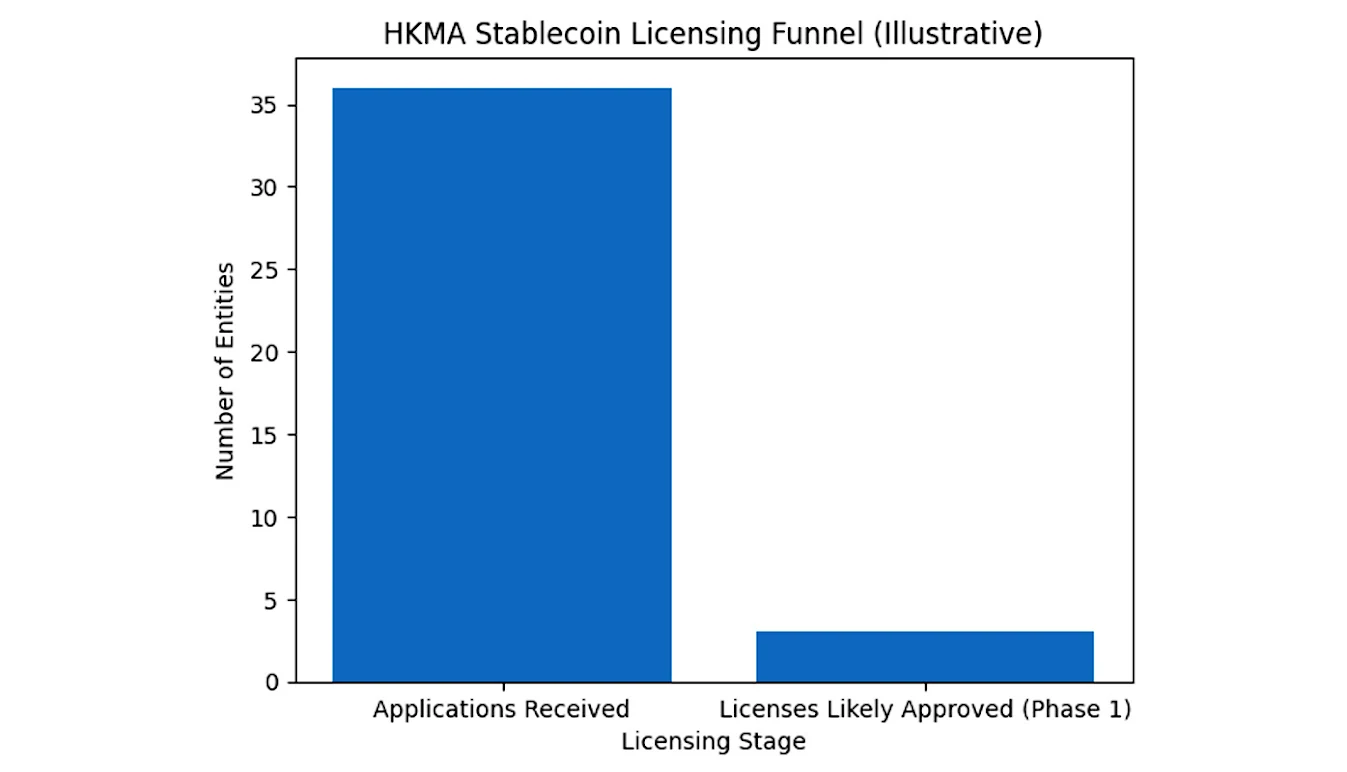
Hong Kong is moving from regulatory intent to execution. According to a recent update reported by Yahoo Finance, the Hong Kong Monetary Authority is preparing to approve its first batch of stablecoin issuer licenses, with only a limited number of applicants expected to clear the initial review. This confirms that Hong Kong is not opening the market broadly. It intentionally selects issuers that demonstrate financial resilience, governance maturity, and operational readiness.
For enterprise and institutional issuers, this is a constructive shift. A selective licensing regime reduces uncertainty, limits regulatory arbitrage, and establishes a clear standard for what qualifies as a credible stablecoin issuer. Rather than competing in an overcrowded and loosely governed market, serious players now operate in an environment designed to reward discipline and long-term viability.
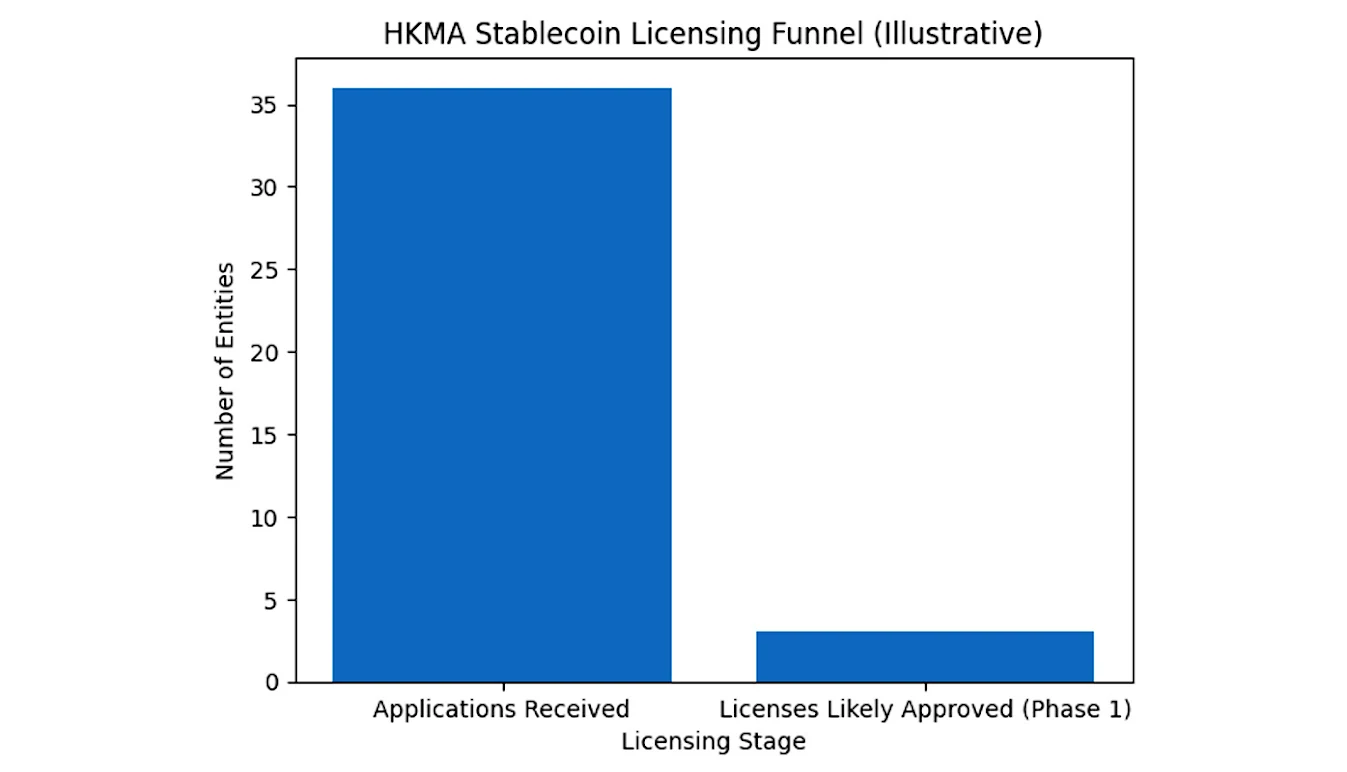
The illustrative licensing funnel above highlights how this framework reshapes competition. While interest in stablecoin issuance remains strong, only issuers with robust governance structures, compliant custody arrangements, and clearly defensible reserve models are likely to progress beyond the first regulatory filter. This changes how stablecoin development must be approached. Development is no longer a technical build followed by regulatory review. Licensing expectations now influence system architecture, reserve design, custody strategy, and operational controls from the earliest planning stages.
In practical terms, Hong Kong’s framework does not just regulate stablecoins. It determines who is qualified to participate in the market at all. Understanding what regulators evaluate next is therefore essential for any issuer aiming to move forward with confidence.
Not sure if your model meets HKMA standards? Get a regulatory alignment review before formal submission.
Understanding HKMA’s Expectations: What Regulators Actually Look For
HKMA’s licensing regime is more than a badge of approval. It defines how stablecoin development must be structured, governed, and operated within a regulated financial environment.
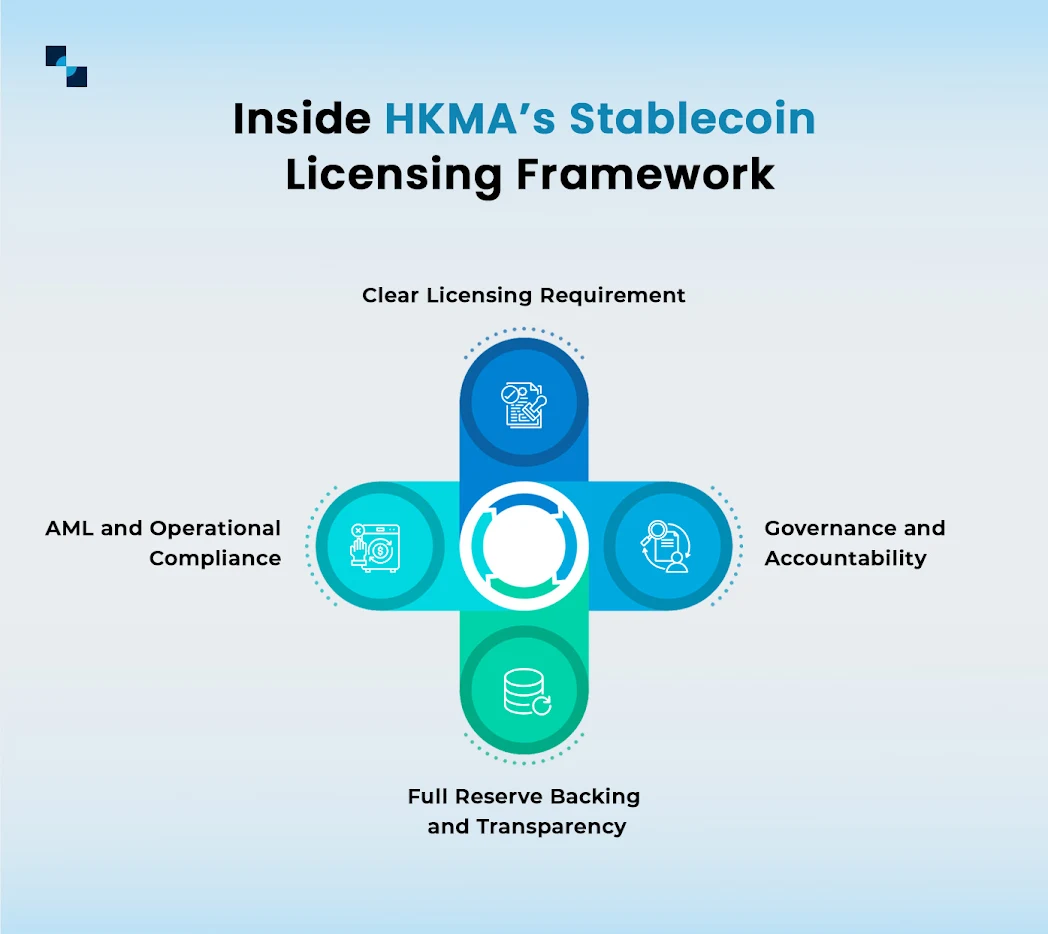
1. Clear Licensing Requirement
From 1 August 2025, the Stablecoins Ordinance took effect in Hong Kong. The regime requires authorization for parties carrying on regulated stablecoin activities in Hong Kong and, in certain cases, for issuers of Hong Kong dollar-referenced stablecoins issued offshore. A valid license from the HKMA is required to operate without enforcement risk.
2. Governance and Accountability
Issuers must demonstrate strong corporate governance with clearly defined accountability for financial, legal, and technology risk. Boards and senior management are expected to have direct responsibility for oversight and compliance. Anonymous or loosely coordinated governance structures do not meet HKMA expectations.
3. Full Reserve Backing and Transparency
Under the HKMA’s supervisory guidelines:
- Reserve assets must at all times equal or exceed the value of stablecoins in circulation.
- Reserve holdings must be disclosed and supported by regular independent attestations or audits.
- Custody arrangements must legally segregate reserve assets and protect them from creditor claims and misuse.
These requirements ensure that stablecoins operate as financial instruments with predictable backing and certainty of redemption.
4. AML and Operational Compliance
HKMA’s AML and counter-terrorist financing guidelines apply to licensed stablecoin issuers and include travel rule and operational AML controls. Issuers are expected to demonstrate compliance readiness before launch, not after issuance.
Taken together, these expectations place stablecoin development services firmly within institutional finance, where issuers must withstand detailed regulatory scrutiny across governance, reserves, custody, and operations.
Why Custody and Reserves Are the Real Differentiators
Custody and reserves determine whether a stablecoin is trusted or questioned. From a regulatory standpoint, the central concern is the protection of user funds. Reserve assets must be legally segregated, protected from issuer insolvency, and held in a manner that allows timely redemption under all conditions. Custody arrangements must clearly define who controls reserve assets, how access is governed, and how conflicts of interest are avoided. These structures are reviewed closely because they directly impact systemic risk. This is where an experienced stablecoin development company adds value beyond code delivery. Designing compliant custody and reserve frameworks requires coordination between legal, financial, and technical teams. Errors in this layer are costly and difficult to reverse once a licensing review begins.
Key Failure Points in HKMA Stablecoin Applications
Most stablecoin applications do not fail because of weak technology. They fail because regulators identify structural and operational risks that issuers underestimate.
The most common failure points include:
- Late Regulatory Alignment: Applications stall when licensing considerations are addressed after development. HKMA expects regulatory intent to be reflected in system architecture, governance, and operating models from the outset.
- Inadequate Custody and Reserve Controls: Weak reserve segregation, unclear custodian responsibilities, or redemption mechanisms that are not stress-tested raise immediate red flags during review.
- Unclear Issuer Accountability: Applications falter when decision-making authority, risk ownership, or compliance responsibility is diffused or insufficiently documented.
- Operational Immaturity: Lack of audit readiness, untested reporting workflows, and limited incident response planning signal that the issuer is not prepared for regulated operations.
These failure points are rarely isolated issues. They are symptoms of an unclear execution strategy. For issuers pursuing regulated stablecoin development in Hong Kong, success depends on following a clear, compliance-led roadmap that aligns regulatory expectations, technical design, and operational readiness from the very beginning.
Turn this framework into an actionable plan for your team.
A Roadmap: From Concept to HKMA-Ready Stablecoin Development
Issuers that succeed in regulated markets follow a structured and disciplined roadmap. Rather than treating licensing as a post-launch task, they align strategy, compliance, and execution from the outset, often in collaboration with an experienced stablecoin development company that understands regulatory expectations.
Phase 1: Regulatory Assessment: The first step is determining whether the proposed stablecoin activity falls within HKMA’s licensing scope. This includes analyzing the token’s reference currency, distribution model, and target users, as well as identifying any cross-border implications under the Stablecoins Ordinance.
Phase 2: Compliance-Aligned Architecture: Once licensing applicability is clear, development must align with regulatory expectations. This includes smart contract logic tied to reserve controls, audit-ready reporting systems, custody workflows, and AML compliance mechanisms designed to meet HKMA standards from day one.
Phase 3: Operational Validation: Before applying for a license, issuers should conduct internal stress testing, simulate redemption scenarios, and validate reporting processes. Operational readiness is as important as technical correctness, particularly under regulatory review.
Phase 4: Licensing and Ongoing Governance: Licensing is not the end of the process. Approved issuers are expected to maintain continuous compliance, governance oversight, and transparent communication with regulators as part of ongoing supervision.
Well-designed stablecoin development solutions reduce friction across every stage of this journey, helping issuers move from concept to regulated issuance with confidence and clarity.
Choosing the Right Development Partner Matters More Than Ever
- The development partner directly impacts HKMA licensing outcomes, not just technical delivery.
- HKMA reviews governance maturity, reserve design, custody controls, and operational discipline alongside code quality.
- Partners that treat compliance as a post-build task increase approval risk and rework costs.
- A capable stablecoin development company embeds regulatory alignment into its architecture from day one.
- Experienced firms reduce licensing friction by aligning technical execution with HKMA expectations.
- The right partner helps issuers remain license-ready throughout development, regulatory review, and post-approval operations.
This makes the final decision clear. In Hong Kong’s regulated market, choosing the right partner is not a technical choice. It is a licensing decision.
Final Thought: Regulation Is the Filter, Not the Finish Line
Hong Kong’s regulatory framework makes one thing clear. Stablecoin initiatives will succeed only if they are designed for licensing, governance, and operational resilience from the start. For serious issuers, stablecoin development is no longer about speed or experimentation. It is about execution that withstands regulatory scrutiny.
This is where partnering with Antier creates a clear advantage. As a trusted stablecoin development company, Antier delivers enterprise-grade Stablecoin Development Services and stablecoin development solutions aligned with HKMA requirements, helping issuers move from concept to compliant launch with confidence.
Ready to launch an HKMA-ready stablecoin? Talk to Antier and start with clarity, compliance, and control.

Crypto World
Fairshake’s $10 million Illinois misfire marks first big hitch in crypto political surge
Losing a race is unusual for the crypto industry’s political action committee, Fairshake, which has recorded a dominant record in the past two congressional elections. But the Illinois primaries this week saw its biggest-ever setback, likely to conclude with a new member of the Senate next year being somebody the PAC spent more than $10 million trying to defeat.
Illinois Lt. Gov. Juliana Stratton won her Democratic primary, and her state’s Democrat lean means she’s likely to be its next senator after the November general election. One of Fairshake’s affiliates had devoted millions to purchase opposition advertising in that race and to support two of her opponents — representing more than 5% of the funds it’s said it had on-hand this year to devote to the congressional contests.
Not only did that money fail to win the outcome the group aimed for, but Stratton may eventually be a member of the 100-member Senate in which a single lawmaker can have a very potent influence, and she’ll be well aware of the industry’s efforts to oppose her. Crypto advocacy group Stand With Crypto, which evaluates politicians and political candidates, graded Stratton with an “F” on digital assets issues, even though she doesn’t have a significant personal record on crypto policy apart from the state’s industry-opposed regulatory regime signed by her boss last year.
“If you support pro-crypto policies, we will show up big,” Fairshake spokesman Geoff Vetter said in a statement. “If you oppose crypto and American innovation, we will show up big. That message is now clear at both the state level and federal level.”
The industry had mixed results in Illinois, supporting three pro-crypto candidates who won their primaries, and one other who didn’t. A person familiar with the PAC’s strategies said that it saw the loss as a one-off and that it was unlikely that other candidates it opposes down the road will have similar campaign resources they can tap.
Starting with the 2024 elections, Fairshake — primarily backed by Coinbase, a16z and Ripple — has targeted multiple Senate races in which it spent more than $10 million trying to influence the outcome. In its biggest spend in the last cycle, it devoted a towering $40 million to oppose former Senator Sherrod Brown, the Ohio Democrat who as ex-chairman of the Senate Banking Committee stood in the way of crypto legislation. (Brown is trying for a comeback this year, though Fairshake hasn’t yet announced its plan for Brown’s challenge of Senator Jon Husted.)
La Shawn Ford, who won his Illinois 7th District congressional primary to potentially join the House of Representatives next year, was another of Fairshake’s targets in a race in which the PAC spent almost $2.5 million. He accused the PAC of pumping out misleading and defamatory accusations in its ads. While he may represent a future political opponent for the sector, Fairshake celebrated wins for Donna Miller, Melissa Bean and incumbent Representative Nikki Budzinski in other House races in that state.
In 2024, Fairshake and its affiliates supported 53 candidates who ended up in Congress, losing in just five races, though many of the favored candidates were clear frontrunners. The super PAC was widely seen as establishing an industry model for a campaign-finance strategy in which more than $100 million devoted to congressional races (often primaries in districts in which one party has a dominant position) can influence the outcomes for dozens of seats. Fairshake purposefully didn’t craft its political ads to reference its own main aim to foster crypto, but it instead made ads based on whatever was the biggest political vulnerability it saw in opponents or positive points it noted in allies.
Fairshake has been very public about the $193 million war chest it started the campaign season with. The funds aren’t just an election tool. Crypto lobbyists and insiders have acknowledged that it also acts as a caution to sitting lawmakers weighing crypto legislation now moving through Congress. Members know that their decisions on crypto bills could bring either millions of dollars in support or opposition in their campaigns, often far exceeding the amount of money that congressional campaigns can raise from direct donors.
Fairshake doesn’t expect to win everything, but it does expect to win most of the races they get involved with, the person said, and it’ll make the point that opposing crypto innovation will be expensive for politicians.
Some candidates that Fairshake opposed in the past did go on to support crypto initiatives, but Stratton criticized the “MAGA-backed crypto bros” that opposed her. Her crypto intentions in the Senate, if she gets there, remain to be seen.
Read More: Crypto campaign PAC Fairshake marks first wins in 2026 U.S. congressional primaries


The prediction markets co-founder said that the company would “abide by court decisions“ but signaled that the charges were based partly on political bias and media attention.
Tarek Mansour, co-founder and CEO of prediction markets platform Kalshi, has pushed back against criminal charges filed by Arizona authorities this week, claiming that they were a “total overstep” and “not about gambling.”
On Tuesday, Arizona Attorney General Kris Mayes announced charges against the companies behind Kalshi, alleging that the company operated an “illegal gambling business in Arizona without a license” and offered illegal election wagering. Mansour said in a Wednesday Bloomberg interview that Mayes was attempting to “subvert the judicial process” by filing charges without a court decision in Kalshi’s own lawsuit against Arizona authorities last week.
“We see this as a total overstep and we look forward to fighting it in court,” said Mansour.
While Kalshi faces several similar cases filed by gaming authorities in other US states over the platform allegedly offering sports gambling to residents without a license, Arizona was one of the first to file criminal charges. The state-level cases come as prediction markets like Polymarket are under scrutiny by lawmakers for offering bets on US military actions, citing concerns about insider information in the government.
Related: Prediction markets boom on Iran bets as Congress eyes ban
Are prediction markets entirely under the CFTC’s jurisdiction?
Kalshi has been arguing in court that the US Commodity Futures Trading Commission (CFTC) has exclusive jurisdiction to oversee the company, rather than state authorities — a position reiterated by US President Donald Trump’s Senate-confirmed CFTC Chair Michael Selig.
“This is a jurisdictional dispute and entirely inappropriate as a criminal prosecution,” said Selig in a Tuesday X post. “The CFTC is watching this closely and evaluating its options.”
An Ohio judge last week denied a preliminary junction based on Kalshi’s CFTC argument. A Tennessee court blocked state authorities from enforcing gambling laws against Kalshi in February.
Magazine: Big Questions: Can Bitcoin save you from the dreaded Cantillon Effect?
This is a comparison of Wednesday’s Federal Open Market Committee statement with the one issued after the Fed’s previous policymaking meeting in January.
Text removed from the January statement is in red with a horizontal line through the middle.
Text appearing for the first time in the new statement is in red and underlined.
Black text appears in both statements.
The perpetuals exchange is promoting WLFI’s stablecoin as a trading asset ahead of the Aster Chain Layer 1 launch.
Aster, the decentralized perpetuals exchange backed by YZi Labs, is expanding its collaboration with World Liberty Financial, the DeFi project affiliated with the Trump family, adding USD1-denominated perpetual contracts and an incentive program aimed at bootstrapping stablecoin liquidity ahead of the platform’s Layer 1 launch.
The exchange is starting with BTC, ETH, and SOL pairs, with more than 10 additional pairs planned in the coming weeks. USD1 is also supported as a core margin asset and collateral equivalent to USDT, and Aster is offering zero maker fees and a 0.5-bps taker fee on USD1 pairs, an approximately 87.5% reduction compared to its standard 4-bps USDT taker fee.
Up to 2.5 million WLFI tokens will be distributed monthly through the USD1 perpetual trading incentive program based on trading activity, with rewards distributed weekly.
Donald Trump Jr., co-founder of World Liberty Financial, promoted the launch on X, saying, “This is how you scale stablecoin utility beyond just payments.”
“Aster Chain’s success depends on the depth of its underlying liquidity,” said Leonard, CEO of Aster. “By bringing USD1 into our core trading engine during this phase, we’re building the trading foundation for the Aster Chain launch.”
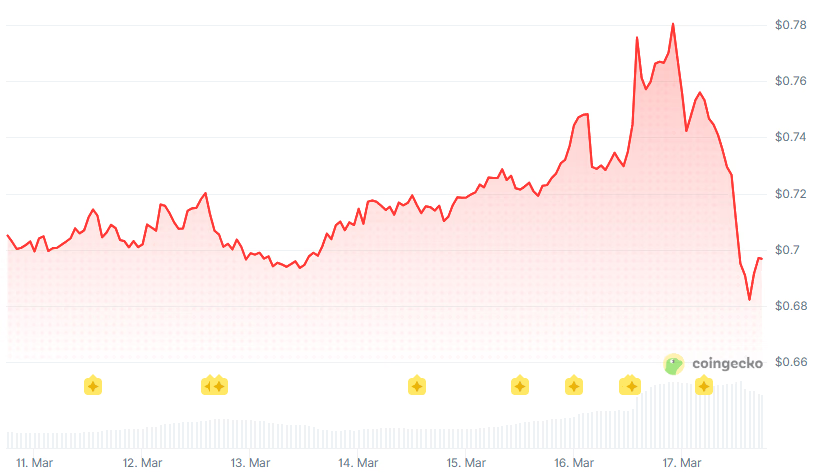
ASTER is trading at around $0.70, down 10% in the past 24 hours to a market cap of approximately $1.7 billion, per CoinGecko. WLFI is down 3.5% over the same period.

Aster originally launched as ApolloX in 2021 and rebranded following a merger with Astherus in December 2024. The platform is incubated by YZi Labs, previously Binance’s venture arm, and received a high-profile boost when Binance co-founder CZ began promoting it on X, sending its token on a roughly 40x run.
Aster is currently the second-largest perp DEX by open interest after Hyperliquid, according to DeFiLlama, and recently launched the genesis phase of Aster Chain, a privacy-focused Layer 1 that uses ZK proofs to keep trades private by default.
SOL spent weeks pinned between $80 and $87, with tightening Bollinger Bands signaling that a sharp move was coming either way.
Solana’s SOL token jumped past a key technical resistance level at about $93, turning what analysts called a “39-day distribution zone” into a structural floor.
The move has brought two price targets into focus, one being an initial level near $103 and a secondary one near $113.
Breakout Above $93 Shifts Sentiment
In a March 18 post on X, chartist Ali Martinez wrote that SOL’s return above the $93 level had turned a zone previously dominated by sellers into a potential base for further gains.
According to him, the setup has put a short squeeze in motion, meaning those who had bet on lower prices could be forced to buy back their positions, with the price moving against them, which could potentially speed up the rally.
“Solana just reclaimed $93.14, flipping a 39-day distribution zone into a structural floor,” Martinez explained. “If this level holds, a bull rally could happen much faster than people think.”
The breakout fits with other technical signals on longer timeframes, including a recurring pattern on Solana’s weekly chart of back-to-back candles with long lower wicks highlighted by analyst WebTrend.
According to them, the pattern has previously come before major rallies, with the first being in 2023, where it led to a 1,604% gain, and the second occurrence happening in 2025, leading to a 142% move upwards.
Fellow market watcher Bluntz also pointed to a completed accumulation phase following the daily breakout, suggesting that if the prices stay above the mid-$90 range, it could confirm a broader trend reversal.
You may also like:
Although SOL indeed broke through $93 earlier today to tap $95, it has lost some traction since then and now sits below $90. It has jumped by 7% monthly, but it was still down nearly 25% over the last year. It remains more than 67% below its all-time high of nearly $293, reached about a year ago.
Improving Market Structure, But Confirmation Still in Progress
The current setup is coming off the back of a period of compressed volatility, with Solana previously trading between $80 and $87 as tightening Bollinger Bands pointed to an imminent breakout. At the time, analysts couldn’t decide on the asset’s next direction, with some predicting a move higher and others, like DrBullZeus, claiming SOL could even drop to the $50 level.
Traders could look at ETF data for further context, with figures from SoSoValue showing that as of March 17, there had been almost $1 billion in net inflows into Solana-linked spot products. Furthermore, daily inflows have turned positive again after a brief period of negative movement earlier in the month.
Binance Free $600 (CryptoPotato Exclusive): Use this link to register a new account and receive $600 exclusive welcome offer on Binance (full details).
LIMITED OFFER for CryptoPotato readers at Bybit: Use this link to register and open a $500 FREE position on any coin!


The U.S. Securities and Exchange Commission (SEC) approved on Wednesday Nasdaq’s proposal to allow certain securities to trade in tokenized form, a significant milestone to integrate blockchain tech into U.S. equity markets.
Nasdaq’s tokenization plan ties into a pilot run by the Depository Trust Company (DTC), which will handle clearing and settlement of tokenized trades. Nasdaq filed for regulatory permission in September,
Under the framework, eligible Nasdaq participants can choose to have trades settled as blockchain-based tokens rather than through standard book-entry systems.
Tokenized shares will trade alongside traditional shares on the same order book and at the same price. They will carry identical rights, use the same ticker and CUSIP (identification number) and follow existing market rules.
The SEC said the structure meets investor protection standards, noting that surveillance, data reporting and settlement timelines remain intact.
The move comes as tokenization of traditional assets like stocks, bonds and funds have become a fast-growing sector in the digital asset space. The process allows near-instant, around-the-clock trading with tokens tied to real-world assets.
The trend has captivated major U.S. exchanges. Nasdaq said last week that it is developing a framework that would allow publicly listed companies to issue blockchain-based versions of their shares. It has teamed up with crypto exchange Kraken to distribute tokenized stocks globally. Meanwhile, Intercontinental Exchange (ICE), the owner of the NYSE, invested in crypto exchange OKX with plans to launch new tokenized stocks and crypto futures.
Read more: Here is why Nasdaq and owner of NYSE are putting the $126 trillion equity market on blockchain
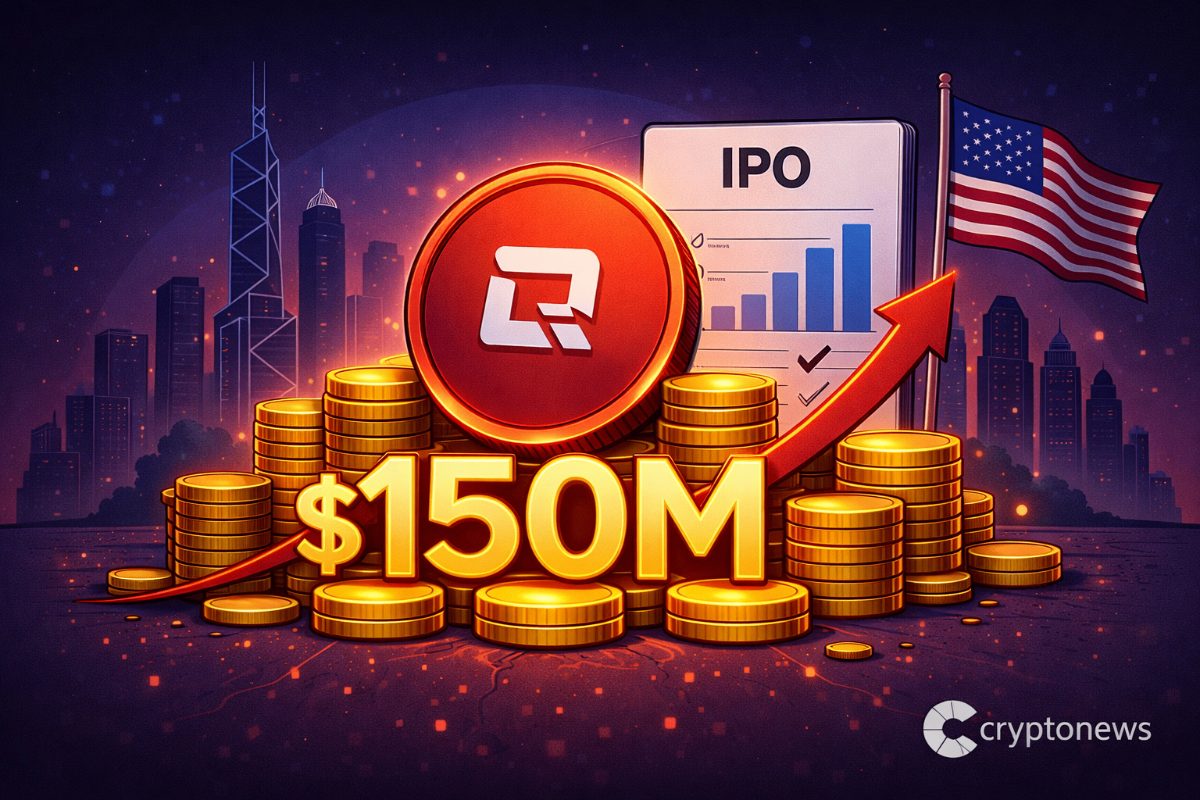

RedotPay is looking to raise $150 million in a pre-IPO round. The Hong Kong based stablecoin payment processor is targeting a $4 billion valuation.
The plan is to lock in capital before a US public listing that could come as early as this year.
What makes it interesting is the context. The company says it is already profitable and has no immediate pressure to raise. There has also been recent executive turnover. And yet the fundraise is moving forward anyway.
Something is being set up here.
- $150 Million Target: RedotPay is seeking fresh capital at a $4 billion+ valuation to support a U.S. IPO as soon as this year.
- Volume Surge: Annualized total payment volume (TPV) hit $10 billion in December, with year-over-year growth exceeding 300%.
- Institutional Backing: Existing investors include Coinbase Ventures and Circle Ventures, signaling strong infrastructure support despite executive turnover.
RedotPay Deal Mechanics: Leveraging Unicorn Status
RedotPay already pulled in $194 million across rounds in late 2025, including a $107 million Series B led by Goodwater Capital. The business generates over $150 million in annualized revenue facilitating crypto-to-fiat spending through traditional payment networks. The fundamentals are there.
JPMorgan, Goldman Sachs, and Jefferies are reportedly lined up as underwriters. The $150 million raised here likely funds compliance infrastructure and market expansion ahead of the public debut.
The timing is deliberate. BlackRock keeps expanding Bitcoin exposure. Institutional appetite is returning. The window for crypto-adjacent IPOs is reopening and RedotPay is moving fast to capitalize on it.
But there are real headwinds. At least five senior executives departed after less than a year. Multiple compliance leadership changes. And the company is currently pursuing a $4 billion valuation without a sitting CFO.
Wall Street is getting selective about crypto IPOs. Compliance disclosures will be scrutinized hard. RedotPay has strong numbers to show. It also has some awkward questions to answer before the listing.
What It Means for the Sector
A $4 billion listing validates stablecoin payments as a standalone vertical and puts pressure on legacy fintechs to integrate or get left behind. Regional banks are already feeling it. Networks like Cari exist specifically because payment flows are bleeding toward crypto-native rails.
For traders, this IPO is a bellwether. If underwriters sell the book at $4 billion despite the executive churn, it signals extreme hunger for crypto infrastructure exposure. If they struggle, it confirms that the compliance discount for offshore-originated firms is still steep and reprices every other private crypto unicorn eyeing a public exit.
Discover: The best new crypto in the world
The post Hong Kong’s RedotPay Targets $150M Pre-IPO Raise for US Listing appeared first on Cryptonews.
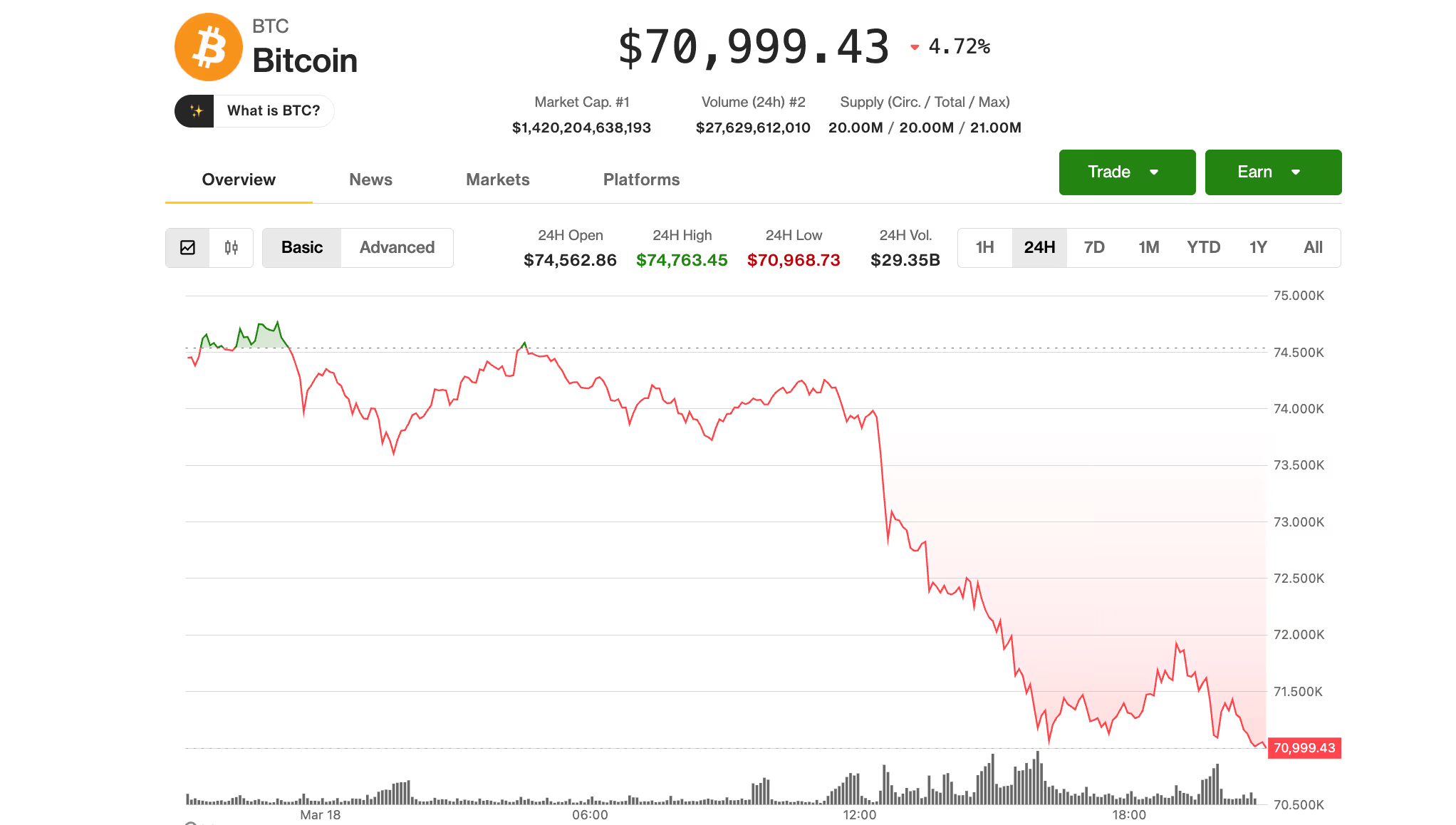
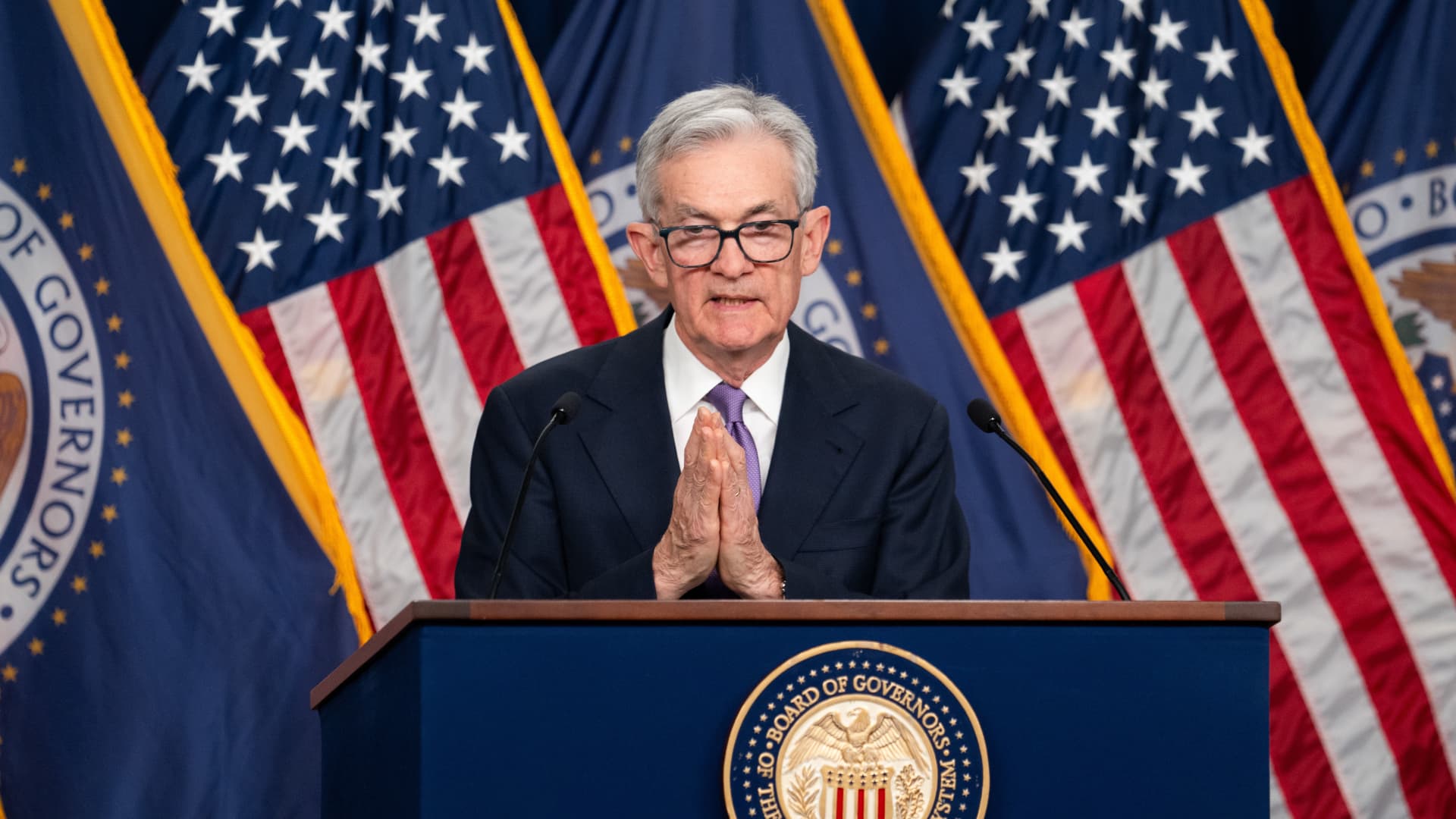
Bitcoin slipped below $71,000 on Wednesday as Federal Reserve Chair Jerome Powell flagged rising oil prices amid the war in Iran as a new inflation risk.
The Fed held interest rates steady as expected, but during his post-meeting press conference, Powell acknowledged that the recent surge in energy prices is already feeding into the central bank’s outlook.
“The oil shock for sure shows up” in higher inflation projections, he said, while cautioning that “nobody knows” yet how persistent the impact will be.
Policymakers raised their 2026 inflation forecast to 2.7% from 2.4%, underscoring concerns that price pressures could remain elevated longer than anticipated.
Despite that, Powell dismissed comparisons to a 1970s-style stagflation, even as the central bank faces growing tension between slowing growth and sticky inflation.
“That’s not the case right now,” he said, noting that unemployment remains near long-run norms while inflation is only modestly above target. “I would reserve the term stagflation for a much more serious set of circumstances.”
“What we have is some tension between the goals, and we’re trying to manage our way through it,” he added.
Cautious markets
Already under pressure prior to the Fed news on poor February inflation data and no sign the war in Iran is letting up, markets fell further late in the session.

Bitcoin late Wednesday afternoon had pulled all the way back to $70,900, down almost 5% over the past 24 hours. Ether (ETH) was sporting a 6.5% decline.
The S&P 500 and Nasdaq closed at the day’s lows, down 1.4% and 1.5%, respectively. Gold extended its decline below $4,850 an ounce, now 3.1% lower on the day at its weakest price in more than a month.
Digital asset-related stocks remained sharply lower, following crypto prices. Strategy (MSTR), the largest corporate BTC holder, and Bitmine (BMNR), the leading Ethereum treasury firm, were 5%-6% lower. Investment firm Galaxy (GLXY) declined almost 7%, while crypto exchange Gemini (GEMI) tumbled 15% to about its lowest level since it went public last year.
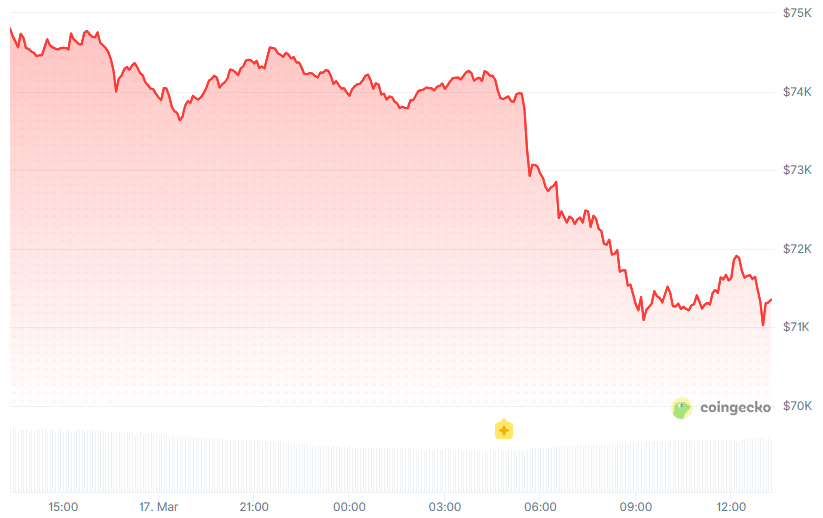
Bitcoin slips 5% as rising U.S. wholesale inflation and ongoing geopolitical tensions weigh on investor sentiment.
Crypto markets erased most of their weekly gains on Wednesday after the Bureau of Labor Statistics reported that U.S. wholesale prices rose sharply in February and the Federal Reserve left interest rates unchanged.
Bitcoin (BTC) is trading at around $71,300, down nearly 5% over the past 24 hours. ETH and SOL fell 6% to $2,190 and $90, respectively.
Meanwhile, Ripple (XRP) dropped by 5%, and BNB by 4%.

The overall crypto market capitalization slipped 4% to $2.52 trillion, according to Coingecko.
PPI Report
February PPI rose 0.7% month-over-month, more than double the 0.3% economists had forecast. Core PPI (ex-food and energy) gained 0.5%, also above the 0.3% consensus. On an annualized basis, headline PPI hit 3.4%, the highest in a year.
Energy prices climbed 2.3% in February, rising in anticipation of a Middle East conflict, and the ongoing US-Israel war with Iran threatens to keep inflation elevated well into the year.
Fed Decision
The central bank held the federal funds rate target range at 3.5% to 3.75%, citing elevated inflation, solid economic growth, and elevated uncertainty over the economic outlook.
The statement specifically flagged that “the implications of developments in the Middle East for the U.S. economy are uncertain.”
Officials indicated they still expect to cut rates once in 2026.
Big Movers
Nearly all of the Top 100 digital assets posted losses over the last 24 hours.
Today’s top gainers are Kaspa (KAS) and Hyperliquid (HYPE).
ASTER and Zcash (ZEC) are the biggest losers, down around 10%.
Around 131,000 leveraged traders were liquidated for $420 million in the past 24 hours, according to CoinGlass. Bitcoin accounted for $136 million, while ETH made up $139 million.
Bitcoin exchange-traded funds (ETFs) recorded inflows of $199 million on Tuesday, marking a seventh straight day of gains.


Changpeng “CZ” Zhao embraced a chance to distance himself from recent accusations against Binance that it has been involved in handling transactions that potentially enabled terrorism financing in Iran.
“I have zero interest in doing that,” said the founder and former chief executive of the exchange, who agreed to leave his company under a criminal settlement with the U.S. “I live in a country that’s being attacked by Iran. Even before that, I was just not interested in that,” he said in a video appearance at the Digital Chamber’s DC Blockchain Summit on Wednesday.
CZ, a resident of the United Arab Emirates, cited a couple of civil lawsuits recently dismissed in U.S. courts that had accused Binance of acting as a conduit for terrorism financing. He also argued that the Iran-tied transactions in question don’t generate fees and wouldn’t offer any business attraction for the firm to get involved in.
“There’s no benefit,” CZ, who’d served a prison sentence and received a pardon from President Donald Trump, said in defense of the implications against his former company.
Binance, the largest global crypto exchange that had settled U.S. anti-money-laundering and sanctions-violation accusations in 2023, sued the Wall Street Journal last week for reporting that it had fired compliance personnel who’d flagged suspicious transactions that may have violated sanctions. Internal investigators had allegedly flagged more than $1 billion in crypto transfers from Chinese clients into wallets linked to Iranian financing networks.
The company has asserted that it couldn’t find evidence that accounts on its platforms had transacted directly with Iranian entities.
CZ, who is close to launching a memoir he’d worked on during his time in prison, said he’s been targeted by false accusations.
“The way they’re attacking, they’re completely using false, baseless information,” he said.
Read More: Binance tells Senate probe no accounts sent crypto directly to Iran

HP Study Finds Many Indian SMBs Still Ignore Printer Security Risks

Zoe Stratford: World Cup-winning Red Rose announces pregnancy

High Tide Inc. (HITI:CA) Q1 2026 Earnings Call Transcript


![Trump's Worst FEAR Just Came True! [This Happens To Oil Next]](https://wordupnews.com/wp-content/uploads/2026/03/1773864099_maxresdefault-80x80.jpg)

-
 Crypto World5 days ago
HYPE Token Enters Net Deflation as HyperCore Buybacks Outpace Staking Rewards
-

 Tech3 days ago
Your Legally Registered ‘Motorcycle’ Might Not Count Under Proposed US Law
-

 Fashion5 days ago
Weekend Open Thread: Addict Lip Glow
-
Sports4 days ago
Why Duke and Michigan Are Dead Even Entering Selection Sunday
-
 Tech1 day ago
Are Split Spacebars the Next Big Gaming Keyboard Trend?
-

 Business3 days ago
Search for Savannah Guthrie’s Mother Enters Seventh Week with No Arrests
-

 Business4 days ago
US Airports Launch Donation Drives for Unpaid TSA Workers as Partial Government Shutdown Enters Fifth Week
-
Crypto World4 days ago
Coinbase and Bybit in Investment Talks: Could Bybit Finally Enter the US Crypto Market?
-

 Business4 days ago
Country star Brantley Gilbert enters growing non-alcoholic beer market
-

 Business2 days ago
Australian shares drop as Iran war enters third week
-

 Crypto World2 days ago
Crypto Lender BlockFills Enters Chapter 11 with Up to $500M in Liabilities
-

 Sports5 days ago
College Basketball Best Bets: Conference Tournament Semifinal Picks
-

 Politics12 hours ago
The House | The new register to protect children from their abusers shows Parliament at its best
-
 Crypto World7 days ago
Three Binance Charts May Be Hinting at Bitcoin’s Next Move
-
 Business6 days ago
Trump demands Powell cut rates as Iran conflict raises energy prices
-
 Crypto World6 days ago
Senate Votes to Include CBDC Ban in Bipartisan Housing Bill
-

 Fashion2 days ago
25 Celebrities with Curly Hair That Are Naturally Beautiful
-

 News Videos4 hours ago
RBA board divided on rate cut, unusually buoyant share market | Finance Report | ABC NEWS
-

 NewsBeat6 days ago
Deane Road crash near Bolton colleges and university
-

 News Videos6 days ago
Tom Lee: The 100x Opportunity EVEN Bigger Than Bitcoin (New Ethereum Prediction 2026)


You must be logged in to post a comment Login