

Crypto World
ETF Flows Signal Early Capital Rotation

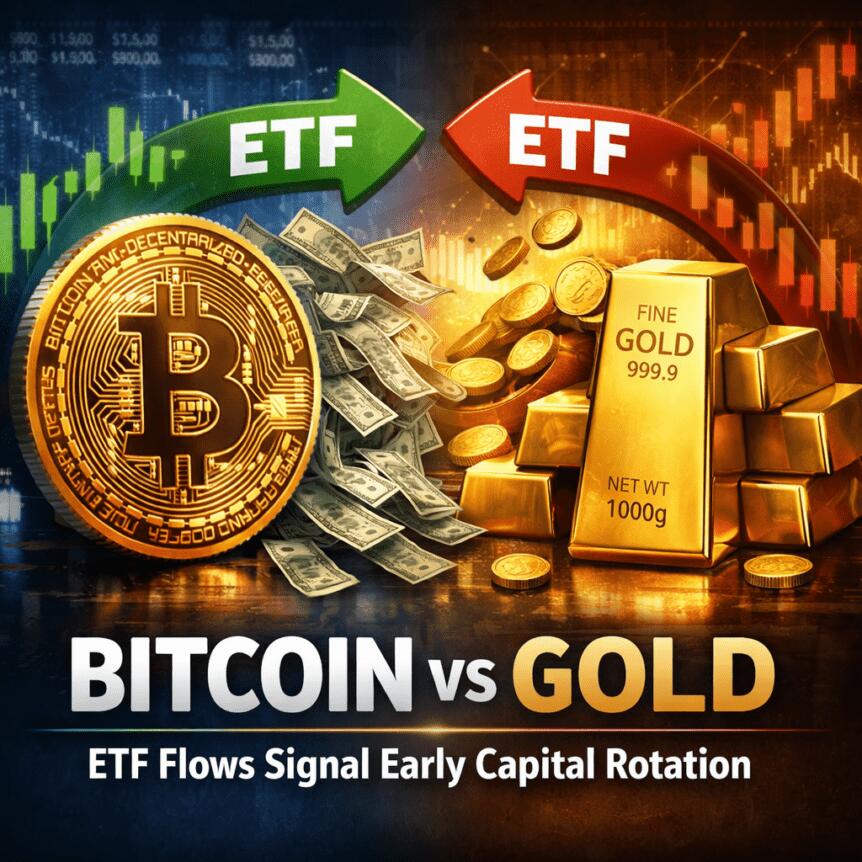
Bitcoin ETF flows have shifted into positive territory over the last 30 days, even as gold ETF demand shows signs of fatigue after a prolonged rally. In the latest data pulse, bitcoin-focused funds logged a net inflow of $273 million on March 6 after a $1.9 billion outflow in February, while GLD—the largest US gold-backed ETF—saw a substantial one-day withdrawal that underscores a potential rotation in investor appetite. The backdrop is nuanced: gold prices have remained elevated, yet momentum appears to be cooling, while bitcoin demand shows resilience that could presage a broader reallocation within risk assets.
Key takeaways
- Bitcoin ETFs posted a 30-day net inflow of $273 million on March 6 after a $1.9 billion outflow in February, signaling renewed interest from what some observers call a risk-on cohort.
- Gold ETFs experienced a marked reversal, with GLD recording a $3 billion outflow on a single day—the largest in more than two years—after a longer streak of inflows totaling roughly $24 billion across January and February.
- Holdings shifted in native units: bitcoin ETF positions rose by about 4,021 BTC on March 6, while gold ETF holdings declined from 1.4 million ounces to roughly 621,100 ounces during the same window.
- Analysts point to a potential rotation from gold toward bitcoin as risk sentiment improves and the macro backdrop remains uncertain, though the timing of any sustained shift remains uncertain.
- Longer-term context from Fidelity suggests gold’s leadership cycle may be peaking, potentially opening room for bitcoin to take the lead in the coming quarters, in line with historical cross-asset dynamics between the two stores of value.
Tickers mentioned: $BTC, $GLD
Sentiment: Neutral
Price impact: Neutral. While flows point toward a possible rotation, there is no clear, immediate price move indicated by the data.
Market context: The flows sit within a broader pattern of ETF activity shaping crypto and precious metals markets as risk sentiment oscillates and liquidity conditions shift. The bitcoin-related inflows come as gold’s rally cools after a strong start to the year, illustrating how investors are reallocating capital across alternative stores of value in a fluctuating macro environment.
Why it matters
Across mainstream markets, exchange-traded funds provide a surprisingly transparent lens into the evolving sentiment of large participants—often illustrating where capital is seeking safety, exposure, or hedges against inflation and geopolitical risks. The latest divergence between bitcoin and gold ETF flows adds a new chapter to the long-running debate over which store of value may lead in a given cycle. The near-term implication is a potential shift in demand dynamics: as gold’s momentum wanes from its January–February surge, bitcoin could begin to attract fresh buyers seeking upside leverage to a risk-on environment.
On the holdings side, the shift is tangible. Bitcoin ETFs recorded a net increase of more than 4,000 coins in a single day, contrasting with a sharp decline in gold holdings over the same period. The data, drawn from native-asset balances rather than dollar-denominated valuations, give a clearer picture of actual accumulation versus distribution. These internal flows can be early signals that price action might follow as new entrants accumulate positions or exit as conditions change. The contrast between the two assets is notable, given their historically divergent performance during different macro regimes and risk cycles.
Market observers have tied the trend to a broader rotation from “safe-haven” assets toward instruments that offer growth exposure or diversification benefits in an improving risk environment. Joe Consorti, head of growth at Horizon, highlighted the possibility that gold’s leadership phase could be nearing its late-stage, with bitcoin poised to surge if the macro backdrop supports a continued risk-on tilt. He encapsulated the view succinctly: “Gold is stalling out while bitcoin is soaring. BTC is set to overtake gold’s % growth over the last month as the U.S. economy accelerates and risk sentiment improves. The anticipated risk-off → risk-on rotation could be underway.”
Further context comes from a 2026 outlook published by Fidelity Digital Assets. The firm noted gold’s 65% return in 2025—the fourth-largest annual gain since the end of the gold standard—arguing that gold could be near the late phase of its leadership cycle. The takeaway echoed by Fidelity is that the two assets have historically taken turns leading, suggesting that bitcoin could take the baton next if the cycle continues to evolve. This historical pattern adds a framework for investors assessing whether the current rotation is a temporary pause or the start of a more durable shift in cross-asset leadership.
What to watch next
- Next 30-day ETF flow data for bitcoin and gold to confirm whether the inflow streak for BTC persists and whether GLD continues to underperform relative to its peers.
- Price action around bitcoin and gold in the wake of any macro data releases that influence risk sentiment, including inflation and growth metrics.
- Monitoring holdings updates for major bitcoin and gold ETFs to verify ongoing accumulation or distribution in native units.
- Geopolitical developments and policy signals that could reintroduce risk-off dynamics or re-ignite appetite for safe havens.
- Industry commentary and analysis from market watchers and asset managers regarding the timing and durability of any rotation between gold and bitcoin.
Sources & verification
- Kobeissi Letter post detailing GLD’s $3 billion outflow and the context of gold’s price decline.
- bold.report flow data showing the 30-day net flow shift for bitcoin ETFs and the December–February momentum for gold ETFs.
- Joe Consorti, Horizon, discussion on bitcoin’s relative strength and potential rotation dynamics, as cited in social posts.
- Fidelity Digital Assets, 2026 Look Ahead report outlining gold’s prior rally, leadership-cycle considerations, and cross-asset dynamics with bitcoin.
- TradingView BTCXAU ratio analysis and related market commentary illustrating how the BTC-to-gold relationship has evolved in recent cycles.
ETF flows hint at Bitcoin-led rotation vs gold
Bitcoin ETF inflows and gold ETF outflows over the past month point to a nuanced shift in investment behavior that could have implications for both assets in the near term. On the one hand, bitcoin funds saw a notable positive swing, with a March 6 inflow of $273 million following a February outflow of $1.9 billion. On the other hand, GLD reversed a long period of inflows, registering a $3 billion one-day withdrawal that marked a stark departure from January’s and February’s robust cash-hauls. The divergence is telling: as gold’s price pullback and consolidation emerged, bitcoin buyers appeared to be re-entering the market, potentially signaling a rotation in the broader risk spectrum.
Holdings data reinforce the narrative. In native units, bitcoin ETF positions rose by about 4,021 BTC on March 6, a clear counterpoint to the gold side where holdings slid from 1.4 million ounces down to roughly 621,100 ounces in the same interval. By focusing on native asset balances rather than dollar valuations, analysts can better gauge genuine accumulation versus mere price-driven valuation changes. This distinction is essential for understanding whether flows translate into meaningful demand that could support higher prices over time.
Analysts have framed the shift within a larger macro tapestry. The idea of a rotation from gold into bitcoin is not new, but recent data adds a degree of plausibility to such a transition—especially if risk appetite improves alongside a cautiously optimistic macro backdrop. The commentary from Horizon’s Joe Consorti emphasizes that the pivot could be underway as market participants reassess the relative appeal of traditional safe-havens against digital stores of value with expected growth characteristics. Fidelity’s outlook provides complementary context, suggesting that the cycles between gold and bitcoin have historically oscillated, with each asset taking turns leading at different phases of monetary and geopolitical stress.
As the market continues to digest these cross-asset dynamics, investors will be watching for confirmatory signs—both in flows and in price action—that the rotation, if it is indeed forming, gains momentum. The 2025 performance of gold—an impressive 65% return—has already shaped expectations about when bitcoin might reassert leadership. The current data do not definitively settle the question, but they do underscore the importance of watching ETF flows as a real-time proxy for investor preferences in a landscape where macro uncertainty and liquidity conditions remain pivotal drivers of asset allocation.



Cryptocurrencies linked to artificial intelligence, such as Bittensor’s TAO, NEAR Protocol, Internet Computer, and others rallied after Wired reported that Nvidia is preparing a new open-source platform for autonomous AI agents, a concept similar to the OpenClaw framework, ahead of its annual developer conference.
The broader artificial intelligence token category rose about 4.8% to roughly $14.17 billion in market value, outperforming the wider crypto market, where the CoinDesk 20 index was up 2.86%. Among the majors, Bittensor’s TAO led the move, with NEAR Protocol and Internet Computer also advancing.
Nvidia’s new platform, according to Wired, will be called NemoClaw. The system would allow enterprise software companies to deploy AI agents that can perform multi-step tasks for employees, and Nvidia has reportedly approached firms including Salesforce, Cisco, Google, Adobe, and CrowdStrike about potential partnerships ahead of its developer conference next week.
Wired says NemoClaw is expected to include security and privacy tools for enterprise use and is part of Nvidia’s broader strategy to expand its software ecosystem while maintaining its dominance in AI infrastructure.
Nvidia’s GTC developer conference begins March 17.
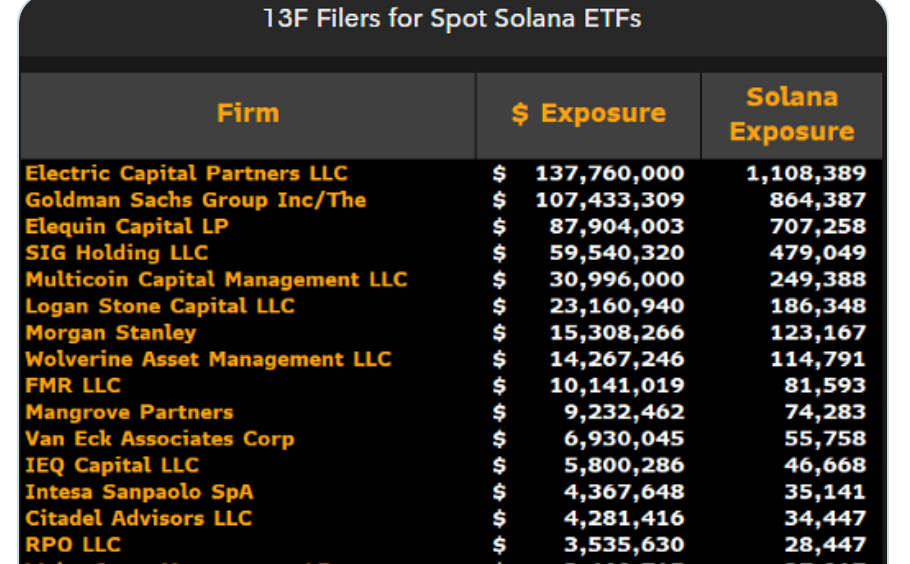
Investment advisors were the biggest buyers of the US-based spot Solana ETFs at over $270 million, while hedge fund managers came in next at $186 million.
Silicon Valley-based venture capital firm Electric Capital Partners and investment bank Goldman Sachs were the two largest buyers of spot Solana exchange-traded funds, which launched for trading in the US in October last year.
Data shared by Bloomberg ETF analyst James Seyffart on Monday shows that the top 30 institutional holders of US spot Solana (SOL) exchange-traded funds bought over $540 million worth of the ETFs in the quarter.
Electric Capital and Goldman Sachs took out the top two positions with $137.8 million and $107.4 million worth of Solana ETF exposure, while Elequin Capital, SIG Holding and Multicoin Capital rounded out the top five.
Morgan Stanley and Citadel Advisors were among the other notable institutions that bought spot Solana ETFs after Bitwise launched the first Securities and Exchange Commission-approved spot Solana ETF on Oct. 28.

Seyffart’s data comes from 13F filings submitted to the SEC in mid-February, where institutions managing over $100 million in assets are required to disclose their Q4 holdings and position sizes.
Investment advisors accounted for by far the largest share of spot Solana ETF ownership at over $270 million, while hedge fund managers came in next at $186.4 million.
Holding companies and brokerage firms held $59.5 million and $20.3 million, while banks held $4.5 million.

The $540 million in Solana ETF holdings was backed by approximately 4.3 million SOL tokens.
However, those 4.3 million SOL tokens have fallen over 30% in market value since the end of Q4, from $124.95 to $86.53 at the time of writing.
SOL ETF net flows steadying despite price fall
Bloomberg ETF analyst Eric Balchunas noted on Thursday that cumulative flows into spot Solana ETFs have held strong in recent months despite Solana’s price fall.
Related: US banking lobby considers suing OCC over crypto bank charters: Report
Balchunas also noted that 50% of Solana ETF assets are held by these 13F-filing firms, arguably making for a more serious investor base.
Farside Investors data shows that US spot Solana ETFs have accumulated $952 million worth of inflows since launching in the US.
Magazine: What’s a ‘Network State’ and are there real-life examples? Big Questions


Major tokens snapped back on Tuesday as ceasefire optimism rippled through risk markets.
Ether reclaimed $2,029, up 2.6% over the past 24 hours and back above the $2,000 level that has served as a psychological pivot for weeks. Solana led the recovery at 2.9% to $85.67. BNB added 2.6% to $639. XRP gained 1.7% to $1.37. Dogecoin lagged at just 1% and remains down 1.4% on the week, continuing to underperform the broader market on every bounce.
The catalyst was U.S. president Donald Trump telling reporters late Monday that the Iran conflict would resolve “very soon” and that U.S. military objectives were “pretty well complete.” Asian equities surged 2% after Monday’s 3.7% plunge. Tech stocks in the MSCI Asia Pacific index jumped 3.5%. Oil fell from Monday’s spike above $100.
Analysts at Nansen said in an email that crypto had “already absorbed the negatives and priced them in,” arguing the market was responding to headlines rather than broader macro deterioration.
The institutional flow data supports that read. CoinShares reported $619 million in crypto fund inflows for the week ending Friday, with $521 million going to bitcoin products and total AUM reaching $108.3 billion.
That capital came in during a week where the S&P lost $1 trillion in a single session and the economy shed 92,000 jobs. “Spot Bitcoin ETFs continue to attract capital even as price weakens, which suggests institutional allocators are treating this as a tactical entry rather than capitulation,” said Ryan Kirkley, co-founder and CEO of Global Settlement, in an email to CoinDesk.
Ethereum’s position above $2,000 is the one to watch this week. The second-largest cryptocurrency has been fighting to hold that level since late February, and FxPro analysts flagged $2,500 and the 200-week moving average as the zone that would confirm a genuine recovery rather than a series of dead cat bounces. The gap between $2,000 and $2,500 is where the narrative shifts from “surviving the drawdown” to “starting a new trend.”
For solana, the recovery has been structurally weaker. SOL remains down roughly 55% from its cycle highs and has underperformed ether on every major bounce since the October crash.
The memecoin economy that fueled solana’s 2024 rally has evaporated, and without that speculative engine the token is trading more on macro sentiment than ecosystem activity.
XRP has been the most range-bound of the majors, hovering between $1.30 and $1.45 for most of March. ETF inflows have been positive and the legal clarity from Ripple’s settlement should be a tailwind, but the token has failed to decouple from broader market direction.
The Fed meeting on March 17-18 looms as the next real test.
Global Settlement’s Kirkley noted that the 90-day correlation between bitcoin and the S&P 500 has climbed to 0.78, one of the highest readings since mid-2022. When bitcoin trades in lockstep with equities, altcoins amplify every move in both directions.
A hawkish dot plot or any hint that rate hikes are back on the table would hit the higher-beta end of crypto hardest.
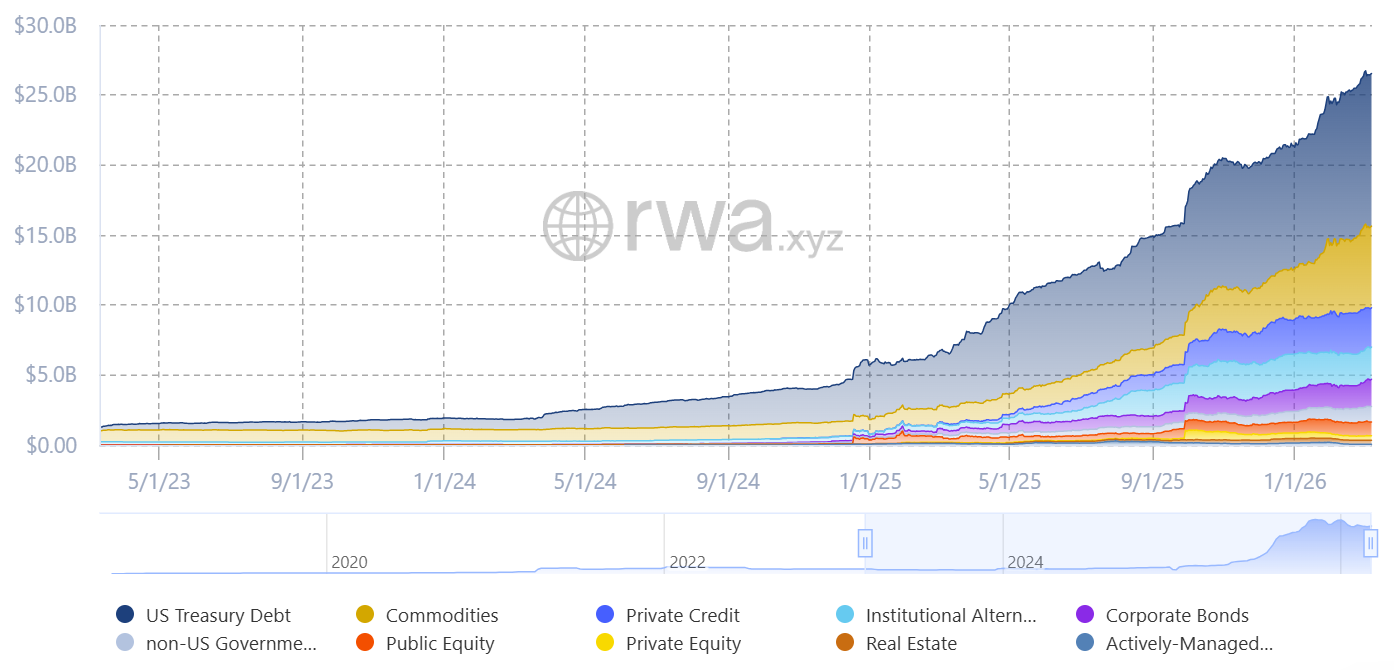
Amina, a Swiss-regulated crypto bank, has joined a blockchain-based settlement platform for tokenized securities operating under the European Union’s DLT pilot regime, marking another step toward integrating digital asset infrastructure with traditional capital markets.
The Zug, Switzerland-based company announced Monday that it has become a listing sponsor on the EU-regulated platform 21X, making Amina the venue’s first fully regulated bank participant.
Amina said the move will allow it to support companies issuing tokenized securities on 21X through its partnership with Tokeny, a Luxembourg-based company that provides technology for creating and managing tokenized financial assets.
The collaboration aims to address a key barrier to institutional adoption of tokenized assets by connecting regulated banks with the issuance and trading of tokenized securities.
21X received an infrastructure permit under the EU’s DLT pilot regime in December 2024, allowing it to run a regulated market for blockchain-based securities in a regulatory test environment.
“A lack of interoperability of tokenized asset platforms” was cited by Baker McKenzie’s European Financial Services practice in June as one of the main obstacles to the adoption of tokenization among financial institutions. “Scale will only be achieved when numerous market players are transacting with each other on common or interconnected platforms,” Zurich partner Yves Mauchle wrote on the firm’s blog.
Introduced in 2023, the DLT framework allows market operators to experiment with blockchain-based trading and settlement of financial instruments within a regulatory sandbox. The program is intended to help regulators evaluate how the technology could fit into existing market infrastructure.
Despite early uptake, the regime has faced scrutiny from industry participants, who warn that its current limits could prevent European onchain markets from scaling and competing with other jurisdictions. It remains unclear whether participation from regulated banks such as Amina will help accelerate adoption.
Related: Crypto exchanges gain as tokenized commodity market climbs to $7.7B
Strong growth of tokenized real-world assets
The development comes as financial institutions increasingly invest in blockchain infrastructure for tokenized assets. In the United States, institutions including BNY, Nasdaq and S&P Global recently backed the expansion of the Canton Network, while Europe is testing regulated blockchain trading venues such as 21X under the EU’s DLT pilot regime.
In February, eight EU-regulated digital asset companies urged policymakers to accelerate digital asset legislation, warning that the bloc risks falling behind the United States and other jurisdictions in developing tokenized financial markets.

To be sure, positive developments are taking place. In September, crypto exchange Kraken launched tokenized securities trading for European users through its xStocks platform, which offers blockchain-based versions of US-listed equities.
Two months later, tokenization platform Ondo received regulatory approval in Liechtenstein to offer tokenized equities trading to European investors.
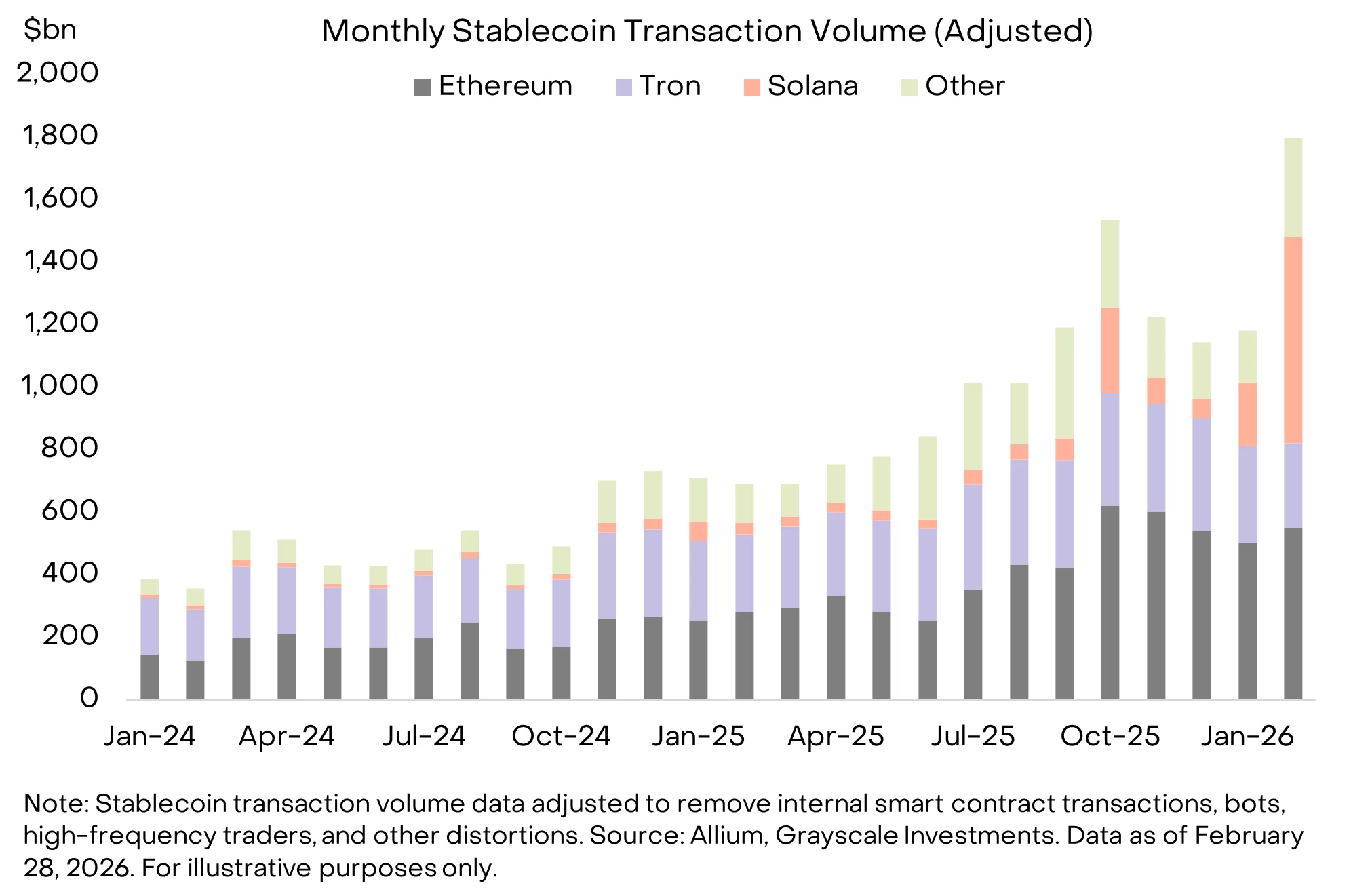
Solana has achieved a historic milestone in the digital asset sector, officially surpassing both Ethereum and Tron in monthly stablecoin transaction volume for February 2026.
Summary
- Solana processed a record $650 billion in stablecoin volume, more than doubling its previous peak from late 2025.
- The network overtook Ethereum and Tron, capturing the largest share of the $1.8 trillion global stablecoin activity.
- SOL is consolidating near $84, with $80 acting as key support and $90 as the first major resistance for a potential trend reversal.
According to latest data, Solana’s (SOL) adjusted stablecoin volume hit a record $650 billion, representing a massive surge in on-chain payment activity that more than doubled its previous peak from late 2025.
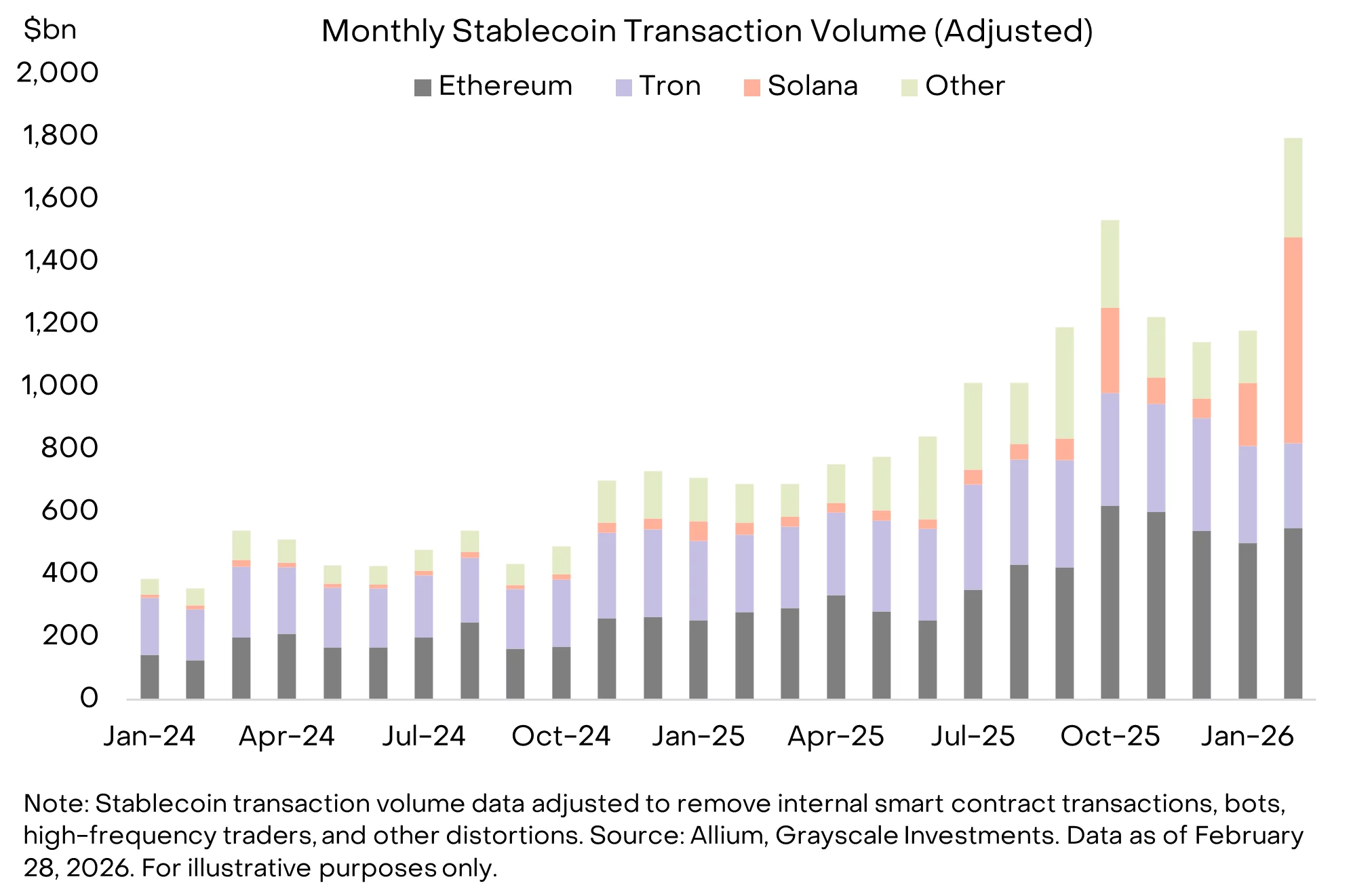
This explosive growth marks a fundamental shift in the network’s utility, moving away from a primary reputation as a hub for meme coin speculation toward becoming the leading infrastructure for global stablecoin settlements.
Solana’s low transaction fees and high throughput have made it the preferred rail for high-frequency, economically meaningful transfers, outperforming traditional heavyweights like Tron, which previously dominated the USDT payment market.
This surge occurred against a backdrop of record global stablecoin volume reaching $1.8 trillion, with Solana now accounting for the largest single share of that activity, solidifying its position as the dominant network for the emerging digital dollar economy.
SOL price analysis
The current price action for SOL on the daily chart indicates a period of cautious consolidation following a long-term downtrend from the January highs. After crashing from the $140 level earlier in the year, Solana has spent the last month attempting to carve out a stable bottom.
Currently, the asset is trading at approximately $84.12, showing a 3.10% gain in the most recent session as it attempts to move away from a local floor.
The immediate support is firmly established at the $80.00 psychological level, which bulls have defended multiple times over the past week. On the upside, the first major hurdle for a recovery is the $90.00 resistance mark, where recent rallies have faced selling pressure.
A decisive break and hold above $90.00 would be the first major signal that a trend reversal is underway, potentially opening the door for a run toward $100.
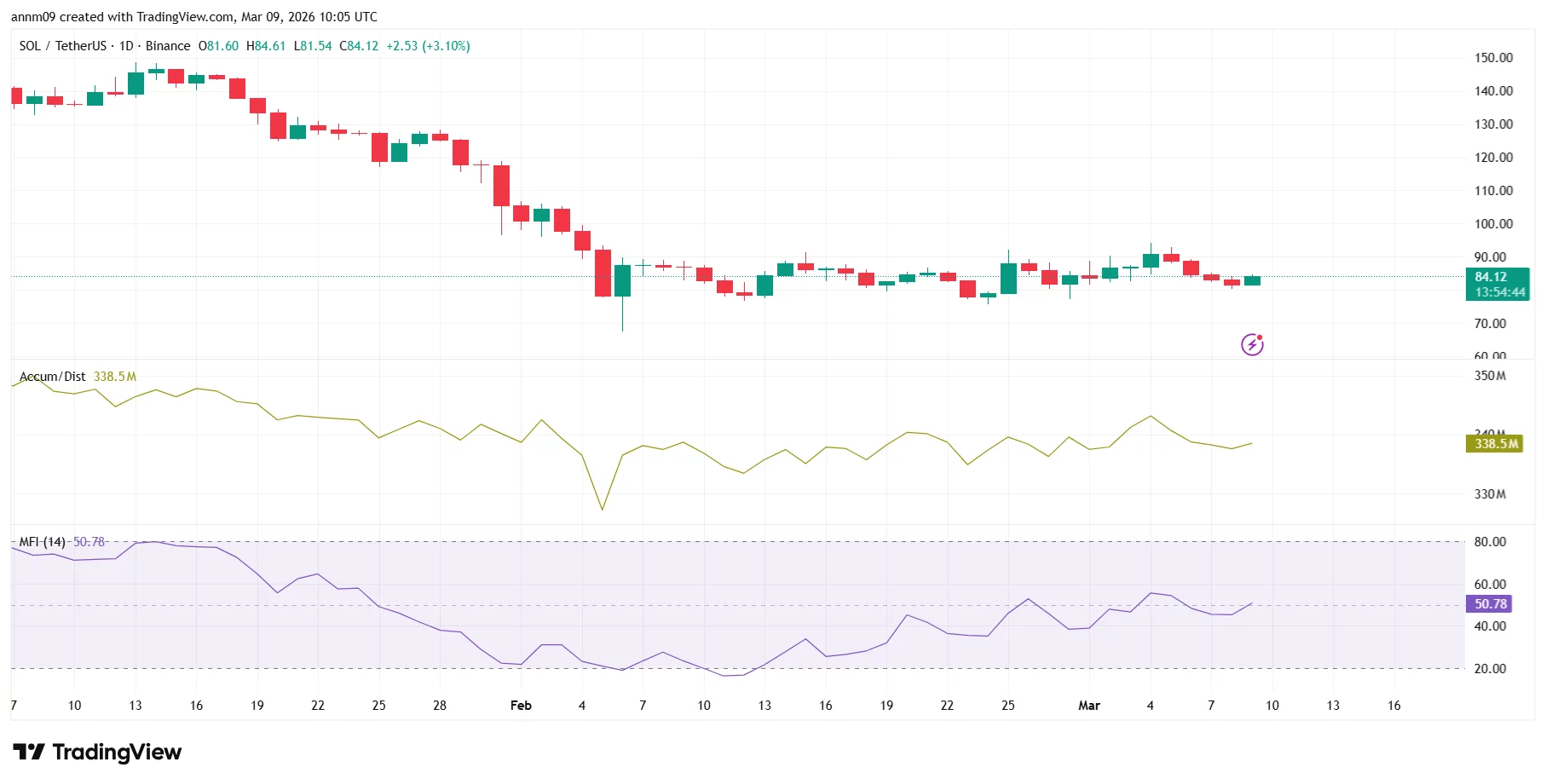
Technical indicators provide a nuanced view of this consolidation phase, suggesting that while the trend remains neutral, bearish momentum is fading.
The Money Flow Index (MFI-14) is currently sitting at 50.78, a perfectly neutral reading that indicates a balance between buying and selling pressure after recovering from an oversold dip in early February.
Furthermore, the Accumulation/Distribution line is positioned at 338.5 million, remaining relatively flat over the last several weeks. This lack of aggressive distribution despite the lower price points suggests that long-term holders are largely staying put, awaiting a catalyst for the next leg up.
If the record-breaking stablecoin utility translates into sustained demand for SOL to cover transaction fees, the next major resistance beyond $90.00 lies at $105.00. However, if the $80.00 support fails to hold, investors should watch for a secondary defensive line at the $70.00 mark.


A banking lobby group in the United States is considering legal action against the Office of the Comptroller of the Currency over the agency granting national trust bank charters to crypto firms.
Summary
- The Bank Policy Institute is considering legal action against the Office of the Comptroller of the Currency over its decision to grant national trust bank charters to crypto firms.
- Banking groups argue the OCC ignored earlier warnings from industry bodies and state regulators while advancing licensing approvals for crypto companies.
An unnamed source familiar with “the lobby’s thinking” has informed The Guardian that the Bank Policy Institute is planning to sue the OCC for ignoring earlier warnings from banking groups and state regulators and moving ahead with its reinterpretation of federal licensing rules to grant national trust bank charters to crypto firms. According to the group, this could potentially put Americans and the financial system at risk.
Under the leadership of Jonathan Gould, who was appointed by President Donald Trump, the OCC granted the first batch of conditional national trust bank charter approvals to crypto firms, including Ripple, BitGo, and Paxos, among others. Since then, several other firms have pursued similar approvals.
Once approved, the national trust bank charter will allow these companies to operate as trust banks and offer custody and asset safekeeping services.
In October, the BPI issued a statement urging the OCC to reject applications from crypto firms, including Ripple and Circle, as it argues that granting such charters could put the financial system at risk.
“BPI cautions that endorsing this pathway and allowing firms to choose a lighter regulatory touch while offering bank-like products could blur the statutory boundary of what it means to be a “bank,” heighten systemic risk and undermine the credibility of the national banking charter itself,” it said at the time.
According to The Guardian, the BPI has yet to decide whether it intends to pursue legal action against the OCC. However, the report noted that the BPI was among a group of banks that had previously taken legal action against the Federal Reserve in late 2024 over its stress testing framework, which the central bank later agreed to reconsider.
Similar warnings over the OCC’s crypto charter approvals have been issued by the Independent Community Bankers of America, which represents thousands of small lenders. Most recently, the ICBA urged the OCC to pull or change its proposal for issuing licenses to crypto firms.
As previously reported by crypto.news, Trump-linked World Liberty Financial applied for a charter in January, and the move has drawn a lot of scrutiny from Senator Elizabeth Warren over potential conflicts of interest.
However, during a Senate Banking Committee hearing, Gould said that the agency would continue to process the application.
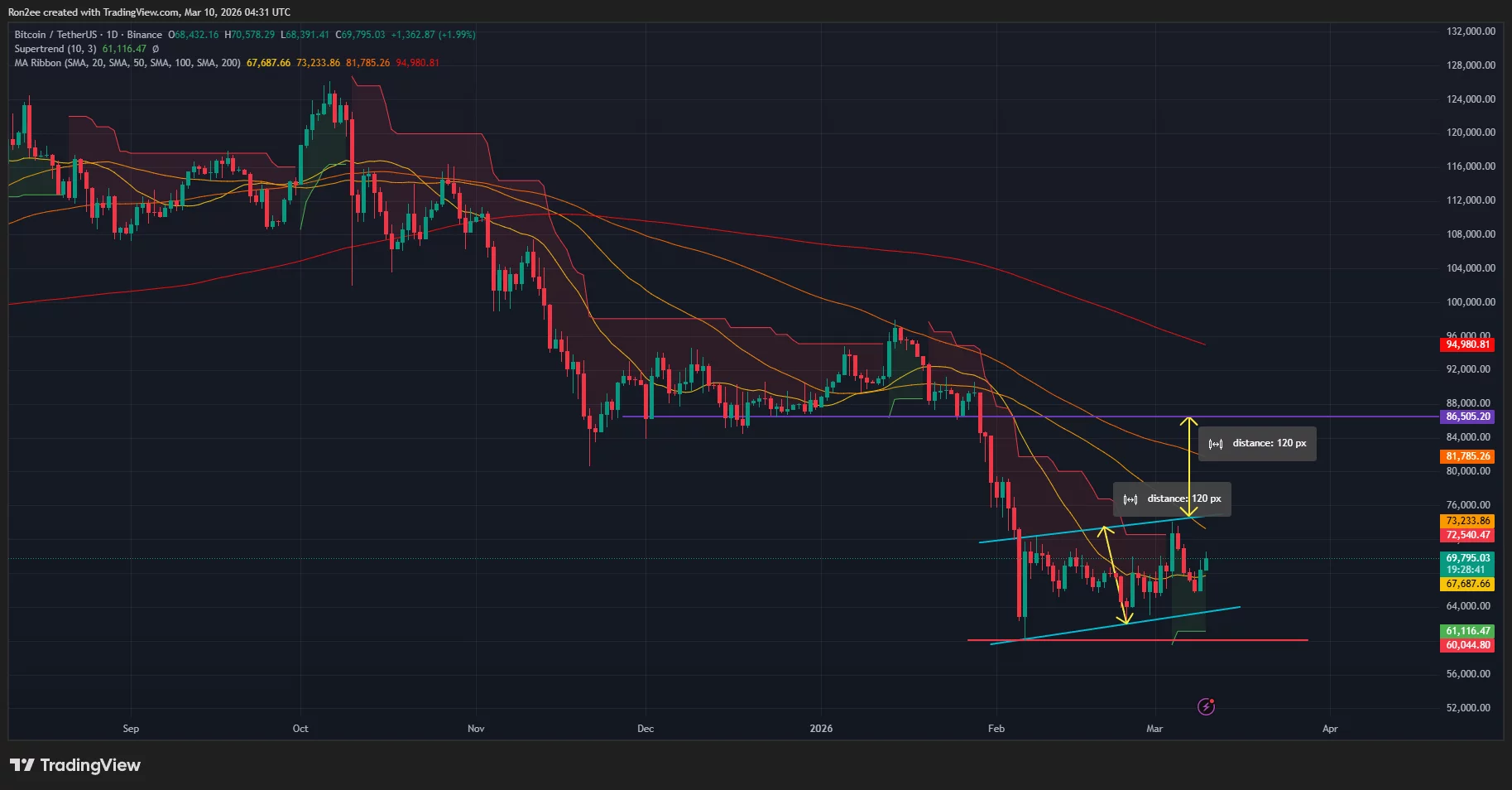
Bitcoin price is eyeing a technical breakout from an ascending parallel channel pattern as institutional demand returns for the bellwether asset.
Summary
- Bitcoin price is trading within a bullish continuation pattern that hints at more upside over the coming sessions.
- Bitcoin ETFs hit a weekly inflow streak for the first time in 5 months.
According to data from crypto.news, Bitcoin (BTC) price rose 4.2% in the past 24 hours, trading at $70,197 at press time. Now, charts suggest Bitcoin could see more recovery over the following sessions.
On the daily chart, Bitcoin price has formed an ascending parallel channel pattern following its sharp drop in early February. The popular bullish continuation pattern hints at sustained gains as long as an asset’s price remains within the two trendlines that define the corridor.
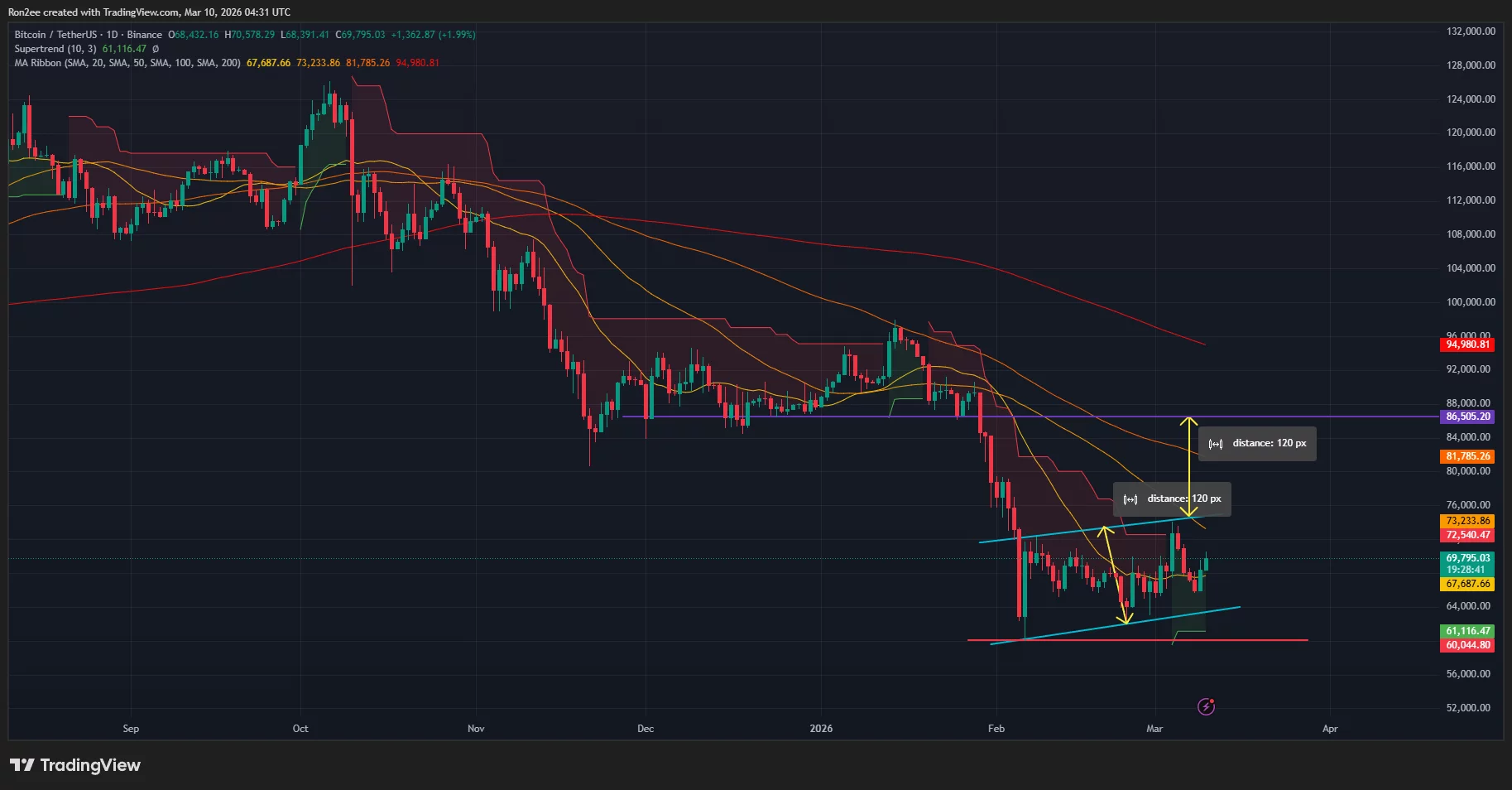
Further, a breakout from the upper side of the channel tends to accelerate bullish momentum for the related asset.
At the time of writing, technical indicators seemed to suggest that Bitcoin price is on the cusp of such a breakout from the pattern. The 20-day and 50-day moving averages are closing in on a bullish crossover, while the Supertrend flashed green as BTC price moved above it.
As such, $73,226, which aligns with the 50-day SMA, is the most immediate key resistance level traders would be keeping an eye on. A sharp rebound from it could springboard its price to around $86,500, a level that had previously served as a key support area during most of January this year.
On the contrary, if Bitcoin price falls below $67,674, the 20-day SMA, the bullish forecast would be invalidated. Bears could then drag BTC price back to the $65,000 key psychological support level.
A major catalyst that has been providing support for Bitcoin’s recent rebound is the surging demand from institutional investors for the asset.
According to data from SoSoValue, the 12 spot Bitcoin ETFs recorded over $1.35 billion in net inflows over the past two weeks. This marked the first time these investment products managed to draw in back-to-back weekly inflows since early October last year. Additionally, March has also marked the first positive month for these funds after four consecutive months of bleeding.
Meanwhile, firms like Strategy have also played a key role in supporting price action. In its latest filing, the firm noted that it bought $1.28 billion worth of BTC, pushing its total holding valuation to $56.04 billion.
Disclosure: This article does not represent investment advice. The content and materials featured on this page are for educational purposes only.
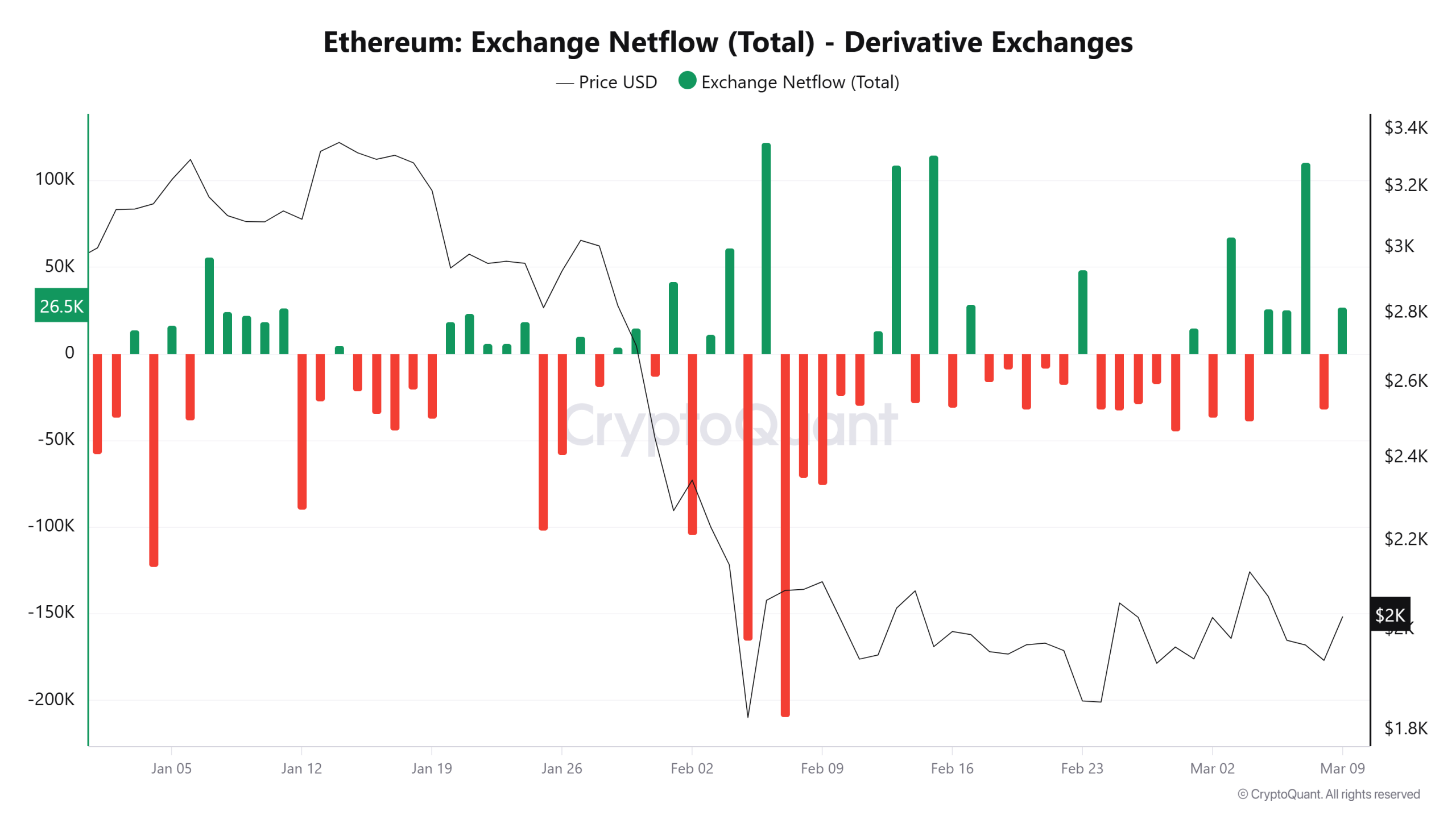
Ether (ETH) climbed back above $2,000 on Monday as the altcoin’s derivatives market activity intensified across major exchanges. Data shows more than 110,000 Ether flowed into derivatives platforms, while a key leverage indicator surged to new highs.
The activity points to a rapid buildup of speculative positioning, suggesting traders are preparing for increased volatility as ETH attempts to break out of its monthly trading range.
Ether derivatives inflows meet rising leverage ratio
Ether derivatives exchanges recorded a netflow of 110,343 ETH on March 7, the third-largest spike in 2026. A larger move occurred on Feb. 6, when ETH rallied roughly 13% from its yearly low at $1,736.

CryptoQuant data shows that the earlier spikes in derivatives inflows frequently preceded short-term drawdowns or periods of sharp volatility.
At the same time, Ether’s estimated leverage ratio climbed to a record 0.78 on Wednesday, exceeding the previous high of 0.778 recorded on Jan. 1. The metric tracks the amount of open interest relative to exchange reserves, and it is widely used to gauge how aggressively traders employ borrowed capital.

A higher reading means a larger share of the positions rely on leverage. Such conditions tend to amplify the price move in either direction as liquidations build across the derivatives markets.
Related: Banks will run RWAs on two blockchain rails, says RedStone co-founder
Key liquidity sits near $2,050
Ether trades inside a monthly range between $1,800 and $2,000 following a swing failure pattern near $2,150 last Wednesday. The rejection signaled profit-taking above local highs, and the price retraced to the internal liquidity levels near $1,900 and $1,950 formed early last week.
The one-hour chart now shows a bullish pivot on the one-hour timeframe, which tracks the recovery on Monday after a liquidity sweep happened near $1,908 on Sunday.

The market’s current attention may shift toward the supply zone between $2,050 and $2,100 formed late last week. A clear breakout above that range and establishing it as support may allow ETH to break significantly above $2,150.
The seven-day liquidation data from CoinGlass shows a dense cluster of short positions above the current price. Roughly $273 million in cumulative short-liquidation leverage sits near $2,030.
Large concentrations of short liquidations often act as magnet levels for the price. A move into that zone may trigger forced buybacks from the overleveraged short positions, which may accelerate the upside volatility if tagged in quick succession.

Crypto analyst Cyril-DeFi noted that ETH/USD is also testing a long-term ascending trendline that has supported the price several times since the last market cycle. The analyst said,
“Every time the price touched this support, it eventually led to a strong bounce. Right now, the $1.9k–$2k area looks like a key level that could determine the next move.”

Related: Crypto funds gain $619M as markets hold up despite oil and war fears
This article does not contain investment advice or recommendations. Every investment and trading move involves risk, and readers should conduct their own research when making a decision. While we strive to provide accurate and timely information, Cointelegraph does not guarantee the accuracy, completeness, or reliability of any information in this article. This article may contain forward-looking statements that are subject to risks and uncertainties. Cointelegraph will not be liable for any loss or damage arising from your reliance on this information.
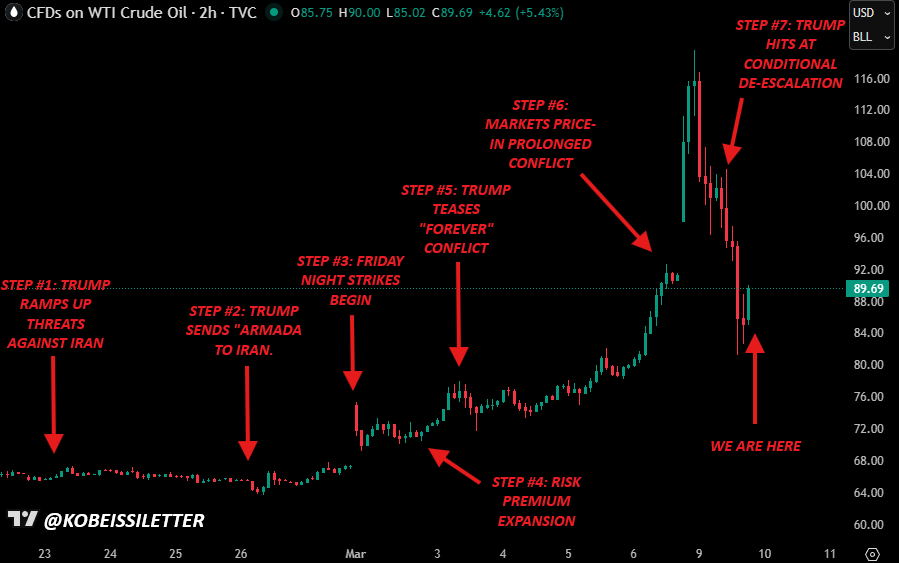
Oil prices fell while cryptocurrencies posted modest gains on Monday after US President Donald Trump told reporters that war with Iran could be coming to an end — even as he later ramped up the war rhetoric again on social media.
In a phone interview with CBS News on Monday, Trump made it appear that the war in Iran was wrapping up. The US military claims to have struck more than 3,000 Iranian targets in the first week of operations.
“I think the war is very complete, pretty much,” Donald Trump told CBS News. “If you look, they have nothing left. There’s nothing left in a military sense,” he added.
The comments saw oil prices fall 28% from their four-year high of $118 on Monday to around $85 in the hours that followed, according to OilPrice.

However, in his latest post on Truth Social on Tuesday, Trump ramped up the war rhetoric again, stating that “If Iran does anything that stops the flow of oil within the Strait of Hormuz, they will be hit by the United States of America TWENTY TIMES HARDER than they have been hit thus far.”
“Additionally, we will take out easily destroyable targets that will make it virtually impossible for Iran to ever be built back, as a Nation, again,” the President added.
“Death, Fire, and Fury will reign upon them — But I hope, and pray, that it does not happen!”
Trump’s comments in a Republican congressional fundraising event in Florida on Monday also hinted that the war may still have room to run.
“We’ve already won in many ways, but we haven’t won enough,” Trump said. “We go forward more determined than ever to achieve ultimate victory that will end this long-running danger once and for all.”
Crypto will follow other risk assets
Crypto markets are up 3.1% over the past 24 hours, with Bitcoin (BTC) reclaiming $70,000, and Ether (ETH) is hovering just above $2,000 at the time of writing.
Augustine Fan, partner and head of insights at crypto trading software service provider SignalPlus, told Cointelegraph that it is generally “hard to take these headline comments at face value, especially with other members of his [Trump’s] cabinet stating that things are still in the beginning phase, and US military assets still deployed in the region.”
“Crypto prices will continue to follow other risk assets without a fundamental narrative of its own in the near term, and macro leadership will still be driven by oil, which has seen a +$30 turnaround over the span of just 24 hours.”
Related: Bitcoin relief rally faces headwinds as bear market persists: analysts
“We don’t expect the conflict to be resolved any time soon,” he said, adding that “we would expect tradable bounces and BTC to do relatively better as a potential store of value during these times.”
Potential for prolonged uncertainty persists
Meanwhile, Andri Fauzan Adziima, research lead at Bitrue, told Cointelegraph that if Trump’s claim that the Iran war is almost over proves accurate, “I’m expecting a strong relief rally in crypto, driven by plunging oil prices, eased inflation/geopolitical fears, and renewed risk appetite.”
However, “doubts persist amid mixed signals from Iran and potential for prolonged uncertainty,” he added.
Iran’s Revolutionary Guard reportedly responded to Trump by saying that his comments were “nonsense” and “we are the ones that will determine the end of the war.”
Magazine: Bitcoin to outperform gold soon, FBI busts $46M crypto heist: Hodler’s Digest
Oil prices declined on Monday as President Donald Trump signaled a potential de-escalation in tensions with Iran, while cryptocurrencies posted modest gains in a risk-on session. In a phone interview with CBS News, Trump framed the conflict as nearing resolution, saying the war “is very complete” and suggesting Iran’s military capabilities had been diminished in the opening days of hostilities. The US military later asserted it had struck more than 3,000 Iranian targets in the first week of operations, a figure used to illustrate the scale of the campaign. The messaging volatility underscored the fragility of the macro backdrop, where energy markets remain volatile and crypto assets are increasingly tethered to risk sentiment. By the close, crypto markets were firmer, with Bitcoin reclaiming around $70,000 and Ether hovering near $2,000.
Key takeaways
- Oil prices retraced about 28% from a four-year high near $118 to roughly $85 as de-escalation chatter took hold, according to OilPrice.
- Crypto markets rose roughly 3.1% in the last 24 hours, with Bitcoin reclaiming around $70,000 and Ether just above $2,000.
- Trump’s later posting on Truth Social reignited war rhetoric, warning that Iran would be hit “TWENTY TIMES HARDER” if oil flow is disrupted, signaling renewed uncertainty for risk assets.
- Iran’s Revolutionary Guard dismissed the president’s remarks as “nonsense,” signaling that Tehran views the conflict as ongoing and unresolved.
- Analysts stressed that headlines may not reflect durable shifts in risk appetite; traders expect crypto to track broader macro moves rather than develop a standalone narrative in the near term.
- If oil continues to retreat and geopolitical tensions ease, a relief rally for crypto remains possible, though a protracted period of uncertainty cannot be ruled out.
Sentiment: Neutral
Price impact: Positive. Crypto prices moved higher as risk sentiment improved on de-escalation signals and softer oil prices.
Trading idea (Not Financial Advice): Hold. In the face of headline-driven moves and ongoing geopolitical ambiguity, traders may favor patience over active repositioning in BTC and ETH.
Market context: The day’s moves highlight how crypto markets often track broader risk assets amid macro headlines. Oil dynamics continue to exercise outsized influence on sentiment, and any shifts in geopolitical risk can quickly reprice crypto exposures as traders reassess risk premiums and liquidity conditions.
Why it matters
Geopolitical headlines have a well-established impact on both traditional and digital asset markets, and this episode underscores the permeability of crypto to macro narratives. When leadership signals the possibility of de-escalation, risk assets—including cryptocurrencies—tend to rally as liquidity conditions improve and investors seek higher-yield opportunities. Conversely, any escalation can trigger rapid risk-off moves, given the sensitivity of energy prices and the potential for volatility to spill over into crypto markets.
Market participants are watching the narrative closely because the outcome touches several interconnected pillars: the geopolitical backdrop, energy markets, and the evolving sentiment toward digital assets as potential hedges or risk-on plays. Analysts highlighted the risk of reading headlines as a sole predictor of direction, emphasizing the need to observe corroborating signals from official channels and macro data. The episode also emphasizes the ongoing debate about whether crypto can function as a stable store of value during periods of geopolitical stress or whether it will continue to mirror broader risk-on/risk-off cycles.
For investors and builders in the crypto space, the episode offers a reminder that macro risks remain a central driver of liquidity and price action. It also points to potential liquidity opportunities in more volatile periods, while cautioning that a longer-term resolution remains uncertain and could hinge on developments outside the crypto ecosystem.
What to watch next
- Official updates from the White House, the Pentagon, or Iran’s leadership in the coming 24–72 hours for signs of escalation or de-escalation.
- Oil price direction in subsequent sessions and its correlation with crypto price action, particularly around the $85 level and beyond.
- Trajectory of major crypto assets, especially BTC and ETH, in response to macro headlines and any shifts in risk appetite.
- Any new commentary from geopolitical actors or market analysts that could confirm a durable shift in sentiment or prolong the period of uncertainty.
Sources & verification
- CBS News interview: https://www.cbsnews.com/news/trump-iran-cbs-news-the-war-is-very-complete-strait-hormuz/
- Truth Social post by Donald Trump: https://truthsocial.com/@realDonaldTrump/posts/116202054617775180
- The Kobeissi Letter tweet: https://x.com/KobeissiLetter/status/2031156579630731462
- OilPrice article on oil price movement: https://oilprice.com/oil-price-charts/#WTI-Crude
- Cointelegraph discussion referencing oil-driven BTC moves: https://cointelegraph.com/markets/will-bitcoin-follow-oil-historic-surge-and-rally-to-79k-before-end-of-march
Oil tensions, Trump rhetoric and crypto markets: a 24-hour snapshot
Oil markets settled lower after President Trump’s remarks hinted at de-escalation in the Iran dispute, a move that coincided with a broad uptick in crypto prices. In a phone interview with CBS News, the president framed the ongoing exchanges as nearing resolution, saying, “the war is very complete, pretty much,” and suggesting Iran had little left militarily. The claim echoed a line of messaging from U.S. officials who have described the initial campaign as a broad and sustained campaign against Iran’s military targets. In the first week of hostilities, the U.S. military said it had struck more than 3,000 Iranian targets, a figure presented to emphasize the scope of the action while the diplomatic channel remains a subject of intense scrutiny.
The price action in crude oil reflected this ambiguity. Oil prices fell from a four-year high of around $118 to near $85 within hours, a move attributed in part to the perception that risk of a full-scale conflict could be receding. Market observers cautioned that headlines alone are not a reliable predictor of outcomes, as multiple officials signaled divergent views on the trajectory of hostilities. The interplay between geopolitical risk and energy markets continued to influence broader risk sentiment, with crypto assets showing resilience in a volatile environment.
Despite the early signals of de-escalation, later developments added a layer of complexity. A Truth Social post from Trump on Tuesday escalated the rhetoric, warning that Iran would be “hit by the United States of America TWENTY TIMES HARDER than they have been hit thus far” if the flow of oil through the Strait of Hormuz was interrupted. He also warned of taking out “easily destroyable targets” that would make it nearly impossible for Iran to emerge as a nation again. In a separate passage, Trump warned that “Death, Fire, and Fury will reign upon them — But I hope, and pray, that it does not happen!” The shifting tone underscored the persistent ambiguity around the ultimate outcome of the conflict, even as the market absorbed the implications of the rhetoric for risk assets.
Market observers tried to separate headline risk from the underlying price action. Augustine Fan, partner and head of insights at SignalPlus, noted that the crypto market tends to follow broader risk assets in the near term, lacking a standalone macro narrative in the absence of fundamental drivers. He said, “Crypto prices will continue to follow other risk assets without a fundamental narrative of its own in the near term, and macro leadership will still be driven by oil, which has seen a +$30 turnaround over the span of just 24 hours.” The interpretation reflected the broader consensus that headlines alone may not establish a durable directional shift, at least in the immediate aftermath of volatile news cycles.
Andri Fauzan Adziima, a research lead at Bitrue, suggested a potential relief rally if Trump’s claim of a quickly resolved Iran scenario proves accurate, pointing to falling oil prices, diminished geopolitical fears, and renewed risk appetite as drivers for crypto. Yet he cautioned that uncertainty remains because Iran’s leadership and the broader regional dynamic could unfold in unexpected ways. Tehran’s response to Trump’s remarks appeared to reinforce that the war’s end remains a contested proposition; the Revolutionary Guard reportedly described the president’s comments as “nonsense” and insisted that Tehran itself would determine the conflict’s end, underscoring the fragility of any near-term de-escalation narratives.
In this environment, the crypto market’s response was to press higher, with Bitcoin and Ether nudging back toward levels last seen during the volatility of the past week. The price movement reflected a broader pattern in which digital assets react to risk-on signals and macro shifts, even as the industry grapples with questions about whether these assets can act as a reliable hedge during geopolitical stress. While the immediate reaction suggested a tactical rally, market participants stressed the importance of watching the next set of statements and data to determine whether the momentum can be sustained beyond the headlines.
The evolving story remains a reminder that geopolitical risk continues to be a meaningful driver for both energy markets and crypto. The immediate question for traders is whether the lull in rhetoric represents a temporary pause or a longer-term turn in policy and strategy. As the political landscape evolves and oil prices stabilize or retreat further, the crypto market will likely reflect the aggregate of those macro signals, rather than presenting a self-contained narrative.)

Apple is planning to 3D print the chassis for future iPhones and Apple Watches

Burst pipe shoots water into the sky in South Shields

Douglas Dynamics: I Should Have Upgraded This Play Sooner (NYSE:PLOW)


-

 Politics7 days ago
Alan Cumming Brands Baftas Ceremony A ‘Triggering S**tshow’
-
Business4 days ago
Form 8K Entergy Mississippi LLC For: 6 March
-

 Fashion3 days ago
Weekend Open Thread: Ann Taylor
-

 News Videos18 hours ago
10th Algebra | Financial Planning | Question Bank Solution | Board Exam 2026
-

 Crypto World14 hours ago
Paradigm, a16z, Winklevoss Capital, Balaji Srinivasan among investors in ZODL
-

 Tech5 days ago
Bitwarden adds support for passkey login on Windows 11
-
 Sports4 days ago
499 runs and 34 sixes later, India beat England to enter T20 World Cup final | Cricket News
-

 Sports2 days ago
Three share 2-shot lead entering final round in Hong Kong
-

 Sports2 days ago
Braveheart Lakshya downs Lai in epic battle to enter All England Open final | Other Sports News
-

 Business6 days ago
Guthrie Disappearance Enters Fifth Week as Family Visits Memorial
-

 Politics4 days ago
Top Mamdani aide takes progressive project to the UK
-

 NewsBeat5 days ago
Piccadilly Circus just unveiled ‘London’s newest tourist attraction’ and it only costs 80p to enter
-

 Business1 day ago
Search for Nancy Guthrie Enters 37th Day as FBI Probes Wi-Fi Jammer Theory
-

 Entertainment3 days ago
Hailey Bieber Poses For Sexy Selfies In New Luscious Lip Thirst Traps
-
 NewsBeat5 hours ago
Pagazzi Lighting enters administration as 70 jobs lost and 11 stores close across Scotland
-
 Sports7 days ago
Jack Grealish posts new injury update as Man City star enters crucial period
-

 Tech15 hours ago
Despite challenges, Ireland sixth in EU for board gender diversity
-

 Crypto World5 days ago
New Crypto Mutuum Finance (MUTM) Reports V1 Protocol Progress as Roadmap Enters Phase 3
-

 Tech5 days ago
ACIP To Discuss COVID ‘Vaccine Injuries’ Next Month, Despite That Not Being In Its Purview
-
Entertainment5 days ago
Harry Styles Has ‘Struggled’ to Discuss Liam Payne’s Death